PART 2: My Son’s Bride Put a Trash Can Where My Seat Should Have Been, and the Secret I Learned That Night Destroyed Her Perfect Wedding
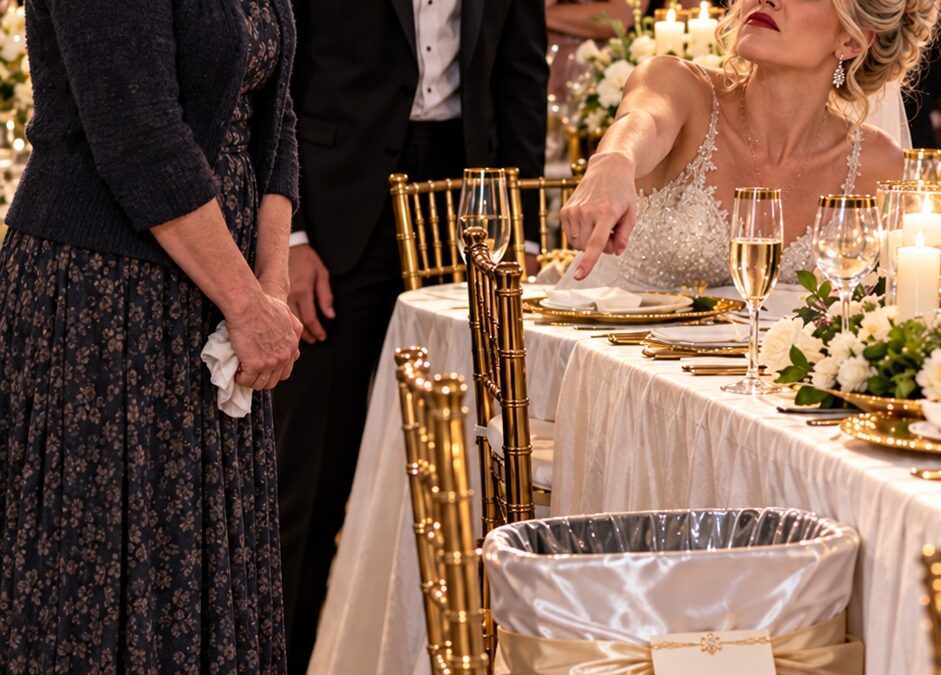
PART 2 and FULL ENDING  Thank you

Then she waved one manicured hand as if dismissing a child.
“Don’t be so dramatic.”
More laughter.
Not everyone.
But enough.
I looked at Tyler.
My only child.
The boy I had raised after his father died.
The boy whose fever I sat beside all night when he was seven.
The teenager whose football uniform I washed at midnight because he forgot to tell me he needed it the next morning.
The college student whose tuition I helped pay by working double shifts as a nurse.
The man who once told me:
“You and me, Mom. Always.”
He looked at me for perhaps two seconds.
Then down at his plate.
“Mom.”
His voice was low.
“It’s not a big deal.”
I felt something inside me break very quietly.
Amanda leaned back.
“My family paid for most of the wedding.”
She smiled as though explaining something obvious.
“So we decided the seating arrangements.”
I looked at Tyler again.
He still would not meet my eyes.
“Just find another seat somewhere,” he muttered.
That was the moment I understood the trash can was not really the humiliation.
My son’s silence was.
I picked up my purse.
Turned around.
And walked toward the last table in the ballroom.
I could feel people watching me.
Whispering.
Pitying me.
I hated the pity almost as much as the laughter.
I sat beside distant acquaintances who looked embarrassed on my behalf.
An older gentleman leaned toward me.
“Aren’t you the groom’s mother?”
“Yes.”
“Why are you sitting back here?”
I forced a smile.
“Apparently, tonight is full of surprises.”
I did not cry.
Not then.
I had spent too many years learning how to hold myself together in hospital rooms.
I had watched families receive devastating diagnoses.
Held the hands of frightened patients.
Worked thirty years beside people facing pain with more courage than they knew they possessed.
I knew how to keep breathing.
So I sat.
Ate almost nothing.
And watched my son celebrate his marriage while his new wife laughed with women who had watched her publicly degrade me.
After nearly an hour, I was preparing to leave when someone touched my arm.
I turned.
An elderly woman stood beside me.
Tiny.
Silver hair.
Beaded purse.
Sharp eyes.
“You’re Tyler’s mother.”
It was not a question.
“Yes.”
She sat in the empty chair beside me.
“My name is Eleanor.”
I recognized her.
Amanda’s grandmother.
“I know.”
She took my hand.
“I want to apologize.”
“You didn’t do anything.”
“No.”
Her expression hardened as she looked across the ballroom.
“But my granddaughter did.”
I swallowed.
“She has never liked me.”
Eleanor gave a humorless little smile.
“Wanita, Amanda doesn’t dislike you because of anything you’ve done.”
“Then why?”
“Because you exist.”
I stared at her.
“She doesn’t like sharing affection.”
Eleanor continued.
“Or influence.”
She opened her purse.
“There are things about Amanda you need to know.”
My pulse changed.
“What things?”
Eleanor removed an envelope.
Thick.
Sealed.
She placed it in my hands.
“I’ve been collecting information.”
“About your granddaughter?”
“Yes.”
“Why?”
“Because I have watched her hurt people before.”
I looked toward the head table.
Amanda was laughing beside Tyler.
Her hand rested on his shoulder.
Perfect bride.
Perfect photograph.
Perfect lie.
Eleanor leaned closer.
“She is not who your son thinks she is.”
My fingers tightened around the envelope.
“What are you saying?”
“I’m saying Tyler may be in serious trouble.”
“Financially?”
Eleanor hesitated.
“Among other things.”
“What exactly is in here?”
“Proof.”
My stomach turned.
“Proof of what?”
She looked at me for a long moment.
“Open it privately.”
“Eleanor—”
“And whatever you do, do not let Amanda know you have it.”
Someone called Eleanor’s name.
She stood.
Then bent toward me.
“One more thing.”
“What?”
“Do not assume tonight was simply cruelty.”
Her eyes moved toward the trash can.
“Amanda wanted you humiliated.”
“Why?”
“Because humiliation makes people leave.”
Then she walked away.
I sat there holding the envelope.
The ballroom seemed to tilt slightly around me.
Amanda wanted me gone.
Not just from the head table.
From Tyler’s life.
Maybe I had known that for years.
But knowing and admitting are different things.
I went to the ladies’ room.
Found a velvet bench in the lounge area.
Locked myself away from the music.
Then opened the envelope.
The first photograph showed Amanda sitting in a restaurant with a dark-haired man.
Close.
Very close.
Her hand over his.
His fingers touching her wrist.
Timestamp:
Three weeks earlier.
My breath caught.
The next photograph showed them entering an apartment building together.
Then embracing beside a car.
Then sitting in a park.
Amanda had the same expression in every picture.
Intimate.
Comfortable.
Familiar.
Not the body language of cousins.
Not friends.
Lovers.
I looked at the financial documents.
Bank transfers.
Tyler’s account.
Offshore destination.
Twenty thousand dollars.
Thirty-five thousand.
Fifteen thousand.
More.
Altogether, more than one hundred thousand dollars had disappeared.
Then a power of attorney.
Amanda had access to Tyler’s accounts.
His investments.
Even the inheritance trust Jack had left him.
The document was dated only one month after Tyler and Amanda began dating.
I felt physically sick.
Then came credit reports.
Cards opened in Tyler’s name.
Luxury purchases.
More than seventy thousand dollars in debt.
I sat on that velvet bench inside the same hotel where my only son had just married her.
The woman at the altar was having an affair.
Stealing his money.
Opening debt in his name.
And somehow controlling financial assets he had never even told me she could access.
I wanted to storm back into the reception.
Throw the papers onto the head table.
Demand an explanation.
Then the nurse in me took control.
Evidence matters.
Timing matters.
A hysterical mother interrupting her son’s wedding would look exactly like Amanda had apparently been telling everyone I was.
I put the documents back.
Returned to the ballroom.
And started watching.
An hour later, Amanda stood.
Tapped her champagne glass.
“Everyone.”
The room quieted.
She pulled Tyler beside her.
“We have an announcement.”
Tyler looked confused.
Amanda placed one hand over her stomach.
“We’re expecting.”
The room erupted.
Cheers.
Applause.
Amanda laughed.
“I’m three months pregnant.”
I froze.
Three months.
Tyler had been in Seattle for two weeks four months earlier.
Maybe the dates could still work.
Maybe.
Then I remembered something.
Months earlier, I had borrowed Tyler’s phone.
A message had appeared.
From Craig.
DNA results look good. She’ll never know.
When I asked Tyler later, he told me it was work-related.
Now I scanned the ballroom.
Amanda kept glancing toward a table near the bar.
Dark-haired man.
The man from Eleanor’s photos.
Someone introduced him later.
“Craig Bennett.”
Amanda’s cousin.
My heart began pounding.
The man Amanda was secretly meeting.
The man who had messaged Tyler about DNA.
Now standing at her wedding.
I did not leave.
I watched.
Amanda found reasons to talk to Craig throughout the evening.
Corners.
Hallways.
Near the bar.
Always briefly.
Always separating when someone approached.
Then Tyler’s childhood friend Sam came to my table.
He brought two glasses of wine.
“You look like you need this.”
I accepted one.
“Thank you.”
He sat.
“Wanita.”
“Yes?”
“There’s something you should know.”
My stomach tightened.
“What?”
“Amanda’s been telling people things about you.”
“What things?”
“That you’ve become unstable since Jack died.”
I stared.
“That you’re obsessed with Tyler.”
He looked embarrassed.
“That you threatened her.”
“I have never threatened Amanda.”
“I know.”
“Who believes this?”
“Some people.”
He sighed.
“Tyler used to defend you.”
“Used to?”
“Lately…”
His silence told me enough.
Amanda had not simply separated me from Tyler.
She had been destroying my credibility first.
That trash can suddenly felt less like a childish prank.
It was a message.
You have no place here.
I went home that night with Eleanor’s envelope inside my purse.
I did not sleep.
My mind kept returning to the three years since Amanda entered Tyler’s life.
Before her, Tyler and I were close.
Not unnaturally close.
Not dependent.
Simply close.
Jack died when Tyler was eight.
Heart attack.
One terrible morning.
One phone call.
One funeral.
One little boy standing beside me asking whether his father could still hear him.
From that day forward, it was the two of us.
I worked double shifts at Memorial Hospital.
Tyler never knew how often I ate peanut-butter sandwiches so he could attend tennis camp.
Or how many nights I worked overtime to cover college tuition.
I never wanted him to feel like a burden.
When he graduated from State University, he hugged me.
“We did it, Mom.”
I cried.
“Dad would be proud.”
“He’d be proud of you.”
“No.”
Tyler shook his head.
“Us.”
That boy disappeared slowly after Amanda arrived.
At first, I blamed adulthood.
Relationships change priorities.
That is normal.
Amanda was beautiful.
Blonde.
Polished.
Pharmaceutical sales.
Luxury car.
Designer clothes.
She constantly talked about wealthy acquaintances.
The first time she came to Sunday dinner, I made pot roast.
She took three bites.
Then looked around my living room.
“Your house is so quaint.”
I smiled.
“That usually means old.”
She laughed.
“My friend Stacy moved her mother into one of those lovely senior communities.”
I was sixty-two.
Working full-time.
Gardening.
Volunteering.
Driving.
Traveling.
I looked at Tyler.
“Should I start packing?”
He laughed.
“Mom loves this house.”
“Dad built the deck.”
Amanda smiled.
“Of course.”
Then:
“I’m just thinking ahead.”
That phrase became her favorite weapon.
Thinking ahead.
Concerned.
Helping.
Supporting.
Always language that made control sound generous.
Within six months, Tyler’s Sunday visits decreased.
Then he brought me a velvet ring box.
“I’m proposing.”
My heart dropped.
I smiled anyway.
He opened the box.
My mother’s diamond.
Jack had given it to me.
I had saved it for Tyler.
“She’ll love it.”
He was happy.
I chose not to interfere.
After the engagement, Amanda took over everything.
Wedding venue.
Guest list.
Rehearsal.
Photos.
She rejected my church.
She removed the plan for me to walk Tyler down the aisle in memory of Jack.
“It would look odd in pictures.”
Tyler repeated that sentence as though it made sense.
At the wedding ceremony, I was seated in the back row.
The coordinator apologized with her eyes.
“Bride’s instructions.”
I watched distant cousins sit ahead of me.
Afterward, I was excluded from family photographs.
Then came the trash can.
Three years of marginalization distilled into one cruel object.
Except now I knew Amanda might be doing far more than isolating my son.
She might be destroying him financially.
Tyler and Amanda left for Bali.
Two-week honeymoon.
I had time.
I used ten thousand dollars from my retirement savings and hired Patrick Donovan.
Former detective.
Thirty years on the job.
Gray hair.
Calm voice.
I handed him everything.
“I believe my daughter-in-law is conning my son.”
He studied the photographs.
Bank records.
Power of attorney.
Credit reports.
He did not laugh.
He did not tell me I was overreacting.
Instead:
“I’ve seen relationships like this.”
“What do you mean?”
“Financial predators often use romance.”
He closed the folder.
“I’ll need time.”
Three weeks later, Patrick called.
“Wanita.”
“Yes?”
“Sit down.”
I sat.
“Amanda Lewis is not Amanda Lewis.”
Silence.
“Her real name is Angela Lton.”
I stared at him.
“What?”
He placed several licenses on the table.
Same face.
Different states.
Different names.
Massachusetts.
Florida.
Nevada.
Now our state.
“She’s changed identity repeatedly.”
“How?”
“Good forged documents.”
He turned another page.
“She has also been married twice before.”
My mouth went dry.
“Tyler knows?”
“I doubt it.”
“What happened to those husbands?”
Patrick’s expression hardened.
“Both financially destroyed.”
One lost his home and business.
One moved overseas beneath crushing debt.
One of the previous victims connected to their scheme had eventually taken his own life after being ruined financially.
Then Patrick showed me the man from the wedding.
“Craig Bennett.”
“Yes.”
“That isn’t his name.”
“What is it?”
“Daniel Mercer.”
My heart began racing.
“And?”
“He and Angela have been romantically involved for years.”
“How many?”
“At least eight.”
“That means—”
“They appear to work together.”
I leaned back.
“No.”
“They target financially secure men.”
“No.”
“Build trust.”
“Patrick.”
“Gain account access.”
I covered my mouth.
“And then drain assets before disappearing.”
I thought about Tyler.
Good job.
Kind.
Trusting.
His father’s inheritance.
“He’s a target.”
“Yes.”
Then pregnancy.
Patrick hesitated.
“What?”
“Amanda attended a fertility clinic.”
My stomach dropped.
“She was artificially inseminated.”
“Tyler?”
Patrick shook his head.
“Donor sperm.”
I could barely speak.
“The baby isn’t his.”
“No.”
My son had married a woman who was legally another person.
Who was involved with another man.
Who was draining his accounts.
Who had intentionally become pregnant using donor sperm while convincing Tyler he was the father.
I stood.
“We tell him now.”
Patrick stopped me.
“If Tyler already believes you’re unstable, he may reject everything.”
“I have evidence.”
“Predators prepare victims to reject evidence.”
He was right.
And I hated him for being right.
Amanda had anticipated me.
When I tried meeting Tyler alone, she appeared.
During lunch, he stepped outside for a call.
Amanda’s face changed instantly.
“I know about your investigator.”
I stared.
“Back off.”
“No.”
“You will.”
“No.”
Her voice lowered.
“Or you will never see Tyler or the baby.”
I looked at her stomach.
“The baby isn’t Tyler’s.”
Shock flickered.
Only briefly.
Then she smiled.
“So?”
That one word chilled me.
“You admit it?”
“He believes it is.”
“How could you do this?”
“He signed the paperwork.”
“What paperwork?”
“Enough to make him legally responsible.”
She leaned closer.
“Eighteen years of support.”
“You’re talking about a child like an insurance policy.”
Amanda shrugged.
“It’s security.”
“Why Tyler?”
“Nothing personal.”
I wanted to slap her.
I didn’t.
She smiled.
“Good job.”
She counted on her fingers.
“Inheritance coming.”
“Trusting personality.”
“Stable career.”
“The perfect target.”
“You’ve done this before.”
“Many people make very easy marks when they want love badly enough.”
“I’ll tell him.”
She laughed.
“Who will he believe?”
I said nothing.
“His jealous, unstable mother?”
She touched her stomach.
“Or his pregnant wife?”
Tyler returned.
Amanda transformed instantly.
Warm.
Affectionate.
She placed Tyler’s hand over her belly.
I nearly vomited.
Later, Patrick discovered something worse.
Amanda and Daniel were legally married.
Arizona marriage certificate.
Three years earlier.
No divorce.
Amanda’s marriage to Tyler was bigamous.
The whole wedding had been fraudulent.
The vows.
The dress.
The trash can.
Everything.
Patrick also discovered they planned to complete the largest transfers within weeks.
Then disappear.
I called Tyler.
“Meet me.”
He agreed.
“Alone.”
“Yes.”
At Riverside Grill.
A restaurant where we had celebrated birthdays since he was a teenager.
I arrived with folders.
Proof.
Marriage certificates.
Financial transfers.
Fertility records.
Photos.
Recordings.
At noon, Amanda walked through the door.
Not Tyler.
She sat opposite me.
“Tyler had an emergency.”
“I asked for my son.”
“I decided that wasn’t happening.”
She looked at the folders.
“More detective work?”
“Yes.”
I pushed one forward.
“Angela.”
Her eyes flickered.
“Excuse me?”
“Angela Lton.”
Nothing.
“Or should I use another name?”
She smiled.
“You wasted retirement money on this?”
“You’re married to Daniel Mercer.”
She leaned back.
“I know about the offshore accounts.”
No reaction.
“The fertility clinic.”
Still nothing.
“The other victims.”
She smiled.
“Impressive.”
“Why are you smiling?”
“Because none of it matters.”
“Why?”
“Tyler will never believe you.”
She leaned forward.
“You don’t understand what I’ve done.”
“What?”
“I didn’t simply make Tyler love me.”
Her eyes were cold.
“I made him distrust you.”
That was the first moment I truly hated her.
“I’ve had three years.”
She continued.
“Three years of small conversations.”
“You’re controlling.”
“You can’t let him grow up.”
“You resent me.”
“You haven’t recovered from Jack’s death.”
“You create problems because you’re lonely.”
She tapped the folder.
“Evidence doesn’t matter when I control the person deciding what evidence means.”
“You are sick.”
“No.”
She smiled.
“I’m good at what I do.”
“Why Tyler?”
“His inheritance.”
That stopped me.
“Jack’s trust?”
“One point two million.”
“How did you know?”
“Research.”
She shrugged.
“Accessible after marriage or age forty.”
My hands shook.
“You married him for the trust.”
“Among other things.”
“You said the baby—”
“Insurance.”
“What?”
“Men leave wives.”
She smiled.
“Fathers hesitate to leave children.”
The restaurant door opened.
Tyler entered.
Amanda’s face transformed.
“Tyler!”
He looked confused.
“I thought we were meeting alone.”
Before I could speak, Amanda sighed.
“Your mom is having another episode.”
His expression immediately changed.
There it was.
Conditioning.
“What happened?”
“She thinks I’m an impostor.”
“Tyler—”
“She hired an investigator.”
His face hardened.
“Mom.”
“Please.”
I opened the folder.
“She is married to another man.”
Tyler pushed it away.
“No.”
“Look.”
“No.”
“The baby isn’t—”
“Stop.”
“Tyler.”
“Stop!”
People looked.
Amanda rubbed his arm.
“It’s okay.”
He turned on me.
“You tried to sabotage the wedding.”
“What?”
“The calls to the venue.”
“I never called them.”
“Emails to Amanda’s parents.”
“I never sent them.”
“The rumors.”
“What rumors?”
“That she’s after my money.”
“She is!”
He stood.
Amanda looked wounded.
Perfectly.
“I’ve tried to be patient with you.”
His voice was shaking.
“But Amanda is my wife.”
“She isn’t legally your wife.”
“She is carrying my child.”
“No.”
“Mom!”
“Please look.”
“Enough!”
Silence.
Then my son looked me directly in the eye.
“Accept my marriage.”
He swallowed.
“Or I can’t have you in our lives.”
I felt the floor disappear beneath me.
“Tyler.”
“That’s my decision.”
Amanda’s eyes met mine.
Victory.
I gathered the documents.
“I cannot apologize for trying to protect you.”
“Then we’re done.”
He walked away with her.
As Amanda passed me, she bent close.
“Checkmate.”
Her whisper was almost cheerful.
“Enjoy your lonely retirement.”
I sat alone.
For the first time since Jack died, I felt genuinely defeated.
Then my phone rang.
Unknown number.
“Mrs. Garcia?”
“Yes.”
“My name is Jennifer Callaway.”
I almost hung up.
“You don’t know me.”
“What do you want?”
“I know Amanda Lewis.”
Pause.
“Actually, I know Angela Lton.”
I sat straighter.
“My husband was one of her victims.”
My heart started pounding.
“There are others.”
“What others?”
“Families.”
“Victims.”
“People Daniel and Angela destroyed.”
“How did you get my number?”
“We track their methods.”
“What?”
“Offshore routing patterns.”
“We’ve been watching them for years.”
She gave me a hotel.
Room 412.
Seven o’clock.
“Come alone.”
I almost laughed.
“I’m sixty-five years old. I don’t go to hotel rooms because strangers tell me to.”
“Then bring your investigator.”
She paused.
“But if you want to save Tyler, come.”
I went.
Patrick knew where I was.
Inside the Harborview Hotel room were three people.
Jennifer Callaway.
Marjorie Wilson.
Richard Taylor.
Jennifer’s husband had lost his technology company.
Marjorie’s brother had been left with hundreds of thousands in debt.
Richard’s best friend had taken his own life after Angela and Daniel destroyed him financially.
The stories were nearly identical.
Fast romance.
Isolation.
Financial access.
Debt.
Disappearance.
New identity.
New victim.
“They use shame,” Richard explained.
“Especially with men.”
“How?”
“Angela makes them believe providing proves masculinity.”
Jennifer added:
“If family questions her, she reframes it as jealousy or control.”
I almost laughed from the bitterness.
“She used exactly that word.”
Jennifer nodded.
“They always do.”
“What can we do?”
“We need something public.”
Marjorie said.
“An admission.”
“They’ll never confess.”
“Everyone makes mistakes when they believe they’re smarter than everyone else.”
Richard leaned forward.
“Daniel’s weakness is arrogance.”
Jennifer looked at me.
“Angela’s is greed.”
We created a plan.
A fake medical technology investment.
High returns.
Exclusive access through hospital employees.
Something too tempting for Amanda and Daniel to ignore.
I named it privately:
Operation Trash Can.
If Amanda wanted to turn humiliation into theater, I could turn that humiliation into motivation.
Over the next two weeks, we planted the idea carefully.
Tyler saw brochures when he stopped by to collect mail.
I mentioned doctors tripling investments.
He told Amanda.
Of course he did.
She called.
Her voice was warm.
“Wanita.”
I nearly laughed.
“Tyler mentioned an opportunity.”
“Yes.”
“Could we participate?”
“Maybe.”
“Minimum?”
“Fifty thousand.”
“That’s fine.”
Too quickly.
We arranged a meeting.
Upscale hotel.
Private conference room.
Hidden recording equipment.
Detectives nearby.
Jennifer would pose as an investment banker.
Richard handled recording.
Marjorie coordinated legal issues.
I would serve as the family referral.
Then Tyler called that morning.
“Amanda’s sick.”
My stomach tightened.
“Morning sickness.”
“She wants Craig to come in her place.”
I almost smiled.
“Fine.”
Daniel Mercer.
Real husband.
Fake cousin.
Sitting beside Tyler.
Perfect.
At two, Tyler arrived with “Craig.”
I hugged my son.
He returned it stiffly.
Jennifer entered in a dark business suit.
Professional.
Confident.
She explained guaranteed returns.
Charts.
Technology.
Market expansion.
Daniel asked sophisticated questions.
Then:
“We’d like to invest one hundred thousand.”
Tyler looked surprised.
“I thought fifty.”
Daniel barely looked at him.
“Amanda and I discussed it.”
I saw Tyler frown.
Small.
But real.
Jennifer kept asking questions.
“How long have you advised Amanda financially?”
“Since before she met Tyler.”
Daniel answered without thinking.
Tyler looked up.
“What?”
Daniel recovered.
“I mean informally.”
Jennifer continued.
“Are you comfortable moving large sums quickly?”
“Of course.”
“Why?”
“We have systems.”
“We?”
Daniel smiled.
“Amanda and I.”
Tyler’s expression changed again.
Jennifer placed the wire instructions on the table.
Then stopped.
“This is interesting.”
“What?”
“The receiving account.”
Daniel stiffened.
“It belongs to Daniel Mercer.”
Tyler frowned.
“Who?”
Jennifer looked at him.
“Daniel Mercer.”
Silence.
I spoke.
“Craig Bennett is Daniel Mercer.”
Daniel stood.
“This is ridiculous.”
“He is Amanda’s legal husband.”
Tyler looked at me.
Then Daniel.
Then the documents.
“No.”
I slid the marriage certificate toward him.
This time—
he looked.
For the first time in months, he actually looked.
Arizona.
Angela Lton.
Daniel Mercer.
Three years earlier.
No divorce.
Tyler went pale.
Daniel started toward the door.
A detective entered.
“Mr. Mercer.”
Daniel froze.
“We have questions regarding fraud investigations in several states.”
He looked at Tyler.
Then something snapped.
“You really are as stupid as Amanda said.”
Tyler stared.
“Three years.”
Daniel laughed bitterly.
“Three years we worked you.”
“Shut up,” I said.
“No.”
He looked at Tyler.
“Your mother wants truth?”
He pointed.
“Let’s give him truth.”
“The trips Amanda took?”
“With me.”
“The money?”
“Ours.”
“The baby?”
Tyler looked sick.
Daniel smiled cruelly.
“You were out of town during conception.”
Tyler whispered:
“No.”
“Amanda called you the perfect mark.”
Tyler closed his eyes.
“Stop.”
“Good income.”
“Trusting.”
“Inheritance.”
Daniel laughed.
“You never questioned anything.”
The detective handcuffed him.
“Daniel Mercer, you are under arrest.”
As officers led him out, he glanced at me.
“Angela’s already leaving.”
My blood went cold.
“What?”
“Flight at six.”
Tyler stood.
“Where is she?”
“Packing.”
Daniel smiled.
“Probably finished cleaning out your accounts right now.”
Jennifer’s team already knew.
Police were moving.
But I did not trust Amanda to wait politely for arrest.
We drove to a hotel suite linked to her backup plan.
Room 1412.
Outside the door, we heard her talking.
“Forget Daniel.”
Pause.
“If he got caught, that’s his problem.”
Another pause.
“I have the account access.”
Tyler closed his eyes.
Then knocked.
“Amanda.”
Silence.
“Open the door.”
She opened it.
Half-packed suitcases behind her.
Then she saw me.
Her face hardened.
“You brought her?”
Tyler entered.
“The game is over.”
“What?”
“Angela.”
For half a second, she froze.
Then smiled.
“I don’t know what you mean.”
“Daniel was arrested.”
“No idea who that is.”
“The offshore accounts.”
“Tyler—”
“The other husbands.”
“This is insane.”
“The fertility clinic.”
She touched her stomach.
“How dare you.”
“The baby isn’t mine.”
Tears appeared instantly.
“How can you say that?”
“We have the records.”
Something changed.
No more tears.
No more frightened wife.
Amanda—Angela—straightened.
“Well.”
She looked at Tyler.
“Looks like you finally grew a backbone.”
Tyler flinched.
“Why?”
She walked toward the minibar.
“Why what?”
“I loved you.”
“That was useful.”
“I gave you everything.”
“That was the point.”
He looked like she had struck him.
“You married me for money.”
“Yes.”
“And the baby?”
“Insurance.”
I felt sick hearing it again.
“You’re talking about a child.”
Amanda poured herself a drink.
“Men abandon wives.”
She shrugged.
“Children create obligations.”
“Eighteen years.”
Tyler stared.
“You planned child support.”
“Long-term income.”
His face crumpled.
“You never loved me.”
She said nothing.
That was answer enough.
Then Richard spoke.
“Everything is being recorded.”
Amanda turned.
For the first time—
fear.
Jennifer stepped forward.
“We also have sworn statements from previous victims.”
“Financial records.”
“Bigamy.”
“Identity fraud.”
“Account transfers.”
Amanda looked at me.
“This is your fault.”
“No.”
“You couldn’t let Tyler be happy.”
“No.”
“You were jealous.”
I shook my head.
“You put a trash can in my seat because you thought humiliating me would remove me.”
She glared.
“It almost worked.”
“But you made one mistake.”
“What?”
“You thought love and weakness were the same thing.”
A knock.
Detectives entered.
Warrant.
Amanda immediately turned toward Tyler.
“Baby.”
I almost admired how quickly the tears returned.
“Think about our child.”
Tyler looked at her stomach.
Then at her.
“It isn’t my child.”
“Tyler.”
“You used that baby before it was even born.”
“No.”
“You used me.”
“Please.”
“You used my father’s money.”
She reached for him.
He stepped away.
Then looked at the detective.
“She’s all yours.”
Handcuffs clicked.
Amanda’s face changed for the last time.
“You’ll regret this.”
No tears now.
“Nobody crosses me.”
The detective led her away.
Tyler stood motionless.
I wanted to say:
I told you so.
I never did.
Instead, I put my hand on his shoulder.
He sat.
Then covered his face.
“Mom.”
“I’m here.”
“I didn’t believe you.”
“I know.”
“I chose her.”
“You were manipulated.”
“I laughed.”
I knew what he meant.
Wedding.
Trash can.
“I laughed.”
His voice broke.
“I let her humiliate you.”
“Yes.”
“I told you to leave my life.”
“Yes.”
“How can you even stand here?”
“Because you’re still my son.”
He cried.
Not elegantly.
Not quietly.
The way people cry when a structure inside them collapses.
Later, in the hotel lobby, he stared at untouched coffee.
“I don’t know how to apologize.”
“You don’t need the perfect words.”
“I called you unstable.”
“I know.”
“I believed her lies about Dad.”
“I know.”
“I wouldn’t even look at evidence.”
“No.”
He looked at me.
“Why aren’t you angry?”
“I am.”
He seemed surprised.
“I’m angry at you.”
He looked down.
“I’m also angry at myself.”
“You?”
“For staying quiet too long.”
“But you were right.”
“That doesn’t mean I handled everything perfectly.”
He waited.
“I saw warning signs.”
I continued.
“I kept swallowing them because I was afraid challenging Amanda would drive you away.”
“She did anyway.”
“Yes.”
Silence.
“What happens now?”
“We heal.”
“How?”
I took his hand.
“Badly at first.”
He laughed through tears.
Then:
“Together?”
“Yes.”
The criminal cases lasted months.
Once Angela and Daniel’s arrests became public, more victims appeared.
Different names.
Different states.
Same pattern.
Romance.
Control.
Financial access.
Shame.
Escape.
Both received substantial prison sentences.
Restitution was ordered.
Some funds were frozen and recovered.
Much was gone.
Tyler’s fraudulent marriage was annulled.
Financial accounts were untangled.
Credit fraud disputed.
His inheritance partially protected because authorities moved quickly enough.
The practical work was exhausting.
The emotional work was worse.
Tyler questioned everything.
“How did I not see it?”
Because Angela was skilled.
“How did I believe her?”
Because trust is normal inside love.
“How did I turn against you?”
Because she made loyalty to her feel incompatible with loyalty to me.
Therapy helped.
Slowly.
He reconnected with friends.
Sam.
College friends.
People Amanda had pushed away.
Some welcomed him instantly.
Others needed time.
That was fair.
Eleanor visited me once.
Amanda’s grandmother.
We sat on my back deck.
Jack’s deck.
The same one Amanda once suggested I abandon for a senior community.
Eleanor looked tired.
“I should have stopped her years ago.”
“You tried.”
“Not enough.”
I understood that guilt.
“What happens to the baby?”
Eleanor asked.
I sighed.
“The child didn’t do anything.”
She nodded.
Amanda’s pregnancy continued during the legal proceedings.
Whatever happened afterward would be handled through law and appropriate guardianship arrangements.
I refused to make the child part of our anger.
A baby is not responsible for the circumstances of conception.
That distinction mattered.
Six months after the arrests, I hosted dinner.
Small.
My house.
Not a hotel.
Not crystal chandeliers.
No seating chart.
Jennifer came.
Richard.
Marjorie.
Patrick.
Sam.
Tyler.
And Allison.
A pediatric nurse from Memorial Hospital who had recently transferred back to town.
She and Tyler were friends.
Only friends, he insisted.
I did not interfere.
I had learned something about interference.
Healthy concern requires room for adults to live their own lives.
Allison arrived carrying apple pie.
“You made this?”
“Yes.”
Tyler smiled.
“Mom’s going to judge you.”
“I absolutely will.”
Allison laughed.
“Good. My mother says my crust is inconsistent.”
I liked her immediately.
At the dining table, Tyler had placed a chair at the head.
A card sat in front of it.
MOM.
I stopped.
Everyone else kept walking.
Tyler watched me.
“What is this?”
“Your seat.”
My throat tightened.
“You did not need to do that.”
“I know.”
He swallowed.
“I wanted to.”
I sat.
No trash can.
No satin ribbon.
No laughter.
Just a wooden chair at the table where my husband once sat.
Dinner was simple.
Roast chicken.
Potatoes.
Vegetables.
Pie.
No eight-tier wedding cake.
No champagne tower.
No designer flowers.
I had never felt more honored at a table.
Halfway through dinner, Tyler stood.
Glass in hand.
“Oh, no.”
He smiled.
“I prepared this.”
“That is what worries me.”
Everyone laughed.
Then he looked at me.
His expression changed.
“To my mom.”
Silence.
“The woman who never gave up on me.”
My eyes burned.
“Even when I gave up on her.”
He paused.
“Who kept fighting for the truth when walking away would have been easier.”
His voice wavered.
“I would not be here without you.”
I lifted my glass.
“To new beginnings.”
Then looked around.
“And to people who teach us that dignity is not something another person gets to assign.”
Jennifer raised hers.
Richard.
Marjorie.
Patrick.
Everyone.
Later, after guests left, Tyler helped me clear plates.
He was quiet.
“What?”
“Nothing.”
“You’re terrible at nothing.”
He smiled.
Then hugged me.
“I love you.”
“I love you too.”
“I’m still sorry.”
“I know.”
“Does that ever stop?”
“Probably.”
“When?”
“Ask me in ten years.”
He laughed.
Then his expression grew serious.
“The trash can.”
“What about it?”
“I think about it all the time.”
“I don’t.”
He looked surprised.
“You don’t?”
“Not the way you think.”
“How?”
“I think about how badly Amanda needed to make me feel worthless.”
“Why?”
“Because people who depend on appearances are frightened by anyone whose dignity doesn’t depend on them.”
He leaned against the counter.
“She wanted you gone.”
“Yes.”
“And I helped her.”
“Yes.”
He flinched.
I touched his arm.
“Tyler.”
“What?”
“Accountability is not the same thing as permanent punishment.”
He looked at me.
“You made a terrible choice.”
“Several.”
“Several.”
I smiled faintly.
“But you eventually made a different one.”
“Late.”
“Yes.”
“Too late?”
“No.”
He breathed.
“That’s what I’m trying to learn.”
I understood.
Healing does not erase history.
It changes what history controls.
A year after the wedding, Tyler returned to the Hillrest Hotel for the first time.
Not for another wedding.
He asked me to meet him there for coffee.
“Why here?”
“I need to do something.”
We entered the same ballroom corridor.
Different event.
Different flowers.
The wedding itself felt like another lifetime.
Tyler stood near the spot where the seating chart had been.
“I wanted to see whether it still felt as bad.”
“Does it?”
“Yes.”
He looked at me.
“For you?”
I thought.
“No.”
“Really?”
“Really.”
“Why?”
“Because the woman who sat at the back table thought humiliation meant she had lost.”
“And?”
“She hadn’t.”
I looked toward the ballroom.
“She had just learned where she stood.”
“With Amanda?”
“With herself.”
Tyler nodded.
“I’m glad you didn’t leave me.”
“I almost did.”
His face changed.
“What?”
“Not stop loving you.”
I clarified.
“But I considered stepping away completely.”
“Why didn’t you?”
“Eleanor.”
He smiled sadly.
“Grandma Eleanor.”
“She gave me something worth fighting with.”
“Proof.”
“Yes.”
“And because you’re my son.”
I paused.
“Though being my son never meant I was required to destroy myself saving you.”
That surprised him.
“What does that mean?”
“It means I fought because there was still something I could do.”
“If you had kept choosing Amanda after seeing undeniable evidence…”
I let the sentence sit.
“I would have loved you from a distance.”
Tyler looked down.
“I deserved that.”
“This is not about deserving.”
“Boundaries protect both sides.”
We walked outside.
He said:
“I think I understand why Dad trusted you so much.”
I laughed.
“Your father thought I was stubborn.”
“Same thing.”
“Not remotely.”
“He would have hated Amanda.”
I smiled.
“Jack disliked almost everyone for the first six months.”
“True.”
“Then fed them barbecue.”
Tyler laughed.
That sound meant something.
For years, Amanda had turned Jack’s memory into a weapon.
Claiming my grief made me unstable.
Claiming my closeness to Tyler was unhealthy.
Now we could speak about Jack without her shadow.
That was another thing recovered.
Not money.
Memory.
Patrick later told me the case against Angela and Daniel had helped investigators connect fraud complaints across several states.
Some victims received restitution.
Others received only answers.
Jennifer once said something that stayed with me.
“People think being conned means being stupid.”
She shook her head.
“It usually means someone found the part of you that wanted to believe.”
For Tyler, that part was family.
He wanted a wife.
Children.
A beautiful future.
Amanda did not create those desires.
She weaponized them.
That distinction helped him forgive himself.
One afternoon, he said:
“I keep thinking I should have known.”
“Known what?”
“That she was fake.”
“How?”
“The lies.”
“Which ones?”
He paused.
“Exactly.”
Most lies were small.
Plausible.
Designed to fit what he hoped was true.
That was how manipulation worked.
Not through one impossible story.
Through a thousand believable ones.
Amanda did the same thing with me.
She never told Tyler:
“Your mother is evil.”
At first.
She said:
“Your mom seems lonely.”
Then:
“She calls a lot.”
Then:
“She has trouble letting you live independently.”
Then:
“Her grief worries me.”
Then:
“She seems confused.”
Then:
“She threatened me.”
By the time I brought evidence, Amanda had spent years preparing Tyler to see my evidence as proof of instability.
That terrified me more than the stolen money.
It taught me how easily perception could be engineered when trust became isolated from outside relationships.
Tyler eventually returned to therapy even after the immediate crisis passed.
Not because something was wrong with him.
Because he wanted to understand his own vulnerabilities.
He became better at saying no.
Better at asking questions.
Less desperate to keep everyone happy.
Allison remained in his life.
Slowly.
Very slowly.
I liked that.
One evening, Tyler called.
“I’m taking Allison to dinner.”
“Good.”
“I’m not asking permission.”
“Even better.”
“She wants to meet you properly.”
“She has met me.”
“She means dinner.”
“What are you worried about?”
He laughed.
“You interrogate people.”
“I was a nurse.”
“That is not a defense.”
At dinner, Allison asked about Jack.
Not his money.
Not inheritance.
Not property.
Jack.
“What was he like?”
I smiled.
“Loud.”
Tyler protested.
“Dad wasn’t loud.”
“He snored like construction equipment.”
Allison laughed.
Then listened while Tyler told stories.
I noticed something.
He did not perform for her.
He did not monitor her reactions constantly.
He disagreed once.
She disagreed back.
Nobody panicked.
Healthy relationships look almost boring after manipulation.
That is a compliment.
Months later, Allison and Tyler became more serious.
I did not ask about marriage.
Children.
Timelines.
If he wanted to tell me, he would.
I had almost lost my son partly because someone convinced him love required surrender.
I would never teach him that from another direction.
I also returned to nursing part-time after briefly considering full retirement.
Not because I needed money.
Because I liked being useful.
One shift, an elderly patient recognized me.
“You’re the woman from that fraud case.”
News had spread locally.
I smiled.
“I’m also the woman checking your blood pressure.”
She laughed.
Then said:
“My daughter married a man I don’t trust.”
I paused.
That sentence once would have sent me into alarm.
Instead:
“What makes you uncomfortable?”
Not:
“He’s dangerous.”
Not:
“Investigate him.”
Not:
“Stop the marriage.”
Questions.
Specific behavior.
Evidence.
Patterns.
The difference between intuition and accusation matters.
My own experience had not taught me to distrust everyone.
It taught me to pay attention.
The woman described financial control.
Isolation.
Rapid changes in estate documents.
I encouraged her to speak with her attorney.
Professionals.
Not confrontation.
Weeks later, she thanked me.
That felt meaningful.
The most painful experiences either narrow you or deepen you.
I wanted mine to deepen me.
Two years after Amanda’s arrest, Tyler and I visited Jack’s grave.
We brought flowers.
Tyler stood quietly.
Then:
“Dad would be disappointed in me.”
“No.”
“You don’t know that.”
“I knew him thirty-two years.”
“He’d be angry.”
“Very.”
“At me.”
“At everyone.”
I smiled.
“Your father had range.”
Tyler laughed.
Then:
“I wish he had been here.”
“So do I.”
“Maybe I wouldn’t have—”
“Stop.”
He looked at me.
“You do not get to invent a version of the past where Jack saves everyone.”
“Why?”
“Because then you never have to forgive the people who actually lived it.”
He stared.
I continued.
“Your father might have seen Amanda immediately.”
“Or?”
“He might have adored her.”
Tyler laughed despite himself.
“Seriously?”
“She was charming.”
“Not to you.”
“At first she was.”
He looked toward the grave.
“I hate that.”
“What?”
“How good she was.”
“That was how she survived.”
Silence.
Then Tyler said:
“Mom?”
“Yes?”
“Thank you.”
“For?”
“Not turning my mistake into my identity.”
That sentence stayed with me.
I squeezed his hand.
“A mistake can change your life.”
I said.
“It still doesn’t have to become your entire definition.”
The same applied to me.
For months after the wedding, people knew me as:
The mother with the trash can seat.
Friends whispered.
Relatives apologized.
Some wanted the whole story.
I refused to let humiliation become my identity either.
I was Wanita.
Nurse.
Widow.
Mother.
Friend.
Woman who loved apple pie too much.
Woman who could grow roses but killed every orchid she touched.
Woman who survived grief.
Woman who fought for her son.
The trash can was one object on one terrible night.
Nothing more.
Eventually, Hillrest Hotel remodeled the ballroom.
Tyler jokingly texted me an article about it.
“Think they kept your seat?”
I replied:
“Probably worth more than half their chairs by now.”
He called laughing.
That was healing too.
Being able to touch an old wound without bleeding.
Jennifer, Richard, and Marjorie stayed in contact.
Their informal victim network eventually became an advocacy organization helping fraud victims connect cases across jurisdictions.
Patrick consulted occasionally.
I volunteered.
Not as an investigator.
I had learned my limits.
Mostly I spoke to parents.
Spouses.
Adult children.
People embarrassed that someone they loved had been manipulated.
I told them:
Do not start with:
“How could you be so stupid?”
Start with:
“What happened?”
Shame isolates.
Isolation helps predators.
Tyler learned that personally.
One man at a support meeting said:
“My brother won’t speak to me because I warned him.”
I remembered Riverside Grill.
Amanda whispering checkmate.
“Keep one door open.”
I said.
“How?”
“Simple messages.”
“I love you.”
“I’m here.”
“No argument.”
“No evidence dump every day.”
“But what if he keeps choosing her?”
“Then protect your own boundaries while leaving a safe way back.”
That was hard.
Love without control always is.
Three years after the wedding, Tyler asked me to dinner at my house.
He arrived early.
Carrying a box.
“What is that?”
“Open it.”
Inside was a small polished wooden chair.
Miniature.
Dollhouse size.
On the seat was a tiny card.
MOM.
I stared.
“You are weird.”
He laughed.
“Turn it over.”
Underneath, engraved:
YOU ALWAYS HAVE A PLACE AT MY TABLE.
My eyes filled.
“Tyler.”
“I know it doesn’t undo anything.”
“No.”
“I know.”
He looked nervous.
“I just wanted you to have it.”
I hugged him.
Then slapped his shoulder lightly.
“What?”
“I told you I’m not dramatic.”
He laughed.
“Okay.”
We placed the miniature chair on my mantel beside Jack’s photograph.
Not as a memorial to humiliation.
As proof that repair is possible.
Later that year, Tyler and Allison became engaged.
He told me quietly.
No giant announcement.
No secrecy.
No manipulation.
“Are you happy?”
“Yes.”
“Nervous?”
“Yes.”
“Good.”
He laughed.
“Why good?”
“Means you’re paying attention.”
Allison wanted a small wedding.
Family.
Friends.
No enormous hotel.
No head table.
“Everyone sits together.”
She said.
I smiled.
“Excellent policy.”
On their wedding day, I wore a blue dress.
Not because blue had some symbolic meaning.
I simply liked it.
Before the ceremony, Tyler found me.
“Mom.”
“Yes?”
“I want you to walk with me.”
I stared.
“Down the aisle?”
“Yes.”
“But—”
“Dad can’t.”
His voice softened.
“And you raised me.”
My throat closed.
We walked together.
No trash can.
No back row.
No humiliation.
But even then, I knew something important.
That moment did not restore my dignity.
My dignity had never been lost.
People can embarrass you.
Exclude you.
Lie about you.
Even persuade someone you love to doubt you.
But they cannot actually remove your worth.
They can only convince you to forget it.
Amanda tried.
For a while, I almost did.
At the reception, there was no formal head table.
Round tables.
Mixed families.
Allison’s mother sat beside me.
Halfway through dinner, a server realized one guest lacked a chair.
Before anyone could say anything, Tyler stood.
“I’ll get one.”
I watched him carry a chair across the room.
Small thing.
Ordinary.
He set it down.
Made space.
Then returned to his meal.
Our eyes met.
He knew what I was thinking.
He smiled.
I smiled back.
No speech.
No tears.
No need.
Sometimes redemption looks like one person noticing there isn’t enough room—
and bringing another chair.
Years earlier, Amanda saw the same problem and chose cruelty.
That was never about seating.
It was about character.
People reveal themselves most clearly when they believe there will be no consequences.
Amanda believed I was harmless.
Old.
Widowed.
Emotionally dependent on Tyler.
She believed she could humiliate me publicly because I would tolerate anything to stay close to my son.
For a while, she was right.
That was my mistake.
I tolerated too much.
Not because I was weak.
Because I feared losing Tyler.
Fear can make love behave strangely.
It can make a mother silent.
A husband compliant.
A friend distant.
A victim ashamed.
Amanda understood fear.
She built her life around exploiting it.
What she never understood was persistence.
Eleanor persisted.
Patrick persisted.
Jennifer and the other victims persisted.
I persisted.
Eventually Tyler did too.
And once truth had enough people standing beside it, Amanda could no longer rewrite reality.
I sometimes think about Eleanor handing me that envelope.
If she had kept quiet, what would have happened?
Tyler could have lost the entire inheritance.
Hundreds of thousands more.
His career might have collapsed beneath fraud and debt.
Amanda and Daniel would have disappeared.
Another victim next.
Another family.
Another fake name.
Instead, one elderly woman decided family loyalty did not require silence.
I will always be grateful to her.
Because the most important person at that wedding was not the bride.
Not the groom.
Not me.
It was the grandmother who saw something wrong and chose truth over protecting appearances.
That takes courage.
At one of our last lunches together, Eleanor said:
“I spent years telling myself Amanda would grow out of it.”
I understood.
“When did you realize she wouldn’t?”
“When I realized I was using hope to avoid action.”
That sentence stayed with me too.
Hope without action can become permission.
Not always.
But sometimes.
Eleanor died peacefully several years later.
Tyler attended the funeral with me.
Amanda could not.
She was still serving her sentence.
I stood beside Eleanor’s family and thought about the woman who handed me an envelope at the worst table in a wedding ballroom.
One act.
One decision.
Changed everything.
After the service, Tyler said:
“She saved me.”
“Yes.”
“So did you.”
“We had help.”
He nodded.
“I think that’s another thing Amanda taught me.”
“What?”
“I thought being strong meant knowing everything myself.”
“And now?”
“Sometimes strength is believing someone else long enough to check.”
I smiled.
“That is much wiser.”
“Therapy.”
“Expensive wisdom.”
He laughed.
That evening, I returned home.
My miniature wooden chair still sat on the mantel.
Jack’s photograph beside it.
I thought about the wedding years earlier.
White satin.
Gold ribbon.
My name attached to a trash can.
At the time, I believed Amanda had reduced me to the thing she put in my place.
Disposable.
Unwanted.
Embarrassing.
Now I understood something else.
The trash can had never represented me.
It represented her.
Her cruelty.
Her arrogance.
Her belief that other people existed according to their usefulness.
The moment she stopped seeing me as useful to Tyler, she decided I belonged with the garbage.
Later, Tyler stopped being emotionally useful too.
Then he became only a financial target.
That is how people like Amanda see relationships.
Not as bonds.
As resources.
Status.
Money.
Access.
Control.
Once I understood that, the wedding humiliation lost its power.
I had spent years asking:
Why would she do that to me?
Wrong question.
The right question was:
Why did I believe her behavior said anything about my value?
It did not.
A cruel person’s judgment is not a mirror.
It is a confession.
Amanda had confessed who she was long before we found the bank accounts.
The false identity.
The other husband.
The fake pregnancy story.
She confessed it when she looked at an older widow at her son’s wedding and decided humiliation was entertainment.
I simply did not yet know how much that moment revealed.
Today, when I sit at my dining table, I no longer care where I am placed.
Head.
Middle.
End.
Because a chair does not create honor.
People do.
The right people make room.
The wrong people make you beg for it.
And the moment you understand the difference, you stop measuring your worth by invitations, photographs, seating charts, or anyone else’s approval.
Tyler once allowed someone to replace my chair with a trash can.
Years later, he learned how easy it would have been to simply pull up another chair.
That lesson cost us both more than I wish it had.
But he learned it.
So did I.
And if I could speak to the woman I was standing in that ballroom, face burning while everyone whispered, I would tell her only this:
Do not confuse humiliation with defeat.
Pick up your purse.
Keep your head high.
Sit wherever you need to sit for now.
Watch carefully.
Listen.
Protect your dignity.
Because sometimes the person trying hardest to convince everyone that you belong with the trash is terrified of what will happen when the truth finally takes its seat at the table.




