𝗣𝗔𝗥𝗧𝟮: My Daughter-In-Law Threw My Things In The Yard And Said, “It’s Trash!”… But I Showed Who’s In Charge
𝗣𝗔𝗥𝗧𝟮 𝗔𝗡𝗗 𝗙𝗨𝗟𝗟𝗦 𝗧𝗢𝗥𝗬𝗜𝗦 𝗜𝗡 𝗧𝗛𝗘 𝗙𝗜𝗥𝗦𝗧 𝗖𝗢𝗠𝗠𝗘𝗡𝗧


My husband had been dead three years.
Those objects were not expensive.
Most had little resale value.
But they held the physical fingerprints of a life that no longer existed anywhere except inside me.
I walked toward the box.
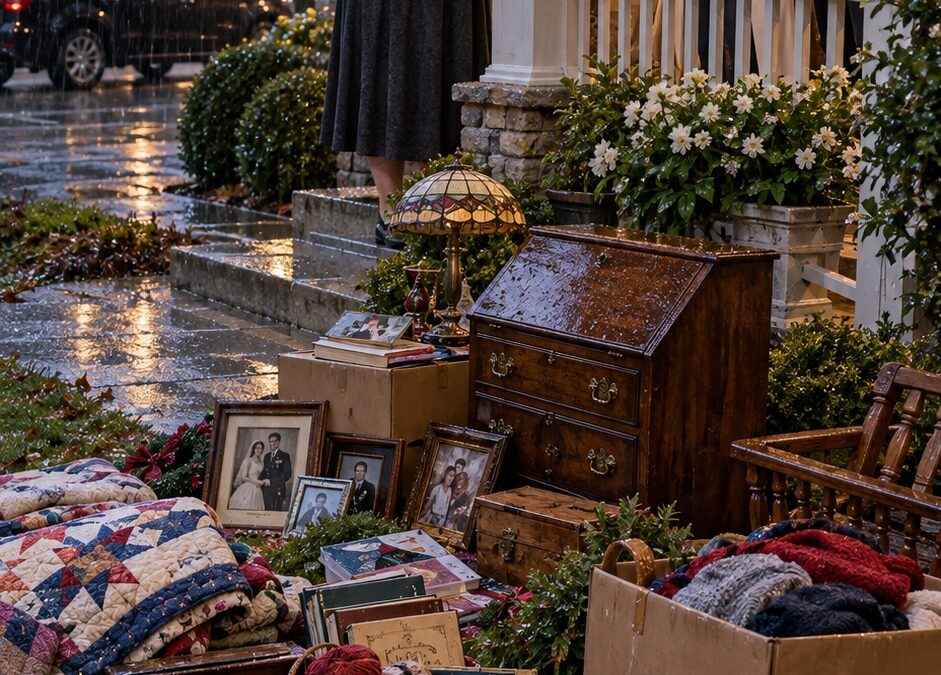
Rain dotted the dark wood.
I lifted it carefully.
Then turned toward Amanda.
“What happened?”
Her smile remained.
“We decided to do some serious cleaning while you were gone.”
“We?”
“Thomas and I.”
Of course.
My son.
She gestured toward the lawn.
“A lot of this stuff was just collecting dust.”
I said nothing.
“And honestly…”
She gave a small laugh.
“So much of it is outdated.”
Still nothing.
“Worn out.”
Nothing.
“Useless.”
That word.
Useless.
My eyes moved slowly across the lawn.
Forty years.
A marriage.
A childhood.
Birthdays.
Christmas mornings.
Funerals.
Family dinners.
Frank teaching Thomas to fish.
My mother’s china.
My father’s books.
My wedding quilt.
And this thirty-five-year-old woman had decided it was useless because it did not match the minimalist house she had imagined building inside walls she did not own.
Something inside me finally stopped being afraid.
Not broke.
Stopped.
For months, I had been terrified that speaking too strongly would cost me my relationship with Thomas.
Terrified that he would choose his wife.
Terrified that setting a boundary would leave me alone in the same silent house that had nearly swallowed me after Frank died.
That fear had made me surrender inch after inch.
Until there was almost nothing left.
I looked Amanda directly in the eyes.
“Then I’ll clean out what’s useless to me too.”
Her smile faltered.
“What does that mean?”
I walked past her.
Into my house.
My house.
That fact suddenly mattered more than it had in years.
My name was Robin Williams.
I was sixty-seven years old.
And until that afternoon, I had somehow allowed two people living under my roof to make me feel like a guest.
That ended in the rain.
But the truth is, Amanda did not throw me out of my own life in one afternoon.
She did it one object at a time.
────────── ✦ ──────────
Frank and I bought the colonial house in Pennsylvania when we were twenty-five.
It was barely livable then.
Peeling wallpaper.
Warped floors.
Plumbing that sounded like someone beating pipes with a hammer every time we showered.
Frank was an engineer.
I taught third grade at Lincoln Elementary.
We had no money.
What we had was optimism and absolutely no understanding of how difficult home renovation could be.
Weekends became projects.
We stripped wallpaper.
Refinished floors.
Repaired molding.
Painted.
Sandpapered.
Argued over colors.
Made up.
Started again.
Frank restored the old chandelier in the master bedroom himself.
Badly at first.
Then correctly after I refused to sleep beneath it until he called an electrician.
The hallway doorframe still carried pencil marks from Thomas’s childhood.
Age four.
Age seven.
Age eleven.
Then one enormous jump at thirteen when Frank wrote:
FINALLY TALLER THAN MOM.
For thirty-nine Thanksgivings, we extended the dining table as far as it would go.
Frank played vinyl records every Sunday morning.
Jazz.
Old rock.
A little Motown.
He always turned the volume slightly too high.
I always complained.
After he died, I would have given almost anything to hear it too loud again.
Heart failure took him three years before Amanda threw his belongings onto the lawn.
After the funeral, the house changed.
Not physically.
Emotionally.
Every room became an echo.
I would walk into the kitchen and almost say something to him.
Turn toward his chair.
Remember.
The first year nearly destroyed me.
Some mornings I stayed in bed because getting dressed required a reason and I could not find one.
Thomas became my lifeline.
My only child.
Sweet from birth.
Sensitive.
The boy who once carried an injured sparrow into my kitchen in a shoebox because he was convinced his mother could repair wings.
He came every weekend.
Helped with insurance papers.
Bank statements.
Frank’s tools.
Medical bills.
Estate documents.
Sometimes we laughed while sorting through memories.
Sometimes we sat on the floor and cried.
Thomas had his own pain.
His first marriage had ended after seven years.
No children.
No scandal.
Just two people who eventually discovered they had become unhappy together.
By thirty-nine, he seemed unsure whether he would ever try marriage again.
Then he met Amanda.
She worked in development for a children’s hospital.
Polished.
Blonde.
Beautiful.
Ambitious.
She wore clothes that looked effortless but clearly cost more than my monthly grocery budget.
Thomas glowed around her.
I wanted that for him.
After six months, they were engaged.
Within a year of meeting, married.
Fast.
Too fast, perhaps.
But he was an adult.
I had spent decades teaching children to become independent thinkers.
I could hardly tell my forty-year-old son whom he was allowed to love.
Shortly before the wedding, Thomas asked whether they might move into my house.
City housing costs had exploded.
I was struggling to maintain the property alone.
He framed it beautifully.
“You won’t be alone.”
“We’ll help with the house.”
“We can all save money.”
At the time, it sounded like rescue.
I had even considered selling the house.
The idea broke my heart.
Thomas moving home meant I could keep it.
Keep Frank.
At least that was how grief made me think.
When the newlyweds moved in after their honeymoon in Italy, I worked for two weeks preparing.
Closets cleared.
Guest room emptied.
Drawers opened.
Bathroom reorganized.
I wanted Amanda to feel welcome.
I wanted her to understand that marriage to my son meant she had gained family.
In the beginning, she was careful.
That was what made everything afterward so difficult to recognize.
“Robin, your cooking is wonderful.”
Pause.
“Have you ever tried using less butter?”
“Those teacups are beautiful.”
Pause.
“They take up so much cabinet space, though.”
“The banister is gorgeous.”
Pause.
“It must be exhausting keeping all those carvings clean.”
Everything was compliment first.
Criticism second.
Small enough to ignore.
When Amanda suggested replacing the floral curtains with white blinds, I said yes.
When she rearranged the kitchen cabinets, I adapted.
When she replaced my towels with matching gray ones, I thanked her.
I wanted to be flexible.
I did not want to become the stereotypical mother-in-law who resisted every change because “we’ve always done it this way.”
Then one afternoon I came home from grocery shopping and found Amanda removing photographs from the hallway.
Generations of them.
My parents.
Frank’s parents.
Thomas as a baby.
His high-school graduation.
Our twenty-fifth anniversary.
Christmas.
Family reunions.
Amanda had stacked them inside a cardboard box.
“What are you doing?”
She turned.
Smiled.
“Oh, Robin.”
That smile again.
“I’m freshening up the hallway.”
I stared at the empty hooks.
“These are family photographs.”
“I know.”
“All of them?”
“It feels cluttered.”
My chest tightened.
“Cluttered?”
“We could digitize everything.”
She brightened.
“One digital frame.”
“Clean.”
“Modern.”
“You’d still have all the pictures.”
“That isn’t the same.”
Her smile tightened.
“Maybe we can select three or four favorites.”
Thomas entered from the kitchen.
He saw my expression.
Then looked at Amanda.
And I watched him make the first of hundreds of tiny choices.
Not a dramatic betrayal.
A convenient one.
“Mom.”
His voice became soothing.
“Amanda has a point.”
I stared.
“We can scan everything.”
“You won’t lose anything.”
I looked at my son.
He gave me that expression.
Please.
Please make this easy.
Please do not put me in the middle.
Please surrender something so I do not have to tell my wife no.
I swallowed.
“All right.”
Days later, one electronic picture frame sat where decades of family history had been.
Images changed every few seconds.
My mother.
Gone.
Frank holding newborn Thomas.
Gone.
Our wedding.
Gone.
Before my eyes could settle on one memory, another replaced it.
That night, I called Georgia.
She lived three houses down.
We had raised children together.
Buried parents.
Shared recipes.
Sat beside each other at Frank’s funeral.
After I explained, she became quiet.
“Robin.”
“What?”
“Be careful.”
“I’m fine.”
“I’m serious.”
“She’s just modernizing things.”
“My daughter-in-law started that way.”
“Georgia.”
“Small changes.”
“Then more.”
“Eventually I felt like a boarder in my own home.”
I dismissed her.
“Thomas would never allow that.”
Georgia sighed.
“Set boundaries now.”
“I don’t want to create tension.”
“That sentence worries me.”
I laughed it off.
I should not have.
Stress began showing up in my body before I admitted it existed in my home.
My arthritis worsened.
Hands stiff in the mornings.
Sleep became difficult.
Dr. Matthews noticed.
“What changed?”
“Nothing.”
He gave me the teacher look.
The same one I had used on children who said nobody threw the eraser.
I explained some of it.
“Stress absolutely aggravates inflammation.”
He said.
“You may need to reduce tension.”
I almost laughed.
“Can you prescribe something for a daughter-in-law?”
He smiled.
“Communication.”
“That sounds unpleasant.”
“Usually is.”
That evening, I mentioned the doctor.
Amanda barely looked up.
“One of my coworkers has rheumatoid arthritis.”
She began telling a long story.
My problem disappeared beneath hers.
Later Thomas found me in the kitchen.
“Mom.”
He touched my swollen hand.
“Why didn’t you tell me?”
“I’m fine.”
“Is there anything I can do?”
I almost said it.
Your wife is making me feel unwanted in my own home.
Instead, I saw Amanda watching from the dining room.
I smiled.
“Just age.”
Thomas relaxed.
My silence protected him.
Not me.
I adapted harder.
Joined Amanda for furniture shopping.
Watched her replace my comfortable living-room sofa with something gray and angular that looked elegant and felt like sitting on a park bench.
Attended a cooking class with her.
Let her sort through my closet.
“This is dated.”
“That color washes you out.”
“You don’t need six cardigans.”
She filled donation bags.
I allowed it.
There were occasional moments that convinced me perhaps we were becoming closer.
We planted flowers one afternoon.
Ruined a recipe together and laughed.
She genuinely complimented my chicken pot pie.
Then the criticisms returned.
She redid chores after me.
Stopped conversations when I entered rooms.
Positioned herself physically between Thomas and me.
Gradually, I began retreating earlier each evening.
My bedroom became the only space that still felt mine.
Even there, Amanda wanted change.
She hated my quilt.
Frank’s mother had stitched it for our wedding.
“Too busy.”
She said.
“One solid duvet would make the room feel bigger.”
“No.”
The word surprised both of us.
Amanda stared.
“No?”
“No.”
“I want the quilt.”
She recovered.
“Of course.”
But something in her eyes changed.
She had learned there was still one room where I could refuse her.
Months later, she came for that room too.
Before that happened, her parents visited.
Amanda asked me to leave.
My own house.
“My parents value privacy.”
She said.
“I’ve spent days preparing for them.”
“I know.”
“But the house will feel crowded.”
“There are enough bedrooms.”
“It’s just a week.”
“I want to meet them.”
Amanda looked uncomfortable.
“They’re particular.”
Then Thomas appeared.
I waited for him to laugh.
Surely he would say:
This is Mom’s house.
Instead:
“Mom, it’s only a few days.”
I stared at him.
“You were just saying you missed Aunt Linda.”
I had said no such thing recently.
“This could be nice.”
Something shifted inside me.
For the first time, I saw my son not as the gentle boy I had raised.
But as an adult man capable of sacrificing his mother’s dignity because standing up to his wife frightened him.
Still, I went.
I packed a suitcase.
My sister Linda welcomed me.
I did not tell her why.
I was too ashamed to admit I had been temporarily evicted from the house with my name on the deed.
Five days later, I came home.
The hallway had new art.
Abstract shapes.
My craft room had been reorganized.
Supplies boxed.
Furniture shifted.
Then I entered the den.
Frank’s chair was gone.
His recliner.
Brown fabric.
Worn armrests.
One cushion permanently depressed where his body had rested night after night.
Sometimes after he died, I sat there because his aftershave still lingered faintly in the fabric.
I turned toward Thomas.
“Where is your father’s chair?”
He looked down.
Amanda answered.
“It was falling apart.”
I stared.
“What did you do with it?”
“We donated it.”
My chest closed.
“To the veterans center.”
She smiled.
“They were very grateful.”
I could not speak.
I walked to my bedroom.
Closed the door.
Sat on the bed.
And cried until my chest hurt.
Later I heard Thomas and Amanda arguing.
The next morning, he apologized.
“I should have asked.”
“Yes.”
“I can try to get it back.”
I shook my head.
The violation had already happened.
“Please.”
I looked at him.
“Ask me before removing anything else that belonged to your father.”
“I promise.”
That promise lasted less than two months.
Books went downstairs.
My antique desk disappeared into storage.
Kitchen tools were replaced with complicated appliances.
Every change was described as help.
Every objection became evidence that I was stubborn.
Old-fashioned.
Unable to adjust.
Meanwhile, Thomas stayed later at work.
He avoided the house.
Avoided us.
Avoided himself.
Thanksgiving finally made me admit what was happening.
I had hosted for nearly forty years.
It was my favorite day.
Family recipes.
Turkey.
Stuffing.
Mashed potatoes.
Pies.
Too many people squeezed around one table.
Amanda announced that she would host.
Not asked.
Announced.
“You deserve a break.”
Then she limited my guest list.
My sister and her husband.
That was all.
Her family?
All invited.
Her friends?
Several.
My traditional dishes?
Rejected.
“Cohesive menu.”
On Thanksgiving Day, I became an assistant in my own kitchen.
Chopping.
Cleaning.
Fetching.
The turkey was replaced by organic duck.
Stuffing by quinoa.
My grandmother’s china appeared on the table.
Amanda’s mother admired it.
“These are gorgeous.”
Amanda smiled.
“We found them stored away.”
Found.
Stored away.
I had used those dishes every holiday for decades.
Suddenly, Amanda had discovered my own inheritance in my own cabinet.
That night, alone in my bedroom, I admitted the truth.
I was disappearing.
Not because someone had forced me out.
Because I kept stepping backward.
One compromise.
Then another.
Then another.
Until the people living with me began believing I needed permission to exist in spaces I owned.
The next morning I met Georgia for coffee.
This time I told her everything.
She listened.
Then said:
“This is emotional abuse.”
I flinched.
“That sounds dramatic.”
“Does it?”
“She’s controlling your space.”
“Your belongings.”
“Your relationship with your son.”
“You are physically getting sick.”
“She is rewriting your role in your own home.”
I stared at my coffee.
“Thomas is enabling it.”
That one hurt worse.
Georgia reached across the table.
“You are not powerless.”
“I feel powerless.”
“You own the house.”
“Yes.”
“Your name is on the deed.”
“Yes.”
“Then start remembering that.”
I left the diner with a thought I had avoided for months.
I needed boundaries.
Real ones.
Not polite discomfort.
Then Amanda announced her renovation plan.
Starting with my bedroom.
She showed me photographs on her phone.
White walls.
Modern furniture.
Floating shelves.
Minimal decorations.
“You can move into the small guest room temporarily.”
She said.
I looked at the wallpaper Frank and I had chosen.
The antique chandelier.
The dresser we bought after Thomas was born.
My quilt.
Everything that still felt like a shared space between my life before Frank’s death and after.
“I need to think.”
Amanda frowned.
“The contractor books quickly.”
“I still need to think.”
That evening, Thomas gave me the sales pitch.
Increased property value.
Easier maintenance.
Better for aging.
Not once:
Mom, what do you want?
That was when I understood talking would not be enough.
They had already convinced themselves they were acting for my benefit.
Two weeks later, Amanda suggested another trip to Linda’s.
“Only a weekend.”
“Preliminary work.”
“Dust.”
“Noise.”
Thomas enthusiastically offered to drive me.
I should have recognized their eagerness.
Instead, I was exhausted.
I wanted two days away.
At Linda’s, I felt like myself.
We cooked.
Looked at albums.
Talked.
I almost told her everything.
Didn’t.
Saturday night, I called Thomas.
His answers were strange.
Short.
“What are you doing?”
“Just some preparation.”
“Everything okay?”
“Yes.”
Sunday morning, I woke with a feeling I could not explain.
Go home.
I called a taxi.
Train station.
Two hours later, another taxi turned onto my street.
I saw the lawn.
Stopped breathing.
Furniture.
Boxes.
Clothes.
Books.
My life scattered beneath a gray Pennsylvania sky.
I told you how Amanda smiled.
How she called it cleaning.
How she called it useless.
What I have not told you yet is what happened after I walked past her.
The master bedroom had been emptied.
Completely.
My bed dismantled.
Dresser gone.
Walls prepared for painting.
My quilt on the lawn.
New furniture waited in boxes.
They had not started a renovation.
They had erased the room.
My room.
Without asking.
Thomas was not home.
I called Georgia.
“I need you.”
“What happened?”
“They emptied my house.”
Ten minutes later, she stood beside me.
“Oh, Robin.”
“Take pictures.”
She pulled out her phone.
We documented everything.
Every pile.
Every damaged box.
Every item exposed to weather.
Then we started rescuing what the drizzle could ruin.
Family papers.
Photos.
Frank’s records.
Books.
His medals.
Georgia moved items into her garage temporarily.
Then a car pulled into the driveway.
Thomas stepped out holding takeout food.
His face changed when he saw me.
“Mom?”
I kept carrying a box.
“What are you doing home?”
“Protecting my property.”
“Mom.”
He rushed toward me.
“This isn’t what it looks like.”
I stopped.
“What does it look like?”
“We were making space.”
“For?”
“The renovation.”
“With my belongings in the rain?”
“We planned to store important things.”
I looked around.
“No storage containers.”
“No labels.”
“No plastic.”
“No protection.”
I met his eyes.
“Do not insult me twice.”
He flinched.
Amanda appeared.
Saw Georgia.
Her expression hardened.
“Why is she here?”
Georgia turned.
“I’m here because your mother-in-law needed a witness.”
“This is family business.”
Georgia looked at the lawn.
“You put her family business where the entire neighborhood can see it.”
Thomas raised his hands.
“Everybody calm down.”
There he was again.
Peacemaker.
Mediator.
The man who believed neutrality existed even when one person was being harmed.
“No.”
I said.
He stared.
“No?”
“There is no misunderstanding.”
I walked to my purse.
Pulled out the folder I had carried to Linda’s.
Important documents.
Because I had learned after Frank died never to travel far without copies.
I removed the deed.
Frank’s will.
Property-tax statement.
Placed them on the porch rail.
Amanda stared.
“What is this?”
“The deed.”
I pointed.
“My name.”
Then the will.
“Mine.”
Then taxes.
“Mine.”
I looked at both of them.
“This is my home.”
Neither spoke.
“You do not own it.”
“Your names are nowhere on these documents.”
“You live here because I invited you.”
Amanda crossed her arms.
“Robin, you’re upset.”
“No.”
“We should give you some time to calm down.”
“I am calm.”
She turned toward Thomas.
“We can go to my parents tonight.”
“Then tomorrow, when everyone is rational—”
“I am rational now.”
Silence.
I continued.
“You have two choices.”
Thomas swallowed.
“You help return my belongings to the house.”
“And then we discuss the terms under which you may continue living here.”
“Or?”
Amanda asked.
“You pack your own belongings.”
“And live somewhere else.”
Thomas looked shocked.
“Mom.”
“Yes?”
“We were trying to help you move on.”
“From what?”
“Dad.”
Fresh anger rose.
He looked toward Frank’s belongings.
“This house is full of painful reminders.”
I pointed toward the wet box of fishing equipment.
“You threw his things in the grass.”
“That was not—”
“You put his medals outside.”
“His records.”
“Things he touched.”
“Things he loved.”
My voice sharpened.
“Do not use your father to justify what you did.”
Thomas looked away.
“Frank would be ashamed of you today.”
His face crumpled.
Amanda immediately began crying.
Perfectly.
Instantly.
“I have tried so hard.”
She looked at Thomas.
“Nothing I do is good enough for your mother.”
I watched her performance.
Months earlier, it would have worked.
I would have begun apologizing.
Softening.
Explaining.
Not anymore.
Georgia spoke.
“I’ve known Robin thirty-five years.”
Amanda looked at her.
“She is one of the kindest, most accommodating people I know.”
“This has nothing to do with you.”
“It became my business when Robin called me because her life was sitting in the rain.”
Amanda’s tears vanished.
Thomas looked around.
Then at me.
Then finally at Amanda.
“This went too far.”
Her expression changed.
“What?”
“We need to put Mom’s things back.”
“If you side with her…”
“Amanda.”
“You are choosing her over our marriage.”
Thomas froze.
There it was.
The ultimatum she had trained him to fear.
Me or her.
Conflict or abandonment.
His face went pale.
For a long moment, I did not know which man would speak.
The child I remembered.
Or the husband he had become.
Then:
“What we did was wrong.”
Amanda stared.
“We should not have touched Mom’s things without permission.”
“Thomas.”
“I was wrong to go along with it.”
Amanda stormed inside.
Door slammed.
Thomas stood on the lawn.
Then bent down.
Picked up a box of books.
“Where do these go, Mom?”
Not enough.
Not forgiveness.
Not repair.
But a beginning.
For two hours, we moved my life back inside.
Georgia.
Thomas.
Me.
Mostly silent.
Amanda remained upstairs.
Drawers slammed.
Doors closed.
Sometimes Thomas disappeared to speak with her.
Returned looking exhausted.
By evening, most things were indoors.
My house looked chaotic.
Boxes everywhere.
Furniture misplaced.
But nothing was on the lawn.
Thomas and I sat at the kitchen table.
“What happens now?”
He sounded twelve.
I wanted to comfort him.
That instinct is difficult to kill in mothers.
Instead, I answered truthfully.
“That depends.”
“On what?”
“Whether my home remains my home.”
He nodded.
“Whether changes happen only with my consent.”
“Yes.”
“Whether you can respect boundaries.”
“Yes.”
“And if Amanda cannot?”
I looked directly at him.
“Then Amanda cannot live here.”
He swallowed.
“And you will decide where you live.”
Upstairs, a suitcase zipped.
Minutes later, Amanda appeared.
Overnight bag.
Cold face.
“I’m going to my parents.”
Thomas stood.
“Okay.”
“Are you coming?”
He looked toward me.
Then her.
“I need time.”
Her eyes hardened.
“If you stay, you are choosing her.”
“No.”
He said quietly.
“I’m choosing not to make another decision because I’m afraid of you leaving.”
Amanda stared.
Then walked out.
The door slammed.
We watched her car disappear.
Thomas sat down.
“I’m sorry.”
I believed he meant it.
That did not make me ready to forgive everything.
“We’ll talk tomorrow.”
I stood.
“I need to sleep.”
He nodded.
“In your room.”
“Yes.”
“My room.”
For the first time in months, I walked upstairs knowing no one else would decide what belonged there.
The room was half empty.
Paint samples on walls.
New fixture in a box.
My furniture scattered.
But that night, even unfinished, it felt more mine than it had in months.
The next morning, Thomas already had coffee ready.
“Amanda called.”
I sat.
“She’s coming for clothes.”
“Fine.”
“She suggested couples counseling.”
“For you two?”
“For all of us.”
I almost laughed.
“No.”
He looked surprised.
“I think counseling could help you and Amanda.”
“But what happened here was not a mutual communication problem.”
He stared into his coffee.
“She deliberately removed my property while I was away.”
“That is not something I need therapy to learn to accept.”
Thomas winced.
But he did not argue.
Georgia arrived with pastries.
We spent another day rescuing things.
Frank’s tackle box had been soaked.
When Thomas opened it, the lures inside were still neatly arranged.
He sat on the porch steps.
Cried.
“Dad took me fishing every Sunday.”
“I know.”
“From six until college.”
“Yes.”
“I let her throw this away.”
I sat beside him.
“You participated.”
He nodded.
No excuse.
No convenient absolution.
“Dad would be ashamed.”
“He would be disappointed.”
Thomas looked at me.
“Difference?”
“Disappointment leaves room for change.”
He stared at the tackle box.
“I kept choosing the easiest thing.”
“Yes.”
“Amanda wanted something.”
“I gave in.”
“You were upset.”
“I asked you to give in.”
“Yes.”
“I thought keeping the peace made me good.”
“It made you absent.”
That hurt him.
I saw it.
But some truths cannot be softened without becoming lies.
Later Amanda arrived with her parents.
I stayed inside with Georgia.
This was Thomas’s confrontation.
Through the window, I watched.
Amanda’s father pointed.
Amanda cried.
Her mother looked furious.
Thomas stood with his arms crossed.
For once, he did not fold.
Amanda loaded her clothes.
Her personal things.
They tried taking some new furniture.
Thomas refused.
“Joint money bought it.”
He told me afterward.
“We’ll decide through mediation.”
Small boundary.
Huge change.
Amanda stayed with her parents.
Thomas remained temporarily with me.
They began couples counseling.
Thomas also began individual therapy.
I did not involve myself in their sessions.
I had spent enough time trying to understand a marriage that was not mine.
Instead, I worked on myself.
Georgia found a support group for older adults navigating difficult family relationships.
I resisted.
“I don’t need a support group.”
Georgia raised an eyebrow.
“Of course.”
I went.
The first meeting changed something.
A seventy-two-year-old man described his daughter controlling his bank account.
A widow said her son regularly entered her apartment without asking.
Another woman had moved into a basement after signing her house to her children and now needed permission to invite friends.
Different details.
Same erosion.
All of us had told ourselves:
It’s family.
They mean well.
I don’t want conflict.
Maybe I’m overreacting.
I realized boundaries were not evidence of failed love.
They were requirements for healthy love.
I returned to the library.
Volunteered again.
Children’s reading program.
The first morning I sat surrounded by eight-year-olds arguing about a storybook character, I remembered who I was before my world had narrowed into managing Amanda’s reactions.
Teacher.
Friend.
Neighbor.
Woman.
Not simply mother.
Not widow.
Not mother-in-law.
Not old person taking up space.
Me.
At home, I reclaimed rooms.
My bedroom became warm again.
Colors I liked.
Comfortable furniture.
Wedding quilt on the bed.
Frank’s photographs restored.
Family pictures returned to the hallway.
Not every single one.
I had learned that some modernization was genuinely useful.
I kept the digital frame too.
That surprised Thomas.
“I thought you hated it.”
“I hated being told it should replace everything.”
Different.
That became another lesson.
The problem was never change.
It was control.
Three months after the yard incident, Thomas came home from therapy.
“Amanda and I are separating.”
I paused.
“Are you sure?”
“Yes.”
“How do you feel?”
He thought.
“Not good.”
Then:
“But I think I will be.”
I waited.
“For the first time since my divorce…”
He meant his first marriage.
“I think I’m making a choice because it’s right for me.”
“Not because someone will be angry if I don’t.”
That mattered.
Their separation was handled through mediation.
The modern furniture was sold.
Proceeds divided.
Thomas found an apartment nearby.
I insisted.
“Mom, I could stay.”
“No.”
His face fell slightly.
I smiled.
“You need your own life.”
“And I need my own house.”
He understood.
That decision helped us more than anything.
We stopped trying to repair our relationship under the same roof.
He visited.
Called.
Sometimes helped with repairs.
Sometimes I said no.
We became two adults.
Mother and son, yes.
But adults.
Amanda returned one last time for belongings.
We stood on the same porch where months earlier she had called my life trash.
She looked different.
Less polished.
Or perhaps I simply no longer saw her through fear.
“I’m sorry.”
She said.
I waited.
“I was trying to create the perfect home.”
She looked toward the hallway.
“I thought everything old represented Thomas’s old life.”
“And?”
“I wanted something that felt like ours.”
“So you erased mine.”
She looked down.
“Yes.”
Then softened it.
“I convinced myself I was helping you move forward.”
There it was.
Still incomplete accountability.
But closer.
“I see now that it was wrong.”
I nodded.
I did not tell her everything was okay.
It wasn’t.
Did not hug.
Did not punish.
“I accept that you’re apologizing.”
She seemed surprised by the wording.
That was all I could genuinely offer.
She drove away.
I stood on the porch until her car disappeared.
And realized something strange.
I was no longer angry enough to need her to understand everything perfectly.
The boundary had done its work.
She was no longer in my home.
Thomas was rebuilding his life.
I was rebuilding mine.
Her interpretation no longer controlled my peace.
One year after the afternoon my belongings lay across the lawn, I invited people to dinner.
Not to commemorate what Amanda did.
To commemorate what I did after.
Georgia came.
Of course.
Friends from my support group.
Linda.
A few old neighbors.
Thomas.
And a woman named Maryanne.
His new girlfriend.
A librarian.
Soft-spoken.
Warm.
She asked about Frank’s records because she noticed the shelves in the den.
Not:
Why do you keep all this old stuff?
Instead:
“What did he listen to most?”
“Motown.”
I said.
“Mostly too loudly.”
She laughed.
“Can we play one?”
That question nearly undid me.
“Absolutely.”
Frank’s music filled the house again.
Thomas looked toward me from the kitchen.
We both smiled.
After dinner, he carried out apple pie.
His grandmother’s recipe.
My mother’s before that.
He had baked it himself.
Poorly shaped crust.
Perfect filling.
We poured coffee.
Then Thomas stood.
Glass in hand.
“Oh no.”
I said.
He smiled.
“Just listen.”
He looked around.
Then at me.
“To my mother.”
My throat tightened.
“Who taught me it is never too late to stand up for yourself.”
“Too late to rebuild.”
“Too late to admit you were wrong.”
He swallowed.
“And too late to learn that keeping peace by allowing someone else to be disrespected isn’t peace at all.”
The room went quiet.
“I am grateful every day that she found her voice.”
His eyes filled.
“And that she gave me the chance to find mine.”
I cried.
Not because one speech repaired everything.
It did not.
The previous year had been messy.
There were nights when I wondered whether boundaries were worth loneliness.
Days when anger returned unexpectedly.
Moments when I looked at Thomas and remembered him standing beside Amanda while photographs came off walls.
Trust rebuilds slowly.
Not through apologies alone.
Through repetition.
Thomas knocked before entering.
Asked before moving things.
Accepted no.
Called because he wanted to talk, not because something needed fixing.
He stopped treating discomfort like disaster.
Therapy helped him understand his conflict avoidance.
At one point, while rehanging photographs, he explained:
“I think I equate disagreement with abandonment.”
I handed him a frame of Frank holding a fish.
“Why?”
“My first girlfriend.”
He laughed awkwardly.
“High school.”
“We fought about college.”
“She left.”
“And somehow I decided if people disagree with me, they’ll leave.”
I thought about his childhood.
Frank and I had been peaceful.
We argued, of course.
But rarely in front of him.
Perhaps Thomas had grown up believing good relationships contained almost no conflict.
We all have blind spots.
Parents too.
“I may have contributed.”
I said.
He shook his head.
“I’m forty.”
“I’m responsible for my choices.”
I appreciated that.
We learned to discuss difficult things without deciding one of us must be the villain.
That was maturity I wished we had found before the yard.
But late is not never.
After the anniversary dinner, guests left slowly.
Thomas stayed to help with dishes.
“You know what I realized?”
“What?”
“Boundaries aren’t just things you don’t do.”
I handed him a plate.
“Go on.”
“They’re also active respect.”
“What does that mean?”
“Seeing the whole person.”
He dried the plate.
“Knowing something matters to them even if it wouldn’t matter to you.”
I looked toward the den.
Frank’s chair sat in its old spot.
We had recovered it from the veterans center.
Luckily, they had not yet given it away.
The fabric needed work after months of use.
I had it reupholstered carefully.
Not made new.
Preserved.
“You mean the chair.”
“Yes.”
“And the photos.”
“Yes.”
“And your room.”
“Yes.”
He sighed.
“I didn’t understand that memory can be part of how someone lives forward.”
I smiled.
“That’s very philosophical.”
“Therapy is expensive.”
“I should get some benefit.”
We laughed.
He left around ten.
I stood alone in the living room.
The quiet felt different now.
After Frank died, silence had been emptiness.
During Amanda’s time in the house, quiet meant retreat.
Now it felt like peace.
I walked through rooms slowly.
The house was not frozen in the past.
That mattered too.
Some changes remained.
The blinds Amanda chose were actually easier to clean.
I kept them.
The new dishwasher was excellent.
The old sofa had eventually needed replacement.
This time I chose the new one.
Comfortable.
Blue.
Not fashionable.
Perfect.
My family photographs returned to the hallway.
Frank’s chair returned to the den.
Craft room remained mine.
My grandmother’s china stayed where I wanted it.
The house looked like a life continuing.
Not a museum.
Not a showroom.
Mine.
My phone buzzed.
Thomas.
A photograph.
Handwritten paper.
HOUSE RULES FOR VISITORS TO MOM’S PLACE.
I laughed before reading.
- Ask before moving anything.
- Family history is not clutter.
- Comfortable furniture outranks fashionable furniture.
- No one “updates” Mom’s bedroom.
- Robin has final say because ROBIN OWNS THE HOUSE.
At the bottom:
For Maryanne’s reference.
And mine.
Never again.
I smiled.
Maryanne had probably found it ridiculous.
Good.
Healthy people can laugh at boundaries because they are not threatened by them.
Amanda had treated every boundary as rejection.
That was one of the differences I understood now.
Age had not made me irrelevant.
Widowhood had not transferred authority over my life to my son.
Needing occasional help did not mean surrendering autonomy.
Love did not require making myself smaller so other people would remain comfortable.
That took me sixty-seven years to fully understand.
I wish I had understood sooner.
I wish I had told Amanda no when she removed the first photograph.
Not because one frame mattered more than family.
Because the first boundary teaches people how you expect the next one to be treated.
Instead, I taught her something else.
Robin will adjust.
Robin will compromise.
Robin will swallow discomfort.
Robin is afraid of upsetting Thomas.
Robin will move aside.
Then one day, she assumed Robin could be removed entirely.
I helped create that expectation through silence.
That does not excuse Amanda.
Her choices were hers.
Thomas’s choices were his.
But my choices mattered too.
There is a difference between kindness and surrender.
I know it now.
One afternoon, months after Thomas moved out, Georgia and I sat on my porch.
She looked across the lawn.
“The famous battlefield.”
I laughed.
“Very dramatic.”
“You were dramatic.”
“I was furious.”
“You were magnificent.”
“I was sixty-seven and having an arthritis flare.”
“Still magnificent.”
We drank iced tea.
I looked toward the place where Frank’s medals had lain in the rain.
“You warned me.”
“I did.”
“Try not to enjoy that.”
“Impossible.”
I smiled.
Then became serious.
“I thought boundaries would make people leave.”
Georgia nodded.
“And?”
“Some did.”
“Amanda.”
“Yes.”
“Was that bad?”
I thought.
“No.”
“And Thomas?”
“He left too.”
“For his own apartment.”
“Yes.”
“Did you lose him?”
“No.”
Exactly.
That was the fear controlling me from the beginning.
If I said no, I would lose my son.
Instead, saying no eventually allowed me to have a healthier relationship with him.
Sometimes keeping someone physically close requires emotional self-erasure.
That is not closeness.
Thomas had lived twenty feet from my bedroom and we had never been farther apart.
Now he lived fifteen minutes away and called because he genuinely wanted to hear my voice.
That was closeness.
I began sharing that lesson at the support group.
Not as advice for every family.
Every situation differs.
But older parents repeatedly asked the same question.
“What if my child gets angry?”
They might.
“What if they stop visiting?”
They might.
“What if I end up alone?”
That possibility deserves honesty.
Boundaries have consequences.
But so does having none.
If maintaining a relationship requires you to surrender dignity, space, money, possessions, identity, or the right to make ordinary decisions, then the cost is already enormous.
A woman named Elaine once cried while telling us her daughter had taken over her finances.
“My daughter says she’s helping.”
“Does the help feel helpful?”
I asked.
Elaine stared.
No one had asked her that.
That became one of my questions.
Does the help feel helpful?
Amanda’s “help” consistently made me smaller.
A real helper increases your capacity.
A controller increases dependence.
Different.
Thomas learned that distinction too.
He once showed up with a contractor’s business card.
My stomach tightened automatically.
He noticed.
Then laughed.
“Relax.”
“What?”
“The back steps.”
“They’re getting unsafe.”
I crossed my arms.
“Are they?”
“Yes.”
“I checked.”
I frowned.
He handed me the card.
“This company does railings.”
“Would you like me to get an estimate?”
Not:
I booked them.
Not:
You need this.
Would you like me to get an estimate?
I smiled.
“Yes.”
He blinked.
“That easy?”
“That easy.”
That was help.
I kept aging.
Of course I did.
Arthritis progressed.
Stairs became more difficult.
Eventually, the house would need adaptation.
Maybe someday I would choose somewhere smaller.
Maybe not.
But the key word was choose.
Amanda had claimed she was preparing the house for my future.
Without me.
There is something especially dangerous about using a person’s future vulnerability to justify taking away present autonomy.
Old people hear it constantly.
“You’ll need this eventually.”
“You won’t be able to manage.”
“This is easier.”
“Let us decide.”
Sometimes those statements come from love.
Sometimes impatience.
Sometimes greed.
The answer is still conversation.
Not takeover.
My home would change as I changed.
With me.
Not around me.
One winter afternoon, Maryanne visited without Thomas.
She wanted recommendations for children’s books.
We sat in the den.
She noticed Frank’s medals displayed inside a small cabinet.
“Were those his?”
“Yes.”
She walked closer.
“Army?”
“Yes.”
“Korea?”
“After.”
She asked questions.
Not because she was performing interest.
She genuinely wanted to know him.
That moved me more than I expected.
Later:
“Thomas talks about his father a lot.”
“I know.”
“He feels guilty.”
“I know.”
“Does that bother you?”
“What?”
“That he still feels guilty.”
I thought.
“No.”
“Guilt can be useful briefly.”
“What about forever?”
“Then it becomes vanity.”
She laughed.
“That sounds harsh.”
“Maybe.”
“But eventually remorse has to become changed behavior.”
“Otherwise you’re just admiring your own suffering.”
Maryanne stared at me.
“I see why Thomas says you’re terrifying.”
“Good.”
We became friends slowly.
I never wanted to make his relationships about me again.
Healthy separation.
Another lesson.
When Thomas and Amanda officially completed their separation, I felt relief.
Then guilt about the relief.
The support group helped.
“You did not end their marriage.”
One woman said.
“I set the boundary that triggered everything.”
“No.”
She corrected me.
“The boundary revealed everything.”
That sentence stayed.
A boundary does not always create a problem.
Sometimes it exposes one.
Amanda and Thomas’s marriage could survive only while Thomas avoided conflict and Amanda controlled the environment.
The moment he said:
What we did was wrong.
The structure cracked.
That was information.
Not sabotage.
Amanda eventually apologized.
Thomas eventually rebuilt.
I eventually stopped needing either of them to validate what I already knew.
That may have been the deepest change.
Before the lawn, I waited for Thomas to tell me I was right to be hurt.
Afterward, I learned that my hurt did not require a vote.
I could say:
This does not work for me.
This is my boundary.
No committee needed.
The old Robin might have found that selfish.
The woman I became understood self-respect differently.
One year after the incident, I stood in the hallway and looked at the photographs.
Thomas at six, holding a fish.
Frank laughing beside him.
My parents.
My wedding.
The family reunion where everyone got food poisoning from Aunt Linda’s potato salad.
Still funny now.
Memory is messy.
So is family.
We should not erase the messy parts simply because they do not fit a design theme.
I thought about Amanda’s apology.
“I wanted to create the perfect home.”
That was the tragedy.
She wanted perfection so badly she began treating history as contamination.
Everything old became clutter.
Everything not chosen by her became wrong.
Even people.
But homes are not perfect.
Families are not perfect.
They accumulate.
Objects.
Habits.
Stories.
Loss.
Ugly chairs.
Good meals.
Bad paint.
Grief.
You make room.
That is home.
Not control.
Room.
Frank’s chair taught me that.
The leather was cracked.
The cushion sagged.
Amanda saw an old recliner.
I saw Sunday mornings.
Flu seasons.
Christmas Eve.
Frank asleep with a newspaper on his chest.
Thomas climbing into his lap at seven.
Neither interpretation was physically visible.
That did not make mine irrational.
Objects acquire value from human experience.
People do too.
Age adds layers.
It should not subtract worth.
After everyone left that anniversary dinner, I sat in Frank’s chair.
Vinyl playing softly.
Not too loud.
I imagined him.
“What took you so long?”
He would probably say.
“To do what?”
“Stand up for yourself.”
I would hit his arm.
He would laugh.
Then maybe he would say something kinder.
I don’t know.
Grief makes us write conversations with the dead.
Sometimes I allow it.
I looked around.
House quiet.
No tension.
No one sighing because my books existed.
No one moving my belongings while I slept.
No one suggesting my memories were unhealthy.
I felt alone.
But not lonely.
There is an enormous difference.
Loneliness is not always caused by empty rooms.
Sometimes the loneliest place is a full house where your presence has become inconvenient.
I learned that the hard way.
Thomas learned something too.
Months after the dinner anniversary, he was washing dishes with me.
“You know what bothers me most?”
“What?”
“That I thought I was neutral.”
I looked at him.
“I kept saying I was stuck between you two.”
“Yes.”
“I wasn’t.”
“No.”
“One person owned the house.”
“Yes.”
“One person’s belongings were being removed.”
“Yes.”
“One person kept being asked to give in.”
“Yes.”
He dried his hands.
“I treated the conflict like both sides had equal responsibility because that made my job easier.”
I nodded.
“That is exactly what you did.”
He sighed.
“I hate when therapy and Mom agree.”
“Powerful alliance.”
He smiled.
Then:
“I’m sorry.”
“I know.”
Not every apology needed a ceremony anymore.
Changed behavior had made the words believable.
That night, after he left, he sent the silly house-rules photograph.
Never again.
I believed him.
Not because sons never fail mothers twice.
People fail.
But because he finally understood what happened.
Amanda did not simply move furniture.
She changed the hierarchy of my home.
She promoted herself to owner.
Demoted me to tolerated elder.
Thomas allowed it because challenging her felt harder than asking me to adjust.
And I participated because losing him felt more frightening than losing myself.
Until the lawn.
That afternoon was ugly.
Humiliating.
Painful.
But it gave me one gift.
Clarity.
Sometimes you do not realize how far someone has pushed you until you see your entire life sitting in wet grass.
The photo albums.
The quilt.
The medals.
That was the moment I could no longer translate disrespect into misunderstanding.
No longer call control “help.”
No longer call cowardice “peacekeeping.”
Words matter.
When Amanda said:
“It’s trash.”
She believed she was describing objects.
She revealed how she had begun seeing everything connected to the life before her.
Including me.
Disposable.
The most powerful response I gave her was not yelling.
Not revenge.
Not humiliating her.
It was pulling out the deed.
Reality.
My name.
My home.
My decision.
“You live here at my invitation.”
That sentence changed all of us.
Amanda left.
Thomas grew up in a way he should have years earlier.
And I remembered I had authority over my own life.
I still have the deed.
It stays inside a fireproof box.
Not because I expect another confrontation.
Because sometimes I look at the paper and smile.
A piece of legal paper should never have been required to remind me who I was.
But that day, it helped.
If someone asks me now what happened when my daughter-in-law dumped my belongings onto the lawn, I do not say:
I showed her who was boss.
That sounds too simple.
I say:
I remembered who I was.
A widow.
Yes.
A mother.
Yes.
Sixty-seven.
Yes.
Arthritic.
Grieving.
Sometimes lonely.
But none of those things made me less entitled to dignity.
My home did not stop being mine because younger people had opinions.
My history did not become trash because someone preferred blank walls.
My kindness did not become consent.
And loving my son did not require allowing him to help someone erase me.
That was the real lesson.
The day I finally understood it, everything changed.
Not because Amanda lost.
Because I stopped disappearing.
The future will change this house.
Time always does.
Maybe one day the stairs will become too much.
Maybe I will move.
Maybe Thomas will help me choose a smaller place.
Maybe Maryanne will help me pack.
Maybe someone else will live in these rooms and paint every wall white.
That is life.
But when change comes, it will not happen because someone decided I had become inconvenient.
It will happen because I chose it.
Until then, Frank’s records will play on Sunday.
My craft supplies will remain exactly where I want them.
Family photographs will cover the hallway.
The quilt will stay on my bed.
And nobody—son, daughter-in-law, designer, contractor, or well-meaning relative—moves a single thing without asking.
Because this is not clutter.
It is a life.
And this is not just a house.
It is my home.
I almost lost both because I was afraid that standing up for myself would cost me my family.
Instead, standing up for myself gave me a healthier family than I had before.
Thomas no longer confuses surrender with kindness.
I no longer confuse silence with love.
And the woman who once stood in my yard calling my memories trash eventually had to pack her own belongings and leave the home she had mistaken for hers.
Not because I screamed louder.
Not because I became crueler.
Because I finally stopped asking permission to have authority over my own life.
And every time I walk past Frank’s restored chair, see his medals safely displayed, or hear one of his old records spinning in the den, I remember the sentence that started my way back:
“Then I’ll clean out what’s useless to me too.”
Amanda thought I meant furniture.
I didn’t.




