𝗙𝗨𝗟𝗟 𝗦𝗧𝗢𝗥𝗬: My Daughter-in-Law Treated Me Like a Maid—So I Exposed Her Dark Secrets!
𝗙𝗨𝗟𝗟 𝗦𝗧𝗢𝗥𝗬 𝗜𝗦 𝗜𝗡 𝗧𝗛𝗘 𝗙𝗜𝗥𝗦𝗧 𝗖𝗢𝗠𝗠𝗘𝗡𝗧


“What?”
“Tell Jason who you really are.”
Silence.
I reached into my purse.
Samantha’s face changed.
Not enough for anyone else to understand.
Enough for me.
Fear.
Real fear.
“Mom,” Jason said cautiously, “what are you doing?”
I pulled out the first document.
Then the second.
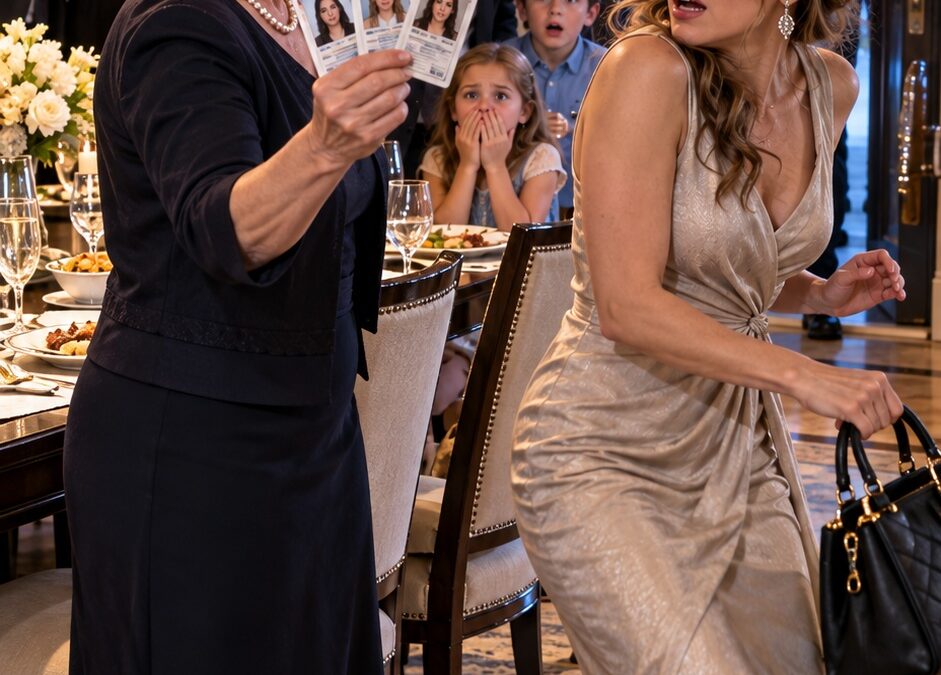
Then three copies of identification cards.
Each had Samantha’s photograph.
Each carried a different name.
Amanda Stevens.
Rachel Palmer.
Elizabeth Grant.
Jason’s eyes moved from the documents to his wife.
“What is this?”
Samantha laughed.
A brittle little sound.
“Jason, your mother has been confused for months.”
I kept my eyes on her.
“Tell him about the three husbands.”
Her face drained.
“Tell him about Florida.”
“Stop.”
“Tell Abby and Adam why their mother bought a house in Washington under another name.”
“Stop.”
“Tell Jason why plane tickets were purchased for three people.”
The room went silent.
Not four.
Three.
Jason.
Samantha.
Their eight-year-old twins.
Three tickets meant one person was never supposed to board that flight.
Jason.
He pushed back from the table.
“What is she talking about?”
Samantha stood.
“Your mother went through my private belongings. She’s paranoid.”
I pulled out another page.
“Eight hundred thousand dollars.”
Jason blinked.
“What?”
“That’s how much has already been transferred out of your business accounts.”
He stared at me.
“That’s impossible.”
“It isn’t.”
I pointed toward Samantha.
“She’s been moving your money through shell companies.”
Samantha’s eyes darted toward the hallway.
Then toward the couple seated beside her.
The man calling himself Paul.
The woman calling herself Lisa.
Neither was who they claimed to be either.
I saw the decision in Samantha’s face before she made it.
Run.
She grabbed her purse.
“This is ridiculous.”
Then the doorbell rang.
One sharp sound.
Samantha froze.
I finally allowed myself to breathe.
“Who is that?” Jason whispered.
I looked at the woman he believed was his wife.
“Someone who knows Amanda Stevens.”
The front door opened.
“Federal agents!”
Everything after that happened quickly.
But the truth had taken months to uncover.
And if Samantha had treated me with even a little dignity, I might never have started asking the questions that destroyed her entire plan.
────────── ✦ ──────────
For thirty-five years, I taught third grade at Lincoln Elementary in Portland, Oregon.
I loved it.
Every exhausting, noisy, sticky-fingered year of it.
Children asked questions adults learned to hide.
Why?
Why not?
Who says?
How do you know?
Those questions became part of me.
My husband Frank used to say I had been born to teach.
He worked as an accountant for the city.
We lived in a modest two-story house on Maple Street.
Nothing extravagant.
Nothing impressive.
But it was ours.
We raised Jason there.
Homework at the kitchen table.
Christmas stockings on the staircase.
Baseball gloves in the hallway.
Arguments about curfews.
College acceptance letters.
Frank and I were married forty-two years.
Then his heart failed.
One year before everything with Samantha began, I woke up married and went to bed a widow.
Grief changed the sound of my home.
That surprised me.
It was not merely that Frank was gone.
It was that everything around his absence became louder.
The refrigerator humming.
The clock ticking.
Rain against the roof.
My own footsteps.
I would walk into the kitchen and start telling him something before remembering there was no one sitting at the table.
Sometimes I spoke anyway.
Jason called every Sunday.
Never missed.
“Mom, you eating?”
“Yes.”
“Actual food?”
“Food counts whether or not you approve.”
“You had toast again.”
“I added jam.”
He would sigh.
Then put Abby and Adam on video.
The twins were eight.
Abby loved stories.
Adam loved numbers.
Seeing them helped.
But screens are not arms.
Three months after Frank’s funeral, Jason said:
“Come to Columbus.”
“For what?”
“To live with us.”
I thought he was joking.
He was not.
“Mom, you shouldn’t be alone.”
“I’ve lived independently since before you were born.”
“I know.”
“The house is paid for.”
“I know.”
“I have friends.”
“I know.”
He softened his voice.
“The kids miss you.”
That hurt.
Because I missed them too.
He continued.
“We have space.”
“What does Samantha think?”
There was a pause.
Very small.
I noticed it later.
At the time, I ignored it.
“She’s completely on board.”
“Completely?”
“She thinks it’ll be great for the kids.”
I had only spent limited time with Samantha.
Holidays.
A wedding.
A few visits.
She was beautiful in a sharp, controlled way.
Auburn hair.
Perfect posture.
Expensive clothes.
She worked as a lawyer at a prestigious Columbus firm.
Jason was a financial adviser.
Together they seemed successful.
Stable.
Modern.
Busy.
I worried I might intrude.
Jason assured me I would not.
So I sold my Portland house.
That was harder than I expected.
Every room held Frank.
Our bedroom.
His chair.
The pencil marks measuring Jason’s height.
The kitchen cabinets Frank installed badly enough that one still leaned.
I donated most of the furniture.
Packed photographs.
Teaching awards.
Books.
Frank’s mother’s handmade quilts.
Everything else went.
I told myself I was not leaving a life.
I was entering the next one.
When I arrived in Columbus, Abby and Adam ran down the driveway.
“Grandma!”
They hit me so hard I nearly lost my balance.
Jason came behind them.
He looked so much like Frank in that moment that grief and joy collided in my chest.
Then Samantha appeared.
She smiled.
“Welcome.”
Brief hug.
Polite.
Controlled.
“The kids have been counting down the days.”
The basement had been converted into a small apartment.
Bedroom.
Bathroom.
Kitchenette.
It was clean.
Comfortable.
Dark.
I missed Portland sunlight.
Still, I told myself:
Adjustment takes time.
The first week was wonderful.
The twins showed me their school.
Their friends.
The park.
Every person they met heard:
“This is Grandma Blake. She lives with us now.”
I liked the sound of now.
Forever felt dangerous after losing Frank.
Now felt manageable.
Then Friday came.
Samantha announced:
“We should have a family meeting.”
She sat at the head of the dining-room table.
Jason sat beside her.
The children had been sent upstairs.
A folder rested in front of Samantha.
I felt as if I had been called into a principal’s office.
“Now that you’re settled,” she began, “we need to establish expectations.”
She slid a page toward me.
I read it.
Breakfast preparation.
Weekdays.
Dinner.
Housecleaning twice weekly.
Laundry.
School pickup.
Childcare until dinner.
Grocery shopping.
Various household errands.
I looked up.
“What is this?”
“A schedule.”
“I can see that.”
“We both work long hours.”
“Yes.”
“You’re home.”
“I’m retired.”
“Exactly.”
Her smile did not move.
“So this gives your day structure.”
Structure.
I had managed classrooms of thirty children for decades.
Raised a son.
Ran my own household.
Cared for a dying husband.
But apparently retirement had transformed me into a confused teenager needing chores.
Samantha continued.
“We’ll also need your Social Security contribution.”
“My what?”
“Household expenses.”
I looked at Jason.
He shifted.
“Mom.”
“Yes?”
“I think it’s fair.”
Something inside me cracked.
Not completely.
Enough.
“You asked me to move here.”
“I know.”
“You said you wanted me near the children.”
“We do.”
Samantha leaned forward.
“Nobody is saying otherwise.”
“It sounds as if you hired a housekeeper who pays you.”
Her mouth tightened.
“That’s not fair.”
“Isn’t it?”
Jason rubbed his forehead.
“Mom, please.”
Again.
Please.
The same word he would use for months.
Not to protect me.
To stop conflict.
I thought about the twins upstairs.
I thought about Frank.
I thought about Portland.
Then I said:
“All right.”
Samantha smiled.
“Great.”
Later that night, while unpacking books in the basement, I heard voices through the vent.
Samantha.
“Your mother needs structure.”
Jason said something too low to hear.
“She’ll take advantage otherwise.”
I stopped moving.
“Trust me. I’ve seen this with elderly parents.”
Elderly parents.
Take advantage.
I pressed a hand over my mouth.
I had sold my home.
Left my friends.
Moved across the country.
And one week later, my daughter-in-law had decided I was an elderly dependent who might exploit her generosity.
I sat on the edge of the bed.
Then cried.
Not because of the chores.
I had worked harder most of my life.
Because I realized I had misunderstood the invitation.
I believed I was joining family.
Samantha believed labor had arrived.
Two months passed.
I woke at six.
Breakfast.
Coffee.
Lunches packed.
Clean kitchen.
Laundry.
Vacuuming.
Bathrooms.
Dinner ready at six-thirty.
School pickup at three-fifteen.
Homework.
Snacks.
Occasionally grocery shopping.
The only part I truly loved was the twins.
Adam could multiply numbers faster than children twice his age.
Abby could discuss fictional characters as if they lived next door.
We baked cookies.
Built a solar system.
Read together.
I introduced little games from my classroom.
Learning disguised as play.
One afternoon Abby looked at me.
“Grandma?”
“Yes?”
“Why does Mom get mad when we have fun with you?”
The question startled me.
“Why do you think she gets mad?”
Before Abby answered, Samantha walked into the kitchen.
Early.
Her eyes moved immediately to the cookies cooling on the rack.
“I thought we discussed sugar.”
“We were practicing multiplication.”
“With cookies?”
“It kept them engaged.”
Samantha’s voice sharpened.
“They aren’t your students.”
Silence.
“No.”
“They have a routine.”
“I know.”
“I would appreciate you respecting it.”
Adam stared at the table.
Abby’s shoulders lowered.
Something about watching children react to adult tension awakens every instinct a teacher develops.
I changed the subject.
At dinner, Samantha criticized the casserole.
“Too rich.”
Jason took another bite.
“Mom’s cooking is great.”
Then stopped eating when Samantha looked at him.
“His cholesterol is borderline.”
“I didn’t know.”
“You should.”
That sentence stayed with me.
You should.
Cleaning wrong.
Laundry folded wrong.
Food wrong.
Too many cookies.
Too much talking.
Too much laughter.
Too much Grandma.
I tried speaking to Jason.
Never enough time.
Work.
Late meetings.
Exhaustion.
Samantha always nearby.
I called my old friend Patty in Portland.
She listened quietly.
Then said:
“You’re being used.”
“I’m helping.”
“You’re scrubbing bathrooms.”
“I live there.”
“You contribute money.”
“Yes.”
“You cook.”
“Yes.”
“Clean.”
“Yes.”
“Babysit.”
“Yes.”
“What do they do for you?”
I did not answer.
“Blake.”
“I love the children.”
“That wasn’t my question.”
I stared at the basement wall.
“At what cost?”
Patty asked.
The next day, I attempted something simpler.
Connection.
Samantha was working from home.
I made her a sandwich.
Knocked on her office door.
“I thought you might be hungry.”
She looked surprised.
“Thank you.”
“I realized we don’t know each other very well.”
She returned her eyes to the laptop.
“We’ve both been busy.”
“Where did you grow up?”
Pause.
“Several places.”
“Military family?”
“No.”
“Where did you go to college?”
She smiled politely.
“Blake, I’m drowning in work today.”
“Of course.”
Another time I asked about her parents.
Deceased.
No details.
Childhood?
Complicated.
Education?
Vague.
Law-school classmates?
She changed subjects.
Every answer closed rather than opened.
Teachers notice inconsistencies.
We listen to children tell stories all day.
You learn when details belong together.
Samantha’s did not.
Then came the barbecue.
Neighbors filled the backyard.
Music.
Hamburgers.
Wine.
I spent the morning making side dishes while Samantha supervised.
When guests arrived, she transformed.
Warm.
Funny.
Charming.
The woman who criticized how I folded towels suddenly laughed easily and complimented everyone.
I carried iced tea to a group near the patio.
A woman said:
“It must be wonderful having your mother-in-law here.”
Samantha smiled.
“Wonderful is one word.”
People chuckled.
“She helps with the children, right?”
Samantha lowered her voice.
Not enough.
“Honestly, it’s like running a senior daycare.”
Laughter.
My fingers tightened around the pitcher.
“She needs managing too.”
I stopped breathing.
Then a silver-haired man said:
“Samantha, you look familiar.”
Her smile froze.
“Do I?”
“Patterson and Rhodes.”
Her face changed.
“Excuse me?”
“I’m sure I met you at a conference.”
He squinted.
“But your name was different.”
A second of panic.
Gone immediately.
“You’re mistaken.”
“I don’t think—”
“I’ve never worked there.”
Smile.
“I’ve always been Samantha Davis.”
The man looked unconvinced.
“I’m Greg Thompson.”
She barely acknowledged him.
Later, driving home from getting ice, Samantha complained to Jason.
“Your mother embarrassed me.”
I sat in the back seat.
“In what way?” Jason asked.
“Asking personal questions.”
“I didn’t.”
“And encouraging Greg.”
“I did nothing.”
Jason looked at me in the mirror.
Disappointment.
“Mom.”
That hurt.
Not because he accused me directly.
Because he accepted Samantha’s version before asking mine.
As summer continued, the rules tightened.
When Samantha’s colleagues visited for dinner, I was told to eat downstairs.
“The table is crowded.”
It could seat eight.
There were six people.
I stopped arguing.
Something else bothered me.
No photographs of Samantha before Jason.
Nothing.
No childhood pictures.
No graduation.
No college friends.
No parents.
No family.
I asked Jason.
“Her parents died young.”
“All photographs?”
“She doesn’t like the past.”
“Why?”
He sighed.
“Mom.”
I knew what came next.
“Can you respect her privacy?”
So I stopped asking him.
Then Moren came from Portland.
We had taught together twenty years.
Samantha would not let her stay at the house.
“No room.”
There was a guest room upstairs used for storage.
Moren booked a hotel.
We spent Friday talking.
Saturday she joined us for dinner.
She watched Samantha speak over me.
Correct me.
Ask me to refill drinks in the middle of a conversation.
Tell me the kitchen needed cleaning while everyone else sat down.
After Jason and Samantha took the twins to baseball practice, Moren helped me wash dishes.
Then she asked:
“Are you happy?”
Simple question.
I cried.
Everything came out.
The chores.
The comments.
Eating downstairs.
Isolation.
The twins.
Jason.
Moren listened.
Then:
“You are not a servant.”
“I know.”
“Do you?”
I looked away.
She dried a plate.
“There’s something else.”
“What?”
“The way Samantha talks about managing assets.”
I frowned.
“It reminds me of a case.”
“What case?”
“An attorney.”
“Where?”
“I don’t remember.”
She looked frustrated.
“Woman defrauded elderly clients. Estate planning. Gained trust. Took control of assets.”
“That could be anyone.”
“I know.”
“But?”
“She feels familiar.”
After Moren left, I could not let it go.
Tuesday morning, the house emptied.
I finished cleaning.
Then stood in front of Samantha’s office.
I knew what I was about to do was wrong.
At least under normal circumstances.
But normal circumstances had stopped existing.
I entered.
Law books.
Desk.
Laptop.
Files.
Everything organized.
The bottom drawer was locked.
Teachers become excellent at finding hidden objects.
Thirty-five years of confiscated notes, toys, candy, and handheld games had trained me.
I searched.
Found a key taped beneath the desk.
My hands shook.
I opened the drawer.
Inside was a small box.
Identification cards.
Same face.
Different names.
Amanda Stevens.
Rachel Palmer.
Elizabeth Grant.
Different states.
Different addresses.
I sat down.
My legs weakened.
Beneath the IDs were newspaper clippings.
Fraud.
Legal investigations.
Financial losses.
At the bottom was a false panel.
Flash drive.
I took it.
Ran downstairs.
Used Frank’s old laptop.
Copied everything.
Then returned the drive.
Locked the drawer.
Replaced the key.
I had just straightened the desk when I heard the front door.
“Hello?”
Samantha.
My heart nearly stopped.
She appeared in the hallway.
Saw me near the office.
Her eyes narrowed.
“Were you in there?”
“No.”
The lie tasted bitter.
“I saw the light.”
“I came to turn it off.”
She studied me.
Long.
Cold.
Then smiled.
“I forgot court files.”
She placed her briefcase down.
“Actually, we should discuss boundaries.”
Of course.
“My office is private.”
“I understand.”
“Our bedroom.”
“Yes.”
“And the upstairs guest room.”
I nodded.
“Off limits.”
“Yes.”
She smiled again.
“I’m glad we understand each other.”
We did.
More than she knew.
That evening Jason repeated her rules.
I watched my son speak.
Withdrawn.
Careful.
Watching Samantha’s reactions.
He no longer looked like the man I raised.
The next week, I heard Samantha speaking in the garage.
“Everything is proceeding.”
Pause.
“The transfer can happen next month.”
She saw me.
Ended the call.
“Client.”
I smiled.
“Of course.”
September became worse.
She checked grocery receipts.
Monitored telephone calls.
Restricted internet access.
“Data limits.”
Nonsense.
The children supposedly needed bandwidth.
My access was reduced to basic sites.
So I began walking to the library.
Every day.
Exercise, I said.
Books.
True.
Also unrestricted internet.
I inserted the copied flash drive into a library computer.
Then my suspicions became facts.
Jason’s accounts.
Transfers.
Offshore banks.
Shell companies.
Documents concerning three previous husbands.
Wealthy men.
All lost large amounts of money after marrying women connected to the identities in Samantha’s drawer.
Then:
Amanda Stevens.
Florida.
Attorney.
Estate planning.
Investigation for defrauding elderly clients.
Disciplinary proceedings.
Disappearance.
Identity changed.
Moved.
Samantha Davis did not exist.
Amanda Stevens did.
And Amanda Stevens had married my son.
I kept researching.
Jason’s financial advisory business had transfers scheduled.
Large ones.
Within weeks.
I tried warning him.
Samantha was at a networking event.
We sat at the kitchen table.
“Jason.”
“Mom, I’m working.”
“This cannot wait.”
He looked irritated.
“It’s Samantha.”
His face closed immediately.
“What now?”
“She isn’t Samantha.”
He stared.
“What?”
“Her real name is Amanda Stevens.”
I showed him documents.
“She’s been married before.”
“Mom.”
“Three times.”
“Stop.”
“She is moving money from your accounts.”
His face hardened.
“How did you get this?”
“That isn’t important.”
“It is.”
“I found identification cards.”
“You searched her office.”
“I found evidence.”
“You invaded her privacy.”
“Jason.”
“You copied her files?”
“Yes.”
He stood.
“I can’t believe this.”
“Listen to me.”
“No.”
His voice rose.
“Since you moved here, you’ve been jealous.”
I stared.
“Of Samantha?”
“You question her.”
“She treats me like hired help.”
“You undermine her with the kids.”
“I bake cookies.”
“You ignore routines.”
“She is stealing from you!”
He slammed his laptop shut.
“You sound paranoid.”
The word landed like a slap.
“Jason.”
“I think you’re confused.”
“No.”
“It happens.”
“What happens?”
“When people get older.”
I stared at my son.
The child I taught to question evidence.
The man I raised to respect truth.
He thought I was senile.
Because Samantha had taught him to.
That night I heard them upstairs.
Vent.
Voices.
“She’s becoming a problem.”
Samantha.
Jason answered quietly.
“She went through my files.”
“She thinks you’re stealing.”
“She’s delusional.”
Pause.
“We may need other options.”
“What options?”
“Senior living.”
My heart stopped.
“Somewhere with supervision.”
Jason hesitated.
“That seems extreme.”
“She’s making accusations.”
“What if she tells your clients?”
Silence.
My own son was considering moving me into a facility because the woman stealing from him had convinced him I was mentally unstable.
The next day, Samantha removed the twins from my care.
After-school program.
“Socialization.”
Weekend park visits stopped.
“They’re tired.”
“They’re sick.”
They were not.
One evening, Abby and Adam slipped downstairs.
“Grandma?”
“Yes?”
“Are you leaving?”
I looked at Abby.
“Why?”
“Mom says you forget things.”
Adam frowned.
“You remember everything.”
I hugged them.
“No one is sending me anywhere tonight.”
“Are you sick?”
“No.”
“Promise?”
“Yes.”
That was the moment fear changed into determination.
Not for me.
For them.
I could leave.
Return to Portland.
Buy another home.
Rebuild.
Jason might lose money.
Painful.
But survivable.
The twins were different.
Samantha was planning something involving them.
I needed help.
Next door lived Dorothy.
Silver hair.
Beautiful garden.
Always waved.
I baked banana bread.
Walked over.
She welcomed me inside.
Tea.
Conversation.
Forty years in the neighborhood.
Then I asked:
“Could I use your computer?”
“Anytime.”
“My internet is limited.”
She frowned.
“Limited?”
“Long story.”
Her grandson had installed everything.
Password on a sticky note.
The next morning I emailed Patty.
Everything.
She responded within hours.
Her son-in-law worked in FBI financial crimes.
Kevin Barnes.
Call him.
Agent Barnes was skeptical.
Correctly.
A sixty-five-year-old woman calling to say her daughter-in-law was a serial financial predator sounded extraordinary.
Then I sent documents.
Identities.
Transfers.
Florida records.
His tone changed.
“This resembles an active pattern.”
“What pattern?”
“Long-con financial fraud.”
“How organized?”
“Very.”
Amanda Stevens targeted wealthy men.
Often isolated.
Created identities.
Built relationships.
Married.
Separated victims from family.
Moved assets.
Then disappeared.
Agent Barnes asked:
“Do you know any previous victims?”
I found one.
Thomas Chandler.
Arizona.
He answered my email immediately.
“She took almost two million dollars.”
His voice sounded tired.
Not angry anymore.
Beyond anger.
“My business.”
“House.”
“Nearly my children.”
“How?”
“Documents.”
“Transfers.”
“Investments.”
“Everything looked legitimate.”
“Police?”
“They said I signed.”
He laughed bitterly.
“I did sign.”
“She had me signing things constantly.”
“Did you know her as Samantha?”
“No.”
“What name?”
“Rachel.”
I closed my eyes.
One of the IDs.
Thomas agreed to give a statement.
Records.
Photographs.
Other victims emerged.
Meanwhile, I documented everything at home.
Schedules.
Calls.
Contradictions.
Sometimes I recorded conversations.
One day Adam casually said:
“Mom told Abby she grew up in California.”
I looked at him.
“She did?”
“Yeah.”
“But at career day she said Chicago.”
Another lie.
Small.
Useful.
Agent Barnes became convinced.
Then I found something worse.
Washington State.
Property purchased under Jane Wilson.
Another identity.
School enrollment.
Abby.
Adam.
Next month.
Then airline reservations.
Three passengers.
Not four.
Samantha planned to take the twins.
Leave Jason.
Disappear.
My son’s business accounts had already lost nearly eight hundred thousand dollars.
I called Barnes from Dorothy’s house.
“She’s leaving.”
“When?”
“I don’t know.”
“We need stronger evidence.”
“You have transfers.”
“We need direction.”
“What?”
“Evidence she is knowingly directing the fraud.”
Then we found Paula.
A new administrative assistant at Jason’s company.
Started six months earlier.
Emails on the flash drive.
Account access.
Transfer schedules.
Aliases.
Samantha had someone inside Jason’s office.
Agent Barnes said:
“We need to catch the operation moving.”
The opportunity came from Samantha herself.
“Saturday dinner.”
She announced it over breakfast.
“Important guests.”
Jason looked tired.
“Who?”
“Paul and Lisa.”
Names appeared in the emails.
Aliases.
Samantha smiled at me.
“You’ll prepare dinner.”
Not:
Would you?
“You’ll.”
“Yes.”
“Beef Wellington.”
I almost laughed.
“What?”
“Nothing.”
“Good silver.”
“Of course.”
“Everything needs to be perfect.”
“Yes.”
She thought I was obedient again.
I was.
For now.
Agent Barnes arranged surveillance.
My phone recorded audio.
A small camera pin captured video.
Agents monitored financial activity.
I kept cooking.
Saturday arrived.
Samantha criticized everything.
Wine glasses.
Napkins.
Vegetables.
Silverware.
I nodded.
She had no idea that every order she gave me brought us closer to the moment I had been waiting for.
Seven o’clock.
Doorbell.
Paul.
Lisa.
Polished.
Professional.
Fraudsters.
I recognized them from FBI photographs.
Known associates in earlier schemes.
“What a lovely home.”
Lisa’s eyes scanned the room.
Not admiring.
Assessing.
Dinner began.
They discussed investments.
Expansion.
Complex financial structures.
Jason tried to follow.
Samantha kept filling his wine.
Too often.
I watched.
Main course.
Jason’s face reddened.
Speech slowed.
Then I saw Samantha’s fingers.
Small packet.
White powder.
Near Jason’s wine.
My blood froze.
She distracted him.
Dropped something.
The powder dissolved.
I moved without thinking.
Bumped the table.
Jason’s glass fell.
Wine everywhere.
Samantha glared.
“I’m so sorry.”
I grabbed towels.
“I’ll bring another.”
In the kitchen, her phone lit.
Documents ready.
Get signatures tonight.
Moving timeline up.
I photographed the message with my phone.
Then brought Jason water.
“No more wine.”
Samantha smiled tightly.
“He’s fine.”
“He’s had enough.”
Paul interrupted.
“Perhaps we should review the paperwork.”
Samantha brightened.
“Excellent idea.”
Jason squinted.
“What paperwork?”
“Investment documents.”
Lisa smiled.
“Standard.”
Paul stood.
“No reason to delay.”
Jason rose unsteadily.
I texted Agent Barnes.
MOVING TO OFFICE. JASON IMPAIRED.
I followed.
Paul spread documents across the desk.
“Sign here.”
Jason frowned.
“What exactly is this?”
“What we discussed.”
“I don’t remember.”
Samantha touched his shoulder.
“You do.”
“I—”
“Jason.”
Her voice softened.
Manipulation disguised as reassurance.
“You agreed.”
He picked up a pen.
I stepped forward.
“Do not sign.”
Four faces turned toward me.
Samantha’s expression became murderous for half a second.
Then polite.
“Blake.”
“Yes?”
“We’re conducting business.”
“So am I.”
“What?”
“Stopping a crime.”
Jason looked at me.
“Mom.”
Samantha laughed.
“Here we go again.”
I reached into my pocket.
“Amanda.”
She froze.
“What did you call me?”
“Amanda Stevens.”
No one moved.
“Or Rachel Palmer.”
Paul’s eyes changed.
“Or Elizabeth Grant.”
Lisa stood.
I continued.
“Which one do you prefer tonight?”
Jason stared at Samantha.
“What is she talking about?”
“Nothing.”
Samantha stepped toward me.
“Your mother is confused.”
I pulled out the copies.
“Are these your photographs?”
Jason took them.
His hands shook.
“Samantha?”
She looked at him.
“Fake.”
“Then explain Florida.”
“Jason—”
“Three husbands.”
“Stop.”
“Two million stolen from Thomas Chandler.”
“Shut up!”
There.
The first crack.
Jason stared.
“Who is Thomas?”
“Another man who thought he married her.”
Samantha’s face twisted.
“Your mother broke into my office.”
Jason looked from her to me.
“Yes.”
I said.
“I did.”
Then I placed financial records on the desk.
“But she stole eight hundred thousand dollars from you.”
Jason stopped breathing.
“What?”
“Already transferred.”
“No.”
“Shell companies.”
I pointed.
“Paula helped.”
His eyes widened.
“My assistant?”
“Yes.”
Paul moved toward the door.
I stepped aside.
Let him.
FBI agents were outside.
“Jason.”
I placed the Washington property information down.
“She bought a house.”
“Who?”
“Samantha.”
“Where?”
“Washington.”
Samantha whispered:
“No.”
“Under Jane Wilson.”
Jason looked at her.
Then the school enrollment.
“Abby and Adam are registered to begin school there next month.”
His face turned white.
“Why?”
I handed him the airline record.
“Three tickets.”
He read.
Then again.
“Three.”
“Yes.”
“Not me.”
“No.”
For the first time since I moved into that house, Jason looked directly at his wife without automatically believing what she showed him.
“Is this true?”
Samantha grabbed her purse.
“This conversation is over.”
“Answer me.”
“Paul.”
She turned.
“Lisa.”
“Let’s go.”
Then the doorbell rang.
Samantha stopped.
Her mind worked quickly.
I could see it.
Escape routes.
Story.
Blame.
The front door opened before anyone reached it.
“FBI!”
Agent Barnes appeared.
Three other agents.
Badges.
“Amanda Stevens.”
Samantha backed away.
“No.”
“You are under arrest for wire fraud, identity theft, and conspiracy to commit financial crimes.”
Chaos.
Lisa ran toward the side door.
Agent intercepted her.
Paul tried another hallway.
Stopped.
Samantha pulled out her phone.
Agent grabbed her wrist.
“Do not delete anything.”
Jason collapsed into his desk chair.
The twins appeared at the hallway.
Terrified.
I went immediately.
“Grandma?”
“Come with me.”
“What’s happening?”
“Come.”
Behind us, Samantha screamed.
“You stupid old woman!”
I stopped.
Turned.
Agents held her.
Hatred transformed her face.
“You ruined everything!”
I looked at her.
“No.”
Calm.
“You did that when you targeted my family.”
Then I took Abby and Adam away.
No victory speech.
No joy.
Children were crying.
My son’s marriage had just disintegrated.
Millions in accounts were at risk.
The woman the twins called Mom was being handcuffed.
Sometimes justice does not feel triumphant.
Sometimes it simply feels necessary.
The following weeks were brutal.
FBI agents recovered most of the eight hundred thousand before it vanished permanently.
Accounts were frozen.
Transactions reversed where possible.
Paula was arrested.
Paul and Lisa were charged.
Other participants surfaced.
The network extended across five states.
Nearly a decade.
Amanda Stevens had built identities the way other people build wardrobes.
Use one.
Discard.
Move.
Repeat.
Thomas Chandler testified.
Two other former husbands came forward.
Each described the same pattern.
Charm.
Marriage.
Isolation.
Financial paperwork.
Confusion.
Loss.
Then disappearance.
Jason listened to statements with a face I barely recognized.
One night we sat on the porch.
October air.
Twins asleep.
“I don’t understand.”
He rubbed his hands together.
“How did I not see it?”
“She was good.”
“That sounds like an excuse.”
“It isn’t.”
“I’m a financial adviser.”
“I know.”
“I tell clients to watch for fraud.”
“I know.”
“And my wife stole from my business.”
“Yes.”
He laughed bitterly.
“I must be the stupidest man alive.”
“No.”
“What would Dad say?”
That hurt.
“Your father would be angry.”
“At me?”
“At everyone.”
A small smile.
Then it disappeared.
“I believed her over you.”
“Yes.”
“I told you that you were paranoid.”
“Yes.”
“That you were old.”
“You implied it.”
He covered his face.
“Mom.”
I waited.
“How do I fix that?”
“You don’t.”
He looked at me.
“Not immediately.”
His eyes filled.
“Trust heals slowly.”
“I’m sorry.”
“I know.”
“She told me you resented her.”
“I know.”
“She said you wanted to control the kids.”
“I know.”
“She said—”
“I know, Jason.”
“How?”
“Because she did the same thing to everyone.”
Amanda isolated targets by changing what people believed about one another.
She told Jason I disliked Samantha.
Told Samantha—I assumed—that I criticized her.
Told the twins I forgot things.
Told Jason’s sister Tara negative stories.
That discovery came later.
Tara had barely spoken to Jason for almost two years.
After the arrest, she came to Columbus.
The moment she saw her brother, she cried.
“Samantha told me you thought I was irresponsible.”
Jason stared.
“I never said that.”
“She said you didn’t want me around the twins because I was divorced.”
“No.”
Tara laughed through tears.
“She told me Mom thought I was a bad influence too.”
“I never said that either.”
Two siblings had lost years because one woman understood the simplest method of isolation.
Lie separately.
Make everyone too hurt to compare notes.
Jason hugged his sister.
“I missed you.”
“I missed you too.”
That was when I understood something that stayed with me.
Healthy families communicate directly.
Predators thrive in messages carried through third people.
She said you said.
He thinks.
They told me.
Whenever communication becomes triangular, manipulation finds room.
We changed that.
The twins had the hardest questions.
FBI victim specialists helped.
So did my teaching experience.
Children deserve truth.
They also deserve truth they can carry.
Abby asked:
“Is Mom bad?”
I sat beside her on the kitchen floor while cookies baked.
“No.”
She frowned.
“She did bad things.”
“Yes.”
“Then she’s bad.”
“People are more complicated.”
Adam watched me.
“Will she come home?”
“No.”
“Ever?”
“Not to live with us.”
Abby cried.
“I miss when she read stories.”
“You can miss that.”
“But she hurt Dad.”
“Yes.”
“And you.”
“Yes.”
“Can I still love her?”
I nearly broke.
“Yes.”
I pulled both children closer.
“You never have to stop loving a good memory because a person also made harmful choices.”
That mattered.
Amanda’s crimes were not the twins’ burden to defend.
They should not have to hate their mother to prove loyalty to their father or grandmother.
Healing cannot require children to amputate half their emotional world.
Three months later, the house changed.
Not furniture.
Atmosphere.
I moved out of the basement.
Jason insisted.
“Mom, take the main-floor bedroom.”
“I don’t need—”
“Yes.”
He looked embarrassed.
“You were family the whole time.”
I understood what he meant.
He needed the gesture.
So I moved.
No chore list.
No contribution schedule.
I still cooked sometimes.
Because I wanted to.
Laundry?
Everyone did their own.
Cleaning?
We hired help twice a month.
Jason reduced his work hours.
Started therapy.
Spent more time with the twins.
Tara visited.
Dorothy became part of our lives.
Patty called weekly.
Moren sent books.
My world expanded again.
I also began volunteering at a senior center.
The first talk I gave was called:
Protecting Yourself and Your Assets.
Every chair filled.
Then more chairs appeared.
People stood at the back.
I told them:
“Financial exploitation rarely begins with someone stealing money.”
It begins with control.
Access.
Isolation.
Someone convincing you that questions are rude.
That privacy means secrecy.
That age makes your judgment unreliable.
That family deserves automatic authority.
An older man raised his hand.
“What if it’s your own child?”
“Then you still verify.”
A woman asked:
“What if they get angry?”
“Anger does not turn a bad request into a good one.”
Another:
“What if you’re afraid they’ll stop visiting?”
That one hurt.
“Then the relationship already has a problem.”
I became good at those talks.
Not because of Samantha.
Because I spent thirty-five years translating difficult ideas for children.
Different audience.
Same skill.
Make it clear.
Use examples.
Never make someone ashamed for not knowing.
Shame blocks learning.
Amanda had used Jason’s shame.
The senior center taught me how many families use it too.
“You should trust me.”
“You’re old.”
“You’ll lose the house.”
“You don’t understand technology.”
“Just sign.”
No.
Ask.
Read.
Verify.
The FBI case continued.
Amanda’s evidence was overwhelming.
Identity documents.
Offshore transfers.
Accomplices.
Recorded conversations.
Washington property.
Travel arrangements.
Past victims.
She eventually accepted a plea agreement involving multiple counts of fraud and identity theft.
The accomplices were prosecuted too.
I attended part of the proceedings.
Not all.
I had spent enough time organizing my life around her.
Jason went.
He needed closure.
After one hearing, he came home.
“She looked at me.”
I waited.
“She smiled.”
“That sounds like her.”
“She mouthed, ‘I love you.’”
“What did you do?”
“Nothing.”
“How did that feel?”
“Horrible.”
I sat beside him.
“I still loved her.”
“Of course.”
“She was lying about everything.”
“Yes.”
“So how can I love her?”
“Because your feelings were real.”
He looked at me.
“Her identity was fake.”
“Yours wasn’t.”
That seemed to help.
The money mattered too.
Jason’s business survived.
His real business partner—Paul, the actual Paul—helped rebuild safeguards.
Clients were informed.
Some left.
Most stayed.
Jason was honest.
“My household was targeted by an organized fraud scheme.”
No euphemisms.
No hiding.
Transparency restored trust better than pretending nothing happened.
The twins returned to normal routines gradually.
Abby read constantly.
Adam remained obsessed with math.
Cookies became common again.
One afternoon Samantha’s old rule crossed my mind.
No sweets on weekdays.
I looked at the tray.
Then at the twins.
“Two each.”
Adam grinned.
“Mom would say one.”
I paused.
“We are not going to do everything opposite just because your mother made mistakes.”
His smile faded.
“Why?”
“Because that would still let her make the rules.”
He thought.
“One and a half?”
I laughed.
“Two.”
I was learning too.
Freedom is not rebellion.
It is choice.
Christmas came.
We decorated together.
Jason made a snowman cookie with so much green icing it looked diseased.
Abby screamed with laughter.
“Dad!”
“What?”
“That’s horrible.”
“I’m an artist.”
“You’re not.”
I watched them.
The sound filled a house that had once felt controlled and silent.
Later, after the twins went to bed, Jason and I sat near the fireplace with hot chocolate.
A childhood tradition.
He stared into the flames.
“Mom.”
“Yes?”
“I don’t regret everything.”
I raised an eyebrow.
“That is a strange sentence.”
“I mean Samantha.”
I waited.
“If I had never met her, I wouldn’t have Abby and Adam.”
“No.”
“And you might still be in Portland.”
“Possibly.”
“We’re closer now.”
“Yes.”
He swallowed.
“I hate what happened.”
“So do I.”
“But I can’t wish away the years entirely.”
“You don’t have to.”
He looked at me.
“I thought you would hate me.”
“I was angry.”
“That’s different.”
“Very.”
“You could have left.”
“Yes.”
“You almost did?”
I answered honestly.
“Yes.”
He closed his eyes.
“When?”
“When you said I was paranoid.”
His face tightened.
“I deserved that.”
“I don’t know what anyone deserves.”
I looked at my son.
“But I knew I could not stay somewhere I was losing my dignity.”
“Why didn’t you go?”
“The twins.”
“And me?”
“Yes.”
He looked surprised.
“Even after I didn’t believe you?”
“You were being manipulated.”
“That doesn’t erase what I did.”
“No.”
“I should have listened.”
“Yes.”
His eyes filled.
“You don’t make forgiveness easy.”
“I don’t think easy forgiveness helps anyone.”
That became part of our new relationship.
No saintly mother.
No permanently guilty son.
Truth.
Jason made mistakes.
So did I.
I stayed silent too long.
I allowed the chore list because I was afraid speaking would threaten access to the grandchildren.
I minimized Samantha’s disrespect because I wanted family harmony.
I ignored my loneliness.
Then I crossed another boundary by searching her office.
Under normal circumstances, I would not defend that.
These were not normal circumstances.
Evidence of fraud justified action.
But I did not pretend every decision I made was comfortable or pure.
Life rarely gives us clean choices inside ugly situations.
The important thing is what you do once the truth becomes clear.
My friendship with Dorothy deepened.
She liked to joke that she helped break an interstate fraud ring because she shared her Wi-Fi.
“Technically correct.”
I told her.
“I expect a badge.”
“You get banana bread.”
“Cheap.”
“Very.”
She became family.
Patty visited from Portland.
Moren too.
The people Samantha had gradually separated me from returned.
That was another lesson.
Isolation makes abuse feel normal because no one outside the system is present to say:
This is not normal.
Patty said it.
Moren said it.
Dorothy created space.
Agent Barnes believed evidence when I produced it.
No single person saved me.
A network did.
Months later, Tara said something I never forgot.
“Samantha always made every conflict feel private.”
“What do you mean?”
“She would say, ‘Don’t tell Jason because he’s stressed.’”
“Or?”
“‘Don’t tell Mom because it will upset her.’”
“Yes.”
“So nobody compared stories.”
Exactly.
We changed that too.
If someone said:
“Don’t tell…”
We asked why.
Secrets can protect privacy.
They can also protect manipulation.
Context matters.
One year after the arrest, I returned to Portland.
Not permanently.
For a visit.
I drove past Maple Street.
My old house had new curtains.
A bicycle lay in the yard.
Someone had planted roses where Frank always claimed nothing would grow.
I parked.
Did not knock.
Just sat.
For months after moving, I regretted selling that house.
I blamed myself.
If I had stayed.
If I had not moved.
If I had not trusted Jason.
Then I realized something.
Moving did not cause Samantha’s fraud.
She was already Samantha.
Already Amanda.
Already targeting Jason.
My arrival exposed the deception.
Without me in that house, she might have succeeded.
Jason might have signed.
Eight hundred thousand could have become everything.
She might have left with the twins.
He might have spent years trying to find them.
So I stopped calling my move a mistake.
It was painful.
Not a mistake.
I visited Lincoln Elementary too.
New principal.
Some familiar teachers.
My old classroom had different posters.
Smaller desks than I remembered.
A teacher recognized me.
“Mrs. Blake?”
I smiled.
“Yes.”
“You taught my sister.”
“Was she trouble?”
“Absolutely.”
“Then I remember her.”
We laughed.
Standing there reminded me who I had been before Samantha reduced me to chores.
Teacher.
Friend.
Wife.
Mother.
Neighbor.
Woman.
Not maid.
Not burden.
Not confused old lady.
One of the most dangerous things about sustained disrespect is that eventually you begin seeing yourself through the other person’s eyes.
I had started doing that.
Maybe I was difficult.
Maybe I was too old.
Maybe I should be grateful for any place in Jason’s home.
Maybe earning my place through labor was reasonable.
No.
Gratitude does not require self-erasure.
Family help should be mutual.
If Samantha had said:
“Could you pick up the children twice a week?”
I would have.
“Would you cook sometimes?”
Gladly.
“Could you contribute toward groceries?”
Reasonable.
But she did not negotiate.
She assigned.
Then monitored.
Then isolated.
Then used my resistance as evidence that something was wrong with me.
That structure mattered more than the individual chores.
I tell people at the senior center:
“Look at patterns, not isolated incidents.”
One criticism may be irritation.
A system of control is different.
Who decides?
Who gets questioned?
Whose privacy disappears?
Who must justify ordinary choices?
Who becomes smaller?
Those questions reveal a lot.
Jason eventually began dating again.
Slowly.
Very slowly.
The first woman he introduced me to was named Claire.
Teacher.
Middle school science.
She came for dinner.
I immediately liked her because she brought terrible store-bought cookies and admitted it.
“I can’t bake.”
“Excellent.”
She laughed.
“Why is that excellent?”
“Low expectations.”
Jason groaned.
“Mom.”
I smiled.
Claire asked me questions.
Real questions.
Portland.
Teaching.
Frank.
No fake charm.
No assessment.
She helped clear dishes without making a production of it.
When I tried to wash everything, she said:
“You cooked.”
Then handed Jason a towel.
He obeyed.
Progress.
I did not compare her to Amanda aloud.
That would have been unfair.
Claire deserved to be known as herself.
Jason deserved to learn trust without pretending the past never existed.
The twins liked her.
That mattered.
But Jason moved carefully.
Therapy helped.
He learned phrases I wish he had known earlier.
“I need time to think.”
“I want independent advice.”
“I don’t agree.”
“I’m going to talk to my family.”
Healthy sentences.
Predators hate them.
Healthy partners survive them.
My work at the senior center expanded.
Eventually local banks invited me to speak.
Then libraries.
Church groups.
Community organizations.
Agent Barnes occasionally joined.
At one session, he said:
“Mrs. Blake did more investigative work than some rookie agents.”
I corrected him.
“I had better free time.”
People laughed.
Then he turned serious.
“She also did something important.”
I looked at him.
“She documented.”
Dates.
Names.
Screenshots.
Copies.
Notes.
Patterns.
Not only feelings.
That distinction helped law enforcement act.
I always emphasize that now.
If something seems wrong:
Write it down.
Do not confront a sophisticated fraudster alone if safety is uncertain.
Preserve evidence.
Talk to independent professionals.
Use secure communication.
Get help.
My story is not proof that every suspicious daughter-in-law is secretly wanted in three states.
That would be ridiculous.
Most family conflict is simply family conflict.
But when financial secrecy, identity inconsistencies, isolation, coercive control, and suspicious transfers appear together, do not dismiss them because the person involved is family.
Family status does not neutralize risk.
Sometimes it increases access.
The hardest part for Jason remained the children.
He feared they would resent him.
Or me.
Or someday romanticize Amanda.
We did not build our family around hatred.
That was deliberate.
Abby once asked:
“Will Mom be in prison forever?”
“No.”
“How long?”
“A long time.”
“Can we write?”
Jason looked at me.
I let him answer.
“Yes.”
He said.
“If your therapist and the people helping us think it’s okay.”
Abby nodded.
“I want to tell her I got an A.”
Jason cried after she left the room.
“I don’t know how to do this.”
“No parent does.”
“What if contact hurts them?”
“Then change it.”
“What if no contact hurts?”
“Then change that.”
He laughed through tears.
“You really don’t have answers anymore.”
“I retired from pretending.”
That became another form of freedom.
Parents are allowed not to know.
Grandparents too.
We can still be useful.
Today, our family is imperfect.
Thank God.
Perfect families are often performances.
Ours has arguments.
Bad moods.
Missed calls.
Homework crises.
Overcooked dinners.
Jason works too much sometimes.
I interfere occasionally.
Tara talks too loudly.
Abby is becoming a teenager and has opinions about everything.
Adam believes mathematics proves emotions are inefficient.
Dorothy steals my recipes while claiming hers are better.
Patty still thinks I should move back to Portland.
Moren thinks Columbus winters are a crime.
Ordinary.
I love ordinary now.
Because under Samantha, everything had become carefully controlled.
Who sat where.
Who said what.
Who ate with guests.
What food children consumed.
Which stories they heard.
Who could access the internet.
Who was believed.
Control masqueraded as order.
Real family is messier.
One Christmas, Jason said:
“Mom, remember the household expectations list?”
I stared.
“How could I forget?”
He laughed nervously.
“I found it.”
“Burn it.”
“I already did.”
I raised an eyebrow.
“Really?”
“Fireplace.”
“That was dramatic.”
“I learned from you.”
“Poorly.”
He smiled.
Then:
“I’m sorry.”
I took his hand.
“We’ve covered this.”
“I know.”
“Changed behavior counts more now.”
“Yes.”
He looked at the twins playing near the tree.
“I still don’t understand how she convinced me you were the problem.”
“She did it slowly.”
“I should have known you.”
“You did.”
“Then why?”
“Because you also believed your wife.”
He looked guilty.
“That isn’t automatically wrong.”
This mattered.
People sometimes think the lesson is:
Always believe your mother over your spouse.
No.
That would be unhealthy too.
The lesson is:
Do not outsource judgment.
Listen.
Verify.
When people you love accuse one another, do not choose the most convenient version simply because conflict makes you uncomfortable.
Jason chose Samantha’s story because accepting mine would have required him to reconsider his entire marriage.
That was psychologically expensive.
So his mind rejected it.
Until evidence made rejection impossible.
Human beings do that more often than we admit.
I do too.
When Moren first mentioned the old fraud story, I dismissed it.
Too dramatic.
Too unlikely.
I wanted Samantha to be merely rude.
Rudeness was survivable.
Serial fraud was terrifying.
Truth does not become false because it is inconvenient.
That lesson changed all of us.
Tara repaired her relationship with Jason.
It took time.
She had been hurt.
He had believed things Samantha said.
They compared stories.
Laughed at some.
Cried over others.
One lie Samantha told Tara was that Jason thought she was “unstable” after her divorce.
He never said it.
One lie she told Jason was that Tara called him greedy.
She never did.
Years of distance.
Built on sentences nobody verified.
Now our family has a rule.
If someone says:
“So-and-so said…”
Ask so-and-so.
Simple.
Powerful.
Abby once said:
“That’s awkward.”
“Yes.”
“Can’t we just believe people?”
“You can.”
“But?”
“Trust and verification are friends.”
Adam looked up.
“That doesn’t make sense.”
“It will when you’re older.”
He sighed.
“Adults say that when they don’t know how to explain things.”
Teacher defeated by eight-year-old.
Fair.
Amanda’s trial process eventually ended.
I did not attend sentencing.
Jason did.
He returned quietly.
“How was it?”
“Sad.”
Not satisfying.
Not victorious.
Sad.
“She looked older.”
“Prison does that.”
“She apologized.”
“To you?”
“Yes.”
“Did you believe her?”
He thought.
“Parts.”
That was enough.
“Do you forgive her?”
“I don’t know.”
“That’s allowed.”
People rush forgiveness because uncertainty makes them uncomfortable.
I no longer do.
Forgiveness can be a process.
A boundary.
A decision not to be consumed.
It does not require trust.
Access.
Reconciliation.
Or pretending.
Jason’s financial recovery took longer than the emotional headlines suggested.
Insurance covered some losses.
FBI recovery restored much.
Some money disappeared.
Business security improved.
Paula’s access revealed weaknesses in internal controls that should have been caught.
Jason took responsibility.
Clients respected that.
He hired independent auditors.
Separated approval systems.
Required multiple authorization levels.
No single administrator could move large amounts.
His business emerged stronger.
So did he.
He once said:
“I thought being trusting made me a good person.”
“It can.”
“But?”
“Being uncritical is different.”
He smiled.
“You always have a ‘but.’”
“Occupational hazard.”
My own life grew beyond the house too.
I joined a book club.
Started walking with Dorothy.
Visited Portland regularly.
Taught occasional literacy workshops.
Volunteered.
For a while, I worried leaving the twins for an afternoon made me selfish.
Then I recognized Samantha’s ghost in that thought.
She had turned my presence into labor.
I needed to relearn that being a grandmother did not mean permanent availability.
One Saturday Abby asked:
“Can you take us to the zoo?”
“Not today.”
Her face fell.
“Why?”
“I’m having lunch with friends.”
“You have friends here?”
I laughed.
“Apparently.”
“What about tomorrow?”
“Yes.”
Easy.
No guilt.
Love survives “no.”
Another lesson.
A year after the arrest, the senior center asked me to help create a fraud-awareness program.
We called it Ask One More Question.
Because that is what saved us.
Greg Thompson at the barbecue asked one more question.
Moren remembered one more story.
I searched one more drawer.
Patty contacted one more person.
Agent Barnes looked one layer deeper.
Thomas Chandler answered one email.
Jason finally looked at the evidence instead of the person presenting it.
One more question.
Predators thrive when everyone stops asking.
The first presentation began with a photograph.
Not of Samantha.
Of me.
Standing in my old classroom.
Thirty years younger.
Children’s drawings behind me.
I told the audience:
“This woman would never have imagined that retirement could make people assume she stopped being competent.”
Then a second photograph.
Me at sixty-five.
“Same mind.”
Older face.
That matters.
Ageism helped Samantha.
She did not invent every stereotype.
Society supplied some.
Old people are confused.
Dependent.
Technologically helpless.
Lonely.
Easily managed.
Once those assumptions are available, manipulators only need to point toward them.
Jason accepted “Mom may be declining” partly because it was culturally plausible.
That should bother us.
It bothers me.
Cognitive decline exists.
It deserves serious attention.
But concern must be evidence-based.
Not convenient.
Not weaponized.
If someone claims an older adult is incompetent at exactly the moment they want control of that person’s money, independent evaluation becomes especially important.
That is not distrust.
That is protection.
One afternoon after a presentation, a woman approached.
Seventy-two.
Elegant.
Her nephew wanted power of attorney.
“He says I’m forgetting things.”
“Are you?”
“Sometimes.”
“So do I.”
She smiled nervously.
“What should I do?”
“See your doctor.”
“Independent lawyer.”
“Bring someone you trust.”
“Review everything.”
“What if I actually am declining?”
“Then planning becomes even more important.”
She looked relieved.
I was not there to tell people every family member was dangerous.
I was there to protect choice.
Samantha stole choice long before she stole money.
She controlled the narrative.
Access.
Information.
Relationships.
That is why being treated like a maid mattered more than it first appeared.
At the beginning, I thought the chores were merely disrespect.
Later I understood.
They established hierarchy.
Samantha gave orders.
I obeyed.
She evaluated.
I performed.
She restricted.
I adjusted.
By the time she suggested senior living, Jason had already watched months of me being treated as subordinate.
Control grows through repetition.
I will never miss that pattern again.
Three years later, Abby asked me something I had feared.
“Grandma?”
“Yes?”
“Do I look like Mom?”
I looked at her.
Auburn in her hair.
Same eyes.
“Yes.”
She swallowed.
“Is that bad?”
My heart broke.
“No.”
“Promise?”
“Yes.”
She looked away.
“I don’t want to be like her.”
I took her face in my hands.
“You are not sentenced to become anyone because you share their face.”
“What if I have her bad parts?”
“We all have bad parts.”
She frowned.
“Even you?”
“Especially me before coffee.”
She smiled.
Then I became serious.
“Character is choices.”
“Not genetics?”
“Not destiny.”
“What if I get angry like her?”
“Then learn what you do with anger.”
“What if I lie?”
“Tell the truth afterward.”
“What if I make a really bad mistake?”
“Take responsibility.”
She nodded.
“Mom didn’t?”
“Not for a long time.”
That was enough.
Children do not need simple monsters.
They need moral clarity without losing complexity.
Amanda was not born fraud.
Somewhere she became a person who repeatedly chose deception.
That history may explain.
It does not excuse.
Abby and Adam get to build differently.
Jason too.
Me too.
I once believed my next chapter after Frank would be quiet.
Maybe lonely.
Then I thought moving to Columbus meant my life would revolve around grandchildren.
Then Samantha tried to turn me into free labor.
Then I exposed an interstate fraud network.
Life is not committed to our plans.
The best we can do is remain awake.
At sixty-eight now, I feel more alive than I did at sixty-five.
Not because pain improved me automatically.
Pain does not deserve credit for work we do afterward.
I improved because I chose to respond.
I found people.
Asked questions.
Took risks.
Set boundaries.
Built another life.
I still miss Frank.
Some mornings, deeply.
I keep his old laptop.
The one I used to copy Samantha’s flash drive.
Jason offered to replace it.
“No.”
“It’s ancient.”
“So am I.”
“You’re not ancient.”
“Then neither is the laptop.”
He groaned.
I keep it because it reminds me of two things.
Frank.
And the day I stopped accepting the role Samantha assigned me.
That old computer helped expose her.
Not because it was powerful.
Because I finally used what I had.
Experience.
Patience.
Observation.
Those are underrated forms of strength.
Samantha mistook quiet for weakness.
She made the same mistake repeatedly.
Quiet people see things.
Teachers especially.
We notice who looks at whom before answering.
Who changes stories.
Who sits alone.
Which child suddenly stops raising a hand.
Which adult’s smile does not match the eyes.
Thirty-five years of teaching gave me tools Samantha never respected.
She saw a retired old woman.
I had spent a career reading rooms.
In the end, that mattered more than she knew.
Sometimes people ask whether I hate her.
No.
Hatred would keep her too present.
I hate what she did.
I hate the fear in Abby’s face during the arrest.
I hate what Jason endured.
I hate the years Tara lost.
I hate the humiliation Thomas Chandler described.
But Amanda herself?
I mostly feel distance.
She is part of our history.
Not the center.
That distinction took time.
For months after the arrest, every conversation was about her.
Therapy.
Lawyers.
FBI.
Accounts.
Evidence.
Children.
Eventually, one Tuesday at dinner, Adam said:
“Can we stop talking about Mom?”
We all froze.
He looked embarrassed.
“I just want to talk about my science test.”
Jason smiled.
“Yes.”
That night, we discussed planets.
Nothing else.
Healing began to look ordinary.
That was a good sign.
Today, Sunday dinner is noisy.
Tara sometimes comes.
Claire too, when her schedule allows.
Dorothy brings pies nobody asked for.
Patty visits twice a year.
The twins argue.
Jason cooks badly.
I do less.
That last part matters.
I help because I choose.
Not because a typed list assigned me a role.
After dinner, everyone clears their own dishes.
The first time Jason told Abby:
“Grandma cooked. We clean.”
I almost cried.
Such a small sentence.
A repaired hierarchy.
Respect made visible through dishes.
One Sunday Jason found the old household-expectations paper in a box.
He held it up.
“Oh God.”
“What?”
“This.”
I recognized it.
Cooking.
Cleaning.
Laundry.
Childcare.
Social Security contribution.
He looked horrified.
“I signed this?”
“You agreed to it.”
“I was terrible.”
“You were passive.”
“Still not nicer.”
“No.”
He walked toward the fireplace.
“What are you doing?”
“Destroying evidence.”
I laughed.
“Too late. Teacher. I kept a copy.”
He stared.
“You’re terrifying.”
“Finally.”
He burned it anyway.
We watched the edges curl.
Not because paper had power.
Because symbolism sometimes helps.
Afterward he said:
“Mom.”
“Yes?”
“You know you never have to earn being here.”
I looked at him.
“I know now.”
That answer affected both of us.
For too long, I believed I had to earn belonging through usefulness.
Meals.
Laundry.
Childcare.
Patience.
Silence.
I was wrong.
Families should contribute to one another.
Absolutely.
But contribution is not admission price.
A human being should not have to clean the house to deserve respect.
A parent should not have to fund adult children to remain loved.
A grandparent should not have to provide childcare to maintain contact.
Love that requires payment is something else.
If my story has any meaning beyond the fraud and FBI badges, it is that.
Do not let someone redefine your value through what you provide.
Samantha treated me like a maid because I was useful.
Then tried to discard me when I became inconvenient.
She assumed Jason would accept the new definition because she had spent months training everyone to see me through her eyes.
For a while, it worked.
Then truth entered the room.
Not dramatically at first.
A neighbor’s comment.
A wrong name.
Missing photographs.
A locked drawer.
Three IDs.
A flash drive.
A previous husband.
A bank transfer.
Three plane tickets.
Truth often arrives as pieces.
Our job is to notice when they fit.
I did.
Eventually.
And on the night the champagne glass fell from my hand, Samantha finally realized that the woman she had ordered around for months had been collecting those pieces one by one.
When I said:
“Tell them who you really are.”
I was not taking revenge.
I was ending a lie.
When the FBI walked through the door, I did not feel powerful.
I felt tired.
But afterward, as months passed and our family rebuilt itself, something more lasting returned.
My voice.
The voice I had used in classrooms.
With Frank.
Raising Jason.
The voice Samantha had slowly trained me to soften.
Now I use it freely.
When something feels wrong:
I say so.
When I need help:
I ask.
When I disagree:
I do not apologize for existing.
When someone tries to make age sound like incompetence:
I ask for evidence.
And when someone mistakes kindness for permission to diminish me, I no longer spend months proving I am easy to live with.
I set a boundary.
That is the difference between the woman who first entered Jason’s basement apartment and the woman I am now.
Samantha thought she had turned me into a maid.
Instead, she reminded me that I had spent thirty-five years teaching children one lesson above all others:
Ask questions.
Pay attention.
Tell the truth.
She should have remembered that before she invited a teacher into a house full of secrets.




