HOA Karen Called 911 to Have Me Arrested for Trespassing—Then the Officer Checked the Property Records
Three months earlier, Karen barely knew anything about me.
That was intentional.
I had moved into the subdivision in March with three boxes of clothes, an old work truck, and a metal filing cabinet that I told the movers to handle carefully.
Nobody asked what was inside.
Nobody asked what I did for a living either.
I liked that.
Most people assumed I worked construction or managed some kind of contracting business because of the boots, the truck, and the fact that I occasionally met surveyors near the entrance road.
I never corrected them.
Assumptions are useful when you want to know how people behave when they think you can’t do anything about it.
Karen introduced herself during my first week.
Not as Karen.
As HOA president.
She had held the position for six years and spoke about the neighborhood the way some people spoke about companies they had personally founded.
She had rewritten the bylaws twice.
Mailbox colors.
Trash cans.
Fence stains.
Basketball hoops.
Storage sheds.
Parking restrictions.
None of the rules sounded terrifying by themselves.
That was how systems like hers worked.
One small fine was easier to pay than fight.
Then came another.
Then a warning.
Then legal fees.
Then the threat of a lien.
My first real warning came from Ruth, a seventy-three-year-old widow who lived near the mailbox cluster.
“You should read the covenant book before Karen finds a reason to make you read it,” she told me.
She smiled when she said it, but her eyes didn’t.
Ruth had lived there eleven years.
She was already months behind on HOA penalties she could barely explain because the violation seemed to change every time she spoke with someone from the board.
“She’s fined half the street,” Ruth said.
“Why doesn’t anyone challenge her?”
Ruth looked toward Karen’s house.
“Because fighting her costs more than paying her.”
Six weeks after I moved in, an orange card appeared on my mailbox.
Wrong color.
Eleven dollars.
I compared my mailbox to four others on the same street.
They looked identical.
I checked the approved Pantone range in the covenant book.
Mine was close enough that no reasonable person could have distinguished it without specialized equipment.
I paid the eleven dollars anyway.
But before I did, I photographed the notice.
Timestamped it.
Copied the relevant rule.
Then I placed everything in a folder inside that filing cabinet.
At the time, it wasn’t a plan.
It was habit.
I had spent enough years dealing with contracts, records, parcels, and legal descriptions to understand something simple.
People who misuse small amounts of authority usually document themselves doing it.
They think paperwork protects them.
Sometimes it does the opposite.
Karen never asked what I did.
She had already decided who I was.
A quiet guy with an old truck.
Somebody she could manage.
At a neighborhood coffee gathering that April, she stood in Ruth’s living room and gave a twenty-minute speech about “protecting property values.”
Nobody looked protected.
They looked exhausted.
Afterward, I overheard Karen talking to another board member about the vacant land near the subdivision entrance.
Survey stakes had recently appeared there.
Trucks came and went.
“Some developer probably bought it,” she said. “He has no idea what he’s walking into.”
She laughed.
I was standing ten feet away.
I said nothing.
The second violation arrived by certified mail.
Six hundred dollars.
Fence stain.
According to Karen’s letter, my fence was outside the HOA-approved earth-tone palette.
It was the exact stain the previous homeowner had used.
I still had the receipt.
The fine irritated me.
The sentence beneath it interested me.
Failure to pay within thirty days could result in a lien against the property.
That was no longer an eleven-dollar annoyance.
Three days later, Karen intercepted me at the mailboxes.
“You got my letter?”
“I did.”
“Six hundred is generous. The board wanted to go higher.”
“Who approved the amount?”
She blinked.
“The compliance committee.”
“Board vote?”
“I chair compliance. I don’t need a board vote for enforcement decisions under six thousand.”
I had already read the bylaws.
Nothing in them said that.
I nodded anyway.
“And if I appeal?”
“You appeal to the board.”
She smiled.
“The board I run.”
A neighbor named Denise was checking her mail nearby.
She heard everything.
Karen stepped closer.
“I don’t make rules because I enjoy punishing people. Somebody has to protect what this neighborhood is worth. The streets, common areas, curbs—everything under HOA control.”
That gave me the opening I wanted.
“Who owns the road, Karen?”
She stared at me.
“What?”
“Not who maintains it. Who owns it?”
She laughed.
“The HOA owns it.”
“You’re sure?”
“It has since before you got here.”
I folded the letter once.
“Okay.”
As I walked away, I heard her tell Denise, “Some people need time to understand how things work.”
That weekend, I bought another folder.
This one had tabs.
My fines.
Bylaws.
Selective enforcement.
Property records.
Witnesses.
Then I visited Ruth.
Her kitchen table was covered with four years of notices.
A fence violation had become a drainage violation.
The drainage violation had somehow become a tree violation.
Fees had been stacked onto penalties, penalties onto administrative charges.
At the bottom of the pile was a notice of intent to file a lien.
“Two months,” Ruth said, tapping the paper. “That’s what they gave me.”
“How much?”
She told me.
I looked at the documents again.
“What was the original violation?”
She hesitated.
“I honestly don’t know anymore.”
That answer bothered me more than the number.
A legitimate enforcement process might be strict.
It might even be unfair.
But it should at least be able to tell a homeowner what she had supposedly done.
Karen’s system couldn’t.
Or wouldn’t.
Ruth mentioned another incident.
Months earlier, Karen had stopped a delivery truck near the old entrance fence and demanded the driver leave because he was supposedly crossing HOA-owned land.
“Where exactly?”
Ruth pointed toward the survey stakes near the entrance.
I knew exactly where she meant.
I added the story to my notes.
Two days later, I noticed Karen’s storage shed.
A neighbor had been fined four hundred dollars for the same type of shed because it was visible from the road.
Karen’s was equally visible.
No violation sticker.
No warning.
No fine.
I took a photograph.
Then another from the sidewalk.
Timestamped both.
Under the tab I wrote:
INCONSISTENT ENFORCEMENT.
That afternoon, Denise finally spoke openly.
“Ruth isn’t the only one,” she said.
“How many?”
“Probably half the street has gotten one of those letters.”
“Anyone challenge them together?”
She shook her head.
“Everybody handles their own problem and hopes Karen chooses somebody else next.”
Then she lowered her voice.
“But if somebody actually stood up to her and won, I think you’d be surprised how quickly people stopped being afraid.”
That was the day my folder became a plan.
The final push came when I arrived home and found two HOA maintenance vehicles parked partly on my lawn.
A three-man crew was dismantling my back fence.
Not inspecting it.
Removing it.
“Stop!”
The crew froze.
“Who authorized this?”
One man checked his clipboard.
“Board order.”
“For what?”
“Encroachment on HOA-controlled property.”
“This fence has been here since before I bought the house.”
He shrugged.
He wasn’t interested in the argument.
Four minutes later, Karen arrived.
She stood at the edge of my yard watching her crew stack pieces of my fence.
“You were notified.”
“No, I wasn’t.”
“There was a notice.”
“Show it to me.”
Her expression tightened.
“You received proper notification.”
“I’m asking you to show me the notice.”
“You can request another copy from the management office.”
There never was one.
I checked my mail, my email, the management portal, everything.
Nothing.
Two nights later, Karen used my name at an HOA meeting in front of more than thirty neighbors.
“We have an ongoing issue involving encroachment and noncompliance,” she announced. “I’m handling it personally.”
People glanced at me.
I stayed seated.
She wanted a confrontation.
I wasn’t giving her one.
After the meeting, Ruth found me in the parking lot.
Her hands were shaking.
“They filed it.”
“What?”
“The lien.”
“How much?”
“Eleven thousand two hundred.”
I stared at her.
Her original fine had been four hundred dollars.
“I raised three children in that house,” she whispered. “Now there’s an eleven-thousand-dollar claim on it, and I still couldn’t tell you what half the charges are for.”
That was when I stopped documenting and started acting.
The next morning, I pulled the subdivision records.
Not because I needed to learn who owned the roadway.
I already knew.
I needed certified copies.
Years earlier, before I ever bought my house in that subdivision, I had acquired the roads and several common-area parcels through a holding company as part of a larger land transaction.
The HOA did not own them.
It operated through recorded easements and lease rights.
Maintenance rights.
Access rights.
Limited operational rights.
Not ownership.
Karen had spent six years saying “our land” without apparently reading the documents beneath her own association.
I could have walked into the next board meeting and dropped the paperwork on the table.
I considered it.
Then I decided against it.
Not because I wanted revenge.
Because the land records solved only one problem.
Karen’s fines were another.
Ruth’s lien was another.
The selective enforcement was another.
I wanted the whole pattern documented.
So when Karen confronted me in my driveway several days later over where my truck was parked, I let her talk.
“You’re blocking HOA access.”
“No, I’m not.”
“Move it.”
“I’m parked beside my own driveway.”
“You’re partially on the private road.”
“Yes.”
“Which belongs to the HOA.”
“No.”
Her face hardened.
“I’m not having this conversation with you again.”
“Then don’t.”
Her husband came outside with his phone.
Karen pointed down the road.
“Move the truck or leave.”
I almost smiled.
“Leave where?”
“My property.”
“You want me to leave the street?”
“Yes.”
“I live here.”
“I don’t care. You don’t control common property.”
I looked at her.
“Neither do you.”
She pulled out her phone.
“What are you doing?”
“Calling the police.”
I could have stopped her.
One sentence would have done it.
I didn’t.
She dialed 911.
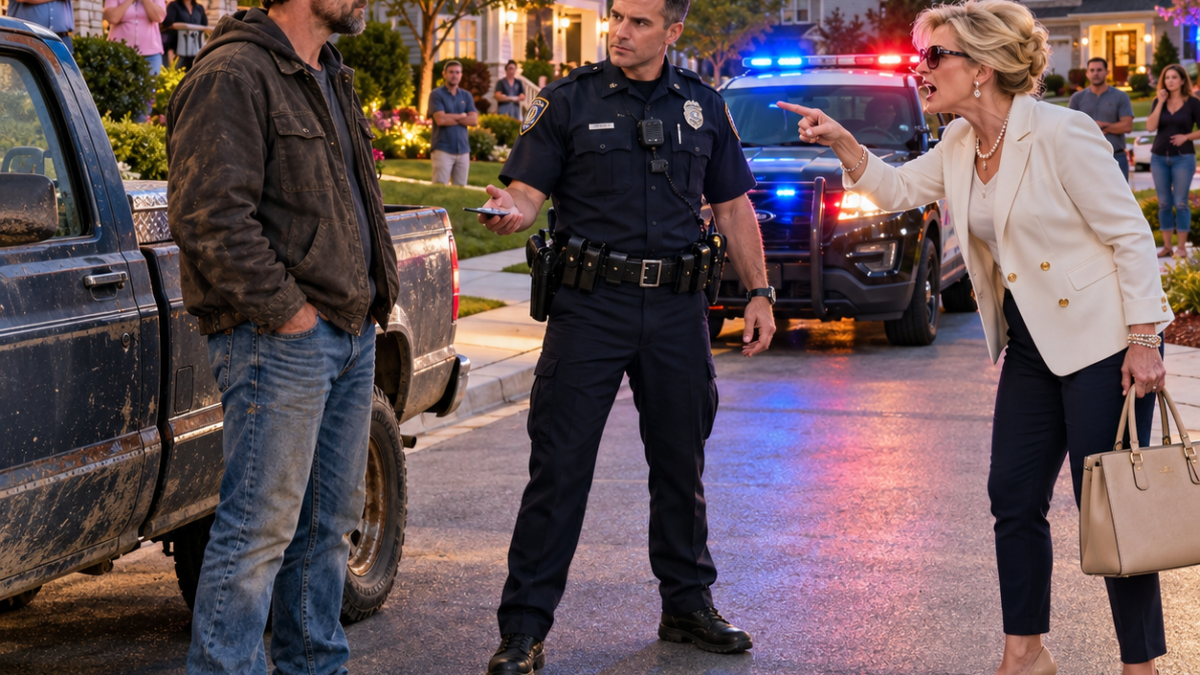
And that brought us back to the flashing patrol lights, the orange violation notice on my gate, the neighbors on their porches, and an officer walking toward Karen after spending several minutes checking my identification.
“Ma’am,” he said.
Karen immediately stepped toward him.
“Yes?”
“Can you come over here for a second?”
Her smile returned.
She assumed he wanted a private statement.
I followed from several feet away.
“I’ve verified the address,” he said. “I’ve also checked the parcel information associated with the roadway.”
Karen nodded impatiently.
“Good. Then you understand he needs to be removed.”
The officer looked at her.
“No, ma’am.”
Her expression changed.
“What?”
He asked her to confirm the HOA’s legal name.
She did.
Then he read a parcel number from his screen.
Karen stared blankly.
The officer repeated it.
“The county record lists the road as privately held property.”
“Correct,” she said quickly. “By the association.”
“No.”
The street became noticeably quieter.
Karen glanced toward me.
Then back at him.
“That isn’t right.”
“I checked twice.”
She laughed once, but there was no confidence in it.
“Our HOA controls all common areas in this neighborhood.”
“Control under an easement isn’t the same thing as ownership.”
Her husband lowered his phone slightly.
Karen’s jaw tightened.
“Who owns it, then?”
The officer turned toward me.
Then back to her.
“The holding company on the county record is registered to him.”
Karen stared at him.
Nobody moved.
The officer continued.
“The roadway, along with the listed common-area parcels, is privately owned. Your HOA has recorded operating and access rights.”
He handed my license back.
“He’s the owner.”
A woman near the mailboxes actually covered her mouth.
Karen looked at me as if I had suddenly changed shape.
“You own this road?”
“Yes.”
“The whole road?”
“And the common parcels listed in the recorded agreement.”
“That’s impossible.”
“It isn’t.”
“The board would know.”
“They should.”
She turned to the officer.
“We’ve been maintaining these roads for years.”
“I’m not disputing that. I’m telling you what the ownership record says.”
Karen’s face went completely still.
For six years she had told people where they could park, where they could walk, which contractors needed permission to enter, where delivery vehicles could stop, and which homeowners were supposedly encroaching on HOA land.
Now twenty neighbors were watching her discover that the land had never belonged to the organization she claimed to command.
She turned on me.
“You knew.”
“Yes.”
“You knew this whole time?”
“Yes.”
“And you let me call the police?”
“I didn’t make that call.”
“You could have told me!”
“I asked you who owned the road.”
She said nothing.
“I asked you directly,” I continued. “You laughed.”
Denise had moved off her porch.
Ruth was standing on her front steps with one hand gripping the railing.
Karen pointed at my folder.
“What is that?”
I opened it.
“The part you should be more worried about.”
I removed the six-hundred-dollar fence notice.
“You told me you could personally approve enforcement decisions under six thousand dollars.”
“I said the compliance committee—”
“There’s no authority for that in the bylaws.”
I placed a copy of the relevant section on top.
Then I pulled out the photographs of her storage shed.
“You fined another homeowner four hundred dollars for this exact structure.”
Her eyes moved to the photographs.
“You have one too.”
“That isn’t relevant.”
“It becomes relevant when enforcement depends on whose yard the violation is in.”
The neighbors were closer now.
Nobody was pretending not to listen.
Then I nodded toward Ruth.
“And there’s an eleven-thousand-two-hundred-dollar lien on her house that started with a four-hundred-dollar fine nobody can consistently explain.”
Karen’s face tightened.
“That is confidential HOA business.”
“Not to Ruth.”
The second officer stepped away and spoke into his radio.
Karen noticed.
“What is he doing?”
The first officer ignored the question.
Instead, he looked at her.
“When you called dispatch, you stated that this gentleman was trespassing on property belonging to the HOA and refusing to leave.”
“He was refusing my instructions.”
“That isn’t what I asked.”
“He was on the road.”
“A road you now know he owns.”
“I didn’t know that when I called.”
“That’s why we’re going to need a separate statement about exactly what you knew and what you reported.”
Her confidence finally cracked.
“This is ridiculous.”
Nobody answered.
Not me.
Not the neighbors.
Not the officers.
For the first time since I had met her, Karen had nothing she could say loudly enough to make reality change.
The fallout began almost immediately.
County staff confirmed the property records within days.
My holding company owned the road parcels and the relevant common land.
The HOA possessed easement and operational rights, exactly as the documents stated.
Karen’s claim of ownership had been wrong.
More importantly for the homeowners, the confrontation forced the board to examine everything else.
The board held an emergency meeting nine days later.
I didn’t attend.
Denise texted me afterward.
One word.
Unanimous.
Karen was removed as HOA president.
An outside review began going through compliance decisions, fine authorizations, appeal records, and enforcement procedures.
My fines disappeared first.
The mailbox violation.
The six-hundred-dollar fence penalty.
The supposed encroachment.
All voided.
The new interim board sent me a formal apology and reimbursed the cost of rebuilding the section of fence Karen’s crew had removed.
I cared less about that than I expected.
I was waiting on Ruth.
Her situation took longer.
Liens don’t disappear as quickly as orange notices.
The review had to trace years of assessments, late fees, administrative charges, shifting violation descriptions, and authorization records.
Three weeks after the police confrontation, I was walking toward the mailbox cluster when Ruth came out of her house holding an envelope.
She didn’t speak at first.
She simply held up the letter.
I knew from her face what it said.
“Released?”
She nodded.
“All of it.”
The lien had been formally removed.
Ruth looked down at the letter again.
“Eleven years I’ve lived here.”
She swallowed.
“I don’t think anyone has ever fought something for me without wanting something back.”
“I didn’t do it for you.”
She frowned.
“I did it because the record was wrong. You happened to be standing next to the truth.”
For a second she stared at me.
Then she laughed.
A real laugh.
I had never heard that sound from her before.
Other things changed more quietly.
Denise stopped looking over her shoulder when she checked her mail.
Neighbors who had barely spoken to me introduced themselves.
Homeowners started attending board meetings instead of assuming decisions had already been made.
The interim board required actual votes for enforcement actions that required them.
Violation notices had to cite specific provisions.
Appeals had to be documented.
Nobody became perfect.
The HOA didn’t disappear.
The neighborhood didn’t turn into some fantasy where everybody suddenly loved one another.
It simply became harder for one person to control the street through fear and paperwork.
As for Karen, she denied deliberately abusing her authority.
She insisted she had acted according to what she believed the HOA controlled and that she had relied on years of board practice.
Whatever investigators ultimately believed about every individual decision, one thing became impossible for her to escape.
She had never verified the ownership she repeatedly claimed.
Her 911 call also created a separate problem because the responding officers documented what she had reported and what the public records showed.
By then, however, she was no longer president.
Within two months, Karen sold her house.
A moving truck appeared one morning.
By evening, most of her furniture was gone.
Nobody gathered outside.
Nobody celebrated.
Nobody needed to.
A week later, the house was empty.
Then I heard she had moved out of the county.
Her name gradually stopped coming up.
That silence felt stranger than I expected.
For months, everything in the subdivision had somehow led back to Karen.
Karen said this.
Karen fined them.
Karen approved that.
Karen won’t allow it.
Then suddenly people started saying something else.
“What do the bylaws actually say?”
That was better.
A few weeks later, I stood at the end of my driveway on a Saturday morning with coffee in one hand.
No patrol cars.
No maintenance trucks.
No orange notice flapping from my gate.
My rebuilt fence stood exactly where the old one had stood.
The road looked ordinary.
That amused me.
It had always been ordinary.
The asphalt had never changed.
Only the story people told about who controlled it had.
I found Karen’s original violation notice in the bottom of my filing cabinet later that afternoon.
The orange paper had faded.
I had handled it so many times the folds were soft.
For a moment, I considered keeping it.
Not as a trophy.
Just evidence of how absurd the entire thing had been.
Then I remembered Ruth holding up that lien-release letter.
I remembered Denise finally speaking without lowering her voice.
I remembered the officer handing back my license while Karen stood frozen on a road she had spent six years calling hers.
The notice had done its job.
I didn’t need it anymore.
I carried it outside and dropped it into the trash.
Then I walked back toward my house.
Behind me was the same street where Karen had once pointed at my chest and ordered police to remove me for trespassing.
Nobody was watching.
Nobody was photographing my truck.
Nobody was keeping score.
And for the first time since I had moved there, the neighborhood felt exactly like what Karen had always claimed she was protecting.
A place where people could simply live.



