At 3:12 A.M., My Old Rescue Cat Pressed Her Ear to My Pregnant Belly—And What She Knew Before I Did Changed Everythin
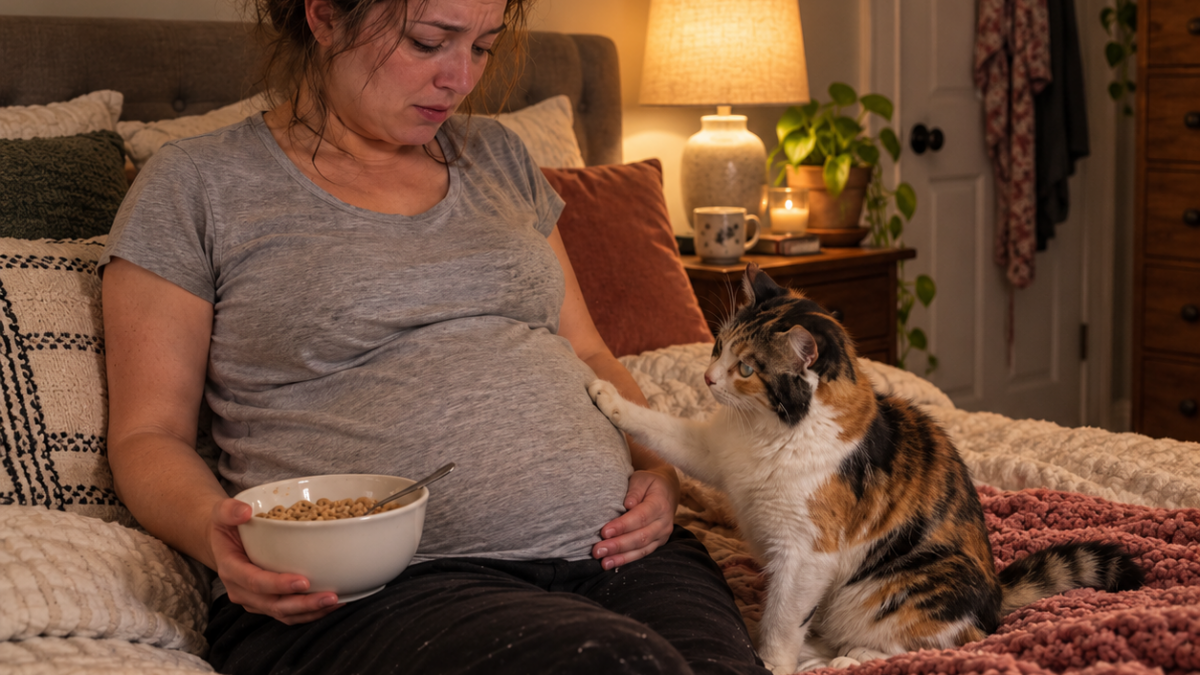
The first time Maple scared me, she wasn’t looking at my face—she was staring at my seven-month-pregnant stomach like someone inside me had called her name.
At exactly 3:12 in the morning, the old rescue cat who barely let me touch her climbed onto my bed, pressed one paw against my belly, and listened.
I thought I was watching an animal meet my unborn daughter for the first time, but what happened after that made me realize Maple had been paying attention to something I had been hiding from everyone—including myself.
I had not chosen the name Lark yet.
At that point, she was still “the baby” on medical forms, “this little girl” when I talked to her in the shower, and “please stop using my bladder as a trampoline” at two in the morning.
But Maple seemed to know her before I did.
That was the part I could not explain.
People love saying animals know things.
They know when storms are coming.
They know when someone is sick.
They know when you are sad.
They know when a woman is pregnant.
I had heard all of it.
I had smiled politely.
It sounded nice.
But there is a difference between hearing stories like that and sitting alone in a tired second-floor apartment outside Dayton, Ohio, at three in the morning watching an old calico cat press her ear against your unborn child.
I whispered, “What are you doing?”
Maple ignored me.
The baby moved once.
Maple purred.
Then everything became still.
That was the first night.
It did not become a beautiful story immediately.
Beautiful stories are usually cleaned up after people survive them.
While you are living them, they mostly feel inconvenient, frightening, expensive, embarrassing, and exhausting.
My apartment was nothing anyone would photograph for a lifestyle magazine.
The bathroom fan sounded like a lawn mower swallowing rocks.
There was a soft spot in the kitchen floor beside the sink.
Cold air came through the windows every winter no matter how many towels I rolled along the sill.
The carpet had been beige once.
Now it was the color of every apartment carpet that has survived several tenants and too many spilled drinks.
But it was mine.
That mattered.
I had lived in prettier places with other people and felt less safe.
I worked evenings at a coin laundry across the parking lot from a discount grocery store.
People came in carrying their whole lives in plastic baskets.
Work uniforms.
Baby blankets.
Sheets.
School clothes.
Once, a man washed a sleeping bag and three stuffed bears.
I cleaned lint traps.
Wiped machines.
Swept the floor.
Explained to elderly customers which washer was “the really big one.”
I kept a folding chair behind the counter for when my ankles swelled.
Customers loved asking about the baby.
“When are you due?”
“Girl or boy?”
“First one?”
Then came the question.
“Dad excited?”
That one always felt like a finger pressing into a bruise.
“It’s just us girls,” I would say.
Smile.
Turn away.
Fold something.
Most people understood.
A few did not.
Pregnant women are supposed to arrive with a complete picture around them.
A partner.
A decorated nursery.
A baby shower.
A registry.
A framed ultrasound photograph.
A hand resting lovingly over theirs.
I had a secondhand crib from a yard sale.
Two packs of diapers beside the couch.
A borrowed infant car seat.
And a sheet of notebook paper taped to the refrigerator.
THINGS TO BUY BEFORE BABY.
I crossed off one item every payday.
I tried not to count the ones left.
I did not go to the animal shelter intending to adopt anything.
It was raining.
That was the glamorous reason.
The shelter was beside the grocery store, and my bus was twenty minutes away.
I was seven months pregnant and did not want to stand in cold rain.
So I walked inside.
The kittens were in the front.
They climbed their cage doors.
Chirped.
Reached through bars.
A little gray one sneezed and three adults made the sound grown people only make around babies and animals.
Maple was in the last enclosure.
She sat in the back.
Not hiding exactly.
Just making no effort whatsoever.
Her card read:
MAPLE
FEMALE
SENIOR
QUIET HOME PREFERRED
That was it.
She looked at me.
I looked at her.
No music played.
No paw came through the bars.
No magical connection happened.
A volunteer approached.
“She’s sweet,” she said. “But she takes time.”
That phrase got me.
She takes time.
So did I.
So did the little girl growing inside me.
So did the life I was trying to build without knowing what I was doing.
“Can I meet her?”
The volunteer took Maple into a visiting room.
Maple ignored me.
She inspected a baseboard.
Smelled the chair.
Sat under a bench.
Washed one paw.
The volunteer looked apologetic.
“She’s not really a lap cat.”
“I’m not really a people person lately.”
Maple stopped licking her paw.
She looked at me.
That was it.
That was the closest thing to a sign I got.
I signed the papers.
Maple complained through the entire bus ride home in a low, rusty voice.
When I opened the cardboard carrier in my apartment, she walked behind the couch.
She stayed there for five hours.
I sat on the floor eating peanut butter toast.
“Same,” I told her.
For the first few weeks, we were roommates.
I filled her bowl.
She waited until I left before eating.
I cleaned the litter box.
She judged me from the hallway.
She slept in my laundry basket.
I slept surrounded by four pillows like I was building a fort against pregnancy.
Then came that first 3:12 morning.
And after that, it happened again.
Two nights later, Maple climbed onto my bed.
She put one paw against my stomach.
The baby moved.
Maple lowered her head.
Three nights after that, she did it again.
Then again.
Soon it was happening almost every night.
Always around the same hour.
Sometimes 3:10.
Sometimes 3:14.
But close enough that I started waking before she arrived.
I would lie there waiting.
Then I would hear the soft thump of her jumping down from the laundry basket.
Her slow paws crossing the floor.
The small grunt she made while pulling herself onto the mattress.
Then that warm ear against my skin.
The baby always responded.
One movement.
Sometimes two.
Then calm.
I started joking about it.
“Well,” I whispered one night, “I guess your meeting is starting.”
Maple ignored me.
The baby rolled.
“You two know I’m technically in charge here?”
Neither reacted.
“Good talk.”
Another night, I whispered, “She’s not even born and she already has a better friend than I do.”
Maple opened one eye.
Her expression said that was definitely my problem.
By eight months, I had chosen the name Lark.
I found it in a used book sitting in a fifty-cent box outside the laundromat.
I liked the word.
Small.
Bright.
Something that could rise.
I started saying it while washing dishes.
“Lark, please let me keep this sandwich down.”
“Lark, my ribs are not playground equipment.”
And most often:
“Lark, we’re going to be okay.”
I said that one so often I nearly convinced myself.
Maple became stranger as the pregnancy progressed.
She started following me.
Not close.
Never close.
Exactly three or four feet behind me.
She watched me brush my teeth.
Watched me put on shoes.
Waited outside the bathroom.
If I stood too quickly, she made a sharp sound.
If I dropped something, she ran over to inspect the situation.
Once, I sat on the kitchen floor crying because I could not open a jar of pasta sauce.
That sounds ridiculous.
At the time, it felt like the end of the world.
I had worked nine hours.
My back hurt.
I was hungry.
I was tired.
The jar would not open.
I tried a dish towel.
Hot water.
A butter knife.
Nothing.
Then I dropped onto the floor and cried.
Maple entered.
She looked at me.
Then at the jar.
Then back at me.
She sat beside my knee.
She did not touch me.
She just stayed.
It helped anyway.
That was the first thing Maple taught me about comfort.
Sometimes the person—or animal—who helps you does not solve anything.
They simply refuse to leave while it hurts.
By thirty-six weeks, sleep barely existed.
I propped myself upright with pillows and dozed in pieces.
Then one night, I woke before Maple came.
I checked the clock.
3:11.
Nothing.
3:12.
Still nothing.
I sat up.
“Maple?”
A low sound came from the hallway.
Not a meow.
Not a hiss.
Something between a growl and a cry.
“Maple?”
I pushed away the blanket.
When I stood, a cramp pulled across my lower back.
I stopped.
Breathed.
Pregnancy had taught me to sort pain into categories.
Normal.
Annoying.
Ask the doctor tomorrow.
This one felt like Annoying.
Maple stood near the front door.
Her back was slightly arched.
Her eyes were fixed on me.
“What?”
She made that sound again.
I stepped toward her.
Warm liquid ran down my leg.
For one second, I stared at the floor without understanding.
Then I understood.
“Oh.”
Such a small word.
Maple walked toward me.
Then toward the front door.
Then back.
Another pain came.
Lower.
Sharper.
I grabbed the couch.
Maple rushed over and bit the bottom of my nightshirt.
Not hard.
Just enough to pull.
“Okay.”
I breathed.
“Okay. I’m moving.”
The next hour came in pieces.
Hospital bag.
Phone.
Shoes.
Wallet.
A ride.
Elevator.
Bright hallway.
Paper bracelet.
Questions.
How far apart?
Any bleeding?
Thirty-six weeks?
First baby?
Anyone with you?
That question.
Anyone with you?
“No.”
The nurse looked up.
Then I said, “I have a cat.”
She smiled because she thought I was joking.
I wasn’t.
I kept thinking about Maple while nurses moved around me.
I had filled her water bowl.
Her food was only half full.
I had left the bathroom door open.
She could reach the litter box.
But I had not said goodbye.
That bothered me more than logic said it should.
Labor makes the world very small.
Breathing.
Pressure.
Pain.
The sound of someone saying, “You’re doing great.”
I hated that sentence.
I did not feel great.
I felt like something larger than courage had taken over my body and forgotten to ask permission.
I kept looking at the empty chair beside the hospital bed.
For months, I had told myself I did not need anyone.
I can do this.
Women do this every day.
I am not the first single mother.
I am fine.
But somewhere during labor, “fine” became too heavy to carry.
I wanted my mother.
We had not spoken properly in months.
That was another story I had stored somewhere I did not like opening.
I wanted a hand.
Someone who knew my face well enough to tell when I was lying.
Instead, I had nurses.
Kind ones.
Professional ones.
Strangers.
At one point, between contractions, I asked for my phone.
My hands shook while I opened the cheap camera app I had installed after adopting Maple.
The picture loaded.
Then I saw her.
Maple was lying in Lark’s crib.
I stared at the screen.
She had never climbed inside it.
Not once.
The crib had been standing in the nursery corner for two weeks.
Maple had sniffed it.
Ignored it.
Now she was curled in the center of the bare mattress.
She was not asleep.
She faced the apartment door.
Waiting.
The nurse noticed me crying.
“Everything okay?”
I turned the screen toward her.
She smiled.
“Looks like somebody knows.”
I cried harder.
Not loud.
Just tears slipping into my hair while another contraction built.
“She’s waiting,” I whispered.
The nurse squeezed my shoulder.
Maybe she thought I meant Lark.
I meant both of them.
Lark was born at 10:48 that morning.
Five pounds, six ounces.
Tiny.
Red-faced.
Furious.
Perfect.
When I heard her cry, something in me broke apart and rearranged itself.
One second, I was Rachel.
The next, I was someone’s mother.
They placed her against my chest.
She was warm.
Wet.
Smaller than every fear I had carried for eight months.
“Hi.”
That was all I could say.
Hi.
Like we had met at a coffee shop.
Her crying softened when she heard my voice.
“Hi, Lark.”
Her eyes stayed closed.
Her mouth trembled.
She made a tiny sound.
I thought of Maple pressing her ear against my belly.
You already know each other.
Then I told myself that was ridiculous.
Then I decided I did not care.
The next three days were feeding, blood pressure checks, forms, soreness, advice, and sleep measured in minutes.
Lark did well.
Small, but strong.
Every night, I opened the camera.
Maple remained near the crib.
Sometimes inside.
Sometimes underneath.
Once she walked to the kitchen, ate a little, and returned immediately.
When Lark cried in the hospital, I would settle her and then check the camera.
More than once, Maple was sitting upright at that exact time, staring toward the apartment door.
I knew logical explanations existed.
Cats like new furniture.
Cameras lag.
New mothers are emotional.
Coincidences happen.
I knew all of it.
I also knew what I saw.
On the third afternoon, they let us go home.
Lark wore a yellow sleeper too big for her legs.
The drive back felt unreal.
Outside, nothing had changed.
People pumped gas.
Cars waited at lights.
A man walked across a parking lot carrying groceries.
I wanted to lower the window and shout, “Don’t you understand? She’s here.”
But of course they didn’t.
That is the strange thing about having a baby.
Your world ends and begins again.
Everyone else keeps ordering coffee.
When I opened my apartment door, Maple did not appear.
My heart jumped.
“Maple?”
Nothing.
Then she appeared at the hallway entrance.
She stopped.
Her nose lifted.
I brought Lark inside in her car seat.
Maple approached slowly.
One careful step.
Then another.
Lark slept with one fist against her cheek.
Maple sniffed the blanket.
Then she backed away.
I waited.
Some embarrassing part of me expected magic.
A dramatic recognition.
A beautiful moment.
Maple turned around and left.
I felt stupidly disappointed.
Thirty seconds later, she came back.
She carried a brown toy mouse in her mouth.
The ugly one she never played with.
She walked to the car seat.
Dropped the mouse beside Lark.
Then Maple went to the hallway.
She sat facing the apartment door.
Her back toward us.
Guarding.
That was her welcome.
Not cuddles.
Not kisses.
A dead toy mouse and a security shift.
I cried anyway.
Our first night home was terrible.
People say magical.
Precious.
Soak it in.
Yes, there were precious moments.
Lark sleeping against my chest.
The smell of her hair.
Her tiny hands opening and closing.
But mostly, that first night was fear.
Every sound terrified me.
Every silence terrified me more.
I checked whether she was breathing until my eyes hurt.
I fed her.
She cried.
Changed her.
She cried.
Rocked her.
She screamed.
At 2:40 in the morning, I was on the living room floor in my robe, Lark against my shoulder, crying into the top of her head.
“I don’t know what you need.”
Lark screamed harder.
“I’m sorry.”
Maple sat under the coffee table.
“Don’t judge me.”
She blinked.
“Seriously. Not tonight.”
Lark’s cry became sharper.
My nerves felt exposed.
Then Maple stood.
She walked onto the blanket beside us.
Not close enough to touch Lark.
Just near.
She tucked her paws beneath her.
And started purring.
Low.
Rough.
At first, I barely heard it.
Then the sound deepened.
Lark’s crying broke.
One breath.
Another.
Maple kept purring.
Lark whimpered.
Then her body softened.
Minutes later, she was asleep.
I did not move.
My arms hurt.
My robe smelled like spit-up.
My apartment looked like someone had shaken a baby store upside down.
And my old, difficult, not-a-lap-cat cat had just done the thing I could not.
She had brought quiet.
“Thank you,” I whispered.
Maple closed her eyes.
Lark slept almost three hours.
I did not.
I sat there watching them.
My daughter against my chest.
My cat on the floor.
Two small creatures breathing in the dark.
And for the first time since seeing the positive pregnancy test, something inside me loosened.
Not all the fear.
Not the money problems.
Not the exhaustion.
But enough.
The weeks that followed were difficult.
Beautiful.
Difficult.
Both things were true.
I wish more people allowed both things to be true.
Lark had trouble sleeping unless someone held her.
She ate slowly.
Every evening, she screamed as if six o’clock had personally offended her.
I learned to perform nearly every task with one hand.
Toast.
Laundry.
Mail.
Coffee.
Crying.
Maple learned Lark’s sounds before I did.
Hungry.
Wet diaper.
Overtired.
Angry about being alive.
If Lark made a tiny sound in the bassinet, Maple’s head lifted.
If I did not react fast enough, Maple came to find me.
One short meow.
Sharp.
Disappointed.
Like a supervisor informing an employee that standards had slipped.
At first, it annoyed me.
Then I realized what she was doing.
She was giving me a head start.
Twenty seconds mattered.
Twenty seconds could mean getting to Lark before she went from fussing to screaming.
It could mean finding a bottle.
A burp cloth.
A chair.
My own patience.
Maple never became a storybook cat.
She did not sleep curled around Lark.
She never climbed into the bassinet.
She did not lick the baby’s head.
She kept distance.
Two feet.
Three feet.
Always nearby.
In the doorway.
Under the chair.
At the foot of the crib.
Watching.
When Lark was six weeks old, I took a photograph.
Lark lay on a quilt on the floor.
Maple sat two feet away.
Not facing Lark.
Facing the room.
Guarding.
I posted it with two words.
My girls.
A woman I barely knew commented:
“That cat looks like she has seen things.”
I laughed.
Then I cried.
Because she did.
Maybe not dramatic things.
Maybe simply enough homes that almost became hers.
Enough people walking away.
Enough doors closing.
Enough hands reaching out and then disappearing.
I understood that.
There is a particular kind of shame in feeling hard to keep.
Even when the reasons are not your fault.
Even when people tell you they had their reasons.
A person can still begin wondering what part of them made leaving so easy.
Maybe that was why Maple and I understood each other.
Neither of us demanded performance.
At my six-week postpartum appointment, a woman in the waiting room looked at Lark.
“She’s beautiful.”
“Thank you.”
“Enjoy every second. It goes so fast.”
I smiled.
That is what mothers are trained to do.
But inside, I thought:
I am not enjoying every second.
Some seconds are terrifying.
Some smell like sour milk.
Some happen after forty minutes of sleep.
Some make me miss my old life so badly that I feel guilty for remembering I ever had one.
I loved Lark more than anything.
I also missed sleeping.
Hot coffee.
Quiet.
Leaving home with only keys and a wallet.
I missed myself.
Then I hated myself for missing her.
No one told me that total love and total exhaustion could exist in the same body.
Or maybe they did.
Maybe I had not believed them.
By two months, I knew how to look okay.
“How are you doing?”
“Good.”
“Sleeping?”
I laughed.
“Getting there.”
“Have support?”
“We’re managing.”
We.
Me.
Lark.
An old cat with one cloudy eye.
Most days, “managing” was true.
Some days, it was not.
The worst time was 3:12.
After Lark was born, I still woke at that hour.
Even when she slept.
My eyes would open.
My heart would be racing.
All the worries I had pushed away during daylight climbed into bed.
Rent.
Diapers.
Childcare.
Work.
Was Lark breathing?
Was I enough?
Would she hate me someday?
Would I become one of those exhausted mothers whose children learn to read moods before entering a room?
Would Maple get sick?
What happened if I lost my job?
What happened if I failed?
I would lie there silently, trying not to wake Lark.
Then Maple would come.
She no longer went to my stomach.
She climbed onto my chest.
Nine pounds of cat can hold a person down surprisingly well if placed correctly.
She rested directly over my sternum.
Then purred.
The vibration traveled through my ribs.
“I’m okay,” I whispered the first several nights.
Maple did not believe me.
She stayed.
When my breathing slowed, she left.
Job finished.
Back to the laundry basket.
For months, I told myself Maple’s strange behavior was about Lark.
That was the sweet version.
The easy version.
People like stories about animals loving babies.
They know how to react.
“Aww.”
“How adorable.”
“She knew!”
People are less comfortable with stories about new mothers sitting on bathroom floors with the fan running so nobody can hear them cry.
So I kept that part quiet.
Even from myself.
Spring arrived slowly.
Ohio spring is mud and false promises.
One warm afternoon.
Then five days of cold rain.
Eventually, though, the trees outside my window turned green.
Lark’s cheeks filled out.
She smiled.
The first time she smiled at me, I felt forgiven for mistakes she did not even know I had made.
Maple became more tolerant.
Lark discovered her hands.
Then she discovered Maple.
I supervised every interaction.
“Gentle.”
Lark had no idea what that meant.
Maple did.
She tolerated one clumsy touch.
Then moved.
No swatting.
No drama.
Just distance.
Boundaries.
When Lark was four months old, she laughed for the first time.
A real laugh.
Maple sneezed.
That was all.
She walked toward Lark’s blanket.
Sniffed.
Sneezed.
Lark exploded.
Her mouth opened.
Her whole body shook.
I laughed because she laughed.
Maple looked personally insulted.
That made Lark laugh harder.
I tried to grab my phone.
Too late.
The best moments are rude that way.
They happen before you can turn them into evidence.
But I remember everything.
Lark’s open mouth.
Maple’s offended expression.
Sunlight through bent blinds.
My own laugh sounding rusty after months of disuse.
That afternoon, I realized I had gone almost an hour without feeling afraid.
An hour sounds small.
Unless it is your first one in months.
Lark rolled.
Sat.
Crawled.
Pulled folded towels out of baskets while Maple watched with professional disgust.
I returned to work part-time.
Leaving Lark with a sitter felt like walking outside without skin.
I checked my phone every few minutes.
Nothing terrible happened.
Life simply continued.
Slow.
Expensive.
Imperfect.
Maple began sleeping outside Lark’s room.
Right beside the door.
Like an elderly security guard.
Sometimes I came home late and found her there.
“Still working?”
Tail flick.
“Union break?”
Nothing.
“Good talk.”
When Lark was eight months old, she got her first fever.
Nothing medically dramatic.
But the first fever does something to a mother’s brain.
I checked her temperature too often.
Held her.
Changed damp pajamas.
Sang terribly.
Maple stayed under the crib.
At 3:12, I sat in the rocking chair with Lark against my chest.
Her skin was too warm.
Her nose was stuffy.
Maple climbed onto the ottoman.
I almost stopped her.
She had not made that jump in weeks.
Her back legs were getting stiff.
But she reached the top.
She sat facing us.
Then purred.
Lark’s fingers relaxed against my shirt.
Her breathing slowed.
I closed my eyes.
“You knew her before I did, didn’t you?”
Maple blinked.
For a moment, I liked that thought.
Then something about it bothered me.
I had known Lark.
I had carried her.
Felt every kick.
Every hiccup.
Whispered to her in the shower.
But Maple had known her differently.
Not as a future.
Not as an idea.
As rhythm.
Movement.
Heartbeat.
Warmth.
Maybe that was all those nights had been.
Not magic.
Something simpler.
And somehow, something more beautiful.
Two living creatures recognizing one another before language entered the room.
When Lark was ten months old, I almost gave Maple back.
I hate that sentence.
But honest stories need ugly parts.
Maple had begun missing her litter box.
Not often.
Enough.
One night, I came home from a long shift.
Lark was crying.
The apartment was hot.
My back hurt.
I found another mess beside the litter box.
I cleaned it.
Then Lark screamed from the crib.
Something inside me snapped.
“I CAN’T DO THIS!”
The sound frightened Lark.
Her cry changed.
That immediately broke me.
I dropped the paper towels.
Covered my face.
Maple stood in the hallway.
She looked old.
Not magical.
Not wise.
Old.
Her hips were thinner.
Her cloudy eye was worse.
She hesitated before jumping.
For one terrible second, I thought:
I cannot take care of everyone.
Then:
That is horrible.
Then:
I cannot take care of everyone.
The next morning, I looked up the shelter’s phone number.
I did not call.
I only stared at it.
I told myself maybe Maple needed someone who could afford more.
Someone with more time.
A bigger apartment.
Less chaos.
Those things were partly true.
They were also excuses that made my exhaustion sound noble.
Maple sat by the window.
Lark banged a spoon against a plastic bowl.
Life continued around my quiet betrayal.
That afternoon, Lark and I went for a walk.
When we returned, Maple was not at the door.
She usually waited.
Not because she loved welcoming me.
Because she believed every person entering the apartment required inspection.
“Maple?”
Nothing.
Bedroom.
Bathroom.
Behind the couch.
Laundry basket.
Nursery.
Nothing.
Then I saw the kitchen window.
Open slightly.
The screen had come loose at one corner.
My stomach dropped.
“Maple!”
I ran downstairs barefoot carrying Lark.
The pavement was damp.
Cars passed on the road.
“MAPLE!”
I searched bushes.
Dumpsters.
Under cars.
Around the laundry building.
One hour.
Two.
Nothing.
Lark cried.
I cried.
I taped a handwritten sign beside the mailboxes.
SENIOR CALICO CAT.
ONE CLOUDY EYE.
BOTH EARS WHOLE.
PLEASE CALL.
No photograph.
My printer had stopped working weeks earlier.
I returned upstairs.
The apartment felt enormous.
Maple’s bowl.
The ugly brown mouse.
The hollow in the laundry basket.
Then I saw my phone.
The shelter number was still open.
I sat on the kitchen floor.
I pressed my face against Lark’s hair.
“I didn’t mean it.”
But I had.
For a few exhausted minutes, I had wanted Maple gone.
That was true.
Love did not erase those minutes.
Maybe love was what happened after them.
At 3:12 that night, my eyes opened.
Lark slept.
The room was silent.
Maple did not come.
For the first time in almost a year, 3:12 arrived without her paws.
I broke.
I cried for Maple.
For Lark.
For myself.
For every animal nobody chose.
For every mother awake somewhere pretending she was grateful enough not to be drowning.
Then I heard a sound.
Scratch.
Very faint.
At the front door.
I sat up.
Scratch.
I ran into the hallway so fast my shoulder hit the wall.
I opened the door.
Maple sat on the mat.
Wet.
Dirty.
Furious.
Alive.
She stared at me.
Then gave one hoarse meow that sounded exactly like a formal complaint.
I dropped to my knees.
Every part of me wanted to grab her.
I knew better.
I held out my hand.
Maple sniffed my fingers.
Then walked past me.
No emotional reunion.
No gratitude.
She marched inside like she had simply returned from an appointment.
Lark woke and cried.
Maple stopped.
She looked toward Lark’s room.
Then looked at me.
And I finally saw it.
The thing I had almost surrendered.
Not a pet.
Not a story.
Family.
“I’m sorry.”
Maple walked away.
Fair.
The next morning, I made changes.
Not dramatic changes.
Real ones.
I moved the litter box somewhere easier for Maple to reach.
Bought a cheap washable mat.
Asked a neighbor for help with groceries.
Accepted an extra hour from the sitter when she offered.
Called my mother.
That one took almost twenty minutes of staring at the phone.
She answered on the fourth ring.
“Rachel?”
Just hearing her voice made me cry.
There was history between us.
Pride.
Arguments.
Things neither of us had apologized for.
That day, I did not have energy for any of it.
“I’m tired, Mom.”
Silence.
Then her voice softened.
“I know.”
“No, I mean really tired.”
Another silence.
“I know that kind too.”
We did not repair everything that afternoon.
Real relationships rarely repair themselves in one phone call.
But we opened a door.
That mattered.
I stopped saying “we’re good” every time somebody asked.
Sometimes I said, “We’re hanging in.”
Sometimes:
“Today is rough.”
Nothing terrible happened when I admitted that.
Nobody came to take Lark away.
Nobody announced that I had failed motherhood.
People sometimes helped.
A ride.
Groceries.
Forty minutes holding Lark while I showered.
Tiny pieces.
They added up.
Maple returned to her 3:12 routine.
At Lark’s first birthday, I made cupcakes from a box.
Burned the first batch.
Lark got frosting in her hair.
Maple sat beneath the high chair collecting crumbs like a queen receiving tribute.
I took a photograph.
The apartment looked terrible in the background.
Laundry.
Mail.
An open cabinet.
I used to hate photographs like that.
I wanted evidence that I had control.
Now it is one of my favorite pictures.
Because we were all there.
That was enough.
When Lark learned to walk, Maple became her slow shadow.
Not under her feet.
Nearby.
If Lark reached for the cleaning-supply cabinet, Maple somehow ended up sitting in front of it.
If Lark grabbed for Maple’s tail, Maple moved precisely six inches beyond reach and stared at me.
Your employee requires supervision.
If Lark fell, Maple watched.
If Lark cried hard, Maple purred.
Always.
That purr became part of our house.
Low.
Rough.
Steady.
Sometimes Lark lay on the rug beside Maple and pressed her face close.
“Do you hear it?” I asked.
Lark slapped the carpet.
Maple purred louder.
I wondered if Lark’s body remembered that sound.
Not consciously.
Not like a picture.
Maybe like the way a song feels familiar before you remember where you heard it.
Like safety having a frequency.
Lark’s first word was not Mama.
I wish I could say it was.
Her first clear word was “Ma.”
For two full days, I believed she meant me.
Then she crawled toward Maple.
“Ma.”
Maple looked at me.
I looked at her.
“Well,” I said. “That’s humiliating.”
Eventually, Lark called me Mama.
Maple remained Ma for a while.
I learned not to mind.
Motherhood was not a contest.
Love did not become smaller because it had somewhere else to go.
It built more rooms.
When Lark was fifteen months old, I finally understood what Maple had been doing all along.
It happened on an ordinary Tuesday.
No storm.
No emergency.
No dramatic music.
I had worked.
Picked Lark up.
Fed her.
Bathed her.
Cleaned applesauce off the wall.
Stepped on a wooden block hard enough to invent several new words.
By nine, Lark slept.
Maple lay on the rug.
I sat on the couch.
I was not sleepy.
I was tired somewhere deeper.
I had been doing better.
Much better.
But “better” is not the same as “finished.”
That night, an old thought returned.
Quietly.
Lark would be better off with someone stronger.
I want to be precise about what that meant.
I did not want to leave.
I loved Lark.
I wanted our life.
I was simply tired of feeling like I was the only wall standing between my daughter and everything that could hurt her.
I covered my face.
I breathed.
Maple stood.
She crossed the room slowly.
By then, jumping onto the couch had become difficult.
She put both front paws on my shin.
Looked up.
I lifted her.
Maple settled directly on my chest.
Just as she had done during those 3:12 mornings.
Her purr started immediately.
Against my heart.
And suddenly I understood.
All this time, I had been telling the story wrong.
I said Maple heard Lark before Lark was born.
That was true.
But Maple had been listening to two hearts.
Lark’s.
And mine.
Maple had noticed my breathing.
My heart racing.
My crying.
My sleepless nights.
She had recognized the moments when I began disappearing inside myself.
She had not only been guarding my baby.
She had been guarding me.
The mother.
The person everybody asked to be strong because a tiny human needed her.
The person everyone assumed would be okay because she loved her child.
I pressed my face into Maple’s fur.
I cried.
This time, I did not apologize.
I did not tell myself I was ungrateful.
I did not compare my pain to people who had more.
Pain does not disappear because someone else hurts worse.
Loneliness does not become imaginary because a baby sleeps in the next room.
Maple stayed.
Her purr did not solve anything.
It did not pay rent.
It did not wash bottles.
It did not magically transform me into the mother I thought I was supposed to be.
It gave me something smaller.
A steady sound to follow back to myself.
That night, smaller was enough.
Sometimes enough is a miracle.
After that, I began telling the story differently.
Not to everyone.
Some people only wanted the cute version.
The cat.
The belly.
The crib.
The baby.
That was okay.
Cute things matter.
But one evening at the laundromat, a young woman came in with a baby strapped to her chest.
Dark circles under her eyes.
Laundry piled so high she could barely see over the basket.
I recognized her face.
Not her specifically.
The face.
Someone asked how motherhood was treating her.
She gave the required smile.
“Great.”
Later, while she loaded a dryer, I said quietly, “Some days are really hard.”
She stopped.
Looked at me.
I saw her eyes fill immediately.
“I thought I was the only one.”
That sentence should break everyone’s heart.
I thought I was the only one.
The only one scared.
The only one who misses who she used to be.
The only one who loves her child and still wants twenty minutes where nobody touches her.
The only one whose home looks chaotic.
The only one whispering, I can’t do this, then getting up and doing it anyway.
I told her about Maple.
Not everything.
Just the 3:12 part.
“My cat used to wake up, climb onto my chest, and purr until my breathing slowed.”
The woman laughed through tears.
“I need your cat.”
“You’re going to have to fight my toddler for her.”
For the first time, saying the truth out loud did not feel like failure.
It felt like revenge.
Not revenge against a person.
Against every expectation that had made me ashamed.
Against every question that implied a family was incomplete without the right picture around it.
Against every cheerful phrase that made exhausted mothers feel guilty for struggling.
The best revenge I could give the life that had tried to convince me I was not enough was to stop hiding.
I was still there.
Lark was thriving.
Maple was still judging everyone.
We were not the family people expected.
We were a family anyway.
Maple got older.
Lark got faster.
Bills continued arriving with insulting consistency.
Some nights dinner was scrambled eggs.
Some mornings I found my coffee in the microwave four hours after making it.
But I stopped measuring my life against some imaginary version of what it should have been.
No smiling husband in a doorway.
No perfect white nursery.
No spotless kitchen.
No coordinated pajamas.
We had a sagging brown couch.
A juice stain.
A toddler who called crackers “cacks.”
An old cat who disliked almost everyone.
A mother learning that being strong did not mean being silent.
Small.
Odd.
Real.
Maple’s favorite place eventually moved from the laundry basket to a folded quilt beneath the window.
Lark brought offerings.
Blocks.
Stuffed animals.
Socks.
Once, half a banana.
I stopped that one.
Maple accepted everything else with royal boredom.
Then, when Lark was two, something happened that stopped me in the doorway.
Maple lay in a patch of afternoon sun.
Lark knelt beside her.
Very carefully, Lark lowered her head.
And pressed her ear against Maple’s side.
Exactly the way Maple had pressed her ear against my pregnant belly.
I forgot how to breathe.
Lark listened.
Maple purred.
“Sound,” Lark whispered.
I covered my mouth.
“Ma sound.”
Maple’s purr grew louder.
Some circles close with applause.
Others close so softly you almost miss them.
That evening, I sat beside Maple after Lark went to sleep.
Her fur had thinned.
Her cloudy eye had become almost completely white.
She moved carefully now.
I stroked the top of her head.
She allowed it.
“You did good.”
Maple slow-blinked.
I had read that slow blinking meant trust.
Maybe that is true.
Maybe humans need translations for things animals have always communicated perfectly well.
I blinked back.
The following winter was harder on her.
She stopped jumping entirely.
I put small steps beside my bed.
She pretended to hate them for three days.
Then used them every night.
At 3:12, she still came.
Not every night anymore.
Enough.
Sometimes Lark woke too.
One morning, around three, I found my daughter standing in the hallway wearing footed pajamas.
“Where Ma?”
“Right here.”
Lark climbed into my bed.
Maple settled between us.
My daughter placed one little hand against Maple’s back.
“Purr.”
“Yeah.”
“Ma happy?”
I looked at Maple.
“I think so.”
Lark considered that.
“Mama happy?”
That question surprised me.
Two-year-olds do that.
They drive toy trucks into walls for twenty minutes, then suddenly ask something capable of breaking your heart.
I looked at my daughter.
At Maple.
At the apartment.
At the life that looked nothing like the one I once thought I needed.
“Yeah.”
I kissed Lark’s forehead.
“Mama’s happy.”
Not every minute.
Not perfectly.
But enough.
For once, enough did not feel like settling.
It felt enormous.
When Lark turned three, Maple slowed dramatically.
I noticed first because she stopped meeting us in the kitchen every morning.
Then she ate less.
I told myself she was tired.
Changed food.
Warmed it.
Mixed in things she liked.
Then one morning, she did not stand when Lark brought her a stuffed rabbit.
My stomach knew before my mind agreed.
I took her to the veterinarian.
Lark came with me.
Maple sat inside the carrier complaining quietly.
The vet examined her.
Bloodwork.
More tests.
Then the conversation nobody who loves an old animal ever wants.
Kidneys.
Age.
Decline.
Comfort.
Time.
“How much?”
I hated how my voice sounded.
The veterinarian gave me the only honest answer.
“We don’t know.”
Weeks.
Maybe months.
I looked at Maple.
She looked annoyed by the table.
Of course she did.
Lark tugged my sleeve.
“Ma home?”
“Yes.”
That was all that mattered that afternoon.
We took her home.
I moved her food closer.
Her water.
A lower litter box.
The folded quilt beneath the window became her world.
Lark adapted without anyone teaching her.
She stopped bringing hard toys.
Only soft ones.
She learned not to grab.
Not to climb.
She sat beside Maple and told her stories.
Long toddler stories.
Half of them incomprehensible.
Maple listened.
As she always had.
One night, I woke at 3:12.
Exactly.
I looked toward the little steps beside my bed.
Empty.
My heart started pounding.
I went into the living room.
Maple lay on the quilt.
Awake.
I sat beside her.
“Couldn’t make it tonight?”
Her good eye opened.
I lifted her carefully.
For all the years Maple had lived with me, she had never really liked being held.
That night, she did not resist.
I carried her to bed.
Set her beside me.
She slowly moved one paw onto my chest.
Then she purred.
Faint.
Rough.
The same sound.
My eyes filled.
“No.”
The word escaped before I could stop it.
Maple blinked.
“I’m not ready.”
She put her head down.
“I know that’s selfish.”
Purr.
“You have been carrying this family since before Lark was even born.”
Purr.
I laughed through tears.
“You’re nine pounds. That seems unreasonable.”
Her eye closed.
I kept one hand against her side until sunrise.
Lark entered the bedroom in the morning.
“Ma?”
Maple opened her eye.
Lark climbed up carefully.
She pressed her ear against Maple’s ribs.
“Sound,” she whispered.
The purr came again.
Quiet.
Lark smiled.
“Ma sound.”
That afternoon, Maple ate a little.
She had better days after that.
Enough that I convinced myself we had more time.
Then worse days.
Then better.
Old age teaches people a cruel rhythm.
Hope.
Fear.
Relief.
Fear again.
I started photographing ordinary things.
Maple in sunlight.
Maple ignoring Lark.
Maple asleep beside an ugly toy mouse.
Maple’s paw.
Her white chin.
Her two perfect ears.
Not because I wanted to turn every moment into a memory.
Because I had learned the best moments are often the ones we fail to recognize while they are happening.
One Sunday morning, my mother visited.
That deserves explanation.
Our phone calls had slowly become visits.
The first one was awkward.
Then less awkward.
She held Lark.
Washed dishes.
Sat beside Maple.
At some point, my mother said, “I should have been here sooner.”
I froze.
There were a hundred answers available.
Yes.
Why weren’t you?
You hurt me.
I needed you.
Instead, I said, “Yeah.”
She cried.
So did I.
Some wounds require speeches.
Others begin healing with one honest word.
Maple watched from the quilt.
Of course she did.
That cat had spent years supervising every repair in my life.
One night, months after the vet first warned me, Maple refused dinner.
Then breakfast.
I knew.
I called.
My mother came for Lark.
I carried Maple to the car wrapped in the towel she used to sleep on in the laundry basket.
The veterinary room was quiet.
The doctor explained everything.
I heard half of it.
Maple lay in my lap.
My difficult cat.
My cat who hated laps.
She stayed.
I bent over her.
“You remember that first night?”
Her eye was half closed.
“You scared me.”
My voice broke.
“You kept staring at my stomach like Lark owed you money.”
A tiny vibration against my hand.
Maybe a purr.
Maybe I imagined it.
“I thought you were listening to her.”
I wiped my face.
“You were listening to both of us, weren’t you?”
Maple breathed.
Slowly.
I pressed my forehead against hers.
“I’m okay now.”
That was the lie I needed her to believe.
Then I corrected myself.
“No. That’s not true.”
I smiled through tears.
“I know how to ask for help now.”
That felt more honest.
“I know how to tell the truth.”
Maple’s paw moved against my wrist.
“And Lark knows what safety sounds like.”
I kissed her head.
“You can stop working.”
Those were the hardest words I have ever spoken.
“You can rest.”
Maple died with my hand against her side.
There was no dramatic sign.
No final miracle.
Her breathing simply stopped.
The room became impossibly quiet.
I had spent years fearing silence.
That silence was different.
It was absence.
When I came home, Lark ran toward me.
“Where Ma?”
I knelt.
My mother stood behind her.
I had spent the entire drive trying to decide what words a three-year-old could understand.
Nothing felt sufficient.
“Maple died, baby.”
Lark stared.
“Ma home later?”
“No.”
“Tomorrow?”
“No.”
Her face changed.
Children understand more than we want them to.
“Ma gone?”
“Yes.”
Lark began crying.
I held her.
My mother held both of us.
For once, I let someone.
That night, at 3:12, I woke automatically.
I looked toward the steps beside my bed.
Nothing.
I waited anyway.
Some part of me expected paws.
A grunt.
The weight on my chest.
Nothing came.
I cried.
Then I heard movement.
Lark stood in the doorway.
“Mama?”
“Come here.”
She climbed into my bed.
She pressed her little ear against my chest.
I froze.
Then she whispered, “Mama sound.”
My entire body broke open.
“Yes.”
I held her.
“That’s Mama’s sound.”
She listened to my heartbeat.
The same heart Maple had listened to.
The heart that had raced through pregnancy.
Panic.
Labor.
Exhaustion.
Joy.
Fear.
Years.
Lark closed her eyes.
I rested my hand on her back.
And somehow, at exactly 3:12 in the morning, the circle closed again.
Years from now, Lark will not remember our old apartment exactly.
She will not remember the bathroom fan.
The bad carpet.
The soft kitchen floor.
She will not remember me bringing her home in an oversized yellow sleeper.
She will not remember Maple dropping an ugly toy mouse beside her car seat.
She probably will not remember the purr that quieted her first terrible night.
But I think her body remembers.
I think some part of her will always know that safety does not have to be loud.
Sometimes love does not rush toward you.
Sometimes it watches from a doorway.
Sometimes it sits two feet away.
Sometimes it wakes at 3:12 in the morning because it knows you are lying when you say you are fine.
People say we rescue animals.
Maybe sometimes we do.
I signed Maple’s adoption papers.
I paid for her food.
Cleaned her litter box.
Took her to the veterinarian.
Technically, I rescued her.
But paperwork never recorded what she did for us.
She heard Lark before the rest of the world did.
She guarded her crib.
Calmed her cries.
Watched her learn to crawl.
Walk.
Talk.
She taught my daughter that gentleness has boundaries.
That love can be quiet.
That you do not need to climb into someone’s lap to stay beside them.
But Maple’s greatest rescue was the one I misunderstood for years.
She rescued the mother too.
Me.
Not once.
Again and again.
At 3:12.
On the kitchen floor.
During panic.
Through exhaustion.
When I nearly sent her away.
When I thought my daughter deserved somebody stronger.
Maple never asked me to become stronger.
She simply stayed until I remembered I already was.
That became my revenge against every person who had looked at my life and decided it was missing something.
The customers who asked where the father was.
The strangers who treated single motherhood like a cautionary tale.
The perfect photographs that made me believe motherhood was supposed to look clean.
The people who said, “Enjoy every second,” as though struggling through some seconds made love smaller.
They were wrong.
My daughter did not grow up inside a broken family.
She grew up inside a small one.
There is a difference.
She was surrounded by watchful love.
A tired mother.
An old cat.
Eventually, a grandmother brave enough to come back.
Neighbors.
A sitter.
People I finally allowed through the door.
The family became bigger when I stopped believing asking for help meant failure.
Lark is older now.
The apartment is different.
So am I.
Maple’s photograph sits beside Lark’s bed.
Not a perfect portrait.
It is the photograph from Lark’s first birthday.
Frosting in Lark’s hair.
Laundry in the background.
Maple beneath the high chair looking disgusted by everyone.
My favorite.
Lark sometimes asks me to tell her the Maple story.
She knows most of it by heart.
“You were in my tummy,” I begin.
“And Ma heard me.”
“That’s right.”
“At three-twelve.”
“Exactly.”
“What did I say?”
“You didn’t have words.”
“Then how did she hear me?”
I always pause there.
Because I used to think words were the only real language.
Maple changed that.
“She heard you being alive.”
Lark usually thinks about that.
Then she presses her ear against my chest.
“Like this?”
“Exactly like that.”
Sometimes she asks the question I knew would come eventually.
“Did Maple know she was going to die?”
“I don’t know.”
“Was she scared?”
“I don’t know that either.”
“Are you scared to die?”
Children have no respect for conversational boundaries.
“Yes.”
I tell her the truth.
“A little.”
She listens to my heartbeat.
Then she says, “I can hear you.”
That sentence gets me every time.
Because underneath every fear I carried through pregnancy and motherhood was one fear larger than the others.
That nobody really saw me.
That I could disappear in plain sight while everyone admired the baby.
Maple saw me.
Lark sees me.
And eventually, I learned to see myself.
Not the woman I thought I was supposed to become.
The woman who actually survived.
Thirty-two.
Pregnant.
Unmarried.
Broke.
Scared.
Sitting awake at 3:12 in the morning with cold cereal.
I used to feel sorry for her.
Now I wish I could sit beside her.
I would tell her:
The apartment will stay messy.
The money will stay tight longer than you want.
You will cry over stupid things.
You will lose your temper once and hate yourself afterward.
You will almost give away someone you love because you are too tired to understand what you are asking for.
You will need people.
That will terrify you.
Let them come anyway.
Your daughter will laugh.
She will walk.
She will call the cat “Ma” before she calls you Mama, and you will survive the insult.
Your mother will come back into your life.
Not perfectly.
But honestly.
You will learn that being alone and being independent are not the same thing.
And the old calico cat sitting three feet away pretending she does not care?
Pay attention to her.
She is going to teach you almost everything.
One final lesson took me years to understand.
I had always thought Maple chose Lark.
Maybe she did.
But sometimes I wonder whether Maple chose me at the shelter before either of us knew what we were doing.
There had been kittens performing at the front.
Cute.
Young.
Easy.
Maple sat in the back.
Old.
Quiet.
Waiting.
I walked past every animal that knew how to ask for attention and stopped in front of the one who did not.
Maybe I recognized something.
Maybe she did too.
Two creatures who had both become too practiced at saying:
I’m fine.
I don’t need anything.
Don’t worry about me.
Then Lark arrived.
And destroyed the lie for both of us.
Love needed things.
Love was inconvenient.
Love woke you up.
Love made messes.
Love cost money you did not have.
Love frightened you because suddenly the world contained something you could not bear to lose.
But love also stayed.
That was Maple’s specialty.
Staying.
People sometimes ask why I still remember 3:12 so clearly.
Because that hour belonged to us.
Before Lark was born, Maple listened to her.
After Lark was born, Maple listened for her.
When I began falling apart, Maple listened to me.
The night Maple disappeared, 3:12 taught me how much I loved her.
When she got old, 3:12 became our quiet hour.
And the first night after she died, my daughter came into my room at 3:12 and placed her ear against my heart.
Some people might call all of that coincidence.
Maybe it was.
Coincidence does not make something meaningless.
A sunrise happens every morning.
That does not make one sunrise less beautiful when you desperately needed to see light.
Maple never performed a miracle.
She was not magical.
She was an old cat with a cloudy eye who sometimes missed the litter box and hated almost every expensive thing I bought for her.
She could not predict the future.
She could not fix postpartum fear.
She could not pay my bills.
She could not raise my child.
She simply noticed.
And being noticed at the right moment can save a life in ways that never make the news.
That is the story I tell now.
Not that an old cat heard my baby before anyone else.
That part is beautiful.
But incomplete.
The whole truth is better.
At 3:12 one morning, Maple placed her ear against my unborn daughter.
Months later, she placed her body against my panicked chest.
Years later, my daughter placed her ear against Maple.
And after Maple was gone, Lark placed her ear against me.
One heartbeat answering another.
Again.
Again.
Again.
Maple is buried beneath a maple tree at my mother’s house.
Yes.
A maple tree.
My mother suggested it.
I laughed so hard I cried.
Every fall, Lark collects the red leaves.
She keeps the prettiest ones.
One sits inside a frame beside Maple’s photograph.
Last October, Lark stood beneath the tree and looked up.
“Do you think Maple can hear us?”
I almost gave her an adult answer.
Something careful.
Something about death.
Memory.
What we know and do not know.
Then I remembered an old cat listening to a baby through skin and muscle and fear.
“I don’t know,” I said.
Lark nodded.
Then she placed both hands around her mouth.
“WE LOVE YOU, MAPLE!”
A flock of birds exploded from a nearby branch.
Lark laughed.
I laughed.
Somewhere inside me, I could almost hear a rusty purr.
Maybe memory.
Maybe imagination.
Maybe love.
I no longer need to name everything.
That was another thing Maple taught me.
Some things matter before they can be explained.
Lark took my hand.
We walked back toward my mother’s house.
There were dishes waiting.
Laundry.
Bills.
Homework.
Normal life.
The kind I once thought I would never have.
Before going inside, Lark stopped.
“Mama?”
“Yeah?”
“What time is it?”
I checked my phone.
3:11.
I stared at the screen.
Then it changed.
3:12.
Lark grinned.
“Maple time.”
I squeezed her hand.
“Maple time.”
We stood beneath that tree for one more minute.
No grand sign came.
No mysterious wind.
No miracle.
Just my daughter’s hand in mine.
Her heartbeat somewhere beneath her coat.
Mine beneath mine.
And the memory of a small old cat who had spent years listening carefully enough to hear both.
That was enough.
It always had been.
Some babies are born into silence.
Mine was born into a purr.
And if I am telling the entire truth now, I think a frightened mother was born into that purr too.


