A Starving Cat Chased My Car Through Freezing Rain—Then He Led Me Back to a Secret Someone Wanted Buried
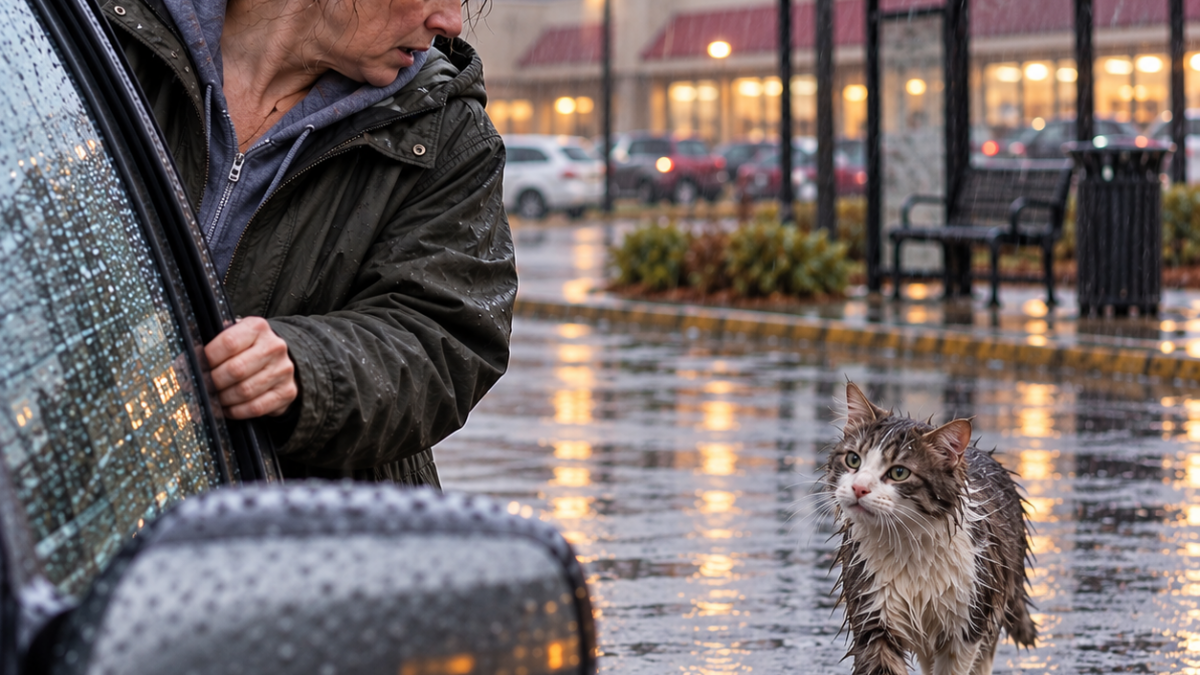
I parked so badly that half my car was over the faded white line
The rain had weakened to a cold drizzle, but the wind had picked up.
“Kitty!”
I hated myself the moment the word left my mouth.
Of course he did not know what I called him.
I did not even know his name.
I walked toward the bus stop with my phone flashlight raised.
Nothing.
The box remained beneath the bench.
The towel was there.
The bowl was there.
But the cat was gone.
Then I heard scratching.
Not from under the bench.
Behind it.
There was a narrow strip of weeds between the bus shelter and the back wall of the old shopping plaza. I pushed through the wet branches and nearly stepped on him.
He was pawing frantically at something wedged beneath a broken wooden pallet.
“Hey.”
His head snapped toward me.
For the first time since I had found him, he did not hiss.
He cried.
Then he pawed the pallet again.
I crouched.
“What is it?”
Underneath was a plastic grocery bag.
Inside the bag were several objects.
A pharmacy receipt.
A bus schedule.
A cheap red pen.
And another folded piece of paper.
This one had survived the rain because it had been sealed inside a sandwich bag.
My hands went cold before I even opened it.
The handwriting was shaky.
Not childish.
Old.
The note read:
His name is Jasper. He is nine years old. He likes chicken and sleeps at the foot of my bed. Please do not let him think I left him. I did not have a choice.
Underneath was a name.
Ruth Ellison.
And a phone number.
I stared at it.
Ruth Ellison.
I knew that name.
Not well.
But enough.
Mrs. Ellison had been coming to the laundromat for years.
She was a small woman with silver hair who always used machine fourteen because she claimed thirteen was unlucky and fifteen shook too much.
She brought quilts, towels, and sometimes cat blankets covered in orange fur.
She had stopped coming about three months earlier.
I had assumed she had moved.
I looked at Jasper.
“Oh, God.”
He sat beside me, shivering.
“You came back for this?”
He pushed his face against my hand.
This time, I picked him up.
He did not fight me.
I tucked him inside my coat and carried him to the car.
The next morning, I called the number.
Disconnected.
I tried again anyway.
Same result.
At nine, I called the laundromat and told my boss I would be late.
At nine-fifteen, Jasper and I were sitting inside a veterinary clinic.
He weighed six pounds and two ounces.
According to the vet, a healthy cat his size should have weighed closer to eleven.
He was dehydrated, undernourished, and had an infected cut on one of his back paws.
But he was alive.
“Any idea how long he was outside?” the veterinarian asked.
“No.”
She ran the microchip scanner across his shoulders.
It beeped.
“Good news. He’s chipped.”
My heart jumped.
“Registered owner?”
She turned the computer monitor slightly.
“Ruth Ellison.”
I swallowed.
“Address?”
She read it to me.
I knew the street.
It was less than three miles from my house.
Twenty minutes later, I was standing in front of a pale yellow ranch house with Jasper’s empty carrier in the back seat.
A FOR SALE sign stood in the yard.
Below it was a red banner.
PENDING.
The curtains were gone.
There was no car in the driveway.
I walked to the front door anyway.
Before I could knock, a voice came from behind me.
“She doesn’t live there anymore.”
I turned.
A woman in a purple raincoat stood in the driveway next door.
“Ruth?”
She nodded.
“You know her?”
“A little. From work.”
The woman studied me.
“What do you want with her?”
There was suspicion in her voice.
I understood why a minute later.
“My name’s Linda Mercer. I found her cat.”
The woman’s expression changed instantly.
“Jasper?”
“Yes.”
Her hand flew to her mouth.
“That son of a bitch.”
Those were the first words anyone said that told me I was no longer dealing with a simple abandoned pet.
“What happened?”
She looked toward Ruth’s house.
“Come inside.”
Her name was Dolores Bennett.
She had lived next door to Ruth for eighteen years.
She made coffee I did not want and sat across from me at a kitchen table covered with unopened mail.
“Ruth fell in May,” she said. “Nothing catastrophic. Cracked wrist, bruised hip. She spent four days in the hospital.”
“What about Jasper?”
“I fed him.”
“Then what?”
“Her nephew showed up.”
“Her nephew?”
“Garrett.”
Dolores said his name the way some people say the word infection.
“Ruth’s husband died years ago. No children. Garrett is her sister’s boy. He started coming around after Ruth fell.”
I knew where this story was going before she finished.
“He told everybody he was helping her. Groceries. Banking. Doctor appointments. Then Ruth stopped answering her phone.”
“Where is she?”
“Maple Grove.”
I knew Maple Grove.
It was an assisted-living facility twenty minutes away.
“Did she want to go?”
Dolores gave me a long look.
“That depends on who you ask.”
“And Jasper?”
Her jaw tightened.
“Garrett told me Jasper had gone to a family with a farm.”
I almost laughed.
Not because it was funny.
Because cruel people apparently never bothered inventing new lies.
A farm.
The old magical farm where unwanted animals disappeared.
“I found him at the Route 19 bus stop.”
Dolores stared at me.
“For how long?”
“I don’t know. Long enough to lose almost half his body weight.”
Her eyes filled with tears.
Then anger replaced them.
“I knew it.”
“What?”
“I knew something was wrong.”
She got up so fast her chair scraped backward.
From a kitchen drawer, she removed a folded sheet of paper.
It was a photocopy of a handwritten note.
“I found this taped inside Ruth’s mailbox two weeks after Garrett took her away.”
The handwriting matched the note from Jasper’s collar.
It said:
Dolores, if you see Jasper, please tell him I’m sorry. Garrett says he has found him a home. I don’t know the people. I asked to speak to them but he says I’m making everything difficult.
My throat tightened.
At the bottom, Ruth had written:
Please keep an eye on my house.
“Why didn’t you call the police?”
“I did.”
“And?”
“Garrett had power of attorney. He said Ruth had become confused. The officer told me a property dispute between relatives was mostly a civil issue unless I had evidence of a crime.”
“Is Ruth confused?”
Dolores leaned forward.
“Ruth forgets where she puts her glasses. She tells the same Christmas stories every December. She is not stupid.”
I thought about Jasper running behind my car.
About the note taped to his collar.
“Can we see her?”
Dolores looked at me.
Then at the cat carrier through the window.
A slow smile appeared.
“Oh, I think we should.”
Maple Grove smelled like lemon disinfectant, old carpet, and coffee.
The receptionist looked up when we entered.
“Can I help you?”
“We’re here to visit Ruth Ellison,” Dolores said.
The woman glanced at her computer.
“Family?”
“Friends.”
She hesitated.
That was my first warning.
“Mrs. Ellison has some visitor restrictions.”
“Placed by whom?”
“Her responsible party.”
“Garrett?” Dolores asked.
The receptionist’s expression told us yes.
I stepped forward.
“I have something that belongs to Ruth.”
“What?”
I raised the carrier slightly.
Jasper gave a small meow.
A voice behind us said, “Is that a cat?”
A nurse in blue scrubs had stopped in the hallway.
Jasper cried again.
The nurse stared at the carrier.
Then she looked toward the far end of the hall.
“Wait here.”
Two minutes later, we heard a walker moving rapidly across the floor.
Then a woman appeared.
She was thinner than I remembered.
Her white hair had grown long around her face.
But I recognized her immediately.
“Mrs. Ellison?”
Her eyes moved from me to the carrier.
She froze.
“Jasper?”
I opened the door.
What happened next erased any doubt I might have had about whether that cat remembered her.
He launched himself out.
Ruth dropped to her knees.
The nurse gasped.
Jasper climbed onto Ruth’s chest while she wrapped both arms around him.
The sound she made was somewhere between a laugh and a sob.
“My baby.”
Jasper pressed his face beneath her chin.
“I’m sorry,” she whispered. “I’m so sorry.”
I turned away.
Dolores did not.
She was crying openly.
Ruth looked at me.
“Where did you find him?”
I told her.
Her face changed.
“Bus stop?”
“Yes.”
“No.”
She shook her head.
“Garrett said a family took him.”
Nobody spoke.
Ruth looked at Dolores.
Then at me.
“He lied?”
Dolores crouched beside her.
“Yes.”
Ruth’s hands tightened around Jasper.
Something in her expression hardened.
It was subtle.
But I saw it.
People sometimes mistake age for weakness.
They confuse a softer voice with surrender.
Ruth Ellison did not look confused.
She looked furious.
“Help me stand up,” she said.
We went to her room.
It was clean but impersonal.
A bed.
A dresser.
Two framed photographs.
Three sweaters hanging in a narrow closet.
It did not look like the home of a woman who had chosen to leave behind seventy-four years of possessions.
Ruth sat with Jasper in her lap.
“He told me I was going there for two weeks,” she said.
“Garrett?” I asked.
“Yes. Rehabilitation after the hospital.”
“How long have you been here?”
“Almost four months.”
My stomach turned.
“He said the doctors thought I shouldn’t live alone.”
“Did they?”
“One doctor said I should have somebody check on me while my wrist healed.”
“Did you sign the power of attorney?”
She looked ashamed.
“Yes.”
There was no reason for her to be ashamed, but shame has a way of choosing the wrong person.
“He brought the papers to the hospital,” she continued. “He said he needed authority to pay my bills.”
Dolores asked, “Did you know he was selling the house?”
Ruth’s eyes dropped.
“I found out three weeks ago.”
My skin prickled.
“The house is already pending.”
“I know.”
“Do you want it sold?”
Ruth looked straight at me.
“No.”
The room became very quiet.
“Then why haven’t you stopped it?”
“I tried calling Garrett. He said the contract was already signed.”
“Did you sign it?”
“He brought papers here.”
“What did they say?”
“I don’t know.”
Dolores closed her eyes.
“Ruth.”
“I didn’t have my glasses. He said they were insurance forms.”
That was the moment my sympathy turned into something sharper.
I thought about Tom.
Near the end of his life, there had been days when medication made him slow.
Vulnerable.
He trusted me to explain things.
To protect him when he could not protect himself.
The idea of someone using that weakness against another human being made something hot rise into my chest.
Ruth stroked Jasper’s head.
“There’s something else,” she said.
“What?”
She looked toward the door.
“Close it.”
I did.
Ruth lowered her voice.
“Garrett has been taking money.”
Dolores sat straighter.
“How do you know?”
“I kept records.”
“Where?”
“At home.”
I glanced toward the hallway.
“Does Garrett know?”
“No.”
“What records?”
“Everything.”
For the first time, I saw the old Ruth I remembered from the laundromat—the woman who separated whites from colors with military precision and counted every quarter twice.
“My husband handled the money until he died,” she said. “After that I learned. Every bill. Every withdrawal. Every deposit.”
She tapped one finger against Jasper’s back.
“When Garrett started helping me, I noticed things.”
“How much?”
“First, eight hundred dollars.”
Dolores inhaled.
“Then twelve hundred. Then three thousand.”
“From your account?”
“Yes.”
“Did you ask him?”
“He said they were medical expenses.”
“Were they?”
“No.”
“How do you know?”
“Because Medicare paid the hospital.”
I felt my jaw tighten.
“Where are the records?”
“In my sewing table.”
“Where?”
“There’s a false bottom in the bottom drawer.”
Dolores looked at me.
I looked at her.
Ruth continued.
“There’s a red notebook. Bank statements. Copies of checks.”
“And Garrett is cleaning out the house?”
“He said everything must be gone before Friday.”
It was Tuesday.
I asked, “When is the closing?”
“Friday morning.”
Three days.
Garrett had three days before Ruth’s house, records, and everything connected to her old life passed into someone else’s hands.
Dolores spoke first.
“We go get it.”
Ruth shook her head.
“You cannot just walk inside.”
“It is your house.”
“Garrett changed the locks.”
That stopped us.
Then Jasper lifted his head.
Ruth stared at him.
“There is another way.”
The old basement window behind the hydrangeas had been broken since 2019.
Tom would have called what we did next the worst idea I had ever had.
And considering I once tried to cut my own bangs two days before Emily’s wedding, that was saying something.
We did not break into Ruth’s house.
That distinction mattered to me.
Ruth still legally owned the property, and she gave Dolores written permission to enter and retrieve personal documents.
I also called the non-emergency police number.
I expected resistance.
Instead, after I explained the situation, an officer agreed to meet us at the house.
His name was Officer Perez.
He looked about thirty.
When I showed him Ruth’s handwritten permission, he read it twice.
“The deed is still in her name?”
“As far as we know,” I said.
“And you are not removing furniture or valuables?”
“Documents.”
He nodded.
“I’ll stand by. I’m not deciding ownership disputes. Understood?”
“Understood.”
Dolores had a spare basement-window latch tool Ruth had given her years earlier.
The window opened.
I looked at the dark opening.
“No.”
Dolores stared at me.
“What?”
“I’m fifty-seven.”
“So?”
“So my knees have terms and conditions now.”
She almost laughed.
In the end, Officer Perez called another officer who was thinner than either of us and willing to crawl through.
Five minutes later, the back door opened.
The house felt wrong.
Not empty.
Violated.
Boxes covered the living-room floor.
Ruth’s photographs had been removed from the walls.
A yellow sticker on her dining table read SOLD.
Another sticker was on her husband’s old recliner.
“Estate sale,” Dolores whispered.
Ruth was not dead.
Yet someone had already turned her life into merchandise.
I felt a cold fury I had not felt in years.
We found the sewing room.
Half the drawers had been emptied.
The old wooden sewing table remained against the wall.
Bottom drawer.
False panel.
Red notebook.
Exactly where Ruth said it would be.
Behind it were two envelopes stuffed with bank statements.
I opened the first.
Withdrawals circled in red ink.
$800.
$1,200.
$3,000.
$5,500.
Then one for $18,000.
“Jesus,” Officer Perez said behind me.
Dolores looked over my shoulder.
“There’s more.”
A check.
Payable to Garrett Sloan.
Memo:
Home repairs.
Amount:
$24,000.
I looked around the house.
There were no new repairs.
Then we heard a truck outside.
Dolores went pale.
“Garrett.”
The front door opened.
A man shouted, “What the hell?”
He came into the hallway.
Mid-forties.
Expensive jacket.
Wet hair.
Face already red.
“What are you doing in this house?”
Officer Perez stepped forward.
“Sir—”
Garrett pointed at Dolores.
“You again.”
Then his eyes landed on me.
“Who are you?”
“The woman who found Jasper.”
His face changed.
Only for half a second.
But that half second was enough.
“You know the cat?” I asked.
He recovered quickly.
“My aunt’s cat.”
“You said he went to a family.”
“So?”
“I found him starving under a bus bench.”
“That’s not my problem.”
Officer Perez’s eyes shifted toward him.
I said, “Actually, I think it might be.”
Garrett stepped closer.
“What exactly are you accusing me of?”
I held up the red notebook.
His expression changed again.
This time, he could not hide it.
“Put that down.”
“Ruth asked us to get it.”
“My aunt is not competent to make those decisions.”
Officer Perez said, “Do you have documentation of guardianship?”
“I have power of attorney.”
“That’s not the same thing.”
Garrett stared at him.
“I know the law.”
“Then you know that a power of attorney does not make you the owner of the principal’s property.”
Garrett looked back at me.
“Give me the notebook.”
“No.”
His voice dropped.
“You have no idea what you’re getting involved in.”
Maybe six months earlier that sentence would have frightened me.
Maybe two years earlier.
But grief does something strange to fear.
When you have already watched the person you love most stop breathing, a red-faced man in an expensive jacket loses some of his power.
“I know you left a nine-year-old house cat outside in freezing rain.”
His mouth tightened.
“You can’t prove that.”
There it was.
Not I didn’t.
You can’t prove it.
Officer Perez heard it too.
I saw his expression change.
Garrett apparently realized his mistake.
He stepped back.
“The cat ran away.”
“From a cardboard box containing his food and towel?”
“You people are insane.”
Dolores laughed once.
It was not a friendly laugh.
“Oh, honey. We’re just getting started.”
We left with the notebook and papers.
Garrett stood in the doorway watching us.
I could feel his stare against my back.
That evening, someone pounded on my front door.
Jasper was asleep on Tom’s old chair.
The pounding woke him.
He bolted beneath the coffee table.
I looked through the peephole.
Garrett.
My first instinct was to pretend I was not home.
My second was to call the police.
Instead, I did both.
I called the non-emergency line, explained who was outside, and stayed behind the locked door.
“Linda!” he shouted.
I had never told him my name.
That frightened me more than the pounding.
“I know you’re in there.”
I said nothing.
“You stole private documents.”
Still nothing.
“If you think you’re helping Ruth, you’re not.”
He hit the door again.
Jasper growled beneath the table.
I had never heard a cat growl like that.
Then Garrett said something that made me pull out my phone and start recording.
“She’s an old woman who doesn’t know what’s good for her.”
I moved closer to the door.
“And you do?”
Silence.
Then:
“You need to stay out of family business.”
“You abandoned her cat.”
“The damn thing scratched me every time I tried to move it.”
“So you left him to die?”
“I left him food.”
My hand tightened around the phone.
There it was.
He had admitted it.
Not everything.
But enough.
“You left him at the bus stop?”
Another pause.
Then he realized.
“You recording me?”
I said nothing.
He slammed his palm against the door.
“Delete it.”
Jasper shot out from beneath the table and stood in the hallway, back arched.
I almost smiled.
“You should leave, Garrett.”
“Give me the notebook.”
“No.”
“You have no idea what Ruth owes me.”
“Then prove it.”
“I gave up months of my life.”
“For twenty-four thousand dollars in home repairs that never happened?”
He stopped.
“You don’t know anything.”
“I know there are bank statements.”
“You stupid—”
A police cruiser turned onto my street.
Garrett saw the lights through the window beside my door.
He walked quickly to his truck.
I watched him leave.
My hands did not start shaking until he was gone.
That night I barely slept.
At six in the morning, Emily called.
I had made the mistake of texting her, Call me when you wake up. I’m okay.
No daughter in human history has ever believed the words I’m okay after receiving a message like that.
“What happened?”
“Nothing.”
“Mom.”
I told her.
Not everything.
Just enough.
There was a long silence.
Then my daughter said, “You confronted a man who may be stealing from an elderly woman?”
“Technically he confronted me.”
“At your house!”
“He left.”
“Mom.”
“I called the police.”
Another silence.
Then she said something that surprised me.
“Dad would be proud of you.”
My throat closed.
I sat at the kitchen table.
Jasper jumped into the chair beside me.
“Your father would say I have no sense.”
“That too.”
I laughed.
It was the first real laugh I had made in weeks.
Emily became serious again.
“Do this the right way.”
“I intend to.”
“No hero stuff.”
“I’m fifty-seven. My hero days have a bad knee.”
“Mom.”
“I promise.”
After we hung up, I contacted Adult Protective Services.
Dolores contacted an attorney she knew from church.
Officer Perez filed a report about the confrontation at Ruth’s house.
I sent the recording from my front porch to the officer handling Jasper’s abandonment case.
Things began moving quickly.
But Garrett moved too.
By Thursday morning, Ruth’s checking account had been emptied.
All but $312.
The bank told her twenty-seven thousand dollars had been transferred the previous afternoon.
Garrett had power of attorney.
On paper, the transaction looked authorized.
Ruth sat in her room at Maple Grove, staring at the balance.
“That was my emergency money.”
Her voice sounded small.
I hated that.
Somebody had taken a woman who had survived a husband’s death, a broken wrist, and seventy-four years of ordinary human hardship and made her feel helpless.
Dolores squeezed her hand.
The attorney, a woman named Marlene Shaw, sat across from us.
“Ruth, listen carefully.”
Ruth looked up.
“A power of attorney can be revoked while the principal has legal capacity.”
“Am I legally capable?”
“I cannot decide that alone, but nothing I’ve seen today suggests you cannot understand what you are doing.”
Ruth sat straighter.
Marlene placed a document on the table.
“If you want to revoke Garrett’s authority, we can execute that today and notify the bank, the realtor, and the title company immediately.”
Ruth did not hesitate.
“Do it.”
The pen shook in her hand.
But her signature was clear.
Marlene made calls.
The bank froze further transactions pending investigation.
The title company was notified that Ruth disputed the sale authorization.
The closing scheduled for the next morning was stopped.
At least, that was what we believed.
At four-thirty that afternoon, Garrett arrived at Maple Grove.
The receptionist called Ruth’s room.
“Your nephew is here.”
Ruth looked at me.
I was sitting beside the window with Jasper in my lap.
“No,” she said.
Then she changed her mind.
“Actually, yes.”
“Ruth?” I asked.
“I want to see him.”
Dolores looked worried.
Marlene had already left.
“You don’t have to.”
“I know.”
Ruth adjusted her sweater.
“Bring him in.”
Garrett entered five minutes later.
The moment he saw me, he stopped.
“You.”
“Hello, Garrett.”
His eyes dropped to Jasper.
The cat’s ears flattened.
“I need to speak to my aunt privately.”
Ruth said, “No.”
He looked at her.
“Aunt Ruth.”
“She stays.”
“So does Dolores.”
Garrett closed the door.
For a second, none of us spoke.
Then he smiled.
It was an awful smile because there was no warmth in it.
“I think people have been putting ideas in your head.”
Ruth looked almost amused.
“No, Garrett.”
“You’re upset about the cat.”
“You lied to me.”
“He ran away.”
Jasper let out a low growl.
Garrett looked at him.
I said, “Interesting. That’s not what you said at my house.”
His eyes snapped toward me.
“You recorded that illegally.”
“Ohio is a one-party-consent state,” I said.
Emily had looked that up for me.
Garrett’s jaw tightened.
Ruth said, “Where is my money?”
He turned back to her.
“I moved it for safekeeping.”
“To where?”
“An investment account.”
“In whose name?”
He did not answer.
Ruth waited.
The silence became unbearable.
“In whose name, Garrett?”
“You don’t understand financial matters.”
Ruth’s eyes sharpened.
“I understood them well enough to notice twenty-seven thousand dollars missing.”
“You’re being manipulated.”
“By whom?”
She pointed toward me.
“Linda?”
Toward Dolores.
“Dolores?”
Then she placed a hand on Jasper.
“Or him?”
For once, Garrett had no immediate answer.
Ruth leaned forward.
“When your mother died, I paid for your funeral suit because you didn’t own one.”
Garrett looked away.
“I loaned you money for your first car.”
“Aunt Ruth—”
“I gave you five thousand dollars after your divorce.”
“That has nothing to do with—”
“I trusted you.”
Her voice broke.
That silenced him.
“You put papers in front of me while I was taking pain medication. You told me they were for bills.”
“I helped you.”
“You sold my furniture.”
“You didn’t need it.”
“My husband built that dining table.”
Garrett rolled his eyes.
It was tiny.
Almost nothing.
But Ruth saw it.
So did I.
Something inside her changed.
The hurt disappeared.
What remained was steel.
“I revoked your power of attorney this morning.”
The color drained from his face.
“What?”
“You heard me.”
“You can’t do that.”
“I already did.”
“The house closes tomorrow.”
“No, it doesn’t.”
He stared at her.
Then at me.
“You did this.”
I said nothing.
He pointed at me.
“You lonely old bitch. You don’t even know her.”
I stood.
So did Dolores.
But Ruth did not move.
“Garrett.”
He turned.
“You will not speak to my friend that way.”
Friend.
One word.
It hit me harder than I expected.
Garrett laughed.
“Your friend?”
Ruth nodded.
“Yes.”
He stepped toward her.
“You think these people are going to take care of you?”
Jasper leaped from my lap.
Not at Garrett.
Onto the floor between them.
His back arched.
His tail doubled in size.
He hissed.
Garrett took one involuntary step backward.
Ruth looked down at the cat.
Then up at her nephew.
“Even he knows what you are.”
Garrett walked out.
But it was not over.
At eight the next morning, Marlene called me.
“The title company received a new document overnight.”
“What document?”
“A competency affidavit.”
I sat up in bed.
“What does that mean?”
“Garrett is claiming Ruth lacked capacity when she revoked his power of attorney.”
“Can he do that?”
“He can claim anything.”
“Will it work?”
“Not if we move fast.”
Garrett had found a doctor who had evaluated Ruth briefly after her hospital stay.
The report mentioned “possible mild cognitive impairment.”
Garrett was using those four words to argue Ruth had been incapable of handling her affairs for months.
Marlene arranged an independent evaluation.
Ruth passed.
Not perfectly.
She forgot one of five words after ten minutes.
She got the exact date wrong by one day.
But she understood her money.
Her property.
Her relationships.
Her choices.
Most importantly, the doctor concluded she had the capacity to revoke the power of attorney.
That should have ended it.
It did not.
Garrett disappeared.
So did several of Ruth’s possessions.
Her husband’s watch.
Her wedding ring.
A box containing old gold coins.
And a set of military medals that had belonged to her father.
The estate-sale company claimed they had never received those items.
Garrett stopped answering calls.
The police now had more than a family disagreement.
They had a possible financial-exploitation case.
And then Dolores remembered the camera.
Her doorbell camera.
She had installed it six months earlier after someone stole a package.
The camera pointed partly toward Ruth’s driveway.
We spent two hours scrolling through old footage.
There he was.
Garrett carrying boxes from Ruth’s house.
Not once.
Not twice.
Six different nights.
The last recording was from three days earlier.
He carried a black metal box to his truck.
Ruth recognized it immediately.
“My father’s medals.”
Officer Perez took a copy.
Then Dolores froze the video.
“Wait.”
“What?”
She moved backward through the footage.
A week earlier.
Garrett’s truck.
Something in the bed.
A cardboard box.
A blue towel hanging over the side.
My stomach dropped.
We watched him carry the cardboard box from Ruth’s house.
Jasper’s box.
Twenty-three minutes later, another traffic camera near the shopping plaza captured his truck entering the parking lot.
The time stamp matched.
He had not accidentally lost Jasper.
He had not given him away.
He had taken an indoor cat that had spent nine years sleeping at an elderly woman’s feet and left him beneath a bus stop in November.
With a bowl.
A towel.
And enough food to make himself feel less like the man he was.
That footage changed everything for me.
Until then, some small part of me had still wondered whether Garrett was simply greedy.
Greed is ugly.
But what he had done to Jasper was something colder.
He had known Ruth loved that cat.
He had known Jasper trusted humans.
He abandoned him anyway because Jasper was inconvenient.
And then he told Ruth a comforting lie so she would stop asking questions.
That was when I stopped wanting Garrett merely stopped.
I wanted him exposed.
Not hurt.
Not physically.
I wanted every lie stripped away.
I wanted him to stand in a room where nobody believed him anymore.
A week later, I got my chance.
Garrett contacted Ruth.
He wanted to make a deal.
Return some of the money.
Drop the house sale.
In exchange, Ruth would tell police everything had been a misunderstanding.
Marlene told her not to respond.
Ruth asked a different question.
“Can I meet him?”
Marlene frowned.
“Why?”
“Because I want to hear what he says.”
“No private meetings.”
“Fine.”
“What are you thinking?”
Ruth smiled.
That smile made me understand why she and I had become friends.
“I spent four months letting that boy believe I was helpless.”
She looked at Jasper.
“I think it is time he learns something.”
The meeting took place at Marlene’s office.
Garrett arrived carrying a folder.
He had hired a lawyer.
That made things less dramatic.
But safer.
Sometimes real revenge is not shouting in a parking lot.
Sometimes it is paperwork.
Sometimes it is evidence.
Sometimes it is letting a liar speak long enough to hang himself with his own sentences.
Garrett offered to return fifteen thousand dollars.
Ruth laughed.
“Fifteen?”
“It’s a reasonable resolution.”
“You took more than sixty.”
His lawyer looked at him.
That reaction told me Garrett had not told his own attorney everything.
Ruth continued.
“Twenty-four thousand for imaginary home repairs. Twenty-seven thousand transferred from my account. Jewelry. Coins. My father’s medals.”
“I didn’t take the medals.”
Dolores slid a printed photograph across the table.
Garrett carrying the black box.
His lawyer picked it up.
Garrett did not.
Then I placed another photograph down.
Garrett carrying Jasper’s cardboard box.
His face hardened.
“You people have been spying on me.”
“No,” Dolores said. “You kept committing your crimes in front of my camera.”
His lawyer closed his eyes for a second.
I almost felt sorry for him.
Almost.
Ruth reached into her purse.
She took out the original note that had been taped to Jasper’s collar.
He is a good cat. I’m sorry.
Her hand rested on it.
“I wrote this because you told me the family adopting him wanted information.”
Garrett said nothing.
“You told me they had children.”
Silence.
“You told me they lived outside Columbus.”
Silence.
“You told me the little girl already had a bed waiting for him.”
His lawyer looked at him again.
Ruth’s voice remained calm.
“You invented an entire family.”
Garrett finally spoke.
“It was a cat.”
That sentence destroyed him.
Not legally.
Not by itself.
But in the room.
His attorney leaned away.
Dolores stared at him with disgust.
I felt my hands go cold.
Ruth simply looked tired.
“Yes,” she said. “It was a cat.”
Garrett exhaled.
“You’re choosing a cat over your family.”
“No.”
Ruth folded her hands.
“I am choosing the creature who never lied to me.”
Garrett’s attorney requested a private conference.
They stepped outside.
Ten minutes later, the attorney returned alone.
“My client will not be continuing settlement discussions today.”
Marlene nodded.
“I expected that.”
Garrett did not come back into the room.
The investigation lasted another six weeks.
The bank recovered most of Ruth’s transferred funds before Garrett could move them again.
The police located several pieces of jewelry at a pawn shop.
The gold coins were recovered from a safe-deposit box.
The medals were found in Garrett’s garage.
Not everything came back.
Her wedding ring never did.
Neither did her husband’s watch.
Garrett was charged in connection with financial exploitation, theft, and animal abandonment.
The legal process continued for months.
There were motions.
Hearings.
Phone calls.
Delays.
I learned that justice is less like lightning and more like erosion.
Slow.
Frustrating.
But relentless when enough pressure keeps pushing.
Garrett eventually accepted a plea agreement.
He was ordered to repay the remaining money.
He received probation with strict conditions, community service, and restrictions connected to managing vulnerable adults’ finances.
The animal-cruelty case resulted in additional penalties and a prohibition on owning animals during the term ordered by the court.
Ruth attended sentencing.
So did I.
Garrett looked smaller in the courtroom.
Not physically.
Just somehow less important.
People like him depend on controlling the story.
The confused aunt.
The helpful nephew.
The runaway cat.
The nosy neighbor.
The lonely woman interfering in family matters.
One by one, those stories had fallen apart.
Ruth was not confused.
He was not helping.
Jasper had not run away.
Dolores was not imagining things.
And I was no longer willing to be intimidated.
Outside the courthouse, Garrett walked past us.
He stopped.
For one second I thought he was going to say something vicious.
Instead, he looked at Ruth.
“You ruined my life.”
Ruth studied him.
I will remember her answer for the rest of mine.
“No, Garrett. I just stopped letting you ruin mine.”
He walked away.
There was no applause.
No dramatic music.
No crowd cheering.
Just cold Ohio air and courthouse doors closing behind him.
But I had never seen revenge look so clean.
Ruth never moved back into the yellow house.
Too much had happened there.
Instead, she sold it months later on her own terms.
The dining table came off the estate-sale list.
So did her husband’s recliner.
She moved into a small independent-living apartment where residents were allowed pets.
Which created one final problem.
Jasper.
By then he had gained nearly five pounds.
His coat had become thick and bright orange again.
The infected paw healed.
He slept beside me every night.
Not at the foot of my bed.
On Tom’s side.
The first time he did it, I cried.
I felt ridiculous crying because a cat had taken my dead husband’s place on a mattress.
Then I realized he had not taken Tom’s place.
Nothing could.
He had simply occupied a space that grief had kept empty.
When Ruth moved into her apartment, I carried Jasper inside.
She had bought him a new bed.
Three bowls.
A scratching post taller than she was.
Toys everywhere.
“Looks like someone has been shopping,” I said.
“I had nine years of guilt to make up for.”
Jasper walked around the room.
He sniffed the couch.
He inspected the bedroom.
Then he returned to Ruth.
He rubbed against her legs.
She sat in her chair and lifted him onto her lap.
For twenty minutes, he stayed there.
I stood by the window trying to prepare myself.
Of course Jasper belonged with Ruth.
That was the right ending.
I told myself that repeatedly.
Then I picked up my purse.
“I should go.”
Ruth looked at me.
“So soon?”
“I want him to settle.”
I could not look at Jasper.
I reached the door.
Behind me came a thump.
Then another.
I turned.
Jasper had jumped from Ruth’s lap.
He walked across the room and sat directly on my shoes.
Ruth laughed.
I did not.
I was too busy trying not to cry again.
“Jasper.”
He looked up at me.
“Oh, for heaven’s sake.”
Ruth was still laughing.
I bent down.
He climbed immediately into my arms.
I looked at Ruth.
“I’m sorry.”
“For what?”
“He’ll adjust.”
“I don’t think he wants to.”
“He’s your cat.”
Ruth became quiet.
Then she shook her head.
“No.”
“What?”
“He was my cat.”
She reached out and scratched beneath his chin.
“But things change.”
“Ruth—”
“When Garrett took me away, Jasper lost his home too.”
She looked at me.
“You gave him another one.”
“I was only supposed to keep him until—”
“Until what?”
I had no answer.
Ruth smiled.
“You think I didn’t notice?”
“Notice what?”
“You talk about him like an old married couple.”
I laughed despite myself.
“He snores.”
“So did my husband.”
“He steals my chair.”
“So did mine.”
“He wakes me at five.”
“That is unforgivable.”
We both laughed.
Then Ruth’s expression softened.
“I want to see him.”
“Anytime.”
“I want him to visit.”
“Of course.”
“I want him when you go somewhere.”
“You have a deal.”
She nodded.
“But he lives with you.”
I hugged Jasper tighter.
“Are you sure?”
Ruth looked at him for a long time.
“Yes.”
Then she whispered something to him.
I barely heard it.
“You found the right person.”
That was almost a year ago.
My life is different now.
Not dramatically.
I still work at the laundromat.
Machine fifteen still shakes.
People still leave tissues in their pockets and blame the dryers when white paper gets all over everything.
I still miss Tom.
There are mornings when grief sits beside me before I even open my eyes.
But the house does not feel quite as empty.
Jasper waits in the kitchen while I make coffee.
He sits on the windowsill when I leave for work.
Every evening, he meets me at the door as if I have returned from war instead of an eight-hour shift surrounded by washing machines.
Ruth and Dolores became part of my life too.
Every Sunday afternoon, I take Jasper to Ruth’s apartment.
We drink coffee.
Sometimes we play cards.
Ruth cheats.
She denies this.
She is lying.
Emily and the children came from Arizona for Christmas.
My granddaughter slept downstairs because she wanted to be close to Jasper.
On Christmas morning, I found Emily standing in the kitchen staring at me.
“What?” I asked.
“You seem different.”
“How?”
She thought about it.
“Like you live here again.”
I understood exactly what she meant.
For two years after Tom died, I had occupied my house.
I paid the taxes.
Changed the furnace filter.
Mowed the grass.
Heated soup.
Watched television.
Slept.
But I was not really living there.
I was guarding a museum.
Everything had belonged to another version of my life.
Tom’s radio.
Tom’s chair.
Tom’s side of the bed.
Then an orange cat ran after my car through freezing rain.
He had every reason to stop.
He was starving.
Cold.
Injured.
Abandoned by someone he had trusted.
But he kept running.
I used to think that day I rescued Jasper.
That is what everyone says when they hear the story.
“You saved him.”
Maybe.
I fed him.
Took him to a veterinarian.
Gave him a warm place to sleep.
But Jasper did something for me too.
He dragged me out of the small safe life I had built around my grief.
He forced me to knock on a stranger’s door.
Walk into an assisted-living facility.
Stand up to a man who frightened me.
Call my daughter and admit I needed help.
Make friends.
Care again.
There is one thing I never told Ruth.
The night Garrett came to my house demanding the notebook, I was terrified.
Not of him hurting me.
Not exactly.
I was terrified because I realized I had something to lose again.
For two years after Tom died, that had not been true.
Then there was Jasper.
Ruth.
Dolores.
Emily calling every morning until the case ended.
A life had quietly formed around me while I was not paying attention.
And once you have something worth protecting, fear changes.
It no longer tells you to hide.
Sometimes it tells you to stand in front of the door.
A few weeks ago, I drove past that old shopping plaza.
The bus stop was still there.
The cardboard box was long gone.
A construction company had purchased two of the empty storefronts. New signs were going up.
I pulled onto the shoulder.
Jasper was in the passenger seat because we were heading to Ruth’s.
He immediately stood and looked out the window.
I wondered if he remembered.
I think he did.
For a few seconds, neither of us moved.
Then I reached over and scratched behind his damaged ear.
“You don’t have to go back there anymore.”
He looked at me.
Then he climbed across the center console and put one paw on my arm.
I smiled.
“All right.”
I started the car.
In the mirror, the bus stop disappeared behind us.
This time Jasper did not chase me.
He did not need to.
He was already going home.


