𝗙𝗨𝗟𝗟 𝗦𝗧𝗢𝗥𝗬 While I Was Deployed Overseas, My Neighbor Burned Down the Beach House My Grandfather Built With His Own Hands
𝗙𝗨𝗟𝗟 𝗦𝗧𝗢𝗥𝗬
She was around forty, maybe early forties, and she had the kind of beauty that made her impossible not to notice.
Long blonde hair.
Perfect makeup.
Expensive jewelry.
A curvy figure she emphasized with clothes designed to make sure every room knew she’d entered it.
Her favorite look was almost theatrical.
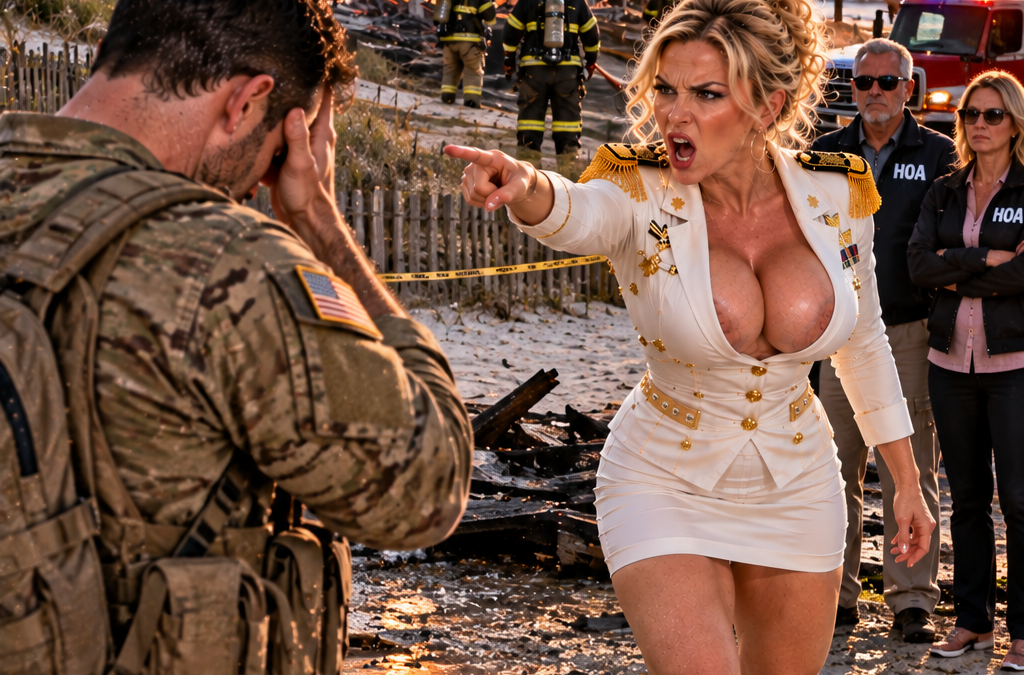
A tight white military-style uniform with polished gold buttons, sharp shoulders, and a deep neckline that emphasized her very large chest.
The first time I saw her wearing it, I almost laughed.
I had spent enough of my life around actual uniforms to know the difference between one that represented service and one that existed to create an impression.
Victoria’s represented exactly one thing.
Victoria.
She lived alone in the house next door.
And from the first day my wife and I took possession of my grandfather’s property, Victoria made it clear she believed we had stolen something from her.
We pulled into the driveway with a rental truck and our kids.
Victoria was already standing at the property line.
Arms crossed.
White outfit spotless.
Large sunglasses covering half her face.
Watching.
My wife is friendly by nature.
Much friendlier than I am.
She stepped over.
“Hi. I’m Sarah.”
Not my wife’s real name, but close enough for this story.
Victoria lowered her sunglasses.
Her eyes traveled over my wife.
Then toward the house.
“So you’re the ones.”
My wife smiled uncertainly.
“The ones?”
“The family who got the property.”
“My husband’s grandfather left it to him.”
Victoria’s mouth tightened.
“I know.”
There was something in her voice that made me stop carrying boxes.
My wife laughed politely.
“Well, I guess we’ll be neighbors.”
Victoria looked directly at her.
“That house was supposed to be mine.”
My wife thought it was a joke.
I could tell because she gave a small confused laugh.
Victoria didn’t.
“What do you mean?”
“I’ve been trying to buy it for years.”
“Oh.”
“Your grandfather-in-law refused every reasonable offer.”
By then I’d walked over.
“My grandfather didn’t want to sell.”
Victoria turned toward me.
Her expression changed immediately.
Not softer.
More calculating.
“You must be the grandson.”
“Yes.”
“He was stubborn.”
“He was.”
“I offered well above market value.”
“He still didn’t want to sell.”
“I could have done something extraordinary with both parcels.”
I glanced from her house to ours.
“Both?”
Victoria pointed across the property line.
“My plan was to combine the lots.”
She gestured broadly toward the ocean.
“A proper residence. Guest wing. Pool courtyard. Full landscaping. Something appropriate for what this area has become.”
I looked at my grandfather’s cedar siding.
The weathered back deck.
The chimney he’d rebuilt after a storm.
“I like what it already is.”
She smiled.
But there was no warmth in it.
“You’re young.”
“What does that mean?”
“You’ll change your mind.”
“I doubt it.”
“We’ll see.”
Then she walked away.
Over the next several months, we learned the full story.
Victoria had tried repeatedly to buy my grandfather’s house.
Not once.
Not twice.
For years.
Every few months she’d appear with another offer.
She wanted our property because her lot by itself wasn’t large enough for the estate she imagined.
Together, the two beachfront parcels would have created an enormous piece of land.
My grandfather refused every offer.
The last time she approached him, according to an older neighbor, Victoria had pushed too hard.
My grandfather finally told her something like:
“I’d burn the place down before I sell it to you.”
That was Grandpa.
Subtlety wasn’t among his strongest qualities.
At the time, everyone treated the statement as just another example of his stubbornness.
Years later, the words would feel sickeningly prophetic.
Victoria apparently assumed that once my grandfather died, the family would sell.
Why wouldn’t we?
We were military.
We moved constantly.
We didn’t live there full-time.
The house was suddenly worth a fortune.
She expected to buy it.
Instead, he left it to me.
Then my wife and I had the audacity to keep it.
Victoria never forgave us.
For the first couple of years, her behavior remained mostly petty.
She complained to the town about our grass.
The property wasn’t neglected.
We just didn’t maintain the lawn like a golf course.
One complaint.
Then another.
Trash bins supposedly out too early.
Complaint.
Kids making noise.
Complaint.
An outdoor light.
Complaint.
Parking.
Complaint.
The local town inspector eventually got so used to her reports that one afternoon he quietly told my wife:
“We have a file.”
“A file?”
“For her complaints.”
My wife looked concerned.
“Are we doing something wrong?”
He smiled.
“No.”
“What happens to the reports?”
He glanced toward Victoria’s house.
“Most of them go nowhere.”
Victoria also hated our kids.
Not because they were badly behaved.
Because they existed on the property she wanted.
One summer afternoon, she screamed at my son and daughter for playing near the water.
“The beach is not your playground!”
My son looked confused.
He was maybe eight.
I walked over.
“The beach is public.”
Victoria’s hands went to her hips.
“They’re screaming.”
“They’re playing.”
“They’re disruptive.”
“They’re children.”
She looked at my son like he had personally ruined the coastline.
“You people have no respect for anyone who actually lives here.”
I almost laughed.
“We own the house next door.”
“You’re barely here.”
“And?”
“Some of us are part of this community.”
The word community became one of her favorite weapons.
In Victoria’s mind, living there full-time somehow gave her more moral ownership over my land than the deed did.
Then came the fence.
Twelve feet of ugly wood running along the property line.
A pure spite fence.
It blocked part of the side view from our kitchen and made the space between the houses feel like a prison corridor.
My wife wanted to fight it.
I didn’t.
“Let her have the fence.”
“It looks terrible.”
“I know.”
“She did it to annoy us.”
“I know.”
“You aren’t angry?”
“Very.”
“Then why aren’t we doing something?”
“Because that’s what she wants.”
So we planted shrubs.
Tall ones.
Within a couple of seasons, the greenery softened the view enough that we barely noticed the fence.
That seemed to make Victoria even angrier.
Our refusal to fight deprived her of whatever satisfaction she expected.
My wife continued trying to be civil.
I don’t know how.
Victoria had insulted us.
Called the town on us.
Yelled at our kids.
Built the fence.
Still, after a hurricane warning one year, my wife baked cookies.
She made enough for a few neighbors.
Including Victoria.
“Why?”
“She lives alone.”
“She hates us.”
“She lives alone.”
“That doesn’t answer the question.”
“If the storm gets bad, we’re still neighbors.”
I loved my wife for that.
Even though I knew how it would end.
She carried the plate next door.
Victoria opened the door wearing one of those white fitted outfits, deep neckline, gold buttons shining under the porch light.
My wife held out the plate.
“I made extras.”
Victoria looked at the cookies.
“Why?”
“Hurricane preparation food.”
My wife smiled.
“Very scientific.”
Victoria took the plate.
For a second, my wife thought it had worked.
Then Victoria tilted the plate.
Every cookie slid off.
Onto the sand beside the walkway.
She handed the empty plate back.
Didn’t say a word.
Then closed the door.
My wife stood there.
Holding the plate.
Staring at the cookies in the sand.
When she came home, I didn’t say I told you so.
There are times marriage requires wisdom.
“That was it,” she said.
“What?”
“No more.”
I nodded.
“No more.”
After that, we stopped trying.
We were civil if we had to interact.
Nothing else.
The strange vandalism began gradually.
Our garden hose was cut.
We replaced it.
The outdoor shower handle disappeared.
I replaced it.
Then someone keyed a long scratch into my truck while it sat in our driveway overnight.
I knew who I suspected.
So did my wife.
But suspicion isn’t proof.
Victoria always had the same response.
Prove it.
The worst incident before the fire involved my son.
He was around ten.
One evening he left his bicycle leaning against our fence.
Not Victoria’s fence.
Ours.
In the morning, the bicycle was gone.
We searched.
Asked neighbors.
Nothing.
Two days later, someone found it down the beach.
Saltwater had destroyed it.
The chain was already rusting.
The seat had been ripped.
One wheel bent.
Someone had deliberately thrown my kid’s bicycle into the ocean.
My son cried.
Not because it was expensive.
Because it had been his birthday bike.
He’d picked the color.
He’d covered one section with stickers.
He didn’t understand why an adult would do something like that.
Neither did I.
At least not in any way that made sense.
I walked straight to Victoria’s house.
My wife tried to stop me.
“Don’t.”
“I just want to talk.”
“You’re furious.”
“Yes.”
“Exactly.”
I knocked.
Victoria opened the door.
She was smiling before I said a word.
That smile told me everything.
“What?”
“My son’s bicycle.”
She leaned against the doorframe.
“What about it?”
“You threw it in the ocean.”
Victoria smiled wider.
“It’s rough this time of year.”
I stared at her.
“Things wash away.”
“You threw a ten-year-old’s bike in the water.”
“Prove it.”
No denial.
Just prove it.
Then she shut the door.
That was the day I bought security cameras.
Good ones.
Visible.
Driveway.
Back deck.
Side path.
Front approach.
And cloud storage.
The cloud storage wasn’t something I thought deeply about.
It was simply an option included with the system.
Pay an annual subscription, and recordings uploaded remotely instead of living only on a local drive.
I paid.
Best money I’ve ever spent.
Victoria noticed the cameras almost immediately.
She stood at the property line one morning looking at them.
“Planning to spy on me?”
“No.”
“That camera can see my yard.”
“It covers our side path.”
“I don’t consent.”
“It isn’t aimed through your windows.”
She frowned.
“You’re paranoid.”
I almost laughed.
“You threw my son’s bike into the ocean.”
“Prove it.”
There it was again.
But the cameras worked.
For nearly a year, the vandalism almost stopped.
No cut hoses.
No damaged cars.
No missing property.
Victoria continued glaring.
Continued complaining.
Continued being Victoria.
But we reached a kind of cold-war stability.
Then I got deployment orders.
Long deployment.
I won’t say where.
I won’t say how long.
Enough to matter.
My wife and I had difficult decisions to make.
Stay at the beach house with the kids?
Return to our regular duty-station area?
Go to her parents?
In the end, she decided to spend most of the deployment with her parents several states away.
They could help with the kids.
She wouldn’t be alone.
And neither of us liked the idea of her living beside Victoria without me for months.
The beach house would sit empty for stretches.
Not abandoned.
Just vacant.
We hired a local caretaker.
Good guy.
He’d stop by every couple of weeks.
Check pipes.
Inspect the exterior.
Cut grass.
Make sure nothing had leaked.
We winterized what needed winterizing.
Reduced power usage.
Made everything as safe as possible.
About a week before I left, we were loading the last bags my wife planned to take to her parents.
Victoria was outside watering plants.
Or pretending to.
Mostly she was watching us.
She wore white again.
A tight military-style jacket that I found particularly irritating that day, given that I was the one actually preparing to deploy.
She called across the property line.
“Going somewhere?”
I ignored her.
My wife didn’t.
That woman is incapable of ignoring another human being completely.
“He’s deploying.”
I turned.
Sarah.
Too late.
Victoria’s eyes shifted toward me.
My wife continued.
“We’ll be away for a while.”
Victoria stopped watering.
Then she smiled.
Slowly.
Not the fake neighbor smile.
Something else.
A smile that settled into my memory afterward and never left.
“Well.”
She tilted her head.
“Safe travels.”
My wife looked uncomfortable immediately.
I loaded the final bag.
We left.
Later she told me she’d felt a chill when Victoria smiled.
At the time, I told her not to let our neighbor get into her head.
We had cameras.
A caretaker.
Locked doors.
Insurance.
What could Victoria possibly do?
I would spend months regretting how confidently I’d asked that question.
Deployment does strange things to time.
Some days crawl.
Some disappear.
You measure life through calls home.
Emails.
Photos.
Countdowns.
There is always part of you living somewhere else.
I would call my wife whenever I could.
Talk to the kids.
Ask about school.
Ask about the house.
The caretaker reported no issues.
Everything seemed fine.
Several months in, I was pulled aside.
Emergency communication from home.
There are words military families learn to fear.
Emergency from home is one of them.
My mind immediately went to my family.
My wife.
My kids.
Car crash?
Hospital?
Parent?
Child?
Death?
I got my wife on the line.
She was sobbing.
So hard I could barely understand her.
The first thing she managed to say was:
“Everyone’s okay.”
I closed my eyes.
“Okay.”
“Everyone’s okay.”
“What’s wrong?”
“The house.”
“What happened?”
“It’s gone.”
I didn’t understand.
“What do you mean gone?”
“It burned.”
My brain rejected the sentence.
“What?”
“The beach house burned down.”
I remember looking at the wall in front of me.
“The whole house?”
It was such a stupid question.
As though she might say, No, just the kitchen. Grandpa’s house is mostly fine.
Instead she cried harder.
“It’s gone, honey.”
I sat down.
The fire department had received the call during the night.
A neighbor farther down saw flames and called.
By the time crews arrived, the house was fully involved.
They prevented the fire from spreading.
Including, bitterly enough, to Victoria’s house.
Firefighters protected her property from the house she had hated for years.
Ours burned almost to the foundation.
I cried.
I’m not embarrassed to say it.
I had lost people in my career.
Been through difficult situations.
Seen things military service teaches you to lock away until later.
But that house reached somewhere different.
My grandfather had built it.
My childhood was inside it.
My proposal.
Our kids.
Decades.
Gone while I was on the other side of the planet.
And I could do nothing.
That helplessness was brutal.
My unit was incredible.
People gave me space.
Covered what they could.
Checked on me without being intrusive.
Still, I barely slept.
Something also bothered me immediately.
Why had it burned?
The house was properly winterized.
Most electrical circuits were shut down.
The caretaker had been there only days before.
No storm.
No lightning.
No active fireplace.
No cooking.
Nothing that made sense.
Then, hours later, one thought hit me.
The cameras.
I had almost forgotten them.
Shock does that.
My first assumption had been that the camera system was destroyed with everything else.
Then I remembered.
Cloud storage.
I got access to a computer.
Logged in.
My hands were shaking so badly I mistyped the password twice.
The account loaded.
There were motion events.
Multiple events from the night of the fire.
I clicked the first one.
Victoria appeared.
My whole body went cold.
She wore dark clothes instead of white.
But there was no question who it was.
Night vision showed her face clearly.
She walked from her property toward ours.
Not running.
Not sneaking.
Casual.
As though taking an evening stroll.
She circled the house.
Tried a door.
Checked another area.
Then walked back toward her property.
The clip ended.
Next clip.
Victoria returning.
This time carrying a gas can.
I stopped breathing.
She walked toward the back deck.
The deck where I’d proposed.
She poured liquid along the boards.
Then around the lower edge of the house.
Methodical.
Calm.
No panic.
No hesitation.
At one point she paused.
Looked toward the camera.
And waved.
A small wave.
Almost playful.
She knew the cameras existed.
But she believed fire would destroy them.
She thought she was waving goodbye to the evidence.
Instead, that wave would later be seen by investigators, lawyers, and a courtroom.
I clicked the next video.
Victoria lit the accelerant.
Flames appeared.
Small at first.
Then faster.
They raced along the deck.
The camera image brightened.
Victoria backed toward the property line.
And watched.
That detail haunted me more than the ignition.
She didn’t run.
She didn’t panic.
She stood there.
Watching my grandfather’s house burn.
Calm.
Satisfied.
The next camera went offline.
Then another.
One by one, as the fire reached them.
But every second before each camera died had already uploaded.
Timestamped.
Stored.
Safe.
I watched the footage again.
Then again.
Five times, maybe more.
I don’t know why.
At first, grief.
Then disbelief.
Then anger.
Eventually the emotion changed into something colder.
Focused.
The kind of calm I usually got when the situation was bad enough that panic became useless.
Victoria was done.
She just didn’t know it yet.
I called my wife.
“Sit down.”
“What?”
“Sit down.”
She did.
“I have the footage.”
Silence.
“What footage?”
“Victoria.”
My wife didn’t speak.
“She burned the house.”
I heard her inhale sharply.
“I have her on camera.”
Still silence.
“Gas can. Everything.”
Then my wife’s voice changed.
The grief was still there.
But something stronger entered it.
“Send me all of it.”
“I will.”
“Everything.”
“Okay.”
“I’m calling the fire marshal in the morning.”
My wife handled what I couldn’t.
She drove back to the coast.
Met fire investigators.
Insurance representatives.
Law enforcement.
She gave them the videos.
Later, she described the lead investigator watching the footage.
He got to the clip showing Victoria with the gas can.
Paused it.
Took off his glasses.
Rubbed his eyes.
Then said something like:
“Ma’am, I’ve been doing this twenty years. I’ve never had one handed to me like this.”
Fire investigation is difficult.
That’s what he explained.
Fire consumes evidence.
Accelerants burn.
Structures collapse.
Electrical systems fail.
Timelines become difficult to prove.
Their initial analysis already suggested arson.
There were burn patterns consistent with accelerant.
The origin didn’t make sense for accidental ignition.
But suspicion isn’t conviction.
The videos connected everything.
They showed the preparation.
The gas.
The ignition.
The suspect’s face.
The physical scene matched the digital evidence almost perfectly.
And Victoria, because arrogance is apparently allergic to caution, had left even more evidence.
She bought fuel and a gas can shortly before the fire.
Credit card.
A gas station roughly fifty minutes away.
Why drive that far?
Maybe she thought distance made it harder to connect to her.
It didn’t.
Investigators obtained purchase records.
There she was.
Then neighbors started talking.
One remembered a conversation about a month before the fire.
Victoria had said something about our family not deserving the property.
Then:
“Houses like that have a way of not lasting.”
At the time, it sounded like another bitter comment.
After the fire, it sounded very different.
She couldn’t help herself.
Victoria needed people to know she resented us.
That was part of what made cruelty enjoyable for her.
While investigators quietly built the case, Victoria performed innocence.
She talked to the local paper.
Concerned neighbor.
Terrifying experience.
Fire so close to her property.
She mentioned the age of our house.
Old wiring.
Old cottages.
Terrible things happen.
“I just hope the family had insurance.”
She was laying groundwork for an accidental-fire explanation while investigators had video of her pouring gasoline across the deck.
Then came the sympathy card.
Yes.
Victoria sent my wife a condolence card.
The woman who burned our home sent us sympathy.
My wife kept it.
I still remember the text she sent me.
You’re not going to believe what arrived.
A photo followed.
Beautiful card.
Something about memories living forever even when places are lost.
Signed by Victoria.
I stared at my phone.
Then laughed.
Not because it was funny.
Because sometimes evil becomes so absurd your brain doesn’t know what else to do.
“Keep it,” I told my wife.
“Oh, I’m keeping it.”
The investigators moved quickly.
A few weeks after the fire, several law-enforcement vehicles arrived at Victoria’s house.
I wasn’t there.
My wife wasn’t there either.
A neighbor across the street witnessed it.
She called my wife almost immediately.
Victoria came outside in a bathrobe.
Then started screaming.
She hadn’t done anything.
She was respected.
This was harassment.
They were making a mistake.
No proof.
She apparently repeated that several times.
“You have no proof!”
Then, according to the neighbor, one officer said something like:
“Ma’am, we have video.”
And Victoria stopped.
Mid-sentence.
No screaming.
No struggling.
Nothing.
The neighbor told my wife she watched the color disappear from Victoria’s face.
Like someone had unplugged her.
Because in that instant, Victoria understood.
The cameras.
The cameras she thought she burned.
The cameras that had watched her wave.
She knew.
They handcuffed her.
Put her in a vehicle.
And took her away.
My wife sent me the update while I was still deployed.
I read the message repeatedly.
Guys around me knew the story by then.
Hard not to know when one of your buddies gets a call saying his neighbor burned down a million-dollar inherited home.
Somebody looked at me after hearing she’d been arrested.
“You okay?”
“No.”
That was the truthful answer.
I was glad she had been caught.
But arrest doesn’t rebuild a childhood.
Justice and restoration aren’t the same thing.
The criminal case was overwhelming.
Video.
Accelerant patterns.
Gas purchase.
Witness statements.
Prior hostility.
Her comments.
Her route from the house next door.
Her own face on multiple camera angles.
At one point, her attorneys apparently suggested the woman in the footage wasn’t her.
That argument didn’t last.
Neighbors identified her.
Clothing matched.
Movement from her property matched.
Timeline matched.
It was ridiculous.
Eventually there wasn’t much left to fight about except consequences.
Victoria received several years in state prison.
Actual prison.
Not probation.
Not a fine.
Not community service.
A woman who had spent years bullying children, destroying property, calling authorities over garbage cans, and saying “prove it” finally committed something too serious and too thoroughly documented to intimidate her way out of.
I didn’t attend every court proceeding.
Military obligations made that impossible.
But I was there for what I could be.
Seeing her in court was strange.
No fitted white military-style uniform.
No deep neckline.
No gold buttons.
No sunglasses.
No property-line superiority.
Just a defendant.
For years she had used appearance and confidence like armor.
Neither mattered there.
Evidence did.
The sympathy card came up.
So did the videos.
That little wave to the camera looked different in court.
Not playful.
Not powerful.
Stupid.
My grandfather once told Victoria he’d rather burn the house than sell it to her.
In the end, she burned it herself.
And still didn’t get the property.
That irony was almost unbearable.
The criminal sentence was only half of what followed.
Insurance companies do not enjoy paying enormous claims caused by intentional criminal acts when they can pursue the responsible person.
Our insurer went after Victoria.
We pursued our own civil remedies.
Between judgments, restitution, insurance subrogation, legal costs, and everything else tied to the destruction, Victoria’s financial life collapsed.
She had wanted our land for years.
She believed if she could just get rid of our family house, maybe she would finally control what happened next.
Instead, she lost her own house.
Her beachfront property had to be sold to satisfy what she owed.
The property she had guarded.
The home next to ours.
The lot she once imagined combining with my grandfather’s.
Gone.
Victoria lost her freedom.
Then her house.
We kept our land.
That mattered to me more than I expected.
When I eventually returned from deployment, one of the first places I went was the property.
Nothing prepares you for seeing the absence of something that has existed your entire life.
Photographs don’t.
Video doesn’t.
Descriptions don’t.
I pulled into the driveway.
Or what remained of it.
And stopped.
The house was gone.
Not damaged.
Gone.
Foundation.
Debris cleared.
Open space where rooms used to be.
The ocean looked almost too visible without the structure blocking part of it.
My wife stood beside me.
Neither of us spoke.
I walked toward the back.
The deck didn’t exist anymore.
That hurt.
I could remember exactly where I had stood when I asked Sarah to marry me.
I could remember Grandpa’s chair.
The old grill.
The door that always stuck in humid weather.
The place where my son once dropped an entire plate of hamburgers because he tried to carry too many.
Memories had coordinates.
And the coordinates remained even after the objects disappeared.
Near the center of the ruins, part of the old masonry chimney had survived.
Damaged.
Blackened.
But there.
I put my hand on it.
My grandfather had laid parts of that chimney himself.
My wife stood behind me.
“We rebuild.”
I looked at her.
She was crying.
So was I.
“We rebuild.”
The process was exhausting.
Insurance.
Permits.
Engineering.
Architects.
Contractors.
Coastal regulations.
Invoices.
Phone calls.
Delays.
Storm requirements.
More delays.
Anyone who thinks receiving insurance money after catastrophic loss means you simply get a check and build a new house has never done it.
It consumed our lives for a while.
But little by little, walls came back.
The new house wasn’t an exact replica.
It couldn’t be.
Codes had changed.
Construction standards had changed.
Our needs had changed.
So we built something stronger.
Hurricane-rated construction.
Fire-resistant materials where practical.
Modern electrical.
Better access.
Stronger shutters.
Updated foundation work.
And cameras.
Lots of cameras.
Cloud storage.
Redundant backups.
My wife joked that the system could monitor an international casino.
She wasn’t far off.
But there was one thing I insisted on preserving.
Grandpa’s chimney.
What could be saved was incorporated into the new home.
Old brick.
Fire marks.
History.
Right at the heart of the house.
The first time the new place was finished enough for us to spend the night, I couldn’t sleep.
I walked onto the new back deck.
Different boards.
Different railing.
Same ocean.
My wife came outside.
“You okay?”
“Yeah.”
“You’re lying.”
“Little bit.”
She stood beside me.
For years, I had imagined retiring in my grandfather’s house.
Technically, that house no longer existed.
But the land did.
The view did.
The chimney did.
The memories did.
And Victoria hadn’t taken them.
That realization gave me more peace than any verdict.
Our children adjusted faster than we did.
Kids are like that.
My son, the one whose bicycle had ended up in the ocean years earlier, stood in his new bedroom looking out toward the water.
“It’s bigger.”
“Yeah.”
“Grandpa would like it?”
“Great-grandpa.”
“Whatever.”
I laughed.
“Yeah. I think he would.”
“Except the cameras.”
“He’d probably love the cameras after what happened.”
My son smiled.
“Can we point one at the ocean?”
“We already did.”
Life eventually became normal again.
Or as normal as military-family life gets.
Deployments ended.
Orders changed.
Kids got older.
The legal cases became documents in a file rather than daily conversations.
Victoria remained in prison.
Her old property belonged to someone else.
That felt strange at first.
The first new owners were nothing like her.
They introduced themselves politely.
Didn’t demand our land.
Didn’t scream at our kids.
Didn’t call the town because a trash can existed.
My wife brought them cookies.
I watched carefully.
They ate them.
Normal neighbors.
Who knew?
Years later, people still ask why Victoria did it.
Jealousy is the easy answer.
But I think jealousy alone is too simple.
Victoria had turned desire into entitlement.
That’s more dangerous.
She wanted my grandfather’s property.
Fine.
People want things.
She made offers.
Fine.
My grandfather refused.
That should have ended it.
But Victoria eventually convinced herself that because she wanted the land enough, she somehow deserved it.
Then every refusal became an injustice.
Grandpa wasn’t merely declining to sell.
He was depriving her.
When he died and left the house to me, I wasn’t inheriting my family’s property.
In her mind, I was stealing her future.
Our kids playing on the beach wasn’t innocent.
They were occupying a life she thought belonged to her.
My wife bringing cookies wasn’t kindness.
It was an insult from the family blocking her dream.
Once you build that kind of story in your head long enough, cruelty becomes easy to justify.
That doesn’t excuse it.
It makes it more frightening.
Victoria didn’t wake up one morning and randomly decide to commit arson.
She spent years teaching herself that we were the enemy.
Complaint by complaint.
Fence board by fence board.
Slashed hose.
Missing handle.
Keyed truck.
Destroyed bicycle.
Each act crossed a line.
Nothing catastrophic happened to her.
So the next line became easier.
When the cameras appeared, she stopped.
For a while.
Not because she became better.
Because risk changed.
Then I deployed.
And suddenly the risk looked low again.
Empty house.
Family gone.
Owner overseas.
Cameras she assumed would burn.
Perfect opportunity.
She thought.
That is what still bothers me most.
Not that she hated us.
People hate each other.
Not that she wanted the property.
People covet things.
It’s that she stood beside the house with gasoline knowing a family loved it.
Knowing my grandfather built it.
Knowing I was deployed.
Knowing my wife and children were away.
Then she lit the fire.
And stayed to watch.
That isn’t a momentary loss of temper.
That’s a decision.
Several decisions.
Get the can.
Buy fuel.
Wait until night.
Walk over.
Pour it.
Light it.
Watch.
At any one of those steps, she could have stopped.
She didn’t.
Then she sent a sympathy card.
Sometimes people ask whether I hate her.
I did.
For a long time.
Maybe part of me still does.
But hatred is exhausting.
Military service already asks enough of a family.
I wasn’t going to let Victoria occupy more years than she’d already stolen.
What I feel now is something colder.
Distance.
She made her choices.
The courts made theirs.
Our family rebuilt.
That is enough.
My grandfather’s original house is gone.
I won’t pretend otherwise.
People like to say things are just things.
Sometimes they are.
Sometimes a place becomes part of the people who lived inside it.
Losing that hurts.
But foundations matter.
Ours survived.
Literally and otherwise.
We rebuilt on the same land.
Bigger.
Safer.
Stronger.
The old chimney stands inside the new house.
The deck faces the same water.
My wife and I still sit there whenever we can.
Sometimes I think about the night I proposed.
Sometimes about my grandfather.
Sometimes about the deployment phone call.
And sometimes about Victoria’s little wave at the camera.
She thought it was a final insult.
A goodbye.
She believed the fire would consume everything.
House.
Cameras.
Evidence.
History.
Instead, that wave became part of the evidence that destroyed her defense.
There is a kind of justice in that.
She spent years telling us that property should have been hers.
She tried to burn away the one thing preventing her from getting it.
But when the smoke cleared, our family still owned the land.
We rebuilt.
Victoria’s property was the one that had to be sold.
She wanted two beachfront lots.
She ended with none.
She wanted our family gone.
We stayed.
She wanted our house erased.
We built another one.
She believed burning my grandfather’s cottage would finally give her control over the future of that land.
Instead, the only future she changed permanently was her own.
One evening after construction was finished, I sat alone on the deck with a beer.
My wife and kids had gone into town.
The sun was dropping toward the water.
The new boards beneath my feet were still too clean.
Grandpa would have hated that.
He believed a deck should look used.
The surviving chimney was visible through the glass doors.
I thought about him telling Victoria he’d burn the place before selling it.
“Careful what you say, old man,” I whispered.
Then I laughed.
A wave broke near shore.
Wind moved through the dune grass.
The cameras quietly recorded.
Nothing happened.
No one shouted.
No neighbor appeared.
No smoke.
No emergency communication.
Just the ocean and the house we had rebuilt.
I raised the bottle toward the chimney.
“We kept it.”
And that, more than Victoria’s conviction, prison sentence, lost house, ruined finances, or public humiliation, was the ending I needed.
She destroyed a building.
She never got the home.𝗧𝗛𝗘 𝗘𝗡𝗗
While I Was Deployed Overseas, My Neighbor Burned Down the Beach House My Grandfather Built With His Own Hands
I was thousands of miles from home when my wife called crying so hard I could barely understand her.
Everyone was alive.
But the million-dollar beach house my grandfather had built with his own hands was gone, and the woman next door was already telling people she hoped we’d had good insurance.
I’ve been active-duty military for more than a decade.
I’m not going to say which branch, where I was stationed, or where I was deployed when this happened. Those details don’t matter anyway.
What matters is that my wife and I had spent most of our marriage living the way a lot of military families do.
We moved.
We rented.
We lived on base when it made sense.
We squeezed our lives into houses we knew wouldn’t be ours for long.
We learned not to become too emotionally attached to neighborhoods because orders change and careers move you whether you’re ready or not.
We had two kids.
We weren’t wealthy.
We weren’t trust-fund people.
We budgeted.
We saved.
We made military life work.
Then my grandfather died and left me something that changed our financial picture without changing who we were.
His beach house.
Calling it a million-dollar beach house sounds glamorous.
That wasn’t what it had been when my grandfather bought the land.
Back then, the area was practically nothing.
Sand.
Dunes.
Scrub grass.
A few roads.
A handful of small cottages.
No luxury restaurants.
No boutique hotels.
No developers trying to squeeze enormous vacation houses onto every available piece of coastline.
My grandfather bought the property when the land was cheap enough that an ordinary working man could afford it.
Then he built a cottage there himself.
Not metaphorically.
With his hands.
I grew up hearing the stories.
How he hauled lumber.
How he framed walls.
How he fixed mistakes instead of paying somebody else.
How the original place was small enough that during family visits everyone slept almost on top of one another.
Over the years, he expanded it.
Replaced things.
Renovated.
Strengthened.
Added a better deck.
Updated the kitchen.
Rebuilt parts after storms.
But the heart of the place remained his.
By the time I was born, it had become the family house.
I learned to fish off the dock behind it.
I remember sitting beside my grandfather when I was a kid, holding a rod that was too big for me while he pretended not to notice I had tangled the line for the third time that morning.
I remember sunburns.
Storm shutters.
Sand inside everything.
The smell of coffee on humid mornings.
My wife and I got engaged on the back deck.
There was no photographer.
No elaborate proposal setup.
Just sunset, salt air, and me trying not to drop the ring between the deck boards because my hands were shaking.
She said yes.
Years later, when our children were old enough, we brought them there.
So when my grandfather passed and left the property to me, I didn’t see a million-dollar asset.
I saw him.
The market saw something else.
The quiet coastal town of my childhood had exploded in value.
Developers had arrived.
Old cottages disappeared.
Huge houses appeared in their place.
Land that had once seemed worthless became some of the most desirable property in the area.
The appraisal on my grandfather’s house and lot came in at a little over one million dollars.
The number looked ridiculous on paper.
My wife stared at it.
“We own a million-dollar house.”
“No,” I said.
She looked at me.
“We own Grandpa’s house.”
She smiled.
“That too.”
We could have sold.
Financially, there were plenty of arguments for doing exactly that.
We could have paid down debt.
Invested the money.
Bought a permanent home somewhere else.
But neither of us wanted to.
We decided we’d keep it.
Rent it occasionally if we needed the income.
Use it whenever military life allowed.
And someday, when I finally left the service for good, maybe retire there.
That was the dream.
There was only one problem.
The woman next door.
I’ll call her Victoria.
She was around forty, maybe early forties, and she had the kind of beauty that made her impossible not to notice.
Long blonde hair.
Perfect makeup.
Expensive jewelry.
A curvy figure she emphasized with clothes designed to make sure every room knew she’d entered it.
Her favorite look was almost theatrical.
A tight white military-style uniform with polished gold buttons, sharp shoulders, and a deep neckline that emphasized her very large chest.
The first time I saw her wearing it, I almost laughed.
I had spent enough of my life around actual uniforms to know the difference between one that represented service and one that existed to create an impression.
Victoria’s represented exactly one thing.
Victoria.
She lived alone in the house next door.
And from the first day my wife and I took possession of my grandfather’s property, Victoria made it clear she believed we had stolen something from her.
We pulled into the driveway with a rental truck and our kids.
Victoria was already standing at the property line.
Arms crossed.
White outfit spotless.
Large sunglasses covering half her face.
Watching.
My wife is friendly by nature.
Much friendlier than I am.
She stepped over.
“Hi. I’m Sarah.”
Not my wife’s real name, but close enough for this story.
Victoria lowered her sunglasses.
Her eyes traveled over my wife.
Then toward the house.
“So you’re the ones.”
My wife smiled uncertainly.
“The ones?”
“The family who got the property.”
“My husband’s grandfather left it to him.”
Victoria’s mouth tightened.
“I know.”
There was something in her voice that made me stop carrying boxes.
My wife laughed politely.
“Well, I guess we’ll be neighbors.”
Victoria looked directly at her.
“That house was supposed to be mine.”
My wife thought it was a joke.
I could tell because she gave a small confused laugh.
Victoria didn’t.
“What do you mean?”
“I’ve been trying to buy it for years.”
“Oh.”
“Your grandfather-in-law refused every reasonable offer.”
By then I’d walked over.
“My grandfather didn’t want to sell.”
Victoria turned toward me.
Her expression changed immediately.
Not softer.
More calculating.
“You must be the grandson.”
“Yes.”
“He was stubborn.”
“He was.”
“I offered well above market value.”
“He still didn’t want to sell.”
“I could have done something extraordinary with both parcels.”
I glanced from her house to ours.
“Both?”
Victoria pointed across the property line.
“My plan was to combine the lots.”
She gestured broadly toward the ocean.
“A proper residence. Guest wing. Pool courtyard. Full landscaping. Something appropriate for what this area has become.”
I looked at my grandfather’s cedar siding.
The weathered back deck.
The chimney he’d rebuilt after a storm.
“I like what it already is.”
She smiled.
But there was no warmth in it.
“You’re young.”
“What does that mean?”
“You’ll change your mind.”
“I doubt it.”
“We’ll see.”
Then she walked away.
Over the next several months, we learned the full story.
Victoria had tried repeatedly to buy my grandfather’s house.
Not once.
Not twice.
For years.
Every few months she’d appear with another offer.
She wanted our property because her lot by itself wasn’t large enough for the estate she imagined.
Together, the two beachfront parcels would have created an enormous piece of land.
My grandfather refused every offer.
The last time she approached him, according to an older neighbor, Victoria had pushed too hard.
My grandfather finally told her something like:
“I’d burn the place down before I sell it to you.”
That was Grandpa.
Subtlety wasn’t among his strongest qualities.
At the time, everyone treated the statement as just another example of his stubbornness.
Years later, the words would feel sickeningly prophetic.
Victoria apparently assumed that once my grandfather died, the family would sell.
Why wouldn’t we?
We were military.
We moved constantly.
We didn’t live there full-time.
The house was suddenly worth a fortune.
She expected to buy it.
Instead, he left it to me.
Then my wife and I had the audacity to keep it.
Victoria never forgave us.
For the first couple of years, her behavior remained mostly petty.
She complained to the town about our grass.
The property wasn’t neglected.
We just didn’t maintain the lawn like a golf course.
One complaint.
Then another.
Trash bins supposedly out too early.
Complaint.
Kids making noise.
Complaint.
An outdoor light.
Complaint.
Parking.
Complaint.
The local town inspector eventually got so used to her reports that one afternoon he quietly told my wife:
“We have a file.”
“A file?”
“For her complaints.”
My wife looked concerned.
“Are we doing something wrong?”
He smiled.
“No.”
“What happens to the reports?”
He glanced toward Victoria’s house.
“Most of them go nowhere.”
Victoria also hated our kids.
Not because they were badly behaved.
Because they existed on the property she wanted.
One summer afternoon, she screamed at my son and daughter for playing near the water.
“The beach is not your playground!”
My son looked confused.
He was maybe eight.
I walked over.
“The beach is public.”
Victoria’s hands went to her hips.
“They’re screaming.”
“They’re playing.”
“They’re disruptive.”
“They’re children.”
She looked at my son like he had personally ruined the coastline.
“You people have no respect for anyone who actually lives here.”
I almost laughed.
“We own the house next door.”
“You’re barely here.”
“And?”
“Some of us are part of this community.”
The word community became one of her favorite weapons.
In Victoria’s mind, living there full-time somehow gave her more moral ownership over my land than the deed did.
Then came the fence.
Twelve feet of ugly wood running along the property line.
A pure spite fence.
It blocked part of the side view from our kitchen and made the space between the houses feel like a prison corridor.
My wife wanted to fight it.
I didn’t.
“Let her have the fence.”
“It looks terrible.”
“I know.”
“She did it to annoy us.”
“I know.”
“You aren’t angry?”
“Very.”
“Then why aren’t we doing something?”
“Because that’s what she wants.”
So we planted shrubs.
Tall ones.
Within a couple of seasons, the greenery softened the view enough that we barely noticed the fence.
That seemed to make Victoria even angrier.
Our refusal to fight deprived her of whatever satisfaction she expected.
My wife continued trying to be civil.
I don’t know how.
Victoria had insulted us.
Called the town on us.
Yelled at our kids.
Built the fence.
Still, after a hurricane warning one year, my wife baked cookies.
She made enough for a few neighbors.
Including Victoria.
“Why?”
“She lives alone.”
“She hates us.”
“She lives alone.”
“That doesn’t answer the question.”
“If the storm gets bad, we’re still neighbors.”
I loved my wife for that.
Even though I knew how it would end.
She carried the plate next door.
Victoria opened the door wearing one of those white fitted outfits, deep neckline, gold buttons shining under the porch light.
My wife held out the plate.
“I made extras.”
Victoria looked at the cookies.
“Why?”
“Hurricane preparation food.”
My wife smiled.
“Very scientific.”
Victoria took the plate.
For a second, my wife thought it had worked.
Then Victoria tilted the plate.
Every cookie slid off.
Onto the sand beside the walkway.
She handed the empty plate back.
Didn’t say a word.
Then closed the door.
My wife stood there.
Holding the plate.
Staring at the cookies in the sand.
When she came home, I didn’t say I told you so.
There are times marriage requires wisdom.
“That was it,” she said.
“What?”
“No more.”
I nodded.
“No more.”
After that, we stopped trying.
We were civil if we had to interact.
Nothing else.
The strange vandalism began gradually.
Our garden hose was cut.
We replaced it.
The outdoor shower handle disappeared.
I replaced it.
Then someone keyed a long scratch into my truck while it sat in our driveway overnight.
I knew who I suspected.
So did my wife.
But suspicion isn’t proof.
Victoria always had the same response.
Prove it.
The worst incident before the fire involved my son.
He was around ten.
One evening he left his bicycle leaning against our fence.
Not Victoria’s fence.
Ours.
In the morning, the bicycle was gone.
We searched.
Asked neighbors.
Nothing.
Two days later, someone found it down the beach.
Saltwater had destroyed it.
The chain was already rusting.
The seat had been ripped.
One wheel bent.
Someone had deliberately thrown my kid’s bicycle into the ocean.
My son cried.
Not because it was expensive.
Because it had been his birthday bike.
He’d picked the color.
He’d covered one section with stickers.
He didn’t understand why an adult would do something like that.
Neither did I.
At least not in any way that made sense.
I walked straight to Victoria’s house.
My wife tried to stop me.
“Don’t.”
“I just want to talk.”
“You’re furious.”
“Yes.”
“Exactly.”
I knocked.
Victoria opened the door.
She was smiling before I said a word.
That smile told me everything.
“What?”
“My son’s bicycle.”
She leaned against the doorframe.
“What about it?”
“You threw it in the ocean.”
Victoria smiled wider.
“It’s rough this time of year.”
I stared at her.
“Things wash away.”
“You threw a ten-year-old’s bike in the water.”
“Prove it.”
No denial.
Just prove it.
Then she shut the door.
That was the day I bought security cameras.
Good ones.
Visible.
Driveway.
Back deck.
Side path.
Front approach.
And cloud storage.
The cloud storage wasn’t something I thought deeply about.
It was simply an option included with the system.
Pay an annual subscription, and recordings uploaded remotely instead of living only on a local drive.
I paid.
Best money I’ve ever spent.
Victoria noticed the cameras almost immediately.
She stood at the property line one morning looking at them.
“Planning to spy on me?”
“No.”
“That camera can see my yard.”
“It covers our side path.”
“I don’t consent.”
“It isn’t aimed through your windows.”
She frowned.
“You’re paranoid.”
I almost laughed.
“You threw my son’s bike into the ocean.”
“Prove it.”
There it was again.
But the cameras worked.
For nearly a year, the vandalism almost stopped.
No cut hoses.
No damaged cars.
No missing property.
Victoria continued glaring.
Continued complaining.
Continued being Victoria.
But we reached a kind of cold-war stability.
Then I got deployment orders.
Long deployment.
I won’t say where.
I won’t say how long.
Enough to matter.
My wife and I had difficult decisions to make.
Stay at the beach house with the kids?
Return to our regular duty-station area?
Go to her parents?
In the end, she decided to spend most of the deployment with her parents several states away.
They could help with the kids.
She wouldn’t be alone.
And neither of us liked the idea of her living beside Victoria without me for months.
The beach house would sit empty for stretches.
Not abandoned.
Just vacant.
We hired a local caretaker.
Good guy.
He’d stop by every couple of weeks.
Check pipes.
Inspect the exterior.
Cut grass.
Make sure nothing had leaked.
We winterized what needed winterizing.
Reduced power usage.
Made everything as safe as possible.
About a week before I left, we were loading the last bags my wife planned to take to her parents.
Victoria was outside watering plants.
Or pretending to.
Mostly she was watching us.
She wore white again.
A tight military-style jacket that I found particularly irritating that day, given that I was the one actually preparing to deploy.
She called across the property line.
“Going somewhere?”
I ignored her.
My wife didn’t.
That woman is incapable of ignoring another human being completely.
“He’s deploying.”
I turned.
Sarah.
Too late.
Victoria’s eyes shifted toward me.
My wife continued.
“We’ll be away for a while.”
Victoria stopped watering.
Then she smiled.
Slowly.
Not the fake neighbor smile.
Something else.
A smile that settled into my memory afterward and never left.
“Well.”
She tilted her head.
“Safe travels.”
My wife looked uncomfortable immediately.
I loaded the final bag.
We left.
Later she told me she’d felt a chill when Victoria smiled.
At the time, I told her not to let our neighbor get into her head.
We had cameras.
A caretaker.
Locked doors.
Insurance.
What could Victoria possibly do?
I would spend months regretting how confidently I’d asked that question.
Deployment does strange things to time.
Some days crawl.
Some disappear.
You measure life through calls home.
Emails.
Photos.
Countdowns.
There is always part of you living somewhere else.
I would call my wife whenever I could.
Talk to the kids.
Ask about school.
Ask about the house.
The caretaker reported no issues.
Everything seemed fine.
Several months in, I was pulled aside.
Emergency communication from home.
There are words military families learn to fear.
Emergency from home is one of them.
My mind immediately went to my family.
My wife.
My kids.
Car crash?
Hospital?
Parent?
Child?
Death?
I got my wife on the line.
She was sobbing.
So hard I could barely understand her.
The first thing she managed to say was:
“Everyone’s okay.”
I closed my eyes.
“Okay.”
“Everyone’s okay.”
“What’s wrong?”
“The house.”
“What happened?”
“It’s gone.”
I didn’t understand.
“What do you mean gone?”
“It burned.”
My brain rejected the sentence.
“What?”
“The beach house burned down.”
I remember looking at the wall in front of me.
“The whole house?”
It was such a stupid question.
As though she might say, No, just the kitchen. Grandpa’s house is mostly fine.
Instead she cried harder.
“It’s gone, honey.”
I sat down.
The fire department had received the call during the night.
A neighbor farther down saw flames and called.
By the time crews arrived, the house was fully involved.
They prevented the fire from spreading.
Including, bitterly enough, to Victoria’s house.
Firefighters protected her property from the house she had hated for years.
Ours burned almost to the foundation.
I cried.
I’m not embarrassed to say it.
I had lost people in my career.
Been through difficult situations.
Seen things military service teaches you to lock away until later.
But that house reached somewhere different.
My grandfather had built it.
My childhood was inside it.
My proposal.
Our kids.
Decades.
Gone while I was on the other side of the planet.
And I could do nothing.
That helplessness was brutal.
My unit was incredible.
People gave me space.
Covered what they could.
Checked on me without being intrusive.
Still, I barely slept.
Something also bothered me immediately.
Why had it burned?
The house was properly winterized.
Most electrical circuits were shut down.
The caretaker had been there only days before.
No storm.
No lightning.
No active fireplace.
No cooking.
Nothing that made sense.
Then, hours later, one thought hit me.
The cameras.
I had almost forgotten them.
Shock does that.
My first assumption had been that the camera system was destroyed with everything else.
Then I remembered.
Cloud storage.
I got access to a computer.
Logged in.
My hands were shaking so badly I mistyped the password twice.
The account loaded.
There were motion events.
Multiple events from the night of the fire.
I clicked the first one.
Victoria appeared.
My whole body went cold.
She wore dark clothes instead of white.
But there was no question who it was.
Night vision showed her face clearly.
She walked from her property toward ours.
Not running.
Not sneaking.
Casual.
As though taking an evening stroll.
She circled the house.
Tried a door.
Checked another area.
Then walked back toward her property.
The clip ended.
Next clip.
Victoria returning.
This time carrying a gas can.
I stopped breathing.
She walked toward the back deck.
The deck where I’d proposed.
She poured liquid along the boards.
Then around the lower edge of the house.
Methodical.
Calm.
No panic.
No hesitation.
At one point she paused.
Looked toward the camera.
And waved.
A small wave.
Almost playful.
She knew the cameras existed.
But she believed fire would destroy them.
She thought she was waving goodbye to the evidence.
Instead, that wave would later be seen by investigators, lawyers, and a courtroom.
I clicked the next video.
Victoria lit the accelerant.
Flames appeared.
Small at first.
Then faster.
They raced along the deck.
The camera image brightened.
Victoria backed toward the property line.
And watched.
That detail haunted me more than the ignition.
She didn’t run.
She didn’t panic.
She stood there.
Watching my grandfather’s house burn.
Calm.
Satisfied.
The next camera went offline.
Then another.
One by one, as the fire reached them.
But every second before each camera died had already uploaded.
Timestamped.
Stored.
Safe.
I watched the footage again.
Then again.
Five times, maybe more.
I don’t know why.
At first, grief.
Then disbelief.
Then anger.
Eventually the emotion changed into something colder.
Focused.
The kind of calm I usually got when the situation was bad enough that panic became useless.
Victoria was done.
She just didn’t know it yet.
I called my wife.
“Sit down.”
“What?”
“Sit down.”
She did.
“I have the footage.”
Silence.
“What footage?”
“Victoria.”
My wife didn’t speak.
“She burned the house.”
I heard her inhale sharply.
“I have her on camera.”
Still silence.
“Gas can. Everything.”
Then my wife’s voice changed.
The grief was still there.
But something stronger entered it.
“Send me all of it.”
“I will.”
“Everything.”
“Okay.”
“I’m calling the fire marshal in the morning.”
My wife handled what I couldn’t.
She drove back to the coast.
Met fire investigators.
Insurance representatives.
Law enforcement.
She gave them the videos.
Later, she described the lead investigator watching the footage.
He got to the clip showing Victoria with the gas can.
Paused it.
Took off his glasses.
Rubbed his eyes.
Then said something like:
“Ma’am, I’ve been doing this twenty years. I’ve never had one handed to me like this.”
Fire investigation is difficult.
That’s what he explained.
Fire consumes evidence.
Accelerants burn.
Structures collapse.
Electrical systems fail.
Timelines become difficult to prove.
Their initial analysis already suggested arson.
There were burn patterns consistent with accelerant.
The origin didn’t make sense for accidental ignition.
But suspicion isn’t conviction.
The videos connected everything.
They showed the preparation.
The gas.
The ignition.
The suspect’s face.
The physical scene matched the digital evidence almost perfectly.
And Victoria, because arrogance is apparently allergic to caution, had left even more evidence.
She bought fuel and a gas can shortly before the fire.
Credit card.
A gas station roughly fifty minutes away.
Why drive that far?
Maybe she thought distance made it harder to connect to her.
It didn’t.
Investigators obtained purchase records.
There she was.
Then neighbors started talking.
One remembered a conversation about a month before the fire.
Victoria had said something about our family not deserving the property.
Then:
“Houses like that have a way of not lasting.”
At the time, it sounded like another bitter comment.
After the fire, it sounded very different.
She couldn’t help herself.
Victoria needed people to know she resented us.
That was part of what made cruelty enjoyable for her.
While investigators quietly built the case, Victoria performed innocence.
She talked to the local paper.
Concerned neighbor.
Terrifying experience.
Fire so close to her property.
She mentioned the age of our house.
Old wiring.
Old cottages.
Terrible things happen.
“I just hope the family had insurance.”
She was laying groundwork for an accidental-fire explanation while investigators had video of her pouring gasoline across the deck.
Then came the sympathy card.
Yes.
Victoria sent my wife a condolence card.
The woman who burned our home sent us sympathy.
My wife kept it.
I still remember the text she sent me.
You’re not going to believe what arrived.
A photo followed.
Beautiful card.
Something about memories living forever even when places are lost.
Signed by Victoria.
I stared at my phone.
Then laughed.
Not because it was funny.
Because sometimes evil becomes so absurd your brain doesn’t know what else to do.
“Keep it,” I told my wife.
“Oh, I’m keeping it.”
The investigators moved quickly.
A few weeks after the fire, several law-enforcement vehicles arrived at Victoria’s house.
I wasn’t there.
My wife wasn’t there either.
A neighbor across the street witnessed it.
She called my wife almost immediately.
Victoria came outside in a bathrobe.
Then started screaming.
She hadn’t done anything.
She was respected.
This was harassment.
They were making a mistake.
No proof.
She apparently repeated that several times.
“You have no proof!”
Then, according to the neighbor, one officer said something like:
“Ma’am, we have video.”
And Victoria stopped.
Mid-sentence.
No screaming.
No struggling.
Nothing.
The neighbor told my wife she watched the color disappear from Victoria’s face.
Like someone had unplugged her.
Because in that instant, Victoria understood.
The cameras.
The cameras she thought she burned.
The cameras that had watched her wave.
She knew.
They handcuffed her.
Put her in a vehicle.
And took her away.
My wife sent me the update while I was still deployed.
I read the message repeatedly.
Guys around me knew the story by then.
Hard not to know when one of your buddies gets a call saying his neighbor burned down a million-dollar inherited home.
Somebody looked at me after hearing she’d been arrested.
“You okay?”
“No.”
That was the truthful answer.
I was glad she had been caught.
But arrest doesn’t rebuild a childhood.
Justice and restoration aren’t the same thing.
The criminal case was overwhelming.
Video.
Accelerant patterns.
Gas purchase.
Witness statements.
Prior hostility.
Her comments.
Her route from the house next door.
Her own face on multiple camera angles.
At one point, her attorneys apparently suggested the woman in the footage wasn’t her.
That argument didn’t last.
Neighbors identified her.
Clothing matched.
Movement from her property matched.
Timeline matched.
It was ridiculous.
Eventually there wasn’t much left to fight about except consequences.
Victoria received several years in state prison.
Actual prison.
Not probation.
Not a fine.
Not community service.
A woman who had spent years bullying children, destroying property, calling authorities over garbage cans, and saying “prove it” finally committed something too serious and too thoroughly documented to intimidate her way out of.
I didn’t attend every court proceeding.
Military obligations made that impossible.
But I was there for what I could be.
Seeing her in court was strange.
No fitted white military-style uniform.
No deep neckline.
No gold buttons.
No sunglasses.
No property-line superiority.
Just a defendant.
For years she had used appearance and confidence like armor.
Neither mattered there.
Evidence did.
The sympathy card came up.
So did the videos.
That little wave to the camera looked different in court.
Not playful.
Not powerful.
Stupid.
My grandfather once told Victoria he’d rather burn the house than sell it to her.
In the end, she burned it herself.
And still didn’t get the property.
That irony was almost unbearable.
The criminal sentence was only half of what followed.
Insurance companies do not enjoy paying enormous claims caused by intentional criminal acts when they can pursue the responsible person.
Our insurer went after Victoria.
We pursued our own civil remedies.
Between judgments, restitution, insurance subrogation, legal costs, and everything else tied to the destruction, Victoria’s financial life collapsed.
She had wanted our land for years.
She believed if she could just get rid of our family house, maybe she would finally control what happened next.
Instead, she lost her own house.
Her beachfront property had to be sold to satisfy what she owed.
The property she had guarded.
The home next to ours.
The lot she once imagined combining with my grandfather’s.
Gone.
Victoria lost her freedom.
Then her house.
We kept our land.
That mattered to me more than I expected.
When I eventually returned from deployment, one of the first places I went was the property.
Nothing prepares you for seeing the absence of something that has existed your entire life.
Photographs don’t.
Video doesn’t.
Descriptions don’t.
I pulled into the driveway.
Or what remained of it.
And stopped.
The house was gone.
Not damaged.
Gone.
Foundation.
Debris cleared.
Open space where rooms used to be.
The ocean looked almost too visible without the structure blocking part of it.
My wife stood beside me.
Neither of us spoke.
I walked toward the back.
The deck didn’t exist anymore.
That hurt.
I could remember exactly where I had stood when I asked Sarah to marry me.
I could remember Grandpa’s chair.
The old grill.
The door that always stuck in humid weather.
The place where my son once dropped an entire plate of hamburgers because he tried to carry too many.
Memories had coordinates.
And the coordinates remained even after the objects disappeared.
Near the center of the ruins, part of the old masonry chimney had survived.
Damaged.
Blackened.
But there.
I put my hand on it.
My grandfather had laid parts of that chimney himself.
My wife stood behind me.
“We rebuild.”
I looked at her.
She was crying.
So was I.
“We rebuild.”
The process was exhausting.
Insurance.
Permits.
Engineering.
Architects.
Contractors.
Coastal regulations.
Invoices.
Phone calls.
Delays.
Storm requirements.
More delays.
Anyone who thinks receiving insurance money after catastrophic loss means you simply get a check and build a new house has never done it.
It consumed our lives for a while.
But little by little, walls came back.
The new house wasn’t an exact replica.
It couldn’t be.
Codes had changed.
Construction standards had changed.
Our needs had changed.
So we built something stronger.
Hurricane-rated construction.
Fire-resistant materials where practical.
Modern electrical.
Better access.
Stronger shutters.
Updated foundation work.
And cameras.
Lots of cameras.
Cloud storage.
Redundant backups.
My wife joked that the system could monitor an international casino.
She wasn’t far off.
But there was one thing I insisted on preserving.
Grandpa’s chimney.
What could be saved was incorporated into the new home.
Old brick.
Fire marks.
History.
Right at the heart of the house.
The first time the new place was finished enough for us to spend the night, I couldn’t sleep.
I walked onto the new back deck.
Different boards.
Different railing.
Same ocean.
My wife came outside.
“You okay?”
“Yeah.”
“You’re lying.”
“Little bit.”
She stood beside me.
For years, I had imagined retiring in my grandfather’s house.
Technically, that house no longer existed.
But the land did.
The view did.
The chimney did.
The memories did.
And Victoria hadn’t taken them.
That realization gave me more peace than any verdict.
Our children adjusted faster than we did.
Kids are like that.
My son, the one whose bicycle had ended up in the ocean years earlier, stood in his new bedroom looking out toward the water.
“It’s bigger.”
“Yeah.”
“Grandpa would like it?”
“Great-grandpa.”
“Whatever.”
I laughed.
“Yeah. I think he would.”
“Except the cameras.”
“He’d probably love the cameras after what happened.”
My son smiled.
“Can we point one at the ocean?”
“We already did.”
Life eventually became normal again.
Or as normal as military-family life gets.
Deployments ended.
Orders changed.
Kids got older.
The legal cases became documents in a file rather than daily conversations.
Victoria remained in prison.
Her old property belonged to someone else.
That felt strange at first.
The first new owners were nothing like her.
They introduced themselves politely.
Didn’t demand our land.
Didn’t scream at our kids.
Didn’t call the town because a trash can existed.
My wife brought them cookies.
I watched carefully.
They ate them.
Normal neighbors.
Who knew?
Years later, people still ask why Victoria did it.
Jealousy is the easy answer.
But I think jealousy alone is too simple.
Victoria had turned desire into entitlement.
That’s more dangerous.
She wanted my grandfather’s property.
Fine.
People want things.
She made offers.
Fine.
My grandfather refused.
That should have ended it.
But Victoria eventually convinced herself that because she wanted the land enough, she somehow deserved it.
Then every refusal became an injustice.
Grandpa wasn’t merely declining to sell.
He was depriving her.
When he died and left the house to me, I wasn’t inheriting my family’s property.
In her mind, I was stealing her future.
Our kids playing on the beach wasn’t innocent.
They were occupying a life she thought belonged to her.
My wife bringing cookies wasn’t kindness.
It was an insult from the family blocking her dream.
Once you build that kind of story in your head long enough, cruelty becomes easy to justify.
That doesn’t excuse it.
It makes it more frightening.
Victoria didn’t wake up one morning and randomly decide to commit arson.
She spent years teaching herself that we were the enemy.
Complaint by complaint.
Fence board by fence board.
Slashed hose.
Missing handle.
Keyed truck.
Destroyed bicycle.
Each act crossed a line.
Nothing catastrophic happened to her.
So the next line became easier.
When the cameras appeared, she stopped.
For a while.
Not because she became better.
Because risk changed.
Then I deployed.
And suddenly the risk looked low again.
Empty house.
Family gone.
Owner overseas.
Cameras she assumed would burn.
Perfect opportunity.
She thought.
That is what still bothers me most.
Not that she hated us.
People hate each other.
Not that she wanted the property.
People covet things.
It’s that she stood beside the house with gasoline knowing a family loved it.
Knowing my grandfather built it.
Knowing I was deployed.
Knowing my wife and children were away.
Then she lit the fire.
And stayed to watch.
That isn’t a momentary loss of temper.
That’s a decision.
Several decisions.
Get the can.
Buy fuel.
Wait until night.
Walk over.
Pour it.
Light it.
Watch.
At any one of those steps, she could have stopped.
She didn’t.
Then she sent a sympathy card.
Sometimes people ask whether I hate her.
I did.
For a long time.
Maybe part of me still does.
But hatred is exhausting.
Military service already asks enough of a family.
I wasn’t going to let Victoria occupy more years than she’d already stolen.
What I feel now is something colder.
Distance.
She made her choices.
The courts made theirs.
Our family rebuilt.
That is enough.
My grandfather’s original house is gone.
I won’t pretend otherwise.
People like to say things are just things.
Sometimes they are.
Sometimes a place becomes part of the people who lived inside it.
Losing that hurts.
But foundations matter.
Ours survived.
Literally and otherwise.
We rebuilt on the same land.
Bigger.
Safer.
Stronger.
The old chimney stands inside the new house.
The deck faces the same water.
My wife and I still sit there whenever we can.
Sometimes I think about the night I proposed.
Sometimes about my grandfather.
Sometimes about the deployment phone call.
And sometimes about Victoria’s little wave at the camera.
She thought it was a final insult.
A goodbye.
She believed the fire would consume everything.
House.
Cameras.
Evidence.
History.
Instead, that wave became part of the evidence that destroyed her defense.
There is a kind of justice in that.
She spent years telling us that property should have been hers.
She tried to burn away the one thing preventing her from getting it.
But when the smoke cleared, our family still owned the land.
We rebuilt.
Victoria’s property was the one that had to be sold.
She wanted two beachfront lots.
She ended with none.
She wanted our family gone.
We stayed.
She wanted our house erased.
We built another one.
She believed burning my grandfather’s cottage would finally give her control over the future of that land.
Instead, the only future she changed permanently was her own.
One evening after construction was finished, I sat alone on the deck with a beer.
My wife and kids had gone into town.
The sun was dropping toward the water.
The new boards beneath my feet were still too clean.
Grandpa would have hated that.
He believed a deck should look used.
The surviving chimney was visible through the glass doors.
I thought about him telling Victoria he’d burn the place before selling it.
“Careful what you say, old man,” I whispered.
Then I laughed.
A wave broke near shore.
Wind moved through the dune grass.
The cameras quietly recorded.
Nothing happened.
No one shouted.
No neighbor appeared.
No smoke.
No emergency communication.
Just the ocean and the house we had rebuilt.
I raised the bottle toward the chimney.
“We kept it.”
And that, more than Victoria’s conviction, prison sentence, lost house, ruined finances, or public humiliation, was the ending I needed.
She destroyed a building.
She never got the home.