𝗙𝗨𝗟𝗟 𝗦𝗧𝗢𝗥𝗬 They Wanted My House Before I Realized They Were Trying to Hand Me the Crime Scene
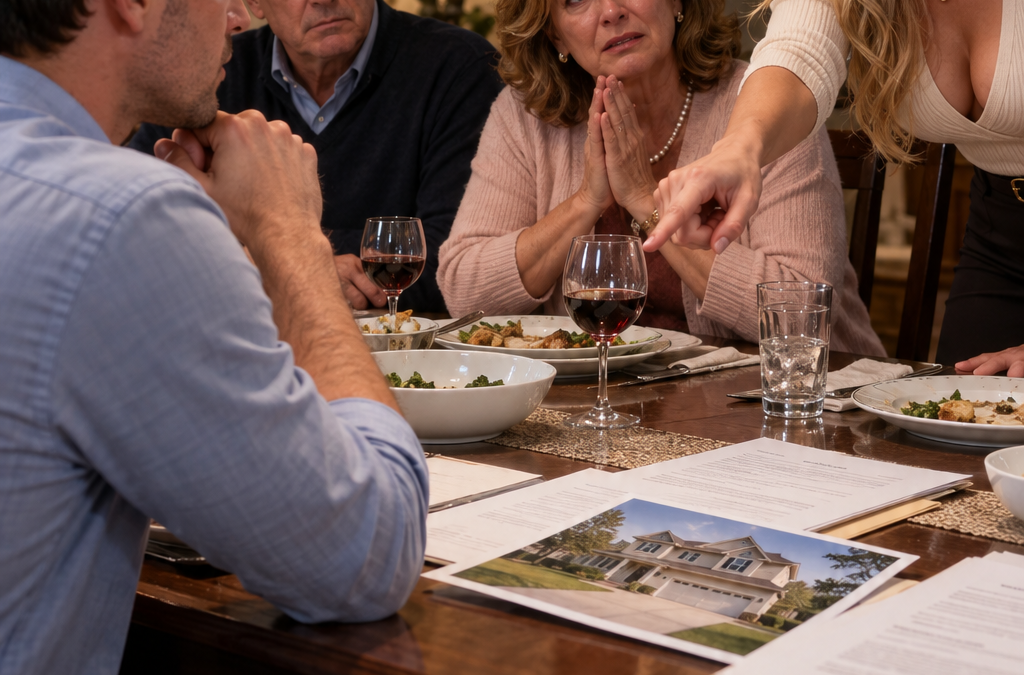
𝗙𝗨𝗟𝗟 𝗦𝗧𝗢𝗥𝗬
The one my parents had funded.
The one she lived in while telling social media she was “independent by choice.”
I looked from Karen to my parents. “Why would her house be involved?”
Silence.
It lasted just long enough to answer me.
My father’s side business had touched Karen’s mortgage. Maybe more than touched it.
I felt my accountant brain begin assembling pieces while my son brain resisted seeing the whole picture. There were things my father had mentioned years earlier, little details from a side LLC he once asked me to help organize books for. At the time, I was younger, busy, and not involved beyond basic bookkeeping support. I remembered invoices. Consulting fees. Vendor payments that had seemed odd but not clearly criminal to me then.
I also remembered keeping copies.
Not because I planned to use them. Because I kept records of everything.
My mother reached across the table toward me. “Your sister could lose everything.”
I looked at Karen.
She sat there with her perfect hair and glossy lips, suddenly looking less like a queen and more like someone whose throne was made of bills other people paid.
“That sounds serious,” I said.
“It is,” my father snapped. “Which is why we need you to step up.”
The words moved through the room like a trap closing.
“What exactly are you asking me to do?”
My mother inhaled carefully.
“We want you to trade houses with Karen.”
For a second, I thought I had misheard.
The room seemed to tilt slightly, not enough to show on my face, but enough that I became aware of my own heartbeat.
“What?”
Karen looked relieved now, as if hearing it said aloud made it reasonable.
My mother nodded, gaining confidence. “Your house is clean. It’s yours outright in the sense that it has nothing to do with any of this. Karen needs a fresh start somewhere stable while everything gets sorted out.”
I stared at her.
She continued, words coming faster. “Her house is bigger, and it’s worth more on paper. You would actually be getting the better end of the deal if you look at it objectively.”
Objectively.
My father jumped in. “You’d take over her place and the mortgage. We’d work out the details. Karen would move into your house. Just temporarily if needed.”
Karen leaned forward. “Your house is cute. It would be perfect for me to downsize into while I figure things out.”
Cute.
The house I had worked two jobs to earn was cute.
A convenient shelter for my spoiled sister while I inherited whatever legal mess my parents had created.
I laughed.
I wish I could say it was controlled. It wasn’t. It came out of me sharp and disbelieving, loud enough that my mother flinched.
“You can’t be serious,” I said.
My father’s expression hardened. “This is not funny.”
“No,” I said. “It’s insane.”
Karen’s eyes widened in offended disbelief. “Excuse me?”
“You want me to sign over my house to you?”
“Trade,” she said.
“No, Karen. A trade suggests both people are exchanging things of legitimate value. You want my clean house, and in return, you want me to take over a property that may be tied to whatever financial crime Dad committed.”
My mother gasped. “Don’t say that.”
“What should I call it?”
“A misunderstanding,” my father said.
“The IRS doesn’t investigate misunderstandings because they’re bored.”
He slammed his palm on the table. “You always have to act like you’re smarter than everyone.”
I looked at him. “I’m not acting.”
That did it.
His face went dark red, the old rage rising. I knew that expression. It had terrified me when I was a child. Back then, it meant I had asked too many questions, needed too much, failed to be invisible enough.
Now it just looked pathetic.
My mother started crying.
Not because she was sorry. My mother’s tears were tools. They had always been tools. When reason failed, she cried, and everyone was expected to gather around her feelings until the original issue disappeared.
“How can you be so cold?” she whispered. “Your sister is terrified.”
I looked at Karen.
She was not crying.
She was glaring at me with pure resentment, as if I had stolen something from her by owning something she wanted.
“She’s terrified because the gravy train might stop,” I said.
Karen stood so fast her chair scraped the floor. “You are such a bitter asshole.”
“Maybe.”
“You’ve always been jealous of me.”
I laughed again, quieter this time. “Karen, I have never wanted to be you.”
“That’s what jealous people say.”
“No. Jealous people demand houses they didn’t earn.”
My father pointed at me. “Enough.”
But I was done being the quiet kid at that table.
“No,” I said. “Not enough. You want to talk about family? Fine. Let’s talk about family. Where was family when I needed help with college? Where was family when I was working nights and going to class on three hours of sleep? Where was family when Karen got cars, vacations, designer clothes, and rent payments while I got lectures about responsibility?”
My mother wiped her cheeks. “We did our best.”
“No, you did your best for her.”
Karen rolled her eyes. “Oh my God, we’re doing childhood trauma now?”
I turned on her. “You sat there and watched it happen.”
“I was a kid.”
“You’re not a kid now.”
She tossed her hair back, a gesture so familiar and arrogant that it made something old and wounded twist inside me.
“I didn’t force you to be miserable,” she said. “Maybe people helped me because I was pleasant to be around.”
There it was.
The family myth in one sentence.
Karen was lovable. I was difficult.
Karen deserved rescue. I deserved lectures.
Karen made mistakes. I made problems.
I pushed my chair back and stood.
“My answer is no.”
My mother’s tears stopped. Just like that. “You can’t mean that.”
“I absolutely mean it.”
My father stood too. “After everything we did raising you?”
“You mean the legal minimum?”
His mouth opened, then closed.
I looked at each of them, one by one.
“I am not trading houses. I am not taking over Karen’s mortgage. I am not attaching myself to whatever investigation you’re under. And I am not sacrificing the one thing I built without your help so she can avoid consequences.”
Karen’s face twisted.
“You’re disgusting,” she said. “You have all this money now, and you won’t even help your own sister.”
“I have a mortgage, a wife, and a life. I’m comfortable because I worked. That doesn’t mean I’m available for plunder.”
My father stepped toward me. “If you walk out that door, don’t expect anything from us when we’re gone.”
I almost smiled.
“What exactly do you think I’ve been expecting?”
That landed harder than I thought it would.
For one second, my father looked uncertain. My mother looked away. Karen stared down at the table.
Then my father recovered.
“You’ll regret this.”
Maybe he meant losing the family. Maybe he meant something darker. At the time, I did not know.
I left anyway.
The first text came before I reached home.
It was from my mother.
I hope you’re proud of yourself. Your sister is sobbing.
I glanced at it at a red light and felt nothing but tired.
By the time I pulled into my driveway, there were three more messages. One from Karen calling me selfish. One from my father saying I was no longer welcome in his home. One from an aunt I had not spoken to in eight years.
Your mother told me what happened. Shame on you. Family comes first.
I sat in my car with the engine off, staring at the little house they had tried to take from me.
Warm light glowed from the front window. Emily had left the porch lamp on. Inside that house were secondhand bookshelves we had assembled together, a couch we saved for, dishes we chose, paint colors nobody mocked, silence nobody weaponized.
Mine.
Ours.
I went inside.
Emily was at the kitchen counter, grading papers from the elementary school where she taught. She took one look at my face and closed her laptop.
“What happened?”
I told her everything.
I expected shock. Anger. Maybe fear.
Emily listened quietly until I finished, then said, “Absolutely not.”
The simplicity of it almost broke me.
No debate. No guilt. No maybe they meant well. No but she’s your sister.
Just absolutely not.
I sank into the chair across from her. “They made it sound like I was abandoning them.”
“They were trying to hand you a bomb.”
“I think the house is tied to something illegal.”
“Then you need a lawyer.”
I nodded slowly.
“And those records from your dad’s side business?” she asked.
I looked up.
Emily knew about them. Not in detail, but she knew I had old files because I kept everything.
“I still have copies,” I said.
“Then you really need a lawyer.”
Over the next week, my family turned the pressure into a campaign.
My parents told everyone a polished version of the story. In their version, I was rich. Karen was about to be homeless. My parents were victims of government overreach. They had generously offered me a bigger house, and I had cruelly refused because I hated my sister.
The extended family responded exactly as expected.
Aunts called.
Cousins texted.
My grandmother left a voicemail saying she was ashamed of me.
People who had never once asked how I survived college suddenly had strong opinions about what I owed Karen.
I tried explaining at first. That was my mistake.
Manipulative families understand something honest people often forget: the first story people hear becomes the shape of the truth. Every correction sounds defensive after that.
So I stopped responding.
But I did start reviewing the old records.
Late at night, after Emily went to bed, I sat at the dining table with my laptop open and boxes of old files spread around me. The deeper I looked, the colder I felt.
Years earlier, my father had asked me for help with bookkeeping for what he called a small consulting LLC. I had been in my mid-twenties then, still desperate enough for parental approval that I said yes too quickly. I did basic work. Organized receipts. Categorized expenses. Helped reconcile some accounts. Nothing strategic. Nothing that looked obviously criminal to me at the time.
But now, with years of professional experience and the context of an IRS investigation, the records looked different.
There were invoices with vague descriptions. Consulting payments from businesses that did not seem to need consulting. Transfers that moved in patterns too neat to be accidental. Amounts broken up in ways that made my stomach tighten. Vendor names that repeated across unrelated entities.
I was not looking at messy bookkeeping.
I was looking at something designed to appear messy enough to hide intent.
One folder in particular made my hands go cold.
It contained payments connected indirectly to Karen’s house.
Not enough for me to understand everything, but enough to suspect that my parents had been using questionable funds to cover her mortgage and lifestyle.
Karen had to know.
Maybe not the legal structure. Maybe not the full scope. But she knew our parents were supposedly middle-class people making payments no middle-class retirees should have been able to make indefinitely. She knew credit cards got paid. She knew the car payment vanished each month. She knew the house remained hers because someone else kept feeding it money.
Karen’s innocence was another family performance.
I considered reporting everything immediately.
Then Emily stopped me.
Not by telling me to stay silent. By asking the question I needed to hear.
“Are you doing this to protect yourself or to punish them?”
I hated that question.
Because the honest answer was both.
I wanted them exposed. I wanted my father’s smug authority stripped away. I wanted my mother’s tears to stop working. I wanted Karen to experience one month of adult life without someone else paying the bill.
I wanted justice, but vengeance was standing very close to it wearing the same coat.
That scared me.
So I made an appointment with a criminal defense attorney who specialized in white-collar cases.
His name was Leonard Price. He had a small office downtown, no flashy ads, and the kind of calm voice people probably paid good money to borrow during panic. I brought copies of the records, the family messages, and a written timeline of my limited involvement in my father’s bookkeeping.
Leonard reviewed everything for a long time.
He did not speak much while reading.
That made me more nervous than if he had gasped.
Finally, he leaned back.
“You did the right thing coming here before doing anything else.”
My mouth went dry. “How bad is it?”
“For them? Potentially very bad.”
“For me?”
He tapped the folder. “That depends on documentation and intent. From what you’ve shown me, your involvement appears limited, historical, and consistent with legitimate bookkeeping tasks. The fact that you kept copies and can show when you stopped working on this helps you enormously.”
“Could I be implicated?”
“If you had continued assisting after becoming aware of fraud, yes. If you knowingly helped disguise transactions, yes. But based on this, I don’t see evidence of that. Still, you need to be careful.”
I exhaled slowly.
He continued. “You’re also a CPA. That matters. If you have credible knowledge of ongoing fraud and you sit on it, especially after being pressured to participate in a transaction that could further conceal assets, you may create professional risk for yourself.”
“So I should report it?”
“You should not make emotional decisions,” he said. “But you should protect yourself. If authorities are already investigating, cooperation may be necessary. We can prepare a controlled disclosure that explains your limited involvement and preserves your position.”
“Controlled disclosure,” I repeated.
“Not revenge. Not a dramatic packet mailed in anger. A documented, attorney-guided response.”
I nodded.
Then he asked, “Have your parents contacted you in writing about the records?”
“No.”
That changed three days later.
A formal demand letter arrived by certified mail.
It was ridiculous before I finished the first paragraph.
My parents, through some bargain-bin attorney, claimed that because I had performed accounting work for my father’s business years ago, I was professionally obligated to maintain confidentiality regarding everything I had seen. The letter demanded I turn over all copies of business records in my possession and threatened to report me to the State Board of Accountancy if I disclosed anything to law enforcement or regulatory authorities.
I read it once.
Then again.
Then a third time, because I genuinely could not believe they had put the threat in writing.
Emily found me standing in the kitchen with the letter in my hand.
“What is it?”
I handed it to her.
She read silently. Her expression went from confusion to disbelief to cold fury.
“They threatened your license?”
“Yes.”
“To cover themselves?”
“Yes.”
She looked up. “Call Leonard.”
Leonard sounded almost cheerful when I brought the letter to his office.
“This,” he said, holding it carefully, “is very useful.”
“That’s one word for it.”
“They just created evidence of intimidation. Possibly obstruction, depending on context. They are demanding silence regarding potential criminal conduct while threatening your professional standing.”
“They think they can scare me.”
“Yes,” Leonard said. “Because historically, that worked.”
The sentence hit harder than expected.
I looked at the floor.
He softened slightly. “That ends now.”
With Leonard’s help, I drafted a response that complied with every actual legal and ethical obligation I had.
It stated that I would preserve all relevant documents. It stated that CPA confidentiality obligations did not require concealment of fraud, money laundering, tax evasion, or other criminal conduct. It stated that I would cooperate fully with lawful requests from authorities. It also stated that any further attempts to intimidate me, compel destruction of records, or interfere with an investigation could have serious legal consequences.
Then Leonard advised attaching a disclosure packet to the proper agencies.
The IRS.
The state attorney general’s office.
Everything documented, organized, and explained with a clear timeline of my limited involvement.
Before we sent it, I sat in the parking lot outside Leonard’s office with the packet in my lap.
My hands trembled.
Not because I doubted the facts.
Because mailing that packet meant accepting something I had avoided saying plainly.
My parents were not merely unfair.
They were dangerous.
They had tried to use me. Not metaphorically. Not emotionally. Legally. Financially. Criminally.
The house trade was not a desperate family request.
It was an attempted laundering of risk through the child they had always considered disposable.
Emily sat beside me in the passenger seat. She had taken the afternoon off work to come with me.
“You don’t have to be okay right now,” she said.
“I feel like I’m betraying them.”
She reached over and took my hand.
“They betrayed you when they asked you to carry their crime.”
I closed my eyes.
Then I walked back inside and gave Leonard permission to send everything.
The explosion did not happen all at once.
That is the strange thing about legal consequences. They do not arrive like thunder. They begin as silence.
My parents stopped texting.
Karen stopped posting.
Extended family members who had been furious with me suddenly had nothing to say.
For a few weeks, life became eerily quiet.
I worked. I came home. Emily and I cooked dinner. I checked the front window too often, expecting my father’s car to appear. Sometimes I woke at night from dreams where I was back in my childhood closet-bedroom, surrounded by boxes of financial records, while Karen stood in the doorway laughing.
Then agents came.
Not to my house first.
To my parents’.
I heard from a cousin who heard from an aunt who heard from God knows who that federal agents had executed a search warrant. Computers were taken. Boxes were removed. My father was questioned. My mother reportedly cried so hard neighbors came outside.
Karen called me that evening.
I let it go to voicemail.
She called again.
And again.
Finally, I answered on the fourth call, mostly because Emily nodded when I looked at her.
Karen did not say hello.
“What did you do?”
Her voice was sharp, panicked, stripped of its usual lazy entitlement.
“I protected myself.”
“You reported them.”
“They threatened me in writing.”
“You destroyed our family.”
“No, Karen. They committed crimes.”
“They are our parents.”
“They tried to use me to hide assets.”
“You don’t know that.”
“I know enough.”
She made a sound of pure disgust. “You’ve been waiting for this your whole life, haven’t you?”
I leaned against the kitchen counter and looked around my little house. The one she had wanted to take. The one my parents had been willing to sacrifice me for.
“No,” I said. “Most of my life, I waited for them to love me.”
The line went silent.
For one brief second, I thought maybe that had reached her.
Then she laughed bitterly.
“God, you are so dramatic.”
There she was.
My sister.
The golden child standing in the ruins of a golden cage and still convinced the real tragedy was being inconvenienced.
“I’m hanging up now,” I said.
“You better hope I don’t lose my house.”
“You mean the one they paid for with dirty money?”
She inhaled sharply. “You don’t know anything.”
“I know I’m not trading.”
Her voice dropped, turning venomous. “You were nothing before that house. Don’t forget that.”
I ended the call.
My hands were shaking, but less than before.
There is power in ending a conversation you once would have begged to survive.
The indictments came months later.
By then, Leonard had explained enough that I understood the broad shape of what investigators believed happened. My father’s “small consulting LLC” was not small, and it was not really consulting. It had been used as part of a scheme involving fake invoices, tax evasion, and money moving through businesses that wanted illegitimate income made to look legitimate.
The total amount was somewhere in the seven figures.
Seven figures.
I remember reading that number in one of the legal updates and feeling physically dizzy.
Not because my father was rich.
Because I understood suddenly that every “we can’t afford it” from my childhood had been a choice wrapped in a lie.
They could afford Karen’s car.
They could afford Karen’s tuition.
They could afford Karen’s vacations.
They could afford everything they wanted to afford, and then some, because the money was flowing through places I had been too young and too neglected to question.
They had simply decided I was not worth spending it on.
That realization hurt more than the crimes.
My father was charged with money laundering, tax evasion, and conspiracy to commit wire fraud. My mother was charged too, though to a lesser degree. She had not been some helpless spouse signing whatever he placed in front of her. She knew enough. She benefited enough. She helped enough.
Karen was not charged in the main case, at least not initially, but her assets were scrutinized heavily. Her house was tangled in the money trail. Her car payments. Her credit cards. The lifestyle she had floated through like a princess on a stolen river.
The beautiful house she had wanted to trade away was not a prize.
It was evidence.
If I had accepted it, I might have carried that evidence right into my own name.
That thought haunted me.
There are alternate versions of our lives that exist only as warnings. In one of mine, I let guilt win. I sign papers. I move into Karen’s house. I take over the mortgage. Months later, federal agents ask why I accepted property tied to proceeds of crime right after my parents came under investigation. My license is questioned. My career collapses. My clean little house is gone.
And Karen?
Karen gets my home.
My parents almost succeeded.
That was the part I could not forgive.
The trial process was long, ugly, and mostly outside my control. Leonard kept me informed when necessary. Prosecutors contacted me. I cooperated. I provided records, answered questions, clarified timelines, and repeated again and again that my involvement had been limited to legitimate bookkeeping years before I understood what my father’s business really was.
It was humiliating, even when I had done nothing knowingly wrong.
Every question felt like a hand reaching into my past.
Why did your father ask you for help?
What did he tell you the business did?
Did you notice irregularities?
Why did you keep copies?
When did you stop assisting him?
Did you ever benefit from these transactions?
That last one almost made me laugh.
Benefit.
I thought of Karen’s new car at sixteen. Her paid tuition. Her vacations. Her house. Her credit cards.
Then I thought of my rusted Civic and my ramen dinners and the winter I wore two sweatshirts indoors because I was trying to keep the heating bill down.
“No,” I said. “I did not benefit.”
My father took a plea eventually.
So did my mother.
My father was sentenced to five years in federal prison. My mother got two.
I watched part of the sentencing from the back of the courtroom.
I had not planned to go. Emily told me I did not have to. Leonard said my presence was not required. But some part of me needed to see it. Not out of celebration. Out of finality.
My father looked smaller in court.
Not physically, exactly. He was still broad-shouldered, still red-faced, still wearing a suit like authority should recognize him. But the power had leaked out of him. Without his house, his money, his ability to shout people into silence, he looked like what he was: an aging man facing consequences he had spent years believing were for other people.
My mother cried during her statement.
For once, nobody rearranged reality around her tears.
Karen sat near the front, dressed in black, her hair smooth and shining. Even in crisis, she looked carefully styled. Her face was pale. Her mouth was tight. She did not look at me.
When my father spoke, he apologized to the court.
Not to me.
Not really to anyone he had harmed.
He said he had made mistakes. He said he had wanted to provide for his family. He said things had gotten away from him.
Things.
As if crimes were weather.
As if fake invoices and laundering money and threatening his son’s career were unfortunate storms that had blown through his life.
My mother said she trusted her husband and wanted to protect her daughter.
Her daughter.
Singular.
I felt Emily stiffen beside me.
I almost reached for her hand, but I didn’t. I was too focused on how little surprise I felt. Even at sentencing, even with everything exposed, I remained the child outside the circle.
But this time, something had changed.
I no longer wanted in.
When the judge sentenced them, Karen made a small wounded sound, like an actress in a scene where the lighting favored her. My father stared straight ahead. My mother sobbed into a tissue.
I sat very still.
I did not feel joy.
I did not feel grief in the way I expected.
I felt the closing of a door that had been open too long.
Afterward, in the hallway, Karen found me.
Emily immediately moved closer, but I touched her arm gently.
Karen approached slowly, her heels clicking against the floor. Up close, I could see the toll the past months had taken. Her makeup was flawless, but exhaustion lived beneath it. Her beauty was still there, but sharpened by fear.
“You happy now?” she asked.
“No.”
“Could’ve fooled me.”
“I’m not happy our parents are going to prison.”
“Our parents?” she repeated bitterly. “You stopped acting like their son a long time ago.”
That almost got me.
Almost.
Then I remembered sitting at their table while they asked me to trade my life for hers.
“I acted like their son for years,” I said. “They treated me like insurance.”
Her eyes filled with tears.
With Karen, it was hard to know what was real. Maybe some of those tears were. Maybe all of them were. Losing the structure that had held up her life must have been terrifying. But fear did not make her innocent.
“I’m going to lose the house,” she said.
“I know.”
“I have nowhere to go.”
I did not answer.
She stepped closer. Her perfume was expensive and familiar, something floral and soft that did not match the hardness in her eyes.
“You have a spare room.”
There it was.
Not an apology.
Not accountability.
A request.
No, not even a request.
An expectation.
I stared at her. “You’re asking to live with me?”
“Temporarily.”
“No.”
The word came easier this time.
Her tears vanished so fast it was almost impressive.
“You haven’t even thought about it.”
“Emily and I already discussed it.”
That threw her.
“You discussed me?”
“We knew this might happen.”
Her face twisted. “So you planned to abandon me.”
“No. We planned boundaries.”
“Boundaries?” She laughed sharply. “You sound like a therapy pamphlet.”
“Maybe you should read one.”
Her eyes flashed.
The courthouse hallway was busy enough that she kept her voice low, but the venom carried.
“I’m your sister.”
“You were my sister when you sat at that dinner table and expected me to give you my house.”
“I was scared.”
“You were smug.”
“I didn’t know everything.”
“You knew enough.”
She looked away.
For the first time, she had no instant comeback.
So I continued.
“You knew they were paying your mortgage. You knew they were paying your car. You knew they were covering credit cards you couldn’t afford. You knew the lifestyle didn’t match the story. Maybe you didn’t know the legal details, but you knew enough not to ask questions.”
Her jaw trembled.
“You’re cruel,” she whispered.
“No,” I said. “I’m finished.”
She looked back at me, and the hatred in her face was almost pure.
“Our parents are in prison because of you.”
“No. They’re in prison because they committed crimes. They’re in prison because they broke the law for years. They’re in prison because when they got caught, they tried to pressure their son into taking part of the risk. They’re in prison because instead of protecting me, they threatened my career.”
Karen’s eyes narrowed.
“You always wanted to win.”
I thought about that.
Then I said, “No. I wanted a family. Winning is what I settled for when I realized I didn’t have one.”
She flinched.
I walked away before she could turn that into another performance.
A week later, Karen came to my house.
I knew from the doorbell camera before she knocked. She stood on my porch wearing oversized sunglasses and a fitted camel coat, holding a designer handbag I suspected she could no longer afford. For a moment, seeing her there made anger rise so fast I felt it in my teeth.
My house.
The one she had tried to take.
Now she stood outside it asking for shelter.
Emily came beside me and looked at the camera feed.
“You don’t have to answer,” she said.
“I know.”
But I did.
Not because Karen deserved it.
Because I wanted to say no to her face in the doorway of the home she once thought would be hers.
I opened the door but kept my body in the gap.
Karen removed her sunglasses slowly, revealing red-rimmed eyes. Whether from crying or lack of sleep, I did not know.
“Can I come in?”
“No.”
Her mouth tightened.
“I just want to talk.”
“We can talk here.”
She looked past me into the house. Her gaze moved over the hallway, the framed print Emily had chosen, the small table by the stairs, the ordinary warmth of a life built honestly. Something like envy crossed her face.
Then she smiled weakly.
“I always liked this place.”
“I remember. You said it was cute.”
“I didn’t mean that in a bad way.”
“You did.”
Her smile collapsed.
“I don’t have anywhere else,” she said. “The house is being seized. The car is gone. My cards are frozen. Mom and Dad’s accounts are gone. Nobody is answering me.”
“That sounds hard.”
Her eyes widened, offended by my calm.
“That sounds hard?” she repeated. “That’s all you have to say?”
“What do you want me to say?”
“I want you to act like my brother.”
I leaned against the doorframe.
“I did. For years. I kept hoping you would act like my sister.”
She crossed her arms, the old Karen returning in posture if not circumstance.
“So this is punishment.”
“No. Punishment would be me inviting you in and treating you the way you treated me.”
Her face flushed.
“I was a child.”
“You were twenty-nine at that dinner.”
She looked down.
For once, silence sat between us without her controlling it.
“I can change,” she said finally.
“I hope you do.”
Her head snapped up. “Then help me.”
“No.”
The word was quiet, but it landed harder than shouting.
Karen stared at me.
“You really mean it.”
“Yes.”
“Where am I supposed to go?”
“I don’t know.”
“How am I supposed to survive?”
“The same way I did.”
That was the cruelest thing I said.
It was also the truest.
She recoiled as if I had struck her.
“You’re heartless.”
“I used to think that too,” I said. “Every time I didn’t feel what you all told me I should feel, I thought something was wrong with me. But there’s a difference between being heartless and refusing to keep bleeding for people who cut you.”
Her lips parted.
No words came.
So I gave her the only mercy I could offer without sacrificing myself.
“There are shelters. Employment agencies. Public assistance offices. I’ll text you a list.”
She laughed once, broken and ugly. “A list.”
“Yes.”
“Your own sister.”
“Yes,” I said. “My own sister.”
She stood there a moment longer, waiting for guilt to resurrect the brother she knew how to use.
It didn’t.
Finally, she put her sunglasses back on.
“I hope you enjoy your perfect little life.”
“It isn’t perfect.”
I looked behind me, where Emily was waiting just out of sight, steady and quiet and real.
“But it’s mine.”
Karen left.
I watched her walk down the path, heels clicking, shoulders stiff. She did not look back.
I texted the list.
She never replied.
Months passed again.
My parents began serving their sentences. Karen vanished into whatever life looks like after the golden child’s gold runs out. Some relatives eventually tried to reconnect, mostly the ones who had called me selfish before the truth became public enough to embarrass them.
An aunt sent a long message saying she had only known what my mother told her.
I responded with one sentence.
Now you know why I stopped answering.
My grandmother never apologized. That hurt more than I expected, then less as time passed. Pain can shrink when you stop feeding it fantasies.
The strangest part was the peace.
At first, I did not trust it. I kept expecting another demand letter, another accusation, another family emergency shaped like a hook. But slowly, the phone stayed quiet. My house stayed mine. Work continued. Emily and I painted the guest room green. We adopted a mutt named Franklin who snored like a malfunctioning appliance and loved the backyard more than any creature had ever loved anything.
One Saturday morning, I stood on my porch with coffee while Franklin chased leaves, and I realized I had not thought about my parents before breakfast.
That felt like freedom.
Not dramatic freedom. Not movie-ending freedom.
Real freedom.
The kind that arrives quietly and asks for nothing.
I still think about that dinner sometimes.
The roast chicken smell. My father’s untouched whiskey. My mother’s folded hands. Karen’s smug little smile when she thought my house was already halfway hers.
I think about how close I came to being pulled back into the role they built for me.
The useful son.
The guilty son.
The son who survived neglect only to be told survival made him responsible for everyone who had neglected him.
For years, I believed my family’s story about me. Difficult. Ungrateful. Cold. Jealous. Bitter.
But the truth was simpler.
I was inconvenient because I remembered.
I remembered who got help and who didn’t. I remembered who was praised and who was blamed. I remembered the converted closet, the rusted car, the tuition they could not afford for me but somehow found for Karen. I remembered every time I was told family meant sacrifice by people who never sacrificed for me.
And when the time came, remembering saved me.
So did the records.
People made jokes later about me being meticulous. About keeping copies. About the accountant finally using paperwork as a weapon. Maybe there is truth in that. But I don’t think of those records as a weapon.
I think of them as proof.
Proof that reality existed even when my family tried to rewrite it.
Proof that I had not imagined the imbalance.
Proof that the house they wanted me to take was not a gift.
Proof that the house they wanted from me was worth protecting.
My parents lost their freedom because they chose crime and then chose intimidation when crime caught up with them.
Karen lost her lifestyle because it had never been built on anything solid.
And me?
I kept my house.
That may sound small compared to federal charges, prison sentences, seized assets, and a family collapsing under the weight of its own lies.
But every evening when I come home, turn my key, and step into the quiet life I earned, it feels enormous.
The living room is still modest. The kitchen cabinets still need replacing. The porch boards creak in damp weather. The backyard is just big enough for Franklin to sprint in circles until he forgets why he started.
It is not Karen’s fresh start.
It is not my parents’ emergency fund.
It is not a bargaining chip, a laundering tool, or proof that I finally became useful enough to deserve attention.
It is my home.
And after everything they tried to take, that is enough.
𝗧𝗛𝗘 𝗘𝗡𝗗
They Wanted My House Before I Realized They Were Trying to Hand Me the Crime Scene
My family only remembered I existed when they needed someone clean enough to save the daughter they had spoiled rotten.
They asked me to trade the only home I had ever earned for a bigger house wrapped in debt, lies, and federal attention.
What they did not know was that I had kept the records, and once they threatened everything I had built, I stopped protecting the truth.
I knew something was wrong the moment my mother called and invited me to dinner.
Not because dinner itself was unusual in a normal family. In a normal family, a mother calling her son for a meal might have meant she missed him, or wanted to catch up, or had made too much pot roast and thought he might like leftovers. In my family, dinner invitations were never casual. They were summonses dressed up as affection.
My mother’s voice had that careful sweetness she used when she wanted something.
“Your father and I would really love to see you,” she said. “It’s been too long.”
It had been too long because I had made it that way.
I was thirty-two years old, married, employed, and finally living in a house I owned because I had clawed my way toward it one paycheck at a time. My family did not contribute to any of that. Not emotionally. Not financially. Not even with the faint, polite encouragement strangers give each other in elevators.
They had always saved their pride for my younger sister.
Her name was Karen.
I know people use that name like a joke now, but in my family, Karen was not a meme. She was a lifestyle. At twenty-nine, she moved through life like consequences were something poorer, uglier people dealt with. She was beautiful in the polished, expensive way my parents had funded since she was old enough to know what attention could buy her. Honey-blonde hair, smooth skin, a gym-shaped body she liked to display in tight dresses and soft sweaters that always seemed innocent until you noticed how carefully they fit. She had big blue eyes she could turn wet on command and a laugh that made men forgive her before she finished lying.
Growing up, Karen did not ask for things.
She received them.
At sixteen, she got a brand-new car with a bow on it in the driveway, while I was working after school and saving for a rusted Honda Civic that coughed like an old smoker every time I started it. She got designer clothes, beach vacations, a bedroom twice the size of mine, and college paid for in full. I slept in what was basically a converted closet and was told I should be grateful I had privacy.
When I asked about help with college, my parents said money was tight.
That same month, Karen posted pictures from a spring break trip they paid for.
So I learned early.
If I wanted anything, I would have to build it myself.
I moved out at eighteen with two duffel bags, a used laptop, and a kind of rage I mistook for ambition because it kept me alive. I worked through community college, transferred to a state school, and earned an accounting degree while juggling jobs that left me so tired I once fell asleep sitting upright with a fork still in my hand.
My twenties were not glamorous. They were ramen noodles, double shifts, discount shoes, and studying in laundromats because I could not afford a quiet apartment. But they were mine.
That mattered.
Years later, I landed a position at a good firm. I worked hard, kept my head down, and got promoted twice. I became a CPA. I married a woman named Emily who loved me without needing me to perform gratitude for basic kindness. And eighteen months before my mother’s dinner invitation, I bought my first house.
It was not a mansion.
It was a two-bedroom starter home on a quiet street with a little front porch, a narrow backyard, and an aging maple tree that dropped leaves into the gutters every fall. But when I turned the key for the first time and stepped inside, I stood in the empty living room and cried.
Not because it was fancy.
Because no one had handed it to me.
Every board, every wall, every window belonged to a life I had earned without my parents deciding I deserved it.
Karen, meanwhile, was living in a beautiful two-story house my parents had co-signed for and were mostly paying for. She called it her “fresh start” even though it was one of many. She had bounced from job to job her entire adult life, never staying anywhere longer than a year because every boss was “toxic,” every coworker was “jealous,” and every workplace somehow failed to appreciate her unique gifts.
Her unique gifts, as far as I could tell, were spending other people’s money and making them feel guilty for noticing.
So when my mother called, I already knew the dinner was not about love.
Still, something in her voice sounded strained enough that I went.
Emily offered to come with me, but I told her not to. Part of me wanted to spare her. Another part, if I’m being honest, still carried that old childhood reflex of walking into my parents’ house alone, ready to be judged, ready to be told who I was supposed to be.
My parents’ house looked the same as always from the outside. Neat lawn, brick walkway, lights glowing in the windows like warmth lived there.
Inside, it smelled like roast chicken and anxiety.
My father was sitting at the dining table with a glass of whiskey he had barely touched. That was the first real sign of danger. My father loved two things with consistent devotion: being right and finishing his whiskey.
My mother moved around the kitchen too quickly, wiping counters that were already clean.
Karen sat at the table in a cream-colored blouse, gold hoops, and full makeup, scrolling through her phone as if this family crisis had interrupted a spa appointment. She looked up when I walked in and gave me a smile that was all lips.
“Hey, big brother,” she said. “Nice of you to finally show up.”
I looked at the clock. “I’m five minutes early.”
She shrugged. “Feels late.”
That was Karen. Even time had to flatter her.
Dinner itself was stiff and quiet. My mother asked about work, but did not listen to the answer. My father asked about Emily, then interrupted before I could finish. Karen spent most of the meal texting under the table, occasionally sighing in a way that suggested life had personally inconvenienced her.
I waited.
I had learned patience from years of being the unfavored child. In my family, the real reason for anything always came after enough fake conversation had been sacrificed on the altar.
Finally, after dessert no one really ate, my mother folded her hands on the table.
“We need to talk about something serious,” she said.
PART 2
My father cleared his throat.
Karen put her phone down.
That was when I knew the conversation had been rehearsed without me.
My mother looked at my father, then back at me, her eyes shiny in the way they got when she wanted to appear fragile.
“We’re in some financial trouble,” she said.
I waited for the familiar tug of guilt to rise in me.
It didn’t.
Maybe I was too old. Maybe I had spent too many years building a life outside their reach. Or maybe some wounds eventually scar over so hard that even family cannot poke through them easily.
“What kind of trouble?” I asked.
My father leaned back in his chair, his jaw tight. “Complicated trouble.”
“That isn’t an answer.”
His eyes narrowed. “Don’t take that tone.”
There it was. One question in, and I was already difficult.
My mother touched his arm, performing calm. “Your father had a business arrangement. A side business. Some of the paperwork has been misunderstood.”
“By who?”
She hesitated.
My father took over. “The IRS has been asking questions.”
That got my attention.
I was a CPA. People did not casually say the IRS was asking questions unless things had already gone past uncomfortable and into dangerous.
“What kind of questions?” I asked.
My father’s face reddened. “The kind people ask when they don’t understand how business works.”
I looked at him for a long moment. “That’s still not an answer.”
Karen sighed dramatically. “Can you not interrogate everyone for two seconds?”
I turned to her. “I’m trying to understand what I was invited here for.”
“For family,” my mother said quickly. “Because family helps family.”
Those words never meant anything good in our house.
My father leaned forward, elbows on the table. “There may be legal scrutiny on some assets.”
“What assets?”
“Our accounts,” my mother whispered. “The house. Some business holdings.”
Karen’s mouth tightened, and for the first time that night, I saw real fear beneath her entitlement.
“My house too,” she said.
Her house.
The one my parents had funded.
The one she lived in while telling social media she was “independent by choice.”
I looked from Karen to my parents. “Why would her house be involved?”
Silence.
It lasted just long enough to answer me.
My father’s side business had touched Karen’s mortgage. Maybe more than touched it.
I felt my accountant brain begin assembling pieces while my son brain resisted seeing the whole picture. There were things my father had mentioned years earlier, little details from a side LLC he once asked me to help organize books for. At the time, I was younger, busy, and not involved beyond basic bookkeeping support. I remembered invoices. Consulting fees. Vendor payments that had seemed odd but not clearly criminal to me then.
I also remembered keeping copies.
Not because I planned to use them. Because I kept records of everything.
My mother reached across the table toward me. “Your sister could lose everything.”
I looked at Karen.
She sat there with her perfect hair and glossy lips, suddenly looking less like a queen and more like someone whose throne was made of bills other people paid.
“That sounds serious,” I said.
“It is,” my father snapped. “Which is why we need you to step up.”
The words moved through the room like a trap closing.
“What exactly are you asking me to do?”
My mother inhaled carefully.
“We want you to trade houses with Karen.”
For a second, I thought I had misheard.
The room seemed to tilt slightly, not enough to show on my face, but enough that I became aware of my own heartbeat.
“What?”
Karen looked relieved now, as if hearing it said aloud made it reasonable.
My mother nodded, gaining confidence. “Your house is clean. It’s yours outright in the sense that it has nothing to do with any of this. Karen needs a fresh start somewhere stable while everything gets sorted out.”
I stared at her.
She continued, words coming faster. “Her house is bigger, and it’s worth more on paper. You would actually be getting the better end of the deal if you look at it objectively.”
Objectively.
My father jumped in. “You’d take over her place and the mortgage. We’d work out the details. Karen would move into your house. Just temporarily if needed.”
Karen leaned forward. “Your house is cute. It would be perfect for me to downsize into while I figure things out.”
Cute.
The house I had worked two jobs to earn was cute.
A convenient shelter for my spoiled sister while I inherited whatever legal mess my parents had created.
I laughed.
I wish I could say it was controlled. It wasn’t. It came out of me sharp and disbelieving, loud enough that my mother flinched.
“You can’t be serious,” I said.
My father’s expression hardened. “This is not funny.”
“No,” I said. “It’s insane.”
Karen’s eyes widened in offended disbelief. “Excuse me?”
“You want me to sign over my house to you?”
“Trade,” she said.
“No, Karen. A trade suggests both people are exchanging things of legitimate value. You want my clean house, and in return, you want me to take over a property that may be tied to whatever financial crime Dad committed.”
My mother gasped. “Don’t say that.”
“What should I call it?”
“A misunderstanding,” my father said.
“The IRS doesn’t investigate misunderstandings because they’re bored.”
He slammed his palm on the table. “You always have to act like you’re smarter than everyone.”
I looked at him. “I’m not acting.”
That did it.
His face went dark red, the old rage rising. I knew that expression. It had terrified me when I was a child. Back then, it meant I had asked too many questions, needed too much, failed to be invisible enough.
Now it just looked pathetic.
My mother started crying.
Not because she was sorry. My mother’s tears were tools. They had always been tools. When reason failed, she cried, and everyone was expected to gather around her feelings until the original issue disappeared.
“How can you be so cold?” she whispered. “Your sister is terrified.”
I looked at Karen.
She was not crying.
She was glaring at me with pure resentment, as if I had stolen something from her by owning something she wanted.
“She’s terrified because the gravy train might stop,” I said.
Karen stood so fast her chair scraped the floor. “You are such a bitter asshole.”
“Maybe.”
“You’ve always been jealous of me.”
I laughed again, quieter this time. “Karen, I have never wanted to be you.”
“That’s what jealous people say.”
“No. Jealous people demand houses they didn’t earn.”
My father pointed at me. “Enough.”
But I was done being the quiet kid at that table.
“No,” I said. “Not enough. You want to talk about family? Fine. Let’s talk about family. Where was family when I needed help with college? Where was family when I was working nights and going to class on three hours of sleep? Where was family when Karen got cars, vacations, designer clothes, and rent payments while I got lectures about responsibility?”
My mother wiped her cheeks. “We did our best.”
“No, you did your best for her.”
Karen rolled her eyes. “Oh my God, we’re doing childhood trauma now?”
I turned on her. “You sat there and watched it happen.”
“I was a kid.”
“You’re not a kid now.”
She tossed her hair back, a gesture so familiar and arrogant that it made something old and wounded twist inside me.
“I didn’t force you to be miserable,” she said. “Maybe people helped me because I was pleasant to be around.”
There it was.
The family myth in one sentence.
Karen was lovable. I was difficult.
Karen deserved rescue. I deserved lectures.
Karen made mistakes. I made problems.
I pushed my chair back and stood.
“My answer is no.”
My mother’s tears stopped. Just like that. “You can’t mean that.”
“I absolutely mean it.”
My father stood too. “After everything we did raising you?”
“You mean the legal minimum?”
His mouth opened, then closed.
I looked at each of them, one by one.
“I am not trading houses. I am not taking over Karen’s mortgage. I am not attaching myself to whatever investigation you’re under. And I am not sacrificing the one thing I built without your help so she can avoid consequences.”
Karen’s face twisted.
“You’re disgusting,” she said. “You have all this money now, and you won’t even help your own sister.”
“I have a mortgage, a wife, and a life. I’m comfortable because I worked. That doesn’t mean I’m available for plunder.”
My father stepped toward me. “If you walk out that door, don’t expect anything from us when we’re gone.”
I almost smiled.
“What exactly do you think I’ve been expecting?”
That landed harder than I thought it would.
For one second, my father looked uncertain. My mother looked away. Karen stared down at the table.
Then my father recovered.
“You’ll regret this.”
Maybe he meant losing the family. Maybe he meant something darker. At the time, I did not know.
I left anyway.
The first text came before I reached home.
It was from my mother.
I hope you’re proud of yourself. Your sister is sobbing.
I glanced at it at a red light and felt nothing but tired.
By the time I pulled into my driveway, there were three more messages. One from Karen calling me selfish. One from my father saying I was no longer welcome in his home. One from an aunt I had not spoken to in eight years.
Your mother told me what happened. Shame on you. Family comes first.
I sat in my car with the engine off, staring at the little house they had tried to take from me.
Warm light glowed from the front window. Emily had left the porch lamp on. Inside that house were secondhand bookshelves we had assembled together, a couch we saved for, dishes we chose, paint colors nobody mocked, silence nobody weaponized.
Mine.
Ours.
I went inside.
Emily was at the kitchen counter, grading papers from the elementary school where she taught. She took one look at my face and closed her laptop.
“What happened?”
I told her everything.
I expected shock. Anger. Maybe fear.
Emily listened quietly until I finished, then said, “Absolutely not.”
The simplicity of it almost broke me.
No debate. No guilt. No maybe they meant well. No but she’s your sister.
Just absolutely not.
I sank into the chair across from her. “They made it sound like I was abandoning them.”
“They were trying to hand you a bomb.”
“I think the house is tied to something illegal.”
“Then you need a lawyer.”
I nodded slowly.
“And those records from your dad’s side business?” she asked.
I looked up.
Emily knew about them. Not in detail, but she knew I had old files because I kept everything.
“I still have copies,” I said.
“Then you really need a lawyer.”
Over the next week, my family turned the pressure into a campaign.
My parents told everyone a polished version of the story. In their version, I was rich. Karen was about to be homeless. My parents were victims of government overreach. They had generously offered me a bigger house, and I had cruelly refused because I hated my sister.
The extended family responded exactly as expected.
Aunts called.
Cousins texted.
My grandmother left a voicemail saying she was ashamed of me.
People who had never once asked how I survived college suddenly had strong opinions about what I owed Karen.
I tried explaining at first. That was my mistake.
Manipulative families understand something honest people often forget: the first story people hear becomes the shape of the truth. Every correction sounds defensive after that.
So I stopped responding.
But I did start reviewing the old records.
Late at night, after Emily went to bed, I sat at the dining table with my laptop open and boxes of old files spread around me. The deeper I looked, the colder I felt.
Years earlier, my father had asked me for help with bookkeeping for what he called a small consulting LLC. I had been in my mid-twenties then, still desperate enough for parental approval that I said yes too quickly. I did basic work. Organized receipts. Categorized expenses. Helped reconcile some accounts. Nothing strategic. Nothing that looked obviously criminal to me at the time.
But now, with years of professional experience and the context of an IRS investigation, the records looked different.
There were invoices with vague descriptions. Consulting payments from businesses that did not seem to need consulting. Transfers that moved in patterns too neat to be accidental. Amounts broken up in ways that made my stomach tighten. Vendor names that repeated across unrelated entities.
I was not looking at messy bookkeeping.
I was looking at something designed to appear messy enough to hide intent.
One folder in particular made my hands go cold.
It contained payments connected indirectly to Karen’s house.
Not enough for me to understand everything, but enough to suspect that my parents had been using questionable funds to cover her mortgage and lifestyle.
Karen had to know.
Maybe not the legal structure. Maybe not the full scope. But she knew our parents were supposedly middle-class people making payments no middle-class retirees should have been able to make indefinitely. She knew credit cards got paid. She knew the car payment vanished each month. She knew the house remained hers because someone else kept feeding it money.
Karen’s innocence was another family performance.
I considered reporting everything immediately.
Then Emily stopped me.
Not by telling me to stay silent. By asking the question I needed to hear.
“Are you doing this to protect yourself or to punish them?”
I hated that question.
Because the honest answer was both.
I wanted them exposed. I wanted my father’s smug authority stripped away. I wanted my mother’s tears to stop working. I wanted Karen to experience one month of adult life without someone else paying the bill.
I wanted justice, but vengeance was standing very close to it wearing the same coat.
That scared me.
So I made an appointment with a criminal defense attorney who specialized in white-collar cases.
His name was Leonard Price. He had a small office downtown, no flashy ads, and the kind of calm voice people probably paid good money to borrow during panic. I brought copies of the records, the family messages, and a written timeline of my limited involvement in my father’s bookkeeping.
Leonard reviewed everything for a long time.
He did not speak much while reading.
That made me more nervous than if he had gasped.
Finally, he leaned back.
“You did the right thing coming here before doing anything else.”
My mouth went dry. “How bad is it?”
“For them? Potentially very bad.”
“For me?”
He tapped the folder. “That depends on documentation and intent. From what you’ve shown me, your involvement appears limited, historical, and consistent with legitimate bookkeeping tasks. The fact that you kept copies and can show when you stopped working on this helps you enormously.”
“Could I be implicated?”
“If you had continued assisting after becoming aware of fraud, yes. If you knowingly helped disguise transactions, yes. But based on this, I don’t see evidence of that. Still, you need to be careful.”
I exhaled slowly.
He continued. “You’re also a CPA. That matters. If you have credible knowledge of ongoing fraud and you sit on it, especially after being pressured to participate in a transaction that could further conceal assets, you may create professional risk for yourself.”
“So I should report it?”
“You should not make emotional decisions,” he said. “But you should protect yourself. If authorities are already investigating, cooperation may be necessary. We can prepare a controlled disclosure that explains your limited involvement and preserves your position.”
“Controlled disclosure,” I repeated.
“Not revenge. Not a dramatic packet mailed in anger. A documented, attorney-guided response.”
I nodded.
Then he asked, “Have your parents contacted you in writing about the records?”
“No.”
That changed three days later.
A formal demand letter arrived by certified mail.
It was ridiculous before I finished the first paragraph.
My parents, through some bargain-bin attorney, claimed that because I had performed accounting work for my father’s business years ago, I was professionally obligated to maintain confidentiality regarding everything I had seen. The letter demanded I turn over all copies of business records in my possession and threatened to report me to the State Board of Accountancy if I disclosed anything to law enforcement or regulatory authorities.
I read it once.
Then again.
Then a third time, because I genuinely could not believe they had put the threat in writing.
Emily found me standing in the kitchen with the letter in my hand.
“What is it?”
I handed it to her.
She read silently. Her expression went from confusion to disbelief to cold fury.
“They threatened your license?”
“Yes.”
“To cover themselves?”
“Yes.”
She looked up. “Call Leonard.”
Leonard sounded almost cheerful when I brought the letter to his office.
“This,” he said, holding it carefully, “is very useful.”
“That’s one word for it.”
“They just created evidence of intimidation. Possibly obstruction, depending on context. They are demanding silence regarding potential criminal conduct while threatening your professional standing.”
“They think they can scare me.”
“Yes,” Leonard said. “Because historically, that worked.”
The sentence hit harder than expected.
I looked at the floor.
He softened slightly. “That ends now.”
With Leonard’s help, I drafted a response that complied with every actual legal and ethical obligation I had.
It stated that I would preserve all relevant documents. It stated that CPA confidentiality obligations did not require concealment of fraud, money laundering, tax evasion, or other criminal conduct. It stated that I would cooperate fully with lawful requests from authorities. It also stated that any further attempts to intimidate me, compel destruction of records, or interfere with an investigation could have serious legal consequences.
Then Leonard advised attaching a disclosure packet to the proper agencies.
The IRS.
The state attorney general’s office.
Everything documented, organized, and explained with a clear timeline of my limited involvement.
Before we sent it, I sat in the parking lot outside Leonard’s office with the packet in my lap.
My hands trembled.
Not because I doubted the facts.
Because mailing that packet meant accepting something I had avoided saying plainly.
My parents were not merely unfair.
They were dangerous.
They had tried to use me. Not metaphorically. Not emotionally. Legally. Financially. Criminally.
The house trade was not a desperate family request.
It was an attempted laundering of risk through the child they had always considered disposable.
Emily sat beside me in the passenger seat. She had taken the afternoon off work to come with me.
“You don’t have to be okay right now,” she said.
“I feel like I’m betraying them.”
She reached over and took my hand.
“They betrayed you when they asked you to carry their crime.”
I closed my eyes.
Then I walked back inside and gave Leonard permission to send everything.
The explosion did not happen all at once.
That is the strange thing about legal consequences. They do not arrive like thunder. They begin as silence.
My parents stopped texting.
Karen stopped posting.
Extended family members who had been furious with me suddenly had nothing to say.
For a few weeks, life became eerily quiet.
I worked. I came home. Emily and I cooked dinner. I checked the front window too often, expecting my father’s car to appear. Sometimes I woke at night from dreams where I was back in my childhood closet-bedroom, surrounded by boxes of financial records, while Karen stood in the doorway laughing.
Then agents came.
Not to my house first.
To my parents’.
I heard from a cousin who heard from an aunt who heard from God knows who that federal agents had executed a search warrant. Computers were taken. Boxes were removed. My father was questioned. My mother reportedly cried so hard neighbors came outside.
Karen called me that evening.
I let it go to voicemail.
She called again.
And again.
Finally, I answered on the fourth call, mostly because Emily nodded when I looked at her.
Karen did not say hello.
“What did you do?”
Her voice was sharp, panicked, stripped of its usual lazy entitlement.
“I protected myself.”
“You reported them.”
“They threatened me in writing.”
“You destroyed our family.”
“No, Karen. They committed crimes.”
“They are our parents.”
“They tried to use me to hide assets.”
“You don’t know that.”
“I know enough.”
She made a sound of pure disgust. “You’ve been waiting for this your whole life, haven’t you?”
I leaned against the kitchen counter and looked around my little house. The one she had wanted to take. The one my parents had been willing to sacrifice me for.
“No,” I said. “Most of my life, I waited for them to love me.”
The line went silent.
For one brief second, I thought maybe that had reached her.
Then she laughed bitterly.
“God, you are so dramatic.”
There she was.
My sister.
The golden child standing in the ruins of a golden cage and still convinced the real tragedy was being inconvenienced.
“I’m hanging up now,” I said.
“You better hope I don’t lose my house.”
“You mean the one they paid for with dirty money?”
She inhaled sharply. “You don’t know anything.”
“I know I’m not trading.”
Her voice dropped, turning venomous. “You were nothing before that house. Don’t forget that.”
I ended the call.
My hands were shaking, but less than before.
There is power in ending a conversation you once would have begged to survive.
The indictments came months later.
By then, Leonard had explained enough that I understood the broad shape of what investigators believed happened. My father’s “small consulting LLC” was not small, and it was not really consulting. It had been used as part of a scheme involving fake invoices, tax evasion, and money moving through businesses that wanted illegitimate income made to look legitimate.
The total amount was somewhere in the seven figures.
Seven figures.
I remember reading that number in one of the legal updates and feeling physically dizzy.
Not because my father was rich.
Because I understood suddenly that every “we can’t afford it” from my childhood had been a choice wrapped in a lie.
They could afford Karen’s car.
They could afford Karen’s tuition.
They could afford Karen’s vacations.
They could afford everything they wanted to afford, and then some, because the money was flowing through places I had been too young and too neglected to question.
They had simply decided I was not worth spending it on.
That realization hurt more than the crimes.
My father was charged with money laundering, tax evasion, and conspiracy to commit wire fraud. My mother was charged too, though to a lesser degree. She had not been some helpless spouse signing whatever he placed in front of her. She knew enough. She benefited enough. She helped enough.
Karen was not charged in the main case, at least not initially, but her assets were scrutinized heavily. Her house was tangled in the money trail. Her car payments. Her credit cards. The lifestyle she had floated through like a princess on a stolen river.
The beautiful house she had wanted to trade away was not a prize.
It was evidence.
If I had accepted it, I might have carried that evidence right into my own name.
That thought haunted me.
There are alternate versions of our lives that exist only as warnings. In one of mine, I let guilt win. I sign papers. I move into Karen’s house. I take over the mortgage. Months later, federal agents ask why I accepted property tied to proceeds of crime right after my parents came under investigation. My license is questioned. My career collapses. My clean little house is gone.
And Karen?
Karen gets my home.
My parents almost succeeded.
That was the part I could not forgive.
The trial process was long, ugly, and mostly outside my control. Leonard kept me informed when necessary. Prosecutors contacted me. I cooperated. I provided records, answered questions, clarified timelines, and repeated again and again that my involvement had been limited to legitimate bookkeeping years before I understood what my father’s business really was.
It was humiliating, even when I had done nothing knowingly wrong.
Every question felt like a hand reaching into my past.
Why did your father ask you for help?
What did he tell you the business did?
Did you notice irregularities?
Why did you keep copies?
When did you stop assisting him?
Did you ever benefit from these transactions?
That last one almost made me laugh.
Benefit.
I thought of Karen’s new car at sixteen. Her paid tuition. Her vacations. Her house. Her credit cards.
Then I thought of my rusted Civic and my ramen dinners and the winter I wore two sweatshirts indoors because I was trying to keep the heating bill down.
“No,” I said. “I did not benefit.”
My father took a plea eventually.
So did my mother.
My father was sentenced to five years in federal prison. My mother got two.
I watched part of the sentencing from the back of the courtroom.
I had not planned to go. Emily told me I did not have to. Leonard said my presence was not required. But some part of me needed to see it. Not out of celebration. Out of finality.
My father looked smaller in court.
Not physically, exactly. He was still broad-shouldered, still red-faced, still wearing a suit like authority should recognize him. But the power had leaked out of him. Without his house, his money, his ability to shout people into silence, he looked like what he was: an aging man facing consequences he had spent years believing were for other people.
My mother cried during her statement.
For once, nobody rearranged reality around her tears.
Karen sat near the front, dressed in black, her hair smooth and shining. Even in crisis, she looked carefully styled. Her face was pale. Her mouth was tight. She did not look at me.
When my father spoke, he apologized to the court.
Not to me.
Not really to anyone he had harmed.
He said he had made mistakes. He said he had wanted to provide for his family. He said things had gotten away from him.
Things.
As if crimes were weather.
As if fake invoices and laundering money and threatening his son’s career were unfortunate storms that had blown through his life.
My mother said she trusted her husband and wanted to protect her daughter.
Her daughter.
Singular.
I felt Emily stiffen beside me.
I almost reached for her hand, but I didn’t. I was too focused on how little surprise I felt. Even at sentencing, even with everything exposed, I remained the child outside the circle.
But this time, something had changed.
I no longer wanted in.
When the judge sentenced them, Karen made a small wounded sound, like an actress in a scene where the lighting favored her. My father stared straight ahead. My mother sobbed into a tissue.
I sat very still.
I did not feel joy.
I did not feel grief in the way I expected.
I felt the closing of a door that had been open too long.
Afterward, in the hallway, Karen found me.
Emily immediately moved closer, but I touched her arm gently.
Karen approached slowly, her heels clicking against the floor. Up close, I could see the toll the past months had taken. Her makeup was flawless, but exhaustion lived beneath it. Her beauty was still there, but sharpened by fear.
“You happy now?” she asked.
“No.”
“Could’ve fooled me.”
“I’m not happy our parents are going to prison.”
“Our parents?” she repeated bitterly. “You stopped acting like their son a long time ago.”
That almost got me.
Almost.
Then I remembered sitting at their table while they asked me to trade my life for hers.
“I acted like their son for years,” I said. “They treated me like insurance.”
Her eyes filled with tears.
With Karen, it was hard to know what was real. Maybe some of those tears were. Maybe all of them were. Losing the structure that had held up her life must have been terrifying. But fear did not make her innocent.
“I’m going to lose the house,” she said.
“I know.”
“I have nowhere to go.”
I did not answer.
She stepped closer. Her perfume was expensive and familiar, something floral and soft that did not match the hardness in her eyes.
“You have a spare room.”
There it was.
Not an apology.
Not accountability.
A request.
No, not even a request.
An expectation.
I stared at her. “You’re asking to live with me?”
“Temporarily.”
“No.”
The word came easier this time.
Her tears vanished so fast it was almost impressive.
“You haven’t even thought about it.”
“Emily and I already discussed it.”
That threw her.
“You discussed me?”
“We knew this might happen.”
Her face twisted. “So you planned to abandon me.”
“No. We planned boundaries.”
“Boundaries?” She laughed sharply. “You sound like a therapy pamphlet.”
“Maybe you should read one.”
Her eyes flashed.
The courthouse hallway was busy enough that she kept her voice low, but the venom carried.
“I’m your sister.”
“You were my sister when you sat at that dinner table and expected me to give you my house.”
“I was scared.”
“You were smug.”
“I didn’t know everything.”
“You knew enough.”
She looked away.
For the first time, she had no instant comeback.
So I continued.
“You knew they were paying your mortgage. You knew they were paying your car. You knew they were covering credit cards you couldn’t afford. You knew the lifestyle didn’t match the story. Maybe you didn’t know the legal details, but you knew enough not to ask questions.”
Her jaw trembled.
“You’re cruel,” she whispered.
“No,” I said. “I’m finished.”
She looked back at me, and the hatred in her face was almost pure.
“Our parents are in prison because of you.”
“No. They’re in prison because they committed crimes. They’re in prison because they broke the law for years. They’re in prison because when they got caught, they tried to pressure their son into taking part of the risk. They’re in prison because instead of protecting me, they threatened my career.”
Karen’s eyes narrowed.
“You always wanted to win.”
I thought about that.
Then I said, “No. I wanted a family. Winning is what I settled for when I realized I didn’t have one.”
She flinched.
I walked away before she could turn that into another performance.
A week later, Karen came to my house.
I knew from the doorbell camera before she knocked. She stood on my porch wearing oversized sunglasses and a fitted camel coat, holding a designer handbag I suspected she could no longer afford. For a moment, seeing her there made anger rise so fast I felt it in my teeth.
My house.
The one she had tried to take.
Now she stood outside it asking for shelter.
Emily came beside me and looked at the camera feed.
“You don’t have to answer,” she said.
“I know.”
But I did.
Not because Karen deserved it.
Because I wanted to say no to her face in the doorway of the home she once thought would be hers.
I opened the door but kept my body in the gap.
Karen removed her sunglasses slowly, revealing red-rimmed eyes. Whether from crying or lack of sleep, I did not know.
“Can I come in?”
“No.”
Her mouth tightened.
“I just want to talk.”
“We can talk here.”
She looked past me into the house. Her gaze moved over the hallway, the framed print Emily had chosen, the small table by the stairs, the ordinary warmth of a life built honestly. Something like envy crossed her face.
Then she smiled weakly.
“I always liked this place.”
“I remember. You said it was cute.”
“I didn’t mean that in a bad way.”
“You did.”
Her smile collapsed.
“I don’t have anywhere else,” she said. “The house is being seized. The car is gone. My cards are frozen. Mom and Dad’s accounts are gone. Nobody is answering me.”
“That sounds hard.”
Her eyes widened, offended by my calm.
“That sounds hard?” she repeated. “That’s all you have to say?”
“What do you want me to say?”
“I want you to act like my brother.”
I leaned against the doorframe.
“I did. For years. I kept hoping you would act like my sister.”
She crossed her arms, the old Karen returning in posture if not circumstance.
“So this is punishment.”
“No. Punishment would be me inviting you in and treating you the way you treated me.”
Her face flushed.
“I was a child.”
“You were twenty-nine at that dinner.”
She looked down.
For once, silence sat between us without her controlling it.
“I can change,” she said finally.
“I hope you do.”
Her head snapped up. “Then help me.”
“No.”
The word was quiet, but it landed harder than shouting.
Karen stared at me.
“You really mean it.”
“Yes.”
“Where am I supposed to go?”
“I don’t know.”
“How am I supposed to survive?”
“The same way I did.”
That was the cruelest thing I said.
It was also the truest.
She recoiled as if I had struck her.
“You’re heartless.”
“I used to think that too,” I said. “Every time I didn’t feel what you all told me I should feel, I thought something was wrong with me. But there’s a difference between being heartless and refusing to keep bleeding for people who cut you.”
Her lips parted.
No words came.
So I gave her the only mercy I could offer without sacrificing myself.
“There are shelters. Employment agencies. Public assistance offices. I’ll text you a list.”
She laughed once, broken and ugly. “A list.”
“Yes.”
“Your own sister.”
“Yes,” I said. “My own sister.”
She stood there a moment longer, waiting for guilt to resurrect the brother she knew how to use.
It didn’t.
Finally, she put her sunglasses back on.
“I hope you enjoy your perfect little life.”
“It isn’t perfect.”
I looked behind me, where Emily was waiting just out of sight, steady and quiet and real.
“But it’s mine.”
Karen left.
I watched her walk down the path, heels clicking, shoulders stiff. She did not look back.
I texted the list.
She never replied.
Months passed again.
My parents began serving their sentences. Karen vanished into whatever life looks like after the golden child’s gold runs out. Some relatives eventually tried to reconnect, mostly the ones who had called me selfish before the truth became public enough to embarrass them.
An aunt sent a long message saying she had only known what my mother told her.
I responded with one sentence.
Now you know why I stopped answering.
My grandmother never apologized. That hurt more than I expected, then less as time passed. Pain can shrink when you stop feeding it fantasies.
The strangest part was the peace.
At first, I did not trust it. I kept expecting another demand letter, another accusation, another family emergency shaped like a hook. But slowly, the phone stayed quiet. My house stayed mine. Work continued. Emily and I painted the guest room green. We adopted a mutt named Franklin who snored like a malfunctioning appliance and loved the backyard more than any creature had ever loved anything.
One Saturday morning, I stood on my porch with coffee while Franklin chased leaves, and I realized I had not thought about my parents before breakfast.
That felt like freedom.
Not dramatic freedom. Not movie-ending freedom.
Real freedom.
The kind that arrives quietly and asks for nothing.
I still think about that dinner sometimes.
The roast chicken smell. My father’s untouched whiskey. My mother’s folded hands. Karen’s smug little smile when she thought my house was already halfway hers.
I think about how close I came to being pulled back into the role they built for me.
The useful son.
The guilty son.
The son who survived neglect only to be told survival made him responsible for everyone who had neglected him.
For years, I believed my family’s story about me. Difficult. Ungrateful. Cold. Jealous. Bitter.
But the truth was simpler.
I was inconvenient because I remembered.
I remembered who got help and who didn’t. I remembered who was praised and who was blamed. I remembered the converted closet, the rusted car, the tuition they could not afford for me but somehow found for Karen. I remembered every time I was told family meant sacrifice by people who never sacrificed for me.
And when the time came, remembering saved me.
So did the records.
People made jokes later about me being meticulous. About keeping copies. About the accountant finally using paperwork as a weapon. Maybe there is truth in that. But I don’t think of those records as a weapon.
I think of them as proof.
Proof that reality existed even when my family tried to rewrite it.
Proof that I had not imagined the imbalance.
Proof that the house they wanted me to take was not a gift.
Proof that the house they wanted from me was worth protecting.
My parents lost their freedom because they chose crime and then chose intimidation when crime caught up with them.
Karen lost her lifestyle because it had never been built on anything solid.
And me?
I kept my house.
That may sound small compared to federal charges, prison sentences, seized assets, and a family collapsing under the weight of its own lies.
But every evening when I come home, turn my key, and step into the quiet life I earned, it feels enormous.
The living room is still modest. The kitchen cabinets still need replacing. The porch boards creak in damp weather. The backyard is just big enough for Franklin to sprint in circles until he forgets why he started.
It is not Karen’s fresh start.
It is not my parents’ emergency fund.
It is not a bargaining chip, a laundering tool, or proof that I finally became useful enough to deserve attention.
It is my home.
And after everything they tried to take, that is enough.