FULL ENDING They Walked Onto My Farm Like HOA Rules Were Law, Then Grabbed the Fence I Warned Them Not to Touch
𝗣𝗔𝗥𝗧 𝟮
“This gate is visible from HOA property. We have a duty to inspect unsafe conditions.”
I reached them and planted myself between him and the latch.
“If you touch this gate again, I’m calling the sheriff.”
Dennis smiled.
“You farmers are always so dramatic.”
That night, I sat at my kitchen table with a beer, my laptop, and every ounce of patience I had left.
I researched trespassing laws. Agricultural fencing. Electric fence signage. Liability. Livestock containment. I read state guidelines, extension office materials, farm supply recommendations, and anything else I could find. Then I called Travis again and explained the gate incident.
“Can I put an electric line on that fence?”
“Is it agricultural property?”
“Yes.”
“Are you using it for livestock containment?”
“Yes.”
“Will it be properly marked?”
“I’ll make it impossible to miss.”
“Then generally, yes. Don’t create some hidden trap. Don’t be stupid. Use proper equipment. Post warnings clearly. Make it for livestock, not revenge.”
That was fair.
Despite what people later claimed, I was not trying to build a trap.
I wanted the opposite.
I wanted warning signs so obvious that even an HOA enforcement officer drunk on imaginary authority could understand them.
That weekend, I upgraded the goat pasture fence.
I used proper farm equipment. Proper charger. Proper grounding. Proper placement. Nothing exotic. Nothing dangerous beyond the normal unpleasant jolt farm animals learn to respect. Electric fencing is common where I live. People use it for cattle, horses, goats, sheep, and sometimes to keep predators out.
Then I bought bright yellow signs.
ELECTRIC FENCE.
DO NOT TOUCH.
I zip-tied them every ten feet along the section nearest the driveway and gate. Then I added more because subtlety had clearly failed. I painted the posts a brighter color. I trimmed weeds so the signs were not hidden. I made sure anyone approaching that gate would have to ignore multiple warnings before getting close enough to regret it.
I stood back afterward and admired the work.
Even from thirty yards away, the message was clear.
Stay out.
Do not touch.
This is a working farm, not your little enforcement playground.
The goats tested the new line exactly once.
Biscuit touched it with his nose, jumped sideways like he had seen God, then spent the rest of the afternoon glaring at me from a respectful distance.
Smart goat.
Smarter than Dennis, as it turned out.
The HOA enforcement boys returned four days later.
I was stacking hay bales near the barn when I saw them coming up the drive. Two of them this time: Dennis and Mark. Black polos. Sunglasses. Clipboards. Same little swagger. They passed the No Trespassing sign like it was a piece of modern art.
I stopped working.
At first, I considered shouting immediately.
Then I saw Dennis point toward the goat pasture.
And I thought, No.
Let’s see if he can read.
They walked straight toward the gate.
The yellow signs were impossible to miss. One hung at eye level beside the latch. Another was tied to the top rail. A third was ten feet to the left. Bright yellow against dark fencing. Black letters. Clear as day.
Dennis leaned forward and looked at one.
I saw him do it.
He actually read the sign.
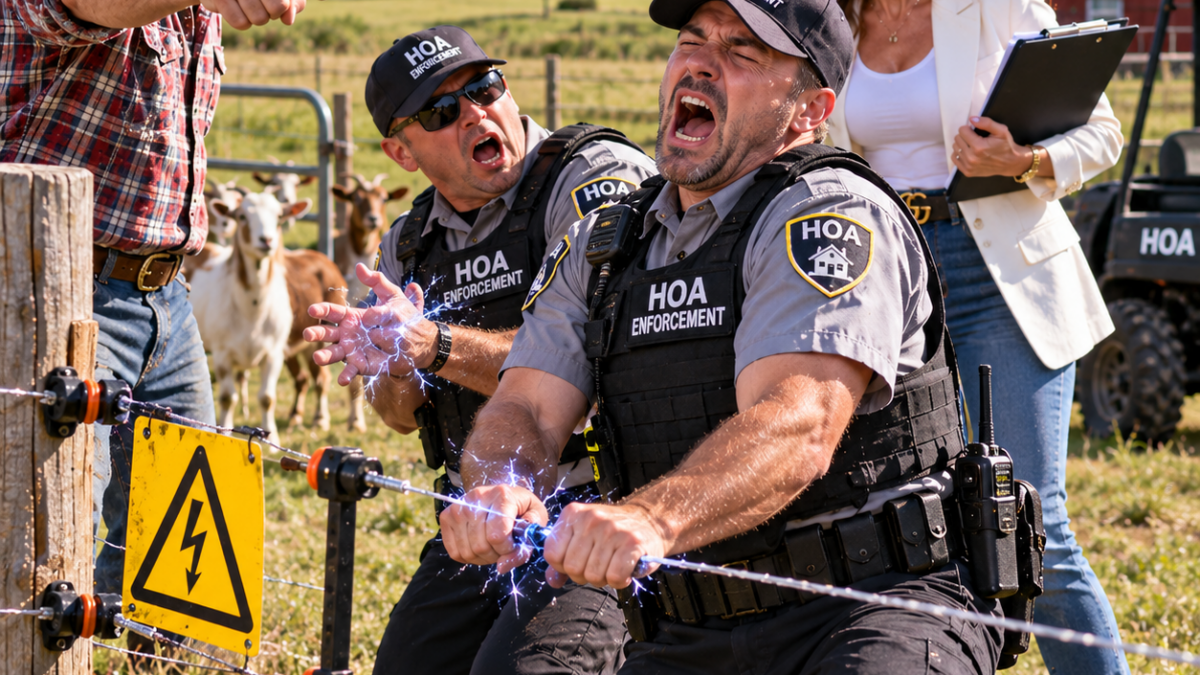
Then, with the confidence of a man who believed reality needed his permission, he reached out and grabbed the top wire.
The jolt hit him instantly.
Now, if you have never seen a grown man get surprised by an electric fence, understand something: it is not like the movies. He did not fly across the field or glow blue. He made a noise halfway between a bark and a curse, jerked backward, windmilled one arm, and stumbled into Mark.
Mark, who had apparently not processed the lesson happening directly in front of him, grabbed for the gate to steady both of them.
He caught the same wire.
Two for two.
Mark yelped, kicked one leg out, and fell sideways into Dennis. Both of them went down in the grass in a tangled pile of black polo shirts, clipboards, and wounded pride.
I laughed.
I am not proud of every laugh I have ever laughed, but I am proud of that one.
It came out of me before I could stop it. Loud, honest, and probably heard by half the subdivision.
Dennis scrambled up first, shaking his hand.
“What the hell?” he shouted.
I walked over slowly, still laughing.
“You okay?”
“You shocked me!”
“No,” I said. “The clearly marked electric fence shocked you.”
Mark was sitting in the grass, staring at the wire like it had betrayed him personally.
Dennis pointed at the sign. “You need bigger warnings.”
I looked at the sign six inches from his shoulder.
“The next size up is a billboard.”
“You set a trap.”
“I set an electric fence around livestock on a farm and marked it every ten feet. You ignored a no trespassing sign, walked onto private property, read the warning, and grabbed the wire anyway.”
Mark muttered, “I didn’t read it.”
“That’s not better.”
Dennis’s face turned red.
“You’ll hear from the board.”
“I’ve been hearing from the board for months. Tell them to learn to read too.”
They gathered their clipboards and retreated. Mark kept flexing his fingers. Dennis tried to walk like a man leaving by choice, not embarrassment. The goats watched them go with what I can only describe as disappointment. I think Biscuit had been hoping they would make it through the gate.
I took photos.
Not of them being hurt. They were fine. Embarrassed, shaken, maybe a little sore in the hand, but fine. I took photos of the signs, the fence, their footprints near the gate, the no trespassing sign at the drive, and the spot where they had clearly entered. I also wrote everything down while it was fresh.
Date.
Time.
Names.
Warnings posted.
No permission granted.
Fence touched voluntarily.
Because laughter is good, but documentation is better.
A week later, I received a letter from the HOA accusing me of setting “dangerous traps” for their authorized enforcement personnel.
Authorized.
That word did more work than a tractor.
The letter claimed the electric fence was malicious, unsafe, and designed to injure HOA representatives. It demanded I remove it immediately, pay for any medical evaluation their officers might require, and cooperate with future inspections.
I read the letter twice.
Then I called Travis.
He came by that afternoon because, in his words, “I have to see this stupidity in its natural habitat.”
We walked the fence line together.
He looked at the signs.
“All these were up?”
“Yes.”
“Before they touched it?”
“Yes.”
“No trespassing sign?”
“At the driveway.”
“Did you invite them?”
“No.”
“Did they have any legal authority?”
“None.”
He stood there for a moment, reading the nearest ELECTRIC FENCE sign.
Then he started chuckling.
By the time we reached the gate, he was laughing hard enough to wipe his eyes.
“They don’t have a leg to stand on,” he said.
“Good.”
“Frankly, they’re lucky you’re not pushing trespass harder.”
“I might.”
“You should at least send a formal response.”
So we did.
Or rather, Travis wrote it, and I enjoyed it.
The response was polite, factual, and sharp in the places that mattered. It stated that my farm was not part of the HOA, that their representatives had no authority to enter, that they had repeatedly trespassed despite verbal warnings and posted signage, that the electric fence was a lawful agricultural fence installed for livestock containment, that warnings were clearly posted at frequent intervals, and that any contact occurred only because their personnel ignored those warnings while trespassing.
It also demanded that the HOA cease all entry onto my property and warned that future trespassing would be reported directly to law enforcement.
We sent it certified.
Karen responded with silence.
For two weeks, no one came.
No black polos. No clipboards. No cameras near the barn. No one rattling gates, peering into sheds, or strutting up my driveway like low-budget law enforcement.
The quiet felt strange at first.
Then it felt wonderful.
I still got letters for a while.
One said my barn remained visually inconsistent with the surrounding community. Another claimed the fence itself was hostile and not in keeping with neighborhood values. A third suggested mediation to “resolve aesthetic conflict.”
I kept them all.
The Karen drawer became a Karen box.
But the enforcement visits stopped.
Completely.
A month later, one of the older men from the subdivision stopped by my roadside stand while I was selling eggs. His name was Paul, and unlike most people from Willow Creek, he had always been polite. He bought eggs now and then and once helped me catch a loose chicken because, according to him, it was the most exercise he had gotten all year.
He looked around, then leaned closer.
“You didn’t hear this from me.”
“That’s how all the best sentences start.”
“The enforcement committee got disbanded.”
I raised an eyebrow. “Did it now?”
He smiled. “Turns out people didn’t like paying for pretend cops who got themselves shocked trespassing on a farm.”
“Imagine that.”
“There was a meeting. Karen tried to say you were creating danger for the neighborhood.”
“My farm isn’t in the neighborhood.”
“Yes, well, a few people finally said that out loud.”
I wish I had been there to hear it.
Paul continued, “Then someone asked why the HOA was spending dues on shirts, patches, clipboards, and liability risk for volunteers with no authority.”
“That sounds like a good question.”
“It was. Karen hated it.”
“I’m heartbroken.”
He laughed.
“Anyway, they voted to suspend the program. Quietly. No announcement.”
“What about Karen?”
“Oh, she’s still angry.”
“I’ll survive.”
Paul looked toward the goat pasture, where Biscuit was standing on a stump for reasons known only to Biscuit.
“I heard one of them grabbed the fence twice.”
“Two different men.”
He grinned. “Even better.”
After that, things slowly returned to normal.
Not perfect.
The subdivision did not disappear. Karen still drove past now and then in her white SUV, staring straight ahead as if the farm offended her peripheral vision. Occasionally, I heard through town gossip that she described me as unstable, hostile, antisocial, and dangerous.
Fine.
I have been called worse by goats.
A few people around town started referring to me as “the electric fence guy.” One cashier at the feed store asked if it was true I had booby-trapped my property. I said no, I had labeled it. Her manager laughed from the next aisle and said, “That’s better than most folks do.”
The story grew, of course.
Stories always do.
In one version, I electrified the whole driveway and sent three men flying into a manure pile. In another, I had trained goats to chase HOA officers. In my favorite version, Biscuit personally guarded the fence and only allowed people through if they could produce a deed.
None of that was true.
But I did not correct every rumor.
Let Karen’s people wonder.
The truth was simple enough: I had put up a legal farm fence, marked it clearly, and the men who thought rules did not apply to them learned electricity is less impressed by confidence than people are.
That is what I liked most about it.
Electricity does not care about your title.
It does not care about your polo shirt, your committee, your clipboard, your president, or your opinion of barn paint.
It responds to contact.
That is all.
Touch the wire, get the lesson.
The goats benefited too.
After the fence went up, they stayed back from the gate. Biscuit still acted offended about it, but he stopped pressing his head against the latch. The younger goats learned quickly. My livestock stayed safer. I slept better knowing no idiot with a patch on his shirt was going to wander into the pasture and turn himself into a lawsuit.
The farm looked the same.
That was the point.
The barn still needed paint, according to Karen. The fence was still practical instead of pretty. The equipment still sat where I needed it, not where a subdivision committee preferred. Hay bales remained visible from certain angles if you went looking for them. In summer, dust still rose behind my tractor. In spring, mud still clung to everything. In winter, the place looked rough and honest under gray sky.
It was a farm.
It was supposed to look like one.
A year later, I ran into Karen at the hardware store.
I was buying fence staples. She was inspecting cabinet handles with the intensity of a surgeon. She noticed me, and for a moment her face did that thing where politeness wrestled with hatred.
Politeness won, barely.
“Mr. Walker,” she said.
“Karen.”
Her eyes flicked to the box in my hand.
“More fencing?”
“Always something to fix.”
“I hope it’s properly marked.”
I smiled.
“I hope people read.”
Her jaw tightened.
She leaned closer, lowering her voice.
“You know, you’ve made yourself very unpopular with a lot of people.”
“Not my goats.”
“This attitude is exactly why communities need standards.”
“No,” I said. “This attitude is why fences exist.”
For a moment, I thought she might keep going.
Then an older man in a seed-company cap turned into the aisle and recognized me.
“Hey,” he said, grinning. “You’re the fella who shocked those HOA boys, right?”
Karen’s face hardened.
I tipped my head. “They shocked themselves.”
The man laughed so loudly someone in the next aisle looked over.
Karen set down the cabinet handle and walked away without buying anything.
I stood there holding fence staples and felt a peace so petty I could have bottled it.
The letters stopped completely not long after that.
Maybe Karen finally got bored. Maybe the board told her to stop creating liability. Maybe the subdivision residents decided they had enough of paying for her personal war against a farm that had existed before their welcome packets. I never found out exactly why, and I did not care enough to ask.
My life narrowed back to the things that mattered.
Weather.
Animals.
Repairs.
Planting.
Harvest.
Fencing.
Feed.
Coffee before dawn.
Quiet after sunset.
The world I had wanted before the HOA decided my peace needed improvement.
Sometimes people ask whether I feel bad that Dennis and Mark got shocked.
No.
I do not.
Not because I wanted them badly hurt. I did not. Electric fences sting. They surprise you. They teach you to step back. They are not designed to maim. If either man had been seriously injured, I would not be telling this story with a smile.
But embarrassed?
Yes.
Startled?
Yes.
Made briefly aware that signs apply even to people holding clipboards?
Absolutely.
I warned them verbally.
I posted no trespassing signs.
I documented their visits.
I told them to stay away from the gates.
I put up bright yellow warnings every few steps.
At some point, a grown man has to become responsible for his own hand.
Besides, the fence was safer than the goats.
I mean that.
If Dennis had gotten into that pasture and Biscuit had decided to defend his kingdom, the HOA might have had a real injury complaint, and I would have had to spend time explaining that goats do not respect committee authority either.
The fence prevented that.
In its own shocking way.
There is a deeper lesson in it, though I do not usually say this part out loud because it sounds too polished for a man who spends half his life scraping mud off boots.
The HOA did not hate my farm because it was dangerous.
They hated it because they could not control it.
That is what all their letters were really about. Not paint. Not fencing. Not hay bales. Control. My farm was an unapproved reality sitting beside their manufactured one. It reminded them that not every patch of land belonged to their rules. It offended them because it existed outside their paperwork.
Karen especially could not stand that.
People like her do not just want order on their property. They want the feeling that nothing nearby escapes them. A farm beyond HOA control was a loose thread, and she kept pulling because she assumed everything eventually unravels for people like her.
But farms do not unravel easily.
They are built from knots.
Old wire twisted onto new posts. Boards patched over older boards. Machines repaired past their expected life. Routines inherited, adjusted, repeated. Boundaries walked until you know every dip in the ground. You do not keep a place like that going by caring what a woman in clean boots thinks about aesthetics.
You keep it going by knowing what is yours and defending it before someone else decides it belongs to them.
The electric fence is still there.
The signs are faded now from sun and rain, but I replace them when they get hard to read. Not for Karen. Not for Dennis. For anyone. Delivery drivers, kids, lost hikers, curious neighbors. A warning should be clear if it is meant to protect people.
That was always the difference between me and the HOA.
They used rules to trap.
I used signs to warn.
One afternoon, not long ago, I found a young couple from the subdivision standing near the roadside fence with their little boy. I recognized them vaguely but did not know their names. The boy was pointing at the goats, delighted.
I walked over.
The parents looked nervous at first.
“We’re not trespassing,” the father said quickly. “He just likes the goats.”
“I can see that.”
The boy asked, “Do they bite?”
“Sometimes shirts,” I said. “Mostly they headbutt each other and complain.”
He giggled.
His mother nodded toward the yellow sign.
“We told him not to touch the fence.”
“Good.”
The father smiled awkwardly. “We heard stories.”
“I bet you did.”
“They said you shocked HOA guards.”
“They shocked themselves.”
He laughed a little, then looked at the farm.
“For what it’s worth, I like seeing this place here. Makes the neighborhood feel less fake.”
That surprised me.
I looked at him for a moment, then nodded.
“Thanks.”
The boy waved at Biscuit.
Biscuit stared back like a tiny judgmental king.
They left without crossing the line.
No drama.
No conflict.
No clipboards.
Just people respecting a fence.
It really can be that simple.
At sunset, I walked the pasture and checked the gate. The wire hummed faintly with that soft electric pulse you hear only when everything else gets quiet. The goats settled near the shed. The subdivision lights blinked on beyond the trees, neat and uniform and far enough away.
I stood there a while.
My barn still looked like a barn. My fence still looked like a fence. My land still looked like mine.
That was enough.
The HOA had tried letters, threats, fake enforcement, trespassing, photographs, and intimidation. They had sent men in black shirts onto a farm that existed before their bylaws did. They had ignored warnings, ignored signs, and ignored the most basic rule every country kid learns early.
Do not grab a hot wire.
In the end, they did not lose because I built some clever revenge scheme.
They lost because I stopped arguing with people who refused to hear me and let reality answer instead.
Sometimes revenge is complicated.
Sometimes it requires lawyers, paperwork, strategy, patience, and a stomach strong enough to watch a bully dig their own hole.
And sometimes revenge is just a properly marked electric fence, two men who think rules are for other people, and a farmer laughing from the barn while the goats look on like witnesses.
Karen wanted my farm to match her subdivision.
Instead, her enforcement committee matched the ground.
And after one good jolt, everyone finally remembered where the property line was.
𝗧𝗛𝗘 𝗘𝗡𝗗
They Walked Onto My Farm Like HOA Rules Were Law, Then Grabbed the Fence I Warned Them Not to Touch
The HOA thought my farm was an eyesore, so they sent their little uniformed “enforcement officers” onto land they did not own.
I warned them, documented them, and posted signs bright enough for a blind mule to notice.
They still grabbed the electric fence with both hands, and for once, the lesson shocked them before I had to say another word.
I had my farm before the subdivision had a name.
That is the part the HOA never wanted to understand.
Before their beige houses climbed up over the hill, before the fake-stone entrance sign, before the decorative streetlights and identical mailboxes and little plastic neighborhood flags that changed with every season, this land was just my land. Fields, pasture, barn, workshop, gravel drive, mud when it rained, dust when it did not, and enough quiet to hear my own thoughts if the goats were not screaming about something.
I am not saying it was paradise.
Farms are not paradise. People who say that have never chased a loose goat in the rain, fixed a busted gate in August, or stepped into something that made them question every choice that led them to that moment. A farm is work. It is early mornings, broken equipment, hay dust in your nose, feed bills that arrive at the worst possible time, animals finding creative ways to injure themselves, and weather acting like it has a personal grudge against your plans.
But it was mine.
That mattered more than pretty.
I had bought the place years earlier, back when the surrounding land was still mostly open. There were a few old houses, some wooded stretches, and a lot of fields nobody had yet figured out how to turn into mortgage payments. I liked that. I liked distance. I liked being able to walk out my back door and see pasture instead of someone else’s kitchen window.
I am an independent man by nature. Some people call that stubborn. I call it peaceful. I do most things myself unless harvest or repairs force me to hire extra hands. I fix fences. I feed animals. I mend what breaks. I keep the barn standing, the tractor running, the water troughs full, and the gates latched. There are days when I talk more to goats than people, and honestly, the goats are usually better company.
Then the developer came.
One year there were survey flags and machines. The next year, roads. After that, foundations. Then frames, roofs, siding, landscaping, signs, mailboxes, and a sales office full of smiling people selling “country charm” to families who apparently wanted country charm without actual country.
They built the subdivision near me, not over me.
That distinction was important.
My farm was not part of it. I did not sell. I did not sign. I did not join. I never agreed to covenants, dues, architectural guidelines, mailbox color standards, barn paint rules, or whatever other nonsense they printed in binders and pretended was scripture.
At first, I thought that would be enough.
I should have known better.
The first letters started showing up about a year after the subdivision filled in.
They came on HOA letterhead, with neat little logos and language that sounded like it had been written by someone who believed authority could be created by formatting. The first one was polite enough, at least on the surface. It said the board had received concerns about the “visual impact” of my farm on the surrounding community. It suggested I consider improvements for the benefit of neighborhood cohesion.
Neighborhood cohesion.
I was drinking coffee at my kitchen table when I read that phrase, and I remember laughing so hard I nearly spilled it.
I had goats that yelled at empty buckets, a rooster that considered 4:30 a.m. a reasonable time to start announcing himself, and a barn that smelled like hay, wood, oil, and animals. There was no version of that farm that would “cohere” with their cul-de-sacs.
The next letter was less polite.
They wanted my fence replaced.
They wanted the barn repainted.
They wanted old equipment moved out of sight.
They wanted certain areas “screened” with landscaping.
They wanted me to stop storing hay bales where they could be seen from the subdivision road.
They wanted, basically, for my farm to stop looking like a farm.
I wrote back once.
I kept it short.
My property is not part of your homeowners association. I will not be making changes to comply with rules I never agreed to follow. Please do not contact me again regarding HOA standards.
I thought that was clear.
They treated it like a negotiation.
More letters came.
Some claimed their rules applied because my farm affected property values. Some used words like nuisance and community impact. One said that, although I was not formally “recorded” as a member, I still had an obligation to preserve the shared character of the area.
That one made me laugh again, but not as much.
Because I started to understand that these people were not confused.
They simply did not care.
Their board president was a woman named Karen, and if ever a person’s name sounded like a warning label, hers did. I had only seen her a few times at first: late forties, maybe, with glossy brown hair, oversized sunglasses, white jeans, expensive boots that had never seen mud, and a smile that could turn cold without moving. She drove a luxury SUV through the neighborhood like she was inspecting a kingdom.
I am not immune to noticing beauty. Karen was beautiful in that curated, polished way some people become when they treat appearance like a weapon.
But beauty does not make a person kind.
And Karen was not kind.
The first time she came to the farm in person, she stood at the edge of my gravel drive in a cream blouse, tight dark pants, and boots too clean to belong anywhere near livestock. I was carrying feed buckets when I saw her. She looked past me at the barn with the expression of a woman watching someone commit a crime against beige paint.
“Mr. Walker?” she called.
“That’s me.”
“I’m Karen Whitmore. President of the Willow Creek Homeowners Association.”
I set the buckets down. “Then you’re lost.”
Her smile flickered.
“I’m here to discuss the ongoing visual violations affecting our community.”
“My farm isn’t in your community.”
“It borders our community.”
“So does the sky.”
Her smile thinned. “You may not realize how much your property affects our residents.”
“I may not care.”
That was not diplomatic.
But by then, I was already tired of letters from people who thought my hay bales were a moral failure.
Karen removed her sunglasses slowly, as if preparing to say something important.
“Mr. Walker, everyone benefits when standards are maintained.”
“I agree. My standard is that people who don’t own my land don’t tell me what to do with it.”
The polite mask cracked just enough for me to see the anger beneath.
“You’re being unreasonable.”
“No,” I said. “I’m being accurate.”
She looked toward the barn again.
“The board has options.”
“I’m sure it does. Use them on HOA property.”
Her eyes came back to mine.
“This isn’t over.”
People like Karen love that line. They say it like they are closing a chapter.
I went back to feeding the goats.
A month later, the HOA created an enforcement committee.
At least, that is what they called it.
I called them clipboard cowboys.
The first time I saw them, there were three of them walking up my driveway in matching black polo shirts with patches that said HOA ENFORCEMENT over the chest. They had sunglasses, clipboards, belts with little pouches, and the posture of men who had watched too many cop shows and misunderstood every lesson.
They were not police.
They were not code enforcement.
They were not county inspectors.
They were four steps below mall security and somehow twice as smug.
I was near the barn repairing a latch when I saw them cross right past my No Trespassing sign. Not near it. Not around it. Past it. As if the sign existed for decoration.
For a second, I just watched.
They spread out near the front pasture, taking pictures of my barn, my fence, my equipment, and even my livestock. One of them crouched to photograph a section of fence like he was documenting a murder scene. Another wrote something on his clipboard with the seriousness of a man recording evidence for a trial that existed only in his imagination.
I set down my tools and walked toward them.
“Can I help you boys?”
The one in front turned. He was broad, red-faced, and had a mustache that looked like it had been grown for authority. His name tag said Dennis.
“We’re conducting an exterior compliance inspection,” he said.
“Not here, you’re not.”
He looked at his clipboard. “This property has been identified as contributing to multiple community standards violations.”
“This property is a farm.”
“Sir, we’ve received complaints regarding fencing, barn condition, visible equipment, and livestock odor.”
I looked around.
“You came to a farm and found farm things. Congratulations.”
One of the other men snickered, then tried to turn it into a cough.
Dennis did not appreciate my tone.
“We are authorized by the Willow Creek HOA board.”
“Not on my land.”
“We have authority to document violations affecting the community.”
“If you think I’m breaking state or county code, report me to people with actual authority. If you mean your HOA rules, you can fold those clipboards in half and store them somewhere personal.”
The third man lowered his phone.
“You can’t talk to us like that.”
“I can if you’re trespassing.”
Dennis puffed himself up.
“We’re not trespassing. We’re performing enforcement duties.”
“No,” I said, taking a step closer. “You are standing on private agricultural property without permission after passing a posted sign. That is trespassing. Leave.”
For a moment, they seemed genuinely surprised.
Not scared.
Offended.
As if the word trespassing should not apply to men wearing matching shirts.
Dennis smiled in a way that told me he had no intention of learning.
“We’ll be back.”
“Bring someone who can read.”
They left, but they laughed as they walked down the drive.
I should have called the sheriff right then.
Instead, I started documenting.
Dates. Times. Photos. Video when I could get it. License plates. Every letter. Every visit. Every time one of them wandered where he did not belong.
Because they did come back.
Again and again.
Sometimes there were three of them. Sometimes two. Sometimes one brave little enforcement officer would appear like a lost dog with a clipboard and start taking pictures near the fence line. They never came to the house and knocked. They never called. They never requested permission. They just walked onto my land like the HOA patch on their shirts had magical powers.
I confronted them every time.
They left every time.
Then they returned the next week.
It became almost routine, which is a dangerous thing because routine can make madness seem normal.
I told myself they would get bored. I told myself eventually they would wander into cow manure, ruin their shiny shoes, and decide the farm was not worth it. I told myself Karen would find another target, maybe a mailbox painted the wrong shade of black or a swing set visible from the road.
But the visits got bolder.
They walked deeper onto the property. They photographed the barn doors. They inspected fence posts. One tried to peer into an equipment shed until I shouted loud enough to make him jump. Another stood near the pasture gate and made notes while my goats watched him with the judgmental curiosity only goats possess.
The goats were the part that worried me most.
People think goats are cute because the internet shows them wearing pajamas, hopping around like tiny comedians. And goats can be cute. Mine can be funny. They can also be stubborn, territorial little battering rams with horns, attitude, and a deep personal commitment to bad decisions.
If those enforcement clowns got into the goat pasture and one of them got knocked over, I knew exactly how the story would be told.
Innocent HOA volunteer injured by dangerous farm animal.
Negligent farmer refuses to secure livestock.
Threat to community safety.
Karen would have a field day.
So I added locks to certain gates. I posted more signs. I called a lawyer friend named Travis and asked what I should do about repeated trespassing.
“Document everything,” he said. “Send a formal no-trespass letter to the board.”
“I did.”
“Send it certified.”
“I will.”
“And if they keep coming?”
“Then what?”
“Call the sheriff.”
I meant to.
I really did.
But farm life has a way of eating intentions. A water line cracked. One of the goats got sick. Hay delivery came late. The tractor battery died. The roof over the feed room started leaking. Days blurred. The trespassers would show up, I would chase them off, add the date to my notes, and go back to work.
Then I caught them rattling the goat gate.
That was the line.
It was a warm afternoon, bright and still, the kind where flies seem to hover in one place just to irritate you. I was repairing a section of old fencing near the side pasture when I heard metal clanging.
Not wind.
Not animals.
Human hands on a gate.
I looked over and saw two HOA enforcement men at the goat pasture entrance. Dennis was there, of course, with his clipboard tucked under one arm. The other was a younger guy named Mark, thinner, with mirrored sunglasses and the anxious energy of someone trying hard to impress a bully.
Dennis had both hands on the gate and was shaking it.
The goats were gathering on the other side.
That sight made my blood go cold.
“Hey!” I shouted.
They turned.
“Get away from that gate.”
Dennis lifted one hand. “We’re just checking the latch.”
“You are not checking anything.”
I started walking fast.
Mark glanced at the goats. “Are those animals properly contained?”
“They are contained until idiots start messing with gates.”
Dennis frowned. “You need to calm down.”
“No. You need to get off my property before you create a problem you won’t understand until it’s already headbutting you.”
The goats were pressing closer now, curious and irritated. One of my larger wethers, a gray-and-white menace named Biscuit, lowered his head in that slow thoughtful way that means he is calculating force and distance.
Dennis looked at Biscuit and laughed.
“They don’t look dangerous.”
“Neither do staplers until someone hits you with one.”
Mark stepped back a little.
Dennis did not.
“This gate is visible from HOA property. We have a duty to inspect unsafe conditions.”
I reached them and planted myself between him and the latch.
“If you touch this gate again, I’m calling the sheriff.”
Dennis smiled.
“You farmers are always so dramatic.”
That night, I sat at my kitchen table with a beer, my laptop, and every ounce of patience I had left.
I researched trespassing laws. Agricultural fencing. Electric fence signage. Liability. Livestock containment. I read state guidelines, extension office materials, farm supply recommendations, and anything else I could find. Then I called Travis again and explained the gate incident.
“Can I put an electric line on that fence?”
“Is it agricultural property?”
“Yes.”
“Are you using it for livestock containment?”
“Yes.”
“Will it be properly marked?”
“I’ll make it impossible to miss.”
“Then generally, yes. Don’t create some hidden trap. Don’t be stupid. Use proper equipment. Post warnings clearly. Make it for livestock, not revenge.”
That was fair.
Despite what people later claimed, I was not trying to build a trap.
I wanted the opposite.
I wanted warning signs so obvious that even an HOA enforcement officer drunk on imaginary authority could understand them.
That weekend, I upgraded the goat pasture fence.
I used proper farm equipment. Proper charger. Proper grounding. Proper placement. Nothing exotic. Nothing dangerous beyond the normal unpleasant jolt farm animals learn to respect. Electric fencing is common where I live. People use it for cattle, horses, goats, sheep, and sometimes to keep predators out.
Then I bought bright yellow signs.
ELECTRIC FENCE.
DO NOT TOUCH.
I zip-tied them every ten feet along the section nearest the driveway and gate. Then I added more because subtlety had clearly failed. I painted the posts a brighter color. I trimmed weeds so the signs were not hidden. I made sure anyone approaching that gate would have to ignore multiple warnings before getting close enough to regret it.
I stood back afterward and admired the work.
Even from thirty yards away, the message was clear.
Stay out.
Do not touch.
This is a working farm, not your little enforcement playground.
The goats tested the new line exactly once.
Biscuit touched it with his nose, jumped sideways like he had seen God, then spent the rest of the afternoon glaring at me from a respectful distance.
Smart goat.
Smarter than Dennis, as it turned out.
The HOA enforcement boys returned four days later.
I was stacking hay bales near the barn when I saw them coming up the drive. Two of them this time: Dennis and Mark. Black polos. Sunglasses. Clipboards. Same little swagger. They passed the No Trespassing sign like it was a piece of modern art.
I stopped working.
At first, I considered shouting immediately.
Then I saw Dennis point toward the goat pasture.
And I thought, No.
Let’s see if he can read.
They walked straight toward the gate.
The yellow signs were impossible to miss. One hung at eye level beside the latch. Another was tied to the top rail. A third was ten feet to the left. Bright yellow against dark fencing. Black letters. Clear as day.
Dennis leaned forward and looked at one.
I saw him do it.
He actually read the sign.
Then, with the confidence of a man who believed reality needed his permission, he reached out and grabbed the top wire.
The jolt hit him instantly.
Now, if you have never seen a grown man get surprised by an electric fence, understand something: it is not like the movies. He did not fly across the field or glow blue. He made a noise halfway between a bark and a curse, jerked backward, windmilled one arm, and stumbled into Mark.
Mark, who had apparently not processed the lesson happening directly in front of him, grabbed for the gate to steady both of them.
He caught the same wire.
Two for two.
Mark yelped, kicked one leg out, and fell sideways into Dennis. Both of them went down in the grass in a tangled pile of black polo shirts, clipboards, and wounded pride.
I laughed.
I am not proud of every laugh I have ever laughed, but I am proud of that one.
It came out of me before I could stop it. Loud, honest, and probably heard by half the subdivision.
Dennis scrambled up first, shaking his hand.
“What the hell?” he shouted.
I walked over slowly, still laughing.
“You okay?”
“You shocked me!”
“No,” I said. “The clearly marked electric fence shocked you.”
Mark was sitting in the grass, staring at the wire like it had betrayed him personally.
Dennis pointed at the sign. “You need bigger warnings.”
I looked at the sign six inches from his shoulder.
“The next size up is a billboard.”
“You set a trap.”
“I set an electric fence around livestock on a farm and marked it every ten feet. You ignored a no trespassing sign, walked onto private property, read the warning, and grabbed the wire anyway.”
Mark muttered, “I didn’t read it.”
“That’s not better.”
Dennis’s face turned red.
“You’ll hear from the board.”
“I’ve been hearing from the board for months. Tell them to learn to read too.”
They gathered their clipboards and retreated. Mark kept flexing his fingers. Dennis tried to walk like a man leaving by choice, not embarrassment. The goats watched them go with what I can only describe as disappointment. I think Biscuit had been hoping they would make it through the gate.
I took photos.
Not of them being hurt. They were fine. Embarrassed, shaken, maybe a little sore in the hand, but fine. I took photos of the signs, the fence, their footprints near the gate, the no trespassing sign at the drive, and the spot where they had clearly entered. I also wrote everything down while it was fresh.
Date.
Time.
Names.
Warnings posted.
No permission granted.
Fence touched voluntarily.
Because laughter is good, but documentation is better.
A week later, I received a letter from the HOA accusing me of setting “dangerous traps” for their authorized enforcement personnel.
Authorized.
That word did more work than a tractor.
The letter claimed the electric fence was malicious, unsafe, and designed to injure HOA representatives. It demanded I remove it immediately, pay for any medical evaluation their officers might require, and cooperate with future inspections.
I read the letter twice.
Then I called Travis.
He came by that afternoon because, in his words, “I have to see this stupidity in its natural habitat.”
We walked the fence line together.
He looked at the signs.
“All these were up?”
“Yes.”
“Before they touched it?”
“Yes.”
“No trespassing sign?”
“At the driveway.”
“Did you invite them?”
“No.”
“Did they have any legal authority?”
“None.”
He stood there for a moment, reading the nearest ELECTRIC FENCE sign.
Then he started chuckling.
By the time we reached the gate, he was laughing hard enough to wipe his eyes.
“They don’t have a leg to stand on,” he said.
“Good.”
“Frankly, they’re lucky you’re not pushing trespass harder.”
“I might.”
“You should at least send a formal response.”
So we did.
Or rather, Travis wrote it, and I enjoyed it.
The response was polite, factual, and sharp in the places that mattered. It stated that my farm was not part of the HOA, that their representatives had no authority to enter, that they had repeatedly trespassed despite verbal warnings and posted signage, that the electric fence was a lawful agricultural fence installed for livestock containment, that warnings were clearly posted at frequent intervals, and that any contact occurred only because their personnel ignored those warnings while trespassing.
It also demanded that the HOA cease all entry onto my property and warned that future trespassing would be reported directly to law enforcement.
We sent it certified.
Karen responded with silence.
For two weeks, no one came.
No black polos. No clipboards. No cameras near the barn. No one rattling gates, peering into sheds, or strutting up my driveway like low-budget law enforcement.
The quiet felt strange at first.
Then it felt wonderful.
I still got letters for a while.
One said my barn remained visually inconsistent with the surrounding community. Another claimed the fence itself was hostile and not in keeping with neighborhood values. A third suggested mediation to “resolve aesthetic conflict.”
I kept them all.
The Karen drawer became a Karen box.
But the enforcement visits stopped.
Completely.
A month later, one of the older men from the subdivision stopped by my roadside stand while I was selling eggs. His name was Paul, and unlike most people from Willow Creek, he had always been polite. He bought eggs now and then and once helped me catch a loose chicken because, according to him, it was the most exercise he had gotten all year.
He looked around, then leaned closer.
“You didn’t hear this from me.”
“That’s how all the best sentences start.”
“The enforcement committee got disbanded.”
I raised an eyebrow. “Did it now?”
He smiled. “Turns out people didn’t like paying for pretend cops who got themselves shocked trespassing on a farm.”
“Imagine that.”
“There was a meeting. Karen tried to say you were creating danger for the neighborhood.”
“My farm isn’t in the neighborhood.”
“Yes, well, a few people finally said that out loud.”
I wish I had been there to hear it.
Paul continued, “Then someone asked why the HOA was spending dues on shirts, patches, clipboards, and liability risk for volunteers with no authority.”
“That sounds like a good question.”
“It was. Karen hated it.”
“I’m heartbroken.”
He laughed.
“Anyway, they voted to suspend the program. Quietly. No announcement.”
“What about Karen?”
“Oh, she’s still angry.”
“I’ll survive.”
Paul looked toward the goat pasture, where Biscuit was standing on a stump for reasons known only to Biscuit.
“I heard one of them grabbed the fence twice.”
“Two different men.”
He grinned. “Even better.”
After that, things slowly returned to normal.
Not perfect.
The subdivision did not disappear. Karen still drove past now and then in her white SUV, staring straight ahead as if the farm offended her peripheral vision. Occasionally, I heard through town gossip that she described me as unstable, hostile, antisocial, and dangerous.
Fine.
I have been called worse by goats.
A few people around town started referring to me as “the electric fence guy.” One cashier at the feed store asked if it was true I had booby-trapped my property. I said no, I had labeled it. Her manager laughed from the next aisle and said, “That’s better than most folks do.”
The story grew, of course.
Stories always do.
In one version, I electrified the whole driveway and sent three men flying into a manure pile. In another, I had trained goats to chase HOA officers. In my favorite version, Biscuit personally guarded the fence and only allowed people through if they could produce a deed.
None of that was true.
But I did not correct every rumor.
Let Karen’s people wonder.
The truth was simple enough: I had put up a legal farm fence, marked it clearly, and the men who thought rules did not apply to them learned electricity is less impressed by confidence than people are.
That is what I liked most about it.
Electricity does not care about your title.
It does not care about your polo shirt, your committee, your clipboard, your president, or your opinion of barn paint.
It responds to contact.
That is all.
Touch the wire, get the lesson.
The goats benefited too.
After the fence went up, they stayed back from the gate. Biscuit still acted offended about it, but he stopped pressing his head against the latch. The younger goats learned quickly. My livestock stayed safer. I slept better knowing no idiot with a patch on his shirt was going to wander into the pasture and turn himself into a lawsuit.
The farm looked the same.
That was the point.
The barn still needed paint, according to Karen. The fence was still practical instead of pretty. The equipment still sat where I needed it, not where a subdivision committee preferred. Hay bales remained visible from certain angles if you went looking for them. In summer, dust still rose behind my tractor. In spring, mud still clung to everything. In winter, the place looked rough and honest under gray sky.
It was a farm.
It was supposed to look like one.
A year later, I ran into Karen at the hardware store.
I was buying fence staples. She was inspecting cabinet handles with the intensity of a surgeon. She noticed me, and for a moment her face did that thing where politeness wrestled with hatred.
Politeness won, barely.
“Mr. Walker,” she said.
“Karen.”
Her eyes flicked to the box in my hand.
“More fencing?”
“Always something to fix.”
“I hope it’s properly marked.”
I smiled.
“I hope people read.”
Her jaw tightened.
She leaned closer, lowering her voice.
“You know, you’ve made yourself very unpopular with a lot of people.”
“Not my goats.”
“This attitude is exactly why communities need standards.”
“No,” I said. “This attitude is why fences exist.”
For a moment, I thought she might keep going.
Then an older man in a seed-company cap turned into the aisle and recognized me.
“Hey,” he said, grinning. “You’re the fella who shocked those HOA boys, right?”
Karen’s face hardened.
I tipped my head. “They shocked themselves.”
The man laughed so loudly someone in the next aisle looked over.
Karen set down the cabinet handle and walked away without buying anything.
I stood there holding fence staples and felt a peace so petty I could have bottled it.
The letters stopped completely not long after that.
Maybe Karen finally got bored. Maybe the board told her to stop creating liability. Maybe the subdivision residents decided they had enough of paying for her personal war against a farm that had existed before their welcome packets. I never found out exactly why, and I did not care enough to ask.
My life narrowed back to the things that mattered.
Weather.
Animals.
Repairs.
Planting.
Harvest.
Fencing.
Feed.
Coffee before dawn.
Quiet after sunset.
The world I had wanted before the HOA decided my peace needed improvement.
Sometimes people ask whether I feel bad that Dennis and Mark got shocked.
No.
I do not.
Not because I wanted them badly hurt. I did not. Electric fences sting. They surprise you. They teach you to step back. They are not designed to maim. If either man had been seriously injured, I would not be telling this story with a smile.
But embarrassed?
Yes.
Startled?
Yes.
Made briefly aware that signs apply even to people holding clipboards?
Absolutely.
I warned them verbally.
I posted no trespassing signs.
I documented their visits.
I told them to stay away from the gates.
I put up bright yellow warnings every few steps.
At some point, a grown man has to become responsible for his own hand.
Besides, the fence was safer than the goats.
I mean that.
If Dennis had gotten into that pasture and Biscuit had decided to defend his kingdom, the HOA might have had a real injury complaint, and I would have had to spend time explaining that goats do not respect committee authority either.
The fence prevented that.
In its own shocking way.
There is a deeper lesson in it, though I do not usually say this part out loud because it sounds too polished for a man who spends half his life scraping mud off boots.
The HOA did not hate my farm because it was dangerous.
They hated it because they could not control it.
That is what all their letters were really about. Not paint. Not fencing. Not hay bales. Control. My farm was an unapproved reality sitting beside their manufactured one. It reminded them that not every patch of land belonged to their rules. It offended them because it existed outside their paperwork.
Karen especially could not stand that.
People like her do not just want order on their property. They want the feeling that nothing nearby escapes them. A farm beyond HOA control was a loose thread, and she kept pulling because she assumed everything eventually unravels for people like her.
But farms do not unravel easily.
They are built from knots.
Old wire twisted onto new posts. Boards patched over older boards. Machines repaired past their expected life. Routines inherited, adjusted, repeated. Boundaries walked until you know every dip in the ground. You do not keep a place like that going by caring what a woman in clean boots thinks about aesthetics.
You keep it going by knowing what is yours and defending it before someone else decides it belongs to them.
The electric fence is still there.
The signs are faded now from sun and rain, but I replace them when they get hard to read. Not for Karen. Not for Dennis. For anyone. Delivery drivers, kids, lost hikers, curious neighbors. A warning should be clear if it is meant to protect people.
That was always the difference between me and the HOA.
They used rules to trap.
I used signs to warn.
One afternoon, not long ago, I found a young couple from the subdivision standing near the roadside fence with their little boy. I recognized them vaguely but did not know their names. The boy was pointing at the goats, delighted.
I walked over.
The parents looked nervous at first.
“We’re not trespassing,” the father said quickly. “He just likes the goats.”
“I can see that.”
The boy asked, “Do they bite?”
“Sometimes shirts,” I said. “Mostly they headbutt each other and complain.”
He giggled.
His mother nodded toward the yellow sign.
“We told him not to touch the fence.”
“Good.”
The father smiled awkwardly. “We heard stories.”
“I bet you did.”
“They said you shocked HOA guards.”
“They shocked themselves.”
He laughed a little, then looked at the farm.
“For what it’s worth, I like seeing this place here. Makes the neighborhood feel less fake.”
That surprised me.
I looked at him for a moment, then nodded.
“Thanks.”
The boy waved at Biscuit.
Biscuit stared back like a tiny judgmental king.
They left without crossing the line.
No drama.
No conflict.
No clipboards.
Just people respecting a fence.
It really can be that simple.
At sunset, I walked the pasture and checked the gate. The wire hummed faintly with that soft electric pulse you hear only when everything else gets quiet. The goats settled near the shed. The subdivision lights blinked on beyond the trees, neat and uniform and far enough away.
I stood there a while.
My barn still looked like a barn. My fence still looked like a fence. My land still looked like mine.
That was enough.
The HOA had tried letters, threats, fake enforcement, trespassing, photographs, and intimidation. They had sent men in black shirts onto a farm that existed before their bylaws did. They had ignored warnings, ignored signs, and ignored the most basic rule every country kid learns early.
Do not grab a hot wire.
In the end, they did not lose because I built some clever revenge scheme.
They lost because I stopped arguing with people who refused to hear me and let reality answer instead.
Sometimes revenge is complicated.
Sometimes it requires lawyers, paperwork, strategy, patience, and a stomach strong enough to watch a bully dig their own hole.
And sometimes revenge is just a properly marked electric fence, two men who think rules are for other people, and a farmer laughing from the barn while the goats look on like witnesses.
Karen wanted my farm to match her subdivision.
Instead, her enforcement committee matched the ground.
And after one good jolt, everyone finally remembered where the property line was.