They Told Me to Build a Stronger Mailbox, So I Built One That Ended Their Game for Good
Part 2
I replaced it again.
Heavier box this time. Thicker post. More concrete.
I remember standing in the hardware store aisle with my hands on my hips, staring at rows of mailboxes like a man choosing armor before battle. I felt ridiculous. It was a mailbox, not a fortress. But I was already irritated enough to spend more than I should have, so I bought one labeled heavy duty and convinced myself that would solve it.
I dug the hole deeper than before.
Set the post carefully.
Poured concrete.
Leveled everything.
Packed the dirt down hard and stood back, sweaty and sore, feeling like I had taken a small but meaningful stand against stupidity.
Ten days later, that mailbox was gone too.
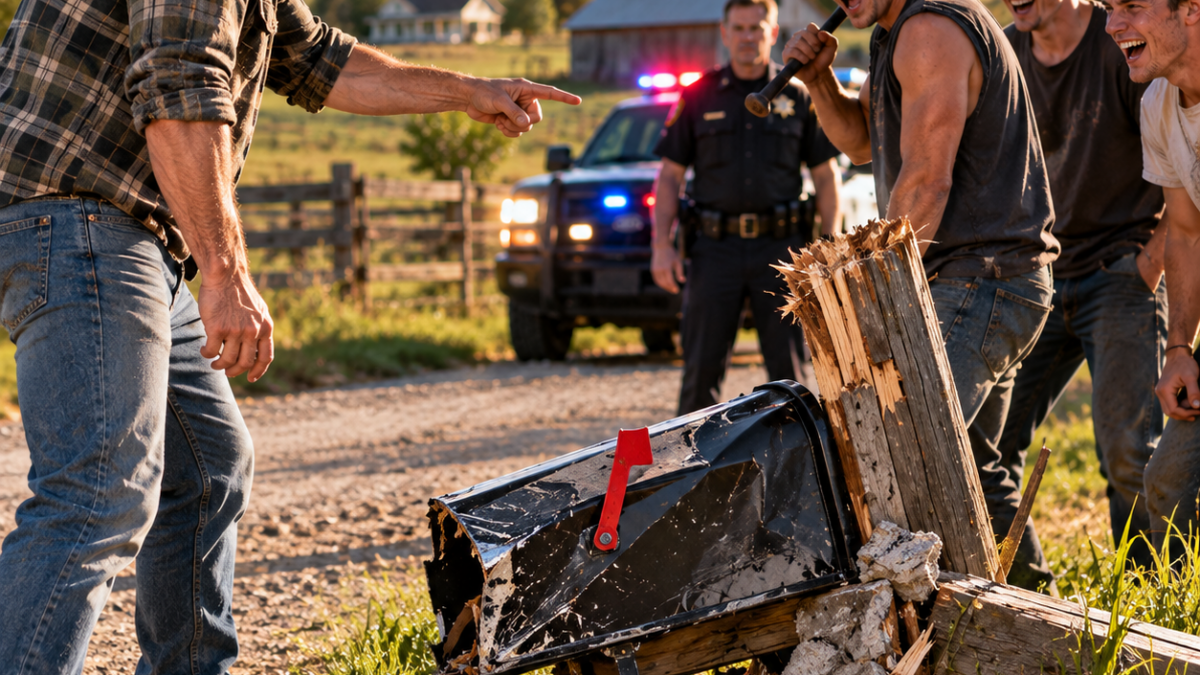
This time the post had not simply been knocked over. It had been cracked at the base and twisted like someone had backed into it repeatedly or hit it with something heavy enough to splinter the wood. The box itself was lying upside down in the ditch, dented nearly beyond recognition.
That became the pattern.
I put up a mailbox.
Someone destroyed it.
I replaced it.
They escalated.
Sometimes it looked like a baseball bat or hammer had done the damage. Big dents. Sharp impacts. Metal folded inward. Other times, tire marks made it clear a vehicle had been used. Once, the post was snapped clean off. Another time, the entire box had been ripped from the post and thrown into the drainage ditch. A few times I found beer cans and cigarette butts near the damage, like whoever did it had stopped to admire their work.
The cost added up.
Mailboxes.
Posts.
Concrete.
Hardware.
Tools I had not planned to buy.
Gas to drive into town.
My time.
My patience.
But the money was not even the worst part. The mail disruption was. Denise could not deliver to a destroyed mailbox. That meant missed bills, delayed packages, and important letters left at the post office until I could get there during its inconvenient hours. I had moved to the country to simplify my life, and somehow my mailbox had become a full-time conflict.
I reported it to the sheriff’s office.
The deputy who took the report was polite enough, but his eyes told me where this ranked in the hierarchy of rural crime.
“Probably kids,” he said.
“Kids have destroyed four mailboxes.”
“Kids do dumb things.”
“They keep coming back.”
He nodded as if that was unfortunate but expected.
“You could install a camera.”
“The nearest power source is over a hundred yards away.”
“Trail cam, maybe.”
“I’ll look into it.”
He shrugged.
“They’ll probably get bored.”
They did not get bored.
They got bolder.
One morning, I found what looked like scorch marks inside the box, the door blown outward and blackened. A firecracker, maybe. Something shoved inside and lit. Another time, deep tire ruts crossed the shoulder, and the whole setup had been flattened into the ground like someone had driven over it on purpose.
That was the day I started asking questions around town.
I did not grow up there. That mattered more than I understood at first. In the city, being new was normal. People came and went constantly. Nobody expected you to know who owned what forty years ago or whose cousin had once gotten into a fight behind the diner in 1989. In a small rural community, history hangs in the air like weather. You can walk into it without knowing you are already standing in someone else’s story.
The farm had belonged to a man named Bill for more than sixty years.
Everyone knew Bill.
Everyone liked Bill.
Bill had let local kids hunt in the back fields. He let families fish at the creek after church. He allowed the high school to use a far pasture for overflow parking during football games. People cut through his land on four-wheelers. Teenagers had bonfires near the tree line. Hunters crossed fences like they were suggestions. According to town legend, Bill never cared.
Maybe that was true.
Maybe people had decided it was true because it benefited them.
Either way, Bill passed away, his kids sold the farm, and I bought it.
The outsider.
The city boy.
The man who had the audacity to put up no hunting signs on land where strangers had been carrying guns for decades without asking.
I learned all this at the diner one afternoon.
I had stopped for lunch after buying fence staples and mineral blocks. The waitress, a tired but kind woman named Marnie, asked how I was settling in. I mentioned the mailbox situation, mostly because it had become the defining feature of my life.
Before she could answer, an older man at the counter turned around.
“You’re the city boy who bought Bill’s place.”
Not a question.
He was in his sixties, maybe older, with a weathered face, a gray beard, and a cap advertising a seed brand. Three men sat near him, all locals by the look of them. They had the easy comfort of people who belonged there and knew it.
“I bought the farm off County Road Six,” I said.
“Bill’s place,” he corrected.
There it was.
Not my farm.
Bill’s place.
I nodded. “Yes.”
He looked me over like he was checking for defects.
“That place has been part of this community a long time.”
“I know.”
“Bill understood how things worked around here.”
“I’m trying to.”
He snorted.
“Are you?”
Marnie shifted uncomfortably behind the counter.
“I haven’t had any complaints,” I said.
The man’s mouth twisted.
“No complaints? You put up no hunting signs before you’d even been here a month.”
“It’s my property.”
“Kids have hunted those woods since before you were born.”
“I’m not comfortable with strangers carrying guns around my house.”
“Strangers,” he repeated, like I had used an offensive word. “That’s the problem with people like you. You buy a place and think that paper means you can erase history.”
“I’m not erasing anything. I’m setting boundaries.”
“Boundaries.” He chuckled, and the men around him smiled. “You want advice?”
Not really.
But I said, “Sure.”
“Learn to get along. This community takes care of its own. But we don’t much care for people who think they’re better than us.”
That was the first time I felt the shape of what was happening.
The mailbox destruction was not random.
It was a message.
You are not welcome.
You do not get to change things.
You may have bought the land, but we still believe it belongs to us.
I paid for my lunch and left without finishing my coffee.
After that, I tried reaching out.
I did not want a war. I had no interest in being the outsider who moved in and immediately became enemies with everyone. I visited a few nearby properties, introduced myself, and tried to be reasonable. Most people were polite in a distant way. A few were friendly enough. But one conversation with the adjacent landowner told me almost everything I needed to know.
His name was Carl Whitaker.
He lived on the property east of mine. Big man. Heavy shoulders. Red face. Voice like gravel in a bucket. His wife, Diane, stood in the kitchen doorway during the conversation, arms crossed, saying nothing. Their teenage son’s muddy truck sat in the driveway with a rifle rack in the back window and beer cans visible in the bed.
I explained that my mailbox had been destroyed repeatedly and that I was trying to figure out whether anyone had seen anything.
Carl leaned against his porch rail.
“Boys will be boys.”
That phrase made my jaw tighten.
“Are you saying your son is involved?”
“I’m saying kids get frustrated.”
“With my mailbox?”
“With change.”
I looked out across the land between our houses.
“I bought the farm legally.”
“Sure.”
“And I have the right to decide who hunts on it.”
“Legally.”
“You keep saying that like there’s another kind of ownership.”
Carl smiled a little.
“There’s legal ownership, and then there’s being part of a community.”
“I’m trying to be part of the community.”
“No,” he said. “You’re trying to make the community fit you.”
Diane finally spoke from the doorway.
“Bill never minded.”
“I’m not Bill.”
“No,” she said. “You sure aren’t.”
Carl folded his arms.
“Maybe if you’d been a little more flexible about the hunting, people wouldn’t feel the need to act out.”
That sentence should have shocked me.
Instead, it clarified everything.
“You’re telling me this is retaliation.”
“I’m telling you small towns run on give and take.”
“Destroying my mailbox is not take. It’s vandalism.”
Carl shrugged.
“Maybe. Maybe it’s a lesson.”
I left before I said something that would escalate the wrong way.
The destruction continued.
Every week or two, another mailbox.
I tried sturdier posts. More concrete. Different placement. Reflective markers. Nothing mattered. If they could not knock it over, they beat it. If they could not beat it enough, they rammed it. If ramming did not finish the job, they blew it up.
I documented everything.
Photos.
Dates.
Receipts.
Damage descriptions.
Tire tracks.
Beer cans.
Cigarette butts.
Scorch marks.
I made a second trip to the sheriff’s office with a folder thick enough to show this was not some one-off prank.
The deputy flipped through the photos and frowned.
“I understand your frustration.”
That phrase never leads anywhere useful.
“This has been going on for months,” I said.
“I see that.”
“I’ve spent hundreds of dollars.”
“I understand.”
“Someone used explosives.”
“You said probably a firecracker.”
“They put it inside a mailbox.”
He sighed.
“Look, unless you can prove who’s doing it, there’s not much we can do. Even if we could prove it, most judges around here aren’t going to throw the book at local kids over mailbox pranks.”
“They’re not pranks.”
He looked tired.
“I’m not saying it’s right.”
“What am I supposed to do? Keep replacing mailboxes forever?”
He leaned back.
“Get a stronger mailbox.”
I stared at him.
“That’s your advice?”
“Make it harder to destroy. Eventually, they’ll get bored and move on.”
Get a stronger mailbox.
Those words followed me out of the sheriff’s office.
I drove straight to the diner.
The older man from before was there again, sitting with three other locals. Same cap. Same coffee. Same sense that he had assigned himself a role in my story without my permission.
I walked over.
“Hey,” I said. “We spoke a few weeks ago.”
He looked up, smirking.
“City boy.”
“I wanted to thank you.”
That got his attention.
“For what?”
“Your advice. About learning how things work around here.”
The men at the table exchanged amused looks.
“You finally decide to be reasonable about hunting?”
“Not exactly.”
His smirk faded just a little.
“I’ve been asking around about my mailbox problem,” I said. “The sheriff’s office. People in town. Everyone keeps saying the same thing.”
“What’s that?”
“Get a stronger mailbox.”
One of the men laughed.
“Sounds like good advice.”
“It does,” I said. “Even the deputy said it. Make it harder to destroy.”
The older man narrowed his eyes.
“What are you getting at?”
“I’m going to take that advice very seriously.”
Nobody laughed that time.
“I’m going to build the strongest mailbox I legally can.”
The man leaned back.
“Careful you don’t build yourself a lawsuit.”
“I plan to be very careful.”
I smiled, paid for a coffee I did not drink, and left.
That night, I started researching.
Postal regulations first.
Mailbox height. Distance from road. Access requirements for the carrier. Setback. Visibility. Requirements for the flag. Guidelines about roadside placement and safety. I learned more about rural mailbox standards than any sane person should.
Then mailbox vandalism laws.
That was where things got interesting.
A mailbox is not just a metal box you buy at a hardware store. It is considered part of the mail delivery system. Damaging or destroying one can be a federal offense because it interferes with mail delivery. That did not mean every kid with a bat ended up in federal prison, but it meant this was not as trivial as the deputy had implied.
Most importantly, I learned the distinction that mattered.
I could not create a roadside hazard designed to injure ordinary drivers.
I could not build something hidden, dangerous, illegal, or intentionally placed to cause harm in normal traffic.
But I could build a mailbox strong enough to withstand vandalism, as long as it met placement requirements and did not extend into the roadway.
That became the line.
Not a trap.
Not revenge by danger.
A legal, compliant mailbox built to survive deliberate abuse.
I called the post office and asked Denise who I should speak to about mailbox placement. She gave me a regional number. I explained I had repeated vandalism issues and wanted to install a heavier-duty mailbox that still met delivery rules. The postal employee was sympathetic, practical, and very clear about measurements.
I wrote everything down.
Then I called a fabrication shop two hours away.
The owner listened quietly as I explained what I wanted.
“So,” he said, “mailbox baseball?”
“Something like that.”
“You want it to look normal from the road?”
“Yes.”
“But not behave normal if some idiot hits it?”
“Exactly.”
He laughed.
“You’re not the first.”
The design was simple.
A mailbox shaped like an ordinary rural mailbox but built from heavy steel plate, welded cleanly and painted black. Same size profile. Same general appearance. The post would be a steel beam set deep in concrete on my property, positioned exactly where a mailbox was allowed to be, not intruding into the road and not creating an unexpected hazard for ordinary travel.
If someone brushed it by accident at low speed, it would be unpleasant, but no worse than hitting any sturdy roadside object.
If someone deliberately drove into it at speed?
That was their choice.
I hired a contractor to excavate and pour the foundation. When he asked what I was installing, I said, “A mailbox that can handle the weather.”
He looked at the depth of the hole, then at me.
“Hell of a weather pattern.”
I said nothing.
He shrugged and kept working.
The steel mailbox took two weeks to fabricate.
When I picked it up, I understood immediately why this would be the last mailbox I bought. It looked normal enough from a distance, but up close, the weight told the truth. Two men helped load it into the truck. The mounting hardware alone looked like it belonged on farm equipment.
The whole thing cost more than every destroyed mailbox combined.
I paid without flinching.
Because by then, it was not about money.
It was about whether I was going to let people bully me off land I owned because they liked the previous owner better.
Installation day drew attention.
I did not try to hide it. In fact, I made sure I was visible on the front porch while the contractor and his helper worked. Trucks slowed on the county road. A few drivers stared. One person stopped long enough to pretend to check their phone while clearly taking a picture.
Good.
Let them talk.
Let the message spread.
The city boy took your advice.
He got a stronger mailbox.
I also installed cameras.
Not obvious ones mounted on a pole with flashing lights. Small trail-style cameras and a basic night-vision system positioned from my tree line with a clear view of the mailbox area and the road. Battery packs. Memory cards. A receiver back at the house. Not fancy, but enough.
I placed a small sign near the mailbox.
AREA UNDER VIDEO SURVEILLANCE.
It was visible.
Barely.
Enough to satisfy my conscience and legal caution, not enough to save anyone too arrogant to read.
The new mailbox went up on a Tuesday morning.
By Tuesday afternoon, I was sure half the county knew.
The first test came Thursday night.
Around eleven, the motion alert pinged on my computer. I opened the feed and watched a pickup pull onto the shoulder near the mailbox. Two figures got out. One held a baseball bat. The other stood near the truck, looking around.
The bat guy took a practice swing.
I sat back in my chair, heart beating hard.
He wound up like he was trying out for the majors and swung full force at the mailbox.
The sound came through the camera microphone as a sharp metallic ring.
The bat bounced off so violently he dropped it and stumbled backward, clutching his hands.
I burst out laughing.
Not a polite chuckle.
A real laugh, sudden and loud in the empty farmhouse.
His friend laughed too until the bat guy started yelling at him. They tried a few more swings, weaker each time. Nothing. Not a dent. Not even a scratch visible on camera.
After five minutes, they gave up, climbed back into the truck, and drove off.
The second attempt came Saturday night.
Four people this time.
Different truck.
Sledgehammer.
The man with the hammer approached with the confidence of someone who had upgraded from stupidity to certainty. He swung hard. The hammer bounced back so sharply he nearly lost his grip and staggered sideways.
His friends shouted.
He tried again.
And again.
Every swing produced the same ringing refusal.
The mailbox did not move.
After a few minutes, one of them kicked it.
That appeared to hurt him more than the mailbox.
They stood around arguing, pointing, gesturing at the post, clearly trying to figure out how something that looked so ordinary could be humiliating them so completely.
Then they left.
I saved the footage.
The third attempt came the following Tuesday.
This one was different from the beginning.
A large pickup approached from the east, moving faster than normal for that stretch of road. It did not slow. It drifted toward the shoulder, not accidentally, but with clear intention. I could see it on the live feed before it happened.
My stomach tightened.
“Don’t,” I whispered.
But he did.
The truck sideswiped the mailbox at around thirty miles per hour.
The mailbox did not budge.
The truck, however, reacted like it had hit a concrete wall.
The entire right side crumpled. The impact threw the vehicle sideways, spinning it across the road and into the ditch on the opposite side. Dirt flew. Metal screamed. The truck came to rest at an ugly angle, steam or smoke rising from under the hood.
I was already calling 911 as I ran outside.
Because I am not a monster.
Because even if someone is vandalizing your property, you call for help when a vehicle wrecks.
And because I wanted an official record immediately.
By the time I reached the road, two people were climbing out. The driver was a young man, maybe nineteen, dazed and bleeding slightly near his hairline. The passenger looked younger, seventeen maybe, holding his shoulder and cursing through gritted teeth.
The truck was destroyed.
Passenger side caved in. Both right tires flat. Fluids leaking into the ditch. A long scrape of paint across the black mailbox, which stood there like it had merely been insulted.
The driver looked at it with pure disbelief.
I almost felt sorry for him.
Almost.
The sheriff’s deputy arrived first, followed by an ambulance. The injuries were not life-threatening, thankfully. The passenger’s shoulder hurt, the driver had a bump and some cuts, and both of them were shaken badly.
The deputy started asking what happened.
The driver said he swerved to miss a deer.
I stared at him.
A deer.
Of course.
That might have worked if the damage pattern made sense. It did not. The right side of the truck looked like it had been peeled open by a giant can opener, and the mailbox had a visible scrape exactly where contact occurred.
The deputy looked skeptical but not certain.
So I walked over.
“Deputy?”
He turned.
“I think I can help clarify what happened.”
“Did you see it?”
“Better,” I said. “I have it on video.”
The driver went pale.
The passenger suddenly found his shoes fascinating.
“You have cameras?” the deputy asked.
“I’ve had repeated mailbox vandalism for months. I installed cameras after your office advised me to get a stronger mailbox.”
The deputy’s expression shifted in a way I enjoyed more than I should have.
“Let’s see it.”
We walked back to my house. I pulled up the footage from multiple angles. The truck approaching. The deliberate drift. The impact. The spin. No deer. No swerve. No accident.
The deputy watched it twice.
Then he said, “That is definitely not a deer.”
“No, sir.”
He rubbed one hand over his face.
“You know damaging a mailbox can be federal.”
“I do now.”
The driver’s last name was Whitaker.
Carl’s son.
Of course it was.
The passenger was seventeen, a friend of his.
By sunrise, everyone knew.
Not just that someone had crashed into my mailbox.
That the mailbox had won.
By noon, the story had mutated into legend. Depending on who told it, my mailbox had totaled a truck, flipped a truck, split a truck in half, or survived a missile strike. The important parts remained true: the new guy had installed cameras, the vandalism had been caught clearly, and federal charges were possible.
The harassment stopped immediately.
No more bats.
No more sledgehammers.
No more firecrackers.
No more tire tracks.
But something even stranger happened.
People started being nice to me.
The same locals who had given me cold nods now waved from trucks. Someone from the feed store asked if I needed help finding a hay supplier. Marnie at the diner gave me extra pie and said, “On the house,” though her boss looked annoyed about it. A man who had ignored me for months stopped by to introduce himself and offer advice about drainage near my lower pasture.
Fear can look a lot like friendliness when people realize you are not leaving.
Two days after the crash, Carl Whitaker came to my door.
He looked smaller than he had on his porch. Still broad, still red-faced, but the certainty had drained out of him. His cap was in his hands. Behind him, his truck idled in my driveway, and Diane sat in the passenger seat staring straight ahead.
“I need to talk to you,” he said.
I stepped onto the porch but did not invite him in.
“What about?”
“My boy.”
I waited.
“He screwed up.”
“Yes.”
“He’s young.”
“He’s nineteen.”
“You know what I mean.”
“I know he is old enough to drive a truck into my mailbox on purpose.”
Carl’s jaw worked.
“Look, insurance won’t cover the truck. They’re calling it an intentional act. And now there’s talk about federal charges.”
“That tends to happen when someone commits a federal crime on video.”
His face tightened.
“I was hoping we could work something out.”
“What kind of something?”
“I’ll pay for the mailboxes.”
I said nothing.
“All of them,” he added quickly. “Every one he and his friends destroyed. Materials, time, whatever. I’ll make it right.”
“That sounds like an admission.”
His eyes flicked away.
“Between us, yes. He was involved before.”
“Involved.”
“He and some boys.”
“How many mailboxes?”
Carl sighed.
“Most of them.”
There it was.
Not a prank.
Not a mistake.
Not one bad night.
A campaign.
“And in exchange,” I said, “you want me to do what?”
“Not press charges.”
“I’m not the one pressing federal charges.”
“But you can tell them you don’t want to pursue it.”
“I turned over evidence. It involves a mailbox. The Postal Inspection Service is involved now. I can’t make that disappear.”
“Could you put in a good word?”
“For what?”
“He’s a good kid.”
I looked past him toward the road, where the mailbox stood straight and black in the sun.
“Is he?”
Carl’s face hardened, then softened again because he knew anger would not help him.
“He made a mistake.”
“No,” I said. “A mistake is backing into something once. Your son and his friends systematically vandalized my property for months because I wouldn’t let them use my land like they owned it. That’s not a mistake. That’s a pattern.”
Carl swallowed.
“We were hard on you.”
“You threatened me without saying the words.”
He did not deny it.
“Bill let people use the land.”
“I’m not Bill.”
“I know.”
“No,” I said. “You didn’t. That was the problem.”
The conversation ended soon after. He left defeated, and I felt no triumph in it. Not exactly. I had not wanted his son injured. I had not wanted a truck totaled. I had not wanted federal investigators, court dates, restitution, or any of it.
I had wanted to receive my mail.
The legal process took months.
The nineteen-year-old eventually pleaded guilty to charges related to destruction of a mail receptacle and vandalism. Because of the repeated incidents, the video evidence, the prior reports, and the admission that he had been part of earlier attacks, it was not treated as one childish mistake. He received six months in federal prison, restitution for the destroyed mailboxes, and probation after release.
The seventeen-year-old was handled through juvenile court, but from what I heard, his consequences were serious too.
Other names came up during the investigation.
Friends.
Accomplices.
People who had participated in earlier attempts but were not in the truck that night. Some got charged locally. Some made restitution. A few families suddenly became very interested in apologizing after months of pretending nothing was happening.
The restitution check did not make up for the stress.
But it helped.
More importantly, the message was clear.
I was not leaving.
I was not opening my land to strangers with guns because people missed the previous owner.
I was not going to be bullied by smashed mailboxes, diner lectures, veiled threats, or fathers excusing vandalism as boys being boys.
The farm was mine.
Legally.
Practically.
Completely.
That did not mean I wanted to be enemies with everyone.
In fact, after things settled, I did make friends.
Real ones.
Not the kind of people who show up after consequences and call it neighborliness. People who had stayed out of the drama, or who quietly admitted they thought what happened was wrong but had not wanted to get involved. Denise, the mail carrier, became one of my favorite people. She tapped the steel mailbox the first time she delivered to it and said, “Well, this one’s ambitious.”
“It meets regulation,” I said.
She grinned.
“Never said it didn’t.”
Marnie at the diner eventually told me the older man at the counter had been Carl’s uncle.
Of course he was.
Small towns do not have gossip.
They have family networks with pie.
The uncle never apologized. But after the crash, he stopped calling me city boy and started nodding once when I came in. I took that as the best he could manage.
Carl and Diane kept their distance.
Their son served his time and came back quieter, from what I heard. I saw him once at the gas station months later. He looked at me, looked away, then muttered, “Sorry about your mailbox.”
It was not enough.
It was something.
I said, “Don’t touch my property again.”
He nodded.
Fair enough.
Over time, the farm became less Bill’s place and more mine.
Not because everyone accepted it emotionally. Some probably never did. But because I stayed through the awkwardness. Fixed fences. Cleared brush. Paid local contractors. Helped pull a neighbor’s stuck trailer out of mud one rainy morning. Donated hay to a family whose barn roof collapsed. Let the volunteer fire department use one of my empty fields for training after they asked properly and signed the paperwork.
That last part mattered.
Ask properly.
Respect the answer.
That was all I had ever wanted.
I was not against community. I was against entitlement dressed up as tradition.
There is a difference.
Tradition says, “Bill used to let us hunt here. Would you be willing to consider that?”
Entitlement says, “We have always done this, so your ownership is an inconvenience.”
Community says, “Can we talk?”
Harassment says, “Maybe if your mailbox keeps getting destroyed, you’ll learn.”
I learned, all right.
I learned that peace sometimes needs a paper trail.
I learned that being polite does not require being passive.
I learned that “kids will be kids” is what people say when they want consequences to stop at someone else’s property line.
I learned that a mailbox can become a symbol if enough people are stupid enough to make it one.
And I learned that when a sheriff’s deputy tells you to get a stronger mailbox, you should ask exactly how strong the law allows it to be.
The mailbox still stands.
Years later, it has weathered storms, snowplows, heat, rain, wind, and one very confused raccoon that climbed on top of it at three in the morning and stared directly into the camera like it had discovered government surveillance.
It has a few scratches on the side from the crash.
I never painted over them.
People sometimes ask why.
Because they remind me that I did not move to the country to be chased away from my own home.
Because they remind me that the quiet I wanted was worth defending.
Because every time I see those marks, I remember the sound of that first destroyed mailbox, the laughter fading down the road, and the feeling that someone was trying to tell me I did not belong.
They were wrong.
I belong to that farm now because I chose it, paid for it, worked it, protected it, and stayed when staying was hard.
No, I was not born there.
No, my grandfather did not hunt those woods.
No, I did not grow up drinking coffee at that diner or playing football with Carl’s cousins or learning which families had been feuding since before I was alive.
But ownership is not disrespect.
Boundaries are not arrogance.
And wanting strangers to stop destroying your mailbox is not thinking you are better than them.
It is expecting the bare minimum from adults.
The funny thing is, once the dust settled, some locals admitted privately that Bill’s open-door policy had gotten out of hand long before I arrived. People had taken advantage of him as he got older. Hunters left trash. Teenagers held bonfires too close to dry grass. Someone had cut a trail through his back field without permission. But nobody wanted to say anything because Bill was kind and the arrangements were convenient.
When I put up signs, I became the bad guy for ending something that should have ended years earlier.
That happens more often than people admit.
The person who sets the boundary gets blamed for the discomfort caused by everyone who crossed it.
I can live with being blamed.
I can also receive my mail.
Nowadays, Denise delivers without trouble. Packages arrive. Bills arrive. Letters from my sister arrive unstomped and dry. The flag goes up. The flag goes down. The mailbox does exactly what mailboxes are supposed to do, which is honestly all I ever asked.
Every so often, a truck slows near it.
Usually someone new.
Someone who has heard the story but wants to see the legendary mailbox for themselves. They creep past, staring, maybe expecting spikes, concrete barriers, warning lights, something dramatic.
They always look disappointed.
From the road, it still looks almost normal.
Black box.
Red flag.
Plain post.
Quiet roadside.
That is my favorite part.
It does not need to look threatening.
It just needs to stand.
And it does.
Better than the truck did.
the end
They Told Me to Build a Stronger Mailbox, So I Built One That Ended Their Game for Good
They treated my mailbox like target practice because they thought the new guy from the city would eventually get scared and leave.
Then I followed their advice exactly, and the next person who tried to destroy it lost far more than a baseball bat.
I bought the farm because I wanted quiet.
Not power. Not status. Not some dramatic reinvention of myself where I put on boots, bought a hat, and pretended I had been born knowing how to mend fences and talk about soil. I just wanted quiet. After decades of city living, after traffic, sirens, neighbors arguing through apartment walls, delivery trucks backing up at six in the morning, and the constant background hum of people stacked too close together, I wanted a place where silence was not something you had to pay extra for.
The property was nothing fancy.
Forty acres at the end of a rural county road. An old farmhouse that leaned more into character than comfort. A barn with tired boards and a roof that complained in the wind. A pasture that needed work, tree lines that needed clearing, and more projects than any reasonable person would take on without being at least a little delusional. But when I first stepped out of my truck and heard nothing except birds, insects, and the dry whisper of grass, I knew I wanted it.
The nearest neighbor was almost two miles away.
The closest thing resembling a town center was five miles out, and even that was mostly a diner, a hardware store, a feed shop, a gas station, a church, and a post office with one clerk who looked like she knew everyone’s business before they did.
It was exactly what I thought I needed.
I signed the papers, moved in, and spent the first few months working until my back hurt and my hands toughened up. I patched holes. Replaced rotten boards. Learned which pipes made which noises. Discovered that “simple fence repair” was a phrase invented by liars. I introduced myself to the mail carrier, a woman named Denise who drove her route with the calm authority of someone who had survived every kind of weather and every kind of dog. I changed my address, put my name on the mailbox, and tried to become the kind of neighbor people could at least tolerate.
The mailbox itself was ordinary.
Black metal box. Wooden post. Red flag. Slight lean from age. Nothing special, but it did the job.
For six weeks, everything felt normal.
Then I came home from a supply run and found it destroyed.
Not knocked over.
Destroyed.
The metal box had been crumpled like someone had stomped it flat, then twisted it sideways for good measure. The wooden post was cracked and leaning at an ugly angle. My mail was scattered across the ditch and into the field beyond, envelopes half-buried in dust and grass. A utility bill had landed in a puddle. A catalog was torn down the middle. A letter from my sister was wedged under a clump of weeds.
At first, I told myself it was an accident.
Rural roads are dark. Deer wander. People swerve. Trucks drift onto shoulders. Maybe someone clipped it and panicked. Maybe a teenager drove too fast around the bend. Maybe a drunk driver hit it and kept going.
I gathered up what mail I could find, drove to the hardware store, bought a new mailbox and post, and spent that Saturday afternoon replacing everything.
I was annoyed, but not alarmed.
The new mailbox lasted three weeks.
This time, I heard it happen.
I was in the barn, wrestling with a rusted hinge on a stall door, when a sharp metallic crack rang out from the road. It was followed immediately by laughter and the sound of an engine revving away.
By the time I ran outside, the second mailbox was in pieces.
There were tire tracks in the soft dirt near the shoulder where someone had pulled over, not swerved. Pulled over. Stopped. Destroyed my mailbox. Then left laughing.
That was when I understood.
This was not bad luck.
Someone was doing this on purpose.
Part 2
I replaced it again.
Heavier box this time. Thicker post. More concrete.
I remember standing in the hardware store aisle with my hands on my hips, staring at rows of mailboxes like a man choosing armor before battle. I felt ridiculous. It was a mailbox, not a fortress. But I was already irritated enough to spend more than I should have, so I bought one labeled heavy duty and convinced myself that would solve it.
I dug the hole deeper than before.
Set the post carefully.
Poured concrete.
Leveled everything.
Packed the dirt down hard and stood back, sweaty and sore, feeling like I had taken a small but meaningful stand against stupidity.
Ten days later, that mailbox was gone too.
This time the post had not simply been knocked over. It had been cracked at the base and twisted like someone had backed into it repeatedly or hit it with something heavy enough to splinter the wood. The box itself was lying upside down in the ditch, dented nearly beyond recognition.
That became the pattern.
I put up a mailbox.
Someone destroyed it.
I replaced it.
They escalated.
Sometimes it looked like a baseball bat or hammer had done the damage. Big dents. Sharp impacts. Metal folded inward. Other times, tire marks made it clear a vehicle had been used. Once, the post was snapped clean off. Another time, the entire box had been ripped from the post and thrown into the drainage ditch. A few times I found beer cans and cigarette butts near the damage, like whoever did it had stopped to admire their work.
The cost added up.
Mailboxes.
Posts.
Concrete.
Hardware.
Tools I had not planned to buy.
Gas to drive into town.
My time.
My patience.
But the money was not even the worst part. The mail disruption was. Denise could not deliver to a destroyed mailbox. That meant missed bills, delayed packages, and important letters left at the post office until I could get there during its inconvenient hours. I had moved to the country to simplify my life, and somehow my mailbox had become a full-time conflict.
I reported it to the sheriff’s office.
The deputy who took the report was polite enough, but his eyes told me where this ranked in the hierarchy of rural crime.
“Probably kids,” he said.
“Kids have destroyed four mailboxes.”
“Kids do dumb things.”
“They keep coming back.”
He nodded as if that was unfortunate but expected.
“You could install a camera.”
“The nearest power source is over a hundred yards away.”
“Trail cam, maybe.”
“I’ll look into it.”
He shrugged.
“They’ll probably get bored.”
They did not get bored.
They got bolder.
One morning, I found what looked like scorch marks inside the box, the door blown outward and blackened. A firecracker, maybe. Something shoved inside and lit. Another time, deep tire ruts crossed the shoulder, and the whole setup had been flattened into the ground like someone had driven over it on purpose.
That was the day I started asking questions around town.
I did not grow up there. That mattered more than I understood at first. In the city, being new was normal. People came and went constantly. Nobody expected you to know who owned what forty years ago or whose cousin had once gotten into a fight behind the diner in 1989. In a small rural community, history hangs in the air like weather. You can walk into it without knowing you are already standing in someone else’s story.
The farm had belonged to a man named Bill for more than sixty years.
Everyone knew Bill.
Everyone liked Bill.
Bill had let local kids hunt in the back fields. He let families fish at the creek after church. He allowed the high school to use a far pasture for overflow parking during football games. People cut through his land on four-wheelers. Teenagers had bonfires near the tree line. Hunters crossed fences like they were suggestions. According to town legend, Bill never cared.
Maybe that was true.
Maybe people had decided it was true because it benefited them.
Either way, Bill passed away, his kids sold the farm, and I bought it.
The outsider.
The city boy.
The man who had the audacity to put up no hunting signs on land where strangers had been carrying guns for decades without asking.
I learned all this at the diner one afternoon.
I had stopped for lunch after buying fence staples and mineral blocks. The waitress, a tired but kind woman named Marnie, asked how I was settling in. I mentioned the mailbox situation, mostly because it had become the defining feature of my life.
Before she could answer, an older man at the counter turned around.
“You’re the city boy who bought Bill’s place.”
Not a question.
He was in his sixties, maybe older, with a weathered face, a gray beard, and a cap advertising a seed brand. Three men sat near him, all locals by the look of them. They had the easy comfort of people who belonged there and knew it.
“I bought the farm off County Road Six,” I said.
“Bill’s place,” he corrected.
There it was.
Not my farm.
Bill’s place.
I nodded. “Yes.”
He looked me over like he was checking for defects.
“That place has been part of this community a long time.”
“I know.”
“Bill understood how things worked around here.”
“I’m trying to.”
He snorted.
“Are you?”
Marnie shifted uncomfortably behind the counter.
“I haven’t had any complaints,” I said.
The man’s mouth twisted.
“No complaints? You put up no hunting signs before you’d even been here a month.”
“It’s my property.”
“Kids have hunted those woods since before you were born.”
“I’m not comfortable with strangers carrying guns around my house.”
“Strangers,” he repeated, like I had used an offensive word. “That’s the problem with people like you. You buy a place and think that paper means you can erase history.”
“I’m not erasing anything. I’m setting boundaries.”
“Boundaries.” He chuckled, and the men around him smiled. “You want advice?”
Not really.
But I said, “Sure.”
“Learn to get along. This community takes care of its own. But we don’t much care for people who think they’re better than us.”
That was the first time I felt the shape of what was happening.
The mailbox destruction was not random.
It was a message.
You are not welcome.
You do not get to change things.
You may have bought the land, but we still believe it belongs to us.
I paid for my lunch and left without finishing my coffee.
After that, I tried reaching out.
I did not want a war. I had no interest in being the outsider who moved in and immediately became enemies with everyone. I visited a few nearby properties, introduced myself, and tried to be reasonable. Most people were polite in a distant way. A few were friendly enough. But one conversation with the adjacent landowner told me almost everything I needed to know.
His name was Carl Whitaker.
He lived on the property east of mine. Big man. Heavy shoulders. Red face. Voice like gravel in a bucket. His wife, Diane, stood in the kitchen doorway during the conversation, arms crossed, saying nothing. Their teenage son’s muddy truck sat in the driveway with a rifle rack in the back window and beer cans visible in the bed.
I explained that my mailbox had been destroyed repeatedly and that I was trying to figure out whether anyone had seen anything.
Carl leaned against his porch rail.
“Boys will be boys.”
That phrase made my jaw tighten.
“Are you saying your son is involved?”
“I’m saying kids get frustrated.”
“With my mailbox?”
“With change.”
I looked out across the land between our houses.
“I bought the farm legally.”
“Sure.”
“And I have the right to decide who hunts on it.”
“Legally.”
“You keep saying that like there’s another kind of ownership.”
Carl smiled a little.
“There’s legal ownership, and then there’s being part of a community.”
“I’m trying to be part of the community.”
“No,” he said. “You’re trying to make the community fit you.”
Diane finally spoke from the doorway.
“Bill never minded.”
“I’m not Bill.”
“No,” she said. “You sure aren’t.”
Carl folded his arms.
“Maybe if you’d been a little more flexible about the hunting, people wouldn’t feel the need to act out.”
That sentence should have shocked me.
Instead, it clarified everything.
“You’re telling me this is retaliation.”
“I’m telling you small towns run on give and take.”
“Destroying my mailbox is not take. It’s vandalism.”
Carl shrugged.
“Maybe. Maybe it’s a lesson.”
I left before I said something that would escalate the wrong way.
The destruction continued.
Every week or two, another mailbox.
I tried sturdier posts. More concrete. Different placement. Reflective markers. Nothing mattered. If they could not knock it over, they beat it. If they could not beat it enough, they rammed it. If ramming did not finish the job, they blew it up.
I documented everything.
Photos.
Dates.
Receipts.
Damage descriptions.
Tire tracks.
Beer cans.
Cigarette butts.
Scorch marks.
I made a second trip to the sheriff’s office with a folder thick enough to show this was not some one-off prank.
The deputy flipped through the photos and frowned.
“I understand your frustration.”
That phrase never leads anywhere useful.
“This has been going on for months,” I said.
“I see that.”
“I’ve spent hundreds of dollars.”
“I understand.”
“Someone used explosives.”
“You said probably a firecracker.”
“They put it inside a mailbox.”
He sighed.
“Look, unless you can prove who’s doing it, there’s not much we can do. Even if we could prove it, most judges around here aren’t going to throw the book at local kids over mailbox pranks.”
“They’re not pranks.”
He looked tired.
“I’m not saying it’s right.”
“What am I supposed to do? Keep replacing mailboxes forever?”
He leaned back.
“Get a stronger mailbox.”
I stared at him.
“That’s your advice?”
“Make it harder to destroy. Eventually, they’ll get bored and move on.”
Get a stronger mailbox.
Those words followed me out of the sheriff’s office.
I drove straight to the diner.
The older man from before was there again, sitting with three other locals. Same cap. Same coffee. Same sense that he had assigned himself a role in my story without my permission.
I walked over.
“Hey,” I said. “We spoke a few weeks ago.”
He looked up, smirking.
“City boy.”
“I wanted to thank you.”
That got his attention.
“For what?”
“Your advice. About learning how things work around here.”
The men at the table exchanged amused looks.
“You finally decide to be reasonable about hunting?”
“Not exactly.”
His smirk faded just a little.
“I’ve been asking around about my mailbox problem,” I said. “The sheriff’s office. People in town. Everyone keeps saying the same thing.”
“What’s that?”
“Get a stronger mailbox.”
One of the men laughed.
“Sounds like good advice.”
“It does,” I said. “Even the deputy said it. Make it harder to destroy.”
The older man narrowed his eyes.
“What are you getting at?”
“I’m going to take that advice very seriously.”
Nobody laughed that time.
“I’m going to build the strongest mailbox I legally can.”
The man leaned back.
“Careful you don’t build yourself a lawsuit.”
“I plan to be very careful.”
I smiled, paid for a coffee I did not drink, and left.
That night, I started researching.
Postal regulations first.
Mailbox height. Distance from road. Access requirements for the carrier. Setback. Visibility. Requirements for the flag. Guidelines about roadside placement and safety. I learned more about rural mailbox standards than any sane person should.
Then mailbox vandalism laws.
That was where things got interesting.
A mailbox is not just a metal box you buy at a hardware store. It is considered part of the mail delivery system. Damaging or destroying one can be a federal offense because it interferes with mail delivery. That did not mean every kid with a bat ended up in federal prison, but it meant this was not as trivial as the deputy had implied.
Most importantly, I learned the distinction that mattered.
I could not create a roadside hazard designed to injure ordinary drivers.
I could not build something hidden, dangerous, illegal, or intentionally placed to cause harm in normal traffic.
But I could build a mailbox strong enough to withstand vandalism, as long as it met placement requirements and did not extend into the roadway.
That became the line.
Not a trap.
Not revenge by danger.
A legal, compliant mailbox built to survive deliberate abuse.
I called the post office and asked Denise who I should speak to about mailbox placement. She gave me a regional number. I explained I had repeated vandalism issues and wanted to install a heavier-duty mailbox that still met delivery rules. The postal employee was sympathetic, practical, and very clear about measurements.
I wrote everything down.
Then I called a fabrication shop two hours away.
The owner listened quietly as I explained what I wanted.
“So,” he said, “mailbox baseball?”
“Something like that.”
“You want it to look normal from the road?”
“Yes.”
“But not behave normal if some idiot hits it?”
“Exactly.”
He laughed.
“You’re not the first.”
The design was simple.
A mailbox shaped like an ordinary rural mailbox but built from heavy steel plate, welded cleanly and painted black. Same size profile. Same general appearance. The post would be a steel beam set deep in concrete on my property, positioned exactly where a mailbox was allowed to be, not intruding into the road and not creating an unexpected hazard for ordinary travel.
If someone brushed it by accident at low speed, it would be unpleasant, but no worse than hitting any sturdy roadside object.
If someone deliberately drove into it at speed?
That was their choice.
I hired a contractor to excavate and pour the foundation. When he asked what I was installing, I said, “A mailbox that can handle the weather.”
He looked at the depth of the hole, then at me.
“Hell of a weather pattern.”
I said nothing.
He shrugged and kept working.
The steel mailbox took two weeks to fabricate.
When I picked it up, I understood immediately why this would be the last mailbox I bought. It looked normal enough from a distance, but up close, the weight told the truth. Two men helped load it into the truck. The mounting hardware alone looked like it belonged on farm equipment.
The whole thing cost more than every destroyed mailbox combined.
I paid without flinching.
Because by then, it was not about money.
It was about whether I was going to let people bully me off land I owned because they liked the previous owner better.
Installation day drew attention.
I did not try to hide it. In fact, I made sure I was visible on the front porch while the contractor and his helper worked. Trucks slowed on the county road. A few drivers stared. One person stopped long enough to pretend to check their phone while clearly taking a picture.
Good.
Let them talk.
Let the message spread.
The city boy took your advice.
He got a stronger mailbox.
I also installed cameras.
Not obvious ones mounted on a pole with flashing lights. Small trail-style cameras and a basic night-vision system positioned from my tree line with a clear view of the mailbox area and the road. Battery packs. Memory cards. A receiver back at the house. Not fancy, but enough.
I placed a small sign near the mailbox.
AREA UNDER VIDEO SURVEILLANCE.
It was visible.
Barely.
Enough to satisfy my conscience and legal caution, not enough to save anyone too arrogant to read.
The new mailbox went up on a Tuesday morning.
By Tuesday afternoon, I was sure half the county knew.
The first test came Thursday night.
Around eleven, the motion alert pinged on my computer. I opened the feed and watched a pickup pull onto the shoulder near the mailbox. Two figures got out. One held a baseball bat. The other stood near the truck, looking around.
The bat guy took a practice swing.
I sat back in my chair, heart beating hard.
He wound up like he was trying out for the majors and swung full force at the mailbox.
The sound came through the camera microphone as a sharp metallic ring.
The bat bounced off so violently he dropped it and stumbled backward, clutching his hands.
I burst out laughing.
Not a polite chuckle.
A real laugh, sudden and loud in the empty farmhouse.
His friend laughed too until the bat guy started yelling at him. They tried a few more swings, weaker each time. Nothing. Not a dent. Not even a scratch visible on camera.
After five minutes, they gave up, climbed back into the truck, and drove off.
The second attempt came Saturday night.
Four people this time.
Different truck.
Sledgehammer.
The man with the hammer approached with the confidence of someone who had upgraded from stupidity to certainty. He swung hard. The hammer bounced back so sharply he nearly lost his grip and staggered sideways.
His friends shouted.
He tried again.
And again.
Every swing produced the same ringing refusal.
The mailbox did not move.
After a few minutes, one of them kicked it.
That appeared to hurt him more than the mailbox.
They stood around arguing, pointing, gesturing at the post, clearly trying to figure out how something that looked so ordinary could be humiliating them so completely.
Then they left.
I saved the footage.
The third attempt came the following Tuesday.
This one was different from the beginning.
A large pickup approached from the east, moving faster than normal for that stretch of road. It did not slow. It drifted toward the shoulder, not accidentally, but with clear intention. I could see it on the live feed before it happened.
My stomach tightened.
“Don’t,” I whispered.
But he did.
The truck sideswiped the mailbox at around thirty miles per hour.
The mailbox did not budge.
The truck, however, reacted like it had hit a concrete wall.
The entire right side crumpled. The impact threw the vehicle sideways, spinning it across the road and into the ditch on the opposite side. Dirt flew. Metal screamed. The truck came to rest at an ugly angle, steam or smoke rising from under the hood.
I was already calling 911 as I ran outside.
Because I am not a monster.
Because even if someone is vandalizing your property, you call for help when a vehicle wrecks.
And because I wanted an official record immediately.
By the time I reached the road, two people were climbing out. The driver was a young man, maybe nineteen, dazed and bleeding slightly near his hairline. The passenger looked younger, seventeen maybe, holding his shoulder and cursing through gritted teeth.
The truck was destroyed.
Passenger side caved in. Both right tires flat. Fluids leaking into the ditch. A long scrape of paint across the black mailbox, which stood there like it had merely been insulted.
The driver looked at it with pure disbelief.
I almost felt sorry for him.
Almost.
The sheriff’s deputy arrived first, followed by an ambulance. The injuries were not life-threatening, thankfully. The passenger’s shoulder hurt, the driver had a bump and some cuts, and both of them were shaken badly.
The deputy started asking what happened.
The driver said he swerved to miss a deer.
I stared at him.
A deer.
Of course.
That might have worked if the damage pattern made sense. It did not. The right side of the truck looked like it had been peeled open by a giant can opener, and the mailbox had a visible scrape exactly where contact occurred.
The deputy looked skeptical but not certain.
So I walked over.
“Deputy?”
He turned.
“I think I can help clarify what happened.”
“Did you see it?”
“Better,” I said. “I have it on video.”
The driver went pale.
The passenger suddenly found his shoes fascinating.
“You have cameras?” the deputy asked.
“I’ve had repeated mailbox vandalism for months. I installed cameras after your office advised me to get a stronger mailbox.”
The deputy’s expression shifted in a way I enjoyed more than I should have.
“Let’s see it.”
We walked back to my house. I pulled up the footage from multiple angles. The truck approaching. The deliberate drift. The impact. The spin. No deer. No swerve. No accident.
The deputy watched it twice.
Then he said, “That is definitely not a deer.”
“No, sir.”
He rubbed one hand over his face.
“You know damaging a mailbox can be federal.”
“I do now.”
The driver’s last name was Whitaker.
Carl’s son.
Of course it was.
The passenger was seventeen, a friend of his.
By sunrise, everyone knew.
Not just that someone had crashed into my mailbox.
That the mailbox had won.
By noon, the story had mutated into legend. Depending on who told it, my mailbox had totaled a truck, flipped a truck, split a truck in half, or survived a missile strike. The important parts remained true: the new guy had installed cameras, the vandalism had been caught clearly, and federal charges were possible.
The harassment stopped immediately.
No more bats.
No more sledgehammers.
No more firecrackers.
No more tire tracks.
But something even stranger happened.
People started being nice to me.
The same locals who had given me cold nods now waved from trucks. Someone from the feed store asked if I needed help finding a hay supplier. Marnie at the diner gave me extra pie and said, “On the house,” though her boss looked annoyed about it. A man who had ignored me for months stopped by to introduce himself and offer advice about drainage near my lower pasture.
Fear can look a lot like friendliness when people realize you are not leaving.
Two days after the crash, Carl Whitaker came to my door.
He looked smaller than he had on his porch. Still broad, still red-faced, but the certainty had drained out of him. His cap was in his hands. Behind him, his truck idled in my driveway, and Diane sat in the passenger seat staring straight ahead.
“I need to talk to you,” he said.
I stepped onto the porch but did not invite him in.
“What about?”
“My boy.”
I waited.
“He screwed up.”
“Yes.”
“He’s young.”
“He’s nineteen.”
“You know what I mean.”
“I know he is old enough to drive a truck into my mailbox on purpose.”
Carl’s jaw worked.
“Look, insurance won’t cover the truck. They’re calling it an intentional act. And now there’s talk about federal charges.”
“That tends to happen when someone commits a federal crime on video.”
His face tightened.
“I was hoping we could work something out.”
“What kind of something?”
“I’ll pay for the mailboxes.”
I said nothing.
“All of them,” he added quickly. “Every one he and his friends destroyed. Materials, time, whatever. I’ll make it right.”
“That sounds like an admission.”
His eyes flicked away.
“Between us, yes. He was involved before.”
“Involved.”
“He and some boys.”
“How many mailboxes?”
Carl sighed.
“Most of them.”
There it was.
Not a prank.
Not a mistake.
Not one bad night.
A campaign.
“And in exchange,” I said, “you want me to do what?”
“Not press charges.”
“I’m not the one pressing federal charges.”
“But you can tell them you don’t want to pursue it.”
“I turned over evidence. It involves a mailbox. The Postal Inspection Service is involved now. I can’t make that disappear.”
“Could you put in a good word?”
“For what?”
“He’s a good kid.”
I looked past him toward the road, where the mailbox stood straight and black in the sun.
“Is he?”
Carl’s face hardened, then softened again because he knew anger would not help him.
“He made a mistake.”
“No,” I said. “A mistake is backing into something once. Your son and his friends systematically vandalized my property for months because I wouldn’t let them use my land like they owned it. That’s not a mistake. That’s a pattern.”
Carl swallowed.
“We were hard on you.”
“You threatened me without saying the words.”
He did not deny it.
“Bill let people use the land.”
“I’m not Bill.”
“I know.”
“No,” I said. “You didn’t. That was the problem.”
The conversation ended soon after. He left defeated, and I felt no triumph in it. Not exactly. I had not wanted his son injured. I had not wanted a truck totaled. I had not wanted federal investigators, court dates, restitution, or any of it.
I had wanted to receive my mail.
The legal process took months.
The nineteen-year-old eventually pleaded guilty to charges related to destruction of a mail receptacle and vandalism. Because of the repeated incidents, the video evidence, the prior reports, and the admission that he had been part of earlier attacks, it was not treated as one childish mistake. He received six months in federal prison, restitution for the destroyed mailboxes, and probation after release.
The seventeen-year-old was handled through juvenile court, but from what I heard, his consequences were serious too.
Other names came up during the investigation.
Friends.
Accomplices.
People who had participated in earlier attempts but were not in the truck that night. Some got charged locally. Some made restitution. A few families suddenly became very interested in apologizing after months of pretending nothing was happening.
The restitution check did not make up for the stress.
But it helped.
More importantly, the message was clear.
I was not leaving.
I was not opening my land to strangers with guns because people missed the previous owner.
I was not going to be bullied by smashed mailboxes, diner lectures, veiled threats, or fathers excusing vandalism as boys being boys.
The farm was mine.
Legally.
Practically.
Completely.
That did not mean I wanted to be enemies with everyone.
In fact, after things settled, I did make friends.
Real ones.
Not the kind of people who show up after consequences and call it neighborliness. People who had stayed out of the drama, or who quietly admitted they thought what happened was wrong but had not wanted to get involved. Denise, the mail carrier, became one of my favorite people. She tapped the steel mailbox the first time she delivered to it and said, “Well, this one’s ambitious.”
“It meets regulation,” I said.
She grinned.
“Never said it didn’t.”
Marnie at the diner eventually told me the older man at the counter had been Carl’s uncle.
Of course he was.
Small towns do not have gossip.
They have family networks with pie.
The uncle never apologized. But after the crash, he stopped calling me city boy and started nodding once when I came in. I took that as the best he could manage.
Carl and Diane kept their distance.
Their son served his time and came back quieter, from what I heard. I saw him once at the gas station months later. He looked at me, looked away, then muttered, “Sorry about your mailbox.”
It was not enough.
It was something.
I said, “Don’t touch my property again.”
He nodded.
Fair enough.
Over time, the farm became less Bill’s place and more mine.
Not because everyone accepted it emotionally. Some probably never did. But because I stayed through the awkwardness. Fixed fences. Cleared brush. Paid local contractors. Helped pull a neighbor’s stuck trailer out of mud one rainy morning. Donated hay to a family whose barn roof collapsed. Let the volunteer fire department use one of my empty fields for training after they asked properly and signed the paperwork.
That last part mattered.
Ask properly.
Respect the answer.
That was all I had ever wanted.
I was not against community. I was against entitlement dressed up as tradition.
There is a difference.
Tradition says, “Bill used to let us hunt here. Would you be willing to consider that?”
Entitlement says, “We have always done this, so your ownership is an inconvenience.”
Community says, “Can we talk?”
Harassment says, “Maybe if your mailbox keeps getting destroyed, you’ll learn.”
I learned, all right.
I learned that peace sometimes needs a paper trail.
I learned that being polite does not require being passive.
I learned that “kids will be kids” is what people say when they want consequences to stop at someone else’s property line.
I learned that a mailbox can become a symbol if enough people are stupid enough to make it one.
And I learned that when a sheriff’s deputy tells you to get a stronger mailbox, you should ask exactly how strong the law allows it to be.
The mailbox still stands.
Years later, it has weathered storms, snowplows, heat, rain, wind, and one very confused raccoon that climbed on top of it at three in the morning and stared directly into the camera like it had discovered government surveillance.
It has a few scratches on the side from the crash.
I never painted over them.
People sometimes ask why.
Because they remind me that I did not move to the country to be chased away from my own home.
Because they remind me that the quiet I wanted was worth defending.
Because every time I see those marks, I remember the sound of that first destroyed mailbox, the laughter fading down the road, and the feeling that someone was trying to tell me I did not belong.
They were wrong.
I belong to that farm now because I chose it, paid for it, worked it, protected it, and stayed when staying was hard.
No, I was not born there.
No, my grandfather did not hunt those woods.
No, I did not grow up drinking coffee at that diner or playing football with Carl’s cousins or learning which families had been feuding since before I was alive.
But ownership is not disrespect.
Boundaries are not arrogance.
And wanting strangers to stop destroying your mailbox is not thinking you are better than them.
It is expecting the bare minimum from adults.
The funny thing is, once the dust settled, some locals admitted privately that Bill’s open-door policy had gotten out of hand long before I arrived. People had taken advantage of him as he got older. Hunters left trash. Teenagers held bonfires too close to dry grass. Someone had cut a trail through his back field without permission. But nobody wanted to say anything because Bill was kind and the arrangements were convenient.
When I put up signs, I became the bad guy for ending something that should have ended years earlier.
That happens more often than people admit.
The person who sets the boundary gets blamed for the discomfort caused by everyone who crossed it.
I can live with being blamed.
I can also receive my mail.
Nowadays, Denise delivers without trouble. Packages arrive. Bills arrive. Letters from my sister arrive unstomped and dry. The flag goes up. The flag goes down. The mailbox does exactly what mailboxes are supposed to do, which is honestly all I ever asked.
Every so often, a truck slows near it.
Usually someone new.
Someone who has heard the story but wants to see the legendary mailbox for themselves. They creep past, staring, maybe expecting spikes, concrete barriers, warning lights, something dramatic.
They always look disappointed.
From the road, it still looks almost normal.
Black box.
Red flag.
Plain post.
Quiet roadside.
That is my favorite part.
It does not need to look threatening.
It just needs to stand.
And it does.
Better than the truck did.