FULL ENDING They Thought My Broken Arm Made Me Harmless
𝗙𝗨𝗟𝗟 𝗦𝗧𝗢𝗥𝗬
Then steadied.
I did not scream.
Not because it didn’t hurt.
It hurt enough that the edges of the room blurred.
It hurt enough that sweat broke instantly along the back of my neck.
It hurt enough that some younger, more frightened version of me might have mistaken silence for strength and pushed further out of pride.
But I was not that version of myself anymore.
I looked at Braden.
His hand released mine.
His face had changed.
He knew.
He knew the difference between contact pressure and what he had done.
So did everyone else.
A medic stepped forward immediately.
I lifted my left hand.
“Negative.”
“Commander—”
“No medical intervention required.”
My voice carried the finality of an order.
Braden took a step back.
“Ma’am, that was just contact pressure.”
No one answered.
His own Marines stood frozen.
I bent, picked up my clipboard with my left hand, and walked off the mat.
Each step was deliberate.
Each breath measured.
Behind me, Braden called out.
“Commander, it was an accident.”
The door closed before he finished speaking.
In the hallway, I stopped.
There are kinds of pain that make sound impossible.
My right arm pulsed inside the brace. I leaned my left shoulder against the wall, closed my eyes, and counted my breaths down from ten.
Ten.
Nine.
Eight.
Not here.
Not where they could see.
Seven.
Six.
Five.
Pain is information.
Four.
Three.
Two.
Control first.
One.
I straightened.
Then I kept walking.
By nightfall, the story had split in two.
Some said it was an accident.
Some said Braden had waited for the right opening and twisted until something gave.
Everyone remembered the sound.
No one wanted to be the first person to say aloud what the whole room already knew.
In the Marine wing, Braden built himself a version of events he could survive.
I heard about it later.
“She didn’t tap,” he’d said. “That’s on her.”
One of his recruits had apparently looked uncomfortable.
Braden snapped at him.
“It was part of the sequence. Pressure test. She wanted realism. She got it.”
Nobody challenged him.
But nobody truly agreed either.
That mattered.
Silence changes when belief leaves it.
Across the compound, the SEAL candidates said even less.
Their silence was not avoidance.
It was containment.
They had seen enough to know the situation would not end where Braden wanted it to end.
Petty Officer Marsh, who had trained under me two rotations before, reportedly told two candidates near the equipment cage, “He thinks he broke her. What he actually did was give her a reason to recalibrate the standard.”
Marsh always had a way with understatement.
I did not go to medical.
I did not return to quarters.
I did not file a complaint.
Instead, at eighteen forty-one hours, I submitted a formal request to Commander Tate.
Subject: Reflex Evaluation Authorization.
Requested location: Reflex Bay.
Time: Twenty-one hundred hours.
Scope: Adaptive demonstration.
Participants: Sergeant Cole Braden and designated Marine unit.
Medical intervention: Denied unless ordered by base command.
No note about my arm.
No accusation.
No speech.
Just protocol.
Tate approved it within minutes.
That told me he had seen enough from the upper gallery.
He didn’t call.
He didn’t ask whether I was sure.
He signed the request, forwarded it through the proper channel, and let the system do what it had been designed to do.
At twenty forty hours, I stood alone in the rehab wing.
The lights were low.
The building hummed quietly around me.
No voices.
No radios.
No audience.
My jacket lay folded on the bench.
My right arm was no longer in the rigid brace.
I had wrapped it in a reinforced compression sling, tight against my torso, immobilized completely. There would be no accidental use. No instinctive reach. No compromise.
If I moved tonight, I would move with one arm.
Not as theater.
As truth.
In front of me stood two aluminum training dummies stripped to foam cores. One had a taped X where the neck met the clavicle. The other had a sandbag resting across its lower trunk.
I exhaled once.
Then I moved.
Left foot pivot.
Elbow drive.
Hip hinge.
Drop.
Rise.
Reset.
Every motion had to be clean.
No flourish.
No wasted movement.
The sling never shifted.
My right arm remained still.
Pain radiated through my shoulder and down into the bone, steady and unforgiving.
I let it exist.
Pain could come with me.
It could not lead.
I moved again.
Low sweep.
Shin trap.
Reverse stance.
Turn.
Leverage.
Fall.
The dummy dropped with a dull sound against the mat.
I reset it manually.
Then I walked to the mirror bolted to the corner pillar.
The woman staring back at me looked calm.
A little pale, perhaps.
Sweat at the temples.
Jaw set.
Arm bound tight beneath the black sling.
I thought, briefly, of BUD/S.
Week six.
Cold surf.
My hand swollen so badly I couldn’t close it into a fist.
I remembered an instructor crouching beside me while the wind cut through us both.
“Your body doesn’t decide what works,” he had said. “Command does. Comfort doesn’t matter. Clarity does.”
At the time, I had hated him for saying it.
Later, I understood.
I whispered the words into the empty room.
“Clarity does.”
Then I stepped back onto the mat.
At exactly twenty-one hundred hours, the doors to Reflex Bay unlocked with a mechanical clack.
Reflex Bay did not look like much from the outside.
A gray structure behind the drone hangars.
A single halogen floodlight above the entrance.
No sign announcing its purpose.
No symbol to impress visitors.
Inside, however, the space had its own gravity.
Red emergency lights pulsed low from the corners. The floor was bare rubber. The walls were padded foam barriers arranged in asymmetrical angles designed to disorient movement and break predictable lines of attack.
No exit markers remained visible once the drill began.
No music.
No crowd noise.
Just red light, rubber floor, and whatever truth people brought with them.
Braden entered first.
His three Marines followed.
Their expressions wavered between amusement and unease.
They did not know whether this was payback, protocol, or punishment.
That uncertainty was useful.
Commander Tate stood in the upper gallery with a tablet in hand.
Braden looked up at him.
“Just want to be clear, sir. This is authorized?”
Tate gave a single nod.
“You requested a branch control demonstration. This is it.”
Braden’s smile faltered.
Then the main floor door opened again.
I stepped into the red light.
No announcement.
No dramatic pause.
My right arm was strapped firmly against my torso in the black sling. My left hand was bare. My boots were soft-soled. I carried no training weapon, no pad, no clipboard.
Braden laughed once, loudly enough to fill the silence.
“You sure you’re cleared to fight, ma’am?”
I did not look at him.
“I’m cleared to demonstrate correction.”
Tate’s voice came over the comm.
“Reflex Bay live. No gear. No exit markers. Clean protocol. One round per contact. Avery Kerr versus Marine unit designated Alpha.”
The Marines shifted.
I nodded.
“Understood.”
I stepped forward.
Slow.
Centered.
Breathing even.
Braden smirked.
“Three on one again. You remember how this went last time?”
I did not answer.
The first Marine was already moving.
He lunged with a front-foot grab, classic pressure posture, shoulders too high, balance too far forward.
I sidestepped left, caught his elbow with my good arm, and dropped him using the weight he had already given me.
His shoulder hit the mat before his mind caught up.
Tate’s voice remained dry and factual.
“Alpha One neutralized.”
The second Marine came harder.
He rushed for my upper torso, perhaps believing the sling would give him a safe side to attack.
It did not.
I pivoted backward, used my shin to sweep his ankle, and brought my left elbow down across the line of his clavicle with controlled pressure.
He folded.
Not injured.
Neutralized.
“Alpha Two neutralized.”
The third Marine hesitated.
His eyes darted toward Braden.
I moved first.
A planted-foot turn.
A low kick behind the knee.
A controlled pin that placed my boot against his wrist before he could recover.
He froze beneath the pressure.
“Alpha Three neutralized.”
I released him and stepped back.
Braden stared.
His mouth hung slightly open.
I had not thrown a punch.
I had not used my right arm.
I had barely raised my breathing.
Then his expression hardened.
“My turn.”
I faced him.
“Then correct your posture.”
He charged.
Heavy boots.
Wide arms.
Anger disguised as aggression.
He wanted collision.
I gave him absence.
He swung high.
I bent beneath it and let him overreach.
My left leg swept behind his knee.
My hip turned through his momentum.
His body tilted off-axis before he understood he was falling.
He hit the floor hard.
I followed him down just far enough to pin him safely.
My knee controlled his ribs.
My left elbow trapped the back of his shoulder.
My right arm remained motionless in the sling.
Unused.
Unneeded.
His breath came hard beneath me.
I leaned closer.
“You wanted proof,” I said evenly. “Consider it logged.”
Then I released him and stood.
The bay remained silent.
The three Marines sat stunned on the mat.
Braden stayed down longer than necessary, staring at the ceiling as though it might provide an explanation.
From above, Tate’s voice cut through the red-lit quiet.
“Drill complete. Results recorded. Training directive closed.”
Nobody clapped.
Nobody spoke.
I adjusted the sling with my left hand and walked toward the exit.
I did not look back.
There was nothing behind me I needed to see.
The review took place the next morning.
Joint Command rarely used that conference room for ordinary discipline. Most problems were handled lower in the chain, quietly and efficiently. This one had traveled higher because too many people had seen too much, and because the body leaves evidence pride cannot erase.
The blinds were shut.
The lights were dim.
The air conditioning ran too cold.
Tate sat at the head of the table with a single folder open before him. He did not look angry. Tate rarely wasted emotion in official rooms.
He looked precise.
Across from him sat Braden.
One hand bandaged at the wrist.
A faint bruise beneath his left eye.
His three Marines sat beside him, quieter than I had ever seen them.
I sat at the far end of the table, right arm secured in the sling, left hand resting calmly on the table surface.
No notes.
No expression.
I had already submitted the necessary facts.
This was not my theater.
Tate cleared his throat.
“This is not a tribunal,” he said. “This is a closed review inquiry into training protocol deviation and unreported injury sustained during interbranch drills.”
Braden shifted.
“Sir, I already stated—”
Tate raised one hand.
“You stated it was standard contact pressure. I am aware.”
He opened the folder.
“Medical disagrees.”
Braden’s jaw tightened.
Tate read from the report.
“Fracture line consistent with direct torque beyond regulation thresholds. Damage pattern indicative of rotational leverage. Not incidental contact. Injury not survivable by bracing alone.”
Silence.
Braden opened his mouth.
Closed it.
Tate continued.
“The angle of the break matches a maneuver prohibited under Clause 12B of the interbranch combat code. You signed that clause. So did every man on that mat.”
No one moved.
Braden looked toward his Marines.
None of them met his eyes.
That was the moment his authority truly began to collapse.
Not when I dropped him in Reflex Bay.
Not when Tate read the medical findings.
But when the men who had once laughed with him chose silence over loyalty.
Tate turned to me.
“Lieutenant Commander Kerr, did you report the injury?”
“No, sir.”
“Why not?”
“Because it did not require attention. It required adjustment.”
Tate’s eyes stayed on mine for a moment.
“So you scheduled a corrective drill.”
I did not answer.
I didn’t need to.
He looked back at Braden.
“The problem is not merely the injury. The problem is intent. You used a banned maneuver in a controlled training environment. You justified it as protocol. You attempted to minimize the damage. And you stopped only when consequence arrived in a form you could not control.”
Braden’s face flushed.
“Sir, I didn’t mean for it to break.”
For the first time that morning, I looked directly at him.
He did not look at me.
Tate closed the folder.
“That may be true.”
Braden’s shoulders loosened slightly.
Then Tate continued.
“But you meant to twist it.”
The room went colder.
Tate leaned forward.
“You meant to force pain. You meant to humiliate an instructor in front of recruits because your pride had been damaged. Whether you intended the fracture to reopen does not erase the decision that created it.”
Braden said nothing.
There are silences that protect people.
There are silences that condemn them.
This one did both.
Tate sat back.
“Effective immediately, you are suspended from instructional duties. A formal reprimand will be filed with both branch liaisons. This facility no longer recognizes your authority to lead joint operations.”
Braden’s jaw flexed.
His hands remained folded on the table.
He gave no excuse.
There was no room left for one.
Tate turned toward me.
“Lieutenant Commander Kerr, your Reflex Bay demonstration has been submitted to Command North for review. You will receive formal commendation for adaptive tactical control under duress.”
“No commendation required, sir.”
A faint smile touched the edge of Tate’s mouth.
“Noted. But not your decision.”
“Then I request the next roster.”
One of the Marines looked up.
I saw shame in his face.
Not fear.
Shame.
That mattered more.
Tate stood.
“This session is closed.”
No one moved for a beat.
Then chairs scraped against the floor.
The Marines filed out first.
Braden rose slowly.
I stood last.
My arm throbbed inside the sling, but the pain felt distant now, almost irrelevant.
The decision had been made.
The line had been redrawn.
Not loudly.
Not perfectly.
But clearly.
Outside the conference room, the corridor stretched cold and polished in both directions. A handful of officers stood near the wall-mounted schedule boards, not speaking, only watching.
I walked through the door.
No one saluted.
Not because they lacked respect.
Because they understood that respect does not always need performance.
Two Marine instructors stood near the opposite wall. Both had been present the night before. Both straightened slightly as I passed.
One gave the smallest nod.
I did not return it fully.
Not out of arrogance.
Out of focus.
At the end of the corridor, Braden sat alone on a metal bench.
No tablet.
No wide posture.
No audience.
His hands were clasped between his knees, elbows braced on his thighs. For once, he looked less like a man defending his pride and more like someone trapped with the consequences of it.
I did not stop.
I did not slow.
But as I passed, he spoke.
“I didn’t think it would snap like that.”
His voice was quiet.
Almost human.
For a moment, I saw him not as an enemy, not as a symbol, but as a man who had convinced himself cruelty was toughness until the bill came due.
My footsteps did not change.
“You didn’t think I’d keep going either,” I said.
Then I walked on.
Tate waited near the elevator bank, arms folded.
When I approached, he said, “You didn’t just win.”
I paused.
He studied me.
“You recalibrated the line.”
I looked down at the sling, then back at him.
“Discipline did.”
The elevator doors opened.
I stepped inside.
As they closed, I saw Tate still standing there, expression unreadable.
Behind him, the corridor remained quiet.
No applause.
No cheers.
No dramatic celebration.
Just silence adjusting itself around a new truth.
The next morning, the sun broke clean across the eastern edge of the base.
Long shadows stretched over the gravel parade grounds. The air was cool, washed pale by early light. Boots moved more deliberately than usual. Conversations were softer. Jokes ended sooner.
The energy had shifted.
Not into fear.
Fear is loud in its own way.
This was different.
It was the calm that follows correction.
I walked the outer perimeter trail alone.
Same posture as always.
Back straight.
Gaze steady.
Hands positioned carefully, one functional, one bound.
No entourage.
No medal pinned to my chest.
No need to announce anything.
Those who passed me stood a little straighter now.
Not because they were afraid of me.
At least, I hoped not.
Fear produces compliance.
Recognition produces change.
A junior Marine I did not know offered a quiet nod from the opposite walkway.
I returned it with a glance.
Just enough.
He kept walking.
Petty Officer Marsh caught up with me near the west range.
“Morning, Commander.”
“Marsh.”
He adjusted his cap as he matched my pace.
“They’re real quiet today.”
“They’ll find their voices again.”
“Hopefully better ones.”
“Hopefully.”
He smiled.
“Guess they finally learned the first rule.”
I glanced sideways.
“Which one is that?”
“Never touch a SEAL.”
I exhaled once through my nose.
It was not quite a laugh.
“Wrong lesson.”
His smile faded a little.
“Ma’am?”
“The lesson is not that I’m dangerous.”
He looked ahead.
“The lesson is that discipline matters before danger arrives.”
Marsh nodded slowly.
“That’s harder to fit on a T-shirt.”
“Most useful things are.”
We walked in silence for several yards before he peeled off toward the equipment building.
I continued toward the central admin block.
Near the personnel gate, Braden stood beside a bench with a duffel bag at his feet.
Waiting.
Not dismissed from service.
Not destroyed.
But removed from the thing he had misused.
His eyes did not meet mine as I passed.
His shoulders had changed.
Pride had once held them high and broad.
Now reality had pulled them inward.
I said nothing.
No nod.
No warning.
No final wisdom.
He was not owed a speech from me.
Some consequences should be experienced without narration.
Inside the instructor wing, two new candidates walked past carrying folders. Fresh officers, recently cleared for joint training. They did not know the story. Not yet.
But they noticed the way the hallway quieted when I entered.
They noticed the sling.
They noticed the way senior personnel made room without being asked.
One day, someone would tell them a version of what happened.
Maybe it would become exaggerated.
Maybe the red lights would become brighter.
Maybe the number of Marines would grow.
Maybe someone would say I fought through a broken arm because I had something to prove.
They would be wrong.
I had nothing to prove.
That was the whole point.
The people who need to prove themselves are the easiest to provoke. They can be moved by laughter, insults, and the fear of being misunderstood.
I had already been misunderstood.
I had been underestimated in classrooms, training bays, briefing rooms, and field exercises. I had been called too calm, too cold, too small, too injured, too controlled, too quiet.
For years, I had thought each insult demanded an answer.
Then experience taught me something better.
Not every false judgment deserves your energy.
Some deserve correction.
And correction is not the same as retaliation.
Retaliation asks, How do I make you hurt because you hurt me?
Correction asks, How do I make sure this line is not crossed again?
That distinction had shaped every choice I made after Braden twisted my arm.
I did not scream because screaming would have given him the reaction he wanted.
I did not file an emotional complaint because emotion was not the strongest evidence.
I did not attack him in Reflex Bay because anger would have made the demonstration about him.
I showed the entire facility exactly what control looked like when pain was present, when pride was absent, and when force was used only as far as necessary.
Then I stopped.
That was the part people missed most often.
Stopping is a skill.
Anyone can continue once adrenaline takes over.
Anyone can justify one more hit, one more humiliation, one more public victory.
But the moment after dominance is established reveals more than the fight itself.
Do you keep taking?
Or do you release?
In Reflex Bay, I released.
In the review room, Tate did not.
That was his job.
By late morning, I stood before the wall-mounted roster outside the staff hallway. The next cycle of training had already been updated. Braden’s name had been removed from the instructor column. Replacement assignments were listed beneath.
I uncapped a pen and crossed off the completed field module.
Done.
No lecture.
No announcement.
Just ink across laminated paper.
As I turned to leave, I saw the younger Marine from Braden’s table—the one who had almost spoken up in the mess hall—standing several feet away.
He looked nervous.
“Commander?”
“Yes?”
He swallowed.
“I just wanted to say…”
He stopped.
I waited.
People often need silence before courage can fit through their teeth.
He looked down, then back up.
“What happened wasn’t right.”
“No,” I said. “It wasn’t.”
“I should’ve said something sooner.”
I studied him.
He was young. Not innocent exactly, but still forming the habits that would eventually define him.
“Why didn’t you?”
His face flushed.
“I didn’t want to be next.”
The honesty mattered.
More than an excuse would have.
I nodded.
“That’s how people like Braden keep rooms quiet.”
He looked ashamed.
“I’m sorry.”
“Then use it.”
He frowned.
“Ma’am?”
“Regret is only useful if it changes your next decision.”
He stood straighter.
“Yes, ma’am.”
I walked past him, then paused.
“And Marine?”
“Yes, ma’am?”
“Speaking up doesn’t always mean making a speech. Sometimes it starts with refusing to laugh.”
His expression shifted.
He understood.
I left him there in the hallway, holding a lesson I hoped would last longer than the rumor.
That afternoon, I returned to the bay.
Empty this time.
No formation.
No Braden.
No gallery.
Just the floor, the mats, and the faint smell of disinfectant.
The red lights were off. In normal white light, Reflex Bay looked smaller, less dramatic, almost ordinary.
That felt right.
Rooms are rarely powerful by themselves.
People bring meaning into them.
I stepped onto the mat and stood in the center.
My right arm throbbed inside the sling.
Medical would have things to say later. They always did. There would be imaging, restrictions, timelines, and lectures disguised as recommendations.
I would listen.
Mostly.
I looked at the spot where Braden had fallen.
Then at the place where his three Marines had sat in stunned silence.
I did not feel victorious.
Victory was too simple a word.
I felt clear.
There was pain, yes.
There was fatigue.
There was a small sadness I had not expected.
Sadness that Braden had needed consequence to understand what respect could have taught him earlier.
Sadness that the recruits had needed a public correction to see a private failure.
Sadness that restraint is so often invisible until someone tries to mistake it for weakness.
But beneath all of that, there was steadiness.
The kind that comes when you know you acted according to the standard you claim to believe in.
I had not been perfect.
No one is.
But I had held the line.
I turned off the bay lights and stepped into the corridor.
Outside, the base moved on.
It always does.
Training schedules continued.
Reports were filed.
Recruits complained about food, weather, and early formations.
Engines turned over near the vehicle bay.
Somewhere in the distance, an instructor barked cadence badly enough to offend music itself.
Life resumed.
But it resumed differently.
That mattered.
By evening, the official notice had circulated through the proper channels. Braden was suspended from instructional duties. His authority in joint operations was revoked pending further review. My commendation was filed despite my objection. The next roster arrived before dinner.
I read it once, made notes, and prepared for the following morning.
There would be new recruits.
New egos.
New mistakes.
There always were.
But perhaps, for a little while, the story of Sergeant Cole Braden and the woman he thought he could break would move through the base with enough weight to slow someone’s hand before it crossed a line.
Perhaps a recruit would remember not to laugh when someone else was targeted.
Perhaps an instructor would recognize the difference between pressure and abuse.
Perhaps a young Marine would understand that silence is not always loyalty.
Sometimes silence is the soil where misconduct grows.
I could not control all of that.
I could only control what I did next.
The next morning, I returned to the training bay at zero six hundred.
The recruits were already there.
They stood straighter than before.
Not rigid.
Attentive.
Their eyes moved once to the sling, then back to my face.
Good.
Progress.
I walked to the front of the formation.
The rubber soles squeaked softly beneath me.
The same sound as before.
The same room.
Different air.
I set my clipboard on the table and faced them.
“Today’s lesson is restraint under pressure.”
No one laughed.
No one coughed.
No one shifted performatively.
I let the silence settle.
Then I continued.
“Most people think control means winning the fight.”
I looked across the formation.
“It doesn’t.”
Their faces remained fixed on mine.
“Control means knowing when force is necessary, how much is necessary, and when it is no longer justified. If you cannot stop yourself, you are not in control. If your pride decides your tactics, you are not in control. If you need an audience to feel powerful, you are already compromised.”
A few eyes lowered.
I did not raise my voice.
I didn’t have to.
“The strongest person in a room is not the one most eager to hurt someone. It is the one who can act decisively without surrendering judgment.”
I paused.
My arm pulsed.
I let it.
“Begin.”
They moved.
This time, the room sounded different.
Still imperfect.
Still full of bodies learning hard lessons through repetition.
But sharper.
Cleaner.
More aware.
I watched a Marine correct his partner’s stance gently instead of mocking him.
I watched a SEAL candidate stop a drill when contact moved too close to a restricted joint.
I watched the younger Marine from the hallway refuse to laugh when another trainee stumbled. Instead, he offered a hand and said, “Reset.”
Small things.
But standards are built from small things repeated until they become culture.
Near the end of the session, Tate appeared in the upper gallery.
He said nothing.
He simply watched.
When the final rotation ended, I dismissed the recruits.
They filed out in controlled lines.
The younger Marine paused at the door and looked back.
Not for approval.
For confirmation.
I gave him a slight nod.
He left.
Tate descended the stairs after the bay cleared.
“Good session,” he said.
“It was adequate.”
He smiled.
“High praise.”
“The day is young.”
He stood beside me, looking across the empty mat.
“Medical still wants to see you.”
“I know.”
“And you’re going?”
“Eventually.”
“Avery.”
I glanced at him.
His voice had softened, but only slightly.
“You held the line. You don’t have to punish your body to prove that.”
I looked down at the sling.
For once, I did not have a quick answer.
Maybe because he was right.
Maybe because the hardest standards to enforce are the ones you apply to yourself.
“I’ll go,” I said.
“Now?”
I sighed.
“Now.”
He nodded, satisfied.
As we walked out of the bay, I looked once more at the floor.
The polished surface reflected the overhead lights in long white lines.
No red glow.
No audience.
No myth.
Just a room where something ugly had been exposed, corrected, and folded into a lesson.
That was enough.
Braden’s name would remain in records.
Mine would too.
But years from then, when recruits told the story, I hoped they would remember more than the one-armed takedowns.
I hoped they would remember that the first line crossed had not been physical.
It had been the moment a room allowed arrogance to masquerade as strength.
I hoped they would remember that discipline did not mean standing still forever.
It meant waiting until the moment required action, then acting with precision instead of rage.
Most of all, I hoped they would remember that silence is not surrender.
Sometimes silence is observation.
Sometimes it is patience.
Sometimes it is the last warning before the standard corrects itself.
And when that correction comes, it does not need to shout.
It only needs to be clear.
𝗧𝗛𝗘 𝗘𝗡𝗗
They Thought My Broken Arm Made Me Harmless
They wanted me to break in front of the whole room.
They mistook restraint for weakness, silence for fear, and a sling for surrender.
By the time the red lights came on inside Reflex Bay, they finally understood that control was not the absence of force—it was the choice not to waste it.
The first sound I heard that morning was rubber soles squeaking against polished composite flooring.
It was a familiar sound, sharp and clean, echoing off the hard walls of the joint evaluation facility like every training bay I had ever stepped into. I had heard it before dawn and after midnight, during selection cycles, emergency drills, punishment circuits, and demonstrations where everyone pretended not to be nervous.
That sound always told the truth.
Before anyone spoke, before anyone postured, before anyone tried to prove who they were, the floor spoke first.
It revealed hesitation.
It revealed impatience.
It revealed who was balanced and who was leaning too far forward.
I stood at the front of the formation and listened.
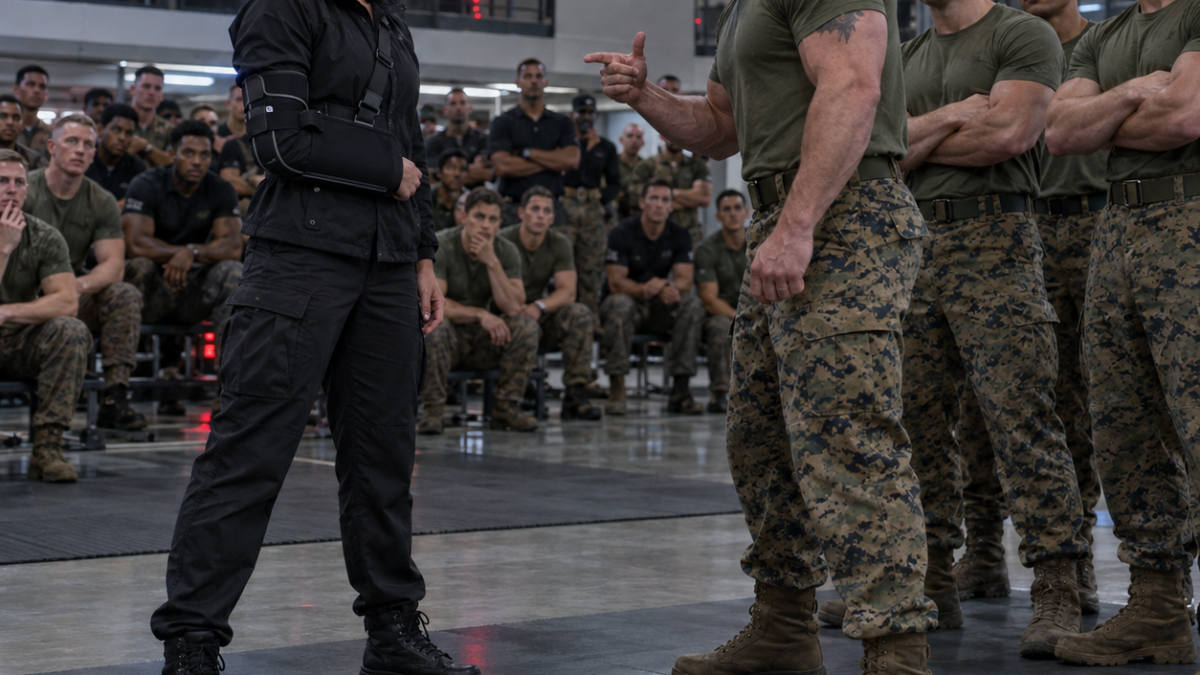
Thirty recruits waited in front of me, half Marines and half SEAL candidates, arranged in uneven lines beneath the dull fluorescent lights. The room smelled of disinfectant, rubber mats, old sweat, and the metallic bite of recycled air. A few men shifted their weight. Someone coughed into a fist. Someone else rolled his shoulders, trying to look loose instead of anxious.
My right arm hung in a rigid elbow brace under my training jacket.
I had tried to keep it subtle.
Not hidden exactly, because nothing stays hidden in a room full of people trained to notice weakness, but controlled. The brace ran from mid-bicep to wrist, locked tight enough to keep my arm stable and discreet enough that a casual observer might believe the injury was nearly healed.
It wasn’t.
Not fully.
The old fracture line still reminded me of itself in cold weather, with a deep ache that settled into the bone and pulsed whenever I moved too quickly. The doctors had called it manageable. I had called it inconvenient.
Pain was information.
Nothing more.
The problem was never pain itself. The problem was letting pain decide what you were allowed to do.
I looked over the formation.
Most of the recruits kept their faces neutral. Some were curious. Some were skeptical. A few stared openly at the brace before snapping their eyes forward when they realized I had noticed.
Then there was Sergeant Cole Braden.
He stood near the wall with his arms folded, surrounded by three Marines who had placed themselves around him like loyal furniture. Each one was taller than I was. Each one was built broad through the shoulders. Each one wore the faint smirk of someone who had arrived believing the outcome of the day had already been decided.
Braden’s smirk was the loudest.
He didn’t need to speak for me to understand him.
I had seen that look in training rooms all over the world.
Some men wore it when they believed they had found the soft spot in the structure. Others wore it when they had already confused volume with authority.
Braden wore it because he had seen my arm.
I didn’t raise my voice.
“Today’s lesson is close-quarters leverage mechanics,” I said. “The goal is not power. It is redirection. Efficiency through angle, not force.”
A Marine near Braden coughed to hide a laugh.
Another shifted on his heels.
Braden stepped forward just enough to pull attention toward himself.
“That’s one way to teach fighting,” he said.
His voice carried easily through the bay.
No one moved.
“Another way,” he continued, “is to actually fight.”
I turned my head slightly, not because he deserved the gesture, but because a room learns from what an instructor chooses to acknowledge.
Some provocations are childish.
Some are dangerous.
The trick is knowing which is which before the line gets crossed.
“Sergeant Braden,” I said.
“Ma’am.”
The word came out polished enough to pass inspection and disrespectful enough to land exactly where he intended.
“Do you have a question?”
His mouth twisted.
“Just an observation.”
“Make it useful.”
Several recruits lowered their eyes.
Braden’s men smiled wider.
He enjoyed having an audience. Men like him often did. In private, cruelty becomes naked. In public, they dress it up as confidence.
“Some of us come from units where combat isn’t theory,” he said. “You don’t redirect weight in an alley. You don’t flow around a threat. You drop them hard, fast, and done.”
I blinked once.
“And yet,” I said, “those who rely on force alone often meet others who don’t need to match it to end it.”
The room changed.
Not dramatically.
There was no gasp, no sudden shuffle of boots, no cinematic pause.
But I felt the shift.
People were listening differently now.
Braden smiled without warmth.
“Then prove it.”
I could have dismissed him.
That would have been acceptable.
I could have reminded him that training demonstrations were scheduled, structured, and controlled.
That would also have been acceptable.
But command presence is not only what you say. It is what you allow to become normal in front of people still learning where the lines are.
So I nodded once.
“Volunteers.”
Braden did not hesitate.
He motioned to his three Marines.
“Show her what real pressure looks like.”
They stepped forward as though they had been waiting all morning for permission.
I removed my pen from my jacket pocket, placed my clipboard on the side table, and stepped onto the mat.
“Protocol rules,” I said. “No sustained holds. No head strikes. Rotating pairs. Stop when I call stop.”
Braden shrugged.
“If you can handle it.”
I faced the first Marine.
He came in with a standard over-the-shoulder grab, wide and confident, expecting me to resist backward. Instead, I dipped beneath his reach, pivoted on my left foot, and used the bend of his own elbow to roll his body through the motion he had started.
He hit the mat in less than a second.
A grunt left his mouth.
He stayed down just long enough to understand that it had not been luck.
“Reset,” I said.
The second Marine moved faster.
He tried to slide behind me and trap my midsection, using size and surprise to force control. I let him commit, turned before his grip locked, hooked his ankle, and dropped him clean with a shoulder check and knee placement that never touched the boundary of excessive force.
He landed hard enough to remember.
Not hard enough to injure.
The third Marine hesitated.
That hesitation told me more than his attack would have.
He was watching the first two and recalculating. Pride told him to continue. Instinct told him he was stepping into something he had misunderstood.
I moved first.
One step.
One shift.
His balance broke before he knew I had taken it.
He went down with almost no noise at all.
I stepped back.
“That concludes the demonstration.”
No one spoke.
The SEAL candidates stood a little straighter.
The Marines looked at the mat as though it had betrayed them.
Braden’s jaw clenched.
I adjusted the edge of my brace, picked up my clipboard, and turned back to the formation.
“The body always announces intention before impact,” I said. “Power is visible. Balance is useful. Learn the difference.”
I dismissed them five minutes later.
I did not look at Braden as I left the mat.
But I heard him.
He waited until he thought I was far enough away, then spoke under his breath, just loud enough for his men to hear.
“She’ll learn what pressure feels like soon enough.”
I kept walking.
Restraint is often mistaken for permission by people who have never paid a real price for crossing a line.
By sundown, the story had already changed shape.
Stories move differently on a base than they do in civilian life. They travel through chow halls, locker corridors, equipment cages, duty desks, and smoke breaks. They pick up exaggerations, lose context, and become whatever the loudest person needs them to be.
By dinner, I was apparently either a one-armed miracle or an overhyped instructor whose trainees had taken a dive.
I heard pieces of it without trying.
“She dropped three Marines.”
“They were going easy.”
“She didn’t even sweat.”
“It was a demo, not a fight.”
“Did you see Braden’s face?”
“She got lucky.”
I sat in the corner of the mess hall with a tray of watery chili and a cup of coffee that tasted like burnt plastic. The fluorescent lights hummed overhead. Forks scraped against plastic trays. Boots dragged beneath tables.
Across the room, Braden held court.
He leaned back in his chair, boots up on the empty seat beside him, arms spread wide as if the room belonged to him.
“She ran a demonstration,” he said loudly. “Not a fight.”
His Marines chuckled.
A little thinner than before.
“Those weren’t takedowns,” he continued. “They were rehearsed falls.”
One younger Marine at the end of the table shifted.
“She did drop all three, though.”
The table went still.
Braden turned toward him slowly.
“What was that?”
The younger Marine looked down at his tray.
“Nothing, Sergeant.”
Braden smiled.
It was not a kind smile.
“That’s what I thought.”
I looked away.
I had no interest in humiliating him further. Men like Braden often thought silence meant victory, but silence can also be documentation. Every word he spoke in that room told me more about his insecurity than any personnel file could have.
Later that evening, I stood at my desk in the operations wing, writing the day’s training log.
The official report was dry.
Names.
Timestamps.
Protocol compliance.
Rotational performance.
No emotion.
No speculation.
No mention of Braden’s pride.
In the margins of my private notes, however, I wrote what mattered.
Marine One: overcommitted leading foot.
Marine Two: dominant-side rear grab. Vulnerable on pivot.
Marine Three: hesitation under observation. Freeze response likely under pressure.
Braden: ego-driven escalation pattern. Watches for perceived weakness. Uses audience to pressure compliance.
I paused over the last line.
Then I deleted it.
Not yet.
A knock sounded against the glass wall.
Commander Ronan Tate stood in the hallway holding a coffee cup.
He had the calm, tired eyes of a man who had survived enough command meetings to know that the most dangerous problems rarely began loudly. Tate had been on base longer than I had, and though he outranked me in the facility structure, he rarely wasted words proving it.
I opened the door.
“You caused a bit of turbulence today,” he said.
“I didn’t intend to.”
“I know.”
He stepped inside and glanced at the training log on my desk.
“They’re already whispering.”
“That tends to happen.”
“Half the base thinks you embarrassed the Marines. The other half thinks you got lucky.”
“I’m not interested in luck.”
Tate looked at me.
“No?”
“Only patterns.”
He studied my face, then my brace.
“How’s the arm?”
“Functional.”
“That’s not what I asked.”
“It’s the answer I have.”
A faint smile tugged at his mouth and disappeared.
“Keep the brace on. Try not to make any more statements this week. Verbal or physical.”
“I’ll do my best.”
“That’s what worries me.”
After he left, I stared at the closed door for a moment.
Then I returned to my report.
My arm ached that night.
It had started as a dull pull behind the elbow, but by twenty-two hundred hours it had settled into a deeper throb. I removed the brace in my quarters, checked the swelling, flexed my fingers carefully, and reminded myself that discomfort was not damage unless the body proved otherwise.
Still, I did not sleep well.
Not because of pain.
Because of Braden’s words.
She’ll learn what pressure feels like soon enough.
Threats are often hidden inside jokes because cowards like plausible deniability.
If challenged, they laugh.
If ignored, they escalate.
The next afternoon, the bay was scheduled for endurance circuits.
Mixed pairings.
Marines versus SEALs.
Controlled contact.
Timed drills.
Safe, if everyone followed the rules.
I stood off to the side with my clipboard tucked under my left arm, calling rotations as recruits moved through the stations. The thud of bodies hitting mats echoed through the room. The air was warm, heavy with breath and effort.
Braden stood near the edge of the bay.
He had been quiet most of the day.
That did not reassure me.
Silence was not his nature. In him, it felt like buildup.
When the third cycle ended, he stepped forward.
“Commander Kerr.”
I looked up from my notes.
“Yes, Sergeant?”
“How about a demonstration?”
Several heads turned.
“Demonstrations are scheduled.”
He smiled thinly.
“Consider this an unscheduled real-time adaptability drill.”
“Unnecessary.”
“It’s joint training, ma’am. We adapt, remember?”
The room quieted.
The air handlers seemed suddenly louder.
I looked at Tate in the upper gallery. He was watching.
Then I looked back at Braden.
“Protocol first. Contact limits apply.”
“I know the limits.”
“Then keep them.”
I placed my clipboard on the table.
My right arm felt heavy inside the brace.
Braden stepped onto the mat.
He was broader than I was, heavier by at least fifty pounds, and radiating the kind of confidence built from strength rooms, sparring trophies, and the assumption that size is destiny.
We squared off.
I did not hate him.
That matters.
People like to imagine confrontations as clean emotional lines. Hero and villain. Anger and justice. Pain and revenge.
Real life is messier.
Braden irritated me. He concerned me. He had become a risk to the training environment.
But I did not hate him.
Hatred makes you careless.
And I could not afford carelessness.
He opened with a forward shove meant to test my range.
I parried with my left hand, slipped outside, and redirected his momentum enough to make him stumble.
A murmur moved through the room.
Braden reset.
“Lucky angle.”
He lunged again, faster this time.
I dropped my center, caught his arm, turned my hip, and rolled him over my shoulder in a clean, controlled throw.
He landed hard.
Not dangerously.
Hard enough.
For a moment, something flickered in his eyes.
Embarrassment.
Then anger.
He came up too quickly.
That was the first warning.
His next movement was not training.
He reached for my right wrist.
I shifted, but the brace limited my angle by a fraction of a second.
His hand locked around the joint.
He stepped inward.
Then he twisted.
It was sharp.
Deliberate.
Not a submission hold.
Not a control technique.
Torque.
The kind used not to win a drill but to force a sound out of someone.
The world narrowed.
There was a crack.
Every breath in the room seemed to stop at once.
Pain shot through my arm so cleanly that for half a second, there was no thought attached to it. Only white heat. Nerve and bone. Old injury meeting new damage.
My body tensed.
Then steadied.
I did not scream.
Not because it didn’t hurt.
It hurt enough that the edges of the room blurred.
It hurt enough that sweat broke instantly along the back of my neck.
It hurt enough that some younger, more frightened version of me might have mistaken silence for strength and pushed further out of pride.
But I was not that version of myself anymore.
I looked at Braden.
His hand released mine.
His face had changed.
He knew.
He knew the difference between contact pressure and what he had done.
So did everyone else.
A medic stepped forward immediately.
I lifted my left hand.
“Negative.”
“Commander—”
“No medical intervention required.”
My voice carried the finality of an order.
Braden took a step back.
“Ma’am, that was just contact pressure.”
No one answered.
His own Marines stood frozen.
I bent, picked up my clipboard with my left hand, and walked off the mat.
Each step was deliberate.
Each breath measured.
Behind me, Braden called out.
“Commander, it was an accident.”
The door closed before he finished speaking.
In the hallway, I stopped.
There are kinds of pain that make sound impossible.
My right arm pulsed inside the brace. I leaned my left shoulder against the wall, closed my eyes, and counted my breaths down from ten.
Ten.
Nine.
Eight.
Not here.
Not where they could see.
Seven.
Six.
Five.
Pain is information.
Four.
Three.
Two.
Control first.
One.
I straightened.
Then I kept walking.
By nightfall, the story had split in two.
Some said it was an accident.
Some said Braden had waited for the right opening and twisted until something gave.
Everyone remembered the sound.
No one wanted to be the first person to say aloud what the whole room already knew.
In the Marine wing, Braden built himself a version of events he could survive.
I heard about it later.
“She didn’t tap,” he’d said. “That’s on her.”
One of his recruits had apparently looked uncomfortable.
Braden snapped at him.
“It was part of the sequence. Pressure test. She wanted realism. She got it.”
Nobody challenged him.
But nobody truly agreed either.
That mattered.
Silence changes when belief leaves it.
Across the compound, the SEAL candidates said even less.
Their silence was not avoidance.
It was containment.
They had seen enough to know the situation would not end where Braden wanted it to end.
Petty Officer Marsh, who had trained under me two rotations before, reportedly told two candidates near the equipment cage, “He thinks he broke her. What he actually did was give her a reason to recalibrate the standard.”
Marsh always had a way with understatement.
I did not go to medical.
I did not return to quarters.
I did not file a complaint.
Instead, at eighteen forty-one hours, I submitted a formal request to Commander Tate.
Subject: Reflex Evaluation Authorization.
Requested location: Reflex Bay.
Time: Twenty-one hundred hours.
Scope: Adaptive demonstration.
Participants: Sergeant Cole Braden and designated Marine unit.
Medical intervention: Denied unless ordered by base command.
No note about my arm.
No accusation.
No speech.
Just protocol.
Tate approved it within minutes.
That told me he had seen enough from the upper gallery.
He didn’t call.
He didn’t ask whether I was sure.
He signed the request, forwarded it through the proper channel, and let the system do what it had been designed to do.
At twenty forty hours, I stood alone in the rehab wing.
The lights were low.
The building hummed quietly around me.
No voices.
No radios.
No audience.
My jacket lay folded on the bench.
My right arm was no longer in the rigid brace.
I had wrapped it in a reinforced compression sling, tight against my torso, immobilized completely. There would be no accidental use. No instinctive reach. No compromise.
If I moved tonight, I would move with one arm.
Not as theater.
As truth.
In front of me stood two aluminum training dummies stripped to foam cores. One had a taped X where the neck met the clavicle. The other had a sandbag resting across its lower trunk.
I exhaled once.
Then I moved.
Left foot pivot.
Elbow drive.
Hip hinge.
Drop.
Rise.
Reset.
Every motion had to be clean.
No flourish.
No wasted movement.
The sling never shifted.
My right arm remained still.
Pain radiated through my shoulder and down into the bone, steady and unforgiving.
I let it exist.
Pain could come with me.
It could not lead.
I moved again.
Low sweep.
Shin trap.
Reverse stance.
Turn.
Leverage.
Fall.
The dummy dropped with a dull sound against the mat.
I reset it manually.
Then I walked to the mirror bolted to the corner pillar.
The woman staring back at me looked calm.
A little pale, perhaps.
Sweat at the temples.
Jaw set.
Arm bound tight beneath the black sling.
I thought, briefly, of BUD/S.
Week six.
Cold surf.
My hand swollen so badly I couldn’t close it into a fist.
I remembered an instructor crouching beside me while the wind cut through us both.
“Your body doesn’t decide what works,” he had said. “Command does. Comfort doesn’t matter. Clarity does.”
At the time, I had hated him for saying it.
Later, I understood.
I whispered the words into the empty room.
“Clarity does.”
Then I stepped back onto the mat.
At exactly twenty-one hundred hours, the doors to Reflex Bay unlocked with a mechanical clack.
Reflex Bay did not look like much from the outside.
A gray structure behind the drone hangars.
A single halogen floodlight above the entrance.
No sign announcing its purpose.
No symbol to impress visitors.
Inside, however, the space had its own gravity.
Red emergency lights pulsed low from the corners. The floor was bare rubber. The walls were padded foam barriers arranged in asymmetrical angles designed to disorient movement and break predictable lines of attack.
No exit markers remained visible once the drill began.
No music.
No crowd noise.
Just red light, rubber floor, and whatever truth people brought with them.
Braden entered first.
His three Marines followed.
Their expressions wavered between amusement and unease.
They did not know whether this was payback, protocol, or punishment.
That uncertainty was useful.
Commander Tate stood in the upper gallery with a tablet in hand.
Braden looked up at him.
“Just want to be clear, sir. This is authorized?”
Tate gave a single nod.
“You requested a branch control demonstration. This is it.”
Braden’s smile faltered.
Then the main floor door opened again.
I stepped into the red light.
No announcement.
No dramatic pause.
My right arm was strapped firmly against my torso in the black sling. My left hand was bare. My boots were soft-soled. I carried no training weapon, no pad, no clipboard.
Braden laughed once, loudly enough to fill the silence.
“You sure you’re cleared to fight, ma’am?”
I did not look at him.
“I’m cleared to demonstrate correction.”
Tate’s voice came over the comm.
“Reflex Bay live. No gear. No exit markers. Clean protocol. One round per contact. Avery Kerr versus Marine unit designated Alpha.”
The Marines shifted.
I nodded.
“Understood.”
I stepped forward.
Slow.
Centered.
Breathing even.
Braden smirked.
“Three on one again. You remember how this went last time?”
I did not answer.
The first Marine was already moving.
He lunged with a front-foot grab, classic pressure posture, shoulders too high, balance too far forward.
I sidestepped left, caught his elbow with my good arm, and dropped him using the weight he had already given me.
His shoulder hit the mat before his mind caught up.
Tate’s voice remained dry and factual.
“Alpha One neutralized.”
The second Marine came harder.
He rushed for my upper torso, perhaps believing the sling would give him a safe side to attack.
It did not.
I pivoted backward, used my shin to sweep his ankle, and brought my left elbow down across the line of his clavicle with controlled pressure.
He folded.
Not injured.
Neutralized.
“Alpha Two neutralized.”
The third Marine hesitated.
His eyes darted toward Braden.
I moved first.
A planted-foot turn.
A low kick behind the knee.
A controlled pin that placed my boot against his wrist before he could recover.
He froze beneath the pressure.
“Alpha Three neutralized.”
I released him and stepped back.
Braden stared.
His mouth hung slightly open.
I had not thrown a punch.
I had not used my right arm.
I had barely raised my breathing.
Then his expression hardened.
“My turn.”
I faced him.
“Then correct your posture.”
He charged.
Heavy boots.
Wide arms.
Anger disguised as aggression.
He wanted collision.
I gave him absence.
He swung high.
I bent beneath it and let him overreach.
My left leg swept behind his knee.
My hip turned through his momentum.
His body tilted off-axis before he understood he was falling.
He hit the floor hard.
I followed him down just far enough to pin him safely.
My knee controlled his ribs.
My left elbow trapped the back of his shoulder.
My right arm remained motionless in the sling.
Unused.
Unneeded.
His breath came hard beneath me.
I leaned closer.
“You wanted proof,” I said evenly. “Consider it logged.”
Then I released him and stood.
The bay remained silent.
The three Marines sat stunned on the mat.
Braden stayed down longer than necessary, staring at the ceiling as though it might provide an explanation.
From above, Tate’s voice cut through the red-lit quiet.
“Drill complete. Results recorded. Training directive closed.”
Nobody clapped.
Nobody spoke.
I adjusted the sling with my left hand and walked toward the exit.
I did not look back.
There was nothing behind me I needed to see.
The review took place the next morning.
Joint Command rarely used that conference room for ordinary discipline. Most problems were handled lower in the chain, quietly and efficiently. This one had traveled higher because too many people had seen too much, and because the body leaves evidence pride cannot erase.
The blinds were shut.
The lights were dim.
The air conditioning ran too cold.
Tate sat at the head of the table with a single folder open before him. He did not look angry. Tate rarely wasted emotion in official rooms.
He looked precise.
Across from him sat Braden.
One hand bandaged at the wrist.
A faint bruise beneath his left eye.
His three Marines sat beside him, quieter than I had ever seen them.
I sat at the far end of the table, right arm secured in the sling, left hand resting calmly on the table surface.
No notes.
No expression.
I had already submitted the necessary facts.
This was not my theater.
Tate cleared his throat.
“This is not a tribunal,” he said. “This is a closed review inquiry into training protocol deviation and unreported injury sustained during interbranch drills.”
Braden shifted.
“Sir, I already stated—”
Tate raised one hand.
“You stated it was standard contact pressure. I am aware.”
He opened the folder.
“Medical disagrees.”
Braden’s jaw tightened.
Tate read from the report.
“Fracture line consistent with direct torque beyond regulation thresholds. Damage pattern indicative of rotational leverage. Not incidental contact. Injury not survivable by bracing alone.”
Silence.
Braden opened his mouth.
Closed it.
Tate continued.
“The angle of the break matches a maneuver prohibited under Clause 12B of the interbranch combat code. You signed that clause. So did every man on that mat.”
No one moved.
Braden looked toward his Marines.
None of them met his eyes.
That was the moment his authority truly began to collapse.
Not when I dropped him in Reflex Bay.
Not when Tate read the medical findings.
But when the men who had once laughed with him chose silence over loyalty.
Tate turned to me.
“Lieutenant Commander Kerr, did you report the injury?”
“No, sir.”
“Why not?”
“Because it did not require attention. It required adjustment.”
Tate’s eyes stayed on mine for a moment.
“So you scheduled a corrective drill.”
I did not answer.
I didn’t need to.
He looked back at Braden.
“The problem is not merely the injury. The problem is intent. You used a banned maneuver in a controlled training environment. You justified it as protocol. You attempted to minimize the damage. And you stopped only when consequence arrived in a form you could not control.”
Braden’s face flushed.
“Sir, I didn’t mean for it to break.”
For the first time that morning, I looked directly at him.
He did not look at me.
Tate closed the folder.
“That may be true.”
Braden’s shoulders loosened slightly.
Then Tate continued.
“But you meant to twist it.”
The room went colder.
Tate leaned forward.
“You meant to force pain. You meant to humiliate an instructor in front of recruits because your pride had been damaged. Whether you intended the fracture to reopen does not erase the decision that created it.”
Braden said nothing.
There are silences that protect people.
There are silences that condemn them.
This one did both.
Tate sat back.
“Effective immediately, you are suspended from instructional duties. A formal reprimand will be filed with both branch liaisons. This facility no longer recognizes your authority to lead joint operations.”
Braden’s jaw flexed.
His hands remained folded on the table.
He gave no excuse.
There was no room left for one.
Tate turned toward me.
“Lieutenant Commander Kerr, your Reflex Bay demonstration has been submitted to Command North for review. You will receive formal commendation for adaptive tactical control under duress.”
“No commendation required, sir.”
A faint smile touched the edge of Tate’s mouth.
“Noted. But not your decision.”
“Then I request the next roster.”
One of the Marines looked up.
I saw shame in his face.
Not fear.
Shame.
That mattered more.
Tate stood.
“This session is closed.”
No one moved for a beat.
Then chairs scraped against the floor.
The Marines filed out first.
Braden rose slowly.
I stood last.
My arm throbbed inside the sling, but the pain felt distant now, almost irrelevant.
The decision had been made.
The line had been redrawn.
Not loudly.
Not perfectly.
But clearly.
Outside the conference room, the corridor stretched cold and polished in both directions. A handful of officers stood near the wall-mounted schedule boards, not speaking, only watching.
I walked through the door.
No one saluted.
Not because they lacked respect.
Because they understood that respect does not always need performance.
Two Marine instructors stood near the opposite wall. Both had been present the night before. Both straightened slightly as I passed.
One gave the smallest nod.
I did not return it fully.
Not out of arrogance.
Out of focus.
At the end of the corridor, Braden sat alone on a metal bench.
No tablet.
No wide posture.
No audience.
His hands were clasped between his knees, elbows braced on his thighs. For once, he looked less like a man defending his pride and more like someone trapped with the consequences of it.
I did not stop.
I did not slow.
But as I passed, he spoke.
“I didn’t think it would snap like that.”
His voice was quiet.
Almost human.
For a moment, I saw him not as an enemy, not as a symbol, but as a man who had convinced himself cruelty was toughness until the bill came due.
My footsteps did not change.
“You didn’t think I’d keep going either,” I said.
Then I walked on.
Tate waited near the elevator bank, arms folded.
When I approached, he said, “You didn’t just win.”
I paused.
He studied me.
“You recalibrated the line.”
I looked down at the sling, then back at him.
“Discipline did.”
The elevator doors opened.
I stepped inside.
As they closed, I saw Tate still standing there, expression unreadable.
Behind him, the corridor remained quiet.
No applause.
No cheers.
No dramatic celebration.
Just silence adjusting itself around a new truth.
The next morning, the sun broke clean across the eastern edge of the base.
Long shadows stretched over the gravel parade grounds. The air was cool, washed pale by early light. Boots moved more deliberately than usual. Conversations were softer. Jokes ended sooner.
The energy had shifted.
Not into fear.
Fear is loud in its own way.
This was different.
It was the calm that follows correction.
I walked the outer perimeter trail alone.
Same posture as always.
Back straight.
Gaze steady.
Hands positioned carefully, one functional, one bound.
No entourage.
No medal pinned to my chest.
No need to announce anything.
Those who passed me stood a little straighter now.
Not because they were afraid of me.
At least, I hoped not.
Fear produces compliance.
Recognition produces change.
A junior Marine I did not know offered a quiet nod from the opposite walkway.
I returned it with a glance.
Just enough.
He kept walking.
Petty Officer Marsh caught up with me near the west range.
“Morning, Commander.”
“Marsh.”
He adjusted his cap as he matched my pace.
“They’re real quiet today.”
“They’ll find their voices again.”
“Hopefully better ones.”
“Hopefully.”
He smiled.
“Guess they finally learned the first rule.”
I glanced sideways.
“Which one is that?”
“Never touch a SEAL.”
I exhaled once through my nose.
It was not quite a laugh.
“Wrong lesson.”
His smile faded a little.
“Ma’am?”
“The lesson is not that I’m dangerous.”
He looked ahead.
“The lesson is that discipline matters before danger arrives.”
Marsh nodded slowly.
“That’s harder to fit on a T-shirt.”
“Most useful things are.”
We walked in silence for several yards before he peeled off toward the equipment building.
I continued toward the central admin block.
Near the personnel gate, Braden stood beside a bench with a duffel bag at his feet.
Waiting.
Not dismissed from service.
Not destroyed.
But removed from the thing he had misused.
His eyes did not meet mine as I passed.
His shoulders had changed.
Pride had once held them high and broad.
Now reality had pulled them inward.
I said nothing.
No nod.
No warning.
No final wisdom.
He was not owed a speech from me.
Some consequences should be experienced without narration.
Inside the instructor wing, two new candidates walked past carrying folders. Fresh officers, recently cleared for joint training. They did not know the story. Not yet.
But they noticed the way the hallway quieted when I entered.
They noticed the sling.
They noticed the way senior personnel made room without being asked.
One day, someone would tell them a version of what happened.
Maybe it would become exaggerated.
Maybe the red lights would become brighter.
Maybe the number of Marines would grow.
Maybe someone would say I fought through a broken arm because I had something to prove.
They would be wrong.
I had nothing to prove.
That was the whole point.
The people who need to prove themselves are the easiest to provoke. They can be moved by laughter, insults, and the fear of being misunderstood.
I had already been misunderstood.
I had been underestimated in classrooms, training bays, briefing rooms, and field exercises. I had been called too calm, too cold, too small, too injured, too controlled, too quiet.
For years, I had thought each insult demanded an answer.
Then experience taught me something better.
Not every false judgment deserves your energy.
Some deserve correction.
And correction is not the same as retaliation.
Retaliation asks, How do I make you hurt because you hurt me?
Correction asks, How do I make sure this line is not crossed again?
That distinction had shaped every choice I made after Braden twisted my arm.
I did not scream because screaming would have given him the reaction he wanted.
I did not file an emotional complaint because emotion was not the strongest evidence.
I did not attack him in Reflex Bay because anger would have made the demonstration about him.
I showed the entire facility exactly what control looked like when pain was present, when pride was absent, and when force was used only as far as necessary.
Then I stopped.
That was the part people missed most often.
Stopping is a skill.
Anyone can continue once adrenaline takes over.
Anyone can justify one more hit, one more humiliation, one more public victory.
But the moment after dominance is established reveals more than the fight itself.
Do you keep taking?
Or do you release?
In Reflex Bay, I released.
In the review room, Tate did not.
That was his job.
By late morning, I stood before the wall-mounted roster outside the staff hallway. The next cycle of training had already been updated. Braden’s name had been removed from the instructor column. Replacement assignments were listed beneath.
I uncapped a pen and crossed off the completed field module.
Done.
No lecture.
No announcement.
Just ink across laminated paper.
As I turned to leave, I saw the younger Marine from Braden’s table—the one who had almost spoken up in the mess hall—standing several feet away.
He looked nervous.
“Commander?”
“Yes?”
He swallowed.
“I just wanted to say…”
He stopped.
I waited.
People often need silence before courage can fit through their teeth.
He looked down, then back up.
“What happened wasn’t right.”
“No,” I said. “It wasn’t.”
“I should’ve said something sooner.”
I studied him.
He was young. Not innocent exactly, but still forming the habits that would eventually define him.
“Why didn’t you?”
His face flushed.
“I didn’t want to be next.”
The honesty mattered.
More than an excuse would have.
I nodded.
“That’s how people like Braden keep rooms quiet.”
He looked ashamed.
“I’m sorry.”
“Then use it.”
He frowned.
“Ma’am?”
“Regret is only useful if it changes your next decision.”
He stood straighter.
“Yes, ma’am.”
I walked past him, then paused.
“And Marine?”
“Yes, ma’am?”
“Speaking up doesn’t always mean making a speech. Sometimes it starts with refusing to laugh.”
His expression shifted.
He understood.
I left him there in the hallway, holding a lesson I hoped would last longer than the rumor.
That afternoon, I returned to the bay.
Empty this time.
No formation.
No Braden.
No gallery.
Just the floor, the mats, and the faint smell of disinfectant.
The red lights were off. In normal white light, Reflex Bay looked smaller, less dramatic, almost ordinary.
That felt right.
Rooms are rarely powerful by themselves.
People bring meaning into them.
I stepped onto the mat and stood in the center.
My right arm throbbed inside the sling.
Medical would have things to say later. They always did. There would be imaging, restrictions, timelines, and lectures disguised as recommendations.
I would listen.
Mostly.
I looked at the spot where Braden had fallen.
Then at the place where his three Marines had sat in stunned silence.
I did not feel victorious.
Victory was too simple a word.
I felt clear.
There was pain, yes.
There was fatigue.
There was a small sadness I had not expected.
Sadness that Braden had needed consequence to understand what respect could have taught him earlier.
Sadness that the recruits had needed a public correction to see a private failure.
Sadness that restraint is so often invisible until someone tries to mistake it for weakness.
But beneath all of that, there was steadiness.
The kind that comes when you know you acted according to the standard you claim to believe in.
I had not been perfect.
No one is.
But I had held the line.
I turned off the bay lights and stepped into the corridor.
Outside, the base moved on.
It always does.
Training schedules continued.
Reports were filed.
Recruits complained about food, weather, and early formations.
Engines turned over near the vehicle bay.
Somewhere in the distance, an instructor barked cadence badly enough to offend music itself.
Life resumed.
But it resumed differently.
That mattered.
By evening, the official notice had circulated through the proper channels. Braden was suspended from instructional duties. His authority in joint operations was revoked pending further review. My commendation was filed despite my objection. The next roster arrived before dinner.
I read it once, made notes, and prepared for the following morning.
There would be new recruits.
New egos.
New mistakes.
There always were.
But perhaps, for a little while, the story of Sergeant Cole Braden and the woman he thought he could break would move through the base with enough weight to slow someone’s hand before it crossed a line.
Perhaps a recruit would remember not to laugh when someone else was targeted.
Perhaps an instructor would recognize the difference between pressure and abuse.
Perhaps a young Marine would understand that silence is not always loyalty.
Sometimes silence is the soil where misconduct grows.
I could not control all of that.
I could only control what I did next.
The next morning, I returned to the training bay at zero six hundred.
The recruits were already there.
They stood straighter than before.
Not rigid.
Attentive.
Their eyes moved once to the sling, then back to my face.
Good.
Progress.
I walked to the front of the formation.
The rubber soles squeaked softly beneath me.
The same sound as before.
The same room.
Different air.
I set my clipboard on the table and faced them.
“Today’s lesson is restraint under pressure.”
No one laughed.
No one coughed.
No one shifted performatively.
I let the silence settle.
Then I continued.
“Most people think control means winning the fight.”
I looked across the formation.
“It doesn’t.”
Their faces remained fixed on mine.
“Control means knowing when force is necessary, how much is necessary, and when it is no longer justified. If you cannot stop yourself, you are not in control. If your pride decides your tactics, you are not in control. If you need an audience to feel powerful, you are already compromised.”
A few eyes lowered.
I did not raise my voice.
I didn’t have to.
“The strongest person in a room is not the one most eager to hurt someone. It is the one who can act decisively without surrendering judgment.”
I paused.
My arm pulsed.
I let it.
“Begin.”
They moved.
This time, the room sounded different.
Still imperfect.
Still full of bodies learning hard lessons through repetition.
But sharper.
Cleaner.
More aware.
I watched a Marine correct his partner’s stance gently instead of mocking him.
I watched a SEAL candidate stop a drill when contact moved too close to a restricted joint.
I watched the younger Marine from the hallway refuse to laugh when another trainee stumbled. Instead, he offered a hand and said, “Reset.”
Small things.
But standards are built from small things repeated until they become culture.
Near the end of the session, Tate appeared in the upper gallery.
He said nothing.
He simply watched.
When the final rotation ended, I dismissed the recruits.
They filed out in controlled lines.
The younger Marine paused at the door and looked back.
Not for approval.
For confirmation.
I gave him a slight nod.
He left.
Tate descended the stairs after the bay cleared.
“Good session,” he said.
“It was adequate.”
He smiled.
“High praise.”
“The day is young.”
He stood beside me, looking across the empty mat.
“Medical still wants to see you.”
“I know.”
“And you’re going?”
“Eventually.”
“Avery.”
I glanced at him.
His voice had softened, but only slightly.
“You held the line. You don’t have to punish your body to prove that.”
I looked down at the sling.
For once, I did not have a quick answer.
Maybe because he was right.
Maybe because the hardest standards to enforce are the ones you apply to yourself.
“I’ll go,” I said.
“Now?”
I sighed.
“Now.”
He nodded, satisfied.
As we walked out of the bay, I looked once more at the floor.
The polished surface reflected the overhead lights in long white lines.
No red glow.
No audience.
No myth.
Just a room where something ugly had been exposed, corrected, and folded into a lesson.
That was enough.
Braden’s name would remain in records.
Mine would too.
But years from then, when recruits told the story, I hoped they would remember more than the one-armed takedowns.
I hoped they would remember that the first line crossed had not been physical.
It had been the moment a room allowed arrogance to masquerade as strength.
I hoped they would remember that discipline did not mean standing still forever.
It meant waiting until the moment required action, then acting with precision instead of rage.
Most of all, I hoped they would remember that silence is not surrender.
Sometimes silence is observation.
Sometimes it is patience.
Sometimes it is the last warning before the standard corrects itself.
And when that correction comes, it does not need to shout.
It only needs to be clear.