𝗙𝗨𝗟𝗟 𝗦𝗧𝗢𝗥𝗬 They Saw the Chain Around My Neck and Decided They Knew What I Was
𝗙𝗨𝗟𝗟 𝗦𝗧𝗢𝗥𝗬
I heard the change in my own voice.
He heard it too.
For a moment, something uncertain crossed his face.
Then pride returned.
“I don’t think so. This is evidence.”
“It is not yours.”
“It is now.”
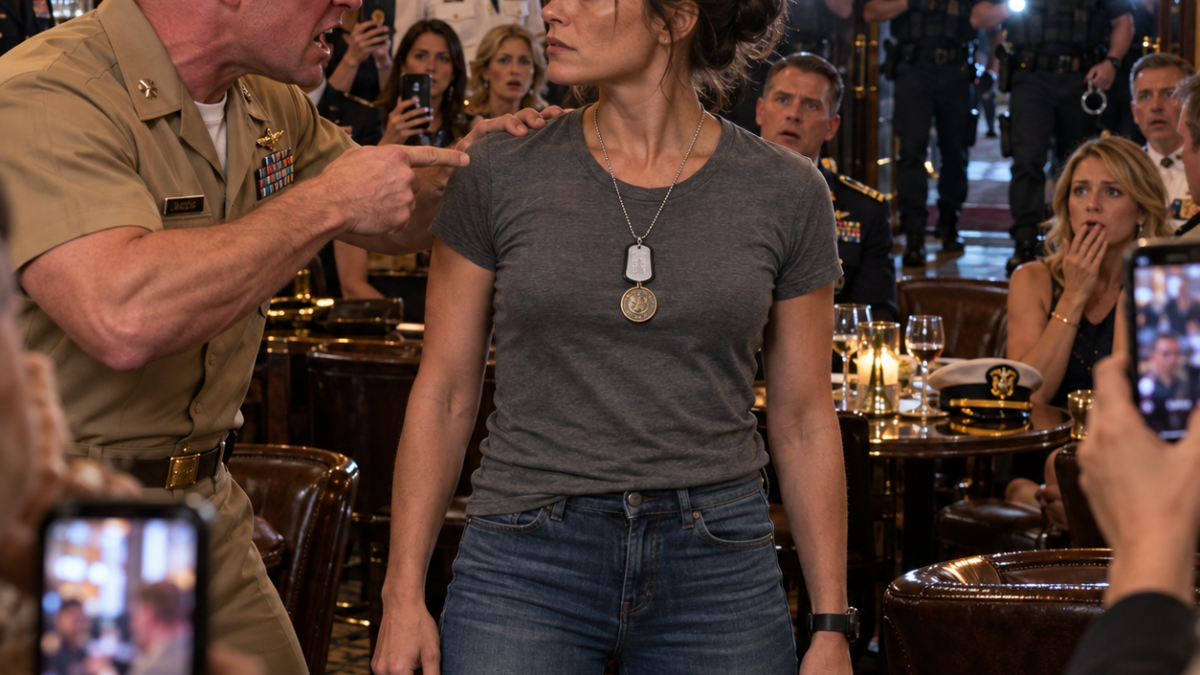
He pocketed the coin.
That was the hardest moment.
Not the accusation. Not the phones. Not even the grip on my shoulder.
That coin was one of the only acknowledgments most of us ever received. Twelve had been issued. Four belonged to people who never came home. Eight had been carried into quiet civilian lives by people who could not explain why a small piece of metal mattered more than medals they were never allowed to receive.
Morrison put it in his pocket like it was a novelty.
Like it was nothing.
The bartender, Joey Martinez, spoke from behind the bar.
He was former Navy corpsman. I could hear it in the way he addressed Morrison—not submissive, but careful.
“Hey, maybe ease up. Let her explain before you escalate this.”
“Explain what?” Morrison snapped. “How she bought fake gear and thought she’d impress people?”
Then he called the MPs.
While he did, Cortez streamed me to whoever was watching.
“This is what stolen valor looks like,” he said into his phone. “Right here at Coronado.”
Ross circled me.
“You know impersonating an officer is a federal crime, right? Prison time. Your life’s about to get complicated.”
I shifted unconsciously into parade rest.
Feet shoulder-width apart.
Hands clasped behind me.
Weight balanced.
It was not a decision. It was a memory.
Sullivan saw that too.
He stepped into the circle.
“Gentlemen, maybe we should all take a breath.”
Morrison turned on him.
“With respect, Master Chief, this doesn’t concern you.”
“What exactly did you catch her doing?” Sullivan asked.
“She’s wearing military identification she didn’t earn.”
“Did she tell you she was a SEAL?”
“She implied it.”
“Did she specifically claim to be something she isn’t?”
Morrison hesitated.
Ross jumped in.
“She said her service record is classified. Classic faker move.”
Sullivan looked at me.
“Ma’am. Prior service?”
“Yes.”
“Branch?”
“Navy.”
“Rate?”
I paused.
“I’m not authorized to discuss specifics without proper clearance verification.”
Morrison spread his hands as if I had confessed.
Then the doors opened, and Captain Vasquez entered with four MPs.
The crowd parted for her.
She had the kind of presence people obeyed. Sharp eyes. Controlled stride. Zero patience for disorder.
“Someone want to tell me why I’m here on a Friday night instead of home with my family?”
Morrison stepped forward eagerly.
“Captain, we have a stolen valor situation.”
He pointed at me.
“This woman has been representing herself as military. Specifically claiming SEAL service. She’s wearing dog tags and carrying military identification she didn’t earn.”
Vasquez approached me.
“Identification.”
I slowly reached into my pocket and handed her my driver’s license.
No military ID.
That absence weighed in the room like proof.
She read the card.
“Rachel Porter. Civilian address in San Diego.”
“Yes.”
“No military designation.”
“No.”
“Yet you’re wearing dog tags.”
“I attended a memorial service for a fallen operator. I made no claims to anyone about my status.”
“She absolutely did,” Morrison said.
Vasquez lifted a hand for silence.
“Did you represent yourself tonight as currently serving or former military?”
“I attended a memorial service. Period.”
“That isn’t an answer.”
“It is the only answer I can give in this room.”
Her face hardened.
“You don’t get to dictate terms.”
“I need you to contact Naval Special Warfare Command. Major General Steven Hayes.”
Morrison laughed again.
“She’s still name-dropping.”
Vasquez held out her hand, and Morrison produced my coin.
“She was carrying this,” he said. “Claims it was issued to her.”
Vasquez turned it over. She frowned at the markings, but there was no recognition in her eyes.
“Challenge coins can be purchased or gifted. This doesn’t prove service.”
“Exactly,” Cortez said.
Lieutenant Colonel James Woo moved through the crowd then. I remembered seeing him near the memorial service. A Marine liaison officer, older, watchful, the kind of man who listened before deciding.
“Captain Vasquez,” he said, “may I examine the coin?”
She handed it to him.
Woo studied the markings.
Something changed in his expression.
Not recognition exactly.
Caution.
“Ms. Porter,” he said, “where did you acquire this?”
“It was issued to me in May 2011 after completion of a classified operation.”
Morrison exploded.
“She’s making it up as she goes.”
But Woo wasn’t looking at him.
“You understand why I’m going to verify that before anyone makes arrests.”
“Colonel,” Vasquez said, “we have sufficient probable cause.”
“What specific claim has she made?” came another voice.
Sergeant First Class Mike Torres stepped forward from the memorial crowd. He had the weathered face of a man who had seen enough bad accusations to distrust easy certainty.
“Morrison,” he said, “what exactly did she say?”
“She talked about SEAL training.”
“What details?”
“BUD/S.”
“Most of that is public.”
“She implied she was one of us.”
“Implied isn’t charged under federal law.”
That should have slowed them down.
It didn’t.
Anger rarely stops simply because truth has entered the room.
Vasquez turned back to me.
“Final opportunity. Do you have documentation? DD-214? Military ID? Anything?”
“My service record is classified under executive order. I cannot produce public documentation without authorization from Naval Special Warfare Command.”
Cortez laughed so loudly it made a woman at the nearest table flinch.
“That’s perfect. Textbook.”
Vasquez seemed to agree.
“People with genuinely classified backgrounds don’t announce it in public bars.”
“I made no announcements,” I said. “These gentlemen approached me.”
“The appropriate authority here is me,” Vasquez said.
Then she nodded to the MPs.
“Cuff her.”
I turned and placed my hands behind my back.
Perfectly.
Too perfectly.
The MP behind me hesitated.
He knew.
Not who I was. Not what I had done.
But he recognized a body that had done this before under people who knew procedure. My wrists aligned automatically. My stance adjusted so he could cuff me without wasting movement.
Sullivan and Torres exchanged a look.
The handcuffs closed.
Cold metal. Familiar pressure.
Vasquez read me my rights loudly enough for the room.
I listened without reacting.
When she finished, I said, “I understand. I repeat my request to contact Major General Steven Hayes at Naval Special Warfare Command.”
Morrison leaned close as they led me past.
“This is beautiful,” he said. “You’re digging yourself deeper with every word.”
Cortez narrated my walk to the door like I was a trophy.
Phones followed.
I kept my head level.
At the bar, Joey Martinez caught my eye. His face was troubled, but he said nothing. I didn’t blame him. Instinct is not evidence.
Then Mrs. Eleanor Grant spoke.
She had been Marcus Webb’s mother.
“Young lady,” she called softly, “thank you for attending Marcus’s service. It meant a great deal.”
My step almost broke.
For one second, I was not at the center of an accusation. I was back in the function room, standing before a framed photo of Webb in uniform, his crooked smile preserved in a way life had not preserved him.
I looked at her.
“He was a good operator, ma’am. I’m sorry for your loss.”
Morrison grabbed my arm.
“Enough with the act.”
They took me outside into the night.
Behind us, the club slowly returned to itself. Conversation rose. Morrison bought a round. Cortez uploaded clips. Ross began preparing an official statement. People speculated over drinks about how foolish I had been to walk into that room pretending to be something I wasn’t.
Nobody noticed Sullivan making a quiet phone call from a corner.
Nobody saw Torres text a message that simply said:
We have a situation at O-Club. Need higher authority ASAP.
And nobody understood that the coin in Morrison’s pocket had already become proof of their catastrophic mistake.
The MP office smelled like stale coffee, industrial cleaner, and institutional confidence.
They sat me in a metal chair inside a windowless room and left the cuffs on.
I had sat in worse rooms.
Under worse lights.
With people outside who genuinely wanted me dead.
This room had posters about integrity and justice taped to the walls.
That was almost funny.
Commander Richard Stokes entered ten minutes later. JAG Corps. Mid-forties. Immaculate uniform. Lawyer’s eyes. The expression of a man who had already placed me into a category before asking the first question.
Vasquez came with him.
Morrison came too, because men like him always want to watch the punishment they initiated.
Torres entered as a neutral observer, though no one had officially invited him.
“Ms. Porter,” Stokes began, sitting across from me. “I’m Commander Stokes. I’ll be conducting the preliminary investigation. If you cooperate honestly, things will go easier for you. Stolen valor is a serious federal crime, but first-time offenders who show remorse often receive reduced sentences.”
I said nothing.
He opened a yellow legal pad.
“Full name?”
“Rachel Anne Porter.”
“Date of birth?”
“November 15, 1989.”
“Current occupation?”
“Emergency medical technician. San Diego County.”
He wrote it down.
“And you claim prior military service?”
“I served in the United States Navy. Honorably discharged October 2013.”
Morrison scoffed from the wall.
Stokes shot him a look and continued.
“What was your rate?”
I waited three seconds.
“I’m not authorized to disclose my specific rate or unit designation without clearance verification from Naval Special Warfare Command.”
“There it is,” Morrison said. “Classic deflection.”
Stokes held up a hand.
“Ms. Porter, I have a Secret clearance. If your service was classified at that level, you can disclose it to me.”
“My service requires higher than Secret clearance, Commander.”
The pen stopped.
For the first time, the room changed shape.
Torres spoke quietly.
“That would be Top Secret SCI. Or a compartmented program.”
“If she’s telling the truth,” Morrison snapped.
Stokes took another approach.
“Tell me about BUD/S training.”
“I haven’t claimed BUD/S.”
“But you know what it is.”
“Basic Underwater Demolition/SEAL training conducted at Naval Special Warfare Center Coronado.”
“Common knowledge,” Morrison muttered.
“What week is Hell Week?”
“Week four of First Phase.”
“What is the Grinder used for?”
“Physical training evolutions. Conditioning drills. Log PT. Approximately one hundred fifty by two hundred feet of asphalt surface.”
Stokes’s eyebrows lifted.
He kept going.
“What happens during surf torture?”
I hesitated.
There are questions that seem harmless to outsiders and still sit on a line. I had spent years learning where that line lived.
“Students form boat crews in the surf zone,” I said carefully. “They link arms and remain in cold water for extended periods. The purpose is psychological endurance, teamwork, and stress adaptation under physically demanding conditions.”
“How long?”
“It varies by instructor decision and student performance. It isn’t standardized.”
“Water temperature?”
“Typically fifty-five to sixty-five degrees Fahrenheit, depending on season.”
Stokes wrote slower now.
Morrison’s confidence was not gone, but it had begun to crack around the edges.
“She could have read that,” he said.
“She could have,” Torres replied. “But she isn’t reciting. She’s remembering.”
Stokes looked at me.
“What weapons platforms are standard for SEAL assault elements?”
That was the line.
I knew it.
He probably didn’t.
Refusing would confirm their suspicion. Answering might expose knowledge I was not supposed to release. But I was under formal questioning by military legal authority regarding a federal allegation. Regulations were not feelings. They were boundaries. Sometimes they protected you. Sometimes they trapped you.
I chose the narrowest truthful answer.
“Standard loadout for certain DEVGRU assault elements has included modified HK416 platforms with ten-point-four-inch barrels, suppressors, EOTech EXPS3 optics, and visible and infrared laser aiming devices.”
“Stop,” Stokes said sharply.
His pen dropped.
The room froze.
“Where did you get that information?”
I fell silent.
Morrison pushed off the wall.
“Where did you get that? That’s not public.”
“No,” Stokes said quietly. “It is not.”
He stared at me as if he was seeing me for the first time and did not like what the image suggested.
“Ms. Porter, you just revealed classified operational knowledge. How do you know those specifications?”
“I was asked a direct question by legal authority,” I said. “I answered honestly.”
“That doesn’t explain how you know.”
“It does if I accessed them through legitimate service.”
The room erupted.
Morrison demanded I be held for espionage. Vasquez wanted names, contacts, sources. Torres argued that the knowledge proved exactly what they refused to consider—that I had belonged somewhere beyond their database access.
Stokes finally raised his hand.
“Enough.”
Everyone quieted.
He leaned forward.
“One direct question. Were you or were you not a member of the United States Naval Special Warfare community?”
“I was.”
“In what capacity?”
“That information requires clearance and need-to-know access I cannot verify you possess.”
“I am the JAG officer for this base.”
“You have authority,” I said. “That does not mean you have need to know.”
His chair scraped as he stood.
“This is absurd. You can’t claim military service and then refuse to provide verifiable details.”
“I’ve provided details. You now know I had legitimate access to classified weapons configurations.”
Morrison’s face had gone red again.
“You’re claiming you were an operator. A woman. In 2010?”
I looked at him.
“Officially, there were no women.”
The word officially hung there longer than the rest of the sentence.
Vasquez stepped closer.
“Let me see your hands.”
“Why?”
“Do it.”
I extended them as much as the cuffs allowed.
She turned my palms toward the light. Her thumbs moved over the ridges at the base of each finger, the scar tissue between thumb and index finger, the old patterns written into skin by years of weapons, rope, metal, impact, and repetition.
“These aren’t normal calluses,” she said slowly.
Torres moved closer.
“That’s pistol grip pattern. Thousands of rounds.”
“Anyone can go to a range,” Morrison said, but his voice had lost something important.
“Not like this,” Torres said. “This is duty wear.”
Stokes looked unsettled.
“Remove your jacket.”
“I’d prefer not to.”
“It wasn’t a request.”
So I removed it.
The room saw my forearms.
Scars scattered along the left. Thin white lines. Deeper marks where shrapnel had torn through. Surgical scars near the shoulder. Wounds old enough to be clean, but not old enough to be forgotten.
Torres inhaled.
“Blast pattern.”
Vasquez studied the scars.
“Military medical care,” she said.
Morrison said something about car accidents.
No one listened.
Stokes ran my name through the databases he could access.
Five minutes passed.
Then he looked up.
“No record of Rachel Porter in the SEAL pipeline, BUD/S graduates, or NSW community databases accessible to me.”
Morrison’s triumph came back.
“There it is.”
“She’s not in the databases you can access,” Torres said. “That is not the same as not existing.”
“What database can’t a JAG commander access?” Morrison demanded.
Torres looked at him.
“More than you think.”
Stokes closed the laptop.
“Ms. Porter, either you’re telling the truth about service above my clearance, or you’ve stolen classified information and built an elaborate cover story.”
“I’ve told the truth.”
“Then provide someone who can verify you.”
“Major General Steven Hayes. Commanding General, Naval Special Warfare Command.”
Morrison laughed bitterly.
“She’s still trying to name-drop.”
“That would be my last commanding officer,” I said.
Vasquez stared at me.
“You expect us to believe you reported directly to him?”
“I don’t expect anything. I’m stating fact.”
Before anyone could respond, an MP opened the door.
“Commander, there’s an NCIS agent here.”
Special Agent Dana Frost entered a moment later.
She was thirty-six, maybe, with the calm of someone who had seen people lie under pressure and learned to wait for the lie to show its seam. She introduced herself, surveyed the room, and then picked up the coin from Stokes’s desk.
Her face did not change.
Her posture did.
“Where did you get this?” she asked me.
“It was issued to me in May 2011.”
“For what operation?”
“Operation 041.”
Her fingers tightened almost invisibly around the coin.
“Commander Stokes,” she said, “I need everyone except essential personnel out of this room.”
Morrison protested immediately.
“I’m the one who identified—”
“You have no rights in an NCIS investigation,” Frost said flatly. “Out.”
Vasquez tried to object.
Frost didn’t blink.
“Was your arrest. It’s my investigation now.”
Morrison passed close behind me on his way out.
Then he shoulder-checked me.
A final act of contempt from a man still certain he had exposed a fraud.
Because my hands were cuffed, I couldn’t balance properly. I stumbled against the desk. My shirt caught on a protruding metal corner and tore at the shoulder.
The room went silent.
The tattoo showed before I could cover it.
A trident, sharp black lines, not standard.
Below it, the letters GU7.
Around them, twelve five-pointed stars in a precise circle.
Three seconds.
That was all.
Three seconds for the air to leave the room.
Chief Warrant Officer Alex Brennan had just arrived outside the open door. He saw it.
“Oh my God,” he whispered.
Torres’s eyes widened.
Joey Martinez, who had followed from the club and stood in the hallway, went pale.
“That’s a ghost unit designation,” he breathed.
Sullivan arrived just behind him.
He saw the tattoo.
His whole body went rigid.
Then, slowly, deliberately, he came to attention.
“Ma’am,” he said, voice rough. “That is not something to take lightly.”
I pulled the torn sleeve back over my shoulder, but it was too late.
The door at the end of the hallway opened.
Footsteps came fast.
Multiple sets.
A voice cut through everything.
“Where is she?”
Major General Steven Hayes entered the MP station in dress uniform, ribbons perfect, face set in controlled fury. He was fifty-eight, but he moved like a man who had refused to let age dull the part of him that still knew how to clear a room.
Behind him came the base commander, Bill Hodges, looking like he wished the floor would open beneath him. Lieutenant Colonel Woo followed.
Everyone who could stand came to attention.
Even I started to rise, cuffs still biting my wrists.
Hayes’s eyes swept the room.
The torn shirt.
The tattoo.
The handcuffs.
The coin on the desk.
Then he looked at me.
Really looked.
Something passed through his face—shock, recognition, pain, relief, anger, all of it gone almost as soon as it appeared.
“Operator Porter,” he said quietly.
The room fell apart.
Morrison’s face drained of color.
Cortez dropped his phone.
Ross stepped backward into the wall.
Vasquez fumbled for her keys.
Stokes sat down as if his legs had failed him.
“No,” Morrison whispered. “No. She can’t be.”
Hayes ignored him.
He walked directly to me.
Then he came to attention and saluted.
“Ma’am,” he said formally. “It’s an honor.”
I couldn’t return it.
The cuffs made sure of that.
But for the first time that night, my control cracked.
Not much.
Just enough for emotion to reach my eyes.
“General,” I said. “Permission to speak freely?”
“Granted.”
“It’s good to see you, sir.”
His jaw tightened.
“The honor is mine, Rachel. Always has been.”
Then he turned.
“Get those handcuffs off her. Now.”
Vasquez’s hands shook so badly the key scraped metal twice before the lock opened. When the cuffs came off, I rubbed my wrists without thinking.
Hayes picked up the challenge coin and held it so the room could see.
“For those present with appropriate clearance,” he said, “what I am about to say does not leave this room. For those without clearance, consider this an official briefing under national security protocols. Disclosure will be prosecuted.”
His eyes landed on Morrison.
“This coin was issued to twelve individuals who participated in some of the most classified naval special warfare operations conducted between 2009 and 2013. These individuals operated under a unit designation that officially did not exist.”
No one moved.
“They conducted missions in denied territories where U.S. military presence could not be acknowledged. They did so with a success rate and casualty ratio that remains unmatched.”
He looked at me.
“Petty Officer First Class Rachel Porter served in that unit from 2009 to 2013. Explosive breacher. Combat medic. Seventeen classified operations across four theaters.”
He paused.
“Including Operation Neptune Spear. May 2, 2011.”
Someone gasped.
“Bin Laden,” Morrison whispered. “But there were no women on that mission.”
Hayes’s eyes hardened.
“Officially, Lieutenant, there were no women.”
Morrison looked like he might be sick.
“Operator Porter’s presence remains classified under executive order, as does the presence of her unit. These coins were issued to the surviving operators of Ghost Unit 7. Four did not survive. Eight carried the only acknowledgment they will likely ever receive.”
He placed the coin on the desk carefully.
“Operator Porter earned hers in places most of you will never hear about, protecting people who will never know they were in danger.”
Brennan stepped forward, eyes wet.
“Ma’am. We heard you were medically retired. Kandahar?”
I nodded.
“IED ambush during exfil. August 2012.”
“Shrapnel collapsed her left lung,” Hayes said. “Severed her radial artery. Fractured her shoulder blade in three places. She rendered aid to three teammates while under fire, despite those injuries. She kept two men alive until medevac.”
His voice roughened.
“She saved Petty Officer Marcus Webb that day. Webb survived his physical wounds. His psychological ones took him last month. That is why she attended the memorial.”
The room had no defense against that truth.
Not the officers.
Not Vasquez.
Not Stokes.
Not the men who had filmed me.
Hayes turned to Morrison.
“You publicly accused, arrested, and assaulted a decorated combat veteran with higher clearance than anyone in this building except me. You humiliated her in front of witnesses and livestreamed accusations of fraud against a woman whose service you were not cleared to know existed.”
Morrison shook.
“You did this based on assumptions, prejudice, and the arrogant certainty that you knew better than she did who belongs in the special operations community.”
No one breathed.
“You have five seconds to apologize before I convene a court-martial board and end your career in the most public way available to me.”
“I’m sorry,” Morrison choked. “Ma’am, I’m so sorry. I didn’t know.”
“No,” I said quietly. “You didn’t. And you didn’t try to find out.”
He looked up.
“You made assumptions based on what you thought an operator should look like. Those assumptions were wrong.”
I faced all three of them—Morrison, Cortez, Ross.
“I don’t need your apologies. But the next woman you encounter who claims service might. You owe it to every female operator, every female veteran, every woman who has earned her place through sacrifice, to offer them the respect you would give any brother in arms. Not because they are women. Because they are warriors.”
The silence that followed felt heavier than the accusation had.
Hayes began issuing consequences.
Vasquez relieved of MP command pending review.
Morrison, Cortez, and Ross suspended from active duty.
Stokes under administrative review.
Hodges ordered to implement new protocols ensuring verification before public accusation or arrest.
Careers began changing in that room.
Some ended.
I did not enjoy it.
That surprised people sometimes. They expected vindication to feel good. Maybe for a moment it did. But beneath it was exhaustion. Grief. The dull ache of knowing all this truth had to be dragged into the light because men who should have known better could not imagine a woman carrying it.
When the room began to clear, Sullivan approached me.
“Ma’am,” he said carefully, “the others from Ghost Unit 7…”
“Four didn’t make it home,” I said. “Three retired like me. Two are still active in other places.”
“And Webb?”
“He was the best of us.”
My throat tightened.
“He survived Kandahar because I did my job. But PTSD doesn’t leave scars you can see. He held on twelve years.”
Mrs. Eleanor Grant stepped forward then.
Webb’s mother.
Tears lined her weathered face.
“My son served under your protection,” she said. “I never knew your name until tonight, but I knew someone kept him alive when everything went wrong. Thank you for bringing him home.”
I embraced her gently.
“He was a good operator. I’m sorry for your loss.”
“And I’m sorry for yours,” she whispered. “All of yours.”
That broke something in me more than the arrest had.
Because for twelve years, most of my grief had lived in sealed compartments. Names without funerals I could attend. Deaths without stories I could tell. Survivors scattered into lives protected by lies. Families given flags and careful phrases, never the full shape of what their loved ones had done.
Mrs. Grant touched my cheek.
“You carry so much weight. Please let people help you bear it.”
I didn’t know how to answer.
Torres stood nearby.
“You saved lives most people will never know about,” he said softly. “That’s the hardest kind of service.”
“The only kind worth doing,” I said.
At 0400, Hayes took me out of the station.
As we reached the door, Morrison spoke one last time.
“Ma’am?”
I stopped.
“I know I have no right to ask,” he said, “but why didn’t you just tell us? Why let us arrest you?”
I looked back at him.
“Could I? At what cost? Breaking federal law to save my ego? Revealing classified information to win an argument?”
He had no answer.
“I took an oath, Lieutenant. It didn’t have an exception for public embarrassment. Some things are more important than being right. Service is one of them.”
Then I walked out into the early morning, free for the first time in hours and somehow heavier than I had been in cuffs.
Hayes drove me to Naval Medical Center San Diego himself.
His SUV was government-plain, black and forgettable. The city outside was quiet, still caught between night and dawn. Delivery trucks moved through empty streets. Joggers appeared like ghosts under streetlights.
After several minutes, Hayes said, “You know, when Woo called me, I was at Admiral Patterson’s retirement dinner. Had to leave before dessert.”
“Sorry to ruin your evening, sir.”
“Don’t be. Patterson’s retirement speeches are legendary for the wrong reasons. You gave me an excuse.”
I almost smiled.
Then the quiet returned.
“What I want to know,” he said, “is why you surfaced tonight. You’ve been ghost for twelve years.”
“Webb’s sister reached out. Asked if any old teammates could attend. Most are active or unreachable. I was available.”
“You could have declined.”
“I could have.”
I watched the city lights blur across the window.
“Webb saved my life in Helmand Province in 2010. I owed him more than silence.”
Hayes’s hands tightened on the wheel.
“Morrison has been on my radar for six months. Excellent operator. Bad attitude toward the female integration program. I was waiting to see whether he evolved or self-destructed.”
“He’s young,” I said. “He can learn.”
“He’s old enough to know better.”
The medical exam was thorough and brief. Cuff bruising. Elevated blood pressure. No new injury. Old scars unchanged. The doctor recommended forty-eight hours of rest.
“I’m scheduled for an EMT shift tomorrow night,” I said.
“Call in,” he said. “Doctor’s orders.”
Hayes took me to a safe house in La Jolla—a two-bedroom cottage with ocean views, stocked kitchen, secure communications, and neighbors nosy enough to be useful.
“How long?” I asked.
“Seventy-two hours minimum.”
“I have an apartment.”
“Morrison has your address. So do thousands of people who saw the stream.”
I closed my eyes.
The video.
Of course.
Cortez’s livestream had gone viral before NCIS could contain it. Millions had seen me handcuffed, accused, labeled a fraud. Now Public Affairs had to clear my name without revealing why it mattered.
“We’ll issue a statement,” Hayes said. “Former Navy service member. Charges dropped after verification. No Ghost Unit 7. No Neptune Spear. Enough to correct the record without burning classified history.”
“And if people dig?”
“They’ll hit walls.”
I was too tired to argue.
After Hayes left, I lay down fully clothed and stared at the ceiling.
Sleep didn’t come at first.
My mind replayed the night in fragments.
Morrison’s hand on my shoulder.
The coin hitting the floor.
Vasquez’s shaking hands.
Hayes saluting me.
Mrs. Grant saying thank you for bringing him home.
Then came the faces of those who hadn’t made it.
Lisa Chen, killed in Fallujah.
David Rodriguez, sniper fire in Yemen.
Marcus Hall, gone during a water insertion off Somalia.
James Mitchell, who took a bullet meant for me in Pakistan.
Four stars around a tattoo.
Four ghosts I carried because the world could never know enough to help me carry them.
For twelve years, I had built a life as an EMT. Clean emergencies. Visible injuries. Problems I could name. Tourniquets, oxygen, chest compressions, broken bones. I helped people in ways that did not require security clearances.
It had been enough most days.
Then one memorial service shattered the wall between the person I had become and the person I had been.
My phone buzzed.
Dr. Patricia Chen.
Just heard. Are you okay? Call when you can.
My therapist knew enough. More than most. Her daughter, Maya, was currently in BUD/S, facing the same kind of doubt I had once swallowed daily.
I typed:
I’m okay. Safe location. We’ll talk tomorrow.
Then another message arrived.
Maya Chen.
Holy crap, Rachel. You’re a legend. Morrison’s an idiot. Mom says you’re okay. Thank you for what you said about female operators. I needed to hear someone who’s been through it believes I can make it.
I stared at that message for a long time.
Then I wrote:
You can make it. You will make it. Being an operator isn’t about being the strongest or fastest. It’s about being the person your teammates can trust when everything goes wrong. Focus on that.
She answered:
Yes, ma’am. Get some rest. You’ve earned it.
This time, when I closed my eyes, sleep came deep and dreamless.
When I woke, afternoon sun filled the room and coffee waited in the kitchen.
Hayes sat at the counter with a folder.
“You look almost human,” he said.
“What time is it?”
“1400. You slept eleven hours.”
He briefed me while I drank coffee.
Morrison’s video had reached more than three million views before removal. Screenshots circulated. Military forums debated whether I was a fraud, a coverup, a victim, or a psyop. Public Affairs had released a careful statement. Mainstream coverage was already shifting toward “mistaken identity” and “legitimate veteran wrongly accused.”
“The bad news,” Hayes said, “is that you’re a minor celebrity in certain corners of the internet.”
“Wonderful.”
“Veterans forums are trying to identify you. So far, your record is holding.”
“For now.”
“For now,” he agreed.
Then he slid another folder toward me.
“I want you to consider my offer.”
“No.”
“You haven’t heard it.”
“I know your offers.”
“SEAL training advisory board. Civilian consultant. Mentoring female candidates. Reviewing protocols. Helping us get this integration right.”
I put down my mug.
“General, I left for a reason.”
“I know.”
“The nightmares. Hypervigilance. Secrets. Waking up in combat mode because a neighbor’s car backfires. I spent twelve years learning how to be normal.”
“I’m not asking lightly.”
“Coming back into that community risks everything I fought to rebuild.”
He nodded.
Then he said the one thing he knew would reach me.
“Maya Chen is struggling. She’s one of three women in training. The other two are considering dropping out because of discrimination. They need someone who knows what it costs.”
“Using me as inspiration is dangerous.”
“So is leaving them to believe they’re alone.”
I looked away.
He continued.
“They don’t need Neptune Spear. They don’t need Ghost Unit 7. They need to know someone like them made it through and came out standing.”
“I’ll think about it.”
“That’s all I ask.”
Then he mentioned an interview request.
A national program wanted to do a story on women in special operations. Sanitized. Approved questions. No classified details. Enough to control the narrative before conspiracy theorists started inventing a version of me more dangerous than the truth.
“Absolutely not,” I said.
“I told them you’d say that.”
“I don’t want to become a public figure.”
“You already are, Rachel. The question is whether you want any control over what people see.”
I had forty-eight hours to decide.
After Hayes left, I wandered the safe house until I found a copy of The Things They Carried on a bookshelf. I sat with it, reading about men carrying weight no one could see, and felt something inside my chest ache with recognition.
Then my phone rang from an unknown number.
“Rachel Porter?” a woman asked.
“Who’s calling?”
“My name is Catherine Rodriguez. David Rodriguez was my brother.”
The room tilted.
David.
Yemen. 2012. Blood in the sand. His hand gripping mine before the medevac. The joke he tried to make even while dying, because that was David—always trying to make the room easier for someone else.
“General Hayes gave me your number,” Catherine said. “I hope that’s okay. He told me what happened. He told me you served with David.”
“I did.”
“He told me David saved your life.”
My throat closed.
“Yes.”
“For fifteen years, my family knew he died in something classified. We never knew what he died for. Last night, General Hayes told us enough. He said David put himself between you and an IED. That his last words were, ‘Get her out.’”
I covered my eyes.
“He was the best of us,” I managed.
“And now I know he died protecting someone worth protecting,” Catherine said. “Someone who kept serving. Someone who carried his memory forward. Thank you for surviving.”
That was when I cried.
Not carefully.
Not silently.
I cried for David, for Webb, for Lisa, Marcus, James, and all the names I had stored away because grief without acknowledgment becomes a locked room inside the body.
Catherine stayed on the phone.
She told me about David as a child. His terrible singing. His dream of service. His habit of carrying too much because he never trusted anyone else to have what the team needed.
I told her what I could.
Not operations.
Not places.
But stories.
The human kind.
The kind families deserve.
The next morning, Hayes returned with consequences.
Morrison discharged under other-than-honorable conditions after a disciplinary board found not only the incident with me, but a pattern of discrimination complaints. Cortez received a letter of reprimand and reassignment. Ross was suspended. Vasquez resigned. Stokes transferred pending ethics review. Hodges implemented new protocols requiring verification before public accusations of stolen valor or impersonation.
“You think it’s too harsh,” Hayes said.
“I think careers are complicated.”
“Choices are simple enough. They made theirs.”
Then he raised the interview again.
I had already decided.
“I’ll do it,” I said.
His eyebrows lifted.
“On one condition. Maya Chen and the other female candidates are there off-camera afterward. I want to talk to them directly.”
Hayes smiled.
“Done.”
The interview happened one week later in a secure conference room on base.
The producer, Jennifer Walsh, was careful and sharp. She asked about the arrest, the humiliation, classified service, PTSD, transition to civilian life, and women in special operations. I answered what I could.
“I served with honor,” I told her. “I’m proud of my teammates and the work we did. Some of them didn’t make it home, and their families deserve recognition even if the operations remain classified.”
“What do you want people to understand about women in special operations?”
“That gender doesn’t determine capability. The women going through training aren’t asking for lowered standards. They’re asking for the same opportunity to prove themselves. They want to be judged on performance, not prejudice.”
“What would you say to young women considering that path?”
“That it will be harder than they imagine. They’ll work twice as hard for half the recognition. Some people will never accept them, even if they succeed.”
I paused.
“But it’s worth it. Because the women who make it through don’t just earn a place for themselves. They open doors for everyone behind them. They prove excellence has no gender.”
After the cameras left, Maya Chen entered with Petty Officers Ashley Grant and Kimberly Martinez.
They looked exhausted, bruised, and determined.
“Ma’am,” Maya said.
“Sit,” I told them. “And stop calling me ma’am. I work for a living.”
That broke the ice.
For two hours, we talked about the parts no recruitment poster mentions.
The isolation.
The pressure of knowing some people are waiting for you to fail.
The danger of trying to prove yourself every minute instead of focusing on the standard.
“You are not competing to be the best woman,” I told them. “You are competing against the standard. Be the person your boat crew wants beside them when everything goes wrong. Be useful. Be steady. Support each other. If all three of you make it, that’s a victory. If one of you makes it, that is still a victory. But don’t quit because someone else decided you don’t belong.”
Kimberly asked the question I knew one of them would.
“Do you regret it?”
I thought of my scars.
Of David’s sister.
Of Webb’s mother.
Of nights I still woke reaching for a weapon that wasn’t there.
“I regret that some of my teammates didn’t come home,” I said. “I regret that families lost people they loved. I regret that some choices had no clean answer. But serving? No. I did work that mattered. I protected people who couldn’t protect themselves. I was part of something larger than myself. I can’t regret that.”
“Even after last Friday?” Maya asked.
“Especially after last Friday. The system failed me at first. Then it corrected itself. Imperfectly. Messily. But it did. That matters too.”
Before she left, I pulled Maya aside.
“Your mother is proud of you,” I said. “She can’t tell you everything directly because of professional boundaries, but she is. So am I.”
Maya’s eyes shone.
“I won’t let you down.”
“You can’t let me down. The only person you can let down is yourself. Don’t quit. Even when everything in you screams to quit, don’t. On the other side of that pain is a knowledge most people never earn—that you are capable of more than you imagined.”
Three weeks later, the interview aired.
For a while, the country cared.
Veterans organizations praised my restraint. Commentators debated the military’s treatment of women. Morrison issued a public apology. The video of my arrest stopped being evidence of a fraud and became evidence of how wrong certainty can be when it refuses to ask questions.
Then the world moved on.
It always does.
Two months later, Maya, Ashley, and Kimberly all completed First Phase.
Six months after that, Maya Chen earned her trident.
I stood at the back of the graduation ceremony, wearing civilian clothes, watching her receive what she had fought for. Hayes stood beside me.
“You made this possible,” he said.
“No. She did. I just showed her it could be done.”
“Will you reconsider the advisory board position?”
I smiled faintly.
“I accepted it last week.”
He looked at me.
“You didn’t tell me.”
“You’re not the only one who can keep secrets, General.”
For a moment, it almost felt like peace.
Then my phone vibrated.
Unknown number.
The message was short.
Package delivered. Forty-eight hours to respond. Ghost 7.
I stared at the screen until the sounds of celebration faded around me.
Ghost 7.
The recall code.
The one we had agreed would only be used in genuine emergencies requiring people who did not officially exist.
Hayes saw my face.
“What is it?”
I showed him.
His expression hardened.
“When did this arrive?”
“Just now.”
“Do you know who sent it?”
“Only three people have that code. One of them just used it.”
“Rachel,” he said carefully, “you’re retired. Medical discharge. You don’t have to respond.”
“Twelve operators,” I said. “That’s what the message implies. Twelve people in danger who need someone who can’t be acknowledged.”
“You’ve built a life.”
“I know.”
“If you do this, you walk away from the peace you fought for.”
“I know that too.”
“If it goes wrong, there’s no cavalry. Ghost Unit 7 officially doesn’t exist. We can’t acknowledge, support, or extract you if the mission burns.”
I looked at Maya across the field, laughing with the other new operators, holding a future I had once believed would never exist.
“Someone has to answer,” I said. “That’s what operators do.”
Hayes was quiet for a long time.
“What do you need?”
“Everything you can get me. Briefing materials. Intel. Twenty-four hours to assess whether it’s viable or suicide.”
“And if you don’t come back?”
“Tell Catherine Rodriguez it mattered. Tell the others too. Not details. Just enough.”
“You have my word.”
Three days later, Rachel Porter disappeared again.
My apartment emptied. My EMT supervisor received a resignation email. Dr. Chen got a message thanking her for saving what parts of me therapy could reach.
Only Hayes knew where I had gone.
Only Hayes knew about the twelve operators trapped behind enemy lines in a place that couldn’t be officially acknowledged.
Only Hayes knew about the high-altitude insertion, the forty-eight-hour planning window, and the mission profile no one would ever write down in a public file.
Three weeks later, thirteen people crossed into friendly territory.
Twelve exhausted operators.
And me.
New scars. Old ghosts. Same coin around my neck.
Hayes met me at the debrief location.
I stood in front of him, older than I had been three weeks before, though time had not passed that way for anyone else.
“Twelve for twelve,” I reported. “Complete success. Zero casualties.”
Hayes looked at me with something like sorrow.
“Welcome back, Operator.”
I shook my head.
“Not back, sir. Just not done yet.”
Six months later, I stood at another SEAL graduation ceremony.
In the back.
In civilian clothes.
Watching new operators earn their tridents.
I wondered which of them would one day understand the cost of answering a call no one could ever know about. Which of them would carry a secret so heavy that silence became both duty and wound. Which of them would learn that service is not glory, not recognition, not a story told correctly by people with cameras.
Service is showing up when needed.
Doing what others can’t.
Carrying the weight so someone else doesn’t have to.
The strongest warriors are not always the ones who seek the fight.
Sometimes they are the quiet ones in the corner.
The ones wearing plain clothes.
The ones accused because they don’t fit someone else’s idea of courage.
The ones who could end an argument with the truth, but choose the oath instead.
I touched the coin beneath my shirt.
Cold metal.
Twelve stars.
Four gone.
Eight who remained.
Somewhere, in a facility buried behind clearances most people would never know existed, another phone would one day buzz with another message.
Ghost 7.
Package delivery required.
And somewhere, someone would answer.
Because that is what operators do.
Always.