FULL ENDING They Saw a Girl Who Looked Too Young for War, Until the Blood Started Falling Into My Hands
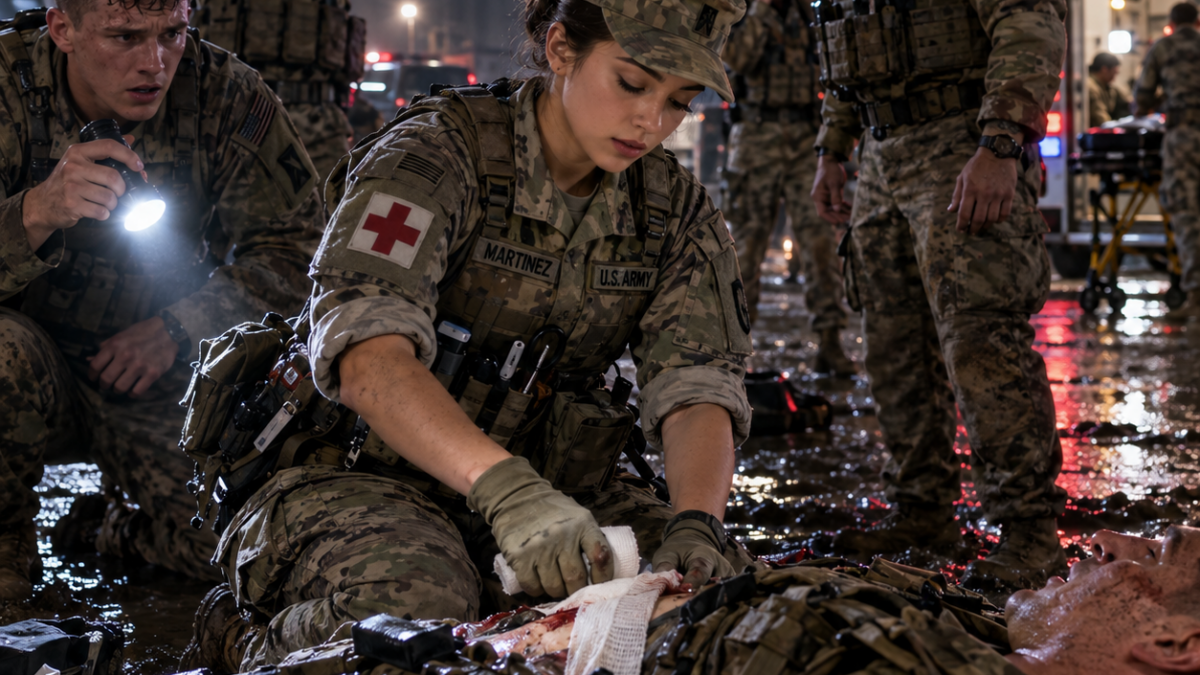
𝗙𝗨𝗟𝗟 𝗦𝗧𝗢𝗥𝗬
He stopped.
I waited.
“Well, they’re saying you might be exaggerating about your deployments. Not that I believe them,” he added quickly. “It’s just…”
“I look young,” I finished for him.
His shoulders dropped with relief and guilt.
“Yes, ma’am. And you seem normal.”
That almost made me smile.
“Normal.”
“I mean, the other combat vets, they have this look. Like they’ve seen things. But you just seem…”
He ran out of courage.
I set my fork down and looked directly at him.
For one second, I let the door open.
Not wide. Just enough.
I let him see the thing I kept behind my eyes. The sleepless rooms. The blood that wouldn’t wash out of field gear. The hands that had clutched mine and gone slack anyway. The sound a person makes when they know they are dying but are too scared to say it. The names lined up inside me like graves.
Jackson’s face changed.
He leaned back without realizing it.
“I’ve seen things too, Private,” I said quietly. “I just choose not to wear them on my face.”
He did not apologize.
He did not need to.
He stood after a moment, nodded once, and left me alone.
That night, sleep would not come.
It rarely did the first week at a new assignment. My body hated safe beds. It trusted dirt, vehicles, medical tents, concrete floors, and the shallow sleep of soldiers who had learned to wake before the shelling. A quiet room made old alarms louder.
So I walked the perimeter.
The Kentucky night was cool, almost gentle. Crickets sang beyond the fencing. The base lights threw pale halos onto pavement. Somewhere in the distance, a door slammed, and my entire body prepared for disaster before my mind caught up and reminded it where we were.
I pulled out my phone.
My thumb found an old message before I meant it to.
Captain Morgan.
Martinez, heard you’re stateside again. Try not to scare the new recruits with your baby face. Remember, they don’t know what you’re made of yet. Give them time to figure it out. Stay safe, little warrior.
I read the message twice.
Then a third time.
He had sent it three months before the IED killed him.
Captain Morgan had been one of the few officers I trusted without keeping a second plan in my pocket. He had known when to speak and when silence was kinder. He had called me “little warrior” the first time after I crawled through the remains of a blasted convoy to stop a man from bleeding out while rounds snapped over us like angry insects.
I had hated the nickname then.
After he died, I would have given anything to hear it again.
I locked the phone and looked toward the medical facility. The lights were still on. Through one window I could see Dr. Jennifer Walsh bent over a desk beneath harsh fluorescent light, reading files.
Mine, probably.
I had met her only briefly that afternoon. Chief medical officer. Calm eyes. The kind of doctor who had seen enough to know when a file did not match a face.
She would find the oddities first. The certifications that made no sense for someone my age. Battlefield amputation. Emergency thoracotomy. Damage control surgery under austere conditions. Trauma response scores too high to belong to classroom experience. Psychological markers no one wanted to say out loud unless they were prepared to be useful after.
I turned away before she could see me through the glass.
On the way back, I caught my reflection in a dark window.
There she was again.
The girl everyone misread.
Soft face. Small shoulders. Eyes young enough to make strangers protective and soldiers suspicious.
I stared at myself until the face blurred.
People thought war should leave visible proof.
A missing limb. A burned jaw. A limp dramatic enough to explain the nightmares. Scars in places strangers could understand.
But some wounds are disciplined.
They learn to stand at attention.
Mine had.
The next morning began at 0500.
The alarm shrieked through the barracks, but I was already awake. I had been staring at the ceiling for an hour, counting breaths, listening to the room come alive. Groans. Boots hitting floor. Lockers opening. Someone cursing softly. Someone laughing too loudly for that early.
I made my bunk with precision and dressed quickly.
“Rise and shine, Martinez,” Corporal Stevens called from across the room.
He was big, with arms like tree trunks and the kind of grin that looked carved in place.
“Hope you’re ready for real training today. Not whatever they taught you in basic.”
I tied my bootlaces.
No answer.
He waited for one.
When it didn’t come, he laughed like he had won something.
Morning formation was followed by a fifteen-mile march with full packs through Kentucky’s rolling hills and dense forest. The air was still cool when we stepped off, but I could feel the heat waiting. It would rise from the ground later and press down on the weak points in everyone’s preparation.
Sergeant Rodriguez watched me adjust my straps.
“Martinez,” he said, not bothering to hide his amusement, “you sure you can handle that pack? It’s not too late to request a desk assignment.”
A few soldiers chuckled.
“I’ll manage, Sergeant.”
The march began.
For the first mile, they watched me.
I could feel it without turning my head. Waiting for my stride to falter. Waiting for the pack to pull me backward. Waiting for my breathing to turn ragged. Waiting for proof that the story they had written about me was true.
By mile five, they had other concerns.
Blisters began introducing themselves. Shoulders tightened. Jokes thinned. The stronger soldiers moved ahead, eager to show separation. The rest found their real pace whether pride approved or not.
I stayed in the middle, steps even, breathing controlled.
Marching is not about strength first. It is about economy. Waste nothing. Not motion. Not breath. Not anger. The body can go farther than the mind wants if the mind stops negotiating every mile.
A private named Johnson stumbled beside me around mile eight.
Nineteen, maybe. Too much muscle for his frame and too little experience with managing it. Sweat poured down his face though the morning had not fully warmed. His breathing came in short, uneven pulls.
“How are you not tired?” he gasped. “You’re half my size.”
“Don’t think about the distance,” I said. “Think about the next step.”
“That’s not helpful.”
“It will be when the distance stops listening to you.”
He gave a weak laugh.
By mile ten, he stopped laughing.
His steps lost rhythm. His lips looked dry. His skin had gone hot beneath a strange absence of sweat. I moved closer.
“Johnson, drink water.”
“I’m fine.”
His words slurred.
I caught his arm and pressed two fingers to his wrist.
Rapid. Weak.
His eyes drifted like he was having trouble keeping the road in one place.
“Johnson, sit down.”
“What? No, I said I’m—”
“That wasn’t a request.”
He sat because his knees had already decided for him.
I looked ahead.
“Sergeant Rodriguez!”
Rodriguez turned fifty yards up the trail, irritation plain even from a distance. He jogged back with the expression of a man prepared to be annoyed.
“What now, Martinez?”
“Private Johnson is showing signs of heat exhaustion with progression risk to heat stroke. He needs immediate cooling and electrolytes.”
Rodriguez looked at Johnson, who was still trying to look embarrassed instead of sick.
“He’s upright.”
“His pulse is one-forty and thready. Skin hot and dry. Slurred speech. Early altered mental status. In ten minutes he’ll likely collapse. In twenty, his core temperature may become dangerous.”
The words came out sharper than I intended.
Not loud.
Certain.
Rodriguez paused.
For the first time, he looked at me differently.
“How do you know his pulse without checking?”
“I did check while you were walking back.”
I already had my medical supplies out.
“Johnson, drink this.”
He tried to wave me off, then blinked at the canteen like he didn’t remember what it was.
That ended Rodriguez’s doubt.
Within minutes, Johnson worsened exactly as predicted. His confusion deepened. His skin turned clammy as his body tried and failed to correct itself. I cooled him with wet cloths, elevated his legs, administered electrolytes, monitored pulse and breathing, and kept my voice steady near his ear.
“You’re all right. Stay with me. Don’t fight the treatment. Breathe slow.”
The trail had gone quiet around us.
Rodriguez watched my hands.
People always watch hands when truth arrives. They look for hesitation. Tremor. Guesswork.
Mine gave them none.
“Where did you learn to do that?” Rodriguez asked finally.
“Combat medicine training.”
“That didn’t look like classroom training.”
I looked up briefly.
“No, Sergeant. It didn’t.”
Within fifteen minutes, Johnson’s color improved. His confusion cleared. When he could stand and answer simple questions without drifting, we redistributed weight and continued.
Nobody joked about my pack after that.
That afternoon, they took us to the rifle range.
Weapons training was one of those places where people expected the world to return to normal. Fine, maybe I knew medicine. Maybe I could spot heat illness. But surely the small medic with the baby face would be awkward behind a rifle.
Master Sergeant Williams handed me an M4 carbine.
“Let’s see what you’ve got, Martinez. Take your time getting comfortable.”
I checked the action, sights, chamber, magazine, and weight.
The rifle was familiar in a way I wished fewer things were.
I went prone, settled my breathing, and fired ten rounds in rapid succession.
When the target came back, all ten sat tight in the bull’s-eye.
Williams looked at the paper.
Then at me.
Then back at the paper.
“Lucky shots,” Stevens muttered behind me.
Williams ignored him.
“Five hundred yards,” he said.
I adjusted.
Ten more rounds.
Tighter grouping.
The range went still in a way I recognized.
Professional curiosity replacing mockery.
Williams lowered the target slowly.
“Where did you train?”
“Sniper School, Camp Pendleton. Advanced marksmanship at Fort Benning.”
A few heads turned.
Stevens was no longer smirking.
“What’s your longest confirmed kill?” he asked.
I looked at him.
There are questions people ask because they want to understand, and questions they ask because they want to turn your pain into a campfire story.
This was the second kind.
“I’m a medic, Corporal. My job is to save lives.”
His eyes flicked toward the target.
“But if someone threatens my patient or my team, I do what’s necessary.”
He looked away first.
That evening, Dr. Walsh requested my complete file.
I learned later that she needed special clearance to get past the sanitized version. Most people got the clean summary. Deployment history. Certifications. Decorations listed without the dirt still under them.
The full file was heavier.
Not because of its pages.
Because of the names.
She called me into her office the next morning.
Her desk was neat but lived-in, stacked with medical journals, training schedules, and too many coffee cups for someone who pretended she slept. She gestured for me to sit.
“I’ve read your file,” she said.
I folded my hands in my lap.
“The real one,” she added. “Not the version they give people who don’t know what they’re looking at.”
I said nothing.
She leaned back, studying me with a doctor’s attention and a soldier’s restraint.
“Five deployments. Three Silver Stars. Five Purple Hearts. Your trauma certifications are beyond anything I expected.”
I kept my face still.
“The Purple Hearts alone tell quite a story,” she said.
“They tell five bad days.”
Her expression softened, but only slightly.
“Why do you let people think you’re a fraud?”
That question had followed me for years, though most people asked it less directly.
I considered lying.
Habit, mostly.
Instead I told her part of the truth.
“Underestimation is a tactical advantage, ma’am.”
“In the field, maybe.”
“In the field, looking harmless kept me alive. Here, it serves a different purpose.”
“Which is?”
“It separates the soldiers who judge by appearances from the ones who judge by actions. I need to know which kind I’m working with before I trust them.”
Dr. Walsh nodded slowly.
She understood more than most.
“That’s a lonely strategy.”
“Yes, ma’am.”
“Effective?”
“Usually.”
She closed the folder.
“And costly.”
I did not answer.
Because she was right.
Three weeks passed.
The base adjusted to me in pieces. Some soldiers still doubted, but more quietly. Some started asking medical questions they pretended were casual. Johnson brought me extra coffee one morning and said nothing about the march. Rodriguez stopped making jokes about desk assignments. Stevens avoided the rifle range when I was there.
I settled into invisibility again.
Efficient. Quiet. Present when needed. Gone before conversations turned personal.
I avoided social gatherings where soldiers compared stories and measured trauma like coin. I had no interest in winning that kind of contest. War stories always leave something bleeding when told for entertainment.
Then, at 2300 hours, the alarm screamed.
The sound ripped through the barracks like a hand closing around my throat.
For one second, I was not in Kentucky.
I was back in a medical tent with dust blowing under the flap and someone shouting for blood products we no longer had.
Then the loudspeaker crackled.
Training accident. Mountain facility. Multiple casualties. Rapid response medical team deploy immediately.
My body moved before fear could organize itself.
Boots. Uniform. Kit. Gloves. Shears. Airway tools. IV supplies. Tourniquets. Hemostatic gauze. Chest seals. Needle decompression kit. Medications. Checklist by touch.
Sergeant Rodriguez burst into the barracks.
“Martinez, you’re with the emergency medical team. We’ve got multiple wounded and need every qualified medic.”
“I’m ready.”
He looked at the kit already in my hand and nodded.
The helicopter ride was tense and loud.
Four other medics sat with me. Staff Sergeant Pierce was among them, older, experienced, confident in the way people are confident before the world asks for more than training scenarios. Dr. Walsh sat across from me, helmet strapped tight, watching my face under dim red cabin light.
“Martinez,” she said over the rotor noise, “this is going to be intense. Mass casualty situations are different from anything you might have trained for. Stay close to the senior medics and follow their lead.”
I nodded respectfully.
There was nothing useful in saying I had treated mass casualty events that still walked through my dreams.
I checked my kit for the third time.
Below us, darkness rolled over Kentucky hills.
Then the landing zone appeared.
Floodlights. Smoke. Shouting. Shapes moving fast across rocky ground.
The helicopter touched down, and the smell hit me as soon as the door opened.
Gunpowder.
Blood.
Burned fabric.
Hot metal.
My chest tightened.
Memory does not return politely. It does not knock. It kicks the door open and pours everything back in at once.
Kandahar. Helmand. Bagram. Iraq. A convoy torn apart on a road so bright with sun I could barely see the blood until I was kneeling in it.
I stepped onto the ground and forced my breath into rhythm.
Not now.
Later.
Major Collins, the senior medical officer on scene, shouted over the chaos.
“Twelve wounded. Three critical, four serious, five walking wounded. Triage protocols in effect immediately.”
My eyes moved across the scene.
Casualty distribution. Blast pattern. Distance from misfire. Available personnel. Evacuation route. Lighting. Noise. Panic level.
The field assembled itself in my head.
The first critical patient was Corporal Adams.
Twenty-two years old. Severe abdominal trauma. Significant blood loss. Conscious but fading. His hands kept clutching at the dirt like he was trying to hold himself to the earth.
Staff Sergeant Pierce knelt beside him.
His hands shook.
“Jesus,” he muttered. “I’ve never seen anything this bad. Where do we even start?”
Adams’s skin was pale and clammy. His pulse was racing. Blood pressure dropping. Abdomen rigid. Penetrating trauma. Probable internal bleed.
In a hospital, he needed surgery.
Here, he needed someone to keep death busy until the helicopter could lift him out.
“Pierce,” I said, “his pressure’s dropping.”
“I can see that,” he snapped. “I’m thinking.”
Thinking was a luxury Adams did not have.
His eyes rolled slightly.
I saw the window closing.
“Sir, recommend two large-bore IVs, rapid fluid resuscitation, blood prep, and damage control intervention for internal bleeding.”
Pierce looked up at me like I had insulted him.
“Martinez, observe and learn. This isn’t a classroom.”
Before I could answer, Dr. Walsh stepped closer.
“What would you do, Martinez?”
Pierce froze.
I looked at him first, because rank still mattered, even when blood was pooling under a young man’s spine.
“Permission to speak freely, ma’am?”
“Granted.”
“Corporal Adams has penetrating abdominal trauma with probable internal hemorrhage. He’s in class three hypovolemic shock and progressing. If we don’t stabilize circulation and control bleeding, he won’t survive transport.”
Dr. Walsh’s face changed.
“How would you stabilize him?”
I looked at Pierce.
“Sir, with your permission.”
His hands were still shaking around the IV kit.
He swallowed.
“Go ahead.”
The world narrowed.
That is what emergencies do when you have learned them deeply enough. Chaos does not disappear. It becomes background. The patient becomes the only true thing.
I established two IV lines despite poor circulation, started rapid fluids, called for blood, checked airway, monitored breathing, assessed wound track, and gave orders before anyone had time to remember I was the medic they had doubted.
“Pierce, maintain pressure. Wilson, light here. Henderson, vitals every minute and call changes out loud. I need blood ready for rapid transfusion. Dr. Walsh, I’m preparing damage control surgery.”
“Here?” Pierce asked.
“Here.”
I laid out the instruments.
My hands were steady.
They always were when someone else was dying.
Fear could have me later.
I made the incision.
The body opened beneath my gloves, warm and terrible and human. I found the bleeding source and controlled it with the efficiency of someone who had learned beneath worse lights, with worse noise, with bullets finding the walls nearby.
“Pressure dropping,” Henderson called.
“Blood now.”
“Heart rate one-fifty.”
“Keep talking to him.”
I leaned closer to Adams.
“Corporal, stay with me.”
His lips moved.
I could not hear him over the noise.
“I know,” I said anyway. “Stay.”
It took thirty minutes.
Thirty minutes can be a lifetime in trauma care. Long enough for a man to die three times if you let your attention slip. Long enough for doubt to become fatal. Long enough for everyone around you to decide whether they trust your hands.
When Adams was finally loaded for evacuation, his pressure had improved. Bleeding was controlled. He was still critical, but he had a chance.
A chance is everything.
As the helicopter lifted off with Adams and two other critical patients, I stood beneath the wash of rotor wind and realized my gloves were soaked red to the wrists.
Dr. Walsh approached.
“That was exceptional work.”
I looked down at my hands.
“Adams did the hard part.”
“Where did you really train, Sarah?”
The use of my first name almost undid me.
I looked at her.
For once, I did not bother hiding the tired thing behind my eyes.
“Bagram Air Base. Combat Support Hospital in Kandahar. Field hospitals in Helmand Province. Places where helicopters couldn’t always fly and waiting meant watching someone die.”
Her voice softened.
“How many times have you performed damage control surgery in the field?”
I wanted to give a smaller answer.
Instead I gave the true one.
“Forty-seven that I remember clearly.”
Pierce stared at me.
The return flight was quiet.
Nobody slept.
Pierce sat across from me, helmet in his lap, studying my face like it had changed during the night. Maybe it had. Or maybe he had finally looked past it.
“Martinez,” he said at last.
“Yes, Sergeant?”
“I owe you an apology.”
I shook my head.
“No, sir.”
“Yes,” he said. “I do. Adams owes you his life. We all saw it.”
“We did our job.”
“That wasn’t just doing your job. That was someone who has seen more trauma than most medics will see in a career.”
He hesitated.
“How old are you really?”
That made Dr. Walsh glance away, hiding the smallest smile.
“Twenty-eight.”
“And you really did five deployments?”
“Yes, Sergeant.”
He leaned back, quiet.
The helicopter touched down as dawn spread thin and gray over Fort Campbell.
By morning formation, everyone knew.
Again, not the whole truth.
But enough.
They knew the small medic had performed emergency surgery in the field. They knew Adams was alive because of it. They knew Pierce had stepped aside. They knew Dr. Walsh had trusted me. They knew the girl they had dismissed had not hesitated when the night turned red.
Attention replaced suspicion.
I hated it more.
Curiosity followed me from the barracks to the mess hall.
“Is it true you operated with just a field kit?”
“Is it true you’ve been shot five times?”
“Did you really serve in Afghanistan?”
“How many people have you saved?”
“How many people have you lost?”
That last question never came out loud.
But I heard it anyway.
At 0800, Sergeant Rodriguez appeared in the doorway.
“Martinez. Colonel Hayes wants you in his office. Dress uniform.”
His voice held none of the amusement from my first morning.
That made me more nervous than mockery had.
Colonel Hayes’s office was lined with commendations, unit photos, and the kind of objects senior officers collect when a career has stretched across decades. An American flag stood in the corner. The room smelled faintly of leather, coffee, and paper.
He sat behind his desk with my file open in front of him.
The full one.
“Sit down, Martinez.”
I sat with my back straight, hands folded.
Colonel Hayes was a large man with graying temples and eyes that missed nothing. His authority did not need decoration, though the room had plenty of it.
“I’ve been reading your file,” he said.
“Yes, sir.”
“The complete file.”
I kept my face still.
“It makes for fascinating reading.”
He turned a page.
“Five deployments across three countries. Sixty-two confirmed saves under direct enemy fire. Three Silver Stars for valor. Five Purple Hearts.”
The words entered the room like ghosts.
He looked up.
“The Purple Hearts interest me most.”
My hands tightened.
“Sir, if it’s all the same to you, I’d rather not discuss the details.”
“I’m afraid it isn’t all the same to me.”
His voice remained calm, but not unkind.
“Your record shows extraordinary service. Your behavior here suggests someone trying very hard to hide that service. I need to understand why.”
He turned another page.
“Kandahar Province, March 2019. Forward operating base under sustained attack. You treated wounded for six hours under direct fire despite shrapnel in your left shoulder. Refused evacuation until all wounded were stable.”
The room disappeared at the edges.
Mortar fire.
Dust.
The scream of someone calling for his brother though his brother was already gone.
Warm blood running down my left arm while I pressed gauze into another man’s thigh and lied to him that he was going home.
“It was my job, sir.”
“Your job was to treat the wounded. Not refuse care for yourself.”
I said nothing.
He continued.
“Iraq, six months later. RPG attack on your convoy. Blast injuries. Concussion. Continued treating casualties for three hours and refused evacuation again.”
Burned rubber.
A vehicle door twisted open like foil.
A young soldier asking whether his leg was still there.
My jaw tightened.
“Third Purple Heart,” Colonel Hayes said. “IED explosion in Helmand Province. You were thrown fifteen feet, suffered concussion and multiple lacerations, then treated other casualties for four hours before anyone realized you were injured.”
My hands began to tremble.
I clasped them together.
“The fourth. Mortar attack on base. Shrapnel in leg and back. Witnesses state you continued moving between casualties under active bombardment and saved at least eight soldiers.”
“Sir,” I said, voice low, “why are we reviewing this?”
He closed the file halfway.
“Because last night my chief medical officer watched you perform surgery in the field with steadier hands than surgeons with twenty years of experience. That kind of competence comes from somewhere. So does that kind of silence.”
I looked at the floor.
“Most soldiers would be proud of this record,” he said.
I laughed once.
A small, broken sound.
“Proud.”
“Yes.”
“With respect, sir, every Purple Heart is a day I couldn’t save everyone.”
The room went quiet.
There it was.
The truth I had built my whole life around avoiding.
I could feel it now, pushing up through the cracks. Ten years of names. Ten years of faces. Ten years of writing reports that said “succumbed to wounds” when the truth was that someone had died with my hands inside their blood, my voice in their ear, my promises failing one by one.
Colonel Hayes’s voice softened.
“How many soldiers have you lost, Martinez?”
“Forty-three, sir.”
The number came immediately.
It always did.
“Forty-three soldiers died under my care across five deployments. I remember all their names.”
He let that sit.
“How many did you save?”
I looked up.
The question confused me.
“Sir?”
“How many did you save?”
“I don’t…”
“Your record lists more than three hundred confirmed saves. Soldiers alive because of your actions. Why don’t you carry that number as clearly?”
I had no answer.
The dead had stayed.
The living had gone home.
Maybe that was why.
The dead visited in dreams. The living sent occasional messages, holiday cards, photos of children I had never met. Proof that life had continued somewhere beyond the tent, beyond the smoke, beyond the moment I last touched their pulse.
But guilt is louder than gratitude when you feed it long enough.
Colonel Hayes leaned forward.
“Your record does not show failure. It shows leadership under the worst conditions imaginable.”
“I declined every battlefield commission,” I said.
“I know. Five commanding officers recommended you.”
“I didn’t want to be an officer.”
“Why?”
“Because officers make decisions that get people killed. I wanted to save lives, not risk them.”
He studied me for a long time.
“Leadership isn’t about making perfect decisions, Martinez. It’s making the best decision possible with incomplete information under extreme pressure. You’ve been doing that for ten years.”
He opened the file again.
“Your fifth Purple Heart.”
My breath changed before he read the first word.
Afghanistan.
Eighteen months earlier.
The day everything in me finally cracked.
“Your base was overrun,” he said. “You spent twelve hours treating wounded while the perimeter collapsed. Witnesses state you organized the defense of the medical facility, coordinated evacuations, and kept wounded soldiers alive until reinforcements arrived. You took a bullet in the chest and kept working.”
I closed my eyes.
Morrison.
Williams.
Jackson.
Not Private Jackson here. A different Jackson. Corporal Daniel Jackson, twenty-four, from Oregon, engaged to a woman whose picture he carried folded in his chest pocket. He had begged me not to let him die.
And I had failed him.
“The citation recommended you for the Distinguished Service Cross,” Colonel Hayes said. “You declined that too.”
“I didn’t deserve it.”
“Why not?”
That was the question that broke me.
I had held together through intake whispers, rifle range stares, field surgery, blood, exhaustion, and every page of the file. But that question went straight to the locked room.
“Because I couldn’t save them all.”
My voice cracked.
The tears came before I could stop them.
“Lieutenant Morrison bled out because I couldn’t get to him fast enough. Sergeant Williams died because we ran out of blood products. Corporal Jackson died because I couldn’t operate while rounds were coming through the walls. Forty-three names, sir. I carry all of them.”
Colonel Hayes came around the desk.
He did not crowd me. He sat in the chair beside mine, no longer speaking like a colonel.
More like a father.
“Sarah,” he said, and the sound of my name nearly made me fold in half, “you have carried this alone for too long.”
I wiped my face with the back of my hand, angry at the tears, ashamed of needing anyone to witness them.
“It doesn’t feel like enough, sir.”
“I know. But those soldiers did not die because you failed them. They died because war is hell, and sometimes even courage, skill, and sacrifice cannot drag everyone home.”
I wanted to believe him.
Wanting hurt.
He returned to his desk and pulled out another folder.
“I have an assignment for you.”
I straightened instinctively.
“Sir?”
“I’m recommending you for promotion to warrant officer and assignment to our special operations medical training team. I want you teaching combat trauma care. Advanced protocols. Field surgery. Decision-making under fire. All of it.”
My stomach tightened.
“No, sir.”
His brows lifted.
“Excuse me?”
“I don’t think I’m ready for that kind of responsibility.”
“Martinez, you’ve been ready for years.”
“I’m not a teacher.”
“You kept medics alive last night by turning chaos into instructions. That is teaching.”
“I’m not ready.”
“No,” he said gently. “You’re afraid.”
That hit harder than I expected.
He was right.
Not afraid of blood. Not afraid of exhaustion. Not even afraid of dying, though I knew better than to say that out loud.
I was afraid that if I taught what I knew, I would have to admit the losses had meaning beyond punishment. I would have to open the locked room and let other people see the names on the walls.
Colonel Hayes slid the folder toward me.
“Hiding your experience does not honor the soldiers you saved or the ones you lost. Sharing what you know might help another medic save someone you never meet.”
I looked at the folder.
The room felt too bright.
“Think about it,” he said. “But understand something. Your past is not only a burden. It is a resource. Stop burying it like contraband.”
When I left his office, the base looked different.
Or maybe I did.
For years, I had defined myself by the forty-three.
Forty-three deaths.
Forty-three failures.
Forty-three reasons every medal felt like an accusation pinned to my chest.
But Colonel Hayes had forced another number into the room.
Three hundred.
More than three hundred soldiers who had gone home.
Soldiers whose children had learned their voices. Soldiers whose parents had opened doors and found them standing there. Soldiers whose wives and husbands had not received the knock that changes a house forever.
I had remembered the dead because they needed remembering.
But maybe the living deserved to be remembered too.
Two weeks later, I stood before a classroom of twenty combat medics.
My hands trembled slightly behind the podium.
The promotion to warrant officer had come through faster than I expected. So had orders to develop and lead an advanced combat trauma program. Colonel Hayes moved like a man who had been waiting for my agreement before he admitted the plan had already grown legs.
The medics in front of me were a mix of experienced soldiers heading for second and third deployments and newer ones preparing for their first. Some looked older than me. Most looked more confident than I felt.
I could see skepticism in their faces.
It would have irritated me once.
Now it almost comforted me.
I knew what to do with skepticism.
“Good morning,” I said. “I’m Warrant Officer Martinez, and I’ll be your instructor for advanced combat trauma care.”
A hand went up immediately.
Sergeant Baker did not wait to be called on. Burly, thick-necked, multiple deployment patches, arms crossed like a barricade.
“Ma’am, with respect, what qualifies you to teach advanced trauma care? You look like you just finished basic.”
A few students snickered.
There it was again.
The old door.
This time, I did not hide behind it.
“That’s a fair question, Sergeant Baker.”
I picked up a marker and turned to the whiteboard.
“Kandahar Province, March 2019.”
The room quieted slightly.
“Forward operating base. Six-hour firefight. Fourteen casualties treated under direct fire while I had shrapnel in my left shoulder.”
I wrote the date, place, casualty count.
“Iraq, September 2019. Convoy ambush. RPG blast. Concussion. Internal injuries. Continued treating casualties for three hours because the evacuation helicopter couldn’t land under fire.”
The snickers died.
I kept writing.
“Helmand Province, January 2020. IED explosion. Thrown fifteen feet. Treated eight wounded with concussion and multiple lacerations. Did not know I was bleeding until someone else told me four hours later.”
My voice strengthened with each line, not because the memories hurt less, but because I was finally making them work.
“Bagram Air Base, June 2021. Mortar attack during medical evacuation. Shrapnel in leg and back. Continued moving between casualties because they needed treatment more urgently than I did.”
Marker against board.
Names of places.
Dates.
Numbers.
Not stories for entertainment.
Evidence.
Finally, I wrote the last one.
“Afghanistan, February 2023. Position overrun. Twelve hours of continuous combat while treating wounded. Organized defense of medical facility. Coordinated evacuations. Performed surgery while taking enemy fire. Took a bullet in the chest. Kept working until reinforcements arrived.”
The classroom was silent.
I turned.
“Five deployments. Five Purple Hearts. Three Silver Stars. More than three hundred confirmed saves. I look young because I started this job at eighteen. I have been practicing combat medicine for ten years.”
Baker’s face had changed completely.
He cleared his throat.
“Ma’am, I apologize. I had no idea.”
“I know.”
I capped the marker.
“The reason I’m telling you this is not to impress you. It’s to establish that what I teach you comes from lived experience, not just manuals. When I teach you to treat a sucking chest wound, it’s because I’ve sealed them under fire. When I teach damage control surgery, it’s because I’ve performed it in conditions you cannot fully simulate. When I teach triage, it’s because I have made those decisions with real people begging me not to leave them.”
No one moved.
“But the most important things I’ll teach you are not in any manual. I’ll teach you how to think when you’re scared. How to keep working when you’re exhausted. How to make decisions when supplies are gone, evacuation is delayed, and everyone is looking at you because your hands are the last thing between a soldier and death.”
I let that settle.
“And I’ll teach you how to live with the choices you make.”
A young medic near the front lifted her hand.
“Private Chen, ma’am.”
The name struck me for reasons I could not explain. Maybe because she looked so young. Maybe because fear sat openly on her face, and I respected the honesty of it.
“Yes, Chen.”
“How do you deal with losing patients?”
The classroom became even quieter.
“How do you keep going when someone dies?”
I walked to the front of the desk and leaned against it.
“That is the hardest part of this job,” I said. “You will lose patients. Good soldiers will die despite everything you do right. If you let every loss convince you that you are a failure, you will eventually stop being useful to the living.”
Her throat moved.
“How do you stop?”
“I’m still learning.”
That answer seemed to surprise them more than any medal.
“For years,” I continued, “I carried the names of every soldier I couldn’t save. Forty-three names. I let those names define me. What I forgot was that more than three hundred soldiers survived because of the same hands I kept blaming.”
I turned back to the board and wrote one large number.
300+
“This is why we train. Not because we can save everyone. We cannot. We train because every technique, every decision, every second you learn to use well might be the difference between someone’s child coming home or becoming a folded flag.”
The first practical exercise began an hour later.
Smoke machines filled the training bay. Speakers played recorded gunfire and explosions. Role players screamed, begged, panicked, cursed, and went limp. The students moved into the chaos with the strained intensity of people discovering that knowing a protocol and performing it under stress are different things.
“Remember,” I called over the noise, “the most dramatic injury is not always the most life-threatening. Triage quickly, but accurately. Watch skin. Watch breathing. Watch the eyes. The body tells you before the monitor does.”
Baker struggled with a simulated chest wound.
His hands shook.
I knelt beside him.
“What do you see?”
“Penetrating trauma left chest. Possible tension pneumothorax.”
“Good. Priority?”
“Seal the wound and decompress if indicated.”
“Good. Now look at his face. Color is changing. He’s tiring. The breathing pattern matters more than the screaming.”
I guided his hands, not doing it for him, only adjusting enough for the lesson to land.
By the end of the day, no one questioned why I was there.
Questions changed shape.
Not “What qualifies you?”
But “How do I know when to move to the next casualty?”
“How do I stop my hands from shaking?”
“What if I choose wrong?”
“What if I freeze?”
That evening, Dr. Walsh visited my new office.
It was small, but it had a desk, training models, medical equipment, and a whiteboard already crowded with notes. I had never had an office before. It felt strange, like wearing someone else’s coat.
“How was your first day as an instructor?” she asked.
“Harder than surgery.”
She smiled.
“Teaching usually is.”
I sat back, exhausted in a way that had nothing to do with sleep.
“Talking about it brings things back.”
“Yes.”
“But it helped them.”
“Yes.”
I looked at the training mannequin on the table.
“For years, I thought my memories were just proof that I had failed. Now I’m starting to think maybe they’re lessons I paid for too dearly to waste.”
Dr. Walsh’s expression softened.
“That sounds like healing.”
I almost rejected the word.
Healing felt too clean.
But that night, when I returned to my quarters and opened my laptop, I began writing the first pages of what would become our training manual.
Not theory.
Not polished doctrine.
Hard-won notes from places where doctrine had met dust, blood, weather, fear, and the limits of evacuation.
I wrote about the subtle grayness that comes before shock.
I wrote about how screaming patients can distract you from silent ones who are closer to dying.
I wrote about using limited blood products.
About hands shaking and how to work anyway.
About the dangerous arrogance of believing you will rise to the occasion instead of falling to the level of your training.
And for the first time in years, I wrote the names of the dead without feeling like I was carving them into myself.
I was building something with them.
Six months later, I stood behind a podium at the National Defense University in Washington, D.C.
The auditorium was full.
Military medical professionals from across the country filled the seats. Surgeons. Medics. Officers. Instructors. People with notebooks open and eyes sharp. The invitation had surprised me, though Colonel Hayes had acted as if it were inevitable.
“Ladies and gentlemen,” the moderator said, “Warrant Officer Sarah Martinez, developer of the Advanced Combat Trauma Response Protocol, now standard training across multiple military medical units.”
Applause rose.
I walked toward the podium.
On the way, I caught my reflection in the darkened window overlooking the Potomac.
I still looked young.
That had not changed.
But something else had.
The old posture of hiding was gone. My shoulders were relaxed. My face did not ask permission to belong. The uniform no longer felt like evidence I had to defend.
It felt like mine.
“Good morning,” I began.
My voice carried clearly through the auditorium.
“A year ago, I was trying very hard to disappear. I thought if people looked too closely at my experience, they would see only the failures I carried. Today, I know our experiences, even the painful ones, are not meant to be buried forever.”
I clicked to the first slide.
Casualty statistics.
Survival rates.
Evacuation timelines.
Field trauma variables.
“The survival rate for wounded soldiers has improved dramatically over the past decade,” I said. “But we can do better. The techniques I’m sharing today were developed under conditions where textbook medicine was not enough.”
In the audience, I saw familiar faces.
Sergeant Rodriguez sat in the third row, now enrolled in my advanced instructor course. Dr. Walsh sat beside Colonel Hayes, looking prouder than she had any right to look without making me emotional. Near the back sat Corporal Adams.
Alive.
Thinner than before. Still recovering. But alive.
When our eyes met, he placed a hand over his abdomen and nodded.
I nearly lost my place.
Then I continued.
“The key to combat medicine is not just technical skill. It is clarity under stress. It is decision-making when every option hurts. It is knowing what to do with fear so fear does not make the decision for you.”
The presentation included training footage, case studies, revised protocols, and lessons from field conditions. But the part that changed the room came halfway through.
I clicked to a slide with only three words.
Learning from Loss.
The auditorium stilled.
“Afghanistan, 2022,” I said. “Multiple casualties after an IED strike. I prioritized one patient over another based on limited information. The soldier I did not treat first died before I could return.”
No one moved.
“For two years, I believed that decision proved I was a failure. I carried Staff Sergeant Wilson’s name like a sentence.”
I advanced the slide.
Revised triage markers appeared.
“His death taught me to look for subtler signs of internal bleeding. To question assumptions. To recognize that the loudest wound is not always the deadliest. That lesson helped me save lives later.”
I took a breath.
“Loss without learning becomes only pain. Loss transformed into knowledge can protect the living. That does not erase grief. It gives grief somewhere useful to go.”
During the break, people approached with questions.
A Navy medic thanked me for a technique that helped him during a deployment. An Army surgeon wanted to implement parts of the protocol in field hospitals. A young Air Force medic, barely nineteen, stood near the edge of the crowd, clearly trying to decide whether courage was worth the embarrassment of speaking.
I stepped toward her.
“What’s your name?”
“Airman Peterson, ma’am.”
“You had a question.”
She swallowed.
“I deploy for the first time next month. I’m scared I won’t be good enough. That I’ll freeze when someone needs me.”
I saw myself at eighteen.
Not in her face.
In the fear she was brave enough to admit.
“Peterson,” I said, “being scared means you understand the responsibility. The medics who worry about being good enough usually keep learning. The dangerous ones are the ones who think they already know everything.”
Her eyes filled, but she held herself together.
I handed her my card.
“When you come home, find me. Whatever happened, whatever you saw, we’ll talk about it.”
“Yes, ma’am.”
“Promise.”
“I promise.”
After the conference, Dr. Walsh and I walked along the Potomac.
The evening air was crisp. Washington lights shimmered on the water. Somewhere in the city, people made decisions that would send young soldiers into dangerous places. My job was to help make sure more of them came home alive.
“You’ve come a long way from the quiet woman at Fort Campbell,” Dr. Walsh said.
“I wasn’t afraid of the job,” I told her. “I was afraid of being known.”
“And now?”
I looked out over the river.
“Now I think hiding only protected my guilt. It didn’t protect anyone else.”
She smiled.
“Colonel Hayes has another proposal for you.”
“I know.”
Direct commission to captain.
Chief instructor for combat medicine.
A role that would take me farther from the field and deeper into teaching, administration, doctrine, responsibility. A role I had once rejected because I believed leadership meant choosing who lived and died.
Maybe I had misunderstood leadership all along.
“I don’t know if I’m ready,” I said.
Dr. Walsh laughed softly.
“Sarah, you’ve been ready for years. You just needed to stop asking your guilt for permission.”
That night, in my hotel room, I video-called my parents for the first time in months.
My father answered with his weathered face filling the screen.
“There’s my little soldier.”
I rolled my eyes, though my throat tightened.
“Dad, I’m twenty-nine and a warrant officer. I think we can drop the little part.”
“Never.”
My mother appeared beside him, already crying.
“We watched your presentation,” she said. “We’re so proud of you.”
I looked away from the screen for a second.
“I’m sorry I stayed away so long.”
“You were finding your way,” my father said.
“I didn’t know how to talk about any of it.”
My mother’s voice softened.
“You don’t have to explain everything at once. Just don’t disappear from us again.”
I nodded.
“I’ll try.”
After the call, I sat by the window and looked at the capital lights.
For a long time, I had believed my decorations were accusations.
Five Purple Hearts.
Five reminders of days when my body was wounded but my mind stayed trapped with the ones I could not save.
Now, slowly, they were becoming something else.
Not proof of failure.
Proof that I had stayed.
Proof that even wounded, terrified, exhausted, and out of answers, I had kept my hands working for the living.
I picked up my phone and sent Colonel Hayes a message.
Sir, I accept the commission and assignment. When do I start?
His reply came within minutes.
Congratulations, Captain Martinez. Monday. The Army is lucky to have you.
I read it once.
Then again.
Captain Sarah Martinez.
The title felt heavy.
Not unbearable.
Just heavy enough to matter.
I thought of Captain Morgan and his last message.
They don’t know what you’re made of yet.
For years, I had thought being known would weaken me. I thought if people saw the grief, the guilt, the names, the nights I woke reaching for patients already gone, they would trust me less.
But the truth had done something else.
It had made the work bigger than me.
The young woman who stepped off the bus at Fort Campbell with a worn duffel and a face nobody believed had become someone I had not expected to meet.
A teacher.
A leader.
A survivor who finally understood survival was not the end of the story.
The real story was what you did after.
I still looked younger than my record.
I still carried forty-three names.
I always would.
But I carried more than loss now.
I carried Adams, alive and sitting in the back of an auditorium.
I carried Peterson, who would deploy afraid and prepared instead of arrogant and blind.
I carried Baker, who learned to ask better questions.
I carried Rodriguez, who stopped measuring soldiers by first impressions.
I carried every medic who would read the manual, every patient they would save, every family that would never know my name and never need to.
That was enough.
No.
More than enough.
Sometimes heroes do not look the way people expect.
Sometimes they are small, quiet, tired, and young-faced, with hands steady enough to work through blood and hearts broken enough to understand what every life costs.
Sometimes they spend years hiding from the very story that could save someone else.
And sometimes, when they finally stop hiding, the pain they carried becomes a light bright enough for others to follow home.