𝗙𝗨𝗟𝗟 𝗦𝗧𝗢𝗥𝗬 They Laughed at My Scars Until a General Saluted Me in Front of the Entire Base
𝗙𝗨𝗟𝗟 𝗦𝗧𝗢𝗥𝗬
That mattered.
Pity is just another way of staring.
“Thanks,” I said. “I’m good.”
She nodded once and let it go.
I appreciated that more than I could explain.
The next morning arrived cold and misty.
By 0550, the range already had an audience.
More than thirty recruits stood behind the safety line, bundled in jackets, grinning like they had bought tickets to a show. Marcus and his crew arrived five minutes later, confident and laughing. Rodriguez carried coffee. David had his phone ready. JJ stretched as if she were the one about to perform.
I arrived at 0558.
Nobody heard me come up behind them.
“I’m here,” I said.
They turned.
For once, nobody laughed immediately.
Maybe it was the morning light.
Maybe it was the way the scars looked against the gray mist.
Maybe it was that I stood at parade rest without thinking, feet shoulder-width apart, hands clasped behind my back, weight slightly forward.
Corporal James, the range instructor, noticed.
I saw it in his eyes.
He had expected embarrassment.
Now he was reassessing.
“All right,” he called. “Everyone behind the line. Reeves, front and center.”
I stepped forward.
On the weapons table lay a standard M4 carbine.
Disassembled.
James had left it that way intentionally.
A small test.
“You’ll need to—”
My hands were already moving.
Charging handle.
Bolt carrier group.
Upper receiver.
Lower.
Pins seated.
Function check.
Twelve seconds.
The rifle became whole in my hands before the rest of his sentence died.
The watching recruits went quiet.
James stared.
“Do that again.”
I broke it down.
Faster.
Then assembled it again.
This time, I did not look down.
The pieces found my hands like old friends.
People think muscle memory sounds poetic until they understand what makes it.
Repetition.
Fear.
Cold.
Dark.
The knowledge that a jammed weapon can turn a human being into a body before anyone finishes shouting your name.
James’s mouth tightened.
“Load.”
I loaded.
Every round seated cleanly.
No hesitation.
No fumble.
No wasted movement.
Marcus shifted behind me.
I could feel his confidence adjusting, trying to survive.
“Range is live,” James called. “Stationary targets. Fifty meters. Fire when ready.”
I raised the rifle.
My breathing slowed.
The world narrowed.
Target.
Front sight.
Pressure.
Exhale.
I fired forty rounds in controlled pairs.
Not fast to impress.
Not slow to look careful.
The rhythm was old and quiet and necessary.
When the magazine was empty, I safed the weapon, set it down, and stepped back.
James walked downrange.
I watched his pace change when he reached the target.
He took longer than he needed to.
When he returned, he held the sheet up.
Every round was grouped center mass inside a circle the size of a baseball.
The recruits stared.
David lowered his phone.
Rodriguez muttered something under his breath.
Marcus smiled too late.
“Beginner’s luck.”
James did not smile.
JJ crossed her arms.
“Try moving targets. Anybody can hit paper.”
I looked at James.
He looked at me.
“You up for that?”
I nodded once.
Sergeant Tanaka arrived while they were setting up the moving target system.
She was sharp-eyed, early thirties, and carried herself like someone who had learned to miss nothing. James handed her the target sheet. She studied it silently, then looked at me.
Not with amusement.
Not with pity.
With recognition beginning to form.
The moving target drill was designed to stress decision-making. Pop-up silhouettes at random distances and angles. Standard qualification did not demand perfection. Nobody expected a new recruit to deliver it.
The first target appeared at thirty meters.
Left side.
My rifle came up.
Double tap.
Down.
Forty-five meters right.
Pivot.
Double tap.
Down.
Two targets appeared at once.
Close first.
Far second.
Threat priority.
Always threat priority.
I moved through the drill the way I had once moved through buildings with smoke in the halls and screams in the comms. Assess, engage, transition, breathe. No panic. No anger. No thought that did not serve survival.
Fifteen targets.
Fifteen hits.
When it was over, nobody cheered.
That told me more than laughter would have.
Entertainment had become evidence.
Sergeant Tanaka spoke quietly to James, but I heard her.
“That’s not range training.”
“No,” he said. “It isn’t.”
Marcus’s jaw was tight.
Rodriguez leaned close to him.
“Dude, maybe we should drop this.”
Marcus looked at the people watching him.
Pride can be a trap.
He stepped into it.
“Range is one thing,” he said loudly. “Real soldiers fight. Let’s see her in the pit.”
JJ seized on it.
“Exactly. Shooting is mechanics. Let’s see if she can handle herself without a rifle.”
The crowd shifted, hungry again.
I safed the weapon and placed it on the table.
Then I walked away.
Sarah fell into step beside me.
“That was impressive.”
“It was adequate.”
She almost laughed.
“Adequate? You just humiliated half the company without raising your voice.”
“They’ll escalate.”
She glanced at me.
“You expected that?”
“They need me to become what they decided I was.”
“And what’s that?”
I stopped walking and looked at her.
“Weak. Vulnerable. An acceptable target.”
Her expression changed.
I started forward again.
“I’ve been through worse than mockery.”
“I believe you,” she said quietly. “But you don’t have to go through this alone.”
I did not answer.
But something in my chest hurt when she said it.
That afternoon, the hand-to-hand pit had more than sixty spectators.
The drill sergeants should have shut it down.
They didn’t.
Curiosity is not always cruel, but it can make cowards of people who should know better.
I removed my jacket methodically.
More scars showed along my forearms.
Sarah was near the front with Tommy Chen.
I heard her whisper, “Those aren’t accident scars.”
Tommy asked something I couldn’t make out.
Sarah answered, “Shrapnel. Blast pattern. Maybe IED. Maybe grenade fragments.”
The words moved through the crowd.
Combat.
Real war.
Marcus was already in the pit, rolling his shoulders and bouncing on his feet. He had sixty pounds on me and a wrestling background. He needed this to end quickly. Not because he cared about the fight.
Because he needed the world to make sense again.
Drill Sergeant Haynes stepped in as referee.
“Keep it clean,” he said, looking at me. “You can tap out anytime. No shame in knowing your limits.”
The old cold feeling returned.
I nodded.
Marcus grinned.
“Ready?” Haynes called.
I lowered my center of gravity.
“Begin.”
Marcus lunged for a double-leg takedown.
Fast.
Powerful.
Predictable.
I stepped aside just enough.
He grabbed for my arm.
I let his momentum carry him past my centerline, then moved inside his reach.
Elbow to solar plexus.
Controlled.
Not full power.
Enough.
His breath left him in a hard grunt.
Before he recovered, I struck the nerve cluster in his thigh with my knee.
Marcus dropped to one knee.
Eight seconds.
The pit went insane.
People shouted. Phones rose. Rodriguez cursed. JJ stared as if reality had personally betrayed her.
Haynes looked stunned.
“Where the hell did you learn that?”
I extended a hand to Marcus.
He stared at it.
Then took it.
I helped him up.
Defeating someone does not require humiliating them. Humiliation is what insecure people confuse with strength.
Marcus’s face burned red.
The pain in his leg would fade.
The wound to his pride would not.
JJ, desperate now, raised her voice.
“Fine. She can shoot and fight. That doesn’t mean she can lead. Doesn’t mean she can think. Muscle memory isn’t strategy.”
David jumped in.
“Tactical planning exercise tomorrow. Classroom. Let’s see if she has a brain to match the reflexes.”
The crowd murmured agreement.
I picked up my jacket.
For a moment, I looked back at them.
Not angry.
Not afraid.
Just tired.
They thought this was a contest.
They had no idea what kind of things I had already lost.
The next morning, Captain Reynolds supervised the tactical planning exercise.
He was stern, combat-tested, and much harder to fool than the recruits. The moment I entered the classroom, I felt his attention land on me and stay there just a little longer than normal.
“Scenario,” he said. “Defensive perimeter establishment in hostile territory. Teams of five. You’ll receive a map, threat assessment, and resources. Design a patrol base capable of withstanding enemy contact for seventy-two hours while awaiting extraction.”
Seventy-two hours.
My throat tightened.
Nobody else reacted.
Of course they didn’t.
For them, seventy-two hours was a classroom parameter.
For me, it was blood, smoke, thirst, names screamed into dead radios, and the taste of dirt between my teeth.
Teams were assigned.
I ended up with Marcus, David, JJ, and Rodriguez.
Maybe coincidence.
Maybe not.
David immediately spread the map and took charge.
“Standard patrol base. Machine gun here. Observation posts here and here. Ammo cache central. Rotating sleep shifts. Clear fields of fire.”
It was textbook.
Textbook plans are useful until the enemy reads the same book.
I studied the terrain.
Contour lines.
Dry riverbed.
Ridge elevation.
Wind direction.
Vegetation.
Vehicle access.
The longer I looked, the more problems appeared.
I let David finish.
Then I pointed to the ridge.
“That kills us.”
He frowned.
“It’s six hundred meters out. We’d see anyone approaching.”
“Not at night. Not with thermals.”
The table went quiet.
I continued.
“From that ridge, they can observe the entire position. Count personnel. Track movement patterns. Identify fighting positions. Anyone outside cover gets picked off before we know we’re compromised.”
JJ rolled her eyes, but not confidently.
“That’s a little dramatic.”
“No,” I said. “It’s what happens.”
David’s face tightened.
“How would you know?”
I pointed to the dry riverbed.
“This looks like a natural defensive boundary, but in this region, it’s a flash flood channel. One hard storm and your escape route becomes a trap.”
Marcus stared at me.
I moved my finger again.
“Loose sand here. Vehicles bog down. Stationary vehicles become targets. Central ammunition cache looks efficient, but one mortar hit turns your supply point into a secondary explosion.”
Nobody spoke.
I had forgotten, briefly, that I was supposed to sound like a recruit.
Captain Reynolds appeared beside our table.
He had heard enough.
“Reeves,” he said.
I stood automatically.
“Sir.”
“That analysis. Where did you learn to think like that?”
“Basic principles, sir.”
His eyes narrowed.
“No. That is not basic. That is not even conventional advanced training. That is special operations level terrain assessment.”
The room went silent.
I felt the door inside me closing.
“Sir, I read a lot.”
He studied my face.
“You look familiar.”
My heartbeat hit once, hard.
“No, sir. I’m certain I would remember meeting a company commander.”
He didn’t believe me.
But he let it go.
“Return to your team. Incorporate her recommendations. All of them.”
I sat down.
Rodriguez leaned toward David.
“Dude,” he whispered, “what if she’s CIA?”
JJ went pale.
“What if this whole thing is some kind of evaluation and we’re failing?”
Marcus said nothing.
For the first time, he looked less angry than uncertain.
The obstacle course evaluation came later that week.
By then, everyone on base had heard some version of the story.
The scarred recruit who shot like a sniper.
The quiet girl who dropped Marcus Caldwell in eight seconds.
The mystery trainee who analyzed terrain like she had planned real missions.
What nobody knew was that General Frank Morrison had arrived that day for an inspection.
I knew him by reputation.
Everyone did.
Two-star general. Special operations background. One of the few senior officers whose name still caused people to lower their voices in certain rooms.
I tried not to look at him.
Two hundred recruits formed up near the course.
The obstacles stretched ahead: walls, balance beams, rope swings, cargo nets slick from earlier rain. Average completion time was ten to twelve minutes. Under nine was excellent. Under eight was rare.
Marcus found me before the start.
“One more chance,” he called loudly. “Beat my time, and we leave you alone. We admit you belong. If you lose, you admit you don’t.”
I looked at him.
I saw more than arrogance now.
I saw desperation.
He needed to win because if I was not weak, then he had been cruel for no reason. Some people will fight harder to protect a lie about themselves than to correct the thing they did wrong.
I nodded once.
Marcus ran first.
He was good.
Strong over the walls. Fast across the beams. Powerful on the rope swing. He crossed the finish line at eight minutes and forty-five seconds.
The crowd cheered.
He bent over, breathing hard but smiling.
“Your turn, Scarface.”
I stepped to the start line.
Inhale for four.
Hold.
Exhale.
“Begin!” Haynes shouted.
I ran.
Not sprinting.
Efficiency matters more than speed when the whole course wants to drain you.
Wall.
Up.
Over.
Drop.
Rope.
Swing.
Land.
Roll.
Come up ready.
I heard murmurs behind me. Some officers noticed the roll. They would. Tactical movement has a signature.
Balance beam.
I crossed at near-running speed.
Cargo net.
Thirty feet of wet rope.
My arms were tired before I touched it. A week of being challenged, watched, tested, and mocked had worn me down more than I wanted to admit. Constant control costs energy. So does pretending not to care.
I climbed.
Hand over hand.
Two-thirds up, my boot slipped.
The wet rope slid beneath me.
I caught myself, but the movement tore strength from my arms.
Below, Marcus saw it.
“Choking!” he shouted. “Just like you would in real combat.”
Rodriguez joined in.
“Give up, Scarface. You don’t belong here.”
JJ’s voice cut through the air.
“Everybody can see you’re failing.”
I hung there for one second.
My arms shook.
Not from fear.
From exhaustion.
And suddenly I was not on a cargo net.
I was crawling over broken concrete with blood in my mouth.
I was dragging myself through smoke while rounds snapped overhead.
I was hearing Ghost Seven Bravo scream my name.
I was alone.
No.
Not alone.
Never alone.
I climbed.
At the top, my hands burned. I forced myself over and started down the far side. Slower now. Mechanical. Determined.
Marcus positioned himself near the exit, blocking the path.
“Too slow,” he said. “Admit it.”
I dropped the last six feet.
Landed in a crouch.
Came up standing.
“Eight minutes, fifty-eight seconds!” someone called.
I had missed Marcus’s time by thirteen seconds.
He stepped in close, triumph lighting his face.
“Admit it,” he snapped. “You’re not cut out for—”
He grabbed my shoulder.
Hard.
The sound of fabric tearing cut through the field like a gunshot.
Everything stopped.
My BDU shirt ripped across the shoulder, exposing the tattoo I had kept hidden since the day I returned from medical rehabilitation.
Black ink.
A skull.
Crossed rifles.
Above it:
GHOST 7
Below:
NIGHTFALL
Under that, coordinates.
Latitude and longitude.
A place in Kandahar Province where fifteen soldiers went into a mission and one came out breathing.
For three seconds, nobody moved.
Then someone gasped.
“Oh my God.”
General Morrison froze fifty yards away.
I saw his head turn.
Saw his face change.
He knew.
Of course he knew.
Sergeant Tanaka covered her mouth.
“No,” she whispered. “No way.”
Marcus still had his hand on my shoulder. He looked confused by the silence.
“What?” he said. “What is it?”
General Morrison started walking toward us.
The crowd parted before anyone told it to.
Officers snapped to attention as he passed. Recruits stepped back, suddenly understanding that whatever was happening was bigger than gossip, bigger than Marcus, bigger than the course.
He stopped three feet in front of me.
His face was carved from discipline, but his eyes held something I recognized.
Grief.
He came to attention.
Then he saluted me.
Slowly.
Deliberately.
A two-star general saluted a recruit with a torn shirt and mud on her boots.
The field went silent enough to hear wind move through rope.
“Staff Sergeant Maya Reeves,” he said, voice carrying across the course. “Ghost Unit Seven. Operation Nightfall.”
My throat closed.
“Sole survivor. Fourteen killed in action. Seventy-two hours behind enemy lines, surrounded by hostile forces. Extracted with critical injuries. Silver Star. Purple Heart. Bronze Star with Valor.”
The words hit harder than any blow.
Not because they were false.
Because they were too small.
No medal contained Jordan Martinez making coffee out of water that tasted like metal and calling it gourmet.
No citation contained Sarah Kim singing under her breath when she was scared.
No official summary contained Falcon-style jokes from men who knew they were outnumbered and still held the line.
No sentence like “fourteen killed in action” could carry fourteen human beings.
The field erupted.
Marcus released my shoulder like my skin burned him.
His face drained white.
JJ began crying immediately, both hands over her mouth.
David stared at his phone in horror, realizing what he had recorded, what he had shared, what he had made into entertainment.
Rodriguez sat down in the dirt and put his head in his hands.
Haynes snapped to attention and saluted, shame written across his face.
Sergeant Tanaka saluted too, tears bright in her eyes.
Captain Reynolds stepped forward and saluted.
“Staff Sergeant,” he said. “It is an honor.”
All around me, recruits were checking their phones, whispering, searching.
Operation Nightfall.
Kandahar.
Ghost Unit Seven.
Massacre.
Classified details.
One survivor.
Tommy Chen read aloud with a shaking voice from a public article that barely touched the truth.
“Fifteen deployed. One survivor. Details classified.”
Sarah stood near him, eyes wet, not surprised exactly.
Just sad.
General Morrison lowered his salute after longer than regulation required.
“At ease,” he said.
My shoulders relaxed a fraction.
I reached back and pulled the torn fabric over the tattoo.
Too late.
Everyone had seen.
Hundreds of cameras had captured it.
The secret I had carried under my skin was no longer mine alone.
Morrison’s voice softened.
“Why are you here?”
The question was not accusation.
It was pain.
“In basic training,” he said, “after everything you’ve done?”
I answered because he deserved the truth.
“Medical discharge after Nightfall, sir. PTSD diagnosis. Eighteen months of recovery and therapy. I requested reinstatement when the medical board cleared me.”
“And they made you redo basic.”
“Regulations, sir. Medical discharge exceeding twelve months requires requalification at basic training level regardless of prior service or rank.”
His jaw tightened.
“The system has no provision for your circumstances.”
“No, sir.”
He turned slowly toward Marcus and his crew.
The temperature of the field seemed to drop.
“Do you understand what you have been doing?”
Marcus tried to speak.
Nothing came out.
“This soldier lost fourteen brothers and sisters in a single operation. She spent three days wounded, isolated, and fighting to survive against impossible odds. She earned decorations most soldiers will only hear about, and you mocked the scars she received defending this country.”
Marcus dropped to his knees.
Tears ran down his face.
“I didn’t know,” JJ sobbed. “We didn’t know.”
“That is exactly the point,” Morrison said, his command voice cutting through her words. “You didn’t know, and you chose cruelty anyway. You saw scars and invented weakness. You saw silence and called it fear. Every mark you mocked is a moment she almost died and kept fighting.”
No one answered.
There was no answer.
Morrison turned back to me.
“Walk with me, Staff Sergeant.”
We moved toward the edge of the field, away from the crowd. His aide kept others back.
When we were far enough away, his expression softened.
“You don’t have to do this,” he said. “I can make calls right now. Advanced instruction. Leadership development. Special operations preparation. Instructor roles. You’ve already proven everything.”
I looked across the field at the recruits.
At Marcus still kneeling.
At Sarah watching me with quiet concern.
At Tommy holding his phone like it had become something sacred and terrible.
“No, sir.”
Morrison studied me.
“I need to finish,” I said.
“Why?”
For a moment, I could not speak.
Because the truth was not simple.
Because surviving had not felt like victory.
Because after Nightfall, people kept telling me I had done enough, suffered enough, earned rest. But rest had felt like a room with no exits. Therapy helped. Time helped. But nothing answered the question that woke with me every morning.
Am I still a soldier, or just the one who lived?
“I need to know I can still serve,” I said finally. “Not just exist. Not just survive. Serve.”
Morrison’s eyes changed.
He understood.
Men like him always understood purpose.
Sometimes too well.
“Then finish your eight weeks,” he said. “But hear me clearly. From this moment forward, if anyone gives you trouble, they answer directly to me.”
“Yes, sir.”
“And Maya?”
I looked at him.
“Your team would be proud.”
That broke something.
Not visibly.
Not enough for anyone else to see.
But I felt it.
A crack in the wall I had built around their names.
I blinked once.
A tear slipped down my cheek.
“I hope so, sir.”
He saluted again.
“It is an honor to serve in the same Army as you.”
I returned the salute.
Perfect form.
Because if my hands shook, I would not forgive them.
After he left, people began approaching one by one.
Tommy Chen came first.
“Ma’am,” he said, nervous and earnest, “I’m sorry I didn’t stand up harder. I should have.”
“You stood up at all,” I said. “That matters.”
Sarah came next.
“I knew the scars were trauma,” she said. “I should have said something sooner.”
“You offered kindness without demanding a story. That matters too.”
Private Anderson, a young female recruit with wide eyes, could barely speak.
“You’re my hero,” she whispered. “I didn’t know someone like you could exist.”
I looked at her for a long moment.
“Don’t try to be me,” I said. “Be better. Come home with fewer ghosts.”
She nodded, crying.
Marcus came last.
The field was nearly empty by then. The sun was low, turning the cargo net gold.
He approached slowly, stopped in front of me, and saluted.
“Ma’am,” he said, voice raw, “there is nothing I can say that fixes what I did.”
I returned the salute.
“No.”
His face tightened.
“No apology is enough.”
“No.”
“I was cruel.”
“Yes.”
“I was ignorant.”
“Yes.”
He swallowed.
“I want to be better.”
That was the first useful thing he had said all week.
I studied him.
I could have destroyed him with a formal complaint. I could have made him an example. A part of me wanted to. Not the noble part. Not the instructor. The wounded part that remembered every laugh in the mess hall.
But punishment alone teaches people to fear consequences.
It does not always teach them to change.
“Report at 0500,” I said.
He blinked.
“What?”
“Bring your crew.”
“For what?”
“Training.”
His eyes widened.
“You’d teach us?”
“I’ll give you the opportunity to learn. What you do with it is on you.”
Relief hit his face so hard it looked painful.
“Yes, ma’am. Thank you.”
“Don’t thank me yet.”
The next four weeks changed everything.
At 0500 each morning, Marcus, JJ, David, Rodriguez, Tommy, Sarah, Anderson, and a handful of others met me before official PT.
No audience.
No phones.
No jokes.
We trained.
I taught them how to move through a doorway without presenting themselves as targets. How to read terrain not as scenery but as cover, concealment, approach, escape. How to think in angles. How to conserve energy. How to make fear useful.
“In combat,” I told them one morning, “you will not rise to the level of your hopes. You will fall to the level of your training. So we train until the right answer happens before panic gets a vote.”
JJ asked me once, during a water break, “How do you stay calm when people are dying?”
The group went silent.
I considered lying.
I didn’t.
“You don’t stay calm,” I said. “Not inside. Inside, you’re terrified. The trick is accepting that fear will be there and deciding it doesn’t get command authority.”
She nodded slowly.
Marcus became different after the reveal.
Not perfect.
People do not become humble overnight.
But he listened. He worked. He apologized with action more than words. When other recruits made careless jokes about scars, weakness, women in combat, or trauma, he shut them down before I had to.
One morning, Rodriguez missed a room-clearing angle for the third time.
Marcus corrected him gently instead of mocking him.
That was when I knew the change might hold.
Sergeant Tanaka watched from a distance often.
Captain Reynolds too.
They said little, but by week six, our little group moved like a team. Not elite. Not finished. But aware of one another. Protective. Sharper than they had been.
And I found something I had not expected.
Teaching did not erase guilt.
Nothing erased guilt.
But it gave it somewhere to go.
Each lesson became a way to honor the dead.
Jordan, who used to say bad coffee was proof civilization still existed.
Sarah Kim, who wanted to teach after the Army.
Miles, who carried extra socks for everyone and pretended not to.
Rourke, who laughed like thunder.
All of them.
Fourteen ghosts at my back.
For a long time, I thought they followed me because I had failed them.
Maybe they followed because I was carrying what they left.
Graduation arrived warm and bright.
Families filled the stands. Cameras flashed. The entire company stood in dress uniform, transformed from the raw civilians who had arrived eight weeks earlier into something closer to soldiers.
General Morrison returned.
When he stepped to the podium, the field quieted.
“Today,” he said, “we recognize completion of basic training. But more than that, we recognize growth. Discipline. Accountability. The transformation required to serve something larger than oneself.”
Names were called.
Certificates handed out.
Then he paused.
“Staff Sergeant Maya Reeves.”
The applause began before I moved.
I stepped forward.
“Highest scores in company history across all evaluation metrics,” Morrison said. “Recipient of the Distinguished Graduate Award for leadership, character, and extraordinary contribution to unit cohesion.”
I accepted the certificate.
Then I did something not in the program.
I turned and gestured toward Marcus, JJ, David, and Rodriguez.
They looked confused.
“Come here,” I said.
They approached carefully, like they were walking into a minefield.
Morrison raised one eyebrow but allowed it.
I turned toward the crowd.
“These four made serious mistakes at the beginning of training,” I said. “They were cruel. They harassed. They failed to live up to the values they claimed to respect.”
Marcus looked down.
I continued.
“But they learned. They changed. They worked. Growth matters. Accountability matters. If we only honor people who never fail, then we teach everyone to hide failure instead of becoming better from it.”
I looked at them.
“They earned the right to stand here because they did the work after they were wrong.”
The applause that followed was different.
Not explosive.
Not dramatic.
Deep.
Sustained.
Human.
After the ceremony, Morrison pulled me aside.
“That was generous.”
“It was true.”
“They may not have deserved it.”
“Maybe not at first,” I said. “But if growth doesn’t matter, why train anyone?”
He smiled faintly.
“Spoken like an instructor.”
Then he handed me a small case.
Inside was an official instructor badge.
I stared at it.
“We need you at the Advanced Combat Training Center,” he said. “Special operations candidates. Leadership modules. Survival under pressure. Tactical decision-making. The things that kept you alive.”
My fingers brushed the badge.
For eighteen months after Nightfall, I had believed my knowledge was only wreckage.
Proof of what happened.
Proof I had lived when others had not.
Now someone was asking me to turn that wreckage into shelter for the next generation.
“Yes, sir,” I said. “I’ll accept.”
That night, after the reception, after the handshakes, after Marcus’s father thanked me with shame in his eyes for teaching his son what he had failed to instill, I moved into instructor quarters.
A small apartment on base.
Quiet.
Private.
Mine.
I unpacked with military precision because old habits comforted me. Boots by the door. Uniforms hung. Field manuals stacked. Badge placed on the desk.
Last came the photo.
Ghost Unit Seven.
Fifteen of us in full gear, standing shoulder to shoulder three days before Operation Nightfall.
Three days before the ambush.
Three days before the world reduced us to one survivor and fourteen flag-draped coffins.
I set the photo on the desk.
Then I spoke their names.
One by one.
“Jordan Martinez,” I whispered. “You made the worst coffee in any war zone and called it art.”
I smiled through the ache.
“Sarah Kim. You wanted to teach after the Army. I’m teaching now. For both of us.”
I continued until all fourteen had been brought into the room.
The dead deserve to be named.
Especially by the living.
When I finished, I sat in the silence.
For the first time in a long while, it did not feel like punishment.
It felt like rest.
Then my phone vibrated.
Unknown number.
I stared at it.
Something deep in my body went still.
I answered.
“Reeves.”
The voice on the other end was digitally masked.
“Ghost Seven secure line active.”
My hand tightened around the phone.
“I’m not active.”
“We have a situation.”
“I’m teaching now.”
“The asset from Nightfall is alive.”
The room disappeared.
My eyes locked on the photo.
“What did you say?”
“He’s alive. He’s talking. Claims he has evidence of what really happened.”
My breath turned cold.
“What really happened?”
“Who set you up. Why fourteen soldiers died.”
My free hand gripped the edge of the desk until my knuckles went white.
“We need Ghost Unit expertise to verify his claims and extract him safely,” the voice said. “You’re the only one left who knows the protocols. The only one he’ll trust.”
I looked at the faces in the photograph.
Fifteen soldiers smiling because none of us knew we had already been marked for death.
I thought basic training had been my return.
I thought the instructor badge meant I had found the shape of my future.
Maybe it had.
But some futures begin by walking back into the fire you survived.
“When and where?” I asked.
“Helicopter pickup. Fort Bragg airfield. Zero six hundred. Briefing en route. This is voluntary.”
“No,” I said.
A pause.
“I’ll be there.”
The line was silent.
“For my team,” I said. “They deserve the truth.”
“Acknowledged, Ghost Seven. Stay safe.”
The call ended.
I set the phone down carefully.
Outside my window, Fort Bragg was quiet beneath the stars.
Inside, fourteen ghosts watched from a photograph on my desk.
I stood, walked to the closet, and pulled out gear I had not touched in eighteen months.
Combat boots.
Tactical pants.
A jacket with the Ghost Unit patch.
The skull.
The crossed rifles.
The symbol they had mocked before they understood what it cost.
In the window’s dark reflection, I saw myself standing there.
Maya Reeves.
Staff Sergeant.
Survivor.
Instructor.
Ghost Seven.
I was no longer hiding the scars.
I was no longer asking whether I still belonged.
I had survived the fire.
I had trained the ones who once laughed at the burns.
And tomorrow, at zero six hundred, I would go find out who had sent my family to die.
Some missions end on paper.
Some end when the truth is buried.
And some wait in silence until the last soldier standing is strong enough to carry them into the light.
𝗧𝗛𝗘 𝗘𝗡𝗗
They Laughed at My Scars Until a General Saluted Me in Front of the Entire Base
The first time they laughed at my scars, I kept my head down and let them think silence meant fear.
By the time the whole base learned what those scars really meant, nobody was laughing anymore.
But the worst part was not being exposed—it was realizing that the past I had survived was not finished with me.
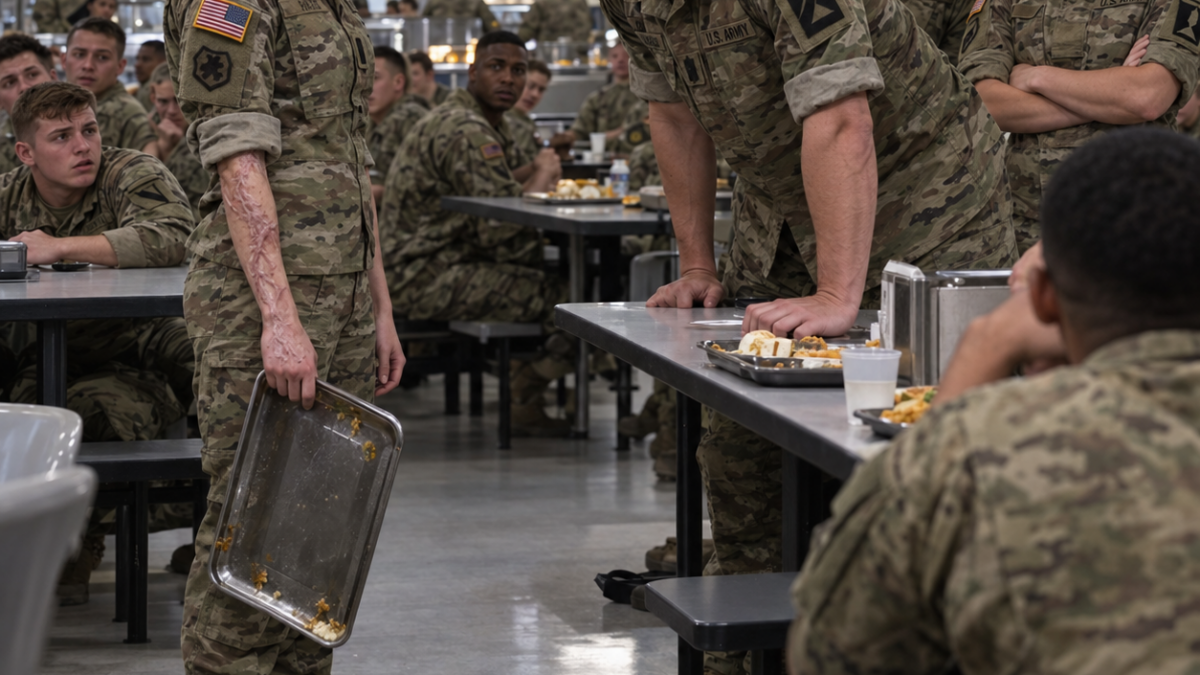
The metal tray hit the mess hall floor so hard that the sound cut through two hundred voices.
Forks, spoons, and a plastic cup scattered across the tile.
For one second, the entire cafeteria at Fort Bragg went quiet.
Then I felt every pair of eyes turn toward me.
I bent down slowly, gathering the utensils with hands that had been steadier under gunfire than they were under those fluorescent lights. My name tag read Reeves. My uniform was new, stiff in all the places new uniforms are stiff, and I could feel the collar rubbing against old scar tissue at the side of my neck.
I should have ignored the silence.
I had survived worse than staring.
Much worse.
But there are different kinds of danger. Bullets are honest. Shrapnel is honest. Fire is honest. They tear into you without pretending to be anything else.
A room full of people deciding what you are based on what they see can cut in a quieter way.
I stood with the tray in my hands and looked straight ahead.
I already knew what they were staring at.
The scars began near my neck and traveled down my right arm in pale ropes of healed skin. Some were thin and silver, some raised and pink, some jagged where field sutures had been done too fast and too dirty because the choice had been ugly stitching or bleeding out.
Under the mess hall lights, they always looked worse.
More visible.
More like a story written on me by people who were no longer alive to explain it.
Someone laughed from the corner table.
“Yo, check it out,” a male voice boomed. “Frankenstein’s bride just joined the Army.”
The cafeteria broke open.
Not awkward chuckles.
Not uncomfortable laughter.
Real laughter.
Loud and rolling, filling the room until the walls seemed to vibrate with it.
I kept my eyes down and set the tray back on the counter.
The server behind the line avoided looking at me as she scooped food onto my plate. Her face was tight with discomfort. She knew it was wrong. A few people did. I could feel them shifting in their seats, waiting for someone else to be brave first.
Nobody was.
“Seriously,” another recruit called out, “what happened? You lose a fight with a lawn mower?”
More laughter.
My fingers tightened around the edge of the tray.
Only for a second.
Then I forced them loose.
Discipline is not the absence of anger. It is what you do with anger when it arrives carrying a weapon and begging you to use it.
I took my food, turned, and walked toward the far corner of the mess hall.
Every step felt measured because I made it measured.
Shoulders down.
Breathing even.
Eyes forward.
Do not scan exits.
Do not identify threats.
Do not prepare to move.
You are not there anymore.
You are here.
Fort Bragg.
Basic training.
Second chance.
That was what I had told myself when I signed the reinstatement paperwork.
A second chance.
Not at being a hero. I had never wanted that word. Heroes were people other people built after the facts became too painful to describe honestly.
I just wanted to know if I could still be a soldier.
Not a survivor.
Not a medical case.
Not the one who made it out.
A soldier.
I sat alone.
The conversations resumed around me, but quieter now, sharper at the edges. Whispers traveled between tables. Glances slid toward me and away.
At the corner table, the biggest one leaned back like he owned the room.
Marcus Caldwell.
I had learned his name on the first day because men like Marcus made sure everyone learned their names. Six foot two, quarterback shoulders, officer’s son, confidence polished into arrogance by years of being told he was made for command.
“I give her three days,” he said loudly. “Maybe less. She looks like she’d cry if somebody yelled at her.”
His table laughed.
David Park sat beside him, wire-rimmed glasses and a face that always looked like he was calculating probabilities. “Probably only here because of some quota.”
Jessica Torres smirked. Everyone called her JJ. She came from a military family, athletic, sharp, and too eager to prove she belonged by deciding who didn’t.
“She looks like she survived a blender accident,” JJ said. “Combat would eat her alive.”
Rodriguez, stocky and aggressive, pounded the table.
“Fifty bucks says she quits by Friday.”
I cut a piece of dry chicken and put it in my mouth.
Chewed.
Swallowed.
One movement at a time.
Marcus’s chair scraped back.
The sound carried.
Conversations died again.
I knew he was walking toward me before I saw his shadow fall across my tray.
“This section is for real soldiers, sweetheart,” he said. “Maybe try the kids’ table.”
I looked up for exactly one second.
Long enough to see his face.
Long enough for him to see my eyes.
Then I looked back down.
It irritated him.
Good.
Silence does that to people who expect fear to explain itself.
David stepped closer.
“He’s talking to you. It’s rude not to answer.”
I folded my napkin carefully.
Corner to corner.
Then again.
Four clean edges.
My hands needed something to do.
JJ laughed.
“Maybe she doesn’t speak English. Or maybe those scars go deeper than skin. Brain damage, maybe.”
A few recruits shifted at nearby tables.
One young private, Tommy Chen, half rose from his chair. He looked barely eighteen, his face still soft in a way the Army would spend the next several months trying to harden.
“Leave her alone, man,” he said.
Marcus turned on him instantly.
“What, are you her boyfriend? Sit down before I make you need your mommy too.”
Tommy flushed and sat back down.
I did not blame him.
Courage is easier in theory than in rooms where everyone is watching.
Marcus leaned both hands on my table.
“Seriously,” he said. “What’s the story? Car crash? Meth lab? House fire? We’re all dying to know what made you look like a horror movie extra.”
That was the first moment I felt something inside me move.
Not rage.
Rage was hot.
This was cold.
I set down my fork.
Slowly.
Deliberately.
Then I stood.
Marcus was almost a foot taller than me. He looked pleased, as if my standing meant he had finally forced a reaction.
I met his eyes.
“Tomorrow,” I said.
He blinked.
My voice was low, even, and quiet enough that the room leaned in to hear it.
“Zero six hundred. Shooting range.”
Marcus stared.
“What?”
“You want to know if I belong here,” I said. “Tomorrow. Shooting range. Zero six hundred.”
For a second, his face went blank.
Then his grin returned bigger than before.
“Oh, she talks.”
He turned toward the room, lifting his voice.
“You hear that? Scarface thinks she can shoot.”
Laughter and whistles rose around us.
Phones came out.
People started texting before I had even picked up my tray.
I walked past Marcus toward the exit.
I did not rush.
I did not lower my head.
I did not let them see that my hands were trembling.
The night in the barracks was worse than the mess hall.
In a cafeteria, cruelty has witnesses. In the dark, it becomes a whispering thing.
The other women talked in low voices around me. My name drifted through the bunks in fragments.
Scars.
Freaky.
Shooting range.
She’ll cry.
I lay on my back and stared at the ceiling.
Inhale for four.
Hold for four.
Exhale for four.
Again.
Again.
The therapist at Walter Reed had taught me that after the nightmares got bad enough that I woke up swinging before I knew where I was.
“Your body thinks the war is still happening,” she had told me. “You have to remind it where you are.”
Where was I?
Fort Bragg.
Female barracks.
Basic training.
Safe.
My mind accepted the words.
My body did not.
Bodies remember in a language older than reason.
Two bunks down, Sarah Mitchell turned toward me.
“Hey,” she whispered.
I did not move.
“You okay?”
A long pause.
“Fine.”
She was quiet for a moment.
“I’m not asking your story,” she said. “I just wanted you to know, if you need somebody to talk to, I’m here. I was an EMT before I enlisted. I’ve seen a lot. Nothing shocks me.”
I turned my head slightly.
In the dim light, her expression was gentle without being pitying.
That mattered.
Pity is just another way of staring.
“Thanks,” I said. “I’m good.”
She nodded once and let it go.
I appreciated that more than I could explain.
The next morning arrived cold and misty.
By 0550, the range already had an audience.
More than thirty recruits stood behind the safety line, bundled in jackets, grinning like they had bought tickets to a show. Marcus and his crew arrived five minutes later, confident and laughing. Rodriguez carried coffee. David had his phone ready. JJ stretched as if she were the one about to perform.
I arrived at 0558.
Nobody heard me come up behind them.
“I’m here,” I said.
They turned.
For once, nobody laughed immediately.
Maybe it was the morning light.
Maybe it was the way the scars looked against the gray mist.
Maybe it was that I stood at parade rest without thinking, feet shoulder-width apart, hands clasped behind my back, weight slightly forward.
Corporal James, the range instructor, noticed.
I saw it in his eyes.
He had expected embarrassment.
Now he was reassessing.
“All right,” he called. “Everyone behind the line. Reeves, front and center.”
I stepped forward.
On the weapons table lay a standard M4 carbine.
Disassembled.
James had left it that way intentionally.
A small test.
“You’ll need to—”
My hands were already moving.
Charging handle.
Bolt carrier group.
Upper receiver.
Lower.
Pins seated.
Function check.
Twelve seconds.
The rifle became whole in my hands before the rest of his sentence died.
The watching recruits went quiet.
James stared.
“Do that again.”
I broke it down.
Faster.
Then assembled it again.
This time, I did not look down.
The pieces found my hands like old friends.
People think muscle memory sounds poetic until they understand what makes it.
Repetition.
Fear.
Cold.
Dark.
The knowledge that a jammed weapon can turn a human being into a body before anyone finishes shouting your name.
James’s mouth tightened.
“Load.”
I loaded.
Every round seated cleanly.
No hesitation.
No fumble.
No wasted movement.
Marcus shifted behind me.
I could feel his confidence adjusting, trying to survive.
“Range is live,” James called. “Stationary targets. Fifty meters. Fire when ready.”
I raised the rifle.
My breathing slowed.
The world narrowed.
Target.
Front sight.
Pressure.
Exhale.
I fired forty rounds in controlled pairs.
Not fast to impress.
Not slow to look careful.
The rhythm was old and quiet and necessary.
When the magazine was empty, I safed the weapon, set it down, and stepped back.
James walked downrange.
I watched his pace change when he reached the target.
He took longer than he needed to.
When he returned, he held the sheet up.
Every round was grouped center mass inside a circle the size of a baseball.
The recruits stared.
David lowered his phone.
Rodriguez muttered something under his breath.
Marcus smiled too late.
“Beginner’s luck.”
James did not smile.
JJ crossed her arms.
“Try moving targets. Anybody can hit paper.”
I looked at James.
He looked at me.
“You up for that?”
I nodded once.
Sergeant Tanaka arrived while they were setting up the moving target system.
She was sharp-eyed, early thirties, and carried herself like someone who had learned to miss nothing. James handed her the target sheet. She studied it silently, then looked at me.
Not with amusement.
Not with pity.
With recognition beginning to form.
The moving target drill was designed to stress decision-making. Pop-up silhouettes at random distances and angles. Standard qualification did not demand perfection. Nobody expected a new recruit to deliver it.
The first target appeared at thirty meters.
Left side.
My rifle came up.
Double tap.
Down.
Forty-five meters right.
Pivot.
Double tap.
Down.
Two targets appeared at once.
Close first.
Far second.
Threat priority.
Always threat priority.
I moved through the drill the way I had once moved through buildings with smoke in the halls and screams in the comms. Assess, engage, transition, breathe. No panic. No anger. No thought that did not serve survival.
Fifteen targets.
Fifteen hits.
When it was over, nobody cheered.
That told me more than laughter would have.
Entertainment had become evidence.
Sergeant Tanaka spoke quietly to James, but I heard her.
“That’s not range training.”
“No,” he said. “It isn’t.”
Marcus’s jaw was tight.
Rodriguez leaned close to him.
“Dude, maybe we should drop this.”
Marcus looked at the people watching him.
Pride can be a trap.
He stepped into it.
“Range is one thing,” he said loudly. “Real soldiers fight. Let’s see her in the pit.”
JJ seized on it.
“Exactly. Shooting is mechanics. Let’s see if she can handle herself without a rifle.”
The crowd shifted, hungry again.
I safed the weapon and placed it on the table.
Then I walked away.
Sarah fell into step beside me.
“That was impressive.”
“It was adequate.”
She almost laughed.
“Adequate? You just humiliated half the company without raising your voice.”
“They’ll escalate.”
She glanced at me.
“You expected that?”
“They need me to become what they decided I was.”
“And what’s that?”
I stopped walking and looked at her.
“Weak. Vulnerable. An acceptable target.”
Her expression changed.
I started forward again.
“I’ve been through worse than mockery.”
“I believe you,” she said quietly. “But you don’t have to go through this alone.”
I did not answer.
But something in my chest hurt when she said it.
That afternoon, the hand-to-hand pit had more than sixty spectators.
The drill sergeants should have shut it down.
They didn’t.
Curiosity is not always cruel, but it can make cowards of people who should know better.
I removed my jacket methodically.
More scars showed along my forearms.
Sarah was near the front with Tommy Chen.
I heard her whisper, “Those aren’t accident scars.”
Tommy asked something I couldn’t make out.
Sarah answered, “Shrapnel. Blast pattern. Maybe IED. Maybe grenade fragments.”
The words moved through the crowd.
Combat.
Real war.
Marcus was already in the pit, rolling his shoulders and bouncing on his feet. He had sixty pounds on me and a wrestling background. He needed this to end quickly. Not because he cared about the fight.
Because he needed the world to make sense again.
Drill Sergeant Haynes stepped in as referee.
“Keep it clean,” he said, looking at me. “You can tap out anytime. No shame in knowing your limits.”
The old cold feeling returned.
I nodded.
Marcus grinned.
“Ready?” Haynes called.
I lowered my center of gravity.
“Begin.”
Marcus lunged for a double-leg takedown.
Fast.
Powerful.
Predictable.
I stepped aside just enough.
He grabbed for my arm.
I let his momentum carry him past my centerline, then moved inside his reach.
Elbow to solar plexus.
Controlled.
Not full power.
Enough.
His breath left him in a hard grunt.
Before he recovered, I struck the nerve cluster in his thigh with my knee.
Marcus dropped to one knee.
Eight seconds.
The pit went insane.
People shouted. Phones rose. Rodriguez cursed. JJ stared as if reality had personally betrayed her.
Haynes looked stunned.
“Where the hell did you learn that?”
I extended a hand to Marcus.
He stared at it.
Then took it.
I helped him up.
Defeating someone does not require humiliating them. Humiliation is what insecure people confuse with strength.
Marcus’s face burned red.
The pain in his leg would fade.
The wound to his pride would not.
JJ, desperate now, raised her voice.
“Fine. She can shoot and fight. That doesn’t mean she can lead. Doesn’t mean she can think. Muscle memory isn’t strategy.”
David jumped in.
“Tactical planning exercise tomorrow. Classroom. Let’s see if she has a brain to match the reflexes.”
The crowd murmured agreement.
I picked up my jacket.
For a moment, I looked back at them.
Not angry.
Not afraid.
Just tired.
They thought this was a contest.
They had no idea what kind of things I had already lost.
The next morning, Captain Reynolds supervised the tactical planning exercise.
He was stern, combat-tested, and much harder to fool than the recruits. The moment I entered the classroom, I felt his attention land on me and stay there just a little longer than normal.
“Scenario,” he said. “Defensive perimeter establishment in hostile territory. Teams of five. You’ll receive a map, threat assessment, and resources. Design a patrol base capable of withstanding enemy contact for seventy-two hours while awaiting extraction.”
Seventy-two hours.
My throat tightened.
Nobody else reacted.
Of course they didn’t.
For them, seventy-two hours was a classroom parameter.
For me, it was blood, smoke, thirst, names screamed into dead radios, and the taste of dirt between my teeth.
Teams were assigned.
I ended up with Marcus, David, JJ, and Rodriguez.
Maybe coincidence.
Maybe not.
David immediately spread the map and took charge.
“Standard patrol base. Machine gun here. Observation posts here and here. Ammo cache central. Rotating sleep shifts. Clear fields of fire.”
It was textbook.
Textbook plans are useful until the enemy reads the same book.
I studied the terrain.
Contour lines.
Dry riverbed.
Ridge elevation.
Wind direction.
Vegetation.
Vehicle access.
The longer I looked, the more problems appeared.
I let David finish.
Then I pointed to the ridge.
“That kills us.”
He frowned.
“It’s six hundred meters out. We’d see anyone approaching.”
“Not at night. Not with thermals.”
The table went quiet.
I continued.
“From that ridge, they can observe the entire position. Count personnel. Track movement patterns. Identify fighting positions. Anyone outside cover gets picked off before we know we’re compromised.”
JJ rolled her eyes, but not confidently.
“That’s a little dramatic.”
“No,” I said. “It’s what happens.”
David’s face tightened.
“How would you know?”
I pointed to the dry riverbed.
“This looks like a natural defensive boundary, but in this region, it’s a flash flood channel. One hard storm and your escape route becomes a trap.”
Marcus stared at me.
I moved my finger again.
“Loose sand here. Vehicles bog down. Stationary vehicles become targets. Central ammunition cache looks efficient, but one mortar hit turns your supply point into a secondary explosion.”
Nobody spoke.
I had forgotten, briefly, that I was supposed to sound like a recruit.
Captain Reynolds appeared beside our table.
He had heard enough.
“Reeves,” he said.
I stood automatically.
“Sir.”
“That analysis. Where did you learn to think like that?”
“Basic principles, sir.”
His eyes narrowed.
“No. That is not basic. That is not even conventional advanced training. That is special operations level terrain assessment.”
The room went silent.
I felt the door inside me closing.
“Sir, I read a lot.”
He studied my face.
“You look familiar.”
My heartbeat hit once, hard.
“No, sir. I’m certain I would remember meeting a company commander.”
He didn’t believe me.
But he let it go.
“Return to your team. Incorporate her recommendations. All of them.”
I sat down.
Rodriguez leaned toward David.
“Dude,” he whispered, “what if she’s CIA?”
JJ went pale.
“What if this whole thing is some kind of evaluation and we’re failing?”
Marcus said nothing.
For the first time, he looked less angry than uncertain.
The obstacle course evaluation came later that week.
By then, everyone on base had heard some version of the story.
The scarred recruit who shot like a sniper.
The quiet girl who dropped Marcus Caldwell in eight seconds.
The mystery trainee who analyzed terrain like she had planned real missions.
What nobody knew was that General Frank Morrison had arrived that day for an inspection.
I knew him by reputation.
Everyone did.
Two-star general. Special operations background. One of the few senior officers whose name still caused people to lower their voices in certain rooms.
I tried not to look at him.
Two hundred recruits formed up near the course.
The obstacles stretched ahead: walls, balance beams, rope swings, cargo nets slick from earlier rain. Average completion time was ten to twelve minutes. Under nine was excellent. Under eight was rare.
Marcus found me before the start.
“One more chance,” he called loudly. “Beat my time, and we leave you alone. We admit you belong. If you lose, you admit you don’t.”
I looked at him.
I saw more than arrogance now.
I saw desperation.
He needed to win because if I was not weak, then he had been cruel for no reason. Some people will fight harder to protect a lie about themselves than to correct the thing they did wrong.
I nodded once.
Marcus ran first.
He was good.
Strong over the walls. Fast across the beams. Powerful on the rope swing. He crossed the finish line at eight minutes and forty-five seconds.
The crowd cheered.
He bent over, breathing hard but smiling.
“Your turn, Scarface.”
I stepped to the start line.
Inhale for four.
Hold.
Exhale.
“Begin!” Haynes shouted.
I ran.
Not sprinting.
Efficiency matters more than speed when the whole course wants to drain you.
Wall.
Up.
Over.
Drop.
Rope.
Swing.
Land.
Roll.
Come up ready.
I heard murmurs behind me. Some officers noticed the roll. They would. Tactical movement has a signature.
Balance beam.
I crossed at near-running speed.
Cargo net.
Thirty feet of wet rope.
My arms were tired before I touched it. A week of being challenged, watched, tested, and mocked had worn me down more than I wanted to admit. Constant control costs energy. So does pretending not to care.
I climbed.
Hand over hand.
Two-thirds up, my boot slipped.
The wet rope slid beneath me.
I caught myself, but the movement tore strength from my arms.
Below, Marcus saw it.
“Choking!” he shouted. “Just like you would in real combat.”
Rodriguez joined in.
“Give up, Scarface. You don’t belong here.”
JJ’s voice cut through the air.
“Everybody can see you’re failing.”
I hung there for one second.
My arms shook.
Not from fear.
From exhaustion.
And suddenly I was not on a cargo net.
I was crawling over broken concrete with blood in my mouth.
I was dragging myself through smoke while rounds snapped overhead.
I was hearing Ghost Seven Bravo scream my name.
I was alone.
No.
Not alone.
Never alone.
I climbed.
At the top, my hands burned. I forced myself over and started down the far side. Slower now. Mechanical. Determined.
Marcus positioned himself near the exit, blocking the path.
“Too slow,” he said. “Admit it.”
I dropped the last six feet.
Landed in a crouch.
Came up standing.
“Eight minutes, fifty-eight seconds!” someone called.
I had missed Marcus’s time by thirteen seconds.
He stepped in close, triumph lighting his face.
“Admit it,” he snapped. “You’re not cut out for—”
He grabbed my shoulder.
Hard.
The sound of fabric tearing cut through the field like a gunshot.
Everything stopped.
My BDU shirt ripped across the shoulder, exposing the tattoo I had kept hidden since the day I returned from medical rehabilitation.
Black ink.
A skull.
Crossed rifles.
Above it:
GHOST 7
Below:
NIGHTFALL
Under that, coordinates.
Latitude and longitude.
A place in Kandahar Province where fifteen soldiers went into a mission and one came out breathing.
For three seconds, nobody moved.
Then someone gasped.
“Oh my God.”
General Morrison froze fifty yards away.
I saw his head turn.
Saw his face change.
He knew.
Of course he knew.
Sergeant Tanaka covered her mouth.
“No,” she whispered. “No way.”
Marcus still had his hand on my shoulder. He looked confused by the silence.
“What?” he said. “What is it?”
General Morrison started walking toward us.
The crowd parted before anyone told it to.
Officers snapped to attention as he passed. Recruits stepped back, suddenly understanding that whatever was happening was bigger than gossip, bigger than Marcus, bigger than the course.
He stopped three feet in front of me.
His face was carved from discipline, but his eyes held something I recognized.
Grief.
He came to attention.
Then he saluted me.
Slowly.
Deliberately.
A two-star general saluted a recruit with a torn shirt and mud on her boots.
The field went silent enough to hear wind move through rope.
“Staff Sergeant Maya Reeves,” he said, voice carrying across the course. “Ghost Unit Seven. Operation Nightfall.”
My throat closed.
“Sole survivor. Fourteen killed in action. Seventy-two hours behind enemy lines, surrounded by hostile forces. Extracted with critical injuries. Silver Star. Purple Heart. Bronze Star with Valor.”
The words hit harder than any blow.
Not because they were false.
Because they were too small.
No medal contained Jordan Martinez making coffee out of water that tasted like metal and calling it gourmet.
No citation contained Sarah Kim singing under her breath when she was scared.
No official summary contained Falcon-style jokes from men who knew they were outnumbered and still held the line.
No sentence like “fourteen killed in action” could carry fourteen human beings.
The field erupted.
Marcus released my shoulder like my skin burned him.
His face drained white.
JJ began crying immediately, both hands over her mouth.
David stared at his phone in horror, realizing what he had recorded, what he had shared, what he had made into entertainment.
Rodriguez sat down in the dirt and put his head in his hands.
Haynes snapped to attention and saluted, shame written across his face.
Sergeant Tanaka saluted too, tears bright in her eyes.
Captain Reynolds stepped forward and saluted.
“Staff Sergeant,” he said. “It is an honor.”
All around me, recruits were checking their phones, whispering, searching.
Operation Nightfall.
Kandahar.
Ghost Unit Seven.
Massacre.
Classified details.
One survivor.
Tommy Chen read aloud with a shaking voice from a public article that barely touched the truth.
“Fifteen deployed. One survivor. Details classified.”
Sarah stood near him, eyes wet, not surprised exactly.
Just sad.
General Morrison lowered his salute after longer than regulation required.
“At ease,” he said.
My shoulders relaxed a fraction.
I reached back and pulled the torn fabric over the tattoo.
Too late.
Everyone had seen.
Hundreds of cameras had captured it.
The secret I had carried under my skin was no longer mine alone.
Morrison’s voice softened.
“Why are you here?”
The question was not accusation.
It was pain.
“In basic training,” he said, “after everything you’ve done?”
I answered because he deserved the truth.
“Medical discharge after Nightfall, sir. PTSD diagnosis. Eighteen months of recovery and therapy. I requested reinstatement when the medical board cleared me.”
“And they made you redo basic.”
“Regulations, sir. Medical discharge exceeding twelve months requires requalification at basic training level regardless of prior service or rank.”
His jaw tightened.
“The system has no provision for your circumstances.”
“No, sir.”
He turned slowly toward Marcus and his crew.
The temperature of the field seemed to drop.
“Do you understand what you have been doing?”
Marcus tried to speak.
Nothing came out.
“This soldier lost fourteen brothers and sisters in a single operation. She spent three days wounded, isolated, and fighting to survive against impossible odds. She earned decorations most soldiers will only hear about, and you mocked the scars she received defending this country.”
Marcus dropped to his knees.
Tears ran down his face.
“I didn’t know,” JJ sobbed. “We didn’t know.”
“That is exactly the point,” Morrison said, his command voice cutting through her words. “You didn’t know, and you chose cruelty anyway. You saw scars and invented weakness. You saw silence and called it fear. Every mark you mocked is a moment she almost died and kept fighting.”
No one answered.
There was no answer.
Morrison turned back to me.
“Walk with me, Staff Sergeant.”
We moved toward the edge of the field, away from the crowd. His aide kept others back.
When we were far enough away, his expression softened.
“You don’t have to do this,” he said. “I can make calls right now. Advanced instruction. Leadership development. Special operations preparation. Instructor roles. You’ve already proven everything.”
I looked across the field at the recruits.
At Marcus still kneeling.
At Sarah watching me with quiet concern.
At Tommy holding his phone like it had become something sacred and terrible.
“No, sir.”
Morrison studied me.
“I need to finish,” I said.
“Why?”
For a moment, I could not speak.
Because the truth was not simple.
Because surviving had not felt like victory.
Because after Nightfall, people kept telling me I had done enough, suffered enough, earned rest. But rest had felt like a room with no exits. Therapy helped. Time helped. But nothing answered the question that woke with me every morning.
Am I still a soldier, or just the one who lived?
“I need to know I can still serve,” I said finally. “Not just exist. Not just survive. Serve.”
Morrison’s eyes changed.
He understood.
Men like him always understood purpose.
Sometimes too well.
“Then finish your eight weeks,” he said. “But hear me clearly. From this moment forward, if anyone gives you trouble, they answer directly to me.”
“Yes, sir.”
“And Maya?”
I looked at him.
“Your team would be proud.”
That broke something.
Not visibly.
Not enough for anyone else to see.
But I felt it.
A crack in the wall I had built around their names.
I blinked once.
A tear slipped down my cheek.
“I hope so, sir.”
He saluted again.
“It is an honor to serve in the same Army as you.”
I returned the salute.
Perfect form.
Because if my hands shook, I would not forgive them.
After he left, people began approaching one by one.
Tommy Chen came first.
“Ma’am,” he said, nervous and earnest, “I’m sorry I didn’t stand up harder. I should have.”
“You stood up at all,” I said. “That matters.”
Sarah came next.
“I knew the scars were trauma,” she said. “I should have said something sooner.”
“You offered kindness without demanding a story. That matters too.”
Private Anderson, a young female recruit with wide eyes, could barely speak.
“You’re my hero,” she whispered. “I didn’t know someone like you could exist.”
I looked at her for a long moment.
“Don’t try to be me,” I said. “Be better. Come home with fewer ghosts.”
She nodded, crying.
Marcus came last.
The field was nearly empty by then. The sun was low, turning the cargo net gold.
He approached slowly, stopped in front of me, and saluted.
“Ma’am,” he said, voice raw, “there is nothing I can say that fixes what I did.”
I returned the salute.
“No.”
His face tightened.
“No apology is enough.”
“No.”
“I was cruel.”
“Yes.”
“I was ignorant.”
“Yes.”
He swallowed.
“I want to be better.”
That was the first useful thing he had said all week.
I studied him.
I could have destroyed him with a formal complaint. I could have made him an example. A part of me wanted to. Not the noble part. Not the instructor. The wounded part that remembered every laugh in the mess hall.
But punishment alone teaches people to fear consequences.
It does not always teach them to change.
“Report at 0500,” I said.
He blinked.
“What?”
“Bring your crew.”
“For what?”
“Training.”
His eyes widened.
“You’d teach us?”
“I’ll give you the opportunity to learn. What you do with it is on you.”
Relief hit his face so hard it looked painful.
“Yes, ma’am. Thank you.”
“Don’t thank me yet.”
The next four weeks changed everything.
At 0500 each morning, Marcus, JJ, David, Rodriguez, Tommy, Sarah, Anderson, and a handful of others met me before official PT.
No audience.
No phones.
No jokes.
We trained.
I taught them how to move through a doorway without presenting themselves as targets. How to read terrain not as scenery but as cover, concealment, approach, escape. How to think in angles. How to conserve energy. How to make fear useful.
“In combat,” I told them one morning, “you will not rise to the level of your hopes. You will fall to the level of your training. So we train until the right answer happens before panic gets a vote.”
JJ asked me once, during a water break, “How do you stay calm when people are dying?”
The group went silent.
I considered lying.
I didn’t.
“You don’t stay calm,” I said. “Not inside. Inside, you’re terrified. The trick is accepting that fear will be there and deciding it doesn’t get command authority.”
She nodded slowly.
Marcus became different after the reveal.
Not perfect.
People do not become humble overnight.
But he listened. He worked. He apologized with action more than words. When other recruits made careless jokes about scars, weakness, women in combat, or trauma, he shut them down before I had to.
One morning, Rodriguez missed a room-clearing angle for the third time.
Marcus corrected him gently instead of mocking him.
That was when I knew the change might hold.
Sergeant Tanaka watched from a distance often.
Captain Reynolds too.
They said little, but by week six, our little group moved like a team. Not elite. Not finished. But aware of one another. Protective. Sharper than they had been.
And I found something I had not expected.
Teaching did not erase guilt.
Nothing erased guilt.
But it gave it somewhere to go.
Each lesson became a way to honor the dead.
Jordan, who used to say bad coffee was proof civilization still existed.
Sarah Kim, who wanted to teach after the Army.
Miles, who carried extra socks for everyone and pretended not to.
Rourke, who laughed like thunder.
All of them.
Fourteen ghosts at my back.
For a long time, I thought they followed me because I had failed them.
Maybe they followed because I was carrying what they left.
Graduation arrived warm and bright.
Families filled the stands. Cameras flashed. The entire company stood in dress uniform, transformed from the raw civilians who had arrived eight weeks earlier into something closer to soldiers.
General Morrison returned.
When he stepped to the podium, the field quieted.
“Today,” he said, “we recognize completion of basic training. But more than that, we recognize growth. Discipline. Accountability. The transformation required to serve something larger than oneself.”
Names were called.
Certificates handed out.
Then he paused.
“Staff Sergeant Maya Reeves.”
The applause began before I moved.
I stepped forward.
“Highest scores in company history across all evaluation metrics,” Morrison said. “Recipient of the Distinguished Graduate Award for leadership, character, and extraordinary contribution to unit cohesion.”
I accepted the certificate.
Then I did something not in the program.
I turned and gestured toward Marcus, JJ, David, and Rodriguez.
They looked confused.
“Come here,” I said.
They approached carefully, like they were walking into a minefield.
Morrison raised one eyebrow but allowed it.
I turned toward the crowd.
“These four made serious mistakes at the beginning of training,” I said. “They were cruel. They harassed. They failed to live up to the values they claimed to respect.”
Marcus looked down.
I continued.
“But they learned. They changed. They worked. Growth matters. Accountability matters. If we only honor people who never fail, then we teach everyone to hide failure instead of becoming better from it.”
I looked at them.
“They earned the right to stand here because they did the work after they were wrong.”
The applause that followed was different.
Not explosive.
Not dramatic.
Deep.
Sustained.
Human.
After the ceremony, Morrison pulled me aside.
“That was generous.”
“It was true.”
“They may not have deserved it.”
“Maybe not at first,” I said. “But if growth doesn’t matter, why train anyone?”
He smiled faintly.
“Spoken like an instructor.”
Then he handed me a small case.
Inside was an official instructor badge.
I stared at it.
“We need you at the Advanced Combat Training Center,” he said. “Special operations candidates. Leadership modules. Survival under pressure. Tactical decision-making. The things that kept you alive.”
My fingers brushed the badge.
For eighteen months after Nightfall, I had believed my knowledge was only wreckage.
Proof of what happened.
Proof I had lived when others had not.
Now someone was asking me to turn that wreckage into shelter for the next generation.
“Yes, sir,” I said. “I’ll accept.”
That night, after the reception, after the handshakes, after Marcus’s father thanked me with shame in his eyes for teaching his son what he had failed to instill, I moved into instructor quarters.
A small apartment on base.
Quiet.
Private.
Mine.
I unpacked with military precision because old habits comforted me. Boots by the door. Uniforms hung. Field manuals stacked. Badge placed on the desk.
Last came the photo.
Ghost Unit Seven.
Fifteen of us in full gear, standing shoulder to shoulder three days before Operation Nightfall.
Three days before the ambush.
Three days before the world reduced us to one survivor and fourteen flag-draped coffins.
I set the photo on the desk.
Then I spoke their names.
One by one.
“Jordan Martinez,” I whispered. “You made the worst coffee in any war zone and called it art.”
I smiled through the ache.
“Sarah Kim. You wanted to teach after the Army. I’m teaching now. For both of us.”
I continued until all fourteen had been brought into the room.
The dead deserve to be named.
Especially by the living.
When I finished, I sat in the silence.
For the first time in a long while, it did not feel like punishment.
It felt like rest.
Then my phone vibrated.
Unknown number.
I stared at it.
Something deep in my body went still.
I answered.
“Reeves.”
The voice on the other end was digitally masked.
“Ghost Seven secure line active.”
My hand tightened around the phone.
“I’m not active.”
“We have a situation.”
“I’m teaching now.”
“The asset from Nightfall is alive.”
The room disappeared.
My eyes locked on the photo.
“What did you say?”
“He’s alive. He’s talking. Claims he has evidence of what really happened.”
My breath turned cold.
“What really happened?”
“Who set you up. Why fourteen soldiers died.”
My free hand gripped the edge of the desk until my knuckles went white.
“We need Ghost Unit expertise to verify his claims and extract him safely,” the voice said. “You’re the only one left who knows the protocols. The only one he’ll trust.”
I looked at the faces in the photograph.
Fifteen soldiers smiling because none of us knew we had already been marked for death.
I thought basic training had been my return.
I thought the instructor badge meant I had found the shape of my future.
Maybe it had.
But some futures begin by walking back into the fire you survived.
“When and where?” I asked.
“Helicopter pickup. Fort Bragg airfield. Zero six hundred. Briefing en route. This is voluntary.”
“No,” I said.
A pause.
“I’ll be there.”
The line was silent.
“For my team,” I said. “They deserve the truth.”
“Acknowledged, Ghost Seven. Stay safe.”
The call ended.
I set the phone down carefully.
Outside my window, Fort Bragg was quiet beneath the stars.
Inside, fourteen ghosts watched from a photograph on my desk.
I stood, walked to the closet, and pulled out gear I had not touched in eighteen months.
Combat boots.
Tactical pants.
A jacket with the Ghost Unit patch.
The skull.
The crossed rifles.
The symbol they had mocked before they understood what it cost.
In the window’s dark reflection, I saw myself standing there.
Maya Reeves.
Staff Sergeant.
Survivor.
Instructor.
Ghost Seven.
I was no longer hiding the scars.
I was no longer asking whether I still belonged.
I had survived the fire.
I had trained the ones who once laughed at the burns.
And tomorrow, at zero six hundred, I would go find out who had sent my family to die.
Some missions end on paper.
Some end when the truth is buried.
And some wait in silence until the last soldier standing is strong enough to carry them into the light.