FULL ENDING They Called the Police on Me for Fishing in My Own Pond, Then Karen Tried to Steal What My Grandfather Built
𝗙𝗨𝗟𝗟 𝗦𝗧𝗢𝗥𝗬
My blood went cold.
Our pond.
A woman in the front row raised her hand. “My son tried to fish there last week, and that man came out screaming at him. He said he owns the pond.”
“I do own it,” I said from the back.
Every head turned.
Karen’s eyes found me. For one second, her smile remained in place, bright and controlled. Then her expression hardened.
“And you are?”
“The owner of the property you’re discussing.”
A murmur went through the room.
I stood. “The pond is on my land. My family has owned it for more than sixty years.”
Karen gave a small laugh, the kind meant to make the room relax at my expense.
“I understand that there may be some confusion.”
“There is no confusion.”
Her eyebrows rose. “Sir, please don’t interrupt.”
“You’re telling people my pond belongs to the HOA.”
She picked up a folder from the table and opened it with theatrical patience.
“The community maps clearly identify the pond as Tyrant Estates common recreation space.”
“Then your maps are wrong.”
Her smile sharpened. “That’s a serious accusation.”
“So is claiming my land.”
An older man on the board leaned toward his microphone. “Maybe we should have our attorney review—”
“I already have,” Karen said quickly.
He looked surprised.
She turned back to me. “Our documents were reviewed. The pond area was included in the original development plan.”
“My father refused to sell that land.”
“Perhaps you misunderstood the extent of what was transferred.”
I felt heat crawl up my neck.
“My father understood his own property.”
Karen’s eyes flashed.
She was not used to being contradicted in public, and definitely not by someone who was not under her control.
“Sir,” she said, voice tightening, “if you cannot remain civil, I will ask you to leave.”
I laughed once, because if I had not, I might have shouted.
“Civil? You’re accusing me of trespassing on land my grandfather dug with his own hands.”
A few residents shifted uncomfortably.
Karen noticed. She leaned forward, letting her voice soften.
“I appreciate that this may be emotional for you. Family stories can feel very real. But our association cannot operate based on sentimental claims. We operate based on documentation.”
“Then get a survey.”
“We have maps.”
“Get a licensed survey.”
“That won’t be necessary.”
“Because you’re afraid of what it will show?”
Her face flushed.
There it was. A crack in the polished surface.
She closed the folder.
“We’re moving on.”
Just like that, she tried to erase me from the room.
I stood there for a second longer, looking at the residents who had been told I was the problem. Some looked skeptical. Some looked annoyed. A few looked embarrassed. Karen looked triumphant.
I left before I said something that could be used against me.
The next morning, I went to the county recorder’s office.
I spent hours pulling every document tied to my property and the Tyrant Estates development. Deeds. plats. transfers. boundary descriptions. Historical records. Anything I could find.
What I found made me angrier than the meeting had.
My deed was clear. My family’s ownership was continuous. The twelve acres, including the pond, had never been sold, transferred, or absorbed into the subdivision. The developer had approached my father. My father had refused. That should have been the end of it.
But the HOA maps told a different story.
Somehow, in the development materials given to homeowners, my land had been drawn into the community. The pond was labeled as a recreation area. Not vaguely. Not accidentally on the edge. Clearly. Boldly. As if drawing it made it true.
I sat in my truck outside the county office with copies on the passenger seat and my hands gripping the steering wheel.
My father had been right.
They had wanted the story off the land.
When they could not buy it, someone had redrawn it.
I hired a real estate attorney named Angela Price.
Angela was in her late forties, calm, sharp, and immune to nonsense in a way that made me trust her immediately. Her office smelled like old paper and coffee. She read through the documents slowly while I sat across from her, waiting for the professional version of what I already knew.
Finally, she leaned back.
“Your deed is clean,” she said.
I exhaled for what felt like the first time all day.
“And the HOA map?”
“Worthless against county records. But dangerous if people are relying on it.”
“Can they take the pond?”
“No,” she said. “Not legally.”
That word mattered.
Because illegally, they were already trying.
Angela recommended an updated licensed survey to remove any possible doubt. I hired a surveyor that week. He came out with GPS equipment, reference maps, stakes, and the patient energy of a man who had seen property disputes ruin Thanksgiving dinners.
He spent a full day walking the land.
When he finished, the result was exactly what my family had always known.
The pond was entirely on my property.
In fact, there was a buffer strip between my boundary and the nearest actual HOA common area. Their claim was not a matter of a few disputed feet. It was fiction.
Angela sent a certified letter to the HOA board. The letter included my deed, county records, and the new survey. It demanded that the HOA correct its records, notify residents that the pond was private property, stop encouraging access, and cease claiming ownership.
Two weeks later, the HOA attorney responded.
They rejected everything.
Their letter claimed the HOA documents were valid, suggested my survey was flawed, and warned that if I continued preventing residents from accessing the pond, the HOA might take legal action against me.
Angela smiled when she read it.
Not a happy smile.
A predator smile.
“They’re building our case for us,” she said.
“They’re threatening to sue me over my own land.”
“Yes. In writing.”
She sent another letter, stronger this time. Cease and desist. Slander of title. Trespass. Interference with property rights. The words were legal, but the meaning was simple.
Stop lying about my land.
Karen did not stop.
If anything, she escalated.
Residents began showing up more often, and they were bolder. Some told me they had received HOA emails assuring them that the pond belonged to the community. One man waved a printed map in my face and told me I had “no right to privatize shared amenities.” A woman accused me of scaring children. A teenager told me his parents paid dues, so he could swim wherever he wanted.
Every confrontation stole a little more peace from the place.
I started carrying a folder of documents to the porch. I posted private property signs. I installed cameras along the most common access points. I hated all of it.
The pond had once been where I went to breathe.
Now I walked toward it bracing for a fight.
The incident that pushed everything over the edge happened on a Saturday morning in late spring.
The air was soft and clear. The water was still. I had woken early, made coffee, and decided I was going fishing whether Karen liked it or not. I grabbed my rod, tackle box, and an old folding chair that had belonged to my father. Then I walked down to the north shore, where the bank sloped gently and bass liked to hide near the reeds.
For twenty minutes, everything felt normal.
Line in the water. Sun on my shoulders. Frogs starting up somewhere near the far side. The faint smell of wet grass and mud.
Then I heard voices.
A group of about eight people came walking across my field like they owned it. Coolers. folding chairs. beach towels. fishing gear. A man in front wore mirrored sunglasses and had the aggressive stride of someone who had rehearsed being right. Beside him was a woman already holding her phone.
I set down my rod and walked toward them.
“Morning,” I said. “This is private property. You can’t be here.”
The man stopped and folded his arms.
“Here we go again.”
“Excuse me?”
“We know about you,” he said. “The HOA sent an email.”
Of course they had.
The woman lifted her chin. “You’ve been harassing residents.”
“I’ve been removing trespassers.”
“This pond belongs to all of us,” the man said.
“No,” I replied. “It belongs to me.”
He scoffed. “You people are unbelievable.”
I almost asked what he meant by you people, but I already had enough problems.
“I have a deed and a licensed survey,” I said, keeping my voice level. “You need to leave.”
The woman raised her phone higher.
“I’m calling the police.”
“Please do.”
She blinked, clearly expecting panic.
“I’d love for them to settle this,” I said.
She called.
I stood there listening while she told the 911 operator that a man was threatening her family and blocking access to a public HOA recreation area. She said I was acting unstable. She said I was fishing illegally. She said they feared for their safety.
I stared at her in disbelief.
She did not look ashamed.
That scared me more than the lie itself.
People who lie with shame can sometimes be reached. People who lie with righteousness are dangerous.
A sheriff’s deputy arrived about fifteen minutes later.
He stepped out of his patrol car and took in the scene: me on one side, eight residents on the other, coolers and fishing rods between us like evidence in the world’s dumbest trial.
“What’s going on?” he asked.
Everyone started talking at once.
He raised both hands. “One at a time. Ma’am, you called?”
The woman launched into her story. I had threatened them. I had blocked them. I had no right to be there. The pond belonged to the HOA. I was unstable. Dangerous. Harassing families.
When she finished, the deputy turned to me.
“Sir?”
“This is my property,” I said. “The pond is on my land. They are trespassing. I asked them to leave. I did not threaten anyone.”
The deputy looked from me to them. “This isn’t community property?”
“No.”
The man in sunglasses stepped forward. “Officer, we have official HOA documentation.”
The deputy sighed. “I’m not a property court.”
“I have my deed and survey at the house,” I said. “You’re welcome to look.”
The residents insisted on coming too, as if I might forge documents during the walk.
I led everyone up to the house and retrieved the folder Angela had told me to keep ready. The deputy studied the deed, the survey, and the county records on my porch. He was not a lawyer, but he could read a boundary line.
After a few minutes, he looked up.
“These appear legitimate,” he said.
The woman grabbed for the survey.
“This has to be fake.”
The deputy pulled it back before she could take it.
“Ma’am, don’t.”
“But the HOA president said—”
“I understand what she said. Based on what I’m looking at, this gentleman has documentation showing the pond is on his property. Until a court says otherwise, I’m going to ask you folks to leave.”
The man in sunglasses turned red.
“This is outrageous.”
The deputy looked tired. “You can take that up with your HOA. Right now, leave the property.”
They left, muttering and glaring.
The deputy apologized before he drove off.
I appreciated that.
But I also knew apologies would not stop Karen.
Three days later, a landscaping truck pulled onto my land.
Two workers got out near the pond with mowers, trimmers, and gas cans. I saw them from the kitchen window and ran outside.
“Hey!” I shouted. “What are you doing?”
The man in charge looked down at a clipboard.
“Maintenance work.”
“For who?”
“Tyrant Estates HOA. Common pond area.”
I laughed once, sharp and humorless.
“This is not HOA property.”
He looked uncomfortable. “The lady said you might say that.”
“The lady is lying.”
He grimaced. “Look, man, I’m just doing a job.”
“No. You’re about to trespass and damage private property.”
That got his attention.
I brought out the folder. I showed him the survey. I showed him the deed. To his credit, he did what Karen had refused to do.
He looked.
Then he called her.
I could hear Karen yelling through the phone from ten feet away.
Her voice was high, furious, unmistakable.
The landscaper held the phone away from his ear and said, “Ma’am, I’m not getting in the middle of a property dispute.”
More yelling.
He glanced at me, then said, “No, ma’am. Not without proof.”
He hung up.
“She wants us to proceed,” he said.
“You going to?”
“Nope. This is above my pay grade.”
The crew packed up and left.
I called Angela immediately.
“That’s it,” she said. “We file.”
The lawsuit went in shortly after.
Trespass. Harassment. Interference with property rights. Slander of title because the HOA was falsely claiming ownership of my land and putting it in official communications. We also filed a complaint demanding correction of the development maps.
The HOA was served.
Karen did not react like a reasonable person facing legal exposure.
She reacted like a queen whose servant had dropped a plate.
According to a sympathetic neighbor named Denise, Karen raged through the next board meeting, calling me unstable, greedy, delusional, and dangerous. She claimed I was trying to “steal community resources.” She said the HOA needed to “take decisive action.”
Decisive action came the following weekend.
I was sitting on my back porch near sunset when I saw people moving across the far field.
At first, I thought it was another family.
Then I realized there were too many.
Fifteen, maybe twenty residents walked toward the pond in a loose group, carrying chairs, bags, fishing rods, and coolers. At the front was Karen.
She wore white.
White fitted pants, white blouse, gold belt, sunglasses pushed into her hair. She looked like she had dressed for a yacht club lunch, not mass trespassing. The sinking sun lit her from behind, giving her an almost angelic glow, which would have been funny if I had not been so furious.
I walked down to meet them at the property line.
“Stop right there.”
Karen smiled.
Not kindly.
Triumphantly.
“We are taking back what belongs to the community.”
“You are trespassing.”
“The board voted unanimously to authorize resident access to the Pond Recreation Area.”
“You mean my pond.”
She stepped closer. Her perfume reached me before she did, sweet and expensive.
“You have bullied these residents long enough.”
I looked behind her at the crowd. Some looked determined. Some looked uneasy. A few children ran ahead toward the shore until I raised my voice.
“No one goes near the water.”
Karen’s smile widened.
“Or what?”
I pulled out my phone. “Or I call the police.”
“Please do,” she said. “We’ll show them our maps.”
She said maps the way a priest might say scripture.
While we waited, residents spread out along the pond despite my warnings. A few set up chairs. One man cast a line into my water. Kids ran near the bank. My hands shook with anger so intense it became hard to think clearly.
Karen stood beside me, arms folded, watching them like a general surveying captured territory.
“You really believe this,” I said quietly.
She glanced at me. “Because it’s true.”
“No. Because you need it to be true.”
Her eyes slid toward mine.
“You’re not special because your grandfather owned a farm.”
I felt that one land.
She saw it and smiled.
“Communities evolve,” she said. “Land use changes. One stubborn man doesn’t get to hold an entire neighborhood hostage because he has sentimental attachment to a pond.”
“That pond was never yours.”
“It should have been.”
There it was.
The truth beneath all the paperwork.
Not ownership.
Entitlement.
The deputies arrived in two vehicles this time. One was the same deputy from the earlier call. His expression changed when he saw me.
Not annoyance at me.
Recognition of a problem that had grown legs.
Karen marched toward him with a folder in hand.
“Officers, thank God. This man has been illegally claiming HOA property and harassing residents. We’re requesting that he be arrested for trespassing and interfering with lawful community access.”
I almost laughed.
She wanted me arrested on my own land.
The deputy looked at her folder, then at the crowd on my pond bank.
“Ma’am,” he said, “I was here a few days ago. He showed documentation that this pond is on his property.”
“Those documents are fraudulent.”
Karen said it instantly, confidently.
The deputy’s eyes narrowed.
“Do you have a court order saying that?”
“We have official HOA maps.”
“That’s not what I asked.”
I stepped forward. “There’s an active lawsuit now. My attorney has already filed over the HOA claiming my property.”
Karen snapped, “Frivolous lawsuit.”
I looked at the deputy. “The county has also been asked to correct the development maps.”
Karen turned on me. “Because you’re manipulating records.”
“My deed predates your subdivision by decades.”
“Your deed is fake.”
That was the moment she went too far, even for some of the residents behind her.
A murmur moved through the group.
The deputy heard it too.
“Ma’am,” he said, voice firm now, “I need you and everyone here to leave this property.”
Karen stared at him.
“No.”
The whole field seemed to go still.
The deputy took one step closer.
“Ma’am, if you refuse to leave private property after being told to do so, you can be arrested for trespassing.”
Her eyes widened.
“You cannot be serious.”
“I am completely serious.”
“I am the president of the HOA.”
“That doesn’t mean anything on his property.”
Her face turned red. “This is community land.”
“Then prove it in court. Today, you need to leave.”
For a long moment, I thought she would force him to arrest her.
Part of me wanted it.
A larger part wanted everyone gone.
Finally, Karen turned toward the residents.
“We’re leaving for now,” she announced. “This is not over.”
People packed quickly. They avoided my eyes. The man who had cast into my pond reeled in without a word. Children were gathered. Chairs folded. Coolers lifted.
Karen walked past me last.
Her face was no longer pretty in that moment. Beauty requires control, and hers was gone. What remained was hatred.
“You’re going to lose everything,” she whispered.
“No,” I said. “I’m going to prove what was always mine.”
She left.
I sat by the pond after everyone was gone, long after the deputies drove away. The water had settled again, but I had not. My father’s old chair sat near the bank. A stranger’s footprint marked the mud beside it.
For the first time in my life, the pond did not feel peaceful.
It felt invaded.
A few days later, the HOA countersued.
Their attorney claimed I had fraudulently acquired title to community property, harassed residents, blocked lawful access, and owed back dues for the years I had supposedly “occupied” HOA land.
Back dues.
For my grandfather’s pond.
I forwarded the letter to Angela.
She called me ten minutes later.
“This is good,” she said.
“I’m being sued for my own land.”
“I know. And they put their bad faith in writing.”
The legal process was slow, expensive, and exhausting. There were depositions. Records requests. Historical document reviews. Survey comparisons. Arguments over maps that had no legal weight but somehow had caused years of trespassing.
Angela subpoenaed original development records.
That was where the case truly turned.
The developer had indeed approached my father. There were notes. Offer letters. Rejections. My father’s refusal was documented more than once. But later draft maps still showed our land blended into the development plan. Someone had redrawn the boundaries after failing to buy the property.
Whether it was deliberate fraud or reckless arrogance hardly mattered by then.
It was false.
And the HOA, after being informed repeatedly, had continued acting on it.
By the time we got to trial, Karen looked different.
She still dressed beautifully, of course. Dark green dress, tailored jacket, gold earrings, hair in soft waves. But stress had sharpened her. Her smile came too fast and vanished too quickly. She avoided looking at me unless people were watching.
The courtroom was not packed, but several residents came. Denise was there. So was the man in sunglasses from the first 911 call, looking much less confident. A couple of board members sat behind Karen like they wished they had resigned earlier.
Angela presented our case with calm precision.
My grandfather’s purchase.
Continuous family ownership.
My father’s refusal to sell.
County records.
Licensed survey.
Developer documents.
HOA communications.
Trespass incidents.
The false claims.
The letters.
The countersuit.
Piece by piece, she rebuilt reality in front of the judge.
The HOA attorney tried to argue that the community maps reflected “intended common use” and that residents had relied on them in good faith. He suggested the issue was a misunderstanding caused by historical inconsistencies.
Angela stood.
“Your Honor, my client’s deed is not inconsistent. The county records are not inconsistent. The survey is not inconsistent. The only inconsistent documents are internal HOA materials created by a developer who never owned the land they labeled as common area.”
The judge looked at the HOA attorney.
“Are you arguing that an internal community map overrides recorded title?”
The attorney hesitated.
Karen leaned forward, whispering harshly.
The judge noticed.
The attorney cleared his throat. “We’re arguing that the association and its residents relied—”
“I understand reliance,” the judge said. “I’m asking about ownership.”
The attorney had no good answer.
Because there was none.
Karen testified too.
That was the part I had both dreaded and anticipated.
She walked to the stand like she was stepping onto a stage. Under questioning from her own attorney, she presented herself as a diligent board president trying to protect community access and resolve confusion. She spoke about families, fairness, amenities, and resident expectations. She made herself sound almost noble.
Then Angela cross-examined her.
“Ms. Delaney, when did you first become aware that my client claimed ownership of the pond?”
Karen smiled lightly. “He began making that claim publicly at an HOA meeting.”
“Before that meeting, had you reviewed the county deed records?”
“I reviewed HOA documentation.”
“That wasn’t my question.”
Karen’s smile tightened. “No.”
“Had you ordered a licensed survey?”
“No.”
“After my client provided a deed and survey, did you correct the residents?”
“I did not believe his documents were valid.”
“Based on what?”
“Our maps.”
“Maps created by the developer?”
“Yes.”
“A developer who never purchased my client’s land?”
Karen’s jaw tightened.
“I was not aware of that at the time.”
“You were made aware before you led a group of residents onto his property, correct?”
Her eyes flicked toward the judge.
“I was aware of his claims.”
“You were aware of his recorded deed.”
“I had concerns about authenticity.”
“Did you have evidence it was fake?”
“No.”
“Did you tell residents it was fake?”
Karen hesitated.
Angela waited.
The silence lengthened.
Finally, Karen said, “I may have expressed concern.”
Angela lifted a printed email.
“Did you write, quote, ‘Do not be intimidated by his fraudulent paperwork’?”
Karen’s face paled slightly.
“Yes, but—”
“Thank you.”
That was the moment I knew we were going to win.
Not because the law had suddenly changed.
Because Karen had finally been forced to answer questions from someone she could not bully, charm, or interrupt.
The judgment came down decisively.
The court ruled that my family owned the land and had always owned it. The pond was private property. The HOA had no access rights. Their maps did not override county records. Their continued claims after receiving proof had been made in bad faith.
The HOA was ordered to pay damages for trespass and harassment, my legal fees, and punitive damages tied to their conduct after being informed of the truth.
The amount was not lottery money.
But it hurt them.
More importantly, the court ordered the HOA to issue a written retraction to every resident stating clearly that the pond and surrounding land were private property and that no resident had any right to access it without my permission. The county records were ordered corrected to eliminate the false designation from development materials.
Karen resigned the next day.
Not gracefully.
According to Denise, she sent a furious email blaming the board, the developer, residents who failed to support her, the court, my attorney, and me. She did not blame herself. People like Karen rarely place blame where it can see them back.
Within a few months, her house was listed for sale.
She moved before the end of the year.
I saw her once during that time, at the grocery store. She was standing near the produce, looking flawless in a cream sweater and fitted jeans, sunglasses resting on her head despite being indoors. For a moment, we made eye contact.
I expected anger.
Instead, she smiled.
Small. Cold. Almost flirtatious in the old manipulative way.
“You must be proud,” she said.
I looked at her for a long moment.
“I’m relieved.”
Her smile faltered.
That bothered her more than pride would have.
Pride would mean she still mattered as an opponent. Relief meant she had become a storm that finally passed.
She stepped closer, lowering her voice.
“You turned an entire community against me over a pond.”
“No, Karen. You did that when you tried to steal it.”
Her eyes hardened.
“You’re a selfish man.”
“Maybe.”
I picked up a bag of apples.
“But I’m a selfish man with a deed.”
I walked away before she could answer.
The pond is quiet again now.
That did not happen immediately. For a while, I still looked up whenever I heard voices. I still checked cameras too often. I still felt my shoulders tighten when I saw someone walking near the property line. Legal victory does not instantly restore peace. Sometimes it only gives peace permission to return slowly.
But it did return.
One morning after the judgment, I took my father’s old chair back to the north bank. The grass was damp. Mist hung over the water. A heron lifted from the far shore, slow and silent. I cast my line and listened to it whisper out across the surface.
No strangers.
No coolers.
No HOA maps.
No Karen.
Just water.
Just land.
Just the place my grandfather made.
I sat there for hours.
I caught two bass and threw them both back. My father always said the pond gave more if you did not take every gift it offered. I used to think that was about fish. Maybe it was about more.
Later that summer, I invited a few neighbors over.
Not the ones who trespassed. Not the ones who called 911. People who had apologized. People who had admitted they were misled. Denise came with her husband. Margaret from two streets over brought lemonade. Even the man with sunglasses eventually wrote me a letter. It was awkward, but it was an apology, and I accepted it.
I did not open the pond to the HOA.
I never will.
But I did invite people I chose.
That distinction matters.
Permission is not the same as surrender.
The new HOA board put up corrected maps in the clubhouse and sent the court-ordered notice. They also added language telling residents to verify property boundaries before entering any area not clearly marked as common space. It was boring and legalistic and exactly what should have existed from the beginning.
Some people still avoided me, embarrassed by how easily they had believed Karen.
I did not chase them.
Embarrassment can teach people if you let it sit.
My children still fish at the pond when they visit. My oldest daughter brings her husband now. My son says he wants his kids to learn there someday. When he says that, I feel the full weight of what Karen almost disrupted.
Not ownership on paper.
Continuity.
The quiet chain between generations.
My grandfather dug that pond because he wanted his family to have something lasting. My father protected it by refusing to sell. I protected it by refusing to be intimidated by fake maps, pretty lies, and a woman who confused authority with truth.
Karen thought the pond became hers because a developer drew it wrong and she repeated the lie loudly enough.
But land remembers.
County records remember.
Families remember.
And sometimes, when necessary, courts remember too.
Every now and then, someone new moves into Tyrant Estates and wanders too close. It does not happen often anymore. Usually a neighbor corrects them before I have to. Word travels. The pond is private. The owner has paperwork. Do not test him.
I do not love being a neighborhood legend.
But I prefer it to being robbed.
On quiet evenings, I walk the property line. I pass the survey markers the licensed surveyor placed during the dispute. They are small things, easy to miss if you do not know what they mean. To me, they look like anchors.
Here is the line.
Here is the truth.
Here is where someone else’s power ends.
At the pond, I sometimes stop and imagine my grandfather standing there, younger than I ever knew him, boots caked in mud, watching water fill the hole he made. I wonder if he imagined subdivisions. HOA meetings. Lawyers. A woman in white leading residents across his land and calling it community property.
Probably not.
But I think he would understand the fight.
He knew what it meant to hold onto land.
Not because land is everything. It is not. People matter more. Family matters more. Peace matters more.
But sometimes land is where all of those things live.
Karen never understood that. To her, the pond was an amenity. A symbol of control. A pretty feature on a map that made the neighborhood more valuable and her presidency more powerful. She saw water and imagined ownership.
I saw water and remembered my father’s hands guiding mine around a fishing rod.
I remembered my children laughing at bluegill.
I remembered my mother setting paper plates on a picnic table.
I remembered my grandfather’s name on the deed.
That is why I fought.
Not because I hate HOAs, though I admit mine did not improve my opinion of them.
Not because I wanted money.
Not because I wanted to embarrass Karen, though she earned every ounce of humiliation she received.
I fought because a lie had walked onto my land and demanded I move.
And I was done moving.
The last time I heard Karen’s name, Denise told me she had moved two counties away and joined another planned community.
I laughed harder than I expected.
“God help them,” I said.
Denise smiled. “Maybe warn them?”
“No,” I said, looking out over the pond. “Some people have to learn where the lines are.”
The wind moved across the water, soft and silver.
A fish jumped near the reeds.
For the first time in a long while, the sound did not make me look for trespassers.
It just made me smile.
Because the pond was peaceful again.
Because the fake maps were corrected.
Because every resident of Tyrant Estates now knew the truth in writing.
Because Karen had stood on my property and demanded my arrest, and in the end, she was the one who had to leave.
I still fish from the north shore on Saturday mornings.
Same chair. Same tackle box. Same quiet water.
Sometimes I catch something.
Sometimes I do not.
Either way, I sit there beneath the trees, on land my family never sold, beside the pond my grandfather dug, and I feel the kind of peace no HOA board can vote into existence and no fake map can take away.
𝗧𝗛𝗘 𝗘𝗡𝗗
They Called the Police on Me for Fishing in My Own Pond, Then Karen Tried to Steal What My Grandfather Built
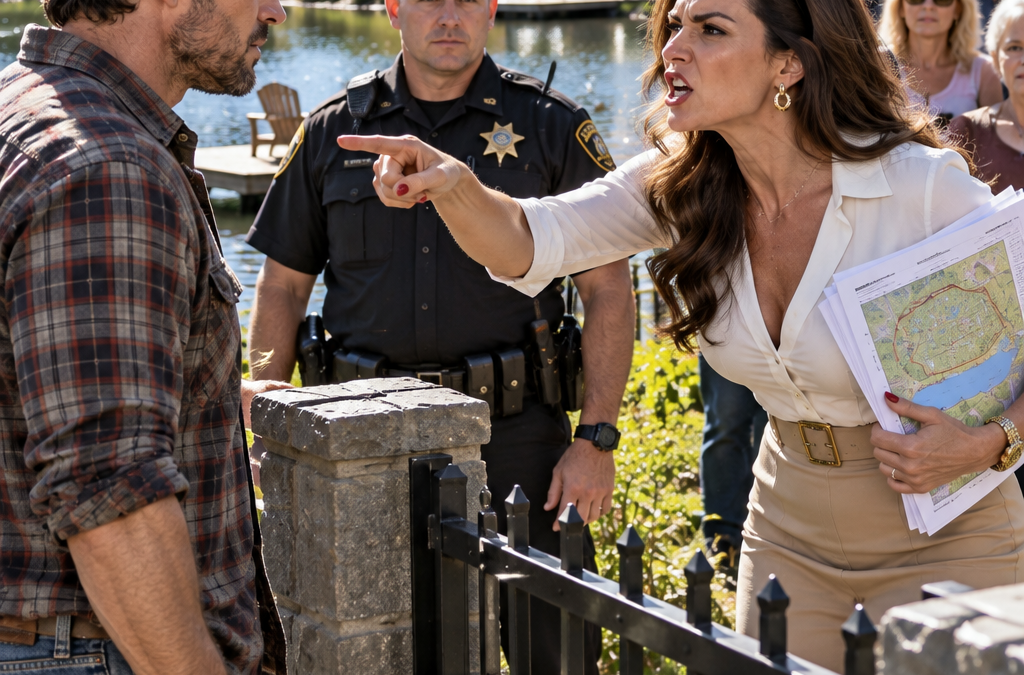
Karen stood on my land with a crowd behind her and told the sheriff to arrest me for trespassing beside the pond my grandfather dug by hand.
She had a fake HOA map, a perfect smile, and the kind of confidence only a liar gets when people stop asking for proof.
What she did not have was my deed, my survey, or sixty years of family history buried in that soil.
The pond was never just water to me.
That is the first thing people need to understand.
To strangers, it probably looked like a pretty little country pond sitting behind an old house, shaded by maples and ringed with grass that grew wild if I did not cut it every week. To the newer residents of Tyrant Estates, it looked like an amenity they had somehow been denied. To the HOA board, eventually, it became a line item on a fake map, a label, a “recreation area,” something they could point to and claim because paper made lies look official.
But to me, it was family.
My grandfather dug that pond before the subdivision existed, before the paved streets, before the matching mailboxes, before the decorative entrance sign with flowers changed out every season by people who argued about mulch color like it was foreign policy. Back then, the whole area was farmland and woods. My grandfather bought twelve acres with money he had saved doing work that bent his back and roughened his hands. He built a modest house, planted trees, raised my father, and when he wanted a pond, he did what men like him did back then.
He figured it out.
He rented equipment, called in favors from neighbors, spent weekends covered in mud, and carved that pond into the earth one stubborn decision at a time. My father learned to fish there. I learned to fish there. My children caught their first bluegill from the north bank, barefoot and squealing like they had landed sharks.
Birthdays happened there. Fourth of July cookouts. Summer evenings with citronella candles and folding chairs. Quiet mornings after funerals when nobody knew what to say, so we sat by the water and let silence do the talking.
When my grandfather passed, my father inherited the land. When my father passed, it became mine.
I never once thought I would have to prove it.
For most of my life, the property sat peacefully in the middle of change. About twenty years before everything went sideways, a developer bought the farmland surrounding us and built a subdivision. They approached my father more than once, trying to buy our land too. He refused every offer.
“They don’t want the land,” he told me once. “They want the story off it.”
I was younger then and did not understand what he meant.
Now I do.
Developers like clean maps. Straight borders. Shared amenities. Things they can name, package, and sell. My family’s property was inconvenient because it did not fit. So they built around us, and our house became an island in the middle of Tyrant Estates.
We were not part of the HOA.
We never signed covenants. We never paid dues. We never gave them access rights. We had our own deed, our own driveway, our own land, and our own pond.
For years, everyone understood that.
The original homeowners knew the history. Some had known my father personally. A few were invited to fish at the pond from time to time. They asked permission. They respected the fence line. If their kids wandered too close, they apologized and called them back. It was never an issue.
Then the old residents started moving away.
New people came in.
And new people, I learned, believe maps faster than memories.
The first trespasser seemed harmless enough. It was a Saturday afternoon about three years before the court case, warm and bright, the kind of day when the pond looked like it had been poured out of the sky. I walked down from the house expecting to check the dock boards and found a family spread out on blankets near the water.
Cooler. Sandwiches. Two little kids throwing bread crusts at fish.
I stopped about twenty feet away.
“Afternoon,” I said.
The father looked up, smiling like we were both where we belonged.
“Hey.”
“I’m sorry, but this is private property.”
His smile faded. “What?”
“This land. The pond. It’s private.”
He frowned at me like I had spoken in a language he almost understood.
“No, it isn’t. This is the HOA pond area.”
I almost laughed because the phrase sounded so absurd.
“No,” I said. “It’s my pond.”
His wife sat up. “The community map says this is a recreation area.”
That was the first time I heard about the map.
I should have gone straight to the county office that day.
Instead, I explained the property line. I pointed toward the markers. I told them my family owned the land long before the subdivision existed. They grumbled, packed slowly, and left with the offended energy of people who had been denied something they had already decided was theirs.
I thought that would be the end of it.
It was only the beginning.
PART 2
Over the next couple of years, strangers kept appearing.
Teenagers came to swim. Dog walkers cut through the back field. Families brought fishing rods and folding chairs. Twice, I found beer cans near the shore. Once, I found fishing line tangled around a low branch where one of my kids used to climb.
Every time, I tried to stay calm.
“Private property.”
“You need permission.”
“This is not HOA land.”
Most people argued.
Some rolled their eyes. Some insisted I was wrong. Some told me the HOA president had said residents were allowed to use the pond. A few acted as if I were stealing from them by asking them to leave.
That was when Karen entered the story.
Karen Delaney had become HOA president about six months before I attended my first meeting. I knew of her before I met her. Everyone did. She was around forty-two, maybe forty-three, but she carried herself like she believed age was something that happened to women with less money. Long caramel-brown hair, smooth skin, bright eyes, perfect nails, and a body she dressed like a weapon. She wore fitted blazers and pencil skirts to HOA meetings, tight tennis dresses to community events, and a white SUV polished so clean it looked allergic to dust.
She was beautiful.
She was also poison with lip gloss.
Karen had the kind of charm that worked best on people who wanted to be charmed. She touched men lightly on the arm when she wanted agreement. She tilted her head and softened her voice when pretending to listen. She called older women “sweetheart” in a way that sounded affectionate until you noticed the insult tucked inside it. If challenged, she could turn icy in half a second.
People said she got things done.
What they meant was that she got people afraid to say no.
The first time I saw her in person, she was sitting at the front of the community clubhouse behind a long table with the rest of the HOA board. I had decided to attend because I was tired of chasing strangers off my property and wanted to understand why they believed they had a right to be there.
The meeting room was packed with folding chairs. About thirty residents had shown up. I sat in the back, arms crossed, trying not to look as angry as I felt.
Karen ran the meeting like a courtroom where she was judge, prosecutor, and star witness. Landscaping contracts. Parking violations. A complaint about a blue front door that was apparently too blue. She moved through each item quickly, cutting people off whenever they spoke too long.
Then she reached new business.
“As many of you know,” Karen said, folding her hands neatly on the table, “we’ve had ongoing issues with the resident on Tyrant Lane who has been harassing community members near our pond recreation area.”
My blood went cold.
Our pond.
A woman in the front row raised her hand. “My son tried to fish there last week, and that man came out screaming at him. He said he owns the pond.”
“I do own it,” I said from the back.
Every head turned.
Karen’s eyes found me. For one second, her smile remained in place, bright and controlled. Then her expression hardened.
“And you are?”
“The owner of the property you’re discussing.”
A murmur went through the room.
I stood. “The pond is on my land. My family has owned it for more than sixty years.”
Karen gave a small laugh, the kind meant to make the room relax at my expense.
“I understand that there may be some confusion.”
“There is no confusion.”
Her eyebrows rose. “Sir, please don’t interrupt.”
“You’re telling people my pond belongs to the HOA.”
She picked up a folder from the table and opened it with theatrical patience.
“The community maps clearly identify the pond as Tyrant Estates common recreation space.”
“Then your maps are wrong.”
Her smile sharpened. “That’s a serious accusation.”
“So is claiming my land.”
An older man on the board leaned toward his microphone. “Maybe we should have our attorney review—”
“I already have,” Karen said quickly.
He looked surprised.
She turned back to me. “Our documents were reviewed. The pond area was included in the original development plan.”
“My father refused to sell that land.”
“Perhaps you misunderstood the extent of what was transferred.”
I felt heat crawl up my neck.
“My father understood his own property.”
Karen’s eyes flashed.
She was not used to being contradicted in public, and definitely not by someone who was not under her control.
“Sir,” she said, voice tightening, “if you cannot remain civil, I will ask you to leave.”
I laughed once, because if I had not, I might have shouted.
“Civil? You’re accusing me of trespassing on land my grandfather dug with his own hands.”
A few residents shifted uncomfortably.
Karen noticed. She leaned forward, letting her voice soften.
“I appreciate that this may be emotional for you. Family stories can feel very real. But our association cannot operate based on sentimental claims. We operate based on documentation.”
“Then get a survey.”
“We have maps.”
“Get a licensed survey.”
“That won’t be necessary.”
“Because you’re afraid of what it will show?”
Her face flushed.
There it was. A crack in the polished surface.
She closed the folder.
“We’re moving on.”
Just like that, she tried to erase me from the room.
I stood there for a second longer, looking at the residents who had been told I was the problem. Some looked skeptical. Some looked annoyed. A few looked embarrassed. Karen looked triumphant.
I left before I said something that could be used against me.
The next morning, I went to the county recorder’s office.
I spent hours pulling every document tied to my property and the Tyrant Estates development. Deeds. plats. transfers. boundary descriptions. Historical records. Anything I could find.
What I found made me angrier than the meeting had.
My deed was clear. My family’s ownership was continuous. The twelve acres, including the pond, had never been sold, transferred, or absorbed into the subdivision. The developer had approached my father. My father had refused. That should have been the end of it.
But the HOA maps told a different story.
Somehow, in the development materials given to homeowners, my land had been drawn into the community. The pond was labeled as a recreation area. Not vaguely. Not accidentally on the edge. Clearly. Boldly. As if drawing it made it true.
I sat in my truck outside the county office with copies on the passenger seat and my hands gripping the steering wheel.
My father had been right.
They had wanted the story off the land.
When they could not buy it, someone had redrawn it.
I hired a real estate attorney named Angela Price.
Angela was in her late forties, calm, sharp, and immune to nonsense in a way that made me trust her immediately. Her office smelled like old paper and coffee. She read through the documents slowly while I sat across from her, waiting for the professional version of what I already knew.
Finally, she leaned back.
“Your deed is clean,” she said.
I exhaled for what felt like the first time all day.
“And the HOA map?”
“Worthless against county records. But dangerous if people are relying on it.”
“Can they take the pond?”
“No,” she said. “Not legally.”
That word mattered.
Because illegally, they were already trying.
Angela recommended an updated licensed survey to remove any possible doubt. I hired a surveyor that week. He came out with GPS equipment, reference maps, stakes, and the patient energy of a man who had seen property disputes ruin Thanksgiving dinners.
He spent a full day walking the land.
When he finished, the result was exactly what my family had always known.
The pond was entirely on my property.
In fact, there was a buffer strip between my boundary and the nearest actual HOA common area. Their claim was not a matter of a few disputed feet. It was fiction.
Angela sent a certified letter to the HOA board. The letter included my deed, county records, and the new survey. It demanded that the HOA correct its records, notify residents that the pond was private property, stop encouraging access, and cease claiming ownership.
Two weeks later, the HOA attorney responded.
They rejected everything.
Their letter claimed the HOA documents were valid, suggested my survey was flawed, and warned that if I continued preventing residents from accessing the pond, the HOA might take legal action against me.
Angela smiled when she read it.
Not a happy smile.
A predator smile.
“They’re building our case for us,” she said.
“They’re threatening to sue me over my own land.”
“Yes. In writing.”
She sent another letter, stronger this time. Cease and desist. Slander of title. Trespass. Interference with property rights. The words were legal, but the meaning was simple.
Stop lying about my land.
Karen did not stop.
If anything, she escalated.
Residents began showing up more often, and they were bolder. Some told me they had received HOA emails assuring them that the pond belonged to the community. One man waved a printed map in my face and told me I had “no right to privatize shared amenities.” A woman accused me of scaring children. A teenager told me his parents paid dues, so he could swim wherever he wanted.
Every confrontation stole a little more peace from the place.
I started carrying a folder of documents to the porch. I posted private property signs. I installed cameras along the most common access points. I hated all of it.
The pond had once been where I went to breathe.
Now I walked toward it bracing for a fight.
The incident that pushed everything over the edge happened on a Saturday morning in late spring.
The air was soft and clear. The water was still. I had woken early, made coffee, and decided I was going fishing whether Karen liked it or not. I grabbed my rod, tackle box, and an old folding chair that had belonged to my father. Then I walked down to the north shore, where the bank sloped gently and bass liked to hide near the reeds.
For twenty minutes, everything felt normal.
Line in the water. Sun on my shoulders. Frogs starting up somewhere near the far side. The faint smell of wet grass and mud.
Then I heard voices.
A group of about eight people came walking across my field like they owned it. Coolers. folding chairs. beach towels. fishing gear. A man in front wore mirrored sunglasses and had the aggressive stride of someone who had rehearsed being right. Beside him was a woman already holding her phone.
I set down my rod and walked toward them.
“Morning,” I said. “This is private property. You can’t be here.”
The man stopped and folded his arms.
“Here we go again.”
“Excuse me?”
“We know about you,” he said. “The HOA sent an email.”
Of course they had.
The woman lifted her chin. “You’ve been harassing residents.”
“I’ve been removing trespassers.”
“This pond belongs to all of us,” the man said.
“No,” I replied. “It belongs to me.”
He scoffed. “You people are unbelievable.”
I almost asked what he meant by you people, but I already had enough problems.
“I have a deed and a licensed survey,” I said, keeping my voice level. “You need to leave.”
The woman raised her phone higher.
“I’m calling the police.”
“Please do.”
She blinked, clearly expecting panic.
“I’d love for them to settle this,” I said.
She called.
I stood there listening while she told the 911 operator that a man was threatening her family and blocking access to a public HOA recreation area. She said I was acting unstable. She said I was fishing illegally. She said they feared for their safety.
I stared at her in disbelief.
She did not look ashamed.
That scared me more than the lie itself.
People who lie with shame can sometimes be reached. People who lie with righteousness are dangerous.
A sheriff’s deputy arrived about fifteen minutes later.
He stepped out of his patrol car and took in the scene: me on one side, eight residents on the other, coolers and fishing rods between us like evidence in the world’s dumbest trial.
“What’s going on?” he asked.
Everyone started talking at once.
He raised both hands. “One at a time. Ma’am, you called?”
The woman launched into her story. I had threatened them. I had blocked them. I had no right to be there. The pond belonged to the HOA. I was unstable. Dangerous. Harassing families.
When she finished, the deputy turned to me.
“Sir?”
“This is my property,” I said. “The pond is on my land. They are trespassing. I asked them to leave. I did not threaten anyone.”
The deputy looked from me to them. “This isn’t community property?”
“No.”
The man in sunglasses stepped forward. “Officer, we have official HOA documentation.”
The deputy sighed. “I’m not a property court.”
“I have my deed and survey at the house,” I said. “You’re welcome to look.”
The residents insisted on coming too, as if I might forge documents during the walk.
I led everyone up to the house and retrieved the folder Angela had told me to keep ready. The deputy studied the deed, the survey, and the county records on my porch. He was not a lawyer, but he could read a boundary line.
After a few minutes, he looked up.
“These appear legitimate,” he said.
The woman grabbed for the survey.
“This has to be fake.”
The deputy pulled it back before she could take it.
“Ma’am, don’t.”
“But the HOA president said—”
“I understand what she said. Based on what I’m looking at, this gentleman has documentation showing the pond is on his property. Until a court says otherwise, I’m going to ask you folks to leave.”
The man in sunglasses turned red.
“This is outrageous.”
The deputy looked tired. “You can take that up with your HOA. Right now, leave the property.”
They left, muttering and glaring.
The deputy apologized before he drove off.
I appreciated that.
But I also knew apologies would not stop Karen.
Three days later, a landscaping truck pulled onto my land.
Two workers got out near the pond with mowers, trimmers, and gas cans. I saw them from the kitchen window and ran outside.
“Hey!” I shouted. “What are you doing?”
The man in charge looked down at a clipboard.
“Maintenance work.”
“For who?”
“Tyrant Estates HOA. Common pond area.”
I laughed once, sharp and humorless.
“This is not HOA property.”
He looked uncomfortable. “The lady said you might say that.”
“The lady is lying.”
He grimaced. “Look, man, I’m just doing a job.”
“No. You’re about to trespass and damage private property.”
That got his attention.
I brought out the folder. I showed him the survey. I showed him the deed. To his credit, he did what Karen had refused to do.
He looked.
Then he called her.
I could hear Karen yelling through the phone from ten feet away.
Her voice was high, furious, unmistakable.
The landscaper held the phone away from his ear and said, “Ma’am, I’m not getting in the middle of a property dispute.”
More yelling.
He glanced at me, then said, “No, ma’am. Not without proof.”
He hung up.
“She wants us to proceed,” he said.
“You going to?”
“Nope. This is above my pay grade.”
The crew packed up and left.
I called Angela immediately.
“That’s it,” she said. “We file.”
The lawsuit went in shortly after.
Trespass. Harassment. Interference with property rights. Slander of title because the HOA was falsely claiming ownership of my land and putting it in official communications. We also filed a complaint demanding correction of the development maps.
The HOA was served.
Karen did not react like a reasonable person facing legal exposure.
She reacted like a queen whose servant had dropped a plate.
According to a sympathetic neighbor named Denise, Karen raged through the next board meeting, calling me unstable, greedy, delusional, and dangerous. She claimed I was trying to “steal community resources.” She said the HOA needed to “take decisive action.”
Decisive action came the following weekend.
I was sitting on my back porch near sunset when I saw people moving across the far field.
At first, I thought it was another family.
Then I realized there were too many.
Fifteen, maybe twenty residents walked toward the pond in a loose group, carrying chairs, bags, fishing rods, and coolers. At the front was Karen.
She wore white.
White fitted pants, white blouse, gold belt, sunglasses pushed into her hair. She looked like she had dressed for a yacht club lunch, not mass trespassing. The sinking sun lit her from behind, giving her an almost angelic glow, which would have been funny if I had not been so furious.
I walked down to meet them at the property line.
“Stop right there.”
Karen smiled.
Not kindly.
Triumphantly.
“We are taking back what belongs to the community.”
“You are trespassing.”
“The board voted unanimously to authorize resident access to the Pond Recreation Area.”
“You mean my pond.”
She stepped closer. Her perfume reached me before she did, sweet and expensive.
“You have bullied these residents long enough.”
I looked behind her at the crowd. Some looked determined. Some looked uneasy. A few children ran ahead toward the shore until I raised my voice.
“No one goes near the water.”
Karen’s smile widened.
“Or what?”
I pulled out my phone. “Or I call the police.”
“Please do,” she said. “We’ll show them our maps.”
She said maps the way a priest might say scripture.
While we waited, residents spread out along the pond despite my warnings. A few set up chairs. One man cast a line into my water. Kids ran near the bank. My hands shook with anger so intense it became hard to think clearly.
Karen stood beside me, arms folded, watching them like a general surveying captured territory.
“You really believe this,” I said quietly.
She glanced at me. “Because it’s true.”
“No. Because you need it to be true.”
Her eyes slid toward mine.
“You’re not special because your grandfather owned a farm.”
I felt that one land.
She saw it and smiled.
“Communities evolve,” she said. “Land use changes. One stubborn man doesn’t get to hold an entire neighborhood hostage because he has sentimental attachment to a pond.”
“That pond was never yours.”
“It should have been.”
There it was.
The truth beneath all the paperwork.
Not ownership.
Entitlement.
The deputies arrived in two vehicles this time. One was the same deputy from the earlier call. His expression changed when he saw me.
Not annoyance at me.
Recognition of a problem that had grown legs.
Karen marched toward him with a folder in hand.
“Officers, thank God. This man has been illegally claiming HOA property and harassing residents. We’re requesting that he be arrested for trespassing and interfering with lawful community access.”
I almost laughed.
She wanted me arrested on my own land.
The deputy looked at her folder, then at the crowd on my pond bank.
“Ma’am,” he said, “I was here a few days ago. He showed documentation that this pond is on his property.”
“Those documents are fraudulent.”
Karen said it instantly, confidently.
The deputy’s eyes narrowed.
“Do you have a court order saying that?”
“We have official HOA maps.”
“That’s not what I asked.”
I stepped forward. “There’s an active lawsuit now. My attorney has already filed over the HOA claiming my property.”
Karen snapped, “Frivolous lawsuit.”
I looked at the deputy. “The county has also been asked to correct the development maps.”
Karen turned on me. “Because you’re manipulating records.”
“My deed predates your subdivision by decades.”
“Your deed is fake.”
That was the moment she went too far, even for some of the residents behind her.
A murmur moved through the group.
The deputy heard it too.
“Ma’am,” he said, voice firm now, “I need you and everyone here to leave this property.”
Karen stared at him.
“No.”
The whole field seemed to go still.
The deputy took one step closer.
“Ma’am, if you refuse to leave private property after being told to do so, you can be arrested for trespassing.”
Her eyes widened.
“You cannot be serious.”
“I am completely serious.”
“I am the president of the HOA.”
“That doesn’t mean anything on his property.”
Her face turned red. “This is community land.”
“Then prove it in court. Today, you need to leave.”
For a long moment, I thought she would force him to arrest her.
Part of me wanted it.
A larger part wanted everyone gone.
Finally, Karen turned toward the residents.
“We’re leaving for now,” she announced. “This is not over.”
People packed quickly. They avoided my eyes. The man who had cast into my pond reeled in without a word. Children were gathered. Chairs folded. Coolers lifted.
Karen walked past me last.
Her face was no longer pretty in that moment. Beauty requires control, and hers was gone. What remained was hatred.
“You’re going to lose everything,” she whispered.
“No,” I said. “I’m going to prove what was always mine.”
She left.
I sat by the pond after everyone was gone, long after the deputies drove away. The water had settled again, but I had not. My father’s old chair sat near the bank. A stranger’s footprint marked the mud beside it.
For the first time in my life, the pond did not feel peaceful.
It felt invaded.
A few days later, the HOA countersued.
Their attorney claimed I had fraudulently acquired title to community property, harassed residents, blocked lawful access, and owed back dues for the years I had supposedly “occupied” HOA land.
Back dues.
For my grandfather’s pond.
I forwarded the letter to Angela.
She called me ten minutes later.
“This is good,” she said.
“I’m being sued for my own land.”
“I know. And they put their bad faith in writing.”
The legal process was slow, expensive, and exhausting. There were depositions. Records requests. Historical document reviews. Survey comparisons. Arguments over maps that had no legal weight but somehow had caused years of trespassing.
Angela subpoenaed original development records.
That was where the case truly turned.
The developer had indeed approached my father. There were notes. Offer letters. Rejections. My father’s refusal was documented more than once. But later draft maps still showed our land blended into the development plan. Someone had redrawn the boundaries after failing to buy the property.
Whether it was deliberate fraud or reckless arrogance hardly mattered by then.
It was false.
And the HOA, after being informed repeatedly, had continued acting on it.
By the time we got to trial, Karen looked different.
She still dressed beautifully, of course. Dark green dress, tailored jacket, gold earrings, hair in soft waves. But stress had sharpened her. Her smile came too fast and vanished too quickly. She avoided looking at me unless people were watching.
The courtroom was not packed, but several residents came. Denise was there. So was the man in sunglasses from the first 911 call, looking much less confident. A couple of board members sat behind Karen like they wished they had resigned earlier.
Angela presented our case with calm precision.
My grandfather’s purchase.
Continuous family ownership.
My father’s refusal to sell.
County records.
Licensed survey.
Developer documents.
HOA communications.
Trespass incidents.
The false claims.
The letters.
The countersuit.
Piece by piece, she rebuilt reality in front of the judge.
The HOA attorney tried to argue that the community maps reflected “intended common use” and that residents had relied on them in good faith. He suggested the issue was a misunderstanding caused by historical inconsistencies.
Angela stood.
“Your Honor, my client’s deed is not inconsistent. The county records are not inconsistent. The survey is not inconsistent. The only inconsistent documents are internal HOA materials created by a developer who never owned the land they labeled as common area.”
The judge looked at the HOA attorney.
“Are you arguing that an internal community map overrides recorded title?”
The attorney hesitated.
Karen leaned forward, whispering harshly.
The judge noticed.
The attorney cleared his throat. “We’re arguing that the association and its residents relied—”
“I understand reliance,” the judge said. “I’m asking about ownership.”
The attorney had no good answer.
Because there was none.
Karen testified too.
That was the part I had both dreaded and anticipated.
She walked to the stand like she was stepping onto a stage. Under questioning from her own attorney, she presented herself as a diligent board president trying to protect community access and resolve confusion. She spoke about families, fairness, amenities, and resident expectations. She made herself sound almost noble.
Then Angela cross-examined her.
“Ms. Delaney, when did you first become aware that my client claimed ownership of the pond?”
Karen smiled lightly. “He began making that claim publicly at an HOA meeting.”
“Before that meeting, had you reviewed the county deed records?”
“I reviewed HOA documentation.”
“That wasn’t my question.”
Karen’s smile tightened. “No.”
“Had you ordered a licensed survey?”
“No.”
“After my client provided a deed and survey, did you correct the residents?”
“I did not believe his documents were valid.”
“Based on what?”
“Our maps.”
“Maps created by the developer?”
“Yes.”
“A developer who never purchased my client’s land?”
Karen’s jaw tightened.
“I was not aware of that at the time.”
“You were made aware before you led a group of residents onto his property, correct?”
Her eyes flicked toward the judge.
“I was aware of his claims.”
“You were aware of his recorded deed.”
“I had concerns about authenticity.”
“Did you have evidence it was fake?”
“No.”
“Did you tell residents it was fake?”
Karen hesitated.
Angela waited.
The silence lengthened.
Finally, Karen said, “I may have expressed concern.”
Angela lifted a printed email.
“Did you write, quote, ‘Do not be intimidated by his fraudulent paperwork’?”
Karen’s face paled slightly.
“Yes, but—”
“Thank you.”
That was the moment I knew we were going to win.
Not because the law had suddenly changed.
Because Karen had finally been forced to answer questions from someone she could not bully, charm, or interrupt.
The judgment came down decisively.
The court ruled that my family owned the land and had always owned it. The pond was private property. The HOA had no access rights. Their maps did not override county records. Their continued claims after receiving proof had been made in bad faith.
The HOA was ordered to pay damages for trespass and harassment, my legal fees, and punitive damages tied to their conduct after being informed of the truth.
The amount was not lottery money.
But it hurt them.
More importantly, the court ordered the HOA to issue a written retraction to every resident stating clearly that the pond and surrounding land were private property and that no resident had any right to access it without my permission. The county records were ordered corrected to eliminate the false designation from development materials.
Karen resigned the next day.
Not gracefully.
According to Denise, she sent a furious email blaming the board, the developer, residents who failed to support her, the court, my attorney, and me. She did not blame herself. People like Karen rarely place blame where it can see them back.
Within a few months, her house was listed for sale.
She moved before the end of the year.
I saw her once during that time, at the grocery store. She was standing near the produce, looking flawless in a cream sweater and fitted jeans, sunglasses resting on her head despite being indoors. For a moment, we made eye contact.
I expected anger.
Instead, she smiled.
Small. Cold. Almost flirtatious in the old manipulative way.
“You must be proud,” she said.
I looked at her for a long moment.
“I’m relieved.”
Her smile faltered.
That bothered her more than pride would have.
Pride would mean she still mattered as an opponent. Relief meant she had become a storm that finally passed.
She stepped closer, lowering her voice.
“You turned an entire community against me over a pond.”
“No, Karen. You did that when you tried to steal it.”
Her eyes hardened.
“You’re a selfish man.”
“Maybe.”
I picked up a bag of apples.
“But I’m a selfish man with a deed.”
I walked away before she could answer.
The pond is quiet again now.
That did not happen immediately. For a while, I still looked up whenever I heard voices. I still checked cameras too often. I still felt my shoulders tighten when I saw someone walking near the property line. Legal victory does not instantly restore peace. Sometimes it only gives peace permission to return slowly.
But it did return.
One morning after the judgment, I took my father’s old chair back to the north bank. The grass was damp. Mist hung over the water. A heron lifted from the far shore, slow and silent. I cast my line and listened to it whisper out across the surface.
No strangers.
No coolers.
No HOA maps.
No Karen.
Just water.
Just land.
Just the place my grandfather made.
I sat there for hours.
I caught two bass and threw them both back. My father always said the pond gave more if you did not take every gift it offered. I used to think that was about fish. Maybe it was about more.
Later that summer, I invited a few neighbors over.
Not the ones who trespassed. Not the ones who called 911. People who had apologized. People who had admitted they were misled. Denise came with her husband. Margaret from two streets over brought lemonade. Even the man with sunglasses eventually wrote me a letter. It was awkward, but it was an apology, and I accepted it.
I did not open the pond to the HOA.
I never will.
But I did invite people I chose.
That distinction matters.
Permission is not the same as surrender.
The new HOA board put up corrected maps in the clubhouse and sent the court-ordered notice. They also added language telling residents to verify property boundaries before entering any area not clearly marked as common space. It was boring and legalistic and exactly what should have existed from the beginning.
Some people still avoided me, embarrassed by how easily they had believed Karen.
I did not chase them.
Embarrassment can teach people if you let it sit.
My children still fish at the pond when they visit. My oldest daughter brings her husband now. My son says he wants his kids to learn there someday. When he says that, I feel the full weight of what Karen almost disrupted.
Not ownership on paper.
Continuity.
The quiet chain between generations.
My grandfather dug that pond because he wanted his family to have something lasting. My father protected it by refusing to sell. I protected it by refusing to be intimidated by fake maps, pretty lies, and a woman who confused authority with truth.
Karen thought the pond became hers because a developer drew it wrong and she repeated the lie loudly enough.
But land remembers.
County records remember.
Families remember.
And sometimes, when necessary, courts remember too.
Every now and then, someone new moves into Tyrant Estates and wanders too close. It does not happen often anymore. Usually a neighbor corrects them before I have to. Word travels. The pond is private. The owner has paperwork. Do not test him.
I do not love being a neighborhood legend.
But I prefer it to being robbed.
On quiet evenings, I walk the property line. I pass the survey markers the licensed surveyor placed during the dispute. They are small things, easy to miss if you do not know what they mean. To me, they look like anchors.
Here is the line.
Here is the truth.
Here is where someone else’s power ends.
At the pond, I sometimes stop and imagine my grandfather standing there, younger than I ever knew him, boots caked in mud, watching water fill the hole he made. I wonder if he imagined subdivisions. HOA meetings. Lawyers. A woman in white leading residents across his land and calling it community property.
Probably not.
But I think he would understand the fight.
He knew what it meant to hold onto land.
Not because land is everything. It is not. People matter more. Family matters more. Peace matters more.
But sometimes land is where all of those things live.
Karen never understood that. To her, the pond was an amenity. A symbol of control. A pretty feature on a map that made the neighborhood more valuable and her presidency more powerful. She saw water and imagined ownership.
I saw water and remembered my father’s hands guiding mine around a fishing rod.
I remembered my children laughing at bluegill.
I remembered my mother setting paper plates on a picnic table.
I remembered my grandfather’s name on the deed.
That is why I fought.
Not because I hate HOAs, though I admit mine did not improve my opinion of them.
Not because I wanted money.
Not because I wanted to embarrass Karen, though she earned every ounce of humiliation she received.
I fought because a lie had walked onto my land and demanded I move.
And I was done moving.
The last time I heard Karen’s name, Denise told me she had moved two counties away and joined another planned community.
I laughed harder than I expected.
“God help them,” I said.
Denise smiled. “Maybe warn them?”
“No,” I said, looking out over the pond. “Some people have to learn where the lines are.”
The wind moved across the water, soft and silver.
A fish jumped near the reeds.
For the first time in a long while, the sound did not make me look for trespassers.
It just made me smile.
Because the pond was peaceful again.
Because the fake maps were corrected.
Because every resident of Tyrant Estates now knew the truth in writing.
Because Karen had stood on my property and demanded my arrest, and in the end, she was the one who had to leave.
I still fish from the north shore on Saturday mornings.
Same chair. Same tackle box. Same quiet water.
Sometimes I catch something.
Sometimes I do not.
Either way, I sit there beneath the trees, on land my family never sold, beside the pond my grandfather dug, and I feel the kind of peace no HOA board can vote into existence and no fake map can take away.