𝗙𝗨𝗟𝗟 𝗦𝗧𝗢𝗥𝗬 They Built a $120,000 Pool on My Land While I Was Overseas, Then Threatened to Sue Me for Wanting It Gone
𝗙𝗨𝗟𝗟 𝗦𝗧𝗢𝗥𝗬
The air smelled like chlorine, sunscreen, fresh mulch, and money badly spent.
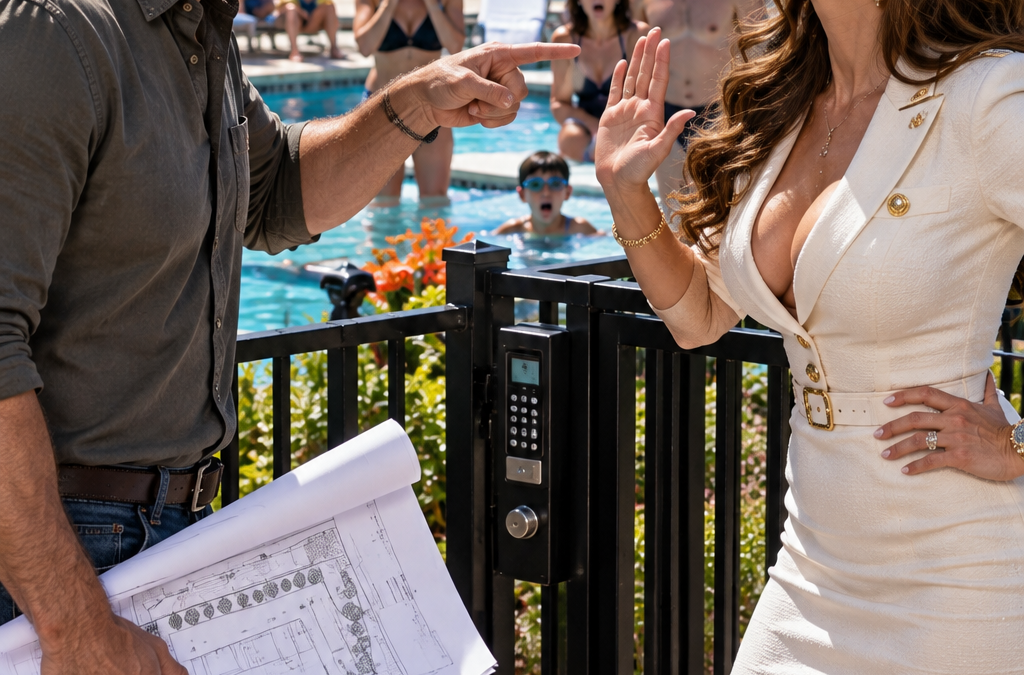
I walked toward the fence they had installed on my property and stopped at the gate. It had a keypad lock. A keypad. On my land.
The man doing laps reached the wall and paused, wiping water from his face.
“Excuse me,” I called.
He looked over, irritated.
“Do you know who authorized this construction?”
He blinked. “What?”
“This pool,” I said. “Who authorized it?”
He frowned like I was interrupting his private resort experience.
“The HOA, I guess. Why?”
“Because this is my property.”
He stared at me.
“This pool is on my land.”
For a second, I saw confusion. Then annoyance replaced it.
“Whatever, man.”
He pushed off the wall and swam away.
A woman in sunglasses turned toward me and whispered something to another woman. Both of them looked at me like I was unstable.
Maybe I looked unstable.
Maybe that was fair.
I went home, dug through my files, and pulled out the property survey.
I spread it across the dining room table with both hands flat on the paper, forcing myself to breathe evenly. I checked the parcel number. The metes and bounds. The location of the gate. The fence line. The survey markers. I compared everything to county maps online.
There was no mistake.
The pool sat well inside my property line.
Not by a foot. Not by a debatable strip. Not by some technical sliver where reasonable people could misunderstand.
They had built an entire community amenity on land they did not own.
My wife stood in the doorway, arms crossed, watching my face.
“How bad is it?” she asked.
“They built a hundred-and-twenty-thousand-dollar lawsuit in the wrong place.”
She closed her eyes. “Oh no.”
“Oh yes.”
I called the HOA office.
The receptionist transferred me twice before I reached the board president.
Her name was Patricia Whitmore, but within ten minutes of talking to her, I knew exactly what kind of Patricia she was.
She had a voice like expensive glass: smooth, polished, and designed to cut without looking sharp. She was the kind of woman who probably considered herself charming because people smiled nervously when she entered a room. Later, I would meet her in person and discover she was in her early forties, beautiful in the weaponized way some people are—dark hair styled in glossy waves, tailored dresses, perfect nails, a figure she knew how to use when she wanted men to soften and women to feel judged. She wore confidence like perfume and authority like jewelry.
On the phone, she sounded delighted with herself before she even knew who I was.
“This is Patricia. How may I help you?”
“My name is Daniel Carter,” I said. “I own the vacant lot on the east side of Briarwood Estates. I just returned from overseas and discovered your HOA has built a swimming pool on my property.”
There was a silence.
Not a confused silence.
A calculating one.
“I’m sorry,” she said at last. “What property are you referring to?”
“The half-acre lot outside your east gate. Parcel ending in 4187. It belonged to my uncle, and now it belongs to me.”
Another pause.
Longer this time.
“I believe there may be some confusion.”
“I agree. Your confusion appears to involve thinking my land is yours.”
Her voice cooled.
“The board approved that area for community use.”
“The board does not own that area.”
“We have documentation.”
“No,” I said. “You may have paperwork. You do not have documentation giving you ownership of my land.”
“Mr. Carter, I do not appreciate your tone.”
“And I don’t appreciate strangers swimming on my property.”
She inhaled softly, the way people do when they are deciding whether to act offended or powerful.
“The association invested a significant amount of money into that amenity.”
“That was a poor decision.”
“We were under the understanding—”
“From who?”
“Excuse me?”
“Who gave you that understanding? My uncle is dead. I never spoke to you. I never signed anything. So who authorized it?”
Patricia’s voice turned syrupy.
“Mr. Carter, I think it would be best if we all took a breath and approached this reasonably.”
Reasonably.
There was a pool on my land.
“I want it removed,” I said.
“That may not be possible.”
“It is very possible. You built it. You can remove it.”
“The residents have already begun using it.”
“That is not my problem.”
“It could become your problem if someone is injured and you are aware of its use.”
That was the first moment I understood she was not merely arrogant.
She was dangerous.
She had taken my property, built an unpermitted structure on it, opened it to residents, and now she was casually trying to slide liability across the table like a dessert menu.
“Let me be very clear,” I said. “You have one week to remove that pool from my property.”
She laughed.
Softly.
Almost flirtatiously.
“Mr. Carter, that is not how things work in a managed community.”
“I’m not in your managed community.”
“You border it.”
“Gravity also borders it. That doesn’t make it subject to your bylaws.”
Her charm vanished.
“I will need to consult the board and our attorney.”
“You should have consulted them before construction.”
“We’ll get back to you.”
“No,” I said. “You’ll get that pool off my land.”
She hung up first.
That was fine.
I had work to do.
I am a civil engineer. I do not say that to brag. I say it because when Patricia decided to build illegally on my land, she accidentally picked a fight with someone trained to notice every unsafe, unpermitted, improperly designed thing she had tried to hide beneath landscaping and lounge chairs.
The next day, I went back to the property with a camera, a tape measure, a notebook, my survey, and a level of anger that had settled into something much more useful than rage.
Rage makes people sloppy.
I needed precision.
I started at the fence.
The barrier did not meet county pool enclosure requirements. The height was wrong in one section. The latch on the gate did not self-close properly. The gap near the bottom was too large in one corner where the ground sloped. Whoever installed it cared more about appearance than compliance.
Then I moved to drainage.
They had graded part of my lot toward the boundary in a way that would redirect storm runoff toward neighboring parcels during heavy rain. The concrete deck had been poured without any visible evidence of proper drainage planning. There were low spots already collecting dirty water near the storage shed.
The pool drain was worse.
Much worse.
I recognized enough from code and safety standards to know that the drain setup was not compliant with federal anti-entrapment requirements. Those rules exist for horrific reasons. Children have died because pool drains were designed or maintained badly. This was not paperwork trivia. This was real safety.
The electrical setup made my stomach turn.
The pump and lighting circuits were installed in a way that raised immediate questions about wet-location protection. I am not a licensed electrician, and I was not going to pretend otherwise, but even from a visual inspection, I could see enough problems to justify calling someone who was.
I took photos of everything.
Wide shots. Close-ups. Measurements. Fence height. Gate latch. Drain cover. Pump equipment. Electrical box. Concrete edges. The storage shed location. The landscaping installed over areas that had not been assessed properly. The sign claiming resident-only access.
Every image went into a folder.
Every observation went into notes.
Then I called the county building department.
“Hi,” I said. “I need to report an unpermitted structure on my property.”
The woman on the phone asked what kind of structure.
“A swimming pool.”
There was a pause.
“On your property?”
“Yes.”
“Was it built by you?”
“No.”
Another pause.
This one was better.
“Sir,” she said carefully, “can you explain?”
“I was out of the country for five months. I came back and found a homeowners association had built a community pool on my lot without permission. I have reason to believe there were no permits pulled, and I’ve identified multiple safety and code concerns.”
This time, she did not pause.
She transferred me to an inspector.
His name was Mr. Hollis, and he sounded like a man who had heard too many dumb things in his career to be easily surprised.
But I surprised him.
“You’re saying an HOA built a pool on land it doesn’t own?”
“Yes.”
“Without permits?”
“As far as I can tell.”
“You checked?”
“I did.”
“And you’re the property owner?”
“Yes.”
He sighed.
Not at me.
At the universe.
“All right,” he said. “I’m going to schedule an inspection.”
“How soon?”
“Given you mentioned public use and possible pool safety violations, I’ll come out tomorrow.”
“Thank you.”
“Don’t thank me yet.”
He arrived the next morning in a county truck, wearing a faded cap and the expression of a man expecting nonsense and finding engineering malpractice instead.
We walked the site together.
I showed him the survey first. Then the pool. Then the fence. Then the gate. Then the drain. Then the pump equipment. He took his own photos. He measured. He crouched. He muttered once under his breath in a way that sounded almost religious.
At one point, he stood near the equipment pad and said, “Who signed off on this?”
“No one, apparently.”
He looked toward the pool, where two teenagers had just arrived with towels over their shoulders.
“Pool is closed,” he called.
They stared at him.
“County inspection. Leave.”
One of them looked annoyed, but they left.
When he finished, Mr. Hollis stood beside his truck and removed his sunglasses.
“This is going to be a formal violation,” he said.
“Against me?”
“You’re the property owner, so the notice goes to you. But the responsible party can be pursued based on evidence. You’ll want an attorney.”
“I have one.”
“Good. This thing either needs to be brought into compliance or removed.”
“I want it removed.”
He looked back at the pool.
“I would too.”
The formal violation notice arrived soon after.
It stated what I needed it to state: unpermitted construction, code violations, required corrective action. It did not solve everything, but it gave me something Patricia could not smile away.
Official paper.
Not HOA paper.
County paper.
I hired an attorney named Rebecca Sloan, who had the kind of calm that made other people’s panic seem inefficient. She reviewed the deed, survey, photos, violation notice, and my notes. Then she leaned back in her chair and said, “This is either one of the most reckless HOA decisions I’ve ever seen, or someone on that board lied to everyone else.”
“Can we make them remove it?”
“Yes.”
“Can they claim they own it because they paid for it?”
“They can claim the moon is made of cheese if they want. The question is whether a judge cares.”
I liked Rebecca immediately.
We sent a certified letter to the HOA.
The letter was direct. The pool, deck, storage shed, fencing, showers, landscaping, equipment, and associated improvements had been constructed on my private property without authorization. The construction was unpermitted and subject to county violation. The HOA had fourteen days to remove all improvements at its own expense and restore the lot. If it failed to do so, I would arrange removal and pursue recovery of all costs, damages, and fees.
Two days later, Patricia called.
She did not bother with charm this time.
“How dare you?” she snapped.
“Good morning to you too.”
“You cannot threaten this community.”
“I’m not threatening the community. I’m telling your association to remove illegal construction from my land.”
“That pool cost us over one hundred and twenty thousand dollars.”
“Then you should have spent a few hundred on a title search.”
“You are being deliberately hostile.”
“I am being very calm.”
“You are trying to destroy a community amenity used by families.”
“No, Patricia. You built that amenity on land you did not own.”
“You left the lot vacant.”
That one actually made me laugh.
Out loud.
For several seconds.
When I stopped, she was breathing hard.
“Vacant does not mean available,” I said.
“It was unused.”
“It was mine.”
“The community has relied on that space.”
“For how long? A few months?”
“You abandoned it.”
“I paid taxes on it.”
“There were understandings about that land before you inherited it.”
I sat up straighter.
“What understandings?”
“With your uncle.”
“My uncle never told me that.”
“Well, perhaps he didn’t tell you everything.”
There it was.
The first hint of the lie that would later bury her.
“If you have a signed agreement from my uncle,” I said, “send it to my attorney.”
She hesitated.
“That may not be necessary.”
“Because it doesn’t exist?”
“You are twisting my words.”
“No. I’m asking for evidence.”
Her voice became low and cold.
“You need to consider how ugly this could become for you.”
“For me?”
“You are one individual,” she said. “We are an association representing hundreds of residents. We have resources. We have counsel. And we will not allow an outsider to bully families out of something they paid for.”
The word outsider hit exactly where she intended.
Patricia did not see my land as my land. She saw it as an inconvenience outside her gate. A loose edge in her perfect community. Something that should have belonged to Briarwood because Briarwood wanted it.
“You have fourteen days,” I said.
“You’ll regret this.”
“I already regret answering the phone.”
Then I hung up.
For the next two weeks, nothing happened.
No demolition crew from the HOA.
No apology.
No proposal to buy the land.
No serious effort to resolve the problem.
Instead, their attorney sent a letter.
Rebecca read it first, then slid it across her desk to me with an expression of professional disgust.
“They’re claiming implied easement,” she said.
I stared at her. “You’re joking.”
“I wish.”
The letter claimed the HOA had developed and maintained the area for community use based on historical understandings and that removing the pool would constitute destruction of association property. It warned that if I interfered with the pool, the HOA would seek damages and injunctive relief.
Rebecca tapped the paper.
“This is weak.”
“How weak?”
“Wet tissue in a hurricane.”
“Can we ignore it?”
“We’ll respond once. Then, if they don’t act, you can proceed. Carefully.”
We responded.
They still did nothing.
So I scheduled a demolition crew.
People later asked why I did not negotiate longer.
Why I did not offer to lease the land.
Why I did not sell it to them.
Why I went “nuclear.”
Here is the answer: because they never came to me like people who had made a mistake.
They came to me like thieves angry that the owner had noticed.
Had Patricia called and said, “We made a terrible error. We need to resolve this. Can we discuss buying or leasing the property?” I would have listened. I might have sold it. I might have negotiated temporary use while they corrected permits and insurance. I might have found a path that did not involve concrete saws and angry residents.
But she threatened me.
She lied about vague understandings with my dead uncle.
She tried to shift liability onto me.
She acted like the money they spent trespassing mattered more than the property rights they violated.
So no, I did not feel obligated to rescue them from the consequences of their own arrogance.
The demolition crew arrived on a Tuesday morning at eight.
I was there at seven-thirty, standing beside my truck with a folder of documents, a camera, bottled water, and a knot in my stomach I refused to acknowledge.
It was one thing to know you were right.
It was another to watch heavy equipment roll up to tear out something families had been using for months.
The crew foreman, a broad man named Luis, looked at the pool, then at me.
“This the one?”
“This is the one.”
“Neighbors going to be a problem?”
“Yes.”
He nodded like that was normal.
“We’ll work safe.”
“Everything gets documented.”
“Already planned.”
They unloaded equipment.
At 8:20, Patricia arrived.
She came in a white SUV so clean it looked allergic to dust. Three other cars followed. Board members. Residents. People in tennis skirts, golf shirts, yoga pants, and outrage.
Patricia got out before her vehicle fully settled.
She wore a fitted red dress, sunglasses, heels entirely wrong for a demolition site, and the expression of a woman who believed reality should pause when she lifted one manicured hand.
“You cannot do this!” she shouted.
The crew kept moving.
I turned toward her.
“Good morning, Patricia.”
“This is illegal.”
“It’s court-adjacent, maybe. But not illegal.”
“I am calling the police.”
“Please do.”
She blinked, clearly disappointed that I was not scared.
“I mean it.”
“I know. You’ve been dramatic very consistently.”
Her mouth opened.
Behind her, residents gathered near the fence.
A man I had never met pointed at me. “Our kids swim here!”
I looked at him. “Not today.”
A woman shouted, “You should be ashamed!”
I did not answer.
Patricia had her phone pressed to her ear now.
“Yes, I need officers immediately,” she said, loudly enough for everyone to hear. “A man is destroying our community pool.”
Luis walked over quietly.
“You want us to stop?”
“No,” I said. “Proceed.”
The first sound of concrete being cut changed the crowd.
Until that moment, I think many of them believed Patricia would somehow stop it. That she would wave a letter, summon police, invoke the magic words HOA property, and the whole operation would freeze. When the saw screamed into the deck, disbelief turned into anger.
People shouted.
Patricia paced.
Someone filmed me.
Someone else filmed the crew.
A child cried, and I hated that part. I really did. Not because I had caused this, but because children do not understand title research, liability, trespass, drainage violations, or board negligence. They just see adults tearing down a place where they had been happy.
That was on Patricia.
I reminded myself of that more than once.
Two patrol officers arrived while the crew was breaking up part of the deck.
Patricia rushed toward them.
“Officers, thank God. This man is destroying our community property.”
One officer looked from her to the pool to the demolition crew to me.
“Sir,” he said, walking over. “Can you explain what’s going on?”
I handed him the folder.
“My name is Daniel Carter. This is my property. The HOA built this pool on my land without permission and without permits. The county issued a violation notice requiring corrective action. I am having the illegal structure removed.”
The officer opened the folder.
Inside were copies of the deed, survey, county violation notice, certified letter, attorney correspondence, and photographs.
His partner came over.
They studied the survey together.
Patricia hovered.
“That is our pool,” she said.
The officer looked at her.
“Do you own the land?”
“The community has used it.”
“That wasn’t my question.”
She flushed.
“The board approved the project.”
“On land you own?”
Patricia’s lips pressed together.
The second officer held up the county notice.
“County says it’s unpermitted and has to be corrected or removed.”
“It’s a civil matter,” Patricia snapped. “He can’t just destroy property.”
The first officer closed the folder and handed it back to me.
“Ma’am, based on what we’re seeing, this appears to be his property, and he has county documentation regarding removal. We’re not going to stop the work.”
Her face went blank.
For the first time, Patricia looked genuinely uncertain.
“But we spent over one hundred thousand dollars.”
The officer’s expression softened slightly, but only slightly.
“You’ll need to address that through civil court.”
“I want him arrested.”
“For what?”
“For vandalism. Destruction of property.”
The officer glanced toward the pool, then back at her.
“Ma’am, you just told me it’s on his land.”
Patricia turned red.
Residents started talking at once.
The officers raised their voices, not shouting, but firm enough to cut through the chaos. Everyone needed to move back. Nobody was to interfere with the crew. Anyone entering the work area could be cited or removed.
That helped.
A little.
But the emotional damage was already unfolding in public.
The pool came apart piece by piece.
The deck broke first. Then fencing. Then equipment. Then the shed. The landscaping was pulled up, the showers removed, the concrete hauled away. The pool itself took the longest. The crew worked carefully, documenting everything, separating materials, taking photos before and after each phase.
I stayed the entire time.
Not because I enjoyed it.
Because I needed a record.
Patricia stayed too, arms folded, jaw tight, sunglasses hiding her eyes. Every so often, she spoke to residents in low tones, no doubt painting herself as a defender of families against an unreasonable outsider. She was good at performance. Even standing beside the ruins of her own bad decision, she found ways to look victimized.
At one point, she walked up to me.
“This will cost you,” she said quietly.
“It already has.”
“You think being technically right makes you untouchable.”
“No,” I said. “I think owning my land gives me the right not to have your pool on it.”
“You’re cruel.”
I looked at the broken concrete, the confused residents, the children being led away by parents who had trusted the wrong board.
“No, Patricia. Cruel is spending community money on a project you had no legal right to build, then letting families believe I’m the villain for removing it.”
Her face hardened.
“You have no idea who you’re dealing with.”
I almost smiled.
“That makes two of us.”
The demolition cost me about eight thousand dollars.
I paid it.
I kept every receipt.
Two weeks later, I was served with a lawsuit.
The HOA sued me for destruction of property and claimed damages over $120,000. They alleged I acted in bad faith. They requested punitive damages. They painted me as a hostile neighboring landowner who had maliciously destroyed a community amenity without pursuing reasonable alternatives.
Rebecca was not surprised.
She skimmed the complaint in her office, made a small sound in her throat, and said, “Good.”
I stared at her.
“Good?”
“They just gave us a beautiful counterclaim.”
“I’m being sued for six figures.”
“And they’re going to regret putting all of this in front of a judge.”
We filed our response.
Then we counterclaimed.
Trespass. Unauthorized construction. Cost of demolition. Attorney’s fees. Damage to my property. Liability exposure. Restoration costs. Bad faith. Anything Rebecca could properly support, she included.
The case dragged on for more than a year.
That is the part people do not see in satisfying stories.
They imagine one dramatic courtroom scene, one perfect speech, one judge slamming a gavel while the villain gasps. Real legal conflict is slower, uglier, and more expensive. It is discovery requests, depositions, emails, invoices, continuances, expert reports, binders, waiting, and more waiting. It is writing checks to your attorney while reminding yourself that surrender would cost something too.
Patricia remained HOA president through most of it.
That still amazes me.
I suppose she controlled the narrative inside Briarwood for a while. She told residents the association had a strong case. She told them my uncle had verbally promised the land for community use. She told them I had blindsided the board. She told them the pool could have been saved if I had not been vindictive.
She did not tell them there was no signed agreement.
She did not tell them no permits had been pulled.
She did not tell them the county found safety violations.
She did not tell them she had pushed the project through without proper title research because she did not want to spend money on lawyers before spending six figures on concrete.
The truth came out slowly.
It always does.
In discovery, we requested documents related to the pool project.
The HOA produced meeting minutes, invoices, emails, internal messages, contractor correspondence, and Patricia’s notes.
Some of it was boring.
Some of it was gold.
There was an email from one board member asking whether they needed to verify ownership of the land beyond the community boundary.
Patricia replied: Don’t overcomplicate this. The area has always been understood as part of our community footprint.
There was another email from the treasurer asking whether legal review was necessary before approving the pool expenditure.
Patricia wrote: Legal will only slow this down and inflate costs. We have enough documentation.
They did not.
There was no documentation.
There were maps with my lot shaded vaguely, printed from old planning materials, none of which transferred ownership. There were references to my uncle, but no agreement, no lease, no easement, no deed, no signature.
During her deposition, Patricia tried to stay polished.
Rebecca told me later she arrived in a cream suit, perfect makeup, perfect hair, perfect posture. She smiled at the court reporter. She charmed the young associate from the HOA’s law firm. She spoke softly and used phrases like “community welfare” and “good faith belief.”
Then Rebecca began asking questions.
“Did you personally verify ownership of the parcel before construction?”
“I relied on board understanding.”
“That was not my question.”
“I relied on available materials.”
“What materials?”
“Community maps.”
“Were those maps legal surveys?”
“I’m not a surveyor.”
“Did you consult one?”
“No.”
“Did you consult an attorney?”
“No.”
“Did you obtain a signed agreement from Mr. Carter?”
“He was overseas.”
“Did you attempt to contact him?”
Patricia hesitated.
“No.”
“Did you have a signed agreement from the prior owner?”
“We had a historical understanding.”
“Do you have a signed agreement from the prior owner?”
“No.”
“Did you tell residents the association had legal rights to the land?”
“I told them what I believed.”
“What you believed or what you knew?”
Rebecca said Patricia did not like that question.
I wish I had seen it.
By the time we finally reached court, the case had become much larger than a demolished pool. It was about arrogance dressed as governance. It was about a private board treating someone else’s property as a community resource because the owner was absent and the land was convenient. It was about what happens when people confuse access with entitlement.
The courtroom was not dramatic in the way television makes courtrooms dramatic.
The judge was patient, technical, and clearly allergic to nonsense.
The HOA argued that the association had invested substantial funds in good faith and that my immediate demolition caused unnecessary harm. Their attorney tried to frame me as unreasonable, hostile, and unwilling to compromise. He talked about children. He talked about community reliance. He talked about the pool as if it had grown naturally from the soil and I had come along with a bulldozer out of spite.
Rebecca stood and dismantled that story one document at a time.
She showed the deed.
She showed the survey.
She showed the county violation notice.
She showed the lack of permits.
She showed the emails where Patricia brushed aside title concerns.
She showed the certified letter giving them two weeks to remove the structure.
She showed their attorney’s threat letter claiming implied easement with no legal foundation.
She showed the demolition invoices.
She showed photographs of the safety problems.
Then she said, calmly, “Your Honor, the association’s argument is essentially that spending money on trespass should create rights against the landowner. That is not the law.”
I looked at Patricia when she said it.
Patricia was sitting at the HOA table in a dark dress, lips tight, eyes fixed forward. She looked beautiful even then, but no amount of beauty could soften the documents stacked against her. For once, charm had no jurisdiction.
The written judgment came later.
Dry. Technical. Almost boring.
Perfect.
The court found that the HOA had trespassed. The construction was unauthorized. The pool violated county code. My actions in removing the structure after notice and official violation were legally justified. The HOA’s claims were dismissed. My counterclaim was granted.
They had to pay my demolition costs.
They had to pay my attorney’s fees.
They had to pay additional damages.
When Rebecca called to tell me, I was standing in my kitchen, making coffee.
I leaned against the counter and closed my eyes.
Not because I was joyful exactly.
Because the weight was finally coming off.
For more than a year, Patricia’s decision had followed me everywhere. It had lived in attorney emails, court deadlines, invoices, meetings, and the back of my mind at night. Even when I knew I was right, the process had been exhausting.
Now it was over.
Or at least, my part was.
The HOA had its own reckoning.
Once the judgment landed, Briarwood residents finally saw the financial damage in clear terms. Not Patricia’s polished version. Not her community-defender narrative. Actual numbers. Actual findings. Actual legal fees. Actual damages. Actual consequences that would affect dues, reserves, and probably future budgets.
Suddenly, people who had called me cruel began asking different questions.
Who approved the project?
Why was no title search done?
Why were permits not pulled?
Why did Patricia claim the land was available?
Why had the board gambled association money on a lawsuit they were warned they could lose?
The next HOA meeting was apparently chaos.
I did not attend, because I was not a member of the HOA and had no desire to sit in a room full of people deciding whether to blame me or the woman who had actually caused the disaster.
But I heard about it later from the new president.
Patricia tried to defend herself.
Of course she did.
She wore white, I was told, which felt on-brand: innocent, immaculate, untouchable. She stood before the residents and talked about community enhancement, legal ambiguity, aggressive outsiders, and how every board decision carried risk. She tried to make the lawsuit sound like an unavoidable storm instead of a fire she had lit with association money.
Then the treasurer stood up and read the total cost.
That changed the room.
People who can forgive arrogance often struggle to forgive special assessments.
Residents shouted. Board members turned on each other. Someone demanded to know why Patricia had told them my uncle had verbally approved community use when there was no proof. Someone else asked why she had blocked a title review. Parents who had once glared at me during demolition now glared at her for letting their children use an unsafe, unpermitted pool.
By the end of the meeting, the residents voted to remove the entire board.
Including Patricia.
Especially Patricia.
I did not see her walk out, but I imagined it clearly: chin high, lips pressed together, heels striking the floor, still convinced that losing power meant everyone else had betrayed her rather than finally noticed her.
Six months later, the new HOA president contacted me.
Her name was Elaine Foster, and unlike Patricia, she did not speak like she was trying to sell me my own patience.
“Mr. Carter,” she said, “I know you probably want nothing to do with us, but I wanted to apologize.”
I was quiet for a moment.
“For what exactly?”
“For the trespass. For the lawsuit. For how the association treated you. For all of it.”
It was the first apology I had received from anyone in Briarwood.
Not a legal strategy.
Not a carefully worded letter.
A human apology.
“Thank you,” I said.
“We’re trying to clean up a lot of messes.”
“I believe that.”
“We wanted to ask whether there is any path forward. Buying the lot, maybe. Or discussing boundaries. We’d like a clean relationship with neighboring property owners.”
A year earlier, maybe I would have considered it.
By then, I was done.
“I appreciate the call,” I said. “But I’m going to sell the property.”
“To whom?”
“A developer, most likely.”
She exhaled softly.
“I understand.”
“I don’t say that to punish anyone. I just want a clean break.”
“After what happened,” she said, “I can’t blame you.”
Selling the lot turned out to be easier than expected.
Ironically, the legal mess made the title more attractive, not less. The boundary had been examined, litigated, documented, and clarified beyond any reasonable argument. A developer made a strong offer. Better than I probably would have gotten before all of this.
I accepted.
When I signed the closing documents, I thought about my uncle.
He had liked quiet land. He liked the idea of potential. He would have been furious that someone tried to take what was his without asking. But I think he also would have laughed at the ending: an HOA trying to steal empty land, losing a lawsuit, getting its board removed, and accidentally helping establish the property’s value.
Some people asked if I felt bad about the families who lost the pool.
The honest answer is yes.
A little.
I am not made of stone. I saw the children crying. I heard the parents yelling. I knew many residents had no idea the pool was illegally built. They paid dues. They trusted their board. They believed the amenity was legitimate because the people in charge told them it was.
But sympathy does not transfer ownership.
Their disappointment did not erase my deed.
Their children’s memories did not create an easement.
Their board’s incompetence did not obligate me to accept liability for an unsafe pool on my land.
That was the part Patricia never understood—or refused to understand.
She believed emotion could replace permission.
She believed money spent could become ownership.
She believed if enough families enjoyed something, the person it had been taken from should feel ashamed for wanting it back.
But property rights do not work only when the trespasser is unsympathetic.
The pool was pretty.
The residents liked it.
Children used it.
None of that changed where it was built.
None of that changed who owned the ground beneath it.
I sometimes think about the first phone call with Patricia. Her pauses. Her careful wording. The way she moved so quickly from confusion to manipulation, from “there’s been some misunderstanding” to “the residents are enjoying it” to “this could become your liability.”
She knew.
Maybe not everything. Maybe not every legal detail. But she knew enough to understand there was a problem, and instead of fixing it, she tried to overpower it.
That was her pattern.
Charm first.
Then pressure.
Then threats.
Then victimhood.
Then blame.
It might have worked on a neighbor worried about social standing. It might have worked on someone without records, without technical knowledge, without the stomach for a long fight. It might have worked if I had come home, seen the pool, felt overwhelmed, and accepted some insulting lease offer just to avoid conflict.
But Patricia had built her lie on land owned by a civil engineer with a survey, a camera, and a very good attorney.
That was her mistake.
Not the first one.
The fatal one.
The last time I saw the lot before selling, the ground was quiet again.
No pool.
No lounge chairs.
No umbrellas.
No sign claiming residents only.
The demolition crew had left it rough, but the restoration work had smoothed it out enough that grass had begun reclaiming the disturbed soil. You could still see where the pool had been if you knew how to look—the slight difference in grade, the newer fill, the places where concrete had once interrupted the land. But to a stranger, it was just an empty lot again.
I stood there for a while.
Briarwood’s gate was visible through the trees. Cars came and went. Somewhere inside, people were probably still arguing about dues and budgets and whether Patricia had truly been responsible or merely misunderstood.
I no longer cared.
That was the peace I had wanted from the beginning.
Not revenge.
Not applause.
Not even the money, though I will admit the payout felt very good.
I wanted the problem off my land.
I wanted the lie exposed.
I wanted the people who caused the damage to carry the cost instead of handing it to me because I happened to be absent when they made their move.
In the end, that happened.
Patricia lost her position. The board was removed. The HOA paid. The lot sold. My wife and I moved on.
Every now and then, someone hears the story and asks what I would do if I could go back.
Would I negotiate?
Would I wait longer?
Would I try to save the pool?
And I always come back to the same answer.
If they had come honestly, I would have listened.
If they had admitted the mistake, I would have talked.
If they had asked instead of threatened, maybe the story would have ended with a sale, a lease, a redesigned legal amenity, or at least a less expensive lesson for everyone involved.
But they did not ask.
They built.
They lied.
They threatened.
They sued.
So I documented, complied with the county, hired professionals, and let the law do what Patricia’s ego refused to do.
Draw the line.
And this time, unlike the boundary she tried to erase, everyone could see it.𝗧𝗛𝗘 𝗘𝗡𝗗
They Built a $120,000 Pool on My Land While I Was Overseas, Then Threatened to Sue Me for Wanting It Gone
I came home expecting jet lag, laundry, and a quiet weekend with my wife.
Instead, I found strangers swimming on my property like I was the trespasser.
I inherited the land from my uncle in 2022.
It was not the kind of inheritance that changed your life overnight. It was not a mansion, a fortune, or some dramatic family estate wrapped in secrets. It was half an acre of vacant land sitting just outside the gates of an upscale residential community on the edge of the county. My uncle had bought it years earlier with vague plans to build a small workshop there, maybe a retirement place, maybe nothing at all. He was like that—always seeing possibility in empty spaces.
When he died, the lot came to me.
At first, I did not know what to do with it.
I already had a house. My wife and I were comfortable where we lived. We did not need a second property, and I did not have some grand dream of building a custom home behind a security gate with ornamental fountains and neighbors who measured success by the symmetry of their hedges. Still, the land was mine. Free and clear. The taxes were manageable. I kept it maintained enough that the county would not complain, and I figured one day I would either sell it, build on it, or hold onto it until the right idea came along.
The lot was positioned in a strange way. It bordered an upscale gated community called Briarwood Estates, though it was not actually part of Briarwood. Their manicured lawns, stone entrance sign, and decorative black fence ran along one side of my property. My land sat just outside their gates, technically independent, legally separate, and according to every survey I had, unquestionably mine.
I am a civil engineer, so property boundaries are not mysterious to me. They are not vibes. They are not neighborhood rumors. They are not whatever a board president thinks they should be after staring at a map from across a conference table. They are lines, recorded and measured, tied to deeds, surveys, pins, and legal descriptions. I understood that better than most people.
That was probably the only reason I did not lose my mind completely when I came home from a five-month overseas work assignment and discovered that someone had treated my land like a suggestion.
I had been in the Middle East on a major infrastructure project, the kind that eats your calendar whole. Long days. Bad sleep. Constant time-zone confusion. Video calls at hours that made no sense. My wife travels often for her own job, so we were used to periods apart, but this assignment had been particularly draining. By the time I boarded the plane home, all I wanted was a shower, my own bed, and food that did not come from an airport lounge.
My wife picked me up from the airport.
I remember the warmth of her hand on my arm in the car, the familiar smell of her perfume, the relief of seeing normal roads and normal signs after months of desert heat and construction-site chaos.
We were halfway home when she said, casually, “Oh, by the way, did you work out some kind of arrangement with the HOA next to your uncle’s lot?”
I turned my head.
“What?”
“The HOA next door,” she said. “Briarwood. Did you let them use the land?”
“No.”
She glanced over, frowning. “You didn’t?”
“No. Why would I?”
“I drove past last week before my Chicago trip, and they had built something there. I tried to call you, but the time difference was awful, and then I figured maybe you had made a deal and forgot to mention it.”
A cold, unpleasant feeling moved through my chest.
“What do you mean, built something?”
She hesitated.
“A pool.”
I actually laughed once, because the words were too absurd to enter my brain any other way.
“A pool?”
“A big one.”
Part 2
The next morning, before I had fully unpacked, before the jet lag had loosened its claws, before I had even finished my second cup of coffee, I drove to the lot.
I kept telling myself there had to be some explanation.
Maybe my wife had mistaken the property line. Maybe the HOA had built near my land, not on it. Maybe there was some easement I had forgotten about, some old paperwork buried in my uncle’s files, some temporary setup for a community event that looked more permanent than it was.
Then I turned onto the access road and saw blue water flashing in the sun.
For a while, I just sat in my truck.
There, on my vacant lot, was a full-size community swimming pool.
Not an above-ground pool. Not a temporary splash area. Not some cheap neighborhood project thrown together with plywood and wishful thinking. This was a professionally constructed pool with a concrete deck, lounge chairs, outdoor showers, a storage shed, landscaping, umbrellas, a fence, and a little sign mounted near the gate that said Briarwood Estates Residents Only.
Residents Only.
On my land.
My hand tightened around the steering wheel until my knuckles went pale.
There were people inside the fenced area. A man doing laps. Two women reclining under umbrellas. Children shrieking in the shallow end while a parent scrolled on a phone. Someone had brought snacks. Someone else had hung towels on the fence. It looked like an ordinary sunny morning at a neighborhood pool, except the entire scene existed inside a place I owned and had never agreed to share.
I got out of the truck slowly.
The air smelled like chlorine, sunscreen, fresh mulch, and money badly spent.
I walked toward the fence they had installed on my property and stopped at the gate. It had a keypad lock. A keypad. On my land.
The man doing laps reached the wall and paused, wiping water from his face.
“Excuse me,” I called.
He looked over, irritated.
“Do you know who authorized this construction?”
He blinked. “What?”
“This pool,” I said. “Who authorized it?”
He frowned like I was interrupting his private resort experience.
“The HOA, I guess. Why?”
“Because this is my property.”
He stared at me.
“This pool is on my land.”
For a second, I saw confusion. Then annoyance replaced it.
“Whatever, man.”
He pushed off the wall and swam away.
A woman in sunglasses turned toward me and whispered something to another woman. Both of them looked at me like I was unstable.
Maybe I looked unstable.
Maybe that was fair.
I went home, dug through my files, and pulled out the property survey.
I spread it across the dining room table with both hands flat on the paper, forcing myself to breathe evenly. I checked the parcel number. The metes and bounds. The location of the gate. The fence line. The survey markers. I compared everything to county maps online.
There was no mistake.
The pool sat well inside my property line.
Not by a foot. Not by a debatable strip. Not by some technical sliver where reasonable people could misunderstand.
They had built an entire community amenity on land they did not own.
My wife stood in the doorway, arms crossed, watching my face.
“How bad is it?” she asked.
“They built a hundred-and-twenty-thousand-dollar lawsuit in the wrong place.”
She closed her eyes. “Oh no.”
“Oh yes.”
I called the HOA office.
The receptionist transferred me twice before I reached the board president.
Her name was Patricia Whitmore, but within ten minutes of talking to her, I knew exactly what kind of Patricia she was.
She had a voice like expensive glass: smooth, polished, and designed to cut without looking sharp. She was the kind of woman who probably considered herself charming because people smiled nervously when she entered a room. Later, I would meet her in person and discover she was in her early forties, beautiful in the weaponized way some people are—dark hair styled in glossy waves, tailored dresses, perfect nails, a figure she knew how to use when she wanted men to soften and women to feel judged. She wore confidence like perfume and authority like jewelry.
On the phone, she sounded delighted with herself before she even knew who I was.
“This is Patricia. How may I help you?”
“My name is Daniel Carter,” I said. “I own the vacant lot on the east side of Briarwood Estates. I just returned from overseas and discovered your HOA has built a swimming pool on my property.”
There was a silence.
Not a confused silence.
A calculating one.
“I’m sorry,” she said at last. “What property are you referring to?”
“The half-acre lot outside your east gate. Parcel ending in 4187. It belonged to my uncle, and now it belongs to me.”
Another pause.
Longer this time.
“I believe there may be some confusion.”
“I agree. Your confusion appears to involve thinking my land is yours.”
Her voice cooled.
“The board approved that area for community use.”
“The board does not own that area.”
“We have documentation.”
“No,” I said. “You may have paperwork. You do not have documentation giving you ownership of my land.”
“Mr. Carter, I do not appreciate your tone.”
“And I don’t appreciate strangers swimming on my property.”
She inhaled softly, the way people do when they are deciding whether to act offended or powerful.
“The association invested a significant amount of money into that amenity.”
“That was a poor decision.”
“We were under the understanding—”
“From who?”
“Excuse me?”
“Who gave you that understanding? My uncle is dead. I never spoke to you. I never signed anything. So who authorized it?”
Patricia’s voice turned syrupy.
“Mr. Carter, I think it would be best if we all took a breath and approached this reasonably.”
Reasonably.
There was a pool on my land.
“I want it removed,” I said.
“That may not be possible.”
“It is very possible. You built it. You can remove it.”
“The residents have already begun using it.”
“That is not my problem.”
“It could become your problem if someone is injured and you are aware of its use.”
That was the first moment I understood she was not merely arrogant.
She was dangerous.
She had taken my property, built an unpermitted structure on it, opened it to residents, and now she was casually trying to slide liability across the table like a dessert menu.
“Let me be very clear,” I said. “You have one week to remove that pool from my property.”
She laughed.
Softly.
Almost flirtatiously.
“Mr. Carter, that is not how things work in a managed community.”
“I’m not in your managed community.”
“You border it.”
“Gravity also borders it. That doesn’t make it subject to your bylaws.”
Her charm vanished.
“I will need to consult the board and our attorney.”
“You should have consulted them before construction.”
“We’ll get back to you.”
“No,” I said. “You’ll get that pool off my land.”
She hung up first.
That was fine.
I had work to do.
I am a civil engineer. I do not say that to brag. I say it because when Patricia decided to build illegally on my land, she accidentally picked a fight with someone trained to notice every unsafe, unpermitted, improperly designed thing she had tried to hide beneath landscaping and lounge chairs.
The next day, I went back to the property with a camera, a tape measure, a notebook, my survey, and a level of anger that had settled into something much more useful than rage.
Rage makes people sloppy.
I needed precision.
I started at the fence.
The barrier did not meet county pool enclosure requirements. The height was wrong in one section. The latch on the gate did not self-close properly. The gap near the bottom was too large in one corner where the ground sloped. Whoever installed it cared more about appearance than compliance.
Then I moved to drainage.
They had graded part of my lot toward the boundary in a way that would redirect storm runoff toward neighboring parcels during heavy rain. The concrete deck had been poured without any visible evidence of proper drainage planning. There were low spots already collecting dirty water near the storage shed.
The pool drain was worse.
Much worse.
I recognized enough from code and safety standards to know that the drain setup was not compliant with federal anti-entrapment requirements. Those rules exist for horrific reasons. Children have died because pool drains were designed or maintained badly. This was not paperwork trivia. This was real safety.
The electrical setup made my stomach turn.
The pump and lighting circuits were installed in a way that raised immediate questions about wet-location protection. I am not a licensed electrician, and I was not going to pretend otherwise, but even from a visual inspection, I could see enough problems to justify calling someone who was.
I took photos of everything.
Wide shots. Close-ups. Measurements. Fence height. Gate latch. Drain cover. Pump equipment. Electrical box. Concrete edges. The storage shed location. The landscaping installed over areas that had not been assessed properly. The sign claiming resident-only access.
Every image went into a folder.
Every observation went into notes.
Then I called the county building department.
“Hi,” I said. “I need to report an unpermitted structure on my property.”
The woman on the phone asked what kind of structure.
“A swimming pool.”
There was a pause.
“On your property?”
“Yes.”
“Was it built by you?”
“No.”
Another pause.
This one was better.
“Sir,” she said carefully, “can you explain?”
“I was out of the country for five months. I came back and found a homeowners association had built a community pool on my lot without permission. I have reason to believe there were no permits pulled, and I’ve identified multiple safety and code concerns.”
This time, she did not pause.
She transferred me to an inspector.
His name was Mr. Hollis, and he sounded like a man who had heard too many dumb things in his career to be easily surprised.
But I surprised him.
“You’re saying an HOA built a pool on land it doesn’t own?”
“Yes.”
“Without permits?”
“As far as I can tell.”
“You checked?”
“I did.”
“And you’re the property owner?”
“Yes.”
He sighed.
Not at me.
At the universe.
“All right,” he said. “I’m going to schedule an inspection.”
“How soon?”
“Given you mentioned public use and possible pool safety violations, I’ll come out tomorrow.”
“Thank you.”
“Don’t thank me yet.”
He arrived the next morning in a county truck, wearing a faded cap and the expression of a man expecting nonsense and finding engineering malpractice instead.
We walked the site together.
I showed him the survey first. Then the pool. Then the fence. Then the gate. Then the drain. Then the pump equipment. He took his own photos. He measured. He crouched. He muttered once under his breath in a way that sounded almost religious.
At one point, he stood near the equipment pad and said, “Who signed off on this?”
“No one, apparently.”
He looked toward the pool, where two teenagers had just arrived with towels over their shoulders.
“Pool is closed,” he called.
They stared at him.
“County inspection. Leave.”
One of them looked annoyed, but they left.
When he finished, Mr. Hollis stood beside his truck and removed his sunglasses.
“This is going to be a formal violation,” he said.
“Against me?”
“You’re the property owner, so the notice goes to you. But the responsible party can be pursued based on evidence. You’ll want an attorney.”
“I have one.”
“Good. This thing either needs to be brought into compliance or removed.”
“I want it removed.”
He looked back at the pool.
“I would too.”
The formal violation notice arrived soon after.
It stated what I needed it to state: unpermitted construction, code violations, required corrective action. It did not solve everything, but it gave me something Patricia could not smile away.
Official paper.
Not HOA paper.
County paper.
I hired an attorney named Rebecca Sloan, who had the kind of calm that made other people’s panic seem inefficient. She reviewed the deed, survey, photos, violation notice, and my notes. Then she leaned back in her chair and said, “This is either one of the most reckless HOA decisions I’ve ever seen, or someone on that board lied to everyone else.”
“Can we make them remove it?”
“Yes.”
“Can they claim they own it because they paid for it?”
“They can claim the moon is made of cheese if they want. The question is whether a judge cares.”
I liked Rebecca immediately.
We sent a certified letter to the HOA.
The letter was direct. The pool, deck, storage shed, fencing, showers, landscaping, equipment, and associated improvements had been constructed on my private property without authorization. The construction was unpermitted and subject to county violation. The HOA had fourteen days to remove all improvements at its own expense and restore the lot. If it failed to do so, I would arrange removal and pursue recovery of all costs, damages, and fees.
Two days later, Patricia called.
She did not bother with charm this time.
“How dare you?” she snapped.
“Good morning to you too.”
“You cannot threaten this community.”
“I’m not threatening the community. I’m telling your association to remove illegal construction from my land.”
“That pool cost us over one hundred and twenty thousand dollars.”
“Then you should have spent a few hundred on a title search.”
“You are being deliberately hostile.”
“I am being very calm.”
“You are trying to destroy a community amenity used by families.”
“No, Patricia. You built that amenity on land you did not own.”
“You left the lot vacant.”
That one actually made me laugh.
Out loud.
For several seconds.
When I stopped, she was breathing hard.
“Vacant does not mean available,” I said.
“It was unused.”
“It was mine.”
“The community has relied on that space.”
“For how long? A few months?”
“You abandoned it.”
“I paid taxes on it.”
“There were understandings about that land before you inherited it.”
I sat up straighter.
“What understandings?”
“With your uncle.”
“My uncle never told me that.”
“Well, perhaps he didn’t tell you everything.”
There it was.
The first hint of the lie that would later bury her.
“If you have a signed agreement from my uncle,” I said, “send it to my attorney.”
She hesitated.
“That may not be necessary.”
“Because it doesn’t exist?”
“You are twisting my words.”
“No. I’m asking for evidence.”
Her voice became low and cold.
“You need to consider how ugly this could become for you.”
“For me?”
“You are one individual,” she said. “We are an association representing hundreds of residents. We have resources. We have counsel. And we will not allow an outsider to bully families out of something they paid for.”
The word outsider hit exactly where she intended.
Patricia did not see my land as my land. She saw it as an inconvenience outside her gate. A loose edge in her perfect community. Something that should have belonged to Briarwood because Briarwood wanted it.
“You have fourteen days,” I said.
“You’ll regret this.”
“I already regret answering the phone.”
Then I hung up.
For the next two weeks, nothing happened.
No demolition crew from the HOA.
No apology.
No proposal to buy the land.
No serious effort to resolve the problem.
Instead, their attorney sent a letter.
Rebecca read it first, then slid it across her desk to me with an expression of professional disgust.
“They’re claiming implied easement,” she said.
I stared at her. “You’re joking.”
“I wish.”
The letter claimed the HOA had developed and maintained the area for community use based on historical understandings and that removing the pool would constitute destruction of association property. It warned that if I interfered with the pool, the HOA would seek damages and injunctive relief.
Rebecca tapped the paper.
“This is weak.”
“How weak?”
“Wet tissue in a hurricane.”
“Can we ignore it?”
“We’ll respond once. Then, if they don’t act, you can proceed. Carefully.”
We responded.
They still did nothing.
So I scheduled a demolition crew.
People later asked why I did not negotiate longer.
Why I did not offer to lease the land.
Why I did not sell it to them.
Why I went “nuclear.”
Here is the answer: because they never came to me like people who had made a mistake.
They came to me like thieves angry that the owner had noticed.
Had Patricia called and said, “We made a terrible error. We need to resolve this. Can we discuss buying or leasing the property?” I would have listened. I might have sold it. I might have negotiated temporary use while they corrected permits and insurance. I might have found a path that did not involve concrete saws and angry residents.
But she threatened me.
She lied about vague understandings with my dead uncle.
She tried to shift liability onto me.
She acted like the money they spent trespassing mattered more than the property rights they violated.
So no, I did not feel obligated to rescue them from the consequences of their own arrogance.
The demolition crew arrived on a Tuesday morning at eight.
I was there at seven-thirty, standing beside my truck with a folder of documents, a camera, bottled water, and a knot in my stomach I refused to acknowledge.
It was one thing to know you were right.
It was another to watch heavy equipment roll up to tear out something families had been using for months.
The crew foreman, a broad man named Luis, looked at the pool, then at me.
“This the one?”
“This is the one.”
“Neighbors going to be a problem?”
“Yes.”
He nodded like that was normal.
“We’ll work safe.”
“Everything gets documented.”
“Already planned.”
They unloaded equipment.
At 8:20, Patricia arrived.
She came in a white SUV so clean it looked allergic to dust. Three other cars followed. Board members. Residents. People in tennis skirts, golf shirts, yoga pants, and outrage.
Patricia got out before her vehicle fully settled.
She wore a fitted red dress, sunglasses, heels entirely wrong for a demolition site, and the expression of a woman who believed reality should pause when she lifted one manicured hand.
“You cannot do this!” she shouted.
The crew kept moving.
I turned toward her.
“Good morning, Patricia.”
“This is illegal.”
“It’s court-adjacent, maybe. But not illegal.”
“I am calling the police.”
“Please do.”
She blinked, clearly disappointed that I was not scared.
“I mean it.”
“I know. You’ve been dramatic very consistently.”
Her mouth opened.
Behind her, residents gathered near the fence.
A man I had never met pointed at me. “Our kids swim here!”
I looked at him. “Not today.”
A woman shouted, “You should be ashamed!”
I did not answer.
Patricia had her phone pressed to her ear now.
“Yes, I need officers immediately,” she said, loudly enough for everyone to hear. “A man is destroying our community pool.”
Luis walked over quietly.
“You want us to stop?”
“No,” I said. “Proceed.”
The first sound of concrete being cut changed the crowd.
Until that moment, I think many of them believed Patricia would somehow stop it. That she would wave a letter, summon police, invoke the magic words HOA property, and the whole operation would freeze. When the saw screamed into the deck, disbelief turned into anger.
People shouted.
Patricia paced.
Someone filmed me.
Someone else filmed the crew.
A child cried, and I hated that part. I really did. Not because I had caused this, but because children do not understand title research, liability, trespass, drainage violations, or board negligence. They just see adults tearing down a place where they had been happy.
That was on Patricia.
I reminded myself of that more than once.
Two patrol officers arrived while the crew was breaking up part of the deck.
Patricia rushed toward them.
“Officers, thank God. This man is destroying our community property.”
One officer looked from her to the pool to the demolition crew to me.
“Sir,” he said, walking over. “Can you explain what’s going on?”
I handed him the folder.
“My name is Daniel Carter. This is my property. The HOA built this pool on my land without permission and without permits. The county issued a violation notice requiring corrective action. I am having the illegal structure removed.”
The officer opened the folder.
Inside were copies of the deed, survey, county violation notice, certified letter, attorney correspondence, and photographs.
His partner came over.
They studied the survey together.
Patricia hovered.
“That is our pool,” she said.
The officer looked at her.
“Do you own the land?”
“The community has used it.”
“That wasn’t my question.”
She flushed.
“The board approved the project.”
“On land you own?”
Patricia’s lips pressed together.
The second officer held up the county notice.
“County says it’s unpermitted and has to be corrected or removed.”
“It’s a civil matter,” Patricia snapped. “He can’t just destroy property.”
The first officer closed the folder and handed it back to me.
“Ma’am, based on what we’re seeing, this appears to be his property, and he has county documentation regarding removal. We’re not going to stop the work.”
Her face went blank.
For the first time, Patricia looked genuinely uncertain.
“But we spent over one hundred thousand dollars.”
The officer’s expression softened slightly, but only slightly.
“You’ll need to address that through civil court.”
“I want him arrested.”
“For what?”
“For vandalism. Destruction of property.”
The officer glanced toward the pool, then back at her.
“Ma’am, you just told me it’s on his land.”
Patricia turned red.
Residents started talking at once.
The officers raised their voices, not shouting, but firm enough to cut through the chaos. Everyone needed to move back. Nobody was to interfere with the crew. Anyone entering the work area could be cited or removed.
That helped.
A little.
But the emotional damage was already unfolding in public.
The pool came apart piece by piece.
The deck broke first. Then fencing. Then equipment. Then the shed. The landscaping was pulled up, the showers removed, the concrete hauled away. The pool itself took the longest. The crew worked carefully, documenting everything, separating materials, taking photos before and after each phase.
I stayed the entire time.
Not because I enjoyed it.
Because I needed a record.
Patricia stayed too, arms folded, jaw tight, sunglasses hiding her eyes. Every so often, she spoke to residents in low tones, no doubt painting herself as a defender of families against an unreasonable outsider. She was good at performance. Even standing beside the ruins of her own bad decision, she found ways to look victimized.
At one point, she walked up to me.
“This will cost you,” she said quietly.
“It already has.”
“You think being technically right makes you untouchable.”
“No,” I said. “I think owning my land gives me the right not to have your pool on it.”
“You’re cruel.”
I looked at the broken concrete, the confused residents, the children being led away by parents who had trusted the wrong board.
“No, Patricia. Cruel is spending community money on a project you had no legal right to build, then letting families believe I’m the villain for removing it.”
Her face hardened.
“You have no idea who you’re dealing with.”
I almost smiled.
“That makes two of us.”
The demolition cost me about eight thousand dollars.
I paid it.
I kept every receipt.
Two weeks later, I was served with a lawsuit.
The HOA sued me for destruction of property and claimed damages over $120,000. They alleged I acted in bad faith. They requested punitive damages. They painted me as a hostile neighboring landowner who had maliciously destroyed a community amenity without pursuing reasonable alternatives.
Rebecca was not surprised.
She skimmed the complaint in her office, made a small sound in her throat, and said, “Good.”
I stared at her.
“Good?”
“They just gave us a beautiful counterclaim.”
“I’m being sued for six figures.”
“And they’re going to regret putting all of this in front of a judge.”
We filed our response.
Then we counterclaimed.
Trespass. Unauthorized construction. Cost of demolition. Attorney’s fees. Damage to my property. Liability exposure. Restoration costs. Bad faith. Anything Rebecca could properly support, she included.
The case dragged on for more than a year.
That is the part people do not see in satisfying stories.
They imagine one dramatic courtroom scene, one perfect speech, one judge slamming a gavel while the villain gasps. Real legal conflict is slower, uglier, and more expensive. It is discovery requests, depositions, emails, invoices, continuances, expert reports, binders, waiting, and more waiting. It is writing checks to your attorney while reminding yourself that surrender would cost something too.
Patricia remained HOA president through most of it.
That still amazes me.
I suppose she controlled the narrative inside Briarwood for a while. She told residents the association had a strong case. She told them my uncle had verbally promised the land for community use. She told them I had blindsided the board. She told them the pool could have been saved if I had not been vindictive.
She did not tell them there was no signed agreement.
She did not tell them no permits had been pulled.
She did not tell them the county found safety violations.
She did not tell them she had pushed the project through without proper title research because she did not want to spend money on lawyers before spending six figures on concrete.
The truth came out slowly.
It always does.
In discovery, we requested documents related to the pool project.
The HOA produced meeting minutes, invoices, emails, internal messages, contractor correspondence, and Patricia’s notes.
Some of it was boring.
Some of it was gold.
There was an email from one board member asking whether they needed to verify ownership of the land beyond the community boundary.
Patricia replied: Don’t overcomplicate this. The area has always been understood as part of our community footprint.
There was another email from the treasurer asking whether legal review was necessary before approving the pool expenditure.
Patricia wrote: Legal will only slow this down and inflate costs. We have enough documentation.
They did not.
There was no documentation.
There were maps with my lot shaded vaguely, printed from old planning materials, none of which transferred ownership. There were references to my uncle, but no agreement, no lease, no easement, no deed, no signature.
During her deposition, Patricia tried to stay polished.
Rebecca told me later she arrived in a cream suit, perfect makeup, perfect hair, perfect posture. She smiled at the court reporter. She charmed the young associate from the HOA’s law firm. She spoke softly and used phrases like “community welfare” and “good faith belief.”
Then Rebecca began asking questions.
“Did you personally verify ownership of the parcel before construction?”
“I relied on board understanding.”
“That was not my question.”
“I relied on available materials.”
“What materials?”
“Community maps.”
“Were those maps legal surveys?”
“I’m not a surveyor.”
“Did you consult one?”
“No.”
“Did you consult an attorney?”
“No.”
“Did you obtain a signed agreement from Mr. Carter?”
“He was overseas.”
“Did you attempt to contact him?”
Patricia hesitated.
“No.”
“Did you have a signed agreement from the prior owner?”
“We had a historical understanding.”
“Do you have a signed agreement from the prior owner?”
“No.”
“Did you tell residents the association had legal rights to the land?”
“I told them what I believed.”
“What you believed or what you knew?”
Rebecca said Patricia did not like that question.
I wish I had seen it.
By the time we finally reached court, the case had become much larger than a demolished pool. It was about arrogance dressed as governance. It was about a private board treating someone else’s property as a community resource because the owner was absent and the land was convenient. It was about what happens when people confuse access with entitlement.
The courtroom was not dramatic in the way television makes courtrooms dramatic.
The judge was patient, technical, and clearly allergic to nonsense.
The HOA argued that the association had invested substantial funds in good faith and that my immediate demolition caused unnecessary harm. Their attorney tried to frame me as unreasonable, hostile, and unwilling to compromise. He talked about children. He talked about community reliance. He talked about the pool as if it had grown naturally from the soil and I had come along with a bulldozer out of spite.
Rebecca stood and dismantled that story one document at a time.
She showed the deed.
She showed the survey.
She showed the county violation notice.
She showed the lack of permits.
She showed the emails where Patricia brushed aside title concerns.
She showed the certified letter giving them two weeks to remove the structure.
She showed their attorney’s threat letter claiming implied easement with no legal foundation.
She showed the demolition invoices.
She showed photographs of the safety problems.
Then she said, calmly, “Your Honor, the association’s argument is essentially that spending money on trespass should create rights against the landowner. That is not the law.”
I looked at Patricia when she said it.
Patricia was sitting at the HOA table in a dark dress, lips tight, eyes fixed forward. She looked beautiful even then, but no amount of beauty could soften the documents stacked against her. For once, charm had no jurisdiction.
The written judgment came later.
Dry. Technical. Almost boring.
Perfect.
The court found that the HOA had trespassed. The construction was unauthorized. The pool violated county code. My actions in removing the structure after notice and official violation were legally justified. The HOA’s claims were dismissed. My counterclaim was granted.
They had to pay my demolition costs.
They had to pay my attorney’s fees.
They had to pay additional damages.
When Rebecca called to tell me, I was standing in my kitchen, making coffee.
I leaned against the counter and closed my eyes.
Not because I was joyful exactly.
Because the weight was finally coming off.
For more than a year, Patricia’s decision had followed me everywhere. It had lived in attorney emails, court deadlines, invoices, meetings, and the back of my mind at night. Even when I knew I was right, the process had been exhausting.
Now it was over.
Or at least, my part was.
The HOA had its own reckoning.
Once the judgment landed, Briarwood residents finally saw the financial damage in clear terms. Not Patricia’s polished version. Not her community-defender narrative. Actual numbers. Actual findings. Actual legal fees. Actual damages. Actual consequences that would affect dues, reserves, and probably future budgets.
Suddenly, people who had called me cruel began asking different questions.
Who approved the project?
Why was no title search done?
Why were permits not pulled?
Why did Patricia claim the land was available?
Why had the board gambled association money on a lawsuit they were warned they could lose?
The next HOA meeting was apparently chaos.
I did not attend, because I was not a member of the HOA and had no desire to sit in a room full of people deciding whether to blame me or the woman who had actually caused the disaster.
But I heard about it later from the new president.
Patricia tried to defend herself.
Of course she did.
She wore white, I was told, which felt on-brand: innocent, immaculate, untouchable. She stood before the residents and talked about community enhancement, legal ambiguity, aggressive outsiders, and how every board decision carried risk. She tried to make the lawsuit sound like an unavoidable storm instead of a fire she had lit with association money.
Then the treasurer stood up and read the total cost.
That changed the room.
People who can forgive arrogance often struggle to forgive special assessments.
Residents shouted. Board members turned on each other. Someone demanded to know why Patricia had told them my uncle had verbally approved community use when there was no proof. Someone else asked why she had blocked a title review. Parents who had once glared at me during demolition now glared at her for letting their children use an unsafe, unpermitted pool.
By the end of the meeting, the residents voted to remove the entire board.
Including Patricia.
Especially Patricia.
I did not see her walk out, but I imagined it clearly: chin high, lips pressed together, heels striking the floor, still convinced that losing power meant everyone else had betrayed her rather than finally noticed her.
Six months later, the new HOA president contacted me.
Her name was Elaine Foster, and unlike Patricia, she did not speak like she was trying to sell me my own patience.
“Mr. Carter,” she said, “I know you probably want nothing to do with us, but I wanted to apologize.”
I was quiet for a moment.
“For what exactly?”
“For the trespass. For the lawsuit. For how the association treated you. For all of it.”
It was the first apology I had received from anyone in Briarwood.
Not a legal strategy.
Not a carefully worded letter.
A human apology.
“Thank you,” I said.
“We’re trying to clean up a lot of messes.”
“I believe that.”
“We wanted to ask whether there is any path forward. Buying the lot, maybe. Or discussing boundaries. We’d like a clean relationship with neighboring property owners.”
A year earlier, maybe I would have considered it.
By then, I was done.
“I appreciate the call,” I said. “But I’m going to sell the property.”
“To whom?”
“A developer, most likely.”
She exhaled softly.
“I understand.”
“I don’t say that to punish anyone. I just want a clean break.”
“After what happened,” she said, “I can’t blame you.”
Selling the lot turned out to be easier than expected.
Ironically, the legal mess made the title more attractive, not less. The boundary had been examined, litigated, documented, and clarified beyond any reasonable argument. A developer made a strong offer. Better than I probably would have gotten before all of this.
I accepted.
When I signed the closing documents, I thought about my uncle.
He had liked quiet land. He liked the idea of potential. He would have been furious that someone tried to take what was his without asking. But I think he also would have laughed at the ending: an HOA trying to steal empty land, losing a lawsuit, getting its board removed, and accidentally helping establish the property’s value.
Some people asked if I felt bad about the families who lost the pool.
The honest answer is yes.
A little.
I am not made of stone. I saw the children crying. I heard the parents yelling. I knew many residents had no idea the pool was illegally built. They paid dues. They trusted their board. They believed the amenity was legitimate because the people in charge told them it was.
But sympathy does not transfer ownership.
Their disappointment did not erase my deed.
Their children’s memories did not create an easement.
Their board’s incompetence did not obligate me to accept liability for an unsafe pool on my land.
That was the part Patricia never understood—or refused to understand.
She believed emotion could replace permission.
She believed money spent could become ownership.
She believed if enough families enjoyed something, the person it had been taken from should feel ashamed for wanting it back.
But property rights do not work only when the trespasser is unsympathetic.
The pool was pretty.
The residents liked it.
Children used it.
None of that changed where it was built.
None of that changed who owned the ground beneath it.
I sometimes think about the first phone call with Patricia. Her pauses. Her careful wording. The way she moved so quickly from confusion to manipulation, from “there’s been some misunderstanding” to “the residents are enjoying it” to “this could become your liability.”
She knew.
Maybe not everything. Maybe not every legal detail. But she knew enough to understand there was a problem, and instead of fixing it, she tried to overpower it.
That was her pattern.
Charm first.
Then pressure.
Then threats.
Then victimhood.
Then blame.
It might have worked on a neighbor worried about social standing. It might have worked on someone without records, without technical knowledge, without the stomach for a long fight. It might have worked if I had come home, seen the pool, felt overwhelmed, and accepted some insulting lease offer just to avoid conflict.
But Patricia had built her lie on land owned by a civil engineer with a survey, a camera, and a very good attorney.
That was her mistake.
Not the first one.
The fatal one.
The last time I saw the lot before selling, the ground was quiet again.
No pool.
No lounge chairs.
No umbrellas.
No sign claiming residents only.
The demolition crew had left it rough, but the restoration work had smoothed it out enough that grass had begun reclaiming the disturbed soil. You could still see where the pool had been if you knew how to look—the slight difference in grade, the newer fill, the places where concrete had once interrupted the land. But to a stranger, it was just an empty lot again.
I stood there for a while.
Briarwood’s gate was visible through the trees. Cars came and went. Somewhere inside, people were probably still arguing about dues and budgets and whether Patricia had truly been responsible or merely misunderstood.
I no longer cared.
That was the peace I had wanted from the beginning.
Not revenge.
Not applause.
Not even the money, though I will admit the payout felt very good.
I wanted the problem off my land.
I wanted the lie exposed.
I wanted the people who caused the damage to carry the cost instead of handing it to me because I happened to be absent when they made their move.
In the end, that happened.
Patricia lost her position. The board was removed. The HOA paid. The lot sold. My wife and I moved on.
Every now and then, someone hears the story and asks what I would do if I could go back.
Would I negotiate?
Would I wait longer?
Would I try to save the pool?
And I always come back to the same answer.
If they had come honestly, I would have listened.
If they had admitted the mistake, I would have talked.
If they had asked instead of threatened, maybe the story would have ended with a sale, a lease, a redesigned legal amenity, or at least a less expensive lesson for everyone involved.
But they did not ask.
They built.
They lied.
They threatened.
They sued.
So I documented, complied with the county, hired professionals, and let the law do what Patricia’s ego refused to do.
Draw the line.
And this time, unlike the boundary she tried to erase, everyone could see it.