FULL ENDING The Yellow Mop in My Hands Was the Last Thing They Should Have Laughed At
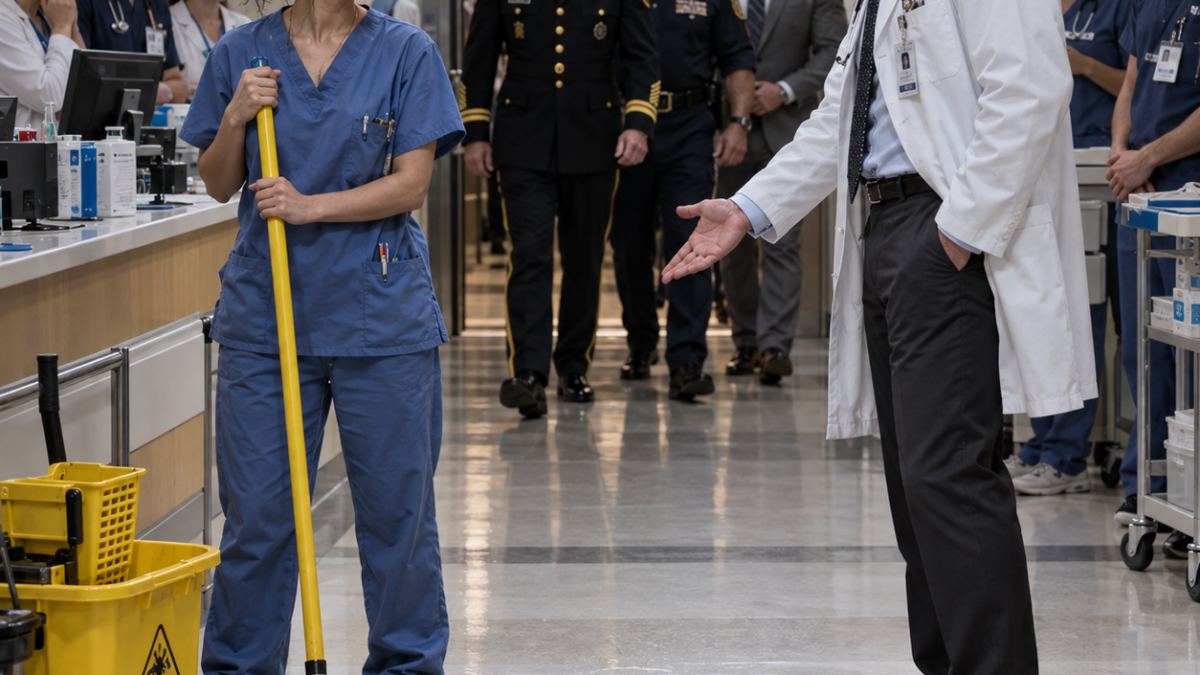
𝗙𝗨𝗟𝗟 𝗦𝗧𝗢𝗥𝗬
I kept my head down.
The mop moved across the floor.
Back and forth.
Back and forth.
My hands shook, but not enough to spill the bucket.
“He never looked at me,” I thought. “He only looked down.”
Then the elevator chimed.
Three men stepped out.
I noticed the first because everyone else noticed him.
Tall. Silver-haired. Dress uniform dark and immaculate. Ribbons across his chest. Jaw set in that military way that never quite leaves a man, even when he is supposed to be attending a friendly hospital ceremony.
General Warren Dalton.
I had seen his face before.
In briefings.
On encrypted calls.
In one terrible mountain valley when his son’s blood would not stop coming through my fingers.
Beside him limped an older man with a white crew cut and the thick shoulders of someone who had once made younger men suffer for their weakness before teaching them how to survive it.
Retired Master Chief Walter Boyd.
Navy SEAL legend.
The kind of man sailors told stories about when they wanted to sound braver than they were.
Behind them walked a younger man in a plain gray suit, built like a door, eyes moving without moving his head.
Protective detail.
Call sign Titan, if my memory was still good.
It was.
Memory had never been my problem.
Forgetting was.
They had arrived early.
That was the first problem.
The second problem was that General Dalton heard Voss’s last words from forty feet away.
The general’s gaze moved from Voss to me.
I felt it before I saw it.
The old instinct ran down my spine like cold water.
Someone important was looking too closely.
I turned my head slightly to wring the mop.
Light caught the scar above my left eyebrow.
The general stopped.
Not slowed.
Stopped.
Titan almost walked into him.
The color drained from Dalton’s face so quickly that for one irrational second I thought he might collapse. His right hand, calm a heartbeat earlier, curled into a fist and began to tremble.
My eyes met his.
One second.
That was all it took.
I saw recognition hit him.
And with it came the terrible knowledge that the life I had built out of silence was cracking open in front of everyone.
I dropped my gaze and pushed the mop bucket toward the wall as if I were no one at all.
Dr. Voss spotted the visitors and transformed instantly.
His smile appeared like a light switching on.
“General Dalton,” he said, rushing forward and buttoning his coat, “what an honor. Welcome to Lake View Covenant Medical Center. Please excuse the small mess. We’re just having the staff tidy up.”
The general did not answer.
He was still looking past him.
At me.
Voss followed his gaze.
“Oh, her,” he said with a careless wave. “That’s only Nurse Linden. She’s slow, but harmless.”
Only.
Slow.
Harmless.
I had been called worse by better men.
Titan watched the general’s face and stepped closer.
“Sir?”
Dalton spoke so quietly I barely heard it from across the hall.
But I heard it.
“Do not touch her,” he said. “Do not say a word. Just watch.”
Master Chief Boyd tried to laugh at something Voss said next.
The laugh came out wrong.
Wet.
Crooked.
Wrong.
His mouth drooped on the right side.
The wooden plaque he had been holding slipped from his fingers and struck the floor with a sharp clatter.
“What is happening to me?” he asked.
The words were thick.
Slurred.
His right arm sagged against his body.
The hallway shifted.
Not physically.
But everyone felt it.
That instant when ordinary embarrassment becomes emergency.
Titan caught Boyd under the arm before he fell.
“Walt,” General Dalton whispered.
Voss waved one hand.
“He’s fine. Overexcited. Probably dehydrated. Older men get dizzy. Someone bring him a chair and a cup of water.”
The mop handle fell from my hands.
It struck the floor once.
My trembling stopped.
Completely.
I have never understood why fear makes my hands shake when people stare at me, but death steadies them. Maybe war rewires the body that way. Maybe my hands had learned that when someone is dying, there is no room left for me.
My shoulders squared.
My chin lifted.
The hallway parted before I reached Master Chief Boyd, though no one had consciously decided to move.
I knelt beside him.
“Master Chief,” I said, keeping my voice low, clear, and steady. “Look at me. My name is Maya. I am going to ask you to do three small things.”
His eyes found mine.
There was confusion there.
And fear.
I hated seeing fear in men who had once taught others not to show it.
“Smile for me.”
He tried.
The right side of his face barely moved.
“Now lift both arms, palms up, and close your eyes.”
His left arm rose.
His right drifted downward like a leaf losing its stem.
“Repeat after me. The sky is blue in Cleveland.”
His mouth worked.
“The sky is blue in Cleavand.”
I looked up at the ring of faces around us.
“Face. Arm. Speech. This is a stroke.”
Dr. Voss laughed.
Thin.
Nervous.
“Linden, step away from my patient. You do not diagnose. You mop.”
I did not look at him.
I looked at General Dalton.
“Sir, I need the last moment he was completely normal. Be exact.”
The general answered before pride, shock, or hierarchy could interfere.
“Eleven fifteen,” he said. “He was telling a joke in the elevator, and he finished it clearly.”
“Thank you.”
I turned to the technician who had laughed at me earlier.
“Glucose meter. Now.”
He glanced at Voss.
“Now,” I repeated.
This time my voice cracked through the hallway like a rifle shot.
He ran.
I found Boyd’s pulse. Strong, slightly irregular. I loosened his collar, checked his breathing, and motioned to the orderlies.
“Gurney here. Head slightly elevated. Nothing by mouth. No water, no food, no pills.”
A nurse reached for a cup someone had already filled.
“Put it down,” I said.
She put it down.
“Keep him warm. Keep him talking. Do not let him stand. Do not let anyone walk him anywhere.”
Voss stepped closer.
“You are creating unnecessary panic.”
“Doctor, his face is drooping, his right arm is drifting, and his speech is slurred. If this is ischemic and he is inside the treatment window, every minute matters.”
“You are not the attending physician.”
“No,” I said. “I am the person recognizing the emergency.”
The technician returned with the glucose meter.
I pricked Boyd’s finger.
One hundred six.
“Blood sugar is normal,” I said. “This is not hypoglycemia. Call a stroke alert. Last known well eleven fifteen. Tell neurology. Tell radiology to clear the scanner.”
The nurse at the desk grabbed the phone.
Then froze.
She looked at Voss.
His face had gone red.
“Do not call anything,” he snapped. “I am the attending physician in this emergency department. It is not a stroke until I say it is a stroke.”
I stood slowly.
For the first time since he had started humiliating me in that hallway, I turned and looked Dr. Carter Voss directly in the eyes.
The hallway went quiet.
My voice did not rise.
That made it carry farther.
“Doctor, every minute you spend arguing costs this man living brain. If I am wrong, you can fire me before lunch. If I am right and we wait, you will carry this for the rest of your life.”
He stared at me as if I had slapped him.
“Security.”
Two guards stepped forward.
Titan moved once.
That was all.
One step between them and me.
The guards stopped like they had walked into a wall.
General Dalton’s voice finally filled the hallway.
“Gentlemen, stay exactly where you are.”
Voss spun toward him.
“General, with respect, this is my emergency department.”
Dalton looked at Voss for the first time.
Really looked.
“Doctor, in this hallway, the person in command is the person who is right. At this moment, that is not you.”
The nurse at the desk pressed the stroke alert.
Then her face fell.
“The east elevators are down for repair. The stroke team is waiting by the scanner on the third floor. Main route takes nine minutes with the crowds.”
“We don’t have nine minutes,” I said.
The building unfolded inside my mind.
Every hallway.
Every service door.
Every stairwell.
Every route I had walked during my first week at Lake View because I never entered a structure without learning how to move through it when things went bad.
I pointed.
“Service corridor behind the kitchen connects to the freight elevator.”
Nobody moved.
I raised my voice.
“Titan, take the head of the gurney. You—” I pointed to the technician. “Run ahead. Hold the freight elevator on this floor. Clear the corridor. Tell everyone wheels are coming through.”
The technician stared.
“Move.”
He moved.
Titan took the head of the gurney without question. An orderly took the foot. I ran beside Boyd with one hand on the rail and one eye on his face.
“Stay with me, Master Chief.”
His gaze wandered.
I touched his shoulder.
“Walter. Look at me.”
His eyes returned.
“That’s it. You are not alone. I am right here.”
We moved.
The hallway became a blur of startled faces and squealing wheels.
“Wheels coming through,” I called. “Stay left. Stay left.”
A woman holding balloons flattened herself against the wall. A janitor yanked a cart backward. A resident opened his mouth to object and closed it when Titan nearly took the corner off the wall.
Behind us, Voss shouted about protocol, liability, chain of command.
No one listened.
We burst through the kitchen doors into heat and steam. A cook stood frozen in the middle of the aisle holding a tray of hot food.
“Hold it high and turn sideways,” I called.
He obeyed instantly.
The gurney passed with an inch to spare.
Boyd’s eyes rolled toward me again.
“Am I dying?” he slurred.
“Not today,” I said. “You picked a bad hallway for that.”
The corner of his mouth twitched on the left.
Good.
Humor meant he was still with me.
The freight elevator doors stood open. The technician held them with both arms, panting.
We rolled inside.
The doors closed.
For ten seconds, no one spoke.
The elevator groaned upward like an old animal.
I watched Boyd’s breathing.
Listened to the rhythm.
Counted time.
At the third floor, the doors opened onto a waiting team.
Dr. Anita Shaw, neurologist, stood beside the scanner in purple scrubs, eyes sharp.
Someone checked a watch.
“Four minutes, ten seconds from alert.”
I gave the handoff before anyone asked.
“Seventy-one-year-old male. Sudden right facial droop, right arm drift, slurred speech. Last known well eleven fifteen. Glucose one hundred six. No known head trauma. Nothing by mouth. No anticoagulant history confirmed yet. Symptoms witnessed in hallway. Stroke alert activated immediately.”
Dr. Shaw stared at me.
“That is the best handoff I’ve received all month.”
“CT?”
“Ready.”
They took Boyd in.
The doors closed.
For the first time since the mop hit the floor, I had nothing to do with my hands.
They began trembling again.
I stepped into the corridor, leaned against the wall, and pressed my palms flat against my scrubs.
Breathe in.
Hold.
Breathe out.
Count exits.
Count ceiling tiles.
Count anything except memories.
But the memories came anyway.
A mountain valley.
Gunfire snapping against rock.
Captain Ben Dalton on his back with a bullet through his chest, blood bubbling between my fingers no matter how hard I pressed.
A voice on the radio screaming that helicopters could not land.
My own voice saying, “Stay with me, Ben. I am not going anywhere.”
For six hours, I had held a man’s life together with my hands.
Six hours under fire.
Six hours of dirt, blood, morphine, prayer, and bargaining with a God I was not sure had time to listen.
When the helicopter finally came, I was barely conscious myself. A piece of shrapnel had cut above my left eyebrow. Someone tried to pull me away from Ben, and I nearly broke his wrist because I thought he was taking my patient too soon.
I saw General Dalton for ten seconds beside the aircraft.
Only ten.
His face had been gray with terror.
He looked at his son, then at me, and I remember thinking, “He will never know my name.”
I made sure of it.
After that mission, my records sealed deeper than most graves.
Then came the next mission.
And the next.
Until one day, after a blast in a village clinic and too many children pulled from rubble, my hands started shaking whenever anyone looked at me too long.
The Navy called it trauma.
I called it failure.
Eventually I disappeared into civilian nursing because it seemed useful, quiet, and far away from men shouting my call sign into burning air.
Iron Dove was gone.
Maya Linden mopped floors.
Footsteps approached.
I knew who they belonged to before I opened my eyes.
General Dalton stopped three feet away and removed his cap.
“Nurse Linden,” he said quietly.
My spine straightened on its own.
“Sir.”
Titan stood behind him, arms folded, but his face was no longer watchful in the same way. It held awe now, and disbelief, and the beginning of understanding.
Before the general could say more, the elevator chimed.
Dr. Voss strode toward us with Gloria Banning, the hospital administrator, at his side.
Voss was talking fast.
Too fast.
“General, I apologize for the disruption. Nurse Linden violated protocol, defied an attending physician, and caused a security incident. She is being dismissed immediately.”
Gloria Banning wore a charcoal suit and the exhausted expression of a woman who solved problems by making people disappear into paperwork.
“Miss Linden,” she said, “I will need your badge.”
I looked down at it.
Lake View Covenant Medical Center.
Maya Linden, RN.
It was the first name tag I had ever worn that did not feel like a classified document.
I unclipped it.
This was familiar too.
Take the blame.
Lower your head.
Walk away.
Silence had kept me alive for years.
I held out the badge.
Voss smiled.
The hand of General Dalton closed gently around my wrist and pushed the badge back toward my chest.
“Miss Banning,” he said, “do you know who this woman is?”
Banning blinked.
“She is a nurse, General.”
“No,” he said.
His voice shook.
“She is the reason my son is alive.”
The corridor went still.
Voss frowned.
“What?”
Dalton looked at me as if the years between us had collapsed.
“Five years ago, my son, Captain Ben Dalton of the Navy SEALs, was shot through the chest in a mountain valley. Helicopters could not land for six hours. A combat medic crawled to him under fire, packed the wound, managed his airway, kept pressure with her own hands, and held his life together until extraction.”
My throat tightened.
I looked down.
The general continued.
“I never learned her name. I only heard her voice on the radio saying, ‘Stay with me, Ben. I am not going anywhere.’ Her call sign was Iron Dove.”
Someone behind me whispered.
Iron Dove.
The name moved through the corridor like a gust of wind through dust.
“When the helicopter lifted,” Dalton said, “I saw her face for ten seconds. Blood on her cheek. A fresh cut above her left eyebrow. Then she vanished, and every record I tried to find was sealed.”
He turned fully toward me.
“Lieutenant Maya Linden, United States Navy Special Operations Combat Medic.”
His voice broke.
“I have searched for you for five years.”
Titan came to attention.
“Lieutenant,” he said, voice thick. “In my unit, they tell the story of Iron Dove to every new recruit. I thought you were a legend.”
I said nothing.
A single tear slid down my cheek.
I did not wipe it away.
Dr. Voss tried to laugh.
He failed.
“That’s impossible,” he said. “She shakes whenever I look at her. She mops floors.”
I looked at him.
All morning, he had seen me.
But not once had he looked at me.
“I shake when people stare at me, Doctor,” I said. “It is a habit I learned after the war. Noise, crowds, eyes on me too long.”
My hands had stopped trembling again.
“I have never shaken when somebody was dying.”
Gloria Banning had gone pale.
The nurses who had looked away earlier now stood at the end of the corridor, guilt written across their faces. The technician who had laughed took a half step forward.
“Nurse Linden,” he whispered, “I’m sorry.”
I believed him.
That did not erase it.
Dr. Shaw appeared at the treatment room door.
“Master Chief Boyd is responding,” she said. “CT shows a clot, not a bleed. He was inside the treatment window, and we started medication. His speech is already improving.”
She looked at me.
“He’s asking for the nurse with the steady voice.”
I closed my eyes for one second.
Then I followed her inside.
Boyd lay propped on pillows, face more even, eyes tired but bright.
“Well,” he rasped, “I knew I’d be rescued by someone tough. Didn’t expect her to be so small.”
The room laughed.
Not cruelly this time.
The tension broke like glass.
He reached for my hand.
I took it.
His grip was weak on the right, stronger on the left, but he could squeeze.
That was enough to make my eyes sting.
“Thank you, Iron Dove,” he said. “Your voice was the only thing I could hold on to.”
I swallowed.
“You did the hard part, Master Chief. I just gave directions.”
He snorted.
“Typical medic. Saves a man’s brain and calls it directions.”
General Dalton stood beside his bed, then turned toward me.
Slowly, he raised his right hand in a crisp salute.
Titan did the same.
Then one by one, the nurses, technicians, orderlies, and even the security guards at the doorway raised their hands too.
Some salutes were awkward.
Some were imperfect.
All were sincere.
For a moment, I could not move.
I had spent so long hiding from honor that receiving it felt more frightening than insult.
My hand trembled once.
Then steadied.
I returned the salute.
Titan looked at the crowd and said quietly, “She was never hiding weakness. She was hiding command.”
Gloria Banning cleared her throat.
“Dr. Voss.”
He turned as if waking from a bad dream.
“You are placed on administrative leave effective immediately, pending a full review of your conduct and of this department. Please surrender your credentials.”
Voss opened his mouth.
Closed it.
For the first time since I had known him, he looked small.
Not humble.
Small.
He turned toward me.
“Linden—Maya. I didn’t know.”
That was the problem with people like Carter Voss.
They thought ignorance was a defense when it was really the evidence.
“That is the point, Doctor,” I said. “You never looked at me. You only looked down.”
His face tightened.
“The next time you see someone holding a mop,” I said, “or holding a tray, or pushing a cart, or cleaning a room, look at the person. Not the job.”
He left alone.
No audience followed him.
Later that afternoon, Gloria Banning offered me a promotion.
Then a department.
Then money.
Then a title.
Anything, she said, as if respect could be retroactively purchased once shame became inconvenient.
I listened politely.
Then I shook my head.
“I don’t want rank.”
“What do you want?”
“A classroom.”
She blinked.
“I’m sorry?”
“I want every nurse, technician, orderly, security guard, cook, volunteer, and janitor in this hospital trained to recognize a stroke in sixty seconds. I want public classes for families. I want FAST posted in every waiting room.”
“FAST?”
I held up one finger.
“Face. Ask the person to smile. Look for one side drooping.”
Second finger.
“Arms. Ask them to raise both arms. Watch for one drifting down.”
Third.
“Speech. Ask them to repeat a simple sentence. Listen for slurring or strange words.”
Fourth.
“Time. Note exactly when they were last normal and call 911 immediately. No food, no water, no pills, no waiting to see if it passes.”
The hallway had grown quiet again, but this time people were listening.
“Do that,” I said, “and Master Chief Boyd will not be the only person this hospital saves faster.”
Banning nodded slowly.
“Done.”
“One more thing.”
“Anything.”
I looked down the hall.
The yellow mop handle leaned against the wall where I had dropped it.
“I want that hung in the training room.”
Banning followed my gaze.
“The mop?”
“The handle. Put a card under it that says, Look up.”
General Dalton smiled for the first time that day.
“Lieutenant,” he said, “my son would like to meet you, if you’ll allow it. He’s waited five years to say thank you.”
For a moment, I could not answer.
Captain Ben Dalton had survived.
I knew that from classified updates, but knowing is different from seeing. I had spent years wondering if he remembered the valley, if he heard my voice in nightmares, if the life I helped save had become a burden or a gift.
I nodded.
The corner of my mouth lifted.
It felt unfamiliar.
A real smile.
“I’d like that.”
That evening, after Boyd had been moved to a quiet room and the hallway returned to the controlled chaos of hospital life, I sat outside on a bench beneath the darkening sky.
My body ached.
Not from running.
From being seen.
Titan found me there.
He sat beside me without asking, which I appreciated. Some silences are invitations. Others are shelters.
For a long time, neither of us spoke.
Then he said, “I didn’t come to disturb your peace.”
I looked at the hospital entrance.
“I don’t think peace knows where I live.”
He smiled faintly.
“I came to say you gave all of us a reason to stand taller today.”
I looked down at my hands.
Small hands.
Scarred hands.
Hands that had packed wounds, delivered compressions, started IVs in moving helicopters, held arteries closed, restrained panic, cleaned floors, and steadied an old man while his brain begged for blood.
“I spent years trying to forget what these hands can do,” I said.
Titan nodded.
“Today they remembered what they’re for.”
I turned my palms over in the light.
The trembling was there again.
Slight.
Human.
Maybe I did not have to hate it.
Maybe a hand could shake and still save a life.
Three months later, the training room at Lake View Covenant Medical Center was full.
Not polite full.
Crowded full.
Nurses lined the walls. Technicians sat on the floor. Cooks from the cafeteria stood in the back in white aprons. Security guards leaned against the doorframes. Parents brought teenagers. Retired veterans came in groups. Even a few local firefighters showed up, though they pretended it was only because the coffee was free.
On the wall hung the yellow mop handle.
Beneath it was a small card with two words.
Look up.
Master Chief Boyd sat in the front row, cane beside his chair, smile even on both sides. He had recovered better than anyone dared hope, mostly because treatment began fast enough to save brain tissue that would otherwise have died while people argued.
Beside him sat Captain Ben Dalton.
He was taller than I remembered, obviously, because the last time I saw him, he had been flat on his back under fire, face gray, chest open beneath my hands.
When he walked into the room that morning, he did not salute.
He hugged me.
Hard.
For a second, I froze.
Then I hugged him back.
“Your voice,” he whispered, “kept me alive.”
I closed my eyes.
“No. Your stubborn heart did that.”
He laughed into my shoulder.
“My father said you’d say something like that.”
Now he sat beside Boyd, smiling every time our eyes met, alive in a way that felt like sunlight after years underground.
I stood at the front of the room in bright blue scrubs that actually fit.
My shoulders were back.
My voice was clear.
“Stroke does not wait for permission,” I told them. “It does not care if the doctor is busy, if the hallway is crowded, if the patient is embarrassed, or if you are afraid of being wrong. FAST gives you a way to act.”
I held up one finger.
“Face.”
The room repeated, “Face.”
“Ask them to smile. Look for drooping.”
Second finger.
“Arms.”
“Arms.”
“Raise both. Watch for drift.”
Third.
“Speech.”
“Speech.”
“Listen for slurred, strange, or confused words.”
Fourth.
“Time.”
“Time.”
“Note the exact last-known-well time and call emergency services immediately. Do not give food, drink, or pills. Do not let them drive. Keep them calm. Stay with them.”
They repeated it until the words became rhythm.
Face.
Arms.
Speech.
Time.
A simple tool.
A one-minute lesson.
A lifetime, if used quickly enough.
I never went back to war.
Some part of me would always live there, in the valley, in the dust, in the sound of helicopters that could not land. But I no longer belonged only to those memories.
I stayed at Lake View.
I taught.
I healed.
I still trembled sometimes when people stared too long. I still counted exits. I still woke from dreams with the taste of smoke in my throat. But I stopped apologizing for surviving.
Dr. Voss eventually resigned.
I heard he took a position somewhere far from emergency medicine. I hoped, for his patients’ sake, that he learned to look at people differently. I did not need revenge. His humiliation was brief compared with what his arrogance had almost cost.
The hospital changed slowly, then all at once.
Nurses spoke up sooner.
Doctors listened harder.
Technicians stopped laughing when someone quiet had a concern.
A janitor caught a stroke in the lobby six weeks after my first class because he remembered the mop handle on the wall and saw a man’s smile collapse on one side.
That man lived.
That was enough.
People sometimes asked me about the mop.
Visitors. New nurses. Medical students who had heard some exaggerated version of the story.
I always gave the same answer.
Sometimes the quietest person in the room is the one holding the whole room together.
Then I taught them FAST.
Face.
Arms.
Speech.
Time.
Because the world is full of people being overlooked.
The nurse with shaking hands.
The janitor pushing a cart.
The old man slurring one word at lunch.
The patient who says, “I’m fine,” because he does not want to cause trouble.
The person everyone assumes is harmless until the moment harm comes and they are the only one ready.
I spent years believing I had hidden because I was broken.
I was wrong.
I had been healing.
And when the moment came, when a life tilted toward the edge and everyone else hesitated, the part of me I thought I had buried stood up.
Not Iron Dove.
Not the legend.
Not the war story.
Just me.
Maya Linden.
Nurse.
Medic.
Survivor.
The woman who finally learned that lowering your head is not the same as losing your strength.
And every time I passed the training room and saw that yellow mop handle on the wall, I remembered the day they laughed at me for holding it.
Then I remembered Master Chief Boyd smiling again.
Captain Dalton breathing because I had refused to let go.
A hallway full of people learning to look up.
And I knew, with a peace I had never expected to find, that my hands had not betrayed me.
They had only been waiting to be needed again.
𝗧𝗛𝗘 𝗘𝗡𝗗
The Yellow Mop in My Hands Was the Last Thing They Should Have Laughed At
The whole hallway watched me bend down for the mop, and not one of them knew what my hands had done in war.
The doctor thought humiliation would keep me quiet, but a dying man does not care who holds the title.
By the time the general said my old name, the people who had laughed at me could barely look me in the eyes.
My name was Maya Linden, at least to everyone at Lake View Covenant Medical Center.
I was thirty-one years old, five foot four on a good day, and almost always dressed in blue scrubs that hung a little too loose on my frame. People said I moved quietly. They meant it as a polite way of saying I made myself easy to ignore.
I did.
On purpose.
For six years, I had practiced taking up less space.
I lowered my voice. I kept my shoulders rounded. I let people interrupt me. I let doctors speak over me. I let nurses with sharper personalities claim credit for things I had caught early enough to prevent from becoming emergencies.
I smiled when patients called me “sweetheart.”
I apologized when people bumped into me.
I said “yes, doctor” even when every nerve in my body knew the doctor was wrong.
That was the version of me Lake View knew.
Quiet Maya.
Nervous Maya.
The nurse who flinched when someone raised their voice and trembled when too many eyes landed on her at once.
Nobody there knew why crowds made my skin tighten.
Nobody knew why I counted exits in every room without meaning to.
Nobody knew why I never sat with my back to a door.
Nobody knew about the scars across my hands, the pale line above my left eyebrow, or the small tattoo near my collarbone that I kept hidden under my scrub top.
Nobody knew that before I was Nurse Linden, I had been Lieutenant Maya Linden, United States Navy Special Operations Combat Medic.
Nobody knew the name they gave me overseas.
Iron Dove.
I hated the name.
Not because it was wrong.
Because it reminded me of every person who had said it while bleeding into my hands.
The morning everything changed started with bed six.
His name was Mr. Alvarez, sixty-eight years old, admitted for observation after chest discomfort that had resolved before he reached the emergency department. His labs were still pending. His EKG had looked boring enough that Dr. Carter Voss barely glanced at it.
But something about him bothered me.
His face had changed.
Not dramatically. Not enough for an untrained eye to notice. But the left corner of his mouth seemed slightly flatter than it had been ten minutes earlier, and when I asked him to squeeze my fingers, his right hand was just a fraction slower than his left.
His speech remained clear.
His blood pressure was elevated, but not shocking.
His wife kept saying, “He’s tired. He didn’t sleep.”
Maybe he was tired.
Maybe I had spent too many years seeing danger before anyone else could.
But my body knew that old warning.
The world tilts, just a little, before it falls.
I found Dr. Voss near the central desk, surrounded by two residents, a technician, and a nursing student who looked at him like he had personally invented emergency medicine.
Dr. Carter Voss was forty-seven, tall, handsome in the way magazine advertisements preferred, with silver at his temples and a white coat that never seemed to wrinkle unless he wanted it to. He had perfect hair, perfect posture, and a voice built for audiences.
He loved audiences.
“Dr. Voss,” I said quietly. “I’m concerned about Mr. Alvarez in bed six.”
He did not turn at first.
One resident smirked, already anticipating the show.
Voss finally looked over his shoulder.
“Concerned how, Nurse Linden?”
The way he said nurse made it smaller than it was.
“His face looks slightly asymmetric compared with earlier, and his right grip is weaker. It may be nothing, but I think we should repeat a neuro assessment and consider—”
He laughed.
Not loudly.
Worse.
Softly, like my concern was too foolish to deserve a full sound.
“A nursing opinion,” he said.
The residents chuckled.
I kept my hands folded in front of me so no one would notice they had begun to tremble.
“Doctor, I understand he doesn’t look critical, but—”
He turned fully then.
“You understand?”
His smile widened.
“Nurse Linden, I appreciate your enthusiasm, but emergency medicine is not a guessing game performed by people who fetch blankets and refill water cups.”
The hallway quieted.
Several nurses looked down.
One technician pressed his lips together, amused and embarrassed at the same time.
I felt heat rise along my neck.
“His symptoms could indicate a transient ischemic event,” I said carefully.
Voss tilted his head.
“Could they?”
“Yes, doctor.”
“Or he could be tired, anxious, and annoyed by repeated interruptions from a nurse who watches too many online training videos.”
The residents laughed louder.
I let the words pass through me.
I had survived worse than laughter.
But the body remembers humiliation differently than it remembers danger. Danger sharpens me. Humiliation makes me small. My shoulders curled inward before I could stop them.
Voss pointed toward the yellow mop bucket near the wall.
Someone had spilled coffee by the vending machines. The floor had been marked with a caution sign, but housekeeping had not reached it yet.
“Linden,” he said, loud enough for the entire hallway to hear, “the floor is wet, and the whole hallway is watching. You are a nurse who fetches things, so fetch that mop and make yourself useful.”
Nobody breathed.
I looked at the mop.
Then at him.
Then down at the floor.
“Yes, doctor,” I said.
The young technician near the desk covered his mouth to hide a laugh.
Two nurses stared at their shoes.
Someone whispered, “Poor thing. She never fights back.”
I heard it.
Of course I heard it.
People think quiet people miss things.
We miss nothing.
We just learn what not to answer.
I took the mop handle. The plastic was slick under my palm. Water slapped against the tile as I dipped the mop and began cleaning the spill in slow, controlled strokes.
Each movement felt deliberate.
Humiliating.
Public.
Voss checked his gold watch.
“Important visitors arrive in five minutes,” he said. “Try to finish before they get here. Some of us have real work to do.”
I kept my head down.
The mop moved across the floor.
Back and forth.
Back and forth.
My hands shook, but not enough to spill the bucket.
“He never looked at me,” I thought. “He only looked down.”
Then the elevator chimed.
Three men stepped out.
I noticed the first because everyone else noticed him.
Tall. Silver-haired. Dress uniform dark and immaculate. Ribbons across his chest. Jaw set in that military way that never quite leaves a man, even when he is supposed to be attending a friendly hospital ceremony.
General Warren Dalton.
I had seen his face before.
In briefings.
On encrypted calls.
In one terrible mountain valley when his son’s blood would not stop coming through my fingers.
Beside him limped an older man with a white crew cut and the thick shoulders of someone who had once made younger men suffer for their weakness before teaching them how to survive it.
Retired Master Chief Walter Boyd.
Navy SEAL legend.
The kind of man sailors told stories about when they wanted to sound braver than they were.
Behind them walked a younger man in a plain gray suit, built like a door, eyes moving without moving his head.
Protective detail.
Call sign Titan, if my memory was still good.
It was.
Memory had never been my problem.
Forgetting was.
They had arrived early.
That was the first problem.
The second problem was that General Dalton heard Voss’s last words from forty feet away.
The general’s gaze moved from Voss to me.
I felt it before I saw it.
The old instinct ran down my spine like cold water.
Someone important was looking too closely.
I turned my head slightly to wring the mop.
Light caught the scar above my left eyebrow.
The general stopped.
Not slowed.
Stopped.
Titan almost walked into him.
The color drained from Dalton’s face so quickly that for one irrational second I thought he might collapse. His right hand, calm a heartbeat earlier, curled into a fist and began to tremble.
My eyes met his.
One second.
That was all it took.
I saw recognition hit him.
And with it came the terrible knowledge that the life I had built out of silence was cracking open in front of everyone.
I dropped my gaze and pushed the mop bucket toward the wall as if I were no one at all.
Dr. Voss spotted the visitors and transformed instantly.
His smile appeared like a light switching on.
“General Dalton,” he said, rushing forward and buttoning his coat, “what an honor. Welcome to Lake View Covenant Medical Center. Please excuse the small mess. We’re just having the staff tidy up.”
The general did not answer.
He was still looking past him.
At me.
Voss followed his gaze.
“Oh, her,” he said with a careless wave. “That’s only Nurse Linden. She’s slow, but harmless.”
Only.
Slow.
Harmless.
I had been called worse by better men.
Titan watched the general’s face and stepped closer.
“Sir?”
Dalton spoke so quietly I barely heard it from across the hall.
But I heard it.
“Do not touch her,” he said. “Do not say a word. Just watch.”
Master Chief Boyd tried to laugh at something Voss said next.
The laugh came out wrong.
Wet.
Crooked.
Wrong.
His mouth drooped on the right side.
The wooden plaque he had been holding slipped from his fingers and struck the floor with a sharp clatter.
“What is happening to me?” he asked.
The words were thick.
Slurred.
His right arm sagged against his body.
The hallway shifted.
Not physically.
But everyone felt it.
That instant when ordinary embarrassment becomes emergency.
Titan caught Boyd under the arm before he fell.
“Walt,” General Dalton whispered.
Voss waved one hand.
“He’s fine. Overexcited. Probably dehydrated. Older men get dizzy. Someone bring him a chair and a cup of water.”
The mop handle fell from my hands.
It struck the floor once.
My trembling stopped.
Completely.
I have never understood why fear makes my hands shake when people stare at me, but death steadies them. Maybe war rewires the body that way. Maybe my hands had learned that when someone is dying, there is no room left for me.
My shoulders squared.
My chin lifted.
The hallway parted before I reached Master Chief Boyd, though no one had consciously decided to move.
I knelt beside him.
“Master Chief,” I said, keeping my voice low, clear, and steady. “Look at me. My name is Maya. I am going to ask you to do three small things.”
His eyes found mine.
There was confusion there.
And fear.
I hated seeing fear in men who had once taught others not to show it.
“Smile for me.”
He tried.
The right side of his face barely moved.
“Now lift both arms, palms up, and close your eyes.”
His left arm rose.
His right drifted downward like a leaf losing its stem.
“Repeat after me. The sky is blue in Cleveland.”
His mouth worked.
“The sky is blue in Cleavand.”
I looked up at the ring of faces around us.
“Face. Arm. Speech. This is a stroke.”
Dr. Voss laughed.
Thin.
Nervous.
“Linden, step away from my patient. You do not diagnose. You mop.”
I did not look at him.
I looked at General Dalton.
“Sir, I need the last moment he was completely normal. Be exact.”
The general answered before pride, shock, or hierarchy could interfere.
“Eleven fifteen,” he said. “He was telling a joke in the elevator, and he finished it clearly.”
“Thank you.”
I turned to the technician who had laughed at me earlier.
“Glucose meter. Now.”
He glanced at Voss.
“Now,” I repeated.
This time my voice cracked through the hallway like a rifle shot.
He ran.
I found Boyd’s pulse. Strong, slightly irregular. I loosened his collar, checked his breathing, and motioned to the orderlies.
“Gurney here. Head slightly elevated. Nothing by mouth. No water, no food, no pills.”
A nurse reached for a cup someone had already filled.
“Put it down,” I said.
She put it down.
“Keep him warm. Keep him talking. Do not let him stand. Do not let anyone walk him anywhere.”
Voss stepped closer.
“You are creating unnecessary panic.”
“Doctor, his face is drooping, his right arm is drifting, and his speech is slurred. If this is ischemic and he is inside the treatment window, every minute matters.”
“You are not the attending physician.”
“No,” I said. “I am the person recognizing the emergency.”
The technician returned with the glucose meter.
I pricked Boyd’s finger.
One hundred six.
“Blood sugar is normal,” I said. “This is not hypoglycemia. Call a stroke alert. Last known well eleven fifteen. Tell neurology. Tell radiology to clear the scanner.”
The nurse at the desk grabbed the phone.
Then froze.
She looked at Voss.
His face had gone red.
“Do not call anything,” he snapped. “I am the attending physician in this emergency department. It is not a stroke until I say it is a stroke.”
I stood slowly.
For the first time since he had started humiliating me in that hallway, I turned and looked Dr. Carter Voss directly in the eyes.
The hallway went quiet.
My voice did not rise.
That made it carry farther.
“Doctor, every minute you spend arguing costs this man living brain. If I am wrong, you can fire me before lunch. If I am right and we wait, you will carry this for the rest of your life.”
He stared at me as if I had slapped him.
“Security.”
Two guards stepped forward.
Titan moved once.
That was all.
One step between them and me.
The guards stopped like they had walked into a wall.
General Dalton’s voice finally filled the hallway.
“Gentlemen, stay exactly where you are.”
Voss spun toward him.
“General, with respect, this is my emergency department.”
Dalton looked at Voss for the first time.
Really looked.
“Doctor, in this hallway, the person in command is the person who is right. At this moment, that is not you.”
The nurse at the desk pressed the stroke alert.
Then her face fell.
“The east elevators are down for repair. The stroke team is waiting by the scanner on the third floor. Main route takes nine minutes with the crowds.”
“We don’t have nine minutes,” I said.
The building unfolded inside my mind.
Every hallway.
Every service door.
Every stairwell.
Every route I had walked during my first week at Lake View because I never entered a structure without learning how to move through it when things went bad.
I pointed.
“Service corridor behind the kitchen connects to the freight elevator.”
Nobody moved.
I raised my voice.
“Titan, take the head of the gurney. You—” I pointed to the technician. “Run ahead. Hold the freight elevator on this floor. Clear the corridor. Tell everyone wheels are coming through.”
The technician stared.
“Move.”
He moved.
Titan took the head of the gurney without question. An orderly took the foot. I ran beside Boyd with one hand on the rail and one eye on his face.
“Stay with me, Master Chief.”
His gaze wandered.
I touched his shoulder.
“Walter. Look at me.”
His eyes returned.
“That’s it. You are not alone. I am right here.”
We moved.
The hallway became a blur of startled faces and squealing wheels.
“Wheels coming through,” I called. “Stay left. Stay left.”
A woman holding balloons flattened herself against the wall. A janitor yanked a cart backward. A resident opened his mouth to object and closed it when Titan nearly took the corner off the wall.
Behind us, Voss shouted about protocol, liability, chain of command.
No one listened.
We burst through the kitchen doors into heat and steam. A cook stood frozen in the middle of the aisle holding a tray of hot food.
“Hold it high and turn sideways,” I called.
He obeyed instantly.
The gurney passed with an inch to spare.
Boyd’s eyes rolled toward me again.
“Am I dying?” he slurred.
“Not today,” I said. “You picked a bad hallway for that.”
The corner of his mouth twitched on the left.
Good.
Humor meant he was still with me.
The freight elevator doors stood open. The technician held them with both arms, panting.
We rolled inside.
The doors closed.
For ten seconds, no one spoke.
The elevator groaned upward like an old animal.
I watched Boyd’s breathing.
Listened to the rhythm.
Counted time.
At the third floor, the doors opened onto a waiting team.
Dr. Anita Shaw, neurologist, stood beside the scanner in purple scrubs, eyes sharp.
Someone checked a watch.
“Four minutes, ten seconds from alert.”
I gave the handoff before anyone asked.
“Seventy-one-year-old male. Sudden right facial droop, right arm drift, slurred speech. Last known well eleven fifteen. Glucose one hundred six. No known head trauma. Nothing by mouth. No anticoagulant history confirmed yet. Symptoms witnessed in hallway. Stroke alert activated immediately.”
Dr. Shaw stared at me.
“That is the best handoff I’ve received all month.”
“CT?”
“Ready.”
They took Boyd in.
The doors closed.
For the first time since the mop hit the floor, I had nothing to do with my hands.
They began trembling again.
I stepped into the corridor, leaned against the wall, and pressed my palms flat against my scrubs.
Breathe in.
Hold.
Breathe out.
Count exits.
Count ceiling tiles.
Count anything except memories.
But the memories came anyway.
A mountain valley.
Gunfire snapping against rock.
Captain Ben Dalton on his back with a bullet through his chest, blood bubbling between my fingers no matter how hard I pressed.
A voice on the radio screaming that helicopters could not land.
My own voice saying, “Stay with me, Ben. I am not going anywhere.”
For six hours, I had held a man’s life together with my hands.
Six hours under fire.
Six hours of dirt, blood, morphine, prayer, and bargaining with a God I was not sure had time to listen.
When the helicopter finally came, I was barely conscious myself. A piece of shrapnel had cut above my left eyebrow. Someone tried to pull me away from Ben, and I nearly broke his wrist because I thought he was taking my patient too soon.
I saw General Dalton for ten seconds beside the aircraft.
Only ten.
His face had been gray with terror.
He looked at his son, then at me, and I remember thinking, “He will never know my name.”
I made sure of it.
After that mission, my records sealed deeper than most graves.
Then came the next mission.
And the next.
Until one day, after a blast in a village clinic and too many children pulled from rubble, my hands started shaking whenever anyone looked at me too long.
The Navy called it trauma.
I called it failure.
Eventually I disappeared into civilian nursing because it seemed useful, quiet, and far away from men shouting my call sign into burning air.
Iron Dove was gone.
Maya Linden mopped floors.
Footsteps approached.
I knew who they belonged to before I opened my eyes.
General Dalton stopped three feet away and removed his cap.
“Nurse Linden,” he said quietly.
My spine straightened on its own.
“Sir.”
Titan stood behind him, arms folded, but his face was no longer watchful in the same way. It held awe now, and disbelief, and the beginning of understanding.
Before the general could say more, the elevator chimed.
Dr. Voss strode toward us with Gloria Banning, the hospital administrator, at his side.
Voss was talking fast.
Too fast.
“General, I apologize for the disruption. Nurse Linden violated protocol, defied an attending physician, and caused a security incident. She is being dismissed immediately.”
Gloria Banning wore a charcoal suit and the exhausted expression of a woman who solved problems by making people disappear into paperwork.
“Miss Linden,” she said, “I will need your badge.”
I looked down at it.
Lake View Covenant Medical Center.
Maya Linden, RN.
It was the first name tag I had ever worn that did not feel like a classified document.
I unclipped it.
This was familiar too.
Take the blame.
Lower your head.
Walk away.
Silence had kept me alive for years.
I held out the badge.
Voss smiled.
The hand of General Dalton closed gently around my wrist and pushed the badge back toward my chest.
“Miss Banning,” he said, “do you know who this woman is?”
Banning blinked.
“She is a nurse, General.”
“No,” he said.
His voice shook.
“She is the reason my son is alive.”
The corridor went still.
Voss frowned.
“What?”
Dalton looked at me as if the years between us had collapsed.
“Five years ago, my son, Captain Ben Dalton of the Navy SEALs, was shot through the chest in a mountain valley. Helicopters could not land for six hours. A combat medic crawled to him under fire, packed the wound, managed his airway, kept pressure with her own hands, and held his life together until extraction.”
My throat tightened.
I looked down.
The general continued.
“I never learned her name. I only heard her voice on the radio saying, ‘Stay with me, Ben. I am not going anywhere.’ Her call sign was Iron Dove.”
Someone behind me whispered.
Iron Dove.
The name moved through the corridor like a gust of wind through dust.
“When the helicopter lifted,” Dalton said, “I saw her face for ten seconds. Blood on her cheek. A fresh cut above her left eyebrow. Then she vanished, and every record I tried to find was sealed.”
He turned fully toward me.
“Lieutenant Maya Linden, United States Navy Special Operations Combat Medic.”
His voice broke.
“I have searched for you for five years.”
Titan came to attention.
“Lieutenant,” he said, voice thick. “In my unit, they tell the story of Iron Dove to every new recruit. I thought you were a legend.”
I said nothing.
A single tear slid down my cheek.
I did not wipe it away.
Dr. Voss tried to laugh.
He failed.
“That’s impossible,” he said. “She shakes whenever I look at her. She mops floors.”
I looked at him.
All morning, he had seen me.
But not once had he looked at me.
“I shake when people stare at me, Doctor,” I said. “It is a habit I learned after the war. Noise, crowds, eyes on me too long.”
My hands had stopped trembling again.
“I have never shaken when somebody was dying.”
Gloria Banning had gone pale.
The nurses who had looked away earlier now stood at the end of the corridor, guilt written across their faces. The technician who had laughed took a half step forward.
“Nurse Linden,” he whispered, “I’m sorry.”
I believed him.
That did not erase it.
Dr. Shaw appeared at the treatment room door.
“Master Chief Boyd is responding,” she said. “CT shows a clot, not a bleed. He was inside the treatment window, and we started medication. His speech is already improving.”
She looked at me.
“He’s asking for the nurse with the steady voice.”
I closed my eyes for one second.
Then I followed her inside.
Boyd lay propped on pillows, face more even, eyes tired but bright.
“Well,” he rasped, “I knew I’d be rescued by someone tough. Didn’t expect her to be so small.”
The room laughed.
Not cruelly this time.
The tension broke like glass.
He reached for my hand.
I took it.
His grip was weak on the right, stronger on the left, but he could squeeze.
That was enough to make my eyes sting.
“Thank you, Iron Dove,” he said. “Your voice was the only thing I could hold on to.”
I swallowed.
“You did the hard part, Master Chief. I just gave directions.”
He snorted.
“Typical medic. Saves a man’s brain and calls it directions.”
General Dalton stood beside his bed, then turned toward me.
Slowly, he raised his right hand in a crisp salute.
Titan did the same.
Then one by one, the nurses, technicians, orderlies, and even the security guards at the doorway raised their hands too.
Some salutes were awkward.
Some were imperfect.
All were sincere.
For a moment, I could not move.
I had spent so long hiding from honor that receiving it felt more frightening than insult.
My hand trembled once.
Then steadied.
I returned the salute.
Titan looked at the crowd and said quietly, “She was never hiding weakness. She was hiding command.”
Gloria Banning cleared her throat.
“Dr. Voss.”
He turned as if waking from a bad dream.
“You are placed on administrative leave effective immediately, pending a full review of your conduct and of this department. Please surrender your credentials.”
Voss opened his mouth.
Closed it.
For the first time since I had known him, he looked small.
Not humble.
Small.
He turned toward me.
“Linden—Maya. I didn’t know.”
That was the problem with people like Carter Voss.
They thought ignorance was a defense when it was really the evidence.
“That is the point, Doctor,” I said. “You never looked at me. You only looked down.”
His face tightened.
“The next time you see someone holding a mop,” I said, “or holding a tray, or pushing a cart, or cleaning a room, look at the person. Not the job.”
He left alone.
No audience followed him.
Later that afternoon, Gloria Banning offered me a promotion.
Then a department.
Then money.
Then a title.
Anything, she said, as if respect could be retroactively purchased once shame became inconvenient.
I listened politely.
Then I shook my head.
“I don’t want rank.”
“What do you want?”
“A classroom.”
She blinked.
“I’m sorry?”
“I want every nurse, technician, orderly, security guard, cook, volunteer, and janitor in this hospital trained to recognize a stroke in sixty seconds. I want public classes for families. I want FAST posted in every waiting room.”
“FAST?”
I held up one finger.
“Face. Ask the person to smile. Look for one side drooping.”
Second finger.
“Arms. Ask them to raise both arms. Watch for one drifting down.”
Third.
“Speech. Ask them to repeat a simple sentence. Listen for slurring or strange words.”
Fourth.
“Time. Note exactly when they were last normal and call 911 immediately. No food, no water, no pills, no waiting to see if it passes.”
The hallway had grown quiet again, but this time people were listening.
“Do that,” I said, “and Master Chief Boyd will not be the only person this hospital saves faster.”
Banning nodded slowly.
“Done.”
“One more thing.”
“Anything.”
I looked down the hall.
The yellow mop handle leaned against the wall where I had dropped it.
“I want that hung in the training room.”
Banning followed my gaze.
“The mop?”
“The handle. Put a card under it that says, Look up.”
General Dalton smiled for the first time that day.
“Lieutenant,” he said, “my son would like to meet you, if you’ll allow it. He’s waited five years to say thank you.”
For a moment, I could not answer.
Captain Ben Dalton had survived.
I knew that from classified updates, but knowing is different from seeing. I had spent years wondering if he remembered the valley, if he heard my voice in nightmares, if the life I helped save had become a burden or a gift.
I nodded.
The corner of my mouth lifted.
It felt unfamiliar.
A real smile.
“I’d like that.”
That evening, after Boyd had been moved to a quiet room and the hallway returned to the controlled chaos of hospital life, I sat outside on a bench beneath the darkening sky.
My body ached.
Not from running.
From being seen.
Titan found me there.
He sat beside me without asking, which I appreciated. Some silences are invitations. Others are shelters.
For a long time, neither of us spoke.
Then he said, “I didn’t come to disturb your peace.”
I looked at the hospital entrance.
“I don’t think peace knows where I live.”
He smiled faintly.
“I came to say you gave all of us a reason to stand taller today.”
I looked down at my hands.
Small hands.
Scarred hands.
Hands that had packed wounds, delivered compressions, started IVs in moving helicopters, held arteries closed, restrained panic, cleaned floors, and steadied an old man while his brain begged for blood.
“I spent years trying to forget what these hands can do,” I said.
Titan nodded.
“Today they remembered what they’re for.”
I turned my palms over in the light.
The trembling was there again.
Slight.
Human.
Maybe I did not have to hate it.
Maybe a hand could shake and still save a life.
Three months later, the training room at Lake View Covenant Medical Center was full.
Not polite full.
Crowded full.
Nurses lined the walls. Technicians sat on the floor. Cooks from the cafeteria stood in the back in white aprons. Security guards leaned against the doorframes. Parents brought teenagers. Retired veterans came in groups. Even a few local firefighters showed up, though they pretended it was only because the coffee was free.
On the wall hung the yellow mop handle.
Beneath it was a small card with two words.
Look up.
Master Chief Boyd sat in the front row, cane beside his chair, smile even on both sides. He had recovered better than anyone dared hope, mostly because treatment began fast enough to save brain tissue that would otherwise have died while people argued.
Beside him sat Captain Ben Dalton.
He was taller than I remembered, obviously, because the last time I saw him, he had been flat on his back under fire, face gray, chest open beneath my hands.
When he walked into the room that morning, he did not salute.
He hugged me.
Hard.
For a second, I froze.
Then I hugged him back.
“Your voice,” he whispered, “kept me alive.”
I closed my eyes.
“No. Your stubborn heart did that.”
He laughed into my shoulder.
“My father said you’d say something like that.”
Now he sat beside Boyd, smiling every time our eyes met, alive in a way that felt like sunlight after years underground.
I stood at the front of the room in bright blue scrubs that actually fit.
My shoulders were back.
My voice was clear.
“Stroke does not wait for permission,” I told them. “It does not care if the doctor is busy, if the hallway is crowded, if the patient is embarrassed, or if you are afraid of being wrong. FAST gives you a way to act.”
I held up one finger.
“Face.”
The room repeated, “Face.”
“Ask them to smile. Look for drooping.”
Second finger.
“Arms.”
“Arms.”
“Raise both. Watch for drift.”
Third.
“Speech.”
“Speech.”
“Listen for slurred, strange, or confused words.”
Fourth.
“Time.”
“Time.”
“Note the exact last-known-well time and call emergency services immediately. Do not give food, drink, or pills. Do not let them drive. Keep them calm. Stay with them.”
They repeated it until the words became rhythm.
Face.
Arms.
Speech.
Time.
A simple tool.
A one-minute lesson.
A lifetime, if used quickly enough.
I never went back to war.
Some part of me would always live there, in the valley, in the dust, in the sound of helicopters that could not land. But I no longer belonged only to those memories.
I stayed at Lake View.
I taught.
I healed.
I still trembled sometimes when people stared too long. I still counted exits. I still woke from dreams with the taste of smoke in my throat. But I stopped apologizing for surviving.
Dr. Voss eventually resigned.
I heard he took a position somewhere far from emergency medicine. I hoped, for his patients’ sake, that he learned to look at people differently. I did not need revenge. His humiliation was brief compared with what his arrogance had almost cost.
The hospital changed slowly, then all at once.
Nurses spoke up sooner.
Doctors listened harder.
Technicians stopped laughing when someone quiet had a concern.
A janitor caught a stroke in the lobby six weeks after my first class because he remembered the mop handle on the wall and saw a man’s smile collapse on one side.
That man lived.
That was enough.
People sometimes asked me about the mop.
Visitors. New nurses. Medical students who had heard some exaggerated version of the story.
I always gave the same answer.
Sometimes the quietest person in the room is the one holding the whole room together.
Then I taught them FAST.
Face.
Arms.
Speech.
Time.
Because the world is full of people being overlooked.
The nurse with shaking hands.
The janitor pushing a cart.
The old man slurring one word at lunch.
The patient who says, “I’m fine,” because he does not want to cause trouble.
The person everyone assumes is harmless until the moment harm comes and they are the only one ready.
I spent years believing I had hidden because I was broken.
I was wrong.
I had been healing.
And when the moment came, when a life tilted toward the edge and everyone else hesitated, the part of me I thought I had buried stood up.
Not Iron Dove.
Not the legend.
Not the war story.
Just me.
Maya Linden.
Nurse.
Medic.
Survivor.
The woman who finally learned that lowering your head is not the same as losing your strength.
And every time I passed the training room and saw that yellow mop handle on the wall, I remembered the day they laughed at me for holding it.
Then I remembered Master Chief Boyd smiling again.
Captain Dalton breathing because I had refused to let go.
A hallway full of people learning to look up.
And I knew, with a peace I had never expected to find, that my hands had not betrayed me.
They had only been waiting to be needed again.