𝗙𝗨𝗟𝗟 𝗦𝗧𝗢𝗥𝗬 The Word the Wounded Soldier Whispered Made the Whole Emergency Room Turn Toward Me
𝗙𝗨𝗟𝗟 𝗦𝗧𝗢𝗥𝗬
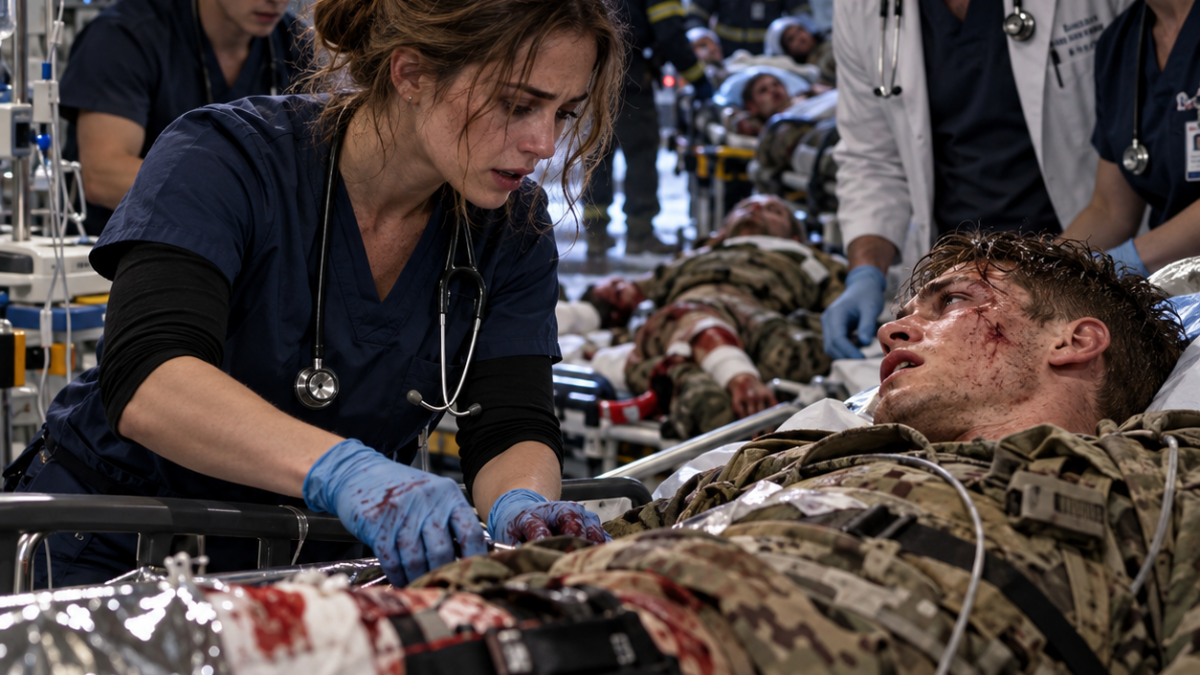
Ten soldiers, some young enough that their faces still belonged in high school yearbooks instead of trauma bays. They groaned, cursed, called for sergeants, asked if the others were alive, asked for their mothers when they thought nobody could hear.
Staff who had handled broken wrists, ranch accidents, winter falls, and the occasional bad car crash stood frozen with gloves half on.
Lisa Caro, fifteen years on the floor, covered her mouth.
“Oh my God,” she whispered. “Oh my God.”
Dr. Dunlevy moved from patient to patient, ordering scans, ordering labs, ordering everything loudly enough to sound in control.
“CT for bed one. Full trauma panel on bed two. X-ray on bed five. Type and cross. Repeat vitals. Call radiology.”
His voice climbed with each order.
The CT scanner sat one hallway away.
It could take one patient every fifteen minutes if nothing went wrong.
There were ten patients.
I watched the room and felt something inside me go cold and clear.
I knew that feeling.
It was the moment before a plan failed.
Marcus appeared at my side, pale but steady.
“What do we do?”
“Sort them.”
“Sort them?”
“Who can breathe. Who is bleeding. Who can talk. Talking is good.”
He nodded, swallowing hard.
“Marker and tape.”
He ran.
I took strips of tape, wrote colors on them, and began placing them on chests and foreheads.
Red.
Yellow.
Green.
Immediate.
Delayed.
Walking wounded.
Nobody told me to.
Nobody stopped me.
That was how chaos often worked. People waited for authority until certainty appeared. Then they followed whatever voice sounded most like survival.
A sharp cry came from bed three.
Sergeant Mateo Ruiz, big man, shaved head, shoulders packed with muscle, was clawing at his collar. His lips had turned blue.
I reached him first.
“Ruiz, look at me.”
He could not.
I put my stethoscope to his chest.
Left side: air movement.
Right side: nothing.
His trachea was shifting left. Neck veins standing like ropes. His breaths shallow, desperate, ineffective.
“Dr. Dunlevy,” I called. “Tension pneumothorax, bed three. He needs decompression now.”
Dunlevy hurried over, glanced at the monitor, and shook his head.
“His pressure is holding. CT first.”
“He will be dead before CT.”
“Nurse Whitfield.”
“Look at his neck.”
“I said step back.”
Patrice came up behind me and touched my elbow.
“Norah,” she whispered, “please don’t do this. He’s the doctor.”
I looked at Ruiz.
His eyes had rolled toward mine.
Not asking.
Begging.
Oxygen saturation dropped.
Ninety-one.
Eighty-eight.
Eighty-four.
For eleven months, silence had told me: stay in your lane.
A frozen ridge from another life said something else.
I reached for the crash cart and took the long needle.
“Norah!” Patrice gasped.
“No,” someone whispered.
I cleaned the spot below the collarbone, found the space, and pushed the needle in with one smooth motion.
A hiss of trapped air escaped.
Ruiz took a huge, shuddering breath.
Color came back into his face so quickly it felt like watching a man return from the edge of a cliff.
The monitor climbed.
Eighty-eight.
Ninety-two.
Ninety-six.
The room went silent.
Dr. Dunlevy stared at the needle.
Then at the monitor.
Then at me.
His face moved through anger, shock, and something almost like shame.
“He would have coded,” I said, without pride. “I’m sorry I raised my voice. He needs a chest tube next. Do you want to place it, or shall I hold the tray?”
A long second passed.
Dunlevy swallowed.
“Hold the tray.”
He placed it.
His hands shook at first.
I talked him through the steps in the same voice I had once used while holding a flashlight between my teeth as another medic tried to close a bleeding artery in the dark.
When it was done, Ruiz breathed easier.
Dunlevy let out a breath of his own and looked at me differently.
Not warmly.
Not with trust.
Not yet.
But he saw me.
“Whitfield,” he said quietly, “tell me what you need.”
The whole emergency room changed.
Nobody announced it.
No dramatic music played.
But suddenly every nurse’s eyes turned toward me.
“Lisa, bed five. Two large-bore IVs and direct pressure on that thigh. Patrice, call the lab. I want every unit of blood we have ready. Marcus, walk the greens to the waiting room, blankets on all of them, and check them every ten minutes. Dr. Dunlevy, you take the reds. I float.”
“Yes, ma’am,” Marcus said.
Then he flushed red because he heard himself say it.
I did not correct him.
For the next hour, I moved through the chaos like water through rock.
A soldier with a broken pelvis.
A corporal with a head wound who kept forgetting his own name.
A nineteen-year-old private who kept apologizing for bleeding on the floor.
“You’re doing great,” I told him, pressing gauze harder into the wound. “Keep talking to me.”
“I’m making a mess,” he whispered.
“You should see the other guy.”
He gave one breath of laughter and stayed awake.
Good.
Laughter meant oxygen reached the brain.
Laughter meant he was still with me.
When the worst edge of the first wave eased, I returned to bed one.
Staff Sergeant Cole Danner was awake, leg splinted, color better. Blood darkened the sheets beneath him, but the bleeding was controlled.
He watched me adjust his blanket.
“It’s you,” he whispered.
“You need to rest, Sergeant.”
“Ridge Nine.”
My hand froze.
“I was nineteen,” he said. “I was the kid with the hole in his side.”
The room noise faded.
“You lit a green light,” he whispered. “Hung it on the rock so I could see something. You told me if I could see the light, I was still alive.”
“Cole,” I said softly. “Please.”
“They called you Lantern.”
I closed my eyes.
“All of us who came home, we never stopped asking where you went.”
I turned my face slightly away.
I had not expected anyone from Ridge Nine to come through the doors of Larkin Falls.
Not in this storm.
Not on this night.
Not when I had spent six years believing distance could become mercy if I just moved far enough.
Danner’s fingers closed weakly around my wrist.
“Colonel Hail was two vehicles behind us tonight. He’s on his way.”
I opened my eyes.
“What?”
“He’s been looking for you for six years.”
The color drained from my face.
Behind me, Dr. Dunlevy had stopped midstep.
He had heard every word.
He did not speak.
He only looked at me as if a stranger had been working beside him for nearly a year.
I pulled my wrist gently free.
Then I walked into the supply room, closed the door, and stood in the dark between shelves of gauze and saline.
My palms pressed against cold metal.
My heart pounded so hard I could feel it in my teeth.
Six years earlier, I had been Specialist Norah Whitfield, combat medic, attached to a Ranger platoon operating in a place no tourist map would ever mark honestly.
A helicopter went down on a ridge during a storm.
Eleven men were alive when I reached them.
Some barely.
The weather made evacuation impossible.
The enemy knew the crash site.
We had almost no supplies, no shelter, and not enough time.
For nine hours, I held death at bay with my hands, my voice, and one green light tied to a rock so the men could look toward something other than the dark.
Ten lived.
One did not.
Corporal Eli Marsh.
Twenty-two years old.
He slipped away in my arms at first light, ten minutes before the rescue helicopters came.
Ten minutes.
People talk about trauma like it is always made from what happened.
Sometimes it is made from what almost happened differently.
Ten minutes earlier, rescue would have saved him.
Ten minutes later, I might have accepted that nothing could be done.
But ten minutes is close enough to spend the rest of your life arguing with God in your sleep.
I came home with scars nobody could see, a medal recommendation I refused, and a silence I could not explain.
I left the Army.
I moved four times.
Then one winter, I read a small newspaper notice from Wyoming and saw the name Walter Puit.
Eli’s father.
Widower.
Rancher.
Moved near Larkin Falls after selling land outside Casper.
I applied to the hospital a week later.
That was why I checked bed four every fifteen minutes.
That was why I brought Walt an extra blanket before he asked.
That was why I knew how he took his coffee.
He had never known who watched over him.
I had told myself it was better that way.
The supply room door opened.
Dr. Dunlevy stood there looking older than he had at midnight.
“I heard what he said.”
I said nothing.
“Is it true?”
“Some of it.”
He took a slow breath.
“I have worked in this ER for nine years,” he said. “I have looked right past you for eleven months.”
I looked at the floor.
“I want you to know I’m ashamed of that.”
I did not know what to do with an apology from a man who still had patients dying in the next room.
Fortunately, he did not seem to need anything from me.
“Blood is our problem,” he said. “We have six units of O-negative. Ruiz needs two. The pelvis may need four. The head injury might need surgery we cannot do here.”
My mind cleared.
“The soldiers who aren’t badly hurt.”
He frowned.
“The walking wounded?”
“Healthy young men. Military records. Known blood types. In the field, we called it a walking blood bank.”
“That is not our protocol.”
“No. But it works. Lab can test in twenty minutes. Every man in a Ranger unit gives when asked.”
Dunlevy looked at me.
For a moment, I saw the struggle in him. The doctor who wanted policies. The doctor who feared liability. The doctor who had spent eleven months dismissing me and now needed what I knew.
Then he nodded once.
“Do it. I’ll sign for it.”
Within minutes, six uninjured soldiers lined the hallway with sleeves rolled up, joking with nurses in the brittle way men joke when they have just survived something that has not yet reached their emotions.
Sergeant First Class Terrence Boyd, tall and calm, took charge of the line.
“Ma’am,” he said when I passed, voice oddly formal.
I pretended not to hear the weight in it.
Then a new alarm cut through the room.
Not a soldier’s monitor.
Bed four.
I ran.
Walt Puit’s face was the color of paper.
His abdomen was tight and swollen beneath the blanket. His pulse was a thread. His blood pressure was so low the number seemed impossible.
“Miss Norah,” he whispered. “Something tore.”
Dr. Dunlevy came up behind me.
His face told me before his mouth did.
“Ruptured aortic aneurysm.”
The words moved through the room like cold air.
“Our surgeon is forty minutes out,” he said. “If the road is open.”
“Then he’s mine until she arrives.”
This time, Dunlevy did not argue.
He stepped aside.
“Norah,” he said, “he’s yours.”
Everyone in the room knew Walt Puit was dying.
I worked anyway.
Blood into one arm.
Second line in the other.
Pressure low enough not to worsen the tear, high enough to perfuse his brain.
Warm blankets.
Calm voice.
Call the surgeon again.
Call the road crew again.
Outside the windows, the snow kept falling.
Every second stretched thin enough to cut.
Patrice stood at the phone, pale and focused.
“Dr. Rao is ten minutes out,” she said. “The plow got her through.”
“Ten minutes,” I repeated.
I leaned close to Walt.
“Just ten minutes. Do you hear me?”
His eyes opened.
Blue.
Clear.
Too awake for a dying man.
“I know who you are, Norah.”
My heart stopped.
“Walt, save your strength.”
“I’ve known since your second week.”
No.
“Your hands,” he whispered. “You have a way of holding a man’s wrist. Eli wrote about it in his last letter.”
My vision blurred.
“Walt.”
“He wrote about a medic named Norah with a green light who wouldn’t leave him.”
My chest opened around the old wound.
“I was there,” I said. “I couldn’t save him. I need you to know I tried. I stayed with him. I—”
Walt’s fingers moved weakly around mine.
“He told me.”
I could not breathe.
“He wrote, ‘If anything happens, tell my dad she did everything right.’”
The words landed like a hand over my heart.
Six years of guilt cracked in one breath.
“He told me to tell you not to carry it,” Walt whispered.
Tears burned down my face.
All the while, my hands kept working.
“You came here to look after me,” he said. “And you never said a word.”
“I didn’t know how.”
“I let you,” he whispered, “because I thought maybe you needed it more than I needed the truth.”
I bent my head.
“I’m so sorry.”
“Don’t be sorry.”
His eyes fluttered.
“Be here.”
The monitor shrieked.
His pressure plunged.
His eyes rolled upward.
My grief vanished behind command.
“Push another unit,” I said. “Marcus, squeeze that bag. Patrice, raise his legs. Dr. Dunlevy, I need calcium ready. Walter Puit, you are not leaving this room.”
For ten long minutes, I fought.
Not gracefully.
Not heroically.
I fought like a woman who had already lost this man’s son by ten minutes and refused to watch the father follow him because the snow was inconvenient.
Dunlevy stood at my shoulder, handing me supplies before I finished asking.
No ego.
No lectures.
No corrections for my tone.
Only help.
The hallway went quiet.
Soldiers with bandaged arms stood in the doorway. Nurses held their breath. Even the storm seemed to lean against the windows and listen.
Then the ambulance bay doors banged open.
Dr. Anita Rao ran in with her coat white with snow, surgical cap already on.
She took one look at the monitor, then at me.
“Status.”
I gave it in twelve seconds.
Presentation.
Pressure.
Blood given.
Likely rupture time.
Current medications.
Access.
Response.
Rao blinked once.
“Who trained you?”
“A long time ago,” I said.
Then I looked down at Walt.
“Doctor, this man has a whole town that loves him. Don’t let him go.”
“Move him,” Rao ordered. “Now.”
We ran the stretcher down the hall toward the small operating room.
My hand stayed on Walt’s as long as it could.
At the doors, his eyes opened once more.
“Lantern,” he whispered.
Then the doors swung shut.
Dawn came slowly to Larkin Falls.
The storm broke apart into pale pink clouds above the mountains. The first plow rolled down Main Street. Inside the ER, the wreckage of the night was being put away quietly.
Blood-stained sheets.
Empty IV bags.
Wet coats.
Discarded tape.
Coffee gone cold in cups nobody remembered pouring.
Ten soldiers stabilized.
One transferred.
None lost.
The news moved through the building in whispers.
Nobody died.
Not one.
I sat alone at the nurse’s station with a cup of cold coffee between my hands.
My scrubs were stained. My hair had fallen loose. My body felt like it had been emptied out and put back together wrong.
Dr. Rao came out of the operating room.
I stood so quickly the chair scraped behind me.
She pulled off her mask.
“He’s alive.”
The room around me blurred.
“Stable,” she said. “He’ll need time. But he’s alive. And I have no idea how, except that somebody kept him that way long enough for me to get there.”
I put both hands over my face and finally breathed out.
A few minutes later, boots sounded in the hallway.
Heavy.
Steady.
Moving in step.
Everyone turned.
Three men in uniform came through the double doors.
Two wore field camouflage: Sergeant First Class Boyd and a lean sergeant with a scar across his chin.
They walked one pace behind the man in the middle.
Colonel Jonas Hail wore a dark green dress uniform, Ranger tab on his shoulder, ribbons across his chest telling a career in colors and metal. He was tall, gray at the temples, and carried himself like a man who had learned not to waste movement.
He stopped in the center of the ER.
I stood slowly.
My hands folded in front of me before I could stop them.
The way I had once stood before commanders who wanted answers after missions nobody was allowed to discuss.
Everyone watched.
Colonel Hail looked at me for a long time.
Not like a superior officer inspecting a subordinate.
Like a man seeing something he had almost stopped believing he would find.
“Ma’am,” he said.
Then he raised his right hand and saluted.
Boyd saluted.
The sergeant with the scar saluted.
Around us, the staff froze.
Six years of hiding ended in the center of a rural emergency room that smelled like coffee, blood, snow, and disinfectant.
“Six years ago on Ridge Nine,” Colonel Hail said, voice rough enough to carry every mile he had searched, “you kept eleven of my men alive for nine hours with no supplies and no help. You refused a medal. You refused every call. Then you vanished.”
My throat tightened.
“I looked for you in every state,” he said. “This morning, you saved ten more of my soldiers and the man we came here to honor.”
I could barely speak.
“Sir,” I whispered, “I only did my job.”
“No, ma’am,” Hail said gently. “You did the work of ten people. And you did it for years without anyone saying thank you.”
He lowered his hand.
The others followed.
Behind me, Dr. Dunlevy stepped forward.
“Norah,” he said.
I turned.
He looked exhausted. Ashamed. Honest in a way I had not seen from him before.
“I owe you an apology. All of us do.”
I thought of bed three.
His shaking hands placing the chest tube.
His voice in the supply room.
His silence beside Walt’s bed, not because he was ignoring me, but because he was finally helping.
“Doctor,” I said, and managed a faint smile, “you held the tray. That’s plenty.”
Patrice was crying.
Lisa too.
Marcus stood near the hallway, grinning like a boy at Christmas with tears in his eyes.
Colonel Hail reached into his jacket and pulled out a folded envelope.
“Mr. Puit was to be honored at the courthouse for his son,” he said. “He sent me a letter months ago. In it, he asked that if I ever found you, you stand beside him.”
He held out the envelope.
“Will you?”
I looked toward the operating room doors.
For six years, I had believed standing near Eli’s memory would burn me alive.
But Walt had known.
He had known and let me stay.
Not as punishment.
As mercy.
“Yes,” I said. “I’ll stand beside him.”
Something in my chest loosened.
A knot tied for six years, not gone, but no longer strangling me.
I looked around the ER.
At the people who had ignored me.
At the young tech who had listened.
At the doctor who had learned.
At the soldiers who had bled in our hallway and lived.
Then I looked back at Colonel Hail.
“And Colonel?”
“Yes, ma’am?”
“I’m not leaving Larkin Falls.”
His expression softened.
“No?”
“These people need training for nights like this one,” I said. “Mass casualty triage. Field blood protocols. Trauma recognition. Rural emergency response when the road is closed and no helicopter is coming.”
I glanced at Dunlevy.
“They need to know what to do before someone like me has to break protocol to save a life.”
Dunlevy nodded.
“Teach us,” he said.
The room grew quiet.
Not the empty quiet of people ignoring me.
A different quiet.
The kind that makes room.
For eleven months, I had carried my light under my ribs where nobody could see it.
I had believed that if nobody noticed me, I could not fail anyone again.
But a lantern hidden too deep does not guide the lost.
I looked at Walt’s closed operating room doors.
Then at Marcus.
Then at the soldiers lined along the wall.
Then at the staff who had finally turned toward me.
“A lantern doesn’t need anyone to notice it,” I said quietly. “It only needs to stay lit.”
Nobody spoke for a long moment.
Then Marcus, young Marcus who had listened before anyone else did, wiped his face with his sleeve and said, “Then teach us how to keep it lit too.”
That was how my quiet life ended.
Not with applause.
Not with a medal.
Not with the past becoming painless.
The past never becomes painless.
But it can become useful.
In the weeks that followed, the ER changed.
Dr. Dunlevy stopped dismissing nurses before hearing them out. Patrice rebuilt our emergency call tree and admitted out loud that leadership without listening was just a different kind of panic. Lisa asked me to run trauma drills. Marcus became insufferably proud of knowing me before everyone else “figured it out.”
Walt survived surgery.
Three days later, when I walked into his room, he opened one eye and said, “Took you long enough, Miss Norah.”
I laughed and cried at the same time.
A month later, I stood beside him at the courthouse while the town honored Eli Marsh.
Walt held my hand through the whole ceremony.
When they read Eli’s name, I did not look away.
Afterward, Colonel Hail handed me a small green chem light sealed in a clear case.
“From the ridge,” he said.
I stared at it.
“I thought it was lost.”
“Boyd found it near the rock after evac,” he said. “Kept it all these years.”
I held the little green light in my palm.
It weighed almost nothing.
It carried everything.
That night, I returned to the hospital for my shift.
Bed four was empty.
The snow had melted from the ambulance bay doors.
The hallway smelled like floor cleaner and coffee.
Ordinary sounds filled the ER: monitors, printers, low voices, wheels rolling across tile.
I clipped my badge to my scrubs.
Norah Whitfield, RN.
No rank.
No medal.
No call sign.
But when I walked past the nurses’ station, Dr. Dunlevy looked up from the computer.
“Norah,” he said, “can you take a look at this with me?”
I did.
Not because I wanted to be seen.
Because a patient needed both of us looking.
And for the first time in eleven months, when I spoke, nobody looked past me.
They listened.
𝗧𝗛𝗘 𝗘𝗡𝗗
The Word the Wounded Soldier Whispered Made the Whole Emergency Room Turn Toward Me
I spent eleven months being ignored in a hospital where everyone thought silence meant I had nothing to say.
Then a wrecked Army truck came through our doors, and one bleeding soldier whispered the name I had buried six years earlier.
By dawn, the people who had looked right through me finally understood that I had not been hiding weakness—I had been carrying a battlefield in my hands.
The alarm on bed four had been chirping for ten minutes when I decided to say it one more time.
“Dr. Dunlevy,” I said, keeping my voice calm, “Mr. Puit’s pressure is drifting down. His abdomen is getting more rigid.”
Dr. Rick Dunlevy did not look up from the computer.
He had the kind of face people trusted because he looked like what they expected a doctor to look like. Tall. Clean-cut. Silver beginning at his temples. A voice smooth enough to make uncertainty sound like expertise.
“Nurse Whitfield,” he said, fingers still moving over the keyboard, “you chart. I diagnose.”
Behind him, Patrice Lindgren, the charge nurse, walked past with a stack of discharge papers in her hand as if the words had never been spoken.
Nobody laughed.
Nobody argued.
That was the worst part.
At Larkin Falls Rural Medical Center, I was not mocked. I was not hated. I was not considered important enough for either.
For eleven months, I had moved through that small emergency room like furniture people learned to walk around. Six beds. One doctor on nights. Four nurses if the schedule was kind. One young tech who still believed listening could save time instead of waste it.
Outside, the snowstorm was beating against the ambulance bay doors hard enough to rattle the glass.
No helicopters would fly in that weather. No specialist would arrive quickly. The nearest trauma center was ninety minutes away on a good road, and Route 12 had not been a good road since sundown.
I looked back at bed four.
Walter Puit lay pale against the pillow, his hands folded over the blanket like he was trying to appear more comfortable than he was. Sixty-eight years old. Rancher. Widower. A man with weathered knuckles, kind eyes, and a habit of apologizing before asking for anything.
He had come in around supper time complaining about belly pain and joking that it was probably just his “old back trying to resign.”
I had checked on him every fifteen minutes since.
I checked on him more than any other patient in the building.
Nobody asked why.
That was another thing about being ignored: people rarely asked you to explain your patterns.
I returned to his bedside and pressed two fingers to his wrist.
His pulse was fast.
Too fast.
Thin beneath my touch.
“Still here, Miss Norah,” he whispered.
I leaned closer.
“You planning on going somewhere?”
A weak smile touched his mouth.
“Don’t tell them I’m scared.”
“I won’t.”
His eyes flicked toward mine.
“Promise?”
“I promise.”
His abdomen was tighter than it had been twenty minutes earlier. The skin beneath my palm had that unforgiving firmness I had learned to dread long before I ever worked in a hospital with walls.
A bad belly talks with the whole body.
Pale face.
Fast pulse.
Restless hands.
That faraway look in the eyes when pain moves from sharp to deep.
My jaw tightened.
Marcus Bell, our night tech, appeared beside me with the quiet urgency of someone who had learned to watch what I watched.
He was twenty-three, too young to be as tired as he always looked, with a kind face and a nervous habit of tapping two fingers against his thigh whenever he was worried.
“Same as before?” he murmured.
“Worse.”
His eyes moved to Walt’s monitor.
“What do you need?”
“Second IV kit. Quietly.”
Marcus did not ask why.
That was why I trusted him.
He disappeared toward supply.
I stood there for half a second, listening to the storm press against the building. Larkin Falls sat in a valley where winter made people humble. Ranchers, loggers, truckers, families who drove too far on bad roads because small towns taught people to endure longer than they should.
I had chosen this place because it was quiet.
Because nobody knew my name.
Because the mountains were close enough to feel familiar, but not close enough to smell like that other ridge when the snow came down sideways and men called for their mothers in the dark.
My name tag said Norah W., RN.
That was all anyone needed.
Then the phone at the front desk rang.
Once.
Twice.
Patrice answered.
I watched her face change before she said a word.
“State police,” she said slowly. “Route 12. Coyote Bend.”
Dr. Dunlevy finally looked up.
Patrice’s voice went thin.
“An Army truck slid on the ice and rolled. Ten soldiers injured. Ambulances are coming here. We’re the nearest hospital by ninety minutes.”
The room went still.
Even Walt seemed to stop breathing.
Dunlevy stood so fast his chair rolled backward and hit the wall.
“Ten?”
Patrice nodded.
“We have six beds.”
“Seven,” I said quietly. “If we clear the hallway.”
Dunlevy glanced at me with irritation, then looked away.
“Patrice, call in everyone.”
“The roads are closed,” she said. “Nobody is getting here.”
The monitors beeped.
The wind hit the doors again.
I looked down and saw my own hands trembling.
Not from fear.
From memory.
My body knew what was coming before my mind gave it permission.
I had spent six years building a quiet life out of routine, night shifts, and half-truths.
Former Army medic.
Short tour.
Came home.
All true.
None of it complete.
Lights swept across the ambulance bay windows.
The doors banged open.
Cold air and diesel smoke rolled down the hall.
The first paramedic came in pushing a stretcher, snow melting in his hair.
On it lay a young soldier in torn camouflage, one leg bound high with a tourniquet, his face gray beneath streaks of blood. His eyes were open and wild, searching the ceiling as if the answer to pain might be written there.
“Staff sergeant, thirty years old,” the paramedic shouted. “Chest trauma, leg bleed. Tourniquet placed at the scene. He keeps saying one word. We don’t know what it means.”
The stretcher crossed the threshold.
I stepped toward it.
The soldier’s head rolled at the sound of my footsteps.
His eyes found my face.
Stopped.
And then he breathed one word.
“Lantern.”
I stopped breathing with him.
Nobody else in the room understood.
To them, it was a strange word from a concussed soldier.
To me, it was a hand reaching out of a grave I had spent six years refusing to visit.
Lantern.
My old name.
Not a call sign assigned by command.
Not official.
Not written on any file I had ever seen.
The men had given it to me on Ridge Nine because of the small green chem light I had hung from a rock in the storm so the wounded would have something to see when everything else disappeared.
I had not heard that name in six years.
I forced the past down into the same locked room where I kept the screaming.
Then I stepped to the stretcher.
“I’ve got him, Marcus. Bed one. Move.”
Dunlevy snapped, “Nurse Whitfield, I will assign the beds.”
I looked at him.
The room around us was filling with the first edges of disaster.
“Then assign them fast, Doctor. The second ambulance is thirty seconds out.”
For once, he hesitated.
Then he pointed.
“Fine. Bed one.”
We rolled the soldier in.
His name tape read DANNER.
I cut away his sleeve and checked the tourniquet. Tight. Well placed. Time written on the strap in black marker. Somebody on that truck had known exactly what to do.
That mattered.
Then the second ambulance arrived.
Then the third.
The hallway filled with snow, blood, and fear.
Four stretchers.
Six.
Eight.
Ten soldiers, some young enough that their faces still belonged in high school yearbooks instead of trauma bays. They groaned, cursed, called for sergeants, asked if the others were alive, asked for their mothers when they thought nobody could hear.
Staff who had handled broken wrists, ranch accidents, winter falls, and the occasional bad car crash stood frozen with gloves half on.
Lisa Caro, fifteen years on the floor, covered her mouth.
“Oh my God,” she whispered. “Oh my God.”
Dr. Dunlevy moved from patient to patient, ordering scans, ordering labs, ordering everything loudly enough to sound in control.
“CT for bed one. Full trauma panel on bed two. X-ray on bed five. Type and cross. Repeat vitals. Call radiology.”
His voice climbed with each order.
The CT scanner sat one hallway away.
It could take one patient every fifteen minutes if nothing went wrong.
There were ten patients.
I watched the room and felt something inside me go cold and clear.
I knew that feeling.
It was the moment before a plan failed.
Marcus appeared at my side, pale but steady.
“What do we do?”
“Sort them.”
“Sort them?”
“Who can breathe. Who is bleeding. Who can talk. Talking is good.”
He nodded, swallowing hard.
“Marker and tape.”
He ran.
I took strips of tape, wrote colors on them, and began placing them on chests and foreheads.
Red.
Yellow.
Green.
Immediate.
Delayed.
Walking wounded.
Nobody told me to.
Nobody stopped me.
That was how chaos often worked. People waited for authority until certainty appeared. Then they followed whatever voice sounded most like survival.
A sharp cry came from bed three.
Sergeant Mateo Ruiz, big man, shaved head, shoulders packed with muscle, was clawing at his collar. His lips had turned blue.
I reached him first.
“Ruiz, look at me.”
He could not.
I put my stethoscope to his chest.
Left side: air movement.
Right side: nothing.
His trachea was shifting left. Neck veins standing like ropes. His breaths shallow, desperate, ineffective.
“Dr. Dunlevy,” I called. “Tension pneumothorax, bed three. He needs decompression now.”
Dunlevy hurried over, glanced at the monitor, and shook his head.
“His pressure is holding. CT first.”
“He will be dead before CT.”
“Nurse Whitfield.”
“Look at his neck.”
“I said step back.”
Patrice came up behind me and touched my elbow.
“Norah,” she whispered, “please don’t do this. He’s the doctor.”
I looked at Ruiz.
His eyes had rolled toward mine.
Not asking.
Begging.
Oxygen saturation dropped.
Ninety-one.
Eighty-eight.
Eighty-four.
For eleven months, silence had told me: stay in your lane.
A frozen ridge from another life said something else.
I reached for the crash cart and took the long needle.
“Norah!” Patrice gasped.
“No,” someone whispered.
I cleaned the spot below the collarbone, found the space, and pushed the needle in with one smooth motion.
A hiss of trapped air escaped.
Ruiz took a huge, shuddering breath.
Color came back into his face so quickly it felt like watching a man return from the edge of a cliff.
The monitor climbed.
Eighty-eight.
Ninety-two.
Ninety-six.
The room went silent.
Dr. Dunlevy stared at the needle.
Then at the monitor.
Then at me.
His face moved through anger, shock, and something almost like shame.
“He would have coded,” I said, without pride. “I’m sorry I raised my voice. He needs a chest tube next. Do you want to place it, or shall I hold the tray?”
A long second passed.
Dunlevy swallowed.
“Hold the tray.”
He placed it.
His hands shook at first.
I talked him through the steps in the same voice I had once used while holding a flashlight between my teeth as another medic tried to close a bleeding artery in the dark.
When it was done, Ruiz breathed easier.
Dunlevy let out a breath of his own and looked at me differently.
Not warmly.
Not with trust.
Not yet.
But he saw me.
“Whitfield,” he said quietly, “tell me what you need.”
The whole emergency room changed.
Nobody announced it.
No dramatic music played.
But suddenly every nurse’s eyes turned toward me.
“Lisa, bed five. Two large-bore IVs and direct pressure on that thigh. Patrice, call the lab. I want every unit of blood we have ready. Marcus, walk the greens to the waiting room, blankets on all of them, and check them every ten minutes. Dr. Dunlevy, you take the reds. I float.”
“Yes, ma’am,” Marcus said.
Then he flushed red because he heard himself say it.
I did not correct him.
For the next hour, I moved through the chaos like water through rock.
A soldier with a broken pelvis.
A corporal with a head wound who kept forgetting his own name.
A nineteen-year-old private who kept apologizing for bleeding on the floor.
“You’re doing great,” I told him, pressing gauze harder into the wound. “Keep talking to me.”
“I’m making a mess,” he whispered.
“You should see the other guy.”
He gave one breath of laughter and stayed awake.
Good.
Laughter meant oxygen reached the brain.
Laughter meant he was still with me.
When the worst edge of the first wave eased, I returned to bed one.
Staff Sergeant Cole Danner was awake, leg splinted, color better. Blood darkened the sheets beneath him, but the bleeding was controlled.
He watched me adjust his blanket.
“It’s you,” he whispered.
“You need to rest, Sergeant.”
“Ridge Nine.”
My hand froze.
“I was nineteen,” he said. “I was the kid with the hole in his side.”
The room noise faded.
“You lit a green light,” he whispered. “Hung it on the rock so I could see something. You told me if I could see the light, I was still alive.”
“Cole,” I said softly. “Please.”
“They called you Lantern.”
I closed my eyes.
“All of us who came home, we never stopped asking where you went.”
I turned my face slightly away.
I had not expected anyone from Ridge Nine to come through the doors of Larkin Falls.
Not in this storm.
Not on this night.
Not when I had spent six years believing distance could become mercy if I just moved far enough.
Danner’s fingers closed weakly around my wrist.
“Colonel Hail was two vehicles behind us tonight. He’s on his way.”
I opened my eyes.
“What?”
“He’s been looking for you for six years.”
The color drained from my face.
Behind me, Dr. Dunlevy had stopped midstep.
He had heard every word.
He did not speak.
He only looked at me as if a stranger had been working beside him for nearly a year.
I pulled my wrist gently free.
Then I walked into the supply room, closed the door, and stood in the dark between shelves of gauze and saline.
My palms pressed against cold metal.
My heart pounded so hard I could feel it in my teeth.
Six years earlier, I had been Specialist Norah Whitfield, combat medic, attached to a Ranger platoon operating in a place no tourist map would ever mark honestly.
A helicopter went down on a ridge during a storm.
Eleven men were alive when I reached them.
Some barely.
The weather made evacuation impossible.
The enemy knew the crash site.
We had almost no supplies, no shelter, and not enough time.
For nine hours, I held death at bay with my hands, my voice, and one green light tied to a rock so the men could look toward something other than the dark.
Ten lived.
One did not.
Corporal Eli Marsh.
Twenty-two years old.
He slipped away in my arms at first light, ten minutes before the rescue helicopters came.
Ten minutes.
People talk about trauma like it is always made from what happened.
Sometimes it is made from what almost happened differently.
Ten minutes earlier, rescue would have saved him.
Ten minutes later, I might have accepted that nothing could be done.
But ten minutes is close enough to spend the rest of your life arguing with God in your sleep.
I came home with scars nobody could see, a medal recommendation I refused, and a silence I could not explain.
I left the Army.
I moved four times.
Then one winter, I read a small newspaper notice from Wyoming and saw the name Walter Puit.
Eli’s father.
Widower.
Rancher.
Moved near Larkin Falls after selling land outside Casper.
I applied to the hospital a week later.
That was why I checked bed four every fifteen minutes.
That was why I brought Walt an extra blanket before he asked.
That was why I knew how he took his coffee.
He had never known who watched over him.
I had told myself it was better that way.
The supply room door opened.
Dr. Dunlevy stood there looking older than he had at midnight.
“I heard what he said.”
I said nothing.
“Is it true?”
“Some of it.”
He took a slow breath.
“I have worked in this ER for nine years,” he said. “I have looked right past you for eleven months.”
I looked at the floor.
“I want you to know I’m ashamed of that.”
I did not know what to do with an apology from a man who still had patients dying in the next room.
Fortunately, he did not seem to need anything from me.
“Blood is our problem,” he said. “We have six units of O-negative. Ruiz needs two. The pelvis may need four. The head injury might need surgery we cannot do here.”
My mind cleared.
“The soldiers who aren’t badly hurt.”
He frowned.
“The walking wounded?”
“Healthy young men. Military records. Known blood types. In the field, we called it a walking blood bank.”
“That is not our protocol.”
“No. But it works. Lab can test in twenty minutes. Every man in a Ranger unit gives when asked.”
Dunlevy looked at me.
For a moment, I saw the struggle in him. The doctor who wanted policies. The doctor who feared liability. The doctor who had spent eleven months dismissing me and now needed what I knew.
Then he nodded once.
“Do it. I’ll sign for it.”
Within minutes, six uninjured soldiers lined the hallway with sleeves rolled up, joking with nurses in the brittle way men joke when they have just survived something that has not yet reached their emotions.
Sergeant First Class Terrence Boyd, tall and calm, took charge of the line.
“Ma’am,” he said when I passed, voice oddly formal.
I pretended not to hear the weight in it.
Then a new alarm cut through the room.
Not a soldier’s monitor.
Bed four.
I ran.
Walt Puit’s face was the color of paper.
His abdomen was tight and swollen beneath the blanket. His pulse was a thread. His blood pressure was so low the number seemed impossible.
“Miss Norah,” he whispered. “Something tore.”
Dr. Dunlevy came up behind me.
His face told me before his mouth did.
“Ruptured aortic aneurysm.”
The words moved through the room like cold air.
“Our surgeon is forty minutes out,” he said. “If the road is open.”
“Then he’s mine until she arrives.”
This time, Dunlevy did not argue.
He stepped aside.
“Norah,” he said, “he’s yours.”
Everyone in the room knew Walt Puit was dying.
I worked anyway.
Blood into one arm.
Second line in the other.
Pressure low enough not to worsen the tear, high enough to perfuse his brain.
Warm blankets.
Calm voice.
Call the surgeon again.
Call the road crew again.
Outside the windows, the snow kept falling.
Every second stretched thin enough to cut.
Patrice stood at the phone, pale and focused.
“Dr. Rao is ten minutes out,” she said. “The plow got her through.”
“Ten minutes,” I repeated.
I leaned close to Walt.
“Just ten minutes. Do you hear me?”
His eyes opened.
Blue.
Clear.
Too awake for a dying man.
“I know who you are, Norah.”
My heart stopped.
“Walt, save your strength.”
“I’ve known since your second week.”
No.
“Your hands,” he whispered. “You have a way of holding a man’s wrist. Eli wrote about it in his last letter.”
My vision blurred.
“Walt.”
“He wrote about a medic named Norah with a green light who wouldn’t leave him.”
My chest opened around the old wound.
“I was there,” I said. “I couldn’t save him. I need you to know I tried. I stayed with him. I—”
Walt’s fingers moved weakly around mine.
“He told me.”
I could not breathe.
“He wrote, ‘If anything happens, tell my dad she did everything right.’”
The words landed like a hand over my heart.
Six years of guilt cracked in one breath.
“He told me to tell you not to carry it,” Walt whispered.
Tears burned down my face.
All the while, my hands kept working.
“You came here to look after me,” he said. “And you never said a word.”
“I didn’t know how.”
“I let you,” he whispered, “because I thought maybe you needed it more than I needed the truth.”
I bent my head.
“I’m so sorry.”
“Don’t be sorry.”
His eyes fluttered.
“Be here.”
The monitor shrieked.
His pressure plunged.
His eyes rolled upward.
My grief vanished behind command.
“Push another unit,” I said. “Marcus, squeeze that bag. Patrice, raise his legs. Dr. Dunlevy, I need calcium ready. Walter Puit, you are not leaving this room.”
For ten long minutes, I fought.
Not gracefully.
Not heroically.
I fought like a woman who had already lost this man’s son by ten minutes and refused to watch the father follow him because the snow was inconvenient.
Dunlevy stood at my shoulder, handing me supplies before I finished asking.
No ego.
No lectures.
No corrections for my tone.
Only help.
The hallway went quiet.
Soldiers with bandaged arms stood in the doorway. Nurses held their breath. Even the storm seemed to lean against the windows and listen.
Then the ambulance bay doors banged open.
Dr. Anita Rao ran in with her coat white with snow, surgical cap already on.
She took one look at the monitor, then at me.
“Status.”
I gave it in twelve seconds.
Presentation.
Pressure.
Blood given.
Likely rupture time.
Current medications.
Access.
Response.
Rao blinked once.
“Who trained you?”
“A long time ago,” I said.
Then I looked down at Walt.
“Doctor, this man has a whole town that loves him. Don’t let him go.”
“Move him,” Rao ordered. “Now.”
We ran the stretcher down the hall toward the small operating room.
My hand stayed on Walt’s as long as it could.
At the doors, his eyes opened once more.
“Lantern,” he whispered.
Then the doors swung shut.
Dawn came slowly to Larkin Falls.
The storm broke apart into pale pink clouds above the mountains. The first plow rolled down Main Street. Inside the ER, the wreckage of the night was being put away quietly.
Blood-stained sheets.
Empty IV bags.
Wet coats.
Discarded tape.
Coffee gone cold in cups nobody remembered pouring.
Ten soldiers stabilized.
One transferred.
None lost.
The news moved through the building in whispers.
Nobody died.
Not one.
I sat alone at the nurse’s station with a cup of cold coffee between my hands.
My scrubs were stained. My hair had fallen loose. My body felt like it had been emptied out and put back together wrong.
Dr. Rao came out of the operating room.
I stood so quickly the chair scraped behind me.
She pulled off her mask.
“He’s alive.”
The room around me blurred.
“Stable,” she said. “He’ll need time. But he’s alive. And I have no idea how, except that somebody kept him that way long enough for me to get there.”
I put both hands over my face and finally breathed out.
A few minutes later, boots sounded in the hallway.
Heavy.
Steady.
Moving in step.
Everyone turned.
Three men in uniform came through the double doors.
Two wore field camouflage: Sergeant First Class Boyd and a lean sergeant with a scar across his chin.
They walked one pace behind the man in the middle.
Colonel Jonas Hail wore a dark green dress uniform, Ranger tab on his shoulder, ribbons across his chest telling a career in colors and metal. He was tall, gray at the temples, and carried himself like a man who had learned not to waste movement.
He stopped in the center of the ER.
I stood slowly.
My hands folded in front of me before I could stop them.
The way I had once stood before commanders who wanted answers after missions nobody was allowed to discuss.
Everyone watched.
Colonel Hail looked at me for a long time.
Not like a superior officer inspecting a subordinate.
Like a man seeing something he had almost stopped believing he would find.
“Ma’am,” he said.
Then he raised his right hand and saluted.
Boyd saluted.
The sergeant with the scar saluted.
Around us, the staff froze.
Six years of hiding ended in the center of a rural emergency room that smelled like coffee, blood, snow, and disinfectant.
“Six years ago on Ridge Nine,” Colonel Hail said, voice rough enough to carry every mile he had searched, “you kept eleven of my men alive for nine hours with no supplies and no help. You refused a medal. You refused every call. Then you vanished.”
My throat tightened.
“I looked for you in every state,” he said. “This morning, you saved ten more of my soldiers and the man we came here to honor.”
I could barely speak.
“Sir,” I whispered, “I only did my job.”
“No, ma’am,” Hail said gently. “You did the work of ten people. And you did it for years without anyone saying thank you.”
He lowered his hand.
The others followed.
Behind me, Dr. Dunlevy stepped forward.
“Norah,” he said.
I turned.
He looked exhausted. Ashamed. Honest in a way I had not seen from him before.
“I owe you an apology. All of us do.”
I thought of bed three.
His shaking hands placing the chest tube.
His voice in the supply room.
His silence beside Walt’s bed, not because he was ignoring me, but because he was finally helping.
“Doctor,” I said, and managed a faint smile, “you held the tray. That’s plenty.”
Patrice was crying.
Lisa too.
Marcus stood near the hallway, grinning like a boy at Christmas with tears in his eyes.
Colonel Hail reached into his jacket and pulled out a folded envelope.
“Mr. Puit was to be honored at the courthouse for his son,” he said. “He sent me a letter months ago. In it, he asked that if I ever found you, you stand beside him.”
He held out the envelope.
“Will you?”
I looked toward the operating room doors.
For six years, I had believed standing near Eli’s memory would burn me alive.
But Walt had known.
He had known and let me stay.
Not as punishment.
As mercy.
“Yes,” I said. “I’ll stand beside him.”
Something in my chest loosened.
A knot tied for six years, not gone, but no longer strangling me.
I looked around the ER.
At the people who had ignored me.
At the young tech who had listened.
At the doctor who had learned.
At the soldiers who had bled in our hallway and lived.
Then I looked back at Colonel Hail.
“And Colonel?”
“Yes, ma’am?”
“I’m not leaving Larkin Falls.”
His expression softened.
“No?”
“These people need training for nights like this one,” I said. “Mass casualty triage. Field blood protocols. Trauma recognition. Rural emergency response when the road is closed and no helicopter is coming.”
I glanced at Dunlevy.
“They need to know what to do before someone like me has to break protocol to save a life.”
Dunlevy nodded.
“Teach us,” he said.
The room grew quiet.
Not the empty quiet of people ignoring me.
A different quiet.
The kind that makes room.
For eleven months, I had carried my light under my ribs where nobody could see it.
I had believed that if nobody noticed me, I could not fail anyone again.
But a lantern hidden too deep does not guide the lost.
I looked at Walt’s closed operating room doors.
Then at Marcus.
Then at the soldiers lined along the wall.
Then at the staff who had finally turned toward me.
“A lantern doesn’t need anyone to notice it,” I said quietly. “It only needs to stay lit.”
Nobody spoke for a long moment.
Then Marcus, young Marcus who had listened before anyone else did, wiped his face with his sleeve and said, “Then teach us how to keep it lit too.”
That was how my quiet life ended.
Not with applause.
Not with a medal.
Not with the past becoming painless.
The past never becomes painless.
But it can become useful.
In the weeks that followed, the ER changed.
Dr. Dunlevy stopped dismissing nurses before hearing them out. Patrice rebuilt our emergency call tree and admitted out loud that leadership without listening was just a different kind of panic. Lisa asked me to run trauma drills. Marcus became insufferably proud of knowing me before everyone else “figured it out.”
Walt survived surgery.
Three days later, when I walked into his room, he opened one eye and said, “Took you long enough, Miss Norah.”
I laughed and cried at the same time.
A month later, I stood beside him at the courthouse while the town honored Eli Marsh.
Walt held my hand through the whole ceremony.
When they read Eli’s name, I did not look away.
Afterward, Colonel Hail handed me a small green chem light sealed in a clear case.
“From the ridge,” he said.
I stared at it.
“I thought it was lost.”
“Boyd found it near the rock after evac,” he said. “Kept it all these years.”
I held the little green light in my palm.
It weighed almost nothing.
It carried everything.
That night, I returned to the hospital for my shift.
Bed four was empty.
The snow had melted from the ambulance bay doors.
The hallway smelled like floor cleaner and coffee.
Ordinary sounds filled the ER: monitors, printers, low voices, wheels rolling across tile.
I clipped my badge to my scrubs.
Norah Whitfield, RN.
No rank.
No medal.
No call sign.
But when I walked past the nurses’ station, Dr. Dunlevy looked up from the computer.
“Norah,” he said, “can you take a look at this with me?”
I did.
Not because I wanted to be seen.
Because a patient needed both of us looking.
And for the first time in eleven months, when I spoke, nobody looked past me.
They listened.