𝗙𝗨𝗟𝗟 𝗦𝗧𝗢𝗥𝗬 The Woman Who Tried to Take My Family Farm Never Expected Me to Let Her Keep Digging
𝗙𝗨𝗟𝗟 𝗦𝗧𝗢𝗥𝗬
Their actual subdivision was on one side of the road. A tidy cluster of houses, cul-de-sacs, and drainage ponds. But their so-called community boundary extended far beyond that. It swallowed my farm, three other old farms, a strip of county land, and even part of a state forest preserve.
My property was shaded pale blue and labeled LOT 47.
I stared at that map until my coffee went cold.
Then I drove to the county courthouse.
The courthouse sat downtown beside the old war memorial, a brick building with marble steps worn down by generations of boots, church shoes, and nervous lawyers. I had been there often enough over the years that the clerk at the property records desk recognized me.
“Afternoon,” she said. “What can I help you with?”
“I need copies of the recorded plat for Ashford Ridge,” I said. “And my deed records.”
She raised an eyebrow.
“That new subdivision giving you trouble?”
“You could say that.”
She sighed like she had heard enough about Ashford Ridge to last a lifetime.
It took about an hour to pull everything. Their subdivision plat. My deed. Historical transfer records. Boundary descriptions. Easement documents. Tax parcel maps. By the time I spread the papers across a public table near the windows, the truth was obvious.
Ashford Ridge had been legally platted and recorded.
My farm had not been included.
Not by accident. Not by implication. Not by some mysterious invisible boundary Karen had invented over the phone.
Their official property lines stopped exactly where they were supposed to stop. Everything else on their HOA map was fantasy.
A bold, printed fantasy.
I made copies of everything.
Then I called Jim Holloway.
Jim was an old-school real estate attorney who had handled a conservation easement for my father years before. He was in his late sixties, wore suspenders without irony, and had the calm voice of a man who had made arrogant people regret writing things down for four decades.
His office smelled like paper, coffee, and old leather. When I handed him Karen’s packet, he adjusted his glasses and began reading.
For the first few minutes, he said nothing.
Then he started smiling.
By the time he reached the map, he laughed out loud.
“This is some amateur-hour nonsense,” he said.
“That’s what I thought.”
“No,” he said, tapping the map with one finger. “This is worse than nonsense. This is arrogance wearing a cheap suit.”
He pulled my deed closer and compared it to the HOA map.
“They cannot just draw a circle around surrounding properties and declare them subject to HOA rules. That is not how real property works. That is not how covenants work. That is not how anything works.”
“So I’m not crazy?”
“Not unless the whole county courthouse is crazy with you.”
For the first time in days, I felt my shoulders loosen.
Jim drafted a letter that afternoon. It was direct, professional, and sharp enough to cut rope. He informed Ashford Ridge that my property had never been part of the subdivision, had never been bound by their covenants, and was not subject to HOA control, assessments, fines, inspections, architectural review, or enforcement action of any kind. He demanded that they remove my property from all maps and databases and cease all correspondence immediately.
He sent copies to Karen, the HOA’s management company, and the law firm listed in their packet.
“I’d expect some huffing and puffing,” Jim said as I stood to leave. “But once their attorney actually looks at the records, they’ll back off.”
He was wrong.
Two weeks later, another letter arrived.
This one came from a law firm in the state capital with a name long enough to sound expensive. It was full of phrases meant to intimidate people who did not know better. Ongoing noncompliance. Community enforcement rights. Accruing penalties. Legal remedies. Failure to cooperate.
The letter accused me of refusing to meet reasonable community standards and warned that further action might be taken if I failed to comply.
I read it twice.
Then I called Jim.
His voice went flat when I told him.
“Send me a copy.”
I scanned the letter and emailed it.
Ten minutes later, he called back.
“They doubled down.”
“I noticed.”
“This is either incompetence,” he said, “or they believe they can bully you into paying just to make them go away.”
“Karen does not strike me as confused.”
“No,” Jim said. “She strikes me as the type who has confused authority with volume.”
A few days later, the situation escalated.
A notice of violation appeared in my mailbox.
This one listed specific offenses.
Agricultural equipment visible from neighboring properties.
Failure to maintain lawn areas to community specifications.
Unauthorized commercial activity.
Nonconforming outbuildings.
Unapproved fencing.
Unsanctioned planting of fruit-bearing trees.
I stood beside the mailbox with the notice trembling in my hand, not because I was afraid, but because I was so angry I could feel my pulse in my teeth.
Unauthorized commercial activity.
My family had been farming that land since before Ashford Ridge’s developers’ grandparents were born. Before the county paved our road. Before half the state highway system existed. Before the idea of a homeowners association ever crawled out of somebody’s control-hungry mind.
And now Karen Whitmore thought I needed her permission to grow vegetables.
That evening, she came to my property.
She did not call first.
I was behind the barn checking a loose latch on the equipment shed when I heard tires crunching too fast on gravel. I stepped around the corner and saw a white luxury SUV roll up my driveway like it had been invited. The driver’s door opened, and Karen climbed out.
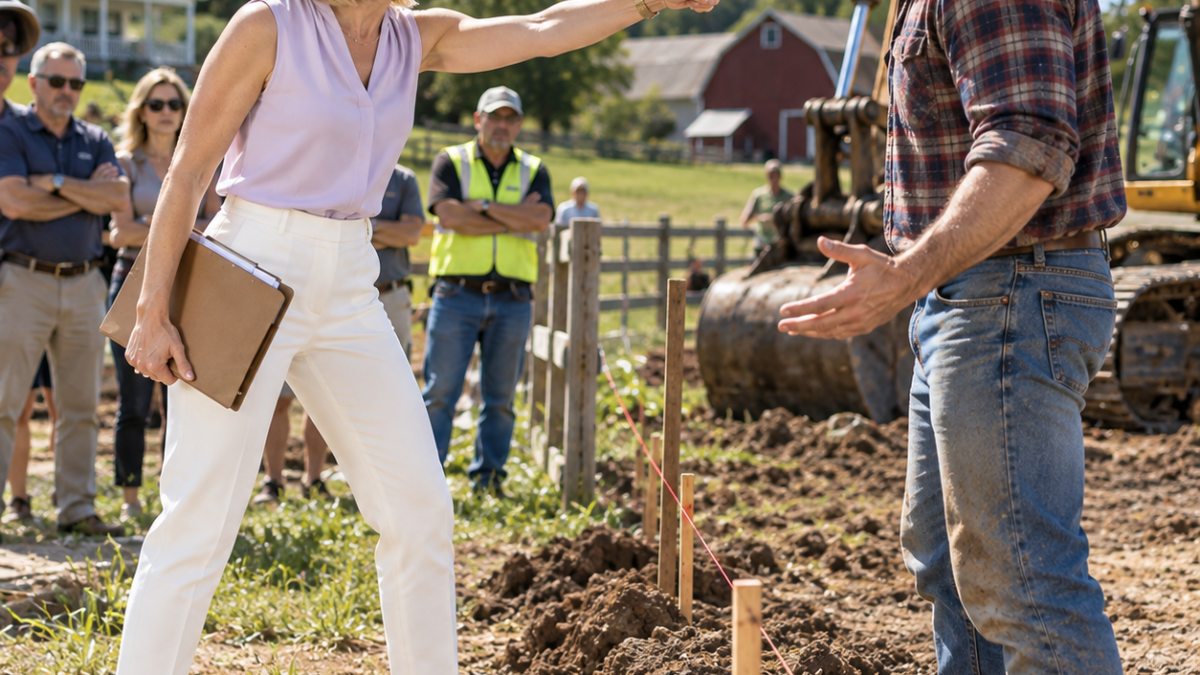
She was somewhere in her late forties, maybe early fifties, with a stiff blond bob cut so precisely it looked expensive to maintain and painful to touch. She wore white slacks, pointed flats, a navy blazer with gold buttons, and oversized sunglasses despite the cloudy sky. A clipboard was tucked under one arm like a weapon.
Two other people got out with her. A thin man in a polo shirt with the HOA logo stitched over his chest and a younger woman holding a tablet.
I walked toward them slowly.
“Can I help you?”
Karen looked past me toward the barn, then at the tractor, then at the rows of peppers and tomatoes beyond the yard. Her mouth tightened with theatrical disappointment.
“This is worse in person.”
I stopped ten feet away.
“You’re trespassing.”
“I am conducting a community compliance inspection.”
“No,” I said. “You are standing on private property where you have no authority.”
The man in the polo shifted uncomfortably.
Karen did not.
“You have received multiple notices,” she said. “You have refused to cooperate. The board is prepared to escalate this matter if necessary.”
“The board can escalate itself off my land.”
Her sunglasses came down just enough for me to see her eyes.
They were pale blue and cold, but not uncertain.
That mattered.
Confused people blink. Confused people hesitate.
Karen did neither.
“You farmers always think sentiment is a legal defense,” she said. “But Ashford Ridge has standards. Our residents paid premium prices for a premium community. They should not have to look at rusting machinery, overgrown fields, collapsing barns, and roadside produce signs.”
“My barn is not collapsing.”
“It is visually obsolete.”
I laughed once, hard and humorless.
“Visually obsolete?”
“Historic charm is one thing,” she said. “Neglect is another.”
Something inside me went quiet.
I thought of my father replacing boards on that barn with hands swollen from arthritis. I thought of him staining the south wall in July heat, sweating through his shirt because he said if a structure kept your animals safe, you owed it care. I thought of Karen looking at it for ten seconds and calling it neglect.
“You need to leave,” I said.
She smiled then, small and sharp.
“Mr. Walker, I understand that change is difficult for people attached to old ways. But you are surrounded by a modern residential community now. Your choices affect others. If you cannot maintain this property properly, perhaps you should consider selling it to someone who can.”
There it was.
Selling.
The word landed between us like a match dropped into dry straw.
“Is that what this is about?”
“This is about compliance.”
“No,” I said. “This is about land.”
Her smile did not move, but her eyes did.
For just a second, they flicked across the fields behind me.
The road frontage. The open acreage. The old house on high ground. The barn. The orchard. The soil.
She saw it as money.
I saw my father’s hands in it.
“I am telling you one last time,” I said. “Get off my property.”
The man in the polo cleared his throat.
“Karen, maybe we should—”
She lifted one finger without looking at him, and he shut up.
“Expect further action,” she said.
“I’m counting on it.”
She put her sunglasses back on, turned, and walked to her SUV.
They left dust hanging in the driveway.
That night, I barely slept.
Not because I believed Karen had legal authority. She did not. I had the records. I had Jim. I had the truth.
But truth has a weakness.
It takes time.
And people like Karen know that.
They know how to use paperwork as a weapon. They know the terror of official letterhead. They know a person can be right and still be forced to spend money, time, sleep, and peace proving it. They know that an elderly farmer might pay a fee just to stop the threats. They know grief makes people tired. They know land rich and cash poor families can be pressured.
That was when I stopped thinking of Karen as a nuisance.
She was a predator.
And she had come hunting behind a clipboard.
Jim sent a second letter, this one less polite. He accused the HOA of harassment and demanded written confirmation that my property would be removed from their records. He warned that any further attempt to enforce covenants against me would result in legal action.
For about a month, things went quiet.
Harvest season kept me busy enough to almost believe the silence meant victory. I fixed a water line near the lower field, replaced two rotted fence posts, sold late tomatoes at the Saturday market, and cleaned out my father’s old workbench one drawer at a time.
Then, on a Monday morning in October, I opened my mailbox and found the letter that made my blood run cold.
NOTICE OF LIEN FILING.
For a moment, the words did not make sense.
I stood in the road ditch with the envelope in one hand and the letter in the other, dry leaves scraping across the gravel around my boots.
The HOA claimed I owed $847 in unpaid assessments, fines, administrative fees, and violation penalties.
They claimed a lien had been placed against my property.
They claimed that if the amount was not paid within thirty days, Ashford Ridge Homeowners Association would begin foreclosure proceedings to satisfy the debt.
Foreclosure.
On my farm.
On the house my great-great-grandfather built.
On my father’s grave of a life.
The world narrowed to the paper in my hands.
I read it again.
Then again.
The letters blurred once, not from tears, but from a kind of rage so clean and bright it scared me.
They were not just trying to annoy me anymore.
They were trying to steal the farm.
I drove straight to Jim’s office.
His secretary took one look at my face and waved me in without asking if I had an appointment.
Jim was on the phone when I stepped into his doorway. He looked up, saw the paper in my hand, and ended the call mid-sentence.
“What happened?”
I laid the notice on his desk.
He read it.
The longer he read, the darker his expression became.
“They filed a lien,” he said quietly.
“That’s what it says.”
“On what authority?”
“That’s what I was hoping you’d tell me.”
He pushed back from his desk, stood, and reached for his coat.
“We’re going to the courthouse.”
We drove together in his old Buick. Neither of us said much. At the records office, Jim requested the lien documents. The clerk returned with a thin file and an expression that suggested she already knew something was off.
Jim read the filing right there at the counter.
Then he read it again.
Then he took off his glasses, pinched the bridge of his nose, and let out a breath.
“This is fraud.”
The lien used a property description that did not match my deed. It referenced HOA covenants that had never applied to my parcel. It cited state statutes governing legitimate homeowners associations, but those statutes only applied to properties legally bound by recorded covenants.
Mine was not.
They had filed a lien against land they did not control, for fees I did not owe, based on rules I had never agreed to.
And they had done it badly.
Sloppily.
Arrogantly.
But it was still there in the record.
Like a stain.
Jim made copies of everything. Back at his office, he spread the papers across his desk and paced behind them.
“Here is what we can do,” he said. “We can file immediately to have the lien declared invalid and removed. We can sue the HOA and the board members personally. We can file complaints with the attorney general, maybe the state real estate commission, maybe the bar association depending on how involved their lawyers were.”
“Do it.”
He looked at me.
“I want to,” he said. “Believe me, I want to. But I also want to know something first.”
“What?”
“How deep this goes.”
I frowned.
He sat down slowly, eyes fixed on the lien.
“This is too stupid to be accidental and too bold to be a one-off. Karen Whitmore did not wake up one morning and invent lien fraud out of nowhere. People like this practice on smaller targets before they take a swing at something this big.”
“You think they’ve done it before?”
“I think they have tried something with those other farms. Maybe with their own homeowners. Maybe somewhere else.” He tapped the paper. “If we shut this down today, you get relief. But if we let them think you’re scared and gather evidence, we may be able to bury this whole operation.”
The word operation stuck in my mind.
Not board.
Not HOA.
Operation.
I thought about the other farms on that fake map. The older couple down the road, Harold and May Bell, who had been on their land almost as long as we had. Mr. Jenkins, a widower whose sons lived two states away. The Delaney place, rented now by a young family trying to keep beef cattle on thin margins.
I thought about Karen’s sunglasses, her clipboard, and the way she had said perhaps you should consider selling it.
“What do you need from me?” I asked.
Jim smiled then, but there was no humor in it.
“Patience.”
Patience was not easy.
For the next several weeks, I lived with a lien on my farm.
Every morning, I woke up and felt it before I remembered it. A pressure behind the ribs. A hand around the throat. I worked the fields, repaired equipment, and tried to maintain the routines that had carried me through grief, but every task felt shadowed by the same thought.
They put their name on my land.
I imagined my father’s reaction. His quiet face. His slow temper. The way he would have stood in the kitchen, reading the notice without a word, until the paper wrinkled in his fist.
Jim’s paralegal, Maria, began digging.
Maria was small, fast-talking, and terrifyingly thorough. She found things the way border collies find gaps in fences. Within a week, she had pulled property records, corporate filings, HOA meeting minutes, management company contracts, past lawsuits, board membership histories, and archived local news from three states.
What she found turned my anger into something heavier.
Karen and the Ashford Ridge board had sent similar compliance letters to all three old farms caught inside their fake community map.
Harold and May Bell had paid $312 in so-called administrative fees because May had recently had surgery and Harold did not want stress landing on her doorstep.
Mr. Jenkins had paid $185 after receiving a threat about his barn roof.
The Delaney renters had ignored the letters because they did not own the property, and the actual landowner lived out of state.
But that was only the beginning.
Ashford Ridge had also submitted maintenance invoices to the county for work they claimed to have performed on a section of state forest land their fake map included inside the HOA boundary. Fallen tree removal. Brush clearing. Drainage work. Mowing.
They had billed taxpayers for land they did not own and work they apparently had not done.
Maria kept digging.
Karen Whitmore had been involved with an HOA in Florida that had been investigated for fraudulent lien filings against elderly homeowners. Another Ashford Ridge board member had been sued in Texas for harassment and improper collection practices. A third owned a small development consulting company that had quietly approached landowners near Ashford Ridge about selling “underperforming rural parcels.”
Underperforming.
That was what they called a farm when they wanted it sold.
Then Maria found the piece that made the whole scheme snap into focus.
A series of emails, obtained from a former HOA volunteer who had resigned after clashing with Karen, mentioned “future acquisition opportunities” along County Road 18. My farm was referenced by acreage, frontage, and estimated resale value if rezoned for residential development.
I sat in Jim’s office while Maria read from the printed emails.
My hands were clasped so tightly my knuckles ached.
“They wanted to pressure you into selling,” Jim said.
“No,” I replied. “They wanted to force it.”
He did not disagree.
Two weeks after the thirty-day deadline on the lien notice expired, the next letter arrived.
Karen had made her move.
Ashford Ridge was beginning foreclosure proceedings.
The letter demanded immediate payment of the original $847 plus additional legal fees, administrative costs, and collection expenses totaling more than $1,200. It outlined a proposed timeline. It warned that failure to pay could result in the forced sale of my property.
And buried in the second page was a sentence I will never forget.
The association has already identified interested parties willing to acquire the parcel should foreclosure become necessary.
I read that sentence aloud to Jim over the phone.
He went silent.
Then he said, “Bring it in.”
When I arrived, Maria was already there. Jim took the letter, read the sentence, and looked at her.
“Find the interested parties.”
She found them in less than forty-eight hours.
Two were connected to Ashford Ridge board members.
One was a limited liability company formed three months earlier by Karen’s brother-in-law.
Another traced back to the same consulting company that had labeled my land an “underperforming rural parcel.”
They were not enforcing community standards.
They were building a trap.
A fraudulent lien would create pressure. Foreclosure would create a forced sale. Connected buyers would scoop up the farm below market value. Then the land could be flipped to developers for millions.
My family’s 180-year-old farm had become a line item in Karen Whitmore’s scheme.
I wanted to drive to her house that night.
I wanted to pound on her door and make her say it to my face. I wanted to ask what kind of person looked at a grieving son, an old farmhouse, a working farm, elderly neighbors, county land, and state forest, and saw only loopholes.
But my father’s voice came back to me.
Never fight angry when the other side is counting on it.
So I stayed home.
I walked out to the barn instead.
The sun had gone down, and the air smelled like damp leaves and diesel. I stood in the doorway under the old beam where my grandfather’s initials were carved. The barn was quiet except for the shifting of tools in the wind and the soft ticking of the tractor engine cooling.
“I’m not losing it,” I said aloud.
The words sounded strange in the dark.
Then stronger.
“I’m not losing it.”
The next morning, Jim filed the lawsuit.
We sued Ashford Ridge Homeowners Association, all five board members personally, the management company, and the first law firm that had sent the threatening letters and helped push the lien. The claims included fraud, conspiracy, slander of title, harassment, intentional infliction of emotional distress, abuse of process, and violations of state consumer protection laws.
Jim also filed formal complaints with the state attorney general’s office, the state bar association, and the county prosecutor.
He did not stop there.
Because the threats, invoices, and lien notices had gone through the mail, he sent a packet to federal authorities as well.
“This is no longer a property dispute,” he told me. “This is a conspiracy using legal filings and mail to commit fraud.”
The HOA’s first response was exactly what you would expect from people who thought boldness could replace evidence.
Their attorney sent another letter.
It claimed the lien was valid. It called me a disgruntled property owner attempting to avoid legitimate community obligations. It accused Jim of making defamatory statements. It demanded that we dismiss the lawsuit, pay the lien amount, pay the HOA’s legal fees, and immediately bring the farm into compliance.
Jim read it while sitting behind his desk.
Then he smiled.
Not the warm smile.
The courtroom smile.
“Oh,” he said softly. “They really should not have done that.”
His response letter was a masterpiece of controlled destruction.
He laid out the chain of title proving my farm had never been part of Ashford Ridge. He attached the recorded subdivision plat. He attached my deed. He attached the fake HOA map with the inflated boundary. He attached copies of the letters sent to the other farms. He attached records showing county invoices for state forest land. He attached Maria’s research on Karen’s prior Florida case, the Texas lawsuit involving another board member, and the shell companies tied to potential buyers.
Then he gave them forty-eight hours.
Remove the lien.
Withdraw all enforcement claims.
Pay damages.
Notify every affected property owner.
Preserve all documents.
Or face not only civil litigation, but criminal exposure.
I asked him if that last phrase was too much.
He leaned back in his chair.
“Not nearly enough.”
The response came within twenty-four hours.
But not from the same law firm.
A new lawyer called Jim. His name was Robert Hale, though Jim immediately started calling him Bob with the amused tone of a man watching someone arrive after the barn was already on fire.
Bob represented the HOA now, he explained. The prior firm had “stepped aside.” His clients wished to resolve the matter amicably.
Amicably.
Karen tried to steal my farm, and now she wanted amicably.
Jim put him on speaker so I could listen.
“My clients are prepared to remove the lien,” Bob said. “They are also willing to acknowledge that Mr. Walker’s property is not part of the Ashford Ridge association.”
“That is not a settlement,” Jim said. “That is them ceasing an ongoing fraud.”
Bob cleared his throat.
“In exchange, we would ask that your client dismiss the lawsuit and agree not to pursue further claims.”
I leaned toward the phone.
“No.”
There was a pause.
Jim looked at me, eyebrow raised.
I shook my head.
Jim said, “My client declines.”
Bob tried to soften his voice.
“Mr. Holloway, I understand emotions are high—”
“You do not,” Jim said. “Your clients placed a fraudulent lien on a farm that predates their subdivision by 180 years and threatened foreclosure while connected parties positioned themselves to buy the land. Do not talk to me about emotions. Talk to me about restitution.”
Bob went quiet again.
Jim slid a sheet of paper toward me. We had prepared the demands the night before.
Immediate removal of the lien.
Full payment of my legal fees.
A public apology in the local newspaper acknowledging that Ashford Ridge had no authority over my property or the other farms.
Direct restitution to Harold and May Bell, Mr. Jenkins, and anyone else who had paid improper fees.
Reimbursement to the county for false maintenance invoices.
Dissolution or court-supervised restructuring of the HOA.
And $25,000 in damages for harassment, emotional distress, and slander of title.
Bob inhaled sharply when Jim read the list.
“That is substantial.”
“So is fraud,” Jim said.
Bob said he would confer with his clients.
But before he could call back, the situation broke open.
The state attorney general’s office opened a formal investigation.
Investigators arrived in town within days. They interviewed property owners inside and outside Ashford Ridge. They interviewed Harold and May Bell at their kitchen table. They interviewed Mr. Jenkins on his front porch. They interviewed county employees about the maintenance invoices. They interviewed actual homeowners in the subdivision who, as it turned out, knew almost nothing about what their board had been doing.
The homeowners thought their HOA fees were high because landscaping, pond maintenance, snow removal, and management costs had increased.
They did not know Karen and the board had been inflating expenses.
They did not know money was being funneled into legal threats against surrounding farms.
They did not know some board members had discussed acquiring nearby land.
They did not know the community they thought protected their property values was being used like a private hunting ground.
Within two weeks, the attorney general’s investigators froze the HOA’s accounts pending review.
That was when the panic started.
I heard about it from a man named Daniel Ross, who lived in Ashford Ridge and had bought his house a few months before the scandal exploded. He came by the farm one afternoon while I was loading crates of squash into the truck for market.
He parked at the end of the driveway and walked up slowly, hands visible, face pale with embarrassment.
“Mr. Walker?”
“That’s me.”
“I’m Daniel. I live over in Ashford Ridge.”
I waited.
He swallowed.
“I just wanted to say I’m sorry. I didn’t know what they were doing.”
I looked at him for a moment.
He was younger than me by maybe ten years, wearing jeans, work boots too clean to be farm boots, and the exhausted expression of a man who had discovered adulthood came with more traps than warnings.
“You on the board?” I asked.
“No, sir. Never even went to a meeting. My wife and I just paid dues. We thought the board handled landscaping and mailbox rules.” He looked toward the barn. “We didn’t know they were harassing you.”
His apology did not fix anything.
But it mattered.
“Most people don’t pay attention until the fire reaches their porch,” I said.
He nodded, accepting the hit.
“My grandfather had a farm,” he said after a moment. “Not around here. Up north. I grew up spending summers there. I always missed it.”
I studied him.
“Well,” I said, lifting another crate, “you want to apologize properly, grab the other end.”
He blinked.
Then he smiled a little and helped me load the truck.
That was the first decent conversation I had with anyone from Ashford Ridge.
It would not be the last.
Meanwhile, Karen did what people like Karen do when consequences finally arrive.
She blamed everyone else.
According to homeowners who later spoke openly, she called an emergency community meeting and stood at the front of the clubhouse in a cream blazer, gold necklace shining under fluorescent lights, insisting that Ashford Ridge was under attack by “rural obstructionists” and “anti-community interests.”
I was not there, but Daniel told me about it afterward.
“She said you were trying to bankrupt us,” he said.
I laughed.
“She tried to foreclose on me.”
“That came up.”
“How’d she handle it?”
“Badly.”
Apparently, one homeowner asked why the HOA map included farms and state forest land. Karen claimed it had been prepared by consultants. Another asked why money had been spent pursuing nonmembers. Karen said legal strategy was confidential. A retired accountant asked to see the books. Karen told him financial review required a formal written request.
Then Harold Bell’s daughter stood up.
She had driven in from two counties away after learning her parents had paid money to Ashford Ridge.
She held up a copy of the letter her father had received and asked Karen why the HOA had threatened two elderly people over a barn that was not in the subdivision.
Karen told her she was out of order.
The meeting exploded.
By the next morning, three Ashford Ridge residents had contacted the attorney general’s office themselves.
Then the federal agents came.
It happened just after sunrise on a Wednesday.
I was in the barn changing a hydraulic hose when my phone buzzed with a text from Daniel.
Turn on local news.
I wiped my hands, walked into the house, and turned on the television.
There it was.
Live footage from Ashford Ridge.
Unmarked vehicles parked outside Karen Whitmore’s house. Men and women in windbreakers carrying boxes from the front door. A reporter standing on the sidewalk, speaking breathlessly about an ongoing investigation into alleged fraud, improper liens, misuse of homeowners association funds, and possible conspiracy involving attempts to acquire neighboring properties.
I sat down slowly.
They showed another house.
Then the management company’s office.
Then the law firm downtown.
By noon, everyone in the county knew.
By evening, everyone had an opinion.
People who had rolled their eyes at my tractor were suddenly calling me. Reporters left messages. Neighbors stopped by. My phone buzzed until I turned it off and left it in the pantry.
But the moment that stayed with me most came the next day.
Jim called and said, “You sitting down?”
“No.”
“Sit anyway.”
I sat at the kitchen table.
“Karen was arrested.”
My first feeling was not joy.
It was stillness.
“What for?”
“Outstanding warrants in Florida, for one. Turns out she left that state before the previous fraud case finished moving through the system. Our friends at the federal level found that while reviewing her background.”
I looked out the kitchen window.
The fields were pale under an autumn sky. A crow landed on the fence post near the lane and shook its feathers.
“She ran from charges?”
“Looks that way. And now she has new problems here.”
I closed my eyes.
For months, Karen had spoken to me like I was ignorant. Like I was backward. Like my farm was an ugly inconvenience standing in the way of progress.
But all that polish, all that authority, all those gold buttons and official letters had been covering rot.
Once the raids happened, the board collapsed fast.
Three members hired separate attorneys and started turning on each other. One claimed Karen had controlled everything. Another produced emails showing board discussions about pressuring landowners. A third admitted that maintenance invoices had been inflated but insisted everyone had approved it.
People like that do not build loyalty.
They build fear.
And fear has no spine when prosecutors start asking questions.
Bob called Jim again.
This time, his voice sounded different.
The confidence was gone.
The HOA, he said, wanted to settle.
Not just remove the lien.
Settle.
The offer was $50,000 in damages, full payment of my legal fees, immediate removal of the lien, a public apology, restitution to the other property owners, reimbursement to the county, and cooperation with dissolving the HOA in its current form.
Jim looked across his desk at me after hanging up.
“You have a decision to make.”
“What do you think?”
“I think we can push for more if we go all the way. I also think trials take time, cost money, and put your life on hold. This gives you almost everything we demanded and more than we originally asked for in damages.”
I stared at the offer.
Part of me wanted a courtroom.
Part of me wanted Karen seated at a defense table while every lie was read into the record. I wanted her to hear my father’s name. I wanted her to look at Harold and May Bell. I wanted her to understand that farms are not vacant opportunities and old people are not easy targets.
But another part of me was tired.
Not weak.
Tired.
The kind of tired that comes from months of waking up ready for a fight you never asked for.
“What happens to the criminal cases?”
“Settlement does not stop those,” Jim said. “The attorney general and federal investigators are moving independently.”
“And the other farmers?”
“They get restitution.”
“And the lien?”
“Removed within forty-eight hours.”
I looked down at my hands.
There was dirt under one thumbnail that no amount of scrubbing had removed. My father had hands like that. So had his father. So had every Walker who had worked that land long enough to learn that winning was not always about crushing the other side.
Sometimes winning was getting back to the life they tried to take from you.
“Accept it,” I said.
Jim nodded once.
“I think that’s wise.”
The lien was removed from my property records two days later.
Jim showed me the stamped release himself.
I held the paper in his office, and for a moment I could not speak. It was just a document. Ink on paper. But the weight that lifted from my chest felt physical, like someone had finally taken a boot off my ribs.
That evening, I drove home slowly.
The sun was setting behind the barn, turning the windows of the old farmhouse gold. For the first time in months, I turned into the driveway without feeling like I was entering contested territory.
The farm was mine.
Still mine.
Always had been.
A week later, the public apology ran in the local paper.
It was stiff, lawyered to death, and clearly written by someone trying to admit wrongdoing without using any language that would make their insurance company faint. But it said the important things.
Ashford Ridge acknowledged that my property and the surrounding farms were not part of the HOA. It acknowledged that enforcement letters and liens had been improperly issued. It apologized for the distress caused. It confirmed that restitution would be made.
I cut it out and placed it in the same folder as the lien release.
Not because I needed to remember Karen’s apology.
Because someday, when I am gone, whoever caretakes this farm next may need proof that people will try anything when land is valuable and the owner looks tired.
The settlement money arrived soon after.
Fifty thousand dollars is not enough to buy peace, not really. But it can buy something useful.
In my case, it bought twelve acres.
The parcel bordered my southern field. An elderly couple, the Morrisons, had owned it for years but no longer used it. My father had talked once or twice about buying it if the chance ever came, mostly because it had good soil and a creek line that would make irrigation easier in dry summers.
When I called Mrs. Morrison and told her I was interested, she sounded relieved.
“We always hoped your family would end up with it,” she said. “Your daddy looked after that fence line better than we did.”
I used the settlement money as the down payment and closed before winter.
The first time I walked that new acreage, frost silvered the grass. My breath smoked in front of me. The creek moved quietly beneath a skin of ice along the edges, and the bare trees clicked together in the wind.
I stood there alone and felt something I had not felt since my father died.
Forward motion.
Not just survival.
Not just defense.
Growth.
Harold and May Bell got their money back, plus damages. Mr. Jenkins did too. The county was reimbursed for every false maintenance bill Ashford Ridge had submitted. The Delaney landowner, furious once he learned what had happened, joined the investigation and helped expose additional pressure tactics.
Inside Ashford Ridge, the homeowners finally saw their books.
The numbers were ugly.
The board had been overcharging them for landscaping. Inflating maintenance costs. Paying connected vendors. Using association funds for legal threats most residents had never approved. Without Karen and her circle skimming, maneuvering, and empire-building, actual neighborhood costs dropped by more than half.
That part made me laugh harder than anything.
For all their talk about property values, the people who had damaged Ashford Ridge most were the ones claiming to protect it.
Karen eventually pleaded guilty to fraud-related charges in both Florida and our state.
She received three years in prison and was ordered to pay restitution. I did not attend every hearing, but I went to the sentencing. Not because I wanted to gloat. I wanted to see the end with my own eyes.
She looked smaller without the blazer.
No sunglasses. No clipboard. No board table between her and consequences.
When the judge spoke about abuse of trust, exploitation of legal processes, and the deliberate targeting of vulnerable property owners, Karen stared straight ahead. Her jaw worked once, but she said nothing.
I had imagined that moment so many times.
I thought I would feel triumph.
What I felt was sorrow sharpened by disgust.
All that damage. All that fear. All that greed. For what? Money she did not earn. Authority she did not deserve. A piece of land that would never have loved her back.
Two other board members received probation and community service. The remaining two made plea deals and testified against the others. The law firm that helped push the fraudulent lien faced disciplinary action. Both lawyers involved had their licenses suspended, and the firm dissolved under the weight of lawsuits and sanctions.
Ashford Ridge dissolved its HOA.
For a while, the subdivision had a reputation.
People called it “that HOA fraud place.” Several homeowners struggled to sell. Some took losses. I did not enjoy that part as much as people expected me to. Most of them had not known. Most had simply trusted the wrong people because trusting was easier than attending meetings and reading budgets.
But irony is still irony.
Karen had claimed my farm hurt their property values.
Her crimes did more damage than my tractor ever could.
Six months after the settlement, Daniel Ross came back to help with spring planting.
He showed up at 6:15 in the morning with coffee, gloves, and boots that finally had some wear on them.
“You sure about this?” I asked.
He looked across the fields, where the first light was catching on the damp rows.
“Absolutely.”
By noon, he was muddy, sunburned, and grinning like a kid.
He became a regular after that. Not an employee at first. Just a neighbor who missed honest work. He helped during harvest, learned how to set irrigation lines, discovered that chickens are more vindictive than they look, and eventually started bringing his wife and little girl out on Saturdays.
His daughter called my tractor “the green dinosaur.”
My father would have loved that.
The farm changed after everything.
Not in the way Karen wanted.
The old barn still stood. The tractor still sat where tractors sit when they are used instead of displayed. The orchard still dropped apples in the grass. The vegetable rows grew straighter because the new acreage gave me room to expand, and business improved after local news covered the scandal.
People came to the farmers market and said, “You’re the farm that fought the HOA, right?”
At first, I hated being known for it.
Then I realized the attention was helping. Customers wanted to support local farms. They wanted to meet the man Karen had tried to bully off his land. They bought tomatoes, squash, apples, and honey. They told me stories about their own battles with petty tyrants: landlords, boards, bosses, neighbors, relatives who thought paperwork made them kings.
The farm became busier than it had been in years.
I added another market. Then a third. I repaired the wash station behind the barn. I hired a high school kid part-time in summer. I planted more sweet corn than I should have and sold every ear.
Sometimes, in the evening, I would sit on the porch with a glass of iced tea and listen to the road.
It was not as quiet as it used to be. More cars passed now. More porch lights glowed down at Ashford Ridge. The world had changed whether I liked it or not.
But the fields were still fields.
The soil still held.
The house still stood.
One evening, almost a year after the first letter, I found myself cleaning out the drawer beside the kitchen sink. It was the kind of drawer every old house has, full of rubber bands, seed packets, loose screws, twine, appliance manuals for machines long dead, and keys nobody can identify but everybody is afraid to throw away.
In the back, beneath a faded receipt and a pocketknife with a cracked handle, I found one of my father’s notebooks.
He kept them everywhere.
This one had planting dates, rainfall notes, machinery reminders, and a list of repairs he meant to finish before getting sick stole his strength.
On the last page, written in his careful block letters, was a sentence I had never seen before.
Leave the place better defended than you found it.
I sat down at the table and read it over and over.
My father had meant fences, soil health, roof repairs, maybe paperwork.
But sitting there in the house he left me, after everything Karen tried to do, I understood it differently.
Defending land is not just standing at the gate with anger in your chest.
It is knowing your boundaries.
It is keeping records.
It is calling the lawyer before the bully turns threats into chains.
It is checking on elderly neighbors.
It is paying attention to meetings, maps, invoices, and small words that people hope you will ignore.
It is refusing to be embarrassed by what honest work looks like.
The next week, I invited Harold, May, Mr. Jenkins, Daniel, the Delaneys, and a few other neighbors to the farm.
Nothing formal.
Just coffee, pie, and a long conversation at the picnic tables near the barn.
Jim came too, because I bribed him with peach cobbler.
We talked about land records, scams, easements, liens, legal notices, and what to do if anyone ever received another suspicious letter. Jim explained things in plain English. Maria handed out folders she had prepared with county contact information, sample response letters, and basic steps for verifying property claims.
Harold Bell slapped the folder against his knee and said, “Wish I’d had this six months ago.”
May patted his hand.
“We have it now.”
That became the beginning of something I did not expect.
Not an HOA.
God forbid.
A neighbors’ watch of a different kind. Not about paint colors or mailbox posts. About protecting people from being pressured, isolated, or tricked. About making sure no one faced official-looking threats alone.
When somebody got a strange letter from a developer, they called around.
When Mr. Jenkins needed help replacing barn tin before winter, five of us showed up.
When Daniel wanted to plant a backyard garden but did not know where to start, May gave him seeds, I loaned him tools, and his daughter drew a sign that said ROSS FAMILY FARM even though it was two raised beds and a tomato cage.
That, to me, was community.
Not Karen’s version.
Not rules used like weapons.
Not neighbors reduced to violations.
Real community.
The kind where people know your name before they judge your property.
The kind where someone notices when your porch light does not come on.
The kind where land is not just an investment but a responsibility shared across fences.
Sometimes I still get letters from developers.
They arrive in clean envelopes with flattering language about opportunity, transition, market demand, and unlocking value. They offer numbers that would have stunned my great-grandfather and tempted a younger version of me.
I read them.
Then I place them in the stove and light the kindling.
The farm is doing better than ever now.
The twelve acres to the south are in production. The barn roof is new on the west side, patched with money Karen never intended to give me. The orchard has been pruned back into shape. The farmhouse still creaks in winter and smells like sun-warmed wood in July. My father’s cap still hangs by the back door.
Every once in a while, someone asks if I am afraid another group will try something like that again.
I tell them the truth.
No.
Not because people stopped being greedy.
Not because paperwork stopped being dangerous.
Not because justice always moves quickly, because it does not.
I am not afraid because I know exactly what my land is, exactly where my boundaries are, and exactly how far some people will go when they think you are too tired, too rural, too polite, or too alone to fight back.
Karen Whitmore looked at my farm and saw weak points.
An old house.
A grieving owner.
Elderly neighbors.
A changing road.
Land worth more to developers than to people who measure value in seasons.
She made one mistake.
She thought history was fragile because it was old.
But history is not fragile when it has roots.
It may weather. It may bend. It may need repair. But if enough hands have held it up, if enough lives have been built into its beams, if enough people are willing to stand between it and the ones who come smiling with false maps, it does not fall easily.
The last time I drove past Ashford Ridge, the sign at the entrance had been changed.
The gold letters were gone. The landscaping was simpler. No grand announcement of exclusive living. No polished promise of community standards. Just the street names and a row of young trees trying to survive their first real summer.
Daniel was outside his house with his daughter, helping her water a little patch of sunflowers near the mailbox.
He saw my truck and lifted a hand.
I lifted mine back.
Then I drove on toward home.
Past the place where the subdivision ended.
Past the line Karen pretended did not matter.
Past the fence my father rebuilt with me when I was twenty-one.
The farm opened ahead of me, green and wide under the afternoon sun.
For a while, I just sat at the top of the driveway before going in.
The tractor was parked by the barn. The old house stood steady against the sky. The fields moved softly in the wind, row after row, season after season, stubborn as memory.
I thought about the first letter.
I thought about Karen’s voice on the phone, cold and certain.
I thought about the lien, the lawsuit, the raids, the apology, the settlement, the courtroom, the new acreage, the neighbors around the picnic tables, and my father’s handwriting in that notebook.
Then I smiled.
Because in the end, Karen had been right about one thing.
My farm did affect the community.
Just not the way she feared.
It reminded people what was worth protecting.
It exposed what was rotten.
It brought neighbors together.
And it taught every person on that road a lesson my family had known for 180 years.
You can draw any map you want on paper.
But paper does not own the land.
The people willing to fight for it do.