FULL ENDING The Woman Who Sold My Land While I Was Overseas Never Expected Me to Come Home Fighting
𝗙𝗨𝗟𝗟 𝗦𝗧𝗢𝗥𝗬
The HOA president lived three streets over in a house that looked like it had been built to intimidate the houses around it. White brick, black shutters, sharp hedges, polished brass hardware on the door. The kind of place where even the flower beds looked obedient.
A woman answered before I could knock a second time.
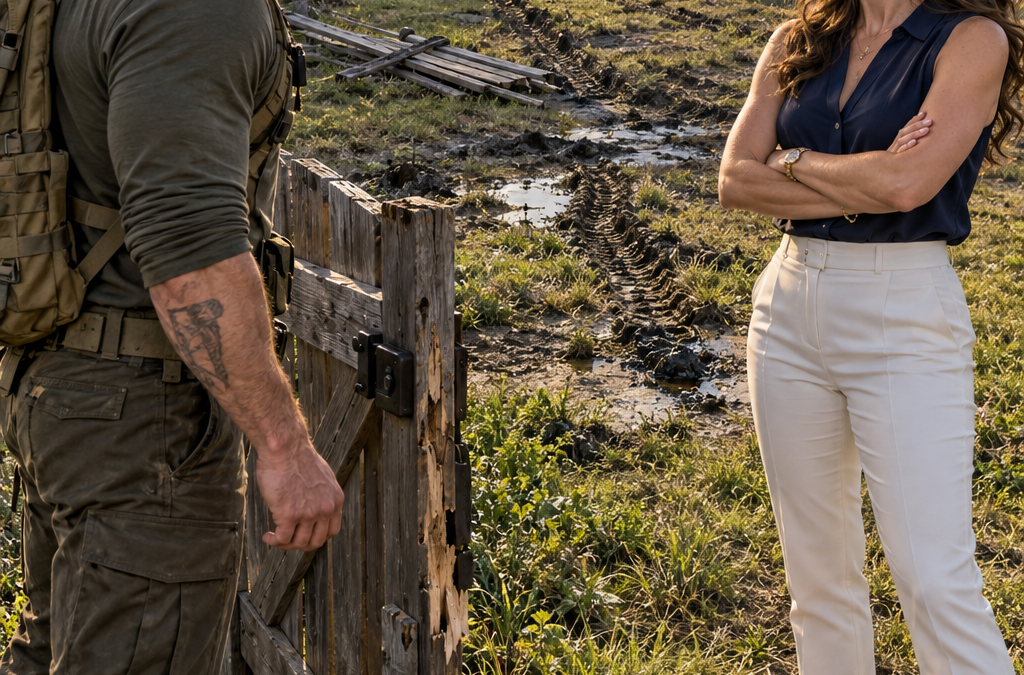
She was around forty, maybe a little over, with glossy brunette hair falling in soft waves over one shoulder and the kind of beauty that made people underestimate the cruelty behind it. She wore fitted white slacks, gold sandals, and a sleeveless navy blouse that looked expensive enough to have its own insurance policy. Her makeup was perfect. Her smile was perfect. Even the way she tilted her head seemed practiced.
“You must be the soldier,” she said.
The soldier.
Not the property owner. Not the neighbor. Not the man whose land her HOA had stolen.
“The name is Daniel,” I said. “Daniel Reeves.”
Her eyes flicked over me, lingering just long enough to feel deliberate. Flirtatious, but not warm. Measuring.
“I’m Karen Whitcomb,” she said. “HOA president.”
“I know.”
She smiled wider. “Then I assume this is about the lot.”
“The lot you sold.”
Her smile didn’t move, but her eyes sharpened. “We didn’t sell anything improperly.”
I pulled my deed from the folder under my arm and held it up. “This property is not part of your HOA. It never has been.”
She leaned one shoulder against the doorframe, completely relaxed. “Mr. Reeves, your parcel has been neglected for years.”
“That’s not true.”
“It was an eyesore.”
“It was fenced.”
“It affected our community’s appearance.”
“It is not your community’s property.”
Her smile thinned. “You were overseas. I respect service, of course, but absence has consequences. When a property in close proximity to our neighborhood becomes abandoned or negatively impacts values, our bylaws allow us to act for community benefit.”
I almost laughed. “Your bylaws do not override my deed.”
She glanced down at the paperwork like it bored her. “We followed proper procedure.”
“You held a vote to steal my land?”
“We held a vote to address an abandoned nuisance parcel.”
“It wasn’t abandoned. My taxes are paid. I hired a property management company. And I was never notified.”
“We posted notices.”
“Where?”
“At the clubhouse. On the HOA board.”
“I’m not in your HOA.”
Karen lifted one shoulder. “Notices were posted.”
“That means nothing to me.”
“It means we complied with our process.”
“Your process has no authority over my property.”
For the first time, the mask cracked. Not much. Just enough.
Her voice lowered. “Mr. Reeves, I understand you’re upset. You’ve been away. You’re emotional. But I would be very careful about making accusations. Mr. Miller purchased the use of that parcel in good faith. He has paid money. The HOA has acted. The community supports this.”
I stared at her.
There it was. That calm, polished arrogance. That belief that if she said a thing beautifully enough, it became true.
“You sold my grandfather’s land to Todd Miller for fifteen thousand dollars,” I said.
She smiled again. “Todd is a respected member of the community.”
“He’s your friend?”
Her eyes narrowed for half a second. “He’s a homeowner.”
“I’m getting an attorney.”
The smile returned, brighter and colder. “That is certainly your right.”
I turned to leave.
Behind me, she said, “But Daniel?”
I stopped.
Her voice softened into something almost intimate. “Court is expensive. Stressful. You just got home. Are you sure this is how you want to spend your peace?”
I looked back at her.
“My peace ended when I saw the cut lock.”
Her expression changed then. Just for a heartbeat, I saw the contempt underneath.
Then the door closed.
That night, I barely slept.
I sat at my kitchen table surrounded by documents, old surveys, emails from the property management company, tax receipts, and photos I had taken at the lot. The first four monthly reports from the company were there in my inbox. Clear pictures. Locked gate. Fence intact. Grass high but manageable. No cars.
Then nothing.
No fifth report. No sixth. No explanation.
I should have noticed. I knew that. But during deployment, life shrank down to immediate concerns. Eat when you could. Sleep when your body allowed it. Answer family messages when the connection worked. Keep your people alive. Get through the day.
Back home, people acted like missing an email was negligence.
Maybe it was.
But it did not give Karen Whitcomb the right to play queen over land she did not own.
The next morning, I met with a real estate attorney named Marcus Bell.
His office was small, cluttered, and aggressively practical. No fountain in the lobby. No dramatic leather chairs. Just walls lined with case files and a receptionist who looked like she could smell nonsense from fifty feet away.
Marcus was in his late fifties, with silver hair, tired eyes, and the calmest voice I had ever heard from someone reading about a crime.
He reviewed my documents first. Then Todd’s HOA packet. Then the photos of the damage.
For a long time, he said nothing.
Finally, he leaned back and took off his glasses. “I’ve practiced real estate law for twenty-three years.”
“That bad?”
“This is one of the more outrageous things I’ve seen.”
I exhaled for what felt like the first time in a day.
“So I’m not crazy.”
“No,” he said. “You’re the legal owner. The HOA had no authority to transfer your property. None.”
“What do we do?”
His eyes sharpened. “We do it correctly. Quiet title action, to eliminate any claim they try to assert. Cease and desist letters to the HOA and Todd Miller. Demand removal of all vehicles. Lawsuit for property damage, legal fees, and punitive damages if the facts support it.”
“They cut my lock.”
“Yes.”
“They damaged my fence.”
“Yes.”
“They sold my land.”
Marcus tapped the HOA packet. “That may cross into fraud or theft by deception. Criminal charges depend on the district attorney, but we are going to document everything.”
“Can I tow the cars?”
“Yes, but not emotionally. Legally. We post proper notice, give the required time, document service, photograph everything, then tow.”
I hated that answer because it was right.
I wanted those cars gone that minute. I wanted Todd standing in an empty field, shouting at grass. I wanted Karen to open her perfect white door and find the law waiting on her porch.
Instead, I went back to the lot with printed notices, a staple gun, tape, and my phone recording every step.
Todd appeared before I finished posting the second notice.
“You’ve got to be kidding me,” he shouted from across the street.
I ignored him.
He marched over, face red, hands clenched. “You touch my vehicles and I’ll bury you.”
I kept recording.
“This is a seventy-two-hour tow notice,” I said evenly. “Your vehicles are parked on private property without authorization.”
“I own this lot.”
“No, you don’t.”
“I paid for it.”
“Then you got scammed.”
His jaw worked like he wanted to spit. “You military guys think everyone’s scared of you.”
I looked at him. “I don’t need you scared. I need you gone.”
He took one step closer. “You’re going to regret messing with me.”
I said nothing.
That made him angrier.
“You hear me?” he shouted. “I know people in this neighborhood. Karen knows people. You think you’re going to come in here after abandoning this place and make us look bad? You’re nothing.”
The word landed harder than I expected.
Nothing.
Months overseas. Years paying taxes. My grandfather’s signature on the original deed. The fence I had paid to install after people dumped trash there twice before. The management company. The receipts. The proof. None of it mattered to Todd because Karen had told him a prettier story, one where he got parking, she got power, and I stayed far enough away to be erased.
I stapled the last notice to the post.
“Seventy-two hours,” I said.
Then I left.
The next three days were the longest I could remember outside deployment.
Todd drove by constantly. Sometimes slowly. Sometimes fast, kicking gravel near the entrance. Once, late in the evening, I saw his truck parked across from my house. I didn’t confront him. I took photos, wrote down times, sent everything to Marcus.
Karen stayed quiet.
That worried me more.
On the second day, Marcus’s demand letters went out by certified mail. One to Todd. One to Karen as HOA president. He requested all documents related to the claimed acquisition and sale of my lot, all meeting minutes, all votes, all financial records, all communications, and any legal authority the HOA believed gave them control over a non-HOA parcel.
His assistant emailed me a copy.
The letter was beautiful in the way a drawn blade is beautiful.
On the morning the seventy-two hours expired, I arrived at the lot early. The sky was low and gray, and the grass still showed the scars of tires cutting through it. I had barely finished photographing the notices when the tow trucks rolled in.
Three trucks. Six vehicles. One driver with a beard and a coffee thermos looked around and whistled.
“This is weird,” he said.
“You have no idea.”
He checked the paperwork, nodded, and got to work.
The first car went without drama.
The second was being hooked when Todd arrived.
I heard him before I saw him.
“What the hell do you think you’re doing?”
He came charging down the street in gym shorts and a hoodie, phone already in his hand. His face turned purple when he saw the sedan lifting off the ground.
“Put it down!” he screamed. “Put my car down!”
The tow driver didn’t even look at him. “Sir, step back.”
Todd turned on me. “You’re dead. You hear me? You are dead in court.”
I held up my phone. “You’re being recorded.”
“Good!” he shouted. “Record this. You’re stealing my property.”
“No,” I said. “I’m removing unauthorized vehicles from mine.”
He called 911.
When the officer arrived, Todd ran toward him like a child sprinting to a parent.
“He’s stealing my cars! He’s trespassing on my land!”
The officer looked at the lot, the tow notices, the paperwork in my hand, and then at me.
“Are you Mr. Reeves?”
“Yes.”
I handed him the folder before he asked.
He reviewed it. Then he went back to his cruiser and pulled up the county property records. Todd hovered nearby, breathing hard, muttering about lawsuits.
The officer returned after a few minutes.
“Mr. Miller,” he said, “county records show Mr. Reeves is the owner of this parcel.”
Todd jabbed a finger at the HOA packet. “I bought it.”
“You may have a dispute with the HOA,” the officer said. “But unless you have a court order, the official records list Mr. Reeves as owner, and he has the right to control access to the property.”
Todd looked stunned. “So you’re letting him tow my cars?”
“The notices appear properly posted. This is private property.”
“You can’t do this,” Todd said, but his voice had changed.
The anger was still there, but fear had entered it.
That felt like the first real shift.
The last vehicle hauled away just after noon. Todd stood on the edge of the lot with his hands on his head, watching thousands of pounds of misplaced confidence disappear down the road.
I should have felt triumphant.
Instead, I felt exhausted.
The lot looked worse empty. Without the cars, I could see everything they had done. Broken fence rail. Muddy trenches. Crushed grass. Fast-food bags. Oil stains. Cigarette butts near the tree line. Someone had even left a cracked plastic chair near the back like they had been hanging out there.
My grandfather’s land had become a dumping place for someone else’s entitlement.
That afternoon, Karen called me.
Her voice was honey over broken glass.
“Daniel, I think perhaps we all got off on the wrong foot.”
I almost laughed. “You sold my land.”
“There may have been a misunderstanding about the scope of the HOA’s authority.”
“That’s one way to say fraud.”
Her breath sharpened. “I would caution you not to use inflammatory language.”
“I would caution you to have your attorney call mine.”
A pause.
Then she tried a different tone.
“I know this has been stressful. I also know men like you are trained to respond strongly to perceived threats.”
“Men like me?”
“Military men,” she said smoothly. “You’re disciplined. Protective. Sometimes reactive. I’m asking you to consider whether dragging an entire community into litigation is really necessary over a vacant lot you weren’t even using.”
There it was again.
The insult dressed up as reason.
I said, “My attorney’s name is Marcus Bell. Your lawyer can contact him.”
“Daniel—”
I hung up.
Two weeks later, Karen’s attorney responded with a letter that managed to be both arrogant and nervous.
The HOA denied wrongdoing. The HOA claimed it had acted in good faith. The HOA believed the parcel’s condition created a negative impact on residents. The HOA wished to resolve the matter amicably. The HOA did not admit liability.
Marcus read it aloud, stopped halfway, and snorted.
“That’s not a defense,” he said. “That’s perfume on a corpse.”
We filed the quiet title action.
Then the lawsuit.
Karen did not like being sued.
That became clear quickly.
First came the social pressure. People from the HOA neighborhood began walking past my lot more often than they ever had before. Some stared. Some whispered. One woman told me, “This could have been handled privately,” as if privacy was owed to the people who stole land.
Then came the emails.
Anonymous at first.
You abandoned it.
Karen only tried to help.
The neighborhood looked better with parking there.
Why punish everyone?
I forwarded each one to Marcus.
Then came the property management company, scrambling to excuse why their reports had stopped. They blamed a staffing transition. A software issue. Miscommunication. They offered to refund several months of fees.
Marcus told them to preserve records.
Suddenly, their tone changed too.
Everywhere I looked, people were realizing this was not going to disappear because Karen wanted it to.
But Karen herself stayed polished.
The first time I saw her after the lawsuit was outside the clubhouse. She wore a red dress, heels, and sunglasses too large for her face, standing beside Todd like she was hosting a fundraiser instead of watching her scheme unravel. Todd looked rough. Dark circles, clenched jaw, no sunglasses that day.
Karen smiled when she saw me.
“Daniel,” she called. “Still determined to punish innocent homeowners?”
I stopped on the sidewalk. “Innocent homeowners didn’t cut my lock.”
A couple of residents nearby turned.
Karen’s smile tightened. “You keep saying that as if the HOA president personally carried bolt cutters over there.”
“Did you?”
Todd snapped, “Watch your mouth.”
Karen lifted one hand, and he shut up.
That told me a lot.
She walked closer, perfume arriving before she did, sweet and expensive. “I think you enjoy this,” she said softly. “The attention. The role of wronged hero. It suits you.”
“No,” I said. “I enjoyed having my property left alone.”
“You should have sold it years ago.”
“You should have asked.”
Something flashed in her eyes.
For the first time, I understood that beneath all the legal nonsense, all the community-value language, all the polished lies, Karen was offended by my ownership. Not because she needed the land. Not really. Because it sat beside her kingdom and did not obey her.
“You don’t even live on it,” she said.
“My grandfather still bought it.”
“Sentimentality is expensive.”
“So is fraud.”
Her smile disappeared.
Todd stepped forward, but Karen touched his arm without looking at him. He stopped again.
“You have no idea what you’re starting,” she whispered.
I looked toward the clubhouse, where a few residents were pretending not to listen.
“No, Karen,” I said. “You have no idea what you started.”
Discovery began ugly and got worse.
At first, the HOA claimed records were misplaced. Meeting minutes were incomplete. Emails had been archived. Financial documents were “being gathered.” Karen’s attorney asked for extensions, then more extensions, then claimed some communications were privileged.
Marcus filed a motion to compel.
That was when the first crack became a fracture.
The court ordered production.
The documents arrived in batches. At first, ordinary things. Bylaws. Meeting schedules. Financial statements. Maintenance complaints. Then minutes from the meeting where the HOA had voted to “assume control” of my lot.
Marcus called me the day he got them.
“You need to come in.”
His voice was calm, but there was something under it.
When I arrived, he had several pages laid across the conference table.
“Read that line,” he said.
The meeting had only five board members present.
The HOA bylaws required a quorum of seven for major decisions involving real property actions or community assessments.
“They didn’t even have enough people to vote?” I asked.
“No.”
The vote had been four to one.
One board member, a man named Robert Alvarez, had voted against it. His objection was recorded in the minutes.
Concern raised regarding HOA authority over non-member parcel. President Whitcomb stated authority existed under nuisance proximity clause. Objection noted.
I read the sentence three times.
“She knew someone questioned it.”
Marcus nodded. “And she overruled him.”
More documents followed.
Emails from Karen to the board calling my lot an eyesore.
Photos she had taken from across the street, zoomed in to make the grass look worse than it was.
Messages complaining that the parcel reduced the “prestige” of the neighborhood entrance.
One email said, We cannot allow a neglected outsider parcel to dictate the visual tone of our community.
Outsider parcel.
That was my grandfather’s land.
Then came deposition testimony.
Robert Alvarez sat across from our attorneys in a conference room and looked like a man who had spent months regretting his own silence. He said Karen had brought up my lot repeatedly. She had complained about it at meetings, at social events, even in private messages. She had called it “dead space” and “a problem waiting to be monetized.”
Monetized.
Another board member testified that Karen had pushed hard for the HOA to “take control” before I returned from deployment because, in her words, “the owner is overseas and unlikely to respond within any meaningful timeline.”
When Marcus read that part to me, something cold moved through my chest.
She had not acted despite my deployment.
She had acted because of it.
Then came the connection to Todd.
His full name was Todd Miller.
Karen’s married sister was Elise Miller.
Todd was Karen’s brother-in-law.
I remember sitting in Marcus’s office, staring at that family relationship on paper, feeling the anger settle into something heavier than rage.
“It was an inside deal,” I said.
Marcus nodded.
“Yes.”
Karen had convinced the board to claim authority over my land using a bogus abandoned-property theory. Then the HOA sold the supposed rights to Todd for fifteen thousand dollars. The money went into HOA accounts, but text messages later showed Karen and Todd discussing the lot as if it were a future investment.
Marcus had obtained the messages through subpoena.
One from Todd read: Once this is cleaned up, we can flip it to a builder easy.
Karen replied: Let the HOA paper trail do its job first. After that we decide how to split upside.
Split upside.
Two words that destroyed every excuse she had built.
There were more.
Todd: What if military guy comes back?
Karen: He won’t have standing once transfer is complete. And if he pushes, we bury him in process.
I sat with that one for a long time.
We bury him in process.
She had counted on exhaustion. On cost. On confusion. On me coming home tired enough to surrender rather than fight a woman with letterhead, signatures, and a neighborhood full of people trained to treat her voice like law.
For a while, I could not speak.
Marcus didn’t rush me.
Finally, I said, “She knew.”
“Yes.”
“She knew the whole time.”
“Yes.”
He slid another page across the table. “And now we can prove it.”
Three HOA board members resigned within a month.
Their resignation letters were cautious, self-protective, and full of phrases like misled, incomplete information, and lack of full legal understanding. One of them wrote privately through his attorney that Karen had dominated the board for years and that disagreeing with her usually meant being humiliated at meetings, excluded from decisions, or targeted socially.
That sounded exactly like Karen.
Beautiful. Charming. Poisonous.
A woman who could smile at you in public while sharpening a knife under the table.
The district attorney’s office contacted me four months after I first found the cars on my lot.
By then, the civil case had grown teeth. The quiet title action was moving forward. The HOA’s insurance company had become involved and was trying to deny coverage because intentional fraud was not covered. Karen’s personal attorney had separated from the HOA’s attorney, which Marcus said was one of the clearest signs that everyone had started looking for someone else to blame.
I met with an investigator in a plain office with bad coffee and a recorder on the table.
He asked me to walk through everything from the beginning.
So I did.
The deployment. The management company. The locked gate. The cut padlock. The cars. Todd’s packet. Karen’s statements. The tow notices. The threats. The documents. The texts.
He listened without much expression, but when I finished, he closed his notebook and said, “We’re taking this seriously.”
Two weeks later, charges were filed against Karen Whitcomb.
Fraud.
Theft by deception.
Abuse of fiduciary duty.
I read the charging documents in my truck outside the courthouse and felt nothing at first. No joy. No satisfaction. Just a strange silence, as if my mind needed time to understand that someone besides me finally saw what she had done.
Then I thought of my grandfather.
I thought of him walking that lot in old boots, telling me that land did not have to be impressive to be worth defending.
And I cried.
Not loudly. Not dramatically. Just enough that I had to sit there a while before driving home.
Karen’s first court appearance drew half the neighborhood.
She arrived in a cream-colored suit, hair perfect, chin lifted, walking like the courthouse was another room she expected to control. Cameras weren’t allowed inside, but people still watched her like she was a celebrity. Some looked angry. Some embarrassed. Some scared.
Todd sat two rows behind her and did not look at me.
Karen did.
Just once.
Her eyes met mine across the courtroom, and I saw hatred stripped clean of charm.
No flirtation now. No honey voice. No careful smile.
Just pure resentment that I had refused to stay erased.
The criminal case moved slowly. Preliminary hearings, motions, discovery, continuances. It ran beside my civil case like a second storm.
Meanwhile, the HOA began to collapse inward.
Their insurance carrier initially denied coverage, arguing that Karen’s fraud was not a covered act. The remaining board tried to distance itself from her, claiming she had acted beyond her authority. Marcus pushed back hard. The HOA had allowed her to act. The HOA had accepted the money. The HOA had issued the documents. The HOA had ignored objections. The HOA had forced me to spend tens of thousands of dollars to clear a title they had no right to cloud.
They could not wash their hands just because the water got dirty.
Settlement talks began after the text messages surfaced.
The first offer was insulting.
Marcus rejected it in one sentence.
The second offer covered property damage but not legal fees.
Marcus laughed and said no.
The third offer came with confidentiality.
I said no before Marcus finished explaining it.
“I want them to acknowledge what they did,” I said.
He studied me. “Publicly?”
“Yes.”
“That may cost us time.”
“I have time.”
And by then, I did.
The fear had changed.
At the beginning, I was afraid of losing my land, afraid of court costs, afraid Karen’s fake paperwork might create a legal nightmare I couldn’t afford. Later, I was afraid she would get away with it by making everything complicated enough that everyone gave up.
But once the documents came out, once the messages showed what she had planned, my fear hardened into patience.
Karen had counted on process burying me.
So I learned to breathe underground.
The settlement conference happened in a sterile room with a long table and bottled water nobody drank.
Karen was not there. Her criminal attorney had likely advised against it. Todd was not there either. The remaining HOA board members sat across from me looking hollow. Their attorney did most of the talking.
A new acting HOA president, a retired accountant named Linda Shaw, looked directly at me before we began.
“Mr. Reeves,” she said, “I want to say personally that I’m sorry.”
Their attorney stiffened.
Linda kept going.
“What happened was wrong. Some of us should have questioned it harder.”
I believed her.
That surprised me.
Not because apology fixed anything, but because guilt looks different from strategy. Karen had never once looked guilty. Linda did.
Marcus glanced at me, then began.
The final settlement came after hours of numbers, arguments, side rooms, and legal phrases that made harm sound like accounting.
The HOA agreed to pay all my legal fees, which had climbed to about fifty-five thousand dollars.
They agreed to pay twenty-five thousand dollars for property damage and loss of use.
They agreed to seventy-five thousand dollars in punitive damages.
They agreed to a written public acknowledgment that the HOA had no authority over my property, had never had authority over my property, and would never attempt to assert control over it again.
The total was over one hundred fifty-five thousand dollars.
When Marcus read the final terms, I felt the room tilt slightly.
Not because the money made me happy. It didn’t. Not exactly.
It meant the damage had finally been measured in a language Karen’s world understood.
The quiet title action went through without opposition after that. The court order cleared every cloud their fake transfer had created. My title was clean. My ownership was confirmed. Todd’s claim vanished.
The lot was mine again in every official sense.
But land remembers what people do to it.
I hired a real fencing company to replace the damaged sections and reinforce the entire perimeter. I installed a better gate with a lock that could not be cut with cheap bolt cutters. I added security cameras with cellular backup and motion alerts. I fired the old property management company after their attorney negotiated a separate payment for their failure to inspect, and I hired a smaller local company whose owner sent me timestamped photos personally every month.
The first time I stood behind the new gate, watching the cameras blink green, I felt relief.
Then sadness.
It should not have taken all that.
A few months later, Karen took a plea deal.
I attended the sentencing.
I wasn’t sure I would until the morning of. Part of me wanted to move on, to let Marcus send me the outcome, to refuse Karen even one more hour of my life. But another part of me needed to see the end with my own eyes.
The courtroom was quieter that day.
No neighborhood crowd. No performance.
Karen wore a dark suit this time. Her hair was still styled, but the shine had gone out of her. She looked smaller without an audience. Not weak. Never that. Just reduced to human size by consequences.
The prosecutor laid out the facts.
Karen Whitcomb had used her position as HOA president to falsely assert control over property the HOA did not own. She had pushed through an invalid vote without quorum. She had ignored objections. She had arranged a sale to her brother-in-law. She had exchanged messages discussing future profit. She had caused financial harm to me, to Todd, and to the HOA members she was supposed to serve.
When the judge asked if she wanted to speak, Karen stood.
For one terrible second, I thought she might finally apologize.
She didn’t.
“I made mistakes in judgment,” she said. “But I always believed I was acting in the best interest of the community.”
The judge looked down at her over his glasses.
“Ms. Whitcomb, selling property your association did not own to a family member while discussing future profit is not a community-interest mistake.”
Karen’s lips pressed together.
The sentence came down after that.
A twenty-five-thousand-dollar fine.
Full restitution to me and to Todd.
Eighteen months in a minimum-security facility.
Two years of probation.
I watched her face when the judge said eighteen months.
That was the moment she finally understood that charm had limits.
Her eyes widened slightly. Her shoulders dropped. Her attorney leaned close and whispered something, but Karen did not move.
For the first time since I had met her, she had no door to close in my face.
Todd tried to sue the HOA for his fifteen thousand dollars.
From what I later heard, he settled for less than he paid because the HOA argued he had failed to do even basic due diligence. He had never ordered a title search. Never checked county records. Never hired an attorney before handing money to his sister-in-law’s association for land that clearly belonged to someone else.
He also had to pay impound fees for all six vehicles.
I will admit something ugly.
That part made me smile.
Not because I’m proud of pettiness, but because Todd had stood on my land and called it his. He had threatened me. He had helped Karen treat my absence like opportunity. Whether he saw himself as a victim later was between him, Karen, and whatever remained of his conscience.
I had no sympathy left for him.
The HOA paid far more than my settlement by the time everything ended. Their own legal fees were brutal. Their insurance premiums jumped. There were internal settlements with board members. A special assessment hit every homeowner for several thousand dollars.
That caused outrage.
Meetings turned chaotic. Residents who had once treated Karen like royalty suddenly acted as if they had always known she was dangerous. A recall effort began. The remaining board was nearly wiped clean. New bylaws were proposed. Outside counsel was brought in to review any future action involving property rights.
I watched all of it from a distance.
Part of me wanted to hate every homeowner there.
But the truth was messier.
Some had enabled Karen because she was useful when her cruelty pointed away from them. Some had feared her. Some had believed her because believing the president was easier than questioning whether their tidy neighborhood was being run like a private empire. Some were innocent and still had to pay for what she did.
That is how people like Karen spread damage.
They never fall alone.
One afternoon, almost two years after I first found the cars, I went to the lot at sunset.
The grass had grown back. Not perfectly, but enough. The ruts were gone. The oil-stained patch had been treated and reseeded. The new fence stood straight and dark against the orange sky. Beyond it, the HOA neighborhood looked peaceful in that artificial suburban way, sprinklers ticking, garage doors closing, porch lights warming one by one.
I unlocked the gate and walked inside.
For a while, I just stood there under the old oak tree.
I thought about selling.
I had considered it more than once. The settlement had made the land more complicated emotionally, not less. Some days it felt like a victory. Other days it felt like a scar I owned on paper.
A developer had even sent a letter asking if I would entertain offers. Before all this, if Karen had come to me honestly and said, “The neighborhood is interested in buying your lot,” I probably would have listened. I might have negotiated. I might have sold.
That was the most ridiculous part.
All she had to do was ask.
Instead, she built a scheme out of arrogance, family favoritism, fake authority, and the assumption that a deployed service member would be too absent, too tired, or too poor to fight back.
She destroyed her career, her reputation, her freedom, and her neighborhood’s finances over land she could have tried to buy like a normal person.
I knelt and picked up a small piece of rusted metal near the fence line.
For a second, I thought it was junk left behind from the damage. Then I realized it was part of the old broken padlock. I must have missed it during cleanup.
I held it in my palm.
That lock had been the first thing I saw. The first warning. The small, ugly proof that someone had crossed a line before they ever invented paperwork to justify it.
I could have thrown it away.
Instead, I slipped it into my pocket.
Not as a souvenir.
As a reminder.
People think property disputes are about dirt, fences, and documents. Sometimes they are. But sometimes they are about whether someone with power gets to decide that your absence means consent. Whether a polished lie can become truth if enough people sign it. Whether a person who comes home exhausted can still stand up and say no.
Karen thought my land was empty.
She thought that meant it was undefended.
She was wrong.
I locked the new gate behind me and checked it twice. Then I stood there for a moment, listening to the quiet.
For the first time since coming home, it felt like mine again.
𝗧𝗛𝗘 𝗘𝗡𝗗
The Woman Who Sold My Land While I Was Overseas Never Expected Me to Come Home Fighting
I came back from deployment expecting quiet, sleep, and a slow return to ordinary life.
Instead, I found six strangers’ cars sitting behind my broken gate, oil stains on my grass, and a beautiful woman named Karen smiling like she had every right to steal what my grandfather left me.
The first thing I noticed was the padlock.
It was lying in the weeds beside the gate, split open like someone had taken a bolt cutter to it and tossed the pieces aside without a second thought. For a few seconds, I just stood there with my truck door hanging open behind me, one hand still on the frame, staring at that busted lock as if it might explain itself.
It didn’t.
Beyond the open gate, six cars were parked across my lot.
Not along the edge. Not respectfully. Not in a way that suggested anybody had made a mistake and tried to minimize the damage. They were scattered across the grass like the place had become some kind of private overflow parking yard. Two sedans sat near the back fence. A lifted pickup had torn deep ruts through the soft ground. A silver SUV was angled so close to one of the old oak trees that its bumper nearly touched the trunk. Another car had driven straight over a section of fence that had been flattened into the mud.
I had been back stateside for three weeks.
Three weeks of paperwork, medical checks, restless nights, and that strange floating feeling that comes after you’ve spent months overseas and suddenly everyone around you is complaining about traffic, grocery prices, and slow Wi-Fi as if the world has not been on fire somewhere else.
I had not come to my grandfather’s lot first because I trusted the property management company I had hired before deployment. They were supposed to drive by once a month, take photos, check the fence, make sure nobody dumped trash there, and call me if anything looked wrong.
That was the whole point of paying them.
My grandfather had bought that land decades before the subdivision next door ever existed. He used to tell me it was the one piece of earth he had kept simply because no one could tell him what to do with it. When he died, he left it to me. It wasn’t huge, and it wasn’t fancy. Just a vacant parcel with grass, trees, and a battered dignity that mattered more to me than I knew how to explain.
The neighborhood beside it had an HOA. My lot did not.
That distinction had always been clear. I had the deed, the title work, the survey, and every original document proving my land was a separate parcel that predated the HOA by about fifteen years. It had never been included in their covenants. It had never been subject to their rules. It was mine.
And yet there I was, standing in front of my own gate, staring at tire marks, trash, and oil-dark patches bleeding into the soil.
“What the hell?” I whispered.
A man’s voice came from behind me.
“Can I help you?”
I turned.
He was walking toward me from the HOA neighborhood, a stocky guy in his late thirties or early forties with mirrored sunglasses, a red face, and the swagger of someone who had already decided the world owed him space. He carried a set of keys in one hand and looked past me at the cars like he was checking livestock.
I said, “Do you know who owns these vehicles?”
His mouth tightened. “A few of them are mine. Why?”
I pointed at the lot. “Because they’re parked on my property.”
He gave a short laugh, not amused, just insulting. “Your property?”
“Yes.”
“No, man.” He shook his head slowly. “This is my parking lot.”
The words hit me so hard I almost laughed back. “Your what?”
“My parking lot.” He stepped closer. “I bought it six months ago. From the HOA.”
I stared at him, waiting for some sign that he knew how insane he sounded.
He didn’t blink.
“That’s impossible,” I said. “The HOA doesn’t own this land. They never have.”
He smiled like I was embarrassing myself. “Take it up with them. I paid fifteen grand for it. I’ve got paperwork.”
That was the moment I felt the old deployment calm slide over me, the part of my brain that knew panic wasted oxygen. My heart was pounding, my palms were hot, and every instinct I had wanted to drag those cars out of the grass with my bare hands. But I took one breath, then another.
“Show me,” I said.
He pulled a folded packet from the glove compartment of the nearest sedan and handed it to me with a smug little flick of his wrist.
The top page had the HOA letterhead on it.
Below that were signatures, a fake-looking transfer statement, and language about community improvement, abandoned property, and authorized use. It looked official enough to fool someone who wanted to be fooled.
But official-looking was not the same thing as legal.
“This is garbage,” I said.
His face hardened. “Excuse me?”
“This document is garbage. They can’t sell property they don’t own.”
“You calling me stupid?”
“I’m saying you bought land from people who had no right to sell it.”
He stepped close enough that I could smell coffee on his breath. “Listen to me. I’ve been using this lot for months. I paid for it. You disappear, leave it sitting here like a dump, and then show up acting like a victim? No. You don’t get to scam me.”
I looked at the cut padlock in the weeds. “I’m calling the police.”
His smile came back.
“Go ahead,” he said. “They already know about it.”
part2
The non-emergency dispatcher sounded tired before I finished the second sentence.
By the time the officer arrived, the neighbor had introduced himself as Todd Miller and had started pacing beside the gate like a man rehearsing for court. He kept muttering about property rights, paperwork, and how people in uniform always thought they could bully civilians.
I ignored him.
The officer took my deed, my survey, and Todd’s HOA packet. He looked through everything with the strained expression of someone who wished the problem had picked a different shift.
“County records show you as the owner?” he asked me.
“Yes,” I said. “You can pull it up right now.”
Todd snapped, “And I have a transfer document.”
“From an HOA that doesn’t own it,” I said.
The officer held up a hand. “Both of you stop.”
He went back to his cruiser and spent several minutes on his laptop. Todd leaned against the sedan with his arms crossed. I stood near my broken fence, trying not to look at the tire ruts because every time I did, I imagined my grandfather standing there, seeing what strangers had done to the place he had trusted me to keep.
When the officer came back, he looked at me first.
“The county does list you as the legal owner of the parcel.”
Todd exploded. “Then tell him I have a document, too.”
The officer turned to him. “I saw it.”
“So tell him this is a civil matter.”
The officer’s jaw tightened, which told me everything. Todd had been waiting for that phrase. Maybe someone had coached him. Maybe Karen had.
The officer sighed. “At this point, with conflicting documents, this is likely going to need to be resolved in court.”
I felt my stomach drop. “Officer, my gate was cut. My fence is damaged. There are six cars on my land.”
“I understand.”
“Do you?”
His face softened a little. “I do. But I can’t adjudicate ownership on the side of the road. I strongly suggest nobody use this lot until the matter is resolved.”
Todd laughed. “I’m not moving anything until a judge tells me to.”
I looked at him then, really looked at him. The sunglasses, the aggressive stance, the way he seemed less surprised than he should have been. This wasn’t a misunderstanding. It had never been a misunderstanding.
“Fine,” I said quietly.
Todd smirked. “Finally seeing reason?”
“No,” I said. “I’m seeing exactly what kind of people I’m dealing with.”
I left before I said something that would hurt me later.
The HOA president lived three streets over in a house that looked like it had been built to intimidate the houses around it. White brick, black shutters, sharp hedges, polished brass hardware on the door. The kind of place where even the flower beds looked obedient.
A woman answered before I could knock a second time.
She was around forty, maybe a little over, with glossy brunette hair falling in soft waves over one shoulder and the kind of beauty that made people underestimate the cruelty behind it. She wore fitted white slacks, gold sandals, and a sleeveless navy blouse that looked expensive enough to have its own insurance policy. Her makeup was perfect. Her smile was perfect. Even the way she tilted her head seemed practiced.
“You must be the soldier,” she said.
The soldier.
Not the property owner. Not the neighbor. Not the man whose land her HOA had stolen.
“The name is Daniel,” I said. “Daniel Reeves.”
Her eyes flicked over me, lingering just long enough to feel deliberate. Flirtatious, but not warm. Measuring.
“I’m Karen Whitcomb,” she said. “HOA president.”
“I know.”
She smiled wider. “Then I assume this is about the lot.”
“The lot you sold.”
Her smile didn’t move, but her eyes sharpened. “We didn’t sell anything improperly.”
I pulled my deed from the folder under my arm and held it up. “This property is not part of your HOA. It never has been.”
She leaned one shoulder against the doorframe, completely relaxed. “Mr. Reeves, your parcel has been neglected for years.”
“That’s not true.”
“It was an eyesore.”
“It was fenced.”
“It affected our community’s appearance.”
“It is not your community’s property.”
Her smile thinned. “You were overseas. I respect service, of course, but absence has consequences. When a property in close proximity to our neighborhood becomes abandoned or negatively impacts values, our bylaws allow us to act for community benefit.”
I almost laughed. “Your bylaws do not override my deed.”
She glanced down at the paperwork like it bored her. “We followed proper procedure.”
“You held a vote to steal my land?”
“We held a vote to address an abandoned nuisance parcel.”
“It wasn’t abandoned. My taxes are paid. I hired a property management company. And I was never notified.”
“We posted notices.”
“Where?”
“At the clubhouse. On the HOA board.”
“I’m not in your HOA.”
Karen lifted one shoulder. “Notices were posted.”
“That means nothing to me.”
“It means we complied with our process.”
“Your process has no authority over my property.”
For the first time, the mask cracked. Not much. Just enough.
Her voice lowered. “Mr. Reeves, I understand you’re upset. You’ve been away. You’re emotional. But I would be very careful about making accusations. Mr. Miller purchased the use of that parcel in good faith. He has paid money. The HOA has acted. The community supports this.”
I stared at her.
There it was. That calm, polished arrogance. That belief that if she said a thing beautifully enough, it became true.
“You sold my grandfather’s land to Todd Miller for fifteen thousand dollars,” I said.
She smiled again. “Todd is a respected member of the community.”
“He’s your friend?”
Her eyes narrowed for half a second. “He’s a homeowner.”
“I’m getting an attorney.”
The smile returned, brighter and colder. “That is certainly your right.”
I turned to leave.
Behind me, she said, “But Daniel?”
I stopped.
Her voice softened into something almost intimate. “Court is expensive. Stressful. You just got home. Are you sure this is how you want to spend your peace?”
I looked back at her.
“My peace ended when I saw the cut lock.”
Her expression changed then. Just for a heartbeat, I saw the contempt underneath.
Then the door closed.
That night, I barely slept.
I sat at my kitchen table surrounded by documents, old surveys, emails from the property management company, tax receipts, and photos I had taken at the lot. The first four monthly reports from the company were there in my inbox. Clear pictures. Locked gate. Fence intact. Grass high but manageable. No cars.
Then nothing.
No fifth report. No sixth. No explanation.
I should have noticed. I knew that. But during deployment, life shrank down to immediate concerns. Eat when you could. Sleep when your body allowed it. Answer family messages when the connection worked. Keep your people alive. Get through the day.
Back home, people acted like missing an email was negligence.
Maybe it was.
But it did not give Karen Whitcomb the right to play queen over land she did not own.
The next morning, I met with a real estate attorney named Marcus Bell.
His office was small, cluttered, and aggressively practical. No fountain in the lobby. No dramatic leather chairs. Just walls lined with case files and a receptionist who looked like she could smell nonsense from fifty feet away.
Marcus was in his late fifties, with silver hair, tired eyes, and the calmest voice I had ever heard from someone reading about a crime.
He reviewed my documents first. Then Todd’s HOA packet. Then the photos of the damage.
For a long time, he said nothing.
Finally, he leaned back and took off his glasses. “I’ve practiced real estate law for twenty-three years.”
“That bad?”
“This is one of the more outrageous things I’ve seen.”
I exhaled for what felt like the first time in a day.
“So I’m not crazy.”
“No,” he said. “You’re the legal owner. The HOA had no authority to transfer your property. None.”
“What do we do?”
His eyes sharpened. “We do it correctly. Quiet title action, to eliminate any claim they try to assert. Cease and desist letters to the HOA and Todd Miller. Demand removal of all vehicles. Lawsuit for property damage, legal fees, and punitive damages if the facts support it.”
“They cut my lock.”
“Yes.”
“They damaged my fence.”
“Yes.”
“They sold my land.”
Marcus tapped the HOA packet. “That may cross into fraud or theft by deception. Criminal charges depend on the district attorney, but we are going to document everything.”
“Can I tow the cars?”
“Yes, but not emotionally. Legally. We post proper notice, give the required time, document service, photograph everything, then tow.”
I hated that answer because it was right.
I wanted those cars gone that minute. I wanted Todd standing in an empty field, shouting at grass. I wanted Karen to open her perfect white door and find the law waiting on her porch.
Instead, I went back to the lot with printed notices, a staple gun, tape, and my phone recording every step.
Todd appeared before I finished posting the second notice.
“You’ve got to be kidding me,” he shouted from across the street.
I ignored him.
He marched over, face red, hands clenched. “You touch my vehicles and I’ll bury you.”
I kept recording.
“This is a seventy-two-hour tow notice,” I said evenly. “Your vehicles are parked on private property without authorization.”
“I own this lot.”
“No, you don’t.”
“I paid for it.”
“Then you got scammed.”
His jaw worked like he wanted to spit. “You military guys think everyone’s scared of you.”
I looked at him. “I don’t need you scared. I need you gone.”
He took one step closer. “You’re going to regret messing with me.”
I said nothing.
That made him angrier.
“You hear me?” he shouted. “I know people in this neighborhood. Karen knows people. You think you’re going to come in here after abandoning this place and make us look bad? You’re nothing.”
The word landed harder than I expected.
Nothing.
Months overseas. Years paying taxes. My grandfather’s signature on the original deed. The fence I had paid to install after people dumped trash there twice before. The management company. The receipts. The proof. None of it mattered to Todd because Karen had told him a prettier story, one where he got parking, she got power, and I stayed far enough away to be erased.
I stapled the last notice to the post.
“Seventy-two hours,” I said.
Then I left.
The next three days were the longest I could remember outside deployment.
Todd drove by constantly. Sometimes slowly. Sometimes fast, kicking gravel near the entrance. Once, late in the evening, I saw his truck parked across from my house. I didn’t confront him. I took photos, wrote down times, sent everything to Marcus.
Karen stayed quiet.
That worried me more.
On the second day, Marcus’s demand letters went out by certified mail. One to Todd. One to Karen as HOA president. He requested all documents related to the claimed acquisition and sale of my lot, all meeting minutes, all votes, all financial records, all communications, and any legal authority the HOA believed gave them control over a non-HOA parcel.
His assistant emailed me a copy.
The letter was beautiful in the way a drawn blade is beautiful.
On the morning the seventy-two hours expired, I arrived at the lot early. The sky was low and gray, and the grass still showed the scars of tires cutting through it. I had barely finished photographing the notices when the tow trucks rolled in.
Three trucks. Six vehicles. One driver with a beard and a coffee thermos looked around and whistled.
“This is weird,” he said.
“You have no idea.”
He checked the paperwork, nodded, and got to work.
The first car went without drama.
The second was being hooked when Todd arrived.
I heard him before I saw him.
“What the hell do you think you’re doing?”
He came charging down the street in gym shorts and a hoodie, phone already in his hand. His face turned purple when he saw the sedan lifting off the ground.
“Put it down!” he screamed. “Put my car down!”
The tow driver didn’t even look at him. “Sir, step back.”
Todd turned on me. “You’re dead. You hear me? You are dead in court.”
I held up my phone. “You’re being recorded.”
“Good!” he shouted. “Record this. You’re stealing my property.”
“No,” I said. “I’m removing unauthorized vehicles from mine.”
He called 911.
When the officer arrived, Todd ran toward him like a child sprinting to a parent.
“He’s stealing my cars! He’s trespassing on my land!”
The officer looked at the lot, the tow notices, the paperwork in my hand, and then at me.
“Are you Mr. Reeves?”
“Yes.”
I handed him the folder before he asked.
He reviewed it. Then he went back to his cruiser and pulled up the county property records. Todd hovered nearby, breathing hard, muttering about lawsuits.
The officer returned after a few minutes.
“Mr. Miller,” he said, “county records show Mr. Reeves is the owner of this parcel.”
Todd jabbed a finger at the HOA packet. “I bought it.”
“You may have a dispute with the HOA,” the officer said. “But unless you have a court order, the official records list Mr. Reeves as owner, and he has the right to control access to the property.”
Todd looked stunned. “So you’re letting him tow my cars?”
“The notices appear properly posted. This is private property.”
“You can’t do this,” Todd said, but his voice had changed.
The anger was still there, but fear had entered it.
That felt like the first real shift.
The last vehicle hauled away just after noon. Todd stood on the edge of the lot with his hands on his head, watching thousands of pounds of misplaced confidence disappear down the road.
I should have felt triumphant.
Instead, I felt exhausted.
The lot looked worse empty. Without the cars, I could see everything they had done. Broken fence rail. Muddy trenches. Crushed grass. Fast-food bags. Oil stains. Cigarette butts near the tree line. Someone had even left a cracked plastic chair near the back like they had been hanging out there.
My grandfather’s land had become a dumping place for someone else’s entitlement.
That afternoon, Karen called me.
Her voice was honey over broken glass.
“Daniel, I think perhaps we all got off on the wrong foot.”
I almost laughed. “You sold my land.”
“There may have been a misunderstanding about the scope of the HOA’s authority.”
“That’s one way to say fraud.”
Her breath sharpened. “I would caution you not to use inflammatory language.”
“I would caution you to have your attorney call mine.”
A pause.
Then she tried a different tone.
“I know this has been stressful. I also know men like you are trained to respond strongly to perceived threats.”
“Men like me?”
“Military men,” she said smoothly. “You’re disciplined. Protective. Sometimes reactive. I’m asking you to consider whether dragging an entire community into litigation is really necessary over a vacant lot you weren’t even using.”
There it was again.
The insult dressed up as reason.
I said, “My attorney’s name is Marcus Bell. Your lawyer can contact him.”
“Daniel—”
I hung up.
Two weeks later, Karen’s attorney responded with a letter that managed to be both arrogant and nervous.
The HOA denied wrongdoing. The HOA claimed it had acted in good faith. The HOA believed the parcel’s condition created a negative impact on residents. The HOA wished to resolve the matter amicably. The HOA did not admit liability.
Marcus read it aloud, stopped halfway, and snorted.
“That’s not a defense,” he said. “That’s perfume on a corpse.”
We filed the quiet title action.
Then the lawsuit.
Karen did not like being sued.
That became clear quickly.
First came the social pressure. People from the HOA neighborhood began walking past my lot more often than they ever had before. Some stared. Some whispered. One woman told me, “This could have been handled privately,” as if privacy was owed to the people who stole land.
Then came the emails.
Anonymous at first.
You abandoned it.
Karen only tried to help.
The neighborhood looked better with parking there.
Why punish everyone?
I forwarded each one to Marcus.
Then came the property management company, scrambling to excuse why their reports had stopped. They blamed a staffing transition. A software issue. Miscommunication. They offered to refund several months of fees.
Marcus told them to preserve records.
Suddenly, their tone changed too.
Everywhere I looked, people were realizing this was not going to disappear because Karen wanted it to.
But Karen herself stayed polished.
The first time I saw her after the lawsuit was outside the clubhouse. She wore a red dress, heels, and sunglasses too large for her face, standing beside Todd like she was hosting a fundraiser instead of watching her scheme unravel. Todd looked rough. Dark circles, clenched jaw, no sunglasses that day.
Karen smiled when she saw me.
“Daniel,” she called. “Still determined to punish innocent homeowners?”
I stopped on the sidewalk. “Innocent homeowners didn’t cut my lock.”
A couple of residents nearby turned.
Karen’s smile tightened. “You keep saying that as if the HOA president personally carried bolt cutters over there.”
“Did you?”
Todd snapped, “Watch your mouth.”
Karen lifted one hand, and he shut up.
That told me a lot.
She walked closer, perfume arriving before she did, sweet and expensive. “I think you enjoy this,” she said softly. “The attention. The role of wronged hero. It suits you.”
“No,” I said. “I enjoyed having my property left alone.”
“You should have sold it years ago.”
“You should have asked.”
Something flashed in her eyes.
For the first time, I understood that beneath all the legal nonsense, all the community-value language, all the polished lies, Karen was offended by my ownership. Not because she needed the land. Not really. Because it sat beside her kingdom and did not obey her.
“You don’t even live on it,” she said.
“My grandfather still bought it.”
“Sentimentality is expensive.”
“So is fraud.”
Her smile disappeared.
Todd stepped forward, but Karen touched his arm without looking at him. He stopped again.
“You have no idea what you’re starting,” she whispered.
I looked toward the clubhouse, where a few residents were pretending not to listen.
“No, Karen,” I said. “You have no idea what you started.”
Discovery began ugly and got worse.
At first, the HOA claimed records were misplaced. Meeting minutes were incomplete. Emails had been archived. Financial documents were “being gathered.” Karen’s attorney asked for extensions, then more extensions, then claimed some communications were privileged.
Marcus filed a motion to compel.
That was when the first crack became a fracture.
The court ordered production.
The documents arrived in batches. At first, ordinary things. Bylaws. Meeting schedules. Financial statements. Maintenance complaints. Then minutes from the meeting where the HOA had voted to “assume control” of my lot.
Marcus called me the day he got them.
“You need to come in.”
His voice was calm, but there was something under it.
When I arrived, he had several pages laid across the conference table.
“Read that line,” he said.
The meeting had only five board members present.
The HOA bylaws required a quorum of seven for major decisions involving real property actions or community assessments.
“They didn’t even have enough people to vote?” I asked.
“No.”
The vote had been four to one.
One board member, a man named Robert Alvarez, had voted against it. His objection was recorded in the minutes.
Concern raised regarding HOA authority over non-member parcel. President Whitcomb stated authority existed under nuisance proximity clause. Objection noted.
I read the sentence three times.
“She knew someone questioned it.”
Marcus nodded. “And she overruled him.”
More documents followed.
Emails from Karen to the board calling my lot an eyesore.
Photos she had taken from across the street, zoomed in to make the grass look worse than it was.
Messages complaining that the parcel reduced the “prestige” of the neighborhood entrance.
One email said, We cannot allow a neglected outsider parcel to dictate the visual tone of our community.
Outsider parcel.
That was my grandfather’s land.
Then came deposition testimony.
Robert Alvarez sat across from our attorneys in a conference room and looked like a man who had spent months regretting his own silence. He said Karen had brought up my lot repeatedly. She had complained about it at meetings, at social events, even in private messages. She had called it “dead space” and “a problem waiting to be monetized.”
Monetized.
Another board member testified that Karen had pushed hard for the HOA to “take control” before I returned from deployment because, in her words, “the owner is overseas and unlikely to respond within any meaningful timeline.”
When Marcus read that part to me, something cold moved through my chest.
She had not acted despite my deployment.
She had acted because of it.
Then came the connection to Todd.
His full name was Todd Miller.
Karen’s married sister was Elise Miller.
Todd was Karen’s brother-in-law.
I remember sitting in Marcus’s office, staring at that family relationship on paper, feeling the anger settle into something heavier than rage.
“It was an inside deal,” I said.
Marcus nodded.
“Yes.”
Karen had convinced the board to claim authority over my land using a bogus abandoned-property theory. Then the HOA sold the supposed rights to Todd for fifteen thousand dollars. The money went into HOA accounts, but text messages later showed Karen and Todd discussing the lot as if it were a future investment.
Marcus had obtained the messages through subpoena.
One from Todd read: Once this is cleaned up, we can flip it to a builder easy.
Karen replied: Let the HOA paper trail do its job first. After that we decide how to split upside.
Split upside.
Two words that destroyed every excuse she had built.
There were more.
Todd: What if military guy comes back?
Karen: He won’t have standing once transfer is complete. And if he pushes, we bury him in process.
I sat with that one for a long time.
We bury him in process.
She had counted on exhaustion. On cost. On confusion. On me coming home tired enough to surrender rather than fight a woman with letterhead, signatures, and a neighborhood full of people trained to treat her voice like law.
For a while, I could not speak.
Marcus didn’t rush me.
Finally, I said, “She knew.”
“Yes.”
“She knew the whole time.”
“Yes.”
He slid another page across the table. “And now we can prove it.”
Three HOA board members resigned within a month.
Their resignation letters were cautious, self-protective, and full of phrases like misled, incomplete information, and lack of full legal understanding. One of them wrote privately through his attorney that Karen had dominated the board for years and that disagreeing with her usually meant being humiliated at meetings, excluded from decisions, or targeted socially.
That sounded exactly like Karen.
Beautiful. Charming. Poisonous.
A woman who could smile at you in public while sharpening a knife under the table.
The district attorney’s office contacted me four months after I first found the cars on my lot.
By then, the civil case had grown teeth. The quiet title action was moving forward. The HOA’s insurance company had become involved and was trying to deny coverage because intentional fraud was not covered. Karen’s personal attorney had separated from the HOA’s attorney, which Marcus said was one of the clearest signs that everyone had started looking for someone else to blame.
I met with an investigator in a plain office with bad coffee and a recorder on the table.
He asked me to walk through everything from the beginning.
So I did.
The deployment. The management company. The locked gate. The cut padlock. The cars. Todd’s packet. Karen’s statements. The tow notices. The threats. The documents. The texts.
He listened without much expression, but when I finished, he closed his notebook and said, “We’re taking this seriously.”
Two weeks later, charges were filed against Karen Whitcomb.
Fraud.
Theft by deception.
Abuse of fiduciary duty.
I read the charging documents in my truck outside the courthouse and felt nothing at first. No joy. No satisfaction. Just a strange silence, as if my mind needed time to understand that someone besides me finally saw what she had done.
Then I thought of my grandfather.
I thought of him walking that lot in old boots, telling me that land did not have to be impressive to be worth defending.
And I cried.
Not loudly. Not dramatically. Just enough that I had to sit there a while before driving home.
Karen’s first court appearance drew half the neighborhood.
She arrived in a cream-colored suit, hair perfect, chin lifted, walking like the courthouse was another room she expected to control. Cameras weren’t allowed inside, but people still watched her like she was a celebrity. Some looked angry. Some embarrassed. Some scared.
Todd sat two rows behind her and did not look at me.
Karen did.
Just once.
Her eyes met mine across the courtroom, and I saw hatred stripped clean of charm.
No flirtation now. No honey voice. No careful smile.
Just pure resentment that I had refused to stay erased.
The criminal case moved slowly. Preliminary hearings, motions, discovery, continuances. It ran beside my civil case like a second storm.
Meanwhile, the HOA began to collapse inward.
Their insurance carrier initially denied coverage, arguing that Karen’s fraud was not a covered act. The remaining board tried to distance itself from her, claiming she had acted beyond her authority. Marcus pushed back hard. The HOA had allowed her to act. The HOA had accepted the money. The HOA had issued the documents. The HOA had ignored objections. The HOA had forced me to spend tens of thousands of dollars to clear a title they had no right to cloud.
They could not wash their hands just because the water got dirty.
Settlement talks began after the text messages surfaced.
The first offer was insulting.
Marcus rejected it in one sentence.
The second offer covered property damage but not legal fees.
Marcus laughed and said no.
The third offer came with confidentiality.
I said no before Marcus finished explaining it.
“I want them to acknowledge what they did,” I said.
He studied me. “Publicly?”
“Yes.”
“That may cost us time.”
“I have time.”
And by then, I did.
The fear had changed.
At the beginning, I was afraid of losing my land, afraid of court costs, afraid Karen’s fake paperwork might create a legal nightmare I couldn’t afford. Later, I was afraid she would get away with it by making everything complicated enough that everyone gave up.
But once the documents came out, once the messages showed what she had planned, my fear hardened into patience.
Karen had counted on process burying me.
So I learned to breathe underground.
The settlement conference happened in a sterile room with a long table and bottled water nobody drank.
Karen was not there. Her criminal attorney had likely advised against it. Todd was not there either. The remaining HOA board members sat across from me looking hollow. Their attorney did most of the talking.
A new acting HOA president, a retired accountant named Linda Shaw, looked directly at me before we began.
“Mr. Reeves,” she said, “I want to say personally that I’m sorry.”
Their attorney stiffened.
Linda kept going.
“What happened was wrong. Some of us should have questioned it harder.”
I believed her.
That surprised me.
Not because apology fixed anything, but because guilt looks different from strategy. Karen had never once looked guilty. Linda did.
Marcus glanced at me, then began.
The final settlement came after hours of numbers, arguments, side rooms, and legal phrases that made harm sound like accounting.
The HOA agreed to pay all my legal fees, which had climbed to about fifty-five thousand dollars.
They agreed to pay twenty-five thousand dollars for property damage and loss of use.
They agreed to seventy-five thousand dollars in punitive damages.
They agreed to a written public acknowledgment that the HOA had no authority over my property, had never had authority over my property, and would never attempt to assert control over it again.
The total was over one hundred fifty-five thousand dollars.
When Marcus read the final terms, I felt the room tilt slightly.
Not because the money made me happy. It didn’t. Not exactly.
It meant the damage had finally been measured in a language Karen’s world understood.
The quiet title action went through without opposition after that. The court order cleared every cloud their fake transfer had created. My title was clean. My ownership was confirmed. Todd’s claim vanished.
The lot was mine again in every official sense.
But land remembers what people do to it.
I hired a real fencing company to replace the damaged sections and reinforce the entire perimeter. I installed a better gate with a lock that could not be cut with cheap bolt cutters. I added security cameras with cellular backup and motion alerts. I fired the old property management company after their attorney negotiated a separate payment for their failure to inspect, and I hired a smaller local company whose owner sent me timestamped photos personally every month.
The first time I stood behind the new gate, watching the cameras blink green, I felt relief.
Then sadness.
It should not have taken all that.
A few months later, Karen took a plea deal.
I attended the sentencing.
I wasn’t sure I would until the morning of. Part of me wanted to move on, to let Marcus send me the outcome, to refuse Karen even one more hour of my life. But another part of me needed to see the end with my own eyes.
The courtroom was quieter that day.
No neighborhood crowd. No performance.
Karen wore a dark suit this time. Her hair was still styled, but the shine had gone out of her. She looked smaller without an audience. Not weak. Never that. Just reduced to human size by consequences.
The prosecutor laid out the facts.
Karen Whitcomb had used her position as HOA president to falsely assert control over property the HOA did not own. She had pushed through an invalid vote without quorum. She had ignored objections. She had arranged a sale to her brother-in-law. She had exchanged messages discussing future profit. She had caused financial harm to me, to Todd, and to the HOA members she was supposed to serve.
When the judge asked if she wanted to speak, Karen stood.
For one terrible second, I thought she might finally apologize.
She didn’t.
“I made mistakes in judgment,” she said. “But I always believed I was acting in the best interest of the community.”
The judge looked down at her over his glasses.
“Ms. Whitcomb, selling property your association did not own to a family member while discussing future profit is not a community-interest mistake.”
Karen’s lips pressed together.
The sentence came down after that.
A twenty-five-thousand-dollar fine.
Full restitution to me and to Todd.
Eighteen months in a minimum-security facility.
Two years of probation.
I watched her face when the judge said eighteen months.
That was the moment she finally understood that charm had limits.
Her eyes widened slightly. Her shoulders dropped. Her attorney leaned close and whispered something, but Karen did not move.
For the first time since I had met her, she had no door to close in my face.
Todd tried to sue the HOA for his fifteen thousand dollars.
From what I later heard, he settled for less than he paid because the HOA argued he had failed to do even basic due diligence. He had never ordered a title search. Never checked county records. Never hired an attorney before handing money to his sister-in-law’s association for land that clearly belonged to someone else.
He also had to pay impound fees for all six vehicles.
I will admit something ugly.
That part made me smile.
Not because I’m proud of pettiness, but because Todd had stood on my land and called it his. He had threatened me. He had helped Karen treat my absence like opportunity. Whether he saw himself as a victim later was between him, Karen, and whatever remained of his conscience.
I had no sympathy left for him.
The HOA paid far more than my settlement by the time everything ended. Their own legal fees were brutal. Their insurance premiums jumped. There were internal settlements with board members. A special assessment hit every homeowner for several thousand dollars.
That caused outrage.
Meetings turned chaotic. Residents who had once treated Karen like royalty suddenly acted as if they had always known she was dangerous. A recall effort began. The remaining board was nearly wiped clean. New bylaws were proposed. Outside counsel was brought in to review any future action involving property rights.
I watched all of it from a distance.
Part of me wanted to hate every homeowner there.
But the truth was messier.
Some had enabled Karen because she was useful when her cruelty pointed away from them. Some had feared her. Some had believed her because believing the president was easier than questioning whether their tidy neighborhood was being run like a private empire. Some were innocent and still had to pay for what she did.
That is how people like Karen spread damage.
They never fall alone.
One afternoon, almost two years after I first found the cars, I went to the lot at sunset.
The grass had grown back. Not perfectly, but enough. The ruts were gone. The oil-stained patch had been treated and reseeded. The new fence stood straight and dark against the orange sky. Beyond it, the HOA neighborhood looked peaceful in that artificial suburban way, sprinklers ticking, garage doors closing, porch lights warming one by one.
I unlocked the gate and walked inside.
For a while, I just stood there under the old oak tree.
I thought about selling.
I had considered it more than once. The settlement had made the land more complicated emotionally, not less. Some days it felt like a victory. Other days it felt like a scar I owned on paper.
A developer had even sent a letter asking if I would entertain offers. Before all this, if Karen had come to me honestly and said, “The neighborhood is interested in buying your lot,” I probably would have listened. I might have negotiated. I might have sold.
That was the most ridiculous part.
All she had to do was ask.
Instead, she built a scheme out of arrogance, family favoritism, fake authority, and the assumption that a deployed service member would be too absent, too tired, or too poor to fight back.
She destroyed her career, her reputation, her freedom, and her neighborhood’s finances over land she could have tried to buy like a normal person.
I knelt and picked up a small piece of rusted metal near the fence line.
For a second, I thought it was junk left behind from the damage. Then I realized it was part of the old broken padlock. I must have missed it during cleanup.
I held it in my palm.
That lock had been the first thing I saw. The first warning. The small, ugly proof that someone had crossed a line before they ever invented paperwork to justify it.
I could have thrown it away.
Instead, I slipped it into my pocket.
Not as a souvenir.
As a reminder.
People think property disputes are about dirt, fences, and documents. Sometimes they are. But sometimes they are about whether someone with power gets to decide that your absence means consent. Whether a polished lie can become truth if enough people sign it. Whether a person who comes home exhausted can still stand up and say no.
Karen thought my land was empty.
She thought that meant it was undefended.
She was wrong.
I locked the new gate behind me and checked it twice. Then I stood there for a moment, listening to the quiet.
For the first time since coming home, it felt like mine again.