𝗙𝗨𝗟𝗟 𝗦𝗧𝗢𝗥𝗬 The Woman Who Slapped Me in Home Depot Kept Screaming for a Manager Until the Police Gave Her One
part2
“Don’t lie to me,” she said.
The words landed hard enough that I actually laughed once, not because anything was funny, but because my brain needed a second to catch up.
“I’m not lying. I’m a customer.”
She looked me up and down, from my tool belt to my boots to the pipe joint in my hand.
“You are wearing tools.”
“I’m a plumber.”
“Exactly.”
I waited.
She stared back like that explained everything.
“Exactly what?”
“You work here.”
“No. I buy things here.”
Her eyes narrowed. “I saw you helping that man earlier.”
I glanced toward the end of the aisle, where a guy in a baseball cap was comparing faucet supply lines with the haunted expression of a person who had already made three wrong trips. I had answered one quick question for him because he had asked nicely and because I knew the answer.
“I answered a question,” I said. “That doesn’t make me an employee.”
“So you’ll help him but not me.”
“That’s not what I said.”
“That is discrimination.”
A couple of customers nearby slowed down.
There it was. The word thrown like a rock, not because it fit, but because she thought it would make me flinch.
I took a breath.
“Ma’am, I am not a Home Depot employee. Employees wear orange aprons. I’m wearing a blue work shirt with a plumbing company name on it. I’m shopping.”
She glanced at my shirt but only for a second, not long enough to read it. People like Karen do not look for information once they have chosen a conclusion. They look for reasons to stay angry.
“Paint brushes,” she snapped.
“What?”
“I need paint brushes.”
“Then you probably want the paint section.”
“I know that,” she said, though her face suggested she had not known that until I said it. “I need you to show me where.”
“I don’t know exactly where they are.”
She made a sharp sound through her nose. “Unbelievable.”
“Again,” I said, slower this time, “I do not work here.”
She leaned closer. “I don’t care what game you’re playing. Get me your manager.”
That sentence.
I had heard jokes about it. Seen videos online. Heard other contractors tell stories about people mistaking them for staff in stores. I always thought those stories were exaggerated. Surely people backed down once they were told the truth. Surely most adults could process a uniform mismatch, an explanation, a name tag absence, basic visual reality.
Karen proved me wrong in real time.
“I don’t have a manager here,” I said.
“Everyone has a manager.”
“Not at a store where they don’t work.”
“Get him.”
“No.”
Her mouth fell open.
The aisle went very quiet.
“No?” she repeated.
“No.”
“You do not tell a customer no.”
“You are not my customer.”
Her face flushed red. “You are being extremely unprofessional.”
“Good news. I am not professionally involved.”
An older man farther down the aisle coughed like he was hiding a laugh.
Karen’s eyes snapped toward him, then back to me.
“You think this is funny?”
“I think it is avoidable.”
“Get. Me. Your. Manager.”
Each word came out clipped, sharp, loud enough now that customers in the next aisle probably heard.
I picked up my basket.
“I’m done.”
I turned to leave.
That was when she followed.
At first, I thought she was just storming away in the same direction. I walked toward the front of the store with my pipe fittings, trying to ignore the heat crawling up my neck. I hate scenes. I hate being watched. I do not enjoy public conflict, and I especially do not enjoy being treated like a misbehaving employee by someone who cannot read a shirt.
Behind me, her shoes clicked faster.
“Where do you think you’re going?” she demanded.
I kept walking.
“Hey!”
I stopped near the endcap by the aisle entrance.
“What do you want?”
Her face twisted at my tone. “Do not talk to me like that.”
“Then stop following me.”
“I still need help.”
“Find an employee.”
“I couldn’t find anyone else.”
“That sounds like a store problem.”
“No,” she said, stepping close enough that I could smell that perfume again. “It is your problem. Paint brushes. Now.”
I stared at her.
Something about the way she said now changed the shape of my anger. Until then, I had been annoyed, embarrassed, maybe a little rattled. But now I understood this was not about paint brushes. It probably had never been about paint brushes.
It was about a woman who had decided I existed beneath her in that moment, and any refusal to play the role she assigned me felt like rebellion.
“I am going to say this one last time,” I said. “I do not work here. I am not helping you. Do not follow me.”
Then I started walking again.
Her hand clamped around my arm.
It happened so fast my body reacted before my mind did. Her nails dug through the fabric of my sleeve, fingers gripping hard near the inside of my elbow, and she yanked me backward.
I stumbled.
Not much. I’m not a small guy, and she wasn’t strong enough to drag me anywhere, but surprise does what strength cannot. For a split second, I was off balance, caught between my basket, my tool belt, and this stranger’s hand twisted around my arm.
“Let go of me,” I said.
She pulled again. “You are not walking away from me.”
I ripped my arm free.
My heart was suddenly pounding.
That was the first moment I felt something beyond anger.
Fear.
Not fear that she could physically overpower me. Fear of how unpredictable she had become. Fear of being a man in a public store with a furious woman who had just grabbed me and was already rewriting reality out loud. Fear that if I moved wrong, spoke wrong, defended myself too sharply, she would turn it into something else.
People think size protects you from situations like that.
It does not.
Sometimes size makes you more careful, because everyone is ready to believe you were the danger.
“Do not touch me again,” I said.
My voice must have carried, because an actual Home Depot employee came jogging over from the next aisle.
She was young, maybe twenty-two, with dark hair pulled into a ponytail and the bright orange apron that Karen had somehow failed to notice on anyone. Her name tag said Maya.
“Excuse me,” Maya said, looking between us. “What’s going on?”
Karen spun toward her, instantly performing victimhood.
“Finally,” she said. “This employee has refused to help me, lied about working here, walked away from a customer, and then got aggressive when I asked for a manager.”
Maya looked at me.
Then at my blue shirt.
Then at my tool belt.
Then back at Karen.
“Sir,” she asked carefully, “do you work here?”
“No,” I said. “I’m a plumber. I’m shopping.”
Maya nodded like that had been obvious from orbit.
“Ma’am,” she said to Karen, “he doesn’t work here. I can help you find paint brushes.”
Karen stared at her.
The silence stretched.
For one precious second, I thought reality might finally land.
Instead, Karen’s eyes widened with fresh betrayal.
“You’re covering for him.”
Maya blinked. “What?”
“You’re covering for him. He works here. I saw him helping a customer.”
“He is a customer,” Maya said. “Our employees wear orange aprons. Like this.”
She lightly touched her apron.
Karen barely glanced.
“You’re probably a trainee,” she said. “You don’t know what’s happening.”
Maya’s jaw tightened. “I’ve worked here three years.”
“Then act like it and get your manager.”
“I can call a manager,” Maya said, very controlled now. “But I’m telling you, this gentleman does not work here.”
“He does.”
“He doesn’t.”
“He does!”
The word echoed through the front aisles.
More people stopped.
A man with a cart full of lumber turned around. A woman holding curtain rods paused mid-step. Someone near appliances leaned out to look.
I wanted to disappear.
Karen wanted an audience.
That difference mattered.
A store manager arrived before Maya could radio again. He was a tall man in his forties with a shaved head, glasses, and the weary walk of someone who had handled customer meltdowns over coupons, lumber cuts, paint colors, and return policies no mortal mind should have to interpret.
“What seems to be the issue?” he asked.
Karen pointed at me.
“That man works for you and refuses to help me.”
The manager looked at me.
I saw the flicker of recognition. Not personal recognition, exactly, but type recognition. Contractor. Customer. Not ours.
“He does not work for us,” the manager said.
Karen recoiled as if he had slapped her first.
“You haven’t even checked.”
“He’s not wearing our uniform.”
“He has tools.”
“A lot of our customers have tools.”
“He was in an aisle.”
“So are all of our customers.”
“He was helping someone.”
“Customers sometimes speak to each other.”
Her face turned redder with every sentence. Each reasonable answer backed her into a corner she had built herself, and instead of stepping out, she started clawing at the walls.
“You are all lying,” she said. “Every single one of you.”
The manager’s expression hardened. “Ma’am, Maya can help you find paint brushes, or you can continue shopping on your own. But you need to stop harassing this customer.”
Customer.
The word should have ended it.
Karen turned slowly toward me.
The look in her eyes was no longer just entitlement.
It was fury at humiliation.
“You did this,” she said.
“I didn’t do anything.”
“You made me look stupid.”
I should not have answered.
But I did.
“No,” I said. “You handled that yourself.”
Her hand came up so fast I barely saw it.
The slap cracked across my face.
It was loud.
Much louder than I would have expected. The sound snapped through the aisle, followed by that strange silence that happens when everyone nearby understands something has crossed from scene into crime.
My head turned with the impact. My cheek stung hot, then cold. My eyes watered automatically. For half a second, I just stood there with my hand rising to my face, not because I was badly hurt, but because my brain refused to accept that a grown woman had slapped me in the middle of Home Depot over paint brushes.
Maya gasped.
The manager moved immediately.
“Security,” he barked into his radio. “Front aisle. Now. We have an assault.”
Karen took one step back.
Her confidence cracked.
Then she tried to fill the crack with noise.
“He threatened me!” she shouted. “I felt threatened. He was discriminating against me. He refused service. He got aggressive.”
I lowered my hand from my cheek.
I was shaking now.
Not from fear anymore.
From the effort it took not to yell.
The manager stepped between us.
“Ma’am, do not move.”
“That’s not necessary,” she said quickly, all at once less loud. “Everything is fine.”
“It is not fine.”
“I’m fine.”
“It’s not for you.”
Two security guards arrived, one from the front and one from the side aisle. They did not touch her at first. They just positioned themselves in a way that made the exit less available.
Karen looked around and finally seemed to realize how many people were watching.
That made her worse.
“Where are the brushes?” she yelled suddenly, like returning to the original demand could reset the whole world. “Just make him show me the brushes!”
“I don’t work here!” I shouted back.
My patience was gone. My cheek burned. My arm hurt where she had grabbed me. My basket was somewhere on the floor with fittings I no longer cared about. All I wanted was for this to be over and for her to be as far away from me as possible.
Someone had already called 911.
I learned that later.
At the time, I heard sirens outside and felt the store shift again. Heads turned. The manager looked relieved. Karen looked trapped.
Two police officers came in through the front entrance. One male, one female. Both looked like they had expected a shoplifting call or a customer disturbance and instead walked into a crowd of silent witnesses surrounding a woman who was still insisting the man she had slapped should help her buy paint brushes.
The manager met them first.
He spoke quickly, pointing to me, Maya, Karen, and the security guards.
The female officer approached Karen.
“Ma’am, I need you to calm down.”
Karen’s voice jumped an octave. “I am calm. He is the problem. He is an employee who refused to help me, and then everyone started lying.”
The officer glanced at me.
The manager said, “He is not an employee.”
Maya added, “He’s a customer. She slapped him.”
Karen snapped, “Because I felt threatened.”
The male officer looked at me. “Did you touch her?”
“No.”
“Did you threaten her?”
“No.”
“He was walking away from me,” Karen shouted.
The female officer turned back. “Ma’am, walking away is not a threat.”
“He was being hostile.”
“Did he touch you?”
Karen hesitated.
That hesitation told the truth before she lied.
“He pulled away violently.”
“After you grabbed his arm?” Maya said.
Karen glared at her. “Stay out of this.”
The officer’s eyes sharpened. “You grabbed his arm?”
“I was trying to get his attention.”
“That is not an answer.”
Karen started waving her hands, talking faster, words tumbling over each other—customer service, discrimination, disrespect, manager, employee, lies. The female officer stepped slightly closer and raised her hand.
“Ma’am, stop moving your hands and listen to me.”
Karen did not listen.
Maybe she was too angry. Maybe she was too embarrassed. Maybe she had lived so long believing volume could bend reality that she no longer recognized authority when it wore a badge instead of a store apron.
She stepped backward, then forward, then sideways, trying to talk over everyone.
The officer reached gently toward her arm.
“Ma’am, I need you to—”
Karen kicked her.
It happened so suddenly the entire aisle seemed to inhale.
Her foot shot forward and struck the officer in the shin hard enough that the officer grunted and stepped back.
Karen froze.
For the first time all afternoon, she understood herself.
The male officer moved immediately.
“Ma’am, you’re under arrest.”
“No,” Karen said.
It came out small.
Then louder.
“No. No, you don’t understand. He started it. He wouldn’t help me. This is his fault.”
“Turn around.”
“I didn’t mean—”
“Turn around now.”
The security guards stepped back as the officers took control. Karen resisted just enough to make it worse, twisting her shoulders, insisting she had done nothing wrong, saying she was the victim, saying she wanted the manager, saying she would sue the store, sue me, sue everyone.
The handcuffs clicked.
That sound changed everything.
The crowd murmured.
Karen’s face went pale beneath her makeup.
“You’re arresting me?” she said, as if the concept had only just become real.
“You assaulted a customer and kicked a police officer,” the male officer said. “Yes.”
“He should be arrested too!”
“For what?” the female officer asked, still wincing slightly.
“For refusing to help me!”
Even in that moment, someone laughed.
Not loud. Not cruel.
Just one involuntary burst from a man near the lumber carts who could not hold it in anymore.
Karen heard it.
Her humiliation turned back into rage.
“This is not funny!” she screamed as they led her toward the front of the store. “He works here! He works here! Make him tell you where the brushes are!”
The automatic doors opened.
Her voice spilled into the parking lot.
Then she was gone.
The silence she left behind was almost physical.
Maya looked at me first.
“Are you okay?”
I touched my cheek again. “I think so.”
The manager exhaled hard and removed his glasses, rubbing the bridge of his nose.
“I am so sorry,” he said.
“This wasn’t your fault.”
“I know, but still.”
The female officer returned after Karen was secured in the cruiser. Her shin had a red mark where Karen’s shoe had hit.
“I need your statement,” she said.
“Of course.”
“Do you want to file a report for the assault?”
I almost answered too quickly.
Yes.
Because in that moment, I saw the alternative clearly. If I shrugged it off, Karen would keep telling the story her way. She would say she had been threatened. She would say she had been ignored. She would say everyone overreacted. She would turn a slap into a misunderstanding and herself into a martyr of customer service.
I had not asked for any of this.
But she had hit me.
In public.
Because I would not obey a job I did not have.
“Yes,” I said. “I want to file.”
The statement process took about an hour.
I told the officers everything from the first throat-clear to the slap. Maya gave her statement. The manager gave his. The older man from the plumbing aisle stuck around to say he had heard me tell Karen multiple times I did not work there. Another customer said she saw Karen grab my arm. The store had cameras too, which the manager promised to preserve.
By the time I finished, I was exhausted in a way that felt heavier than a full day under a crawlspace.
The manager gave me a bottle of water and a $25 gift card.
I almost refused it because again, none of this was the store’s fault. But he looked so genuinely sorry that refusing seemed rude, so I took it.
“She’ll be banned from this location,” he said. “Maybe more, depending on corporate.”
“Good.”
“I’m sorry again.”
I looked down at the gift card.
“Do I have to use this for paint brushes?”
Maya burst out laughing from behind the service desk.
The manager smiled despite himself.
“You can buy whatever you want.”
I went home without the pipe fittings.
That part annoyed me more than it should have.
The next morning, my cheek had faded from red to a faint mark that only I noticed. My arm had a small crescent scratch from one of Karen’s nails. I took pictures of both because the officer had told me to document everything.
Then I went back to Home Depot.
Not because I wanted to be brave.
Because I still needed the fittings.
Maya saw me in the plumbing aisle and grinned.
“Back for your shift?” she asked.
I pointed at her. “Too soon.”
She laughed. “Paint brushes are aisle twelve.”
“I will haunt this store.”
The employees were kind. Too kind, almost. People kept checking on me. The manager came over again. A guy in electrical said, “You’re the plumber from yesterday?” like I had survived a minor natural disaster. I hated the attention, but I appreciated the support.
For the next few weeks, the story followed me around in strange ways.
Contractors heard about it. One guy from another jobsite texted me a meme of an orange apron with the words I DON’T WORK HERE. A customer asked why I had a scratch on my arm, and when I told her the short version, she said, “People are losing their minds,” with the seriousness of someone discussing the weather.
I gave my official paperwork at the station.
The officer who took it told me Karen had been charged with simple assault and disorderly conduct, and the situation with the officer might add more depending on how the prosecutor handled it. I did not ask for details beyond what involved me. I did not want to become obsessed. I had work, bills, actual customers, and no desire to spend my life mentally trapped in aisle twelve.
But I thought about it more than I wanted to.
Not constantly.
Just in flashes.
The way she grabbed my arm.
The crack of the slap.
The way she shouted that she felt threatened before anyone even challenged the lie.
The word discrimination thrown at me like a weapon because she did not want to admit she had made a mistake.
That was the part that stayed with me.
Not being mistaken for an employee. That happens. I get it. Tool belt, work clothes, supply store—fine. Ask me politely, and I might even help. I have helped strangers in hardware stores more times than I can count. I’ve explained the difference between fittings, told people which valve they probably needed, warned a guy once that the thing he was holding would absolutely not fix his toilet and might create a new problem large enough to deserve its own zip code.
Mistakes are human.
Karen did not make a mistake and correct it.
She made an assumption and defended it like a throne.
Every fact that contradicted her became an insult. My shirt. The apron. Maya. The manager. The officers. Witnesses. Reality itself. She did not want directions to paint brushes anymore. She wanted the universe to admit she had been right all along.
When it wouldn’t, she hit me.
Two months later, I got a call from the officer handling the case.
Karen had pleaded guilty to simple assault and disorderly conduct. She received fines, community service, and a ban from that Home Depot location. The kick toward the officer had been handled in a way I did not fully understand, folded into the disorderly conduct plea with additional conditions. I was told she would have consequences, though not the dramatic kind people imagine when they hear “arrested.”
No jail.
No big courtroom showdown.
No moment where she apologized to me while dramatic music played.
Just paperwork, fines, service hours, and a record.
I thought I would be disappointed.
Maybe part of me was.
But mostly, I felt relieved that it was over.
Then, three weeks after that, I saw her again.
Not at Home Depot.
At a grocery store across town.
I was there after work, still in my blue shirt and boots, because apparently I had learned nothing about shopping in work clothes. I was picking up milk, eggs, and a frozen pizza, which is the official dinner of men too tired to cook but too proud to order delivery twice in one week.
I turned down the cereal aisle, and there she was.
Karen.
Same blond hair. Same expensive purse. Same stiff posture.
For one second, neither of us moved.
Her eyes went to my shirt.
Then my face.
Then, maybe, the memory of orange aprons and handcuffs crossed her mind, because the color drained slightly from her cheeks.
I said nothing.
She said nothing.
A younger woman beside her—daughter, maybe, or niece—looked between us with confusion.
Karen turned her cart around and left the aisle so fast she nearly clipped an endcap of granola bars.
I stood there holding a frozen pizza and felt something unclench.
Not because she ran.
Because I didn’t.
After that, I stopped letting the incident change my routine.
I still wear my work clothes into supply stores. I still answer polite questions when people ask. I still shop at that Home Depot. I still joke with Maya when I see her. The employees there know me now, not because I work there, but because apparently surviving a Karen attack earns you honorary aisle recognition.
Sometimes I get asked if I’m an employee.
I just smile and say, “Nope, contractor. Orange aprons are the people you want.”
Most people laugh and apologize.
Normal people do that.
The last time it happened, an older woman asked me where toilet flappers were. She was polite, so I showed her.
She said, “I’m sorry, I know you don’t work here. You just look like you know things.”
“That,” I said, “is a much better opening.”
She laughed, bought the right part, and no one got arrested.
That is all it ever had to be.
I have replayed the Karen incident enough times to know there was no magic sentence that would have fixed her. No perfect tone. No better explanation. No clever joke. No visual aid. I pointed out the orange aprons. Maya confirmed it. The manager confirmed it. The police confirmed it. Every step gave her a chance to recover gracefully.
She refused every exit.
Pride can be a locked door from the inside.
And entitlement turns the handle the wrong way.
Looking back, the strangest part is how small the original problem was. Paint brushes. Somewhere in a giant store, maybe two aisles away, were paint brushes. She could have asked anyone. She could have checked a sign. She could have used the app. She could have approached me like a human being and said, “Excuse me, do you work here?” She could have accepted no. She could have let Maya help her. She could have walked away embarrassed but free.
Instead, she built a disaster out of a question.
She turned confusion into accusation.
Accusation into harassment.
Harassment into assault.
Assault into arrest.
All because she believed needing something gave her the right to command whoever stood nearest.
The funny thing is, I never did find out whether she got her paint brushes.
I hope not.
I hope somewhere in her garage there is an unfinished project, a half-painted wall, a blank piece of trim, something small and irritating that reminds her every time she sees it that the man in the blue shirt did not work there.
And even if he had, she still had no right to put her hands on him.
𝗧𝗛𝗘 𝗘𝗡𝗗
The Woman Who Slapped Me in Home Depot Kept Screaming for a Manager Until the Police Gave Her One
I only went in for pipe fittings, a few joints, and one quiet trip through the plumbing aisle before tomorrow’s job. Karen saw my tool belt, decided I belonged to the store, and treated my no like a personal attack. By the time her hand hit my face, everyone in the aisle understood she did not want help—she wanted obedience.
I should have known the day was going to go sideways when the morning started with a busted shutoff valve, a homeowner who thought “tiny leak” meant “waterfall behind drywall,” and a supply list that kept getting longer every time I opened my toolbox.
I’m a plumber. Not glamorous, not clean, not the kind of work people notice unless something smells wrong, floods, clogs, bursts, backs up, or makes a noise at two in the morning. But it’s honest work, and I’m good at it. Good enough that most of my customers keep my number saved under “call this guy before panicking.” Good enough that I can usually walk into a supply store, find what I need, and be out before my coffee gets cold.
That was all I wanted that afternoon.
A quick stop at Home Depot.
A few pipe joints.
Some fittings.
Maybe a new set of washers if I remembered.
Then home, shower, food, sleep, and an early start the next morning.
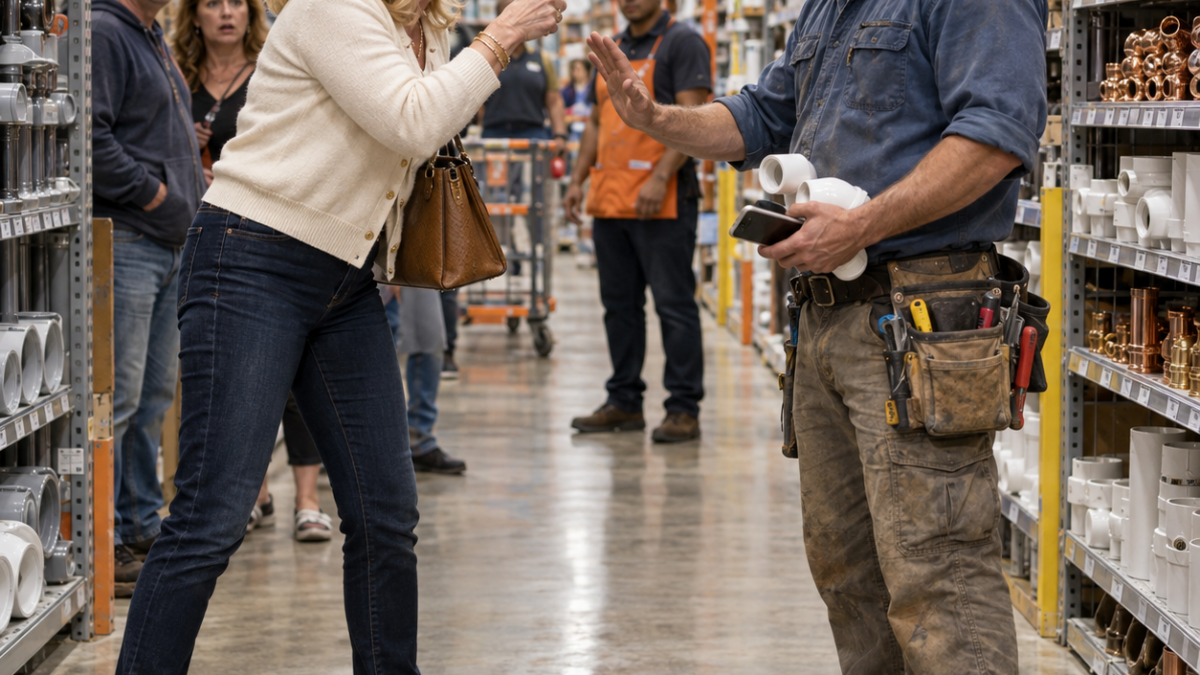
I was wearing my usual work clothes: faded blue work shirt, canvas pants, steel-toe boots, and a tool belt that had seen better years but still held everything I used most. My shirt had my company name stitched over the left pocket. Not Home Depot. Not even close. Home Depot employees wear bright orange aprons, which is one of those things I thought was pretty hard to miss if you had eyes and had ever been inside the store for more than six seconds.
Apparently, I was wrong.
The store was busy but not packed. That ordinary weekday kind of busy where contractors are grabbing materials, homeowners are looking confused in front of shelves, and somewhere far away a forklift is beeping like it has important news. The place smelled like lumber dust, rubber, cardboard, fertilizer from the garden section, and whatever chemical sadness lives near the paint aisle.
I went straight to plumbing.
That aisle has always felt like a second office to me. PVC, copper, PEX, valves, traps, fittings, adapters—rows of small decisions that can ruin your day if you pick wrong. I had my phone in one hand with measurements written in my notes app and two different joints in the other, comparing sizes while trying to picture the mess I had left opened up in a customer’s wall.
That was when I felt someone behind me.
Not passing behind me.
Standing.
Waiting.
I glanced over my shoulder and saw her.
Karen.
I didn’t know her name then, obviously, but some people carry their category in the way they stand. She was a white American woman in her late forties, maybe early fifties, dressed like suburban money having a stressful day. Cream cardigan. Dark jeans so crisp they looked ironed. Expensive-looking flats. A small leather purse hooked over one arm. Blond hair blown out into stiff waves that didn’t seem designed to move. Large sunglasses perched on her head. Nails bright pink. Lips pressed so tight they had nearly disappeared.
She stood with her arms crossed, staring at me like I was a vending machine that had taken her dollar.
I shifted slightly. “Sorry, am I in your way?”
She rolled her eyes.
“No,” she said.
Then, just loud enough for me to hear, she muttered, “Idiot.”
I looked at her, waiting for the rest of the sentence.
Nothing.
She just stared.
I had dealt with impatient customers, angry homeowners, nervous landlords, inspectors with God complexes, and one restaurant owner who blamed me personally for gravity because grease kept going down instead of sideways. But there was something uniquely uncomfortable about a stranger staring at you in a store aisle as if you had failed a test she had not explained.
“Okay,” I said slowly.
I turned back to the shelf.
She sighed.
I kept comparing fittings.
She sighed again, louder.
I looked back.
Her eyebrows lifted as if she could not believe I still had not understood whatever imaginary order she had issued telepathically.
“Can I help you with something?” I asked, already regretting the politeness.
Her expression sharpened. “That is what you were supposed to ask five minutes ago.”
I blinked.
“Excuse me?”
She stepped closer, perfume hitting the air between us, heavy and sweet enough to taste.
“People these days don’t want to work anymore,” she said. “You stand there playing on your phone while customers wander around helpless.”
I looked down at my phone. Measurements. Pipe sizes. Nothing even remotely recreational unless you are the kind of person who reads plumbing notes for fun, in which case I cannot help you.
“I think you’ve got the wrong idea,” I said.
She made a disgusted sound. “Of course. Always an excuse.”
That was the moment I should have walked away.
Actually, that’s not true.
The moment I should have walked away was before I opened my mouth the first time.
But I was tired, she was rude, and some stubborn part of me still believed a misunderstanding could be solved by one clear sentence.
“Ma’am,” I said, “I don’t work here.”
Her face changed.
Not into embarrassment.
Into outrage.
Like I had insulted her intelligence by stating a fact she did not approve.
part2
“Don’t lie to me,” she said.
The words landed hard enough that I actually laughed once, not because anything was funny, but because my brain needed a second to catch up.
“I’m not lying. I’m a customer.”
She looked me up and down, from my tool belt to my boots to the pipe joint in my hand.
“You are wearing tools.”
“I’m a plumber.”
“Exactly.”
I waited.
She stared back like that explained everything.
“Exactly what?”
“You work here.”
“No. I buy things here.”
Her eyes narrowed. “I saw you helping that man earlier.”
I glanced toward the end of the aisle, where a guy in a baseball cap was comparing faucet supply lines with the haunted expression of a person who had already made three wrong trips. I had answered one quick question for him because he had asked nicely and because I knew the answer.
“I answered a question,” I said. “That doesn’t make me an employee.”
“So you’ll help him but not me.”
“That’s not what I said.”
“That is discrimination.”
A couple of customers nearby slowed down.
There it was. The word thrown like a rock, not because it fit, but because she thought it would make me flinch.
I took a breath.
“Ma’am, I am not a Home Depot employee. Employees wear orange aprons. I’m wearing a blue work shirt with a plumbing company name on it. I’m shopping.”
She glanced at my shirt but only for a second, not long enough to read it. People like Karen do not look for information once they have chosen a conclusion. They look for reasons to stay angry.
“Paint brushes,” she snapped.
“What?”
“I need paint brushes.”
“Then you probably want the paint section.”
“I know that,” she said, though her face suggested she had not known that until I said it. “I need you to show me where.”
“I don’t know exactly where they are.”
She made a sharp sound through her nose. “Unbelievable.”
“Again,” I said, slower this time, “I do not work here.”
She leaned closer. “I don’t care what game you’re playing. Get me your manager.”
That sentence.
I had heard jokes about it. Seen videos online. Heard other contractors tell stories about people mistaking them for staff in stores. I always thought those stories were exaggerated. Surely people backed down once they were told the truth. Surely most adults could process a uniform mismatch, an explanation, a name tag absence, basic visual reality.
Karen proved me wrong in real time.
“I don’t have a manager here,” I said.
“Everyone has a manager.”
“Not at a store where they don’t work.”
“Get him.”
“No.”
Her mouth fell open.
The aisle went very quiet.
“No?” she repeated.
“No.”
“You do not tell a customer no.”
“You are not my customer.”
Her face flushed red. “You are being extremely unprofessional.”
“Good news. I am not professionally involved.”
An older man farther down the aisle coughed like he was hiding a laugh.
Karen’s eyes snapped toward him, then back to me.
“You think this is funny?”
“I think it is avoidable.”
“Get. Me. Your. Manager.”
Each word came out clipped, sharp, loud enough now that customers in the next aisle probably heard.
I picked up my basket.
“I’m done.”
I turned to leave.
That was when she followed.
At first, I thought she was just storming away in the same direction. I walked toward the front of the store with my pipe fittings, trying to ignore the heat crawling up my neck. I hate scenes. I hate being watched. I do not enjoy public conflict, and I especially do not enjoy being treated like a misbehaving employee by someone who cannot read a shirt.
Behind me, her shoes clicked faster.
“Where do you think you’re going?” she demanded.
I kept walking.
“Hey!”
I stopped near the endcap by the aisle entrance.
“What do you want?”
Her face twisted at my tone. “Do not talk to me like that.”
“Then stop following me.”
“I still need help.”
“Find an employee.”
“I couldn’t find anyone else.”
“That sounds like a store problem.”
“No,” she said, stepping close enough that I could smell that perfume again. “It is your problem. Paint brushes. Now.”
I stared at her.
Something about the way she said now changed the shape of my anger. Until then, I had been annoyed, embarrassed, maybe a little rattled. But now I understood this was not about paint brushes. It probably had never been about paint brushes.
It was about a woman who had decided I existed beneath her in that moment, and any refusal to play the role she assigned me felt like rebellion.
“I am going to say this one last time,” I said. “I do not work here. I am not helping you. Do not follow me.”
Then I started walking again.
Her hand clamped around my arm.
It happened so fast my body reacted before my mind did. Her nails dug through the fabric of my sleeve, fingers gripping hard near the inside of my elbow, and she yanked me backward.
I stumbled.
Not much. I’m not a small guy, and she wasn’t strong enough to drag me anywhere, but surprise does what strength cannot. For a split second, I was off balance, caught between my basket, my tool belt, and this stranger’s hand twisted around my arm.
“Let go of me,” I said.
She pulled again. “You are not walking away from me.”
I ripped my arm free.
My heart was suddenly pounding.
That was the first moment I felt something beyond anger.
Fear.
Not fear that she could physically overpower me. Fear of how unpredictable she had become. Fear of being a man in a public store with a furious woman who had just grabbed me and was already rewriting reality out loud. Fear that if I moved wrong, spoke wrong, defended myself too sharply, she would turn it into something else.
People think size protects you from situations like that.
It does not.
Sometimes size makes you more careful, because everyone is ready to believe you were the danger.
“Do not touch me again,” I said.
My voice must have carried, because an actual Home Depot employee came jogging over from the next aisle.
She was young, maybe twenty-two, with dark hair pulled into a ponytail and the bright orange apron that Karen had somehow failed to notice on anyone. Her name tag said Maya.
“Excuse me,” Maya said, looking between us. “What’s going on?”
Karen spun toward her, instantly performing victimhood.
“Finally,” she said. “This employee has refused to help me, lied about working here, walked away from a customer, and then got aggressive when I asked for a manager.”
Maya looked at me.
Then at my blue shirt.
Then at my tool belt.
Then back at Karen.
“Sir,” she asked carefully, “do you work here?”
“No,” I said. “I’m a plumber. I’m shopping.”
Maya nodded like that had been obvious from orbit.
“Ma’am,” she said to Karen, “he doesn’t work here. I can help you find paint brushes.”
Karen stared at her.
The silence stretched.
For one precious second, I thought reality might finally land.
Instead, Karen’s eyes widened with fresh betrayal.
“You’re covering for him.”
Maya blinked. “What?”
“You’re covering for him. He works here. I saw him helping a customer.”
“He is a customer,” Maya said. “Our employees wear orange aprons. Like this.”
She lightly touched her apron.
Karen barely glanced.
“You’re probably a trainee,” she said. “You don’t know what’s happening.”
Maya’s jaw tightened. “I’ve worked here three years.”
“Then act like it and get your manager.”
“I can call a manager,” Maya said, very controlled now. “But I’m telling you, this gentleman does not work here.”
“He does.”
“He doesn’t.”
“He does!”
The word echoed through the front aisles.
More people stopped.
A man with a cart full of lumber turned around. A woman holding curtain rods paused mid-step. Someone near appliances leaned out to look.
I wanted to disappear.
Karen wanted an audience.
That difference mattered.
A store manager arrived before Maya could radio again. He was a tall man in his forties with a shaved head, glasses, and the weary walk of someone who had handled customer meltdowns over coupons, lumber cuts, paint colors, and return policies no mortal mind should have to interpret.
“What seems to be the issue?” he asked.
Karen pointed at me.
“That man works for you and refuses to help me.”
The manager looked at me.
I saw the flicker of recognition. Not personal recognition, exactly, but type recognition. Contractor. Customer. Not ours.
“He does not work for us,” the manager said.
Karen recoiled as if he had slapped her first.
“You haven’t even checked.”
“He’s not wearing our uniform.”
“He has tools.”
“A lot of our customers have tools.”
“He was in an aisle.”
“So are all of our customers.”
“He was helping someone.”
“Customers sometimes speak to each other.”
Her face turned redder with every sentence. Each reasonable answer backed her into a corner she had built herself, and instead of stepping out, she started clawing at the walls.
“You are all lying,” she said. “Every single one of you.”
The manager’s expression hardened. “Ma’am, Maya can help you find paint brushes, or you can continue shopping on your own. But you need to stop harassing this customer.”
Customer.
The word should have ended it.
Karen turned slowly toward me.
The look in her eyes was no longer just entitlement.
It was fury at humiliation.
“You did this,” she said.
“I didn’t do anything.”
“You made me look stupid.”
I should not have answered.
But I did.
“No,” I said. “You handled that yourself.”
Her hand came up so fast I barely saw it.
The slap cracked across my face.
It was loud.
Much louder than I would have expected. The sound snapped through the aisle, followed by that strange silence that happens when everyone nearby understands something has crossed from scene into crime.
My head turned with the impact. My cheek stung hot, then cold. My eyes watered automatically. For half a second, I just stood there with my hand rising to my face, not because I was badly hurt, but because my brain refused to accept that a grown woman had slapped me in the middle of Home Depot over paint brushes.
Maya gasped.
The manager moved immediately.
“Security,” he barked into his radio. “Front aisle. Now. We have an assault.”
Karen took one step back.
Her confidence cracked.
Then she tried to fill the crack with noise.
“He threatened me!” she shouted. “I felt threatened. He was discriminating against me. He refused service. He got aggressive.”
I lowered my hand from my cheek.
I was shaking now.
Not from fear anymore.
From the effort it took not to yell.
The manager stepped between us.
“Ma’am, do not move.”
“That’s not necessary,” she said quickly, all at once less loud. “Everything is fine.”
“It is not fine.”
“I’m fine.”
“It’s not for you.”
Two security guards arrived, one from the front and one from the side aisle. They did not touch her at first. They just positioned themselves in a way that made the exit less available.
Karen looked around and finally seemed to realize how many people were watching.
That made her worse.
“Where are the brushes?” she yelled suddenly, like returning to the original demand could reset the whole world. “Just make him show me the brushes!”
“I don’t work here!” I shouted back.
My patience was gone. My cheek burned. My arm hurt where she had grabbed me. My basket was somewhere on the floor with fittings I no longer cared about. All I wanted was for this to be over and for her to be as far away from me as possible.
Someone had already called 911.
I learned that later.
At the time, I heard sirens outside and felt the store shift again. Heads turned. The manager looked relieved. Karen looked trapped.
Two police officers came in through the front entrance. One male, one female. Both looked like they had expected a shoplifting call or a customer disturbance and instead walked into a crowd of silent witnesses surrounding a woman who was still insisting the man she had slapped should help her buy paint brushes.
The manager met them first.
He spoke quickly, pointing to me, Maya, Karen, and the security guards.
The female officer approached Karen.
“Ma’am, I need you to calm down.”
Karen’s voice jumped an octave. “I am calm. He is the problem. He is an employee who refused to help me, and then everyone started lying.”
The officer glanced at me.
The manager said, “He is not an employee.”
Maya added, “He’s a customer. She slapped him.”
Karen snapped, “Because I felt threatened.”
The male officer looked at me. “Did you touch her?”
“No.”
“Did you threaten her?”
“No.”
“He was walking away from me,” Karen shouted.
The female officer turned back. “Ma’am, walking away is not a threat.”
“He was being hostile.”
“Did he touch you?”
Karen hesitated.
That hesitation told the truth before she lied.
“He pulled away violently.”
“After you grabbed his arm?” Maya said.
Karen glared at her. “Stay out of this.”
The officer’s eyes sharpened. “You grabbed his arm?”
“I was trying to get his attention.”
“That is not an answer.”
Karen started waving her hands, talking faster, words tumbling over each other—customer service, discrimination, disrespect, manager, employee, lies. The female officer stepped slightly closer and raised her hand.
“Ma’am, stop moving your hands and listen to me.”
Karen did not listen.
Maybe she was too angry. Maybe she was too embarrassed. Maybe she had lived so long believing volume could bend reality that she no longer recognized authority when it wore a badge instead of a store apron.
She stepped backward, then forward, then sideways, trying to talk over everyone.
The officer reached gently toward her arm.
“Ma’am, I need you to—”
Karen kicked her.
It happened so suddenly the entire aisle seemed to inhale.
Her foot shot forward and struck the officer in the shin hard enough that the officer grunted and stepped back.
Karen froze.
For the first time all afternoon, she understood herself.
The male officer moved immediately.
“Ma’am, you’re under arrest.”
“No,” Karen said.
It came out small.
Then louder.
“No. No, you don’t understand. He started it. He wouldn’t help me. This is his fault.”
“Turn around.”
“I didn’t mean—”
“Turn around now.”
The security guards stepped back as the officers took control. Karen resisted just enough to make it worse, twisting her shoulders, insisting she had done nothing wrong, saying she was the victim, saying she wanted the manager, saying she would sue the store, sue me, sue everyone.
The handcuffs clicked.
That sound changed everything.
The crowd murmured.
Karen’s face went pale beneath her makeup.
“You’re arresting me?” she said, as if the concept had only just become real.
“You assaulted a customer and kicked a police officer,” the male officer said. “Yes.”
“He should be arrested too!”
“For what?” the female officer asked, still wincing slightly.
“For refusing to help me!”
Even in that moment, someone laughed.
Not loud. Not cruel.
Just one involuntary burst from a man near the lumber carts who could not hold it in anymore.
Karen heard it.
Her humiliation turned back into rage.
“This is not funny!” she screamed as they led her toward the front of the store. “He works here! He works here! Make him tell you where the brushes are!”
The automatic doors opened.
Her voice spilled into the parking lot.
Then she was gone.
The silence she left behind was almost physical.
Maya looked at me first.
“Are you okay?”
I touched my cheek again. “I think so.”
The manager exhaled hard and removed his glasses, rubbing the bridge of his nose.
“I am so sorry,” he said.
“This wasn’t your fault.”
“I know, but still.”
The female officer returned after Karen was secured in the cruiser. Her shin had a red mark where Karen’s shoe had hit.
“I need your statement,” she said.
“Of course.”
“Do you want to file a report for the assault?”
I almost answered too quickly.
Yes.
Because in that moment, I saw the alternative clearly. If I shrugged it off, Karen would keep telling the story her way. She would say she had been threatened. She would say she had been ignored. She would say everyone overreacted. She would turn a slap into a misunderstanding and herself into a martyr of customer service.
I had not asked for any of this.
But she had hit me.
In public.
Because I would not obey a job I did not have.
“Yes,” I said. “I want to file.”
The statement process took about an hour.
I told the officers everything from the first throat-clear to the slap. Maya gave her statement. The manager gave his. The older man from the plumbing aisle stuck around to say he had heard me tell Karen multiple times I did not work there. Another customer said she saw Karen grab my arm. The store had cameras too, which the manager promised to preserve.
By the time I finished, I was exhausted in a way that felt heavier than a full day under a crawlspace.
The manager gave me a bottle of water and a $25 gift card.
I almost refused it because again, none of this was the store’s fault. But he looked so genuinely sorry that refusing seemed rude, so I took it.
“She’ll be banned from this location,” he said. “Maybe more, depending on corporate.”
“Good.”
“I’m sorry again.”
I looked down at the gift card.
“Do I have to use this for paint brushes?”
Maya burst out laughing from behind the service desk.
The manager smiled despite himself.
“You can buy whatever you want.”
I went home without the pipe fittings.
That part annoyed me more than it should have.
The next morning, my cheek had faded from red to a faint mark that only I noticed. My arm had a small crescent scratch from one of Karen’s nails. I took pictures of both because the officer had told me to document everything.
Then I went back to Home Depot.
Not because I wanted to be brave.
Because I still needed the fittings.
Maya saw me in the plumbing aisle and grinned.
“Back for your shift?” she asked.
I pointed at her. “Too soon.”
She laughed. “Paint brushes are aisle twelve.”
“I will haunt this store.”
The employees were kind. Too kind, almost. People kept checking on me. The manager came over again. A guy in electrical said, “You’re the plumber from yesterday?” like I had survived a minor natural disaster. I hated the attention, but I appreciated the support.
For the next few weeks, the story followed me around in strange ways.
Contractors heard about it. One guy from another jobsite texted me a meme of an orange apron with the words I DON’T WORK HERE. A customer asked why I had a scratch on my arm, and when I told her the short version, she said, “People are losing their minds,” with the seriousness of someone discussing the weather.
I gave my official paperwork at the station.
The officer who took it told me Karen had been charged with simple assault and disorderly conduct, and the situation with the officer might add more depending on how the prosecutor handled it. I did not ask for details beyond what involved me. I did not want to become obsessed. I had work, bills, actual customers, and no desire to spend my life mentally trapped in aisle twelve.
But I thought about it more than I wanted to.
Not constantly.
Just in flashes.
The way she grabbed my arm.
The crack of the slap.
The way she shouted that she felt threatened before anyone even challenged the lie.
The word discrimination thrown at me like a weapon because she did not want to admit she had made a mistake.
That was the part that stayed with me.
Not being mistaken for an employee. That happens. I get it. Tool belt, work clothes, supply store—fine. Ask me politely, and I might even help. I have helped strangers in hardware stores more times than I can count. I’ve explained the difference between fittings, told people which valve they probably needed, warned a guy once that the thing he was holding would absolutely not fix his toilet and might create a new problem large enough to deserve its own zip code.
Mistakes are human.
Karen did not make a mistake and correct it.
She made an assumption and defended it like a throne.
Every fact that contradicted her became an insult. My shirt. The apron. Maya. The manager. The officers. Witnesses. Reality itself. She did not want directions to paint brushes anymore. She wanted the universe to admit she had been right all along.
When it wouldn’t, she hit me.
Two months later, I got a call from the officer handling the case.
Karen had pleaded guilty to simple assault and disorderly conduct. She received fines, community service, and a ban from that Home Depot location. The kick toward the officer had been handled in a way I did not fully understand, folded into the disorderly conduct plea with additional conditions. I was told she would have consequences, though not the dramatic kind people imagine when they hear “arrested.”
No jail.
No big courtroom showdown.
No moment where she apologized to me while dramatic music played.
Just paperwork, fines, service hours, and a record.
I thought I would be disappointed.
Maybe part of me was.
But mostly, I felt relieved that it was over.
Then, three weeks after that, I saw her again.
Not at Home Depot.
At a grocery store across town.
I was there after work, still in my blue shirt and boots, because apparently I had learned nothing about shopping in work clothes. I was picking up milk, eggs, and a frozen pizza, which is the official dinner of men too tired to cook but too proud to order delivery twice in one week.
I turned down the cereal aisle, and there she was.
Karen.
Same blond hair. Same expensive purse. Same stiff posture.
For one second, neither of us moved.
Her eyes went to my shirt.
Then my face.
Then, maybe, the memory of orange aprons and handcuffs crossed her mind, because the color drained slightly from her cheeks.
I said nothing.
She said nothing.
A younger woman beside her—daughter, maybe, or niece—looked between us with confusion.
Karen turned her cart around and left the aisle so fast she nearly clipped an endcap of granola bars.
I stood there holding a frozen pizza and felt something unclench.
Not because she ran.
Because I didn’t.
After that, I stopped letting the incident change my routine.
I still wear my work clothes into supply stores. I still answer polite questions when people ask. I still shop at that Home Depot. I still joke with Maya when I see her. The employees there know me now, not because I work there, but because apparently surviving a Karen attack earns you honorary aisle recognition.
Sometimes I get asked if I’m an employee.
I just smile and say, “Nope, contractor. Orange aprons are the people you want.”
Most people laugh and apologize.
Normal people do that.
The last time it happened, an older woman asked me where toilet flappers were. She was polite, so I showed her.
She said, “I’m sorry, I know you don’t work here. You just look like you know things.”
“That,” I said, “is a much better opening.”
She laughed, bought the right part, and no one got arrested.
That is all it ever had to be.
I have replayed the Karen incident enough times to know there was no magic sentence that would have fixed her. No perfect tone. No better explanation. No clever joke. No visual aid. I pointed out the orange aprons. Maya confirmed it. The manager confirmed it. The police confirmed it. Every step gave her a chance to recover gracefully.
She refused every exit.
Pride can be a locked door from the inside.
And entitlement turns the handle the wrong way.
Looking back, the strangest part is how small the original problem was. Paint brushes. Somewhere in a giant store, maybe two aisles away, were paint brushes. She could have asked anyone. She could have checked a sign. She could have used the app. She could have approached me like a human being and said, “Excuse me, do you work here?” She could have accepted no. She could have let Maya help her. She could have walked away embarrassed but free.
Instead, she built a disaster out of a question.
She turned confusion into accusation.
Accusation into harassment.
Harassment into assault.
Assault into arrest.
All because she believed needing something gave her the right to command whoever stood nearest.
The funny thing is, I never did find out whether she got her paint brushes.
I hope not.
I hope somewhere in her garage there is an unfinished project, a half-painted wall, a blank piece of trim, something small and irritating that reminds her every time she sees it that the man in the blue shirt did not work there.
And even if he had, she still had no right to put her hands on him.