𝗙𝗨𝗟𝗟 𝗦𝗧𝗢𝗥𝗬 The Woman Who Said She Was Above the Law Stole My Son’s Wheelchair, Then Learned I Had Survived Worse Than Her
part2
From the beginning, Karen had that familiar entitled shine I had seen before in people who thought rules were for everyone beneath them.
She was in her late forties, blond hair always styled, nails always painted, lips always pressed into that smug little half smile people wear when they are about to say something cruel and pretend it is wisdom. She worked for the city, though she never explained exactly what that meant at first. She spoke about it constantly, as if “city employee” were a royal title.
“I know people,” she told the neighborhood within her first week. “That’s the benefit of working where I work. Police, code enforcement, city hall. If something happens, I know who to call.”
She said it while blocking Mr. Alvarez’s driveway with her car.
She said it while tossing yard waste near Mrs. Bennett’s fence.
She said it after someone told her she could not leave trash bags at the curb three days early.
“Common law doesn’t apply to me the way it applies to regular people,” she said once, loud enough for three houses to hear.
I remember turning slowly from my mailbox and staring at her because the sentence was so absurd I needed to confirm it had come from a human mouth.
“Common law?” I asked.
She looked pleased with herself. “You wouldn’t understand.”
“I’m sure.”
“I work for the city.”
“Does the city know you think that makes you above the law?”
Her smile thinned.
That was the first time she decided she did not like me.
I could have lived with that.
I had been disliked by better people.
The problem was that Karen did not stop at me.
At first, she did what she did to everyone. Parked too close to my driveway. Let trash blow onto my lawn. Made comments about my yard. Complained that Greg’s school bus blocked the street for “too long” when the wheelchair lift was lowering.
Then she started mocking the way I moved.
The first time, I was carrying groceries from the car, one bag hooked over my wrist and another balanced against my hip. My back was bad that day. Rain was coming, and my nerves always knew weather before the sky admitted it.
Karen stood in her driveway watching me.
“You know,” she called, “for someone who was supposedly in the military, you sure walk like an old lady.”
I kept moving.
“You must have been one of those desk soldiers,” she said.
I unlocked my front door and went inside without answering.
That bothered her.
Silence bothers people who feed on reaction.
After that, she got louder.
She asked if I had “played soldier” until I got tired and collected benefits. She called me “GI Jane with a limp.” Once, when she thought I wasn’t looking, she imitated my hunch to two other neighbors, dragging one leg exaggeratedly behind her until they looked so uncomfortable she stopped.
I could take that.
Not because it didn’t hurt.
Because I had learned to store pain in compartments.
But then she noticed Greg.
That was different.
She never seemed to understand wheelchairs. Or disability. Or children. Or dignity. To Karen, if Greg could stand for a few seconds during a transfer, he must be faking. If he could laugh, he must not be sick. If he could understand, then his body’s limitations were somehow an act. And if he could not walk, then she treated him like a burden the rest of us had foolishly chosen to carry.
Most of her comments happened when Greg was inside or at school.
Thank God.
But not all.
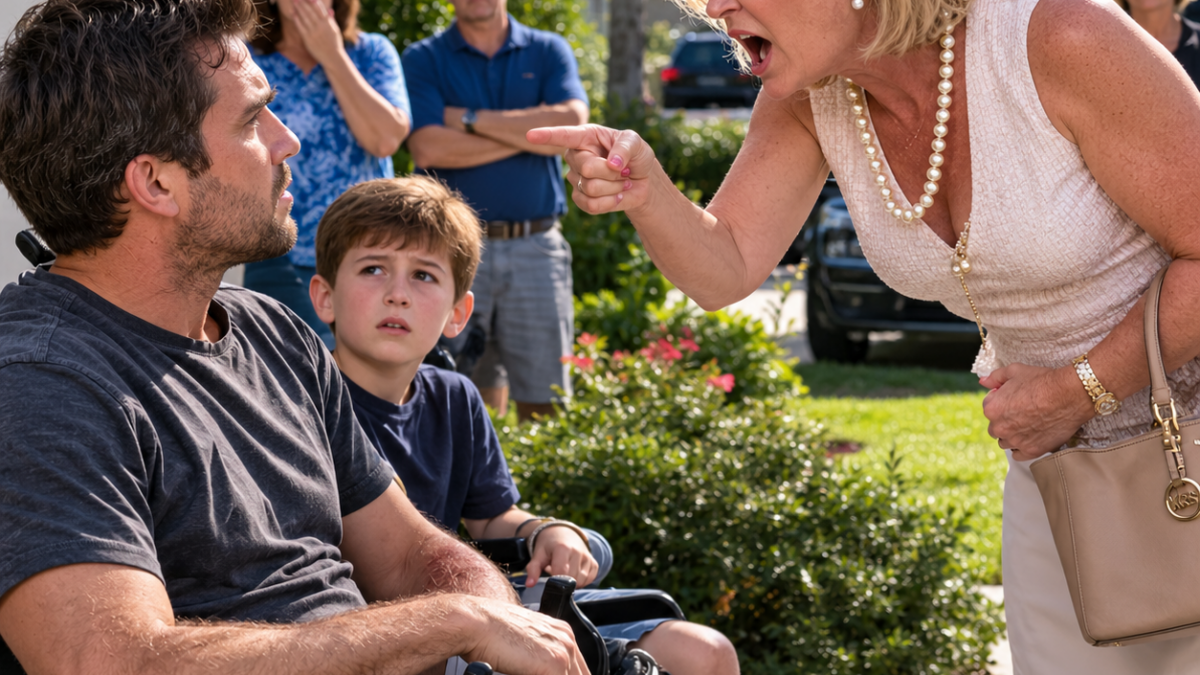
One afternoon, I was on the porch adjusting a cushion on Greg’s electric wheelchair while he was inside finishing homework. Karen stood near the hedge talking to two neighbors.
Not quietly.
“I don’t know why she keeps pretending that boy needs all that equipment,” Karen said. “I’ve seen him stand.”
One neighbor muttered, “Karen, stop.”
But she did not.
“She’s milking it. Both of them are. Benefits, sympathy, special treatment. And honestly, if my child had been born like that—”
She paused.
I looked up.
She smiled slightly.
“I wouldn’t drag him through life just to make myself feel noble.”
My hand tightened around the wheelchair armrest.
“What did you say?”
Karen turned as if surprised to find me there.
“I said some people don’t know when to let go.”
Before I could answer, I heard a sound behind me.
Greg.
He was in the doorway.
His face had gone pale.
That night, my son cried and apologized for being broken.
I sat beside his bed with my hand on his hair and felt hatred settle in me like iron.
“You are not broken,” I told him.
“But she said—”
“She is cruel.”
He wiped his eyes with the back of his hand.
“What if she’s right?”
That question did something to me no enemy ever had.
I had been shot at. Blown up. Broken. Abandoned. Dismissed by doctors. Pitied by strangers. Mocked by a woman with city employee arrogance and a dead heart.
But hearing my son ask whether his life was a burden nearly split me in half.
“She is not right,” I said, slowly enough that he could hold onto every word. “You are not broken. You are my son. You are brave. You are funny. You are smart. You are loved. And she is a miserable woman who knows nothing about you.”
He cried until he slept.
I sat in the hallway afterward because I did not trust myself to stand near Karen’s house.
From that night on, I documented everything.
Old habit.
Military habit.
Survivor habit.
Dates. Times. Comments. Witnesses. Photos of trash. Notes about blocked driveway incidents. Names of neighbors who heard things. I did not know if it would ever matter, but I had learned that the truth needs records when liars speak confidently.
The day Karen stole Greg’s wheelchair started like any other difficult day.
Greg had a specialist appointment across town. Those appointments always took planning. I had to time pain medication for myself, make sure he was rested enough for transfers, pack snacks, medical paperwork, backup braces, wipes, water, and the smaller manual wheelchair in the trunk.
I brought the car around.
Then I helped Greg out of the house in his electric wheelchair.
He was wearing his favorite blue hoodie and had stickers on the side of his chair—space stickers, mostly. A rocket, a planet, a little astronaut giving a thumbs-up. His name was on a label near the control panel because school equipment sometimes got mixed, and Greg liked knowing the chair looked unmistakably his.
“Ready, partner?” I asked.
He grinned. “Ready.”
I opened the passenger door and positioned myself for the transfer.
Transfers were hard on both of us. I had to brace my bad back, lock my knees, hold him securely, and move slowly enough not to hurt him. Greg helped as much as he could with his arms, but most of his weight came through me.
We did it.
He was in the car, buckled, breathing a little hard but okay.
“You good?”
“Yeah.”
“Give me one minute to take the chair in.”
I turned back toward the driveway.
The wheelchair was gone.
For a second, I did not understand what I was seeing.
The space where it had been was empty.
I looked left. Right. Toward the porch. Toward the garage. My mind tried to build a reasonable explanation and failed immediately. Electric wheelchairs do not wander off. They do not roll away silently across driveways and decide to explore the neighborhood.
Then I saw Karen.
She was pushing Greg’s electric wheelchair toward her garage.
My vision narrowed.
She had both hands on the back of it, struggling because she clearly did not understand the power system or wheel locks. The chair jerked slightly as she forced it, grinding in a way that made my stomach drop. She had almost reached her garage door.
I moved as fast as my back allowed.
That is not fast.
Not anymore.
But rage has its own momentum.
“Karen!” I shouted.
She looked over her shoulder and had the audacity to look annoyed.
I reached her driveway before she got the chair fully inside.
“What the hell do you think you’re doing?”
She huffed. “I need this more.”
The words were so insane I almost missed them.
“You need my son’s wheelchair?”
“I’ve seen him stand. The two of you are lazy and lying to get benefits.”
I put one hand on the chair.
“Let go.”
“My legs get tired,” she said. “And my mother is old. She would love something like this.”
For a second, all I could hear was my own heartbeat.
Then Greg’s voice from the car.
“Mom?”
He could see us through the open passenger door.
Fear hit me then. Not for myself. For him. He was watching this woman steal the thing that gave him independence, dignity, movement. He was watching me fight for it. He was trapped in the car, unable to come to me, unable to stop her, unable to do anything but witness.
That made me calmer.
Dangerously calmer.
“This chair belongs to my child,” I said. “You are not taking it.”
Karen looked at my hand on the armrest and smiled.
“I’d like to see you stop me with your hunch and limp.”
She shoved the chair again.
I held on.
“Let go,” she snapped.
“No.”
Her face twisted.
“You people think everyone owes you something.”
“You are stealing medical equipment from an eight-year-old.”
“He doesn’t need it.”
“You don’t get to decide that.”
“I work for the city.”
“I don’t care if you work for God.”
She reached for my wrist.
I tightened my grip.
Then she grabbed my arm and shoved me hard.
Pain flashed through my back. Not just pain—alarm. The old injury screamed as my body shifted wrong. My training reacted before my thoughts finished forming. She pushed into me, and I deflected, stepping as much as my body allowed, using her momentum the way I had been taught hundreds of times in drills.
I did not punch her.
I did not chase her.
I did not attack.
I redirected.
Karen lost her balance.
Her feet slipped on the smooth garage floor.
She went down hard.
Her head hit the concrete.
The sound stopped everything.
For about fifteen seconds, she did not move.
Those fifteen seconds felt longer than Afghanistan.
All the rage drained out of me so fast it left me cold.
“Oh God,” I whispered.
I still held the wheelchair with one hand. My other hand hovered uselessly in the air. I wanted to check her pulse. I wanted to run to Greg. I wanted to call 911. I wanted time to reverse two minutes so none of us were standing there.
Then Karen groaned.
Her eyes opened.
Relief hit first.
Then fear.
Because the moment she realized she was awake, her face filled with fury.
“You attacked me,” she hissed.
“You shoved me.”
“You attacked me!”
She fumbled for her phone.
I did not leave.
Every instinct told me leaving would make it worse. Greg was still in the car. Neighbors had come outside after hearing the yelling. Mr. Alvarez stood near his porch. Mrs. Bennett was at her mailbox with one hand over her mouth. Two houses down, someone was recording on a phone.
Good.
Let them record.
Karen called the police.
Her voice changed the moment dispatch answered.
“Yes, I need officers. My neighbor assaulted me. She’s ex-military and unstable. She threw me onto my garage floor.”
I closed my eyes.
Ex-military and unstable.
There it was.
The story she wanted.
When the police arrived nearly fifty minutes later, Karen had spent the whole wait pacing, muttering, holding her head, and telling anyone who would listen that I was going to jail.
“You have no idea who I am,” she said more than once. “I’m above this. I work for the city.”
I stayed by Greg’s wheelchair.
Greg stayed in the car, crying quietly by then, because the appointment had been missed, the chair was damaged, and the woman next door kept saying his mother was a criminal.
When the officers arrived, they separated us.
Karen went first because she was louder. I watched her point, gesture, press a hand dramatically to her head, and hold out her city work ID like it was some kind of shield.
Then an officer came to me.
I told him everything.
My voice shook more than I wanted it to.
“She took my son’s wheelchair. I confronted her. She grabbed and shoved me first. I redirected her push. She fell.”
He looked at the chair.
“That wheelchair belongs to your son?”
“Yes.”
“Do you have proof?”
“My son uses it every day. His name is on it. His stickers are on it. The purchase and medical documents are inside my house. The school has records. His doctor has records. Everyone here knows it’s his.”
Another officer spoke with Greg.
I could see my son trying to be brave.
He pointed toward the chair. He showed them the stickers. He explained that he had been transferred into the car and that when I turned around, Karen was pushing his chair into her garage. He told them she said he didn’t need it.
That broke my heart all over again.
The officers spoke to the neighbors.
Mr. Alvarez had seen Karen pulling the chair. Mrs. Bennett heard her say she needed it more. The neighbor who recorded had video starting after the first shout but clear enough to show Karen with the wheelchair and me trying to stop her. It also captured Karen grabbing my arm before she fell.
Still, because I had physically redirected her and she had hit her head, the officers put me in cuffs while they sorted it out.
Cold metal on my wrists.
My son crying harder.
Karen smiling.
That moment almost broke me.
Not because I thought cuffs meant guilt. I knew procedure. I understood caution. But Greg did not. Greg saw his mother restrained while the woman who had stolen his chair stood there smirking like justice belonged to whoever performed outrage best.
“It’s okay,” I told him.
My voice was steady for him.
Only for him.
“It’s okay, baby. Tell the truth.”
He nodded through tears.
The officers kept working.
They asked Karen why she had the wheelchair.
At first, she denied taking it.
Then they pointed to the neighbors.
Then the video.
Then Greg’s name label.
Then the medical stickers.
Cornered by facts, Karen changed tactics.
“I was borrowing it,” she said.
“For what purpose?” the officer asked.
“My mother is elderly.”
“This is a child’s prescribed mobility device.”
“She doesn’t need it. He can stand.”
The officer looked toward Greg in the passenger seat, then back at Karen.
“Ma’am, can you explain why you attempted to take a child’s wheelchair into your garage without permission?”
Karen lifted her work ID again.
“I work for the city. You need to be careful how you handle this.”
That was the wrong thing to say.
The officer’s expression changed.
Not dramatically. Just enough.
“Put the ID away.”
“You don’t understand. I know people.”
“Put it away.”
“You cannot arrest me.”
“For theft of medical equipment? Yes, we can.”
Her face went blank.
Then red.
Then loud.
The cuffs came off me.
They went on her.
Karen screamed the entire time.
She threatened to have the officers fired. She said they had no idea who they were messing with. She said I had manipulated everyone. She said Greg was lying. She said the chair should not count as theft because he could “stand fine.” She said her city job gave her immunity. She said common law did not apply to her.
The officers did not blink.
She was arrested for theft.
Later, that charge became grand theft because of the value of the wheelchair. They also added a battery-related charge for grabbing and shoving me first. Watching her get put into the back of the cruiser did not feel good exactly.
It felt necessary.
Then I turned to the chair.
Karen had damaged it.
At first, I hoped it was minor. But when I tried to move it, the motor made a grinding noise and pulled to one side. She had forced the wheels while the power system was engaged, and something inside the drive assembly was damaged.
Greg saw my face.
“Can it be fixed?” he asked.
“Yes,” I said immediately.
I did not know if that was true yet.
But he needed the answer before I did.
The repair cost over $1,200.
They had to replace the motor assembly and realign the drive system. I paid out of pocket because waiting for court was not an option. Greg needed his chair. Not eventually. Not after paperwork. Not after Karen faced consequences. Now.
For weeks, life became appointments, reports, repair calls, police follow-ups, court notices, and Greg trying to act like he was fine when I knew he was not. He asked me twice if someone could steal the chair again. I installed a camera facing the driveway. Then one near the porch. Then I added a lockable storage setup inside the front entry.
I hated that I had to make our home feel fortified because a neighbor had decided disabled children were easy targets.
The criminal process moved slowly.
Painfully slowly.
Karen was released pending court and ordered not to contact us. She still glared from her yard, but the whole neighborhood had changed around her. People who had tolerated her before now avoided her openly. Parents crossed the street rather than walk near her house. Mrs. Bennett stopped waving. Mr. Alvarez told me once, “Everyone knew she was awful. We didn’t know she was evil.”
The civil case for the wheelchair repair was boring in the way expensive stress is boring.
Receipts.
Repair invoices.
Police report.
Proof of ownership.
Statements.
Karen’s attempt to argue that the chair had already been damaged.
The judge did not buy it.
She was ordered to reimburse me.
By then, the criminal case had revealed the funniest, stupidest part of the whole mess.
Karen’s mighty city job?
The thing she bragged about constantly?
The authority she thought made her untouchable?
She worked at the post office.
Not in law enforcement.
Not city legal.
Not public administration.
Not some shadowy department with influence over arrests.
The post office.
I am not mocking postal workers. They work hard. They do an important job. But Karen had built an entire identity around the idea that handling mail somehow placed her above criminal law.
Her lawyer tried to work with what he had.
There was not much.
The evidence was too clear. Witnesses. Video. Police reports. Her own admission that she had taken the chair. The damage. The medical necessity. The battery. Her repeated statements that she was above the law did not help the impression she made.
She was convicted.
Six months of house arrest.
Two years probation.
Restitution for the wheelchair repair.
A felony record.
She was lucky she did not go to prison.
But the consequence that destroyed her most was the one she had created herself.
Because of the felony conviction, she lost her job.
Not only that, she was barred from holding that kind of position again because of her criminal record. The one thing she had bragged about, the one thing she had used as a weapon, the one thing she believed lifted her above everyone else—it vanished because she tried to steal mobility from an eight-year-old boy.
The day I heard she had been fired, I did not cheer.
I sat at the kitchen table across from Greg while he worked on a drawing of a rocket ship.
“She can’t bother us anymore?” he asked.
“She is not allowed to.”
He considered that.
“Good.”
“Yes,” I said. “Good.”
He looked at me then, serious in the way he gets when his mind is carrying something heavier than a child should carry.
“Mom?”
“Yeah?”
“I’m not broken.”
My throat closed.
“No,” I said. “You are not.”
“I know that now.”
I had to turn away for a moment because I did not want him to see me cry.
In the aftermath, something unexpected happened.
People helped.
Not in the vague thoughts-and-prayers way, but practically. Lisa from three houses down told me about a local disability resource group. Mr. Alvarez connected me with a veteran support organization that helped families with mobility needs. Mrs. Bennett introduced me to her niece, who worked with adaptive equipment grants. Greg’s school counselor helped gather documentation for transportation assistance.
For years, I had been so focused on surviving that I did not know what we might qualify for.
Now I am looking into help buying a used accessibility van.
The idea of it still feels almost impossible.
A vehicle where Greg’s electric wheelchair fits.
No exhausting transfers every time.
No leaving his independence behind because my trunk can only hold a manual chair.
No lifting him while my back screams.
No balancing pain against necessity every time we need groceries, appointments, or a simple trip somewhere normal.
When I told Greg we might one day get a van with a ramp, he got quiet.
Then he asked, “Could I stay in my chair?”
“Yes.”
“And drive up the ramp myself?”
“If the setup works that way, yes.”
He smiled slowly.
Not the small polite smile he gives adults.
A real one.
The kind that makes his whole face younger.
“That would be awesome,” he said.
Karen tried to take something from him because she thought disability made him less deserving of it.
Instead, her cruelty exposed how much support we had been missing.
I wish it had not taken that.
I wish my son had never heard her words, never watched her drag his chair away, never seen me in cuffs, never had to explain to police that yes, the wheelchair with rocket stickers belonged to him. I wish people like Karen understood humanity without needing a judge to explain consequences.
But wishing has never been a strategy.
So I document.
I protect.
I teach my son the truth.
I teach him that his chair is not a symbol of weakness. It is freedom. It is movement. It is technology helping his body do what it cannot do alone. I teach him that needing help does not make him a burden. I teach him that standing for a few seconds does not mean he has to perform ability for ignorant people. I teach him that cruelty is not truth just because it is loud.
And I remind myself too.
Because Karen’s voice was not the first cruel voice we heard.
It will not be the last.
But it no longer gets to live in our house.
Sometimes I still think about that day in her garage.
The concrete floor.
The grinding motor.
Greg calling for me from the car.
Karen saying she needed the chair more.
The way she smiled when I was cuffed.
The way her face changed when the officers turned toward her instead.
She had spent months telling anyone who would listen that she was above the law. She believed her job made her untouchable, her cruelty made her powerful, and our disabilities made us easy to push aside.
She was wrong about every single part.
I survived an IED.
I survived losing the life I thought I would have.
I survived raising a medically fragile child alone in a world that rarely makes anything easy.
Karen was never the strongest thing I had faced.
She was just the loudest neighbor.
And when she tried to steal my son’s wheelchair, all that noise finally became evidence.
𝗧𝗛𝗘 𝗘𝗡𝗗
The Woman Who Said She Was Above the Law Stole My Son’s Wheelchair, Then Learned I Had Survived Worse Than Her
Karen mocked my limp, my service, and my disabled little boy until the whole neighborhood knew exactly what kind of woman she was. But the day she put her hands on my son’s wheelchair and tried to drag it into her garage, she crossed a line I had spent my life learning how to defend. She thought her city job made her untouchable, but the law she bragged about being above was already closing around her.
I learned early in the military that entitlement does not survive structure.
You can show up thinking you are special, thinking rules bend for you, thinking volume counts as authority. But there is always someone louder, calmer, better trained, and far less impressed by your attitude. In basic training, I watched grown adults who had never been told no in their lives get stripped down to reality before breakfast. No one cared who their parents were, how pretty they were, what car they had driven, or what kind of person they imagined themselves to be.
The standard was the standard.
I missed that sometimes after I came home.
Not the war. Not the fear. Not the sand in everything or the sound of helicopters cutting through the night. I did not miss the parts that still visited me in dreams. But I missed the clarity. The directness. The way a person could act like a fool and be corrected before that foolishness grew teeth.
Civilian life had too much room for people like Karen.
People who mistook patience for weakness.
People who called cruelty honesty.
People who thought a job title, a uniform, a parking sticker, or a smug little smile gave them permission to hurt whoever looked easier to hurt.
I was in my thirties when Karen moved in next door, but I was already carrying more years than that inside my back.
When I was younger and still trying to figure out who I was, I joined the military. I was not running away from anything, exactly, though maybe I was running toward a version of myself I hoped would be stronger. I served. I learned. I changed. Then, during a deployment outside Kandahar, our convoy hit an IED.
There are sounds your body remembers even when your mind tries to file them away.
The blast. Metal screaming. Men shouting. The sudden, impossible violence of a normal road becoming fire and pressure and dust. I survived. I kept my limbs. Some people I cared about did not get to say the same.
The explosion threw me hard against the inside of the vehicle. My back took the worst of it. Three compressed vertebrae, nerve damage, chronic pain that never really moved out, and a medical discharge that left me standing in a life I did not recognize.
Standing was not even the right word.
Limping.
Hunching.
Trying.
For a while, I did not know what I was supposed to do with myself. I had gone from purpose, schedule, mission, team, and noise to doctor appointments, forms, pain medication, physical therapy, and silence. People thanked me for my service in grocery store parking lots and then looked away from the way I moved. I was young enough that strangers expected my body to work properly and old enough inside to know expectations did not matter.
Then I found out I was pregnant.
His father disappeared almost as soon as he heard. Some men can wear confidence like armor until responsibility touches it, and then you see how thin they really are. I named my son Greg after my father, the best man I had ever known. I told myself that if the world had narrowed to just me and this baby, then fine.
We would become our own unit.
When Greg was born, I knew immediately something was wrong.
Mothers are told not to panic. Doctors are careful with words. Nurses smile in ways that are meant to soothe but sometimes only confirm that everyone else has noticed too. His legs looked too thin. Too weak. His little body did not move the way I expected. After tests, specialists, and words I had to learn through tears and medical pamphlets, we got the diagnosis.
Spinal muscular atrophy type 2.
SMA.
A genetic condition affecting motor neurons in the spinal cord, causing progressive muscle weakness, especially in his legs and trunk.
By the time Greg was eight, he could not use the muscles in his legs for more than a few minutes before they gave out. He was bright, funny, stubborn, observant, and gentle in the way children sometimes are when pain teaches them early to notice other people’s moods. He used an electric wheelchair at home and at school, where the bus had a lift. When it was just the two of us going somewhere, we had a complicated system because I could not afford an accessibility van.
I would transfer him from his electric wheelchair into the car seat, supporting most of his weight because his trunk muscles were weak. Then I would take the electric wheelchair back inside because it could not fit in our regular car. In the trunk, I kept a lightweight manual wheelchair that folded up. It was not ideal. He could not self-propel it like his electric one, and the small wheels made everything harder, but it was the only option we had.
That was our life.
Imperfect.
Careful.
Ours.
Then Karen moved in next door and decided our existence offended her.
part2
From the beginning, Karen had that familiar entitled shine I had seen before in people who thought rules were for everyone beneath them.
She was in her late forties, blond hair always styled, nails always painted, lips always pressed into that smug little half smile people wear when they are about to say something cruel and pretend it is wisdom. She worked for the city, though she never explained exactly what that meant at first. She spoke about it constantly, as if “city employee” were a royal title.
“I know people,” she told the neighborhood within her first week. “That’s the benefit of working where I work. Police, code enforcement, city hall. If something happens, I know who to call.”
She said it while blocking Mr. Alvarez’s driveway with her car.
She said it while tossing yard waste near Mrs. Bennett’s fence.
She said it after someone told her she could not leave trash bags at the curb three days early.
“Common law doesn’t apply to me the way it applies to regular people,” she said once, loud enough for three houses to hear.
I remember turning slowly from my mailbox and staring at her because the sentence was so absurd I needed to confirm it had come from a human mouth.
“Common law?” I asked.
She looked pleased with herself. “You wouldn’t understand.”
“I’m sure.”
“I work for the city.”
“Does the city know you think that makes you above the law?”
Her smile thinned.
That was the first time she decided she did not like me.
I could have lived with that.
I had been disliked by better people.
The problem was that Karen did not stop at me.
At first, she did what she did to everyone. Parked too close to my driveway. Let trash blow onto my lawn. Made comments about my yard. Complained that Greg’s school bus blocked the street for “too long” when the wheelchair lift was lowering.
Then she started mocking the way I moved.
The first time, I was carrying groceries from the car, one bag hooked over my wrist and another balanced against my hip. My back was bad that day. Rain was coming, and my nerves always knew weather before the sky admitted it.
Karen stood in her driveway watching me.
“You know,” she called, “for someone who was supposedly in the military, you sure walk like an old lady.”
I kept moving.
“You must have been one of those desk soldiers,” she said.
I unlocked my front door and went inside without answering.
That bothered her.
Silence bothers people who feed on reaction.
After that, she got louder.
She asked if I had “played soldier” until I got tired and collected benefits. She called me “GI Jane with a limp.” Once, when she thought I wasn’t looking, she imitated my hunch to two other neighbors, dragging one leg exaggeratedly behind her until they looked so uncomfortable she stopped.
I could take that.
Not because it didn’t hurt.
Because I had learned to store pain in compartments.
But then she noticed Greg.
That was different.
She never seemed to understand wheelchairs. Or disability. Or children. Or dignity. To Karen, if Greg could stand for a few seconds during a transfer, he must be faking. If he could laugh, he must not be sick. If he could understand, then his body’s limitations were somehow an act. And if he could not walk, then she treated him like a burden the rest of us had foolishly chosen to carry.
Most of her comments happened when Greg was inside or at school.
Thank God.
But not all.
One afternoon, I was on the porch adjusting a cushion on Greg’s electric wheelchair while he was inside finishing homework. Karen stood near the hedge talking to two neighbors.
Not quietly.
“I don’t know why she keeps pretending that boy needs all that equipment,” Karen said. “I’ve seen him stand.”
One neighbor muttered, “Karen, stop.”
But she did not.
“She’s milking it. Both of them are. Benefits, sympathy, special treatment. And honestly, if my child had been born like that—”
She paused.
I looked up.
She smiled slightly.
“I wouldn’t drag him through life just to make myself feel noble.”
My hand tightened around the wheelchair armrest.
“What did you say?”
Karen turned as if surprised to find me there.
“I said some people don’t know when to let go.”
Before I could answer, I heard a sound behind me.
Greg.
He was in the doorway.
His face had gone pale.
That night, my son cried and apologized for being broken.
I sat beside his bed with my hand on his hair and felt hatred settle in me like iron.
“You are not broken,” I told him.
“But she said—”
“She is cruel.”
He wiped his eyes with the back of his hand.
“What if she’s right?”
That question did something to me no enemy ever had.
I had been shot at. Blown up. Broken. Abandoned. Dismissed by doctors. Pitied by strangers. Mocked by a woman with city employee arrogance and a dead heart.
But hearing my son ask whether his life was a burden nearly split me in half.
“She is not right,” I said, slowly enough that he could hold onto every word. “You are not broken. You are my son. You are brave. You are funny. You are smart. You are loved. And she is a miserable woman who knows nothing about you.”
He cried until he slept.
I sat in the hallway afterward because I did not trust myself to stand near Karen’s house.
From that night on, I documented everything.
Old habit.
Military habit.
Survivor habit.
Dates. Times. Comments. Witnesses. Photos of trash. Notes about blocked driveway incidents. Names of neighbors who heard things. I did not know if it would ever matter, but I had learned that the truth needs records when liars speak confidently.
The day Karen stole Greg’s wheelchair started like any other difficult day.
Greg had a specialist appointment across town. Those appointments always took planning. I had to time pain medication for myself, make sure he was rested enough for transfers, pack snacks, medical paperwork, backup braces, wipes, water, and the smaller manual wheelchair in the trunk.
I brought the car around.
Then I helped Greg out of the house in his electric wheelchair.
He was wearing his favorite blue hoodie and had stickers on the side of his chair—space stickers, mostly. A rocket, a planet, a little astronaut giving a thumbs-up. His name was on a label near the control panel because school equipment sometimes got mixed, and Greg liked knowing the chair looked unmistakably his.
“Ready, partner?” I asked.
He grinned. “Ready.”
I opened the passenger door and positioned myself for the transfer.
Transfers were hard on both of us. I had to brace my bad back, lock my knees, hold him securely, and move slowly enough not to hurt him. Greg helped as much as he could with his arms, but most of his weight came through me.
We did it.
He was in the car, buckled, breathing a little hard but okay.
“You good?”
“Yeah.”
“Give me one minute to take the chair in.”
I turned back toward the driveway.
The wheelchair was gone.
For a second, I did not understand what I was seeing.
The space where it had been was empty.
I looked left. Right. Toward the porch. Toward the garage. My mind tried to build a reasonable explanation and failed immediately. Electric wheelchairs do not wander off. They do not roll away silently across driveways and decide to explore the neighborhood.
Then I saw Karen.
She was pushing Greg’s electric wheelchair toward her garage.
My vision narrowed.
She had both hands on the back of it, struggling because she clearly did not understand the power system or wheel locks. The chair jerked slightly as she forced it, grinding in a way that made my stomach drop. She had almost reached her garage door.
I moved as fast as my back allowed.
That is not fast.
Not anymore.
But rage has its own momentum.
“Karen!” I shouted.
She looked over her shoulder and had the audacity to look annoyed.
I reached her driveway before she got the chair fully inside.
“What the hell do you think you’re doing?”
She huffed. “I need this more.”
The words were so insane I almost missed them.
“You need my son’s wheelchair?”
“I’ve seen him stand. The two of you are lazy and lying to get benefits.”
I put one hand on the chair.
“Let go.”
“My legs get tired,” she said. “And my mother is old. She would love something like this.”
For a second, all I could hear was my own heartbeat.
Then Greg’s voice from the car.
“Mom?”
He could see us through the open passenger door.
Fear hit me then. Not for myself. For him. He was watching this woman steal the thing that gave him independence, dignity, movement. He was watching me fight for it. He was trapped in the car, unable to come to me, unable to stop her, unable to do anything but witness.
That made me calmer.
Dangerously calmer.
“This chair belongs to my child,” I said. “You are not taking it.”
Karen looked at my hand on the armrest and smiled.
“I’d like to see you stop me with your hunch and limp.”
She shoved the chair again.
I held on.
“Let go,” she snapped.
“No.”
Her face twisted.
“You people think everyone owes you something.”
“You are stealing medical equipment from an eight-year-old.”
“He doesn’t need it.”
“You don’t get to decide that.”
“I work for the city.”
“I don’t care if you work for God.”
She reached for my wrist.
I tightened my grip.
Then she grabbed my arm and shoved me hard.
Pain flashed through my back. Not just pain—alarm. The old injury screamed as my body shifted wrong. My training reacted before my thoughts finished forming. She pushed into me, and I deflected, stepping as much as my body allowed, using her momentum the way I had been taught hundreds of times in drills.
I did not punch her.
I did not chase her.
I did not attack.
I redirected.
Karen lost her balance.
Her feet slipped on the smooth garage floor.
She went down hard.
Her head hit the concrete.
The sound stopped everything.
For about fifteen seconds, she did not move.
Those fifteen seconds felt longer than Afghanistan.
All the rage drained out of me so fast it left me cold.
“Oh God,” I whispered.
I still held the wheelchair with one hand. My other hand hovered uselessly in the air. I wanted to check her pulse. I wanted to run to Greg. I wanted to call 911. I wanted time to reverse two minutes so none of us were standing there.
Then Karen groaned.
Her eyes opened.
Relief hit first.
Then fear.
Because the moment she realized she was awake, her face filled with fury.
“You attacked me,” she hissed.
“You shoved me.”
“You attacked me!”
She fumbled for her phone.
I did not leave.
Every instinct told me leaving would make it worse. Greg was still in the car. Neighbors had come outside after hearing the yelling. Mr. Alvarez stood near his porch. Mrs. Bennett was at her mailbox with one hand over her mouth. Two houses down, someone was recording on a phone.
Good.
Let them record.
Karen called the police.
Her voice changed the moment dispatch answered.
“Yes, I need officers. My neighbor assaulted me. She’s ex-military and unstable. She threw me onto my garage floor.”
I closed my eyes.
Ex-military and unstable.
There it was.
The story she wanted.
When the police arrived nearly fifty minutes later, Karen had spent the whole wait pacing, muttering, holding her head, and telling anyone who would listen that I was going to jail.
“You have no idea who I am,” she said more than once. “I’m above this. I work for the city.”
I stayed by Greg’s wheelchair.
Greg stayed in the car, crying quietly by then, because the appointment had been missed, the chair was damaged, and the woman next door kept saying his mother was a criminal.
When the officers arrived, they separated us.
Karen went first because she was louder. I watched her point, gesture, press a hand dramatically to her head, and hold out her city work ID like it was some kind of shield.
Then an officer came to me.
I told him everything.
My voice shook more than I wanted it to.
“She took my son’s wheelchair. I confronted her. She grabbed and shoved me first. I redirected her push. She fell.”
He looked at the chair.
“That wheelchair belongs to your son?”
“Yes.”
“Do you have proof?”
“My son uses it every day. His name is on it. His stickers are on it. The purchase and medical documents are inside my house. The school has records. His doctor has records. Everyone here knows it’s his.”
Another officer spoke with Greg.
I could see my son trying to be brave.
He pointed toward the chair. He showed them the stickers. He explained that he had been transferred into the car and that when I turned around, Karen was pushing his chair into her garage. He told them she said he didn’t need it.
That broke my heart all over again.
The officers spoke to the neighbors.
Mr. Alvarez had seen Karen pulling the chair. Mrs. Bennett heard her say she needed it more. The neighbor who recorded had video starting after the first shout but clear enough to show Karen with the wheelchair and me trying to stop her. It also captured Karen grabbing my arm before she fell.
Still, because I had physically redirected her and she had hit her head, the officers put me in cuffs while they sorted it out.
Cold metal on my wrists.
My son crying harder.
Karen smiling.
That moment almost broke me.
Not because I thought cuffs meant guilt. I knew procedure. I understood caution. But Greg did not. Greg saw his mother restrained while the woman who had stolen his chair stood there smirking like justice belonged to whoever performed outrage best.
“It’s okay,” I told him.
My voice was steady for him.
Only for him.
“It’s okay, baby. Tell the truth.”
He nodded through tears.
The officers kept working.
They asked Karen why she had the wheelchair.
At first, she denied taking it.
Then they pointed to the neighbors.
Then the video.
Then Greg’s name label.
Then the medical stickers.
Cornered by facts, Karen changed tactics.
“I was borrowing it,” she said.
“For what purpose?” the officer asked.
“My mother is elderly.”
“This is a child’s prescribed mobility device.”
“She doesn’t need it. He can stand.”
The officer looked toward Greg in the passenger seat, then back at Karen.
“Ma’am, can you explain why you attempted to take a child’s wheelchair into your garage without permission?”
Karen lifted her work ID again.
“I work for the city. You need to be careful how you handle this.”
That was the wrong thing to say.
The officer’s expression changed.
Not dramatically. Just enough.
“Put the ID away.”
“You don’t understand. I know people.”
“Put it away.”
“You cannot arrest me.”
“For theft of medical equipment? Yes, we can.”
Her face went blank.
Then red.
Then loud.
The cuffs came off me.
They went on her.
Karen screamed the entire time.
She threatened to have the officers fired. She said they had no idea who they were messing with. She said I had manipulated everyone. She said Greg was lying. She said the chair should not count as theft because he could “stand fine.” She said her city job gave her immunity. She said common law did not apply to her.
The officers did not blink.
She was arrested for theft.
Later, that charge became grand theft because of the value of the wheelchair. They also added a battery-related charge for grabbing and shoving me first. Watching her get put into the back of the cruiser did not feel good exactly.
It felt necessary.
Then I turned to the chair.
Karen had damaged it.
At first, I hoped it was minor. But when I tried to move it, the motor made a grinding noise and pulled to one side. She had forced the wheels while the power system was engaged, and something inside the drive assembly was damaged.
Greg saw my face.
“Can it be fixed?” he asked.
“Yes,” I said immediately.
I did not know if that was true yet.
But he needed the answer before I did.
The repair cost over $1,200.
They had to replace the motor assembly and realign the drive system. I paid out of pocket because waiting for court was not an option. Greg needed his chair. Not eventually. Not after paperwork. Not after Karen faced consequences. Now.
For weeks, life became appointments, reports, repair calls, police follow-ups, court notices, and Greg trying to act like he was fine when I knew he was not. He asked me twice if someone could steal the chair again. I installed a camera facing the driveway. Then one near the porch. Then I added a lockable storage setup inside the front entry.
I hated that I had to make our home feel fortified because a neighbor had decided disabled children were easy targets.
The criminal process moved slowly.
Painfully slowly.
Karen was released pending court and ordered not to contact us. She still glared from her yard, but the whole neighborhood had changed around her. People who had tolerated her before now avoided her openly. Parents crossed the street rather than walk near her house. Mrs. Bennett stopped waving. Mr. Alvarez told me once, “Everyone knew she was awful. We didn’t know she was evil.”
The civil case for the wheelchair repair was boring in the way expensive stress is boring.
Receipts.
Repair invoices.
Police report.
Proof of ownership.
Statements.
Karen’s attempt to argue that the chair had already been damaged.
The judge did not buy it.
She was ordered to reimburse me.
By then, the criminal case had revealed the funniest, stupidest part of the whole mess.
Karen’s mighty city job?
The thing she bragged about constantly?
The authority she thought made her untouchable?
She worked at the post office.
Not in law enforcement.
Not city legal.
Not public administration.
Not some shadowy department with influence over arrests.
The post office.
I am not mocking postal workers. They work hard. They do an important job. But Karen had built an entire identity around the idea that handling mail somehow placed her above criminal law.
Her lawyer tried to work with what he had.
There was not much.
The evidence was too clear. Witnesses. Video. Police reports. Her own admission that she had taken the chair. The damage. The medical necessity. The battery. Her repeated statements that she was above the law did not help the impression she made.
She was convicted.
Six months of house arrest.
Two years probation.
Restitution for the wheelchair repair.
A felony record.
She was lucky she did not go to prison.
But the consequence that destroyed her most was the one she had created herself.
Because of the felony conviction, she lost her job.
Not only that, she was barred from holding that kind of position again because of her criminal record. The one thing she had bragged about, the one thing she had used as a weapon, the one thing she believed lifted her above everyone else—it vanished because she tried to steal mobility from an eight-year-old boy.
The day I heard she had been fired, I did not cheer.
I sat at the kitchen table across from Greg while he worked on a drawing of a rocket ship.
“She can’t bother us anymore?” he asked.
“She is not allowed to.”
He considered that.
“Good.”
“Yes,” I said. “Good.”
He looked at me then, serious in the way he gets when his mind is carrying something heavier than a child should carry.
“Mom?”
“Yeah?”
“I’m not broken.”
My throat closed.
“No,” I said. “You are not.”
“I know that now.”
I had to turn away for a moment because I did not want him to see me cry.
In the aftermath, something unexpected happened.
People helped.
Not in the vague thoughts-and-prayers way, but practically. Lisa from three houses down told me about a local disability resource group. Mr. Alvarez connected me with a veteran support organization that helped families with mobility needs. Mrs. Bennett introduced me to her niece, who worked with adaptive equipment grants. Greg’s school counselor helped gather documentation for transportation assistance.
For years, I had been so focused on surviving that I did not know what we might qualify for.
Now I am looking into help buying a used accessibility van.
The idea of it still feels almost impossible.
A vehicle where Greg’s electric wheelchair fits.
No exhausting transfers every time.
No leaving his independence behind because my trunk can only hold a manual chair.
No lifting him while my back screams.
No balancing pain against necessity every time we need groceries, appointments, or a simple trip somewhere normal.
When I told Greg we might one day get a van with a ramp, he got quiet.
Then he asked, “Could I stay in my chair?”
“Yes.”
“And drive up the ramp myself?”
“If the setup works that way, yes.”
He smiled slowly.
Not the small polite smile he gives adults.
A real one.
The kind that makes his whole face younger.
“That would be awesome,” he said.
Karen tried to take something from him because she thought disability made him less deserving of it.
Instead, her cruelty exposed how much support we had been missing.
I wish it had not taken that.
I wish my son had never heard her words, never watched her drag his chair away, never seen me in cuffs, never had to explain to police that yes, the wheelchair with rocket stickers belonged to him. I wish people like Karen understood humanity without needing a judge to explain consequences.
But wishing has never been a strategy.
So I document.
I protect.
I teach my son the truth.
I teach him that his chair is not a symbol of weakness. It is freedom. It is movement. It is technology helping his body do what it cannot do alone. I teach him that needing help does not make him a burden. I teach him that standing for a few seconds does not mean he has to perform ability for ignorant people. I teach him that cruelty is not truth just because it is loud.
And I remind myself too.
Because Karen’s voice was not the first cruel voice we heard.
It will not be the last.
But it no longer gets to live in our house.
Sometimes I still think about that day in her garage.
The concrete floor.
The grinding motor.
Greg calling for me from the car.
Karen saying she needed the chair more.
The way she smiled when I was cuffed.
The way her face changed when the officers turned toward her instead.
She had spent months telling anyone who would listen that she was above the law. She believed her job made her untouchable, her cruelty made her powerful, and our disabilities made us easy to push aside.
She was wrong about every single part.
I survived an IED.
I survived losing the life I thought I would have.
I survived raising a medically fragile child alone in a world that rarely makes anything easy.
Karen was never the strongest thing I had faced.
She was just the loudest neighbor.
And when she tried to steal my son’s wheelchair, all that noise finally became evidence.