𝗙𝗨𝗟𝗟 𝗦𝗧𝗢𝗥𝗬 The Woman Who Ruled Our HOA Thought She Could Order My Plane Off My Own Property—Until She Took Her SUV Onto the Runway
𝗣𝗔𝗥𝗧 𝟮
I actually laughed.
That was a mistake.
Her face changed instantly.
“Something funny?”
“Yes. This.”
I tapped the air between us.
“You walked through an airport gate wearing a fake admiral costume to give me an HOA violation because my airplane is visible from houses built next to an airport.”
Her cheeks flushed.
“This is not a costume.”
I looked at the decorative gold braid on her shoulder.
“Which branch?”
“What?”
“Which branch of the military?”
“That’s irrelevant.”
“So is your notice.”
I turned away.
Her heels struck the pavement sharply behind me.
“Daniel, I’m speaking to you.”
I kept walking toward the hangar.
Then she said something that made me stop.
“If the aircraft isn’t moved by noon tomorrow, fines begin at five hundred dollars per day.”
I turned slowly.
She had followed me several steps.
“You’re threatening to fine my house because of an airplane located on municipal airport property?”
“I’m informing you of the consequences of noncompliance.”
“That’s not authority, Victoria. That’s extortion with stationery.”
Her eyes flashed.
“Be careful.”
“No. You be careful.”
The apron suddenly felt very quiet.
She wasn’t used to being spoken to that way.
I wasn’t shouting.
That made it worse for her.
I walked closer until only a few feet separated us.
“You don’t control this airport. You don’t control my lease. You don’t control my airplane. And you don’t get to invent jurisdiction because somebody in Silver Oaks doesn’t like looking at wings through their kitchen window.”
Her jaw clenched.
“You think this is about one complaint?”
“I think this is about you hearing the word no.”
For one second, the polished mask slipped.
I saw pure anger.
Then she smiled again.
“Move the plane, Daniel.”
“No.”
Her eyes stayed on mine.
“By noon tomorrow.”
“No.”
“You will regret making this difficult.”
I took the violation notice from her hand.
Then I tore it in half.
Not dramatically.
Just once.
Straight down the middle.
I placed both pieces back on her clipboard.
“Have a good morning, Victoria.”
Her face went completely still.
I should have known right then that she wasn’t going to let it go.
What I didn’t know was how far she was willing to take it.
By lunchtime, I had three emails from the HOA.
The first repeated the violation.
The second added a “hostile conduct” complaint.
The third informed me that my account had been assessed a $250 administrative enforcement fee.
I forwarded all three to my attorney, Rachel Morrison.
Her response came five minutes later.
Call me.
Rachel had handled the closing when I bought my house in Silver Oaks. She knew the covenants better than most members of the HOA board did.
I called from my office above the hangar.
She answered immediately.
“Tell me you didn’t threaten her.”
“I didn’t.”
“Touch her?”
“No.”
“Block her?”
“No.”
“Use language you wouldn’t want read aloud in court?”
I thought about the fake admiral costume.
“Probably not.”
Rachel sighed.
“Daniel.”
“She walked onto the airport apron and ordered me to move my plane.”
“I saw the notices you sent.”
“Can she do this?”
“No.”
“That was fast.”
“Because the HOA declaration isn’t magic. It applies to property inside the association and certain conduct originating there. It doesn’t give Victoria Hale regulatory authority over municipal airport operations.”
“So the fines are garbage.”
“Probably unenforceable. Don’t ignore them, though.”
“I thought you said—”
“I said they’re probably unenforceable. That doesn’t mean she can’t create a headache.”
That turned out to be the understatement of the week.
The next morning, there was a white envelope taped to my front door.
FINAL DEMAND.
Victoria had increased the daily fine to $750.
She’d also scheduled an emergency compliance hearing.
For that evening.
At six-thirty.
I went.
Not because I believed they had authority over the plane.
I went because people like Victoria became more dangerous when everyone reasonable stopped showing up.
The Silver Oaks clubhouse was full when I arrived.
That surprised me.
Usually HOA meetings attracted eight people, three of whom were board members.
That night there were more than forty residents.
Word had spread.
Victoria sat at the center of the long table in front.
She was wearing another white outfit, this one even more theatrical than the first. Tight white trousers, high heels, a fitted double-breasted jacket, gold buttons, and the same plunging neckline. Her blonde hair fell perfectly over one shoulder.
If you didn’t know her, you might have mistaken the whole performance for confidence.
I knew better.
It was armor.
She liked being watched.
She liked entering a room and feeling people reorganize themselves around her.
Beside her sat the vice president, Martin Cole, who looked uncomfortable before the meeting had even started.
Two other board members sat farther down.
Victoria tapped the microphone.
“The purpose of tonight’s emergency session is to address a continuing nuisance violation created by resident Daniel Mercer.”
Every face in the room turned toward me.
I stayed seated.
Victoria continued.
“Mr. Mercer owns an aircraft currently positioned adjacent to the Silver Oaks community. Multiple residents have reported concerns involving noise, visual pollution, safety, possible fuel exposure, and reduced property enjoyment.”
Possible fuel exposure.
I almost admired the phrase.
She had a gift for making nonsense sound official.
Victoria looked directly at me.
“Mr. Mercer has refused repeated reasonable requests to relocate the aircraft.”
She paused.
“More troublingly, he responded to a formal board representative with hostility and intimidation.”
Murmurs moved through the room.
I stood.
“May I respond?”
“You’ll have an opportunity.”
“I’m being accused publicly.”
“You’ll have an opportunity.”
Martin leaned toward her.
“Victoria, maybe let him—”
She covered the microphone with one hand and whispered something to him.
Martin leaned back.
Victoria smiled.
“We’ll now review evidence.”
She displayed photographs on the projector.
My airplane.
Taken from outside the airport fence.
One from a sidewalk.
One through the trees.
One zoomed in from somebody’s backyard.
The crowd stared.
I raised my hand.
She ignored me.
Next came a sound recording.
An airplane engine.
Loud.
Very loud.
Victoria let it play for fifteen seconds.
“This,” she said, “was recorded by a homeowner at six forty-two yesterday morning.”
I stood again.
“That’s not my airplane.”
She stopped.
“Sit down.”
“That’s not my engine.”
“Daniel.”
“My plane wasn’t running yesterday morning.”
“You’ve been given instructions.”
“I have maintenance logs and airport cameras.”
Her face tightened.
Someone in the back said, “Let him talk.”
Another person agreed.
Victoria looked across the room.
“This isn’t a debate.”
That was her second mistake.
The first had been assuming nobody else was tired of her.
A man near the aisle stood.
“Then why are we here?”
I recognized him.
Kevin.
The guy with the work truck.
Victoria stiffened.
“This is a formal compliance proceeding.”
Kevin crossed his arms.
“Looks more like you already decided.”
A few people murmured approval.
Victoria tapped her gavel.
Actually tapped a gavel.
“Order.”
I looked at Rachel, who had come with me.
She gave the slightest nod.
My turn.
I walked to the front carrying a folder.
“My plane is kept in Hangar 14 under a lease with the municipal airport. The apron where it’s parked is airport property. It isn’t owned or controlled by Silver Oaks.”
Victoria cut in.
“The nuisance clause—”
Rachel stood.
“Please allow my client to finish.”
That changed the room.
Victoria’s eyes snapped toward her.
“And you are?”
“Rachel Morrison. Counsel for Mr. Mercer.”
Victoria hesitated.
Only for a second.
But everybody saw it.
I continued.
“My plane did not operate yesterday morning. It did not operate the morning before that. The engine noise you just played is not mine.”
I opened the folder.
“Airport movement records.”
Another sheet.
“Fuel records.”
Another.
“Security logs.”
Victoria stared at the papers.
“The visual issue remains.”
“So we’re down to you don’t like seeing an airplane next to an airport?”
Her nostrils flared.
I continued before she could interrupt.
“I also spoke to airport management today. Victoria was not authorized to enter the apron without an escort yesterday.”
That created a louder reaction.
Martin turned toward her.
“You went airside?”
She ignored him.
I looked directly at her.
“Through a restricted gate.”
“I had legitimate association business.”
“HOA business doesn’t authorize access to an aircraft operations area.”
She leaned toward the microphone.
“This board will not be distracted by procedural technicalities.”
Rachel almost smiled.
“Federal and municipal airport access rules are not procedural technicalities.”
The room went silent.
Victoria knew she’d lost the hearing.
So she changed the battlefield.
“We’ll take this under advisement.”
Martin looked confused.
“I thought we were voting.”
“I said we’ll take it under advisement.”
“You scheduled a vote.”
“Martin.”
He stared at her.
For the first time, I saw something important.
Her own board was scared of her too.
The meeting ended without a vote.
At 8:17 the next morning, I received notice that the fine had doubled.
One thousand five hundred dollars per day.
That was when I stopped believing this was about the plane at all.
It was about obedience.
Rachel filed a formal dispute.
The airport issued Victoria a written trespass warning for unauthorized access to the secure apron.
I thought that might end it.
Instead, she escalated.
Two days later, I arrived at the hangar and found a red sticker on the windshield of my airport vehicle.
UNAUTHORIZED COMMERCIAL ACTIVITY.
It had the Silver Oaks logo on it.
The next afternoon, code enforcement showed up at my house after an anonymous complaint claimed I was storing aviation fuel in my garage.
I wasn’t.
The inspector apologized after ten minutes.
The following morning, animal control knocked on my door because somebody had reported a dangerous dog living at my address.
I didn’t own a dog.
That afternoon, the city received a complaint claiming I’d installed an illegal radio antenna.
There was no antenna.
Every complaint was technically anonymous.
Nobody needed to tell me who was behind them.
Then Victoria went after my hangar lease.
Airport manager Sam Ortega called me into his office.
Sam was a calm man in his late fifties who had spent thirty years working around aviation and possessed the rare ability to make almost any crisis sound temporary.
That day, he wasn’t calm.
He slid a packet across his desk.
“What am I looking at?”
“A petition.”
I read the first page.
More than seventy signatures.
“Residents of Silver Oaks request immediate review of Hangar 14 operations due to recurring safety hazards, noise violations, environmental concerns, and threatening behavior by tenant.”
I looked up.
“Threatening behavior?”
Sam rubbed his forehead.
“There’s more.”
There were witness statements.
Several claimed I’d performed high-power engine runs early in the morning.
False.
One claimed aviation fuel had been seen flowing toward the storm drains.
False.
Another claimed I’d taxied recklessly near pedestrians.
Impossible.
Pedestrians weren’t permitted in that area.
I flipped through page after page.
“This is insane.”
“I know.”
“Then why am I here?”
“Because one complaint is noise. Seventy signatures become politics.”
“You think seventy people witnessed this?”
“No.”
Sam leaned back.
“I think somebody walked around with a clipboard and told residents their property values were threatened.”
Victoria.
Of course.
“What happens now?”
“I have to review it.”
“My lease?”
“Everything.”
My stomach tightened.
Hangar space at that airport had a waiting list measured in years.
Losing Hangar 14 didn’t just mean finding another building.
It could mean relocating my airplane to an airport forty miles away.
Victoria knew that.
That was why she’d done it.
“What do you need from me?”
“Records. Cameras. Maintenance logs. Anything.”
“I’ll get it.”
Sam nodded.
Then his expression hardened.
“And Daniel?”
“Yeah?”
“Do not engage with her.”
“I’ve been trying not to.”
“Try harder.”
I left his office angry enough that my hands shook.
The easiest thing would have been to move the plane.
That thought bothered me more than I wanted to admit.
The western hangars were available.
Not permanently, but temporarily.
I could have relocated the aircraft for a few weeks.
Victoria would declare victory.
The fines would probably disappear.
The complaints would stop.
My life would become quiet again.
Rachel said exactly what I was thinking when I called her.
“You can move it.”
I stood in my hangar looking through the open doors at the aircraft.
“And then what?”
“That’s the question.”
“What happens next time?”
Rachel didn’t answer.
I already knew.
Next time it would be my truck.
Or my fence.
Or the color of my front door.
Or a neighbor’s garden.
Or someone’s kid’s basketball hoop.
People like Victoria didn’t stop when submission worked.
They learned.
“I won’t move it.”
Rachel was silent for a moment.
“Then we document everything.”
That became my life.
Cameras.
Logs.
Emails.
Photographs.
Every interaction recorded.
Every notice saved.
Every call documented.
For a week, Victoria avoided me.
Then she appeared at the airport gate on a Saturday morning.
This time, she couldn’t get through.
Her access had been revoked.
I was walking from the parking area when I saw her standing outside the fence.
She wore white again.
A tight fitted jacket, short skirt, gold trim, high heels.
Even furious, she looked composed.
At least until she saw me.
“Daniel.”
I kept walking.
“Daniel!”
I stopped on the airport side of the gate.
She approached the fence.
“You’ve been telling people I trespassed.”
“You did.”
“I entered through an open gate.”
“A restricted gate.”
“It was open.”
“So if somebody leaves their front door open, you can walk inside?”
Her lips thinned.
“You embarrassed me.”
There it was.
Not the airplane.
Not the residents.
Not safety.
Her.
“You did that yourself.”
“You brought a lawyer to an HOA meeting.”
“You accused me of violations I didn’t commit.”
“You made me look incompetent in front of the community.”
“I didn’t make you anything.”
She stepped closer to the fence.
“Move the aircraft.”
“No.”
“Your lease is under review.”
“Because of your false complaints.”
“Can you prove they’re false?”
“Yes.”
Something flickered in her eyes.
That bothered her.
I continued.
“The airport cameras prove it.”
Her mouth tightened.
“Be very sure you want to keep fighting me.”
“Victoria, listen carefully. I’m not fighting you. I’m refusing to obey you.”
That landed harder.
She wrapped her fingers around the fence.
“For two years I’ve watched you act like you’re above everyone else.”
I almost laughed.
“Me?”
“You don’t attend community events. You don’t seek approval. You come and go whenever you want. You fly that ridiculous machine over our houses—”
“There it is.”
“What?”
“This isn’t about complaints.”
Her cheeks colored.
She looked away for half a second.
I understood.
Victoria didn’t hate the airplane because it made noise.
She hated what it represented.
It existed outside her control.
I could leave whenever I wanted.
I could roll out of the hangar, start the engine, taxi away, and there wasn’t a damn thing the president of Silver Oaks could do about it.
To a normal person, that meant nothing.
To Victoria, it was an insult.
“You think you’re special because you own a plane,” she said.
“No. I think I own a plane.”
“Move it.”
“No.”
She smiled coldly.
“Then don’t complain about what happens next.”
She turned and walked back toward her SUV.
A white luxury model.
Of course.
Three days later, the situation crossed from harassment into danger.
I arrived before sunrise for a planned flight.
My preflight inspection started normally.
Oil.
Fuel.
Control surfaces.
Tires.
Lights.
Then I reached the right main gear.
Something looked wrong.
I crouched.
The brake line had been cut.
Not worn.
Not cracked.
Cut.
A clean slice.
I froze.
For several seconds, the entire airport disappeared around me.
If I had missed it, I might have lost braking on landing.
Depending on conditions, that could mean runway excursion.
Aircraft damage.
Fire.
Death.
I stood slowly and called Sam.
Airport police arrived fifteen minutes later.
So did Rachel.
The security footage showed a figure near my hangar after midnight.
White SUV.
Female driver.
But the camera angle was too distant to identify her face clearly.
Victoria denied everything.
Through an attorney.
That was the moment my anger changed into something colder.
Until then, I had treated her like a bully.
Now I treated her like a threat.
The aircraft was grounded until a mechanic replaced the line and inspected the entire braking system.
I spent two days wondering whether she had actually cut it herself.
I wanted proof.
Not suspicion.
Proof.
The police couldn’t give me that.
Victoria, meanwhile, became louder.
At the next HOA meeting, she accused me of conducting a “smear campaign.”
She claimed I was using my position as an aircraft owner to intimidate the community.
I didn’t even know what that meant.
The board room was packed again.
This time, the mood was different.
Residents had begun comparing stories.
Marjorie brought her shutter notices.
Kevin brought his parking fines.
The retired teacher brought twenty months of correspondence about his fence.
A young couple described being threatened with legal action over a children’s playhouse that wasn’t visible from the street.
Another resident said Victoria had personally called his employer after he criticized her online.
Martin sat at the board table looking exhausted.
Victoria sat beside him in white, chin high, pretending the room wasn’t turning against her.
Then Martin spoke.
“I move that all enforcement actions against Mr. Mercer concerning the aircraft be suspended pending independent legal review.”
Victoria turned toward him.
“You can’t.”
“I’m making a motion.”
“As president, I’m ruling it out of order.”
“On what basis?”
She stared.
Martin didn’t look away.
Another board member seconded the motion.
Applause erupted.
Victoria slammed the gavel.
“Stop.”
Nobody did.
She stood.
“Stop!”
The room quieted.
Her chest rose and fell beneath the tight white jacket.
Her face was flushed.
She looked around at people who had feared her for years.
And for the first time, they were looking back.
“You have no idea what you’re doing,” she said.
Someone laughed.
That destroyed whatever control she had left.
She pointed toward me.
“This man has manipulated all of you.”
I stood.
“No, Victoria. They started talking to each other.”
Her eyes burned.
“You think you’ve won?”
“I think this stopped being about me.”
She grabbed her papers.
The meeting ended with the motion passing four votes to one.
Victoria cast the only opposing vote.
The next morning, the airport cleared me completely.
The petition was rejected.
Security logs disproved the operational complaints.
Environmental inspection found no fuel violations.
My lease remained intact.
Rachel began preparing a civil action over the fraudulent fines and harassment.
For the first time in two weeks, I thought the worst might be over.
I was wrong.
At 6:52 the next morning, Victoria came back to the airport.
I was already there.
The repaired aircraft was parked in front of the hangar.
I had a flight scheduled for nine, but weather north of us was questionable, so I was checking radar on my tablet while waiting for an updated forecast.
Sam was across the ramp near the fuel truck.
Two mechanics were working outside another hangar.
Everything was normal.
Then I heard an engine rev behind me.
I turned.
Victoria’s white SUV was inside the airport fence.
My first thought was that she’d somehow convinced someone to let her through.
Then I saw the broken plastic arm hanging from the vehicle entrance gate.
She hadn’t been let through.
She had driven through.
The SUV accelerated across the service lane.
I stared in disbelief.
Sam shouted.
“Hey!”
Victoria stopped twenty yards from me.
The driver’s door opened.
She stepped out.
White uniform.
White heels.
Blonde hair.
Clipboard.
I remember thinking the clipboard was the craziest part.
She had just forced her SUV through a controlled airport gate, and she still brought the damn clipboard.
“Victoria!” Sam yelled. “You need to leave now!”
She ignored him.
Her eyes were fixed on me.
“Move it.”
I almost couldn’t believe what I was hearing.
“Are you insane?”
“Move the aircraft.”
“You’re trespassing.”
“This is your final opportunity.”
Sam was already on the radio.
Airport police.
I could hear him calling them.
Victoria walked toward me.
Her heels clicked across the apron.
“You humiliated me in front of my board.”
“You did that yourself.”
“You turned residents against me.”
“They were already against you. They were afraid of you.”
“Move the plane.”
“No.”
Her face twisted.
“Why?”
The question came out almost like a scream.
“Because it’s my hangar.”
“That isn’t an answer!”
“It’s the only answer you were ever entitled to.”
She stopped five feet away.
Her eyes were wet now.
Not sad.
Furious.
“You could have ended this the first morning.”
“So could you.”
“I gave you every opportunity.”
“You threatened me.”
“I warned you.”
“You filed false complaints.”
“You forced me to protect the community.”
“My brake line was cut.”
For the first time, she went still.
I watched her face carefully.
“What brake line?”
I hadn’t told her which system had been damaged.
Police hadn’t released the detail.
Sam hadn’t.
My mechanic hadn’t.
Rachel and I had deliberately kept it private.
I felt something cold crawl up my back.
“I said something on my airplane was damaged.”
Her expression changed.
Too late.
“I assumed—”
“No.”
She stepped back.
“You just said brake line.”
“I heard people talking.”
“Who?”
She looked toward Sam.
Then toward the gate.
Sirens were approaching.
Victoria knew it too.
Something broke inside her.
She spun around and marched back toward the SUV.
Sam moved in front of her.
“Do not get in that vehicle.”
“Get away from me.”
“Victoria, police are coming.”
“I said move.”
He held up both hands.
“I’m not touching you. But you cannot drive on this apron.”
She shoved past him.
Sam stumbled.
“Victoria!”
She climbed into the SUV.
I ran toward the wing of my plane.
Not because I thought she’d hit it.
Because the SUV was facing the taxiway.
An aircraft was approaching from the south.
A Piper with two people aboard.
If she drove onto the taxiway, she could put lives at risk.
I waved both arms.
“Stop!”
Victoria slammed the SUV into reverse.
The tires chirped.
She backed hard.
Then turned.
For one second, our eyes met through the windshield.
I still think about that second.
There was no confusion in her face.
No panic.
No accident.
She looked directly at me.
Then directly at the airplane.
And accelerated.
“Victoria!”
The SUV came forward.
Fast.
Too fast.
I jumped backward.
The sound of the impact was unlike anything I’d ever heard.
Metal folded.
Fiberglass shattered.
The SUV struck the aircraft near the forward fuselage and nose section, lifting part of the plane sideways.
The propeller bent.
The cowling crumpled.
The nose gear collapsed.
The aircraft lurched off its chocks and twisted across the apron.
I fell hard onto my shoulder.
For half a second, everything went silent inside my head.
Then sound came back all at once.
Car horn.
Shouting.
Grinding metal.
A fuel smell.
Sam yelling for everyone to move.
The SUV’s airbags had deployed.
Victoria sat behind them, stunned.
Steam rose from the crushed hood.
My airplane rested crookedly, nose damaged, one wing lower than the other.
I couldn’t process it.
I had spent years working for that aircraft.
Hundreds of hours maintaining it.
Thousands flying it.
It wasn’t just a machine.
It was freedom.
Memory.
Responsibility.
And now it looked wounded.
Victoria pushed the airbag aside.
Her door opened.
She stumbled out.
Sam shouted at her to stay where she was.
She looked at the plane.
Then at me.
And somehow—somehow—she still tried to take control.
“He moved it!”
Nobody spoke.
She pointed at me.
“He moved the aircraft toward me!”
I stared at her.
“What?”
“He tried to block me.”
Sam’s face was almost expressionless.
“Victoria.”
“He did.”
“His engine wasn’t running.”
“He pushed it!”
The aircraft weighed several thousand pounds.
Its wheels had been chocked.
Security cameras covered the entire apron.
Yet she kept going.
“He threatened me. He came at me. I panicked.”
I stood slowly, pain shooting through my shoulder.
“You accelerated into a parked airplane.”
“I was afraid for my life.”
“From the parked airplane?”
“From you!”
Airport police vehicles entered through the damaged gate.
Victoria straightened her jacket.
I watched something almost unbelievable happen.
Her entire demeanor changed.
Her voice softened.
Her posture shifted.
The anger disappeared.
She became vulnerable.
Fragile.
Beautiful.
Confused.
“Officer,” she said as the first policeman approached, “thank God.”
He looked at the destroyed gate.
Then the SUV.
Then the aircraft.
“Ma’am, step away from the vehicle.”
She blinked.
“I need to explain.”
“Step away from the vehicle.”
“This man has been harassing me for weeks.”
“Ma’am.”
“I’m president of the Silver Oaks Homeowners Association. I have documented—”
“Turn around.”
Her face emptied.
“What?”
“Turn around and place your hands behind your back.”
For the first time since I’d known her, Victoria Hale had no answer.
The officer handcuffed her on the apron.
She stared at me while he did it.
Not frightened.
Not remorseful.
Hateful.
“You did this,” she said.
I looked at my airplane.
“No. You did.”
The consequences came faster than I expected.
Because airports are covered in cameras.
A lot of cameras.
The security footage showed everything.
Victoria’s SUV smashing through the controlled gate.
Her confrontation with me.
Sam attempting to stop her.
Her getting back into the vehicle.
Her reversing.
Turning.
Pausing.
Then accelerating directly into the aircraft.
Another camera captured the brake-line incident from a better angle than the investigators had initially realized.
The night footage was dark, but enhancement and vehicle records helped identify her SUV.
More importantly, a second camera near the maintenance building showed Victoria walking toward Hangar 14 carrying something in her hand.
She had been there.
That changed the case.
Police executed a search warrant.
Rachel called me the day it happened.
“You sitting down?”
“I am now.”
“They found tools in her garage.”
“What kind?”
“Cutters.”
I didn’t answer.
“They’re testing them.”
I looked through the glass wall of my office at the empty space where my aircraft normally sat.
It had been moved to a maintenance facility for structural inspection.
“Anything else?”
“Copies of HOA complaint forms.”
“That’s not surprising.”
“Daniel, blank complaint forms.”
I frowned.
“Okay.”
“Some had resident names written on them.”
“So?”
“Residents say they didn’t sign them.”
That became another investigation.
Of the seventy-three signatures on Victoria’s airport petition, investigators eventually determined that more than twenty had been obtained under misleading pretenses.
Several residents said Victoria told them they were signing a general airport-noise survey.
Five denied signing anything at all.
Two signatures belonged to people who had moved months earlier.
One belonged to a dead man.
When that detail became public, Silver Oaks exploded.
An emergency HOA meeting was scheduled.
Victoria couldn’t attend.
A judge had ordered her to stay away from me, the airport, and several board members.
The clubhouse was packed.
More than a hundred people came.
Martin sat in the president’s chair.
He looked uncomfortable there.
He opened the meeting quietly.
“We have one item.”
Nobody needed him to say it.
“Removal of Victoria Hale as president and as a member of the board.”
The vote wasn’t close.
It wasn’t even remotely close.
Residents who had once been too afraid to challenge parking fines stood up and spoke openly.
Marjorie described six years of intimidation.
Kevin described retaliation.
The retired teacher talked about losing sleep over legal threats.
A single mother named Allison described crying in her kitchen after Victoria threatened to place a lien on her home over a $150 landscaping dispute.
One story became ten.
Ten became thirty.
Listening to them, I finally understood something.
My airplane hadn’t caused the collapse of Victoria’s little kingdom.
It had exposed how fragile that kingdom already was.
All I had done was say no where everyone could hear me.
The board removed her unanimously.
Then the residents voted to authorize an independent audit of six years of HOA enforcement.
That audit uncovered enough irregularities to fill boxes.
Improper fines.
Selective enforcement.
Legal expenses that had never been properly approved.
Reimbursement claims without documentation.
Private investigators hired against residents.
Association funds used for personal legal consultations.
Nothing dramatic by itself.
Together, it told a story.
Victoria hadn’t managed Silver Oaks.
She had ruled it.
And she had used other people’s money to maintain that rule.
Rachel filed my civil case.
We challenged every aircraft-related fine.
They were voided.
The HOA reimbursed my legal costs associated with the enforcement action.
The association’s insurance carrier became involved in the aircraft damage claim.
Victoria’s personal insurer tried very hard to call the collision accidental.
The security video made that difficult.
My airplane was repairable.
That surprised me.
The damage looked catastrophic that morning, but the main structure had escaped the worst-case scenario.
The propeller was destroyed.
Engine inspection was mandatory.
Nose gear needed replacement.
Cowling, firewall components, and forward fuselage structures needed major work.
It took months.
For those months, every time I walked into Hangar 14, I saw an empty floor.
That hurt more than I expected.
People kept telling me, “At least nobody was killed.”
They were right.
Of course they were right.
But gratitude doesn’t erase loss.
You can know something could have been worse and still grieve what happened.
I blamed myself for a while.
That sounds ridiculous now.
But I did.
Maybe I should have moved the airplane.
Maybe I should have ignored her.
Maybe I should have sold the house.
Maybe I should have let her win some meaningless argument so she never reached the point where she became dangerous.
Rachel shut that down one afternoon.
We were sitting in the hangar after another insurance inspection.
“You need to stop.”
“Stop what?”
“Rewriting this so you’re responsible for her choices.”
“I’m not.”
“You are.”
I looked away.
Rachel leaned against the workbench.
“Daniel, she cut a brake line.”
“Allegedly.”
“Fine. She allegedly cut a brake line. She definitely forced her way into a secure airport and deliberately drove an SUV into your airplane.”
I didn’t answer.
“You saying no did not cause that.”
“I knew she was unstable.”
“You knew she was controlling.”
“There’s a difference?”
“A huge one.”
I looked toward the empty apron.
“If I’d moved it—”
“Then she would have learned that escalation works.”
Rachel let that sit.
“You didn’t create her behavior. You just stopped cooperating with it.”
That was harder to accept than anger.
But eventually, I did.
Victoria took a plea deal before the criminal case reached trial.
Her attorney fought aggressively to reduce the charges, emphasizing that no one had been physically injured beyond my bruised shoulder.
The prosecutor emphasized the opposite.
That nobody had died was luck.
The damaged brake line could have caused a serious aircraft accident.
The forced airport entry could have put moving aircraft at risk.
The collision itself could have ruptured fuel systems or struck someone standing nearby.
The judge agreed that luck wasn’t the same as innocence.
Victoria was convicted on multiple counts related to property damage, reckless endangerment, unlawful airport access, and the falsified documents tied to the petition.
The brake-line charge was resolved as part of the agreement.
She received jail time, probation, restitution obligations, and a long-term prohibition against entering the airport property.
She also lost the thing I suspect mattered most to her.
Control.
By spring, Silver Oaks had a new board.
Martin refused to run for president.
Marjorie did.
The seventy-two-year-old widow Victoria had once threatened over gray shutters won by a landslide.
Her first board meeting lasted forty-three minutes.
No gavel.
No theatrics.
No white military costume.
No threats.
They reviewed old fines.
Several were refunded.
The association adopted new rules requiring recorded votes for major enforcement actions.
Anonymous complaints could still be submitted, but penalties required independent verification.
No single board officer could authorize legal retaliation.
At the next annual meeting, attendance dropped back to twelve people.
That made me laugh.
Healthy local government, I learned, is usually boring.
My airplane came home eleven months after Victoria hit it.
I was standing outside Hangar 14 when the mechanic taxied it back.
The engine sounded steady.
Clean.
Familiar.
I hadn’t realized how much I’d missed that sound.
Sam stood beside me.
“Looks good.”
“Better than your gate.”
He laughed.
The damaged security gate had been replaced immediately.
With a stronger one.
I walked around the airplane slowly.
New cowling.
Fresh paint.
Repaired structure.
New propeller.
There was no obvious sign of the collision unless you knew where to look.
I knew.
Machines remember damage in hidden places.
So do people.
I ran my hand along the fuselage.
For a second, I was back on that morning.
Victoria’s SUV accelerating.
The impact.
Metal folding.
Her voice shouting that I’d caused it.
Then the memory passed.
Sam handed me the paperwork.
“Ready?”
I looked toward the east.
Beyond the fence stood the roofs of Silver Oaks.
Same neighborhood.
Same houses.
Different atmosphere.
“Yeah.”
I climbed into the cockpit.
The first flight after a major repair isn’t romantic.
It’s careful.
Methodical.
You check everything twice.
Then check the things you already checked.
Fuel.
Controls.
Trim.
Instruments.
Brakes.
Especially brakes.
I started the engine.
The propeller became a silver blur.
Oil pressure rose.
Temperatures stabilized.
I called ground control.
“Mercer Four-Seven ready to taxi from Hangar Fourteen.”
The controller cleared me.
I released the brakes.
The airplane moved.
For eleven months, Victoria’s decision had kept it grounded.
Now the hangars slid past my window.
Fuel pumps.
Maintenance buildings.
The repaired gate.
Then the taxiway opened ahead.
At the hold-short line, I completed the run-up.
Everything normal.
Tower cleared me for takeoff.
I lined up with the runway.
Full power.
The engine pulled hard.
Airspeed alive.
The centerline passed beneath me faster and faster.
For a moment, the entire Silver Oaks neighborhood was off my right wing.
I wondered how many times Victoria had looked from those houses toward the airport and seen my airplane as some kind of insult.
Maybe she thought freedom was insulting.
Maybe people obsessed with control always do.
Rotation speed.
I eased back.
The wheels left the runway.
Just like that.
The ground fell away.
The airport shrank beneath me.
Silver Oaks became a neat pattern of roofs, streets, yards, fences, and tiny cars.
From a thousand feet up, Victoria’s imaginary kingdom looked very small.
I climbed west.
Sunlight spread across the windshield.
My hands relaxed on the controls.
For months, people had asked whether I regretted refusing to move the plane.
The answer wasn’t as simple as they expected.
I regretted the damage.
I regretted the fear.
I regretted the money, the lawyers, the police interviews, the nights I stayed awake wondering what somebody might do next.
I regretted that residents had spent years believing the safest way to live in their own homes was to avoid making one woman angry.
But I didn’t regret saying no.
Because there are moments when surrender looks reasonable.
Cheap, even.
Move the airplane.
Pay the fine.
Change the shutters.
Hide the work truck.
Take down the playhouse.
Apologize for something you never did.
Tell yourself it isn’t worth the fight.
Sometimes that really is wisdom.
But sometimes the person demanding the small surrender isn’t interested in the thing they’re demanding.
They’re interested in proving they can demand it.
And once they learn that lesson, the next demand comes easier.
Victoria never wanted my airplane moved because it harmed Silver Oaks.
She wanted it moved because she had ordered me to move it.
That was the entire conflict.
Everything else was paperwork.
At three thousand feet, I leveled off and looked toward the horizon.
The aircraft flew straight.
Smooth.
Exactly as it should.
I thought about the first morning Victoria had walked across the apron in that absurd white uniform, clipboard beneath her arm, completely certain the ending had already been decided.
She had looked at my airplane and said, “Move it.”
I had said no.
She spent weeks trying to make that word hurt.
In the end, it cost me almost a year without my aircraft.
It cost me money.
Sleep.
Peace.
It left a scar on the airplane and a few on me that nobody could see.
But it cost Victoria far more.
Her position.
Her reputation.
Her freedom.
Her ability to frighten people into silence.
And the strangest part was that none of it needed to happen.
All she had ever needed to do was accept something every adult eventually has to learn.
Other people are allowed to tell you no.
The nose of the airplane pointed toward open sky.
I pushed the throttle forward.
And this time, there wasn’t anybody on earth who could order me to move it somewhere else.
𝗧𝗛𝗘 𝗘𝗡𝗗
The Woman Who Ruled Our HOA Thought She Could Order My Plane Off My Own Property—Until She Took Her SUV Onto the Runway
Victoria Hale had spent six years teaching an entire neighborhood that saying no to her came with consequences. The morning she pointed at my airplane and ordered me to move it, I became the first person in a long time who looked her in the eyes and said it anyway.
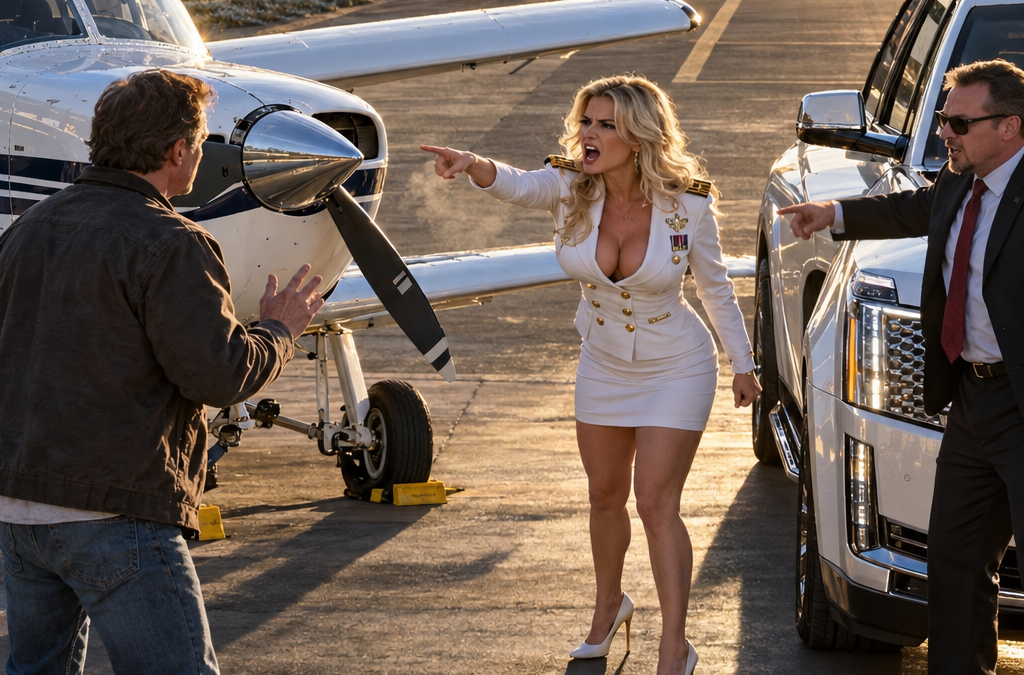
I had just finished the morning inspection of my private aircraft when I saw her marching across the airport apron toward me like she owned the concrete beneath her heels.
It was seven in the morning, cool enough that my breath still showed faintly when I stepped out of the hangar. The airport was barely awake. A maintenance cart buzzed somewhere beyond the fuel pumps, a Cessna was warming up near the far taxiway, and sunlight was beginning to spill across the roofs of the hangars.
My plane sat exactly where it had every right to sit.
That mattered.
A lot.
It was parked on the privately leased apron in front of Hangar 14, secured, chocked, and well inside the airport boundary. It wasn’t blocking a taxi lane. It wasn’t creating a hazard. It wasn’t even running.
None of that seemed to matter to Victoria.
Even from fifty yards away, I knew there was going to be trouble.
Victoria never walked anywhere casually.
She advanced.
She was about forty, blonde, strikingly attractive, and completely aware of it. That morning she’d apparently decided subtlety was for other people. She wore one of the bizarre white military-style outfits she’d become known for around Silver Oaks—a fitted white jacket with polished gold buttons, matching skirt, decorative shoulder insignia that meant absolutely nothing, and a neckline cut low enough to make the whole thing look less like a uniform and more like a costume designed to make sure every conversation started with her.
The fabric clung tightly to her exaggerated curves, especially across her chest, and she moved with the practiced confidence of someone who expected men to notice her before they noticed what she was doing.
Her sunglasses were pushed into her hair.
A clipboard was tucked beneath one arm.
Her phone was in the other hand.
The combination was familiar.
It meant somebody was about to receive an order they had never agreed to obey.
Victoria had been president of the Silver Oaks Homeowners Association for six years.
Silver Oaks sat along the eastern boundary of the small municipal airport where I kept my aircraft. Most of the homes had been built long after the airport opened, which never stopped residents from occasionally complaining about airplane noise.
Most people complained normally.
Victoria weaponized complaints.
People in Silver Oaks didn’t simply disagree with her.
They learned what happened when they did.
A widow named Marjorie once refused to replace perfectly legal shutters because Victoria wanted a different shade of gray.
Three violation notices appeared in ten days.
A retired teacher challenged a landscaping fine at a board meeting.
The next month, his backyard fence was suddenly subjected to an architectural review.
My friend Kevin parked his work truck in his own driveway overnight after coming home late from a job.
Victoria fined him for a “commercial vehicle visibility violation.”
When he appealed, she found three more violations.
She enjoyed control too much to hide it.
I’d stayed out of her way for almost two years.
That morning, she decided that wasn’t enough.
She stopped beside the left wing of my plane and stared at me over the top of her sunglasses.
“Daniel.”
Not hello.
Not good morning.
Just my name, spoken like she’d summoned me to a disciplinary hearing.
“Victoria.”
Her mouth tightened slightly.
She looked at the airplane.
Then back at me.
“You need to move this.”
I waited.
She didn’t smile.
“Move what?”
Her expression hardened.
“The aircraft, Daniel.”
I glanced at it.
Then around the apron.
Then back at her.
“Why?”
“Because I’ve received complaints.”
“About a parked airplane?”
“About the visual intrusion.”
For a second, I thought she was joking.
She wasn’t.
I folded my inspection rag and placed it on the wing.
“Victoria, we’re standing at an airport.”
“I am aware of where we’re standing.”
“Good. Because planes tend to show up here.”
Her eyes narrowed.
“Don’t be difficult.”
That sentence told me exactly how she expected the conversation to go.
She expected irritation.
Then resistance.
Then submission.
She had probably run that sequence hundreds of times.
I leaned against the wing.
“Who complained?”
“Residents.”
“Which residents?”
“I’m not required to disclose that.”
“Then what exactly are they complaining about?”
“The size of the aircraft. Its proximity to the Silver Oaks property line. The reflection from the fuselage in the mornings. Noise associated with its operation. Fuel odors.”
I looked toward the houses beyond the fence.
The nearest home was hundreds of feet away.
“My plane hasn’t flown in three days.”
“That doesn’t change the issue.”
“It changes the noise and fuel odor part.”
She ignored that.
“I need it relocated to the western hangars.”
“You need it relocated?”
“Yes.”
“That’s interesting.”
Her chin lifted.
“Excuse me?”
“Because I lease this hangar from the airport. The apron is part of that lease. Silver Oaks has no authority here.”
Victoria smiled then.
It wasn’t friendly.
It was the smile she used when someone had wandered into the part of the conversation where she planned to punish them.
She pulled a sheet from her clipboard.
“I anticipated that response.”
She held it toward me.
Across the top, in bold letters, was:
VIOLATION NOTICE.
I didn’t take it.
“What is that?”
“A formal notice.”
“From the HOA?”
“Correct.”
“I’m not in your HOA.”
“Your residence is.”
“My house is. This hangar isn’t.”
“The board’s regulations apply to nuisances created by residents that affect the community.”
I actually laughed.
That was a mistake.
Her face changed instantly.
“Something funny?”
“Yes. This.”
I tapped the air between us.
“You walked through an airport gate wearing a fake admiral costume to give me an HOA violation because my airplane is visible from houses built next to an airport.”
Her cheeks flushed.
“This is not a costume.”
I looked at the decorative gold braid on her shoulder.
“Which branch?”
“What?”
“Which branch of the military?”
“That’s irrelevant.”
“So is your notice.”
I turned away.
Her heels struck the pavement sharply behind me.
“Daniel, I’m speaking to you.”
I kept walking toward the hangar.
Then she said something that made me stop.
“If the aircraft isn’t moved by noon tomorrow, fines begin at five hundred dollars per day.”
I turned slowly.
She had followed me several steps.
“You’re threatening to fine my house because of an airplane located on municipal airport property?”
“I’m informing you of the consequences of noncompliance.”
“That’s not authority, Victoria. That’s extortion with stationery.”
Her eyes flashed.
“Be careful.”
“No. You be careful.”
The apron suddenly felt very quiet.
She wasn’t used to being spoken to that way.
I wasn’t shouting.
That made it worse for her.
I walked closer until only a few feet separated us.
“You don’t control this airport. You don’t control my lease. You don’t control my airplane. And you don’t get to invent jurisdiction because somebody in Silver Oaks doesn’t like looking at wings through their kitchen window.”
Her jaw clenched.
“You think this is about one complaint?”
“I think this is about you hearing the word no.”
For one second, the polished mask slipped.
I saw pure anger.
Then she smiled again.
“Move the plane, Daniel.”
“No.”
Her eyes stayed on mine.
“By noon tomorrow.”
“No.”
“You will regret making this difficult.”
I took the violation notice from her hand.
Then I tore it in half.
Not dramatically.
Just once.
Straight down the middle.
I placed both pieces back on her clipboard.
“Have a good morning, Victoria.”
Her face went completely still.
I should have known right then that she wasn’t going to let it go.
What I didn’t know was how far she was willing to take it.
By lunchtime, I had three emails from the HOA.
The first repeated the violation.
The second added a “hostile conduct” complaint.
The third informed me that my account had been assessed a $250 administrative enforcement fee.
I forwarded all three to my attorney, Rachel Morrison.
Her response came five minutes later.
Call me.
Rachel had handled the closing when I bought my house in Silver Oaks. She knew the covenants better than most members of the HOA board did.
I called from my office above the hangar.
She answered immediately.
“Tell me you didn’t threaten her.”
“I didn’t.”
“Touch her?”
“No.”
“Block her?”
“No.”
“Use language you wouldn’t want read aloud in court?”
I thought about the fake admiral costume.
“Probably not.”
Rachel sighed.
“Daniel.”
“She walked onto the airport apron and ordered me to move my plane.”
“I saw the notices you sent.”
“Can she do this?”
“No.”
“That was fast.”
“Because the HOA declaration isn’t magic. It applies to property inside the association and certain conduct originating there. It doesn’t give Victoria Hale regulatory authority over municipal airport operations.”
“So the fines are garbage.”
“Probably unenforceable. Don’t ignore them, though.”
“I thought you said—”
“I said they’re probably unenforceable. That doesn’t mean she can’t create a headache.”
That turned out to be the understatement of the week.
The next morning, there was a white envelope taped to my front door.
FINAL DEMAND.
Victoria had increased the daily fine to $750.
She’d also scheduled an emergency compliance hearing.
For that evening.
At six-thirty.
I went.
Not because I believed they had authority over the plane.
I went because people like Victoria became more dangerous when everyone reasonable stopped showing up.
The Silver Oaks clubhouse was full when I arrived.
That surprised me.
Usually HOA meetings attracted eight people, three of whom were board members.
That night there were more than forty residents.
Word had spread.
Victoria sat at the center of the long table in front.
She was wearing another white outfit, this one even more theatrical than the first. Tight white trousers, high heels, a fitted double-breasted jacket, gold buttons, and the same plunging neckline. Her blonde hair fell perfectly over one shoulder.
If you didn’t know her, you might have mistaken the whole performance for confidence.
I knew better.
It was armor.
She liked being watched.
She liked entering a room and feeling people reorganize themselves around her.
Beside her sat the vice president, Martin Cole, who looked uncomfortable before the meeting had even started.
Two other board members sat farther down.
Victoria tapped the microphone.
“The purpose of tonight’s emergency session is to address a continuing nuisance violation created by resident Daniel Mercer.”
Every face in the room turned toward me.
I stayed seated.
Victoria continued.
“Mr. Mercer owns an aircraft currently positioned adjacent to the Silver Oaks community. Multiple residents have reported concerns involving noise, visual pollution, safety, possible fuel exposure, and reduced property enjoyment.”
Possible fuel exposure.
I almost admired the phrase.
She had a gift for making nonsense sound official.
Victoria looked directly at me.
“Mr. Mercer has refused repeated reasonable requests to relocate the aircraft.”
She paused.
“More troublingly, he responded to a formal board representative with hostility and intimidation.”
Murmurs moved through the room.
I stood.
“May I respond?”
“You’ll have an opportunity.”
“I’m being accused publicly.”
“You’ll have an opportunity.”
Martin leaned toward her.
“Victoria, maybe let him—”
She covered the microphone with one hand and whispered something to him.
Martin leaned back.
Victoria smiled.
“We’ll now review evidence.”
She displayed photographs on the projector.
My airplane.
Taken from outside the airport fence.
One from a sidewalk.
One through the trees.
One zoomed in from somebody’s backyard.
The crowd stared.
I raised my hand.
She ignored me.
Next came a sound recording.
An airplane engine.
Loud.
Very loud.
Victoria let it play for fifteen seconds.
“This,” she said, “was recorded by a homeowner at six forty-two yesterday morning.”
I stood again.
“That’s not my airplane.”
She stopped.
“Sit down.”
“That’s not my engine.”
“Daniel.”
“My plane wasn’t running yesterday morning.”
“You’ve been given instructions.”
“I have maintenance logs and airport cameras.”
Her face tightened.
Someone in the back said, “Let him talk.”
Another person agreed.
Victoria looked across the room.
“This isn’t a debate.”
That was her second mistake.
The first had been assuming nobody else was tired of her.
A man near the aisle stood.
“Then why are we here?”
I recognized him.
Kevin.
The guy with the work truck.
Victoria stiffened.
“This is a formal compliance proceeding.”
Kevin crossed his arms.
“Looks more like you already decided.”
A few people murmured approval.
Victoria tapped her gavel.
Actually tapped a gavel.
“Order.”
I looked at Rachel, who had come with me.
She gave the slightest nod.
My turn.
I walked to the front carrying a folder.
“My plane is kept in Hangar 14 under a lease with the municipal airport. The apron where it’s parked is airport property. It isn’t owned or controlled by Silver Oaks.”
Victoria cut in.
“The nuisance clause—”
Rachel stood.
“Please allow my client to finish.”
That changed the room.
Victoria’s eyes snapped toward her.
“And you are?”
“Rachel Morrison. Counsel for Mr. Mercer.”
Victoria hesitated.
Only for a second.
But everybody saw it.
I continued.
“My plane did not operate yesterday morning. It did not operate the morning before that. The engine noise you just played is not mine.”
I opened the folder.
“Airport movement records.”
Another sheet.
“Fuel records.”
Another.
“Security logs.”
Victoria stared at the papers.
“The visual issue remains.”
“So we’re down to you don’t like seeing an airplane next to an airport?”
Her nostrils flared.
I continued before she could interrupt.
“I also spoke to airport management today. Victoria was not authorized to enter the apron without an escort yesterday.”
That created a louder reaction.
Martin turned toward her.
“You went airside?”
She ignored him.
I looked directly at her.
“Through a restricted gate.”
“I had legitimate association business.”
“HOA business doesn’t authorize access to an aircraft operations area.”
She leaned toward the microphone.
“This board will not be distracted by procedural technicalities.”
Rachel almost smiled.
“Federal and municipal airport access rules are not procedural technicalities.”
The room went silent.
Victoria knew she’d lost the hearing.
So she changed the battlefield.
“We’ll take this under advisement.”
Martin looked confused.
“I thought we were voting.”
“I said we’ll take it under advisement.”
“You scheduled a vote.”
“Martin.”
He stared at her.
For the first time, I saw something important.
Her own board was scared of her too.
The meeting ended without a vote.
At 8:17 the next morning, I received notice that the fine had doubled.
One thousand five hundred dollars per day.
That was when I stopped believing this was about the plane at all.
It was about obedience.
Rachel filed a formal dispute.
The airport issued Victoria a written trespass warning for unauthorized access to the secure apron.
I thought that might end it.
Instead, she escalated.
Two days later, I arrived at the hangar and found a red sticker on the windshield of my airport vehicle.
UNAUTHORIZED COMMERCIAL ACTIVITY.
It had the Silver Oaks logo on it.
The next afternoon, code enforcement showed up at my house after an anonymous complaint claimed I was storing aviation fuel in my garage.
I wasn’t.
The inspector apologized after ten minutes.
The following morning, animal control knocked on my door because somebody had reported a dangerous dog living at my address.
I didn’t own a dog.
That afternoon, the city received a complaint claiming I’d installed an illegal radio antenna.
There was no antenna.
Every complaint was technically anonymous.
Nobody needed to tell me who was behind them.
Then Victoria went after my hangar lease.
Airport manager Sam Ortega called me into his office.
Sam was a calm man in his late fifties who had spent thirty years working around aviation and possessed the rare ability to make almost any crisis sound temporary.
That day, he wasn’t calm.
He slid a packet across his desk.
“What am I looking at?”
“A petition.”
I read the first page.
More than seventy signatures.
“Residents of Silver Oaks request immediate review of Hangar 14 operations due to recurring safety hazards, noise violations, environmental concerns, and threatening behavior by tenant.”
I looked up.
“Threatening behavior?”
Sam rubbed his forehead.
“There’s more.”
There were witness statements.
Several claimed I’d performed high-power engine runs early in the morning.
False.
One claimed aviation fuel had been seen flowing toward the storm drains.
False.
Another claimed I’d taxied recklessly near pedestrians.
Impossible.
Pedestrians weren’t permitted in that area.
I flipped through page after page.
“This is insane.”
“I know.”
“Then why am I here?”
“Because one complaint is noise. Seventy signatures become politics.”
“You think seventy people witnessed this?”
“No.”
Sam leaned back.
“I think somebody walked around with a clipboard and told residents their property values were threatened.”
Victoria.
Of course.
“What happens now?”
“I have to review it.”
“My lease?”
“Everything.”
My stomach tightened.
Hangar space at that airport had a waiting list measured in years.
Losing Hangar 14 didn’t just mean finding another building.
It could mean relocating my airplane to an airport forty miles away.
Victoria knew that.
That was why she’d done it.
“What do you need from me?”
“Records. Cameras. Maintenance logs. Anything.”
“I’ll get it.”
Sam nodded.
Then his expression hardened.
“And Daniel?”
“Yeah?”
“Do not engage with her.”
“I’ve been trying not to.”
“Try harder.”
I left his office angry enough that my hands shook.
The easiest thing would have been to move the plane.
That thought bothered me more than I wanted to admit.
The western hangars were available.
Not permanently, but temporarily.
I could have relocated the aircraft for a few weeks.
Victoria would declare victory.
The fines would probably disappear.
The complaints would stop.
My life would become quiet again.
Rachel said exactly what I was thinking when I called her.
“You can move it.”
I stood in my hangar looking through the open doors at the aircraft.
“And then what?”
“That’s the question.”
“What happens next time?”
Rachel didn’t answer.
I already knew.
Next time it would be my truck.
Or my fence.
Or the color of my front door.
Or a neighbor’s garden.
Or someone’s kid’s basketball hoop.
People like Victoria didn’t stop when submission worked.
They learned.
“I won’t move it.”
Rachel was silent for a moment.
“Then we document everything.”
That became my life.
Cameras.
Logs.
Emails.
Photographs.
Every interaction recorded.
Every notice saved.
Every call documented.
For a week, Victoria avoided me.
Then she appeared at the airport gate on a Saturday morning.
This time, she couldn’t get through.
Her access had been revoked.
I was walking from the parking area when I saw her standing outside the fence.
She wore white again.
A tight fitted jacket, short skirt, gold trim, high heels.
Even furious, she looked composed.
At least until she saw me.
“Daniel.”
I kept walking.
“Daniel!”
I stopped on the airport side of the gate.
She approached the fence.
“You’ve been telling people I trespassed.”
“You did.”
“I entered through an open gate.”
“A restricted gate.”
“It was open.”
“So if somebody leaves their front door open, you can walk inside?”
Her lips thinned.
“You embarrassed me.”
There it was.
Not the airplane.
Not the residents.
Not safety.
Her.
“You did that yourself.”
“You brought a lawyer to an HOA meeting.”
“You accused me of violations I didn’t commit.”
“You made me look incompetent in front of the community.”
“I didn’t make you anything.”
She stepped closer to the fence.
“Move the aircraft.”
“No.”
“Your lease is under review.”
“Because of your false complaints.”
“Can you prove they’re false?”
“Yes.”
Something flickered in her eyes.
That bothered her.
I continued.
“The airport cameras prove it.”
Her mouth tightened.
“Be very sure you want to keep fighting me.”
“Victoria, listen carefully. I’m not fighting you. I’m refusing to obey you.”
That landed harder.
She wrapped her fingers around the fence.
“For two years I’ve watched you act like you’re above everyone else.”
I almost laughed.
“Me?”
“You don’t attend community events. You don’t seek approval. You come and go whenever you want. You fly that ridiculous machine over our houses—”
“There it is.”
“What?”
“This isn’t about complaints.”
Her cheeks colored.
She looked away for half a second.
I understood.
Victoria didn’t hate the airplane because it made noise.
She hated what it represented.
It existed outside her control.
I could leave whenever I wanted.
I could roll out of the hangar, start the engine, taxi away, and there wasn’t a damn thing the president of Silver Oaks could do about it.
To a normal person, that meant nothing.
To Victoria, it was an insult.
“You think you’re special because you own a plane,” she said.
“No. I think I own a plane.”
“Move it.”
“No.”
She smiled coldly.
“Then don’t complain about what happens next.”
She turned and walked back toward her SUV.
A white luxury model.
Of course.
Three days later, the situation crossed from harassment into danger.
I arrived before sunrise for a planned flight.
My preflight inspection started normally.
Oil.
Fuel.
Control surfaces.
Tires.
Lights.
Then I reached the right main gear.
Something looked wrong.
I crouched.
The brake line had been cut.
Not worn.
Not cracked.
Cut.
A clean slice.
I froze.
For several seconds, the entire airport disappeared around me.
If I had missed it, I might have lost braking on landing.
Depending on conditions, that could mean runway excursion.
Aircraft damage.
Fire.
Death.
I stood slowly and called Sam.
Airport police arrived fifteen minutes later.
So did Rachel.
The security footage showed a figure near my hangar after midnight.
White SUV.
Female driver.
But the camera angle was too distant to identify her face clearly.
Victoria denied everything.
Through an attorney.
That was the moment my anger changed into something colder.
Until then, I had treated her like a bully.
Now I treated her like a threat.
The aircraft was grounded until a mechanic replaced the line and inspected the entire braking system.
I spent two days wondering whether she had actually cut it herself.
I wanted proof.
Not suspicion.
Proof.
The police couldn’t give me that.
Victoria, meanwhile, became louder.
At the next HOA meeting, she accused me of conducting a “smear campaign.”
She claimed I was using my position as an aircraft owner to intimidate the community.
I didn’t even know what that meant.
The board room was packed again.
This time, the mood was different.
Residents had begun comparing stories.
Marjorie brought her shutter notices.
Kevin brought his parking fines.
The retired teacher brought twenty months of correspondence about his fence.
A young couple described being threatened with legal action over a children’s playhouse that wasn’t visible from the street.
Another resident said Victoria had personally called his employer after he criticized her online.
Martin sat at the board table looking exhausted.
Victoria sat beside him in white, chin high, pretending the room wasn’t turning against her.
Then Martin spoke.
“I move that all enforcement actions against Mr. Mercer concerning the aircraft be suspended pending independent legal review.”
Victoria turned toward him.
“You can’t.”
“I’m making a motion.”
“As president, I’m ruling it out of order.”
“On what basis?”
She stared.
Martin didn’t look away.
Another board member seconded the motion.
Applause erupted.
Victoria slammed the gavel.
“Stop.”
Nobody did.
She stood.
“Stop!”
The room quieted.
Her chest rose and fell beneath the tight white jacket.
Her face was flushed.
She looked around at people who had feared her for years.
And for the first time, they were looking back.
“You have no idea what you’re doing,” she said.
Someone laughed.
That destroyed whatever control she had left.
She pointed toward me.
“This man has manipulated all of you.”
I stood.
“No, Victoria. They started talking to each other.”
Her eyes burned.
“You think you’ve won?”
“I think this stopped being about me.”
She grabbed her papers.
The meeting ended with the motion passing four votes to one.
Victoria cast the only opposing vote.
The next morning, the airport cleared me completely.
The petition was rejected.
Security logs disproved the operational complaints.
Environmental inspection found no fuel violations.
My lease remained intact.
Rachel began preparing a civil action over the fraudulent fines and harassment.
For the first time in two weeks, I thought the worst might be over.
I was wrong.
At 6:52 the next morning, Victoria came back to the airport.
I was already there.
The repaired aircraft was parked in front of the hangar.
I had a flight scheduled for nine, but weather north of us was questionable, so I was checking radar on my tablet while waiting for an updated forecast.
Sam was across the ramp near the fuel truck.
Two mechanics were working outside another hangar.
Everything was normal.
Then I heard an engine rev behind me.
I turned.
Victoria’s white SUV was inside the airport fence.
My first thought was that she’d somehow convinced someone to let her through.
Then I saw the broken plastic arm hanging from the vehicle entrance gate.
She hadn’t been let through.
She had driven through.
The SUV accelerated across the service lane.
I stared in disbelief.
Sam shouted.
“Hey!”
Victoria stopped twenty yards from me.
The driver’s door opened.
She stepped out.
White uniform.
White heels.
Blonde hair.
Clipboard.
I remember thinking the clipboard was the craziest part.
She had just forced her SUV through a controlled airport gate, and she still brought the damn clipboard.
“Victoria!” Sam yelled. “You need to leave now!”
She ignored him.
Her eyes were fixed on me.
“Move it.”
I almost couldn’t believe what I was hearing.
“Are you insane?”
“Move the aircraft.”
“You’re trespassing.”
“This is your final opportunity.”
Sam was already on the radio.
Airport police.
I could hear him calling them.
Victoria walked toward me.
Her heels clicked across the apron.
“You humiliated me in front of my board.”
“You did that yourself.”
“You turned residents against me.”
“They were already against you. They were afraid of you.”
“Move the plane.”
“No.”
Her face twisted.
“Why?”
The question came out almost like a scream.
“Because it’s my hangar.”
“That isn’t an answer!”
“It’s the only answer you were ever entitled to.”
She stopped five feet away.
Her eyes were wet now.
Not sad.
Furious.
“You could have ended this the first morning.”
“So could you.”
“I gave you every opportunity.”
“You threatened me.”
“I warned you.”
“You filed false complaints.”
“You forced me to protect the community.”
“My brake line was cut.”
For the first time, she went still.
I watched her face carefully.
“What brake line?”
I hadn’t told her which system had been damaged.
Police hadn’t released the detail.
Sam hadn’t.
My mechanic hadn’t.
Rachel and I had deliberately kept it private.
I felt something cold crawl up my back.
“I said something on my airplane was damaged.”
Her expression changed.
Too late.
“I assumed—”
“No.”
She stepped back.
“You just said brake line.”
“I heard people talking.”
“Who?”
She looked toward Sam.
Then toward the gate.
Sirens were approaching.
Victoria knew it too.
Something broke inside her.
She spun around and marched back toward the SUV.
Sam moved in front of her.
“Do not get in that vehicle.”
“Get away from me.”
“Victoria, police are coming.”
“I said move.”
He held up both hands.
“I’m not touching you. But you cannot drive on this apron.”
She shoved past him.
Sam stumbled.
“Victoria!”
She climbed into the SUV.
I ran toward the wing of my plane.
Not because I thought she’d hit it.
Because the SUV was facing the taxiway.
An aircraft was approaching from the south.
A Piper with two people aboard.
If she drove onto the taxiway, she could put lives at risk.
I waved both arms.
“Stop!”
Victoria slammed the SUV into reverse.
The tires chirped.
She backed hard.
Then turned.
For one second, our eyes met through the windshield.
I still think about that second.
There was no confusion in her face.
No panic.
No accident.
She looked directly at me.
Then directly at the airplane.
And accelerated.
“Victoria!”
The SUV came forward.
Fast.
Too fast.
I jumped backward.
The sound of the impact was unlike anything I’d ever heard.
Metal folded.
Fiberglass shattered.
The SUV struck the aircraft near the forward fuselage and nose section, lifting part of the plane sideways.
The propeller bent.
The cowling crumpled.
The nose gear collapsed.
The aircraft lurched off its chocks and twisted across the apron.
I fell hard onto my shoulder.
For half a second, everything went silent inside my head.
Then sound came back all at once.
Car horn.
Shouting.
Grinding metal.
A fuel smell.
Sam yelling for everyone to move.
The SUV’s airbags had deployed.
Victoria sat behind them, stunned.
Steam rose from the crushed hood.
My airplane rested crookedly, nose damaged, one wing lower than the other.
I couldn’t process it.
I had spent years working for that aircraft.
Hundreds of hours maintaining it.
Thousands flying it.
It wasn’t just a machine.
It was freedom.
Memory.
Responsibility.
And now it looked wounded.
Victoria pushed the airbag aside.
Her door opened.
She stumbled out.
Sam shouted at her to stay where she was.
She looked at the plane.
Then at me.
And somehow—somehow—she still tried to take control.
“He moved it!”
Nobody spoke.
She pointed at me.
“He moved the aircraft toward me!”
I stared at her.
“What?”
“He tried to block me.”
Sam’s face was almost expressionless.
“Victoria.”
“He did.”
“His engine wasn’t running.”
“He pushed it!”
The aircraft weighed several thousand pounds.
Its wheels had been chocked.
Security cameras covered the entire apron.
Yet she kept going.
“He threatened me. He came at me. I panicked.”
I stood slowly, pain shooting through my shoulder.
“You accelerated into a parked airplane.”
“I was afraid for my life.”
“From the parked airplane?”
“From you!”
Airport police vehicles entered through the damaged gate.
Victoria straightened her jacket.
I watched something almost unbelievable happen.
Her entire demeanor changed.
Her voice softened.
Her posture shifted.
The anger disappeared.
She became vulnerable.
Fragile.
Beautiful.
Confused.
“Officer,” she said as the first policeman approached, “thank God.”
He looked at the destroyed gate.
Then the SUV.
Then the aircraft.
“Ma’am, step away from the vehicle.”
She blinked.
“I need to explain.”
“Step away from the vehicle.”
“This man has been harassing me for weeks.”
“Ma’am.”
“I’m president of the Silver Oaks Homeowners Association. I have documented—”
“Turn around.”
Her face emptied.
“What?”
“Turn around and place your hands behind your back.”
For the first time since I’d known her, Victoria Hale had no answer.
The officer handcuffed her on the apron.
She stared at me while he did it.
Not frightened.
Not remorseful.
Hateful.
“You did this,” she said.
I looked at my airplane.
“No. You did.”
The consequences came faster than I expected.
Because airports are covered in cameras.
A lot of cameras.
The security footage showed everything.
Victoria’s SUV smashing through the controlled gate.
Her confrontation with me.
Sam attempting to stop her.
Her getting back into the vehicle.
Her reversing.
Turning.
Pausing.
Then accelerating directly into the aircraft.
Another camera captured the brake-line incident from a better angle than the investigators had initially realized.
The night footage was dark, but enhancement and vehicle records helped identify her SUV.
More importantly, a second camera near the maintenance building showed Victoria walking toward Hangar 14 carrying something in her hand.
She had been there.
That changed the case.
Police executed a search warrant.
Rachel called me the day it happened.
“You sitting down?”
“I am now.”
“They found tools in her garage.”
“What kind?”
“Cutters.”
I didn’t answer.
“They’re testing them.”
I looked through the glass wall of my office at the empty space where my aircraft normally sat.
It had been moved to a maintenance facility for structural inspection.
“Anything else?”
“Copies of HOA complaint forms.”
“That’s not surprising.”
“Daniel, blank complaint forms.”
I frowned.
“Okay.”
“Some had resident names written on them.”
“So?”
“Residents say they didn’t sign them.”
That became another investigation.
Of the seventy-three signatures on Victoria’s airport petition, investigators eventually determined that more than twenty had been obtained under misleading pretenses.
Several residents said Victoria told them they were signing a general airport-noise survey.
Five denied signing anything at all.
Two signatures belonged to people who had moved months earlier.
One belonged to a dead man.
When that detail became public, Silver Oaks exploded.
An emergency HOA meeting was scheduled.
Victoria couldn’t attend.
A judge had ordered her to stay away from me, the airport, and several board members.
The clubhouse was packed.
More than a hundred people came.
Martin sat in the president’s chair.
He looked uncomfortable there.
He opened the meeting quietly.
“We have one item.”
Nobody needed him to say it.
“Removal of Victoria Hale as president and as a member of the board.”
The vote wasn’t close.
It wasn’t even remotely close.
Residents who had once been too afraid to challenge parking fines stood up and spoke openly.
Marjorie described six years of intimidation.
Kevin described retaliation.
The retired teacher talked about losing sleep over legal threats.
A single mother named Allison described crying in her kitchen after Victoria threatened to place a lien on her home over a $150 landscaping dispute.
One story became ten.
Ten became thirty.
Listening to them, I finally understood something.
My airplane hadn’t caused the collapse of Victoria’s little kingdom.
It had exposed how fragile that kingdom already was.
All I had done was say no where everyone could hear me.
The board removed her unanimously.
Then the residents voted to authorize an independent audit of six years of HOA enforcement.
That audit uncovered enough irregularities to fill boxes.
Improper fines.
Selective enforcement.
Legal expenses that had never been properly approved.
Reimbursement claims without documentation.
Private investigators hired against residents.
Association funds used for personal legal consultations.
Nothing dramatic by itself.
Together, it told a story.
Victoria hadn’t managed Silver Oaks.
She had ruled it.
And she had used other people’s money to maintain that rule.
Rachel filed my civil case.
We challenged every aircraft-related fine.
They were voided.
The HOA reimbursed my legal costs associated with the enforcement action.
The association’s insurance carrier became involved in the aircraft damage claim.
Victoria’s personal insurer tried very hard to call the collision accidental.
The security video made that difficult.
My airplane was repairable.
That surprised me.
The damage looked catastrophic that morning, but the main structure had escaped the worst-case scenario.
The propeller was destroyed.
Engine inspection was mandatory.
Nose gear needed replacement.
Cowling, firewall components, and forward fuselage structures needed major work.
It took months.
For those months, every time I walked into Hangar 14, I saw an empty floor.
That hurt more than I expected.
People kept telling me, “At least nobody was killed.”
They were right.
Of course they were right.
But gratitude doesn’t erase loss.
You can know something could have been worse and still grieve what happened.
I blamed myself for a while.
That sounds ridiculous now.
But I did.
Maybe I should have moved the airplane.
Maybe I should have ignored her.
Maybe I should have sold the house.
Maybe I should have let her win some meaningless argument so she never reached the point where she became dangerous.
Rachel shut that down one afternoon.
We were sitting in the hangar after another insurance inspection.
“You need to stop.”
“Stop what?”
“Rewriting this so you’re responsible for her choices.”
“I’m not.”
“You are.”
I looked away.
Rachel leaned against the workbench.
“Daniel, she cut a brake line.”
“Allegedly.”
“Fine. She allegedly cut a brake line. She definitely forced her way into a secure airport and deliberately drove an SUV into your airplane.”
I didn’t answer.
“You saying no did not cause that.”
“I knew she was unstable.”
“You knew she was controlling.”
“There’s a difference?”
“A huge one.”
I looked toward the empty apron.
“If I’d moved it—”
“Then she would have learned that escalation works.”
Rachel let that sit.
“You didn’t create her behavior. You just stopped cooperating with it.”
That was harder to accept than anger.
But eventually, I did.
Victoria took a plea deal before the criminal case reached trial.
Her attorney fought aggressively to reduce the charges, emphasizing that no one had been physically injured beyond my bruised shoulder.
The prosecutor emphasized the opposite.
That nobody had died was luck.
The damaged brake line could have caused a serious aircraft accident.
The forced airport entry could have put moving aircraft at risk.
The collision itself could have ruptured fuel systems or struck someone standing nearby.
The judge agreed that luck wasn’t the same as innocence.
Victoria was convicted on multiple counts related to property damage, reckless endangerment, unlawful airport access, and the falsified documents tied to the petition.
The brake-line charge was resolved as part of the agreement.
She received jail time, probation, restitution obligations, and a long-term prohibition against entering the airport property.
She also lost the thing I suspect mattered most to her.
Control.
By spring, Silver Oaks had a new board.
Martin refused to run for president.
Marjorie did.
The seventy-two-year-old widow Victoria had once threatened over gray shutters won by a landslide.
Her first board meeting lasted forty-three minutes.
No gavel.
No theatrics.
No white military costume.
No threats.
They reviewed old fines.
Several were refunded.
The association adopted new rules requiring recorded votes for major enforcement actions.
Anonymous complaints could still be submitted, but penalties required independent verification.
No single board officer could authorize legal retaliation.
At the next annual meeting, attendance dropped back to twelve people.
That made me laugh.
Healthy local government, I learned, is usually boring.
My airplane came home eleven months after Victoria hit it.
I was standing outside Hangar 14 when the mechanic taxied it back.
The engine sounded steady.
Clean.
Familiar.
I hadn’t realized how much I’d missed that sound.
Sam stood beside me.
“Looks good.”
“Better than your gate.”
He laughed.
The damaged security gate had been replaced immediately.
With a stronger one.
I walked around the airplane slowly.
New cowling.
Fresh paint.
Repaired structure.
New propeller.
There was no obvious sign of the collision unless you knew where to look.
I knew.
Machines remember damage in hidden places.
So do people.
I ran my hand along the fuselage.
For a second, I was back on that morning.
Victoria’s SUV accelerating.
The impact.
Metal folding.
Her voice shouting that I’d caused it.
Then the memory passed.
Sam handed me the paperwork.
“Ready?”
I looked toward the east.
Beyond the fence stood the roofs of Silver Oaks.
Same neighborhood.
Same houses.
Different atmosphere.
“Yeah.”
I climbed into the cockpit.
The first flight after a major repair isn’t romantic.
It’s careful.
Methodical.
You check everything twice.
Then check the things you already checked.
Fuel.
Controls.
Trim.
Instruments.
Brakes.
Especially brakes.
I started the engine.
The propeller became a silver blur.
Oil pressure rose.
Temperatures stabilized.
I called ground control.
“Mercer Four-Seven ready to taxi from Hangar Fourteen.”
The controller cleared me.
I released the brakes.
The airplane moved.
For eleven months, Victoria’s decision had kept it grounded.
Now the hangars slid past my window.
Fuel pumps.
Maintenance buildings.
The repaired gate.
Then the taxiway opened ahead.
At the hold-short line, I completed the run-up.
Everything normal.
Tower cleared me for takeoff.
I lined up with the runway.
Full power.
The engine pulled hard.
Airspeed alive.
The centerline passed beneath me faster and faster.
For a moment, the entire Silver Oaks neighborhood was off my right wing.
I wondered how many times Victoria had looked from those houses toward the airport and seen my airplane as some kind of insult.
Maybe she thought freedom was insulting.
Maybe people obsessed with control always do.
Rotation speed.
I eased back.
The wheels left the runway.
Just like that.
The ground fell away.
The airport shrank beneath me.
Silver Oaks became a neat pattern of roofs, streets, yards, fences, and tiny cars.
From a thousand feet up, Victoria’s imaginary kingdom looked very small.
I climbed west.
Sunlight spread across the windshield.
My hands relaxed on the controls.
For months, people had asked whether I regretted refusing to move the plane.
The answer wasn’t as simple as they expected.
I regretted the damage.
I regretted the fear.
I regretted the money, the lawyers, the police interviews, the nights I stayed awake wondering what somebody might do next.
I regretted that residents had spent years believing the safest way to live in their own homes was to avoid making one woman angry.
But I didn’t regret saying no.
Because there are moments when surrender looks reasonable.
Cheap, even.
Move the airplane.
Pay the fine.
Change the shutters.
Hide the work truck.
Take down the playhouse.
Apologize for something you never did.
Tell yourself it isn’t worth the fight.
Sometimes that really is wisdom.
But sometimes the person demanding the small surrender isn’t interested in the thing they’re demanding.
They’re interested in proving they can demand it.
And once they learn that lesson, the next demand comes easier.
Victoria never wanted my airplane moved because it harmed Silver Oaks.
She wanted it moved because she had ordered me to move it.
That was the entire conflict.
Everything else was paperwork.
At three thousand feet, I leveled off and looked toward the horizon.
The aircraft flew straight.
Smooth.
Exactly as it should.
I thought about the first morning Victoria had walked across the apron in that absurd white uniform, clipboard beneath her arm, completely certain the ending had already been decided.
She had looked at my airplane and said, “Move it.”
I had said no.
She spent weeks trying to make that word hurt.
In the end, it cost me almost a year without my aircraft.
It cost me money.
Sleep.
Peace.
It left a scar on the airplane and a few on me that nobody could see.
But it cost Victoria far more.
Her position.
Her reputation.
Her freedom.
Her ability to frighten people into silence.
And the strangest part was that none of it needed to happen.
All she had ever needed to do was accept something every adult eventually has to learn.
Other people are allowed to tell you no.
The nose of the airplane pointed toward open sky.
I pushed the throttle forward.
And this time, there wasn’t anybody on earth who could order me to move it somewhere else.