FULL ENDING The Woman Who Hit My Autistic Son Learned That Being Loud Was Not the Same as Being Untouchable
part2
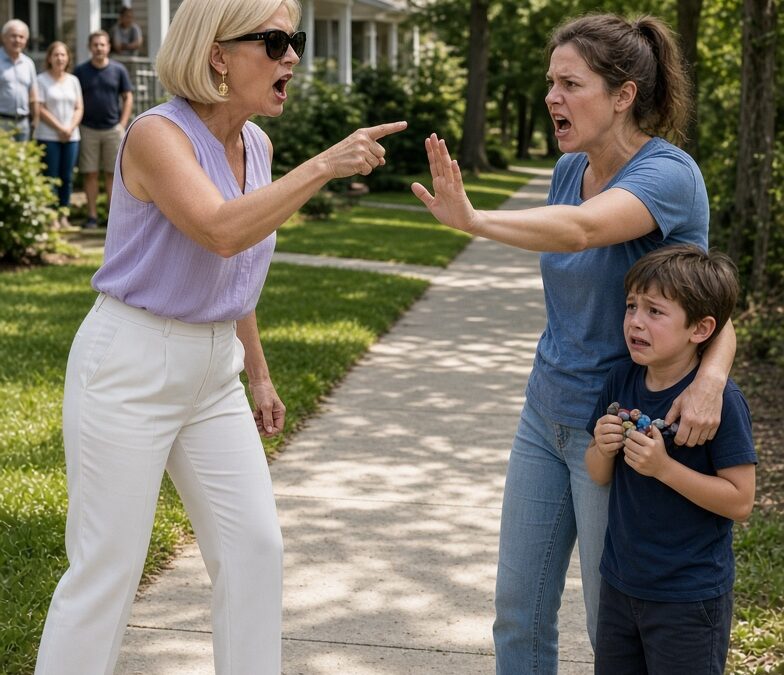
At first, I thought something was wrong.
She had appeared from the side street so suddenly that I assumed she needed help. Maybe she had lost a dog. Maybe there was a loose branch in the road. Maybe she wanted to warn us about something ahead. My mind went to normal explanations because normal people do not plant themselves in front of a mother and child like a security checkpoint.
Karen stood with her feet apart, one hand gripping her tumbler, the other resting on her hip. Her sunglasses were pushed up on top of her head even though the sun was directly in her eyes.
“What are you doing?” she demanded.
I stopped.
My son stopped with me.
He was already moving slightly behind my left side, not hiding completely, but seeking the familiar barrier of my body between him and a stranger’s voice.
“We’re walking,” I said.
Karen’s eyes flicked to my son’s pocket. “What is he carrying?”
I felt the first small tug of unease.
“Rocks.”
Her eyebrows lifted. “Rocks.”
“Yes.”
“From where?”
“The trail.”
“What trail?”
“The public path near the creek.”
She laughed once, sharp and humorless. “That’s a likely story.”
I stared at her, trying to decide whether she was joking. She was not.
My son’s fingers curled into the hem of my shirt.
I softened my voice, mostly for him. “He likes collecting interesting rocks. It’s soothing for him. We only take loose ones from the path.”
Karen leaned around me to look at him. “You shouldn’t be taking things that don’t belong to you.”
He pulled farther behind me.
I stepped slightly to block her view. “He isn’t taking anything from anyone.”
“Rocks are property.”
“Loose rocks on a public trail?”
“Neighborhood property,” she said, as if the phrase should have ended the conversation.
I could feel my patience thinning, but I kept my expression calm. My son was still holding my shirt. His breathing had changed, not panic yet, but the shallow, careful breathing he did when something felt unpredictable.
“We’re not damaging anything,” I said. “We’re not in anyone’s yard. We’re going home.”
Karen tilted her head. “Does he understand rules?”
The question hit harder than I expected.
It was the tone.
Not curious.
Not kind.
Assessing. Accusing. Like my son was not a child standing five feet away, listening, but a problem being discussed at a meeting.
“He understands plenty,” I said.
“Then he can understand not to steal.”
My voice dropped. “Do not call my son a thief.”
Karen’s nostrils flared. She was not used to being corrected. I saw that immediately. Some people argue because they are confused; Karen argued because being challenged felt like theft of her authority.
“I’m trying to protect the neighborhood,” she said.
“From a child picking up rocks?”
“From bad parenting.”
That was the moment I knew walking away was the only choice.
There are arguments you can win with facts, and there are arguments that exist only to pull you into the mud. Karen’s face had brightened with conflict. She wanted escalation. She wanted me loud, defensive, messy. I would not give that to her in front of my son.
“Come on,” I said gently to him. “We’re going home.”
I turned us toward the curb to go around her.
Karen shifted, blocking us again.
For one second, anger flashed so hot through me I could feel it behind my eyes.
Then my son whispered, “Mom?”
That one word pulled me back.
I took his hand and changed direction, guiding him away from the sidewalk and back the way we had come. We took the long route home. Behind us, Karen called something about responsibility, but I did not turn around.
When we got inside, my son went straight to the mudroom and placed the three rocks in his blue bucket.
One.
Two.
Three.
He lined them up carefully on top of the others.
Then he asked, “Was I bad?”
My heart cracked.
I knelt beside him so we were eye level.
“No,” I said. “You were not bad.”
“She said stealing.”
“She was wrong.”
He looked at the bucket. His lower lip trembled, but he did not cry.
“Rocks from the trail are okay?”
“Yes. Loose rocks from the trail are okay.”
He nodded, but I could tell something had changed. Karen’s voice had left a mark.
That night, after he went to bed, I sat at the kitchen table with a cold cup of tea and replayed the whole encounter again and again. I told myself Karen was just a miserable woman who needed a hobby. I told myself she had probably embarrassed herself and would avoid us from then on.
I wanted that to be true.
Two days later, we went for another walk.
I almost changed our route. I almost suggested sidewalk chalk in the driveway instead. But my son had asked for “the creek path” at breakfast, and I hated the idea of letting Karen’s ugliness steal something that belonged to him. So we went.
The air smelled like cut grass and damp soil. He had his little cloth pouch for special finds. I had my keys clipped to my belt loop and a bottle of water in my hand. For the first ten minutes, everything felt normal. He pointed out a line of ants. He found a pebble shaped vaguely like a heart. He asked if clouds could get tired.
Then I saw Karen.
She was across the street, half a block behind us, walking slowly with her phone held chest-high.
Recording.
My hand tightened around the water bottle.
She did not approach that time. She kept her distance, but she followed us. When we stopped, she stopped. When we crossed, she crossed after us. Sometimes she typed furiously with both thumbs. Sometimes she lifted the phone again.
My son did not seem to notice at first.
That was the only reason I did not confront her.
If he had looked scared, if he had asked why she was following us, if his breathing had changed even a little, I would have turned around and told her to back off. But he was focused on the ground, humming softly under his breath as he searched the gravel edge near the path.
So I kept walking.
It felt awful.
There is a particular helplessness in knowing someone is trying to provoke you while your child remains unaware beside you. Every instinct in me wanted to turn and protect, but protecting him also meant preserving the calm he still had. Karen’s presence became a shadow dragging behind us, unwanted but not yet touching him.
When we got home, I locked the door and looked through the front window.
Karen stood on the opposite sidewalk, still typing.
The next week, the rumors started.
At first, they came indirectly.
Mrs. Alvarez from the corner asked me in a lowered voice if everything was okay.
“Of course,” I said. “Why?”
She looked uncomfortable. “I heard there had been some… taking.”
“Taking?”
“From yards. Decorative stones, maybe. Landscaping things.”
My stomach sank.
“Who told you that?”
She did not have to answer. Her face did it for her.
Karen.
Then another neighbor mentioned that someone had posted in a private neighborhood group about “items disappearing.” I was not in that group. Neither were several families on our end of the street. Karen had apparently written vague warnings about “a pattern of theft” and “a parent enabling destructive behavior.” She never named us directly, because naming us would have made the accusation easy to challenge. Instead, she let suspicion breathe on its own.
That was crueler.
If she had said, “That autistic boy is stealing rocks,” most decent people would have rolled their eyes. But “items disappearing” sounded serious. “Theft” sounded serious. “Destructive behavior” sounded serious. Karen knew exactly what she was doing.
She was turning my son’s harmless comfort into a neighborhood threat.
I considered posting a response.
I considered knocking on her door.
I considered calling the non-emergency police line just to ask what counted as harassment.
But every option felt like feeding the fire. I did not want my son’s diagnosis discussed by strangers online. I did not want his routine turned into gossip. I did not want to become the angry mother Karen was clearly trying to create.
So I documented quietly.
Dates.
Times.
What she said.
Who told me what rumor.
I saved screenshots when a neighbor sent them. I wrote down everything in a notebook, because somewhere deep down, I had stopped believing Karen would get bored.
I was right.
About a week after the rumors began, my son and I were walking on a narrow paved path that curved behind the last row of houses before the creek trail opened up. It was one of his favorite parts because rain often pushed little stones onto the edge of the pavement there. He had already found two that day: one speckled gray, one smooth and dark green.
He was calmer than he had been in days.
Then Karen stepped out from behind a hedge.
It was so sudden that my son made a small sound and grabbed my wrist.
Karen looked different that day. Not polished in the usual cold way, but energized. Her blond hair was clipped back. Her face was flushed. She wore a pale pink athletic jacket and held her phone in one hand like evidence she had already decided existed.
“I knew it,” she said.
I moved my son behind me. “Move.”
She smiled. “No.”
“Karen, get out of our way.”
“You’re going to return what he stole.”
“He did not steal anything.”
“He has stolen from this neighborhood repeatedly.”
“He picked up rocks from a public path.”
“That is not your decision to make.”
I tried to step around her to the left.
She moved left.
I shifted right.
She moved right.
My son’s fingers dug into my palm.
“Please,” he whispered. “Home.”
The fear in his voice tore through me.
“We’re going home,” I said to him. Then to Karen, “If you do not move, I’m calling the police.”
That should have stopped her.
It did not.
“Good,” she snapped. “Call them. I’ll tell them exactly what he’s been doing.”
I turned, deciding we would go back the way we came.
Karen lunged forward and grabbed my son by the shoulder.
Everything after that happened in fragments.
His body jerked.
His pouch fell.
The two rocks hit the pavement.
Karen’s red nails pressed into his hoodie.
“Return the property,” she demanded.
My son screamed.
Not a normal startled cry.
A full sensory scream, raw and terrified, ripped out of him by shock, touch, fear, and the sudden collapse of every safe pattern we had built around these walks. He twisted away from her, hands flying to his ears, knees buckling.
I shoved myself between them.
“Do not touch him!”
Karen stumbled back, eyes wide, but not with remorse. With surprise. As if she had touched an object and it had made a sound she disliked.
My son was sobbing now, rocking, trying to fold into himself right there on the path.
I dropped to my knees in front of him.
“Look at me,” I said, forcing my voice to stay steady even though my hands shook. “Baby, look at me. You’re safe. I’m here. Hands on me if you need.”
He grabbed my sleeves, gasping, unable to find the rhythm of breathing. His face was red. Tears ran down his cheeks. He could not hear me fully, not yet, but he knew my voice. He knew my hands. He knew the pressure of my palms against his arms, firm but gentle, grounding him.
Behind me, Karen began shrieking.
“Oh, stop that! Stop that right now!”
I did not turn around.
“He is overwhelmed,” I snapped. “Back up.”
“He is throwing a tantrum because he got caught!”
“He is autistic, and you grabbed him.”
“He needs discipline.”
My son cried harder.
Something in Karen’s voice sharpened into panic, but not the kind that leads to guilt. The kind that comes from losing control of a scene she had expected to dominate.
“Shut up!” she yelled.
Then she stepped around me.
I saw movement at the edge of my vision.
I turned too late.
Karen slapped my son across the face.
The sound was small.
That was the part that haunted me later.
Not dramatic. Not thunderous. Just a quick, flat crack of palm against skin.
For half a second, my son went silent from shock.
Then he screamed like the world had broken.
I do not remember standing.
I only remember being between them, so close to Karen that her eyes widened and she took a step back.
Every animal part of me wanted to hit her.
Every grieving, furious, protective part of me wanted to make her feel one fraction of what she had just done to my child.
But my son was behind me.
My son needed me more than my rage did.
So I did not touch her.
I pointed one shaking finger at her face.
“If you come near him again,” I said, “I swear to God, Karen, you will regret breathing in his direction.”
She flinched, but only for a second.
Then she found her volume again.
“He deserved it!” she screamed. “He should have listened! None of this would have happened if he had done what he was told!”
I turned away from her before I lost control.
My son had both hands over his face now. The mark was already rising on one cheek. He was crying so hard he could barely breathe. I wrapped myself around him as much as he would allow, shielding him with my body.
“I’m here,” I whispered. “I’m here. She is not touching you again. You are safe. You are safe.”
I do not know how long we stayed like that.
Time changed shape.
There was only his breathing, his shaking, Karen’s voice in the background like broken glass, and my own heartbeat pounding so hard it hurt.
I did not see the neighbors at first.
Later, I learned that three separate people had witnessed enough from windows, porches, and backyards to call 911. Mrs. Alvarez had seen Karen block us. A man named David, whose house backed up near the path, had seen her grab my son. Another neighbor had stepped outside just in time to see the slap.
They all called.
Karen did not know that.
She kept pacing several yards away, talking loudly to no one and everyone.
“This is what happens when children are not disciplined.”
“He attacked me emotionally.”
“I was protecting community property.”
“Some parents want special treatment.”
I covered my son’s ears whenever I could, but I could not block everything. He was starting to come down from the peak of the meltdown, exhausted and hiccuping, still pressed against me.
Then the police cars arrived.
No sirens.
No flashing lights at first.
Just two cruisers rolling slowly onto the quiet suburban street like reality had finally decided to intervene.
My son noticed before I did.
He loved emergency vehicles. Fire trucks most of all, but police cars too. Their lights, their shapes, the radios, the purposeful way they moved through the world. Even through tears, he lifted his head slightly when the cruisers stopped.
“Police car,” he whispered.
“Yes,” I said, brushing damp hair from his forehead. “Police car.”
His crying softened into sniffles.
Two officers got out.
The first was a broad-shouldered man with a calm face and silver beginning at his temples. The second was younger, a woman with dark hair pulled into a bun and eyes that took in everything quickly. They approached without rushing, which I appreciated more than I can explain. Fast movements would have scared him all over again.
Karen rushed toward them.
Of course she did.
“Officers,” she cried, one hand pressed dramatically to her chest. “Thank goodness. This child has been stealing from the neighborhood for weeks.”
The male officer held up a hand. “Ma’am, slow down.”
“I will not slow down. I have been trying to stop a crime while his mother enables him.”
I stayed on the ground with my son, one arm around him. The female officer looked at us, and her expression changed when she saw his cheek.
Karen kept talking.
“He collects property. He refuses to obey. He started screaming when I confronted him. I had no choice.”
The male officer’s voice remained even. “No choice about what?”
Karen blinked, irritated by the interruption.
“I had to slap him.”
The air seemed to go very still.
The female officer looked up sharply.
The male officer repeated, “You slapped him?”
Karen waved a hand, as if the detail bored her. “To stop the screaming.”
The younger officer took one step toward my son and me, then crouched a respectful distance away.
“Hi,” she said softly. “Is he hurt?”
I swallowed. My throat felt scraped raw. “She hit him across the face.”
My son tucked himself tighter against me.
The officer did not reach for him. She just nodded.
“What’s his name?”
I told her.
She said his name gently, then asked, “Does he like police cars?”
His eyes flicked toward her.
After a long moment, he nodded.
She smiled a little. “My car has a radio in it. It makes a lot of noise, though, so I won’t turn it on unless you want me to.”
That mattered.
She understood enough not to force comfort on him.
He sniffled again and whispered, “Lights?”
“Not right now,” she said. “But maybe I can show you from here.”
While she kept him focused on safe, predictable questions, the male officer continued with Karen.
“Ma’am, we received calls about a woman assaulting a child.”
Karen’s mouth fell open.
“Assaulting? No. Absolutely not. I am the one who called attention to theft.”
“Did you strike the child?”
“I disciplined him.”
“That is not what I asked.”
“I slapped him because he was acting like a wild animal.”
My hand tightened around my son’s shoulder, but I kept my body still.
The male officer’s face hardened.
Karen seemed not to notice.
“And frankly,” she continued, “if his mother were better at parenting, he would not behave this way. She uses autism as an excuse.”
The female officer looked at me.
I kept my eyes on my son.
The male officer said, “You were told he is autistic?”
Karen scoffed. “Obviously. She says that like it explains everything.”
“It explains why grabbing him and striking him would be especially harmful.”
“It explains nothing except lazy parenting.”
“Ma’am.”
“No,” Karen snapped. “I am tired of everyone acting like certain children get to do whatever they want. If she disciplined him more, he probably would not even have autism.”
Silence.
Real silence.
The kind that makes birdsong seem suddenly far away.
The younger officer slowly stood.
The male officer took out his notebook and wrote down exactly what Karen had said.
Karen looked between them, finally sensing that the ground under her had shifted.
“What?” she demanded.
The male officer’s voice was cold now. “You struck a minor after being told he was autistic, because he was crying after you grabbed him.”
“He was not crying. He was throwing a fit.”
“He is a child.”
“He is male,” Karen snapped. “And girls cannot be arrested for hitting males.”
The female officer stared at her.
I had never seen a professional expression fight so hard against disbelief.
“That is not true,” she said.
Karen lifted her chin. “It is true.”
“No,” the male officer said. “It is not. Women can absolutely be arrested for assault. Especially for striking a minor.”
Karen’s face flushed. “You people are twisting this.”
“No, ma’am,” he said. “You are explaining it very clearly.”
One of the neighbors had come closer now—David, I realized, standing at the edge of his yard. Mrs. Alvarez was on the sidewalk with both hands over her mouth. Another woman I did not know hovered near a mailbox, phone still in hand.
Karen saw them.
Her face changed.
Until that moment, she had believed she controlled the story. She had believed she could talk faster than truth. But witnesses make arrogance stumble.
“They are all lying,” she said.
“No one has said anything yet,” the female officer replied.
“They hate me.”
“Why would they hate you?”
“Because I maintain standards.”
Mrs. Alvarez made a sound that was almost a laugh and almost a cough.
Karen pointed at her. “See? Hostile.”
The male officer nodded toward the female officer. “Can you take statements?”
She did.
One by one, the neighbors told what they had seen. Not gossip. Not interpretation. Facts.
Karen blocked the path.
Karen followed us before.
Karen grabbed my son.
Karen slapped him.
Karen screamed that he deserved it.
With every statement, Karen became louder.
“That is not what happened!”
“You saw it wrong!”
“She provoked me!”
“He was stealing!”
“Those rocks are not his!”
The male officer finally said, “Ma’am, turn around.”
Karen froze.
“What?”
“Turn around and place your hands behind your back.”
Her mouth opened, but no sound came out.
For one brief, surreal moment, she looked not angry but genuinely confused. As if arrest had been something that happened to other kinds of people. People without clean sneakers. People without expensive tumblers. People who did not live several streets over and use words like “standards.”
“You can’t arrest me,” she said.
“I can.”
“I’m a woman.”
“That is not a legal defense.”
“I was protecting property.”
“You assaulted a child.”
“He was stealing rocks!”
The officer stepped closer. “Turn around.”
Karen backed up one step.
The female officer moved to the side, ready but calm.
Karen looked at me then.
The hatred in her face was so intense it almost felt hot.
“This is your fault,” she hissed.
I covered my son’s ear with one hand.
“No,” I said. “You did this.”
The handcuffs clicked around her wrists.
That sound was quieter than I expected too.
So many life-changing sounds are.
Karen began screaming again as they led her to the cruiser. She called me a terrible mother. She called my son spoiled. She said we were criminals. She said everyone would regret this. She said the officers were corrupt. She said she would sue the whole neighborhood.
My son flinched at the volume.
I pressed his head gently against my shoulder and covered both his ears as best I could.
“Look at me,” I whispered. “Police car. Remember? You saw the police car.”
He nodded against me.
The younger officer opened the rear door of the cruiser. Karen twisted to keep yelling, still convinced words could unlock metal.
“This is all a mistake!” she shouted. “You should be arresting them!”
Then the door shut.
For the first time since Karen stepped onto the path, the world became quiet enough for my son to breathe.
The officers stayed a while.
They took my statement carefully. They asked whether my son needed medical attention. His cheek was red and tender, but the bigger injury was not something an ambulance could fix. I told them I would call his pediatrician and therapist. The younger officer gave him a small sticker shaped like a badge, after asking me first and then asking him. He held it by the edge, studying the shine.
“Can I keep it with rocks?” he asked.
“Of course,” I said.
The officer smiled, but her eyes were sad.
After everyone left, I walked my son home the shortest way. He held my hand so tightly my fingers ached. At the house, he went to the mudroom and looked at the blue bucket.
For a moment, I thought he might dump it out.
Instead, he took the two rocks from that day—the speckled gray one and the dark green one—and placed them gently on top.
Then he put the police sticker beside them.
“Safe rocks,” he whispered.
I had to turn away so he would not see me cry.
The days after Karen’s arrest were strange.
The neighborhood became kinder in that awkward, guilty way people become when they realize suffering happened near them and they did not notice soon enough. Mrs. Alvarez brought muffins. David came by to say he wished he had stepped outside sooner. A woman from the next block messaged me screenshots of Karen’s posts, apologizing for not questioning them earlier.
The private neighborhood group exploded.
I did not read most of it. I did not have the energy. From what friends told me, Karen had posted for weeks about “theft,” “unsupervised behavior,” and “parents weaponizing disability.” After her arrest, people began replying with what they had seen and heard. Her old posts, once vague enough to seem concerned, now looked vicious.
I cared less about Karen’s reputation than I expected.
All my focus narrowed to my son.
For several days, he did not want to walk.
He lined up rocks in the mudroom instead. He sorted them by size, then color, then texture. He asked the same questions again and again.
“Is Karen coming?”
“No.”
“Can she touch me?”
“No.”
“Was I stealing?”
“No.”
“Police took her?”
“Yes.”
“Because hitting?”
“Because hitting is wrong. Because grabbing is wrong. Because she hurt you.”
He absorbed answers through repetition. I gave them as many times as he needed. I kept my voice steady even when my heart broke on the same words.
His therapist helped us make a plan to return to walking slowly. First, just the porch. Then the mailbox. Then the corner. Then a short route with no rocks. Then one rock from our own yard. Then, eventually, the creek path again.
The first time we went back, my body was more tense than his.
I scanned every sidewalk, every parked car, every hedge. He walked beside me wearing his noise-reducing headphones, pouch in hand, quiet but determined. When we reached the place where Karen had grabbed him, he stopped.
I stopped too.
For a moment, neither of us moved.
Then he crouched.
He picked up a small tan stone shaped like a triangle.
He held it out to me.
“This one is brave,” he said.
I swallowed hard.
“Yes,” I whispered. “It is.”
The legal process moved slower than my anger wanted and faster than my anxiety could handle.
I had to give statements. So did the neighbors. There were discussions of charges I barely understood at first. Assault. Aggravating factors. Minor victim. Disability-related circumstances. Harassment. The prosecutor’s office explained things with professional calm, but every phone call pulled me back to the path, to the slap, to my son screaming.
Karen did herself no favors.
That became clear quickly.
Even after being arrested, she refused to understand that she was not the victim. She claimed she had been targeted by “a conspiracy of permissive parents and dishonest neighbors.” She insisted she had a right to intervene. She argued that my son’s autism was irrelevant while also repeatedly using it to insult him. She seemed completely unable to stop talking, even when silence would have served her better.
At one hearing, she glared at me across the room like I had personally placed her there.
I had never been inside a courtroom for anything serious before. The wooden benches felt too hard. The air smelled faintly of paper and old coffee. My son did not attend; I refused to put him through that. My sister stayed with him at home, where he sorted rocks and watched videos about fire trucks.
Karen wore a navy dress and a cream cardigan, trying for respectable. Her hair was perfect again. Her face was pale, but her mouth still held that familiar tight line.
When the prosecutor read some of her statements from the day of the arrest, the room seemed to stiffen.
If she were a better mother and disciplined him more, then he wouldn’t have autism.
Girls cannot be arrested for hitting males.
He got what he deserved.
Hearing those words aloud was different from remembering them. They sounded even uglier in the formal quiet of court, stripped of Karen’s volume and left bare.
The judge looked up slowly.
I learned later that he had an autistic child.
Maybe that mattered. Maybe it did not. I think any decent person would have heard those words and understood exactly what kind of cruelty stood behind them. But when he spoke, his voice carried a controlled anger that made Karen look down for the first time.
“You struck a vulnerable child,” he said. “Then you justified it. Then you blamed him for your violence. This court is not confused about who created this situation.”
Karen’s attorney put a hand on her arm, likely warning her not to respond.
She responded anyway.
“He was stealing.”
The judge stared at her.
Her attorney closed his eyes.
That moment may have sealed more than she realized.
In the end, Karen was sentenced to eighteen months in jail, followed by probation. There were conditions about contacting us, coming near us, and avoiding harassment. I listened to the sentence with my hands clasped so tightly in my lap that my knuckles hurt.
I expected relief.
I felt it, but it came mixed with exhaustion.
Justice is not a magic door. It does not open and suddenly everything painful stays on the other side. Karen was punished, yes. She would not be standing on our sidewalk tomorrow. She would not be waiting behind hedges, recording my son, accusing him, touching him.
That mattered.
But my son still had the memory.
So did I.
Karen’s life unraveled after sentencing.
I heard about it through the neighborhood because neighborhoods, for all their kindness, are also machines built for information. She lost her job. Some said her employer had already been unhappy with her behavior before the arrest; others said the conviction made keeping her impossible. Her house went on the market months later. Whether she lost it because of legal costs, missed work, shame, or some combination of everything, I never knew for certain.
I did not celebrate when the sign went up.
For Sale.
White post.
Red letters.
Fresh mulch beneath it, because of course Karen’s property had to look controlled even while her life fell apart.
I stood at my kitchen window and felt something complicated.
She had hurt my child.
She had terrorized him over rocks.
She had grabbed him, slapped him, insulted him, and then blamed him for bleeding fear into the street.
I did not forgive her.
Not then.
Maybe not ever.
But watching the house go up for sale did not feel like victory. It felt like the final visible piece of a disaster she had built around herself.
My son noticed the sign on a walk.
“Karen moving?” he asked.
“Yes.”
“Far?”
“I think so.”
He considered that.
“Good.”
There was no malice in his voice. Just relief.
“Yes,” I said. “Good.”
When Karen was released, she apparently contacted several neighbors, trying to find out who had “ratted her out.” That phrase came back to me through Mrs. Alvarez, who said Karen had called her from an unfamiliar number and demanded to know who had made statements. Mrs. Alvarez hung up.
David got a message too.
So did another neighbor.
Karen believed there had been a conspiracy. She believed people had gathered in secret to destroy her. Even after jail, even after losing her job, even after losing her house, she could not seem to look at the simplest truth.
She hit a child.
People saw.
Consequences followed.
I thought I saw her car once after that, idling at the far end of the street. My stomach dropped before my mind caught up. A dark sedan, same make as one she had sometimes driven before. It slowed near the corner, then moved on.
Maybe it was her.
Maybe it was not.
She never approached us.
She never spoke to us again.
Whether that was because probation scared her, or shame stopped her, or she finally understood that my son was protected, I do not know. I only know she disappeared from our daily life, and the absence of her felt like air returning to a room.
Healing came in small pieces.
A walk without flinching.
A rock placed in the blue bucket without a question afterward.
A day when my son did not ask if Karen was coming.
The first time he laughed on the creek path again, really laughed, because he found a stone that looked exactly like a tiny shoe.
I kept that one.
Not in the bucket.
In my dresser drawer, wrapped in a tissue.
I needed my own reminder that joy can come back, strange and small and shaped like something you never would have noticed before.
Months later, the new family moved into Karen’s old house. A couple with two young daughters and a golden retriever who believed every human being existed to throw tennis balls. On their second weekend there, my son and I passed them while walking.
The younger girl crouched near the curb.
“Look,” she said. “A sparkly rock.”
My son stopped.
I felt him tense beside me, but not with fear. With interest.
The girl held up a piece of quartz.
My son studied it from a safe distance.
“That one has crystals,” he said.
She smiled. “Do you want it?”
He looked at me.
I nodded, letting him choose.
He shook his head.
“You found it,” he said. “It is yours.”
The girl grinned and dropped it into her pocket.
Her mother looked at me warmly. “He knows a lot about rocks.”
“He does,” I said.
My son’s shoulders straightened a little.
On the walk home, he found a smooth gray stone and handed it to me.
“For you,” he said.
“Why this one?”
He thought about it.
“Strong.”
I closed my hand around it.
It fit perfectly in my palm.
That evening, after he went to bed, I sat on the porch and held that stone while the neighborhood settled into night. Somewhere, the golden retriever barked. A car passed slowly. A porch light flicked on across the street. Everything looked ordinary, and that ordinariness felt sacred.
I thought about Karen.
Not with fear anymore.
Not even with anger as sharp as before.
I thought about how she had mistaken difference for disobedience, gentleness for weakness, and her own loud certainty for truth. I thought about how many chances she had been given to turn around. She could have walked away the first day. She could have stopped following us. She could have corrected the rumors. She could have removed her hand from my son’s shoulder. She could have backed off when he cried. She could have apologized after the slap.
At every point, there had been a door.
She chose the wall.
My son still collects rocks.
The blue bucket became two buckets, then a shelf in his room. We label some of them now with little tags: creek path, after rain, triangle brave rock, shoe rock, Mom’s strong rock. He does not keep every stone forever. Sometimes he returns them to the trail because, as he says, “Other rocks might miss them.” I do not question the logic. The world could use more of his kind.
People sometimes ask why we kept walking after everything.
They do not say it accusingly. Usually they mean well. They wonder why I did not choose another hobby for him, another route, another comfort untouched by what happened.
The answer is simple.
Because Karen did not get to keep the path.
She took enough.
She took his sense of safety for a while. She took my trust in the neighborhood for a while. She took peaceful walks and turned them into court statements, therapy plans, and nightmares. But she did not get the creek trail. She did not get the rocks. She did not get to decide that my son’s joy was too inconvenient to exist in public.
So we walk.
We move at his pace.
We stop for pebbles.
We breathe.
And every so often, when he places a new rock in my hand and tells me what it feels like, I remember the day Karen tried to make him small and the whole world answered no.
Not immediately.
Not perfectly.
But clearly enough.
Neighbors called.
Officers listened.
A judge saw through her.
And my son, my beautiful boy who notices calm stones and shoe-shaped pebbles and crystals hidden in gravel, learned something I wish he had never needed to learn but am grateful he knows now.
He learned that being different does not mean being defenseless.
He learned that adults can be wrong.
He learned that his mother will stand between him and cruelty every time.
And I learned something too.
I learned that restraint is not weakness, but silence can become dangerous when cruel people mistake it for permission. I learned that documentation matters. Witnesses matter. Calm matters. But when someone touches your child, clarity matters most of all.
Karen wanted everyone to believe my son was the problem.
In the end, all she proved was that he had been innocent from the beginning.
He was just a child on a walk, holding rocks like treasures.
She was the one who could not keep her hands to herself.
And when those handcuffs closed around her wrists, she finally learned what my son had understood all along.
Some things do not belong to you.
Not someone else’s peace.
Not someone else’s child.
Not the right to hurt people and call it authority.
𝗧𝗛𝗘 𝗘𝗡𝗗
The Woman Who Hit My Autistic Son Learned That Being Loud Was Not the Same as Being Untouchable
Karen thought my son was too different to be protected.
She thought if she screamed loud enough, everyone would believe her version before they saw his tears.
Then she raised her hand against my child, and the quiet little street that had ignored her cruelty finally opened every curtain.
My son collects rocks.
That sounds small when I write it down, almost too ordinary to explain the peace it brings him, but for us, it became one of the gentlest routines in our lives. Smooth stones, jagged stones, gray ones with white veins running through them, rust-colored ones that looked like they had been dipped in old brick dust, tiny black pebbles shiny from rainwater—he could see beauty in things most people stepped over without noticing.
He is autistic, and the world can be too much for him.
Too bright.
Too loud.
Too fast.
A grocery store with buzzing lights and squeaky cart wheels can drain him in twenty minutes. A sudden dog bark behind a fence can send his shoulders up to his ears. A stranger touching him without warning can undo an entire day. But outside, on quiet walking paths near our neighborhood, with my hand nearby and the rhythm of our footsteps steady, he could breathe.
He would crouch beside the trail, study the ground with serious concentration, and pick up one rock between two fingers like he had discovered treasure. Then he would hold it out to me.
“This one has a stripe.”
And I would lean close, because those moments mattered.
“You’re right. It does.”
“This one looks like a potato.”
“It absolutely does.”
“This one feels calm.”
That was my favorite.
I never fully knew what made a rock feel calm to him, but I knew what he meant. Some things simply did. A certain shape, a certain texture, a weight that fit right in his palm. We kept a small blue bucket in the mudroom for his favorites. Others went back outside after he examined them. We never stole from yards, never took from landscaping beds, never disturbed anyone’s property. We collected from the edges of public trails, the gravelly strips beside nature paths, the places where rain washed loose stones into little piles.
It was harmless.
More than harmless.
It was therapy, even if we did not always call it that. It helped him regulate. It gave his hands something to do, his mind something to focus on, his body a reason to keep moving forward. And if I am being honest, those walks helped me too. Being his mother meant loving him more than my own heartbeat, but it also meant carrying a constant quiet vigilance other parents did not always understand. On those walks, I could stop scanning for danger for a few seconds at a time and simply be with him.
The neighborhood itself was usually peaceful. Not perfect, because no neighborhood is, but normal. Lawns trimmed to different levels of enthusiasm. Mailboxes leaning at different angles. Dogs announcing every delivery truck like national emergencies. People waved. People minded their business. People were kind enough, or at least polite enough, which can sometimes feel like the same thing when all you want is a calm life.
Karen lived several streets over.
I knew her only in that vague neighborhood way where a person’s face becomes familiar before their name does. I had seen her walking with a stainless-steel tumbler in one hand and her phone in the other, always dressed like she was late to complain somewhere. She was a white American woman in her late forties, with stiff highlighted blond hair cut just below her jaw, oversized sunglasses, sharp cheekbones, and a mouth that seemed built for disapproval. She wore expensive athletic clothes even when she was not exercising: fitted zip jackets, white sneakers too clean for actual walking, leggings with little designer logos near the ankle. Everything about her looked controlled, polished, and tense.
I had waved to her once or twice.
She had given me the kind of nod people give when they want credit for being civil.
That was the entire history between us.
Then one mild afternoon, while my son and I were walking home with three small rocks in his jacket pocket, Karen stepped into the middle of the sidewalk and blocked our way.
part2
At first, I thought something was wrong.
She had appeared from the side street so suddenly that I assumed she needed help. Maybe she had lost a dog. Maybe there was a loose branch in the road. Maybe she wanted to warn us about something ahead. My mind went to normal explanations because normal people do not plant themselves in front of a mother and child like a security checkpoint.
Karen stood with her feet apart, one hand gripping her tumbler, the other resting on her hip. Her sunglasses were pushed up on top of her head even though the sun was directly in her eyes.
“What are you doing?” she demanded.
I stopped.
My son stopped with me.
He was already moving slightly behind my left side, not hiding completely, but seeking the familiar barrier of my body between him and a stranger’s voice.
“We’re walking,” I said.
Karen’s eyes flicked to my son’s pocket. “What is he carrying?”
I felt the first small tug of unease.
“Rocks.”
Her eyebrows lifted. “Rocks.”
“Yes.”
“From where?”
“The trail.”
“What trail?”
“The public path near the creek.”
She laughed once, sharp and humorless. “That’s a likely story.”
I stared at her, trying to decide whether she was joking. She was not.
My son’s fingers curled into the hem of my shirt.
I softened my voice, mostly for him. “He likes collecting interesting rocks. It’s soothing for him. We only take loose ones from the path.”
Karen leaned around me to look at him. “You shouldn’t be taking things that don’t belong to you.”
He pulled farther behind me.
I stepped slightly to block her view. “He isn’t taking anything from anyone.”
“Rocks are property.”
“Loose rocks on a public trail?”
“Neighborhood property,” she said, as if the phrase should have ended the conversation.
I could feel my patience thinning, but I kept my expression calm. My son was still holding my shirt. His breathing had changed, not panic yet, but the shallow, careful breathing he did when something felt unpredictable.
“We’re not damaging anything,” I said. “We’re not in anyone’s yard. We’re going home.”
Karen tilted her head. “Does he understand rules?”
The question hit harder than I expected.
It was the tone.
Not curious.
Not kind.
Assessing. Accusing. Like my son was not a child standing five feet away, listening, but a problem being discussed at a meeting.
“He understands plenty,” I said.
“Then he can understand not to steal.”
My voice dropped. “Do not call my son a thief.”
Karen’s nostrils flared. She was not used to being corrected. I saw that immediately. Some people argue because they are confused; Karen argued because being challenged felt like theft of her authority.
“I’m trying to protect the neighborhood,” she said.
“From a child picking up rocks?”
“From bad parenting.”
That was the moment I knew walking away was the only choice.
There are arguments you can win with facts, and there are arguments that exist only to pull you into the mud. Karen’s face had brightened with conflict. She wanted escalation. She wanted me loud, defensive, messy. I would not give that to her in front of my son.
“Come on,” I said gently to him. “We’re going home.”
I turned us toward the curb to go around her.
Karen shifted, blocking us again.
For one second, anger flashed so hot through me I could feel it behind my eyes.
Then my son whispered, “Mom?”
That one word pulled me back.
I took his hand and changed direction, guiding him away from the sidewalk and back the way we had come. We took the long route home. Behind us, Karen called something about responsibility, but I did not turn around.
When we got inside, my son went straight to the mudroom and placed the three rocks in his blue bucket.
One.
Two.
Three.
He lined them up carefully on top of the others.
Then he asked, “Was I bad?”
My heart cracked.
I knelt beside him so we were eye level.
“No,” I said. “You were not bad.”
“She said stealing.”
“She was wrong.”
He looked at the bucket. His lower lip trembled, but he did not cry.
“Rocks from the trail are okay?”
“Yes. Loose rocks from the trail are okay.”
He nodded, but I could tell something had changed. Karen’s voice had left a mark.
That night, after he went to bed, I sat at the kitchen table with a cold cup of tea and replayed the whole encounter again and again. I told myself Karen was just a miserable woman who needed a hobby. I told myself she had probably embarrassed herself and would avoid us from then on.
I wanted that to be true.
Two days later, we went for another walk.
I almost changed our route. I almost suggested sidewalk chalk in the driveway instead. But my son had asked for “the creek path” at breakfast, and I hated the idea of letting Karen’s ugliness steal something that belonged to him. So we went.
The air smelled like cut grass and damp soil. He had his little cloth pouch for special finds. I had my keys clipped to my belt loop and a bottle of water in my hand. For the first ten minutes, everything felt normal. He pointed out a line of ants. He found a pebble shaped vaguely like a heart. He asked if clouds could get tired.
Then I saw Karen.
She was across the street, half a block behind us, walking slowly with her phone held chest-high.
Recording.
My hand tightened around the water bottle.
She did not approach that time. She kept her distance, but she followed us. When we stopped, she stopped. When we crossed, she crossed after us. Sometimes she typed furiously with both thumbs. Sometimes she lifted the phone again.
My son did not seem to notice at first.
That was the only reason I did not confront her.
If he had looked scared, if he had asked why she was following us, if his breathing had changed even a little, I would have turned around and told her to back off. But he was focused on the ground, humming softly under his breath as he searched the gravel edge near the path.
So I kept walking.
It felt awful.
There is a particular helplessness in knowing someone is trying to provoke you while your child remains unaware beside you. Every instinct in me wanted to turn and protect, but protecting him also meant preserving the calm he still had. Karen’s presence became a shadow dragging behind us, unwanted but not yet touching him.
When we got home, I locked the door and looked through the front window.
Karen stood on the opposite sidewalk, still typing.
The next week, the rumors started.
At first, they came indirectly.
Mrs. Alvarez from the corner asked me in a lowered voice if everything was okay.
“Of course,” I said. “Why?”
She looked uncomfortable. “I heard there had been some… taking.”
“Taking?”
“From yards. Decorative stones, maybe. Landscaping things.”
My stomach sank.
“Who told you that?”
She did not have to answer. Her face did it for her.
Karen.
Then another neighbor mentioned that someone had posted in a private neighborhood group about “items disappearing.” I was not in that group. Neither were several families on our end of the street. Karen had apparently written vague warnings about “a pattern of theft” and “a parent enabling destructive behavior.” She never named us directly, because naming us would have made the accusation easy to challenge. Instead, she let suspicion breathe on its own.
That was crueler.
If she had said, “That autistic boy is stealing rocks,” most decent people would have rolled their eyes. But “items disappearing” sounded serious. “Theft” sounded serious. “Destructive behavior” sounded serious. Karen knew exactly what she was doing.
She was turning my son’s harmless comfort into a neighborhood threat.
I considered posting a response.
I considered knocking on her door.
I considered calling the non-emergency police line just to ask what counted as harassment.
But every option felt like feeding the fire. I did not want my son’s diagnosis discussed by strangers online. I did not want his routine turned into gossip. I did not want to become the angry mother Karen was clearly trying to create.
So I documented quietly.
Dates.
Times.
What she said.
Who told me what rumor.
I saved screenshots when a neighbor sent them. I wrote down everything in a notebook, because somewhere deep down, I had stopped believing Karen would get bored.
I was right.
About a week after the rumors began, my son and I were walking on a narrow paved path that curved behind the last row of houses before the creek trail opened up. It was one of his favorite parts because rain often pushed little stones onto the edge of the pavement there. He had already found two that day: one speckled gray, one smooth and dark green.
He was calmer than he had been in days.
Then Karen stepped out from behind a hedge.
It was so sudden that my son made a small sound and grabbed my wrist.
Karen looked different that day. Not polished in the usual cold way, but energized. Her blond hair was clipped back. Her face was flushed. She wore a pale pink athletic jacket and held her phone in one hand like evidence she had already decided existed.
“I knew it,” she said.
I moved my son behind me. “Move.”
She smiled. “No.”
“Karen, get out of our way.”
“You’re going to return what he stole.”
“He did not steal anything.”
“He has stolen from this neighborhood repeatedly.”
“He picked up rocks from a public path.”
“That is not your decision to make.”
I tried to step around her to the left.
She moved left.
I shifted right.
She moved right.
My son’s fingers dug into my palm.
“Please,” he whispered. “Home.”
The fear in his voice tore through me.
“We’re going home,” I said to him. Then to Karen, “If you do not move, I’m calling the police.”
That should have stopped her.
It did not.
“Good,” she snapped. “Call them. I’ll tell them exactly what he’s been doing.”
I turned, deciding we would go back the way we came.
Karen lunged forward and grabbed my son by the shoulder.
Everything after that happened in fragments.
His body jerked.
His pouch fell.
The two rocks hit the pavement.
Karen’s red nails pressed into his hoodie.
“Return the property,” she demanded.
My son screamed.
Not a normal startled cry.
A full sensory scream, raw and terrified, ripped out of him by shock, touch, fear, and the sudden collapse of every safe pattern we had built around these walks. He twisted away from her, hands flying to his ears, knees buckling.
I shoved myself between them.
“Do not touch him!”
Karen stumbled back, eyes wide, but not with remorse. With surprise. As if she had touched an object and it had made a sound she disliked.
My son was sobbing now, rocking, trying to fold into himself right there on the path.
I dropped to my knees in front of him.
“Look at me,” I said, forcing my voice to stay steady even though my hands shook. “Baby, look at me. You’re safe. I’m here. Hands on me if you need.”
He grabbed my sleeves, gasping, unable to find the rhythm of breathing. His face was red. Tears ran down his cheeks. He could not hear me fully, not yet, but he knew my voice. He knew my hands. He knew the pressure of my palms against his arms, firm but gentle, grounding him.
Behind me, Karen began shrieking.
“Oh, stop that! Stop that right now!”
I did not turn around.
“He is overwhelmed,” I snapped. “Back up.”
“He is throwing a tantrum because he got caught!”
“He is autistic, and you grabbed him.”
“He needs discipline.”
My son cried harder.
Something in Karen’s voice sharpened into panic, but not the kind that leads to guilt. The kind that comes from losing control of a scene she had expected to dominate.
“Shut up!” she yelled.
Then she stepped around me.
I saw movement at the edge of my vision.
I turned too late.
Karen slapped my son across the face.
The sound was small.
That was the part that haunted me later.
Not dramatic. Not thunderous. Just a quick, flat crack of palm against skin.
For half a second, my son went silent from shock.
Then he screamed like the world had broken.
I do not remember standing.
I only remember being between them, so close to Karen that her eyes widened and she took a step back.
Every animal part of me wanted to hit her.
Every grieving, furious, protective part of me wanted to make her feel one fraction of what she had just done to my child.
But my son was behind me.
My son needed me more than my rage did.
So I did not touch her.
I pointed one shaking finger at her face.
“If you come near him again,” I said, “I swear to God, Karen, you will regret breathing in his direction.”
She flinched, but only for a second.
Then she found her volume again.
“He deserved it!” she screamed. “He should have listened! None of this would have happened if he had done what he was told!”
I turned away from her before I lost control.
My son had both hands over his face now. The mark was already rising on one cheek. He was crying so hard he could barely breathe. I wrapped myself around him as much as he would allow, shielding him with my body.
“I’m here,” I whispered. “I’m here. She is not touching you again. You are safe. You are safe.”
I do not know how long we stayed like that.
Time changed shape.
There was only his breathing, his shaking, Karen’s voice in the background like broken glass, and my own heartbeat pounding so hard it hurt.
I did not see the neighbors at first.
Later, I learned that three separate people had witnessed enough from windows, porches, and backyards to call 911. Mrs. Alvarez had seen Karen block us. A man named David, whose house backed up near the path, had seen her grab my son. Another neighbor had stepped outside just in time to see the slap.
They all called.
Karen did not know that.
She kept pacing several yards away, talking loudly to no one and everyone.
“This is what happens when children are not disciplined.”
“He attacked me emotionally.”
“I was protecting community property.”
“Some parents want special treatment.”
I covered my son’s ears whenever I could, but I could not block everything. He was starting to come down from the peak of the meltdown, exhausted and hiccuping, still pressed against me.
Then the police cars arrived.
No sirens.
No flashing lights at first.
Just two cruisers rolling slowly onto the quiet suburban street like reality had finally decided to intervene.
My son noticed before I did.
He loved emergency vehicles. Fire trucks most of all, but police cars too. Their lights, their shapes, the radios, the purposeful way they moved through the world. Even through tears, he lifted his head slightly when the cruisers stopped.
“Police car,” he whispered.
“Yes,” I said, brushing damp hair from his forehead. “Police car.”
His crying softened into sniffles.
Two officers got out.
The first was a broad-shouldered man with a calm face and silver beginning at his temples. The second was younger, a woman with dark hair pulled into a bun and eyes that took in everything quickly. They approached without rushing, which I appreciated more than I can explain. Fast movements would have scared him all over again.
Karen rushed toward them.
Of course she did.
“Officers,” she cried, one hand pressed dramatically to her chest. “Thank goodness. This child has been stealing from the neighborhood for weeks.”
The male officer held up a hand. “Ma’am, slow down.”
“I will not slow down. I have been trying to stop a crime while his mother enables him.”
I stayed on the ground with my son, one arm around him. The female officer looked at us, and her expression changed when she saw his cheek.
Karen kept talking.
“He collects property. He refuses to obey. He started screaming when I confronted him. I had no choice.”
The male officer’s voice remained even. “No choice about what?”
Karen blinked, irritated by the interruption.
“I had to slap him.”
The air seemed to go very still.
The female officer looked up sharply.
The male officer repeated, “You slapped him?”
Karen waved a hand, as if the detail bored her. “To stop the screaming.”
The younger officer took one step toward my son and me, then crouched a respectful distance away.
“Hi,” she said softly. “Is he hurt?”
I swallowed. My throat felt scraped raw. “She hit him across the face.”
My son tucked himself tighter against me.
The officer did not reach for him. She just nodded.
“What’s his name?”
I told her.
She said his name gently, then asked, “Does he like police cars?”
His eyes flicked toward her.
After a long moment, he nodded.
She smiled a little. “My car has a radio in it. It makes a lot of noise, though, so I won’t turn it on unless you want me to.”
That mattered.
She understood enough not to force comfort on him.
He sniffled again and whispered, “Lights?”
“Not right now,” she said. “But maybe I can show you from here.”
While she kept him focused on safe, predictable questions, the male officer continued with Karen.
“Ma’am, we received calls about a woman assaulting a child.”
Karen’s mouth fell open.
“Assaulting? No. Absolutely not. I am the one who called attention to theft.”
“Did you strike the child?”
“I disciplined him.”
“That is not what I asked.”
“I slapped him because he was acting like a wild animal.”
My hand tightened around my son’s shoulder, but I kept my body still.
The male officer’s face hardened.
Karen seemed not to notice.
“And frankly,” she continued, “if his mother were better at parenting, he would not behave this way. She uses autism as an excuse.”
The female officer looked at me.
I kept my eyes on my son.
The male officer said, “You were told he is autistic?”
Karen scoffed. “Obviously. She says that like it explains everything.”
“It explains why grabbing him and striking him would be especially harmful.”
“It explains nothing except lazy parenting.”
“Ma’am.”
“No,” Karen snapped. “I am tired of everyone acting like certain children get to do whatever they want. If she disciplined him more, he probably would not even have autism.”
Silence.
Real silence.
The kind that makes birdsong seem suddenly far away.
The younger officer slowly stood.
The male officer took out his notebook and wrote down exactly what Karen had said.
Karen looked between them, finally sensing that the ground under her had shifted.
“What?” she demanded.
The male officer’s voice was cold now. “You struck a minor after being told he was autistic, because he was crying after you grabbed him.”
“He was not crying. He was throwing a fit.”
“He is a child.”
“He is male,” Karen snapped. “And girls cannot be arrested for hitting males.”
The female officer stared at her.
I had never seen a professional expression fight so hard against disbelief.
“That is not true,” she said.
Karen lifted her chin. “It is true.”
“No,” the male officer said. “It is not. Women can absolutely be arrested for assault. Especially for striking a minor.”
Karen’s face flushed. “You people are twisting this.”
“No, ma’am,” he said. “You are explaining it very clearly.”
One of the neighbors had come closer now—David, I realized, standing at the edge of his yard. Mrs. Alvarez was on the sidewalk with both hands over her mouth. Another woman I did not know hovered near a mailbox, phone still in hand.
Karen saw them.
Her face changed.
Until that moment, she had believed she controlled the story. She had believed she could talk faster than truth. But witnesses make arrogance stumble.
“They are all lying,” she said.
“No one has said anything yet,” the female officer replied.
“They hate me.”
“Why would they hate you?”
“Because I maintain standards.”
Mrs. Alvarez made a sound that was almost a laugh and almost a cough.
Karen pointed at her. “See? Hostile.”
The male officer nodded toward the female officer. “Can you take statements?”
She did.
One by one, the neighbors told what they had seen. Not gossip. Not interpretation. Facts.
Karen blocked the path.
Karen followed us before.
Karen grabbed my son.
Karen slapped him.
Karen screamed that he deserved it.
With every statement, Karen became louder.
“That is not what happened!”
“You saw it wrong!”
“She provoked me!”
“He was stealing!”
“Those rocks are not his!”
The male officer finally said, “Ma’am, turn around.”
Karen froze.
“What?”
“Turn around and place your hands behind your back.”
Her mouth opened, but no sound came out.
For one brief, surreal moment, she looked not angry but genuinely confused. As if arrest had been something that happened to other kinds of people. People without clean sneakers. People without expensive tumblers. People who did not live several streets over and use words like “standards.”
“You can’t arrest me,” she said.
“I can.”
“I’m a woman.”
“That is not a legal defense.”
“I was protecting property.”
“You assaulted a child.”
“He was stealing rocks!”
The officer stepped closer. “Turn around.”
Karen backed up one step.
The female officer moved to the side, ready but calm.
Karen looked at me then.
The hatred in her face was so intense it almost felt hot.
“This is your fault,” she hissed.
I covered my son’s ear with one hand.
“No,” I said. “You did this.”
The handcuffs clicked around her wrists.
That sound was quieter than I expected too.
So many life-changing sounds are.
Karen began screaming again as they led her to the cruiser. She called me a terrible mother. She called my son spoiled. She said we were criminals. She said everyone would regret this. She said the officers were corrupt. She said she would sue the whole neighborhood.
My son flinched at the volume.
I pressed his head gently against my shoulder and covered both his ears as best I could.
“Look at me,” I whispered. “Police car. Remember? You saw the police car.”
He nodded against me.
The younger officer opened the rear door of the cruiser. Karen twisted to keep yelling, still convinced words could unlock metal.
“This is all a mistake!” she shouted. “You should be arresting them!”
Then the door shut.
For the first time since Karen stepped onto the path, the world became quiet enough for my son to breathe.
The officers stayed a while.
They took my statement carefully. They asked whether my son needed medical attention. His cheek was red and tender, but the bigger injury was not something an ambulance could fix. I told them I would call his pediatrician and therapist. The younger officer gave him a small sticker shaped like a badge, after asking me first and then asking him. He held it by the edge, studying the shine.
“Can I keep it with rocks?” he asked.
“Of course,” I said.
The officer smiled, but her eyes were sad.
After everyone left, I walked my son home the shortest way. He held my hand so tightly my fingers ached. At the house, he went to the mudroom and looked at the blue bucket.
For a moment, I thought he might dump it out.
Instead, he took the two rocks from that day—the speckled gray one and the dark green one—and placed them gently on top.
Then he put the police sticker beside them.
“Safe rocks,” he whispered.
I had to turn away so he would not see me cry.
The days after Karen’s arrest were strange.
The neighborhood became kinder in that awkward, guilty way people become when they realize suffering happened near them and they did not notice soon enough. Mrs. Alvarez brought muffins. David came by to say he wished he had stepped outside sooner. A woman from the next block messaged me screenshots of Karen’s posts, apologizing for not questioning them earlier.
The private neighborhood group exploded.
I did not read most of it. I did not have the energy. From what friends told me, Karen had posted for weeks about “theft,” “unsupervised behavior,” and “parents weaponizing disability.” After her arrest, people began replying with what they had seen and heard. Her old posts, once vague enough to seem concerned, now looked vicious.
I cared less about Karen’s reputation than I expected.
All my focus narrowed to my son.
For several days, he did not want to walk.
He lined up rocks in the mudroom instead. He sorted them by size, then color, then texture. He asked the same questions again and again.
“Is Karen coming?”
“No.”
“Can she touch me?”
“No.”
“Was I stealing?”
“No.”
“Police took her?”
“Yes.”
“Because hitting?”
“Because hitting is wrong. Because grabbing is wrong. Because she hurt you.”
He absorbed answers through repetition. I gave them as many times as he needed. I kept my voice steady even when my heart broke on the same words.
His therapist helped us make a plan to return to walking slowly. First, just the porch. Then the mailbox. Then the corner. Then a short route with no rocks. Then one rock from our own yard. Then, eventually, the creek path again.
The first time we went back, my body was more tense than his.
I scanned every sidewalk, every parked car, every hedge. He walked beside me wearing his noise-reducing headphones, pouch in hand, quiet but determined. When we reached the place where Karen had grabbed him, he stopped.
I stopped too.
For a moment, neither of us moved.
Then he crouched.
He picked up a small tan stone shaped like a triangle.
He held it out to me.
“This one is brave,” he said.
I swallowed hard.
“Yes,” I whispered. “It is.”
The legal process moved slower than my anger wanted and faster than my anxiety could handle.
I had to give statements. So did the neighbors. There were discussions of charges I barely understood at first. Assault. Aggravating factors. Minor victim. Disability-related circumstances. Harassment. The prosecutor’s office explained things with professional calm, but every phone call pulled me back to the path, to the slap, to my son screaming.
Karen did herself no favors.
That became clear quickly.
Even after being arrested, she refused to understand that she was not the victim. She claimed she had been targeted by “a conspiracy of permissive parents and dishonest neighbors.” She insisted she had a right to intervene. She argued that my son’s autism was irrelevant while also repeatedly using it to insult him. She seemed completely unable to stop talking, even when silence would have served her better.
At one hearing, she glared at me across the room like I had personally placed her there.
I had never been inside a courtroom for anything serious before. The wooden benches felt too hard. The air smelled faintly of paper and old coffee. My son did not attend; I refused to put him through that. My sister stayed with him at home, where he sorted rocks and watched videos about fire trucks.
Karen wore a navy dress and a cream cardigan, trying for respectable. Her hair was perfect again. Her face was pale, but her mouth still held that familiar tight line.
When the prosecutor read some of her statements from the day of the arrest, the room seemed to stiffen.
If she were a better mother and disciplined him more, then he wouldn’t have autism.
Girls cannot be arrested for hitting males.
He got what he deserved.
Hearing those words aloud was different from remembering them. They sounded even uglier in the formal quiet of court, stripped of Karen’s volume and left bare.
The judge looked up slowly.
I learned later that he had an autistic child.
Maybe that mattered. Maybe it did not. I think any decent person would have heard those words and understood exactly what kind of cruelty stood behind them. But when he spoke, his voice carried a controlled anger that made Karen look down for the first time.
“You struck a vulnerable child,” he said. “Then you justified it. Then you blamed him for your violence. This court is not confused about who created this situation.”
Karen’s attorney put a hand on her arm, likely warning her not to respond.
She responded anyway.
“He was stealing.”
The judge stared at her.
Her attorney closed his eyes.
That moment may have sealed more than she realized.
In the end, Karen was sentenced to eighteen months in jail, followed by probation. There were conditions about contacting us, coming near us, and avoiding harassment. I listened to the sentence with my hands clasped so tightly in my lap that my knuckles hurt.
I expected relief.
I felt it, but it came mixed with exhaustion.
Justice is not a magic door. It does not open and suddenly everything painful stays on the other side. Karen was punished, yes. She would not be standing on our sidewalk tomorrow. She would not be waiting behind hedges, recording my son, accusing him, touching him.
That mattered.
But my son still had the memory.
So did I.
Karen’s life unraveled after sentencing.
I heard about it through the neighborhood because neighborhoods, for all their kindness, are also machines built for information. She lost her job. Some said her employer had already been unhappy with her behavior before the arrest; others said the conviction made keeping her impossible. Her house went on the market months later. Whether she lost it because of legal costs, missed work, shame, or some combination of everything, I never knew for certain.
I did not celebrate when the sign went up.
For Sale.
White post.
Red letters.
Fresh mulch beneath it, because of course Karen’s property had to look controlled even while her life fell apart.
I stood at my kitchen window and felt something complicated.
She had hurt my child.
She had terrorized him over rocks.
She had grabbed him, slapped him, insulted him, and then blamed him for bleeding fear into the street.
I did not forgive her.
Not then.
Maybe not ever.
But watching the house go up for sale did not feel like victory. It felt like the final visible piece of a disaster she had built around herself.
My son noticed the sign on a walk.
“Karen moving?” he asked.
“Yes.”
“Far?”
“I think so.”
He considered that.
“Good.”
There was no malice in his voice. Just relief.
“Yes,” I said. “Good.”
When Karen was released, she apparently contacted several neighbors, trying to find out who had “ratted her out.” That phrase came back to me through Mrs. Alvarez, who said Karen had called her from an unfamiliar number and demanded to know who had made statements. Mrs. Alvarez hung up.
David got a message too.
So did another neighbor.
Karen believed there had been a conspiracy. She believed people had gathered in secret to destroy her. Even after jail, even after losing her job, even after losing her house, she could not seem to look at the simplest truth.
She hit a child.
People saw.
Consequences followed.
I thought I saw her car once after that, idling at the far end of the street. My stomach dropped before my mind caught up. A dark sedan, same make as one she had sometimes driven before. It slowed near the corner, then moved on.
Maybe it was her.
Maybe it was not.
She never approached us.
She never spoke to us again.
Whether that was because probation scared her, or shame stopped her, or she finally understood that my son was protected, I do not know. I only know she disappeared from our daily life, and the absence of her felt like air returning to a room.
Healing came in small pieces.
A walk without flinching.
A rock placed in the blue bucket without a question afterward.
A day when my son did not ask if Karen was coming.
The first time he laughed on the creek path again, really laughed, because he found a stone that looked exactly like a tiny shoe.
I kept that one.
Not in the bucket.
In my dresser drawer, wrapped in a tissue.
I needed my own reminder that joy can come back, strange and small and shaped like something you never would have noticed before.
Months later, the new family moved into Karen’s old house. A couple with two young daughters and a golden retriever who believed every human being existed to throw tennis balls. On their second weekend there, my son and I passed them while walking.
The younger girl crouched near the curb.
“Look,” she said. “A sparkly rock.”
My son stopped.
I felt him tense beside me, but not with fear. With interest.
The girl held up a piece of quartz.
My son studied it from a safe distance.
“That one has crystals,” he said.
She smiled. “Do you want it?”
He looked at me.
I nodded, letting him choose.
He shook his head.
“You found it,” he said. “It is yours.”
The girl grinned and dropped it into her pocket.
Her mother looked at me warmly. “He knows a lot about rocks.”
“He does,” I said.
My son’s shoulders straightened a little.
On the walk home, he found a smooth gray stone and handed it to me.
“For you,” he said.
“Why this one?”
He thought about it.
“Strong.”
I closed my hand around it.
It fit perfectly in my palm.
That evening, after he went to bed, I sat on the porch and held that stone while the neighborhood settled into night. Somewhere, the golden retriever barked. A car passed slowly. A porch light flicked on across the street. Everything looked ordinary, and that ordinariness felt sacred.
I thought about Karen.
Not with fear anymore.
Not even with anger as sharp as before.
I thought about how she had mistaken difference for disobedience, gentleness for weakness, and her own loud certainty for truth. I thought about how many chances she had been given to turn around. She could have walked away the first day. She could have stopped following us. She could have corrected the rumors. She could have removed her hand from my son’s shoulder. She could have backed off when he cried. She could have apologized after the slap.
At every point, there had been a door.
She chose the wall.
My son still collects rocks.
The blue bucket became two buckets, then a shelf in his room. We label some of them now with little tags: creek path, after rain, triangle brave rock, shoe rock, Mom’s strong rock. He does not keep every stone forever. Sometimes he returns them to the trail because, as he says, “Other rocks might miss them.” I do not question the logic. The world could use more of his kind.
People sometimes ask why we kept walking after everything.
They do not say it accusingly. Usually they mean well. They wonder why I did not choose another hobby for him, another route, another comfort untouched by what happened.
The answer is simple.
Because Karen did not get to keep the path.
She took enough.
She took his sense of safety for a while. She took my trust in the neighborhood for a while. She took peaceful walks and turned them into court statements, therapy plans, and nightmares. But she did not get the creek trail. She did not get the rocks. She did not get to decide that my son’s joy was too inconvenient to exist in public.
So we walk.
We move at his pace.
We stop for pebbles.
We breathe.
And every so often, when he places a new rock in my hand and tells me what it feels like, I remember the day Karen tried to make him small and the whole world answered no.
Not immediately.
Not perfectly.
But clearly enough.
Neighbors called.
Officers listened.
A judge saw through her.
And my son, my beautiful boy who notices calm stones and shoe-shaped pebbles and crystals hidden in gravel, learned something I wish he had never needed to learn but am grateful he knows now.
He learned that being different does not mean being defenseless.
He learned that adults can be wrong.
He learned that his mother will stand between him and cruelty every time.
And I learned something too.
I learned that restraint is not weakness, but silence can become dangerous when cruel people mistake it for permission. I learned that documentation matters. Witnesses matter. Calm matters. But when someone touches your child, clarity matters most of all.
Karen wanted everyone to believe my son was the problem.
In the end, all she proved was that he had been innocent from the beginning.
He was just a child on a walk, holding rocks like treasures.
She was the one who could not keep her hands to herself.
And when those handcuffs closed around her wrists, she finally learned what my son had understood all along.
Some things do not belong to you.
Not someone else’s peace.
Not someone else’s child.
Not the right to hurt people and call it authority.