FULL ENDING The Woman Who Claimed She Could Throw Me Out of My Own Home Forgot One Thing About Where Her Authority Ended
𝗙𝗨𝗟𝗟 𝗦𝗧𝗢𝗥𝗬
She said it like she expected the title to make me stand straighter.
I wiped my hands on a rag. “What can I do for you?”
“We received your email.”
“Good.”
“And we need to correct a misunderstanding.”
I waited.
Karen removed her sunglasses slowly. Her eyes were pale blue and cold in a way that made it clear she had practiced looking unimpressed.
“Your property benefits from Willow Ridge community standards,” she said. “You border our neighborhood. You use the visual continuity, sidewalks, lighting, access roads, and nearby common areas. Therefore, your property is considered an adjacent participating parcel.”
“No,” I said.
Her eyebrows lifted.
“No?”
“No. My property is not governed by your HOA.”
Mark clicked his pen.
Beverly made a small noise like I had used profanity.
Karen’s mouth hardened. “The board has authority to interpret the community boundary as it relates to enforcement.”
“That must be exciting for the board,” I said, “but my deed has authority over my house.”
For one second, her face changed. Not much. Just enough for me to see what lived under the polished surface. Annoyance, yes. But more than that, offense. She was not used to being told no on a porch by a man in an oil-stained T-shirt.
“We prefer to handle these matters collaboratively,” she said.
“Great. Collaboratively stop sending me letters.”
“That is not how community harmony works.”
“Then I guess I’m lucky I’m not in your community.”
Her eyes moved past me to the open garage, the tools on the bench, the lawn mower, the stacked bags of mulch Sarah had been asking me to spread for two weeks.
“You may not care about appearances,” she said, “but your choices affect property values for families who invested in Willow Ridge.”
There it was.
Not law. Not covenant. Not fairness. Appearance.
I looked across the road at the row of HOA houses, every lawn clipped to the same height, every shutter the same approved shade of charcoal, every mailbox standing at attention like soldiers in a parade. Then I looked back at my house, with its uneven dogwood and judgmental metal heron.
“I invested in this house,” I said. “Not your board.”
Karen put her sunglasses back on.
“You will be receiving formal notice.”
“Send whatever you want,” I said. “I’ll add it to the folder.”
For the first time, Mark stopped smiling.
Karen noticed too. “Folder?”
“Documentation,” I said. “Letters, photos, emails, dates, times, names. That kind of thing.”
Beverly gave a breathy little laugh. “That seems excessive.”
“So does trying to enforce rules on a house you don’t govern.”
Karen stared at me for a long moment.
Then she said, “We’ll be in touch.”
“I was afraid of that.”
They left without another word. Sarah came to the doorway a few seconds later, arms crossed.
“She seems fun,” she said.
“She seems like someone who thinks clipboards are a form of government.”
Sarah looked toward the street where Karen’s white SUV was pulling away. “Be careful.”
I glanced at her.
My wife knows me well enough to hear what I do not say. She also knows the part of me I try to keep separate from home. I am a police officer. I do not announce that at neighborhood disputes. I do not lead with it in conversations. I do not use it to win arguments or make people nervous. When I am home, I want to be a husband, a homeowner, a guy trying to fix his own truck badly enough that YouTube mechanics would cry.
But my job changes the way I see certain behavior.
Most people think harassment starts loudly. In my experience, it usually starts politely. A note. A reminder. A smile that does not reach the eyes. One person testing whether you will push back when they step one inch over a line. Then two inches. Then a foot.
Karen was testing.
So I documented.
Every letter went into a binder. Every email got saved. Every time someone from Willow Ridge walked past slowly, pointed at my house, or took a picture, I wrote it down. Sarah teased me at first and called it my “suburban crime board,” but she stopped joking after the mailbox incident.
It happened while I was at work.
Sarah called me around three in the afternoon, and I could hear anger under her laugh.
“You are not going to believe this.”
I stepped away from the desk. “Try me.”
“The HOA is in our driveway.”
My stomach tightened. “Doing what?”
“Trying to paint our mailbox.”
I closed my eyes.
“They have a bucket,” she said. “A bucket, Adam. Light gray. Karen says our mailbox is visually disruptive.”
“Is she touching it?”
“Not now. I told them if they touched anything on our property, I’d call the police.”
Good woman.
I asked her to put me on speaker.
A second later, Karen’s voice came through, crisp and irritated.
“Mrs. Harlan, this is a courtesy adjustment. We are not damaging anything.”
“It’s my mailbox,” Sarah said. “You don’t get to adjust it.”
A man’s voice cut in. “The board approved the color palette.”
“That’s Don,” Sarah muttered to me. “He says he’s compliance.”
I knew the type before I met him. Every neighborhood has one. A man whose natural habitat is standing too close to people while wearing a badge he bought online.
“Mrs. Harlan,” Don said, “collective aesthetic requires cooperation.”
Sarah’s laugh went sharp. “The collective can collectively keep its paint off my mailbox.”
I almost smiled despite myself.
Then Karen spoke louder.
“Your husband’s refusal to participate is creating unnecessary tension. We are trying to help you avoid fines.”
I said, “Karen.”
Silence.
Sarah said, “He’s on the phone.”
Karen’s tone changed. “Mr. Harlan. You should know your wife is being very confrontational.”
“My wife is standing on property we own, telling strangers not to paint our mailbox.”
“We are not strangers. We are the board.”
“You are strangers with paint.”
There was a pause, and in that pause I heard the thing I needed to hear: not confusion, not embarrassment, not apology. Defiance.
I lowered my voice. “Leave my property.”
Karen exhaled through her nose. “We will note your refusal.”
“Note whatever you want. Leave.”
They left that day, but not before Beverly took photos of the mailbox from multiple angles. Sarah sent me one picture afterward. Karen stood in the driveway with her arms folded, sunglasses reflecting our garage. Don stood beside her holding the bucket. He had a little black name badge clipped to his shirt that said SECURITY LIAISON.
I stared at that photo for a long time.
Not because of the mailbox.
Because they had gone from letters to touching property.
That is a step. People like Karen count on you treating each step like a minor annoyance so you never respond to the pattern. A letter is annoying. A visit is awkward. A photo is invasive. A bucket of paint is ridiculous. But together they tell a story.
Karen believed my no did not matter.
After that, the letters got uglier.
They stopped saying courtesy. They started saying demand. The fines increased. The subject lines in the emails looked like they had been written by a person trying to scare someone who had never opened a legal document.
URGENT FINAL NOTICE.
FAILURE TO CURE VIOLATIONS.
PENDING ENFORCEMENT ACTION.
I stopped replying. I had already stated the truth. Repeating it was only giving Karen another chance to pretend there was a conversation.
Sarah wanted to know if we should hire a lawyer.
“Not yet,” I said.
She studied me from across the dinner table. “That means you think this is going somewhere.”
“I think Karen is going somewhere,” I said. “I’m not sure she knows where.”
Sarah pushed her food around with her fork. “I hate that she can make our house feel less like ours.”
That hit harder than any letter.
Because that was the damage people like Karen do before anything official happens. They make you look out your own window differently. They make your driveway feel watched. They make a normal afternoon carry a little static under it. You start wondering whether the person walking a dog is just walking a dog or checking whether your trash can is visible. You start closing curtains you used to leave open.
I hated her for that.
Not loudly. Not theatrically. But in the quiet, steady way you hate someone who steals peace and calls it order.
Still, I did nothing reckless. I went to work. I came home. I mowed the lawn when it needed mowing. I parked my truck in my driveway. I waved at neighbors who waved back. I kept the binder updated.
Then Karen came to evict me.
It was a warm afternoon, the kind where the garage smells like cut grass, gasoline, and sun-baked concrete. I was off shift and fighting with the grill, which had decided to flare up every time I looked away. Sarah was inside making iced tea. I had just gotten the flame under control when three vehicles turned onto our little street.
Karen’s white SUV led the way.
Beverly’s sedan followed.
Behind them came a dark crossover I recognized from the mailbox incident. Don.
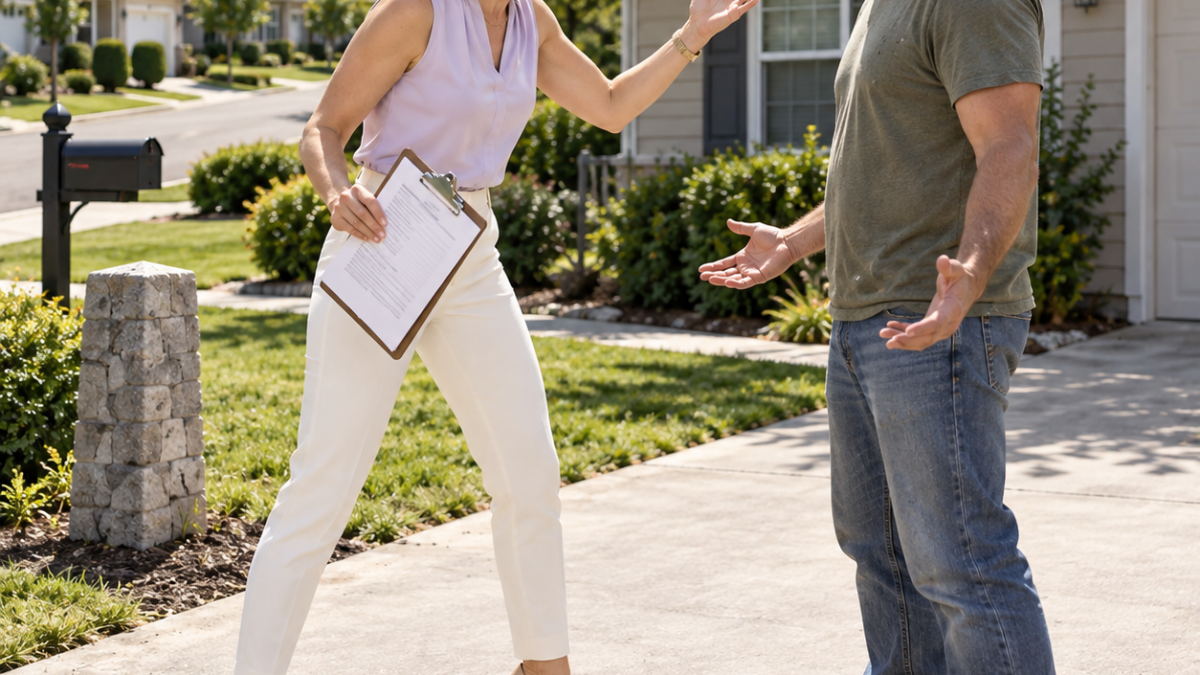
They parked along the curb with their hazard lights blinking like some kind of municipal convoy. Karen stepped out first. She wore another navy Willow Ridge polo, this one tucked into khaki pants with a gold belt buckle. Her sunglasses were bigger than before. Her hair looked freshly blown out. Beverly came around carrying a folder. Don had his clipboard pressed to his chest and the SECURITY LIAISON badge clipped proudly to his shirt.
Mark was there too, because apparently no bad decision was complete without a man taking notes.
They walked up my driveway like they had rehearsed it.
I turned off the grill and wiped my hands.
Sarah appeared in the doorway behind me. “Again?”
“Looks like it.”
Karen stopped five feet from me and lifted her chin.
“Mr. Harlan,” she said. “The board has voted.”
I glanced at the others. “Congratulations.”
Beverly’s mouth tightened.
Karen held out a folded document. “You are being served formal notice of immediate eviction due to nonpayment of fines, repeated covenant violations, refusal to cure aesthetic deficiencies, and hostile conduct toward board representatives.”
For a second, I honestly thought I had misheard her.
Then I laughed.
I did not mean to. It just came out, one short disbelieving sound.
Karen’s face flushed.
“This is not amusing.”
“You’re evicting me,” I said, “from my own house?”
“Yes,” she said.
She said it with complete confidence. That was the wildest part. Not nervous. Not uncertain. Not even pretending. She looked me in the eye and acted like four people with a letterhead could remove a homeowner from a deeded property because his mailbox offended them.
I unfolded the paper.
At the top, in huge bold letters, it said:
EVICTION NOTICE.
Below that was my name, my address, a list of violations, and a final balance so absurd I almost laughed again. Trash receptacle visibility. Nonconforming mailbox. Unapproved garden ornament. Driveway oil staining. Failure to attend orientation. Failure to participate in community standards. Administrative security response fee.
At the bottom, it said I was required to vacate the premises effective immediately.
Vacate was misspelled.
I looked at Sarah. She had stepped closer, just inside the doorway. Her eyes moved over my face, and I saw the exact moment she recognized my expression.
She knew what was coming.
I looked back at Karen. “This is not a legal eviction notice.”
“It is an HOA enforcement document,” she said.
“I’m not in your HOA.”
“You are an adjacent participating parcel.”
“No, I’m not.”
Don stepped forward. He was shorter than I expected up close, stocky, with a reddish face and a buzz cut that did him no favors. His badge caught the sun.
“You’ve had ample opportunity to comply,” he said.
“With rules that don’t apply to me.”
“The board has authority,” he said.
“No,” I said. “The board has stationery.”
Karen’s voice sharpened. “You can either leave voluntarily, or we will escalate.”
I folded the paper carefully. “You need to leave my property.”
“We are authorized to be here.”
“Not by me.”
Beverly opened her folder. “Mr. Harlan, refusal will only make this worse.”
“For who?”
She blinked.
Karen stepped closer. “You have created months of disruption. You ignore standards, mock the board, and encourage disrespect. Your property sits at the entrance edge of Willow Ridge. Every person who drives past sees your noncompliance before they see our community. You may think this is about a mailbox, but this is about respect.”
That was the first honest thing she said.
Respect.
Not law. Not safety. Not community.
She wanted obedience because obedience looked like respect to her.
I lowered my voice. “Karen, listen carefully. I am telling you and everyone with you to leave my property. Right now.”
Nobody moved.
Mark scribbled.
Don smirked.
Karen crossed her arms. “If you believe we are acting improperly, call the police.”
I stared at her.
She smiled then. A small, satisfied smile. The kind of smile people wear when they think they have maneuvered you into a corner.
“Go ahead,” she said. “Call them. They will tell you the same thing.”
“Are you sure?”
“Yes.”
Don puffed up. “Do it.”
Sarah murmured behind me, “Adam.”
Not warning. Not fear.
Permission.
I took out my phone.
I did not call emergency dispatch. No one was bleeding. No one had a weapon. I called the non-emergency line, because habits matter even when you are angry.
When the dispatcher answered, I kept my voice calm.
“Hi. I have several individuals on my property refusing to leave after being asked. They are claiming to represent a homeowners association and are attempting to remove me from my home with what they’re calling an eviction notice. I would like an officer to respond for trespassing.”
Karen watched me with that smirk still in place.
I gave my address. I described the vehicles. I did not say I was a cop.
That part mattered to me.
I wanted this handled the way it would be handled for anyone. Not because of my badge. Not because of who I knew. Because a homeowner has the right to stand in his own driveway and tell trespassers to leave.
When I hung up, Don looked almost pleased.
“Your window to comply is closing,” he said.
I looked at him. “You practiced that, didn’t you?”
His smirk fell.
For the next ten minutes, they wandered my driveway like they were inspecting a rental before checkout. Beverly photographed my mailbox. Mark took pictures of the garage. Karen paced near the stone marker, careful not to acknowledge it. Don stood closest to me, chest out, trying to look official.
Every minute or so, I repeated, “You need to leave my property.”
Every time, Karen answered with some version of, “We are authorized.”
Sarah stayed in the doorway, phone in her hand. I did not know then that she had started recording.
The first cruiser rolled up quietly, no siren, followed by a second a few seconds later.
Two officers stepped out. I did not know either of them personally. Our area overlaps with nearby jurisdictions sometimes, but this was not my department’s call. That was fine with me. Better, honestly.
The older officer approached first. Calm face, measured walk, hands relaxed.
“What’s going on?” he asked.
I gestured toward Karen and her crew. “These individuals are on my property. They say they’re evicting me. I’ve asked them to leave multiple times. They refuse.”
Karen immediately stepped forward and thrust the paper at him.
“Officer, I am Karen Whitcomb, president of the Willow Ridge Homeowners Association. We are executing an enforcement action.”
The officer took the paper, glanced at it, and looked back at her.
“Is this part of a court-ordered process?”
“It is a board-approved action.”
“That’s not what I asked,” he said. “Has a court issued an eviction order?”
Karen’s nostrils flared. “This is an HOA matter.”
“So no court order.”
“The board voted.”
The younger officer looked at me for half a second, then at the driveway, then at the stone marker near the edge of the yard. He was already reading the scene.
The older officer handed the paper back to Karen. “Ma’am, you need to step off the property.”
Karen looked stunned. “Excuse me?”
“He has asked you to leave. Unless you have a court order or some other lawful authority to be here, you need to step off his property.”
Beverly jumped in. “This property falls within our expanded community boundary.”
“Do you have documentation showing that?”
Karen opened her mouth, then closed it.
Mark offered his clipboard like it might contain magic.
“We have a map,” Beverly said.
“Is it recorded with the county?” the officer asked.
Karen’s jaw tightened. “It was approved internally.”
The officer nodded once, slowly. I knew that nod. It meant he had received an answer so useless that responding directly would only waste oxygen.
“Okay,” he said. “You need to leave.”
Don stepped forward. “Officer, with respect, this is a civil enforcement matter.”
“It became a trespass matter when the homeowner asked you to leave and you refused.”
Don pointed toward my house. “He has ten minutes to pack a bag. That’s what the notice says.”
The younger officer’s head turned toward him.
I felt Sarah go still behind me.
The older officer said, “Nobody is packing anything. Step off the property.”
Karen’s voice rose. “You are misunderstanding the situation.”
“No, ma’am. I understand it.”
“We have authority.”
“Not here.”
That was when Don made his mistake.
Maybe he felt Karen watching him. Maybe he was embarrassed. Maybe his little badge had convinced him he was braver than he was. Whatever the reason, he turned away from the officer and walked toward my front door.
I said, “Do not touch my door.”
He looked back at me with a grin.
Then he put his hand on the doorknob.
Everything in me went quiet.
That is the thing people do not understand about real anger. It is not always hot. Sometimes it is cold enough to make the whole world sharpen.
The younger officer moved first. “Sir, step away from the door.”
Don did not.
He twisted the knob.
It was locked.
Sarah made a sound I had never heard from her before, half gasp, half fury.
The older officer’s voice cut through the driveway. “Step away now.”
Don turned with both hands raised, but he did not move away from the door. “We’re within our enforcement rights.”
I reached slowly into my pocket.
Not for a weapon. For my badge.
I held it up where both officers could see it.
“My name is Adam Harlan,” I said. “I’m a police officer. I am off duty and this is my residence. I have repeatedly asked this individual to leave my property. He has refused lawful orders from responding officers and attempted to enter my home.”
Karen’s face changed so fast it would have been funny if Sarah had not been standing behind me shaking.
The smirk vanished.
Beverly lowered her phone.
Mark stopped writing.
Don stared at the badge like it had appeared from another dimension.
The older officer looked at me, then gave one short nod. He did not need a speech. He had seen what happened.
“Sir,” he said to Don, “turn around and put your hands behind your back.”
Don’s face went red. “What? No. This is ridiculous.”
“Turn around.”
Karen exploded.
“You cannot arrest our compliance officer!”
The younger officer stepped between her and Don. “Ma’am, back up.”
“He is acting under board authority!”
“No,” the older officer said, taking Don’s wrist. “He is being detained for trespassing and refusing lawful orders.”
Don tried to pull his arm away.
That made it worse.
Not dramatically worse. Not movie-scene worse. But enough. Enough for the officers to secure him properly. Enough for the metal click of handcuffs to cut through the afternoon like a church bell.
For months, Karen had treated my home like a problem to be corrected.
Now her man with the badge from nowhere was standing in my driveway with his hands cuffed behind his back because she had told me to call the police.
I did not smile.
I wanted to. God help me, I wanted to. But Sarah was pale in the doorway, and my neighbors were peeking through blinds, and Don was muttering about lawsuits, and Karen was shouting that this was harassment.
The satisfaction came anyway, deep and steady.
Not because I enjoyed seeing someone arrested.
Because for the first time since the first glossy packet appeared in my door, reality had entered the conversation.
Two more units arrived. Statements were taken. The officers separated everyone. Karen tried to read from the eviction notice like scripture. Beverly said she had everything on video, which was unfortunate for her because Sarah had everything on video too, including Don touching my doorknob after being told not to.
One officer asked Karen again for proof that my property was under HOA jurisdiction.
She produced a PDF on her phone.
It was a “community map” with a colored shape drawn around Willow Ridge and, conveniently, around my little notch of property.
The officer zoomed in. “Who made this?”
“The board approved it.”
“That wasn’t my question.”
Karen’s voice dropped. “Our consultant prepared it.”
“Was it recorded with the county?”
Silence.
“Is it reflected on his deed?”
Silence.
“Do you have any court order allowing you to remove him from the property?”
Her lips pressed so tightly together they almost disappeared.
“No.”
The officer handed the phone back.
Then he explained, very calmly, that Karen, Beverly, and Mark were being officially trespassed from my property. If they returned without invitation, they could be arrested. Don was placed in the back of a cruiser for refusing orders, trespassing, attempting to access the residence, and resisting when officers tried to detain him.
Karen looked smaller standing at the end of my driveway.
Not humbled yet. People like Karen rarely reach humbled on the first stop. But shaken. Definitely shaken.
Before she left, she pointed at me.
“This is not over.”
I looked at the officers, then at Sarah, then back at Karen.
“For once,” I said, “I agree with you.”
She left in Beverly’s car because Don’s crossover stayed behind until someone could come retrieve it.
When the last cruiser pulled away, the neighborhood went quiet in that embarrassed suburban way, like every house had suddenly remembered it had curtains. Sarah came down the steps and stood beside me.
For a moment, neither of us spoke.
Then she handed me her phone.
“I recorded most of it,” she said.
I looked at her. “You okay?”
“No,” she said. Then she swallowed. “But I will be.”
That broke something loose in me.
Not anger this time. Guilt.
I had treated the whole thing like a problem I could manage because I knew the rules. I knew property law well enough. I knew trespass procedure. I knew documentation. I knew what Karen could not do. But knowing did not protect Sarah from standing in her own doorway while a stranger tried to open it under color of fake authority.
I put my arms around her, and she leaned into me hard.
“I hate them,” she whispered.
“I know.”
“She touched our peace.”
That was exactly it.
Karen had not taken the house. She had not gotten inside. She had not won. But she had reached into our ordinary life and left fingerprints on it.
That night, I added the eviction notice to the binder. Sarah sent me the video, and I saved it in three places. I wrote a summary of everything while it was fresh: times, statements, names, vehicle descriptions, officer responses. Then I sent a clean, factual report to the city and to my department’s legal liaison, not asking them to do anything dramatic, just making sure there was a record in case Karen tried to reshape the story.
She did.
Of course she did.
The next week brought three letters.
The first said I had the right to appeal the eviction decision.
The second accused me of filing a false police report.
The third was a special assessment notice for “security incident expenses,” with my address listed next to a dollar amount. Karen had sent me a bill for the time she spent trying to throw me out of my own house.
Sarah stood at the kitchen counter, reading over my shoulder.
“She’s insane,” she said.
“She’s committed,” I said.
“To being insane.”
I scanned every page and added them to the binder.
Then I sent one final certified letter. It was short, direct, and stripped of emotion.
My property is not part of Willow Ridge HOA. Your board has no authority to assess fines, fees, or enforcement costs against my property. Your representatives have been trespassed from my property by law enforcement. Any further attempts to enter my property, interfere with my access, or represent that you have authority over my home will be documented and referred to the appropriate agencies.
I included copies of the deed page, the plat map, and the incident number from the police response.
I did not call Karen names. I did not threaten her. I did not tell her what I thought of her personally, though I had several drafts in my head that would have been satisfying in an unwise way.
I sent the letter and waited.
Three days later, the city replied.
The message was brief, dry, and beautiful.
They confirmed that my property was outside the Willow Ridge HOA boundary. They confirmed the sidewalk and footpath near my lot were public access. They confirmed Willow Ridge had no enforcement authority over my parcel.
I printed that email and slid it into the binder like a trophy.
Karen responded by going social.
A friend of mine named Luis lived inside Willow Ridge. Good guy. Quiet. Two kids, old Lab, garage full of bikes. He sent me a screenshot from the Willow Ridge private Facebook group with the message, You’re famous.
The post was from Karen.
Neighbors, as many of you know, the board has recently faced aggressive behavior from a noncompliant adjacent homeowner whose actions have endangered community safety and forced police involvement. We remain committed to protecting Willow Ridge standards and ensuring that hostile individuals do not undermine the harmony we have built together.
There were comments.
Some people supported her. Those were the predictable ones. The same three or four residents who seemed to think property values depended on punishing children for leaving scooters in driveways.
But other comments surprised me.
Is this about the guy outside the boundary?
Didn’t the police tell the board to leave?
Why are we spending money on this?
My son got fined for a basketball hoop while this is happening?
Luis told me people were talking. Quietly at first, then less quietly. Apparently Karen had been making life miserable inside Willow Ridge for years. Fines for visible hoses. Warnings about wreath sizes. Notices because a child’s bike leaned against a garage door for twenty minutes. One family got a violation because their Christmas lights were up two days too long after New Year’s, even though the husband had been in the hospital.
Bullies always look bigger when everyone thinks they are suffering alone.
Once people compare notes, the monster shrinks.
I stayed out of it. That was important. I did not post. I did not join the group. I did not send Sarah’s video around, though she showed it to Luis when he came over one night. What happened after that was not exactly under our control. Neighborhood videos have a way of moving when people are tired of pretending.
Within a week, half of Willow Ridge seemed to know that Don had been cuffed in my driveway after trying to open my front door.
Karen’s emails changed.
Only slightly.
She stopped writing “authority” in capital letters. She started using phrases like recommend and encourage. She referred to “misunderstandings regarding boundary properties.” She announced a review of enforcement communication standards. She did not apologize.
People like Karen do not apologize unless apology benefits them.
Then came the last power move.
It happened two weeks after the police incident, on a Sunday afternoon.
I was in the front yard replacing a cracked sprinkler head when Karen appeared at the edge of the property line with Beverly, a new man I did not recognize, and another security-liaison type. Don, unsurprisingly, was not with them.
Karen had downgraded the sunglasses but upgraded the folder. This one was thick, laminated, and color-tabbed. She wore a cream blouse and navy slacks, like she wanted to look less like HOA president and more like someone testifying before Congress. Beverly hovered half a step behind her. The new man had silver hair, a sports coat, and the slick energy of a consultant who billed by the hour to say obvious things in expensive language.
They stopped just outside my property line.
That was progress.
I stood up slowly and brushed dirt off my jeans.
Karen raised her voice. “Mr. Harlan.”
“Karen.”
Her mouth tightened at the lack of title.
“This is Daniel Price,” she said. “He is advising the board on legal and community access matters.”
Daniel stepped forward with a smile that had never met sincerity. “Good afternoon.”
“You a lawyer?” I asked.
His smile thinned. “I advise community associations.”
“So no.”
Karen cut in. “We are here to inform you that Willow Ridge will be placing a temporary community lock on the gate at the end of the walkway.”
I looked toward the path.
Between my side yard and a strip of HOA common area was a chain-link gate opening onto a footpath that ran toward the park. People used it constantly. Dog walkers, kids on scooters, joggers, parents pushing strollers. It was public access, maintained by the city, and it had been open longer than Willow Ridge had existed.
“You can’t lock that,” I said.
Daniel lifted one hand in a calming gesture. “Access management can be an important soft barrier when community tension escalates.”
I stared at him. “Did you just call a padlock a soft barrier?”
He blinked.
Karen held up a cheap brass lock like she had discovered fire. “This is a temporary safety measure due to your unpredictable behavior and police escalation.”
“My police escalation?”
“You involved law enforcement.”
“You told me to.”
Her face flickered.
Beverly whispered something to the new security liaison, who shifted from one foot to the other, eager and nervous.
I pointed at the gate. “That path is public access. It’s in city records. You lock it, you’re tampering with public access.”
Karen’s smile returned, brittle and sharp. “Then call the city.”
There it was again.
The same mistake, dressed in different clothes.
I took out my phone.
Daniel’s smile faltered. “I don’t think that’s necessary.”
“You’re advising them, right?” I said. “Advise faster.”
I called the city’s non-emergency number and asked for public works. I explained that representatives from Willow Ridge were attempting to lock a public access gate. I gave the location and mentioned the recent police incident only as context. The woman on the phone did not sound surprised. That told me Karen had probably created more work for the city than anyone wanted to admit.
While I was still on the call, the new security liaison snapped the lock onto the gate.
Karen looked directly at me while he did it.
A little victory. That was what she thought she had.
For fifteen minutes, the lock hung there.
Kids on bikes approached, stopped, and turned around. An older man walking a beagle frowned at the gate, then at Karen. Sarah came outside and stood beside me without saying anything.
Then a white city truck pulled up.
A woman got out wearing work boots, dark pants, and a municipal badge clipped to her belt. She carried a clipboard, but unlike Mark, she looked like she had earned the right to use it.
She walked to the gate, looked at the lock, looked at Karen, and said, “Nope.”
Just that.
Nope.
It may have been the most satisfying word I had ever heard.
Karen straightened. “Excuse me?”
“You need to remove that lock immediately,” the city employee said.
Daniel stepped forward with his consultant smile. “Perhaps we can discuss the access implications—”
“No,” she said. “This is public access. You do not get to lock it. Remove it now, or the city cuts it and issues a fine for tampering.”
Karen’s face reddened. “We are trying to protect residents.”
“From walking?”
“This homeowner has created an unsafe environment.”
The city employee glanced at me. I lifted one hand in a small hello. She looked back at Karen.
“I’m not here for neighborhood drama,” she said. “I’m here for the lock.”
Beverly stared at the ground.
The new security liaison fumbled with the key. His hands shook badly enough that he dropped it once, picked it up, and finally removed the lock.
The city employee handed Karen a printed notice. “Do not obstruct this gate again. If there is a legitimate safety issue, contact the city. You do not create your own access restrictions on public paths.”
Daniel said nothing.
For the first time since I had met her, Karen seemed unable to find words strong enough to bend the moment.
The city employee came over to my driveway before she left.
“You Mr. Harlan?”
“Yes, ma’am.”
“Sorry you’re dealing with this,” she said. “Call my office directly if they try it again.”
I thanked her.
Karen heard every word.
That mattered too.
The board left without speeches that time. No threats. No dramatic warnings. No “this isn’t over.” Just four people walking back to their vehicles under the weight of being corrected in public.
After that, the letters slowed.
They did not stop completely. Karen was too proud for silence. Every few weeks, something appeared in the mail, softer and stranger than before. A community harmony survey. A reminder that Willow Ridge “valued respectful relationships with adjacent neighbors.” An invitation to attend a listening session. I recycled most of them.
Inside Willow Ridge, things got louder.
Luis kept me updated, usually over beers in my garage while his Lab slept on my welcome mat like a defector. Residents started asking why the board was spending time and money harassing a property outside the boundary. Someone requested financial records. Someone else asked whether the board’s “legal consultant” had malpractice insurance, which was funny because he was not a lawyer and therefore had no business acting like one.
At the next meeting, people raised their voices.
Karen tried to control the room and discovered that fear only works while everyone believes they are the only one afraid. Once the residents started speaking openly, years of small humiliations spilled out. A retired teacher talked about being fined over flowerpots after her husband died. A young father talked about violation notices for sidewalk chalk. Luis stood up and talked about his son’s bike.
Then someone asked about Don.
Karen said personnel matters were confidential.
That did not go well.
A week later, Don was no longer security liaison. Beverly took what the newsletter called a “temporary leave from board responsibilities.” Daniel Price disappeared from all communications. Karen stayed president, but her language changed so dramatically it was almost funny. Authority became collaboration. Compliance became guidance. Fines became last resort measures.
Then came the policy clarification email.
Luis forwarded it to me with the subject line: You’ll enjoy this.
The email said Willow Ridge recognized the importance of clear boundaries and respectful neighbor relations. It said the HOA could not enforce covenants outside its recorded community jurisdiction. It said representatives must not enter nonmember property without permission. It announced the formation of a boundary review committee.
I laughed so hard Sarah came in from the other room.
“What?”
“They made a committee to find the stone marker.”
She read the email and shook her head. “No apology?”
“Of course not.”
But I did not need one.
An apology from Karen would have been satisfying for about thirty seconds. What mattered more was that the machine she had used to bully people had been forced to slow down. Maybe not stop forever. Maybe not become kind. But slow down. Explain itself. Stay in its lane.
That was enough.
Months passed.
Spring came around again, and the dogwood bloomed pink near the driveway. My mailbox still leaned forward a little. Sarah repainted it herself one Saturday, not HOA gray, but a deep green she liked because it matched the front door. We kept the metal heron in the garden. Sometimes I imagined Karen driving past and seeing it standing there like a witness.
The trash can was still visible now and then when I came home too tired to care.
No one fined me.
No one tried to evict me.
No one came onto my driveway with paint.
The house started feeling like ours again.
That took longer than I expected. Peace does not return all at once after someone tries to take it. It comes back in pieces. The first morning you drink coffee on the porch without checking the street. The first evening your wife leaves the curtains open. The first time you mow the lawn because it needs mowing, not because you are proving a point to a woman with a clipboard.
One afternoon, I was working in the front yard when Karen drove by.
Her white SUV slowed near the stone marker. For a second, through the windshield, I saw her face. No sunglasses this time. No smirk. Just a tight, controlled stare.
I lifted a hand and waved.
Not friendly exactly.
Not hostile either.
Just enough.
She looked away and kept driving.
Sarah saw it from the porch. “You enjoyed that.”
“A little.”
“She still hates you.”
“I can live with that.”
Sarah walked down the steps and stood beside me, looking at the boundary marker half-hidden in the grass.
“It’s funny,” she said. “Such a small thing.”
The stone was only a few inches high, weathered and ordinary. Most people would walk past without noticing it. But that little marker had done what months of Karen’s letters could not undo. It told the truth.
Here is where your power ends.
I think some people go their whole lives unable to accept that sentence.
Karen saw a neighborhood and believed everything near it should bend to her idea of order. She saw my house and decided it was a flaw in her picture. She saw my refusal as disrespect because she could not imagine authority needing permission. Every letter, every warning, every fake legal phrase was just another way of saying the same thing.
Obey me, so I can feel in control.
But control is not the same as authority.
A board vote is not a law.
A title is not a badge.
And a woman with a folder cannot throw a man out of a house she does not own just because his mailbox ruins her view.
People asked me later if I regretted calling the police.
I never did.
Karen told me to call them if I wanted to stop her.
So I did.
For months, I had been patient. I had answered politely. I had sent maps, emails, documents, and explanations. I had given her every chance to step back before she turned a ridiculous disagreement into something uglier. She refused because she thought politeness meant weakness.
That day in my driveway, she learned otherwise.
Not because I yelled louder.
Not because I threatened her.
Not because I used my job to bully her back.
Because when someone crosses a line enough times, you do not need to move the line. You just need to stop pretending they cannot see it.
The last letter I ever got from Willow Ridge arrived near the end of summer.
It was addressed to Resident instead of my name, which I considered growth. Inside was a general notice about maintaining positive relationships with neighboring properties. No fines. No threats. No eviction. At the bottom, in small print, was Karen’s name.
Karen Whitcomb, HOA President.
I pinned it to the garage fridge for a while because it made Sarah laugh.
Then one day, I took it down and threw it away.
Not because I forgave Karen exactly.
Because I did not want her living on my refrigerator.
That evening, Sarah and I sat on the back steps under the oaks. The air smelled like cut grass and charcoal. Somewhere beyond the fence, kids were shouting on the public path Karen had tried to lock. A dog barked. A bike bell rang. Ordinary neighborhood sounds. Beautiful because they were ordinary.
Sarah leaned her shoulder against mine.
“Do you think she’ll ever try again?” she asked.
I thought about Karen’s face when Don was cuffed. The city employee saying nope. The policy clarification email. The residents finally speaking up. The stone marker waiting quietly at the edge of the yard.
“No,” I said. “Not here.”
Sarah smiled.
The metal heron stood in the garden, angled toward Willow Ridge like it was keeping watch.
My mailbox leaned.
My driveway had an oil stain.
My porch light did not match anyone’s standard.
And my house, finally, felt like mine again.