𝗙𝗨𝗟𝗟 𝗦𝗧𝗢𝗥𝗬 The Woman Who Called Herself HOA Enforcement Picked the One Driveway She Should Have Left Alone
𝗙𝗨𝗟𝗟 𝗦𝗧𝗢𝗥𝗬
I waited, hoping she would hear how insane that sounded once it was hanging in the air between us.
She did not.
“You can’t authorize parking on property you don’t own,” I said.
Her eyes narrowed. Without makeup, she looked less polished but even sharper, like the cruelty had fewer decorations around it.
“You really need to learn how this neighborhood works,” she said. “The HOA exists to maintain order. Sometimes order requires cooperation.”
“Cooperation is when you ask.”
“And sometimes homeowners need to be told.”
There it was.
That was Karen, stripped clean. Not a neighbor. Not a volunteer board member. A woman who had tasted a spoonful of authority and decided everyone else should live on their knees.
I felt heat rise in my chest, but I forced my voice low.
“Move it.”
She smiled. “He’s sleeping.”
“Wake him up.”
“No.”
The word landed like a slap.
For the first time, I understood that this was not about parking. Not really. My driveway was just the stage. Karen had chosen it because she wanted a place to perform power where everyone could see. If I let her keep doing it, she would not become satisfied. She would become hungrier.
I stepped back from her porch.
“Fine,” I said.
Her smile widened. She thought she had won.
The sedan was gone by noon, and I spent the next few days learning everything I should have learned the first time she dared me to call a tow truck.
I pulled out the HOA bylaws. I read them at my kitchen table with a yellow highlighter and a cup of coffee going cold beside me. I checked the county property records to make sure there was nothing strange about easements along my driveway. I called the HOA management number and asked general questions without naming Karen. I asked whether any board member, officer, committee member, or “enforcement officer” had the right to use private residential driveways as overflow parking.
The woman on the phone actually laughed before she realized I was serious.
“No,” she said. “Absolutely not.”
“What about for HOA business?”
“Still no.”
“What if the car has a sticker?”
“A sticker doesn’t grant property rights.”
That sentence stayed with me.
A sticker does not grant property rights.
I wrote it down.
Then I called two tow companies. The first one said they did not like getting involved in neighborhood disputes unless law enforcement was present. The second one, a family-owned place about twenty minutes out, listened carefully and asked the right questions. Was it my property? Did I have proof? Were there signs? Were the vehicles parked without permission? Could I be available to sign the tow authorization?
“Yes,” I said. “To all of that.”
The dispatcher, a tired-sounding woman named Marlene, said, “Then we can tow. Just understand, once we hook it, the owner deals with us.”
“That’s fine.”
“People get ugly.”
“They already are.”
She gave a small dry laugh. “Then take pictures and stay calm.”
So I did.
I took pictures every time Karen or one of her relatives parked in my driveway. I took pictures of the stickers. I took pictures of the license plates. I put up a clear PRIVATE DRIVEWAY — NO PARKING sign near the entrance, the kind you can buy at a hardware store in angry red letters.
Karen parked beside it two days later.
Not near it.
Beside it.
As if the sign were a decoration she had approved.
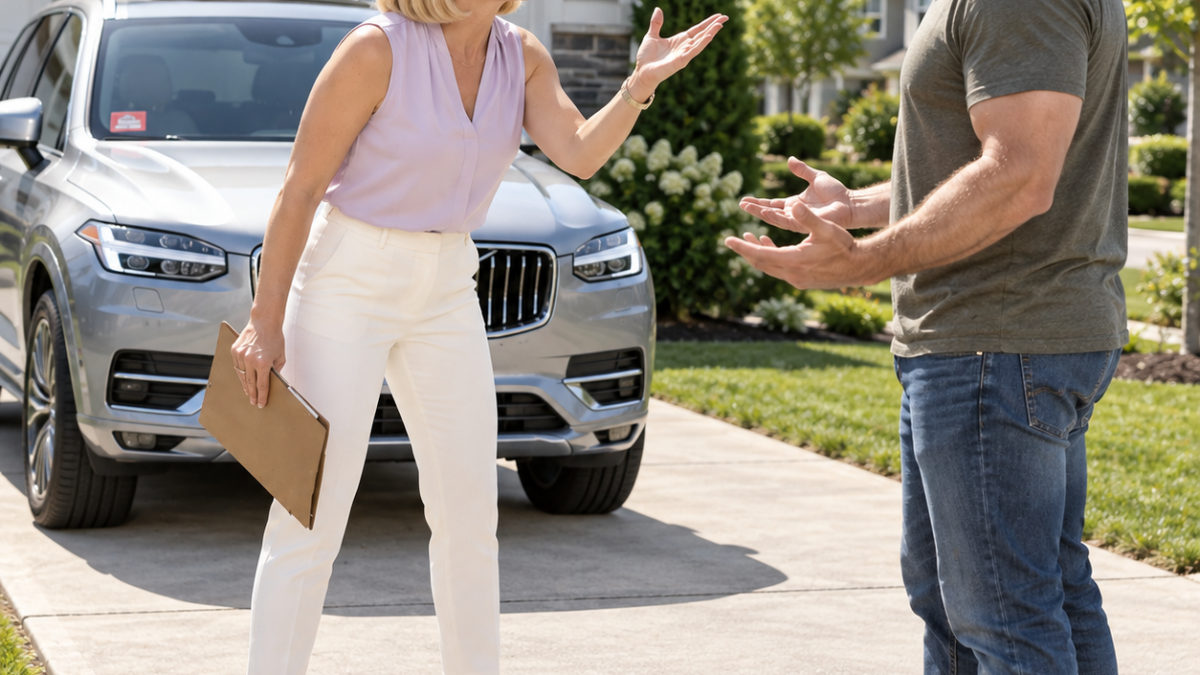
When I confronted her, she stood there in white capri pants and a pale blue blouse, one hand on her hip, the other waving her clipboard like a weapon.
“That sign is hostile,” she said.
“It’s accurate.”
“It creates an unfriendly neighborhood environment.”
“So does trespassing.”
She clicked her tongue. “You really are aggressive.”
“I’m asking you not to park on my property.”
“You’re towering over me.”
I looked down at the three feet of space between us. “I’m standing on my lawn.”
“You know how intimidating you look.”
That one cut deeper than I wanted it to.
Because Karen knew what she was doing. She was not afraid of me. She was using the idea that she could be afraid of me as a shield. A big man raising his voice at a woman on a suburban street—she could make that story ugly if she wanted to. She could file complaints. She could twist words. She could drag the HOA into it and make me defend myself against shadows.
So I stepped back.
Again.
She noticed.
Of course she noticed.
From that day on, Karen got bolder.
The homemade stickers multiplied. Her sister’s minivan had one. Her nephew’s pickup had one. A cousin’s old Honda had one taped from the inside because the adhesive had failed. HOA ENFORCEMENT. HOA SECURITY. HOA OFFICIAL USE. Each one looked worse than the last, printed crookedly, laminated badly, trimmed with scissors by someone who had apparently never met a straight line.
They parked in my driveway during cookouts, birthdays, random weeknight visits, and what Karen called “board-related planning sessions,” though those sessions seemed to involve wine, shouting, and music from the early 2000s.
I tried speaking to her husband once.
His name was Paul, a quiet man with thinning brown hair and the exhausted look of someone who had surrendered years ago. He was putting bags of ice into a cooler when I approached him.
“Paul,” I said, “I need your family to stop using my driveway.”
He glanced toward the house, then back at me. “You should talk to Karen.”
“I have.”
He lowered his voice. “Then you know how that goes.”
“That doesn’t make it my problem.”
He looked genuinely sorry for half a second. Then the front door opened and Karen appeared.
“Paul,” she snapped. “Inside.”
He went.
I watched him disappear into the house, and something in me hardened. Karen did not just bully neighbors. She ruled everyone around her by making resistance more exhausting than surrender.
By late summer, it was not only my driveway.
Her family blocked sidewalks, forcing parents with strollers into the street. They parked in front of mailboxes, and one elderly neighbor missed a medication delivery because the postal carrier could not reach the box. They left tire ruts in the grass near the common area and once parked halfway up on Mr. Dawson’s curb, cracking a section he had paid to repair himself.
When people complained, Karen used the same words every time.
“HOA approved.”
“Enforcement matter.”
“Temporary authority.”
“Neighborhood safety.”
She wore those phrases like armor.
And for a while, they worked.
People were scared. Not terrified, exactly, but worn down. Nobody wanted fines. Nobody wanted letters. Nobody wanted their yard inspected or their fence questioned or their holiday decorations suddenly found to be “noncompliant.” Karen understood that fear and fed on it.
One evening in September, I had three neighbors standing in my garage while rain tapped against the driveway outside. I had the smoker going under the overhang, and the smell of ribs should have made the whole thing feel friendly. Instead, everyone looked tired.
“She told me my mailbox color was under review,” said Lisa from across the street. “Under review. It’s black. It has always been black.”
Mr. Dawson leaned against the workbench, arms folded. “She sent me a notice about my grass being over the recommended height. It was raining all week. I couldn’t mow.”
“She threatened to fine me over sidewalk chalk,” said Ben, who had two young daughters. “Sidewalk chalk. It washed away the next day.”
They all looked at me because they knew I had become Karen’s main target.
“What are you going to do?” Lisa asked.
I flipped the ribs, buying time.
The truth was, by then, I had a plan. Not a perfect plan. Not a noble plan. A patient plan. The kind that required letting Karen believe she was winning until the exact moment her own arrogance did the work for me.
“I’m going to wait,” I said.
Ben frowned. “For what?”
“For her to give me the right day.”
They did not understand then.
That was fine.
Karen did not understand either.
September became October. October became November. Leaves turned brittle and gathered along the curb in brown, curled piles. Football season made the neighborhood louder on weekends, and Karen complained about it constantly, even though her own family gatherings were worse than anything the rest of us did.
Once, after my team won in overtime, I let out one shout from my living room. One. Within twenty minutes, Karen had emailed the HOA board about “aggressive male vocalizations disrupting residential peace.”
I knew because one of the other board members, a retired accountant named Phil, quietly forwarded me the complaint with only three words typed above it:
Are you kidding?
I did not reply.
I was learning that the best way to deal with Karen was not to argue with every absurdity. Some people want you to chase every spark they throw so you are too tired to notice the bonfire they are building.
I watched.
I documented.
I waited.
Then, about two weeks before Thanksgiving, I heard what I needed to hear.
I was out front dragging bins back from the curb when Karen stood in her driveway talking loudly enough for half the street to hear. She loved public conversations when they made her sound important.
“My whole family is coming,” she said into her phone. “Everyone. We’ll eat early, then hit the stores. I already told them parking is handled.”
Parking is handled.
I stopped with one hand on the bin.
She continued pacing, phone pressed to her ear, sunglasses on her head despite the gray sky.
“No, don’t worry about it. The board has authority for overflow. People can complain, but they won’t do anything.”
Her eyes flicked toward my house.
Then she smiled.
I smiled back.
Not because I was happy.
Because Thanksgiving had just become the right day.
The next morning, I called Marlene at the tow company.
“I have a situation likely coming up on Thanksgiving,” I said.
She sighed. “Of course you do.”
I explained everything. Private property. Repeated unauthorized parking. Multiple vehicles likely. Advance notice. Rural area. Holiday.
“We’ll have one truck running,” she said. “Maybe two if somebody wants overtime, but don’t count on it. Holiday staffing is thin.”
“One truck is enough if you have time.”
“How many cars are we talking?”
“Could be three. Could be five.”
She whistled softly. “You trying to ruin somebody’s day?”
“They’ve had months to stop ruining mine.”
There was a pause.
“Fair enough,” she said. “Send me your address and pictures of the sign. If they park there, call us. You’ll need to sign for each vehicle.”
“I’ll be here.”
“People will scream.”
“I’ll be here for that, too.”
After I hung up, I sat at the kitchen table and stared out the window at my driveway.
I should say I felt conflicted.
Part of me did. A small part. The part of me raised to be polite, to give second chances, to keep peace when peace was possible. That part whispered that Thanksgiving was a harsh day to make a point. Families. Food. Holiday plans. Maybe children disappointed because the adults could not go Black Friday shopping. Maybe people stuck dealing with tow fees until Monday.
Then I remembered Karen standing in my driveway saying, Call a tow truck, then see what happens.
I remembered her using my size against me when I had kept my hands at my sides and my voice calm.
I remembered Mr. Dawson’s cracked curb, Lisa’s mailbox, Ben’s daughters having to erase chalk drawings because a woman with a clipboard wanted to feel powerful.
I remembered every car that had sat on my property while I swallowed anger to avoid becoming the villain in Karen’s version of the story.
No.
Thanksgiving was not harsh.
Thanksgiving was generous.
It gave Karen one more chance to make a better choice.
On Thanksgiving morning, the air smelled like wet leaves and distant wood smoke. The sky was pale and flat, the kind of November sky that makes every sound travel farther. I woke early, made coffee, and stood on my porch in jeans and a flannel shirt, watching the neighborhood come alive.
Cars were already arriving at houses up and down the street. People carried foil-covered dishes, pies in plastic domes, folding chairs, bags of ice. Kids ran across lawns in sweaters they clearly hated. Somewhere, somebody’s dog barked like the whole holiday depended on it.
Karen’s house was decorated like a magazine had exploded across her porch. White pumpkins. Gold ribbon. A wreath big enough to block half the door. A chalkboard sign near the steps read GIVE THANKS in perfect cursive, which felt almost too on the nose.
Around nine, Karen came outside carrying a tray of something covered in foil. She wore cream-colored pants, a burnt-orange blouse, and gold earrings shaped like leaves. Her hair was sharp as ever. Her lipstick was deep red. She looked like a woman prepared to host a holiday and prosecute a misdemeanor before dessert.
I walked down my driveway and stopped near the sidewalk.
“Morning, Karen.”
She paused like my greeting had inconvenienced her.
“What?”
I kept my voice easy. “Just reminding you. I need my driveway clear today. No one has permission to park there.”
Her eyes glittered.
Behind her, Paul was unloading folding chairs from the trunk. He froze.
Karen slowly lowered the foil tray onto the hood of a car and turned fully toward me.
“Are you serious?” she asked.
“Yes.”
“It’s Thanksgiving.”
“I know.”
“I have family coming.”
“I know.”
“We need overflow parking.”
“Not in my driveway.”
She gave a short laugh, sharp and fake. “Your obsession with this is unhealthy.”
“My obsession with my own property?”
“It’s a driveway. You act like I’m stealing your house.”
“You’re not using it.”
Her smile vanished.
“Let me make something clear,” she said, taking a step toward me. “I do not have time for your hostility today. I am hosting twenty-four people, several of whom are elderly, and I will not have them walking half a mile because you suddenly decided to be difficult.”
“There’s street parking.”
“There is limited street parking.”
“Then your guests should arrive early.”
Her jaw tightened. “I am an HOA board member.”
“You are not parking on my property.”
“I have authority to manage parking for community safety.”
“No, you don’t.”
Paul looked down at the chairs in his hands like he wished he could disappear behind them.
Karen’s voice rose. “I don’t care what you like. I have a lot of people coming over, and we need the space for HOA business.”
I looked at the Thanksgiving wreath, the foil tray, the chairs, the cars already filling her curb.
“HOA business?”
“Yes.”
“On Thanksgiving?”
Her nostrils flared. “You are not entitled to question board operations.”
I nodded slowly.
“All right.”
She blinked. She had expected more argument.
I turned to leave.
“That’s it?” she called after me.
I looked back. “That’s it.”
She mistook my calm for defeat. I saw the relief in her face, followed by satisfaction. She picked up the tray again and gave Paul a look that said, See?
I went inside, poured another cup of coffee, and placed my phone on the kitchen counter beside the folder I had prepared.
Property record.
HOA bylaw page.
Photos.
Tow company number.
The first unauthorized car arrived at 11:18 a.m.
It was the black sedan, the brother-in-law’s. He pulled into my driveway, parked neatly along the curve, and walked away carrying a casserole dish. He did not look toward my house. He did not hesitate. The sticker on his windshield flashed red and white.
I took a picture.
The second arrived at 11:42. A blue minivan with two kids and a woman who told one of them not to step in “the neighbor’s mud,” as if the paved driveway beneath her tires belonged to a public park. She parked behind the sedan.
I took a picture.
The third was a gray pickup with mud along the tires. It bounced slightly over the edge of my lawn before correcting into the drive. A young man got out, looked at my PRIVATE DRIVEWAY sign, laughed, and slapped the hood as he walked toward Karen’s house.
I took a picture.
The fourth arrived just after noon, a white SUV that pulled in too far and blocked the curve near my garage. That one would have trapped my own truck if I had parked inside.
I took a picture.
At 12:27, a fifth car stopped directly across the mouth of my driveway, not even pretending to fit. It blocked the entire entrance.
The driver got out, stretched, and shouted toward Karen’s house, “Is this okay?”
Karen appeared on her porch with a glass of wine already in her hand.
“You’re fine!” she called. “It’s approved!”
I stood inside my kitchen window, looking at five vehicles on or blocking my private property.
Approved.
That word settled the last small argument inside me.
I called Marlene.
“They’re here,” I said.
“How many?”
“Five.”
There was a pause, then paper rustling. “You weren’t exaggerating.”
“No.”
“You got photos?”
“Yes.”
“Sign visible?”
“Yes.”
“Stay available. Truck’s finishing a job about thirty minutes out.”
“I’ll be ready.”
I hung up and felt my heartbeat slow rather than speed up.
That surprised me.
I had expected anger. Maybe adrenaline. Instead, there was a strange stillness. Like after months of noise, the world had finally gone quiet enough for consequences to walk in.
Thanksgiving smells drifted through the neighborhood all afternoon. Turkey, butter, onions, sweet potatoes, smoke from somebody’s grill. Laughter rose and fell from houses. Football played somewhere loud enough that I could hear the crowd roar through a cracked window. From Karen’s place came music, clinking glasses, and her unmistakable voice cutting through everyone else’s.
At 1:09, the tow truck arrived.
It was an older flatbed with scratched yellow paint and mud on the tires. The driver was a broad man in a knit cap named Dale. He climbed down, glanced at the cars, then looked at me.
“All yours?” he asked.
“The property is mine. The cars are not.”
He gave the PRIVATE DRIVEWAY sign a quick look, then nodded. “Paperwork.”
I signed the first authorization on the hood of his truck.
My hand did not shake.
Dale hooked the car blocking the driveway first. Smart. Once that one was gone, he would have room to work. The winch made a grinding sound that seemed impossibly loud to me, but Karen’s house stayed full of music and laughter. No one came out.
Across the street, Lisa opened her front door and stepped onto her porch.
Her eyes went wide.
I raised one finger to my lips.
She covered her mouth with both hands, but her shoulders started shaking.
Dale hauled the first car away at 1:31.
He came back at 2:08.
By then, Mr. Dawson had wandered over wearing a cardigan and holding a plate.
“You hungry?” he asked.
I looked down.
Turkey. Stuffing. Green beans. A roll.
“Dawson.”
“What? Man’s got to eat while justice is served.”
Despite everything, I laughed.
I ate Thanksgiving leftovers standing in my own driveway while Dale hooked the second car. The absurdity of it almost overwhelmed the anger. Almost. But then I looked at the red sticker on the sedan’s windshield and remembered Karen smirking at me months earlier.
They’ll see the sticker and leave it be.
Dale saw the sticker.
Dale did not care.
By the third tow, word had spread quietly. Not loudly. Nobody wanted to warn Karen. But curtains shifted. Garage doors opened. A few neighbors found reasons to step outside. Ben came over with a beer he did not open, just held, grinning like a man watching a movie reach the scene he had been waiting for.
“She’s going to lose her mind,” he said.
“Probably.”
“You okay?”
I looked at Karen’s house. Through the front window I could see shapes moving, people laughing, somebody dancing badly near the dining room.
“I gave her every chance.”
Ben nodded. “We know.”
That mattered more than I expected.
Because when someone like Karen pushes you long enough, she does more than steal space. She makes you question your own reactions. Am I being petty? Am I overreacting? Would a better person let it go? She had used politeness against me so many times that standing up for myself felt almost rude.
But my neighbors knew.
They had watched.
They had swallowed their own anger, too.
Dale returned again as the afternoon deepened and the sky turned steel gray. The fourth car went up onto the flatbed while Karen’s family sang something inside the house, loud and off-key. The sound drifted over the lawn like a joke written by fate.
The fifth and final vehicle, the white SUV near my garage, took longer. Dale had to angle the truck carefully around the curve, and for one tense moment I worried he might not be able to get it out without damaging my landscaping.
He spat into the grass, studied the angle, and said, “I’ve pulled trucks out of ditches uglier than this.”
He did.
At 5:46 p.m., my driveway was empty.
Empty.
For the first time on a holiday since Karen had discovered its convenience, my driveway belonged entirely to me.
The pavement looked wider than usual in the fading light. Peaceful. Almost innocent.
Dale handed me the final carbon copy.
“That’s all of them.”
“Thank you.”
He glanced toward Karen’s house. “You want me nearby?”
I almost said no. Then from inside her house came a burst of laughter so loud it rolled across the yard.
I folded the papers. “No. I think this part needs an audience.”
Dale grinned. “Happy Thanksgiving.”
“You too.”
He drove away, and the neighborhood settled into that early evening hush that comes after big meals. Lights glowed in windows. Cold crept across the grass. Somewhere, a kid shrieked with laughter. Somewhere else, dishes clattered in a sink.
At Karen’s house, the front door opened at 6:23.
I know because I looked at my phone.
The first person out was the brother-in-law with the sunburned face. He jingled keys in one hand and called back over his shoulder, “Come on, we’re going to miss the doorbusters.”
A woman followed him, pulling on a coat. Two teenagers came after her, both looking at their phones. Then more relatives spilled onto the porch, full of food and Black Friday energy, talking over one another.
Karen came out last.
She had changed into a black coat with a fur-trimmed collar, like she was headed to inspect a luxury mall rather than fight strangers over discounted electronics. Her lipstick was refreshed. Her earrings caught the porch light. She looked satisfied, queenly, completely unaware that the kingdom had vanished.
The brother-in-law reached the driveway first.
He stopped.
The woman behind him bumped into his back.
“What are you doing?” she snapped.
He did not answer.
He just stared at my driveway.
One by one, they all turned.
The black sedan was gone.
The blue minivan was gone.
The gray pickup was gone.
The white SUV was gone.
The car that had blocked the entrance was gone.
For three seconds, nobody spoke.
It was the most beautiful silence I had heard all year.
Then Karen screamed.
Not shouted.
Screamed.
“What happened to the cars?”
Porch lights flicked on up and down the street.
I was standing near my garage with my hands in my jacket pockets. I had not hidden. I had not gone inside. I wanted her to see me calm.
Her head snapped toward me.
“You.”
I said nothing.
She stormed across the yard in wedge boots that sank into the damp grass, coat swinging behind her, face twisted in disbelief.
“What did you do?”
I looked at the empty driveway, then back at her.
“I had unauthorized vehicles removed from my private property.”
Her mouth opened.
Closed.
Opened again.
“You cannot do that.”
“I did.”
“I’m HOA enforcement!”
“No, Karen. You’re a board member who made stickers.”
Her relatives gathered behind her, voices rising in confusion and anger.
“Where’s my truck?”
“My purse was in the van!”
“Karen, you said this was allowed!”
“My car seat is in there!”
That last one came from the woman who owned the blue minivan, and for a brief second, I almost felt bad for her. Almost. Then I remembered she had looked at my sign and parked anyway.
Karen jabbed a red nail toward my face.
“You are going to regret this.”
I held up the tow company’s business card.
“Here’s where they went.”
She stared at it like I had offered her a dead insect.
“What?”
“The tow yard. You’ll need to call them.”
“You call them.”
“No.”
Her voice shook with fury. “You will call them right now and tell them this was a mistake.”
“It wasn’t.”
A man behind her shouted, “Karen, what the hell?”
She spun on him. “Be quiet, Brian.”
“No, you said we could park there.”
“You could.”
“Clearly we couldn’t!”
She turned back to me, and now I saw panic beneath the rage. Karen was used to being feared by people one at a time. She was not used to being exposed in front of her own family.
“You had no right,” she said.
“My property. My sign. My warning. My right.”
“This was retaliation.”
“Yes.”
The honesty shocked her. It shocked me a little, too. But I was done dressing truth in polite clothing.
Her eyes widened. “You admit it?”
“I admit I warned you for months. I admit I asked nicely. I admit I checked the rules. I admit I gave you one last warning this morning. And I admit that when you ignored all of that, I called the tow company you dared me to call.”
A murmur moved through the relatives.
Karen’s face flushed dark red.
“I never dared you.”
“You did.”
“I did not.”
I pulled out my phone.
Her expression changed.
It was slight, but I saw it. The first flicker of fear. Not fear of me. Fear of proof.
“I have pictures,” I said. “Dates. Plates. Stickers. The sign. The bylaws. And I have enough witnesses on this street to fill your dining room again.”
Behind me, I heard Lisa’s screen door creak. Mr. Dawson coughed from his porch. Ben did not even pretend not to watch.
Karen looked around and realized the neighborhood had become a courtroom.
“You people are unbelievable,” she snapped.
Mr. Dawson, bless him, called out, “We learned from the best.”
Someone laughed.
Karen’s brother-in-law snatched the card from my hand. “I’m calling.”
“Put it on speaker,” Karen demanded, recovering just enough arrogance to try taking command again. “I want everyone to hear them tell him he’s responsible.”
Brian dialed.
The phone rang.
Once.
Twice.
Three times.
A woman answered, voice faint but clear. “McBride Towing.”
Brian launched in. “Yeah, you people towed my car from a private driveway today, and there’s been a misunderstanding.”
Karen grabbed the phone. “This is Karen Whitaker. I am an HOA enforcement officer for the neighborhood where your driver illegally removed several authorized vehicles.”
There was a pause long enough for the entire street to breathe.
Then Marlene said, “Authorized by the property owner?”
Karen stiffened. “Authorized by the HOA.”
“Were the vehicles on HOA-owned property?”
“They were on a residential driveway being used for overflow during official community business.”
Marlene did not laugh.
That made it better.
“Ma’am,” she said, “we removed vehicles from private property at the request of the property owner. We have signed authorizations, photographs, and posted signage.”
Karen’s fingers tightened around the phone.
“You need to bring them back.”
“We do not release vehicles without payment of fees and proof of ownership.”
“This is Thanksgiving.”
“Yes, ma’am.”
“We have plans.”
“I can’t help with that.”
Karen’s voice sharpened. “Then connect me to your manager.”
“I am the manager on call.”
“Then connect me to the owner.”
“He’s eating Thanksgiving dinner with his family.”
Several neighbors laughed quietly.
Karen heard them. Her shoulders climbed toward her ears.
“When can we retrieve the vehicles?” Brian asked, pushing closer to the phone.
Marlene answered, “The yard office is closed for the holiday. We have limited release by appointment tomorrow morning, but holiday after-hours fees apply. Otherwise regular office hours resume Monday.”
“Monday?” someone shouted.
“My medication is in my car!”
“My work badge is in mine!”
“Karen!”
The relatives turned on her all at once.
That was the moment Karen’s power cracked.
It did not shatter loudly. It cracked in thin lines across her face. Until then, she had imagined the conflict as me versus her. She could manage that. She could call me aggressive, rude, hostile, unreasonable. But now it was her family standing behind her, realizing she had gambled with their cars and lost.
“You said he couldn’t tow us,” the woman from the minivan said.
Karen lowered the phone.
“I said he shouldn’t.”
“No,” Brian snapped. “You said the sticker meant we were covered.”
“It does.”
“Apparently it doesn’t!”
The teenager muttered, “This is why Mom said not to listen to Aunt Karen.”
Karen whipped around. “Excuse me?”
The teenager stepped behind his mother.
I should have gone inside then. A better man might have. But I had spent months absorbing Karen’s contempt in public. I allowed myself the small, petty luxury of staying.
Karen turned back to me, eyes wet with rage.
“You ruined Thanksgiving.”
“No,” I said. “I cleared my driveway.”
“You did this on purpose.”
“You parked on purpose.”
“I had guests.”
“You had warnings.”
“You humiliated me.”
I took one step closer, still leaving plenty of space, my hands visible at my sides.
“No, Karen. You humiliated yourself every time you told people you could take what wasn’t yours. You humiliated yourself when you made fake enforcement stickers for your family. You humiliated yourself when you threatened people with HOA fines because they were too polite to fight back.”
Her lips parted.
For once, she had no immediate answer.
So I gave her the one I had been saving since that first day.
“Happy Thanksgiving, by the way.”
The street went silent again.
Then Ben lost it.
He laughed so hard he had to turn away.
Lisa followed. Mr. Dawson made a sound that was half cough, half chuckle. Even one of Karen’s relatives let out a shocked bark of laughter before covering his mouth.
Karen looked like she might combust.
“You think this is funny?” she screamed.
“No,” I said. “I think it’s over.”
I went inside before she could answer.
My hands were steady until I closed the door. Then they shook.
I leaned against it, eyes closed, listening to the muffled chaos outside. People arguing. Karen denying. Brian swearing. Someone crying over fees. Someone else asking how they were supposed to get to the tow yard. The doorbell rang once, then again, then someone pounded.
I did not open it.
I had said what needed saying.
For months, Karen had treated my restraint like weakness. She had mistaken peace for permission. That night, for the first time, I let her live with the cost of being wrong.
The fallout started before dessert dishes were done drying across the neighborhood.
By the next morning, everyone knew.
That is how neighborhoods work. News moves faster than Wi-Fi when it has humiliation attached. By noon on Friday, I had received six texts, three calls, and one pumpkin pie from a neighbor who said she had “accidentally made too much” but winked when she handed it over.
The story grew in the telling, as stories do.
By Saturday, someone said Karen had tried to physically block the tow truck, which was not true. By Sunday, teenagers were riding bikes past her house shouting, “HOA enforcement coming through!” which was childish but difficult to condemn with a straight face. One kid left a toy tow truck on the edge of my driveway. Another taped a tiny paper sticker to his bicycle that said OFFICIAL BUSINESS.
Karen did not come outside much.
When she did, she wore sunglasses even under cloudy skies and walked quickly to her car. Her relatives were gone, though from what I heard, several of them had to pay serious holiday release fees to get their vehicles back. One cousin apparently refused to speak to her. Brian, the brother-in-law, posted something vague online about “people who act important but cost you money.”
I did not gloat publicly.
I did not need to.
The empty driveway did it for me.
But the bigger reckoning came from the HOA board.
For months, the other board members had treated Karen like a problem they could manage quietly. They were not evil people. Mostly, they were tired people. Phil, the retired accountant, had joined the board because he liked balanced budgets and hated potholes. Marianne, another member, cared about landscaping and community events. Ron mostly wanted to make sure dues did not go up. None of them had signed up to supervise a woman who had turned volunteer authority into personal theater.
But they had let it happen.
They let her send aggressive emails. They let her call herself enforcement. They let her bully people over small things because confronting her was unpleasant.
Karen counted on that.
The Thanksgiving incident made ignoring her more embarrassing than confronting her.
On Monday evening, Phil knocked on my door.
He looked uncomfortable, holding a folder under one arm and wearing the expression of a man about to apologize for a mess he had not personally made but had failed to clean up.
“Got a minute?” he asked.
“Sure.”
We stood on my porch because I was not ready to invite the HOA into my house, even in the form of Phil.
He glanced toward Karen’s place. Her curtains moved.
“I wanted to tell you the board is meeting tomorrow,” he said. “Emergency session.”
“About?”
He gave me a look.
“Right.”
“We need copies of anything you’re willing to provide. Pictures, dates, that kind of thing.”
“I have plenty.”
“I figured.”
His mouth tightened. “I’m sorry it got this far.”
That surprised me.
Phil was not an emotional guy. He spoke in numbers, not feelings.
“You knew?” I asked.
“We knew pieces.”
“Pieces?”
He sighed. “Complaints came in. She framed them as personality conflicts. Said people resisted compliance because she was enforcing standards.”
“And you believed her?”
“No,” he said. “But we didn’t push hard enough.”
There was honesty in that, at least.
I looked past him at the street. A car slowed near Karen’s house, then continued. Probably someone hoping for a glimpse of the fallen queen.
“She made people afraid,” I said.
“I know.”
“She used your name to do it.”
“I know.”
“She told people she could park wherever she wanted.”
Phil winced. “We definitely didn’t know the full extent of that.”
“You would have if you had asked us.”
He accepted that without defending himself.
“You’re right.”
It was not enough to erase months of frustration, but it mattered. Accountability often starts too late. That does not make it worthless.
I gave him copies of everything.
The pictures made it impossible for Karen to hide behind vague language. There were the cars. There were the stickers. There was my sign. There were timestamps. There were repeated violations across months. There was even one short video from October where Karen said, clear as anything, “HOA enforcement has broader access than regular homeowners.”
When Phil saw that one, he closed his eyes.
“She actually said that.”
“Yes.”
“We are so screwed.”
“You are embarrassed,” I corrected. “That’s different.”
He looked at me, then nodded. “Fair.”
The emergency meeting happened Tuesday night at the small community clubhouse near the entrance. I was not on the board, but I attended because by then several homeowners demanded the meeting be open.
Karen arrived seven minutes late.
Of course she did.
She entered wearing a fitted navy blazer, white blouse, black pants, and heels that clicked sharply on the tile floor. Her blond bob was perfect. Her makeup was perfect. Her mouth was set in a line of righteous suffering. She carried her clipboard against her chest like a shield.
For one wild second, I wondered if she might apologize.
Then she spoke.
“I hope everyone is proud of what this neighborhood has become.”
The room went still.
Phil sat at the folding table with Marianne and Ron. A few other homeowners lined the walls. I stood near the back, arms crossed loosely, saying nothing.
Karen placed her clipboard on the table.
“I have been harassed, targeted, and publicly humiliated for performing duties this board has allowed me to perform.”
Marianne’s eyebrows rose. “Allowed?”
“Yes. Allowed.”
Phil opened his folder. “Karen, before we start—”
“No,” she snapped. “I will start. Because apparently anyone can weaponize a tow company against an HOA officer and then turn the whole neighborhood into a mob.”
I felt several people glance at me.
I kept my face blank.
Phil folded his hands. “There is no HOA officer position.”
Karen stared at him.
“What?”
“There is no position called HOA enforcement officer.”
“I handle enforcement.”
“You are a board member who volunteers on compliance notices. That does not give you independent authority.”
Her cheeks flushed. “That is semantics.”
“No,” Marianne said. “That is governance.”
Karen shifted her glare to Marianne. “You were happy to let me handle the ugly work.”
“The ugly work,” Marianne replied, “was supposed to be sending approved notices about actual violations. Not inventing powers.”
Karen laughed once, bitterly. “So now I’m the villain.”
Nobody answered quickly.
That silence told her more than words could have.
Phil slid printed photos across the table. “Did you make these stickers?”
Karen glanced down.
HOA ENFORCEMENT.
HOA OFFICIAL USE.
HOA SECURITY.
Her jaw worked.
“They were identification markers.”
“They were not approved by the board.”
“They helped residents understand—”
“They helped your relatives justify parking on private property,” Ron said.
Ron rarely spoke. When he did, people listened.
Karen looked betrayed. “You too?”
“My mailbox was blocked twice by your guests,” Ron said.
“You never said anything.”
“I shouldn’t have had to.”
A few murmurs of agreement moved around the room.
Karen’s control began slipping again. I watched her grip the edge of the table, red nails pressing against cheap laminate.
“This is being exaggerated,” she said. “One disgruntled homeowner has manipulated—”
“Careful,” I said.
My voice was quiet, but it carried.
Karen turned slowly.
There it was again—that calculated look, measuring whether she could paint me as dangerous in front of everyone. But this time, she was surrounded by people who had seen enough.
I stepped away from the wall.
“Call me disgruntled if you want,” I said. “But don’t call me a liar.”
“I didn’t say liar.”
“You implied it.”
“You are aggressive.”
Lisa spoke from the side of the room. “No, he’s not.”
Karen blinked.
Lisa stood near the coffee table, arms folded over her sweater. “He asked you calmly for months. We heard him. We saw it.”
Ben raised a hand. “I saw your nephew park on his lawn.”
Mr. Dawson lifted his cane slightly. “I saw your brother-in-law block the driveway entrance.”
Another neighbor said, “You threatened me over trash cans after I complained.”
Another said, “You told my son he couldn’t ride his scooter near the clubhouse because it looked disorderly.”
The room warmed with voices. Not shouting. Worse for Karen than shouting. Calm testimony. One person after another, saying what they had swallowed because they thought they were alone.
Karen’s face changed as she realized the truth.
I had not turned the neighborhood against her.
She had.
I was only the first person to make it visible.
Phil let the room speak for several minutes, then raised his hand.
“We have enough.”
Karen let out a humorless laugh. “Enough for what?”
Phil looked almost sad. “We are asking for your resignation from the board, effective immediately.”
The room fell silent.
Karen stared at him.
“No.”
Marianne said, “Karen—”
“No. Absolutely not.”
Ron leaned forward. “If you refuse, we move to remove you under the conduct provisions. We have the votes.”
“You wouldn’t.”
“We already do.”
For the first time since I had known her, Karen looked small. Not physically. She still sat upright, chin lifted, armor polished. But the authority she wore around herself had vanished, and without it she seemed like a woman sitting in a folding chair, surrounded by the consequences of her own behavior.
“You need me,” she said.
Nobody answered.
Her eyes shone. “This neighborhood was sloppy before me.”
“It was peaceful before you,” Mr. Dawson said.
That one landed hard.
Karen gathered her clipboard, but her hands trembled.
“I will not be bullied into apologizing for maintaining standards.”
Phil nodded slowly, as if he had expected exactly that.
“Then the minutes will reflect your refusal to resign voluntarily and the board’s vote to remove you.”
“You can’t do this.”
“We can.”
“I’ll sue.”
“That’s your right.”
“I’ll report every violation in this room.”
Marianne’s voice went cold. “You will no longer have access to compliance systems after tonight.”
Karen stood so quickly her chair scraped backward.
“You’re all going to regret this.”
I had heard that line before. From her mouth, it had once sounded like a threat. Now it sounded like habit.
She stormed toward the door.
As she passed me, she stopped close enough that I smelled the same heavy perfume from the first day in my driveway.
“This isn’t over,” she whispered.
I looked at her.
“Yes,” I said. “It is.”
Her eyes searched my face, looking for fear, anger, anything she could use.
I gave her nothing.
She left.
The door slammed behind her, and for a second everyone in the clubhouse sat frozen.
Then Ron exhaled and said, “Well. That was fun.”
The room burst into exhausted laughter.
Not joyful, exactly. Relieved. Like people who had been holding up a heavy piece of furniture together and finally set it down.
The board voted that night to remove Karen from all roles. They revoked any authority she had been given for compliance communication. They sent a neighborhood-wide email clarifying that no board member had the right to park on private property, authorize others to do so, create enforcement credentials, or threaten fines without board process. The language was dry and official, but everyone knew what it meant.
Karen had been stripped of her crown.
She did not take it gracefully.
For two weeks, she tried to salvage control through outrage. She posted long messages in the neighborhood Facebook group about “mob mentality” and “declining standards.” She claimed she had been targeted for being a strong woman. She hinted at legal action. She accused unnamed neighbors of harassment while carefully not naming anyone who might respond with screenshots.
The responses were not what she expected.
People who had once stayed quiet began correcting her.
Politely at first.
Then less politely.
When she wrote, “Certain residents objected to accountability,” Lisa replied, “Certain residents objected to their private property being used as parking.”
When Karen wrote, “No one appreciates volunteer labor,” Ben replied, “We appreciate volunteers. We don’t appreciate fake tow-proof stickers.”
When she wrote, “The truth will come out,” Mr. Dawson replied, “It already did.”
After that, she stopped posting.
The physical neighborhood changed, too.
Not dramatically. There were no parades. No banners. No cinematic sunrise over liberated driveways. Life simply relaxed. Kids drew chalk on sidewalks again. Mr. Dawson fixed his curb without worrying it would be cracked by another unauthorized guest. Lisa painted her mailbox dark green just because she wanted to, and nobody reviewed it. Football weekends got loud, then quiet again, like they always had before Karen decided noise was only acceptable when it came from her house.
My driveway stayed empty unless I invited someone to use it.
That was the part I loved most.
Not revenge.
Peace.
There is a difference, though sometimes you have to fight through one to reach the other.
One Saturday in early December, I was outside cleaning the smoker when Paul walked over.
I had not spoken to him since Thanksgiving.
He looked thinner somehow, or maybe just less hidden. He wore jeans, an old sweatshirt, and no expression at all for a moment. Then he stopped at the edge of my driveway.
“Hey,” he said.
“Hey.”
He looked at the pavement, then at me. “I wanted to apologize.”
I leaned against the smoker. “For what?”
“For not saying something sooner.”
I did not respond right away.
He swallowed. “I knew she was using your driveway. I knew it bothered you. I should have told her to stop.”
“Would she have listened?”
He gave a tired laugh. “No.”
“Then why apologize?”
“Because not trying made it easier for her.”
That was an answer I respected.
I nodded.
He glanced back toward his house. “Things have been… tense.”
“I imagine.”
“She blames you.”
“I know.”
“But she knows.” His voice dropped. “Deep down, she knows.”
I was not sure Karen knew anything deep down. Some people bury truth so far beneath pride that it never sees daylight. But Paul looked like he needed to believe there was still a person under all that armor, so I did not argue.
“I don’t want trouble with you,” he said.
“You won’t have any from me.”
He nodded, then almost smiled. “For what it’s worth, Brian still hasn’t forgiven her.”
“That does not break my heart.”
This time Paul actually laughed.
After he left, I stood there a long time, watching the street.
The neighborhood was not perfect. It never had been. Someone would still leave garbage cans out too long. Someone would still mow too early. Someone’s dog would still bark at a leaf like it had committed a felony. People are people, and put enough of them near each other and friction is guaranteed.
But friction is not the same as tyranny.
Rules are supposed to protect peace, not become weapons for people who crave control. Authority, even tiny authority, reveals character. Karen had been given a clipboard and a few responsibilities, and she used them to make herself feel taller by pushing everyone else down.
For months, I tried to solve it the gentle way.
Conversation.
Patience.
Documentation.
Warnings.
And each time, Karen took my restraint as proof she could push harder.
That is the thing about bullies. They do not stop because you deserve better. They stop when the cost of continuing becomes higher than the pleasure of control.
Karen’s cost came on a cold Thanksgiving evening, in front of her family, with an empty driveway and a tow company on speakerphone.
Was it petty?
Maybe.
Was it satisfying?
Absolutely.
But it was also fair.
She dared me to call a tow truck.
I did.
She said the sticker would protect her.
It did not.
She claimed the HOA gave her power over private property.
The HOA removed her.
There are consequences that feel almost poetic because the person wrote every line themselves.
The next year, as Thanksgiving approached again, I went to the hardware store and stood in the aisle looking at signs.
NO PARKING.
PRIVATE PROPERTY.
VIOLATORS WILL BE TOWED.
All accurate. All boring.
Then I saw a blank custom sign template and smiled.
A week later, I planted the finished sign beside my driveway, right where Karen could see it from her front porch.
TOW TRUCKS ON STANDBY.
HOA STICKERS NOT ACCEPTED.
It was petty.
It was beautiful.
By noon, three neighbors had taken pictures.
By evening, somebody had left a tiny toy tow truck at the base of it.
Karen never mentioned the sign.
She also never parked in my driveway again.
Sometimes I still see her walking down the street, sunglasses on her head, mouth tight, clipboard gone. She does not wave. I do not wave either. We exist on the same road now with a silence that feels less like tension and more like a boundary.
That is enough for me.
Because my home feels like mine again.
My driveway is clear.
My neighbors laugh easier.
And every Thanksgiving, when I hear the first distant sound of holiday traffic and smell someone’s turkey smoking in the cold November air, I remember Karen standing in my yard, furious and powerless, demanding to know what I had done.
I remember the empty pavement behind me.
I remember the whole neighborhood watching.
And I remember how calm my voice sounded when I told her the truth.
I had her towed off my property.
It really was that easy.