FULL ENDING The Woman in the White Escalade Said My Farm Belonged to Her HOA, So I Let the Property Line Answer Back
𝗙𝗨𝗟𝗟 𝗦𝗧𝗢𝗥𝗬
The homes were big, clean, and expensive. The kind with perfect lawns, fake shutters, and HOA-approved mailboxes. I didn’t care. People could live how they wanted, as long as how they wanted didn’t spill through my fences.
For a while, it didn’t.
Then, about six months after the last phase filled in, I noticed tire tracks in the east field.
At first, I told myself what any reasonable person would. Maybe someone got lost. Maybe a delivery driver followed bad GPS. Maybe a teenager made one dumb choice. I put up a few more Private Property signs and moved on.
Then the tracks came back.
Same route. Same angle. Same shortcut from the development side toward the county road.
I put up large orange No Trespassing signs every fifty feet along the path.
The tracks kept coming.
I installed wooden rail barriers.
Someone knocked them down.
I put in plastic posts.
They were driven over.
That was when I caught Karen in the Escalade, and suddenly all the random damage had a face, a voice, and pearl earrings.
The next morning, I called the HOA management company.
It took three transfers, two holds, and one woman who kept asking if I was calling about pool access before I finally reached someone who could look at the actual map.
“My name is Thomas Reed,” I said. “I own the farm east of your Stonebridge Glen development. One of your board members is claiming my land is HOA common area.”
There was a pause.
“Could you repeat that?”
“I wish I couldn’t.”
I gave them Karen’s name, the location, the parcel number, and a description of the route she had been using.
The man on the phone clicked around for a while.
“No,” he finally said. “Your parcel is not part of Stonebridge Glen.”
“I know that.”
“There is no recorded easement through your property.”
“I know that too.”
“And the HOA has no ownership or access rights there.”
“That makes three of us who know it now.”
He sounded embarrassed. “Would you like us to send a notice to the board?”
“Yes. Specifically to Karen Whitmore.”
“I’ll send it today.”
I hung up feeling slightly better.
That feeling lasted until the next morning, when the white Escalade cut through my field again at 7:42 a.m.
This time, I filmed it.
The day after that, it came through at 7:39 a.m. and again at 5:18 p.m.
I filmed both.
By the end of the week, I had a folder on my computer named KAREN TRESPASSING. Inside were photos, videos, dates, times, and notes about damage. I sent Karen a certified letter explaining that she was trespassing on private property and had no right to use my land. It included the parcel number, copies of the map, and a warning that further entry would result in legal action.
The letter came back refused.
So I sent another copy to the HOA management company for her attention.
No response.
I found her public board email on the HOA website and sent a message there too. I kept it short and professional.
Ms. Whitmore, you are repeatedly trespassing on my private farmland. The HOA management company has confirmed that Stonebridge Glen has no access rights to my property. Stop immediately.
She replied twelve minutes later.
Mr. Reed, your tone is inappropriate. I will not be intimidated by aggressive landowners.
I stared at the screen, then laughed once because if I didn’t laugh, I was going to put my fist through the desk.
I wrote back.
Stop driving through my field.
Her response came almost immediately.
The community will not be held hostage by outdated boundaries.
I saved that one too.
My lawyer, Rachel Monroe, looked at the email in her office two days later and raised both eyebrows.
“Outdated boundaries?” she said.
“She’s creative.”
“She’s reckless.”
Rachel had been my lawyer for years, mostly for boring farm things—lease agreements, equipment purchase contracts, a dispute once with a hay buyer who thought “delivered” meant “delivered someday when vibes allow.” She was calm, sharp, and did not waste words.
She flipped through the photos I had printed.
“You have a strong trespass case,” she said. “And if this continues, we can pursue an injunction.”
“How long does that take?”
“That depends.”
“That means slow.”
“It can mean slow.”
I leaned back in the chair. “Meanwhile she keeps tearing up my field.”
Rachel folded her hands. “Document everything. Don’t threaten her. Don’t block her in. Don’t do anything that makes you look like the unreasonable one.”
“I’m the one whose field has tire ruts.”
“I know. But being right and looking right in court are not always the same work.”
I hated that she was right.
For the next month, I did everything the clean way.
I documented.
I called the HOA again.
I sent more letters.
I took pictures of every new rut, every broken post, every place the grass was crushed and the soil began to trench under repeated tire pressure.
Karen ignored all of it.
She drove through my land at least once a day, sometimes twice. Always in the white Escalade. Always too fast. Sometimes with coffee in one hand. Once, with a phone pressed to her ear, not even looking toward the cattle as they scattered from the sound.
One afternoon, I stood at the edge of the route and held up my phone as she approached. She slowed just enough to roll down her window.
“Get out of my field,” I said.
She smiled. “You really need a hobby.”
“This is my property.”
“It’s a community access corridor.”
“Show me one document.”
She tapped the steering wheel with her nails. “I don’t answer to you.”
“You’re damaging crops.”
“Then send a bill to the HOA.”
“The HOA doesn’t own this.”
Her sunglasses slid down her nose slightly as she leaned forward. “Mr. Reed, I don’t know what sort of little kingdom you think you run out here, but progress happens whether you like it or not. The people in Stonebridge Glen pay dues. They pay taxes. They are entitled to reasonable access.”
“You have roads.”
“This route saves time.”
There it was.
Not safety.
Not legal right.
Not community necessity.
Convenience.
Five minutes, maybe less, depending on traffic.
I pointed toward the far road. “Use the public route.”
She rolled her window up.
“Have a blessed day,” she said through the glass, then drove away, leaving dust in my face.
I went to an HOA meeting the following week.
That was my attempt to handle things face-to-face in a room full of witnesses. I wore clean jeans, a button-down shirt, and boots without manure on them, which counted as formal wear in my life. The meeting was held in their clubhouse, a stone-and-glass building that probably cost more than my barn and still managed to feel cheaper.
Karen sat at the front table beneath a framed print of the Stonebridge Glen logo. She wore a navy dress, a white blazer, and a gold name badge that read KAREN WHITMORE – DIRECTOR OF COMMUNITY STANDARDS.
That title explained far too much.
When public comments opened, I stood.
“My name is Thomas Reed,” I said. “I own the farm east of your development. One of your board members has been repeatedly driving through my land—”
Karen struck the table with a small gavel.
“You are not a resident,” she said.
“No, I’m the person whose property you keep trespassing on.”
A few people turned toward her.
Her smile froze.
“This forum is for HOA members only.”
“Your board member is damaging private property.”
She looked toward the back of the room. “Security.”
I almost laughed because I thought she was joking.
She wasn’t.
A man in a black polo shirt came over, looking deeply uncomfortable.
“Sir,” he said quietly, “I’m going to have to ask you to leave.”
“Are you serious?”
He lowered his voice. “Please don’t make this harder.”
Karen watched with that same polished, superior expression she had worn in the Escalade.
“This is official HOA business,” she said. “Disruptions will not be tolerated.”
I left before my temper could give her anything useful.
That night, I sat at the kitchen table with a stack of photographs and a cup of coffee I didn’t drink. The tire ruts had grown deep enough that water collected in them after rain. That field had a natural drainage pattern, and Karen’s repeated path was starting to interfere with it. If it kept going, I would have erosion problems. Real ones. Expensive ones.
Boone lay under the table, his tail thumping once each time I shifted my foot.
“I’m trying to do this right,” I told him.
He sighed like he had heard that from humans before and wasn’t impressed.
The next morning, after Karen’s Escalade crossed my land again, I drove to the sheriff’s office.
A deputy I knew, Mark Hollis, met me in the lobby. We weren’t close friends, but in a rural county, you know people. Mark had helped when a drunk driver took out my south fence years earlier. He was practical, steady, and allergic to drama.
I laid everything out.
Photos.
Videos.
Returned letters.
Emails.
The HOA management confirmation.
Rachel’s advice.
Maps.
Damage.
Mark watched the videos twice.
“She drives like she’s late to inherit the county,” he said.
“She thinks my field is a shortcut.”
“It is a shortcut.”
I looked at him.
He held up a hand. “Not a legal one. Just saying that’s the kind of stupid that convinces people they’re clever.”
“What can I do?”
“We can issue a formal trespass warning if we catch her or serve her properly. You can keep pursuing civil action. You can improve barriers.”
“She drives over barriers.”
Mark leaned back. “Then improve them better.”
“I’ve thought about vehicle deterrents.”
His eyes narrowed slightly. “What kind?”
“Spike strips.”
He didn’t answer immediately.
“I’m not talking about hidden traps,” I said. “I’m talking about marked deterrents. Warning signs. Final written notice. Everything documented. I want her to stop driving through my field before she ruins it or hits livestock.”
Mark rubbed his jaw.
“I can’t give you legal advice,” he said. “You have a lawyer for that.”
“I know.”
“But I can tell you what will matter if someone calls us screaming. Clear signage. Multiple warnings. Proof she knew. Proof the devices were visible or at least clearly announced. No intent to hurt a person. No hidden booby-trap nonsense. And call us when it happens. Don’t get into a shouting match.”
“I’m tired of shouting.”
“Good. Courts like tired better than crazy.”
I took the idea back to Rachel.
She did not love it.
She sat in silence for nearly a full minute after I explained.
“Thomas,” she said finally, “this is the kind of thing that can go sideways if done carelessly.”
“So tell me how not to do it carelessly.”
“I want final written warnings. I want them clear and boring. I want signage so obvious a blind raccoon would feel insulted. I want photos of every sign. I want no hidden devices. I want no dangerous homemade garbage. I want you to call the sheriff immediately if she triggers them. And I want you to understand she may sue you anyway.”
“She’s going to sue me no matter what I do.”
Rachel sighed. “Probably.”
“Can I legally protect my field?”
“Yes, within limits. And based on what you’ve shown me, after repeated warnings and property damage, properly marked vehicle deterrents are defensible.”
“Defensible isn’t the same as fun.”
“No,” she said. “But neither is watching someone steal your property one tire track at a time.”
So I gave Karen one last chance.
Three certified letters went out.
One to her home.
One to the HOA management company for her attention.
One to her workplace address, which was public because she was a real estate broker and had her name plastered across half the internet.
The letters were identical. Rachel drafted most of the language.
You are trespassing on private property located at the address and parcel listed below. You have been verbally warned, notified by email, and informed through the HOA management company that no access right exists. Effective immediately, vehicle deterrent devices will be installed to prevent unauthorized vehicular entry. Unauthorized vehicles may be damaged if they continue past posted warnings. Use public roads only. Further trespass will result in legal action.
This time, one letter was accepted.
The one sent to her workplace.
I knew because the receipt came back with a signature.
Not Karen’s, but someone had signed for it.
Good enough.
Then I put up the signs.
I didn’t put up one or two. I put them everywhere along the route she used. Large yellow reflective signs with black lettering.
PRIVATE PROPERTY
NO TRESPASSING
VEHICLE DETERRENTS IN USE
TIRE DAMAGE MAY OCCUR
TRESPASSERS WILL BE PROSECUTED
I installed them at both ends of the route and along the path every twenty feet. I photographed each one. I filmed the whole route from both directions. I placed cameras at multiple angles, motion-activated and time-stamped. I saved the receipts for every post, sign, and device.
Then I installed the deterrents.
I am not going to pretend I felt noble doing it. I felt angry. I felt cornered. I felt like a man forced to defend something that should never have been up for debate.
But I also felt calm.
Because Karen had choices.
She could use the road.
She could accept the map.
She could respect the signs.
She could stop.
Four days passed.
No Escalade.
I started to wonder if the final warning had worked.
On the fifth morning, my phone exploded with camera alerts.
I was in the barn changing a belt on the tractor. The first alert showed dust rising near the development side. The second showed the white Escalade entering the field.
Same angle.
Same speed.
Same contempt.
I opened the live feed.
Karen drove past the first sign without slowing.
Then the second.
Then the third.
The Escalade bounced over the uneven ground, sunlight flashing off the windshield. For a second, I could see her face through the glass. Sunglasses on. Chin lifted. One hand on the wheel.
She passed another warning sign.
Then her front tires hit the first deterrent.
The Escalade lurched.
For a moment, it slowed.
Then it kept going.
I said out loud, alone in the barn, “You have got to be kidding me.”
She drove another twenty yards before the rear tires hit the second line. The vehicle sagged slightly, but momentum and stubbornness carried it forward. By the time it reached the third warning zone, all four tires were losing air.
The Escalade rolled to a stop in the middle of my field, tilted like a wounded ship.
I saved the footage immediately.
Then I called the sheriff.
“This is Thomas Reed,” I said. “I have a trespasser disabled on my property after driving past posted warnings.”
The dispatcher asked if anyone was injured.
“Not unless pride counts.”
“Deputies are on the way.”
I walked out slowly, phone recording in my hand.
Karen was standing beside the Escalade, screaming into her phone. She had on white pants, a coral blouse, and wedge sandals that were sinking into the dirt. The Escalade sat on four flattening tires, its glossy perfection ruined by dust and grass.
When she saw me, her face twisted.
“You psychopath!” she shouted. “You destroyed my car!”
“I already called the sheriff.”
“I’m calling them too!”
“Good. Saves time.”
She pointed at me, her hand shaking with rage. “You set traps.”
“No. I posted warnings.”
“This is illegal!”
“You drove past at least fifteen signs.”
“This is HOA land!”
I kept my phone raised. “For the record, this is private property owned by me. You have been warned verbally, in writing, and through your management company. You accepted final notice four days ago through your workplace. You ignored posted signs and continued trespassing.”
Her eyes went to the phone.
“Stop recording me.”
“No.”
She stepped toward me and reached for it.
I moved back.
“Don’t touch me.”
“I’m going to sue you for everything you have.”
“You’ll need a tow truck first.”
Her mouth opened, then closed. For the first time since I had met her, Karen seemed to have run into a sentence she could not dominate.
The deputy who arrived was Mark Hollis.
He stepped out of his cruiser, looked at the Escalade, looked at the signs, looked at me, then looked at Karen.
His face remained professional, but his eyes gave him away.
“Morning,” he said.
Karen stormed toward him.
“Officer, this man set illegal spike traps and destroyed my vehicle. I want him arrested.”
Mark held up one hand. “Ma’am, slow down.”
“He’s dangerous.”
“Are you injured?”
“I am emotionally traumatized.”
Mark blinked once. “Are you physically injured?”
“No, but—”
“Okay.” He looked at me. “Mr. Reed?”
I handed him a folder.
Karen stared. “What is that?”
“Documentation,” I said.
Inside were the property map, warning letters, delivery receipts, photos of the signs, screenshots of emails, the HOA management confirmation, and stills from the camera showing Karen driving past posted warnings.
Mark reviewed enough to understand the shape of it.
“Ma’am,” he said, turning back to Karen, “this appears to be private property.”
“It is not.”
“Do you have documentation showing a legal right to access this land?”
“I’m on the HOA board.”
“That is not documentation.”
Her cheeks flushed. “The board has maps.”
“Do you have one?”
“Not with me.”
“Do you have any recorded easement, deed, court order, access agreement, anything like that?”
She lifted her chin. “This is a community matter.”
“No, ma’am. Right now it’s a trespassing matter.”
Her expression shifted from rage to disbelief.
Mark continued. “You have been warned. The landowner has provided evidence of repeated notice. You drove past visible warning signs. I’m issuing a formal trespass warning today. If you come onto this property again, you may be arrested.”
Karen’s mouth fell open.
“You’re taking his side?”
“I’m taking the law’s side.”
“He ruined my tires.”
“You drove over marked vehicle deterrents on land you had been told not to enter.”
She looked at me with pure hatred.
“This isn’t over.”
I believed her.
The tow truck took more than an hour to arrive. Karen sat in her disabled Escalade the entire time, making calls, glaring through the windshield, and occasionally wiping at her face like angry tears were an insult she refused to acknowledge.
The tow truck driver struggled to get the Escalade out without tearing up more of my field. I documented that too.
I did not help.
I did not gloat.
I just stood near the fence with Boone beside me and watched the white vehicle disappear the same way it had entered my life—leaving damage behind.
For two weeks, the field was quiet.
No Escalade.
No new tracks.
No dust cloud from the development.
I repaired the worst ruts, reseeded a strip of grass, and let myself imagine the thing might finally be over.
Then I got served.
Karen sued me for $25,000.
Property damage.
Emotional distress.
Illegal traps.
Malicious destruction of a motor vehicle.
She demanded reimbursement for four tires, towing, “loss of use,” legal fees, and an injunction requiring me to remove “all hazardous devices from HOA-accessible property.”
I stood on my porch reading the lawsuit with the same strange calm I had felt watching her drive past the signs.
Boone sniffed the process server’s pant leg, sneezed, and walked away.
That seemed about right.
Rachel was not surprised.
“This is frivolous,” she said after reading the complaint. “But frivolous still has to be answered.”
“Can we countersue?”
“Oh, we absolutely can.”
She filed our response and counterclaims for trespass, property damage, nuisance, and bad-faith litigation. We included photographs of the ruts, estimates for drainage repair, evidence of repeated warnings, sheriff’s reports, the footage, and every self-important email Karen had been foolish enough to send.
The legal process took months.
During that time, I learned that courts move like old tractors. Powerful, maybe reliable, but never fast when you’re standing in the field waiting for the work to be done.
Karen’s attorney tried everything.
He argued the deterrents were booby traps.
Rachel responded that they were marked vehicle deterrents placed after months of trespass and warnings, designed to disable tires, not harm people.
He argued the signs were inadequate.
Rachel submitted photos showing the route lined with reflective warnings so obvious they could probably be seen from space.
He argued Karen had established an implied easement by using the route regularly.
Rachel nearly smiled at that one.
“Your Honor,” she said at one hearing, “illegal trespass repeated often enough does not become a property right. If it did, burglary would be a mortgage program.”
Even the judge’s mouth twitched.
Discovery was where Karen truly began to bury herself.
We obtained her emails, text messages, and posts from the private HOA Facebook group. Apparently, Karen had been bragging.
Found a faster route through the farm road. Saves me at least five minutes in the morning.
The farmer is being difficult, but he’ll learn cooperation eventually.
Rural people get territorial over land they barely use.
Someone has to teach these holdouts that community planning matters.
Five minutes.
That was what this entire nightmare had been about.
Five minutes off her commute.
Five minutes that she believed mattered more than my crops, my cattle, my fence posts, my drainage, my peace, my rights, my family history, and every warning I had given her.
I read the messages in Rachel’s office and felt something colder than anger.
Anger burns.
This settled.
“She did all this for five minutes,” I said.
Rachel nodded. “And control.”
“That too.”
“There’s more.”
She handed me a deposition transcript.
Karen had sat for questioning the week before. I had not attended because Rachel thought my presence might make Karen perform instead of answer. Based on the transcript, she had performed anyway.
Rachel had asked, “Why did you continue using Mr. Reed’s property after receiving notice that you had no legal access?”
Karen answered, “Because the route was necessary.”
“Necessary for what?”
“For efficient travel.”
“Were public roads available?”
“Yes, but they were inefficient.”
“How much time did the route through Mr. Reed’s property save you?”
“I don’t know exactly.”
“Approximately.”
“Five minutes.”
“Five minutes each way?”
“Sometimes.”
“And you believed saving five minutes gave you the right to cross private property?”
“I believed the property should have been designated for community access.”
“But was it?”
“It should have been.”
“Was it?”
“I’m not a surveyor.”
“Did the HOA management company inform you that the property was not HOA land?”
“They sent an email.”
“Did you read it?”
“I skimmed it.”
“Did you continue driving through Mr. Reed’s property afterward?”
“I continued using the access corridor.”
“The land.”
“The corridor.”
“Ms. Whitmore, did you have any deed, easement, license, court order, or written agreement allowing you to enter Mr. Reed’s farm?”
“I’m on the HOA board.”
Rachel had paused there. I could almost hear it through the transcript.
“That was not my question.”
Karen answered, “I didn’t need documentation. I was acting for the good of the community.”
I lowered the pages.
“She really said that?”
“She really said that.”
“For the good of the community.”
“Yes.”
“While driving alone to work.”
“Yes.”
I looked back at the transcript.
Sometimes people imagine villains twirling mustaches, making plans in dark rooms, knowing they are villains.
Karen was worse than that.
Karen thought she was righteous.
She thought the world was divided into people who understood standards and people who needed to be corrected. She thought a title on an HOA website turned her convenience into authority. She thought my farm became negotiable because she wanted something from it.
That kind of arrogance is harder to fight than greed, because greed knows when it is stealing.
Karen believed she was improving me.
The hearing that ended it came seven months after she filed the lawsuit.
I remember the courthouse smelled like old paper and floor polish. I wore a clean shirt, dark jeans, and boots I had scrubbed the night before. Karen arrived in a tailored black suit with her blond bob perfectly curved under her chin. She looked composed until she saw me. Then her mouth tightened.
Rachel touched my elbow.
“Let her look,” she said quietly. “Today she has to listen.”
The judge had already reviewed the filings. That became clear within minutes.
Karen’s attorney stood first and argued that no private citizen should be allowed to destroy a vehicle over a property dispute. He described Karen as a community leader, a woman trying to navigate ambiguous access rights, a resident misled by unclear boundaries.
Rachel stood after him with one folder and no theatrics.
She walked the court through the timeline.
The property records.
The first confrontation.
The HOA management confirmation.
The refused letters.
The accepted final warning.
The signs.
The videos.
The sheriff’s report.
The deposition.
The Facebook posts.
The damage estimates.
She did not raise her voice once.
She did not have to.
Karen had supplied all the volume the case needed.
The judge asked Karen’s attorney a simple question.
“Where is the ambiguity?”
He shuffled papers.
“Your Honor, the route had been used—”
“Illegally.”
“It had been treated as community access by my client.”
“Incorrectly.”
“My client believed—”
“Belief is not a deed.”
Silence.
The judge looked down at the documents, then back up.
“Ms. Whitmore was told repeatedly that she had no right to enter the property. She ignored warnings, refused or evaded communication, drove past posted signs, and then sought to use this court to recover damages caused by her own decision to trespass.”
Karen stared straight ahead.
The ruling came in writing two weeks later.
I opened the email from Rachel at my kitchen table. Boone was under the table. Coffee steamed beside my hand. Outside, the repaired field was green again in patches, stubborn grass pushing through the scars.
The judge dismissed all of Karen’s claims.
Then he awarded me damages for the documented trespass, the field repair, drainage restoration, legal fees, and punitive damages for bad-faith litigation.
Total judgment: just over $31,000.
I read that number three times.
Then I read the paragraph Rachel told me to look at.
The Court finds that Ms. Whitmore’s conduct demonstrated a willful and persistent disregard for clearly established property rights. Her continued trespass after repeated warnings reflects an entitled attitude inconsistent with the rule of law. The lawsuit appears to have been filed not to seek legitimate relief, but to punish the defendant for enforcing boundaries Ms. Whitmore had no right to cross.
I sat back.
For a long moment, I did nothing.
Then I laughed.
Not because it was funny.
Because something heavy had finally lifted, and my body didn’t know what else to do.
Karen’s consequences did not stop with the judgment.
The HOA management company, which had tried very hard to avoid becoming part of her personal disaster, was furious. Their own staff had told her the farm was not HOA property. She ignored them. Then she kept claiming authority she did not have. Then she sued me and dragged Stonebridge Glen’s name into court filings that became public.
Someone leaked the documents online.
I don’t know who.
I didn’t ask.
But once the story spread through the neighborhood, Karen’s image as the elegant protector of community standards cracked wide open.
Residents learned she had been using my farm as a private shortcut to save five minutes. They learned she had ignored warnings. They learned she had claimed HOA authority where none existed. They learned she had risked dragging the association into liability because she couldn’t stand being told no.
At the next special meeting, they voted her out.
I did not attend, but three people told me about it afterward.
Apparently, Karen gave a speech.
She said she had been targeted by anti-HOA sentiment. She said rural resentment had been weaponized against her. She said she had only ever acted to preserve access, continuity, and community values.
Then an older man in the second row stood up and asked, “Did the farm belong to us?”
Karen tried to talk around it.
He repeated, “Did the farm belong to us?”
She did not answer.
That was answer enough.
They removed her from the board that night.
Her insurance refused to cover the tire damage because she had willfully ignored posted warnings while trespassing. She had to pay for the tires, the tow, her lawyer, the judgment, and whatever embarrassment costs when it compounds in a neighborhood full of people who pretend not to gossip while doing nothing else.
About a year later, she and her husband sold their house.
I saw the sign go up from the far ridge.
FOR SALE.
Then SOLD.
Then one morning, a moving truck pulled into her driveway.
I was repairing a section of fence when she came outside carrying a small box. She saw me across the distance between her old neighborhood and my land.
For a second, we looked at each other.
No sunglasses this time.
No window between us.
No board title.
No Escalade.
Just Karen standing in her perfect driveway, and me standing beside the field she had once believed she could claim by repetition.
She looked away first.
That was the closest thing to an apology I ever got.
I used part of the judgment money to improve the property.
Not because Karen had scared me off my own land, but because she had reminded me that clear boundaries are only useful when they are visible to people determined not to see them.
I installed proper gates where my land met the road. I added motion cameras with better angles. I put up professional signage that no one could pretend to miss. I repaired the drainage in the field she had damaged, and honestly, it ended up better than before. The ruts were filled, the grade was corrected, and the next rain flowed the way it was supposed to.
The vehicle deterrents stayed behind the warnings.
I have not had to use them again.
Word travels fast when a rich woman in a white Escalade loses four tires, a lawsuit, a board seat, and thirty-one thousand dollars because she couldn’t take the long way around.
The development has been quiet since.
Sometimes people from Stonebridge Glen wave when they pass on the public road. Some don’t. That’s fine. I don’t need friendship from people who once watched their board member treat my field like a driveway. I need distance, respect, and gates that close.
I still farm my land.
I still wake before sunrise, drink coffee too hot, argue with equipment older than some of the people who tried to lecture me about progress, and watch cattle move through morning fog like dark shapes in a dream. I still cut hay. I still rent the corn acreage. I still walk the fences after storms.
The farm is not fancy.
It does not have approved colors.
It does not have a clubhouse.
It does not have a community standards committee.
It has mud, sweat, grass, diesel fumes, stubborn animals, old trees, and a history deeper than any subdivision brochure.
And it is mine.
That matters.
More than Karen understood. More than five minutes. More than convenience. More than the kind of authority people invent when real authority tells them no.
Some people believe wanting something badly enough gives them a right to take it. They dress that belief up in words like community, standards, access, progress, and fairness. But underneath, it is still taking.
Karen chose to trespass.
She chose to ignore warnings.
She chose to drive past the signs.
She chose to sue after her own decisions caught up with her.
Every step of the way, there was a road available to her.
A real road.
A public road.
A legal road.
It took five minutes longer.
She could have taken it at any time.
Instead, she tried to make my land bend around her convenience.
In the end, the land stayed where it was.
So did the law.
And so did I.
𝗧𝗛𝗘 𝗘𝗡𝗗
The Woman in the White Escalade Said My Farm Belonged to Her HOA, So I Let the Property Line Answer Back
She drove across my land twice a day like my fields were nothing but pavement she had not paid for yet. Every warning I gave her only made her more certain she could take what she wanted. By the time Karen finally learned where my property ended, she had already made the mistake of confusing patience with weakness.
The first time I saw the white Escalade cutting across my hayfield, I thought somebody had made an honest mistake.
That sounds foolish now, but at the time, I still believed most people stopped doing wrong things once they understood they were wrong. I was standing near the cattle trough with mud on my boots and a wrench in my hand, trying to fix a leaky valve before the afternoon heat rolled in. It was early summer, one of those mornings when the sun comes up bright and hard, turning every blade of grass silver for a few minutes before the day starts baking the ground.
Then I heard the engine.
Not a tractor. Not a delivery truck. Not one of the county road crew vehicles that sometimes passed near the far line. This was a smoother sound, expensive and out of place, humming over the uneven field like arrogance had found four wheels.
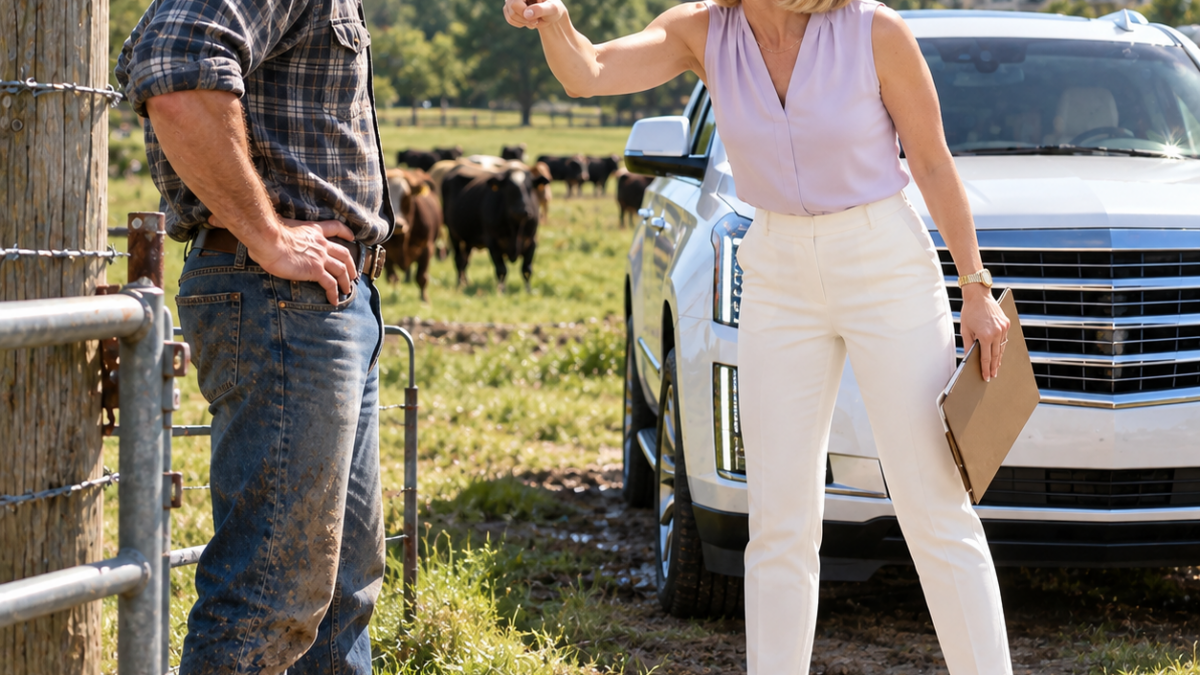
I looked up and saw a white Cadillac Escalade bouncing across my land.
It came from the direction of the new housing development half a mile away and angled straight through the field toward the county road on the far side of my property. The vehicle wasn’t crawling along like someone lost and embarrassed. It was moving fast enough to kick dust behind it, fast enough to make my cattle lift their heads and scatter.
For a second, I just stared.
My family had owned that farm for three generations. Forty acres. Not an empire, not some massive corporate operation, but enough to raise cattle, cut hay, rent a few acres to a local farmer for corn, and live without punching a clock under fluorescent lights. My grandfather had worked that soil until his hands looked like bark. My father had kept it alive through bad years, dry years, and one flood that nearly took the barn. By the time it became mine, the place was paid off, surveyed, fenced, posted, and recorded in the county offices so clearly that even a bored intern could have traced the boundary lines.
There was no public road through my land.
There was no easement.
There was no community trail.
There was no permission.
I dropped the wrench into my toolbox and stepped into the vehicle’s path, waving both arms.
The Escalade slowed, then stopped about fifteen feet from me. Dust drifted around the hood. The driver’s window rolled down with a soft electric buzz.
That was my first close look at Karen Whitmore.
She was probably in her late forties, though she carried herself like age was something she intended to discipline out of the room. She had smooth blond hair cut to her jaw, oversized sunglasses pushed up on her head, pearl earrings, and a sleeveless cream blouse that looked painfully expensive for someone driving through a field. Her nails were glossy red. Her lips were the same color. A gold bracelet flashed on her wrist as she rested one hand on the steering wheel.
She looked at me the way someone looks at mud on a clean floor.
“Can I help you?” she asked.
Not polite. Not curious. That tone people use when what they really mean is, why are you in my way?
I kept my voice even. “You’re on my property.”
Her eyebrows lifted behind the sunglasses.
“This is private land,” I said. “You need to turn around and use the main roads.”
She laughed.
Not a nervous laugh. Not a confused laugh.
A sharp little laugh, like I had said something charmingly stupid.
“This is not your property,” she said.
I blinked. “Excuse me?”
“This is HOA common area. It’s designated for community access.”
For a moment, I honestly wondered if I had misheard her.
“Lady,” I said, “this is my farm.”
Her mouth tightened. “Don’t call me lady.”
“Then don’t drive through my field.”
She leaned slightly toward the window, her perfume drifting out into the warm air. “I’m on the HOA board. I’ve seen the maps.”
“I don’t care if you’ve seen treasure maps. You’re trespassing.”
Her fingers tapped the steering wheel. “You’re mistaken.”
“I’ve owned this farm for fifteen years. My family owned it sixty years before that. I can show you the survey right now.”
“I don’t need to see anything.” She rolled her eyes like I was wasting her valuable time. “The development has access rights for community circulation. If you have an issue, you can take it up with the board.”
“The board doesn’t own my land.”
“You people always make everything difficult.”
That stopped me.
“You people?”
She smiled without warmth. “Rural landowners who don’t understand that communities grow.”
Something hot moved through my chest, but I swallowed it down. I had cattle nearby, crops under tire tracks, and a stranger in a luxury SUV telling me my land belonged to her neighborhood.
“Turn around,” I said.
Instead, she put the Escalade in gear.
“Do not harass HOA board members,” she said, already rolling up the window. “We take that very seriously.”
Then she drove past me.
Right past me.
Across my field, over grass I had planned to cut that week, leaving two dark tracks pressed into the dirt.
I stood there watching until the Escalade disappeared onto the county road.
That was the day Karen Whitmore taught me something I should have learned sooner.
Some people don’t misunderstand boundaries.
They hate them.
part2
By the time I got back to the house, I was angry enough that my hands were shaking.
My kitchen still smelled like coffee. My old dog, Boone, lifted his head from his bed near the back door, decided my mood was not worth getting up for, and dropped his chin back onto his paws. I went straight into the small office off the hallway and opened the file cabinet where I kept the property records.
Deed.
Survey.
Tax records.
County plat.
Fence map.
Everything.
I spread the papers across my desk and checked what I already knew. The property lines were clear. The development sat on completely different parcels. There was no easement through my land, no right-of-way, no trail, no access corridor, no “community circulation,” whatever that was supposed to mean.
There was my farm.
There was their subdivision.
Between them was private property and reality.
Apparently, Karen had no use for either.
The housing development had gone up about eight years earlier. I remembered when the land beyond my north ridge was still woods and scrub. Then the bulldozers came, the trees disappeared, and a sign went up showing smiling families, elegant homes, walking paths, and a name that sounded like it had been invented by people who thought nature was a marketing theme.
Stonebridge Glen.
The homes were big, clean, and expensive. The kind with perfect lawns, fake shutters, and HOA-approved mailboxes. I didn’t care. People could live how they wanted, as long as how they wanted didn’t spill through my fences.
For a while, it didn’t.
Then, about six months after the last phase filled in, I noticed tire tracks in the east field.
At first, I told myself what any reasonable person would. Maybe someone got lost. Maybe a delivery driver followed bad GPS. Maybe a teenager made one dumb choice. I put up a few more Private Property signs and moved on.
Then the tracks came back.
Same route. Same angle. Same shortcut from the development side toward the county road.
I put up large orange No Trespassing signs every fifty feet along the path.
The tracks kept coming.
I installed wooden rail barriers.
Someone knocked them down.
I put in plastic posts.
They were driven over.
That was when I caught Karen in the Escalade, and suddenly all the random damage had a face, a voice, and pearl earrings.
The next morning, I called the HOA management company.
It took three transfers, two holds, and one woman who kept asking if I was calling about pool access before I finally reached someone who could look at the actual map.
“My name is Thomas Reed,” I said. “I own the farm east of your Stonebridge Glen development. One of your board members is claiming my land is HOA common area.”
There was a pause.
“Could you repeat that?”
“I wish I couldn’t.”
I gave them Karen’s name, the location, the parcel number, and a description of the route she had been using.
The man on the phone clicked around for a while.
“No,” he finally said. “Your parcel is not part of Stonebridge Glen.”
“I know that.”
“There is no recorded easement through your property.”
“I know that too.”
“And the HOA has no ownership or access rights there.”
“That makes three of us who know it now.”
He sounded embarrassed. “Would you like us to send a notice to the board?”
“Yes. Specifically to Karen Whitmore.”
“I’ll send it today.”
I hung up feeling slightly better.
That feeling lasted until the next morning, when the white Escalade cut through my field again at 7:42 a.m.
This time, I filmed it.
The day after that, it came through at 7:39 a.m. and again at 5:18 p.m.
I filmed both.
By the end of the week, I had a folder on my computer named KAREN TRESPASSING. Inside were photos, videos, dates, times, and notes about damage. I sent Karen a certified letter explaining that she was trespassing on private property and had no right to use my land. It included the parcel number, copies of the map, and a warning that further entry would result in legal action.
The letter came back refused.
So I sent another copy to the HOA management company for her attention.
No response.
I found her public board email on the HOA website and sent a message there too. I kept it short and professional.
Ms. Whitmore, you are repeatedly trespassing on my private farmland. The HOA management company has confirmed that Stonebridge Glen has no access rights to my property. Stop immediately.
She replied twelve minutes later.
Mr. Reed, your tone is inappropriate. I will not be intimidated by aggressive landowners.
I stared at the screen, then laughed once because if I didn’t laugh, I was going to put my fist through the desk.
I wrote back.
Stop driving through my field.
Her response came almost immediately.
The community will not be held hostage by outdated boundaries.
I saved that one too.
My lawyer, Rachel Monroe, looked at the email in her office two days later and raised both eyebrows.
“Outdated boundaries?” she said.
“She’s creative.”
“She’s reckless.”
Rachel had been my lawyer for years, mostly for boring farm things—lease agreements, equipment purchase contracts, a dispute once with a hay buyer who thought “delivered” meant “delivered someday when vibes allow.” She was calm, sharp, and did not waste words.
She flipped through the photos I had printed.
“You have a strong trespass case,” she said. “And if this continues, we can pursue an injunction.”
“How long does that take?”
“That depends.”
“That means slow.”
“It can mean slow.”
I leaned back in the chair. “Meanwhile she keeps tearing up my field.”
Rachel folded her hands. “Document everything. Don’t threaten her. Don’t block her in. Don’t do anything that makes you look like the unreasonable one.”
“I’m the one whose field has tire ruts.”
“I know. But being right and looking right in court are not always the same work.”
I hated that she was right.
For the next month, I did everything the clean way.
I documented.
I called the HOA again.
I sent more letters.
I took pictures of every new rut, every broken post, every place the grass was crushed and the soil began to trench under repeated tire pressure.
Karen ignored all of it.
She drove through my land at least once a day, sometimes twice. Always in the white Escalade. Always too fast. Sometimes with coffee in one hand. Once, with a phone pressed to her ear, not even looking toward the cattle as they scattered from the sound.
One afternoon, I stood at the edge of the route and held up my phone as she approached. She slowed just enough to roll down her window.
“Get out of my field,” I said.
She smiled. “You really need a hobby.”
“This is my property.”
“It’s a community access corridor.”
“Show me one document.”
She tapped the steering wheel with her nails. “I don’t answer to you.”
“You’re damaging crops.”
“Then send a bill to the HOA.”
“The HOA doesn’t own this.”
Her sunglasses slid down her nose slightly as she leaned forward. “Mr. Reed, I don’t know what sort of little kingdom you think you run out here, but progress happens whether you like it or not. The people in Stonebridge Glen pay dues. They pay taxes. They are entitled to reasonable access.”
“You have roads.”
“This route saves time.”
There it was.
Not safety.
Not legal right.
Not community necessity.
Convenience.
Five minutes, maybe less, depending on traffic.
I pointed toward the far road. “Use the public route.”
She rolled her window up.
“Have a blessed day,” she said through the glass, then drove away, leaving dust in my face.
I went to an HOA meeting the following week.
That was my attempt to handle things face-to-face in a room full of witnesses. I wore clean jeans, a button-down shirt, and boots without manure on them, which counted as formal wear in my life. The meeting was held in their clubhouse, a stone-and-glass building that probably cost more than my barn and still managed to feel cheaper.
Karen sat at the front table beneath a framed print of the Stonebridge Glen logo. She wore a navy dress, a white blazer, and a gold name badge that read KAREN WHITMORE – DIRECTOR OF COMMUNITY STANDARDS.
That title explained far too much.
When public comments opened, I stood.
“My name is Thomas Reed,” I said. “I own the farm east of your development. One of your board members has been repeatedly driving through my land—”
Karen struck the table with a small gavel.
“You are not a resident,” she said.
“No, I’m the person whose property you keep trespassing on.”
A few people turned toward her.
Her smile froze.
“This forum is for HOA members only.”
“Your board member is damaging private property.”
She looked toward the back of the room. “Security.”
I almost laughed because I thought she was joking.
She wasn’t.
A man in a black polo shirt came over, looking deeply uncomfortable.
“Sir,” he said quietly, “I’m going to have to ask you to leave.”
“Are you serious?”
He lowered his voice. “Please don’t make this harder.”
Karen watched with that same polished, superior expression she had worn in the Escalade.
“This is official HOA business,” she said. “Disruptions will not be tolerated.”
I left before my temper could give her anything useful.
That night, I sat at the kitchen table with a stack of photographs and a cup of coffee I didn’t drink. The tire ruts had grown deep enough that water collected in them after rain. That field had a natural drainage pattern, and Karen’s repeated path was starting to interfere with it. If it kept going, I would have erosion problems. Real ones. Expensive ones.
Boone lay under the table, his tail thumping once each time I shifted my foot.
“I’m trying to do this right,” I told him.
He sighed like he had heard that from humans before and wasn’t impressed.
The next morning, after Karen’s Escalade crossed my land again, I drove to the sheriff’s office.
A deputy I knew, Mark Hollis, met me in the lobby. We weren’t close friends, but in a rural county, you know people. Mark had helped when a drunk driver took out my south fence years earlier. He was practical, steady, and allergic to drama.
I laid everything out.
Photos.
Videos.
Returned letters.
Emails.
The HOA management confirmation.
Rachel’s advice.
Maps.
Damage.
Mark watched the videos twice.
“She drives like she’s late to inherit the county,” he said.
“She thinks my field is a shortcut.”
“It is a shortcut.”
I looked at him.
He held up a hand. “Not a legal one. Just saying that’s the kind of stupid that convinces people they’re clever.”
“What can I do?”
“We can issue a formal trespass warning if we catch her or serve her properly. You can keep pursuing civil action. You can improve barriers.”
“She drives over barriers.”
Mark leaned back. “Then improve them better.”
“I’ve thought about vehicle deterrents.”
His eyes narrowed slightly. “What kind?”
“Spike strips.”
He didn’t answer immediately.
“I’m not talking about hidden traps,” I said. “I’m talking about marked deterrents. Warning signs. Final written notice. Everything documented. I want her to stop driving through my field before she ruins it or hits livestock.”
Mark rubbed his jaw.
“I can’t give you legal advice,” he said. “You have a lawyer for that.”
“I know.”
“But I can tell you what will matter if someone calls us screaming. Clear signage. Multiple warnings. Proof she knew. Proof the devices were visible or at least clearly announced. No intent to hurt a person. No hidden booby-trap nonsense. And call us when it happens. Don’t get into a shouting match.”
“I’m tired of shouting.”
“Good. Courts like tired better than crazy.”
I took the idea back to Rachel.
She did not love it.
She sat in silence for nearly a full minute after I explained.
“Thomas,” she said finally, “this is the kind of thing that can go sideways if done carelessly.”
“So tell me how not to do it carelessly.”
“I want final written warnings. I want them clear and boring. I want signage so obvious a blind raccoon would feel insulted. I want photos of every sign. I want no hidden devices. I want no dangerous homemade garbage. I want you to call the sheriff immediately if she triggers them. And I want you to understand she may sue you anyway.”
“She’s going to sue me no matter what I do.”
Rachel sighed. “Probably.”
“Can I legally protect my field?”
“Yes, within limits. And based on what you’ve shown me, after repeated warnings and property damage, properly marked vehicle deterrents are defensible.”
“Defensible isn’t the same as fun.”
“No,” she said. “But neither is watching someone steal your property one tire track at a time.”
So I gave Karen one last chance.
Three certified letters went out.
One to her home.
One to the HOA management company for her attention.
One to her workplace address, which was public because she was a real estate broker and had her name plastered across half the internet.
The letters were identical. Rachel drafted most of the language.
You are trespassing on private property located at the address and parcel listed below. You have been verbally warned, notified by email, and informed through the HOA management company that no access right exists. Effective immediately, vehicle deterrent devices will be installed to prevent unauthorized vehicular entry. Unauthorized vehicles may be damaged if they continue past posted warnings. Use public roads only. Further trespass will result in legal action.
This time, one letter was accepted.
The one sent to her workplace.
I knew because the receipt came back with a signature.
Not Karen’s, but someone had signed for it.
Good enough.
Then I put up the signs.
I didn’t put up one or two. I put them everywhere along the route she used. Large yellow reflective signs with black lettering.
PRIVATE PROPERTY
NO TRESPASSING
VEHICLE DETERRENTS IN USE
TIRE DAMAGE MAY OCCUR
TRESPASSERS WILL BE PROSECUTED
I installed them at both ends of the route and along the path every twenty feet. I photographed each one. I filmed the whole route from both directions. I placed cameras at multiple angles, motion-activated and time-stamped. I saved the receipts for every post, sign, and device.
Then I installed the deterrents.
I am not going to pretend I felt noble doing it. I felt angry. I felt cornered. I felt like a man forced to defend something that should never have been up for debate.
But I also felt calm.
Because Karen had choices.
She could use the road.
She could accept the map.
She could respect the signs.
She could stop.
Four days passed.
No Escalade.
I started to wonder if the final warning had worked.
On the fifth morning, my phone exploded with camera alerts.
I was in the barn changing a belt on the tractor. The first alert showed dust rising near the development side. The second showed the white Escalade entering the field.
Same angle.
Same speed.
Same contempt.
I opened the live feed.
Karen drove past the first sign without slowing.
Then the second.
Then the third.
The Escalade bounced over the uneven ground, sunlight flashing off the windshield. For a second, I could see her face through the glass. Sunglasses on. Chin lifted. One hand on the wheel.
She passed another warning sign.
Then her front tires hit the first deterrent.
The Escalade lurched.
For a moment, it slowed.
Then it kept going.
I said out loud, alone in the barn, “You have got to be kidding me.”
She drove another twenty yards before the rear tires hit the second line. The vehicle sagged slightly, but momentum and stubbornness carried it forward. By the time it reached the third warning zone, all four tires were losing air.
The Escalade rolled to a stop in the middle of my field, tilted like a wounded ship.
I saved the footage immediately.
Then I called the sheriff.
“This is Thomas Reed,” I said. “I have a trespasser disabled on my property after driving past posted warnings.”
The dispatcher asked if anyone was injured.
“Not unless pride counts.”
“Deputies are on the way.”
I walked out slowly, phone recording in my hand.
Karen was standing beside the Escalade, screaming into her phone. She had on white pants, a coral blouse, and wedge sandals that were sinking into the dirt. The Escalade sat on four flattening tires, its glossy perfection ruined by dust and grass.
When she saw me, her face twisted.
“You psychopath!” she shouted. “You destroyed my car!”
“I already called the sheriff.”
“I’m calling them too!”
“Good. Saves time.”
She pointed at me, her hand shaking with rage. “You set traps.”
“No. I posted warnings.”
“This is illegal!”
“You drove past at least fifteen signs.”
“This is HOA land!”
I kept my phone raised. “For the record, this is private property owned by me. You have been warned verbally, in writing, and through your management company. You accepted final notice four days ago through your workplace. You ignored posted signs and continued trespassing.”
Her eyes went to the phone.
“Stop recording me.”
“No.”
She stepped toward me and reached for it.
I moved back.
“Don’t touch me.”
“I’m going to sue you for everything you have.”
“You’ll need a tow truck first.”
Her mouth opened, then closed. For the first time since I had met her, Karen seemed to have run into a sentence she could not dominate.
The deputy who arrived was Mark Hollis.
He stepped out of his cruiser, looked at the Escalade, looked at the signs, looked at me, then looked at Karen.
His face remained professional, but his eyes gave him away.
“Morning,” he said.
Karen stormed toward him.
“Officer, this man set illegal spike traps and destroyed my vehicle. I want him arrested.”
Mark held up one hand. “Ma’am, slow down.”
“He’s dangerous.”
“Are you injured?”
“I am emotionally traumatized.”
Mark blinked once. “Are you physically injured?”
“No, but—”
“Okay.” He looked at me. “Mr. Reed?”
I handed him a folder.
Karen stared. “What is that?”
“Documentation,” I said.
Inside were the property map, warning letters, delivery receipts, photos of the signs, screenshots of emails, the HOA management confirmation, and stills from the camera showing Karen driving past posted warnings.
Mark reviewed enough to understand the shape of it.
“Ma’am,” he said, turning back to Karen, “this appears to be private property.”
“It is not.”
“Do you have documentation showing a legal right to access this land?”
“I’m on the HOA board.”
“That is not documentation.”
Her cheeks flushed. “The board has maps.”
“Do you have one?”
“Not with me.”
“Do you have any recorded easement, deed, court order, access agreement, anything like that?”
She lifted her chin. “This is a community matter.”
“No, ma’am. Right now it’s a trespassing matter.”
Her expression shifted from rage to disbelief.
Mark continued. “You have been warned. The landowner has provided evidence of repeated notice. You drove past visible warning signs. I’m issuing a formal trespass warning today. If you come onto this property again, you may be arrested.”
Karen’s mouth fell open.
“You’re taking his side?”
“I’m taking the law’s side.”
“He ruined my tires.”
“You drove over marked vehicle deterrents on land you had been told not to enter.”
She looked at me with pure hatred.
“This isn’t over.”
I believed her.
The tow truck took more than an hour to arrive. Karen sat in her disabled Escalade the entire time, making calls, glaring through the windshield, and occasionally wiping at her face like angry tears were an insult she refused to acknowledge.
The tow truck driver struggled to get the Escalade out without tearing up more of my field. I documented that too.
I did not help.
I did not gloat.
I just stood near the fence with Boone beside me and watched the white vehicle disappear the same way it had entered my life—leaving damage behind.
For two weeks, the field was quiet.
No Escalade.
No new tracks.
No dust cloud from the development.
I repaired the worst ruts, reseeded a strip of grass, and let myself imagine the thing might finally be over.
Then I got served.
Karen sued me for $25,000.
Property damage.
Emotional distress.
Illegal traps.
Malicious destruction of a motor vehicle.
She demanded reimbursement for four tires, towing, “loss of use,” legal fees, and an injunction requiring me to remove “all hazardous devices from HOA-accessible property.”
I stood on my porch reading the lawsuit with the same strange calm I had felt watching her drive past the signs.
Boone sniffed the process server’s pant leg, sneezed, and walked away.
That seemed about right.
Rachel was not surprised.
“This is frivolous,” she said after reading the complaint. “But frivolous still has to be answered.”
“Can we countersue?”
“Oh, we absolutely can.”
She filed our response and counterclaims for trespass, property damage, nuisance, and bad-faith litigation. We included photographs of the ruts, estimates for drainage repair, evidence of repeated warnings, sheriff’s reports, the footage, and every self-important email Karen had been foolish enough to send.
The legal process took months.
During that time, I learned that courts move like old tractors. Powerful, maybe reliable, but never fast when you’re standing in the field waiting for the work to be done.
Karen’s attorney tried everything.
He argued the deterrents were booby traps.
Rachel responded that they were marked vehicle deterrents placed after months of trespass and warnings, designed to disable tires, not harm people.
He argued the signs were inadequate.
Rachel submitted photos showing the route lined with reflective warnings so obvious they could probably be seen from space.
He argued Karen had established an implied easement by using the route regularly.
Rachel nearly smiled at that one.
“Your Honor,” she said at one hearing, “illegal trespass repeated often enough does not become a property right. If it did, burglary would be a mortgage program.”
Even the judge’s mouth twitched.
Discovery was where Karen truly began to bury herself.
We obtained her emails, text messages, and posts from the private HOA Facebook group. Apparently, Karen had been bragging.
Found a faster route through the farm road. Saves me at least five minutes in the morning.
The farmer is being difficult, but he’ll learn cooperation eventually.
Rural people get territorial over land they barely use.
Someone has to teach these holdouts that community planning matters.
Five minutes.
That was what this entire nightmare had been about.
Five minutes off her commute.
Five minutes that she believed mattered more than my crops, my cattle, my fence posts, my drainage, my peace, my rights, my family history, and every warning I had given her.
I read the messages in Rachel’s office and felt something colder than anger.
Anger burns.
This settled.
“She did all this for five minutes,” I said.
Rachel nodded. “And control.”
“That too.”
“There’s more.”
She handed me a deposition transcript.
Karen had sat for questioning the week before. I had not attended because Rachel thought my presence might make Karen perform instead of answer. Based on the transcript, she had performed anyway.
Rachel had asked, “Why did you continue using Mr. Reed’s property after receiving notice that you had no legal access?”
Karen answered, “Because the route was necessary.”
“Necessary for what?”
“For efficient travel.”
“Were public roads available?”
“Yes, but they were inefficient.”
“How much time did the route through Mr. Reed’s property save you?”
“I don’t know exactly.”
“Approximately.”
“Five minutes.”
“Five minutes each way?”
“Sometimes.”
“And you believed saving five minutes gave you the right to cross private property?”
“I believed the property should have been designated for community access.”
“But was it?”
“It should have been.”
“Was it?”
“I’m not a surveyor.”
“Did the HOA management company inform you that the property was not HOA land?”
“They sent an email.”
“Did you read it?”
“I skimmed it.”
“Did you continue driving through Mr. Reed’s property afterward?”
“I continued using the access corridor.”
“The land.”
“The corridor.”
“Ms. Whitmore, did you have any deed, easement, license, court order, or written agreement allowing you to enter Mr. Reed’s farm?”
“I’m on the HOA board.”
Rachel had paused there. I could almost hear it through the transcript.
“That was not my question.”
Karen answered, “I didn’t need documentation. I was acting for the good of the community.”
I lowered the pages.
“She really said that?”
“She really said that.”
“For the good of the community.”
“Yes.”
“While driving alone to work.”
“Yes.”
I looked back at the transcript.
Sometimes people imagine villains twirling mustaches, making plans in dark rooms, knowing they are villains.
Karen was worse than that.
Karen thought she was righteous.
She thought the world was divided into people who understood standards and people who needed to be corrected. She thought a title on an HOA website turned her convenience into authority. She thought my farm became negotiable because she wanted something from it.
That kind of arrogance is harder to fight than greed, because greed knows when it is stealing.
Karen believed she was improving me.
The hearing that ended it came seven months after she filed the lawsuit.
I remember the courthouse smelled like old paper and floor polish. I wore a clean shirt, dark jeans, and boots I had scrubbed the night before. Karen arrived in a tailored black suit with her blond bob perfectly curved under her chin. She looked composed until she saw me. Then her mouth tightened.
Rachel touched my elbow.
“Let her look,” she said quietly. “Today she has to listen.”
The judge had already reviewed the filings. That became clear within minutes.
Karen’s attorney stood first and argued that no private citizen should be allowed to destroy a vehicle over a property dispute. He described Karen as a community leader, a woman trying to navigate ambiguous access rights, a resident misled by unclear boundaries.
Rachel stood after him with one folder and no theatrics.
She walked the court through the timeline.
The property records.
The first confrontation.
The HOA management confirmation.
The refused letters.
The accepted final warning.
The signs.
The videos.
The sheriff’s report.
The deposition.
The Facebook posts.
The damage estimates.
She did not raise her voice once.
She did not have to.
Karen had supplied all the volume the case needed.
The judge asked Karen’s attorney a simple question.
“Where is the ambiguity?”
He shuffled papers.
“Your Honor, the route had been used—”
“Illegally.”
“It had been treated as community access by my client.”
“Incorrectly.”
“My client believed—”
“Belief is not a deed.”
Silence.
The judge looked down at the documents, then back up.
“Ms. Whitmore was told repeatedly that she had no right to enter the property. She ignored warnings, refused or evaded communication, drove past posted signs, and then sought to use this court to recover damages caused by her own decision to trespass.”
Karen stared straight ahead.
The ruling came in writing two weeks later.
I opened the email from Rachel at my kitchen table. Boone was under the table. Coffee steamed beside my hand. Outside, the repaired field was green again in patches, stubborn grass pushing through the scars.
The judge dismissed all of Karen’s claims.
Then he awarded me damages for the documented trespass, the field repair, drainage restoration, legal fees, and punitive damages for bad-faith litigation.
Total judgment: just over $31,000.
I read that number three times.
Then I read the paragraph Rachel told me to look at.
The Court finds that Ms. Whitmore’s conduct demonstrated a willful and persistent disregard for clearly established property rights. Her continued trespass after repeated warnings reflects an entitled attitude inconsistent with the rule of law. The lawsuit appears to have been filed not to seek legitimate relief, but to punish the defendant for enforcing boundaries Ms. Whitmore had no right to cross.
I sat back.
For a long moment, I did nothing.
Then I laughed.
Not because it was funny.
Because something heavy had finally lifted, and my body didn’t know what else to do.
Karen’s consequences did not stop with the judgment.
The HOA management company, which had tried very hard to avoid becoming part of her personal disaster, was furious. Their own staff had told her the farm was not HOA property. She ignored them. Then she kept claiming authority she did not have. Then she sued me and dragged Stonebridge Glen’s name into court filings that became public.
Someone leaked the documents online.
I don’t know who.
I didn’t ask.
But once the story spread through the neighborhood, Karen’s image as the elegant protector of community standards cracked wide open.
Residents learned she had been using my farm as a private shortcut to save five minutes. They learned she had ignored warnings. They learned she had claimed HOA authority where none existed. They learned she had risked dragging the association into liability because she couldn’t stand being told no.
At the next special meeting, they voted her out.
I did not attend, but three people told me about it afterward.
Apparently, Karen gave a speech.
She said she had been targeted by anti-HOA sentiment. She said rural resentment had been weaponized against her. She said she had only ever acted to preserve access, continuity, and community values.
Then an older man in the second row stood up and asked, “Did the farm belong to us?”
Karen tried to talk around it.
He repeated, “Did the farm belong to us?”
She did not answer.
That was answer enough.
They removed her from the board that night.
Her insurance refused to cover the tire damage because she had willfully ignored posted warnings while trespassing. She had to pay for the tires, the tow, her lawyer, the judgment, and whatever embarrassment costs when it compounds in a neighborhood full of people who pretend not to gossip while doing nothing else.
About a year later, she and her husband sold their house.
I saw the sign go up from the far ridge.
FOR SALE.
Then SOLD.
Then one morning, a moving truck pulled into her driveway.
I was repairing a section of fence when she came outside carrying a small box. She saw me across the distance between her old neighborhood and my land.
For a second, we looked at each other.
No sunglasses this time.
No window between us.
No board title.
No Escalade.
Just Karen standing in her perfect driveway, and me standing beside the field she had once believed she could claim by repetition.
She looked away first.
That was the closest thing to an apology I ever got.
I used part of the judgment money to improve the property.
Not because Karen had scared me off my own land, but because she had reminded me that clear boundaries are only useful when they are visible to people determined not to see them.
I installed proper gates where my land met the road. I added motion cameras with better angles. I put up professional signage that no one could pretend to miss. I repaired the drainage in the field she had damaged, and honestly, it ended up better than before. The ruts were filled, the grade was corrected, and the next rain flowed the way it was supposed to.
The vehicle deterrents stayed behind the warnings.
I have not had to use them again.
Word travels fast when a rich woman in a white Escalade loses four tires, a lawsuit, a board seat, and thirty-one thousand dollars because she couldn’t take the long way around.
The development has been quiet since.
Sometimes people from Stonebridge Glen wave when they pass on the public road. Some don’t. That’s fine. I don’t need friendship from people who once watched their board member treat my field like a driveway. I need distance, respect, and gates that close.
I still farm my land.
I still wake before sunrise, drink coffee too hot, argue with equipment older than some of the people who tried to lecture me about progress, and watch cattle move through morning fog like dark shapes in a dream. I still cut hay. I still rent the corn acreage. I still walk the fences after storms.
The farm is not fancy.
It does not have approved colors.
It does not have a clubhouse.
It does not have a community standards committee.
It has mud, sweat, grass, diesel fumes, stubborn animals, old trees, and a history deeper than any subdivision brochure.
And it is mine.
That matters.
More than Karen understood. More than five minutes. More than convenience. More than the kind of authority people invent when real authority tells them no.
Some people believe wanting something badly enough gives them a right to take it. They dress that belief up in words like community, standards, access, progress, and fairness. But underneath, it is still taking.
Karen chose to trespass.
She chose to ignore warnings.
She chose to drive past the signs.
She chose to sue after her own decisions caught up with her.
Every step of the way, there was a road available to her.
A real road.
A public road.
A legal road.
It took five minutes longer.
She could have taken it at any time.
Instead, she tried to make my land bend around her convenience.
In the end, the land stayed where it was.
So did the law.
And so did I.