FULL ENDING The Woman in the Trailer Said My Farmhouse Belonged to Her Family Until the Sheriff Found Her on My Porch
part2
The first time she spoke to me, I was repairing a section of fence near the orchard.
She came over wearing tight jeans, wedge sandals that sank into the soft ground, and a white sleeveless top too clean for the dusty walk from her trailer. Her hair was big, sprayed, and aggressively blond, the kind of style that seemed to declare battle against humidity. She had oversized sunglasses perched on her head and a phone in one hand, though she was not using it. Just holding it like proof she could call someone important if the world disappointed her.
“Beautiful house,” she said.
I looked up from the post hole. “Thank you.”
“How many bedrooms?”
That was not a question I expected from a stranger.
“Enough,” I said.
She laughed like I had made a joke. “No, really. How many?”
I rested my forearm on the shovel handle. “Can I help you with something?”
“I’m Karen. I’m next door.”
She pointed at the trailer.
I nodded. “Nice to meet you.”
“You live here alone?”
The way she asked it made my shoulders tighten.
“Yes.”
“All this space for one person?”
I looked out over the yard, the porch, the trees beyond. “That’s the idea.”
She tilted her head. Her smile stayed in place, but her eyes narrowed.
“Must be nice.”
“It is.”
“You have family?”
“Not nearby.”
“So you don’t really need all this.”
There are moments in life when a person tells you exactly who they are, but politeness makes you pretend you did not hear it.
I picked up the shovel again. “Well, it was my aunt’s place. I take care of it.”
Karen looked toward the house with an expression I did not like. Not admiration. Calculation.
“My kids would love a house like that,” she said.
I did not know how to answer that, so I gave a neutral hum and went back to work.
She stayed another minute, asking questions that got more intrusive each time. How much land came with it? What was the house worth? Did I own it outright? Did I ever think about selling? Was it hard keeping up with so many rooms “at my age”?
At my age.
I was fifty-five then, not a fossil, but Karen had a talent for making any sentence feel like a finger poking a bruise.
I finally said, “I need to finish this before the heat gets worse.”
She took the hint badly.
“Sure,” she said. “Wouldn’t want to interrupt all your important fence work.”
Then she walked back to her trailer, leaving behind a cloud of sweet perfume and entitlement.
I hoped that would be the end of our meaningful conversations.
Of course, it was only the beginning.
Over the next few months, Karen’s interest in my house grew from rude curiosity into open resentment. She would appear whenever I was outside, as if she had set an alarm for my peace. If I was pruning trees, she would comment on how many fruit trees I had “for one man.” If I was sitting on the porch, she would mention how unfair it was that some people got wraparound porches while families were “crammed into boxes.” If I carried groceries inside, she would ask whether I ever used the dining room or if it “just sat empty.”
Her children played outside often.
I never minded that. Kids need to run. They were loud sometimes, but loud children in the country are not exactly a tragedy. I had no issue with them kicking balls, chasing each other, or making forts out of sticks. The only time I said anything was when I found two of them climbing one of my apple trees and snapping small branches to throw at each other.
I walked over to the fence and said, “Hey, kids. Please stay out of the fruit trees. They’re old.”
They climbed down.
No yelling. No threats. No drama.
Karen turned it into one anyway.
She came marching over fifteen minutes later, face tight, sunglasses on her head like a crown.
“Did you yell at my children?”
“No.”
“They said you yelled.”
“I asked them not to climb my trees.”
“They’re kids.”
“I noticed.”
“They need somewhere to play.”
“They can play on your side.”
Her mouth twisted. “My side is not exactly a park.”
“That is not my fault.”
“You have trees everywhere.”
“Yes.”
“And no children.”
I stared at her.
She stared back like that was a complete argument.
“Karen,” I said slowly, “your children are not allowed to climb my fruit trees.”
“You are such a typical selfish old man.”
Something in my chest tightened.
I had heard worse in burning buildings from people half out of their minds with fear, but this was different. This was calm cruelty dressed as moral superiority.
“You don’t know anything about me,” I said.
“I know enough.”
“No,” I said, and felt my voice go colder than I intended. “You really don’t.”
She flinched at the tone, then recovered with a scoff.
“Whatever. Keep your precious trees.”
“I plan to.”
After that, her comments turned sharper.
She began glaring at me from her lawn chair whenever I stepped outside. If I started my mower, she yelled that the noise bothered her. If I split wood, she accused me of showing off. If I had a neighbor over for coffee on the porch, she watched us like we were conspiring.
I started a journal.
That may sound dramatic, but old instincts die hard. In the FDNY, documentation mattered. Details mattered. Times, dates, conditions, names. A scene could become chaos in seconds, and what you remembered afterward was not always enough. So I bought a black composition notebook and began writing down every strange interaction.
June 4 — Karen asked again how many rooms in house. Said “families should get priority over single men.”
June 11 — Children climbing apple trees. Asked them to stop. Karen called me selfish old man.
June 18 — Karen yelling from property line while I repaired fence. Said land “should be used by someone who appreciates family.”
At first, writing it down made me feel ridiculous.
Later, it saved me.
The day Karen asked me to swap homes began with rain.
Not hard rain. Just a steady gray drizzle that made the whole world smell like wet grass and old wood. I was on the porch with coffee, enjoying the fact that for once I had no urgent repairs to handle, when Karen crossed onto my driveway carrying a folder under one arm.
That folder should have warned me.
She came up the steps without being invited and stopped near the porch swing.
“We need to talk.”
I lowered my coffee. “Morning to you too.”
“This is serious.”
“It usually is with you.”
She ignored that. Her hair was bigger than usual, protected from the drizzle under a plastic hood that made her look even more annoyed with the weather for existing. She wore a red raincoat, black leggings, and boots too shiny for mud.
“I’ve been thinking,” she said.
I waited.
“It makes sense for us to trade.”
“Trade what?”
“Homes.”
I stared at her.
Then I laughed.
I did not mean to. It came out before I could stop it, short and disbelieving.
Karen’s face hardened instantly.
“That is extremely rude.”
“I’m sorry,” I said, though I was still half laughing. “I thought you were joking.”
“I am not joking.”
That killed the laughter.
She opened the folder and pulled out a sheet of notebook paper covered in handwritten notes.
“Your house is too large for one person. My trailer is perfectly adequate for a single man. I have children. I am a woman. I need safety, space, bedrooms, land. You need less responsibility.”
I looked at her for a long moment.
“Karen.”
“Before you say anything, I am willing to sign the trailer over to you.”
“That trailer?”
“Yes.”
“In exchange for my farmhouse.”
“Yes.”
“My farmhouse, my land, my orchard, my garage, and everything my aunt left me.”
She waved one hand like I was getting bogged down in details.
“We can work out specifics.”
“No.”
“You haven’t even considered it.”
“I considered it before you finished the sentence.”
Her lips thinned. “You are being emotional.”
“I’m being clear.”
“The trailer is big enough for one person.”
“I do not want your trailer.”
“My children need space.”
“They are your children.”
Her eyes flashed.
“You don’t need this much room. You’re alone.”
“This house belonged to my aunt.”
“And now it belongs to you because you got lucky.”
I set the coffee down carefully.
“No. It belongs to me because she left it to me.”
“Same thing.”
“It is not the same thing.”
Karen stepped closer, clutching the folder to her chest.
“You people with extra always act like someone asking for fairness is attacking you.”
“Trying to take my home is not fairness.”
“I’m not trying to take it. I’m offering a trade.”
“A ridiculous trade.”
“It is not ridiculous. It makes perfect sense. You’re just selfish.”
There it was again.
Selfish.
The word landed somewhere near scars she could not see.
I thought of a night in Brooklyn when I was thirty-eight, crawling down a hallway with smoke so thick my mask felt like the only thing separating me from the next world. I thought of a child passed into my arms through a window. I thought of burns across my back from falling debris while we got an old man out of a kitchen fire. I thought of funerals. Bagpipes. Black bands over badges.
Selfish.
I stood.
Karen took a half step back.
“The answer is no,” I said. “No trade. No discussion. No paperwork. No.”
“You are a greedy, nasty old man.”
My hands curled once, then opened.
I had learned a long time ago that anger is useful only if you control where it goes.
“Leave my porch.”
She looked startled, then offended.
“I’m trying to solve a problem.”
“You are the problem on my porch.”
Her mouth opened.
“Leave,” I repeated.
She stormed down the steps, boots hitting each board like punctuation.
At the bottom, she turned back and shouted, “You’ll regret being this cruel!”
I picked up my coffee and went inside.
My hands shook for five minutes afterward.
That was the thing I hated most. Not her demand. Not even the insult. It was that she got under my skin and knew it. I had faced collapsed ceilings and flashovers with a clearer head than I had dealing with one entitled woman in a red raincoat.
After the house swap conversation, Karen stopped pretending to be friendly.
She yelled whenever she saw me. Sometimes words, sometimes just noise. If I stepped onto the porch, she would shout, “Enjoying all that space?” If I worked in the yard, she would call me greedy. If neighbors came by, she would watch from her lawn chair with her phone out, recording like she expected to catch me committing the crime of existing.
Then she started crossing onto my property.
The first time, she claimed one of her kids had kicked a ball over the fence.
There was no ball.
I found her near the side of the house, looking into the windows of the old mudroom.
“Can I help you?”
She jumped, then put on outrage like a coat.
“My son’s ball came over.”
“Where?”
“He already got it.”
“There was no ball.”
“You calling my child a liar?”
“I’m calling you trespassing.”
She laughed. “Dramatic.”
“Get off my property.”
The second time, she claimed her dog had run over.
She did not own a dog.
The third time, she said she was checking whether one of my trees was a danger to her trailer. The tree was forty yards from her side.
I wrote it all down.
July 3 — Karen found near mudroom window. Claimed ball. No ball visible.
July 9 — Karen crossed fence line, claimed dog. No dog.
July 14 — Karen inspected pear tree, claimed safety concern. Tree nowhere near her property.
I also began talking to neighbors.
Not gossiping. Verifying. Letting people know, calmly, that Karen had been making strange claims about my house and property. Most of them already had their own stories. Loud music. Trash. Her kids cutting through other yards. Karen yelling at a retired couple because their visiting grandkids rode bikes near her trailer. A man down the road told me she had asked him whether he thought I “really needed” the farmhouse.
“She’s got her eye on your place,” he said.
“I noticed.”
“Be careful.”
“I am.”
I wish careful had been enough.
In early August, I went on a day-long fishing trip with an old friend. It was the first full day away from the house I had taken in weeks, and I needed it badly. The morning was cool, the lake was quiet, and for several hours Karen did not exist. There was only water, line, sun, and the kind of silence that restores something in a man.
When I pulled back into my driveway near sunset, I saw red on the garage door.
At first, my mind refused to turn it into words.
Then I parked, got out slowly, and stood in front of the garage.
PROMISE TO ME
The letters were huge, sprayed in angry red paint across the old white door.
Promise to me.
Not Give me my house.
Not You said yes.
Promise to me.
Like language itself had cracked under the pressure of Karen’s entitlement.
I stood there with fishing gear still in the truck bed, smelling lake water and gasoline, staring at vandalism on my property, and felt an old familiar calm settle over me.
Scene assessment.
Hazard.
Evidence.
Next steps.
I took pictures before touching anything.
Wide shots. Close-ups. Paint can residue near the grass. Footprints in the soft dirt near the garage. Tire tracks along the edge of the property.
Then I called the sheriff’s office.
A deputy came out, polite and young enough that I had boots older than his law enforcement career. He took notes, looked at the spray paint, and asked whether I knew who might have done it.
“I know who,” I said. “I cannot prove who.”
He looked toward Karen’s trailer, where loud music was already playing.
“Neighbor dispute?”
“Something like that.”
I told him everything. The house swap demand. The trespassing. The fake claims. The yelling. The children in the fruit trees. The strange questions about my property. I showed him the notebook.
His expression changed when he saw the dates.
“Good that you wrote this down.”
“Old habit.”
“I can talk to her.”
“Can you do more?”
“Without proof she painted this? Not yet.”
Not yet.
Those two words stayed with me.
The deputy warned her. I watched from my porch as he walked over to her trailer. Karen came outside in a pink robe, acting confused, then offended, then wounded. Her hands flew around. She pointed at my house. She pointed at herself. She looked like the victim in a play only she had rehearsed.
The deputy left without arresting anyone.
Karen stared at me afterward from across the property line.
Then she smiled.
That smile told me the warning had not scared her.
It had challenged her.
The next week, neighbors began approaching me with uncomfortable faces.
Karen had been telling people I promised her the house.
Not joked. Not discussed. Promised.
According to her version, I had recognized that she and her children needed the farmhouse more than I did. I had offered it as an “act of goodwill.” Then I had cruelly backed out because I enjoyed humiliating a struggling mother.
The first neighbor who told me could barely look me in the eye.
“I don’t believe her,” he said quickly. “I just thought you should know.”
“Thank you.”
“She’s saying you led her on.”
“I laughed in her face when she suggested it.”
He actually smiled. “That sounds more likely.”
Fortunately, most people had known me long enough not to buy Karen’s story. Unfortunately, Karen did not need everyone to believe her. She only needed to make the air dirty enough that I had to keep explaining why my own house was mine.
Then came the letter.
It was dropped at my door in a large envelope with my name written across it in big block letters. No return address. Inside was a document Karen had clearly typed herself, though “document” may be too generous. It was a rambling, poorly formatted “agreement” stating that I had voluntarily agreed to transfer my farmhouse and surrounding land to Karen for the benefit of her children and that I needed to sign immediately because she had “already filed it with the state.”
She had even left a blank line for my signature.
I read it twice, then sat down because the absurdity had become heavy.
There is a point where crazy stops being funny because it starts printing documents.
I called an attorney the next morning.
His name was Bill Porter, a local lawyer recommended by a neighbor. He was in his sixties, with thick glasses, a dry voice, and the comforting habit of not looking surprised by anything. I brought the letter, my notebook, photos of the graffiti, and copies of my deed.
Bill read Karen’s document silently.
Then he removed his glasses, rubbed the bridge of his nose, and said, “Well, this is nonsense.”
“I figured.”
“Legally meaningless nonsense.”
“That is good.”
“But keep it.”
“I planned to.”
“Keep everything. Notes, pictures, dates, names of witnesses. Do not engage more than necessary. Do not threaten her. Do not try to scare her off yourself.”
“I’m sixty-three, not twenty-three.”
He looked at me over the glasses. “Good. Let’s keep acting like it.”
I liked him immediately.
On Bill’s advice, I reported the fake document and the pattern of harassment to the sheriff’s office. Again, they warned her. Again, they told me the proof was not yet enough for the kind of consequences I wanted. Trespassing was hard to prove without footage. The graffiti was suspicious, not proven. The fake agreement was weird, not enforceable. Her calling me names from her property was obnoxious, not criminal.
So I changed tactics.
I put up cameras.
Not cheap dummy cameras. Real ones. Motion-activated, night vision, mounted high enough to be hard to reach, covering the driveway, porch, garage, side yard, and orchard. I posted NO TRESPASSING signs at clear intervals. I photographed the signs after installing them. I backed up the footage to cloud storage because Bill told me evidence was only useful if it survived.
Karen noticed the cameras immediately.
She stood near the property line, hands on hips, glaring up at one mounted near the porch.
“Paranoid!” she yelled.
I was carrying a toolbox to the garage.
“No,” I called back. “Prepared.”
“You can’t record me.”
“I’m recording my property.”
“You’re harassing me.”
“From my own driveway?”
“You’re obsessed.”
I looked at the camera, then at her.
“Wave.”
She stormed away.
For several weeks, the cameras seemed to help. Karen still yelled, but she stopped crossing the line as often. I began to think maybe visible boundaries had finally done what words could not.
Then she called 911.
I was in the kitchen making coffee when two sheriff’s vehicles pulled into my driveway. I remember looking out the window and feeling more tired than alarmed. That was what Karen had done by then—turned police cars into another item on my property maintenance list.
I stepped onto the porch before they knocked.
“Morning,” I said.
The older deputy, Harris, nodded. He had been out once before. “Morning, Mr. Callahan.”
The younger deputy stood beside him, looking between me and the house.
“Everything okay?” I asked.
Harris sighed in a way that answered before words did.
“We received a call about a squatter.”
“A squatter.”
“Yes.”
“On whose property?”
He glanced at his notes. “Caller claims this property belongs to her and that you’re refusing to leave.”
I stared at him.
Then I laughed.
Not because it was funny. Because if I did not laugh, I might say something that would make the morning worse.
“Would you like to see the deed?”
“That would help.”
I invited them no farther than the porch and brought out copies of everything. Deed. Tax records. Attorney letter. My identification. Bill had told me to keep a folder ready, and there it was, saving everyone time.
The younger deputy looked embarrassed as he reviewed it.
Harris looked angry.
Not at me.
“I apologize,” he said.
“You don’t need to. But I want to know what can be done about her.”
He looked toward Karen’s trailer. She was outside, of course, pretending to water weeds from a plastic pitcher while watching us.
“False calls can become a problem for her,” Harris said.
“Can become?”
“We need a pattern. We need proof. You’re building that.”
“I have graffiti, trespassing, a fake agreement, harassment, and now she’s telling emergency services I’m squatting in my own house.”
“I know.”
“Is there a line she has to cross before somebody stops calling it a neighbor dispute?”
Harris’s jaw tightened.
“I understand your frustration.”
That phrase was never as comforting as people hoped.
After they left, Karen stood at the edge of her land and shouted, “You won’t fool everybody forever!”
I looked at the camera above my porch.
It recorded every word.
Bill filed for a no-contact order.
He warned me it might not be granted. No violence yet. No direct threats serious enough to guarantee it. Rural courts did not always move fast on harassment unless someone got hurt, and everyone seemed determined to wait until Karen turned dangerous enough to qualify.
But the judge saw the pattern.
The fake agreement. The police call. The documented trespassing. The yelling. The graffiti, even without full proof. The escalating fixation on my home. The fact that I was a retired man living alone while she had repeatedly tried to force contact.
I got a one-year no-contact order.
When Bill called to tell me, I sat on the porch with the phone pressed to my ear and felt something loosen in my chest.
“She cannot contact you,” he said. “She cannot come onto your property. She cannot harass you through third parties. She needs to stay away.”
“Will she understand that?”
Bill paused.
“Understanding and obeying are different things.”
He was right.
Karen was served two days later.
She understood enough to scream.
I watched from inside as Deputy Harris handed her the paperwork. Karen read the first page, then began waving it in the air like it had personally insulted her. I could not hear everything through the closed window, but I heard enough.
“He’s lying!”
“This is my home too!”
“You people always side with men!”
“My children deserve better!”
Harris said something calm. She shouted over him. He said something else. She pointed at my house. He pointed at the paper.
Eventually, he left.
Karen stood outside her trailer holding the order, breathing hard.
Then she looked at my house.
Even from that distance, I knew the look.
This was not over.
For a while, though, she stayed away.
The silence should have felt peaceful, but it had teeth. I could feel her watching. I saw curtain movement from the trailer. I heard her music get louder on days I worked outside, though technically that was not contact. Her children still shouted near the fence, but they no longer climbed my trees. I kept the cameras running, the folder updated, the attorney informed.
Retirement was not supposed to feel like standing watch.
The night she finally broke the order was humid and still.
I remember that because the air felt wrong even before she arrived. Heavy. Charged. Like a fire scene before the smoke shows, when something in your body knows danger before your eyes confirm it.
I had eaten dinner, washed the dishes, and settled in the living room with an old baseball game on low volume. Around 8:40, one of the camera alerts pinged on my phone.
Motion: front porch.
I opened the app.
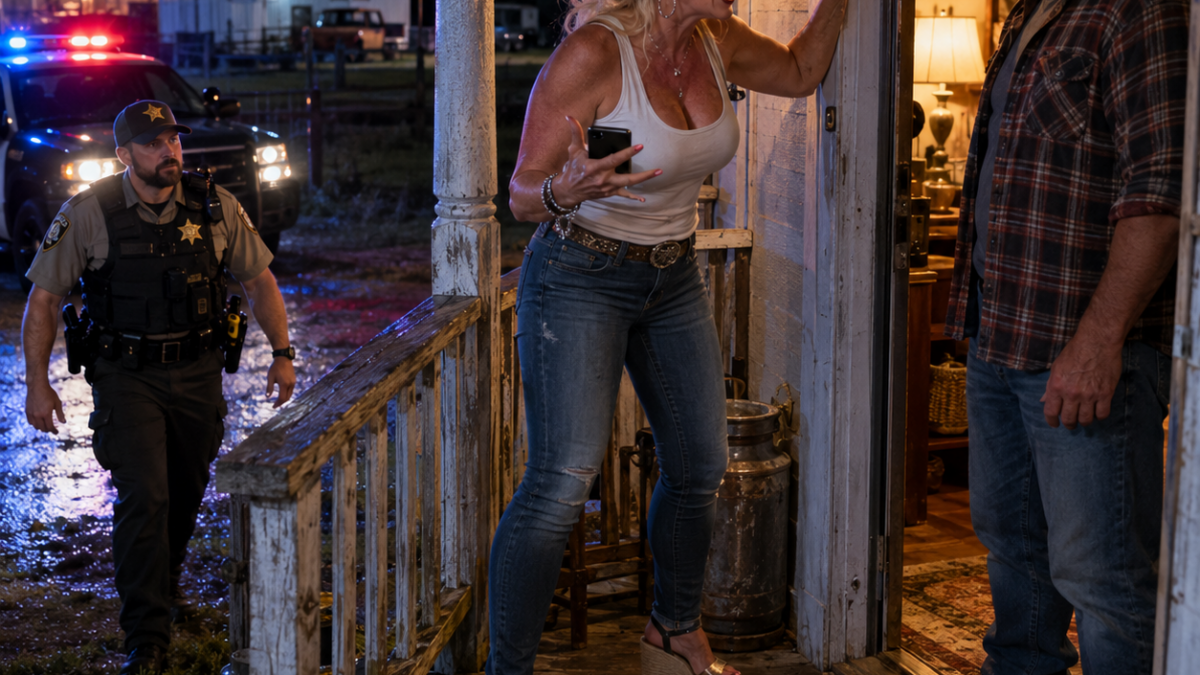
Karen stood on my porch with another woman beside her.
For a moment, I just stared at the screen.
Karen wore a purple tank top and cut-off denim shorts, hair wild around her face, one hand balled into a fist. The woman with her was younger, dark-haired, nervous-looking, holding a phone as if recording or ready to. Karen leaned toward my front door and pounded.
The sound hit a second later.
Boom.
Boom.
Boom.
My house shook with it.
I stood slowly.
Another boom.
“Open this door!” Karen screamed.
I did not move toward it.
Training matters. Experience matters. Pride gets people hurt. I had opened doors in dangerous situations before, but never because someone raging outside deserved access.
I called 911.
“This is Patrick Callahan,” I told the dispatcher. “I have a no-contact order against my neighbor Karen Whitaker. She is on my porch right now, pounding on my door and screaming. She has another woman with her. I am inside. I am not opening the door.”
Karen kicked the door.
The dispatcher heard it.
“Sir, are you safe?”
“For now.”
“Do not open the door.”
“I do not intend to.”
Karen screamed again.
“You promised me! You promised! This is mine!”
The dispatcher asked whether she had weapons.
“I can’t see any,” I said, watching through the camera feed. “But she is trying to force the door or damage it.”
Karen’s friend said something I could not make out.
Karen turned on her.
“No! He doesn’t get to hide!”
Then she grabbed the porch railing and shook it with both hands. The old wood held, but I heard it creak.
“You thief!” she screamed. “You stole from my children!”
I stood in my living room with the phone to my ear, looking at the door as it bucked under another kick.
Fear is different when you are older.
When I was young, fear was fuel. It sharpened me, made me fast, made me useful. At sixty-three, fear had weight. It sat in the knees and chest. It reminded me that if she came through that door, I could still defend myself, but the price might be higher than it used to be.
I hated her for bringing that feeling into my aunt’s house.
I hated her for turning my porch into another emergency scene.
But I kept my voice calm.
“She is still kicking the door,” I told the dispatcher. “She is now pulling at the porch railing. The other woman is recording.”
Karen began crying then.
Not soft crying.
Rage crying. The kind that sounds like anger drowning in itself.
“I need it!” she screamed. “You don’t need it! You never needed it!”
The friend tried again. “Karen, maybe we should go.”
Karen slapped her hand away.
“Shut up! He has to come out!”
That woman, whoever she was, took two steps back.
For the first time, I saw that Karen’s madness had frightened even the person she brought with her.
The dispatcher told me deputies were close.
Karen was still going when headlights washed across the front windows.
She did not run.
That shocked me a little. Some people, when consequence appears, suddenly remember their legs. Not Karen. She turned toward the driveway like the sheriff had been invited to witness her claim.
Through the window, I watched Deputy Harris step out with another deputy behind him.
“Karen,” Harris called. “Step away from the door.”
She pointed at my house.
“He’s inside!”
“I know.”
“He’s trespassing!”
“No, he is not.”
“He stole my house!”
“Step away from the door.”
“I have paperwork!”
“You have a court order telling you not to be here.”
That finally stopped her.
Only for a second.
Then she shouted, “That order is illegal!”
Harris moved closer. “Turn around.”
“No.”
“Karen.”
“No! I’m not leaving without my house!”
The younger deputy approached from the side. Karen’s friend had both hands raised and was backing toward the steps, saying, “I didn’t touch anything. I didn’t touch anything.”
Harris took Karen’s arm.
She tried to pull away.
Not well. Not successfully. But enough.
The deputies turned her, cuffed her, and led her off my porch while she screamed that everyone was corrupt, that I had tricked the court, that her children would remember this, that she was the real victim.
I waited until she was secured near the cruiser before opening the door.
The humid air rushed in.
My porch looked violated.
Scuff marks on the door. A crack in one piece of railing. A dent near the bottom panel where her boot had landed again and again.
Harris walked up the steps.
“You okay, Mr. Callahan?”
“I’m upright.”
His mouth twitched. “That’s one answer.”
I handed him a copy of the no-contact order before he asked.
“Got it on camera too?” he asked.
“Every second.”
For the first time in months, Harris looked almost relieved.
“Good.”
Karen saw me from near the cruiser and lost whatever control she had left.
“You liar!” she screamed. “You said I could have it!”
I looked at her across the yard, across the distance she was never supposed to cross.
“No,” I said. “I didn’t.”
She lunged forward, but the deputy holding her arm kept her in place.
Her friend gave a statement. From what I learned later, Karen had convinced her she was going to retrieve property or confront a man who had cheated her. The friend had not expected the no-contact order, the cameras, or the level of Karen’s meltdown. She looked shaken enough that I almost felt bad for her.
Almost.
Karen was arrested for trespassing and violating the court order.
Two real charges.
Finally.
Not a warning. Not a note in a file. Not another conversation about needing more proof.
Handcuffs.
Paperwork.
A cruiser pulling away with Karen in the back seat.
After they left, I stood on the porch for a long time. The night insects started up again. The air smelled like wet wood and disturbed dust. My old house settled around me, wounded but standing.
I ran one hand over the damaged door.
“I’m sorry,” I whispered, though I could not have said whether I was talking to the house, my aunt, or myself.
The court process after that was mercifully less dramatic than Karen wanted.
The camera footage was clear. The no-contact order was clear. The trespassing signs were clear. Her screaming about taking what was hers did not exactly help her case. I had to provide evidence, answer questions, and confirm dates from my notebook, but I did not have to turn my retirement into a full-time legal career.
Karen did most of the work against herself.
She apparently argued in court that the no-contact order should not count because it was based on lies. Then she argued that she had a moral right to confront me. Then she claimed she had not contacted me because she had been speaking “to the house.” When that failed, she cried about her children needing stability, which might have landed better if she had not been the person making everything unstable.
She did not go to jail long-term.
Part of me expected to be angrier about that.
Instead, when Bill explained the outcome, I mostly felt tired.
Probation.
Community service.
Court-mandated counseling.
Fines and conditions.
Continued order to stay away from me.
“It’s not nothing,” Bill said.
“I know.”
“Given the charges, the evidence, and her lack of prior violent history, this is within the range.”
“I know.”
“You wanted prison.”
“I wanted peace.”
He softened at that.
“This should help.”
It did.
But not for the reason I expected.
The legal consequences shook something loose beyond my property line. Other neighbors, finally sick of Karen’s noise, trespassing, trash, and drama, started making formal complaints. Not just to the sheriff. To whoever owned the land her trailer sat on.
That was when I learned Karen did not own that property.
She had been staying there through some arrangement nobody had clearly understood—rental, favor, handshake, maybe a relative of a relative. It did not matter. The owner had apparently been unaware of just how much trouble she caused until the complaints stacked high enough to make ignoring her harder than removing her.
She was told to leave within thirty days.
When I heard, I did not believe it at first.
After all those months of cameras, court orders, police calls, and property damage, the final push came from the simple fact that Karen had annoyed everyone else too.
I watched the next few weeks like a man watching storm clouds move away inch by inch.
Karen packed badly. Loudly. Angrily. She shouted at her kids. She shouted at people on the phone. She slammed bins. She cursed while dragging plastic bags to a rented truck. A man I did not recognize came twice to help and left both times looking like he regretted every choice that brought him there.
I stayed away.
No comments.
No victory lap.
No petty sign.
Not because I was above it. I was not always above it. The younger version of me might have stood on the porch with coffee and toasted her departure. The younger version might have shouted something clever, something satisfying, something that would feel good for five seconds and risk another month of chaos.
But sixty-three-year-old me had learned a few things.
Do not pour gasoline on a fire already moving away from your house.
So I watched quietly.
The morning she left, I woke before sunrise.
I did not know that would be the day. I just woke early, old habits and restless sleep. I made coffee and stepped onto the porch as the sky began turning from black to blue.
The trailer was gone.
At first, my brain did not accept it.
The space where it had sat was empty. Mud ruts, flattened grass, a few forgotten pieces of trash, and silence. No music. No lawn chairs. No big blond hair moving behind cheap curtains. No voice shouting across the property line. No children running through my orchard. No Karen watching my house like hunger had a human shape.
Gone.
I stood there in the cool morning air and breathed in.
It was the best breath I had taken in years.
People say relief washes over you, but this was not water. It was space. Space returning to my chest. Space returning to the land. Space between my home and another person’s wanting.
I sat on the porch steps with my coffee and watched the sun come up over my aunt’s fruit trees.
For the first time since Karen had arrived, the farmhouse felt fully mine again.
The damage remained, of course.
I had to repaint the garage door. I repaired the porch railing. I replaced the dented lower panel on the front door because every time I saw it, I heard her boot hitting wood. I kept the cameras. I kept the signs. I kept the notebook, now full of dates and quotes and evidence of one woman’s obsession with taking what did not belong to her.
The land next door stayed empty for a while.
Eventually, the owner had it cleaned up. Trash hauled away. Grass cut. Ruts leveled. For a few months, there was nothing there but field and quiet. It was beautiful.
Neighbors began stopping by more often after that.
Not intrusively. Just enough.
A jar of jam from Mrs. Kelly down the road. A warning from Tom that coyotes had been seen near the creek. An invitation to a cookout I almost declined and then attended. People told me, in their own indirect rural ways, that they were sorry it had gone as far as it did.
Tom said, “She was a piece of work.”
Mrs. Kelly said, “Some people don’t know where their property ends and their imagination begins.”
Harris, the deputy, stopped by once while passing through and said, “Quiet?”
I said, “Finally.”
He smiled. “Good.”
I thought I would feel triumphant for longer.
Instead, I felt grateful.
That may sound strange. Karen had vandalized my garage, lied about me, tried to manipulate police, forged fake paperwork, violated a court order, and spent months trying to bully me out of a home my aunt had left me. I had every right to bitterness.
But bitterness is heavy.
I had carried heavier things in my life, and I was tired.
So I chose the cleaner feeling when I could. Gratitude for neighbors who eventually spoke up. Gratitude for cameras. Gratitude for an attorney who knew how to turn chaos into paperwork. Gratitude for a sheriff’s department that, while slow in the way systems often are, acted when the proof finally stood in front of them. Gratitude that I had not let anger make me stupid.
That last one mattered most.
There were moments when I wanted to get even.
Real even.
Not legal even. Not patient even. I wanted to march across that property line and tell Karen exactly what kind of woman she was. I wanted to scare her the way she had tried to make me feel unsafe in my own home. I wanted to let the old firehouse temper loose and burn her delusions down with words she would never forget.
But every time, I thought of the notebook.
The cameras.
The deed.
The order.
The system works slowly, but it works best when you do not sabotage yourself trying to outrun it.
Karen wanted me to become the angry old man in her story.
I refused.
That refusal may have been the best revenge I had.
Because in the end, she could not point to anything I did except protect what was mine.
She was the one who demanded a house for a trailer.
She was the one who insulted me for living alone.
She was the one who crossed property lines.
She was the one who lied to neighbors.
She was the one who sent fake papers.
She was the one who called police and claimed I was squatting.
She was the one who stood on my porch, pounding my door, screaming that she was taking what belonged to her.
All I did was keep the receipts.
A year after she left, I repainted the garage.
Not just the door. The whole structure. White walls, dark green trim, new hardware. It took me three weekends, two sore shoulders, and more muttered profanity than my aunt would have approved of. When I finished, I stood back with a cold drink in my hand and looked at it.
No trace of red paint.
No trace of PROMISE TO ME.
Just clean wood in late afternoon light.
That evening, I picked apples from the old trees and set a basket on the porch. More than I could eat. My aunt used to give fruit to neighbors, and I had let that tradition slip during the Karen years because every interaction outside had begun to feel like risk. Now, I carried baskets down the road.
Mrs. Kelly made a pie.
Tom made cider.
One family with three kids took apples home, and the youngest asked if they could come back next year to help pick. I said yes, as long as nobody climbed without permission. His mother laughed. I laughed too.
The sound surprised me.
It had been a while since the orchard felt like something to share rather than something to defend.
That is what people like Karen steal when they decide they are entitled to your life.
Not just property.
Ease.
Generosity.
The ability to sit on your porch without watching the tree line.
The ability to hear a knock without your shoulders tightening.
The ability to believe a neighbor approaching with a folder might be bringing a recipe, not a homemade claim to your home.
I have most of that back now.
Not all.
I still check the cameras. I still keep copies of legal documents in a folder near the front hall. I still look twice when a strange vehicle slows near the property line. Experience changes a man, and I have been changed by worse things than Karen.
But I sleep well.
My house stands.
The porch wraps around it like open arms.
The windows catch the morning sun.
The fruit trees bloom in spring and bend heavy in fall.
I am still one man living in more space than Karen thought I deserved. She was right about one thing: I do not need every room every day. Some stay quiet. Some hold memories. Some hold tools, books, old fire department photographs, and boxes I keep meaning to sort.
But need is not the measure of ownership.
I do not have to justify a gift from my aunt to a woman who saw my home as a solution to her resentment. I do not have to apologize for surviving long enough to retire somewhere peaceful. I do not have to trade the life I built because someone else looked across a property line and mistook envy for fairness.
Sometimes, in the evening, I sit on the porch with coffee I should not drink that late and watch the sky go pink above the empty stretch where Karen’s trailer used to be.
The quiet still amazes me.
No bad music.
No shouting.
No red paint.
No demands.
Just wind, trees, and the old farmhouse settling around me.
I think about my aunt often then. I imagine her standing in the doorway, wiping her hands on a dish towel, telling me not to let fools track mud into the house. She was gentle, but she was not weak. She loved this place because it was hers, because she had cared for it, because home means something deeper when you have fought to keep it standing.
Karen never understood that.
She thought a house was something you could claim by wanting it loudly enough.
She thought my age made me easy.
She thought kindness meant softness.
She thought the law would bend because she had children, a grievance, and a folder full of nonsense.
She was wrong every time.
The last I heard, Karen had moved two towns over. Someone said she was living with a cousin. Someone else said she was still doing community service, picking up trash along a county road in a bright vest, furious at every passing car. I do not know if that part is true. I do not need it to be.
The best revenge was not picturing her with a trash bag.
The best revenge was stepping outside one morning and breathing clean air where her trailer used to be.
It was repairing my door.
Painting over her words.
Harvesting apples.
Sleeping through the night.
Living in my home without having to explain to anyone why it belonged to me.
That is enough.
More than enough.
Because after everything I saw in my old life, after every alarm bell and smoke-filled hallway and family crying on sidewalks, I know the difference between inconvenience and disaster. Karen was not the worst thing I ever faced.
But she was the last person I intended to let take peace from me without consequence.
She wanted my house.
She got a court order, probation, community service, counseling, and thirty days to move her trailer off land that was never hers.
I kept the farmhouse.
I kept the orchard.
I kept my aunt’s porch and my retirement and the quiet life I had come there to find.
And every morning now, when sunlight fills those big old windows and the floorboards creak under my feet, I remember one simple truth Karen could never scream her way around.
Some homes are not empty just because only one person lives there.
Some homes are full of everything that made a person strong enough to say no.