𝗙𝗨𝗟𝗟 𝗦𝗧𝗢𝗥𝗬 The Woman in Seat 23B Was Never Just a Passenger
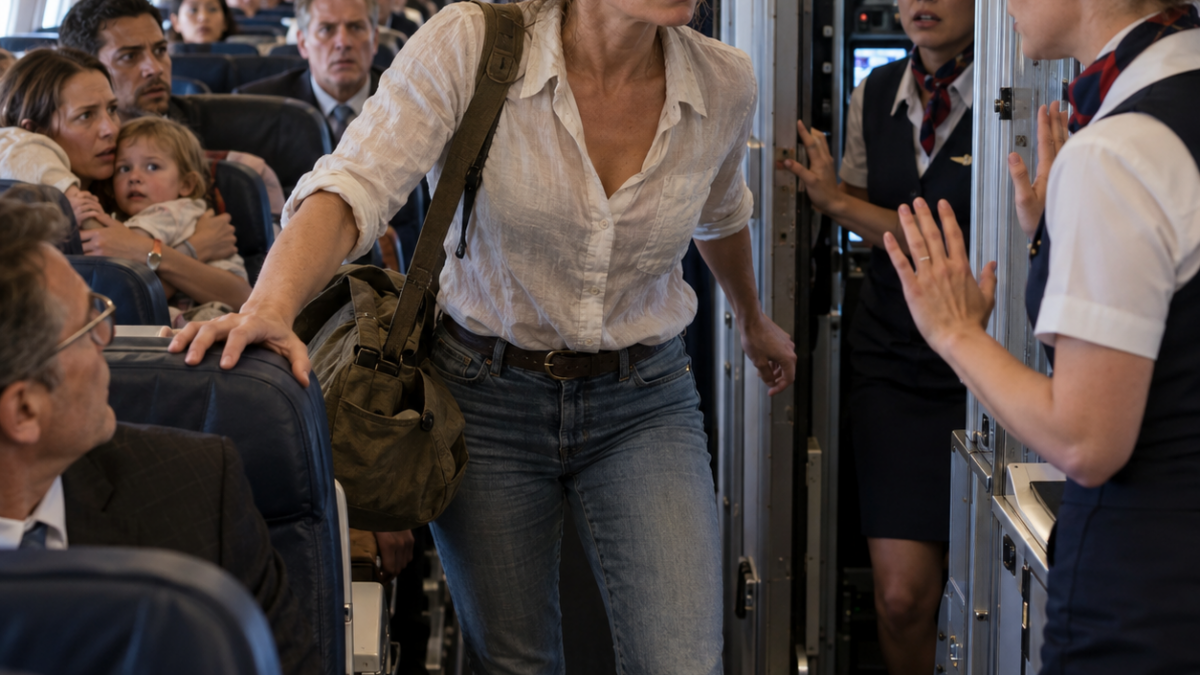
𝗣𝗔𝗥𝗧 𝟮
Middle of the aircraft. Aisle. Not ideal, but not bad. Close enough to observe cabin movement, far enough from the front that I wouldn’t be noticed by crew unless I wanted to be.
I stowed my duffel under the seat, kept the paperback in my lap, and buckled in.
The cabin filled around me with the usual chaos of boarding. Overhead bins slammed. Seat belts clicked. A baby fussed near the back. Somebody laughed too loudly. Somebody else asked whether there was room for a garment bag as though physics might be negotiated.
I watched without appearing to watch.
The flight attendant who had greeted me moved down the aisle with a slight favoring of her left leg. Not severe, but noticeable if you knew what imbalance looked like. Another attendant near the rear was younger, alert, and trying hard not to look nervous. A man in a dark business suit placed an unusually empty-looking briefcase under his seat and checked it twice. An elderly couple in row 21 wore small oxygen sensors clipped to their fingers.
None of it meant danger.
Details rarely meant anything by themselves.
But details were how you survived when they suddenly began to connect.
A flight attendant passed by.
“Could I get a cup of water before takeoff?” I asked.
“Of course. Headache?”
“A little.”
It was a lie, but a harmless one. I wanted to see whether she remembered, how quickly she responded, how smoothly the crew worked before routine became pressure.
She brought the water in under two minutes.
Competent.
Calm.
Good.
I opened my book to the marked page and pretended to read.
The captain’s voice came over the intercom as we taxied.
“Ladies and gentlemen, welcome aboard Pacific Airways Flight 782 with service to Los Angeles. We’ll be climbing to thirty-six thousand feet today. Weather looks smooth all the way across, so sit back, relax, and enjoy the flight.”
A few people clapped from the back.
I never understood that, but I didn’t judge it. People celebrated what comfort they could find.
The captain sounded young. Confident. Maybe a little too eager to sound relaxed.
The aircraft turned onto the runway.
The engines spooled.
Acceleration pressed me gently into the seat.
I closed my eyes as the wheels left the ground.
For most passengers, takeoff was either a thrill or a fear. For me, it was memory.
The exact change in vibration as weight shifted from runway to air.
The moment the aircraft stopped being a vehicle and became a promise.
The climb out over blue water.
The island falling away behind us.
I had flown fighter jets through hostile skies. I had flown commercial aircraft with hundreds of passengers trusting me without knowing my face. I had landed through thunderstorms that turned runways into blurred strips of light and water.
But I had not sat as an ordinary passenger in over a year.
It felt strange to surrender control to strangers behind a locked cockpit door.
I told myself that was the point.
People who spent their whole lives taking responsibility eventually had to learn how to put responsibility down.
For the first hour, everything was ordinary.
The seat belt sign switched off. Laptops opened. Drinks were served. A child asked loudly whether planes could run out of sky. The mother from row twenty-one thanked me again when she walked past with the toddler balanced on her hip.
I smiled.
I drank my water.
I checked the time.
Then, nearly two hours into the flight, I felt it.
A faint vibration beneath my seat.
It lasted less than two seconds.
Most passengers did not notice.
I did.
My eyes lifted from the page I had not been reading.
The vibration had not been turbulence. It was too clean, too brief, too mechanical. A correction, perhaps. A trim adjustment. A momentary pitch compensation that felt like it had been triggered manually or by a system trying to respond to something abnormal.
During cruise, with clear weather and stable conditions, it should not have felt like that.
I waited.
A pilot learns not to chase every tiny irregularity. Aircraft are living systems in their own way. They settle, hum, correct, and breathe. Most things that feel strange to a passenger are nothing.
But ten minutes later, the fasten seat belt sign came on.
The overhead chime sounded.
An automated message followed.
“Ladies and gentlemen, please return to your seats and fasten your seat belts. The captain has turned on the fasten seat belt sign due to expected turbulence.”
Expected turbulence.
My gaze moved toward the window across the aisle.
The sky was clean.
Weather reports before departure had shown a smooth route. Of course, forecasts could be wrong. Clear-air turbulence existed. But the first vibration had come before any warning, and it had not felt like unstable air.
I buckled my seat belt and looked toward the front galley.
The attendants had noticed something too.
It was subtle. A glance exchanged too quickly. A hand reaching for the interphone and then dropping away. The lead attendant’s smile becoming fixed in the way crew members smile when they are trying not to alarm people before they themselves understand what is happening.
The aircraft lurched.
Hard.
Gasps burst through the cabin.
A drink cart near the rear slammed sideways. Cups scattered. A child screamed. Someone cursed. Overhead bins rattled violently.
I braced one hand against the armrest and kept my breathing steady.
That was not ordinary turbulence.
That was a flight path disturbance.
The aircraft recovered, but not smoothly. It hunted for stability, almost as if the controls were lagging behind command input.
The flight attendant with the limp hurried down the aisle toward her jump seat.
“Excuse me,” I said.
She stopped, though her body clearly wanted to keep moving.
“Is everything all right up front?”
Her eyes widened for less than a second.
Less than a second was enough.
“I’m sure it’s just turbulence, ma’am. Please remain seated.”
“You’re sure?”
“Yes.”
But her voice did not belong to someone who was sure.
I nodded once, because forcing her into an argument would not help.
She continued forward.
I looked at the cockpit door.
Closed.
Normal.
Silent.
The aircraft steadied again, but the cabin had changed. People whispered now. Nervous laughter flickered and died. The toddler in row twenty-one cried into his mother’s shoulder.
Then came the sound that made every muscle in my body go still.
A metallic thud somewhere forward through the fuselage.
Not loud.
Not dramatic.
But unmistakable to someone who had listened to airplanes for a living.
A system had done something it was not supposed to do, or something had failed in a way that sent force through structure.
I unbuckled my seat belt.
Before I could stand fully, the intercom crackled.
“This is the captain. We are experiencing a…”
Silence.
Static.
Nothing.
Every passenger waited for the rest of the sentence.
It never came.
The cabin entered that awful suspended state before panic, when the human mind tries to create harmless explanations faster than fear can form.
A man across the aisle said, “Probably just the mic.”
Nobody answered.
A call button lit up.
Another followed.
At the front of the cabin, two flight attendants gathered near the galley. One picked up the interphone and pressed it to her ear. She waited. Spoke. Waited again.
Her face changed.
No answer from the cockpit.
I stood.
The nearest attendant saw me immediately.
“Ma’am, please sit down.”
I stepped into the aisle.
“You’re not getting a response from the flight deck.”
Her mouth tightened.
“We’re handling the situation.”
“No, you’re trying to understand it.”
“Ma’am—”
“I can help.”
“Please return to your seat.”
The plane jerked again, harder than before.
A tray flew from somewhere behind me. A woman screamed. The overhead lights flickered once and steadied.
Faint alarms sounded from beyond the cockpit door.
Not cabin alerts.
Flight deck warnings.
I knew that tone.
The attendant heard them too. Her face lost color.
The intercom clicked again, and this time a flight attendant spoke, her voice trembling beneath its professional polish.
“Ladies and gentlemen, please remain seated with your seat belts fastened. We are currently experiencing a situation. If there is a licensed pilot on board, please make yourself known to the crew immediately.”
The cabin went silent.
Three hundred twenty people seemed to inhale and forget how to release the breath.
I reached down, pulled my black nylon folder from my carry-on, and opened it.
The flight attendant stared at the documents inside.
FAA credentials.
Commercial certifications.
Department of Homeland Security identification.
And one older military identification card I had never been able to throw away.
“My name is Captain Emily Parker,” I said. “Former United States Air Force. Former Pacific Skies Airlines. Qualified on multiple Boeing and Airbus platforms. I need access to the cockpit now.”
The attendant looked from the folder to my face.
“You’re really a pilot?”
“I am.”
Her eyes shone with terror.
“What if—”
“I’m your best chance.”
That ended the discussion.
She turned and moved quickly toward the cockpit, unlocking the emergency access procedure. The door had already shifted into emergency mode.
That alone told me something was very wrong.
I stepped inside.
What I saw in that cockpit would stay with me for the rest of my life.
The first officer was slumped in his seat, pale, sweating, his head tilted at an unnatural angle but his chest still moving. The captain was still upright, barely. His face was flushed red, eyes unfocused, hands shaking as he tried to manage controls that were no longer responding properly.
He turned toward me.
His lips moved.
“Oxygen,” he rasped. “Something… vent…”
Then his body sagged.
I moved before thought could catch up.
I sealed the cockpit airflow and switched to emergency ventilation override. I grabbed the backup oxygen mask and secured it to the captain’s face, then checked the first officer’s breathing. Alive. Both alive, but incapacitated.
Alarms pulsed.
The autopilot had disconnected.
The aircraft had drifted south of its planned route and was moving toward restricted military airspace.
The controls felt heavy when I took the left seat.
Sluggish.
Not dead.
Not yet.
I adjusted pitch first.
Stabilize the aircraft before solving the mystery.
That was rule one.
Aviate. Navigate. Communicate.
Every pilot learns it. Some survive because they never forget it.
My hands moved across the panel. Power stable. Engines holding. Altitude fluctuating but recoverable. Hydraulics not clean. Navigation screens flickering with intermittent delay.
I put on the headset and keyed the radio.
“Los Angeles Center, this is Pacific Airways Flight 782 declaring an emergency. Both pilots incapacitated. I am a qualified pilot assuming command. Request immediate vectors to nearest viable landing site. Do you copy?”
Static.
I changed frequency.
“Flight 782 declaring emergency. Do you copy?”
More static.
I tried the emergency frequency.
A voice answered faintly.
“Aircraft calling emergency, say again.”
“This is Pacific Airways Flight 782. Captain Emily Parker speaking. I am a licensed commercial pilot and retired Air Force pilot. I have assumed command of the aircraft due to dual pilot incapacitation, possible toxic event in cockpit ventilation. We are manually controlled, systems compromised, requesting immediate emergency vector.”
There was a pause long enough for me to imagine every controller in the room sitting upright at once.
“Flight 782, confirm both assigned pilots incapacitated?”
“Confirmed. Both breathing. Neither able to fly.”
“Confirm you are in control of the aircraft.”
“I have control.”
Another pause.
“Flight 782, nearest suitable field is Edwards Air Force Base. We are coordinating priority emergency landing. Can you maintain altitude?”
I glanced across the instruments.
“For now.”
“State souls on board and fuel.”
I scanned the flight data and passenger manifest clipped near the captain’s side.
“Three hundred twenty souls. Fuel approximately nine thousand four hundred pounds. Aircraft is airworthy but compromised. Manual flight only. I need a straight descent approach. I do not trust the controls for steep maneuvering.”
“Copy, Flight 782. Edwards is being notified. Emergency services will be standing by.”
I swallowed, then reached for the intercom.
The passengers needed to hear my voice.
Not everything.
Enough.
“Ladies and gentlemen, this is Captain Emily Parker speaking. We’ve had a medical emergency in the cockpit. I have assumed command of the aircraft, and we are diverting to Edwards Air Force Base for an emergency landing. I need everyone to remain seated, keep your seat belts fastened, and follow every instruction from the cabin crew. We are in control.”
I let the words settle.
Then I added, very deliberately, “I have over ten thousand flight hours, commercial and military. You are in good hands.”
I switched off the intercom and looked at the unconscious captain.
“I hope that’s true.”
The aircraft dipped slightly.
I corrected.
It responded slowly, like steering a stubborn freight train across ice.
Fear pressed against the edges of my focus, looking for a way in.
I did not let it.
Fear was not the enemy.
Panic was.
There is a difference.
Fear tells you the situation matters.
Panic steals your hands from the controls.
I had learned that at twenty-six years old over hostile territory, when the sky filled with missile warnings and I understood that my life had become a calculation measured in seconds.
Back then, my call sign was Ghost Hawk.
I earned it because I could appear where people least expected, stay calm when the mission fell apart, and bring damaged aircraft home when instructors would have said the numbers did not work.
People loved making legends out of pilots.
They rarely asked what legends cost.
Mine cost me friends.
One in particular.
Major Lucas Hale.
Call sign Saint.
He had been my wingman, my rival, my closest friend, and the only person who could tell when I was afraid even if my voice stayed calm.
Lucas died during a mission over the Syrian border when enemy fire caught his aircraft after we had already pushed beyond the point where we should have turned back.
I heard him until the signal cut.
I heard him in dreams for years after.
After that, I walked away from military flying.
Later, I flew commercially because I thought maybe civilian skies would feel different. No weapons. No hostile radar. No classified briefings with photographs of people who might not come home.
For a while, it helped.
Then bureaucracy, fatigue, and grief found me there too.
I retired quietly.
No ceremony.
No interviews.
No dramatic farewell.
I told everyone I was tired.
That was true.
It was not the whole truth.
The whole truth was that I no longer trusted the sky not to take something from me.
And now I was back in it with three hundred twenty lives behind me.
“Flight 782,” ATC said, “Edwards confirms runway Two Two Left is being cleared. Winds five knots from the north. Emergency and hazmat teams standing by.”
“Copy.”
“Do you require fighter escort?”
I looked at the navigation display flickering in slow pulses.
“Wouldn’t hurt.”
“Understood.”
A few minutes later, two F-16s appeared outside the cockpit windows like gray guardians against the blue. One moved along each side of the aircraft, holding careful formation.
The pilot on my left must have gotten a good look through the cockpit glass, because a new voice came over guard frequency.
“Flight 782, Viper One. We have visual. You appear to be alone up there.”
“Not alone,” I replied. “Just busy.”
A brief silence.
Then, “Copy that, Flight 782. We’ll stay with you until final.”
“Appreciated.”
Inside the cockpit, another warning light blinked.
Hydraulic system two.
Partial pressure loss.
I exhaled slowly.
“That explains the sluggish response.”
I rerouted actuator control through the remaining system and checked redundancy. The aircraft answered, but reluctantly. Landing would be heavy, and any asymmetry on approach could become unforgiving.
“Edwards Tower, Flight 782. We have partial hydraulic failure on system two. Request emergency braking support, fire response, medical and hazmat on arrival.”
“Affirmative, Flight 782. Brake net being deployed as precaution. All emergency services standing by.”
Brake net.
That meant they understood how ugly this could become.
I opened the cockpit door enough for the lead flight attendant to hear me. He was a man in his forties named Scott, according to his name tag. His face was pale, but his posture was steady.
“Captain Parker?”
“Keep the cabin calm,” I said. “Have your strongest attendants braced and ready. We may come in hard. No one stands. No one opens overhead bins. If people pray, let them. If people cry, let them. But nobody moves.”
He nodded.
“Are the pilots…”
“Alive. Medical teams will handle them after landing.”
He swallowed.
“Can you land this?”
I looked at him directly.
“Yes.”
I said it because he needed certainty.
I said it because the passengers needed him to carry that certainty back down the aisle.
I said it because some part of me needed to hear it too.
Scott nodded again.
“I’ll tell them.”
“One more thing.”
He paused.
“You may see fighters outside. Tell passengers they’re escorting us. They are not a threat.”
“Yes, Captain.”
He closed the door.
Captain.
The word moved through me like pain and memory.
I had tried so hard to stop being that.
But titles have a way of returning when responsibility does.
I guided the aircraft into descent.
Altitude twenty-nine thousand feet.
Then twenty-six.
Then twenty-three.
The Pacific gave way to the long approach toward the California desert. The coastline eventually appeared beneath the haze, then the rough golden land beyond it.
The aircraft wanted to drift right.
I corrected gently.
Too much pressure worsened the instability. Too little allowed the deviation to build.
It was like holding an injured animal that still had enough strength to hurt itself if you fought too hard.
The cabin pressure alert flashed.
Not catastrophic, but enough to require immediate attention. I adjusted the outflow manually and stabilized the rate. The cockpit hissed as airflow changed.
The captain groaned behind me.
“You…” he murmured.
“Stay still,” I said without turning. “You’re safe. I have control.”
“Passengers…”
“Alive.”
He tried to move.
“Don’t,” I snapped. “That is not a suggestion.”
He stilled.
A pilot understands that tone.
The first officer remained unconscious but breathing.
I keyed the radio.
“Edwards, Flight 782 descending through nineteen thousand. Request straight-in approach.”
“Flight 782, cleared straight-in. Runway Two Two Left is yours. Fighter escort will break off at five miles.”
“Copy.”
The control yoke resisted in my hands.
Sweat gathered under my collar.
The old concentration returned fully now. The world narrowed into instruments, horizon, speed, altitude, descent rate, runway distance, fuel, wind, control response.
Everything else became background.
Fear could wait.
Memory could wait.
The aircraft could not.
Back in the cabin, I imagined the passengers sitting in silence. I had been on the other side of that door before as a commercial pilot, knowing people in the cabin were creating stories out of every sound.
A change in engine noise became catastrophe.
A bank became a fall.
A calm voice became a lifeline.
I reached for the intercom again.
“Ladies and gentlemen, this is Captain Parker. We are beginning our emergency descent into Edwards Air Force Base. You may see emergency vehicles when we land. That means people are ready to help us. You may feel a firm touchdown and heavy braking. That is expected. Keep your seat belts tight. Listen to the crew. We are almost there.”
I stopped.
Then added, “I know you’re frightened. That’s all right. Let the crew handle the cabin. Let me handle the airplane.”
I switched off.
My voice had sounded steadier than I felt.
That was part of the job.
Another warning light blinked as I configured for approach.
Flaps.
I watched the indicators.
Left wing: thirty degrees.
Right wing: twenty-two.
My stomach tightened.
“Asymmetrical flap deployment,” I said aloud.
No one in the cockpit could answer.
The aircraft would have uneven lift on final. It would pull. If I fought it too aggressively, I could worsen the roll. If I under-corrected, we could come in misaligned and destroy the landing gear or worse.
“Edwards, Flight 782. We have partial flap asymmetry. Right side not fully extending.”
“Copy, Flight 782. Emergency teams advised.”
“I’ll need full runway and brake net active.”
“Confirmed.”
Viper One came back on frequency.
“Flight 782, from our visual, your right flap looks partially deployed. You’re carrying slight right bias.”
“I feel it.”
“Want external guidance?”
“Call deviations only if they worsen. Otherwise stay quiet.”
“Copy.”
He understood.
Too many voices could kill you in an emergency.
I did not need encouragement.
I needed usable information.
At eight thousand feet, the desert spread beneath us, harsh and open. Edwards appeared ahead as a long pale geometry carved into the earth. Runway Two Two Left stretched like a promise.
I had never loved concrete so much.
The F-16s peeled away one at a time.
“Flight 782,” Viper One said, “we’re breaking off. You’ve got this.”
I did not answer immediately.
My hands were busy.
Then I said, “Thanks for the company.”
“Anytime, Captain.”
They vanished from my peripheral view.
The sky was mine now.
“Cabin crew,” I said over the intercom, “brace for landing.”
Seconds later, their voices echoed down the cabin.
“Brace. Brace. Heads down. Stay down.”
I imagined heads lowering. Hands gripping armrests. Parents wrapping themselves over children. Strangers reaching for strangers without knowing their names.
Three hundred twenty souls.
That phrase had always bothered me in routine paperwork.
Now I understood it again.
Not passengers.
Not numbers.
Souls.
Lives full of unfinished conversations, unpaid bills, birthdays, grudges, jokes, secrets, and people waiting at home.
I would not let fear fly them into the ground.
“Flight 782, winds holding steady,” Edwards Tower said. “You are cleared to land.”
“Cleared to land.”
The runway grew larger.
Altitude one thousand feet.
I adjusted thrust carefully.
The rightward pull intensified.
I braced with rudder, small correction, then another.
The aircraft groaned.
“Easy,” I whispered. “Easy.”
Five hundred feet.
Sink rate stable, but high enough to demand respect.
Four hundred.
The runway markings sharpened.
Three hundred.
The yoke trembled in my hands.
Two hundred.
The right wing wanted to drop.
I corrected with measured pressure, every instinct screaming not to overdo it.
One hundred.
The aircraft floated less than I wanted and dropped more than I liked.
“Come on,” I whispered.
Fifty.
Thirty.
Twenty.
The landing gear hit concrete with a violent slam.
The aircraft bounced once.
A hard, ugly bounce that lifted us just enough to make my blood turn cold.
I held the nose, resisted the urge to shove it down, let the aircraft settle.
The wheels struck again.
This time we stayed down.
I deployed braking manually and held the centerline with everything I had.
The aircraft shook like it was coming apart.
Tires smoked.
The cabin behind me erupted in muffled cries, but no one moved.
The brake net at the far end of the runway grew closer.
Too close.
“Stop,” I said through clenched teeth.
The aircraft continued roaring forward.
Speed bleeding.
Not fast enough.
I applied everything the damaged systems would give me.
The runway blurred.
Emergency vehicles flashed red and white along both sides.
The brake net loomed ahead.
Thirty feet.
Twenty-five.
Twenty.
Then, finally, the aircraft shuddered, groaned, and stopped.
Twenty feet from the net.
Silence fell so completely that for a moment I thought I had gone deaf.
My hands remained locked on the yoke.
I stared forward.
We were down.
We were stopped.
We were alive.
“Edwards Tower,” I said, my voice lower than I expected. “Flight 782 is safely down. Repeat, aircraft is down. Request immediate medical assistance for cockpit crew and hazmat inspection for possible toxic contamination.”
The tower responded, but the first words disappeared beneath a sound from behind me.
Applause.
It began with one person.
Then another.
Then it spread through the cabin in waves, breaking apart into sobs, laughter, prayers, and voices saying thank you to no one and everyone.
I took off my headset slowly.
My hands began shaking only after I no longer needed them to be steady.
The captain behind me whispered, “You landed.”
I turned slightly.
“Yes.”
He blinked, still disoriented.
“Who are you?”
I looked through the cockpit window at the emergency vehicles racing toward us.
“Today?”
I breathed out.
“Just the passenger in 23B.”
Scott opened the cockpit door a few minutes later, after receiving clearance from ground crews.
He found me still sitting in the captain’s seat, scanning instruments as if the aircraft might somehow surprise me even after stopping.
“Captain Parker,” he said softly. “You did it.”
“Are emergency crews boarding?”
“They’re bringing stairs now. Hazmat is ready. Medics too.”
“Disembark from the rear first. Keep the front rows seated until hazmat clears this area. Nobody comes into the cockpit except medical and emergency personnel.”
He nodded.
“The passengers want to see you.”
“They need to get off safely first.”
His face softened.
“They’re going to remember you for the rest of their lives.”
I looked past him, toward the cabin.
From where I sat, I could see only a narrow slice of humanity. A woman crying into her hands. A teenager staring forward in shock. The mother from row twenty-one clutching her toddler so tightly he squirmed.
“They should remember that the crew kept them alive too,” I said.
Scott swallowed hard.
“We were trying not to fall apart.”
“But you didn’t.”
He looked down.
“That matters.”
Ten minutes later, fresh air entered the cabin through the rear exit.
Passengers began leaving row by row under the careful direction of crew and emergency personnel. Some stumbled. Some cried. Some looked numb. Nearly all of them turned back toward the plane before stepping onto the tarmac, their eyes searching the cockpit windows.
I remained inside until both pilots were in medical care and hazmat crews had begun testing the ventilation system.
The preliminary readings suggested contaminants in the cockpit airflow.
Not enough information yet.
Enough to explain what had happened.
I walked down the aisle only after the cabin was almost empty.
It felt strange to see what remained after people were removed from a crisis. Crumpled napkins. A child’s blanket. An abandoned paperback. Earbuds hanging from a seat pocket. Water bottles rolling gently near the aisle.
Evidence of ordinary lives interrupted.
At the exit, I stopped and looked back.
For several hours, this aircraft had been a floating city on the edge of becoming a memorial.
Instead, it was empty.
Silent.
Saved.
I stepped onto the stairs.
The desert heat rose from the tarmac.
Emergency lights washed across the aircraft skin.
Beyond the perimeter, cameras had already appeared.
Of course they had.
In the modern world, privacy bled out faster than fuel.
I kept my head down and walked to the medical team.
A doctor tried to guide me toward a chair.
“I’m fine.”
“Captain, you just landed a compromised aircraft under emergency conditions.”
“I know what I just did.”
“Then sit down.”
I sat.
Authority recognizes authority.
While they checked my blood pressure, oxygen saturation, and neurological response, military officers gathered nearby. One held a printed credential sheet. Another stared at me with the expression people wore when a name from old stories suddenly had a face.
“Captain Emily Parker,” one of them said.
I looked up.
“Yes.”
He hesitated.
“Ghost Hawk?”
The nickname moved through me like cold water.
I had not heard it spoken aloud in years by anyone who knew what it meant.
“I haven’t used that name in a long time.”
“No, ma’am,” he said quietly. “But some names don’t disappear just because people stop saying them.”
I looked away.
Reporters shouted from behind the barrier.
“Captain Parker\!”
“Emily\!”
“Were you flying the plane?”
“How did you save everyone?”
“Are you a hero?”
I hated that word.
Hero.
It was too clean.
Too simple.
People loved heroes because heroes made disasters easier to understand. They turned terror into a story with a face, a headline, a beginning and an ending.
But emergencies were never that neat.
A hero was often just the person standing closest to responsibility when everyone else lost the ability to move.
I gave my first statement to the authorities, not the cameras.
My official position on the flight was simple.
Passenger.
Emergency pilot in command.
When a man from the FAA asked me to describe the sequence of events, I did it without embellishment. Initial vibration. Seat belt sign. Cabin lurch. Interrupted captain transmission. Lack of cockpit response. Crew request for pilot. Entry into cockpit. Dual pilot incapacitation. Ventilation isolation. Aircraft stabilization. Emergency communications. Diversion. Hydraulic failure. Flap asymmetry. Manual landing.
He wrote quickly.
The NTSB investigator, Daniel Reyes, arrived later that evening. Calm eyes. Navy blazer. Professional patience. He asked better questions than most people.
“What do you believe caused the crew incapacitation?”
“Likely contamination through cockpit ventilation. Possibly from avionics bay or auxiliary electrical components. The captain mentioned something in the vent before losing consciousness.”
“Could a leak like that overcome both pilots?”
“With prolonged exposure, yes. Especially if odorless or mistaken for a minor electrical smell.”
“You noticed anything before entering the cockpit?”
“Aircraft control anomalies. Autopilot disconnect or degraded response. No coherent captain announcement. Crew unable to reach flight deck.”
He looked up.
“You recognized all that from the cabin?”
“I recognized enough.”
He studied me for a second.
“Most passengers wouldn’t have.”
“Most passengers shouldn’t have to.”
His pen paused.
“That landing,” he said, “with partial hydraulics, flap asymmetry, and manual braking. You understand how close this came?”
I looked toward the aircraft sitting under floodlights.
“Yes.”
“Borderline impossible.”
I shook my head.
“Not impossible.”
“No?”
“If it were impossible, we wouldn’t be talking.”
He gave the smallest smile.
“Fair enough.”
By nightfall, the passengers had been moved to temporary accommodations, the aircraft had been secured, and the pilots had been transported for treatment. Both were alive. That mattered more than every camera, commendation, and headline that followed.
An Air Force commander offered me an empty barrack room away from the press.
I accepted.
The room was plain. Bed. Desk. Chair. Beige walls. A smell of disinfectant and old dust. There was a photograph tacked to one wall showing a squadron from decades earlier, young pilots grinning beside aircraft as if time had not yet taught them what the sky could take.
I sat on the bed without removing my shoes.
My phone was still powered off inside my bag.
I knew what waited there.
Messages.
Calls.
News alerts.
People who had not spoken to me in years.
People who would want statements, interviews, tears, lessons, inspiration, closure.
I had none to give.
Not yet.
I lay back and stared at the ceiling.
For hours, I listened to the quiet.
But sleep would not come.
Every time I closed my eyes, I felt the landing gear strike concrete again. I heard passengers clapping. I heard the captain asking who I was. I heard the Air Force officer say Ghost Hawk.
Near dawn, I finally turned on my phone.
It lit up as though the world had been waiting to rush in.
Dozens of missed calls.
Hundreds of messages.
Former squadmates.
Commanders.
Reporters.
Unknown numbers.
My parents.
My sister.
One message sat near the top from a number I still knew by heart.
Lucas’s widow.
Anna.
I stared at her name until the screen blurred.
I had not spoken to her in almost two years.
Not because she had pushed me away.
Because I had.
Guilt has a way of convincing you that absence is kindness.
I opened the message.
I saw what happened.
I’m glad you’re alive.
Lucas would be proud of you.
That was all.
Three sentences.
They undid me completely.
I lowered the phone and cried harder than I had in years.
Not because the landing had terrified me, though it had.
Not because the world knew my name again, though it did.
I cried because for the first time since Lucas died, I wondered whether surviving might not be a betrayal.
Maybe it could be a responsibility.
A knock came at my door at eight in the morning.
I wiped my face, stood, and opened it.
Colonel Ray Mercer stood outside holding two terrible coffees and wearing the same expression he had worn through half my military career: unimpressed by everything except competence.
His hair was grayer. His jaw was still set like stone. His eyes softened when he saw me.
“Parker.”
“Colonel.”
“Hell of a landing.”
“I’ve had smoother.”
“I’ve seen the data. No, you haven’t.”
Despite myself, I smiled.
He handed me one of the coffees.
It smelled burned.
“Still trying to poison people with this stuff?”
“Builds character.”
We walked along the edge of the base as the morning sun lifted over the desert.
For a while, neither of us said anything.
That was one thing I had always appreciated about Mercer. He did not spend silence cheaply.
Finally, he stopped near the hangar and reached into his jacket pocket.
“I brought something.”
He opened his hand.
My old wings.
The original metal insignia I had turned in the day I retired from active service.
I stared at them.
“I don’t understand.”
“You earned them once,” he said. “Yesterday, you reminded a lot of people you never stopped being worthy of them.”
I did not take them immediately.
“I’m not coming back.”
“I didn’t ask you to.”
“The uniform doesn’t fit me anymore.”
“Didn’t bring the uniform.”
I looked up.
Mercer’s voice gentled.
“Emily, you keep thinking the sky only knows how to take from you. Maybe yesterday it gave something back.”
The words hit deeper than I wanted.
“I was just there.”
“No,” he said. “You stood up.”
I looked across the tarmac toward Flight 782.
Investigators moved around it like surgeons around a patient that had survived against expectation.
“What if I hadn’t been on that plane?” I asked.
Mercer followed my gaze.
“Then we might be having a very different morning.”
I swallowed.
“That’s what keeps going through my head.”
“It always does after survival.”
I looked at him.
“I hate being called a hero.”
“I know.”
“People say it like it explains everything.”
“It doesn’t.”
“No.”
He placed the wings in my palm.
“Then don’t let them turn you into a statue. Stay human. Tell the truth if you ever choose to speak. Or don’t speak at all. But stop pretending you’re nobody just because being somebody hurts.”
My fingers closed around the metal.
It was heavier than I remembered.
Over the next three days, my name became public property.
Mystery Passenger Lands Flight 782.
Retired Air Force Legend Saves 320 Lives.
Ghost Hawk Returns.
Modern-Day Miracle Over California.
I did not watch most of it.
The clips I did see made me feel as though they were describing someone else. A grainy image of my silhouette in the cockpit. A passenger’s shaky video of applause after landing. A retired general telling a morning show that Ghost Hawk had been one of the finest pilots he had ever known.
People made graphics.
They found old photographs.
They mispronounced names.
They speculated about trauma with the confidence of people who had never cleaned blood off their own flight glove.
Book agents emailed.
Documentary producers called.
A Hollywood assistant left a voicemail saying their studio wanted to discuss “life rights.”
I deleted it.
The only public event I agreed to attend was not public at all.
A closed gathering for passengers and crew from Flight 782.
No cameras.
No reporters.
No livestreams.
Just people who had shared the same narrow escape trying to stand in the same room without falling apart.
It was held at a community center near the temporary hotel where many survivors were staying. When I entered, conversations quieted.
That was the worst part.
The way people looked at me.
Not with fame.
With gratitude so raw it hurt.
The mother from row twenty-one approached first, holding her toddler on one hip. The little boy still had his plastic airplane.
“You helped with my bag,” she said, crying before she finished the sentence.
“I remember.”
“I didn’t know…”
“Neither did I.”
She laughed through tears.
“My son keeps saying the airplane lady saved us.”
The boy held out his toy plane.
I crouched slightly.
“Is this yours?”
He nodded solemnly.
“Plane.”
“Yes,” I said. “A very good one.”
He pushed it toward me.
I looked at his mother.
She nodded, crying harder.
I took it carefully.
“Thank you.”
An elderly man told me he had been flying to meet his newborn grandson.
“I kept thinking,” he said, voice trembling, “that I had come so close to never seeing his face.”
I hugged him because there was no answer good enough.
A teenager admitted he had always been terrified of flying and did not know if he could ever board another plane.
“You don’t have to decide that today,” I told him.
He looked surprised.
“I don’t?”
“No. Surviving something doesn’t mean you owe anyone instant bravery.”
He nodded slowly, like nobody had given him permission to be honest about fear before.
Briel, the young flight attendant, found me near the coffee table later. She held two paper cups, just as Mercer had that morning, but hers smelled significantly less dangerous.
“I brought you the better option,” she said.
“Low bar.”
She laughed, then grew emotional.
“I applied to flight school.”
I looked at her.
“When?”
“This morning.”
I smiled.
“That’s fast.”
“I almost didn’t. Then I kept thinking about your voice over the intercom.”
“My voice?”
“You sounded scared.”
That surprised me.
“I did?”
“A little,” she said. “But you sounded like the fear wasn’t in charge.”
I looked down at the coffee.
“That may be the best description of flying I’ve ever heard.”
“I want to learn that.”
“You can.”
Her eyes filled.
“You really think so?”
“I think anyone willing to tell the truth about fear has a better start than most.”
The official investigation moved quickly.
The NTSB confirmed a slow leak in the avionics bay had released odorless toxic fumes into the cockpit ventilation path. A sensor that should have detected the fault had been disconnected during recent maintenance and not properly logged. The pilots had been exposed long enough to become confused, impaired, and then unconscious.
The aircraft had drifted off course and would likely have continued until fuel exhaustion or uncontrolled descent if no one had intervened.
That sentence appeared in one report.
I read it three times.
Would likely have continued until fuel exhaustion or uncontrolled descent.
Three hundred twenty souls.
The number became a weight I could feel in my hands.
When the FAA asked whether I considered myself a hero, I gave the only answer I could live with.
“I did what a trained pilot is supposed to do. I just wasn’t supposed to be on duty that day.”
A week after the landing, I went home to Ohio under a false booking name.
It did not work.
The gate agent recognized me anyway.
She leaned close as I handed over my boarding pass.
“Thank you,” she whispered.
I nodded.
The captain of that flight came out before boarding finished.
He stood beside my seat, cap tucked under one arm.
“Captain Parker.”
“Just Emily today.”
“Yes, ma’am.”
His voice caught slightly.
“What you did meant a lot to all of us.”
I looked toward the cockpit door.
“Fly safe.”
“We will.”
For the first time in years, when the aircraft took off, I did not close my eyes to endure it.
I looked out the window.
Clouds passed beneath us like a white country without borders.
And I let myself love the sky again, even though I knew what it could take.
Back home, my townhouse looked exactly as I had left it.
A mug in the sink.
A dusty flight jacket in the closet.
Old medals in a wooden box I rarely opened.
A framed photograph of my old squadron on the wall.
Lucas stood beside me in that photo, grinning like trouble had personally invited him to dinner. I had avoided looking at it for years, but that day I stood in front of it for a long time.
Then I placed Mercer’s wings on the shelf beneath it.
Not because I was returning to duty.
Not because the world had decided I was Ghost Hawk again.
Because I was done pretending that losing people meant I had to lose myself too.
Six weeks passed.
The headlines faded, as headlines always do.
The world found new disasters, new miracles, new faces to praise and forget.
Flight 782 became a reference point. A documentary topic. A safety case. A training scenario.
I became quieter.
Not the old kind of quiet, made of avoidance and locked doors.
A better quiet.
One that had room to breathe.
I stopped driving past the small local airfield without turning in.
At first, I only parked outside the fence and watched small aircraft take off. Cessnas. Pipers. Training flights. Nothing dramatic. Nothing armed. No alarms. No hostile radar.
Just wings lifting because they were built to.
One Thursday morning, I sat at my favorite coffee shop reading an article about the final safety recommendations from the Flight 782 investigation when someone stopped beside my table.
“You always sit like that,” a familiar voice said. “Half ready to leave, half ready to take command.”
I looked up.
Briel stood there with a duffel bag, tired eyes, and a grin she was trying to hide.
I stood and hugged her.
“You didn’t tell me you were coming.”
“I didn’t know until last night. Flight school entrance interview in Dayton.”
“And?”
She pulled back.
“I got in.”
I felt a smile spread across my face.
“Told you.”
“You also told me fear doesn’t get to fly the aircraft.”
“It doesn’t.”
She studied me.
“Do you miss it?”
I knew what she meant.
The cockpit.
The altitude.
The person I used to be.
I looked out the coffee shop window toward a thin line of sky between buildings.
“Yes,” I said. “Every day.”
That night, I opened the folder of messages I had avoided.
There were hundreds.
Passengers.
Pilots.
Veterans.
Students.
People who had survived emergencies.
People who had not, but loved someone who had tried.
One message came from a teenage girl who wrote that she had been afraid of flying since childhood. After hearing the Flight 782 story, she had asked her parents to take her on a short flight for her birthday.
“You made the sky feel less like a place where people disappear,” she wrote, “and more like a place where someone might bring them home.”
I closed my laptop and sat in the dark for a long time.
Three days later, I went to the airfield.
Tommy Reed, a retired instructor I had known during my civilian transition years, stood beside a small Cessna 172 with a headset in his hand.
He had known better than to make a speech.
“You sure?” he asked.
“No.”
He nodded.
“Good. Means you’re paying attention.”
I climbed into the left seat.
The cockpit was small, almost intimate. No military systems. No commercial complexity. No rows of passengers behind me. Just a modest aircraft, clear weather, and a runway stretching ahead.
My hands found the controls.
Not dramatically.
Not like a movie.
Simply.
As though some part of me had been waiting patiently for the rest of me to come back.
The engine started.
We taxied.
At the hold line, Tommy glanced over.
“Your aircraft.”
I looked down the runway.
For a second, I heard Lucas laugh.
Not dying.
Laughing.
I pushed the throttle forward.
The Cessna rolled ahead, light and eager.
Speed built.
The nose lifted.
The ground released us.
At five thousand feet, the town below looked soft and small. Roads curved like pencil marks. Houses shone in morning light. Cars moved like patient insects.
The sky opened around me.
Not as a battlefield.
Not as an emergency.
Just sky.
I laughed into the headset before I could stop myself.
Tommy’s voice crackled.
“Still got it?”
I looked toward the horizon.
“No,” I said softly.
He glanced at me.
I smiled.
“I never lost it.”
A month later, I accepted an invitation to speak at a small aviation academy.
Not to reporters.
Not to generals.
Not to politicians looking for a photograph.
To students.
They expected medals, drama, maybe a heroic retelling with clean edges and inspirational timing.
I wore jeans, boots, and a leather jacket.
No uniform.
No ribbons.
No polished legend.
Just me.
I told them about fear.
I told them about responsibility.
I told them that flying was not about ego, adrenaline, or pretending you were invincible.
“It is about trust,” I said. “The people behind you trust you with lives they have not finished living. That should humble you every time.”
The room was silent.
I looked at their young faces and saw versions of myself before grief, before fame, before all the things the sky had taken and returned.
“When the worst happened on Flight 782,” I said, “I did not save that airplane because I was fearless. I saved it because I refused to let fear fly it into the ground.”
No one moved.
Then the applause came.
I accepted a part-time mentoring role after that.
Two days a week.
Sometimes three.
I taught young pilots how to listen to aircraft, how to respect checklists without worshiping them, how to speak calmly when calm was the only gift they could give someone else.
I turned down every book deal.
Every major interview.
Every movie rights call.
I did not need to sell the story.
The people who had lived it carried it for me.
One autumn morning, six months after Flight 782, I found myself at Los Angeles International Airport again.
Different flight.
Different gate.
Same restless human river of suitcases, announcements, crying children, hurried footsteps, and people trying to get somewhere they hoped would matter.
I stood near the window and watched an aircraft lift into the clouds.
A little boy raced past me dragging a rolling suitcase shaped like a race car. His mother hurried after him, apologizing to everyone and no one.
A gate agent walking by slowed, stared, and then stopped.
“Wait,” she said. “You’re her, aren’t you?”
I turned.
“The pilot from that flight. The passenger who landed the plane.”
I could have denied it.
There had been a time when I would have.
Instead, I smiled.
“I was never just a passenger.”
She blinked, then smiled back.
I picked up my bag and looked through the glass at the runway.
For years, I had believed the sky was behind me.
A closed chapter.
A wound.
A place where ghosts lived.
But the sky had never belonged only to pain.
It held courage too.
Memory.
Second chances.
The names of people we loved and lost.
The lives we still had time to save.
And as another plane climbed into the morning light, I felt no need to run from it anymore.
The sky was not finished with me.
And at last, I was not finished with the sky.