𝗙𝗨𝗟𝗟 𝗦𝗧𝗢𝗥𝗬 The Woman From the HOA Told Me to Get Off My Own Beach
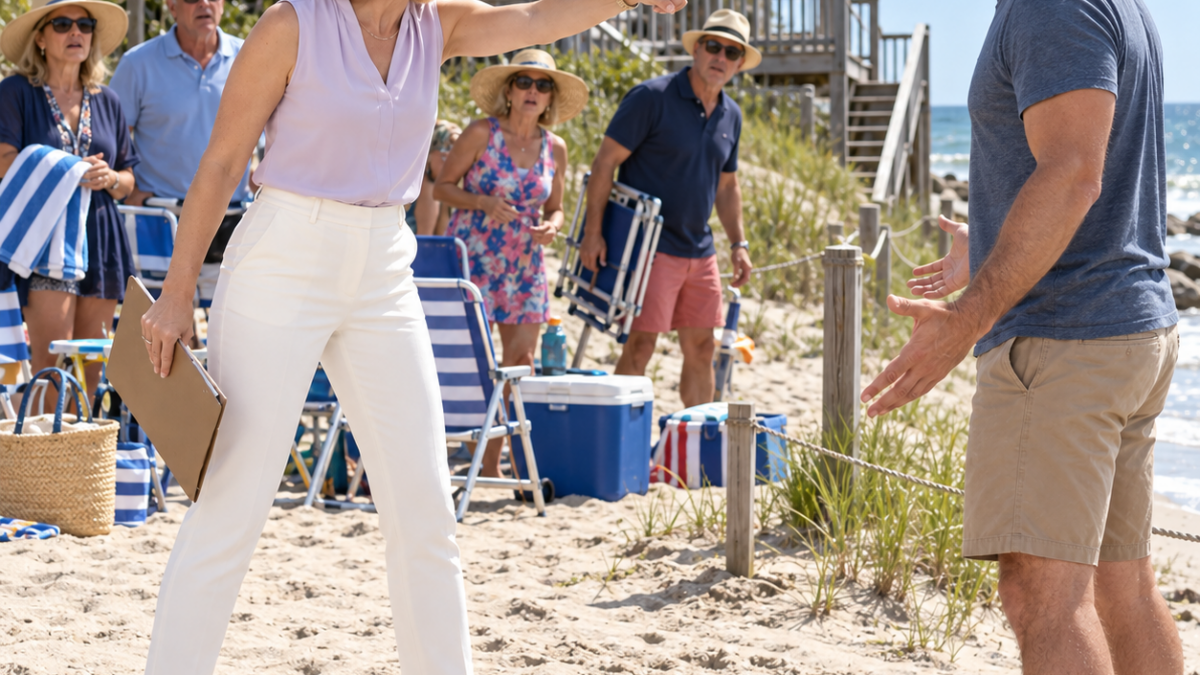
𝗙𝗨𝗟𝗟 𝗦𝗧𝗢𝗥𝗬
Emily’s face hardened.
“My husband owns this property.”
Karen laughed once, short and ugly.
“Oh, now he owns it.”
I felt Emily’s fingers touch my wrist. Not holding me back exactly. Reminding me she was there.
I pointed toward the house.
“That’s my house. This is my land. I have the deed, the survey, property tax records—everything. I’m happy to show you.”
Karen pushed her sunglasses onto the top of her visor and looked me over slowly, as if my shorts and faded T-shirt were evidence against me.
“That’s very convenient,” she said.
“It’s not convenient. It’s true.”
“No,” she said. “I know who owns this property, and you are definitely not him.”
That stopped me.
“You know the owner?”
Her smile turned smug.
“Yes. His name is Robert. Older gentleman. Very kind. Rarely comes down anymore.” She crossed her arms. “And he certainly did not give you permission to be here.”
The sand seemed to shift under my feet.
For one brief second, I was not angry. I was somewhere else entirely.
I saw my grandfather sitting in his old green chair on the porch, rolling a cigarette between his fingers even after the doctor told him to quit. I saw his hands, rough and freckled, resting on the railing. I heard him telling me the ocean was honest because it never pretended not to be dangerous.
Then Karen’s voice dragged me back.
“So if anyone is trespassing,” she said, “it’s you.”
Emily inhaled sharply.
“My grandfather is dead,” I said.
The words came out flatter than I intended.
Karen blinked, but only for a moment.
“Excuse me?”
“Robert was my grandfather,” I said. “He passed away several years ago. I inherited the property from him. I’m the legal owner now.”
A decent person would have stepped back.
A decent person would have said, I’m sorry. I didn’t know.
Karen rolled her eyes.
“Sure you are.”
Emily took half a step forward. “Are you serious?”
Karen ignored her and looked at me like I had tried to sell her fake jewelry in a parking lot.
“If you really knew Robert,” she said, “you’d know he loved this community.”
I almost laughed, but there was no humor in me.
“My grandfather did not love your HOA.”
“He was always friendly.”
“He was polite. That’s different.”
“In fact,” Karen said, raising her voice, “he made a verbal agreement with us years ago because he didn’t need all this beach. He signed it over in practice.”
“In practice is not a legal term,” I said.
“It means everyone knows what happened.”
“No,” I said. “It means you made up a story that benefits you.”
Her face tightened.
A few people in her group had stopped pretending not to listen.
The man with the blue cooler looked uncomfortable now. The woman in the sunhat folded her towel back into her bag. But Karen was not reading the room. Or maybe she was, and it made her even more determined to crush me before doubt spread.
“You need to pack up,” she said.
I stared at her. “What?”
“You heard me. You and your wife need to pack your things and go somewhere else. There is plenty of public beach down that way.”
She pointed south, past my property, past the dunes, as if banishing me from my own inheritance was the most natural thing in the world.
The absurdity of it landed so hard I almost could not speak.
Emily’s hand tightened around my wrist.
I looked at the private property sign. I looked at my house. I looked at the strangers sitting in my sand while this woman told me to leave.
“No,” I said.
Karen’s eyebrows lifted.
“No?”
“No.”
Her mouth opened slightly, stunned not by the word but by the fact that I had dared to use it.
I kept my voice steady, but my heart was pounding.
“You are on private property. I have been patient. I have explained this clearly. I am asking you and your group to move to the HOA beach access.”
Karen leaned closer.
“And I am telling you,” she said, “that this beach belongs to our community.”
“It doesn’t.”
“You’re confused.”
“I’m not.”
“You’re trying to intimidate residents.”
“I’m trying to drink coffee in front of my own house.”
The man with the cooler coughed into his hand, maybe hiding a laugh.
Karen snapped her head toward him, and he suddenly became fascinated by the cooler lid.
Emily said, quietly enough that only Karen and I heard, “Maybe we should go inside and call the non-emergency line.”
Karen caught the word “call” and pounced.
“Oh, yes,” she said, voice brightening with triumph. “Let’s call someone.”
I looked at her.
She smiled.
“Call Robert.”
The air went very still.
Emily stared at her as if she had just watched a person step willingly onto thin ice.
Karen continued, encouraged by her own performance.
“Go ahead. Call him right now. He will tell you exactly what he told the HOA. He will confirm you have no right to be here. Honestly, he should know there are people on his property pretending to own it.”
Something inside me shifted.
Until that moment, I had been angry in the way you get angry when somebody cuts you off in traffic or talks down to a waiter. Hot, immediate, messy.
But now the anger went cold.
Because Karen had just handed me the cleanest possible rope.
“You want someone to call the owner?” I asked.
Her smile widened.
“Yes.”
“The owner of this property?”
“Yes,” she said. “Call Robert.”
“He’s dead.”
“Then call whoever handles his estate,” she snapped. “Call the real owner. I don’t care. But this nonsense ends now.”
Emily turned away slightly, pressing her lips together.
She knew me too well.
I pulled my phone from my pocket.
Karen’s posture straightened. Her entire body seemed to say, Finally.
Her audience gathered in silence.
One man whispered, “Karen doesn’t mess around.”
I almost felt sorry for him.
Almost.
I turned to Emily and made my voice loud enough for every person on that beach to hear.
“Honey,” I said, “this woman wants confirmation about who owns this property. Can you please call the owner?”
Emily did not miss a beat.
She lifted her phone, looked directly at Karen, and tapped my contact.
Two seconds later, my phone rang in my hand.
The ringtone sounded absurdly cheerful in the middle of all that tension.
No one moved.
Karen’s expression did not collapse all at once. It changed in pieces.
First, confusion.
Then irritation.
Then a flicker of understanding.
Then color rising up her neck.
I held up my ringing phone.
“That would be me,” I said.
The beach was silent except for the waves.
Emily let the call ring twice more before ending it.
Karen’s lips parted, but nothing came out.
I answered anyway, because I was past letting her control the pace.
“I inherited this property from Robert, my grandfather, through his estate. I am the legal owner. I’ve told you this repeatedly. You refused to accept it.”
I opened my email app and pulled up the folder I kept for the beach house. My hands were steady now.
“Here is an email from the property insurance company addressed to me for this address. Here is my property tax payment confirmation from three months ago. My name. This property. Paid.”
I turned the screen toward her.
She barely looked.
“I don’t care what fake emails you have.”
Emily’s voice sharpened. “Fake?”
Karen seized on the word as if volume could make it true.
“Yes. Fake. Screenshots. Emails. Anyone can make anything look real on a phone.”
“Would you like me to go inside and get the actual deed?” I asked. “The survey? The county documents?”
Her jaw worked.
“What I would like,” she said, “is for you to stop harassing residents.”
One of the older men in her group stepped closer.
“Karen,” he said carefully, “maybe we should just move down to our section. This is getting out of hand.”
She turned on him.
“No. I have been on the board for six years. I know Robert personally. This is some kind of scam.”
The man stepped back, embarrassed.
That was the moment I stopped negotiating.
“Okay,” I said.
Karen looked back at me, breathing hard.
“You asked me to contact the owner. I did. I am the owner. I showed you evidence. You refused to accept it. So here are your choices.”
I pointed down the beach.
“You and your group can voluntarily move to the HOA access right now.”
Then I pointed toward the house.
“Or I can call the police and report trespassing.”
Her laugh came out too loud.
“Go ahead.”
Emily whispered, “Are you sure?”
I looked at Karen.
She stood there with her visor, her embroidered logo, and her borrowed authority, daring me to blink.
“Yes,” I said. “I’m sure.”
I called the local police non-emergency number.
Karen crossed her arms while I spoke to the dispatcher. I kept my voice calm, almost boring. My name. My address. A group trespassing on my private beach. Asked multiple times to leave. Refused. Documentation available. No weapons. No physical threats. Yes, I could meet the officer at the property.
When I hung up, the beach felt different.
Karen had wanted an audience. Now she had one.
And audiences are dangerous when the performance starts going badly.
A young couple began packing their towels. The woman avoided Karen’s eyes as she snapped a cooler shut.
Karen noticed.
“Where are you going?” she demanded.
The woman did not answer. She just took her child’s hand and walked toward the HOA section.
Another family followed.
Karen’s control was slipping, and she hated it.
“Cowards,” she muttered, but loudly enough for them to hear.
Emily stared at her. “They’re not cowards. They’re decent people who don’t want to trespass.”
Karen swung toward her.
“You don’t get to lecture me.”
“No,” Emily said. “Apparently the police do.”
For a second, I thought Karen might explode.
Instead, she pulled out her phone and turned away, speaking in a furious low voice. I caught pieces.
“Hostile man…”
“Claims he owns it…”
“Yes, police…”
“No, I’m not moving…”
She paced along the sand, stabbing one hand through the air while the remaining people stood around pretending to rearrange things.
Twenty minutes is not a long time unless you spend it standing between your home and a group of people who have decided your boundaries are offensive.
My coffee sat untouched.
My book lay facedown in the sand.
Emily and I sat near our chairs, but neither of us relaxed. Every few minutes, Karen glared at us. Once, she walked close enough that her shadow fell across my legs.
“I contacted our HOA president,” she said. “And our attorney.”
“Okay.”
“You’re going to regret this.”
“Okay.”
Her eyes narrowed.
“You think you’re clever.”
“I think I’m tired of repeating myself.”
“You young people inherit something and suddenly believe you understand how communities work.”
That one landed closer than I wanted it to.
Because beneath her arrogance, I could hear the accusation. I had not earned the beach. I had not been there every weekend. I did not patrol it. I did not sit in meetings or join committees or wear shirts with logos.
To her, ownership was not a deed. It was presence. Confidence. The willingness to take up space until everyone else got tired and backed away.
My grandfather had warned me about people like that too.
“Some folks,” he used to say, “don’t steal by sneaking. They steal by acting insulted when you notice.”
A police cruiser pulled up in front of my house at 10:42 a.m.
I remember the exact time because I looked at my phone and thought, This is my Saturday now.
The officer who stepped out was broad-shouldered, maybe early forties, with a calm expression and sand-colored hair cut close at the sides. He walked down from the road, scanning the beach, the signs, the group, Karen, Emily, me.
I met him halfway.
“Are you the caller?” he asked.
“Yes, sir.”
I gave him my name and ID.
He looked from the ID to the house, then to the address.
“You live here?”
“Part-time. I own it.”
“And this section of beach?”
“Yes. I have the deed and survey inside.”
He nodded. “Tell me what happened.”
I gave him the short version. Private property. HOA access nearby. Group set up here. I asked them to move. Karen insisted it was community beach and refused.
The officer’s face did not change much, but his eyes moved to Karen when I said her name.
She was already marching toward us.
“Officer,” she called, before he had even finished with me. “Thank goodness. This man has been harassing residents.”
The officer held up one hand without looking away from me.
“I’ll speak with you in a moment, ma’am.”
Karen stopped like she had hit glass.
I almost admired his technique.
He asked, “Do you have documents?”
“Yes.”
I jogged up to the house.
Inside, everything felt strangely normal. The kitchen still smelled like coffee. Emily’s sweater hung over a chair. A tiny trail of sand crossed the floor from our feet. I went to the office, opened the file drawer, and pulled out the folder I had reorganized after the last property tax assessment.
Thank God for one boring afternoon of paperwork.
The deed.
The transfer from my grandfather’s estate.
The property survey with boundary lines marked clearly.
The tax bill.
The insurance paperwork.
When I carried the folder back down, Karen had positioned herself near the officer and was talking at him, not to him.
“…historical community usage…”
“…Robert personally told several of us…”
“…no one has ever objected before…”
“…beach access is an amenity…”
The officer turned as I approached.
I handed him the folder.
Karen looked at it like it was something obscene.
He took his time reading.
I appreciated that.
Not because I doubted what the documents said, but because I wanted every person on that beach to watch the process happen slowly. No shouting. No bluffing. No HOA board voice. Just paper and law.
The officer checked the survey, then looked at the posts marking the property line. He walked several yards in both directions, comparing the map to the sand and the signs. Then he came back.
“All right,” he said.
Karen stepped forward. “Exactly. So you can see—”
“Ma’am,” he said, “this appears to be private property.”
Her face froze.
“No.”
The officer’s eyebrows lifted slightly.
“No?”
“This is community beach.”
“Not according to the documents I’m looking at.”
“We have used it for years.”
“That does not make it yours today.”
“You don’t understand. There was an agreement.”
“Do you have written documentation of that agreement?”
Karen’s mouth tightened.
“It was verbal.”
“With the current owner?”
“With Robert.”
The officer looked at me. “Robert is?”
“My grandfather,” I said. “Deceased.”
Karen cut in. “But he gave the HOA permission.”
I said, “No, he didn’t.”
The officer looked back at Karen.
“Ma’am, without written permission from the property owner, and after being asked to leave, you and your group are trespassing.”
The word landed hard.
Trespassing.
Not misunderstanding. Not community disagreement. Not neighborly tension.
Trespassing.
A few people in Karen’s group immediately began packing. Chairs folded. Cooler lids slammed. Towels were shaken out with frantic energy.
Karen did not move.
Her arms crossed so tightly I thought she might hurt herself.
“I am not leaving.”
The officer’s voice changed.
It was subtle, but everyone felt it.
“Ma’am, I am instructing you to leave private property.”
“This is absurd.”
“You can move to the HOA beach access down there, or you can refuse a lawful instruction and risk being cited or arrested for trespassing.”
Her sunglasses were back over her eyes, but they did not hide the color draining from her face.
“You would arrest an HOA board member?”
The officer stared at her.
“I would arrest someone refusing to leave private property after being told to leave.”
The beach went so quiet I could hear the plastic flutter of a half-folded umbrella.
Karen looked around for support.
Nobody gave it to her.
The older man who had tried to reason with her earlier avoided her gaze while stuffing towels into a canvas bag. A woman in a floral cover-up mouthed something like, “Let’s just go.” Someone else muttered, “This is embarrassing.”
Karen heard that.
Her pride cracked, but instead of humility, fury spilled out.
“Fine,” she snapped. “Fine. We will move. But this is not over.”
She grabbed her chair and folded it so violently one of the legs pinched shut with a metallic bang.
“This is absolutely not over,” she said again, louder, facing me. “The HOA will be contacting you.”
I did not answer.
That angered her more than any response would have.
She dragged her belongings through the sand, making a show of every motion. She shook towels in my direction. She complained loudly about harassment, hostile outsiders, and young people who did not understand community values. Her remaining followers moved faster than she did, heads down, avoiding eye contact as they crossed back toward the section they should have used in the first place.
The officer stayed until every last chair, umbrella, cooler, and bag had been removed from my property.
Then he walked back to me and handed me a card.
“Incident report number,” he said. “If they come back and cause problems, call us.”
“Thank you.”
He looked down the beach toward the HOA group, where Karen was now standing with her hands on her hips as if she had chosen to relocate for strategic reasons.
“Some people,” he said, “cannot accept being wrong.”
“No,” I said. “They really can’t.”
After he left, Emily and I stood there on the empty sand.
For a few seconds, neither of us spoke.
Then Emily started laughing.
Not happy laughter exactly. More like the sound your body makes when it has been carrying too much tension and has no elegant way to release it.
I laughed too.
The whole thing was ridiculous. A woman had marched onto our property, accused me of trespassing, demanded I call the owner, and then watched my phone ring.
It should have ended there.
In a fair world, embarrassment would have done what reason could not. Karen would have gone home, complained privately, and maybe avoided eye contact the next time she saw me.
But Karen was not built for graceful defeat.
An hour later, my phone rang.
The number was unfamiliar, local.
I almost let it go to voicemail. Then I looked down the beach and saw Karen standing apart from her group, phone in hand, watching me.
I answered.
“Hello?”
“Is this the owner of the property adjacent to Seabright Dunes Community?”
The man’s voice was smooth, practiced, and cautious.
“This is he.”
“My name is Daniel Mercer. I’m president of the Seabright Dunes HOA.”
Of course he was.
I walked away from Emily and stood near the waterline.
“What can I do for you, Mr. Mercer?”
“I understand there was an incident this morning involving one of our board members.”
“That’s one way to put it.”
He paused.
“I’d like to discuss it.”
“There isn’t much to discuss,” I said. “Your board member brought a group onto my private property, refused to leave when asked, accused me of trespassing, and forced me to call the police.”
“I think there may have been a misunderstanding.”
“There wasn’t.”
Another pause.
The waves rolled in, thin and silver over the sand.
Daniel cleared his throat.
“Our community has been under the impression for some time that access extended along that portion of beach.”
“Then your community has been under the wrong impression.”
“I understand that’s your position.”
“It’s not a position. It’s the property line.”
His voice cooled a degree.
“We are trying to maintain neighborly relationships.”
“So am I.”
“Perhaps we could work out an arrangement.”
I stared at the water.
“What kind of arrangement?”
“Limited access during peak periods. Holiday weekends, summer Saturdays, community events. Nothing unreasonable.”
I laughed once, quietly.
“Mr. Mercer, your board member tried to throw me off my own beach this morning.”
“I understand feelings are high.”
“No,” I said. “You don’t. Because this is not about feelings. My property is not a community overflow lot. Your HOA has its own beach access two hundred feet away.”
“That area becomes crowded.”
“Then your HOA has a crowding problem. Not a me problem.”
He did not like that.
“I would hate for this to create tension with the neighborhood.”
The threat was wrapped in polite stationery, but I heard it clearly.
“It already created tension,” I said. “When your board member trespassed and refused to leave. If your HOA respects my property boundaries, there won’t be any more tension.”
“Are you refusing to discuss access?”
“Yes.”
“You may want to consider whether that is the most neighborly approach.”
“I have considered it.”
“And?”
“My answer is still no.”
His voice was clipped when he said, “We’ll be in touch.”
“I’m sure you will.”
I hung up and stood there for a moment with the phone in my hand.
Emily walked up beside me.
“HOA president?”
“Yep.”
“How bad?”
“He wants us to share the beach during peak times.”
She looked down the shoreline toward Karen’s cluster of umbrellas.
“After that?”
“Apparently refusing would be unneighborly.”
Emily’s laugh had no humor.
“That woman accused you of scamming your dead grandfather.”
“I know.”
Her expression softened.
The anger drained from her face, leaving something more tender and more painful.
“She said his name like she owned him too.”
That was exactly it.
I had been trying to put words to the particular ugliness of Karen’s behavior, and Emily had found them.
Karen did not just claim the beach. She claimed the story. The history. My grandfather’s kindness. She took the fact that he had been polite to people and tried to twist it into surrender. She turned friendliness into permission, absence into abandonment, death into opportunity.
That night, after the sun went down and the HOA side finally quieted, I sat on the porch with the folder of documents beside me.
Emily went to bed early, exhausted by a day that was supposed to have been peaceful.
I stayed outside.
The air smelled like salt and wet wood. The porch light attracted moths that tapped themselves senseless against the glass. Somewhere down the beach, people laughed around a fire pit on HOA property, where they were allowed to be.
I opened the folder and looked at the deed again.
My name.
The legal description.
The transfer from Robert’s estate.
The paper was boring. Dry. Clean.
It did not say anything about my grandfather teaching me to fish in the surf. It did not mention him carrying me on his shoulders when the sand got too hot. It did not record how he sat in silence after my grandmother died, watching the waves for hours because grief had made language useless.
But it protected all of that.
I realized then that I had been too casual with the property because I had thought decency would be enough.
A sign would be enough.
A polite correction would be enough.
It had never occurred to me that someone could look at a boundary, understand it perfectly, and still decide that wanting something entitled them to cross it.
Two days later, we drove back to the city.
For a while, nothing happened.
Then the letters started.
The first one arrived a little over a week after the beach incident.
The envelope had the Seabright Dunes HOA logo in the corner.
Emily found it in the mail and held it up like it might bite.
“Do we burn it now or after reading?”
“After,” I said. “Evidence first. Fire later.”
It was four pages of polished nonsense.
Community values.
Shared coastal enjoyment.
Longstanding neighborly traditions.
A request that I grant Seabright Dunes residents access to “the disputed beachfront area” during reasonable hours.
Disputed.
I read that word three times.
Nothing was disputed. They had trespassed, been told by police to leave, and now wanted to rename my property as a question.
At the bottom, Daniel Mercer had signed his name in blue ink.
I put the letter in a folder and ignored it.
Ten days later, the second letter came.
This one was colder.
It referenced an alleged verbal agreement between my grandfather and “representatives of the Association.” It claimed the HOA had relied on that agreement for years. It said I had an obligation to honor Robert’s commitments and avoid unnecessary conflict with the surrounding community.
I called my attorney, Margaret Ellis, before I even finished reading it.
Margaret had handled the estate paperwork after my grandfather died. She was in her sixties, sharp as broken glass, with a voice that could make a banker apologize for breathing too loudly.
I emailed her both letters and called her office.
She called back twenty minutes later.
“Well,” she said, “that is adorable.”
I leaned back in my chair for the first time all morning.
“Adorable?”
“In the way raccoons are adorable when they think hiding behind a curtain means you can’t see them.”
“So they have no case?”
“Based on what you sent me? No.”
“They’re claiming my grandfather made a verbal agreement.”
“Did he?”
“Not that I know of. And he would have written it down if he had.”
“Exactly. Also, a verbal agreement to casually allow beach use is not the same thing as transferring a property right. Did they provide dates? Names? Terms? Anything?”
“No.”
“Of course not.”
Her confidence helped, but it did not erase the knot in my stomach.
“What do I do?”
“Nothing yet. Keep everything. Do not call them. Do not argue with them. If they escalate, I’ll respond.”
“They already had a board member removed by police.”
Margaret hummed.
“That may become useful.”
Three weeks after the incident, the third letter arrived.
This one came from a law firm.
The envelope alone made my stomach drop.
I opened it in the kitchen while Emily watched my face.
“What?” she asked.
I handed it to her.
The letter claimed the HOA had established a prescriptive easement over my section of beach through continuous, open, and notorious use over a period of years.
I knew just enough about property law to understand why that sounded serious.
And not enough to know whether it was.
The words crawled under my skin.
Continuous use.
Open and notorious.
Adverse.
Easement by prescription.
I imagined years of occasional trespassing transformed into a legal crowbar. I imagined losing the very thing my grandfather had refused to sell. I imagined Karen smiling in some meeting room while people congratulated themselves for being persistent enough to take what they wanted.
Emily read the letter twice.
“Can they do this?”
“I don’t know.”
My voice sounded smaller than I liked.
That was the worst part. Not Karen yelling. Not the police. Not even the letters.
It was the possibility, however small, that paperwork and persistence could turn wrong into right.
I forwarded the letter to Margaret.
Then I waited.
Waiting on legal answers is its own kind of punishment. Every hour gives your imagination room to build disasters. By noon, I had convinced myself the HOA had some obscure coastal access argument. By one, I was pricing surveyors. By two, I was furious at my grandfather for not fencing the whole thing off years earlier, then immediately ashamed because he was dead and had done nothing wrong.
Margaret called at 3:17.
I answered before the first ring finished.
“Tell me how bad it is.”
“It’s garbage,” she said.
I closed my eyes.
“Really?”
“Complete garbage. Decorated garbage, but garbage.”
Emily, who had been pretending not to hover in the doorway, mouthed, What?
I gave her a thumbs-up, and she leaned against the wall like her knees had gone weak.
Margaret continued.
“A prescriptive easement would require them to prove specific elements under state law, including continuous and uninterrupted use for the statutory period. They would also need to establish that the use was adverse, not permissive.”
“What does that mean for us?”
“It means if your grandfather occasionally allowed neighbors to cross or sit there out of kindness, that actually undermines their claim. Permission defeats adversity.”
I let out a breath.
“And they’d need evidence?”
“They would need real evidence. Not Karen in a visor saying she feels entitled.”
Despite everything, I laughed.
Margaret’s voice sharpened.
“But listen to me. We respond firmly. We do not leave room for them to keep fishing. I’ll send a letter demanding they cease representing that they have access, warning against trespass, and preserving your right to pursue claims for harassment, interference, and any future damages.”
“Do it.”
“My pleasure.”
I almost pitied the HOA attorney who received Margaret’s response.
Almost.
She sent me a copy before mailing it.
It was magnificent in the way only a legal letter can be magnificent. Calm. Precise. Merciless. It acknowledged their claim, dismantled each element, attached copies of relevant ownership and boundary documents, referenced the police incident, and warned that further attempts to interfere with my property rights would be met with immediate legal action.
No insults.
No drama.
Just a blade wrapped in letterhead.
After that, the letters stopped.
For two quiet weeks, nothing happened.
No calls.
No envelopes.
No surprise beach invasions.
I began to think maybe Margaret had scared them off.
Then, five weeks after the original incident, Daniel Mercer called again.
I saw his name because I had saved the number under “HOA Problem” after his first call.
Emily saw the screen and said, “Don’t answer.”
I considered it.
Then I did.
“This is Daniel Mercer,” he said.
“I know.”
A pause.
“I was hoping we could speak.”
“We are speaking.”
His exhale crackled through the line.
“I wanted to apologize.”
That was not what I expected.
I sat up straighter.
“For what, exactly?”
“For the way the situation was handled by our association.”
“That’s broad.”
“Yes,” he said, and there was enough exhaustion in his voice that I believed, for the first time, he might actually understand the size of the mess Karen had made. “It was unacceptable.”
I said nothing.
People show you how serious an apology is by what they do when you leave silence in front of them.
Daniel continued.
“Karen Whitcomb has been removed from the HOA board.”
I looked toward Emily, who was watering a plant by the kitchen window.
She froze when she saw my expression.
Daniel said, “Several residents who were present that morning gave statements to other board members. Their accounts matched yours. There were also concerns about her conduct before this incident, but this brought everything to a head.”
Karen Whitcomb.
Until that call, she had only been Karen in my head. A type. A force. A woman with a visor and a logo shirt who believed authority was something you could embroider onto cotton.
Hearing her last name made her smaller somehow.
Not harmless. Just human. And accountable.
Daniel cleared his throat.
“Our attorney also advised us that pursuing the matter would be expensive and unlikely to succeed.”
“Your attorney said that?”
“In less friendly language.”
I almost smiled.
Daniel went on.
“The board has voted to respect the existing property boundaries. We have installed additional signage at the end of the HOA beach access to make clear where community property stops and private property begins.”
I stood and walked to the window.
Outside our city apartment, traffic moved through afternoon light. No waves. No gulls. No sand. Just glass and concrete and people hurrying through crosswalks.
But in my mind, I could see the beach.
The signs.
The place where Karen had stood with her arms crossed, daring the truth to inconvenience her.
“I appreciate the apology,” I said carefully. “But I want to be clear. I’m not interested in an access arrangement. I’m not interested in revisiting a verbal agreement that never existed. I’m not part of your HOA, and my property is not an amenity.”
“I understand.”
“And if anyone from your community crosses onto my property and refuses to leave again, I will call the police again.”
“I understand that as well.”
His voice sounded different from the first call. No polished threat. No talk of neighborly duty. Just a man cleaning up after someone else’s arrogance had become expensive.
“We would like to start fresh,” he said. “As neighbors.”
I thought about my grandfather.
I thought about how he had managed to be friendly without surrendering. Kind without being weak. Open-handed without letting anyone pry his fingers loose from what was his.
“Starting fresh means respecting the line,” I said.
“Yes,” Daniel replied. “It does.”
“Then we’re fine.”
After the call ended, Emily asked, “Well?”
“Karen’s off the board.”
Her eyebrows shot up.
“You’re kidding.”
“Nope.”
“What happened?”
“Witnesses backed us up. Their attorney told them they had no case. They’re putting up clearer signs.”
Emily set down the watering can.
For a moment, she just stood there.
Then she said, “Good.”
It was such a small word, but it carried all the exhaustion of the past five weeks.
Good that she had consequences.
Good that the HOA backed down.
Good that my grandfather’s beach had not been turned into a committee amenity by intimidation and letterhead.
We went back the following month.
I was tense the whole drive down.
I hated that.
The beach house had always been the place where my shoulders lowered as soon as I smelled the ocean. But that trip, every mile closer made me wonder what we would find. More signs removed? People set up in front of the house again? Karen waiting with a clipboard and a new theory?
Instead, we found quiet.
The house stood exactly as we had left it.
The porch boards creaked under my feet.
The private property signs were still there.
And down the beach, near the HOA access, two new signs had been installed.
Community Beach Ends Here.
Private Property Beyond This Point.
The words looked almost too simple after everything.
Emily stood beside me, reading them.
“Think she’s seen those?”
“I hope so.”
We carried our bags inside, opened the windows, and let the house breathe.
The next morning, I woke before Emily again.
Habit, maybe.
Or maybe some part of me needed to reclaim the morning Karen had ruined.
I made coffee. I picked up my book. I carried my chair down to the beach.
The sand was cool under my feet.
The tide was low.
For a while, I sat there listening to the waves and trying not to scan the shoreline every few seconds.
Then I saw movement near the HOA access.
A couple walked toward the water with chairs slung over their shoulders. They stopped at the new sign. The man looked down the beach toward my house. For a second, I braced myself.
Then he raised one hand in a small wave.
I lifted mine back.
They set up on their side.
That was it.
No confrontation.
No speech.
No drama.
Just a boundary respected.
The relief that moved through me felt almost embarrassing in its intensity.
Emily came down later and found me smiling at nothing.
“What?” she asked.
“Nothing.”
She followed my gaze toward the couple on the HOA beach.
“Ah,” she said. “Nothing.”
She sat beside me.
For a long time, we did not talk.
The ocean did what it had always done. Came in. Went out. Smoothed the sand. Erased footprints. Refused to care about board titles, legal threats, embroidered logos, or people who mistook loudness for ownership.
Over the next several visits, things stayed calm.
Sometimes I saw HOA residents on their side of the beach. A few waved. One older man, the same one who had tried to get Karen to move that first day, approached me once while I was rinsing sand off near the outdoor spigot.
“I just wanted to say,” he said, shifting awkwardly, “I’m sorry about what happened.”
I turned off the water.
“You don’t have to apologize for her.”
“I know. But a lot of us should have said something sooner.”
That surprised me more than the apology.
He looked toward the beach.
“She gets people worked up. Makes everything sound like a crisis. You don’t want to be the one arguing in front of everyone, so you stay quiet. Then suddenly quiet starts looking like agreement.”
I thought about that for a moment.
“Yeah,” I said. “It does.”
He nodded, embarrassed.
“Well. We know where the line is now.”
“It was always marked.”
A faint smile touched his face.
“Some people need bigger signs.”
After he left, I thought about how Karen had almost succeeded—not legally, maybe, but socially.
That was the part that stayed with me.
Not the easement letter. Not even the police call.
It was the way she had counted on discomfort. On people not wanting a scene. On my desire to be reasonable. On my grandfather’s reputation for kindness. On the strange pressure that makes decent people wonder if defending themselves is somehow rude.
She had not needed to own the beach if she could make me feel guilty for saying it was mine.
That was the real theft she attempted.
And that was why the ending mattered.
Not because she was humiliated.
Not because she lost her board seat, though I would be lying if I said that part did not feel satisfying.
It mattered because the line held.
The one on the survey.
The one in the sand.
The one inside me.
I still keep the folder in the office at the beach house. Deed, survey, tax records, insurance paperwork, incident report, Margaret’s letter. All of it in one place now, clearly labeled.
Emily teases me about it sometimes.
“Going to read your bedtime deed?”
“Maybe.”
“Very romantic.”
“You married a man with organized property documents.”
“I was young. I didn’t know.”
But she knows why I keep it close.
Not because I expect Karen to come back.
She has not. I heard through the older man that she sold her place the following year after losing some other battle about fence heights and golf cart parking. Apparently, without a board seat, she found community living far less enjoyable.
That sounded about right.
People like Karen do not love rules.
They love being the one who weaponizes them.
As for the HOA, they have kept their distance. Daniel Mercer sends a polite email once a year before summer reminding residents about beach boundaries, and Margaret reviews it when I feel like being extra cautious. Nobody asks for access anymore. Nobody claims Robert signed anything over. Nobody calls my private property “disputed.”
The house is peaceful again.
Sometimes, when I sit on the porch at dusk, I imagine my grandfather there in the old green chair, watching the water with that half-smile he wore when the world proved itself both foolish and predictable.
I think he would have enjoyed the phone call part.
He would have loved Emily’s timing.
He would have told me I waited longer than he would have before calling the police.
And he would have been right.
The last time we were down there, I found one of his old pocketknives in a drawer I had cleaned a dozen times before. It was tucked behind a stack of yellowing manuals, dull and stiff with age. I carried it outside and sat on the porch, turning it over in my hand while the sun went down.
For a moment, grief came back so sharply I had to close my eyes.
Not the heavy, suffocating grief from right after he died. Something cleaner. A tide pool version of it. Still deep, but held by edges.
I wished I could tell him I had protected it.
The house.
The beach.
The line he refused to sell.
Then again, maybe he already knew.
The ocean was quiet that evening. The HOA beach was empty except for a pair of folded umbrellas. My stretch of sand lay untouched, pale under the fading light.
Emily came out with two mugs of tea and handed me one.
“You okay?” she asked.
I nodded.
“Just thinking about him.”
She sat beside me.
“He’d be proud.”
I looked at the private property sign near the dune.
It was not pretty. It was not poetic. Just black letters on white metal, bolted to a post.
But after everything, it looked almost sacred.
“He used to say some things shouldn’t be sold just because someone else wants them,” I said.
Emily leaned her shoulder against mine.
“He was right.”
Down by the water, a wave slid up the sand, reached as far as it could, and fell back.
The line remained.
And this time, no one crossed it.