𝗙𝗨𝗟𝗟 𝗦𝗧𝗢𝗥𝗬 The Woman Blocking My Garage Smiled Like She Owned My Life Until I Built a Fence Around Her Lie
𝗙𝗨𝗟𝗟 𝗦𝗧𝗢𝗥𝗬
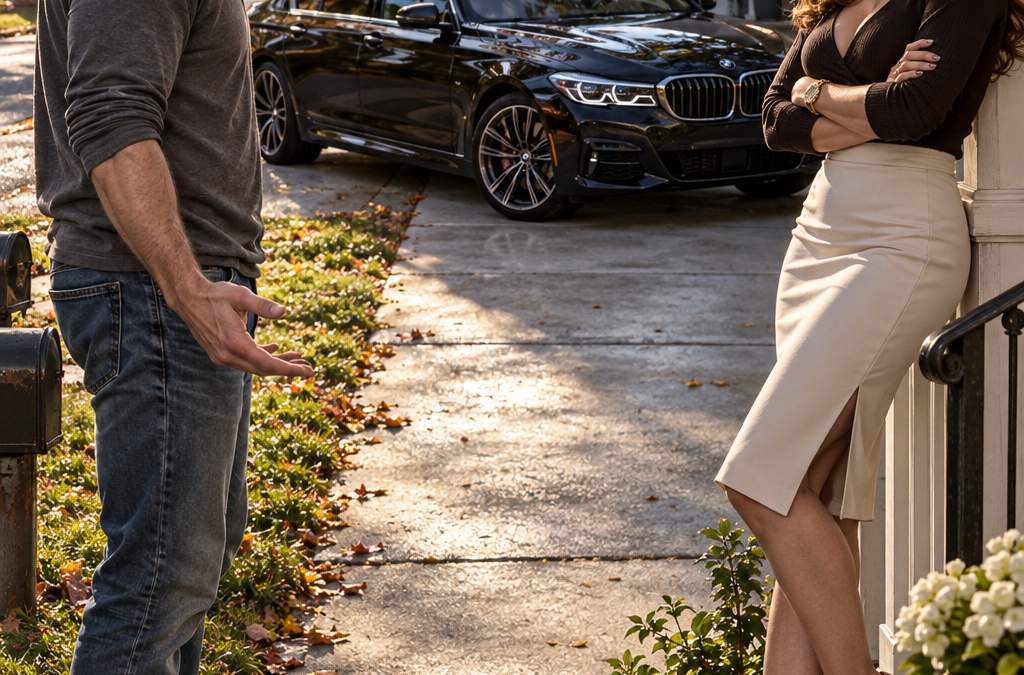
Some mornings, I would open my garage and there it was again, the BMW angled across my driveway like a challenge. Some evenings, I came home and found it there, blocking me from pulling in. Each time, I went to her door. Each time, she acted surprised. Each time, she moved it with an exaggerated sigh, as if my need to enter and leave my own property was a personal inconvenience she had generously chosen to tolerate.
It made no sense.
Karen had a driveway. She had curb space in front of her own house. Her husband had a truck, and her teenage son had an older sedan, but there was still room along their side of the street. She was not parking there because she had no other option. She was choosing my driveway.
At first, I searched my memory for something I might have done.
Had I parked too close to her mailbox once? Had I failed to wave? Had I said something in a tone she didn’t like? Had one of the neighbors told her I had complained about her?
Nothing came to mind.
Our entire relationship consisted of stiff greetings and me occasionally crossing the street to ask her to stop trapping my car.
The more it happened, the more I dreaded mornings.
I hated the feeling of pressing the garage opener and not knowing whether I would be able to leave. I hated walking to her door, hated seeing that smug little smile, hated the way she made me ask for access to something that already belonged to me. It was humiliating in a small but persistent way, like being forced to borrow your own shoes from someone who stole them.
One evening, after a long day that had already drained every ounce of patience I had, I turned onto my street and saw the BMW again.
This time, it wasn’t just in front of my driveway.
It was on my driveway.
Sideways.
The front wheels were on one edge, the back end angled across the other, blocking the garage completely. She had parked like she was claiming the space with the car’s whole body.
I sat there in the street with my hands on the steering wheel, feeling a cold kind of anger settle into me.
Not hot. Not explosive.
Cold.
I parked at the curb, got out, and walked to Karen’s house.
She opened the door before I knocked, like she had been waiting.
She was wearing a fitted green dress that looked expensive enough to have its own insurance policy. One shoulder was bare. A delicate gold necklace rested against her collarbone. Her perfume hit me before her voice did.
“Well?” she said.
I kept my tone calm. “Karen, we need to talk.”
Her eyebrows lifted. “About what?”
“About your car.”
She glanced past me toward my house with theatrical confusion. “What about it?”
“It’s parked across my driveway again. Actually, this time it’s parked on my driveway.”
“Oh,” she said. “That.”
“Yes. That.”
She leaned against the doorframe, crossing her arms. “I already told you I would move it if you needed me to.”
“That’s not the point,” I said. “You shouldn’t be parking there at all.”
Her smile thinned.
I took a breath. “I’m not trying to start a fight. But this is disruptive. I shouldn’t have to come ask you to move your car every time I need to leave or come home. It’s my driveway. My garage. My access to my house. You need to stop blocking it.”
For one second, her face went still.
Then she laughed.
Not loudly. Not naturally. Just a soft, insulting little sound.
“You’re welcome, by the way,” she said.
I frowned. “For what?”
“For moving my car whenever you come whining to my door. I take time out of my day to help you, and now you’re standing here lecturing me.”
My hands curled at my sides. “Helping me would be not blocking my driveway in the first place.”
“You could park on the curb,” she said.
“I could,” I said. “But I have a garage.”
“And?”
“And I use it.”
She looked me up and down as if I were a child refusing to share a toy.
“You know,” she said, “for someone who lives in such a small house, you are very territorial.”
I felt my face warm. “This has nothing to do with the size of my house.”
“It has everything to do with attitude,” she said. “You people act like every square inch is sacred.”
“You people?”
Her smile returned, wider now, prettier and uglier at the same time. “Neighbors,” she said sweetly. “Difficult neighbors.”
I swallowed the response I wanted to give. “Karen, the driveway is my property. You do not have the right to park there.”
That was when her expression changed.
The performance dropped.
Her eyes sharpened.
“Actually,” she said, “that’s where you’re wrong.”
I stared at her. “Excuse me?”
She pushed away from the doorframe and stepped onto the porch. “The previous owner of my house owned that strip of land.”
“What strip of land?”
She pointed toward my house with one manicured finger. “Your driveway. Your garage area. That part.”
For a moment, I honestly thought I had misheard her.
“My garage,” I said slowly.
“Yes.”
“Attached to my house.”
“Property lines can be complicated.”
“My driveway is in front of my garage.”
“And apparently,” she said, “you didn’t do your homework before buying.”
The street seemed too quiet around us. Somewhere a lawn mower hummed in the distance. A bird chirped from a tree like nothing insane was happening on Karen’s porch.
I said, “That’s ridiculous.”
Her eyes flashed. “Be careful how you speak to me.”
“Be careful where you park.”
She inhaled through her nose, then smiled again, but this time it was pure ice.
“Wait here,” she said. “I’ll show you.”
She disappeared inside, leaving me on the porch with my heart beating harder than it should have been. I looked back at my house, at the driveway I had used every day for four years, at the garage where my car belonged, and tried to convince myself this was just another Karen performance. Just another invented grievance. Just another power game.
Then she came back holding a folder.
It was navy blue, glossy, and absurdly official-looking. She opened it with a little flourish and pulled out a folded document.
“Here,” she said.
I did not take it from her hand right away.
She pushed it closer. “Go on.”
I took it.
The paper showed a property survey. Lines, measurements, labels, signatures, stamps. At first glance, it looked real enough to make my stomach tighten. My eyes moved across it, searching for something obvious. A typo. A wrong address. A missing seal. Anything.
Then I saw what she wanted me to see.
The boundary line curved in a way that swallowed my driveway and garage area into her lot.
“That can’t be right,” I said.
“It is.”
“The previous owner never mentioned anything like this.”
Karen gave a delicate shrug. “That sounds like your problem.”
I looked up at her. “Where did you get this?”
“From my closing documents.”
“Then your closing documents are wrong.”
She leaned closer, her voice dropping into something almost intimate. “No. You are wrong. And I have been more than patient while you parked on land that belongs to me.”
A car drove by slowly. I could feel the driver looking.
Karen noticed too. She straightened, raising her voice just enough to sound wounded. “I’ve tried to be neighborly, but you keep harassing me.”
My mouth fell open. “Harassing you? You’re blocking my garage.”
“My garage access,” she snapped.
That sentence hit me so hard I almost laughed.
Instead, I handed the paper back. “Move your car.”
She took the survey and slid it into the folder. “I will move it today because I am generous. But if I see your car on my property again, I will call the police.”
“You cannot be serious.”
“I am very serious.”
“You’re threatening to call the cops because I parked in my own garage?”
“I’m warning you,” she said. “There’s a difference.”
I stood there for a few seconds, trying to measure the situation. Part of me wanted to march over to the BMW, call a tow truck immediately, and let the pieces fall where they fell. But I had work the next morning. I had bills. I had responsibilities. I had the sickening awareness that official-looking paper, even fake paper, can cause real problems when the wrong person waves it around loudly enough.
Karen knew that.
She was counting on it.
She moved the BMW that evening, but the damage was done. Not to the driveway. To my peace.
That night, I parked on the curb.
It felt wrong in a way I could not fully explain. My garage sat empty while my car rested under a streetlight like a guest outside its own home. I stood at my front window long after dark, watching Karen’s house.
At one point, I saw her step out onto her porch with a glass of wine.
She looked toward my car on the curb.
Then she smiled.
The next morning, I called the county office during my lunch break.
I explained the situation as calmly as I could, though the woman on the phone went silent for a full three seconds when I told her my neighbor claimed to own my garage.
“Your attached garage?” she asked.
“Yes.”
“Attached to the house you own?”
“Yes.”
“And your neighbor is claiming her property line includes it?”
“Yes.”
Another pause.
Then she said, very professionally, “You may want to come in and pull the official records.”
So I did.
I left work early, drove to the county office, and spent the afternoon sitting in a beige waiting area under fluorescent lights while a clerk pulled records, maps, and archived documents. I expected confusion. I expected some complicated old easement or clerical mess.
There was none.
My property lines were exactly what I had believed they were.
My driveway was mine.
My garage was mine.
The strip Karen claimed belonged to her did not belong to her, had never belonged to her, and according to every official record available, was not even close to belonging to her.
The clerk printed certified copies for me. I paid the fee with a strange sense of relief and fury mixed together. Relief because I was not losing my mind. Fury because Karen had known exactly what she was doing.
On the way home, I kept replaying her voice.
If I see your car on my property again, I will call the police.
By the time I pulled up to my house, her BMW was sitting in my driveway again.
This time, not just blocking it.
Claiming it.
I sat in my car at the curb with the certified records on the passenger seat and stared until the sun dipped behind the houses.
That night, I called my friend Mark.
Mark was one of those friends who seemed to know how to fix everything practical. He worked for a company that installed chain-link fences, security gates, temporary construction barriers, and pretty much anything made of metal posts and stubbornness. We had known each other since college, and he had the calm voice of someone who could solve a crisis with a socket wrench and a sarcastic comment.
When I finished telling him what happened, he was quiet.
Then he said, “Let me make sure I understand. She parked her car on your property and threatened to call the cops if you parked in your own garage.”
“That is exactly what happened.”
“And you have certified county records proving she’s lying?”
“Yes.”
“And she keeps putting the car there?”
“Yes.”
He exhaled. “Wow.”
“I know.”
“No,” he said. “I mean wow, as in she really wants a lesson.”
I leaned back in my chair. “Mark.”
“What?”
“I’m not trying to go to jail.”
“Good. Don’t.”
“I’m serious.”
“So am I. Don’t touch her car. Don’t damage it. Don’t threaten her. Don’t do anything illegal.”
“That was the plan.”
“But,” he said slowly, and I could hear the smile entering his voice, “there may be a way to make your point using nothing but your own property.”
I sat up. “What do you mean?”
He explained it.
At first, I thought he was joking.
Then I realized he was not.
“No,” I said.
“Yes.”
“That’s insane.”
“It’s beautiful.”
“It’s insane.”
“It’s legal if we keep it on your property and don’t damage her vehicle.”
“You’re talking about building a fence around her car.”
“A temporary chain-link enclosure,” he corrected. “Very classy.”
I rubbed my forehead. “Mark.”
“She says the land is hers, right?”
“That’s her claim.”
“So if it’s hers, why should she care what you build on it?”
Despite everything, a laugh escaped me. It came out sharp and exhausted.
Then I stopped laughing.
Because the idea was ridiculous.
And perfect.
We spent the next two days planning carefully. I did not want revenge badly enough to do something stupid. Mark checked the measurements. I checked local rules about temporary fencing. I made sure the fence would stay entirely within my property lines. I took pictures of Karen’s car sitting there day after day. I recorded myself asking her to move it and her refusing. I kept copies of the real survey in my house, my car, and even scanned to my email.
Karen, meanwhile, grew bolder.
Since I had started parking on the curb, she seemed to believe she had won. She began leaving the BMW in my driveway overnight. Once, I came outside to find her standing beside it, talking on the phone.
She looked directly at me and said loudly, “Some people don’t understand boundaries.”
I almost admired the audacity.
Almost.
The night we did it was cool and moonless.
Karen’s BMW was parked where it had been for two days, angled across my driveway like a trophy. Her house was dark by ten. The neighborhood settled into silence. At eleven-thirty, Mark pulled up with another guy from his crew and a trailer full of materials.
“Are you sure?” he whispered.
I looked at the BMW, then at my empty garage, then at the folder of county records sitting on my kitchen table.
“Yes,” I said.
They worked fast.
I helped where I could, though mostly I stayed out of the way and kept watch. Metal posts went up. Panels followed. The soft clink of chain-link sounded impossibly loud in the night air, but no lights came on. No curtains shifted. Karen’s BMW slowly disappeared inside a cage that stood entirely on my property, close enough to make escape impossible but not close enough to scratch the paint.
By three in the morning, the fence was finished.
It surrounded the BMW on all sides.
There was no gate.
Mark stepped back, hands on his hips, and admired his work.
“I have to say,” he whispered, “this might be my masterpiece.”
I should have felt guilty.
Instead, I felt something I had not felt in weeks.
Control.
The next morning, I woke before my alarm.
For a moment, I forgot.
Then I remembered and went to the window.
The BMW sat inside the fence, black paint gleaming behind silver mesh. The whole thing looked absurd, like an art installation about entitlement.
I made coffee.
I got dressed.
I walked outside, got into my car at the curb, and drove to work.
For the first time in weeks, I was not late.
At noon, my phone buzzed.
Unknown number.
Then another.
Then six more.
I did not answer.
By the time I got home, Karen was waiting in front of my house.
She was not alone. Her husband stood behind her looking uncomfortable, arms crossed, eyes down. Her teenage son leaned against their truck, trying very hard not to laugh and failing.
Karen, however, was incandescent.
Her face was flushed under her perfect makeup. Her hair, usually arranged in glossy waves, looked like she had run her hands through it fifty times. She was wearing white jeans, a fitted pink sweater, and heels that sank slightly into the edge of my lawn as she marched toward me.
“You,” she hissed.
I got out of my car slowly. “Good evening, Karen.”
“Do not good evening me.”
I shut the car door. “Is there a problem?”
Her mouth opened, then closed, as if the words were piling up too fast to fit through.
“You built a fence around my car.”
I looked past her at the BMW. “I built a fence on my property.”
“You trapped my vehicle.”
“Your vehicle is on my property.”
She pointed at me, her bracelet flashing in the late sunlight. “You are trespassing. You are vandalizing. You are harassing me. You are going to regret this so badly.”
“I didn’t touch your car.”
“I cannot move it!”
“That does seem to be the case.”
Her husband muttered, “Karen, maybe we should just—”
“Do not start,” she snapped without turning around.
He looked away.
She stepped closer to me. “You are going to remove that fence right now.”
“No.”
The word came out calmly.
It stunned her more than yelling would have.
Her eyes narrowed. “Excuse me?”
“No,” I said again. “I am not removing it right now.”
“You don’t have a choice.”
“I do.”
“That is my car.”
“Yes.”
“And that is my land.”
“No.”
She smiled suddenly, viciously. “Fine. Then we’ll let the police explain it to you.”
“Please do.”
She stared at me, waiting for fear.
I gave her none.
Her fingers trembled slightly as she pulled out her phone.
The police arrived twenty minutes later.
Two officers stepped out of the cruiser, both wearing the tired expressions of men who had handled too many neighbor disputes that week. Karen rushed toward them before they had fully closed their doors.
“Officers, thank God,” she said, voice instantly transforming into something breathy and wounded. “This man has built a fence around my car. He’s been harassing me for weeks, and now he’s trapped my property.”
One officer looked toward the fenced BMW.
His eyebrows moved slightly.
The other officer glanced at me. “Sir, is this your fence?”
“Yes.”
“Did you build it?”
“On my property, yes.”
Karen let out a sharp laugh. “It is not his property. That’s the entire issue.”
The first officer sighed. “Okay. One at a time.”
Karen launched into her story. She said she had documents proving the driveway belonged to her. She said I had been using it without permission. She said she had been patient. She said I had retaliated by building an illegal fence around her car.
She pulled out the navy folder.
Of course she had brought it.
Of course she had rehearsed this.
She handed the fake survey to the officer with a trembling hand, playing the victim so beautifully that if I had not been living the nightmare, I might have believed her.
The officer studied the paper.
Then he looked at me. “Do you have documentation?”
“Yes,” I said.
I went inside, retrieved my folder, and came back with certified county records. I handed them over.
“These are the official property records,” I said. “I pulled them from the county office. My driveway and garage are mine. Her survey is not consistent with county records. You can call and confirm.”
Karen’s face changed.
Only for a second.
But I saw it.
The confidence cracked.
Her lips parted. Her eyes flicked from the officer to me, then to the papers, then back to the officer. She recovered quickly, but not quickly enough.
“That’s not updated,” she said.
The officer looked at her. “Ma’am, this is certified.”
“My copy is from my closing.”
“This appears to show a different boundary.”
“Because his is wrong.”
“County records usually control this kind of thing,” the officer said.
Karen’s voice rose. “Usually? So you admit there are exceptions.”
The second officer rubbed the bridge of his nose. “This is starting to sound like a civil property dispute.”
“It is not a dispute,” Karen snapped. “It is theft.”
I almost laughed.
The first officer handed back the papers. “Here’s where we are. We cannot adjudicate property lines on the street. If there is a dispute, you’ll need to handle that through the proper civil process. But we’re not seeing damage to the vehicle, and the fence appears to be on the ground the homeowner claims as his, with documentation. We’re not forcing him to remove it today.”
Karen stared at him. “You’re joking.”
“No, ma’am.”
“My car is trapped.”
“You may need to resolve that with your neighbor or through civil court.”
She turned to me slowly.
If hatred had a temperature, the air between us would have burned.
The officers spoke with me privately before they left. One of them advised me to keep documenting everything and not escalate. I told him I had no intention of touching her car or arguing beyond what was necessary.
Karen stood near the fence, breathing hard, watching the cruiser drive away.
When it disappeared around the corner, she spun toward me.
“You think you’re clever,” she said.
“No,” I said. “I think I’m done being bullied.”
Her eyes glittered. “You have no idea who you’re dealing with.”
“I’m dealing with a woman who parked on my property and lied about owning it.”
She stepped closer, lowering her voice. “Remove the fence.”
“No.”
“I will sue you.”
“Then sue me.”
“I will ruin you.”
I looked at the BMW behind the chain-link fence, then back at her. “Karen, you couldn’t even get out of my driveway.”
Her son made a sound behind her that was definitely a laugh.
Karen whipped around. “Go inside.”
He raised both hands and walked away, still smiling.
That was the beginning of the week that changed everything.
Karen did not give in at first.
Of course she didn’t.
People like Karen do not retreat when reality contradicts them. They attack harder, because surrender would require admitting that the world does not bend around their desires.
The next morning, she was waiting when I left for work.
She wore oversized sunglasses and a long beige coat, arms folded, standing beside the fence like a disappointed queen inspecting a rebellion.
“You need to remove this,” she said.
“Do you acknowledge that the driveway is mine?”
Her jaw tightened. “It is not.”
“Then the fence stays.”
She pulled off her sunglasses. “I have somewhere to be.”
“So did I,” I said. “Several times.”
Her mouth hardened. “This is different.”
“It always is when it happens to you.”
She followed me halfway to my car, heels clicking on the pavement.
“I’m calling my attorney,” she said.
“Okay.”
“You’re going to pay for this.”
“Okay.”
“You’re acting like a child.”
I stopped and turned. “No, Karen. A child takes something that doesn’t belong to them and screams when they’re told to give it back.”
Her face went red.
I got in my car and left.
At work, I could barely focus. I kept imagining the fence cut open, the car gone, Karen claiming I had damaged it. Every buzz of my phone made my shoulders tense. Every unknown number felt like another attack waiting to happen. I checked my security camera app too often, watching the silent live feed of my driveway from my desk.
Karen came out five times that day.
She circled the fence. She tugged at one section. She took pictures. She talked on the phone with violent hand gestures. At one point, her husband came outside and stood beside her. They argued. He pointed at the car, then at my house, then at her. She jabbed a finger into his chest and stormed back inside.
That evening, she came over again.
This time, she tried a different approach.
I was taking out the trash when she appeared at the edge of my lawn wearing a soft blue dress and a wounded expression.
“Can we talk like adults?” she asked.
I almost admired the costume change.
“We can talk,” I said.
She glanced around as if making sure someone might see how reasonable she was being. “This has gotten out of hand.”
“I agree.”
“I think we both said things we didn’t mean.”
“I meant what I said.”
Her smile twitched. “I’m trying to be gracious.”
“I’m trying to be clear.”
She inhaled. “Fine. What do you want?”
“I want you to admit my driveway and garage are mine. I want you to stop parking there. I want you to stop claiming any part of my property belongs to you.”
She gave me a pitying look. “That’s not how this works.”
“That is exactly how this works.”
“You can’t force me to make a false statement.”
I stared at her. “A false statement?”
“Yes.”
“You want your car back?”
Her expression sharpened again.
I nodded toward the fence. “Then say the truth.”
She laughed softly. “You’re extorting me.”
“No. I’m offering you the simplest way out of a situation you created.”
She looked at the fence, then at me.
For a moment, the mask slipped again, and I saw the panic underneath. Not fear of me. Fear of humiliation. Fear of losing control. Fear of needing other people.
Then she rebuilt herself.
“I will never say that land is yours,” she said.
“Then I guess the car stays.”
She left without another word.
By the third day, the neighborhood knew everything.
People tried not to stare, which meant they stared constantly. Mrs. Alvarez watered the same patch of flowers for twenty minutes. Mr. Denson walked his dog past my house three times in one hour. A teenage boy from down the block took a picture until his mother hissed at him to stop.
I hated being the spectacle.
I hated that my private frustration had become public entertainment.
But I also noticed something else.
Nobody sided with Karen.
People who had spent months avoiding her now slowed down to ask if I was okay. One neighbor brought over a plate of cookies and said, “For strength,” with a straight face. Another told me Karen had once accused him of deliberately mowing his lawn while she was meditating, even though she had been inside with the windows closed.
“She picks targets,” he said. “You just happened to be the one who finally pushed back.”
That stuck with me.
Because until then, part of me had still been embarrassed. Some small, poisoned voice in my head kept asking whether I had gone too far, whether a better person would have just let it go, whether peace was worth swallowing one more insult.
But peace built on surrender is not peace.
It is just silence.
On the fourth day, Karen’s husband came over alone.
His name was David. We had spoken maybe twice before, both times in passing. He looked tired in a way that expensive houses and clean shirts could not hide.
I was in my front yard, checking the mail, when he approached with both hands visible, like he was walking toward a nervous animal.
“Hey,” he said.
“Hey.”
He looked at the fence, then at the ground. “Can we talk?”
“That depends.”
“I’m not here to yell.”
“Okay.”
He rubbed the back of his neck. “This is… difficult.”
I waited.
“She needs her car.”
“She knows what she needs to do.”
He nodded, eyes still lowered. “I know.”
“Then why are you here?”
He exhaled. “Because she won’t listen to me. She won’t listen to our son. She won’t listen to anybody. And I can’t keep driving her around. I have work. Our son has school and practices. This whole thing is becoming impossible.”
I felt a flicker of sympathy for him despite myself.
Then I remembered the weeks I had spent trapped by her choices.
“I’m sorry you’re dealing with that,” I said. “But I didn’t create this.”
“I know.”
The words surprised me.
He looked at me then, and there was no performance in his face. Just exhaustion.
“I know,” he repeated. “She showed me the survey. I told her it didn’t make sense. She said I was undermining her. Then she kept parking there, and I told her to stop. She said you needed to learn not to challenge her.”
A chill moved through me.
Not because it was surprising.
Because it confirmed what I already knew.
“This was never about parking,” I said.
David shook his head faintly. “No.”
“What was it about?”
He gave a humorless laugh. “With Karen? Control. Always.”
For a moment, neither of us spoke.
Then he said, “I can’t speak for her. But I’m sorry.”
The apology landed in a place I had not expected.
It did not fix anything. It did not undo anything. But it reminded me that even inside Karen’s house, her version of reality was not universal.
“I appreciate that,” I said.
He glanced at the fence again. “What exactly do you need from her?”
“A signed statement acknowledging that the driveway and garage are mine, that she has no claim to them, and that she will not park there or interfere with my access again.”
He winced. “She’ll hate that.”
“I know.”
“She’ll say it humiliates her.”
“She humiliated herself.”
He nodded slowly. “Fair.”
When he left, I watched him cross the street with heavy steps.
That night, Karen screamed at him so loudly that even with my windows closed, I heard pieces.
“You went behind my back.”
“You made me look weak.”
“He thinks he can control us.”
The last one almost made me laugh.
Almost.
On the fifth day, Karen tried anger again.
She pounded on my door at 7:15 in the morning.
When I opened it, she was standing there with no sunglasses, no polished smile, and very little of her usual control. Her hair was pulled back too tightly. Her lipstick was uneven. She looked beautiful still, but in the dangerous way a broken wineglass can catch light.
“You are enjoying this,” she said.
“No.”
“Yes, you are. You wanted to embarrass me.”
“I wanted you to stop parking in my driveway.”
“You could have talked to me.”
“I did. Many times.”
“You could have been neighborly.”
“You threatened to call the police on me for using my own garage.”
Her nostrils flared. “Because you were provoking me.”
“By existing?”
“By refusing to respect my claim.”
“Your false claim.”
Her eyes went wet suddenly, but there was no softness in them.
“You men always do this,” she said. “You think if you push hard enough, women should just shut up.”
The accusation was so absurd, so calculated, that it took effort not to step back.
“This is not about you being a woman,” I said. “This is about you lying.”
“How dare you.”
“You lied about my property. You lied to the police. You lied to yourself so hard you trapped your own car.”
Her hand came up like she wanted to slap me.
She did not.
But for a second, I thought she might.
I looked at her raised hand, then back at her face.
“Be very careful,” I said quietly.
Something in my voice stopped her.
She lowered her hand.
“I will remember this,” she whispered.
“So will I.”
She left shaking.
I closed the door and leaned against it, my own hands trembling now.
That was the part nobody tells you about standing up to someone unreasonable. People imagine the satisfying moments. The clever line. The evidence revealed. The bully exposed.
They don’t imagine the adrenaline crash afterward.
They don’t imagine standing alone in your hallway wondering whether the person outside is angry enough to break a window, file a false report, key your car, or poison the peace of your home for months.
That day, I called a lawyer.
Not because I intended to sue Karen right away, but because I needed to know where the edges were. I explained everything. The fake survey. The county records. The fence. The police response. The demand for a signed statement.
The lawyer listened, asked questions, and then said, “You’re in a stronger position than she is, but document everything. Do not threaten. Do not touch her car. Do not block public access. Keep the fence on your property. If she signs anything, make sure the language is simple and factual.”
So that evening, I drafted the statement.
It was not emotional. It did not insult her. It did not mention her behavior beyond what mattered.
I, Karen Whitmore, acknowledge that the driveway and garage located at the residence of my neighbor are not my property and that I have no ownership claim, easement, or right of access over them. I agree not to park, block, obstruct, or direct anyone else to park on or across that driveway or garage access without express permission from the homeowner.
I printed two copies.
Then I waited.
By the sixth day, Karen’s desperation began to show.
Her son had stopped giving her rides. I knew because I heard him say, “Mom, I’m not missing practice because you won’t admit you lied.”
Her husband left early and came home late, clearly avoiding the battlefield.
Karen tried ordering groceries and rideshares, but each arrival seemed to irritate her more. She was used to moving through the world as if convenience were a natural resource owed to her personally. Watching her have to arrange her life around the absence of one car was like watching a queen discover stairs.
That afternoon, she approached me while I was trimming a shrub near the front walk.
No heels this time.
Sneakers.
That alone told me something had shifted.
She stopped several feet away. “I need my car.”
I set down the clippers. “You know what I need.”
Her lips pressed together. “I will stop parking there.”
“I need it in writing.”
“That is excessive.”
“So was producing a fake survey.”
“It wasn’t fake.”
“Karen.”
She looked away.
The silence stretched.
A breeze moved through the trees. Somewhere nearby, a garage door opened. Life continued around us, ordinary and indifferent, while Karen fought a war against one sentence.
Finally she said, “I was given incorrect information.”
It was the closest thing to an admission she had offered.
“By who?”
She glanced at me. “What?”
“Who gave you incorrect information?”
“My documents.”
“Documents do not give information by themselves. Someone made that survey or altered it or gave it to you knowing it was wrong.”
Her expression hardened. “I am not discussing that.”
“Then sign the statement.”
She laughed once, bitterly. “You really need to win, don’t you?”
“No,” I said. “I need this to end.”
For the first time, I think she heard the difference.
Maybe because I sounded tired.
Maybe because she was tired too.
She looked at the fenced BMW. “If I sign it, you’ll remove the fence?”
“Yes.”
“Immediately?”
“A few days.”
Her head snapped back. “A few days?”
“I need Mark’s schedule. Also, I want the signed statement first, and I want no more games.”
“You are unbelievable.”
“I learned from you.”
Her eyes flashed, but the fire was weaker now.
“I’ll think about it,” she said.
“Okay.”
She walked away.
That night, she did not come back.
The next morning, she did.
She knocked once, sharply.
When I opened the door, she stood there wearing a black blouse and gray slacks, dressed like she was attending a business meeting where she planned to fire everyone. Her makeup was flawless again, but there were shadows under her eyes. She held a pen in one hand.
“Give me the paper,” she said.
I did not smile. I did not gloat. I did not say anything clever.
I simply handed her the statement.
She read it on my porch, lips moving slightly over the words. Twice, she looked like she might argue. Twice, she swallowed it.
Then she signed.
The sound of the pen scratching across the paper was small, but it felt louder than all her yelling.
When she finished, she thrust it at me.
“There,” she said.
I looked at the signature. “I’ll need the second copy signed too.”
Her eyes could have cut glass.
But she signed it.
I gave her one copy and kept the other.
“Fence comes down when?” she asked.
“I’ll call Mark today.”
“You said a few days.”
“That’s what I said.”
Her mouth twisted. “You are enjoying this.”
I met her gaze. “Karen, if I were enjoying this, I’d be smiling.”
She looked at my face, and whatever she saw there made her turn away first.
Mark came two days later.
By then, Karen had stayed mostly inside, which made the neighborhood feel strangely peaceful. People still glanced at the fence when they passed, but the spectacle had lost some of its electricity. The lesson had been taught. Everyone was waiting for the final bell.
Mark and his crew arrived on a Saturday morning.
Karen came outside immediately.
She stood on her porch with arms crossed, watching as the panels came down one by one. I stood near my garage with my signed copy of the statement inside the house and my phone in my pocket recording, just in case.
When the last section opened, the BMW was free.
Karen walked toward it quickly, chin high, determined to salvage dignity through posture alone.
Then I said, “Karen.”
She stopped without turning. “What now?”
“You are still parked on my property.”
She turned slowly.
I had never seen a person’s face change so many times in one second.
Confusion.
Realization.
Fury.
Fear.
I held up my phone. “I called a tow company.”
Her voice dropped. “You wouldn’t.”
“I did.”
“But the fence is down.”
“Yes.”
“You said if I signed, you would remove it.”
“I did remove it.”
“You said I could have my car back.”
“No,” I said. “I said I would remove the fence. Your car has been illegally parked on my property for over a week. You signed a statement acknowledging you have no right to park here. You did not have permission to leave it here. The tow truck is on its way.”
For a second, she seemed unable to breathe.
Then the explosion came.
“You disgusting, petty little man.”
I did not respond.
“You planned this.”
I stayed silent.
“You tricked me.”
“No, Karen. You trapped yourself.”
She lunged toward the BMW like she might jump in and drive before the tow truck arrived, but there was a problem. The car had sat long enough, angled awkwardly enough, with the fence posts close enough, that she could not simply whip it out without careful maneuvering. And careful maneuvering took time.
The tow truck turned onto the street before she managed to start the engine.
When she saw it, she screamed.
Not words at first.
Just sound.
Neighbors came outside.
David appeared in their doorway, saw the tow truck, and closed his eyes like a man praying for patience.
The driver stepped out, calm and large and completely unimpressed. I showed him the documentation. The signed statement. The county records. The photos. The timeline. He nodded and got to work.
Karen rushed at him.
“You cannot take my car.”
“Ma’am, step back.”
“I will sue you personally.”
“Ma’am, step back.”
“That is a BMW.”
He glanced at it. “Yes, ma’am.”
The flatness of his voice nearly broke me.
She turned to the neighbors gathering at safe distances. “Are you all seeing this? Are you seeing what he’s doing to me?”
Mrs. Alvarez, bless her, said, “We’ve been seeing what you’ve been doing for months.”
Karen spun toward her. “Stay out of this.”
Mr. Denson stepped off his porch. “Maybe you should have stayed out of his driveway.”
A murmur moved through the street.
For the first time since she had arrived in our neighborhood, Karen had no audience willing to accept her version.
The tow driver hooked the BMW.
Karen tried calling the police again.
When the dispatcher apparently told her this was a private property tow and not an emergency, she shouted, “So everyone is corrupt now?” before hanging up.
The BMW rolled backward slowly, lifted and secured, its glossy black body leaving my driveway at last.
I watched it go with a strange ache in my chest.
Not joy exactly.
Not even satisfaction in the simple way I expected.
It was relief, heavy and tired, like setting down something sharp I had been forced to carry too long.
Karen stood in the street, shaking.
The tow truck disappeared around the corner.
Silence settled.
Then Karen turned to me.
There was no beauty in her face now. Not because her features had changed, but because the cruelty had finally consumed the performance. Her eyes were wet. Her mouth trembled. Her posture, once regal, looked brittle.
“You humiliated me,” she said.
I shook my head. “No. I stopped you.”
She looked around at the neighbors, at the porches, at the curtains, at every witness she could no longer control.
Then she walked back to her house without another word.
After that, the neighborhood changed again.
Not all at once.
There was no parade. No dramatic announcement. No one came out and declared the reign of Karen over.
But the air felt different.
The next morning, I opened my garage door and saw an empty driveway.
Just concrete.
Plain, unblocked, ordinary concrete.
I stood there longer than I needed to.
My car sat inside the garage where it belonged. Sunlight spilled across the floor. The world did not shift. Music did not swell. But something inside me loosened.
I backed out without asking anyone’s permission.
That small act felt enormous.
Karen got her BMW back after paying the towing and storage fees. I knew because I saw it return two days later, driven by David, not her. He parked it in their driveway. Properly. Entirely on their property.
Karen did not come outside.
For weeks, she avoided me completely.
If I stepped outside while she was checking the mail, she went back in without the mail. If I was mowing the lawn, she waited to leave her house. If we both happened to be outside at the same time, she turned away so sharply it looked painful.
I did not chase civility.
I had been willing, once, to return to polite nods and quiet distance. But Karen wanted disappearance, and I was fine with that too.
The signed statement stayed in my file cabinet.
The certified county records stayed beside it.
The photos, videos, and recordings stayed backed up in three places.
Not because I wanted to keep living in the conflict, but because I had learned something important. Peace is easier to protect when you keep proof of the war someone tried to start.
Her husband waved sometimes.
Her son gave me a thumbs-up once from behind his mother’s back, which almost made me choke on my coffee.
The neighbors relaxed. Conversations returned to lawns and weather and whose garbage pickup had been missed. Mrs. Alvarez’s wind chimes continued to ring in the breeze, aggressive as ever. Nobody complained.
As for Karen, the complaints did not stop completely, but they became smaller. Quieter. Less confident. She still had that tight smile. She still wore the dresses, the jewelry, the perfume, the armor of a woman determined to look untouchable. But the neighborhood had seen the truth now.
She could still perform.
She just could not command belief.
A few months later, I came home from work and found her standing near the curb with a real estate agent.
A “For Sale” sign went up the next week.
I do not know whether the driveway incident was the only reason they decided to move. Maybe David had finally had enough. Maybe Karen wanted a fresh audience. Maybe the neighborhood had become too small for a woman who needed everyone around her to pretend she was always right.
Whatever the reason, I did not ask.
On her last day, I watched movers carry boxes from her house into a truck. Karen stood on the sidewalk in white pants and oversized sunglasses, supervising with a clipboard. Even leaving, she looked like she was managing a hostile takeover.
At one point, she glanced toward my house.
I was in my driveway, sweeping leaves from the edge of the garage.
Our eyes met.
For the first time in months, she did not look away immediately.
Neither did I.
There was no apology in her face. No remorse. No understanding, maybe. People like Karen often remember consequences as cruelty and boundaries as betrayal.
But there was recognition.
She knew I had not folded.
She knew I had not begged for peace at any price.
She knew that when she tried to take a piece of my life and rename it hers, I made her carry the weight of that lie until she could not stand under it anymore.
The moving truck pulled away that afternoon.
Her house sat empty for a while afterward, quiet behind the white columns and abandoned flowerpots. Eventually, another family moved in, a young couple with a toddler and a golden retriever that kept escaping through their side gate. The first time the dog ran onto my lawn, the husband came over red-faced and apologetic, already holding a leash.
“I’m so sorry,” he said. “We’re fixing the latch.”
I looked at the happy dog rolling in my grass and laughed.
“It’s fine,” I said. “Just don’t park a BMW in my driveway.”
He blinked, confused.
From across the street, Mrs. Alvarez burst out laughing.
I never told him the whole story.
Not right away.
Some neighborhood legends are better when they reveal themselves slowly.
But every morning after that, when my garage door opened and my driveway sat clear in front of me, I felt the quiet satisfaction of someone who had learned exactly where his property ended and his patience did too.
Karen had arrived believing confidence could turn lies into law.
She left knowing that a fake survey, a pretty smile, and a loud enough tantrum could not move a property line.
And I kept my garage, my driveway, and my peace.
This time, nobody made me ask for them back.