𝗙𝗨𝗟𝗟 𝗦𝗧𝗢𝗥𝗬 The Woman Behind My Fence Thought She Could Write Rules for My Farm Until She Stepped Onto the Wrong Side of the Line
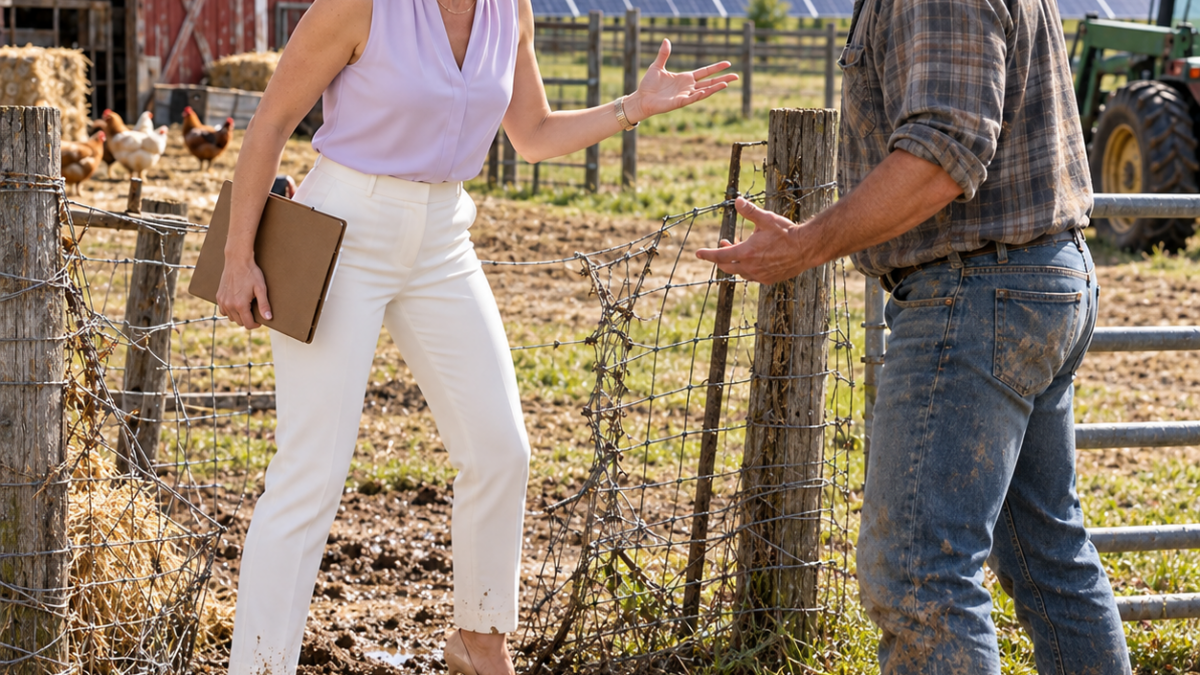
𝗙𝗨𝗟𝗟 𝗦𝗧𝗢𝗥𝗬
I got up, went to the office, pulled my deed from the file cabinet, scanned it with the plat map and county parcel record, and emailed the management company a short message.
I am not a member of Stonebridge Meadows HOA. My property is not part of your subdivision. Please correct your records and cease sending violation notices.
I attached everything.
Then I went back to work.
Two weeks later, another letter arrived.
The fines had reached $1,400.
That was when I stopped laughing.
I called the management company and sat on hold long enough to fix a loose cabinet hinge while their recorded voice told me how much they valued community. Finally, a woman answered and asked for my account number.
“I don’t have an account number,” I said. “I don’t belong to your HOA.”
She asked for my address. I gave it to her.
“Oh yes,” she said. “Lot XYZ.”
“No. That is not my lot.”
“Our records show—”
“Your records are wrong.”
“Sir, I understand this can be frustrating.”
“No,” I said, keeping my voice level because Laura had come into the room and was watching me. “What’s frustrating is being fined by an organization I never joined for a property it doesn’t control.”
There was a pause.
“Would you like to attend the next board meeting and discuss a resolution?”
“I’m not attending an HOA meeting for an HOA I’m not part of.”
“That may limit our ability to help you.”
“Your ability to help me begins and ends with deleting my address from your system.”
After I hung up, my phone buzzed with a text from an unknown number.
You’ll find we have standards here.
I stared at it for a long moment.
Laura leaned closer. “Who is that?”
“I have a guess.”
Another message appeared before I could reply.
It would be better for everyone if you blended the view.
I saved both screenshots.
Then I blocked the number.
For a while, I told myself that would be enough. I had sent documents. I had corrected the mistake. I had kept records. People could be ridiculous, but ridiculous people usually got tired when reality didn’t bend fast enough.
Karen did not get tired.
The next month was a slow drip of pressure. Another letter. Another fine. A photo of my solar panels taken from behind my fence. A notice taped to the outside of my mailbox that said “Pending Architectural Enforcement.” A man in khakis standing near the utility easement with his phone raised toward my barn.
I started walking the property line every evening after chores.
That was how I saw the first muddy footprint inside my fence.
It was near the south corner, beside a stretch of wire I had patched twice because children from the subdivision kept cutting through to chase fireflies or retrieve balls or whatever excuse their parents found convenient. This footprint was not from a child. It was large, deep, and angled toward the solar field.
I stood there in the fading light, listening to the cicadas buzz in the trees, and felt something cold settle in my chest.
When I told Laura, she went very quiet.
“We have Nathan,” she said.
Our son was eight years old, fearless in the way farm kids often are. He knew how to gather eggs, avoid the electric fence, and run from goats when they got ideas. He also played outside alone sometimes, because this had always been the kind of place where we could let him.
That night, I ordered trail cameras.
I also put up more No Trespassing signs.
The lawsuit arrived on a Tuesday afternoon.
A process server pulled into my driveway just as I was unloading feed bags from the truck. He stepped out wearing a cheap tie and a tired expression, asked if I was Daniel Walker, and handed me a thick stack of papers.
“You’ve been served,” he said.
For a second, all I could do was look at the cover page.
Stonebridge Meadows Homeowners Association v. Daniel Walker.
They were suing me for injunctive relief to remove the “noncompliant solar installation,” repaint or screen the barn, pay accrued fines and attorney’s fees, and comply with all relevant CC&Rs.
The amount listed was $65,000 and growing.
Laura came onto the porch with Nathan behind her, his hair still wet from the sprinkler.
“What is it?” she asked.
I looked up from the pages.
“Apparently,” I said, “we joined an HOA and forgot.”
Nathan laughed because he thought I was joking.
Laura didn’t.
That evening, after Nathan went to bed, I sat at the kitchen table reading the complaint under the yellow light above the sink. The more I read, the angrier I got.
They had attached a version of the subdivision plat with a thick, sloppy outline drawn around not only their lots but part of my land, as if a marker could annex a farm. They claimed the HOA had voted to “extend community influence boundaries to align with the existing utility easement and viewshed corridor.” They wrote that phrase like it meant something legal.
It did not.
They included photos of my solar panels, my barn, my driveway, and my battery enclosure.
One picture made me stop breathing.
It had been taken from inside my barn.
The angle showed my workbench, the labels on the battery units, and the calendar Laura had hung by the door. On that calendar, in blue marker, was Nathan’s pediatric appointment.
Someone had been close enough to my family’s private life to photograph it.
Laura covered her mouth when I showed her.
“Daniel,” she whispered.
“I know.”
Her eyes filled. “They came inside?”
“I don’t know if they stepped in or shot through the window, but they were at the barn.”
“That’s where Nathan keeps his bike.”
I closed the folder carefully because if I kept looking at it, I was going to do something stupid.
The next morning, I called a land-use attorney named Martin Ellis. I found him through the county bar association, and when I explained the situation, he did not laugh. That alone told me I had made the right call.
“Send me everything,” he said.
I did.
Letters, texts, deed, plat map, permits, inspection reports, county parcel records, photos, trail camera stills, and the lawsuit.
He called back the next afternoon.
“They don’t have a legal leg to stand on,” Martin said. “But that doesn’t mean they can’t make your life expensive.”
“That’s comforting.”
“I don’t do comforting. I do useful. We’ll file a motion to dismiss. Lack of any enforceable covenant, failure to state a claim, no membership, no jurisdiction over the property. I also want to prepare counterclaims.”
“For what?”
“Trespass. Harassment. Invasion of privacy if we can support it. Possibly slander of title if they’ve clouded your property records or represented that they control your parcel.”
I rubbed my face. “What’s this going to cost me?”
He told me.
I sat back in my chair.
Laura was standing in the doorway, watching my expression fall.
“That bad?” she asked after I hung up.
“It’s not nothing.”
She came over and rested her hand on my shoulder. “Can we handle it?”
“We’ll have to.”
That was the first time Karen cost us money.
It would not be the last.
Martin moved quickly. He filed our response and a motion to dismiss. He sent a letter to Stonebridge’s attorney demanding they withdraw the lawsuit immediately. He copied the county recorder, the planning department, and the state attorney general’s consumer protection division. Then he drafted a separate complaint about unauthorized enforcement attempts against a non-member agricultural parcel and improper use of HOA power.
“He doesn’t mess around,” Laura said, reading over the copies.
“No,” I said. “Thankfully.”
Karen’s side responded with twenty pages of nonsense about harmonious development, community reliance, implied servitudes, and visual impact. They cited a case about a condominium owner painting a balcony neon orange.
“My farm is not a condo balcony,” I told Martin.
“I noticed,” he said.
Then Karen made her next move.
I came home one afternoon and found a laminated notice zip-tied to my front gate.
STOP WORK ORDER
STONEBRIDGE MEADOWS ARCHITECTURAL REVIEW COMMITTEE
UNAUTHORIZED SOLAR EXPANSION
UNAUTHORIZED AGRICULTURAL STRUCTURE MODIFICATION
ALL WORK MUST CEASE IMMEDIATELY
I stood in the driveway holding the notice while anger rose so fast it made my hands shake.
Across the road, a man sat in a white SUV with his phone pointed at me.
I walked toward him.
He lowered the window two inches.
“What are you doing?” I asked.
“Documenting.”
“For who?”
“The board.”
“Get off my property.”
He smirked. “I’m on the easement.”
“You’re on my driveway.”
“This area is under review.”
“No,” I said, pointing toward the road. “This area is under my boot if you don’t move your car.”
His smirk wavered.
“Karen said—”
“I do not care what Karen said.”
He rolled up his window.
I took out my phone and photographed his license plate. He drove away thirty seconds later.
That night, Martin told me we were filing for a temporary restraining order.
“We should have enough,” he said. “The lawsuit, the notices, the texts, the trespass evidence, the barn photo. We’ll name the HOA and specific officers, including Karen Whitmore.”
“Good.”
“You need to understand something,” Martin said. “Once we do this, it may escalate before it stops.”
“It’s already escalating.”
“Yes,” he said. “But people like Karen don’t usually back down because they realize they’re wrong. They back down when the cost of being wrong becomes higher than the pleasure of controlling someone.”
The judge granted the temporary restraining order ex parte for fourteen days.
I was in the field when Martin called.
“They’re barred from entering your property, approaching your structures, posting notices, photographing inside buildings, or directing others to do so,” he said.
I closed my eyes and let out a breath I felt like I had been holding for weeks.
“Thank you.”
“The sheriff’s office will serve them.”
“They’ll enforce it?”
“They should. And Daniel?”
“Yeah?”
“Call if anyone shows up. Don’t argue. Don’t threaten. Call.”
That evening, a deputy served the HOA at their management office and Karen personally at her house behind my property. I didn’t see it happen, but I saw the aftermath.
Karen came out onto her back patio at sunset, still dressed like she had walked out of a suburban campaign ad. She stood there staring across the fence at my barn, the papers hanging from one hand. Even from a distance, I could feel the fury coming off her.
Then my phone buzzed from an unknown number.
This is unnecessary.
I took a screenshot and sent it to Martin.
He replied: Do not respond.
So I didn’t.
The surveyor came two days later.
His name was Phil, and he had the calm, weathered look of a man who trusted measurements more than personalities. He walked the line, checked deeds, found corners, marked the easement, and drove bright orange stakes along the fence.
When I told him the HOA claimed the utility easement gave them some kind of community access, he laughed so hard he had to take off his cap.
“They’re smoking something,” he said. “Your line is where your fence is. Easement means utility access. Not Karen access.”
I liked Phil immediately.
He gave me a stamped survey, marked the utility easement path clearly, and wrote a short professional statement explaining that Stonebridge Meadows had no property interest in my parcel.
Martin sent copies to the HOA, their lawyer, the management company, the utility company, and the court.
The utility company responded with its own letter a week later. The easement allowed the power co-op and its contractors to access equipment. It did not create public access. It did not grant rights to the HOA. It did not authorize residents, board members, or agents of Stonebridge Meadows to enter my property.
For one brief, beautiful moment, I thought reality might finally matter.
Then the trail camera pinged at 2:13 in the morning.
I had set alerts on the camera near the barn corridor, mostly expecting raccoons, foxes, maybe the neighbor’s golden retriever that had already terrorized my chickens twice.
What appeared on my phone was a man in a dark hoodie standing near the battery enclosure door.
For a second, I thought I was still dreaming.
He moved slowly, flashlight in hand, sweeping the beam across the side wall. Then he leaned toward the window.
The camera caught his profile.
I knew him. Not by name, but by sight. He lived two houses down from Karen. I had seen him walking his dog along the subdivision path.
He touched the battery enclosure door.
A small alarm chirped.
He flinched, spun, and ran.
I was already out of bed.
Laura sat up. “What is it?”
“Someone’s at the barn.”
Her face went pale.
“Stay inside,” I said.
“No. Call the sheriff.”
“I am.”
I did not go outside with a shotgun. I did not chase him. I did not do any of the things anger told me to do. I called the sheriff, turned on every exterior light, and waited on the porch with my phone in my hand while Laura stood behind the locked front door watching me through the glass.
Two deputies arrived twelve minutes later.
They reviewed the footage, walked the barn, dusted the battery door for prints, and took a report.
One of them, Deputy Harris, looked at the battery warning labels and frowned.
“Messing with this could get somebody hurt.”
“That’s what I’ve been trying to tell people.”
He asked if anyone had threatened me.
I showed him Karen’s texts. The most recent one said: Remove the panels before this goes somewhere you regret.
Deputy Harris read it twice.
“That from the HOA president?”
“Yes.”
He gave a low whistle. “She thinks she’s mayor of the fence line.”
“She thinks she’s queen.”
He looked toward the subdivision lights beyond my property. “Queens fall hard when they forget laws apply to them.”
The preliminary court hearing happened three days later.
I wore my cleanest work shirt because it was the closest thing I owned to court clothes that didn’t make me feel like I was pretending to be somebody else. Laura sat beside me. Karen sat across the aisle with two board members and their attorney.
In person, away from the fence, she looked even more polished. Pearl earrings. Cream blazer. Perfect nails. Not a hair out of place. She didn’t look frightened or embarrassed.
She looked offended.
As if the legal system had been rude enough to question her taste.
When our case was called, Martin stood with calm confidence. Stonebridge’s attorney shuffled papers.
The judge listened to the HOA’s argument for maybe seven minutes before holding up one hand.
“Counsel,” he said, “show me where Mr. Walker’s deed subjects his parcel to your client’s CC&Rs.”
The HOA attorney opened his mouth, then closed it.
Karen leaned toward him and whispered sharply.
The judge’s eyes flicked to her. “I asked counsel.”
The attorney cleared his throat. “Your Honor, our position is that the property falls within a broader community viewshed—”
“No,” the judge said. “That is not what I asked.”
A silence spread through the courtroom.
The judge tapped the file. “Where is the recorded covenant binding this parcel?”
“There is no specific recorded covenant on Mr. Walker’s deed.”
I felt Laura’s hand close around mine under the table.
The judge looked over his glasses. “Then you may want to consider whether continuing this action is a wise use of your members’ money.”
Karen’s lips pressed into a white line.
The judge did not dismiss everything that day. He set a full hearing on the motion, extended the temporary restraining order, and warned both sides to preserve evidence.
On the way out, Karen stepped close enough for me to smell her expensive perfume.
“This didn’t have to become hostile,” she said.
I turned toward her.
“It became hostile when someone went inside my barn.”
Her eyes flashed.
“I have no idea what you’re implying.”
“I didn’t imply anything.”
Laura tugged lightly at my sleeve. “Daniel.”
I looked at Karen one more time.
“Stay off my land.”
That night, the trail camera pinged again.
This time it was the same man from the hoodie, but he had a ladder.
He was at the south fence, trying to angle it near the line for a better view over my property. He had a backpack slung over one shoulder.
I called the sheriff.
Two patrol cars came in without lights until they reached the edge of the road. The deputies found him right there, ladder in hand, trying to explain himself before anyone had even accused him.
“I’m just checking compliance,” he said loudly, as if the camera could hear him too.
Deputy Harris, who had responded before, looked tired.
“Compliance for who?”
“The HOA.”
“You’re not the HOA.”
“I’m assisting the board.”
“Did the board tell you to bring a ladder to a property under a restraining order at night?”
The man said nothing.
They searched his backpack.
Inside were bolt cutters, insulated gloves, a printed photo of my solar array, and a folded sheet with handwritten notes about “battery access,” “panel brackets,” and “southern rack.”
My stomach dropped so hard I had to put one hand against the porch railing.
Laura stood behind me, arms wrapped around herself.
Nathan was asleep upstairs, unaware that strangers had come within yards of the system that powered his night-light and our refrigerator and half our life.
The deputies arrested the man for trespass and possession of burglary tools.
As they put him in the back of the patrol car, he kept saying, “Karen said we had authority. Karen said this was community enforcement.”
Deputy Harris glanced at me.
I didn’t say anything.
I didn’t need to.
Martin filed the arrest report with the court the next morning and amended our counterclaims to include civil harassment and invasion of privacy. He also notified Stonebridge’s directors and officers insurance carrier.
“How did you even find their insurance carrier?” I asked.
“Annual disclosure filings,” he said. “HOAs love rules until the rules start talking back.”
The insurance company’s claims department contacted Martin within a week.
They wanted to know why the HOA had filed suit against a non-member. They wanted to know why there were trespass allegations. They wanted copies of the texts, survey, utility letter, court orders, trail cam footage, and arrest report.
Martin sent them everything.
Three days later, the management company resigned from representing Stonebridge Meadows.
I found out because Karen’s HOA posted the meeting minutes on their community website, apparently without realizing the public link still worked. The note was short and cold.
Management company can no longer support current board actions.
I read it twice and then called Martin.
“Rats leaving the ship?” I asked.
“More like rats noticing the ship is on fire.”
We subpoenaed the HOA for communications related to my property, the solar panels, the barn, the easement, and enforcement efforts.
Karen fought it.
Of course she did.
Her attorney claimed the requests were burdensome, irrelevant, and invasive. The judge disagreed and ordered production.
When the emails came in, I sat in Martin’s office and read them with a numbness that slowly turned into rage.
Karen had written to the board: We cannot allow that farm to define the visual identity of our community. I swore to set the tone when I ran for president, and I intend to keep that promise.
Another email: If we annex the Walker parcel into Phase Two by amendment referencing the utility easement, he will be forced to comply.
One board member replied: We cannot annex land we do not own.
Karen answered: Then we enforce informally first. People comply when pressure is consistent.
I stared at that sentence until the words blurred.
People comply when pressure is consistent.
There it was. Her whole philosophy in one line.
She had not misunderstood. She had not made a clerical error. She had decided that if she pushed hard enough, long enough, and publicly enough, I would give in because defending myself would be too expensive, too stressful, too embarrassing, too exhausting.
She had almost been right.
Then we found the photo folder.
There were pictures of my barn interior, my workbench, my battery system, and the calendar with Nathan’s appointment. Metadata showed some had been taken by the man arrested with the ladder. One email from him to Karen said: Got pictures. He leaves the side door open sometimes.
Karen replied: Excellent. Document everything. We need to demonstrate ongoing noncompliance.
I had to stand up and walk to the window.
Martin let me.
Outside his office, cars moved along Main Street like the world had not shifted under my feet. People were going to lunch. A woman was pushing a stroller. Somewhere, Karen was probably still telling herself she was defending standards.
“She knew,” I said.
Martin’s voice was quiet behind me. “Yes.”
“She sent him.”
“That’s what it looks like.”
“He went near my battery system.”
“Yes.”
“My kid’s bike was in that barn.”
“I know.”
I turned around. “What do we do?”
Martin’s expression hardened.
“Now we stop defending and start hunting.”
The motion-to-dismiss hearing was not long.
Stonebridge’s attorney looked like a man trying to carry a bucket of water with no bottom. The judge asked again for any legal authority binding my property to their CC&Rs. There was none. Martin laid out the deed, the survey, the utility letter, the state solar statute, the lack of membership, the improper fines, the trespass evidence, and the communications showing bad faith.
Karen sat stiffly behind her lawyer, her hands clasped in her lap.
For the first time, she looked less like a queen and more like someone hearing footsteps in the hall.
The judge dismissed the HOA’s claims with prejudice.
With prejudice.
Two words I had never cared about before became two of the most beautiful words in the English language.
He allowed our counterclaims to proceed, extended the restraining order for six months, and set a separate hearing on fees and sanctions.
When we walked out, Laura cried in the hallway.
I put my arms around her.
“It’s not over,” she whispered.
“No,” I said. “But they can’t take the panels.”
That should have been the moment things started easing.
Instead, an anonymous letter arrived in our mailbox three days later.
No return address. No stamp from anywhere unusual. Just block letters printed on plain paper.
YOU THINK YOU WON? TAKE THE PANELS DOWN.
Laura read it once and sank into the kitchen chair.
“I can’t do this,” she whispered.
I took the letter from her hand. “Yes, you can.”
She looked up at me, eyes wet and furious. “Nathan asked me yesterday why I keep watching cars. He notices, Daniel. He notices everything.”
That broke me more than the lawsuit had.
I called the sheriff. The detective assigned to the case, Detective Morales, came out personally this time. She was in her forties, sharp-eyed, calm, and not impressed by suburban drama hiding behind polite language.
She took the letter, bagged it, and asked Laura questions gently.
Then she turned to me.
“We’re neck deep in your neighbor’s HOA situation,” she said. “But this is moving out of civil nonsense and into coordinated harassment.”
“Can you prove Karen sent it?”
“Not yet.”
“Do you think she did?”
Detective Morales gave me a look that said she had opinions she would not put in a report.
“I think people who believe they are entitled to control other people’s property often get angry when a court reminds them they’re not.”
Martin took a different angle.
“She insists you’re part of the HOA when it benefits her,” he said during our next meeting. “Let’s make her say the opposite when it inconveniences her.”
“What does that mean?”
“It means you use their own documents against them. If their lawsuit says you’re Lot XYZ and subject to their rules, then under their bylaws you have member rights. Send a certified letter demanding records inspection.”
I blinked at him.
“You want me to act like I believe their claim?”
“No. I want you to force them to choose which lie they prefer.”
So I sent the letter.
As a homeowner in the community, as alleged in your complaint, I am exercising my rights under the Stonebridge Meadows bylaws to inspect records, including membership rosters, budgets, contracts, meeting minutes, enforcement logs, architectural review documents, and communications related to common area boundary signage adjacent to my parcel.
I also requested to be placed on the agenda for the next board meeting to discuss “security concerns and community access issues.”
Their response came from Karen herself.
Only members in good standing may inspect association records. You are not a member of Stonebridge Meadows HOA.
I laughed for the first time in days.
Then I forwarded it to Martin.
He replied: Perfect.
I showed up at the next board meeting in work boots, jeans, and a plaid shirt because I had been repairing irrigation lines until twenty minutes before I got there. The meeting was held in the subdivision clubhouse, a building with stone veneer, soft lighting, and framed prints of wildflowers that had probably never grown within fifty miles of that room.
People turned when I walked in.
Whispers moved faster than I did.
Karen sat at the front table with a gavel beside her right hand. She wore a red blazer that looked expensive enough to feed my chickens for a year. When she saw me, her face tightened so quickly I almost smiled.
She started the meeting with the usual formalities. Approval of minutes. Treasurer’s report. Landscaping updates. A debate about pool furniture.
Then came member comments.
I raised my hand.
Karen stared at me.
“You are not a member,” she said.
I stood anyway.
“That’s interesting,” I said. “Because your lawsuit says my farm is part of your community.”
A murmur went through the room.
Karen’s nostrils flared. “This is not the time or place.”
“It became the time and place when you mailed residents a fundraising notice claiming my property was a Stonebridge violation.”
More murmurs.
I held up a copy of the complaint.
“You sued me as if my property is under your authority. You fined me. You sent people to photograph my land. You posted notices on my gate. So I’m asking one simple question in front of your members. Am I part of this HOA or not?”
Karen’s face turned a shade paler.
“That is a legal matter.”
“No,” I said. “It’s a yes-or-no matter.”
A woman on the board, older than Karen and visibly uncomfortable, cleared her throat.
“Karen,” she said softly, “maybe we should let counsel handle—”
Karen snapped, “I am handling it.”
That was the moment the room shifted. People heard it. Not the words, exactly, but the tone. The command. The entitlement. The voice of someone used to making smaller people shrink.
I looked around the room.
“I don’t want your pool,” I said. “I don’t want your clubhouse. I don’t want to paint my barn beige. I want three things. Stop trespassing. Remove references to my parcel from your records. Tell your residents to leave my property alone.”
Someone in the back said, “That seems reasonable.”
Karen’s eyes cut toward the voice, and the person went quiet.
I added, “And if I am a member, as your lawsuit claimed, I nominate myself to the architectural review committee.”
A man coughed into his hand. Someone else laughed under their breath.
Karen’s neck flushed red.
“You are not in the HOA,” she said sharply. “You have never been in the HOA. Your presence here is disruptive.”
I nodded slowly.
“Thank you.”
A man near the aisle had his phone up. Recording.
That recording became very useful later.
After the meeting, the treasurer approached me in the parking lot. His name was Paul Jenkins, and he looked like a man who hadn’t slept properly in weeks.
“Mr. Walker,” he said, keeping his voice low. “I owe you an apology.”
I turned toward him carefully. “For what?”
“For not stopping this sooner.”
That surprised me enough that I didn’t answer right away.
Paul looked back toward the clubhouse doors. “Karen has gone off the rails. Some of us pushed back, but she kept saying we’d lose credibility as a board if we let one property ruin the view.”
“My property is not part of your view. It’s my property.”
“I know.”
“Do you?”
He swallowed. “Yes.”
“What do you want, Paul?”
He took a folded envelope from inside his jacket.
“I shouldn’t be giving you this directly,” he said. “But I can’t be part of it anymore.”
Inside were copies of invoices.
Landscaping. Perimeter enhancement. Fence access adjustment. Emergency inspection support.
Some charges were billed to the HOA.
Some referenced work near “rear agricultural boundary.”
One invoice had a handwritten note: access points patched after review.
I felt my heartbeat change.
“Access points?”
Paul looked miserable. “Karen told the landscaper to create temporary access openings along the fence line so volunteers could document conditions without climbing over.”
I stared at him.
“She used HOA funds to cut into my fence?”
“I believe so.”
“Do you have emails?”
He looked toward the clubhouse again.
“Yes.”
“Give them to my attorney.”
He hesitated.
“If you’re scared,” I said, “imagine how my wife feels every time a car slows down near our driveway.”
That landed.
Paul’s face folded inward.
“I’ll send them,” he said.
He did.
Within forty-eight hours, Martin had enough to file a separate civil action against Karen personally. Not just as HOA president. Personally.
The complaint included the texts, the barn photos, the ladder incident, the anonymous letter, the invoices, the emails, the meeting recording where she admitted I was not a member, and Paul’s records showing HOA money may have been used to facilitate illegal access to my land.
Martin also asked for a civil harassment restraining order against Karen as an individual.
The judge granted it pending a full hearing.
It barred Karen from coming within one hundred yards of me, Laura, Nathan, our home, our barn, our solar array, and our farm entrances. It also barred her from directing, encouraging, or authorizing anyone else to approach or enter the property.
A deputy served her at home.
This time, I did see it.
I was near the barn when the patrol car pulled up outside Karen’s house. She opened the door in yoga clothes, phone in hand, expression irritated before she even knew why they were there. The deputy spoke to her. She looked across the fence at me.
Even from that distance, I felt the hatred in her stare.
Then the deputy handed her the papers.
For one second, all the control drained from her face.
It was the first time I saw Karen understand that authority could point both ways.
A week later, Detective Morales called.
“We executed a search warrant at Ms. Whitmore’s residence this morning.”
I sat down on the porch steps.
“What did you find?”
“I can’t discuss details yet. But I can tell you we recovered electronic devices and documents relevant to the investigation.”
“Is she being charged?”
“The DA is reviewing conspiracy, stalking, trespass-related offenses, and misuse of association funds. There may be more.”
I looked out at my solar panels. They were shining in the afternoon sun, ordinary and silent, as if they had not become the center of a war.
That evening, the subdivision’s private Facebook group exploded. I wasn’t a member, but screenshots came to me from three different residents within an hour.
Did anyone else see police at Karen’s?
Why were boxes removed?
Is this about the farm lawsuit?
How much has the board spent?
Paul called Martin the next morning and said residents were demanding a special meeting.
The HOA was beginning to crack from the inside.
At the sanctions hearing, Karen did not sit at counsel’s table. She sat in the back, away from the new interim attorney the HOA had hired after the insurance carrier got involved. Her red blazer was gone. She wore gray. She looked smaller, but not sorry.
The judge awarded us attorney’s fees for the dismissed HOA lawsuit. Not everything, but enough to take the worst sting out of the retainer. He also sanctioned the HOA for filing a frivolous action and wrote in his order that attempting to enforce private covenants against non-member agricultural land was a serious overreach.
He specifically cited the state solar statute.
A local paper picked it up.
HOA Sanctioned After Suing Farmer Over Solar Panels Outside Community Boundaries.
That headline did what months of legal filings had not done. It made the problem public.
Residents called a special meeting and recalled Karen along with two board members who had backed her blindly. Paul stayed on as treasurer. A new interim board formed, mostly made up of people who looked embarrassed to be associated with the whole disaster.
Their first letter to me was not a violation notice.
It was an apology.
Martin told me not to respond emotionally.
“Let them put everything in writing,” he said.
So I did.
The settlement took weeks.
The HOA agreed to pay an amount that covered the remainder of my legal fees, compensated us for time and stress, and resolved our civil counterclaims against the association. They agreed to remove all references to my parcel from their records, send a written retraction to every resident, and install permanent signs along the fence line stating:
PRIVATE PROPERTY
NO HOA ACCESS
NO RESIDENT ACCESS WITHOUT OWNER PERMISSION
They also agreed to notify residents that the utility easement did not permit entry, photography, inspection, monitoring, dog walking, shortcutting, picnicking, or any other use by HOA members.
The day that letter went out, Laura read it at the kitchen table and cried again.
This time, she smiled while she did it.
“It says we were right,” she whispered.
I sat beside her. “We knew we were right.”
“No,” she said, tapping the paper. “Now they have to know it too.”
The criminal case against Karen moved slower.
The man with the ladder, whose name was Travis, took a plea deal. He pleaded to lesser charges, agreed to community service, paid restitution for fence damage, and wrote a public apology that was read at an HOA meeting.
He looked wrecked when he apologized to me outside the courthouse.
“I thought she had authority,” he said.
I studied him for a long moment.
“You brought bolt cutters.”
His eyes dropped.
“She said we might need access if the gate was locked.”
“Travis, you’re a grown man.”
“I know.”
“You scared my wife. You went near my kid’s bike. You messed with equipment you didn’t understand.”
His face crumpled. “I’m sorry.”
I believed he was.
That didn’t erase what he had done.
Karen refused to plead.
Of course she did.
Her defense was exactly what I expected. Civic duty. Misunderstanding. Overzealous enforcement. No intent to harm. A president trying to protect property values and community safety.
By then, I had learned that people like Karen never say, “I wanted control.”
They say, “I was protecting standards.”
They say, “I was concerned.”
They say, “I was acting for the community.”
They wrap selfishness in public language and expect everyone to admire the ribbon.
The trial lasted four days.
I testified on the second.
Walking into that courtroom felt different from every hearing before it. This time, Karen sat at the defense table. No clipboard. No HOA pin. No gavel. Just her, her attorney, and the evidence she had created because she never believed anyone would be strong enough or organized enough to use it against her.
The prosecutor asked me to explain my property, my solar system, the letters, the fines, the lawsuit, the photos, the restraining order, the ladder incident, and the fear in our home.
I kept my answers clear.
Then Karen’s attorney cross-examined me.
“Mr. Walker, isn’t it true that your solar panels are visible from Stonebridge Meadows?”
“Yes.”
“And isn’t it true that some residents found them unattractive?”
“I don’t know what some residents found.”
“But you knew they objected?”
“I knew Karen objected.”
A few people in the gallery shifted.
Her attorney tried again.
“You could have planted screening earlier, couldn’t you?”
“I could have done many things voluntarily.”
“But you refused.”
“I refused to let an HOA I did not belong to order me around on land it did not own.”
He frowned.
“Isn’t it possible this was all a misunderstanding about boundary lines?”
“No.”
“Why not?”
“Because I sent them my deed, the plat map, county records, survey, and utility letter. Their own board member told Karen they could not annex land they did not own. She kept going anyway.”
Karen looked away.
Laura testified too.
That was harder to watch.
She spoke about the anonymous letter, the cameras, the nights she woke up because headlights slowed near the driveway, and the way Nathan stopped asking to play in the yard by himself.
“My son asked me if the lady behind the fence was mad at us,” Laura said, her voice shaking. “I didn’t know how to explain to an eight-year-old that a grown woman was angry because we wouldn’t let her control our farm.”
The courtroom went very still.
The jury deliberated less than a day.
They convicted Karen of conspiracy and stalking. Some lesser trespass-related charges were folded into sentencing and restitution. The misuse of funds piece became part of a separate restitution order involving the HOA, because apparently even crime can come with paperwork thick enough to choke on.
At sentencing, Karen spoke.
She stood in front of the judge wearing a dark dress, her hair perfect again. She held a folded statement and read from it in a controlled voice.
“I only wanted to preserve the quality and safety of my community,” she said. “I regret that my actions were misunderstood.”
I felt Laura stiffen beside me.
Misunderstood.
Even then.
Even after everything.
The judge looked at Karen for a long time after she finished.
“Ms. Whitmore,” he said, “this was not a misunderstanding. This was a sustained pattern of coercive behavior directed at a family that had no legal obligation to you or your association. You used a position of private authority as if it were public power. You encouraged others to invade property rights you had been repeatedly told you did not possess. You persisted after warnings, after documentation, after court involvement, and after your own colleagues questioned your authority.”
Karen’s face went rigid.
The judge sentenced her to a short jail term, probation, mandatory counseling, restitution to me and to the HOA, and a long-term restraining order. She was barred from serving on an HOA board for a set period under a county ordinance that passed after the public mess of our case embarrassed enough people into action.
When the bailiff led her away, I did not feel joy.
I thought I might.
For months, I had imagined some big clean rush of satisfaction, some golden moment where everything she had done came crashing back on her and I would finally feel whole.
Instead, I felt tired.
Relieved, yes.
Grateful, yes.
But also aware that consequences do not undo fear. They do not give back the nights Laura lay awake listening for tires on gravel. They do not erase the image of my son’s appointment calendar in a stranger’s photograph. They do not reimburse the part of your peace that gets spent before you realize you were paying.
Still, when Karen disappeared through the side door in custody, I breathed easier.
Actions had consequences.
That mattered.
After the dust settled, the new HOA board reached out again.
This time, they asked instead of demanded.
They wanted to know if I would consider planting a hedgerow along the fence line to soften the view of the solar array from the subdivision path. They offered to split costs using voluntary donations from interested residents, not HOA enforcement funds. They also said they would sign any agreement Martin considered appropriate and would stay entirely on their side of the property line.
I almost said no out of reflex.
Then I looked at the fence.
Beyond it were houses full of people who had not all been Karen. Some had believed her because she had sounded official. Some had stayed quiet because quiet felt safe. Some had apologized. Some had helped.
And honestly, I liked hedges.
So I said yes, but only if we did it right.
Martin drafted a simple license agreement. The utility company confirmed nothing would interfere with the easement. I chose native shrubs that would bloom, feed pollinators, and give birds somewhere to land. Then I added black wire panels on my side with climbing vines because if I was going to soften the view, I wanted it done my way.
The first planting day was strange.
A few residents came out to help on their side. Nobody crossed the line without asking. Nobody carried a clipboard. Nobody mentioned architectural harmony. Paul brought coffee. One woman apologized while holding a shovel and said she had believed the board because she assumed boards knew things.
“Boards are just people sitting at tables,” I told her. “Some people should not be given tables.”
She laughed, then looked ashamed for laughing.
“It’s okay,” I said.
And somehow, it was.
Not all at once, but slowly.
The farm found its rhythm again.
The solar panels kept humming quietly in the sun, doing exactly what they had always done. The barn stayed red. The goats continued their lifelong campaign against fences. The chickens resumed acting personally offended by weather. Nathan started leaving his bike by the barn again.
Laura stopped freezing every time a car slowed near the driveway.
I kept the cameras up.
That was not paranoia. That was education.
Some lessons leave equipment behind.
Months later, I was repairing a gate hinge near the back fence when a moving truck pulled up behind Karen’s old house. I had heard she and her husband were selling. I did not know where she was going. I did not ask.
A little boy from one of the neighboring houses stood on the path, watching the truck.
“Are you the farmer?” he called.
I looked up. “Depends who’s asking.”
“My mom says not to go over there unless we ask.”
“Your mom is smart.”
He pointed at the goats. “Do they bite?”
“Only fences, shirts, gloves, and anything important.”
He giggled.
Then he pointed at the solar panels. “Are those yours?”
I looked at the rows of dark glass tilted toward the sky.
“Yes,” I said. “They are.”
“Do they make electricity?”
“They do.”
“That’s cool.”
I smiled.
“It is.”
He ran back toward his house, and I went back to fixing the hinge.
The wind moved through the new hedge plants, small and green and not yet tall enough to hide anything. Someday they would grow thick along the fence. Someday flowers would open there. Bees would come. Birds would perch. The view would change, not because someone forced me, not because Karen won, but because peace sometimes looks like choosing what to plant after the fight is over.
I still have the first violation letter in a folder.
I keep it with the court order, the survey, the settlement agreement, and the newspaper clipping about the sanctions. Not because I like remembering. I don’t. I keep it because memory is a fence too, and some fences are worth maintaining.
People think property lines are just marks on paper or stakes in the ground.
They are not.
A property line can be the difference between neighbor and trespasser. Between request and demand. Between community and control. Between a woman with a clipboard and a family with the right to be left alone.
Karen learned that too late.
I learned it just in time.
And every morning now, when the sun rises over my panels and turns them silver, I stand on my porch with my coffee and look out at the farm I almost let fear shrink around me.
The barn is still red.
The land is still mine.
And no one behind that fence gets to vote on either one.