𝗙𝗨𝗟𝗟 𝗦𝗧𝗢𝗥𝗬 The Woman at My Door Thought the Quietest Place I Owned Was Hers to Control
𝗣𝗔𝗥𝗧 𝟮
No one did.
I emailed.
No response.
I emailed again with more detail, attaching scans of the letters. I explained the property history, the fence, the survey, the fact that I had no agreement with them and owed them nothing. I kept the tone civil because I still believed a civil tone mattered.
No response.
By then, Karen had become a presence in my mind in a way she had no right to be. I would catch myself looking out the window around the same time she had first visited, expecting to see her car. I would pause when gravel shifted in the driveway. I would check the mailbox with a tightness in my chest that embarrassed me.
That was what made me angriest.
Not the letters themselves, not even the money they claimed I owed. It was the way a stranger had managed to put tension into my quiet routines. My porch no longer felt entirely like my porch. My mailbox no longer felt harmless. My fence, once a simple boundary, now felt like a challenge someone might decide to test.
I had built my life there carefully.
Karen had walked up one afternoon and decided my peace was an inconvenience.
Exactly two months after her first visit, someone knocked on my door again.
This time, I was not cooking dinner or sorting groceries. I was in the living room, half-reading a book I had already read before, when the knock came. It was firm. Not frantic. Not casual.
I looked out the window expecting Karen’s car.
Instead, I saw a police cruiser.
For a second, my heart dropped for reasons that had nothing to do with me. My first thought was that something had happened nearby. Maybe someone had gone missing. Maybe there had been an accident on one of the neighborhood roads. Maybe they were asking properties along the lake if anyone had seen something unusual.
I opened the door without hesitation.
A police officer stood on my porch. He looked calm, maybe a little tired, the way officers often do when they have already heard one version of a story and are hoping the next version makes more sense.
“Good evening,” he said.
“Evening, officer,” I replied. “Is everything okay?”
“I hate to bother you,” he said, “but our office received a report earlier today regarding this property. I wanted to ask you a few questions.”
“Sure,” I said. “What can I do to help?”
He opened his mouth to answer, but before he could speak, headlights swept across the trees behind him.
We both turned.
A car was coming up my driveway.
I knew it before it fully reached the house.
Karen.
She parked behind the cruiser and stepped out like she had been waiting for her entrance. The moment I saw her face, I understood that whatever report had brought the officer to my door, it had her fingerprints all over it.
She came toward the porch quickly, anger already gathered in her shoulders.
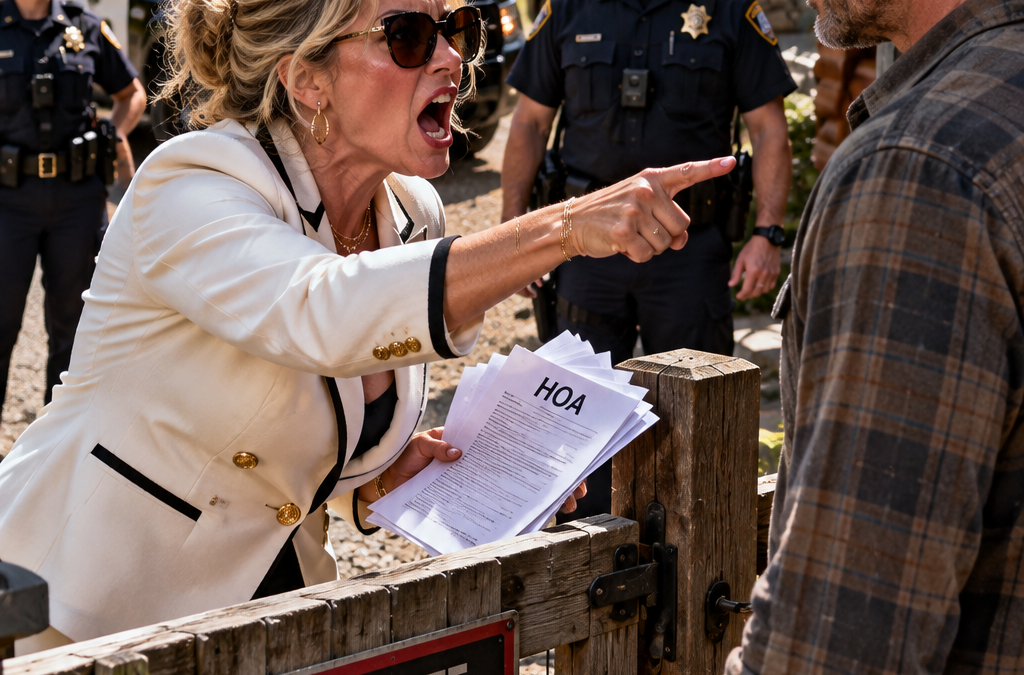
“Officer,” she called, pointing at me before she was even close, “this is the man I told you about.”
The officer turned slightly.
“Ma’am,” he said, his voice firm, “please let me handle this.”
Karen stopped, but only because she had to. Her mouth tightened. She stood a few steps behind him, glaring at me as though my front door was an insult.
The officer turned back to me.
“I’m here regarding a report that you may be occupying this cabin illegally.”
For a moment, I did not understand the words.
Not because they were complicated.
Because they were insane.
“Illegally?” I repeated.
“Yes,” he said. “There was a claim that this property is not yours to occupy.”
I looked past him at Karen. She stared back with open satisfaction, as if she had finally forced the world to take my disobedience seriously.
I felt heat rise in my face. Not fear exactly, though there was some of that. More disbelief. More humiliation. The kind that comes when someone drags you into a public accusation so ridiculous you feel foolish even having to deny it.
“I can assure you,” I said slowly, “I live here legally. I own this property.”
Karen made a sharp sound behind him.
“He’s lying,” she said. “He doesn’t even own the lake.”
The officer did not look at her.
“Ma’am,” he said, sharper this time, “I won’t tell you again. Step back and let me handle this.”
She huffed, but she stepped back.
The officer kept his attention on me. “Are you the current owner of the property?”
“Yes,” I said. “Everything inside that fence is mine. The cabin, the land, the lake, all of it.”
“Do you have documentation you can show me?”
I swallowed.
Of course I had documentation. Somewhere. Deeds do not live in your hand waiting for a stranger to accuse you of trespassing in your own home. My mind started flipping through possibilities too quickly. Paper copies. Digital copies. Mortgage emails. Survey documents. Tax records.
“I should have an electronic copy of the deed,” I said. “My mortgage company sent it to me. If you can give me a second, I can pull it up.”
“That’s fine,” he said.
He did not step over the threshold. He did not ask to come in. He looked past me into the cabin, but not in the invasive way Karen had. More like he was confirming what common sense already suggested. This was not an abandoned shack. There were coats by the door, books on the table, a lamp glowing in the corner, boots by the mat, the ordinary evidence of a life being lived.
I stepped back just inside the doorway and pulled out my phone.
My hands were not shaking, but they felt clumsy. I opened my email and searched for the documents. The loading wheel spun for what felt like too long. Outside, Karen shifted her weight, impatient.
“You know,” she said, loud enough for both of us, “anyone can fake things these days.”
The officer turned his head.
“Ma’am.”
One word. A warning.
She crossed her arms.
I found the email.
Relief came so quickly it nearly made me angry. I opened the deed, then showed the officer the email it had come from as well. He leaned slightly closer, read the relevant information, checked the address, then looked at the property description.
He handed the phone back.
“That’s all I needed to see,” he said. “Thank you. I apologize for taking up your time.”
Karen exploded.
“That’s it?” she demanded. “You’re not going to arrest him? You’re not even going to investigate? He could be lying!”
The officer turned fully toward her now.
“Ma’am, I have seen documentation showing he owns the property.”
“He owns the cabin maybe,” she snapped. “Not the lake. The lake belongs to the HOA. It’s part of our neighborhood amenities, and he has fenced it off.”
I stared at her.
In that moment, I finally saw the whole picture. Not just the letters. Not just the dues. Not just the fines. The lake was what she wanted. Maybe not personally, maybe not with a swimsuit and a towel under her arm, but symbolically. She wanted the authority to say it belonged to her neighborhood. She wanted to turn my quiet water into an amenity on a brochure. She wanted the fence gone not because it was wrong, but because it stopped her from claiming something pretty.
“This property was here before your neighborhood,” I said. My voice sounded steadier than I felt. “The lake is part of my land. I had a survey done before the fence went up. I don’t know where you got your information, but it’s wrong.”
Karen looked at me like I had insulted her.
“That is not what I was told.”
“Then you were told incorrectly.”
Her eyes flashed. “You can’t just say that and make it true.”
“No,” I said. “The deed makes it true. The survey makes it true. The county records make it true.”
For the first time since she had arrived, Karen seemed uncertain. Not defeated. Not sorry. Just uncertain in the way people become when the ground beneath their confidence shifts and they have not yet decided whom to blame.
The officer glanced between us.
“I’m going to step over by my cruiser,” he said. “If either of you needs me, I’ll be right there.”
I understood what he was doing. He did not want to stand between two adults arguing over property lines in the middle of my porch, but he also knew better than to leave Karen alone with me while she was that angry.
He walked back toward the driveway.
Karen stayed where she was for a few seconds, breathing hard through her nose. Then she turned back to me.
“You have no idea how difficult this has been,” she said.
I almost laughed.
“For you?”
“Yes, for me,” she said. “Do you know what kind of mess I inherited? The previous board kept terrible records. There were properties outside the neighborhood that were supposed to be associated with the HOA. Nobody gave me complete addresses. Nobody had clean files. I’ve been trying to sort out years of negligence.”
“So you decided to accuse me of owing money?”
“I sent notices.”
“You sent threats.”
“I sent formal notices.”
“You accused me of fencing off your property.”
“Because based on what I had, it appeared—”
“No,” I cut in. “You didn’t know. That is not the same thing.”
Her mouth closed.
I had not meant to raise my voice, but I heard the edge in it now and did not regret it.
“You came here two months ago,” I said. “You stood on my porch and talked about rules and dues and people thinking they’re exceptions. Then you started sending letters demanding money. I called. I emailed. Nobody responded. And tonight, instead of checking county records or answering a single message, you called the police and accused me of illegally occupying my own home.”
Karen looked toward the cruiser, then back at me. Her face had gone red, though whether from embarrassment or fury, I could not tell.
“I was acting on information I had.”
“You were acting on assumptions you liked.”
That hit her. I saw it.
Her expression hardened again, but something behind it faltered. For just a moment, she did not look like the head of anything. She looked like a woman who had pushed too far and was trying to arrange the pieces into a story where she was still the wronged party.
“The previous HOA head misled us,” she said finally.
“Maybe,” I said. “But you chose not to verify it.”
She adjusted the strap of her purse.
“I’ll have to look into it.”
“You do that.”
She turned without apologizing.
That bothered me more than I expected.
Not because I needed her apology to survive. I did not. But there is a particular kind of insult in watching someone create chaos in your life, stand corrected in front of a police officer, and still walk away as if inconvenience is the worst thing they suffered.
She marched toward her car.
I stayed in the doorway.
As she reached the driveway, the officer stepped toward her. I could not hear every word at first, but the night was quiet enough that his voice carried when he spoke more firmly.
“Ma’am,” he said, “this entire incident could be considered a false police report.”
Karen stopped.
He continued, “I don’t say that lightly. But if he wanted to press charges over this, he could.”
That was the first time I saw her shoulders drop.
Only a little.
But they dropped.
I did not hear her reply. I was already closing the door.
Inside, the cabin felt both familiar and strange. The same lamp was on. The same book lay open on the chair. The same dishes sat drying beside the sink. Yet everything felt touched by the accusation. I stood in the entryway for a long moment, listening as car doors closed outside.
The police cruiser left first.
Karen’s car followed.
Then the driveway was empty.
I locked the door, though I had never been much of a door-locking person before that night. Then I walked to the kitchen, poured a glass of water, and stood at the sink looking out toward the lake.
The moon had come up. A pale strip of it lay across the water. The fence was barely visible in the dark, just a shadow line between what was mine and everything that wanted to press against it.
I should have felt victorious.
Instead, I felt tired.
There are people who think conflict ends the moment you prove you are right. It does not. Sometimes proving you are right is only the point where your body finally understands how much stress it has been holding.
I slept badly that night.
Every sound woke me. Branches moving. The refrigerator settling. A car somewhere on the road beyond the trees. Each time, I opened my eyes and felt that same jolt. Someone is here. Someone is coming. Someone is going to knock.
Nobody did.
The next day, I expected another letter.
None came.
A few days passed. Then a week.
I began to relax, but not completely. Peace, once interrupted, does not return all at once. It comes back carefully, testing the room before it sits down.
About a week after the police visit, someone knocked on my door again.
I froze.
That is not an exaggeration. I was standing near the kitchen table, sorting mail, and the sound made my whole body go still. For one ridiculous second, I considered not answering. But then I looked out the window and saw an unfamiliar car in the driveway. Not Karen’s. Not a police cruiser.
An older woman stood on the porch.
She was holding a folder against her chest.
I opened the door, but not all the way.
“Can I help you?”
She gave me a small, apologetic smile. Unlike Karen’s, it did not feel sharpened at the edges.
“My name is Lauren,” she said. “I’m sorry to bother you. I’m with the HOA from the neighborhood nearby.”
My grip tightened on the door.
She noticed.
“I’m not here to demand anything,” she said quickly. “Actually, I came to apologize.”
That was not what I expected.
I opened the door a little wider.
Lauren took a breath.
“I’m the new head of the board,” she said. “Karen is no longer in that position.”
For a moment, I simply stared at her.
“She stepped down?”
“She was asked to,” Lauren said carefully.
There was more in that sentence than she said aloud.
Lauren explained that my emails had, in fact, been received. They had gone to the right account. They had been seen. Karen had told the people handling the inbox not to respond because she claimed the messages were spam, or not relevant, or part of someone trying to avoid legitimate HOA responsibilities.
“When you called,” Lauren said, “I was the person who answered.”
“I remember.”
“I told you I’d speak to someone and have them get back to you. I did bring it up. Karen said she knew the situation and that you were refusing to cooperate. When I later realized your emails matched that call, I pushed harder.”
I thought back to that phone call. The brief hope I had felt afterward. The way no one followed up. The weeks of silence.
“She knew I was disputing it,” I said.
Lauren nodded, ashamed.
“Yes.”
I looked past her toward the lake. The morning light had turned it silver. A bird skimmed low over the surface and vanished into the reeds.
Lauren continued, “After the police were involved and we learned what actually happened, the board reviewed the county records. Your property is not part of the HOA. It never was. The lake is not ours. The fence is on your land. You owe us nothing.”
Hearing it said aloud should not have mattered. I already knew those things.
But it did matter.
There is a difference between knowing the truth alone in your kitchen and hearing someone from the other side finally admit it on your porch.
“I appreciate you saying that,” I said.
“I also issued a notice to the board and the neighborhood,” Lauren said. “Your property is private. It is not an HOA amenity. Residents are not to trespass, park near your fence for access, or contact you about dues or lake use.”
That last part loosened something in my chest.
I had not realized how much I had feared the next phase. Because that was the thing about Karen’s mistake. If left uncorrected, it could have grown. One person might tell another that the lake was supposed to belong to the neighborhood. Someone might try to use it. Someone might climb the fence. Someone might bring children, dogs, coolers, fishing poles. And when I objected, I would become the unreasonable one.
Lauren seemed to understand that without me saying it.
“I’m truly sorry,” she said. “This should never have happened.”
For a few seconds, I did not answer.
Part of me wanted to be colder. Part of me wanted to unload every sleepless moment, every letter, every time I had looked out the window expecting trouble. Lauren had not caused all of it personally, but she represented the group that had allowed it to happen.
But she had also come to my door, told the truth, and done what Karen refused to do.
So I nodded.
“Thank you for coming here,” I said. “And thank you for putting it in writing.”
She smiled faintly. “I figured you might appreciate that.”
For the first time in months, I almost smiled back.
She handed me a copy of the notice and a letter confirming that my property was not associated with the HOA and that all previous notices had been issued in error. The phrase issued in error felt small compared to what had happened, but I understood what it meant in the language organizations use when they are trying not to say wrongdoing too loudly.
Still, I kept that letter.
I kept all of them.
The threats. The fines. The accusation. The apology.
Not because I planned to do anything with them. Not then, anyway. But because I had learned something about paper. Paper can be used to intimidate, but it can also protect. A deed. A survey. An email. A notice. The same world that lets people dress assumptions in official language also gives you tools to answer back.
Lauren left after a few more apologies.
I watched her car go down the driveway. Then I stood outside for a while.
It was quiet.
Actually quiet.
Not the fragile quiet that had followed Karen’s visit. Not the tense quiet between one letter and the next. This was the old quiet. Wind through leaves. Water against the bank. A distant lawn mower from one of the developments, softened by distance.
I walked down toward the lake.
The grass was damp under my shoes. Near the fence, I stopped and rested one hand on the top rail. On the other side, the new neighborhood sat in perfect rows, roofs and windows and trimmed lawns, all arranged to suggest order. I wondered how many people living there had any idea what had happened. Maybe some did. Maybe Karen had told her version. Maybe Lauren’s notice would be the first they heard of it.
I realized I did not care as much as I thought I would.
For weeks, I had imagined explanations. Speeches. The perfect thing to say if Karen returned. The perfect proof to show. The perfect line that would make her understand the difference between authority and entitlement.
But standing by the fence, looking at the lake, I felt the desire to argue drain out of me.
My home did not need Karen to understand it.
It only needed her to leave it alone.
I did not press charges.
Some people have told me I should have. They are probably right in a practical sense. She filed a report serious enough to send an officer to my door. She ignored attempts to correct the record. She used a position of neighborhood authority to harass someone outside her neighborhood. If I had wanted to make an example of her, I likely could have.
But I was never looking for revenge.
That may sound noble, but it was simpler than that. I did not want Karen to become a bigger part of my life than she already had. I did not want court dates and statements and more paperwork. I did not want to feed the conflict until it became the defining story of my home.
I wanted my porch back.
I wanted my mailbox to be boring again.
I wanted to sit beside the lake without thinking about fines, dues, patrol cars, or a woman with a tight smile telling herself my property was an error she could correct.
So I let it end where it ended.
Karen lost her position. The HOA corrected the record. The neighborhood was told to stay off my land. The letters stopped.
And slowly, the cabin became mine again in the way that matters most.
At first, I still checked the driveway when I heard tires on gravel. I still opened the mailbox expecting another envelope. I still kept my phone close, with the deed easy to find, just in case someone else decided confidence was a substitute for facts.
But days became weeks.
No one came.
No one parked by the fence.
No one knocked on my door demanding dues.
One evening, not long after Lauren’s visit, I took a chair down near the water. The air was warm, and the sky had that deep, fading color that makes everything feel briefly suspended. I sat there until the first stars showed, listening to frogs call from the reeds.
For the first time in months, I did not feel watched.
I thought about Karen then, but not with the same anger.
I wondered what kind of person looks at a fence and sees not a boundary, but a dare. I wondered how long she had mistaken control for competence. I wondered if losing her position taught her anything, or if she simply found a way to make herself the victim in someone else’s story.
Maybe she did.
People like that often do.
But she was no longer in mine.
The lake was still.
The cabin lights glowed behind me.
The fence stood where it had always stood, not as a challenge, not as a weapon, but as a quiet line around the life I had built.
That was the part Karen never understood.
Owning land is not just about documents, though documents matter. It is not just about fences, though fences help. It is about the feeling of coming home and knowing you are allowed to breathe there. It is about planting your feet on a patch of earth and feeling, for once, that nobody gets to move you simply because they speak louder.
Karen tried to take that feeling from me.
She failed.
In the end, nothing dramatic happened to the lake. No courtroom showdown. No angry crowd at my gate. No grand revenge. The water stayed where it was. The cabin stayed quiet. The fence stayed standing.
And I learned that peace is not always something you find once and keep forever.
Sometimes peace is something you have to defend.
Sometimes it arrives as a deed pulled up on a phone while a police officer waits on your porch. Sometimes it sounds like a stranger finally saying, “You owe us nothing.” Sometimes it is a letter in a folder proving the truth you knew from the beginning.
And sometimes it is simply the moment after everyone leaves, when the driveway is empty, the door is locked, and the place they tried to claim still belongs to you.
𝗧𝗛𝗘 𝗘𝗡𝗗
The Woman at My Door Thought the Quietest Place I Owned Was Hers to Control
The first time Karen stood on my porch, she smiled like she was welcoming me to land I had owned long before she ever knew it existed.
The first letter felt like a mistake, the second felt like arrogance, and the third made it clear she wanted more than money.
By the time the police cruiser rolled up my driveway, I realized a stranger had tried to turn my own home into a crime scene.
I used to believe peace was something you could build if you found the right place, put up the right fence, and kept mostly to yourself.
For a long time, that belief worked for me.
My home sits beside a small lake at the edge of what used to be farmland. When I bought it, the area around me was quiet enough that I could stand on my porch at night and hear frogs from the reeds, wind moving through the trees, and sometimes nothing at all but my own breathing. The house itself was nothing impressive to anyone looking for luxury. It was a small log cabin with a narrow front porch, a gravel driveway, weathered steps, and a roof that made soft, steady music when rain came down hard.
To me, it was perfect.
It was the kind of place that felt removed from the world without being completely cut off from it. I could drive to the grocery store without making a day of it, but when I came home, I could shut my truck door and feel the noise of everything else fall away. The lake was small, not the kind people would travel to see, but in the early mornings, when mist sat over the water and the sun climbed through the trees behind it, it looked like something private and sacred.
And it was private.
That part mattered.
Everything inside the fence was mine. The cabin, the gravel drive, the strip of land around the water, the lake itself, and a few feet beyond it. I knew that because I had paid for a survey. I had records. I had maps. I had gone through all the boring, necessary steps people go through when they want to make sure their life is built on something solid.
The fence came later, after a developer made the mistake of assuming a section of my land belonged to the property they had purchased nearby. That situation had ended quickly. A phone call to zoning, a review of the property lines, a polite apology, and then it was done. No shouting. No threats. No strange letters. Just a misunderstanding corrected by facts.
After that, I decided it would be easier for everyone if the boundaries were impossible to ignore. So I put up a fence.
Not a hostile-looking thing. Not barbed wire. Not anything dramatic. Just a clear border. A quiet statement. This is private property. This is where my home begins.
For years, the fence did exactly what I needed it to do. People drove by sometimes, especially after the land around me started changing, but nobody bothered me. Nobody tried to claim the lake. Nobody knocked on my door acting like my driveway had been waiting for their permission to exist.
Then the neighborhoods came.
At first, it was just survey flags and machines. Then roads. Then foundations. Then entire rows of houses rising where fields used to stretch open under the sky. I watched it happen from my porch like a man watching the tide come in. I did not resent it exactly. Land changes. Towns grow. People need places to live. I understood that.
But I missed the silence.
Soon there were streetlights where there had been stars. Weekend lawn equipment where there had been birds. SUVs rolling through streets that had not existed when I first moved in. Children’s bikes. Delivery trucks. Real estate signs. Landscapers. Neighborhood newsletters. Security patrols. Decorative entry monuments with names carved into stone.
And, eventually, homeowners associations.
I was never part of one.
That was one of the reasons I loved my place. No committee. No approved paint palette. No one telling me where to put a chair on my porch or how long my grass could be before somebody with a clipboard decided I was ruining the character of a neighborhood I had never joined.
My property had existed before those neighborhoods. My cabin had stood there when the land around it was still open. I was not surrounded because I had moved into their world. They had been built around mine.
That distinction seemed simple to me.
It would become very complicated to Karen.
I first noticed her car on an afternoon that began so normally I can still remember the groceries in the back seat. I had gone into town for a few things for dinner. Nothing memorable. Bread, onions, chicken, maybe a carton of eggs. I remember the plastic bags shifting when I turned onto my road. I remember feeling tired in that pleasant, ordinary way that comes after errands are done and home is close.
When I pulled into my driveway, I saw a car parked along the far side of my fence.
It was not blocking anything. It was just there, angled close enough to the property line that it caught my attention. I did not recognize it. That alone was not unusual anymore. With all the new neighborhoods nearby, unfamiliar cars had become part of the landscape. Still, something about it made me pause before I opened my door.
I stood beside my truck for a moment, one grocery bag in each hand, and watched.
Nobody got out.
The windows were dark enough that I could not tell who was inside. Maybe someone had pulled over to take a phone call. Maybe they were lost. Maybe they had car trouble. I told myself not to assume the worst, because I have always believed that most situations are less dramatic than they first appear.
So I carried my groceries inside.
But I kept looking out the window.
Every few minutes, I found myself drifting back toward the glass above the kitchen sink, watching that car through the slats of the fence. It stayed for maybe fifteen minutes after I got home, though I had no idea how long it had been there before that. Then, without anyone stepping out where I could see, it drove away.
I remember standing there after it left, one hand on the counter, feeling faintly foolish for being so alert over a parked car.
Half an hour later, someone knocked on my door.
The sound landed strangely in the cabin. People did not knock on my door often unless I was expecting them. I wiped my hands on a dish towel and looked through the front window.
The same car was in my driveway.
A woman stood on my porch.
She was probably in her forties, maybe older, dressed neatly in a way that made it clear she cared about how she appeared to strangers. Her posture was straight, chin lifted, purse hanging from her arm like she had arrived with purpose. She had the kind of smile some people use when they are not offering warmth so much as announcing control.
I opened the door.
“Hello,” I said.
Her smile widened.
“Hi there,” she said brightly. “I’m Karen.”
Of course she was.
I did not think that then. At that moment, she was just a stranger on my porch.
She introduced herself as the new head of the HOA for one of the nearby neighborhoods. She named the development closest to my lakeside fence, the one with the stone sign and the identical mailboxes. She said she had been driving around, introducing herself, making sure everyone in the area knew who she was.
“That’s kind of you,” I said, because I had no reason yet to be rude. “Welcome to the area.”
She looked past me into the cabin for a second. Not long enough to call it snooping outright, but long enough for me to notice.
“It’s important,” she said. “People should know who to come to when there are issues. Especially now that we’re tightening things up.”
“Tightening things up?” I asked.
“Oh, you know how it is.” She gave a little laugh, but there was no humor in it. “Some people get comfortable. They think rules only apply to everyone else. Dues go unpaid. Properties get neglected. Boundaries get… misunderstood.”
I should have corrected her right then.
I should have said, clearly and directly, I’m not part of your HOA.
But I thought she was speaking generally. I thought she meant the surrounding area in the casual way people call everything near them “the neighborhood.” I had no reason to believe she had already assigned me a role in a story she was writing inside her own head.
So I nodded politely and let her talk.
She talked about responsibility. She talked about community standards. She talked about how difficult it was to take over after years of poor leadership and disorganized records. She said there had been too much leniency before, too many exceptions, too much confusion about who owed what and which properties fell under HOA authority.
“I’m going to fix that,” she said.
There was something almost proud in the way she said it. Not determined. Not helpful. Proud.
“Well,” I said, “good luck with that.”
She studied me for a moment, and I saw something shift behind her eyes. At the time, I thought she was simply the kind of person who did not like brief conversations ending before she decided they were over.
Now I understand she was waiting for me to say something. She wanted me to explain myself. She wanted me to apologize, maybe. She wanted me to admit I knew what she was really there for.
But I did not know.
So I wished her luck again, and after another tight smile, she left.
I watched her car back down my driveway and disappear toward the road.
Then I shut the door and went back to making dinner.
That should have been the end of it.
For one peaceful evening, it was.
The next day, I found the letter.
It was in my mailbox, folded inside an envelope with the HOA’s name printed across the top. I remember frowning before I even opened it. My first thought was that they had sent something to the wrong address. New developments had new systems, and mistakes happened. Maybe they were sending information to everyone nearby. Maybe it was some kind of notice about landscaping, roadwork, or a community meeting I had no interest in attending.
Then I read it.
According to the letter, I had failed to pay HOA dues for the entire time I had been a resident of the neighborhood. The amount was not small. They claimed I needed to settle the debt by the end of the week or additional fines would be added.
For a few seconds, I just stood there at the end of my driveway with the envelope in one hand and the letter in the other, reading the same lines again.
Resident of the neighborhood.
Unpaid dues.
Fines.
I laughed once, not because it was funny, but because it was so wrong my mind rejected it before it could make me angry.
I was not a resident of that neighborhood.
I had never signed anything with that HOA. I had never attended a meeting, received a welcome packet, voted on a bylaw, used their pool, parked in their visitor spaces, or agreed to let them tell me anything at all about my property.
The neighborhood did not exist when I moved in.
I folded the letter, put it on the kitchen counter, and told myself someone would correct it when they realized the error. I had dealt with property confusion before. Facts had handled it then. They would handle it now.
I threw away the first letter.
That was my first mistake.
A week later, another one came.
This one said I was now in violation for failing to pay after formal notice had been issued. It used stronger language. More official phrases. More threats. It spoke as though a process had begun and I was already losing by not participating.
I should have been angrier than I was, but at that point I still believed in the basic sanity of adults. I thought, This is paperwork. Somebody has the wrong address in a spreadsheet. That is all.
I put the letter in a drawer instead of the trash.
The third letter arrived at the beginning of the following week.
That one made the whole thing change shape.
It accused me of constructing a fence around HOA property.
Specifically, the lake.
I remember the air in the room feeling different after I read that sentence. Not colder exactly, but thinner. Like the cabin had taken a breath and was waiting to see what I would do.
The lake.
My lake.
The small, quiet, ordinary lake beside the cabin I had purchased, maintained, paid taxes on, and protected. The lake whose boundary had been marked by a surveyor before the fence ever went up. The lake that had been there long before Karen’s neighborhood wrapped itself around my road and decided everything pretty must belong to them.
For the first time, I understood the letters were not a clerical mistake.
They knew exactly which property they were targeting.
They just thought they had a right to it.
I sat at my kitchen table with the letter spread flat in front of me and read every word. They claimed I would continue to be fined until I either removed the fence or paid the dues owed to the HOA.
It was amazing how calm the language looked on paper. That was what bothered me most. There was no screaming. No visible anger. Just neat paragraphs pretending theft could sound reasonable if printed on letterhead.
I looked out the window toward the lake.
Evening was coming on. The water had gone dark blue under a bruised sky. The trees stood quiet on the far side of the fence, their branches moving slightly in the wind. Everything outside looked exactly the same as it had that morning, but it no longer felt untouched.
It felt watched.
Over the next month, more letters came.
Some threatened fees. Some referenced previous notices. Some mentioned violations. Each one treated my silence as guilt and my property as an administrative problem. I kept them all. I stacked them in a folder on the corner of my desk. At first, I did it because I thought I might need proof. After a while, I did it because holding onto the paper made me feel like I had some control over a situation that seemed determined to become absurd.
I called the number listed on the letters.
A woman answered. Her voice was older, patient, professional.
I explained that I was not a member of the HOA, that my property had never been part of their neighborhood, and that I was being sent improper fines and demands. She listened. She asked for my name and address. I could hear keys clicking faintly in the background.
“That does sound like something we need to look into,” she said. “I’ll speak to someone and have them get back to you.”
No one did.
I emailed.
No response.
I emailed again with more detail, attaching scans of the letters. I explained the property history, the fence, the survey, the fact that I had no agreement with them and owed them nothing. I kept the tone civil because I still believed a civil tone mattered.
No response.
By then, Karen had become a presence in my mind in a way she had no right to be. I would catch myself looking out the window around the same time she had first visited, expecting to see her car. I would pause when gravel shifted in the driveway. I would check the mailbox with a tightness in my chest that embarrassed me.
That was what made me angriest.
Not the letters themselves, not even the money they claimed I owed. It was the way a stranger had managed to put tension into my quiet routines. My porch no longer felt entirely like my porch. My mailbox no longer felt harmless. My fence, once a simple boundary, now felt like a challenge someone might decide to test.
I had built my life there carefully.
Karen had walked up one afternoon and decided my peace was an inconvenience.
Exactly two months after her first visit, someone knocked on my door again.
This time, I was not cooking dinner or sorting groceries. I was in the living room, half-reading a book I had already read before, when the knock came. It was firm. Not frantic. Not casual.
I looked out the window expecting Karen’s car.
Instead, I saw a police cruiser.
For a second, my heart dropped for reasons that had nothing to do with me. My first thought was that something had happened nearby. Maybe someone had gone missing. Maybe there had been an accident on one of the neighborhood roads. Maybe they were asking properties along the lake if anyone had seen something unusual.
I opened the door without hesitation.
A police officer stood on my porch. He looked calm, maybe a little tired, the way officers often do when they have already heard one version of a story and are hoping the next version makes more sense.
“Good evening,” he said.
“Evening, officer,” I replied. “Is everything okay?”
“I hate to bother you,” he said, “but our office received a report earlier today regarding this property. I wanted to ask you a few questions.”
“Sure,” I said. “What can I do to help?”
He opened his mouth to answer, but before he could speak, headlights swept across the trees behind him.
We both turned.
A car was coming up my driveway.
I knew it before it fully reached the house.
Karen.
She parked behind the cruiser and stepped out like she had been waiting for her entrance. The moment I saw her face, I understood that whatever report had brought the officer to my door, it had her fingerprints all over it.
She came toward the porch quickly, anger already gathered in her shoulders.
“Officer,” she called, pointing at me before she was even close, “this is the man I told you about.”
The officer turned slightly.
“Ma’am,” he said, his voice firm, “please let me handle this.”
Karen stopped, but only because she had to. Her mouth tightened. She stood a few steps behind him, glaring at me as though my front door was an insult.
The officer turned back to me.
“I’m here regarding a report that you may be occupying this cabin illegally.”
For a moment, I did not understand the words.
Not because they were complicated.
Because they were insane.
“Illegally?” I repeated.
“Yes,” he said. “There was a claim that this property is not yours to occupy.”
I looked past him at Karen. She stared back with open satisfaction, as if she had finally forced the world to take my disobedience seriously.
I felt heat rise in my face. Not fear exactly, though there was some of that. More disbelief. More humiliation. The kind that comes when someone drags you into a public accusation so ridiculous you feel foolish even having to deny it.
“I can assure you,” I said slowly, “I live here legally. I own this property.”
Karen made a sharp sound behind him.
“He’s lying,” she said. “He doesn’t even own the lake.”
The officer did not look at her.
“Ma’am,” he said, sharper this time, “I won’t tell you again. Step back and let me handle this.”
She huffed, but she stepped back.
The officer kept his attention on me. “Are you the current owner of the property?”
“Yes,” I said. “Everything inside that fence is mine. The cabin, the land, the lake, all of it.”
“Do you have documentation you can show me?”
I swallowed.
Of course I had documentation. Somewhere. Deeds do not live in your hand waiting for a stranger to accuse you of trespassing in your own home. My mind started flipping through possibilities too quickly. Paper copies. Digital copies. Mortgage emails. Survey documents. Tax records.
“I should have an electronic copy of the deed,” I said. “My mortgage company sent it to me. If you can give me a second, I can pull it up.”
“That’s fine,” he said.
He did not step over the threshold. He did not ask to come in. He looked past me into the cabin, but not in the invasive way Karen had. More like he was confirming what common sense already suggested. This was not an abandoned shack. There were coats by the door, books on the table, a lamp glowing in the corner, boots by the mat, the ordinary evidence of a life being lived.
I stepped back just inside the doorway and pulled out my phone.
My hands were not shaking, but they felt clumsy. I opened my email and searched for the documents. The loading wheel spun for what felt like too long. Outside, Karen shifted her weight, impatient.
“You know,” she said, loud enough for both of us, “anyone can fake things these days.”
The officer turned his head.
“Ma’am.”
One word. A warning.
She crossed her arms.
I found the email.
Relief came so quickly it nearly made me angry. I opened the deed, then showed the officer the email it had come from as well. He leaned slightly closer, read the relevant information, checked the address, then looked at the property description.
He handed the phone back.
“That’s all I needed to see,” he said. “Thank you. I apologize for taking up your time.”
Karen exploded.
“That’s it?” she demanded. “You’re not going to arrest him? You’re not even going to investigate? He could be lying!”
The officer turned fully toward her now.
“Ma’am, I have seen documentation showing he owns the property.”
“He owns the cabin maybe,” she snapped. “Not the lake. The lake belongs to the HOA. It’s part of our neighborhood amenities, and he has fenced it off.”
I stared at her.
In that moment, I finally saw the whole picture. Not just the letters. Not just the dues. Not just the fines. The lake was what she wanted. Maybe not personally, maybe not with a swimsuit and a towel under her arm, but symbolically. She wanted the authority to say it belonged to her neighborhood. She wanted to turn my quiet water into an amenity on a brochure. She wanted the fence gone not because it was wrong, but because it stopped her from claiming something pretty.
“This property was here before your neighborhood,” I said. My voice sounded steadier than I felt. “The lake is part of my land. I had a survey done before the fence went up. I don’t know where you got your information, but it’s wrong.”
Karen looked at me like I had insulted her.
“That is not what I was told.”
“Then you were told incorrectly.”
Her eyes flashed. “You can’t just say that and make it true.”
“No,” I said. “The deed makes it true. The survey makes it true. The county records make it true.”
For the first time since she had arrived, Karen seemed uncertain. Not defeated. Not sorry. Just uncertain in the way people become when the ground beneath their confidence shifts and they have not yet decided whom to blame.
The officer glanced between us.
“I’m going to step over by my cruiser,” he said. “If either of you needs me, I’ll be right there.”
I understood what he was doing. He did not want to stand between two adults arguing over property lines in the middle of my porch, but he also knew better than to leave Karen alone with me while she was that angry.
He walked back toward the driveway.
Karen stayed where she was for a few seconds, breathing hard through her nose. Then she turned back to me.
“You have no idea how difficult this has been,” she said.
I almost laughed.
“For you?”
“Yes, for me,” she said. “Do you know what kind of mess I inherited? The previous board kept terrible records. There were properties outside the neighborhood that were supposed to be associated with the HOA. Nobody gave me complete addresses. Nobody had clean files. I’ve been trying to sort out years of negligence.”
“So you decided to accuse me of owing money?”
“I sent notices.”
“You sent threats.”
“I sent formal notices.”
“You accused me of fencing off your property.”
“Because based on what I had, it appeared—”
“No,” I cut in. “You didn’t know. That is not the same thing.”
Her mouth closed.
I had not meant to raise my voice, but I heard the edge in it now and did not regret it.
“You came here two months ago,” I said. “You stood on my porch and talked about rules and dues and people thinking they’re exceptions. Then you started sending letters demanding money. I called. I emailed. Nobody responded. And tonight, instead of checking county records or answering a single message, you called the police and accused me of illegally occupying my own home.”
Karen looked toward the cruiser, then back at me. Her face had gone red, though whether from embarrassment or fury, I could not tell.
“I was acting on information I had.”
“You were acting on assumptions you liked.”
That hit her. I saw it.
Her expression hardened again, but something behind it faltered. For just a moment, she did not look like the head of anything. She looked like a woman who had pushed too far and was trying to arrange the pieces into a story where she was still the wronged party.
“The previous HOA head misled us,” she said finally.
“Maybe,” I said. “But you chose not to verify it.”
She adjusted the strap of her purse.
“I’ll have to look into it.”
“You do that.”
She turned without apologizing.
That bothered me more than I expected.
Not because I needed her apology to survive. I did not. But there is a particular kind of insult in watching someone create chaos in your life, stand corrected in front of a police officer, and still walk away as if inconvenience is the worst thing they suffered.
She marched toward her car.
I stayed in the doorway.
As she reached the driveway, the officer stepped toward her. I could not hear every word at first, but the night was quiet enough that his voice carried when he spoke more firmly.
“Ma’am,” he said, “this entire incident could be considered a false police report.”
Karen stopped.
He continued, “I don’t say that lightly. But if he wanted to press charges over this, he could.”
That was the first time I saw her shoulders drop.
Only a little.
But they dropped.
I did not hear her reply. I was already closing the door.
Inside, the cabin felt both familiar and strange. The same lamp was on. The same book lay open on the chair. The same dishes sat drying beside the sink. Yet everything felt touched by the accusation. I stood in the entryway for a long moment, listening as car doors closed outside.
The police cruiser left first.
Karen’s car followed.
Then the driveway was empty.
I locked the door, though I had never been much of a door-locking person before that night. Then I walked to the kitchen, poured a glass of water, and stood at the sink looking out toward the lake.
The moon had come up. A pale strip of it lay across the water. The fence was barely visible in the dark, just a shadow line between what was mine and everything that wanted to press against it.
I should have felt victorious.
Instead, I felt tired.
There are people who think conflict ends the moment you prove you are right. It does not. Sometimes proving you are right is only the point where your body finally understands how much stress it has been holding.
I slept badly that night.
Every sound woke me. Branches moving. The refrigerator settling. A car somewhere on the road beyond the trees. Each time, I opened my eyes and felt that same jolt. Someone is here. Someone is coming. Someone is going to knock.
Nobody did.
The next day, I expected another letter.
None came.
A few days passed. Then a week.
I began to relax, but not completely. Peace, once interrupted, does not return all at once. It comes back carefully, testing the room before it sits down.
About a week after the police visit, someone knocked on my door again.
I froze.
That is not an exaggeration. I was standing near the kitchen table, sorting mail, and the sound made my whole body go still. For one ridiculous second, I considered not answering. But then I looked out the window and saw an unfamiliar car in the driveway. Not Karen’s. Not a police cruiser.
An older woman stood on the porch.
She was holding a folder against her chest.
I opened the door, but not all the way.
“Can I help you?”
She gave me a small, apologetic smile. Unlike Karen’s, it did not feel sharpened at the edges.
“My name is Lauren,” she said. “I’m sorry to bother you. I’m with the HOA from the neighborhood nearby.”
My grip tightened on the door.
She noticed.
“I’m not here to demand anything,” she said quickly. “Actually, I came to apologize.”
That was not what I expected.
I opened the door a little wider.
Lauren took a breath.
“I’m the new head of the board,” she said. “Karen is no longer in that position.”
For a moment, I simply stared at her.
“She stepped down?”
“She was asked to,” Lauren said carefully.
There was more in that sentence than she said aloud.
Lauren explained that my emails had, in fact, been received. They had gone to the right account. They had been seen. Karen had told the people handling the inbox not to respond because she claimed the messages were spam, or not relevant, or part of someone trying to avoid legitimate HOA responsibilities.
“When you called,” Lauren said, “I was the person who answered.”
“I remember.”
“I told you I’d speak to someone and have them get back to you. I did bring it up. Karen said she knew the situation and that you were refusing to cooperate. When I later realized your emails matched that call, I pushed harder.”
I thought back to that phone call. The brief hope I had felt afterward. The way no one followed up. The weeks of silence.
“She knew I was disputing it,” I said.
Lauren nodded, ashamed.
“Yes.”
I looked past her toward the lake. The morning light had turned it silver. A bird skimmed low over the surface and vanished into the reeds.
Lauren continued, “After the police were involved and we learned what actually happened, the board reviewed the county records. Your property is not part of the HOA. It never was. The lake is not ours. The fence is on your land. You owe us nothing.”
Hearing it said aloud should not have mattered. I already knew those things.
But it did matter.
There is a difference between knowing the truth alone in your kitchen and hearing someone from the other side finally admit it on your porch.
“I appreciate you saying that,” I said.
“I also issued a notice to the board and the neighborhood,” Lauren said. “Your property is private. It is not an HOA amenity. Residents are not to trespass, park near your fence for access, or contact you about dues or lake use.”
That last part loosened something in my chest.
I had not realized how much I had feared the next phase. Because that was the thing about Karen’s mistake. If left uncorrected, it could have grown. One person might tell another that the lake was supposed to belong to the neighborhood. Someone might try to use it. Someone might climb the fence. Someone might bring children, dogs, coolers, fishing poles. And when I objected, I would become the unreasonable one.
Lauren seemed to understand that without me saying it.
“I’m truly sorry,” she said. “This should never have happened.”
For a few seconds, I did not answer.
Part of me wanted to be colder. Part of me wanted to unload every sleepless moment, every letter, every time I had looked out the window expecting trouble. Lauren had not caused all of it personally, but she represented the group that had allowed it to happen.
But she had also come to my door, told the truth, and done what Karen refused to do.
So I nodded.
“Thank you for coming here,” I said. “And thank you for putting it in writing.”
She smiled faintly. “I figured you might appreciate that.”
For the first time in months, I almost smiled back.
She handed me a copy of the notice and a letter confirming that my property was not associated with the HOA and that all previous notices had been issued in error. The phrase issued in error felt small compared to what had happened, but I understood what it meant in the language organizations use when they are trying not to say wrongdoing too loudly.
Still, I kept that letter.
I kept all of them.
The threats. The fines. The accusation. The apology.
Not because I planned to do anything with them. Not then, anyway. But because I had learned something about paper. Paper can be used to intimidate, but it can also protect. A deed. A survey. An email. A notice. The same world that lets people dress assumptions in official language also gives you tools to answer back.
Lauren left after a few more apologies.
I watched her car go down the driveway. Then I stood outside for a while.
It was quiet.
Actually quiet.
Not the fragile quiet that had followed Karen’s visit. Not the tense quiet between one letter and the next. This was the old quiet. Wind through leaves. Water against the bank. A distant lawn mower from one of the developments, softened by distance.
I walked down toward the lake.
The grass was damp under my shoes. Near the fence, I stopped and rested one hand on the top rail. On the other side, the new neighborhood sat in perfect rows, roofs and windows and trimmed lawns, all arranged to suggest order. I wondered how many people living there had any idea what had happened. Maybe some did. Maybe Karen had told her version. Maybe Lauren’s notice would be the first they heard of it.
I realized I did not care as much as I thought I would.
For weeks, I had imagined explanations. Speeches. The perfect thing to say if Karen returned. The perfect proof to show. The perfect line that would make her understand the difference between authority and entitlement.
But standing by the fence, looking at the lake, I felt the desire to argue drain out of me.
My home did not need Karen to understand it.
It only needed her to leave it alone.
I did not press charges.
Some people have told me I should have. They are probably right in a practical sense. She filed a report serious enough to send an officer to my door. She ignored attempts to correct the record. She used a position of neighborhood authority to harass someone outside her neighborhood. If I had wanted to make an example of her, I likely could have.
But I was never looking for revenge.
That may sound noble, but it was simpler than that. I did not want Karen to become a bigger part of my life than she already had. I did not want court dates and statements and more paperwork. I did not want to feed the conflict until it became the defining story of my home.
I wanted my porch back.
I wanted my mailbox to be boring again.
I wanted to sit beside the lake without thinking about fines, dues, patrol cars, or a woman with a tight smile telling herself my property was an error she could correct.
So I let it end where it ended.
Karen lost her position. The HOA corrected the record. The neighborhood was told to stay off my land. The letters stopped.
And slowly, the cabin became mine again in the way that matters most.
At first, I still checked the driveway when I heard tires on gravel. I still opened the mailbox expecting another envelope. I still kept my phone close, with the deed easy to find, just in case someone else decided confidence was a substitute for facts.
But days became weeks.
No one came.
No one parked by the fence.
No one knocked on my door demanding dues.
One evening, not long after Lauren’s visit, I took a chair down near the water. The air was warm, and the sky had that deep, fading color that makes everything feel briefly suspended. I sat there until the first stars showed, listening to frogs call from the reeds.
For the first time in months, I did not feel watched.
I thought about Karen then, but not with the same anger.
I wondered what kind of person looks at a fence and sees not a boundary, but a dare. I wondered how long she had mistaken control for competence. I wondered if losing her position taught her anything, or if she simply found a way to make herself the victim in someone else’s story.
Maybe she did.
People like that often do.
But she was no longer in mine.
The lake was still.
The cabin lights glowed behind me.
The fence stood where it had always stood, not as a challenge, not as a weapon, but as a quiet line around the life I had built.
That was the part Karen never understood.
Owning land is not just about documents, though documents matter. It is not just about fences, though fences help. It is about the feeling of coming home and knowing you are allowed to breathe there. It is about planting your feet on a patch of earth and feeling, for once, that nobody gets to move you simply because they speak louder.
Karen tried to take that feeling from me.
She failed.
In the end, nothing dramatic happened to the lake. No courtroom showdown. No angry crowd at my gate. No grand revenge. The water stayed where it was. The cabin stayed quiet. The fence stayed standing.
And I learned that peace is not always something you find once and keep forever.
Sometimes peace is something you have to defend.
Sometimes it arrives as a deed pulled up on a phone while a police officer waits on your porch. Sometimes it sounds like a stranger finally saying, “You owe us nothing.” Sometimes it is a letter in a folder proving the truth you knew from the beginning.
And sometimes it is simply the moment after everyone leaves, when the driveway is empty, the door is locked, and the place they tried to claim still belongs to you.