𝗙𝗨𝗟𝗟 𝗦𝗧𝗢𝗥𝗬 The Woman Across the Street Thought She Could Turn My Own Garage Into a Crime Scene
𝗙𝗨𝗟𝗟 𝗦𝗧𝗢𝗥𝗬
She turned and walked back across the street without welcoming me, without saying goodbye, without even pretending this had been neighborly.
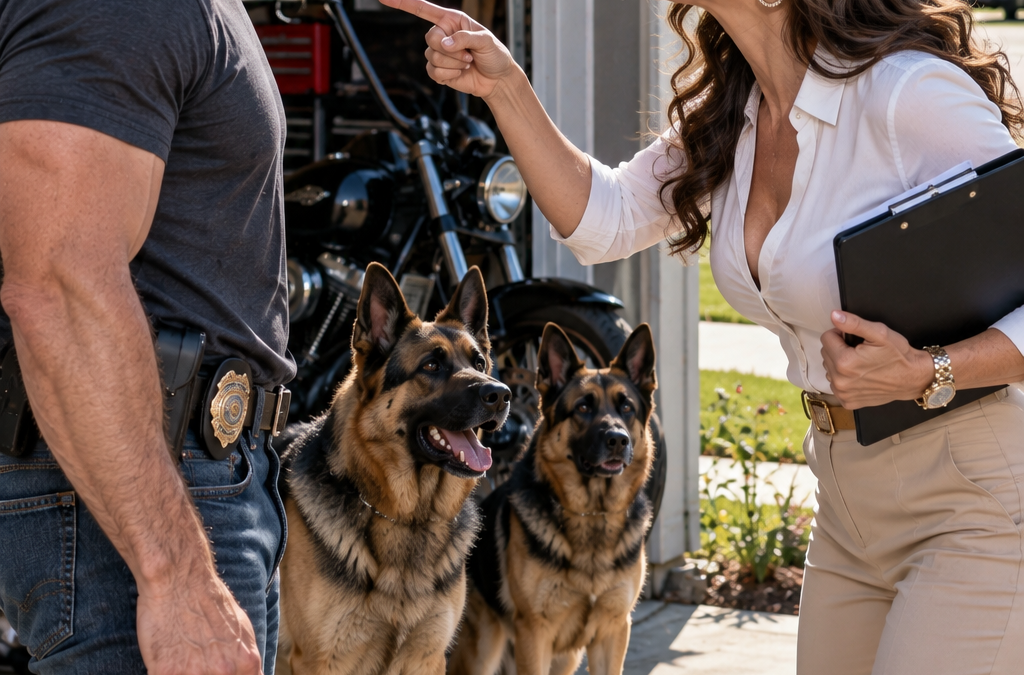
I watched her go, heels clicking on the pavement, hips swaying with practiced confidence, clipboard tucked under one arm like a weapon.
Rex gave a low whine behind me.
“Yeah,” I muttered. “I saw it too.”
That was day one.
By the end of the first month, Karen had made monitoring me her personal hobby.
At first, it was small things.
A white envelope in my mailbox because my grass was supposedly too high. I measured it. It was within limits.
Another notice because my trash bins were allegedly visible from the street after six p.m. The rule said they had to be brought in by six. My shifts sometimes ended at seven-thirty, eight, even later if an arrest turned into paperwork or someone decided to confess to six unrelated crimes at the end of the night. I emailed the board, politely explained my rotating work schedule, and asked if there was any reasonable accommodation for residents who worked emergency services.
The reply came from a generic HOA email address.
Rules are rules. Exceptions create disorder.
I stared at that sentence for a long time.
Disorder.
Because a trash bin sat beside my garage for two extra hours.
Then came a warning about my motorcycle being “excessively visible.” Not loud. Not leaking oil. Not blocking anything. Visible.
I got a notice because Rex barked twice at a squirrel. Not for ten minutes. Not at midnight. Twice, at two in the afternoon. I knew because my security camera caught it, along with Karen standing at her window across the street, phone lifted, recording my yard like she was gathering evidence for a murder trial.
I got another warning because a friend parked in my driveway overnight, and Karen claimed the vehicle “created suspicion.” The friend was a firefighter. His suspicious vehicle was a pickup truck with a union sticker and a baby seat in the back.
Karen was relentless.
If I washed my bike in the driveway, I saw her blinds move. If I brought groceries in after dark, her porch light came on. If a delivery truck stopped at my house, her beige sedan somehow rolled slowly past within five minutes. She would pause at the corner, glance toward my property, then continue like she was patrolling a border crossing.
The thing was, most of my neighbors were decent people.
The retired couple next door brought over banana bread and asked if Rex and Bailey liked children because their grandkids visited on weekends. A young couple three houses down waved whenever they walked their stroller past. An older widow named Mrs. Delaney, who lived two doors over from Karen, told me my motorcycle reminded her of her late husband’s Harley and asked if I would rev it once for her birthday.
I did.
Karen sent me a noise complaint.
At work, I dealt with criminals, drunks, liars, terrified victims, angry families, grieving parents, and teenagers who thought running from police became less stupid if they filmed it. I had patience. I had training. I knew how to deescalate people who wanted a fight.
But Karen got under my skin because she hid cruelty behind rules.
She never screamed at first. She never threatened directly. She used official language. Community standards. Safety concerns. Resident complaints. Covenant compliance. She turned personal dislike into paperwork and expected me to treat it like law.
I kept my professional life separate from my neighborhood life for a reason.
When I was home, I did not wear my uniform. I changed at the station. I did not drive a marked unit home. Most people knew I worked for the city, but not exactly what I did. That was intentional. Being a police officer changes how people treat you. Some get too friendly. Some get nervous. Some want favors. Some want to argue about every ticket they have ever received. I did not want to be Sergeant Mark Donovan when I was grilling burgers in my driveway.
I wanted to be the guy with the dogs, the motorcycle, and the slightly ugly kitchen I planned to remodel someday.
Karen did not know I was a cop.
And for a while, that suited me fine.
Then she decided to declare war on my firearms.
I am a gun owner. Given my profession, that should not surprise anyone. I carry a firearm at work. I also own personal firearms legally, safely, and responsibly. Some are historical pieces. Some are for sport shooting. Some are practical. All are secured. All are handled properly. Safety had been drilled into me for so long that even in my own garage, alone, I treated every weapon with the same discipline I expected from a rookie on the range.
One Saturday afternoon, I came back from a range session and set up in my garage with the door open. It was a nice day, warm but not miserable, with a breeze moving through the neighborhood and the smell of cut grass in the air. Rex and Bailey were inside, asleep after a long walk. My cats were perched on a shelf like weird little supervisors.
I had music playing low and a bolt-action hunting rifle disassembled on my workbench. The magazine was out. The chamber had been checked. Ammunition was nowhere near the table. I was wiping down the barrel when a shadow fell across the garage floor.
I looked up.
Karen stood at the threshold.
She had no reason to be that close to my garage.
None.
She was wearing oversized sunglasses, a silk scarf, and a sleeveless summer dress that made her look like she had stepped out of a country club brunch. Her expression, though, was pure theatrical horror. Her eyes widened. One hand flew to her chest. The other gripped her phone.
“What,” she said, each word trembling with outrage, “are you doing?”
I set the cloth down slowly.
“Cleaning my equipment.”
“That is a gun.”
“Yes.”
“In your garage.”
“My garage.”
“In this neighborhood.”
I almost laughed.
Almost.
“It’s unloaded,” I said. “Safe. Legal. On private property.”
Karen stepped back like the rifle might leap off the bench.
“I do not feel safe knowing there are weapons across the street from my home.”
“You don’t have to feel anything about it. It’s not your property.”
Her face flushed.
“Do not take that tone with me.”
“Karen, you are standing in my driveway uninvited, commenting on legal property inside my garage.”
“I am the HOA president.”
“You’re still not invited.”
She inhaled sharply, as if I had slapped her.
“You people always hide behind legal technicalities.”
I stood straighter.
“You people?”
Her mouth tightened.
“Men who think owning guns makes them powerful.”
I looked at the disassembled rifle, then back at her.
“It’s a hunting rifle, Karen. It’s in pieces. The only thing it’s threatening right now is dust.”
That was when I made another mistake.
I smiled.
Not big. Not mocking. Just enough.
Karen saw it and turned red.
“You think this is funny?”
“I think you’re overreacting.”
“I think,” she said, her voice lowering, “that this community has standards. I think families live here. Children live here. And I will not tolerate some kind of militia operating out of a garage across from my house.”
That time, I did laugh.
I could not help it.
A militia.
Me, my sleeping dogs, two judgmental cats, and a disassembled hunting rifle.
Karen spun on her heel, scarf fluttering, and marched back across the street.
Two days later, the community newsletter went out.
The subject line was: New Safety Initiative.
I opened it while drinking coffee before work and nearly choked.
Near the bottom, in bold red font, Karen had announced that the neighborhood was now a weapon-free zone. Residents were prohibited, according to the newsletter, from storing “assault weapons, military-grade firearms, or dangerous tactical equipment” in homes, garages, vehicles, sheds, or any HOA-governed space.
I read it twice.
Then I laughed so hard one of my cats jumped off the counter.
It was absurd.
An HOA newsletter does not override state law. It does not rewrite property rights. It does not create criminal penalties. It does not transform legal ownership into contraband because Karen Whitmore got dramatic near a garage.
But it was also revealing.
Karen did not merely want me fined.
She wanted me branded.
Dangerous. Unwanted. A threat. A man who needed to be controlled for the comfort of people like her.
I forwarded the newsletter to my personal email, saved a copy, and did nothing.
That might sound passive, but sometimes doing nothing is strategy.
Karen expected me to storm across the street and argue. She wanted confrontation. She wanted me angry enough to give her something she could quote out of context at the next board meeting. I had handled enough unstable people to know the value of letting someone build their own paper trail.
So I waited.
For a few weeks, things quieted down.
Not completely. Karen still watched. She still sent petty notices. She still drove past my house slowly, lips pursed, sunglasses hiding eyes I knew were scanning for violations.
But work got busy, and I had bigger problems.
We were dealing with a ring of catalytic converter thieves who had been hitting apartment complexes, church parking lots, and hospital staff lots. They were fast, organized, and arrogant. For weeks, the department was buried in reports, surveillance footage, late-night calls, and frustrated citizens. My unit worked double shifts. Detectives pulled long nights. Patrol was exhausted. Everyone was living on burnt coffee, gas station food, and stubbornness.
When we finally cracked the case and made the arrests, the whole squad needed to decompress.
Nothing wild. Nothing reckless.
Just one night where we could be normal people instead of walking containers for everyone else’s emergencies.
I offered to host.
I had the driveway. I had the grill. I had the garage fridge. I had enough yard space that people could spread out, talk, eat, laugh, and not bother anyone.
I invited about fifteen guys from the department. Mostly patrol officers, a couple of detectives, and two K9 handlers I had known for years. Some rode motorcycles. Some drove pickups. Most looked like exactly what they were: large, tired men who carried too much stress and covered it with bad jokes.
Friday evening rolled around, and I spent the afternoon prepping.
Burgers, brats, chicken, ribs, potato salad from the grocery store because I know my limits, coolers full of soda and beer, water bowls for Rex and Bailey, folding chairs in the garage. I swept the driveway. I moved my bike to the side. I checked the HOA quiet hours, just because I knew Karen would be waiting for a reason.
People started arriving around six.
And I will admit, from a certain angle, the optics were probably not ideal.
Fifteen off-duty cops do not always look like a church group. There were motorcycles rumbling in one after another, pickup trucks backing into the driveway, big guys in jeans and boots, some with tattoos, some with shaved heads, most wearing sunglasses even though the sun was already dropping. Mike Kowalski, a detective and one of the gentlest men I knew, was six-foot-four, built like a refrigerator, covered in tattoos from wrists to collar, and looked like he had been hired by central casting to stand outside a biker bar and scare people.
To Karen, watching from across the street, we probably looked like the apocalypse had chosen my cul-de-sac as a staging area.
But we were being respectful.
The music was low. Nobody blocked driveways. Nobody yelled. Nobody revved bikes after parking. The beer stayed in the garage and driveway. The food was good, the jokes were terrible, and for the first time in weeks, I felt my shoulders unclench.
About an hour in, I saw Karen’s blinds move.
I raised my hand and waved.
The blinds snapped shut.
Mike noticed.
“That the HOA queen?”
“That’s her.”
He grinned. “She always watch you like that?”
“Only when she’s awake.”
He laughed and shook his head.
A few minutes later, he walked to his truck and came back with a small case.
“You got a second?” he asked. “I finally picked up that compact I told you about.”
Mike was a firearms instructor on the side and had been talking for months about a custom off-duty carry piece he had ordered. He was proud of it the way car guys are proud of engines and watch guys are proud of mechanisms no one else understands.
We stood inside the garage near the workbench. He opened the case, removed the compact pistol, cleared it, checked it, locked the slide back, and handed it to me grip first.
“Nice,” I said, inspecting the stippling. “Who did the work?”
“Guy out in Henderson. Took forever, but look at that trigger.”
I was looking at the sights when I heard a sound from the street.
Not a normal sound.
A sharp, triumphant gasp.
I looked up.
Karen stood at the edge of my driveway, phone in hand, recording.
Her face was lit with victory.
Not fear.
Victory.
“I knew it,” she shouted.
The garage went quiet.
I lowered the pistol, keeping it pointed safely down.
“Karen,” I said, “what are you doing?”
“I have proof,” she said, waving her phone. “Proof of illegal weapons activity. Proof of violations. Proof that you are turning this neighborhood into some kind of armed compound.”
Mike looked at me.
“Is she serious?”
“Unfortunately.”
I handed the cleared pistol back to him.
Karen kept recording.
“I have you on video,” she shouted. “All of you. Drinking, carrying weapons, gathering in violation of HOA safety policy.”
A few guys in the garage exchanged looks.
One of the K9 handlers muttered, “HOA safety policy?”
I walked down the driveway, hands visible, voice calm.
“Karen, you need to go home.”
She stood her ground. Her lips were painted a deep red that made her smile look sharper.
“You would like that, wouldn’t you?”
“I would like you to stop recording people on my property and stop making accusations you don’t understand.”
“I understand perfectly.” She pointed past me toward Mike. “That thug had a gun.”
Mike, behind me, said, “Wow.”
I turned slightly. “Don’t.”
Karen’s eyes glittered.
“You think you can intimidate me because you ride motorcycles and collect weapons and invite criminals into the neighborhood?”
“Those are my friends.”
“They look like gang members.”
“They are not gang members.”
“You don’t get to decide what makes residents feel unsafe.”
“No,” I said, “but you also don’t get to invent crimes because you dislike someone.”
Her smile widened.
There was something flirtatious about Karen even when she was angry, a practiced tilt of the chin, a softness she could inject into her voice when she wanted to sound wounded instead of aggressive. I had seen people use charm as camouflage before. Karen used it like perfume over smoke.
“You’re scared,” she said.
“Not even a little.”
“You know you’re wrong. That’s why you’re trying so hard to sound calm.”
“Karen, listen carefully. You do not want to escalate this.”
Her eyes flashed.
“Are you threatening me?”
“No. I’m warning you.”
“That sounds like a threat to me.”
“It’s advice.”
She lifted her phone higher.
“I am calling the police.”
Behind me, several men started laughing.
Not because it was smart.
Because it was absurd.
I closed my eyes briefly.
“Karen,” I said, “you really, really do not want to do that.”
Her smile became smug enough to make my molars hurt.
“Oh, I think I do.”
Then she dialed 911 on speakerphone.
Right there in front of me.
I could hear the dispatcher answer.
“911, what’s the address of your emergency?”
Karen gave my address in a trembling voice that would have deserved an award if it had not been attached to a lie.
“There are men with guns,” she said. “A large group of men. They’re drinking, they’re armed, and I believe they are threatening the neighborhood.”
My body went cold.
Not with fear for myself.
With anger.
Because that was not a noise complaint. That was not “my neighbor has a gun.” That was a high-risk call. Multiple armed men. Drinking. Threatening neighbors. Buzzwords that could turn a quiet barbecue into a tactical response.
“Are you in a safe place?” the dispatcher asked.
“I’m going inside now,” Karen said, backing toward her lawn but keeping her eyes locked on me. “I can see them loading weapons. I’m terrified. Please hurry.”
I stared at her.
She stared back.
For the first time since I moved in, I saw something behind her confidence that looked like hunger. She wanted sirens. She wanted spotlights. She wanted me on the ground in my own driveway while she watched from her porch.
She thought she was summoning authority.
She had no idea she was summoning my coworkers.
Karen hung up and pointed at me.
“You’re finished.”
I took a slow breath.
Then I turned back toward the garage.
“All right,” I said, raising my voice. “Listen up.”
The laughter died when the guys saw my face.
“She called it in as armed men threatening the neighborhood.”
Mike’s expression changed first.
“Seriously?”
“Seriously.”
A low wave of curses moved through the group.
A false 911 call like that is not funny once the adrenaline starts moving. A responding officer does not know what is true. Dispatch gives them the information they have. Multiple armed men. Possible threats. Drinking. Residential neighborhood. That is how good people get hurt because one person lied confidently.
“When they roll up,” I said, “hands visible. No sudden moves. No jokes until they know who we are. I mean it.”
Everyone understood.
Bottles went down. Hands emptied. Those carrying off-duty secured everything safely and visibly stepped away. We moved to the driveway as a group, not because we had done anything wrong, but because the safest place during a misunderstanding with responding officers is somewhere open, well-lit, and calm.
Ten minutes later, the cul-de-sac lit up.
The first patrol car came in fast without sirens, followed by another, then two more. Floodlights washed across my driveway, turning every face pale and every shadow sharp. Doors opened. Officers moved behind them.
“Police! Let me see your hands!”
I raised mine high.
“Hands!” another officer shouted.
All around me, my friends lifted their hands, palms open, still as statues.
A rookie named Mueller was on point behind the driver’s door of the first unit, weapon drawn, aimed in my direction. I knew Mueller. I had field trained him two years earlier. He was a good kid, serious, cautious, maybe a little too eager to prove himself, and at that moment he was running on pure adrenaline.
He saw fifteen big men in leather, boots, and dark shirts standing in a driveway after a weapons call.
He did not see coworkers yet.
He saw threat.
“Everybody stay where you are!” Mueller shouted.
Karen came running out of her house.
Actually running.
“Those are them!” she screamed, pointing at us. “That’s the gang! They have guns!”
“Ma’am, get back!” Mueller shouted without taking his eyes off us. “Get back in your house!”
“But they—”
“Get back!”
She stumbled, shocked that the police she had called were not treating her like the director of the scene.
I kept my hands high.
I could feel the whole situation balanced on a wire.
One wrong move. One startled officer. One drunk idiot would have been bad, but thankfully none of my people were idiots. Still, even trained people can become targets if a situation starts with a lie.
I used the command voice I had used on dark streets, traffic stops, domestic calls, and chaotic scenes where panic needed something solid to grab.
“Mueller!”
He froze.
“Check your background,” I said. “It’s Sergeant Donovan. Stand down.”
Mueller blinked.
The muzzle of his weapon dipped a fraction.
“Sergeant?”
“It’s a barbecue,” I said. “Everyone here is law enforcement. Lower slowly. Confirm faces.”
Another officer leaned toward his spotlight, squinting.
“Wait,” someone said. “Is that Kowalski?”
Mike, hands still up, said, “Please don’t shoot me before dessert.”
“Shut up, Mike,” I said.
The tension cracked.
Not fully. Not all at once. But enough.
Weapons lowered. Officers stepped out from behind doors. Recognition moved through them like sunrise. One of the patrol guys started laughing under his breath. Another looked deeply annoyed in the way only cops can look when they realize paperwork is about to become stupid.
Then Sergeant Connor arrived.
Connor and I went way back. He climbed out of his unit, took one look at the driveway full of off-duty cops, then looked at Karen standing in her yard with her phone clutched to her chest.
He rubbed a hand over his face.
“Mark,” he said.
“Connor.”
“This the gang disturbance?”
“Apparently.”
He looked toward the garage, where the grill was still smoking peacefully.
“Dangerous setup.”
“Mike brought potato salad,” I said. “So maybe.”
Connor sighed, but his mouth twitched.
Karen stormed forward.
“Why are you laughing?” she demanded. “Why are you not arresting them?”
Connor turned to her slowly.
“Ma’am, lower your voice.”
She pointed at Mike. “That man had a gun.”
Connor looked at Mike.
Mike lowered his hands and lifted his badge from his belt.
“Detective Michael Kowalski, City PD,” he said. “And no, ma’am, I did not threaten you with a firearm.”
Karen’s face flickered.
Just for a second.
Then she recovered.
“They’re lying,” she said. “All of them. Obviously. They’re protecting each other.”
Connor’s expression went flat.
That dead professional calm settled over him, the one that made people on traffic stops suddenly reconsider their life choices.
“Ma’am,” he said, “you called 911 and reported multiple armed men threatening the neighborhood.”
“They were armed.”
“Were they threatening you?”
“They were intimidating.”
“How?”
“They were standing there.”
“In his driveway?”
“With guns.”
“Pointed at you?”
Karen’s eyes darted to me, then back to Connor.
“Yes,” she said.
The driveway went silent.
That was the moment everything changed.
Up until then, she had been dramatic, reckless, malicious. But now she had accused a police officer of pointing a firearm at her. That was not neighborhood drama. That was a felony allegation. That could ruin careers, trigger internal investigations, and place innocent people under suspicion because Karen wanted to win an argument.
Mike took one step forward.
His voice was low.
“Ma’am, I want to be very clear. I did not point a weapon at you. I did not threaten you. The firearm you saw was cleared, safe, and inside the garage. You just made a false report.”
Karen scoffed.
“I want real police. Not his friends.”
Connor stared at her.
“These are real police.”
She looked confused.
Connor gestured toward the driveway.
“Most of the men standing here are off-duty law enforcement. Including the homeowner.”
Karen turned to me.
For the first time, she saw me differently.
Not as the noisy motorcycle guy.
Not as the man with dogs.
Not as the undesirable resident she thought she could paper into submission.
As a police sergeant.
I gave her a small wave.
“Hi, neighbor.”
Her mouth opened, but nothing came out.
Connor continued.
“You initiated a high-priority emergency response based on claims that do not match what we found on scene. You reported armed men threatening residents. We arrived to find an off-duty gathering on private property, no disturbance, no visible threat, no victim, and multiple officers present who directly contradict your claim.”
“I felt unsafe,” Karen whispered.
“Feeling unsafe is not the same as being threatened.”
“They had guns.”
“Legal possession of firearms on private property is not a crime.”
“The HOA banned them.”
Connor stared at her like he was trying to decide whether she was serious.
“The police department does not enforce HOA bylaws.”
“But I am the president.”
“Of an HOA,” he said. “Not the state legislature.”
A few guys behind me made noises that might have become laughter if I had not shot them a look.
Karen’s eyes filled with tears.
It was impressive how quickly she could transform from triumphant accuser to delicate victim. Her lower lip trembled. Her shoulders softened. She clutched her scarf like she was in a courtroom drama.
“I was trying to protect the community,” she said.
Connor was unmoved.
“You pulled four units away from actual calls because you exaggerated a situation you did not understand.”
“I didn’t exaggerate.”
“You said they were waving guns and threatening people.”
“I thought they might.”
“That is not what you reported.”
Her cheeks flushed red.
The neighbors had started coming outside. Porch lights clicked on. Curtains moved. People stood in driveways whispering. Mrs. Delaney stood two doors down in a robe, arms folded, watching Karen with the satisfied expression of a woman who had waited years for this exact scene.
Connor pulled out his citation book.
Karen saw it and stiffened.
“What are you doing?”
“I’m issuing a summons for misuse of 911.”
Her face went white.
“You can’t do that.”
“I can.”
“This is outrageous.”
“What’s outrageous,” Connor said, “is creating a dangerous response because you dislike your neighbor.”
“I didn’t—”
“If we receive another false call regarding this address,” he continued, “we will explore harassment charges. Do you understand?”
Karen looked around.
That was the part I think hurt her most.
Not the citation.
The audience.
For months, she had ruled the neighborhood by making people fear her attention. A notice here. A fine there. A whisper about property values. A reminder that the board could place liens, hold hearings, make life difficult. She had built herself into the self-appointed queen of the cul-de-sac.
Now everyone was watching her get corrected in the street.
Not by me.
By the actual police she had summoned.
Her hand shook as she signed the citation.
Connor handed her a copy.
“You’ll have a court date listed there.”
She looked like she might cry for real now, but I had seen enough weaponized tears to keep my sympathy locked away.
“This is not over,” she whispered to me.
Connor’s head turned.
“Ma’am,” he said, “I strongly suggest that it is.”
Karen looked at him, then at me, then at the neighbors.
For once, she had no speech ready.
She turned and walked back to her house, shoulders stiff, head down, phone still in her hand.
The officers stayed for a few minutes after that. They had to clear the call properly, confirm there was no threat, make sure no one wanted to file additional complaints. Connor pulled me aside near the mailbox.
“You okay?”
“Annoyed.”
“That was a bad call.”
“She knew what she was doing.”
“I figured.”
“She’s been harassing me since I moved in.”
Connor glanced toward Karen’s house.
“Document everything.”
“Already have.”
He gave me a look.
“Of course you do.”
I offered the on-duty guys burgers. They refused because they were working, though one of them looked emotionally wounded by the decision. Mueller apologized three times for pointing his weapon at me.
“You did your job,” I told him.
“I should have recognized you.”
“Not through floodlights on a weapons call. You followed the information dispatch gave you.”
“She lied.”
“Yes,” I said. “That’s on her, not you.”
When the units finally left, the party resumed, but the energy had shifted. The adrenaline dump hit everyone. Guys who had laughed at danger for years stood around quietly for a while, eating burgers they barely tasted, replaying how easily a stupid lie could have created a tragedy.
Then Mike raised a soda.
“To gang activity,” he said.
Someone else added, “And potato salad dangerous enough to require backup.”
The laughter came back slowly.
By the end of the night, the story had already become department legend.
At work the next week, I could not walk into a room without someone asking, “Is the HOA watching?”
Mike threatened to print business cards that said Gang Leader.
Even the chief called me into his office, shook his head, and said, “Only you could host a barbecue so boring someone called in a tactical response.”
I said, “In my defense, the ribs were criminally good.”
He pointed at me.
“Don’t make me laugh. I’m trying to be disappointed.”
But beneath the jokes, people understood the seriousness. False reports get people hurt. They create danger for officers, bystanders, and the people being accused. Karen had not just annoyed me. She had played with a loaded system because she wanted power.
Her court date came a few weeks later.
I did not attend. I did not need to. Connor told me what happened afterward.
Karen tried to contest the citation.
Of course she did.
She appeared in court dressed like she was attending a charity luncheon, all soft colors and expensive posture, and claimed she had been terrified. She said she saw armed men, heard loud voices, and believed the neighborhood was in immediate danger. She implied the police had treated her unfairly because some of the men involved were officers.
Then the judge played the 911 recording.
Not the whole thing, Connor said. Just enough.
Karen’s own voice filled the courtroom, breathless and dramatic, claiming men were waving guns, threatening neighbors, loading weapons, making her fear for her life.
Then Connor testified to what they found on arrival: off-duty officers, legal gathering, no disturbance, no threat, no victim, no evidence supporting her claims.
The judge was not amused.
Apparently, he lectured her for almost ten minutes about emergency resources, public safety, and the difference between personal discomfort and actual danger. He upheld the fine and ordered her to pay court costs.
I wish I could say that was the end.
With Karen, there was always another layer.
A week after court, I got a letter from the HOA management company.
When I saw the logo on the envelope, I almost threw it straight into the trash. I assumed it was another fine, maybe something absurd like “improper police presence” or “unauthorized use of driveway as emergency staging area.”
Instead, it was an apology.
A real one.
Stiff, corporate, probably reviewed by an attorney, but still an apology.
The letter said the board had reviewed the so-called weapon-free zone policy and determined it was inconsistent with state law and the association’s governing documents. The policy was rescinded immediately.
Then I kept reading.
All outstanding fines against my property were voided.
Grass height.
Trash bins.
Motorcycle visibility.
Dog noise.
Guest vehicle.
Every petty notice Karen had weaponized against me disappeared with one paragraph.
I stood in my kitchen holding that letter while Rex leaned against my leg and Bailey stared up at me like she understood bureaucracy had been defeated.
“Well,” I told them, “apparently we’re not criminals anymore.”
One of the cats knocked a spoon off the counter.
“Mostly,” I added.
The real ending came at the next HOA meeting.
I almost did not go.
Part of me wanted to stay home, grill something, and enjoy the peace. But another part of me knew that people like Karen thrive when normal people get tired and stop showing up. So I went.
I came straight from work, which meant I was still in uniform.
I did not plan it as intimidation. I genuinely did not have time to change. But when I walked into that community center meeting room and Karen saw me, the look on her face told me the uniform had landed exactly where months of polite emails never had.
She sat at the front table with the remaining board members, posture rigid, lips pressed together, hair perfect as always. She had dressed carefully in a fitted navy dress and pearl earrings, trying to reclaim elegance, authority, control. She looked beautiful. She always did. But now everyone in the room knew beauty did not make her honest.
Neighbors filled the chairs.
More than usual, I was told.
People who had never attended an HOA meeting in their lives showed up that night. The young couple with the stroller. The retired man from the corner. Mrs. Delaney, sitting in the front row with a purse in her lap and the expression of a woman who had brought exact change to a reckoning.
Karen opened the meeting with forced brightness.
“Before we begin,” she said, “I would like to remind everyone that recent misunderstandings have created unnecessary tension in our community.”
I nearly laughed.
Misunderstandings.
That was a beautiful word for “I lied to 911.”
She continued.
“As president, my priority has always been safety, harmony, and protecting the character of our neighborhood.”
Mrs. Delaney raised her hand.
Karen hesitated.
“Yes, Margaret?”
Mrs. Delaney stood slowly.
She was small, white-haired, and sweet-looking in the way certain older women are sweet right up until they decide to destroy you with parliamentary procedure.
“I would like to make a motion,” she said.
Karen’s smile stiffened.
“What kind of motion?”
“A motion to remove Karen Whitmore as president of the HOA board.”
The room went absolutely silent.
Karen’s face changed.
Not dramatically. She was too practiced for that. But I saw the crack: a flash of panic beneath the polish.
“You can’t simply—”
Mrs. Delaney raised a sheet of paper.
“According to the bylaws, I can. Section four, subsection three. Removal may be initiated by motion from a member in good standing with support from at least two additional members.”
Two hands went up immediately.
Then more.
Karen looked around the room, stunned.
Mrs. Delaney continued, voice calm.
“I cite repeated abuse of authority, selective enforcement, creation of legal liability for the association, misuse of emergency services, and conduct unbecoming of a board president.”
Someone in the back murmured, “Amen.”
Karen stood.
“This is outrageous.”
A man from the corner row said, “No, Karen. Calling armed police on a barbecue was outrageous.”
The room erupted.
Not yelling exactly, but months, maybe years, of swallowed frustration broke open.
One neighbor brought up fines for holiday lights approved the year before. Another mentioned being threatened over a mailbox color that was never actually prohibited. The young couple said Karen had photographed their backyard playset from the sidewalk and sent a violation because the slide was “too visually stimulating.” Even Mrs. Delaney admitted Karen had once tried to fine her for planting yellow flowers instead of white near the walkway.
I sat quietly, listening.
This had never been only about me.
Karen had made herself queen by convincing everyone they were alone in being targeted.
They were not.
When the vote finally happened, it was almost unanimous.
Almost.
Karen voted for herself.
No one else did.
She gathered her things with shaking hands, stuffing papers into a designer tote bag. For a moment, I thought she might cry again, or scream, or threaten lawsuits. Instead, she looked around the room with pure contempt.
“You people have no idea how much I did for this community,” she said.
Mrs. Delaney smiled sweetly.
“We have some idea.”
Karen walked out in a storm of perfume, heels, and wounded pride.
No one followed.
The new acting president was a guy named Daniel Price who worked in IT and had the general energy of someone who considered HOA leadership a terrible but necessary software patch. His first statement was, “I think we should probably stop making rules we can’t legally enforce.”
It was the most sensible thing anyone had said in that room all night.
Life changed after that.
Not instantly perfect. Neighborhoods are still neighborhoods. Dogs bark. Lawns grow. Trash bins occasionally offend the delicate balance of suburban civilization.
But the fear lifted.
People waved more. Kids played outside longer. Neighbors stopped whispering when Karen drove by. Notices from the HOA became rare, boring, and actually tied to real rules. Daniel, the new president, asked me for advice on home security cameras and whether Rex and Bailey were as well trained as they looked.
“They’re better behaved than most people,” I told him.
“I believe that.”
Karen stayed in her house for a while, but she no longer patrolled the street like she owned it. Her blinds still moved sometimes. Her sedan still appeared at odd moments. But the power had drained out of her watching. She could observe all she wanted. Observation without authority is just staring.
A few months later, a For Sale sign appeared in her yard.
I saw it on my way home from a long shift.
I sat in my truck for a moment, looking at it while the engine ticked softly.
I expected to feel triumphant.
Instead, I felt tired.
Not sorry for her. Not exactly. Karen had earned every consequence she faced. She had harassed me, lied about me, endangered officers, embarrassed herself, and exposed the HOA to potential legal trouble because she could not tell the difference between leadership and control.
But watching that sign sway in her yard, I thought about how much damage one person can do when everyone else decides it is easier to stay quiet.
Karen had been awful.
But silence had helped her.
Every neighbor who paid a nonsense fine just to avoid drama. Every board member who let her send aggressive letters. Every management company employee who copied and pasted “rules are rules” instead of asking whether the rule existed. Every person who rolled their eyes privately but never showed up publicly.
That is how petty tyrants grow.
Not because they are strong.
Because everyone else is tired.
I understood tired. I lived tired. But I also understood that peace bought through surrender is not peace. It is just a pause between demands.
The house eventually sold to a young family with two kids, a golden retriever, and a minivan with a dent in the back bumper. The father apologized to me on move-in day because the dog barked once from the yard.
I laughed.
“Trust me,” I said, “we can handle barking.”
A week later, he asked if my motorcycle was as loud as it looked.
“Legally loud,” I said.
He grinned. “Good. My dad rides. He’ll love it.”
Mrs. Delaney got her wish too. On her birthday, I rolled the cruiser into the driveway, waited until a reasonable afternoon hour, and revved it once while she stood on her porch clapping like I had performed at the Super Bowl.
No complaint arrived.
That evening, I opened the garage, put music on low, and cleaned the same hunting rifle that had started Karen’s little crusade. Rex slept near the workbench. Bailey watched the sidewalk. The cats sat above everything like tiny judges in fur coats.
For the first time since moving in, I felt fully at home.
Not because Karen was gone.
Because I had stopped shrinking myself to make unreasonable people comfortable.
I had tried politeness. I had tried patience. I had tried minding my own business. None of it mattered to Karen because she had never been responding to my behavior. She had been responding to the fact that I existed outside her control.
That was the real conflict from the beginning.
The dogs were not the problem.
The motorcycle was not the problem.
The firearms were not the problem.
The barbecue was not the problem.
The problem was that Karen looked across the street and saw a man she could not easily intimidate, living a life she had not approved, and she decided that made me dangerous.
In the end, she proved only one thing.
The most dangerous person in the neighborhood was never the guy cleaning an unloaded rifle in his own garage.
It was the woman willing to lie to emergency dispatch because she thought power belonged to whoever sounded the most afraid.
I still host garage nights.
The guys still come by, though now everyone jokes about checking for HOA snipers before getting out of their trucks. Mike never did put “gang leader” on his business card, but somebody taped a sticky note with those words to his locker, and it stayed there for almost a month.
We keep the music reasonable.
We park legally.
We grill too much food.
Sometimes the neighbors stop by.
Daniel from the HOA brings craft beer and asks boring questions about router security. Mrs. Delaney brings cookies and flirts shamelessly with half the department. The young family’s golden retriever tries to become best friends with Rex and Bailey through the fence.
It is loud sometimes.
Not reckless.
Not illegal.
Just alive.
And every now and then, when I sit in my garage at the end of a long shift, boots dusty, hands smelling faintly of metal polish and charcoal smoke, I look across the street at the house that used to be Karen’s.
The new owners have string lights on the porch.
A child’s bike lies in the yard.
The blinds are open.
Nobody is watching me like a threat.
Nobody is waiting with a clipboard.
Nobody is inventing rules from behind a curtain.
That is what peace looks like.
Not silence.
Not control.
Not perfect lawns and frightened neighbors.
Peace is being able to come home, open your garage, let your dogs stretch in the yard, laugh with your friends, and know that the person across the street cannot turn your ordinary life into an emergency just because she hates that she cannot command it.
Karen thought she could make me look dangerous.
She thought she could use the HOA, the police, the courts, and the fear of public humiliation to force me into submission.
But she made one mistake that people like her always make eventually.
She believed her own performance.
And when the lights came on, when the officers arrived, when the recording played, when the neighbors finally raised their hands and voted, all that performance collapsed into what it had always been.
One angry woman.
One false call.
One neighborhood done being afraid.
As for me, I still ride the motorcycle. I still own the house. I still wave at neighbors. I still keep Rex and Bailey behind a secure fence, though half the kids on the block now know them by name. I still keep my work and home life as separate as I can.
But I no longer hide what I do.
Not because I want special treatment.
Because if another Karen ever decides to turn fear into a weapon, I want her to understand something before she picks up the phone.
Some people actually know the difference between rules and law.
Some people document everything.
And some garage parties are a lot more official than they look.