The Woman Across the Road Had a Rule for Everything Except Herself
𝗙𝗨𝗟𝗟 𝗦𝗧𝗢𝗥𝗬
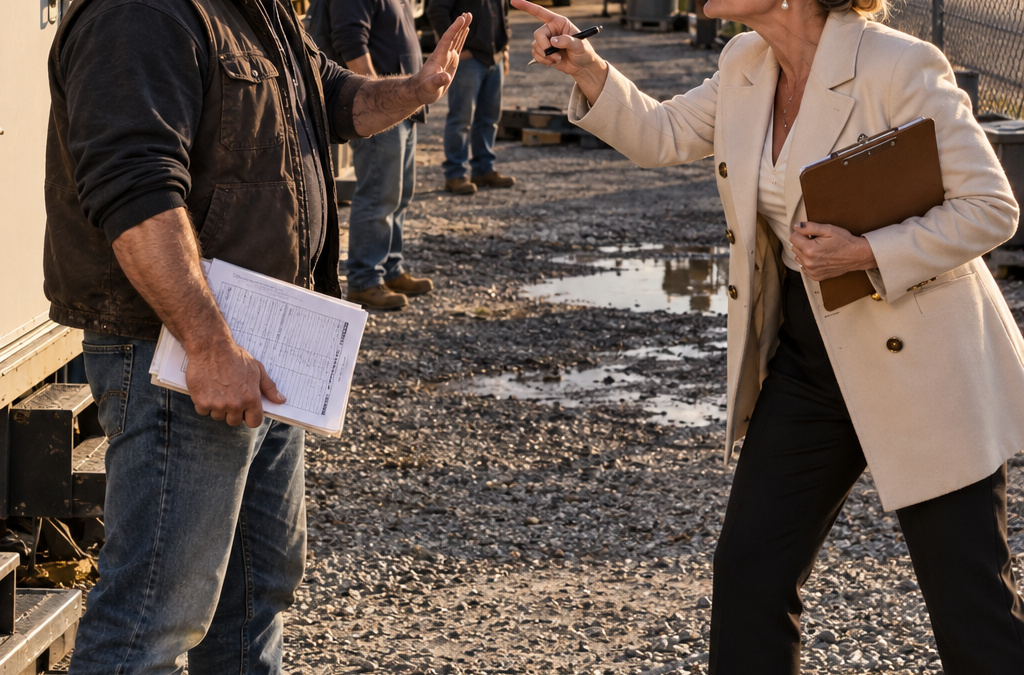
By the time I got over there, Mike had already rolled the window back up and was pulling away carefully. Karen turned on me like I had personally ordered an invasion.
“Your employees are disrespectful,” she snapped.
“My employees are trying to work.”
“They are intimidating residents.”
“By driving?”
“By ignoring rules.”
I took a breath. “Karen, listen to me carefully. You do not have authority over my business, my drivers, my property, or the public roads around it.”
She leaned forward. “Men like you always think you’re above accountability.”
That was the first time I noticed how personal it had become for her. This was not really about trucks anymore. Maybe it never had been. The trucks were just symbols. Big, loud, visible things she could point to when she wanted to feel like she was defending something.
What she was really defending was control.
I should have gone to a lawyer then. I know that now. I should have documented every interaction more formally, sent a certified letter, maybe filed for a no-trespass order sooner. But when you run a small business, you learn to choose which fires deserve your attention.
The cruel joke is that I did not know there would be a real one.
The situation crossed a new line on a Friday evening in early spring.
I had an early delivery scheduled for Saturday, one of those inconvenient jobs where being ten minutes late could cost me the client. The truck assigned to it had just come back from service, and rather than drive across town at four in the morning to get it from the yard, I brought it home.
My house was nowhere near Karen’s subdivision.
I lived on the other side of town in a quiet cul-de-sac with older homes, wide driveways, and neighbors who mostly kept to themselves. There was no HOA there. There had never been an HOA there. That was one of the reasons I bought the place.
I parked the semi neatly along the curb in front of my own property. It was legal. It was temporary. It was going to be there less than twelve hours.
The next morning, I opened my front door and found a letter taped to it.
At first, I assumed it was from a neighbor. Maybe someone asking me not to park the rig there again. I could have understood that. Not everyone wants to wake up to a semi in the cul-de-sac.
Then I saw the header.
Official Violation Notice.
I stood there in my doorway in socks and work pants, staring at the paper while my coffee went cold inside.
According to the notice, I owed a $250 fine for prohibited vehicle storage. It cited “community appearance standards,” “residential use expectations,” and “oversized vehicle restrictions.” It gave me seven days to comply or face “further action.”
There was no HOA name on it that applied to my neighborhood.
No legal authority.
No contact information except an email address I recognized from Karen’s complaints.
For a moment, I actually laughed.
Not because it was funny in any normal way, but because laughter was the only response my brain could produce. The woman had followed me across town, found my house, and invented a violation notice for a neighborhood she did not live in and an association that did not exist.
I kept that paper.
I still have a copy of it.
At the time, though, I did something less strategic. I drove to the subdivision and confronted her.
She was outside her house watering flowers when I pulled up. The second she saw me, her chin lifted.
I held up the notice. “Did you put this on my front door?”
She turned off the hose slowly. “You received a formal warning.”
“No. I received a fake fine from a woman with too much time and no authority.”
Her eyes narrowed. “You brought a commercial vehicle into a residential community.”
“My residential community. Not yours.”
“You brought an eyesore into the greater neighborhood environment.”
I almost laughed again. “The greater neighborhood environment?”
“Yes.”
“Karen, my house is three miles away.”
“That doesn’t matter.”
“You keep saying that about things that absolutely matter.”
She stepped toward me, water dripping from the hose onto the grass. “You think boundaries are just technicalities. You think because you found loopholes, people have to tolerate whatever you do.”
“Loopholes?” I said. “You mean property lines? Zoning laws? City permits? Those are not loopholes.”
“You’re selfish.”
“And you’re harassing me.”
That word hit her like a slap.
Her face went stiff. “Be careful.”
“No,” I said, my voice lower now. “You be careful. Stay away from my business. Stay away from my drivers. Stay away from my house. Do not put another piece of paper on my door. Do not follow me again.”
For the first time since I had known her, Karen did not immediately answer.
I turned and walked back to my truck.
Behind me, she said, “You’re going to regret talking to me like that.”
I did not turn around.
I should have.
Not because it would have changed anything, but because I wish now that I had seen her face clearly in that moment. I wish I had understood whether she was angry, humiliated, or something deeper and more dangerous.
After that, the harassment sharpened.
Anonymous complaints began arriving in my business email. They were written in that strange official tone some people use when they want personal anger to sound like civic duty.
Your vehicles are releasing toxic fumes into family spaces.
Your industrial operation is reducing quality of life for homeowners.
Your company is an environmental threat.
My drivers started noticing cars following them for a few blocks after they left the yard. One driver, a quiet young man named Luis, came into my office one afternoon looking rattled.
“That woman was behind me again,” he said.
“Karen?”
“I think so. Blue SUV?”
“That’s her.”
“She followed me to the gas station. She didn’t say anything, but she parked across from me and filmed while I fueled up.”
I felt something cold move through my chest.
My employees had families. Bills. Kids. Bad backs. Normal worries. They did not sign up to be stalked by a woman playing neighborhood police.
“From now on,” I told everyone at our next meeting, “nobody talks to her. Nobody argues. Nobody explains. If she comes onto the property, call me. If she blocks you, call the police. If she follows you, document it.”
Mike crossed his arms. “You think she’s dangerous?”
I hesitated.
That hesitation said enough.
“I think she’s unstable,” I said.
The thing about unstable people is that they often look ridiculous right up until they do something that is not ridiculous at all.
Karen still looked ridiculous at that stage. She stood across the road with her phone. She posted online. She wrote complaints. She glared at trucks as if they were stray animals she intended to have removed.
Then came the Facebook thread.
Someone sent me screenshots. A neighborhood group I did not belong to had a long post about my company, complete with photos taken over the fence. Karen had written paragraphs about “commercial invasion,” “falling property values,” and “the city’s failure to protect homeowners.” She called my yard a blight. She implied we were operating illegally. She posted a photo of one of my employees and wrote, “Would you want this activity near your children?”
That was the line that made my hands shake.
Not because she insulted me. I had been insulted plenty in business. But dragging my employees into her crusade felt different.
I considered responding, but I did not want to feed the fire. Most of the comments were not on her side anyway. A few neighbors agreed with her, but more told her to calm down. One person wrote, “The company was there before half this neighborhood was built.” Another said, “They’re zoned commercial. Leave them alone.”
Karen replied to every disagreement like it was proof of betrayal.
You will care when your property value drops.
You will care when the fumes make your children sick.
You will care when they expand.
We had no plans to expand.
It did not matter.
In her mind, I had become an enemy large enough to justify anything she wanted to do.
The last incident before the fire happened on a Saturday morning.
I was at the yard doing light maintenance on one of the rigs. It was quiet, sunny, the kind of morning where work almost feels peaceful. I had the hood open, a rag in my back pocket, and grease on my knuckles when a tow truck rolled up to the gate.
The driver got out looking confused.
“You the owner?” he asked.
“Of the truck or the property?”
“Both, I guess.”
“That would be me.”
He scratched the back of his neck. “We got a call about an abandoned vehicle.”
I slowly lowered the wrench in my hand. “Which vehicle?”
He pointed at the semi I was actively working on.
I looked at him.
He looked at me.
To his credit, embarrassment hit him fast.
“Lady said it had been abandoned here and animals were living in it.”
“Animals?”
“Raccoons, specifically.”
For one wild second, I imagined Karen telling a tow company that raccoons had colonized a registered commercial truck inside a locked business yard. It was so stupid that it almost looped back around to impressive.
“Come on,” I said.
I showed him the registration. The business license. The property deed. The maintenance log. Then, because he looked like a decent guy caught in a stupid situation, I opened the cab and let him look inside.
No raccoons.
No abandoned vehicle.
Just a clean truck with a half-full coffee cup in the holder and my gloves on the seat.
The tow driver shook his head. “I’m sorry, man.”
“Not your fault.”
He lowered his voice. “This happen a lot?”
“You have no idea.”
As he climbed back into his truck, he glanced toward the subdivision. “People get weird about HOAs.”
“No,” I said, watching Karen’s street beyond the trees. “People get weird when nobody tells them no.”
That afternoon, I ordered more cameras.
I already had a basic security system at the yard, but now I installed additional cameras covering the gate, fence line, office trailer, and parking rows. At home, I checked my doorbell camera, added another camera facing the curb, and one angled toward the driveway.
I told myself I was being cautious.
In truth, I was scared.
Not terrified exactly. Not yet. But there was a pressure building in my life, a sense that this woman had put herself on a track and did not know how to step off it. Every time I refused to bend, she found a new way to push. Every time the city failed to punish me for existing, she grew more desperate to prove that someone should.
For a short while after the tow truck incident, things went quiet.
No new complaints.
No Facebook posts that anyone sent me.
No sightings at the fence.
I wanted to believe she had finally worn herself out. Maybe someone in the HOA had talked sense into her. Maybe the tow company had warned her. Maybe the city had told her that repeated false complaints could become a problem for her instead of me.
I let myself breathe a little.
That was my mistake.
One Thursday afternoon, I drove home from the yard and found Karen standing in the street in front of my house.
For a second, my brain rejected what I was seeing. She did not belong there. She had no reason to be there. Yet there she was, feet planted near the curb, phone in hand, filming the semi I had parked in front of my house for another early delivery.
This time I did not laugh.
I got out of my pickup slowly.
“Karen.”
She kept filming.
“What are you doing here?”
“Documenting.”
“For who?”
“For the record.”
I looked up and down the quiet street. Curtains shifted in a few windows. Somewhere a dog barked.
“You followed me to my house again?”
“I have a right to be on a public street.”
“And I have a right to park legally in front of my own home.”
She lowered the phone just enough for me to see her expression.
There was no embarrassment in it. No hesitation. No flicker of awareness that she had crossed a line most people would recognize without being told.
“You think you’re above the rules,” she said.
I was tired then. Deeply tired. Not the kind of tired sleep fixes, but the kind that settles into your bones when someone keeps forcing you to defend your right to live your own life.
“I think you don’t understand what rules are,” I said.
Her smile was small and cold. “We’ll see about that.”
Then she got into her SUV and drove away too fast.
I stood there for a long moment after she disappeared around the corner.
My neighbor Tom came out of his garage, wiping his hands on a towel. Tom was retired, kind, and nosy in the harmless way that older men who spend a lot of time in garages often are.
“That the HOA lady?” he asked.
I nodded.
“Thought you weren’t in an HOA.”
“I’m not.”
He looked at the semi. “Truck bothering anyone?”
“Not unless they followed it across town to be bothered.”
Tom frowned. “You want me to keep an eye out tonight?”
I almost said no. Pride is strange that way. Even when someone offers help, a part of you wants to insist everything is under control.
But it was not under control.
“Yeah,” I said. “I’d appreciate that.”
That night, I went to bed uneasy.
I checked the cameras twice before turning off the lights. The semi sat under the streetlamp, huge and still, its white cab faintly glowing. My house was quiet. The cul-de-sac was quiet. Everything looked normal.
I told myself Karen was all threat and no action.
I told myself people like her wanted attention, not prison time.
I told myself a lot of things that felt reasonable at midnight.
At 2\:00 a.m., sirens woke me.
At first, they were part of a dream. Then they sharpened, grew louder, multiplied. Red light pulsed against my bedroom wall.
I sat up.
For half a second, I did not understand the orange glow beyond the curtains.
Then I smelled smoke.
I threw myself out of bed and ran to the window.
My semi was on fire.
There are images that do not become memories slowly. They brand themselves into you instantly.
Flames were climbing through the cab, bright and violent, twisting out of the windows like something alive. Smoke rolled upward in thick black sheets. The heat shimmered above the hood. The tires popped with sounds like gunshots.
I ran outside barefoot with my phone in my hand, shouting before I even knew what I was saying.
“Call 911! Everybody get back!”
Tom was already outside, dragging a garden hose across his lawn. He was spraying water toward the truck, but the stream looked pitiful against the flames.
“Tom, get away from it!” I yelled.
He coughed, stumbling back. “I called them!”
The heat hit me in the face like an open furnace. I could feel it on my arms, my chest, my bare feet against the cold pavement. Neighbors came out in robes and sweatpants, faces pale in the flashing light. Someone was crying. Someone else kept saying, “Oh my God, oh my God,” over and over.
I stood there helpless, watching fifteen years of work burn in front of my house.
It was not just a truck.
People who have never built a small business might not understand that. Insurance can price a vehicle. A bank can list its value. A mechanic can estimate the repairs. But no number captures what a piece of equipment means when you remember every sacrifice that helped you buy it.
That truck had carried contracts that kept my company alive.
It had been driven through rain, snow, heat, and dawns so dark the headlights seemed to tunnel through the world.
It represented payments made when money was tight, trust earned with clients, work given to drivers who depended on me.
And now it was a skeleton of fire in front of my home.
The fire department arrived fast. Men in gear moved with practiced urgency, pulling hoses, shouting commands, forcing us farther back. Water blasted the cab. Steam rose. The flames fought and then weakened. By the time they were gone, the semi looked like something pulled from a war zone.
Blackened frame.
Collapsed interior.
Melted glass.
Charred paint.
The smell was awful. Burned rubber, diesel, wet ash, and something metallic that clung to the back of my throat.
A police officer approached me while firefighters checked for hot spots.
“Is this your vehicle?”
“Yes.”
“When did you last drive it?”
“Yesterday evening.”
“Any mechanical issues? Electrical problems?”
“No.”
“Anyone who might want to damage it?”
I almost laughed, but there was nothing left in me that night for laughter.
“Yes,” I said. “There is.”
He took out his notebook.
I told him about Karen. Not everything, not at first. At 2\:30 in the morning, standing barefoot on burned pavement, it is hard to summarize months of obsession clearly. I told him she was an HOA president from a neighborhood near my business. I told him my business was not in her HOA. I told him she had been harassing me, calling inspectors, following my drivers, posting online, trying to fine me at my house.
The officer’s expression changed as I talked.
“Do you have cameras?”
“Yes.”
“Covering the truck?”
“I think so.”
“We’ll need that footage.”
I nodded.
After the police left and the tow crew came for what was left of the semi, I did not go back to sleep. I sat at my kitchen table until sunrise, still smelling smoke on my skin, staring at the violation notice I had kept in a folder.
At some point, anger should have come roaring in.
Instead, I felt hollow.
People talk about rage like it always burns hot. Sometimes it is cold. Sometimes it is a quiet, heavy thing that sits behind your ribs and makes every breath feel deliberate.
Around seven, I made coffee I did not drink and opened the camera footage.
I started with the view facing the street.
For a while, there was nothing. Just the semi under the streetlamp. A moth flickering near the lens. A passing car around midnight. Shadows moving in the wind.
Then, at 1\:47 a.m., a figure entered the frame.
The person wore a dark hoodie, pulled low. They moved quickly but not randomly. They knew where they were going. They approached the truck from the far side, carrying something in one hand.
My hand tightened around the mouse.
The figure bent near the cab.
For several seconds, the camera caught only their back.
Then flames bloomed.
Small at first.
Then sudden.
The figure stepped away, startled by the speed of it, and turned toward the light.
The fire lit her face.
Karen.
Clear as day.
No doubt. No blur. No mercy of uncertainty.
I paused the video and just sat there.
I had imagined many outcomes over the months. Another complaint. Another fake letter. A civil restraining order. Maybe a confrontation where she screamed and embarrassed herself in front of neighbors.
I had not imagined this.
All that talk about rules. Community standards. Property values. Safety. All her righteous speeches, all her outrage, all her claims that she was protecting people.
And there she was on camera, setting fire to a truck parked in a residential cul-de-sac while families slept nearby.
The hypocrisy of it was so enormous it almost became irrelevant.
This was no longer about hypocrisy.
It was a crime.
I called the detective assigned to the case.
“You’re going to want to come back,” I told him.
He heard something in my voice and did not waste time.
When he arrived, I played the footage without saying much. He watched the figure approach, watched the flames start, watched the face turn toward the camera.
His eyebrows lifted.
“That your HOA neighbor?”
“Yes.”
He looked at me. “You’re sure?”
“I’m sure.”
“And you said she’s been making complaints against you?”
“For months.”
He took notes for a long time after that.
I gave him copies of everything. Camera footage. Screenshots. The fake violation notice. Emails. Code enforcement reports. Photos of her near the yard. Names of employees who had seen her. The tow truck company’s information.
For the first time since she had walked into my lot with that clipboard, I felt the ground shift under the situation.
Not in her direction.
In mine.
Word spread quickly after the police went to her house.
I did not see the arrest happen from the beginning. I was standing near my driveway speaking with another officer when neighbors started drifting toward their windows. A few stepped onto porches. The whole street seemed to hold its breath.
Then Karen came out in handcuffs.
She was not composed anymore.
Her hair was loose. Her face was red. She was yelling before she reached the police car.
“He broke the law first!”
Nobody answered her.
“He thinks rules don’t apply to him!”
The officers guided her forward.
“The HOA has rights! We have rights!”
One officer opened the back door of the cruiser.
Karen saw me then.
For a second, all the noise seemed to narrow to her face. She looked furious, but beneath it there was something else. Not guilt. Not regret. Panic, maybe. The panic of someone who had spent so long inventing authority that she had forgotten real authority existed.
“You did this!” she screamed at me.
I looked at the black scar on the pavement where my truck had burned.
“No,” I said quietly, though I doubt she heard me. “You did.”
They put her in the car.
The door closed.
And just like that, the woman who had spent months trying to control my life was behind glass, shouting at people who no longer had any reason to pretend she mattered.
Later that day, the detective called.
They had found a gas can in her SUV. A lighter too. Both smelled of accelerant. At first, she denied everything. Then, when confronted with the footage and the items in her trunk, she admitted she had gone there to “make a point.”
Those words stayed with me.
Make a point.
She had risked burning down homes, killing people, destroying livelihoods, and sending firefighters into danger because she wanted to make a point.
That was the moment my anger finally came.
It did not come because of the truck. Not really. The truck was devastating, but metal can be replaced.
It came because my neighbors had been asleep.
Tom’s house was close enough that if the wind had shifted, his garage could have caught. A family with two little kids lived three doors down. My own home was only yards away. Fire does not respect property lines any more than Karen did.
She had not just attacked me.
She had endangered everyone around me.
The charges came quickly: arson, property damage, reckless endangerment. The district attorney took it seriously, especially after the fire department’s report noted how easily the blaze could have spread. I did not have to beg anyone to prosecute. I did not have to convince them she was dangerous.
For once, the facts were enough.
That did not mean the months that followed were easy.
Insurance was cooperative, but cooperative does not mean painless. There were forms, inspections, delays, valuations, deductibles, and phone calls that seemed to multiply every time I answered one. The truck had been worth around $70,000, but replacement costs had climbed. Losing it disrupted schedules. I had to shuffle contracts, rent equipment, ask drivers to adjust, and swallow costs I had not planned for.
Small businesses do not absorb disasters gracefully. They limp first.
My crew helped more than I can explain.
Mike took extra routes. Luis came in on his day off. My mechanic spent evenings getting another older truck into better shape so we could bridge the gap. Nobody complained. Nobody asked whether the company would survive in a dramatic way, but I could see the question in their faces.
One afternoon, I gathered them in the yard.
The burned truck was gone by then, but its absence had weight. Everyone knew where it would have been.
“I’m going to be honest,” I told them. “This is going to hurt for a while.”
They were quiet.
“But we are not closing. We are not losing contracts if I can help it. And none of you are paying the price for what she did.”
Mike looked down at his boots.
Luis said, “We know, boss.”
I nodded because if I tried to say more, I might not have gotten through it.
There are moments when leadership is not about sounding strong. It is about standing where everyone can see you and refusing to disappear.
Meanwhile, Karen’s lawyer began floating the kind of argument that makes you wonder whether shame has gone extinct.
According to him, Karen had acted under emotional distress. My trucks, he claimed, had caused ongoing anxiety. Their presence near the subdivision had diminished her quality of life. She had felt ignored by the city. She had felt powerless.
Powerless.
That word almost made me stand up in court.
Karen had called inspectors on me. Followed my drivers. Posted my business online. Tried to tow a registered truck from my own lot. Left a fake violation notice at a home outside her HOA. She had done all of that while claiming the authority of a board, a community, a set of rules she stretched like wire around anything she wanted to control.
Powerless was not the word for her.
Unchecked was closer.
The judge did not seem impressed either. During one hearing, Karen’s lawyer tried to suggest that my refusal to comply with “reasonable community requests” had escalated the conflict.
The judge looked over his glasses.
“Counsel,” he said, “are you arguing that the defendant’s concern about parked trucks is a mitigating factor in an alleged arson?”
The lawyer hesitated. “We are arguing that the emotional context—”
“The emotional context does not authorize setting a vehicle on fire in a residential neighborhood.”
That was the first time in months I felt something close to relief.
Not happiness.
Just relief.
The HOA tried to distance itself from Karen immediately. They released a statement saying her actions did not reflect the values of their community. I read it three times because I could not believe how cleanly they were trying to wash their hands.
They had entertained her complaints.
They had allowed her to speak as if she represented them.
They had benefited from her aggression when it was aimed at a business they did not want near their neighborhood.
But now that she had crossed into criminal territory, suddenly she was alone.
During the civil case, my attorney brought up that statement. He also brought up the repeated complaints, the pattern of harassment, and the fact that the HOA had apparently warned Karen more than once to stop targeting local businesses.
That part surprised me.
I had not known they had warned her.
I had not known they understood she was a problem before the fire.
An older board member testified reluctantly. He said Karen had been “passionate” about maintaining standards. My attorney asked if “passionate” meant she had been instructed to stop contacting my business.
The man shifted in his seat.
“Yes.”
“And did she stop?”
“No.”
“Did the board remove her from her position?”
“No.”
“Did the board notify Mr. —” my attorney nodded toward me “— that Ms. Karen was acting outside her authority?”
“No.”
“Did the board continue allowing her to present herself as HOA president?”
The man looked miserable. “Yes.”
I watched him answer and felt a bitter taste in my mouth.
Karen had lit the match herself. I never doubted that. But people had handed her little pieces of permission along the way. Every time they shrugged off her behavior because she was annoying but useful. Every time they let her be the bad guy so they did not have to. Every time they allowed “community standards” to become a polite mask for harassment.
One neighbor testified that Karen had asked him a few days before the fire whether he had gasoline she could borrow.
He thought she meant for a lawn mower.
Another admitted she had said she was going to “teach that truck guy a lesson.”
When my attorney asked whether he had reported that comment, the man looked down.
“No.”
“Why not?”
“I didn’t think she meant it.”
That sentence could have been carved onto the whole disaster.
I didn’t think she meant it.
How many dangerous people are protected by that assumption? How many warnings are ignored because taking them seriously would be inconvenient?
Karen sat through the trial with a stiff face, dressed neatly, her hands folded like she was attending a board meeting instead of facing prison. Sometimes she looked at me. Mostly she looked past me. I wondered whether she hated me or whether she still believed, somewhere deep down, that she was the victim.
Maybe both.
When the verdict came, the courtroom felt airless.
Guilty on all counts.
Karen’s face changed slowly.
At first, she looked confused. Not shocked exactly. Confused. As if the words had been spoken in a language she did not accept. Then her lips parted slightly. Her eyes moved from the judge to her attorney to the jury, searching for someone who would correct the mistake.
No one did.
For the first time since I had met her, Karen had encountered a rule she could not bend, reinterpret, threaten, or ignore.
She was sentenced to three years in state prison and ordered to pay restitution. Whether I will ever see all of that money is another story. People like Karen can cause damage far beyond their ability to repair.
But the sentence mattered.
Not because it made me whole.
Because it made the truth official.
She had not been defending a community. She had not been enforcing rules. She had not been protecting property values or families or peace.
She had committed arson because someone told her no.
After the trial, life did not snap back into place all at once.
People like to imagine closure as a door shutting cleanly. In reality, closure is more like cleaning up after a storm. You pick up one broken thing, then another. You find damage in places you did not expect. You keep moving because standing still does not rebuild anything.
My insurance eventually covered most of the loss. I bought a newer truck, better than the one I lost, though I would never have chosen to upgrade that way. The first time I saw it parked in my yard, shining under the afternoon sun, I felt proud and sad at the same time.
Mike walked around it slowly.
“She’s pretty,” he said.
“She’s expensive.”
He laughed. “Pretty usually is.”
Luis ran a hand along the side and smiled. “Feels like we won.”
I looked toward the fence, toward the line of trees and the neighborhood beyond them.
“Not exactly,” I said. “But we survived.”
A few weeks later, I parked that new truck in front of my house.
Same spot.
Same curb.
Same quiet cul-de-sac.
I did it because I had another early delivery, but if I am honest, part of me also needed to do it. Not as a dare. Not as revenge. As a reminder to myself that fear had not inherited my driveway.
I stood by the front window for a while that evening, watching the truck under the streetlamp.
Nothing happened.
No SUV slowed at the corner.
No fake notice appeared on my door.
No phone camera glinted from the sidewalk.
The silence felt strange at first. Then it felt wonderful.
The next morning, Tom came over with two coffees.
“Figured you might be up early,” he said.
I smiled. “You guarding the neighborhood now?”
“Somebody has to enforce the greater neighborhood environment.”
For the first time in a long while, I laughed and meant it.
Some of the decent neighbors from Karen’s subdivision came by over the next few months. Not many, but enough. A man I recognized from the Facebook screenshots apologized awkwardly near the fence one afternoon.
“I should have said something sooner,” he told me.
I did not know what to say to that.
Part of me wanted to tell him yes, he should have. Part of me knew guilt had already done that work for him.
So I just nodded.
Another woman brought cookies to the yard office, which was so unexpected that my mechanic thought she was serving legal papers. She apologized for the way Karen had treated us and said most people had been embarrassed by her long before everything happened.
I believed her.
I also wondered why embarrassment so often stays quiet until after damage is done.
The HOA elected a new president. He called me one afternoon and introduced himself in the careful tone of a man approaching a dog that had already been kicked by someone else.
“I wanted to reach out,” he said, “and say we’d like to start fresh.”
“With me?”
“With neighboring property owners.”
I leaned back in my chair. “That sounds reasonable.”
“We don’t want conflict.”
“Neither did I.”
There was a pause.
“Yes,” he said softly. “I understand that.”
I let the silence sit for a second, then said, “Here’s my position. Your members stay on their side of the property line. My people will stay on ours. If there’s a real concern, you contact me directly like adults. No fake violations. No following drivers. No social media campaigns. No trespassing.”
“Agreed.”
“And if anyone from your board decides otherwise, I won’t wait months next time.”
“I understand.”
Maybe he did. Maybe the threat of lawsuits helped him understand. Either way, the complaints stopped.
Karen’s house went up for sale about a month after sentencing. I heard she could not keep up with legal bills, fines, and whatever financial wreckage followed her conviction. I did not celebrate it as much as people might expect.
There was a time when I would have imagined that moment feeling like justice.
The sold sign appeared on her lawn one gray afternoon. I drove past it on my way back from a client meeting. The big red sticker was slapped diagonally across the sign, bright against the white background.
For a moment, I slowed down.
The house looked ordinary. Curtains in the windows. A trimmed lawn. Flower beds near the porch. Nothing about it announced that the woman who had lived there had tried to destroy part of my life because she could not tolerate being told her authority had limits.
That is one of the unsettling things about people like Karen. They do not always look like monsters. Sometimes they look like neighbors. Board members. Volunteers. Concerned citizens with clipboards and polite phrases.
Sometimes they speak the language of rules while breaking the most basic ones.
I kept driving.
A new family moved in a few weeks later. I never met them properly, but I saw kids’ bikes in the driveway and someone repainting the mailbox. I hoped they liked peace and quiet. After what had happened, I think the whole neighborhood did.
A year has passed now.
The black scars on the pavement outside my house are gone. Rain, repairs, and time took care of them. If you drove down my street today, you would never know a semi once burned there in the middle of the night while neighbors stood helpless in the glow.
But I know.
Tom knows.
My crew knows.
Sometimes, when I leave for an early delivery and the sky is still dark, I catch myself checking the mirrors more than I used to. Sometimes I notice a car behind me for too long and feel my shoulders tighten. Sometimes the smell of hot rubber from a road crew or a distant barbecue can pull me back to that night before I have time to stop it.
That is the part people forget when they talk about “property damage.”
They count the truck. The deductible. The replacement cost. The legal fees.
They do not count the way your body remembers danger after your mind has filed the paperwork away.
Still, I am not bitter.
I refuse to be.
Bitterness would mean Karen still owns some piece of my life, and she has taken enough.
My business recovered. Better than recovered, in some ways. Clients heard what happened and stuck with us. A few new ones came because they liked the fact that we had kept running through the mess. My employees stayed. The new truck runs beautifully. The yard is cleaner than ever, partly because I became almost obsessive about documenting everything.
Every permit is scanned.
Every inspection report is saved.
Every camera works.
Every gate locks.
I learned that being right is not always enough. You have to be able to prove you are right. You have to protect yourself before someone else’s obsession becomes your emergency.
But I also learned something else.
There is a particular kind of person who mistakes patience for weakness. They push once, and if you do not push back hard, they think you cannot. They confuse courtesy with surrender. They build little kingdoms out of rules, titles, committees, and fear, and then act shocked when the world outside their fence refuses to kneel.
Karen believed the HOA made her powerful.
She believed a clipboard made her official.
She believed repetition could turn a lie into authority.
She believed if she said “community” enough times, she could erase property lines, permits, laws, and common sense.
In the end, all she proved was that control without restraint becomes destruction.
I still park my trucks where they are legally allowed to be parked.
I still run my business beside that subdivision.
The chain-link fence is still there. The service road is still there. The row of trees still moves in the wind between my yard and their neighborhood like a quiet reminder that boundaries exist whether some people respect them or not.
Sometimes I see the new HOA president walking near the fence. He waves.
I wave back.
That is all it ever needed to be.
Respect does not require surrender. Peace does not require letting someone invent power over you. And rules, real rules, are not weapons for angry people to swing at anyone they dislike.
The last time I drove past Karen’s old house, the new owners were outside hanging a porch swing. Their little girl was drawing with chalk on the driveway. A dog barked from behind the fence. It looked normal, gentle, untouched by the madness that came before.
I slowed down just long enough to see the chalk drawing.
It was a big uneven sun, bright and simple, with lines stretching out in every direction.
I thought about the fire then, about another kind of light in the same neighborhood, one born from rage instead of innocence. I thought about how close it had come to spreading. I thought about Tom with his garden hose, my employees standing in the empty space where the truck used to be, Karen’s face when the verdict was read.
Then I looked back at the road.
I had deliveries to make.
Work to do.
A life that was still mine.
So I kept driving.