𝗙𝗨𝗟𝗟 𝗦𝗧𝗢𝗥𝗬 The Twelve Feet Behind My Fence
𝗙𝗨𝗟𝗟 𝗦𝗧𝗢𝗥𝗬
I think he expected me to shout. Or threaten him. Or beg. People like Victor are prepared for noise. They know how to perform against anger.
Silence makes them underestimate you.
When I got home, I made three calls.
The first was to the local building permits office.
I asked whether a permit had been issued for construction at the subdivision entrance. It had. But the permit was based on a site plan submitted by the HOA showing all work contained within the subdivision’s common area.
According to the approved plan, nothing extended onto my lot.
That meant one of two things. Either the HOA submitted a false plan, or the contractor had deviated massively from the approved plan during construction.
Neither was good for them.
The permit did not authorize building on my property.
The second call was to my surveyor.
I explained what happened and asked him to come back as soon as possible to mark the boundary visibly. Two days later, he arrived with his equipment, confirmed the line matched the original survey, and drove fresh stakes into the ground with bright pink flagging tape.
There was nothing subtle about it anymore.
The property line stood there in pink, fluttering in the sun.
The brick pillars, gate track, concrete, keypad post, wiring, and fresh sod were all clearly on my side.
The third call was to a lawyer.
Not because I wanted to start a lawsuit. Not yet.
I wanted one question answered.
“If someone builds a structure on my land without permission,” I asked, “do I have the legal right to remove it myself?”
The lawyer listened carefully. I sent him the survey, photos, permit information, and the new boundary markers. He reviewed everything and called me back.
“Yes,” he said. “As the property owner, you generally have the right to remove unauthorized structures from your land.”
I sat very still.
“You’re sure?”
“Based on what you’ve shown me, yes. I would normally recommend sending a written demand first. It creates a clean record and gives them a chance to fix it.”
“They already told me to sue them.”
“I understand.”
“They said they might claim adverse possession.”
He made a sound that was almost a laugh.
“That is not how adverse possession works.”
“I figured.”
“Still, I’m going to advise caution. Do not touch anything on their side of the line. Document before and after. Stay strictly within your property. And understand they may call the police.”
“I expect them to.”
“Then have your survey ready.”
I thought about sending the demand letter.
I really did.
There was a version of me, calmer and more patient, that would have done everything through paperwork first. But that version had not just come home from five weeks of caring for a sick aunt to find twelve feet of family land swallowed by a gate.
That version had not sat across from Victor while he smirked and told me I should be grateful.
That version had not heard him say, “Go ahead and sue me.”
I decided a letter would not teach him anything.
On Friday afternoon, I called a heavy equipment rental yard about twenty minutes away and rented a skid steer with a demolition bucket.
I had used machines like that before on a relative’s farm for cleanup and landscaping work. I was not an expert operator, but I was comfortable enough, and the job did not require elegance. It required discipline.
The machine was delivered Friday evening.
It sat in my yard like a sleeping animal.
I walked the boundary again after dinner. The pink flags flickered softly in the dark. On one side was my land. On the other, theirs. Between the two stood Victor’s expensive mistake.
I barely slept.
Not because I was uncertain.
Because I was waiting.
At 5:15 Saturday morning, my alarm went off.
The sky was still mostly dark when I stepped outside with coffee in one hand and the survey in the other. The air was cool. The neighborhood was quiet in that fragile way that exists before people wake up and begin being themselves again.
I walked the property line.
One stake.
Then the next.
Then the next.
I compared everything against the survey. I took another video, slowly panning across the gate, the concrete, the pillars, the flags. I said the date and time out loud. I stated that I would remove only the unauthorized structures located inside my property boundary.
Then I put on work gloves.
I climbed into the skid steer.
The engine roared to life at 5:30 in the morning.
I am sure the subdivision did not appreciate that.
But then again, I had not appreciated them stealing my yard.
I drove the machine toward the first brick pillar on my side of the line. The bucket rose, metal catching the dim light. For a heartbeat, I hesitated.
Not because I was afraid.
Because I understood the moment.
They had tried to make their theft permanent. Brick feels permanent. Concrete feels permanent. Gates, wiring, columns, stone caps—these things tell the eye, “This belongs here.”
But permanence is not created by weight.
It is created by right.
And they had none.
I pushed forward.
The bucket struck the pillar about two feet up.
The brick gave way with a crack that snapped through the morning. Mortar burst apart. Bricks scattered across the sod. The decorative cap tipped, fell, and shattered against the concrete.
The sound was beautiful.
Not because I enjoy destruction, but because every broken brick corrected a lie.
I worked carefully.
Everything on my side of the pink flags came down.
The second pillar cracked and collapsed. I drove the bucket under the aluminum gate track and tore it out of the concrete. Metal screamed as it bent. The gate came loose from its rail and folded awkwardly, expensive and helpless. I broke the concrete pad in sections, prying up slabs with the bucket edge until they lifted and split. I scraped sod away in sheets. Electrical conduit tore from the ground, dragging wires behind it like exposed nerves.
I did not touch one inch beyond the boundary.
Not one brick on their side.
Not one piece of concrete that belonged to the subdivision.
I was methodical. Almost surgical. I checked the line constantly. I climbed down twice to confirm the stakes. I filmed between stages. I made sure that when this became an argument, the evidence would show exactly what I had done and exactly what I had not done.
By 7:30, the sun had risen.
What had once been a proud new entrance now looked absurd.
On my property sat a pile of broken bricks, cracked concrete, twisted metal, torn sod, and dangling wire. On their side remained half an entrance—one lonely brick pillar, a short strip of gate track ending in nothing, jagged concrete edges, and exposed wiring where the missing gate used to connect.
It looked like someone had started building ambition and run out of lies.
I shut off the skid steer.
The silence after the engine died felt enormous.
I went inside, got a bottle of water, and sat on my front porch.
Then I waited.
It took seven minutes.
Victor came sprinting down the street in a bathrobe and slippers.
Not shoes.
Slippers.
He must have jumped straight out of bed and run out the door without thinking. His robe flapped around him as he charged toward the rubble, already shouting before I could understand the words.
When he reached the destroyed gate, he stopped dead.
His mouth opened.
For ten full seconds, he just stared.
I watched the truth move across his face.
Confusion first.
Then disbelief.
Then horror.
Then rage.
He turned toward me.
“What did you do?” he screamed. “What the hell did you do?”
I took a sip of water.
“That is HOA property!” he shouted. “That gate cost forty thousand dollars!”
I said nothing.
“I’m calling the police. You’re going to jail. Do you hear me? Jail.”
He pulled his phone from the pocket of his bathrobe with shaking hands and dialed.
I sat there while he shouted into the phone, telling the dispatcher his neighbor had destroyed HOA property with heavy machinery, that I had vandalized their gate, that officers needed to come immediately and arrest me.
Residents began appearing outside.
At first, only a few. A man in shorts holding coffee. A woman in pajamas. Someone peeking from behind curtains. Then more gathered, drawn by Victor’s shouting and the sight of their grand entrance lying in pieces.
Fifteen minutes later, two patrol cars arrived.
Victor ran into the street to meet them, waving his arms, pointing at the rubble, pointing at me, talking so fast the words nearly tripped over each other.
The officers listened, faces neutral.
Then they walked over to me.
I stood.
“Good morning,” I said.
One officer looked past me at the skid steer, then at the rubble.
“Can you tell us what happened?”
“Yes,” I said. “The HOA tore down my fence and built their new entrance on my property while I was out of town. I removed the unauthorized structures from my land.”
Victor barked something behind them, but the officer lifted a hand.
“Sir, we’ll speak with you in a moment.”
I handed over copies of my survey, the photos from before demolition, the permit information, and pointed to the pink boundary stakes still standing clearly along the line.
The officer studied the survey.
Then he walked to the nearest stake.
He looked at the rubble.
He looked back at the survey.
The second officer did the same.
By then, half the subdivision seemed to be watching from the sidewalk. Some residents looked angry. Some looked stunned. A few, I swear, looked entertained.
Victor kept talking.
“He destroyed our gate,” he said. “That was a forty-thousand-dollar project. He used a bulldozer.”
“It’s a skid steer,” I said.
The first officer glanced at me.
I shrugged.
“Just clarifying.”
The officer looked like he was trying not to smile.
They walked the line again. They noted that the debris and destroyed structures were on my side of the pink markers. They looked at the before photos showing the gate and pillars in place. They reviewed the survey once more.
Finally, one officer turned to Victor.
“Sir,” he said, “we don’t survey land, and we don’t enforce property lines. This gentleman has a legal survey showing this is his property. If you disagree, that is a civil matter you’ll need to take to court.”
Victor’s face went red.
“He destroyed HOA property!”
The officer remained calm.
“We cannot arrest someone for removing a structure from his own land.”
“It wasn’t his land!”
“Did you have an official survey?”
Victor said nothing.
The officer waited.
Victor looked at the board members, who had now arrived and were standing behind him looking significantly less confident than they probably felt during the planning phase.
“Contractors measured it,” Victor muttered.
“With a licensed survey?” the officer asked.
No answer.
“Did you get his permission before building there?”
“We didn’t need permission.”
The officer’s expression changed slightly. Not anger. Not amusement. Something more tired.
“I recommend you speak with your attorney.”
Then they left.
No handcuffs.
No arrest.
No dramatic rescue of Victor’s gate.
Just two patrol cars driving away while the HOA president stood in the street in his bathrobe, staring at the rubble like reality had betrayed him.
I finished my water and went inside.
The meltdown began almost immediately.
By afternoon, my phone had messages from people in the subdivision I barely knew. Some were furious. Some wanted to know if what I had said was true. Some apologized in that vague way people do when they are not personally responsible but want to stand near the correct side after the danger has passed.
The HOA held an emergency meeting that week.
I did not attend, but several residents told me what happened.
It was chaos.
Victor blamed the contractor. The contractor blamed the HOA. The board tried to say they had relied on professional judgment. Residents demanded to know why no licensed survey had been ordered before spending so much money. Someone reportedly asked, “You couldn’t spend a few hundred on a survey before pouring forty thousand into concrete?”
Victor had no answer.
The HOA’s attorney gave them worse news.
They had built on private property without authorization. The permit they pulled did not match the actual construction. If they sued me for destroying the gate, I would countersue for trespass, unauthorized construction, and destruction of my fence.
And I would probably win.
That last part changed the mood.
Because the gate was not the only property destroyed.
My old fence mattered, too.
It may not have had LED lights or decorative stone caps, but it was mine. It was properly built, properly placed, and properly maintained. They had torn it out and thrown parts of it into a ditch like garbage.
So my lawyer sent a demand letter.
It itemized everything: replacement cost of the destroyed fence, surveyor fees for re-marking the boundary, skid steer rental, cleanup costs, and damages for unauthorized use of my land during construction. He included photos. He included the survey. He included the permit discrepancy. He included enough documentation that arguing would have cost them more than paying.
Victor, I heard, exploded when he saw the amount.
Their attorney told them to pay it.
They paid within two weeks.
But the part that gave me the most satisfaction came after the rubble was cleared.
They had to pay for that, too.
Once my side was cleaned up, I went to a hardware store and bought the cheapest agricultural wire fencing I could find. Thin galvanized posts. Basic farm wire. The kind of fence people use to keep chickens from wandering into the road.
Then I installed it exactly on my property line, exactly where my wooden fence had stood before.
Was it beautiful?
No.
Was it elegant?
Absolutely not.
Was it legal?
Perfectly.
The subdivision’s grand entrance now looked like a failed construction project next to a chicken enclosure. One lonely brick pillar stood on their side, wires dangling. The concrete pad ended in broken edges. The gate was gone. The track led nowhere. And beside it all was my ugly little farm fence, shining in the sun like petty justice.
I did not put it there because I loved the look.
I put it there because boundaries should be visible to people who claim they cannot see them.
About a month later, Victor came to my door.
This time, he was not shouting.
He wore proper clothes instead of a bathrobe, and his expression had been polished into something almost polite. That alone told me a lawyer had spoken to him.
“Can we talk?” he asked.
I stood in the doorway.
“About what?”
“The entrance.”
“No.”
His mouth tightened, but he kept control.
“We would like to discuss purchasing a strip of your property.”
“There is nothing to discuss.”
He forced a smile.
“It would benefit both of us.”
“It would benefit you.”
“We’re prepared to make a fair offer.”
He named a number.
It was maybe a third of what the land was actually worth, presented with the confidence of a man who still believed generosity meant letting me keep most of what was mine.
I almost laughed.
“No,” I said.
His polite mask slipped slightly.
“Maybe don’t answer immediately. Think about it.”
“I have.”
“We can increase it a little.”
“No.”
“This entrance affects the entire community.”
“You should have thought of that before building it on my land.”
He looked away.
For the first time, I saw something like embarrassment cross his face.
Not remorse.
Embarrassment.
Those are different things.
“I was relying on the contractor,” he said.
“You told me they eyeballed it.”
He said nothing.
“You told me to go ahead and sue you.”
His jaw worked.
“You said I should be grateful you took my land.”
“That’s not what I meant.”
“That is exactly what you meant.”
The silence between us was brief but heavy.
I leaned one hand against the doorframe.
“I am not selling land to someone who waited until I was gone, destroyed my fence, built twelve feet into my property, dismissed me to my face, threatened to use time and money against me, and then called the police when I fixed the problem myself.”
Victor’s eyes hardened.
For a second, I thought the old version of him might return—the smirk, the condescension, the little performance of power.
But reality had finally reached him.
He looked past me toward the ugly wire fence and the half-ruined entrance.
Then he left without another word.
I watched him walk back toward the subdivision. His shoulders were lower than before. He passed the lonely brick pillar, the broken concrete edge, and the fence that made the whole entrance look ridiculous. For the first time since I had known him, he looked like a man carrying the weight of his own decision.
The HOA eventually abandoned the grand entrance plan.
They removed what remained of the failed construction at their own expense and rebuilt a simpler entrance entirely within their actual property. It was smaller. Less impressive. No dramatic sweep. No wide luxury-style turn. No proud motorized gate stretching across land that was not theirs.
The total cost of the fiasco became neighborhood legend.
Original construction. Demolition. Cleanup. Settlement to me. Legal fees. Redesign. New construction. Increased dues.
All because Victor decided a survey was too expensive and my property line was something he could guess.
He tried to blame the contractor, of course.
Men like Victor rarely place responsibility where it belongs. They scatter it outward, hoping some of it sticks to someone else. But by then, everyone knew enough. Residents knew he had pushed the project. They knew he had skipped the survey. They knew he had dismissed me when I gave him the chance to fix it peacefully. They knew he had gambled with their dues and lost.
At the next board election, he was voted out.
I heard he looked shocked.
That almost made me laugh.
Power always looks surprised when the people paying for it finally get the bill.
My old wooden fence is gone. I still miss it sometimes. Not because it was beautiful, but because it belonged there. It had done its job quietly for years, marking a line everyone should have respected.
The wire fence remains for now.
Maybe someday I will replace it with something better. Maybe another wooden privacy fence. Maybe a wall. Maybe something strong enough to make even the next self-important HOA president understand without explanation.
But part of me likes the wire.
It is ugly, yes.
But it tells the truth.
It says this is the line.
It says you do not get to move it because I am not home.
It says a shiny gate does not turn theft into ownership.
It says I keep my documents, I know my land, and I do not confuse arrogance with authority.
Sometimes, when I stand in my yard and look toward the subdivision entrance, I think about that morning with the skid steer. I think about the sound of brick breaking. I think about Victor running in his bathrobe, screaming about property he had built on land he did not own. I think about the police officer looking at the survey and calmly telling him what he should have understood from the beginning.
You cannot steal twelve feet and call it improvement.
You cannot guess a boundary and call it measurement.
You cannot build on another person’s land and expect gratitude.
And you should never tell a tired property owner with a stamped survey to go ahead and sue you unless you are prepared to learn what patience looks like when it finally starts the engine.
The land is still mine.
Every inch.
𝗧𝗛𝗘 𝗘𝗡𝗗
The Twelve Feet Behind My Fence
They waited until I was gone to move the line.
They thought concrete, brick, and a shiny gate would make theft look permanent.
But land remembers where it ends, and so did every document I had kept.
I did not grow up thinking my family’s land would ever become something people fought over.
When I was a kid, it was just our lot. A familiar piece of earth on a quiet corner in the Philippines, bordered by open farmland, dirt roads, and the kind of silence that settles over a place before developers arrive and teach it how to make noise. Back then, there were no matching roofs, no clubhouse, no guard post, no decorative columns, no homeowners association pretending it was the government of a tiny country.
There was just our land.
My family had owned it for decades. No mortgage. No liens. No complicated title problem waiting in the dark. It sat right where the main road curved toward what later became the entrance to a gated subdivision. That detail, harmless for most of my life, eventually became the reason a group of strangers decided they were entitled to take what did not belong to them.
The subdivision came later.
First came surveyors walking through former farmland with tripods and stakes. Then came trucks, dust, cement mixers, sales banners, and men in hard hats pointing at plans as if they had invented the future. Slowly, the land around us changed. Where there had once been fields, houses rose in rows. Same rooflines. Same paint palettes. Same small front lawns. A clubhouse appeared, then a park, then a sign with the subdivision’s name in gold letters.
And, of course, the HOA followed.
I was never part of it.
I never signed their covenants. I never agreed to their rules. I never paid their dues. My land existed before their neighborhood existed, before their board meetings, before their newsletters, before their fines and committees and power trips. My property was independent, and I liked it that way.
For a long time, that seemed understood.
The residents came and went through their entrance. I minded my own business. I kept my fence maintained. I paid my taxes. Occasionally, I chatted with people at the corner store or waved to someone passing by. Sometimes a subdivision resident parked badly near my driveway, or a landscaping crew blew leaves onto my side, and I had to remind someone where my property began. But nothing serious happened.
Not at first.
The problem was the corner.
Their original entrance had worked fine when the development was small, but the subdivision kept expanding. More houses. More cars. More delivery trucks. More complaints. The turn into the entrance was tight, visibility was not great, and I heard there had been a couple of minor accidents. Fender benders mostly, from what people said, but enough for the HOA to start talking about redesigning the entrance.
They wanted something wider.
Straighter.
More impressive.
Brick columns. Decorative stone caps. A motorized security gate. A keypad. LED lights. Fresh landscaping. An entrance that would make the subdivision look more expensive than it really was.
I heard the rumors the way you hear most neighborhood things, in fragments.
Someone at the store said the HOA wanted to upgrade the gate. Another person mentioned the board president was pushing for a grand entrance project. A resident told me they were arguing about the cost. I listened, nodded, and forgot most of it because none of it involved me.
That was my mistake.
I had a wooden fence along the property line between my lot and the subdivision entrance road. Nothing fancy, just a six-foot privacy fence, solid and properly built. It sat exactly on my boundary line.
I knew that because when I inherited the property, one of the first things I did was hire a licensed surveyor.
Some people thought that was excessive. They said everyone already knew where the lines were. But I have always believed that land without paperwork is an argument waiting to happen. So I paid for a full boundary survey. The surveyor came out, measured everything, drove iron pins at the corners, and gave me a signed, stamped document showing the exact dimensions of my lot.
I filed it away with my deed, tax records, and other important papers.
At the time, it felt like being responsible.
Later, it felt like prophecy.
The trouble began when my aunt got sick.
She lived about six hours away in another province, and when her health turned serious, there was no one else who could stay with her. She had always been good to me when I was young. She had fed me, scolded me, given me advice I did not ask for, and defended me when other relatives thought I needed more discipline. So when she needed help, I packed a bag, locked up my house, and drove to her.
I thought I would be gone a week.
Maybe two.
It became five.
Five weeks of sleeping on a couch that seemed designed to punish the spine. Five weeks of medication schedules, doctor appointments, grocery runs, insurance papers, hospital corridors, and the slow emotional exhaustion that comes from watching someone you love become smaller inside their own body. By the time she was stable enough for another relative to take over, I was running on fumes.
All I wanted was to go home.
I remember the drive back in pieces: the heat rising off the road, the ache in my shoulders, the way my eyes burned from lack of sleep, the relief I felt when I finally turned onto the road toward my property.
Then I saw it.
At first, my brain refused to understand.
Something was wrong with the corner.
My fence was gone.
Not damaged.
Not leaning.
Gone.
Almost the entire stretch of it had disappeared, and where it used to stand, pushed deep into my yard, was a brand-new subdivision entrance.
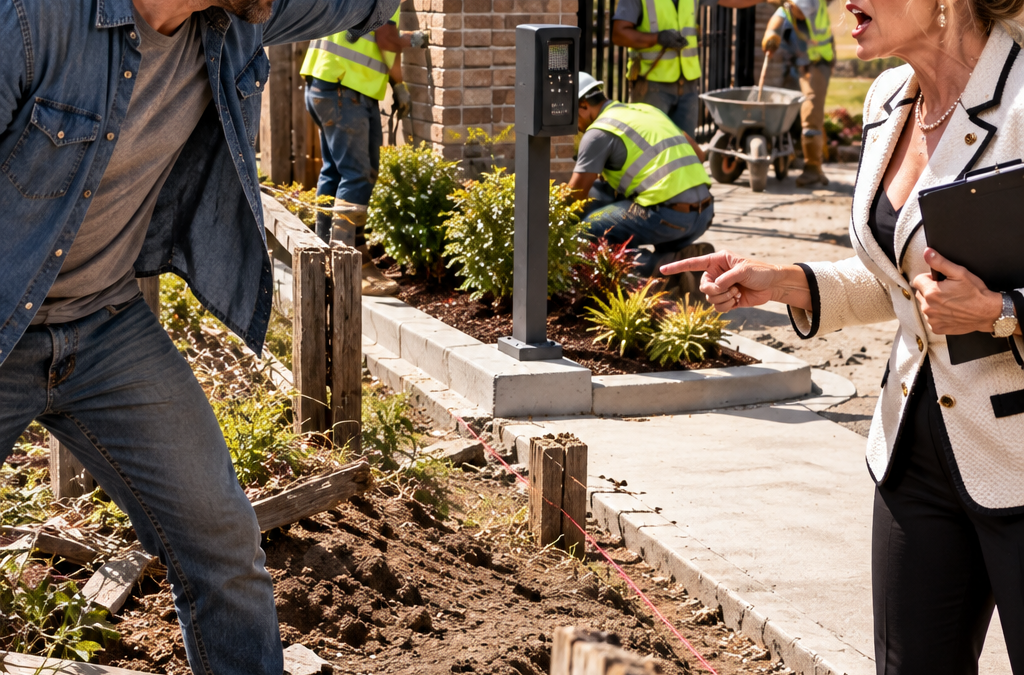
Two fat brick pillars stood where my grass used to be, each topped with decorative stone caps and small LED lights. A shiny aluminum security gate sat on a rail system. A fresh concrete driveway pad stretched across the ground. There was a keypad on a metal post. New sod covered the scarred area. Someone had even planted a little flower bed with fresh mulch at the base of one pillar, as if decorating theft made it less ugly.
I stopped my truck in the road.
For several minutes, I just sat there.
My hands were still on the steering wheel. The engine was still running. I could hear the faint clicking of the turn signal, though I did not remember turning it on. My body was too tired to react, but my eyes kept measuring the distance again and again.
Twelve feet.
Maybe more in places, but roughly twelve feet of my property had been swallowed.
My fence had not simply been moved a little. They had torn it out, destroyed most of it, shoved the remaining line deeper into my land, graded my yard flat, poured concrete, installed electrical wiring, mounted a keypad, built brick columns, laid sod, and landscaped the space like they had always owned it.
This was not a mistake someone made with a shovel.
This was a full construction project.
A professional crew had worked on my land without calling me, without asking me, without permission, without shame.
I felt anger rise slowly, but it had to push through exhaustion first. I had spent five weeks holding myself together for my aunt, and now I had come home to find that someone had taken advantage of my absence. That was the part that hit hardest at first.
They waited until I was gone.
Maybe they knew. Maybe they did not. But either way, nobody stopped to ask.
I could have marched straight to the HOA clubhouse right then. I could have shouted until someone came outside. I could have done what angry people do when shock is fresh and judgment is weak.
Instead, I turned off the truck.
I went inside.
I took a shower.
I heated food I barely tasted.
Then I went to sleep.
That was the smartest thing I did that day.
Because if there is one thing I have learned, it is that rage may give you energy, but a clear head gives you aim.
The next morning, I woke before sunrise. For a few seconds, I lay in bed hoping I had dreamed it. Then I remembered the brick pillars, the gate, the missing fence, and the hot weight returned to my chest.
I made coffee.
Then I pulled out my folder.
The deed. The tax records. The survey.
There it was: the signed, stamped map of my property, neat lines on paper, exact measurements, corners marked. Calm, factual, patient. The kind of document people ignore until they need it to speak for them.
I took the survey outside with my phone.
For the next hour, I photographed everything.
I took pictures of the new pillars from multiple angles. The gate. The rail system. The concrete pad. The keypad. The sod. The flower bed. The spot where my fence posts used to be. You could still see the marks in the ground where they had pulled them out. I measured distances using the survey as reference. I filmed slow passes across the boundary area.
Behind my lot, near the drainage ditch, I found several boards from my old fence.
They had been tossed there like trash.
For some reason, seeing those boards hurt more than the gate. The gate was arrogant, but the fence boards were personal. I had paid for that fence. I had maintained it. It had marked the edge of something that belonged to my family.
They had ripped it out and thrown it away.
I took pictures of those, too.
Only after I had documented everything did I walk to the HOA clubhouse.
The president was there.
I knew him, though not well. His name was Victor Santos, and he had the kind of personality that made a little authority look dangerous. He had become HOA president because, from what I understood, nobody else wanted the job. But Victor acted as if the residents had crowned him governor.
Every interaction I had ever had with him followed the same pattern. If I complained about subdivision cars blocking part of my driveway, he dismissed it. If I mentioned landscaping debris blowing onto my lot, he shrugged. If I reminded him my property was not part of the HOA, he looked annoyed, as if my independence were a personal insult.
That morning, he was seated at a table inside the clubhouse, looking at his phone. Two other board members sat nearby, a man and a woman. They glanced at me when I walked in, then looked away with the bored confidence of people who believed the matter had already been settled before I opened my mouth.
“We have a serious problem,” I said.
Victor did not fully look up.
“With what?”
“The new entrance.”
That got a reaction, but not concern. His face tightened, like I had interrupted him to complain about paint color.
“What about it?”
“It’s on my property.”
The woman beside him gave a small laugh, as if I had said something ridiculous.
Victor finally put his phone down.
“No,” he said. “It isn’t.”
“Yes,” I said. “It is. You removed my fence and built about twelve feet inside my boundary line.”
He leaned back in his chair.
“That’s not your land.”
The sentence landed cold.
Not confused. Not uncertain.
Certain.
As if he had decided reality on behalf of both of us.
“The old fence was past the property line,” he continued. “The contractors measured it and corrected the boundary when they built the entrance.”
The woman nodded. The other board member inspected his fingernails.
I stared at Victor.
“I have an official survey.”
He waved one hand like he was brushing away smoke.
“The contractors are professionals.”
“Did you have a licensed survey done before construction?”
His expression shifted into irritation.
“We didn’t need to waste money on that. The line was obvious.”
“The line was obvious,” I repeated.
“Yes.”
“So they guessed.”
“They measured.”
“With what?”
He paused.
I already knew the answer.
“They eyeballed it,” he said finally. “And it looked right.”
For a moment, I could only look at him.
They had eyeballed a property line for a major construction project.
They had spent what must have been a huge amount of money on brick, concrete, wiring, sod, lights, labor, and a motorized gate, but not a proper survey.
“Eyeballing a boundary is not legal measurement,” I said.
Victor’s jaw tightened.
“Look, the concrete is poured. The gate is installed. The project is finished. We spent a lot of money on this.”
“You spent it on my land.”
“You should be grateful,” he said. “A nicer entrance next to your property probably increases your value.”
There it was.
The special kind of arrogance that expects gratitude after theft.
“I’m going to say this once,” I told him. “Your gate, your pillars, your concrete, and your landscaping are on my property. They need to be removed.”
Victor looked at the other board members, then back at me. A slow smirk spread across his face.
“And what are you going to do?” he asked. “Sue us?”
I did not answer.
He leaned farther back, enjoying himself now.
“Go ahead. You’ll spend years in court and waste thousands on legal fees. By the time a judge even looks at it, we’ll have been using that entrance long enough to claim rights.”
“Adverse possession?” I asked.
He smiled wider, pleased that he knew the phrase.
“Maybe.”
I almost admired the confidence.
Almost.
Instead, I nodded once.
“Okay,” I said. “Thanks for the conversation.”
Then I walked out.
I think he expected me to shout. Or threaten him. Or beg. People like Victor are prepared for noise. They know how to perform against anger.
Silence makes them underestimate you.
When I got home, I made three calls.
The first was to the local building permits office.
I asked whether a permit had been issued for construction at the subdivision entrance. It had. But the permit was based on a site plan submitted by the HOA showing all work contained within the subdivision’s common area.
According to the approved plan, nothing extended onto my lot.
That meant one of two things. Either the HOA submitted a false plan, or the contractor had deviated massively from the approved plan during construction.
Neither was good for them.
The permit did not authorize building on my property.
The second call was to my surveyor.
I explained what happened and asked him to come back as soon as possible to mark the boundary visibly. Two days later, he arrived with his equipment, confirmed the line matched the original survey, and drove fresh stakes into the ground with bright pink flagging tape.
There was nothing subtle about it anymore.
The property line stood there in pink, fluttering in the sun.
The brick pillars, gate track, concrete, keypad post, wiring, and fresh sod were all clearly on my side.
The third call was to a lawyer.
Not because I wanted to start a lawsuit. Not yet.
I wanted one question answered.
“If someone builds a structure on my land without permission,” I asked, “do I have the legal right to remove it myself?”
The lawyer listened carefully. I sent him the survey, photos, permit information, and the new boundary markers. He reviewed everything and called me back.
“Yes,” he said. “As the property owner, you generally have the right to remove unauthorized structures from your land.”
I sat very still.
“You’re sure?”
“Based on what you’ve shown me, yes. I would normally recommend sending a written demand first. It creates a clean record and gives them a chance to fix it.”
“They already told me to sue them.”
“I understand.”
“They said they might claim adverse possession.”
He made a sound that was almost a laugh.
“That is not how adverse possession works.”
“I figured.”
“Still, I’m going to advise caution. Do not touch anything on their side of the line. Document before and after. Stay strictly within your property. And understand they may call the police.”
“I expect them to.”
“Then have your survey ready.”
I thought about sending the demand letter.
I really did.
There was a version of me, calmer and more patient, that would have done everything through paperwork first. But that version had not just come home from five weeks of caring for a sick aunt to find twelve feet of family land swallowed by a gate.
That version had not sat across from Victor while he smirked and told me I should be grateful.
That version had not heard him say, “Go ahead and sue me.”
I decided a letter would not teach him anything.
On Friday afternoon, I called a heavy equipment rental yard about twenty minutes away and rented a skid steer with a demolition bucket.
I had used machines like that before on a relative’s farm for cleanup and landscaping work. I was not an expert operator, but I was comfortable enough, and the job did not require elegance. It required discipline.
The machine was delivered Friday evening.
It sat in my yard like a sleeping animal.
I walked the boundary again after dinner. The pink flags flickered softly in the dark. On one side was my land. On the other, theirs. Between the two stood Victor’s expensive mistake.
I barely slept.
Not because I was uncertain.
Because I was waiting.
At 5:15 Saturday morning, my alarm went off.
The sky was still mostly dark when I stepped outside with coffee in one hand and the survey in the other. The air was cool. The neighborhood was quiet in that fragile way that exists before people wake up and begin being themselves again.
I walked the property line.
One stake.
Then the next.
Then the next.
I compared everything against the survey. I took another video, slowly panning across the gate, the concrete, the pillars, the flags. I said the date and time out loud. I stated that I would remove only the unauthorized structures located inside my property boundary.
Then I put on work gloves.
I climbed into the skid steer.
The engine roared to life at 5:30 in the morning.
I am sure the subdivision did not appreciate that.
But then again, I had not appreciated them stealing my yard.
I drove the machine toward the first brick pillar on my side of the line. The bucket rose, metal catching the dim light. For a heartbeat, I hesitated.
Not because I was afraid.
Because I understood the moment.
They had tried to make their theft permanent. Brick feels permanent. Concrete feels permanent. Gates, wiring, columns, stone caps—these things tell the eye, “This belongs here.”
But permanence is not created by weight.
It is created by right.
And they had none.
I pushed forward.
The bucket struck the pillar about two feet up.
The brick gave way with a crack that snapped through the morning. Mortar burst apart. Bricks scattered across the sod. The decorative cap tipped, fell, and shattered against the concrete.
The sound was beautiful.
Not because I enjoy destruction, but because every broken brick corrected a lie.
I worked carefully.
Everything on my side of the pink flags came down.
The second pillar cracked and collapsed. I drove the bucket under the aluminum gate track and tore it out of the concrete. Metal screamed as it bent. The gate came loose from its rail and folded awkwardly, expensive and helpless. I broke the concrete pad in sections, prying up slabs with the bucket edge until they lifted and split. I scraped sod away in sheets. Electrical conduit tore from the ground, dragging wires behind it like exposed nerves.
I did not touch one inch beyond the boundary.
Not one brick on their side.
Not one piece of concrete that belonged to the subdivision.
I was methodical. Almost surgical. I checked the line constantly. I climbed down twice to confirm the stakes. I filmed between stages. I made sure that when this became an argument, the evidence would show exactly what I had done and exactly what I had not done.
By 7:30, the sun had risen.
What had once been a proud new entrance now looked absurd.
On my property sat a pile of broken bricks, cracked concrete, twisted metal, torn sod, and dangling wire. On their side remained half an entrance—one lonely brick pillar, a short strip of gate track ending in nothing, jagged concrete edges, and exposed wiring where the missing gate used to connect.
It looked like someone had started building ambition and run out of lies.
I shut off the skid steer.
The silence after the engine died felt enormous.
I went inside, got a bottle of water, and sat on my front porch.
Then I waited.
It took seven minutes.
Victor came sprinting down the street in a bathrobe and slippers.
Not shoes.
Slippers.
He must have jumped straight out of bed and run out the door without thinking. His robe flapped around him as he charged toward the rubble, already shouting before I could understand the words.
When he reached the destroyed gate, he stopped dead.
His mouth opened.
For ten full seconds, he just stared.
I watched the truth move across his face.
Confusion first.
Then disbelief.
Then horror.
Then rage.
He turned toward me.
“What did you do?” he screamed. “What the hell did you do?”
I took a sip of water.
“That is HOA property!” he shouted. “That gate cost forty thousand dollars!”
I said nothing.
“I’m calling the police. You’re going to jail. Do you hear me? Jail.”
He pulled his phone from the pocket of his bathrobe with shaking hands and dialed.
I sat there while he shouted into the phone, telling the dispatcher his neighbor had destroyed HOA property with heavy machinery, that I had vandalized their gate, that officers needed to come immediately and arrest me.
Residents began appearing outside.
At first, only a few. A man in shorts holding coffee. A woman in pajamas. Someone peeking from behind curtains. Then more gathered, drawn by Victor’s shouting and the sight of their grand entrance lying in pieces.
Fifteen minutes later, two patrol cars arrived.
Victor ran into the street to meet them, waving his arms, pointing at the rubble, pointing at me, talking so fast the words nearly tripped over each other.
The officers listened, faces neutral.
Then they walked over to me.
I stood.
“Good morning,” I said.
One officer looked past me at the skid steer, then at the rubble.
“Can you tell us what happened?”
“Yes,” I said. “The HOA tore down my fence and built their new entrance on my property while I was out of town. I removed the unauthorized structures from my land.”
Victor barked something behind them, but the officer lifted a hand.
“Sir, we’ll speak with you in a moment.”
I handed over copies of my survey, the photos from before demolition, the permit information, and pointed to the pink boundary stakes still standing clearly along the line.
The officer studied the survey.
Then he walked to the nearest stake.
He looked at the rubble.
He looked back at the survey.
The second officer did the same.
By then, half the subdivision seemed to be watching from the sidewalk. Some residents looked angry. Some looked stunned. A few, I swear, looked entertained.
Victor kept talking.
“He destroyed our gate,” he said. “That was a forty-thousand-dollar project. He used a bulldozer.”
“It’s a skid steer,” I said.
The first officer glanced at me.
I shrugged.
“Just clarifying.”
The officer looked like he was trying not to smile.
They walked the line again. They noted that the debris and destroyed structures were on my side of the pink markers. They looked at the before photos showing the gate and pillars in place. They reviewed the survey once more.
Finally, one officer turned to Victor.
“Sir,” he said, “we don’t survey land, and we don’t enforce property lines. This gentleman has a legal survey showing this is his property. If you disagree, that is a civil matter you’ll need to take to court.”
Victor’s face went red.
“He destroyed HOA property!”
The officer remained calm.
“We cannot arrest someone for removing a structure from his own land.”
“It wasn’t his land!”
“Did you have an official survey?”
Victor said nothing.
The officer waited.
Victor looked at the board members, who had now arrived and were standing behind him looking significantly less confident than they probably felt during the planning phase.
“Contractors measured it,” Victor muttered.
“With a licensed survey?” the officer asked.
No answer.
“Did you get his permission before building there?”
“We didn’t need permission.”
The officer’s expression changed slightly. Not anger. Not amusement. Something more tired.
“I recommend you speak with your attorney.”
Then they left.
No handcuffs.
No arrest.
No dramatic rescue of Victor’s gate.
Just two patrol cars driving away while the HOA president stood in the street in his bathrobe, staring at the rubble like reality had betrayed him.
I finished my water and went inside.
The meltdown began almost immediately.
By afternoon, my phone had messages from people in the subdivision I barely knew. Some were furious. Some wanted to know if what I had said was true. Some apologized in that vague way people do when they are not personally responsible but want to stand near the correct side after the danger has passed.
The HOA held an emergency meeting that week.
I did not attend, but several residents told me what happened.
It was chaos.
Victor blamed the contractor. The contractor blamed the HOA. The board tried to say they had relied on professional judgment. Residents demanded to know why no licensed survey had been ordered before spending so much money. Someone reportedly asked, “You couldn’t spend a few hundred on a survey before pouring forty thousand into concrete?”
Victor had no answer.
The HOA’s attorney gave them worse news.
They had built on private property without authorization. The permit they pulled did not match the actual construction. If they sued me for destroying the gate, I would countersue for trespass, unauthorized construction, and destruction of my fence.
And I would probably win.
That last part changed the mood.
Because the gate was not the only property destroyed.
My old fence mattered, too.
It may not have had LED lights or decorative stone caps, but it was mine. It was properly built, properly placed, and properly maintained. They had torn it out and thrown parts of it into a ditch like garbage.
So my lawyer sent a demand letter.
It itemized everything: replacement cost of the destroyed fence, surveyor fees for re-marking the boundary, skid steer rental, cleanup costs, and damages for unauthorized use of my land during construction. He included photos. He included the survey. He included the permit discrepancy. He included enough documentation that arguing would have cost them more than paying.
Victor, I heard, exploded when he saw the amount.
Their attorney told them to pay it.
They paid within two weeks.
But the part that gave me the most satisfaction came after the rubble was cleared.
They had to pay for that, too.
Once my side was cleaned up, I went to a hardware store and bought the cheapest agricultural wire fencing I could find. Thin galvanized posts. Basic farm wire. The kind of fence people use to keep chickens from wandering into the road.
Then I installed it exactly on my property line, exactly where my wooden fence had stood before.
Was it beautiful?
No.
Was it elegant?
Absolutely not.
Was it legal?
Perfectly.
The subdivision’s grand entrance now looked like a failed construction project next to a chicken enclosure. One lonely brick pillar stood on their side, wires dangling. The concrete pad ended in broken edges. The gate was gone. The track led nowhere. And beside it all was my ugly little farm fence, shining in the sun like petty justice.
I did not put it there because I loved the look.
I put it there because boundaries should be visible to people who claim they cannot see them.
About a month later, Victor came to my door.
This time, he was not shouting.
He wore proper clothes instead of a bathrobe, and his expression had been polished into something almost polite. That alone told me a lawyer had spoken to him.
“Can we talk?” he asked.
I stood in the doorway.
“About what?”
“The entrance.”
“No.”
His mouth tightened, but he kept control.
“We would like to discuss purchasing a strip of your property.”
“There is nothing to discuss.”
He forced a smile.
“It would benefit both of us.”
“It would benefit you.”
“We’re prepared to make a fair offer.”
He named a number.
It was maybe a third of what the land was actually worth, presented with the confidence of a man who still believed generosity meant letting me keep most of what was mine.
I almost laughed.
“No,” I said.
His polite mask slipped slightly.
“Maybe don’t answer immediately. Think about it.”
“I have.”
“We can increase it a little.”
“No.”
“This entrance affects the entire community.”
“You should have thought of that before building it on my land.”
He looked away.
For the first time, I saw something like embarrassment cross his face.
Not remorse.
Embarrassment.
Those are different things.
“I was relying on the contractor,” he said.
“You told me they eyeballed it.”
He said nothing.
“You told me to go ahead and sue you.”
His jaw worked.
“You said I should be grateful you took my land.”
“That’s not what I meant.”
“That is exactly what you meant.”
The silence between us was brief but heavy.
I leaned one hand against the doorframe.
“I am not selling land to someone who waited until I was gone, destroyed my fence, built twelve feet into my property, dismissed me to my face, threatened to use time and money against me, and then called the police when I fixed the problem myself.”
Victor’s eyes hardened.
For a second, I thought the old version of him might return—the smirk, the condescension, the little performance of power.
But reality had finally reached him.
He looked past me toward the ugly wire fence and the half-ruined entrance.
Then he left without another word.
I watched him walk back toward the subdivision. His shoulders were lower than before. He passed the lonely brick pillar, the broken concrete edge, and the fence that made the whole entrance look ridiculous. For the first time since I had known him, he looked like a man carrying the weight of his own decision.
The HOA eventually abandoned the grand entrance plan.
They removed what remained of the failed construction at their own expense and rebuilt a simpler entrance entirely within their actual property. It was smaller. Less impressive. No dramatic sweep. No wide luxury-style turn. No proud motorized gate stretching across land that was not theirs.
The total cost of the fiasco became neighborhood legend.
Original construction. Demolition. Cleanup. Settlement to me. Legal fees. Redesign. New construction. Increased dues.
All because Victor decided a survey was too expensive and my property line was something he could guess.
He tried to blame the contractor, of course.
Men like Victor rarely place responsibility where it belongs. They scatter it outward, hoping some of it sticks to someone else. But by then, everyone knew enough. Residents knew he had pushed the project. They knew he had skipped the survey. They knew he had dismissed me when I gave him the chance to fix it peacefully. They knew he had gambled with their dues and lost.
At the next board election, he was voted out.
I heard he looked shocked.
That almost made me laugh.
Power always looks surprised when the people paying for it finally get the bill.
My old wooden fence is gone. I still miss it sometimes. Not because it was beautiful, but because it belonged there. It had done its job quietly for years, marking a line everyone should have respected.
The wire fence remains for now.
Maybe someday I will replace it with something better. Maybe another wooden privacy fence. Maybe a wall. Maybe something strong enough to make even the next self-important HOA president understand without explanation.
But part of me likes the wire.
It is ugly, yes.
But it tells the truth.
It says this is the line.
It says you do not get to move it because I am not home.
It says a shiny gate does not turn theft into ownership.
It says I keep my documents, I know my land, and I do not confuse arrogance with authority.
Sometimes, when I stand in my yard and look toward the subdivision entrance, I think about that morning with the skid steer. I think about the sound of brick breaking. I think about Victor running in his bathrobe, screaming about property he had built on land he did not own. I think about the police officer looking at the survey and calmly telling him what he should have understood from the beginning.
You cannot steal twelve feet and call it improvement.
You cannot guess a boundary and call it measurement.
You cannot build on another person’s land and expect gratitude.
And you should never tell a tired property owner with a stamped survey to go ahead and sue you unless you are prepared to learn what patience looks like when it finally starts the engine.
The land is still mine.
Every inch.