FULL ENDING The Surgeon Dared Me to Take His Floor, Never Knowing Why I Had Been Saving Him
𝗙𝗨𝗟𝗟 𝗦𝗧𝗢𝗥𝗬
The room went colder.
He stepped closer.
“It makes you a nurse who forgot her place.”
I pulled my sleeve down slowly.
Not because I was ashamed of the scar.
Because some stories are too heavy to be held in a hallway by people waiting to see whether you break.
Dr. Ransom turned toward the staff.
“Let me make this simple.”
Loretta closed her eyes.
I watched his hand holding the reports.
The papers trembled just a little.
Nobody else saw it.
I did.
“The next real emergency that comes through those doors,” he said, “Rock runs the floor.”
A murmur went through the department.
“Triage. Orders. Beds. Staff. All of it. Not me. Her.”
His smile sharpened.
“And when she sinks, we will all watch.”
Someone whispered, “He can’t mean that.”
He did.
Of course he did.
Humiliation is easiest when the person delivering it believes he controls the ground beneath everyone’s feet.
I looked at Dr. Ransom for a long moment.
His jaw was tight.
His hand was still trembling.
His fear was wearing anger like a coat.
“If it comes to that, Doctor,” I said softly, “I will hold you to it.”
He laughed once.
No humor in it.
Then he threw the reports against my chest and stalked toward his office. The door slammed hard enough to shake the framed diplomas on the wall.
Loretta hurried over.
“Honey,” she whispered, grabbing my arm, “what on earth did you do?”
I bent down, gathered the reports one by one, and smoothed them flat against my knee.
“I moved a tray,” I said.
But my eyes had already gone to the tall window at the end of the hall.
Rain had been falling over the bitter hills for two days. Not gentle rain. Not spring rain. The hard, relentless kind that turns dirt roads into ribbons of mud and makes people in Montana look twice at creeks they have crossed their whole lives.
The creek behind the hospital had risen to the edge of the footbridge.
Brown.
Fast.
Angry.
It carried branches, fence posts, and foam down the channel.
I knew that color of water.
I knew what it could do to people who trusted a road.
Behind me, the red phone from County Dispatch began to ring.
The room did not move.
I did.
I reached the phone before the second ring finished.
“Dry Creek emergency.”
“This is County Dispatch, Wanda Kesling.”
Wanda’s voice was tight but steady. I had heard that kind of voice before. Calm on the outside because panic would cost too much.
“I have a church van in Miller Creek at the low crossing,” she said. “Eleven people aboard. Mostly older folks and one little girl coming home from a harvest dinner. The water took them about twenty minutes ago.”
My body went still.
Not frozen.
Focused.
I grabbed a pen.
“How many ambulances?”
“One on the road. Eight minutes out. Second is blocked by a washout on County Road Nine. State helicopter is grounded by storm. Dry Creek, you are all I have.”
I looked across the department.
Every face was already turned toward me.
Dr. Ransom had stepped out of his office, his jacket half on, arms crossed, a thin smile at the corner of his mouth.
He had heard everything.
“Well, Nurse Rock,” he said. “The floor is yours. Show us.”
He expected me to turn pale.
He expected me to ask him to take over.
He expected the weight of eleven patients and a flooded creek to crush me in front of everyone.
Instead, I took off my black cardigan.
I folded it once, laid it on the counter, and pushed my sleeves to my elbows.
The scar on my forearm lay bare under the lights.
My shoulders settled.
Something in me changed.
Not because I became someone else.
Because, for the first time in years, I stopped pretending I was only the woman they thought they knew.
“Listen up,” I said.
My voice was not loud.
It carried anyway.
“Eleven patients. One child. Water injuries. Crush injuries. Cold exposure. Possible head trauma. We open all three trauma bays and turn the main hallway into a fourth.”
People stared.
“Loretta, you have triage. Red, yellow, green tags. Nobody enters my hallway without one.”
Loretta blinked.
Then her spine straightened.
“Yes, ma’am.”
“Dr. Whitaker, Bay One. Airway and chest. You tell me the second something changes.”
Ben swallowed.
“Got it.”
“Jenna, you are my runner. Warm blankets, warm saline, every heating pad in this building. I want space heaters from maintenance if they have them. Call the regional blood bank and tell them we need O negative on the first truck that can cross the hills.”
Jenna’s hands were shaking.
I pointed at her.
“Look at me.”
She did.
“You can shake and still move.”
Her chin lifted.
“Yes, ma’am.”
“Page every off-duty nurse, every tech, lab, kitchen, housekeeping. If they can carry a stretcher, warm a blanket, hold pressure, or answer a phone, I want them here.”
The department came alive.
Phones rang.
Carts rolled.
Drawers banged open.
Beds moved.
Within ninety seconds, the chaos had a shape.
Not calm.
Not yet.
But direction.
A flooded river can kill because it spreads wherever it wants. Force it between banks, and it becomes something you can fight.
The ER became a river between banks.
Dr. Ransom’s smile had disappeared.
He had run that department for eleven years.
I don’t think he had ever seen it move that fast.
I turned toward him.
“Chief Surgeon.”
His eyes narrowed at the title.
I did not use his first name.
I did not mock him.
“At least two patients may need an operating room. Can I count on you for OR One with Dr. Whitaker as backup when he’s free?”
For one full second, he had no clever answer.
It was not a challenge.
It was a question asked with respect.
Maybe that was why it disarmed him.
“OR One is ready,” he said.
“Then please scrub, Doctor.”
He found himself walking toward the scrub sink before he realized he had obeyed.
Outside, headlights swept across the rain-streaked glass doors.
The first ambulance slid into the bay with its siren screaming.
Paramedic Noah Tilden jumped out soaked to the bone, hair plastered across his forehead, face pale beneath the rain.
“Dry Creek!” he shouted. “Two reds and a yellow. One man still trapped in the van, pinned under the frame. Water keeps rising.”
The rear doors opened.
The first stretcher rolled in carrying Harold Teague, sixty-eight, the van driver. His face was gray. His lips were blue. The left side of his chest barely moved.
The second carried Dolores Whitmer, seventy-one, both hands pressed to her lower abdomen, blood soaking through the blankets beneath her hips.
Behind them came a small girl in a yellow raincoat, wide awake, clutching a soaked stuffed rabbit.
Her voice was tiny.
“Where’s my grandpa?”
I looked at her.
Then at Noah.
He did not have to say it.
Her grandfather was the man still pinned in the van.
The storm had finally reached Dry Creek.
And I was done hiding.
Harold Teague went straight into Bay One.
Dr. Whitaker bent over him with a stethoscope, listened, and went pale.
“I think his lung is collapsed,” he said. “I’ve only done this on a training dummy.”
“You have the training,” I said from across the bed. “And you have the hands.”
He looked at me as if I had given him something he did not know he was allowed to have.
“Pressure is building in his chest,” I said. “Every breath makes it worse. You know where the needle goes.”
His fingers shook.
I placed my hand over his for one second.
No more.
“Three. Two. One.”
He moved.
A hiss of trapped air escaped.
Harold dragged in a breath so deep it seemed to pull color back from the edge of death. His lips shifted from blue toward pink.
Ben stared at his hands.
Not in pride.
In disbelief.
As if they belonged to someone braver than him.
“They’re yours,” I said. “Keep using them.”
Two beds over, Dolores Whitmer’s blood pressure was falling faster than anyone liked.
“Pelvic binder,” I called. “Jenna, tight and even. Loretta, two large lines. First units of blood as soon as they arrive. She goes to OR One the moment Ransom clears.”
The room rolled forward under the orders.
Nobody argued.
That, I had learned, was the mercy of clear direction.
In a crisis, people do not need someone to sound impressive.
They need someone to remove the fog.
A small cry rose from the hallway.
Lucy Hutchkins sat on a bench in her yellow raincoat, the soaked rabbit pressed beneath her chin.
“Where is my grandpa?”
For a moment, the commander in me vanished.
Only a woman remained.
I crouched in front of her until my eyes were level with hers.
“Lucy, my name is Cassidy.”
She sniffed.
“Your grandpa is stuck. People are working to get him out.”
“Is he going to die?”
The hallway seemed to stop around us.
Adults lie to children too easily in hospitals because they want to protect themselves from the child’s fear.
I could not do that.
“I cannot promise how it will end,” I said. “But I can promise I will not stop trying until it does.”
She nodded once and squeezed the rabbit.
My radio crackled.
Noah had gone back to the creek.
His voice came through fast and breathless.
“Dry Creek, Tilden. Extraction crew is ready to cut the frame and drag Mr. Hutchkins out. His leg has been pinned forty-five minutes. He’s talking. He’s cold. We can pull him in two minutes.”
My blood turned cold.
I had heard that sentence before.
A different storm.
Different water.
Different man.
Same danger.
“Noah, stop.”
Static.
“Ma’am?”
“Do not free that leg.”
The line went quiet.
Wanda cut in from dispatch.
“Noah, that’s the floor commander at Dry Creek. Do exactly what she says.”
I kept my voice slow.
“A leg pinned that long is starved of blood and oxygen. When you release it, everything built up in that trapped tissue can flood the bloodstream at once. It can stop his heart.”
Someone behind me whispered, “Crush injury.”
I ignored them.
“Noah, before anyone touches that frame, I want two IV lines running. Warm saline wide open if you have it. Put a tourniquet above the pinned leg, loose, ready to tighten if I say. Wrap him warm. Then call me back.”
His breathing shook through the radio.
“Copy. Ma’am?”
“Yes?”
“How do you know that?”
I closed my eyes for one second.
“Because I’ve done it in worse water.”
When I opened them, the entire emergency department had gone still.
Dr. Whitaker stared at me.
“Worse water?” he whispered.
Loretta looked from my face to the scar on my arm.
Dr. Ransom stood in the scrub-room doorway.
For the first time in eight months, he truly looked at me.
Not down.
At.
Then the radio screamed.
“Dry Creek, water just jumped! Second surge coming. We have maybe twelve minutes.”
Twelve minutes.
I ran to the weather monitor at the nurses’ station.
The radar glowed green and red, a massive storm cell churning over the hills. But along the river valley, a thin pocket of clear air was sliding east like a door opening by inches.
I snatched up the red phone.
“Wanda, I need a helicopter with a hoist.”
“Honey, they’ve been grounded for two hours.”
“The radar shows a gap along the river for the next fifteen minutes. A good pilot can fly it low.”
“The state already said no.”
“Then ask again. Tell them a man is pinned at Miller Creek and the water is rising. Tell them the gap is real.”
A pause.
Static.
Then Wanda said quietly, “I’ll try.”
I turned back.
The monitor over Dolores Whitmer showed numbers sliding in the wrong direction.
“She goes to OR One now,” I said. “Dr. Ransom, she needs you.”
For a heartbeat, his jaw tightened.
Then he nodded.
No insult.
No performance.
He took the head of the stretcher, and together we rolled her down the hall.
A new voice cut through the radio as they disappeared into surgery.
Deep.
Grainy.
Rotor noise behind it.
“Dispatch, this is Guard Medevac Twenty-Seven. We found a hole in the weather and a request from Dry Creek. Who asked for this gap?”
Wanda answered, “Floor commander. Nurse Cassidy Rock.”
Silence.
Long enough that I felt it in my ribs.
Then the pilot said, “Say that name again.”
“Cassidy Rock.”
Another pause.
“Dispatch,” the pilot said, voice changed now, “tell her Rescue Four is inbound. Tell her I’m flying the line myself.”
Wanda relayed it word for word.
For a moment, I stood perfectly still with my palm flat on the counter.
My eyes closed.
When they opened, they were wet.
Jenna saw.
“What is Rescue Four?” she asked.
I swallowed.
“A promise.”
Then I moved on.
Ten minutes passed in a blur of triage tags, blankets, and shouted numbers.
The yellow patient stabilized.
The old pastor from the van sat wrapped in three blankets, praying out loud for everyone in the hospital and several people who were not there.
Lucy Hutchkins fell asleep sitting upright with the wet rabbit tucked under her chin while a nurse’s aide guarded her like a sentry.
The rain hammered harder.
Then lightning lit every window white.
Thunder cracked so close the floor seemed to jump.
The lights flickered once.
Twice.
Then died.
For eleven long seconds, the hospital went dark.
Monitors went blank.
Somebody screamed.
I raised my voice.
Not loud.
Not panicked.
Clear.
“Generators will catch. Hands on your patients. Count your breaths. Count with me.”
I began counting.
“One. Two. Three.”
Others joined.
Four.
Five.
Six.
The emergency lights flared red.
The generators roared.
Machines beeped back to life one by one, and the whole floor let out a breath it had been holding.
I was already moving when Jenna burst out of the surgical wing with her face white as paper.
“Cassidy, it’s the chief.”
My stomach tightened.
“What happened?”
“He dropped the clamp. He’s just standing there.”
I ran.
The doors of OR One banged open under my palm.
Dolores Whitmer lay beneath the harsh lights, abdomen open, blood welling faster than suction could clear it. Pete Morales, the scrub nurse, held a tray with both hands. A steel clamp lay on the tile where it had bounced and spun.
Dr. Ransom stood across from the patient with his right hand held out in front of him.
It was shaking.
Not the faint tremor I had watched for months.
A violent, helpless shake that rattled his whole forearm.
He stared at it as though it belonged to a stranger.
“I can’t hold it steady,” he whispered. “Not tonight. Not when it matters.”
The monitor alarm began to scream.
I crossed the room in three steps.
I did not look at the blood first.
I looked at the man.
“Dr. Ransom, look at me. Not your hand.”
His eyes lifted.
They were raw.
“You know,” he said.
“Yes.”
“How long?”
“Since my second week.”
Pete blinked above his mask.
Jenna stood in the doorway, forgetting to breathe.
Ransom closed his eyes.
“Tell them.”
“Doctor—”
“Please,” he said. “Tell them what you’ve been doing.”
So I did.
Quietly.
Respectfully.
“Your hand shakes worst in the afternoon and after long cases. I moved your surgeries to mornings when I could. I switched your clamps to heavier ones because they’re easier to hold. When you were tired, I asked if you wanted me to close.”
The room was so quiet the monitor alarm sounded like a shout.
“Every report you wrote about me was true,” I said. “I did all of it. I just never told anyone why.”
A laugh broke out of him.
Not humor.
Grief.
“Eight months,” he said. “Eight months you covered for me, and I wrote you up for insubordination.”
He looked at the open wound on the table, then at his shaking hand.
“I shouted at you in front of my staff because every time you helped, you reminded me I needed help.”
His voice cracked.
“It was easier to hate you than to say it out loud.”
For one moment, I let those words exist.
Then I stepped closer.
“Doctor, we have two minutes.”
Pete looked down.
“She’s sinking.”
“I can’t do this,” Ransom said.
“Yes, you can.”
His laugh was bitter.
“You see my hand.”
“I see it. But your mind isn’t shaking.”
He stared at me.
“You have experience and no steady hand. Dr. Whitaker has steady hands and no experience. Put them together.”
Ben had just entered behind me, still in gloves from the ER.
His face went pale.
“Me?”
“You hold the instruments,” I said. “He tells you where and why. I’ll steady your wrist and count the clock.”
Ransom looked at Ben.
For the first time in eleven years as chief surgeon of Dry Creek, Theodore Ransom asked for help out loud.
“Dr. Whitaker,” he said, “scrub in, please.”
Ben scrubbed.
He stepped to the table.
His fingers closed around the clamp Pete handed him.
I placed my palm lightly beneath his wrist.
Ransom took one breath.
Then his voice changed.
It was no longer the voice of a man afraid of being seen.
It was the voice of a teacher who had waited too long to teach.
“Bleeding is deep behind the pelvic brim,” he said. “Press there. Not too much. Hold. Slide the clamp one finger lower. Good. Now pack. Do not let go.”
I watched the monitor.
“Pressure seventy.”
Ben’s hands steadied.
Ransom leaned in, eyes sharp again.
“Angle left. No, not that far. There. Feel the resistance?”
“Yes.”
“That’s it. Hold.”
“Seventy-five,” I called. “Eighty. Holding.”
Minute after minute, the three of us worked as one body.
Ben’s hands became Ransom’s hands.
Ransom’s mind became Ben’s eyes.
My voice kept time between them.
Pete fed instruments.
Jenna watched from the doorway with tears on her face.
At last, Ransom let out a long breath.
“Pack and close. She doesn’t need a longer surgery. She needs a bigger hospital.”
The monitor settled into a slow, honest rhythm.
Dolores Whitmer was alive.
Nobody spoke.
Then Pete said, voice rough, “Nine years I’ve worked beside you, Doctor. That was the best surgery I’ve ever seen.”
Ransom shook his head.
“It was the first surgery I ever didn’t do alone.”
He turned toward me.
For a moment, I thought he might say something.
Then my radio exploded with static.
“Dry Creek! Dry Creek! This is Tilden!”
I lifted it.
“Go.”
“The helicopter is overhead. They’re lowering a medic. We started the lines like you said, and we freed the leg, but ma’am—”
His voice broke.
“His heart rate is crashing. Mr. Hutchkins is slipping away.”
I was already running.
At the nurses’ station, I pressed the radio to my lips.
“Put me on speaker.”
Around me, the whole staff gathered in a silent half circle.
“Noah, tell me what you see.”
“No pulse, ma’am. He just went limp. Rain’s in my eyes. I don’t know what to do.”
“Yes, you do,” I said. “You’re going to do it with me.”
I let my voice drop into rhythm.
The old rhythm.
The one that had carried me through storms and wreckage and screaming water.
“Start compressions now. Hard and fast. Let the chest come all the way back up. Do not stop for anything. The medication I told you to draw up is for this moment. Give it now. Keep pressing.”
Through the radio came grunts.
Rain.
The thunder of rotors.
Then another voice joined, female, sharp and calm.
“Guard flight medic on scene. I have airway. Keep talking, Dry Creek.”
“Two more minutes of compressions, then check,” I said. “He has a granddaughter asleep in my hallway with a stuffed rabbit. He is not going anywhere.”
Ninety seconds.
One hundred twenty.
Then Noah screamed.
“Pulse! I have a pulse! He’s back!”
The room erupted.
Loretta sobbed into her sleeve.
Jenna jumped into Ben’s arms.
Someone laughed.
Someone prayed.
I closed my eyes.
Only for a moment.
Twenty minutes later, the Guard helicopter settled onto Dry Creek’s small pad, rotors spraying rain across the lot.
Gil Hutchkins came through the doors on a stretcher, gray but alive, a tourniquet still on his thigh. Lucy woke at the noise and began crying before anyone told her anything, because children know more than adults think they do.
Behind the stretcher walked a tall man in a flight suit, helmet tucked beneath one arm.
He crossed the floor slowly.
Stopped in front of me.
“Major Hollis Teague,” he said.
I knew his face before he finished saying his name.
Older.
Weathered.
Alive.
The room blurred.
He looked at my scar.
Then at my face.
“Rock,” he said softly. “I flew your hoist for six years.”
My breath caught.
“Two hundred eleven rescues,” he said. “You were the medic who never let go of anyone, even the day the cable opened your arm.”
Every head in the room turned toward my scar.
The old wound seemed to burn under their eyes.
“I never thought I’d hear that voice on a county radio,” Hollis said.
I could not speak.
He stepped closer.
“And I need you to hear this. The man you caught on that cable that night, the team leader with the numb hand he hid from everybody—he lived.”
Something inside me stopped.
For years, I had carried that night like a stone tied to my lungs.
The storm.
The overturned rescue basket.
The cable snap.
The weight of a man slipping.
My arm torn open.
My hands locked so hard around him that I thought my bones would break.
His numb hand.
His terror.
His career, I believed, ruined because I had told command the truth about his injury afterward.
“He teaches young pilots now,” Hollis said. “He tells every class the medic who saved him taught him to ask for help.”
My mouth trembled.
“I thought I taught him nothing.”
“You saved his life,” Hollis said. “Twice.”
I looked down at the floor.
At last, I understood myself.
For years, I had believed silence was kindness.
If a person was struggling, hide it for them.
If a hand shook, move the tray.
If a surgeon faltered, cover the gap.
If a team leader was injured, blame yourself for the consequences.
I had confused protection with secrecy.
I had thought I was saving Dr. Ransom from shame.
Maybe I had only helped him stay alone.
A stretcher bumped gently against my elbow.
Gil Hutchkins had opened his eyes.
Lucy climbed carefully onto the bed and laid her cheek against his chest, the soaked rabbit tucked between them.
“Grandpa,” she whispered.
His hand moved, weak but real, to the back of her raincoat.
That was when Dr. Ransom stepped into the middle of the hall.
Every head turned.
His right hand shook openly at his side.
For once, he did not hide it.
“I need to say something,” he said.
The department fell quiet.
His voice was not loud now.
It did not need to be.
“Eight months ago, Nurse Rock noticed that my hand was failing.”
The word failing cost him something.
I saw it.
“She covered for me quietly. She changed schedules, trays, instruments. She protected patients and, whether I deserved it or not, protected my pride.”
He looked at the floor.
“And I punished her for it.”
No one moved.
“Today I dared her to run this floor because I wanted to watch her sink.”
His eyes lifted to mine.
“She swam the whole river.”
His hand went into the pocket of his white coat.
He pulled out the three crumpled incident reports, tore them in half, and dropped them into the trash.
“I will see a specialist this month,” he said. “Dr. Whitaker will operate beside me until I understand what I can still do safely and what I cannot. The staff will know what they need to know. No more hiding behind anger.”
Ben’s eyes shone.
Ransom turned fully toward me.
Then, in front of everyone, he lowered his head.
“You said you would hold me to it,” he said. “You did.”
His voice broke.
“Thank you.”
For a long moment, I could not answer.
I thought about the woman I had been before Dry Creek.
The rescue medic hanging from a cable in black water.
The one who believed every life was hers to hold alone.
The nurse who came to a rural hospital and tried to save a proud surgeon in secret because asking him to face the truth felt crueler than carrying it for him.
Then I stepped closer.
I laid my scarred hand over his shaking one.
He flinched.
Then he let it rest there.
“I never needed to run your floor, Doctor,” I said. “I only wanted nobody to fall alone.”
Around us, the hospital breathed.
Rain softened against the windows.
Monitors beeped.
People moved again, but differently now.
Not faster.
Not louder.
More honestly.
Gil Hutchkins was alive.
Dolores Whitmer was alive.
Harold Teague was breathing.
Lucy had her grandfather.
Dr. Ransom’s hand still shook.
Mine still carried the scar.
Nothing had been magically healed because everyone finally saw it.
That is not how wounds work.
But something had changed.
The silence had changed.
For eight months, I had thought silence was mercy.
That night, I learned mercy sometimes sounds like a steady voice saying the truth before someone drowns in what they are hiding.
Weeks later, Dry Creek held its first full-department emergency response review.
Not a punishment meeting.
Not a ceremony.
A real review.
We talked about the flood, the van, the triage flow, the power outage, the OR handoff, the crush injury, the helicopter window, and the call that brought Gil Hutchkins back on the riverbank.
Dr. Ransom stood at the front of the room beside Dr. Whitaker.
His right hand still shook.
He did not hide it in his pocket.
When he spoke, he let everyone see.
“We work in teams,” he said. “Not because teamwork sounds nice on a policy document, but because every one of us will eventually reach the edge of what we can do alone.”
He looked at me once.
I nodded.
That was enough.
After the meeting, Loretta found me near the window at the end of the hall.
The creek had gone down.
It looked almost harmless again, curling behind the hospital beneath a pale morning sky.
“Honey,” she said, “are you staying?”
I looked at the water.
For years, I had chosen places based on how well they allowed me to disappear.
Dry Creek had failed at that.
Maybe that was why I finally belonged there.
“Yes,” I said. “I’m staying.”
She smiled.
“Good.”
Outside, the hills were wet and shining.
Inside, Jenna laughed at something Ben said near the nurses’ station. Pete Morales argued with maintenance about the backup lights. Dr. Ransom walked slowly down the hall with a referral card in his hand and no white-knuckled grip hiding what shook.
The hospital was still small.
Still rural.
Still underfunded.
Still imperfect.
But that morning, it felt less like a place where people survived by looking away.
It felt like a place where someone might notice when another person’s hand began to tremble.
And instead of laughing, or hiding, or writing reports, they might reach out.
I touched the scar on my forearm.
For the first time in years, I did not pull my sleeve down over it.
Strength, I had learned, was not pretending nothing shakes.
It was letting someone hold the weight with you.
And sometimes, when the rain comes hard and the river rises, that is the only way anyone makes it home.
𝗧𝗛𝗘 𝗘𝗡𝗗
The Surgeon Dared Me to Take His Floor, Never Knowing Why I Had Been Saving Him
He thought my silence meant I was afraid of him.
He thought the scar on my arm was just an old injury and the reports in his hand were proof that I had forgotten my place.
Then the flood came down from the hills, the helicopters were grounded, and the whole hospital learned that I had not been hiding from emergencies—I had been hiding from myself.
The first sound I remember from that afternoon was paper hitting the nurses’ station like a slap.
Not a file being dropped.
Not a chart being set down too hard.
A slap.
The kind meant to make an entire room look up.
The whole emergency department went quiet before I even turned around. Monitors kept beeping. The rain kept ticking against the tall windows at the end of the hall. Somewhere behind the supply room, an IV pump chirped for attention. But the people stopped moving, and in a hospital, that kind of stillness is never harmless.
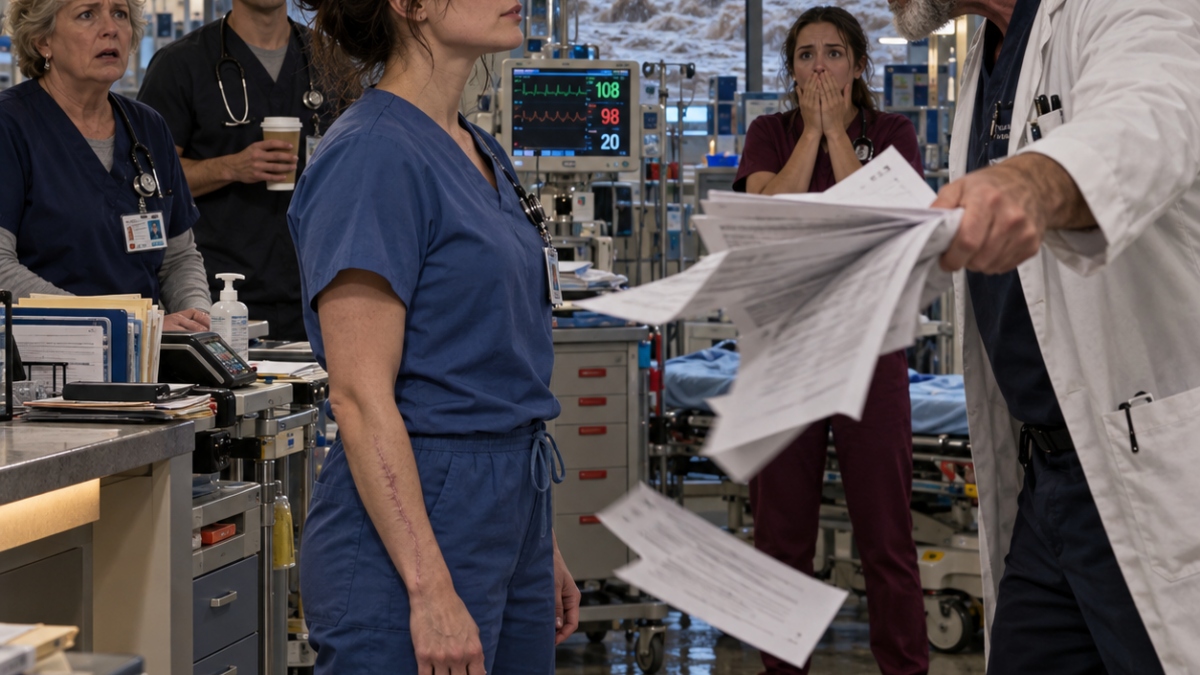
Dr. Theodore Ransom stood across from me with three incident reports in one hand.
He was fifty-five, broad through the shoulders, with a graying beard, wire-rimmed glasses, and the kind of reputation that made people straighten when he entered a room. In Dry Creek, Montana, people liked to say he never raised his voice.
That day, he was shouting loud enough to rattle the medication cart.
“Three reports,” he said, shaking the pages in front of my face. “Three in one month, Nurse Rock. And every one of them has my name in it.”
I kept my arms crossed, mostly to keep my hands still.
My name is Cassidy Rock.
At Dry Creek Rural Community Hospital, most people knew me as the quiet nurse in the black cardigan. Blue scrubs. Dark hair twisted into a loose knot. Sensible shoes. No drama. No gossip. No questions about where I had been before I arrived eight months earlier.
That was how I wanted it.
A small rural hospital was supposed to be a place where a person could become ordinary again.
I had come to Dry Creek looking for quiet work, quiet nights, quiet patients, and a life that did not require me to stand in rushing water with someone else’s blood running down my arms.
For a while, I thought I had found it.
Then I noticed Dr. Ransom’s hand.
Not at first.
At first, he was just the chief surgeon.
Proud.
Difficult.
Brilliant when he wanted to be.
Cruel when he felt threatened.
But two weeks into my job, I saw his right hand tremble while he reached for a clamp after a long afternoon case. Not a dramatic tremor. Not something the residents would notice while trying to impress him. Just a faint flicker through the fingers, gone almost as soon as it came.
But I saw it.
I always saw what hands did when people thought no one was watching.
Hands tell the truth before mouths are ready.
After that, I saw more.
His hand shook worse after fatigue.
Worse late in the day.
Worse when he held lighter instruments.
Worse when he had been operating too long without admitting he needed a break.
So I began changing little things.
Quiet things.
I moved some of his surgical cases to the morning schedule when his hands were steadier.
I swapped lighter clamps for heavier ones because they rested better in his grip.
I adjusted trays so the instruments he needed most were closer to his left side.
During one long closure, when his fingers twitched just enough to make a resident tense, I stepped in and asked, softly, “Would you like me to close, Doctor?”
He glared at me as if I had insulted his bloodline.
The next morning, the first report appeared.
Insubordination.
Interference with surgical workflow.
Unauthorized tray modification.
I did not defend myself.
That was another thing people misunderstood.
They thought I stayed silent because I was weak.
Sometimes I stayed silent because the truth belonged to someone else.
Sometimes because revealing it would do more harm than good.
Sometimes because I had lived long enough to know that being right did not automatically make speaking the right thing to do.
But that afternoon, standing beneath the fluorescent lights while Dr. Ransom shook those reports in my face, I could feel the room turning.
Charge nurse Loretta Finch stood frozen near the medication cabinet with a chart pressed to her chest. Dr. Ben Whitaker, our young ER physician, lowered his coffee cup very slowly. A tech named Jenna Okoye covered her mouth with both hands near the supply shelves.
Everyone was watching.
Dr. Ransom loved an audience when he was angry.
“Eight months,” he said, his voice cracking off the tiled walls. “Eight months of you watching me with that look.”
“What look?” I asked.
My voice was low.
Even.
That made him angrier.
“That look,” he snapped. “Like you know better. Like you’re standing there judging every decision I make.”
“I moved a tray.”
A gasp passed through the room.
I should have stopped there.
I knew it even as the next sentence left my mouth.
“And I asked whether you wanted me to close.”
The color rose in his face.
His finger swung toward my forearm.
My sleeve had slipped.
The scar was visible.
Long.
Pale.
Uneven.
It ran along the inside of my right forearm like a rope burn that had gone too deep. Most people pretended not to see it after the first glance. Dr. Ransom stared directly at it, and for a moment, something mean settled into his expression.
“Whatever gave you that,” he said, “a kitchen knife, a fall from a horse, some little accident you’ve turned into a personality—it does not make you a leader.”
The room went colder.
He stepped closer.
“It makes you a nurse who forgot her place.”
I pulled my sleeve down slowly.
Not because I was ashamed of the scar.
Because some stories are too heavy to be held in a hallway by people waiting to see whether you break.
Dr. Ransom turned toward the staff.
“Let me make this simple.”
Loretta closed her eyes.
I watched his hand holding the reports.
The papers trembled just a little.
Nobody else saw it.
I did.
“The next real emergency that comes through those doors,” he said, “Rock runs the floor.”
A murmur went through the department.
“Triage. Orders. Beds. Staff. All of it. Not me. Her.”
His smile sharpened.
“And when she sinks, we will all watch.”
Someone whispered, “He can’t mean that.”
He did.
Of course he did.
Humiliation is easiest when the person delivering it believes he controls the ground beneath everyone’s feet.
I looked at Dr. Ransom for a long moment.
His jaw was tight.
His hand was still trembling.
His fear was wearing anger like a coat.
“If it comes to that, Doctor,” I said softly, “I will hold you to it.”
He laughed once.
No humor in it.
Then he threw the reports against my chest and stalked toward his office. The door slammed hard enough to shake the framed diplomas on the wall.
Loretta hurried over.
“Honey,” she whispered, grabbing my arm, “what on earth did you do?”
I bent down, gathered the reports one by one, and smoothed them flat against my knee.
“I moved a tray,” I said.
But my eyes had already gone to the tall window at the end of the hall.
Rain had been falling over the bitter hills for two days. Not gentle rain. Not spring rain. The hard, relentless kind that turns dirt roads into ribbons of mud and makes people in Montana look twice at creeks they have crossed their whole lives.
The creek behind the hospital had risen to the edge of the footbridge.
Brown.
Fast.
Angry.
It carried branches, fence posts, and foam down the channel.
I knew that color of water.
I knew what it could do to people who trusted a road.
Behind me, the red phone from County Dispatch began to ring.
The room did not move.
I did.
I reached the phone before the second ring finished.
“Dry Creek emergency.”
“This is County Dispatch, Wanda Kesling.”
Wanda’s voice was tight but steady. I had heard that kind of voice before. Calm on the outside because panic would cost too much.
“I have a church van in Miller Creek at the low crossing,” she said. “Eleven people aboard. Mostly older folks and one little girl coming home from a harvest dinner. The water took them about twenty minutes ago.”
My body went still.
Not frozen.
Focused.
I grabbed a pen.
“How many ambulances?”
“One on the road. Eight minutes out. Second is blocked by a washout on County Road Nine. State helicopter is grounded by storm. Dry Creek, you are all I have.”
I looked across the department.
Every face was already turned toward me.
Dr. Ransom had stepped out of his office, his jacket half on, arms crossed, a thin smile at the corner of his mouth.
He had heard everything.
“Well, Nurse Rock,” he said. “The floor is yours. Show us.”
He expected me to turn pale.
He expected me to ask him to take over.
He expected the weight of eleven patients and a flooded creek to crush me in front of everyone.
Instead, I took off my black cardigan.
I folded it once, laid it on the counter, and pushed my sleeves to my elbows.
The scar on my forearm lay bare under the lights.
My shoulders settled.
Something in me changed.
Not because I became someone else.
Because, for the first time in years, I stopped pretending I was only the woman they thought they knew.
“Listen up,” I said.
My voice was not loud.
It carried anyway.
“Eleven patients. One child. Water injuries. Crush injuries. Cold exposure. Possible head trauma. We open all three trauma bays and turn the main hallway into a fourth.”
People stared.
“Loretta, you have triage. Red, yellow, green tags. Nobody enters my hallway without one.”
Loretta blinked.
Then her spine straightened.
“Yes, ma’am.”
“Dr. Whitaker, Bay One. Airway and chest. You tell me the second something changes.”
Ben swallowed.
“Got it.”
“Jenna, you are my runner. Warm blankets, warm saline, every heating pad in this building. I want space heaters from maintenance if they have them. Call the regional blood bank and tell them we need O negative on the first truck that can cross the hills.”
Jenna’s hands were shaking.
I pointed at her.
“Look at me.”
She did.
“You can shake and still move.”
Her chin lifted.
“Yes, ma’am.”
“Page every off-duty nurse, every tech, lab, kitchen, housekeeping. If they can carry a stretcher, warm a blanket, hold pressure, or answer a phone, I want them here.”
The department came alive.
Phones rang.
Carts rolled.
Drawers banged open.
Beds moved.
Within ninety seconds, the chaos had a shape.
Not calm.
Not yet.
But direction.
A flooded river can kill because it spreads wherever it wants. Force it between banks, and it becomes something you can fight.
The ER became a river between banks.
Dr. Ransom’s smile had disappeared.
He had run that department for eleven years.
I don’t think he had ever seen it move that fast.
I turned toward him.
“Chief Surgeon.”
His eyes narrowed at the title.
I did not use his first name.
I did not mock him.
“At least two patients may need an operating room. Can I count on you for OR One with Dr. Whitaker as backup when he’s free?”
For one full second, he had no clever answer.
It was not a challenge.
It was a question asked with respect.
Maybe that was why it disarmed him.
“OR One is ready,” he said.
“Then please scrub, Doctor.”
He found himself walking toward the scrub sink before he realized he had obeyed.
Outside, headlights swept across the rain-streaked glass doors.
The first ambulance slid into the bay with its siren screaming.
Paramedic Noah Tilden jumped out soaked to the bone, hair plastered across his forehead, face pale beneath the rain.
“Dry Creek!” he shouted. “Two reds and a yellow. One man still trapped in the van, pinned under the frame. Water keeps rising.”
The rear doors opened.
The first stretcher rolled in carrying Harold Teague, sixty-eight, the van driver. His face was gray. His lips were blue. The left side of his chest barely moved.
The second carried Dolores Whitmer, seventy-one, both hands pressed to her lower abdomen, blood soaking through the blankets beneath her hips.
Behind them came a small girl in a yellow raincoat, wide awake, clutching a soaked stuffed rabbit.
Her voice was tiny.
“Where’s my grandpa?”
I looked at her.
Then at Noah.
He did not have to say it.
Her grandfather was the man still pinned in the van.
The storm had finally reached Dry Creek.
And I was done hiding.
Harold Teague went straight into Bay One.
Dr. Whitaker bent over him with a stethoscope, listened, and went pale.
“I think his lung is collapsed,” he said. “I’ve only done this on a training dummy.”
“You have the training,” I said from across the bed. “And you have the hands.”
He looked at me as if I had given him something he did not know he was allowed to have.
“Pressure is building in his chest,” I said. “Every breath makes it worse. You know where the needle goes.”
His fingers shook.
I placed my hand over his for one second.
No more.
“Three. Two. One.”
He moved.
A hiss of trapped air escaped.
Harold dragged in a breath so deep it seemed to pull color back from the edge of death. His lips shifted from blue toward pink.
Ben stared at his hands.
Not in pride.
In disbelief.
As if they belonged to someone braver than him.
“They’re yours,” I said. “Keep using them.”
Two beds over, Dolores Whitmer’s blood pressure was falling faster than anyone liked.
“Pelvic binder,” I called. “Jenna, tight and even. Loretta, two large lines. First units of blood as soon as they arrive. She goes to OR One the moment Ransom clears.”
The room rolled forward under the orders.
Nobody argued.
That, I had learned, was the mercy of clear direction.
In a crisis, people do not need someone to sound impressive.
They need someone to remove the fog.
A small cry rose from the hallway.
Lucy Hutchkins sat on a bench in her yellow raincoat, the soaked rabbit pressed beneath her chin.
“Where is my grandpa?”
For a moment, the commander in me vanished.
Only a woman remained.
I crouched in front of her until my eyes were level with hers.
“Lucy, my name is Cassidy.”
She sniffed.
“Your grandpa is stuck. People are working to get him out.”
“Is he going to die?”
The hallway seemed to stop around us.
Adults lie to children too easily in hospitals because they want to protect themselves from the child’s fear.
I could not do that.
“I cannot promise how it will end,” I said. “But I can promise I will not stop trying until it does.”
She nodded once and squeezed the rabbit.
My radio crackled.
Noah had gone back to the creek.
His voice came through fast and breathless.
“Dry Creek, Tilden. Extraction crew is ready to cut the frame and drag Mr. Hutchkins out. His leg has been pinned forty-five minutes. He’s talking. He’s cold. We can pull him in two minutes.”
My blood turned cold.
I had heard that sentence before.
A different storm.
Different water.
Different man.
Same danger.
“Noah, stop.”
Static.
“Ma’am?”
“Do not free that leg.”
The line went quiet.
Wanda cut in from dispatch.
“Noah, that’s the floor commander at Dry Creek. Do exactly what she says.”
I kept my voice slow.
“A leg pinned that long is starved of blood and oxygen. When you release it, everything built up in that trapped tissue can flood the bloodstream at once. It can stop his heart.”
Someone behind me whispered, “Crush injury.”
I ignored them.
“Noah, before anyone touches that frame, I want two IV lines running. Warm saline wide open if you have it. Put a tourniquet above the pinned leg, loose, ready to tighten if I say. Wrap him warm. Then call me back.”
His breathing shook through the radio.
“Copy. Ma’am?”
“Yes?”
“How do you know that?”
I closed my eyes for one second.
“Because I’ve done it in worse water.”
When I opened them, the entire emergency department had gone still.
Dr. Whitaker stared at me.
“Worse water?” he whispered.
Loretta looked from my face to the scar on my arm.
Dr. Ransom stood in the scrub-room doorway.
For the first time in eight months, he truly looked at me.
Not down.
At.
Then the radio screamed.
“Dry Creek, water just jumped! Second surge coming. We have maybe twelve minutes.”
Twelve minutes.
I ran to the weather monitor at the nurses’ station.
The radar glowed green and red, a massive storm cell churning over the hills. But along the river valley, a thin pocket of clear air was sliding east like a door opening by inches.
I snatched up the red phone.
“Wanda, I need a helicopter with a hoist.”
“Honey, they’ve been grounded for two hours.”
“The radar shows a gap along the river for the next fifteen minutes. A good pilot can fly it low.”
“The state already said no.”
“Then ask again. Tell them a man is pinned at Miller Creek and the water is rising. Tell them the gap is real.”
A pause.
Static.
Then Wanda said quietly, “I’ll try.”
I turned back.
The monitor over Dolores Whitmer showed numbers sliding in the wrong direction.
“She goes to OR One now,” I said. “Dr. Ransom, she needs you.”
For a heartbeat, his jaw tightened.
Then he nodded.
No insult.
No performance.
He took the head of the stretcher, and together we rolled her down the hall.
A new voice cut through the radio as they disappeared into surgery.
Deep.
Grainy.
Rotor noise behind it.
“Dispatch, this is Guard Medevac Twenty-Seven. We found a hole in the weather and a request from Dry Creek. Who asked for this gap?”
Wanda answered, “Floor commander. Nurse Cassidy Rock.”
Silence.
Long enough that I felt it in my ribs.
Then the pilot said, “Say that name again.”
“Cassidy Rock.”
Another pause.
“Dispatch,” the pilot said, voice changed now, “tell her Rescue Four is inbound. Tell her I’m flying the line myself.”
Wanda relayed it word for word.
For a moment, I stood perfectly still with my palm flat on the counter.
My eyes closed.
When they opened, they were wet.
Jenna saw.
“What is Rescue Four?” she asked.
I swallowed.
“A promise.”
Then I moved on.
Ten minutes passed in a blur of triage tags, blankets, and shouted numbers.
The yellow patient stabilized.
The old pastor from the van sat wrapped in three blankets, praying out loud for everyone in the hospital and several people who were not there.
Lucy Hutchkins fell asleep sitting upright with the wet rabbit tucked under her chin while a nurse’s aide guarded her like a sentry.
The rain hammered harder.
Then lightning lit every window white.
Thunder cracked so close the floor seemed to jump.
The lights flickered once.
Twice.
Then died.
For eleven long seconds, the hospital went dark.
Monitors went blank.
Somebody screamed.
I raised my voice.
Not loud.
Not panicked.
Clear.
“Generators will catch. Hands on your patients. Count your breaths. Count with me.”
I began counting.
“One. Two. Three.”
Others joined.
Four.
Five.
Six.
The emergency lights flared red.
The generators roared.
Machines beeped back to life one by one, and the whole floor let out a breath it had been holding.
I was already moving when Jenna burst out of the surgical wing with her face white as paper.
“Cassidy, it’s the chief.”
My stomach tightened.
“What happened?”
“He dropped the clamp. He’s just standing there.”
I ran.
The doors of OR One banged open under my palm.
Dolores Whitmer lay beneath the harsh lights, abdomen open, blood welling faster than suction could clear it. Pete Morales, the scrub nurse, held a tray with both hands. A steel clamp lay on the tile where it had bounced and spun.
Dr. Ransom stood across from the patient with his right hand held out in front of him.
It was shaking.
Not the faint tremor I had watched for months.
A violent, helpless shake that rattled his whole forearm.
He stared at it as though it belonged to a stranger.
“I can’t hold it steady,” he whispered. “Not tonight. Not when it matters.”
The monitor alarm began to scream.
I crossed the room in three steps.
I did not look at the blood first.
I looked at the man.
“Dr. Ransom, look at me. Not your hand.”
His eyes lifted.
They were raw.
“You know,” he said.
“Yes.”
“How long?”
“Since my second week.”
Pete blinked above his mask.
Jenna stood in the doorway, forgetting to breathe.
Ransom closed his eyes.
“Tell them.”
“Doctor—”
“Please,” he said. “Tell them what you’ve been doing.”
So I did.
Quietly.
Respectfully.
“Your hand shakes worst in the afternoon and after long cases. I moved your surgeries to mornings when I could. I switched your clamps to heavier ones because they’re easier to hold. When you were tired, I asked if you wanted me to close.”
The room was so quiet the monitor alarm sounded like a shout.
“Every report you wrote about me was true,” I said. “I did all of it. I just never told anyone why.”
A laugh broke out of him.
Not humor.
Grief.
“Eight months,” he said. “Eight months you covered for me, and I wrote you up for insubordination.”
He looked at the open wound on the table, then at his shaking hand.
“I shouted at you in front of my staff because every time you helped, you reminded me I needed help.”
His voice cracked.
“It was easier to hate you than to say it out loud.”
For one moment, I let those words exist.
Then I stepped closer.
“Doctor, we have two minutes.”
Pete looked down.
“She’s sinking.”
“I can’t do this,” Ransom said.
“Yes, you can.”
His laugh was bitter.
“You see my hand.”
“I see it. But your mind isn’t shaking.”
He stared at me.
“You have experience and no steady hand. Dr. Whitaker has steady hands and no experience. Put them together.”
Ben had just entered behind me, still in gloves from the ER.
His face went pale.
“Me?”
“You hold the instruments,” I said. “He tells you where and why. I’ll steady your wrist and count the clock.”
Ransom looked at Ben.
For the first time in eleven years as chief surgeon of Dry Creek, Theodore Ransom asked for help out loud.
“Dr. Whitaker,” he said, “scrub in, please.”
Ben scrubbed.
He stepped to the table.
His fingers closed around the clamp Pete handed him.
I placed my palm lightly beneath his wrist.
Ransom took one breath.
Then his voice changed.
It was no longer the voice of a man afraid of being seen.
It was the voice of a teacher who had waited too long to teach.
“Bleeding is deep behind the pelvic brim,” he said. “Press there. Not too much. Hold. Slide the clamp one finger lower. Good. Now pack. Do not let go.”
I watched the monitor.
“Pressure seventy.”
Ben’s hands steadied.
Ransom leaned in, eyes sharp again.
“Angle left. No, not that far. There. Feel the resistance?”
“Yes.”
“That’s it. Hold.”
“Seventy-five,” I called. “Eighty. Holding.”
Minute after minute, the three of us worked as one body.
Ben’s hands became Ransom’s hands.
Ransom’s mind became Ben’s eyes.
My voice kept time between them.
Pete fed instruments.
Jenna watched from the doorway with tears on her face.
At last, Ransom let out a long breath.
“Pack and close. She doesn’t need a longer surgery. She needs a bigger hospital.”
The monitor settled into a slow, honest rhythm.
Dolores Whitmer was alive.
Nobody spoke.
Then Pete said, voice rough, “Nine years I’ve worked beside you, Doctor. That was the best surgery I’ve ever seen.”
Ransom shook his head.
“It was the first surgery I ever didn’t do alone.”
He turned toward me.
For a moment, I thought he might say something.
Then my radio exploded with static.
“Dry Creek! Dry Creek! This is Tilden!”
I lifted it.
“Go.”
“The helicopter is overhead. They’re lowering a medic. We started the lines like you said, and we freed the leg, but ma’am—”
His voice broke.
“His heart rate is crashing. Mr. Hutchkins is slipping away.”
I was already running.
At the nurses’ station, I pressed the radio to my lips.
“Put me on speaker.”
Around me, the whole staff gathered in a silent half circle.
“Noah, tell me what you see.”
“No pulse, ma’am. He just went limp. Rain’s in my eyes. I don’t know what to do.”
“Yes, you do,” I said. “You’re going to do it with me.”
I let my voice drop into rhythm.
The old rhythm.
The one that had carried me through storms and wreckage and screaming water.
“Start compressions now. Hard and fast. Let the chest come all the way back up. Do not stop for anything. The medication I told you to draw up is for this moment. Give it now. Keep pressing.”
Through the radio came grunts.
Rain.
The thunder of rotors.
Then another voice joined, female, sharp and calm.
“Guard flight medic on scene. I have airway. Keep talking, Dry Creek.”
“Two more minutes of compressions, then check,” I said. “He has a granddaughter asleep in my hallway with a stuffed rabbit. He is not going anywhere.”
Ninety seconds.
One hundred twenty.
Then Noah screamed.
“Pulse! I have a pulse! He’s back!”
The room erupted.
Loretta sobbed into her sleeve.
Jenna jumped into Ben’s arms.
Someone laughed.
Someone prayed.
I closed my eyes.
Only for a moment.
Twenty minutes later, the Guard helicopter settled onto Dry Creek’s small pad, rotors spraying rain across the lot.
Gil Hutchkins came through the doors on a stretcher, gray but alive, a tourniquet still on his thigh. Lucy woke at the noise and began crying before anyone told her anything, because children know more than adults think they do.
Behind the stretcher walked a tall man in a flight suit, helmet tucked beneath one arm.
He crossed the floor slowly.
Stopped in front of me.
“Major Hollis Teague,” he said.
I knew his face before he finished saying his name.
Older.
Weathered.
Alive.
The room blurred.
He looked at my scar.
Then at my face.
“Rock,” he said softly. “I flew your hoist for six years.”
My breath caught.
“Two hundred eleven rescues,” he said. “You were the medic who never let go of anyone, even the day the cable opened your arm.”
Every head in the room turned toward my scar.
The old wound seemed to burn under their eyes.
“I never thought I’d hear that voice on a county radio,” Hollis said.
I could not speak.
He stepped closer.
“And I need you to hear this. The man you caught on that cable that night, the team leader with the numb hand he hid from everybody—he lived.”
Something inside me stopped.
For years, I had carried that night like a stone tied to my lungs.
The storm.
The overturned rescue basket.
The cable snap.
The weight of a man slipping.
My arm torn open.
My hands locked so hard around him that I thought my bones would break.
His numb hand.
His terror.
His career, I believed, ruined because I had told command the truth about his injury afterward.
“He teaches young pilots now,” Hollis said. “He tells every class the medic who saved him taught him to ask for help.”
My mouth trembled.
“I thought I taught him nothing.”
“You saved his life,” Hollis said. “Twice.”
I looked down at the floor.
At last, I understood myself.
For years, I had believed silence was kindness.
If a person was struggling, hide it for them.
If a hand shook, move the tray.
If a surgeon faltered, cover the gap.
If a team leader was injured, blame yourself for the consequences.
I had confused protection with secrecy.
I had thought I was saving Dr. Ransom from shame.
Maybe I had only helped him stay alone.
A stretcher bumped gently against my elbow.
Gil Hutchkins had opened his eyes.
Lucy climbed carefully onto the bed and laid her cheek against his chest, the soaked rabbit tucked between them.
“Grandpa,” she whispered.
His hand moved, weak but real, to the back of her raincoat.
That was when Dr. Ransom stepped into the middle of the hall.
Every head turned.
His right hand shook openly at his side.
For once, he did not hide it.
“I need to say something,” he said.
The department fell quiet.
His voice was not loud now.
It did not need to be.
“Eight months ago, Nurse Rock noticed that my hand was failing.”
The word failing cost him something.
I saw it.
“She covered for me quietly. She changed schedules, trays, instruments. She protected patients and, whether I deserved it or not, protected my pride.”
He looked at the floor.
“And I punished her for it.”
No one moved.
“Today I dared her to run this floor because I wanted to watch her sink.”
His eyes lifted to mine.
“She swam the whole river.”
His hand went into the pocket of his white coat.
He pulled out the three crumpled incident reports, tore them in half, and dropped them into the trash.
“I will see a specialist this month,” he said. “Dr. Whitaker will operate beside me until I understand what I can still do safely and what I cannot. The staff will know what they need to know. No more hiding behind anger.”
Ben’s eyes shone.
Ransom turned fully toward me.
Then, in front of everyone, he lowered his head.
“You said you would hold me to it,” he said. “You did.”
His voice broke.
“Thank you.”
For a long moment, I could not answer.
I thought about the woman I had been before Dry Creek.
The rescue medic hanging from a cable in black water.
The one who believed every life was hers to hold alone.
The nurse who came to a rural hospital and tried to save a proud surgeon in secret because asking him to face the truth felt crueler than carrying it for him.
Then I stepped closer.
I laid my scarred hand over his shaking one.
He flinched.
Then he let it rest there.
“I never needed to run your floor, Doctor,” I said. “I only wanted nobody to fall alone.”
Around us, the hospital breathed.
Rain softened against the windows.
Monitors beeped.
People moved again, but differently now.
Not faster.
Not louder.
More honestly.
Gil Hutchkins was alive.
Dolores Whitmer was alive.
Harold Teague was breathing.
Lucy had her grandfather.
Dr. Ransom’s hand still shook.
Mine still carried the scar.
Nothing had been magically healed because everyone finally saw it.
That is not how wounds work.
But something had changed.
The silence had changed.
For eight months, I had thought silence was mercy.
That night, I learned mercy sometimes sounds like a steady voice saying the truth before someone drowns in what they are hiding.
Weeks later, Dry Creek held its first full-department emergency response review.
Not a punishment meeting.
Not a ceremony.
A real review.
We talked about the flood, the van, the triage flow, the power outage, the OR handoff, the crush injury, the helicopter window, and the call that brought Gil Hutchkins back on the riverbank.
Dr. Ransom stood at the front of the room beside Dr. Whitaker.
His right hand still shook.
He did not hide it in his pocket.
When he spoke, he let everyone see.
“We work in teams,” he said. “Not because teamwork sounds nice on a policy document, but because every one of us will eventually reach the edge of what we can do alone.”
He looked at me once.
I nodded.
That was enough.
After the meeting, Loretta found me near the window at the end of the hall.
The creek had gone down.
It looked almost harmless again, curling behind the hospital beneath a pale morning sky.
“Honey,” she said, “are you staying?”
I looked at the water.
For years, I had chosen places based on how well they allowed me to disappear.
Dry Creek had failed at that.
Maybe that was why I finally belonged there.
“Yes,” I said. “I’m staying.”
She smiled.
“Good.”
Outside, the hills were wet and shining.
Inside, Jenna laughed at something Ben said near the nurses’ station. Pete Morales argued with maintenance about the backup lights. Dr. Ransom walked slowly down the hall with a referral card in his hand and no white-knuckled grip hiding what shook.
The hospital was still small.
Still rural.
Still underfunded.
Still imperfect.
But that morning, it felt less like a place where people survived by looking away.
It felt like a place where someone might notice when another person’s hand began to tremble.
And instead of laughing, or hiding, or writing reports, they might reach out.
I touched the scar on my forearm.
For the first time in years, I did not pull my sleeve down over it.
Strength, I had learned, was not pretending nothing shakes.
It was letting someone hold the weight with you.
And sometimes, when the rain comes hard and the river rises, that is the only way anyone makes it home.