𝗙𝗨𝗟𝗟 𝗦𝗧𝗢𝗥𝗬 The Stranger Wearing an Apron in My Father’s Doorway Was Waiting to Call Me the Intruder
𝗣𝗔𝗥𝗧 𝟮
The road out to the farm looked both familiar and changed. A few houses had new roofs. A gas station had remodeled. A field that used to be soybeans now had storage units on it. But the closer I got, the more the old shapes returned. The bend near the ditch. The line of trees before the gravel road. The long stretch where dust rose behind the truck and hung in the air like a ghost.
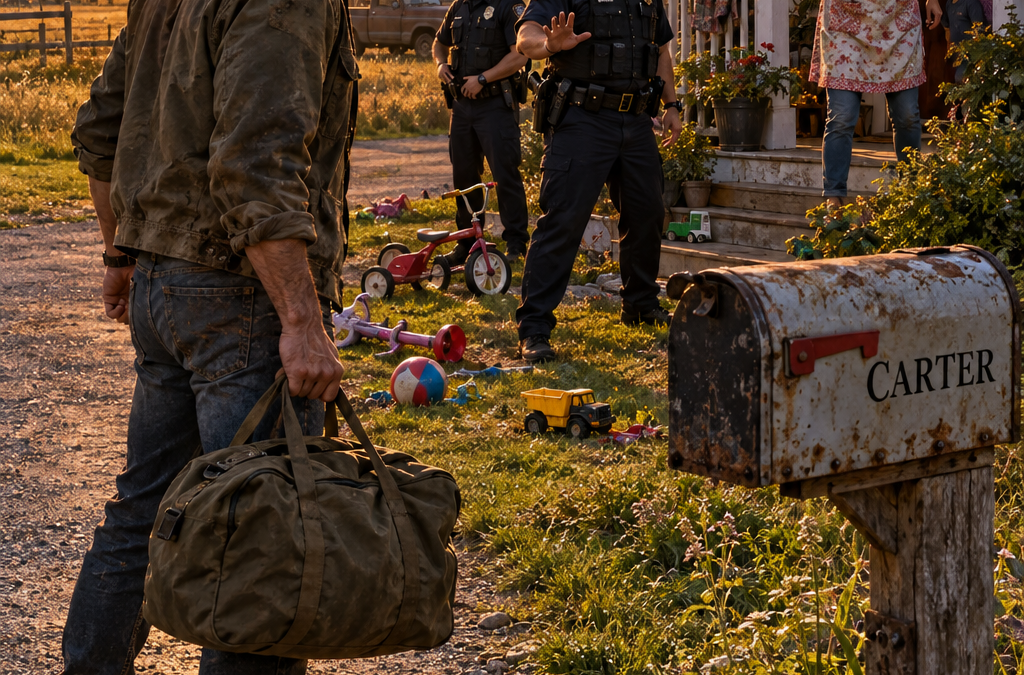
Then I saw the mailbox.
I slowed without meaning to.
My dad’s mailbox was gone.
That mailbox had been ugly, heavy, and practically indestructible. He had welded it himself out of scrap metal because he said store-bought ones were flimsy pieces of junk. He had painted our family name on the side in black letters. Every time I left home as a kid, that mailbox had been the last thing I saw. Every time I came back, it was the first thing that told me I was close.
Now it was gone.
In its place stood a cheap hardware-store mailbox with a different name on it.
Not faded. Not temporary. Not mistaken.
Different.
I sat there in the road for a few seconds, one hand on the steering wheel, staring at that name as my mind tried to make sense of it.
Maybe the old one rusted out, I thought.
But my dad’s mailbox would have survived a tornado out of spite.
Maybe the county replaced it.
The county would not have changed the name.
Maybe someone made a mistake.
A mistake does not bolt itself into the ground.
I kept driving because I needed an explanation, and the only place I might find one was up that driveway.
When the farmhouse came into view, my stomach dropped so hard it felt physical.
There were two vehicles parked out front.
Not mine. Not anyone’s I recognized.
A trampoline sat in the side yard. A dog ran loose near the porch with a chewed-up rope toy swinging from its mouth. There were potted plants on the steps, a wind chime hanging from the overhang, children’s bikes leaning against the barn, and that teal front door shining like an insult in the afternoon sun.
Someone was living in my house.
Not passing through. Not hiding. Living.
Settled.
Comfortable.
I parked and sat in the rental truck for what must have been two or three minutes, though it felt longer. My hands gripped the steering wheel until my knuckles went pale. There are moments when the mind refuses to accept what the eyes are telling it. This was one of them.
I had imagined coming home so many times.
In my mind, the driveway was empty. The house was dusty. Maybe a little neglected. Maybe the grass was too high and a few boards needed replacing. I was prepared for work. I was prepared for grief. I was prepared for the ache of walking into rooms where my father was no longer alive.
I was not prepared for a stranger’s wind chime.
I got out of the truck.
The dog barked once, then trotted away. The wind chime made a delicate sound that made me want to rip it down with my bare hands. I walked toward the porch slowly, not because I was afraid, but because I was trying to keep myself from doing something reckless.
Before I reached the steps, the front door opened.
A woman stepped out.
She was in her mid-forties, blonde hair pulled back, wearing an apron with flour dusted across the front like she had been baking inside my kitchen. For one strange second, the image was so domestic that my anger had nowhere to land. She looked like somebody’s mother interrupted during dinner prep. She looked like she belonged in the life she had stolen.
Then her face changed.
Confusion first. Then irritation. Then hostility.
“Can I help you?” she asked.
Her tone was ice cold.
Not cautious. Not embarrassed. Not surprised in the way an innocent person would be surprised if the legal owner of the house appeared.
It was the tone of someone who had already decided I was the problem.
I looked past her into the house. My house. I could see a rug I did not own, shoes by the door, a child’s backpack hanging from a hook that had once held my father’s coat.
“Yeah,” I said. My voice sounded calm, but it did not feel like mine. “Actually, I’m trying to figure out why you’re living in my house.”
Her eyes narrowed.
“Your house?”
“Yes.”
“Excuse me?” She laughed once, sharp and fake. “This is my house.”
“No,” I said. “It isn’t.”
“I’ve lived here for four years,” she snapped. “Who exactly are you?”
I told her my name.
For half a second, something flickered across her face. Recognition. Maybe fear. Maybe the sudden appearance of a truth she had buried under years of performance.
Then it was gone.
“This is my family’s farm,” I said. “My grandparents bought it. My father lived here. He built that east addition himself. His father’s initials are carved into the barn door frame.”
She folded her arms.
“I don’t know what kind of scam you’re trying to run,” she said, “but you need to get off my property right now.”
My property.
The words moved through me like a blade.
I almost laughed. Not because it was funny, but because the audacity was so complete it seemed unreal. This woman stood in the doorway of the house she had broken into, wearing an apron in front of my father’s work, and told me to leave my own land.
“You should call the police,” I said.
She blinked.
“What?”
“Call them,” I said. “I’ll wait.”
That was not the answer she expected. Her mouth tightened, and for a moment I thought she might back down. Instead, she pulled out her phone right there on my porch and dialed 911.
I could hear her voice change when the dispatcher answered.
It softened. Shook. Became fragile.
“There’s a man on my property,” she said. “He won’t leave. He’s acting aggressive. I have children in the house.”
I stood at the base of the porch steps and watched her perform fear with the confidence of someone who had practiced being believed.
Her husband came outside while she was still on the phone.
He was a big man, the kind of guy who looked like he worked with his hands, but there was nothing solid in his posture. He stopped near the doorway and would not look directly at me. His eyes moved from me to Karen, then to the yard, then back to Karen. He looked less angry than trapped.
That told me something.
He knew.
Maybe not every detail at first. Maybe Karen had fed him the same story she fed everyone else. But standing there, hearing my name, seeing my face, watching his wife scream into a phone about trespassing, he knew enough.
“Babe,” he said quietly, “maybe we should just—”
“Shut up,” Karen snapped without looking at him. “I’m handling this.”
He closed his mouth.
I leaned against the rental truck, hands in my pockets, and waited.
The wait lasted about twenty minutes.
Out there, that was a fast response. During those twenty minutes, Karen stood on the porch glaring at me as if hatred alone could erase county records. Her husband paced near the side of the house. The dog wandered through the yard. Somewhere inside, one of the kids asked something, and Karen shouted back for them to stay inside.
I stayed still.
That was one thing the Army had given me. The ability to keep my face calm when everything inside me was burning. I had spent years in situations where panic could get people killed. An entitled woman on a stolen porch was not going to make me lose control.
But do not mistake that for peace.
I was furious.
Not loud furious. Not shaking furious. The deeper kind. The kind that settles behind your ribs and turns everything sharp. Every second I stood there, another detail hit me. The potted flowers. The wind chime. The painted door. The child’s bike against my barn. The sign that said welcome to our home.
Our home.
My father’s house.
The deputy arrived in a cloud of gravel dust.
Karen rushed toward him before he had fully stepped out of the cruiser. She talked fast, pointing at me, wiping at eyes that had not been crying until he arrived. She told him I was trespassing. She said she wanted me removed. She said I was making her feel unsafe.
The deputy listened for a moment, then held up a hand.
“Ma’am, give me a second.”
He walked toward me.
I straightened.
“Sir,” he said, “can you tell me what’s going on?”
“I’m the legal owner of this property,” I said. “I’ve been deployed overseas for several years. I came home today and found people I’ve never met living in my house.”
He studied me, then asked for identification.
I handed it over.
He looked at my ID, then toward the house, then back at me. His expression shifted slightly. Not enough for Karen to notice, maybe, but enough for me to know he was listening.
“Do you have documentation showing ownership?”
“I can get it,” I said. “The deed is in my name. Taxes have been paid the whole time.”
Karen cut in from behind him.
“He’s lying. He showed up out of nowhere. We’ve lived here for years.”
The deputy turned to her.
“Ma’am, do you have a deed or lease for this property?”
Her face changed again.
“We’ve been here four years,” she said.
“That’s not what I asked.”
“We’ve taken care of this place. We paid bills. We fixed things. This is our home.”
The deputy’s voice stayed even.
“Do you have a deed, a bill of sale, a rental agreement, or any legal document showing you have the right to occupy this property?”
She opened her mouth.
Closed it.
Opened it again.
Nothing useful came out.
Because there was nothing useful to say.
No deed existed. No lease. No sale agreement. No handwritten permission. No text message from me. No handshake deal. Nothing.
She had moved into a house because she wanted it, then trusted time and confidence to make the theft feel normal.
The deputy turned back to me.
I showed him what I could pull up on my phone first. Then I gave him enough information to verify the records. The whole time, Karen hovered like a storm cloud, muttering about how she had children and how nobody could just appear after years and claim a home.
But I had not just appeared.
I had returned.
There is a difference.
After checking what he could, the deputy told Karen that based on the information available, I appeared to be the legal owner of the property and had every right to be there. He said the rest would need to be handled through the proper legal process, but he would not remove me from my own land.
Karen exploded.
She screamed that it was unfair. She screamed that she had maintained the property. She screamed that she had painted rooms, repaired porch boards, planted a garden, and kept the yard from falling apart. She cried about her children. She said I could not throw a family into the street. She called me a liar, a fraud, and a few other things that do not deserve repeating.
I stood there and let her burn through it.
Not because it did not affect me.
Because if I spoke then, I might have said something I could not take back.
The deputy warned her that if she did not calm down, things would move in a direction she did not want. That brought her volume down, but not her rage.
Then her husband finally spoke.
He did not look at Karen when he said it. He looked at the deputy.
“We don’t have a deed.”
The yard went quiet.
Karen whipped around.
“Shut your mouth,” she hissed.
But he kept going, barely above a whisper.
“She told me the owner was dead. Said nobody wanted the place.”
There it was.
The first crack wide enough for truth to show through.
Karen’s face went hard in a way I will never forget. Not fear. Not guilt. Rage at betrayal. Her husband had not confessed to doing wrong because he was suddenly noble. He had confessed because he was tired, because the lie had finally reached a uniform and a legal question, because somewhere inside him he understood they had crossed from bold into doomed.
The deputy wrote it down.
That statement mattered later.
At the time, I just stood there hearing the words owner was dead echo in my head.
She had told people I was dead.
Not missing. Not away. Dead.
She had buried me in conversation so she could live in my house.
The next morning, I was at the county courthouse as soon as the doors opened.
I pulled everything.
The deed. Tax records. Property history. Anything tied to that land. My name was exactly where it was supposed to be. The farm had never been sold, transferred, leased, or reassigned. The taxes had been paid every year through my automatic payments. There was no legal cloud, no ambiguity, no forgotten filing that gave Karen even a shadow of an argument.
The farm was mine in every way the law understood ownership.
From the courthouse, I went straight to a local attorney who handled property law. He was older, with tired eyes and a desk buried in files. He listened without interrupting while I explained the deployment, my buddy checking the place, the woman moving in, the 911 call, and her husband’s statement.
He looked through the documents.
Five minutes in, he leaned back and said, “This is one of the clearest squatting cases I’ve seen in a while.”
I remember feeling relief and anger at the same time.
Relief because someone who understood the system was telling me I was not crazy.
Anger because I needed a lawyer at all to remove strangers from my father’s house.
He explained that adverse possession, which Karen would almost certainly try to mention once she found someone willing to listen, required specific legal elements. She had met none of them. She had not paid the property taxes. She had not filed any legal claim. She did not have a good-faith belief that the property belonged to her, especially not after telling people the owner was dead. And the amount of time she had been there was not enough under state law anyway.
“She has no case,” he said.
Then he paused.
“But that doesn’t mean she won’t make this miserable.”
He was right.
He filed for a formal eviction that same day. He also helped initiate a criminal complaint for trespassing and unlawful entry. Meanwhile, Karen did what people like Karen do when facts stop favoring them.
She got louder.
She called the sheriff’s office multiple times demanding that I be arrested. She called the courthouse and screamed at whoever had the bad luck to answer. She apparently tried to hire at least two lawyers, both of whom turned her down after reviewing the facts. There was no legal argument to build. She was not a misunderstood tenant. She was not a buyer with missing paperwork. She was not a caretaker owed gratitude.
She was an illegal occupant in another person’s home.
Still, she tried one more angle that got under my skin more than almost anything else.
She claimed I owed her money.
Compensation, she called it.
For improvements.
When my attorney told me, I stared at him for a moment, waiting for the punch line.
“She says she painted rooms,” he said, scanning the paperwork. “Fixed porch boards. Replaced some plumbing fixtures. Planted a garden. Maintained the yard.”
“She broke into my house,” I said.
“I know.”
“She changed my locks.”
“I know.”
“She threw away my father’s mailbox.”
“I know.”
“She wants me to pay her?”
My attorney looked over his glasses at me.
“She can ask for anything. That doesn’t mean she’ll get it.”
The entitlement was staggering.
It was not enough that she had stolen years inside my home. Not enough that she had lied to the community and used my address for her life. Not enough that she had called the police on me. She wanted to bill me for the privilege of being robbed.
My attorney handled that argument quickly.
He pointed out that whatever cosmetic changes she made were unauthorized. He also documented the damage. The changed locks. The discarded custom mailbox. The painted door. The interior walls her kids had drawn on. The holes her dog had dug around the yard. The wear and tear from four years of illegal occupancy. If money was going to move between us, it would not be from me to her.
The eviction hearing came faster than I expected.
Maybe because the facts were simple. Maybe because Karen’s claims were so thin they could not support delay. I walked into that courtroom wearing a button-down shirt that still felt strange after years in uniform. Karen was there with her husband, looking angry enough to crack stone. She had dressed carefully, like she believed presentation might do what documents could not.
The judge reviewed my deed.
He reviewed the tax records.
He reviewed the absence of any paperwork from Karen’s side.
Then he asked her directly whether she had any legal basis for occupying the property.
She started talking about time.
About how long she had lived there.
About her children.
About the work she had done.
About fairness.
The judge cut her off.
He told her that occupying property without legal right does not become lawful simply because enough time passes. He said maintenance does not equal ownership. He said hardship does not create title.
Then he ruled in my favor.
Thirty days to vacate.
I should have felt victorious.
Instead, I felt like someone had handed me back something broken.
Karen used every single one of those thirty days.
I am certain she did it out of spite. She could have packed in a week. She could have left quietly, grateful she had not been dragged out immediately. But she stayed until the last possible day because it was the only control she had left.
During that time, she made herself as difficult as possible.
She called the sheriff’s office at least three more times. Once, she complained that I was intimidating her family by driving past the property to check whether she was still there. A deputy had to explain to her that I had the right to check on my own land and that she should focus on moving.
She also went door to door.
That part was almost impressive in its shamelessness. She told neighbors I was a heartless soldier throwing a poor family with children out of their home. She painted herself as the victim of some cruel technicality, as if my ownership were a loophole and her breaking in were a misunderstanding.
A few people believed her at first.
Not many, but enough.
Then the real story spread.
Rural communities may mind their own business at first, but once the truth gets loose, it travels fast. People learned that I had inherited the farm. They learned I had been overseas. They learned my taxes had been paid the entire time. They learned Karen had told people I was dead. That detail did more damage to her reputation than anything I could have said myself.
Dead men do not usually come home to correct rumors.
But I did.
The day she finally moved out, I drove to the farm early enough to make sure there was no last-minute trick. A rental moving truck sat in the driveway. Her husband loaded boxes with the stiff, silent efficiency of a man who just wanted the worst day of his life to end. Karen stood in the yard with her arms crossed, watching me like I had personally destroyed her family.
Maybe, in her mind, I had.
That is one of the strangest things about people who do harm. Some of them truly believe consequences are attacks. They can break into your home, sleep in your rooms, throw away your father’s mailbox, tell the town you died, and still look at you like you are the cruel one for asking them to leave.
I parked far enough away not to interfere and waited.
She glared the entire time.
When the last boxes were loaded and the kids were already in one of the vehicles, Karen walked toward the passenger side of the truck. Just before getting in, she turned back.
“You’ll regret this,” she said.
Her voice was lower than usual. Bitter. Controlled.
“You have no idea what you’ve done to my family.”
For a moment, I saw the woman on the porch again. The apron. The cold eyes. The performance of fear on the 911 call. The way she had looked at my house and decided wanting it was close enough to owning it.
I walked a few steps closer.
“You lived in my dead father’s house,” I said. “You threw away his mailbox. You changed his door. You told people I was dead so you could stay here. I think we both know who did what.”
For once, Karen had no answer.
She got into the truck.
The door slammed.
Then she was gone.
The silence that followed was not peaceful at first.
It was heavy.
I stood in the driveway after they left, looking at the house I had imagined coming home to for years. The teal door stared back at me. The welcome sign was gone, but the nail where it had hung remained. The yard was scarred by tires and dog holes. The porch boards were different in places. The flower beds looked too bright, too strange, like someone else’s handwriting across a family photograph.
I walked to the road first.
I wanted to see the mailbox space.
The cheap replacement still stood there with Karen’s name on it. I ripped it out myself. It came loose easier than it should have, the post wobbling in the dirt before giving way. I threw it in the bed of the pickup and stood there looking at the empty hole.
My father’s mailbox was gone.
That hurt more than I expected.
A mailbox is a small thing until it is the thing your father made with his hands. Until it is the first marker of home. Until someone discards it because your name is inconvenient to their lie.
I searched later, hoping maybe she had tossed it somewhere on the property.
I never found it.
The criminal charges moved forward.
Karen eventually pleaded guilty to criminal trespass to avoid a trial. She received probation, community service, and was ordered to pay restitution for the lock changes, the discarded mailbox, and the damage to the property. The amount was not life-changing. It did not restore the mailbox. It did not erase the years. It did not give me back the homecoming I had dreamed about.
But it made the truth official.
That mattered.
Her name was on a record now for what she had done. Not as a misunderstood mother. Not as a homeowner treated unfairly. As someone who had trespassed, lied, and taken what was not hers.
In a small town, the court sentence was only part of the punishment.
The rest was reputation.
Everybody learned. Everybody talked. The woman who had spent four years presenting herself as the proud owner of the old farm was exposed as someone who moved into a deployed soldier’s family home and pretended he was dead. People were disgusted. Even those who had been sympathetic at first backed away once the facts were clear.
Karen and her husband moved out of the county within a few months.
I do not know where they went.
I do not care.
What I cared about was the work left behind.
The first night I spent in the house after they were gone, I barely slept.
Not because I was afraid.
Because the house did not feel fully like mine yet.
That is a difficult thing to admit. Legally, it had never stopped being mine. Emotionally, something had been disturbed. Every room carried evidence of strangers. Scratches on floors from furniture I never owned. Crayon marks on one hallway wall. Cabinet handles changed in the kitchen. A bedroom painted a color I hated. The smell of someone else’s laundry detergent in closets that had once smelled like cedar and dust.
I moved from room to room with a trash bag, taking down what they left behind.
A broken plastic toy under the stairs.
A curtain rod bent in the guest room.
A sticker on the inside of a closet door.
A grocery list stuck behind the refrigerator with a magnet shaped like a strawberry.
Normal family debris.
That was the worst part.
They had lived there normally.
Birthdays maybe. Homework at my kitchen table. Dinners cooked on my stove. Arguments in the hallway. Morning routines. School lunches. Christmas gifts. Four years of ordinary life built on top of theft.
I tried not to hate the kids.
They had not chosen it. Not really. Children live where parents put them. They believe the stories adults tell until life proves otherwise. I wondered what Karen had told them when they moved out. Probably that I was cruel. Probably that I had taken their home.
Maybe someday they would learn the truth.
Maybe not.
The house took months to reclaim.
I changed every lock again. I repainted the front door, not the original exact color because I could not remember the brand, but close enough to feel right. I repaired the yard. I patched walls. I replaced damaged trim. I cleaned until my hands cracked. I took down every trace of Karen’s choices that I could bear to remove.
Some things I left for a while.
Not because I wanted them.
Because I needed time.
The first time I opened the barn and saw my grandfather’s initials still carved into the frame, I had to sit down on an overturned bucket. I put my hand over those letters and cried for the first time since coming home. Not loud. Not dramatically. Just the kind of crying that finally happens when there is no immediate problem to solve.
My father’s mailbox was gone.
The house had been violated.
My homecoming had been stolen.
But those initials remained.
They had survived Karen.
That became important to me.
Slowly, I began putting my own life back into the place. I brought in my belongings. I unpacked boxes that had followed me from one military storage space to another. I found old photographs and set them where they belonged. I hung one of my father in the hallway, the one where he is standing near the barn with one hand on his hip, squinting into the sun like he is suspicious of whoever is holding the camera.
Every morning, I made coffee and sat on the porch.
At first, I looked at what was wrong. The patched boards. The places where paint still needed touching up. The empty space by the road where the mailbox should have been.
Then, little by little, I started seeing what was still there.
The pond catching the sky.
The barn leaning slightly but standing.
The fields moving under wind.
The house making its old sounds at night.
One afternoon, I went into town and found a local welder. I showed him pictures of my dad’s mailbox from old photos and asked if he could make something close. He told me he could, but it would not be exact.
“I know,” I said. “Nothing is.”
When the new mailbox was finished, it was heavier than the store-bought one Karen had installed, built from thick metal, painted dark, with my family name on the side. Not my father’s hand, but in honor of it.
I set the post myself.
Dug the hole. Mixed the concrete. Leveled it twice. Waited until it held firm.
When I stepped back and saw our name by the road again, something in me settled.
Not healed completely.
Settled.
People sometimes ask why I stayed.
Not directly, usually. More like, “After all that, didn’t it feel ruined?” Or, “Wouldn’t it have been easier to sell and start fresh somewhere else?”
I understand the question.
There were days I wondered the same thing.
But Karen did not get to be the final chapter of that farm.
She got four years because she lied well enough and because I was too far away to see what was happening. She did not get the rest. She did not get to make my father’s house unbearable. She did not get to turn my inheritance into a wound I avoided.
So I stayed.
I stayed through the repairs.
I stayed through the anger.
I stayed through the strange grief of finding someone else’s life layered over mine.
And eventually, the farm remembered me.
That is how it felt, anyway.
The first time I sat by the pond at sunset and felt calm instead of tense, I knew I was going to be all right. The water was still. The air smelled like cut grass and damp soil. A heron lifted from the far edge of the pond and moved across the sky with slow, prehistoric grace. The house stood behind me, imperfect and scarred, but mine.
I thought about my father then.
I thought about the way he used to say land does not belong to you just because a piece of paper says so. Paper matters, he said, but belonging is proven by what you protect, what you repair, and what you refuse to abandon.
For years, I had protected that farm from far away the only way I knew how. Taxes paid. Doors locked. A friend checking in. Trust placed where trust seemed reasonable.
Karen found the gap and forced herself through it.
But in the end, the paper mattered too. The deed mattered. The tax records mattered. The truth mattered. Her lies had sounded convincing in grocery store aisles and on phone calls to 911, but they could not survive a courthouse.
That is the lesson I carry now.
Evil does not always arrive looking like evil. Sometimes it wears an apron and plants flowers. Sometimes it waves at neighbors, enrolls children in school, pays an electric bill, and calls stolen walls a home. Sometimes it does not kick down the door in the night. Sometimes it changes the locks in daylight and waits for everyone to accept the new story.
And sometimes the only thing standing between your life and someone else’s lie is a record, a name, and the stubborn decision to come home.
Karen wanted my farm because it was convenient to her.
I wanted it because it was my blood, my grief, my childhood, my father’s labor, my grandfather’s mark in the barn, and the one place I had dreamed about through years of dust, distance, and war.
That was the difference.
She occupied it.
I belonged to it.
And when I finally came back, no amount of screaming, no false 911 call, no painted door, no fake mailbox, no story about a dead owner could change what had always been true.
The farm was mine.
It had been waiting for me.
And this time, I was staying.
𝗧𝗛𝗘 𝗘𝗡𝗗
The Stranger Wearing an Apron in My Father’s Doorway Was Waiting to Call Me the Intruder
I came home expecting dust, silence, and the smell of old wood.
Instead, my father’s mailbox was gone, another family’s name was nailed in its place, and children’s toys were scattered across the yard where I used to help him carry lumber.
By sunset, a woman who had stolen four years inside my house was begging the police to drag me off my own land.
I grew up on forty acres in the rural Midwest, on a stretch of land most people drove past without thinking twice.
To them, it was just an old farm set back from a gravel road. A farmhouse, a barn, a few outbuildings, a pond tucked toward the back, fields that went flat and gold in late summer, and a windbreak of trees that turned black against the sunset. Nothing fancy. Nothing that would ever end up in a magazine. Just a working place, worn at the edges, honest in the way old family land becomes honest after enough sweat has soaked into it.
To me, it was the only place that had ever felt like home.
My grandparents bought the land long before I was born, back when a man could build a life with callused hands, a stubborn back, and more faith than money. My dad grew up there. He learned to fix engines in that barn. He learned to drive before his feet properly reached the pedals. He learned the moods of the soil, the sound of rain on tin roofing, the difference between a storm that would pass and one that would tear branches loose from the cottonwoods.
Later, he raised me there.
Some of my earliest memories are of following him around the property with a hammer I was too young to use safely, pretending I was helping while he did the real work. When he added onto the east side of the house, I was there holding boards steady while he measured twice, cut once, and muttered under his breath whenever something refused to sit square. He had a habit of pressing his thumb against wood grain before driving a nail, like he was asking permission from the house before changing it.
That was how he treated the farm.
Not like an object.
Like something alive.
The barn still had my grandfather’s initials carved into one of the door frames. My dad had never sanded them off, even when he repaired that section. He said some marks were supposed to stay because they told the truth about who came before you. There were places in the house where his hands had left invisible fingerprints, places nobody else would ever notice. The repaired stair tread that creaked differently from the others. The trim around the kitchen window that did not quite match because he had used leftover lumber. The back porch boards he replaced one October after I nearly put my foot through a rotten plank.
That farm held my family in ways paperwork never could.
But paperwork mattered too.
When my dad died, the property became mine.
I was in my mid-twenties then, already enlisted in the Army, already active duty, already living a life that did not pause just because grief had knocked the breath out of me. Losing him while I was stationed overseas is still something I do not know how to explain. People say they are sorry, and I believe them, but distance changes grief. It makes it unreal in the beginning. You get a phone call, you sit on the edge of a bunk thousands of miles away, and the world continues moving around you like nothing sacred has cracked open.
I inherited the farm free and clear. No mortgage. No bank waiting to take it. Just taxes, upkeep, and the responsibility of holding onto the last solid piece of my family.
The problem was that I could not simply walk away from my service and go home.
So I made arrangements.
A buddy of mine from high school still lived in the area. We had known each other since we were kids, back when summers meant dust on our boots and cheap gas station drinks sweating in our hands. He agreed to keep an eye on the place while I was gone. Nothing complicated. He would drive out every couple of weeks, mow around the house so it did not look abandoned, check the doors, make sure no windows were broken, and let me know if anything looked wrong.
I set up automatic payments for the property taxes through my bank. I put the utilities on a minimal plan, mostly to keep the pipes from freezing in the winter. The farmhouse was locked. The barn was locked. The outbuildings were locked. I had no reason to believe anyone would bother the place.
It was rural.
There was no homeowners association. No neighborhood committee. No one with a clipboard and too much free time. The nearest house sat roughly a quarter mile down the road. People out there generally left each other alone unless someone needed help pulling a truck from mud or borrowing a chainsaw.
At first, everything worked.
My buddy sent pictures now and then. The grass cut short around the porch. The barn standing solid. The windows intact. The old mailbox still at the road, the one my dad had welded from scrap metal with our family name on the side. Every time I received one of those photos, I would stare at it longer than I needed to. Sometimes I opened them at night when I could not sleep, just to remind myself that somewhere on the other side of the world, home was still sitting there, waiting.
Then the Army did what the Army does.
One tour became more. Time stretched. Plans shifted. I reenlisted because, by then, the military was the structure I knew best. The pay was steady. The world outside felt distant. Civilian life became something I imagined in pieces rather than something I could touch.
I kept sending money to my buddy as a thank you. He never asked for much, but I knew he was doing me a favor that mattered more than he probably understood.
Then he got a job opportunity out of state.
He called me sounding guilty before he even explained. I could hear it in his voice.
“Man, I hate doing this,” he said. “But I got offered something good. Real good. I’d be stupid not to take it.”
I was sitting under harsh fluorescent light when he told me. I remember rubbing a hand over my face and feeling exhausted in a way sleep would not fix.
“You should take it,” I said.
“But the farm—”
“You’ve done enough,” I told him. “More than enough. Go take the job.”
“I can maybe ask around,” he said. “Find somebody else to check on it.”
“Don’t worry about it,” I said.
I meant that.
At least, I thought I did.
The place had sat safely for years. Taxes were paid. Doors were locked. The area was quiet. What could possibly happen?
That thought has haunted me more times than I can count.
Because while I was overseas dealing with things I still do not like talking about, a woman named Karen was slowly turning my home into a lie.
I did not know her then.
I did not know she lived about two miles down the road in a rental house with her husband and two kids. I did not know she had been driving past my farm for months, maybe longer, watching the grass grow higher after my buddy moved away. I did not know she noticed the dark windows, the empty driveway, the closed barn doors, the absence of a man who had every legal right to be there but could not come home yet.
I did not know she had started talking.
That was how it began, from what I later pieced together. Not with a crowbar. Not with a moving truck. Not yet.
It began with words.
She told people she had heard the farm was abandoned. Then she told people the owner had died overseas. Then she told people nobody had claimed the place. Each version sounded more certain than the last. She repeated it at the post office. At the grocery store. To neighbors. To her landlord.
Then she told her landlord she was buying a farm.
She gave notice on her rental.
And then she broke into my house.
I still do not know exactly how she got in. The locks were ordinary deadbolts, not bank vaults. Maybe she forced one. Maybe she picked one. Maybe she had someone help. By the time I came back, the original locks were gone, changed by someone who had no right to touch them.
She moved her entire family into my farmhouse.
Not the barn. Not an outbuilding. Not some temporary corner of the property.
My house.
The house my father had worked on with his own hands. The house where my mother had once kept holiday dishes in the kitchen cabinet. The house where my dad taught me how to patch drywall after I slammed a chair into it when I was fourteen and stupid. The house whose floors knew the weight of my family’s footsteps.
Karen moved in furniture. Curtains. Dishes. Her children’s toys. She put potted flowers near the porch like she was dressing a stage. She hung a little sign that said welcome to our home, as if a decorative phrase could erase a deed. She repainted the front door a bright teal color I would never have chosen. She set up a trampoline in the side yard. She had packages delivered there. She used my address to enroll her children in school.
She committed to the lie completely.
In a rural community, that was apparently enough.
People mind their own business in places like that. It is one of the things I always loved about it, and one of the things that helped Karen get away with what she did. If a woman says she bought the old farm, most people are not going to march down to the courthouse and pull records. They are going to nod, say it is nice someone is fixing the place up, and move on with their day.
The mail carrier changed during those years. The sheriff’s office had staff turnover. I was not posting updates from overseas about the condition of my property. My taxes kept being paid automatically, so nothing triggered a warning there. On paper, everything remained mine. In daily life, Karen made herself visible enough that people accepted her story.
For four years, I believed my farm was empty.
For four years, she slept under my roof.
Then I got out.
I had served my time. My body was tired. My head was crowded. I was ready to be somewhere quiet long enough to remember who I was without rank, orders, deployments, and the kind of alertness that becomes second nature when danger has been your weather for too long.
My plan was simple.
Go home.
That was it.
I did not have some grand business idea. Maybe I would lease some acreage. Maybe I would start something small. Maybe I would do nothing for a while except sit on the porch, drink coffee, and watch the sun go down over the pond until my nervous system finally believed nobody was shooting at me anymore.
I did not tell anyone I was coming.
Part of that was habit. Years in the military teach you to move quietly. Part of it was sentimental. I wanted that first moment alone. I wanted to pull into the driveway, step out, breathe in dust and grass and old wood, and let the place recognize me before anyone else did.
I flew into the regional airport and rented a pickup truck. It was late afternoon when I started the drive. The weather was almost painfully beautiful. Blue sky. Warm air. Windows down. Radio low. The kind of day that makes memory feel close.
For the first time in a long time, I felt something like hope.
Not happiness exactly. I was not there yet.
But hope.
The road out to the farm looked both familiar and changed. A few houses had new roofs. A gas station had remodeled. A field that used to be soybeans now had storage units on it. But the closer I got, the more the old shapes returned. The bend near the ditch. The line of trees before the gravel road. The long stretch where dust rose behind the truck and hung in the air like a ghost.
Then I saw the mailbox.
I slowed without meaning to.
My dad’s mailbox was gone.
That mailbox had been ugly, heavy, and practically indestructible. He had welded it himself out of scrap metal because he said store-bought ones were flimsy pieces of junk. He had painted our family name on the side in black letters. Every time I left home as a kid, that mailbox had been the last thing I saw. Every time I came back, it was the first thing that told me I was close.
Now it was gone.
In its place stood a cheap hardware-store mailbox with a different name on it.
Not faded. Not temporary. Not mistaken.
Different.
I sat there in the road for a few seconds, one hand on the steering wheel, staring at that name as my mind tried to make sense of it.
Maybe the old one rusted out, I thought.
But my dad’s mailbox would have survived a tornado out of spite.
Maybe the county replaced it.
The county would not have changed the name.
Maybe someone made a mistake.
A mistake does not bolt itself into the ground.
I kept driving because I needed an explanation, and the only place I might find one was up that driveway.
When the farmhouse came into view, my stomach dropped so hard it felt physical.
There were two vehicles parked out front.
Not mine. Not anyone’s I recognized.
A trampoline sat in the side yard. A dog ran loose near the porch with a chewed-up rope toy swinging from its mouth. There were potted plants on the steps, a wind chime hanging from the overhang, children’s bikes leaning against the barn, and that teal front door shining like an insult in the afternoon sun.
Someone was living in my house.
Not passing through. Not hiding. Living.
Settled.
Comfortable.
I parked and sat in the rental truck for what must have been two or three minutes, though it felt longer. My hands gripped the steering wheel until my knuckles went pale. There are moments when the mind refuses to accept what the eyes are telling it. This was one of them.
I had imagined coming home so many times.
In my mind, the driveway was empty. The house was dusty. Maybe a little neglected. Maybe the grass was too high and a few boards needed replacing. I was prepared for work. I was prepared for grief. I was prepared for the ache of walking into rooms where my father was no longer alive.
I was not prepared for a stranger’s wind chime.
I got out of the truck.
The dog barked once, then trotted away. The wind chime made a delicate sound that made me want to rip it down with my bare hands. I walked toward the porch slowly, not because I was afraid, but because I was trying to keep myself from doing something reckless.
Before I reached the steps, the front door opened.
A woman stepped out.
She was in her mid-forties, blonde hair pulled back, wearing an apron with flour dusted across the front like she had been baking inside my kitchen. For one strange second, the image was so domestic that my anger had nowhere to land. She looked like somebody’s mother interrupted during dinner prep. She looked like she belonged in the life she had stolen.
Then her face changed.
Confusion first. Then irritation. Then hostility.
“Can I help you?” she asked.
Her tone was ice cold.
Not cautious. Not embarrassed. Not surprised in the way an innocent person would be surprised if the legal owner of the house appeared.
It was the tone of someone who had already decided I was the problem.
I looked past her into the house. My house. I could see a rug I did not own, shoes by the door, a child’s backpack hanging from a hook that had once held my father’s coat.
“Yeah,” I said. My voice sounded calm, but it did not feel like mine. “Actually, I’m trying to figure out why you’re living in my house.”
Her eyes narrowed.
“Your house?”
“Yes.”
“Excuse me?” She laughed once, sharp and fake. “This is my house.”
“No,” I said. “It isn’t.”
“I’ve lived here for four years,” she snapped. “Who exactly are you?”
I told her my name.
For half a second, something flickered across her face. Recognition. Maybe fear. Maybe the sudden appearance of a truth she had buried under years of performance.
Then it was gone.
“This is my family’s farm,” I said. “My grandparents bought it. My father lived here. He built that east addition himself. His father’s initials are carved into the barn door frame.”
She folded her arms.
“I don’t know what kind of scam you’re trying to run,” she said, “but you need to get off my property right now.”
My property.
The words moved through me like a blade.
I almost laughed. Not because it was funny, but because the audacity was so complete it seemed unreal. This woman stood in the doorway of the house she had broken into, wearing an apron in front of my father’s work, and told me to leave my own land.
“You should call the police,” I said.
She blinked.
“What?”
“Call them,” I said. “I’ll wait.”
That was not the answer she expected. Her mouth tightened, and for a moment I thought she might back down. Instead, she pulled out her phone right there on my porch and dialed 911.
I could hear her voice change when the dispatcher answered.
It softened. Shook. Became fragile.
“There’s a man on my property,” she said. “He won’t leave. He’s acting aggressive. I have children in the house.”
I stood at the base of the porch steps and watched her perform fear with the confidence of someone who had practiced being believed.
Her husband came outside while she was still on the phone.
He was a big man, the kind of guy who looked like he worked with his hands, but there was nothing solid in his posture. He stopped near the doorway and would not look directly at me. His eyes moved from me to Karen, then to the yard, then back to Karen. He looked less angry than trapped.
That told me something.
He knew.
Maybe not every detail at first. Maybe Karen had fed him the same story she fed everyone else. But standing there, hearing my name, seeing my face, watching his wife scream into a phone about trespassing, he knew enough.
“Babe,” he said quietly, “maybe we should just—”
“Shut up,” Karen snapped without looking at him. “I’m handling this.”
He closed his mouth.
I leaned against the rental truck, hands in my pockets, and waited.
The wait lasted about twenty minutes.
Out there, that was a fast response. During those twenty minutes, Karen stood on the porch glaring at me as if hatred alone could erase county records. Her husband paced near the side of the house. The dog wandered through the yard. Somewhere inside, one of the kids asked something, and Karen shouted back for them to stay inside.
I stayed still.
That was one thing the Army had given me. The ability to keep my face calm when everything inside me was burning. I had spent years in situations where panic could get people killed. An entitled woman on a stolen porch was not going to make me lose control.
But do not mistake that for peace.
I was furious.
Not loud furious. Not shaking furious. The deeper kind. The kind that settles behind your ribs and turns everything sharp. Every second I stood there, another detail hit me. The potted flowers. The wind chime. The painted door. The child’s bike against my barn. The sign that said welcome to our home.
Our home.
My father’s house.
The deputy arrived in a cloud of gravel dust.
Karen rushed toward him before he had fully stepped out of the cruiser. She talked fast, pointing at me, wiping at eyes that had not been crying until he arrived. She told him I was trespassing. She said she wanted me removed. She said I was making her feel unsafe.
The deputy listened for a moment, then held up a hand.
“Ma’am, give me a second.”
He walked toward me.
I straightened.
“Sir,” he said, “can you tell me what’s going on?”
“I’m the legal owner of this property,” I said. “I’ve been deployed overseas for several years. I came home today and found people I’ve never met living in my house.”
He studied me, then asked for identification.
I handed it over.
He looked at my ID, then toward the house, then back at me. His expression shifted slightly. Not enough for Karen to notice, maybe, but enough for me to know he was listening.
“Do you have documentation showing ownership?”
“I can get it,” I said. “The deed is in my name. Taxes have been paid the whole time.”
Karen cut in from behind him.
“He’s lying. He showed up out of nowhere. We’ve lived here for years.”
The deputy turned to her.
“Ma’am, do you have a deed or lease for this property?”
Her face changed again.
“We’ve been here four years,” she said.
“That’s not what I asked.”
“We’ve taken care of this place. We paid bills. We fixed things. This is our home.”
The deputy’s voice stayed even.
“Do you have a deed, a bill of sale, a rental agreement, or any legal document showing you have the right to occupy this property?”
She opened her mouth.
Closed it.
Opened it again.
Nothing useful came out.
Because there was nothing useful to say.
No deed existed. No lease. No sale agreement. No handwritten permission. No text message from me. No handshake deal. Nothing.
She had moved into a house because she wanted it, then trusted time and confidence to make the theft feel normal.
The deputy turned back to me.
I showed him what I could pull up on my phone first. Then I gave him enough information to verify the records. The whole time, Karen hovered like a storm cloud, muttering about how she had children and how nobody could just appear after years and claim a home.
But I had not just appeared.
I had returned.
There is a difference.
After checking what he could, the deputy told Karen that based on the information available, I appeared to be the legal owner of the property and had every right to be there. He said the rest would need to be handled through the proper legal process, but he would not remove me from my own land.
Karen exploded.
She screamed that it was unfair. She screamed that she had maintained the property. She screamed that she had painted rooms, repaired porch boards, planted a garden, and kept the yard from falling apart. She cried about her children. She said I could not throw a family into the street. She called me a liar, a fraud, and a few other things that do not deserve repeating.
I stood there and let her burn through it.
Not because it did not affect me.
Because if I spoke then, I might have said something I could not take back.
The deputy warned her that if she did not calm down, things would move in a direction she did not want. That brought her volume down, but not her rage.
Then her husband finally spoke.
He did not look at Karen when he said it. He looked at the deputy.
“We don’t have a deed.”
The yard went quiet.
Karen whipped around.
“Shut your mouth,” she hissed.
But he kept going, barely above a whisper.
“She told me the owner was dead. Said nobody wanted the place.”
There it was.
The first crack wide enough for truth to show through.
Karen’s face went hard in a way I will never forget. Not fear. Not guilt. Rage at betrayal. Her husband had not confessed to doing wrong because he was suddenly noble. He had confessed because he was tired, because the lie had finally reached a uniform and a legal question, because somewhere inside him he understood they had crossed from bold into doomed.
The deputy wrote it down.
That statement mattered later.
At the time, I just stood there hearing the words owner was dead echo in my head.
She had told people I was dead.
Not missing. Not away. Dead.
She had buried me in conversation so she could live in my house.
The next morning, I was at the county courthouse as soon as the doors opened.
I pulled everything.
The deed. Tax records. Property history. Anything tied to that land. My name was exactly where it was supposed to be. The farm had never been sold, transferred, leased, or reassigned. The taxes had been paid every year through my automatic payments. There was no legal cloud, no ambiguity, no forgotten filing that gave Karen even a shadow of an argument.
The farm was mine in every way the law understood ownership.
From the courthouse, I went straight to a local attorney who handled property law. He was older, with tired eyes and a desk buried in files. He listened without interrupting while I explained the deployment, my buddy checking the place, the woman moving in, the 911 call, and her husband’s statement.
He looked through the documents.
Five minutes in, he leaned back and said, “This is one of the clearest squatting cases I’ve seen in a while.”
I remember feeling relief and anger at the same time.
Relief because someone who understood the system was telling me I was not crazy.
Anger because I needed a lawyer at all to remove strangers from my father’s house.
He explained that adverse possession, which Karen would almost certainly try to mention once she found someone willing to listen, required specific legal elements. She had met none of them. She had not paid the property taxes. She had not filed any legal claim. She did not have a good-faith belief that the property belonged to her, especially not after telling people the owner was dead. And the amount of time she had been there was not enough under state law anyway.
“She has no case,” he said.
Then he paused.
“But that doesn’t mean she won’t make this miserable.”
He was right.
He filed for a formal eviction that same day. He also helped initiate a criminal complaint for trespassing and unlawful entry. Meanwhile, Karen did what people like Karen do when facts stop favoring them.
She got louder.
She called the sheriff’s office multiple times demanding that I be arrested. She called the courthouse and screamed at whoever had the bad luck to answer. She apparently tried to hire at least two lawyers, both of whom turned her down after reviewing the facts. There was no legal argument to build. She was not a misunderstood tenant. She was not a buyer with missing paperwork. She was not a caretaker owed gratitude.
She was an illegal occupant in another person’s home.
Still, she tried one more angle that got under my skin more than almost anything else.
She claimed I owed her money.
Compensation, she called it.
For improvements.
When my attorney told me, I stared at him for a moment, waiting for the punch line.
“She says she painted rooms,” he said, scanning the paperwork. “Fixed porch boards. Replaced some plumbing fixtures. Planted a garden. Maintained the yard.”
“She broke into my house,” I said.
“I know.”
“She changed my locks.”
“I know.”
“She threw away my father’s mailbox.”
“I know.”
“She wants me to pay her?”
My attorney looked over his glasses at me.
“She can ask for anything. That doesn’t mean she’ll get it.”
The entitlement was staggering.
It was not enough that she had stolen years inside my home. Not enough that she had lied to the community and used my address for her life. Not enough that she had called the police on me. She wanted to bill me for the privilege of being robbed.
My attorney handled that argument quickly.
He pointed out that whatever cosmetic changes she made were unauthorized. He also documented the damage. The changed locks. The discarded custom mailbox. The painted door. The interior walls her kids had drawn on. The holes her dog had dug around the yard. The wear and tear from four years of illegal occupancy. If money was going to move between us, it would not be from me to her.
The eviction hearing came faster than I expected.
Maybe because the facts were simple. Maybe because Karen’s claims were so thin they could not support delay. I walked into that courtroom wearing a button-down shirt that still felt strange after years in uniform. Karen was there with her husband, looking angry enough to crack stone. She had dressed carefully, like she believed presentation might do what documents could not.
The judge reviewed my deed.
He reviewed the tax records.
He reviewed the absence of any paperwork from Karen’s side.
Then he asked her directly whether she had any legal basis for occupying the property.
She started talking about time.
About how long she had lived there.
About her children.
About the work she had done.
About fairness.
The judge cut her off.
He told her that occupying property without legal right does not become lawful simply because enough time passes. He said maintenance does not equal ownership. He said hardship does not create title.
Then he ruled in my favor.
Thirty days to vacate.
I should have felt victorious.
Instead, I felt like someone had handed me back something broken.
Karen used every single one of those thirty days.
I am certain she did it out of spite. She could have packed in a week. She could have left quietly, grateful she had not been dragged out immediately. But she stayed until the last possible day because it was the only control she had left.
During that time, she made herself as difficult as possible.
She called the sheriff’s office at least three more times. Once, she complained that I was intimidating her family by driving past the property to check whether she was still there. A deputy had to explain to her that I had the right to check on my own land and that she should focus on moving.
She also went door to door.
That part was almost impressive in its shamelessness. She told neighbors I was a heartless soldier throwing a poor family with children out of their home. She painted herself as the victim of some cruel technicality, as if my ownership were a loophole and her breaking in were a misunderstanding.
A few people believed her at first.
Not many, but enough.
Then the real story spread.
Rural communities may mind their own business at first, but once the truth gets loose, it travels fast. People learned that I had inherited the farm. They learned I had been overseas. They learned my taxes had been paid the entire time. They learned Karen had told people I was dead. That detail did more damage to her reputation than anything I could have said myself.
Dead men do not usually come home to correct rumors.
But I did.
The day she finally moved out, I drove to the farm early enough to make sure there was no last-minute trick. A rental moving truck sat in the driveway. Her husband loaded boxes with the stiff, silent efficiency of a man who just wanted the worst day of his life to end. Karen stood in the yard with her arms crossed, watching me like I had personally destroyed her family.
Maybe, in her mind, I had.
That is one of the strangest things about people who do harm. Some of them truly believe consequences are attacks. They can break into your home, sleep in your rooms, throw away your father’s mailbox, tell the town you died, and still look at you like you are the cruel one for asking them to leave.
I parked far enough away not to interfere and waited.
She glared the entire time.
When the last boxes were loaded and the kids were already in one of the vehicles, Karen walked toward the passenger side of the truck. Just before getting in, she turned back.
“You’ll regret this,” she said.
Her voice was lower than usual. Bitter. Controlled.
“You have no idea what you’ve done to my family.”
For a moment, I saw the woman on the porch again. The apron. The cold eyes. The performance of fear on the 911 call. The way she had looked at my house and decided wanting it was close enough to owning it.
I walked a few steps closer.
“You lived in my dead father’s house,” I said. “You threw away his mailbox. You changed his door. You told people I was dead so you could stay here. I think we both know who did what.”
For once, Karen had no answer.
She got into the truck.
The door slammed.
Then she was gone.
The silence that followed was not peaceful at first.
It was heavy.
I stood in the driveway after they left, looking at the house I had imagined coming home to for years. The teal door stared back at me. The welcome sign was gone, but the nail where it had hung remained. The yard was scarred by tires and dog holes. The porch boards were different in places. The flower beds looked too bright, too strange, like someone else’s handwriting across a family photograph.
I walked to the road first.
I wanted to see the mailbox space.
The cheap replacement still stood there with Karen’s name on it. I ripped it out myself. It came loose easier than it should have, the post wobbling in the dirt before giving way. I threw it in the bed of the pickup and stood there looking at the empty hole.
My father’s mailbox was gone.
That hurt more than I expected.
A mailbox is a small thing until it is the thing your father made with his hands. Until it is the first marker of home. Until someone discards it because your name is inconvenient to their lie.
I searched later, hoping maybe she had tossed it somewhere on the property.
I never found it.
The criminal charges moved forward.
Karen eventually pleaded guilty to criminal trespass to avoid a trial. She received probation, community service, and was ordered to pay restitution for the lock changes, the discarded mailbox, and the damage to the property. The amount was not life-changing. It did not restore the mailbox. It did not erase the years. It did not give me back the homecoming I had dreamed about.
But it made the truth official.
That mattered.
Her name was on a record now for what she had done. Not as a misunderstood mother. Not as a homeowner treated unfairly. As someone who had trespassed, lied, and taken what was not hers.
In a small town, the court sentence was only part of the punishment.
The rest was reputation.
Everybody learned. Everybody talked. The woman who had spent four years presenting herself as the proud owner of the old farm was exposed as someone who moved into a deployed soldier’s family home and pretended he was dead. People were disgusted. Even those who had been sympathetic at first backed away once the facts were clear.
Karen and her husband moved out of the county within a few months.
I do not know where they went.
I do not care.
What I cared about was the work left behind.
The first night I spent in the house after they were gone, I barely slept.
Not because I was afraid.
Because the house did not feel fully like mine yet.
That is a difficult thing to admit. Legally, it had never stopped being mine. Emotionally, something had been disturbed. Every room carried evidence of strangers. Scratches on floors from furniture I never owned. Crayon marks on one hallway wall. Cabinet handles changed in the kitchen. A bedroom painted a color I hated. The smell of someone else’s laundry detergent in closets that had once smelled like cedar and dust.
I moved from room to room with a trash bag, taking down what they left behind.
A broken plastic toy under the stairs.
A curtain rod bent in the guest room.
A sticker on the inside of a closet door.
A grocery list stuck behind the refrigerator with a magnet shaped like a strawberry.
Normal family debris.
That was the worst part.
They had lived there normally.
Birthdays maybe. Homework at my kitchen table. Dinners cooked on my stove. Arguments in the hallway. Morning routines. School lunches. Christmas gifts. Four years of ordinary life built on top of theft.
I tried not to hate the kids.
They had not chosen it. Not really. Children live where parents put them. They believe the stories adults tell until life proves otherwise. I wondered what Karen had told them when they moved out. Probably that I was cruel. Probably that I had taken their home.
Maybe someday they would learn the truth.
Maybe not.
The house took months to reclaim.
I changed every lock again. I repainted the front door, not the original exact color because I could not remember the brand, but close enough to feel right. I repaired the yard. I patched walls. I replaced damaged trim. I cleaned until my hands cracked. I took down every trace of Karen’s choices that I could bear to remove.
Some things I left for a while.
Not because I wanted them.
Because I needed time.
The first time I opened the barn and saw my grandfather’s initials still carved into the frame, I had to sit down on an overturned bucket. I put my hand over those letters and cried for the first time since coming home. Not loud. Not dramatically. Just the kind of crying that finally happens when there is no immediate problem to solve.
My father’s mailbox was gone.
The house had been violated.
My homecoming had been stolen.
But those initials remained.
They had survived Karen.
That became important to me.
Slowly, I began putting my own life back into the place. I brought in my belongings. I unpacked boxes that had followed me from one military storage space to another. I found old photographs and set them where they belonged. I hung one of my father in the hallway, the one where he is standing near the barn with one hand on his hip, squinting into the sun like he is suspicious of whoever is holding the camera.
Every morning, I made coffee and sat on the porch.
At first, I looked at what was wrong. The patched boards. The places where paint still needed touching up. The empty space by the road where the mailbox should have been.
Then, little by little, I started seeing what was still there.
The pond catching the sky.
The barn leaning slightly but standing.
The fields moving under wind.
The house making its old sounds at night.
One afternoon, I went into town and found a local welder. I showed him pictures of my dad’s mailbox from old photos and asked if he could make something close. He told me he could, but it would not be exact.
“I know,” I said. “Nothing is.”
When the new mailbox was finished, it was heavier than the store-bought one Karen had installed, built from thick metal, painted dark, with my family name on the side. Not my father’s hand, but in honor of it.
I set the post myself.
Dug the hole. Mixed the concrete. Leveled it twice. Waited until it held firm.
When I stepped back and saw our name by the road again, something in me settled.
Not healed completely.
Settled.
People sometimes ask why I stayed.
Not directly, usually. More like, “After all that, didn’t it feel ruined?” Or, “Wouldn’t it have been easier to sell and start fresh somewhere else?”
I understand the question.
There were days I wondered the same thing.
But Karen did not get to be the final chapter of that farm.
She got four years because she lied well enough and because I was too far away to see what was happening. She did not get the rest. She did not get to make my father’s house unbearable. She did not get to turn my inheritance into a wound I avoided.
So I stayed.
I stayed through the repairs.
I stayed through the anger.
I stayed through the strange grief of finding someone else’s life layered over mine.
And eventually, the farm remembered me.
That is how it felt, anyway.
The first time I sat by the pond at sunset and felt calm instead of tense, I knew I was going to be all right. The water was still. The air smelled like cut grass and damp soil. A heron lifted from the far edge of the pond and moved across the sky with slow, prehistoric grace. The house stood behind me, imperfect and scarred, but mine.
I thought about my father then.
I thought about the way he used to say land does not belong to you just because a piece of paper says so. Paper matters, he said, but belonging is proven by what you protect, what you repair, and what you refuse to abandon.
For years, I had protected that farm from far away the only way I knew how. Taxes paid. Doors locked. A friend checking in. Trust placed where trust seemed reasonable.
Karen found the gap and forced herself through it.
But in the end, the paper mattered too. The deed mattered. The tax records mattered. The truth mattered. Her lies had sounded convincing in grocery store aisles and on phone calls to 911, but they could not survive a courthouse.
That is the lesson I carry now.
Evil does not always arrive looking like evil. Sometimes it wears an apron and plants flowers. Sometimes it waves at neighbors, enrolls children in school, pays an electric bill, and calls stolen walls a home. Sometimes it does not kick down the door in the night. Sometimes it changes the locks in daylight and waits for everyone to accept the new story.
And sometimes the only thing standing between your life and someone else’s lie is a record, a name, and the stubborn decision to come home.
Karen wanted my farm because it was convenient to her.
I wanted it because it was my blood, my grief, my childhood, my father’s labor, my grandfather’s mark in the barn, and the one place I had dreamed about through years of dust, distance, and war.
That was the difference.
She occupied it.
I belonged to it.
And when I finally came back, no amount of screaming, no false 911 call, no painted door, no fake mailbox, no story about a dead owner could change what had always been true.
The farm was mine.
It had been waiting for me.
And this time, I was staying.