𝗙𝗨𝗟𝗟 𝗦𝗧𝗢𝗥𝗬 The Signal I Was Never Supposed to Know
𝗣𝗔𝗥𝗧 𝟮
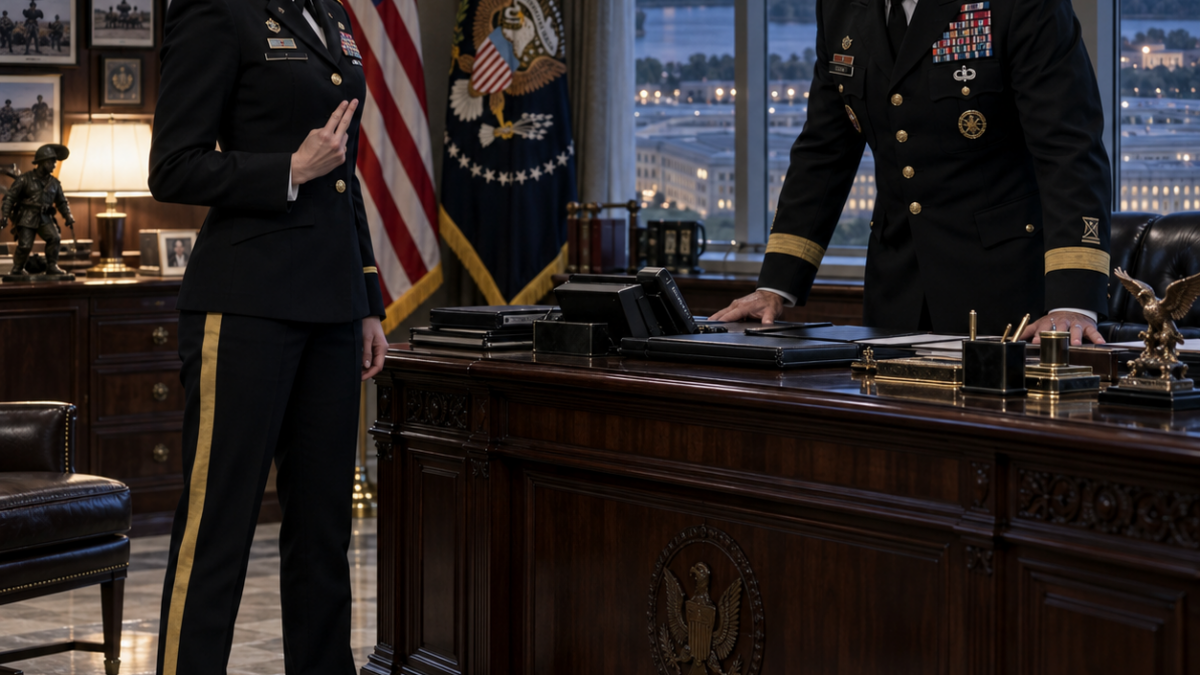
He turned fully toward me.
“Stand up.”
I rose.
The movement was calm.
Inside, every instinct sharpened.
“Let’s try something practical,” he said. “You are in a hostile safe house. Your team is across the street. You cannot speak. You need to warn them that the target is not alone.”
I did not move.
“What do you signal?”
“Sir?”
“You heard me.”
“With respect, sir, I would need to know what signal set had been established before the operation.”
His eyes gleamed.
“Use your best judgment.”
He wanted a mistake.
Any mistake.
Something to expose exaggeration, insecurity, or unauthorized knowledge.
The problem was that he had unknowingly stepped into the one part of my life where the truth was more dangerous than any lie.
Three years earlier, I had learned a signal set I was never supposed to know as an Army captain. I had learned it because my survival and the survival of a Navy SEAL team depended on it. I had used it under fire, in darkness, with blood on my sleeve and smoke filling my lungs.
But that knowledge lived behind layers of classification so deep that even acknowledging it could trigger investigations I was not cleared to explain.
I could have refused.
I should have refused.
Instead, my body betrayed me.
Or maybe it remembered before my mind could stop it.
A slight movement of the hand.
Two fingers.
Angle.
Pause.
Close.
To most people, it would look like nothing.
To the wrong person, it meant: target accompanied, armed presence, hold position.
Thompson saw it.
The change in him was immediate.
His face drained of color.
The authority in his expression collapsed into something raw and startled.
For a man who had commanded troops in war zones, briefed presidents, and built a career around intimidation, he suddenly looked as if the floor beneath him had opened.
His mouth parted.
No sound came out.
Then he whispered, “Captain Carter.”
I stood perfectly still.
His eyes were fixed on my hand.
“How in God’s name do you know that signal?”
The office seemed to shrink around us.
I heard the air conditioner.
My own breathing.
A distant phone ringing somewhere outside.
The smart answer would have been ignorance.
The truthful answer would have been treason against an oath I had sworn.
I said nothing.
Thompson’s shock hardened into suspicion.
He moved toward his desk with slow, deliberate steps.
“Captain, I’m going to ask you one more time, and I suggest you think very carefully before you answer.”
His hand hovered over the secure phone.
“How do you know classified Navy SEAL hand signals?”
My mind raced through every possible path.
If I lied and he could prove it, I was finished.
If I told the truth without authorization, people could die even three years later. Networks might still be active. Names still protected. Methods still classified.
“I cannot discuss that, sir.”
His jaw tightened.
“Wrong answer.”
“Sir, I am not refusing lawful authority. I am stating that the matter may involve compartmentalized information.”
“May involve?”
“Yes, sir.”
“Do you understand how this looks?”
“Yes, sir.”
“No, Captain. I don’t think you do.”
He picked up the secure phone and dialed a short extension.
“This is Thompson. I need a security team in my office immediately. Full lockdown protocol.”
The words struck like a door closing.
Full lockdown.
I had entered the office as an officer under review.
I was about to leave it as a security concern.
Maybe worse.
Thompson hung up and kept his eyes on me.
“You are not to leave this room or speak to anyone until this matter is resolved.”
“Understood.”
“Hands where I can see them.”
The humiliation of it burned more than I expected.
I placed my hands at my sides.
I had faced armed men who wanted to kill me.
I had crossed a hostile city under an assumed identity with a dead radio and a pistol I was not supposed to carry.
I had watched men bleed because they trusted me to get them home.
And now, inside the Pentagon, wearing the uniform I had spent my adult life honoring, I stood like a suspect in front of a general who thought I might be a traitor.
Security arrived in less than two minutes.
Two military police officers entered first, followed by a woman in a dark uniform whose name tape read Hayes.
Colonel Rebecca Hayes.
Counterintelligence.
Her eyes moved from Thompson to me to the file on his desk.
“What do we have, sir?”
Thompson did not look away from me.
“Captain Carter demonstrated knowledge of restricted Naval Special Warfare hand signals during an evaluation.”
Hayes’s expression did not change.
But the room became colder.
“Captain Carter,” she said, “you will come with us.”
I nodded once.
No protest.
No explanation.
Not because I was innocent.
Because innocence does not always protect you when the truth is classified.
They escorted me through a side corridor, away from the main administrative flow. Nobody stared openly, but people noticed.
They always notice.
A captain being walked by counterintelligence officers does not become invisible simply because everyone pretends to be professional.
We descended two levels.
Passed through a secured door.
Then another.
My phone, ID, and personal effects were removed and cataloged.
I was placed in a windowless interview room with a metal table, three chairs, a recording device, and walls painted a color that seemed designed to drain hope from the human body.
Hayes sat across from me.
She opened a folder.
“Captain Amanda Carter. Army intelligence. West Point. Combat deployments. Commendations. No disciplinary history.”
She looked up.
“Until today.”
“I have not violated any regulation knowingly, ma’am.”
“We’ll determine that.”
For the next six hours, they questioned me.
Hayes began with professionalism.
Major Williams followed with skepticism sharp enough to draw blood.
A civilian analyst whose name I never caught asked questions so quietly they somehow felt more threatening.
They went through everything.
Training history.
Deployment timelines.
Foreign contacts.
Financial records.
Personal relationships.
Unit assignments.
Travel.
Languages.
Every badge I had ever held.
Every base I had entered.
Every classified system I had accessed.
Again and again, they returned to the same missing eight months.
“Your file lists a classified assignment,” Major Williams said, tapping the page. “No location. No mission. No attached command structure. Convenient.”
“I was assigned to a joint intelligence fusion center,” I said.
“Which one?”
“I am not authorized to discuss that at this clearance level.”
“We contacted every joint intelligence fusion center active during that window. None have record of you.”
“Then the record is held elsewhere.”
“Where?”
“I am not authorized to discuss that.”
He leaned back.
“You understand how absurd that sounds.”
“Yes.”
“And yet that’s your answer.”
“Yes.”
Hayes returned later with coffee she did not offer me.
She sat down slowly.
“Captain, your story has not changed.”
“No, ma’am.”
“That can mean consistency. It can also mean preparation.”
I said nothing.
She opened another folder.
“Let’s be direct. We know you’re hiding something. The question is whether you’re hiding it because you’re protecting a legitimate classified operation or because you’re compromised.”
The word sat on the table between us.
Compromised.
In my world, few accusations carried more weight.
I felt exhaustion pressing against the edges of my discipline. Six hours of repetition had done what it was designed to do. My head hurt. My throat was dry. My back ached from sitting upright under fluorescent lights.
Still, I held the line.
“If I were hypothetically aware of information classified beyond the level available to this room,” I said carefully, “what would be the proper procedure for validating that without forcing unauthorized disclosure?”
Hayes studied me.
For the first time, something like doubt entered her eyes.
“Are you claiming such a compartment exists?”
“I am asking a procedural question.”
“Captain Carter.”
“Ma’am.”
“If there is someone who can verify your claim, you need to give us a name.”
There was a name.
I had carried it for three years like a sealed letter against my heart.
Admiral Thomas Mitchell.
United States Navy.
At the time of the operation, he had overseen the task force that officially did not exist in the form we had used it.
But giving his name was itself a risk.
If he denied knowledge, I was finished.
If he was unreachable, I was finished.
If the compartment had shifted and my access had been buried deeper than my current protections could prove, I was finished.
And yet the alternative was worse.
They would keep digging.
Eventually, they might break open something they had no authority to expose.
I looked at Hayes.
“Admiral Thomas Mitchell.”
Her pen stopped.
“Spell it.”
I did.
She did not react, but I saw the recognition.
Everyone in that room knew the name.
Mitchell was not a man people invoked casually.
Hayes closed the folder and stood.
“Remain here.”
She left.
The door locked behind her.
For the first time since the interview began, I was alone.
That was when the fear finally came.
Not panic.
Not tears.
Something quieter and more corrosive.
I imagined my career ending in a classified file no one would ever see. I imagined my parents receiving a careful, meaningless explanation. I imagined the men from Syria—Rodriguez, Ellis, Banks, Reardon, Shah, Miller, Torres, and Vance—learning that the woman they had trusted had been accused of betraying what she had nearly died to protect.
I pressed my hands together beneath the table.
My wrists hurt from tension.
For three years, I had lived inside a contradiction.
The most important thing I had ever done could not be spoken aloud.
The bravest choice of my life existed as a blank space in my service record.
I had received no public medal.
No ceremony.
No acknowledgment beyond a classified debrief and a warning that operational security would remain absolute.
I had told myself I did not need recognition.
Most days, I believed that.
But sitting alone in that room, accused by implication of treason, I realized something painful.
Secrecy does not only hide the mission.
Sometimes it hides the person who survived it.
The door opened nearly forty minutes later.
Colonel Hayes entered first.
Behind her was a man in a dark Navy uniform with silver hair, tired eyes, and the kind of presence that made everyone in the room straighten without being told.
Admiral Thomas Mitchell.
I stood so quickly the chair scraped the floor.
“Sir.”
He looked at me for a long moment.
There was recognition in his face.
And anger.
Not at me.
That almost broke me.
“Captain Carter,” he said.
Hayes remained near the door.
Mitchell turned to her.
“Leave us.”
“Sir, this is an active counterintelligence—”
“I said leave us.”
His voice did not rise.
It did not need to.
Hayes hesitated only a second before stepping out.
Mitchell waited until the door closed.
Then he walked to the recording device and switched it off.
From his pocket, he removed a small electronic device and activated it.
A faint hum filled the room.
Signal jammer.
Only then did he sit across from me.
“Captain Amanda Carter,” he said quietly. “Or should I say Jessica Morgan, war correspondent for Global News Network?”
The name hit me harder than the interrogation had.
Jessica Morgan.
My alias.
My ghost.
For three years, nobody had spoken that name to me.
Not once.
I felt tears rise so suddenly I had to clench my jaw to hold them back.
“Sir,” I managed, “I wasn’t sure you’d remember.”
Mitchell laughed once, but there was no humor in it.
“Remember? Captain, what you did in Syria is burned into my memory.”
I sat down slowly.
He leaned forward.
“Now tell me how the hell you ended up in an interrogation room inside the Pentagon.”
So I told him.
General Thompson’s interview.
The scenario.
The hand signal.
The lockdown.
The questions.
The accusation hanging over every word.
As I spoke, Mitchell’s expression darkened.
By the time I finished, his jaw was tight.
“Those idiots,” he muttered.
I had never heard an admiral sound so close to fury.
“They nearly blew open an operation three years in the making because Thompson wanted to play psychological chess.”
“He recognized the signal,” I said.
“Of course he did. Thompson worked near enough to special operations in the past to know fragments. Not enough to understand what he was touching.”
He looked at me.
“Have you told them anything about Syria?”
“No, sir.”
“Nothing?”
“Nothing beyond your name.”
His shoulders eased slightly.
“Good.”
He leaned back, eyes fixed on mine.
“What I’m about to say still cannot leave this room in full. Not yet. Maybe not ever.”
“I understand.”
“Do you?”
“Yes, sir.”
He studied me.
Then his voice softened.
“I don’t think anyone ever properly told you what you did.”
I looked down.
“That wasn’t the mission.”
“No. But maybe it should have been part of the aftermath.”
I said nothing.
Mitchell folded his hands on the table.
“Three years ago, we had intelligence indicating that a Syria-based extremist network was planning coordinated attacks against American diplomatic and military targets. We needed someone who could get close to a courier cell operating under humanitarian cover.”
I remembered every detail.
The dust.
The heat.
The smell of diesel and old concrete.
The scarf I wore to hide the small earpiece when it still worked.
My press badge.
My camera.
My false biography.
Journalist Jessica Morgan.
Freelance conflict correspondent with Global News Network.
In reality, I was an Army intelligence officer placed under temporary joint command.
My job had been to enter a network no uniformed service member could approach.
The cell believed they were using me to push propaganda through Western media channels.
We believed I was using them to identify their leadership, couriers, and attack timeline.
For three weeks, our side was right.
Then we weren’t.
Mitchell continued.
“You trained with Rodriguez’s SEAL element for rapid recognition signals, emergency movement, and nonverbal coordination. He told me you were the fastest study he’d ever seen.”
Despite everything, I smiled.
Chief Petty Officer Miguel Rodriguez had hated me at first.
Not personally.
Professionally.
To him, I was an Army intelligence officer inserted into a Navy operation under an alias, with just enough training to become a liability.
On the first day, he had looked me up and down and said, “Ma’am, no offense, but if this goes sideways, your press badge won’t stop bullets.”
I had answered, “No, Chief. That’s why I’m listening.”
By the end of the first week, he called me Doc because I kept correcting mistranslations in field reports like a professor marking essays.
By the end of the second, he trusted me enough to teach me the things not written in any manual.
Short signals.
Emergency warnings.
Hold.
Move.
Compromised.
Multiple hostiles.
Do not enter.
The signal Thompson had seen was one of them.
I had used it once in Syria.
That single movement had stopped Rodriguez’s team from entering a doorway wired for death.
Mitchell watched my face.
“You remember the safe house?”
My throat tightened.
“Yes.”
The morning everything collapsed began with an empty room.
I had arrived expecting to meet a courier who claimed to have details about an attack timeline.
Instead, I found a table overturned, a blood smear on the floor, and a message scratched into the wall in Arabic.
The Americans are here.
For three weeks, we had believed we were penetrating their network.
They had been studying ours.
They had fed us enough truth to earn trust, enough lies to shape our movements, and enough bait to expose four safe locations.
Their attack began less than six minutes after I found the message.
Four operational sites hit simultaneously.
Communications degraded almost immediately.
The extraction helicopter assigned to Rodriguez’s element was struck before it reached the landing zone.
Backup was hours away.
Rodriguez’s team was pinned in a building surrounded by hostile fighters.
I was supposed to maintain cover.
That had been the order.
If compromised, preserve the intelligence channel if possible.
Do not expose U.S. operational presence unless authorized.
Do not self-identify.
Do not improvise beyond mission constraints.
Those instructions made sense in planning rooms.
They made less sense when eight Americans were trapped and dying over the radio.
I could still hear Rodriguez’s voice.
“Jessica, if you can hear me, stay out of this. Maintain cover.”
He knew what he was asking.
If I walked away, I might preserve the larger operation.
If I intervened, I would destroy months of work and possibly start an international incident no one would officially acknowledge.
Then I heard gunfire through the transmission.
Someone shouted for a tourniquet.
Someone else screamed.
I made my choice.
I broke cover.
Not dramatically.
Not like movies portray courage.
There was no music. No slow motion. No certainty.
There was only terror and the knowledge that if I did nothing, men who had trusted me would die while I protected paperwork.
I used every lie the cell believed about me.
Every contact.
Every piece of street-level access my cover had built.
I moved through checkpoints as Jessica Morgan, panicked journalist, shouting about civilian casualties in the wrong district. I redirected local attention. Fed false information into a channel I knew the hostile cell monitored. Created the impression that their leadership had been betrayed from inside.
Chaos buys time when used carefully.
I bought twenty-three minutes.
Then I reached the building across from Rodriguez’s position.
From a broken window, I saw movement near the alley.
Three armed men preparing to enter through a side door.
Rodriguez’s team could not see them.
I could not speak.
The radio was intermittent.
So I used the signal.
Target accompanied.
Armed presence.
Hold position.
Rodriguez saw it.
He stopped his men.
The side door exploded seconds later.
If they had entered, the blast would have killed them.
After that, everything became motion.
I coordinated through fragments.
Hand signals.
Broken radio bursts.
Local power outages triggered through a contact who thought I was helping expose a massacre.
A false media alert that pulled hostile fighters toward the wrong street.
A narrow escape route through a basement I had mapped two weeks earlier.
When extraction finally came, eight SEALs were alive.
Two were badly wounded.
All eight came home.
My cover was destroyed.
The operation was burned.
The planned attacks were disrupted because the network panicked after believing its own people had turned.
Later, analysts would say my decision prevented a terrorist attack on American soil.
But the official file remained sealed.
Publicly, Jessica Morgan disappeared.
Officially, Captain Amanda Carter returned from a classified joint assignment with an eight-month gap and eyes that no longer slept well.
Mitchell’s voice brought me back to the interrogation room.
“You could have run,” he said. “You could have preserved your cover. You could have followed the strict reading of your orders.”
“No, sir.”
“No?”
I looked at him.
“Not after I heard Rodriguez.”
He nodded slowly.
“That’s what he said you’d say.”
My chest tightened.
“You’ve spoken to him?”
“More than once. He asks about you every year.”
I looked away.
I had not allowed myself to ask about the team.
I had been told separation was necessary.
No contact.
No reunions.
No shared acknowledgment.
Compartmentalization protects operations, but it can feel very much like abandonment.
Mitchell leaned forward.
“Rodriguez told me something after the extraction. He said, ‘That Army captain moved like she’d been one of ours her whole life.'”
I closed my eyes.
The tears came then.
Silent.
Uncontrolled.
Six hours of interrogation had not broken me.
One sentence almost did.
Mitchell let me compose myself.
Then he said, “You maintained operational security today under extreme pressure.”
“I was terrified.”
“Good. Only fools aren’t.”
“I thought my career was over.”
“It nearly was.”
I looked up.
He did not soften the truth.
“Thompson had enough suspicion to trigger a legitimate inquiry. Hayes did what counterintelligence is supposed to do. But none of them had enough context to understand what they were holding.”
“What happens now?”
“Now I clean up the mess.”
He switched off the jammer, stood, and walked to the door.
Before opening it, he turned back.
“Captain, you did not betray your oath today.”
My throat tightened.
“Thank you, sir.”
“You honored it.”
Then he opened the door.
Colonel Hayes stood outside with Major Williams and General Thompson.
Thompson’s face was hard to read.
His usual severity remained, but something behind it had shifted.
Mitchell stepped into the hall.
“Conference room. Now.”
No one questioned him.
I was escorted—not as a suspect this time, but not quite as free either—to a secure briefing room down the corridor.
Mitchell ordered the room cleared of everyone except Thompson, Hayes, Williams, one legal officer, and a secure records custodian.
The door closed.
Mitchell placed a sealed authorization packet on the table.
“You are about to be read into limited portions of a compartmented operation for the purpose of resolving a wrongful suspicion involving Captain Amanda Carter. You will not discuss this outside authorized channels. You will not copy these materials. You will not refer to this in any unclassified record.”
No one spoke.
He looked at Thompson.
“Do you understand, General?”
Thompson’s jaw worked once.
“I understand.”
Mitchell began.
He did not tell them everything.
Not the names of local sources.
Not current methods.
Not details still locked behind active protection.
But he told them enough.
The alias.
The joint assignment.
The training with Rodriguez’s element.
The compromise.
The rescue.
The attacks prevented.
The eight SEALs saved.
And the reason Captain Amanda Carter knew a Navy SEAL hand signal no Army intelligence officer should ever have learned.
Nobody interrupted.
Hayes sat very still.
Major Williams’s face reddened slowly as the meaning of his accusations settled over him.
Thompson stared at the table.
For once, the famous general had nothing to say.
When Mitchell finished, he removed another folder from his case.
“This recognition was delayed due to classification restrictions. Given today’s events, the department has authorized limited formal acknowledgment within secure military channels.”
He opened the folder.
My breath caught.
Inside was a citation.
Navy Cross.
My name.
Captain Amanda Carter.
For extraordinary heroism in support of joint special operations under hostile conditions.
I could not move.
For three years, I had told myself recognition did not matter.
But seeing those words, seeing the truth no longer buried entirely beneath black ink, something inside me gave way.
Mitchell looked at me.
“This does not make the operation public. It does not release you from secrecy. But it corrects the record where the record needed correcting.”
General Thompson stood.
The movement was slow.
Heavy.
For the first time since I had entered his office, he looked his age.
“Captain Carter.”
I stood automatically.
He stepped forward.
“I owe you an apology.”
The room was utterly silent.
“My test was designed to evaluate pressure response and operational judgment. It was aggressive by design. But I failed to recognize when I had crossed from evaluation into endangerment.”
He swallowed.
“I saw a signal and assumed unauthorized knowledge. I did not consider the possibility that your silence was protecting something larger than your own reputation.”
I did not know what to say.
So I gave the simplest answer.
“Thank you, sir.”
He shook his head.
“No. Thank you.”
Colonel Hayes approached next.
Her expression remained controlled, but her eyes had changed.
“Captain, I’ve conducted interrogations for eighteen years. I have seen people lie, collapse, deflect, and bargain under less pressure than you endured today.”
She extended her hand.
“You maintained security even when accused of betraying it. That is rare.”
I shook her hand.
Major Williams looked as though he would rather be anywhere else.
“Captain,” he said stiffly, “my conduct was within interrogation parameters, but my assumptions were wrong.”
That was not quite an apology.
But for that room, it was enough.
Mitchell turned to the records custodian.
“Update Captain Carter’s restricted file. Ensure future clearance reviews show protected compartment verification. No more fishing expeditions into that eight-month gap without flagging my office.”
“Yes, sir.”
For the first time all day, I felt air enter my lungs fully.
Not relief exactly.
Relief is light.
This felt heavy.
Like a door that had been locked for years had opened only far enough to prove there had been a room behind it all along.
After the meeting, Mitchell walked with me through a secure corridor.
Neither of us spoke at first.
Then he said, “Rodriguez wanted to be here.”
I stopped.
“He knows?”
“He’ll be briefed that the recognition moved forward. Nothing beyond that.”
I nodded.
“How is he?”
“Still stubborn. Still impossible. Still alive.”
I smiled through the ache in my chest.
“Good.”
Mitchell reached into his jacket and removed a small sealed envelope.
“He asked me to give you this if the day ever came when the truth surfaced enough.”
My hands trembled as I took it.
Inside was a note, folded once.
The handwriting was blocky and uneven.
Carter,
You once told me Army intelligence officers don’t do dramatic rescues. You were wrong. You came for us when every rule told you not to. Eight of us went home because you chose people over cover. I don’t care what your file says. To us, you were never just Jessica and never just Captain Carter. You were Ghost Walker—the one who moved through hell quietly and brought us out.
—Rodriguez
I pressed the note to my chest.
Mitchell looked away, giving me privacy without leaving.
For three years, I had carried the weight of silence alone.
Suddenly, it was not gone.
But it was shared.
That changed everything.
By the time I left the Pentagon, evening had settled over Washington.
The sky was streaked with gold and gray. The Potomac reflected the last light in broken pieces.
I stepped outside in my dress uniform with the sealed citation packet under one arm and Rodriguez’s note tucked safely inside my jacket.
Nothing about the world looked different.
Cars moved through traffic.
People crossed sidewalks.
A helicopter thudded faintly in the distance.
But I felt changed in a way I could not yet name.
That morning, I had entered the Pentagon as Captain Amanda Carter, Army intelligence officer with a mysterious gap in her file.
By sunset, at least within the walls that mattered, the gap had a name.
Syria.
Jessica Morgan.
Rodriguez.
Eight men alive.
A terror plot disrupted.
Ghost Walker.
I did not need the whole world to know.
I did not need cameras or speeches or public applause.
In some ways, secrecy still protected the best parts of what we had done.
But I needed the truth to exist somewhere outside my own memory.
Now it did.
As I walked toward my car, my phone buzzed with a secure message notification.
No sender name appeared.
Only one line.
Some signals are worth remembering.
I stood beneath the fading light and smiled for the first time all day.
Then I looked back at the Pentagon.
For years, I had believed my silence was a cage.
Maybe it had been.
But it had also been a promise.
A promise to the men who trusted me.
A promise to the mission.
A promise to the woman I had been when everything went wrong and there was no time left to ask permission.
Tomorrow would bring new questions.
New duties.
New shadows.
But that night, I drove home with Rodriguez’s words close to my heart and the weight of the Navy Cross no longer feeling like a secret pressed into darkness.
For the first time in three years, I was not only the keeper of a classified truth.
I was allowed to be proud of surviving it.
And even if the world never knew the full story, I knew.
So did they.
That was enough.
𝗧𝗛𝗘 𝗘𝗡𝗗
The Signal I Was Never Supposed to Know
For three years, I carried a secret so deep that even defending myself could have destroyed me.
Then one careless test inside the Pentagon forced me to choose between my career and the oath that had kept eight men alive.
General Thompson thought he was studying me, but the moment he saw my hand move, I watched fear replace every ounce of authority in his eyes.
The corridor outside General Marcus Thompson’s office looked longer than it had any right to be.
Maybe it was the polished marble floor reflecting the fluorescent lights overhead. Maybe it was the silence between footsteps, the kind of silence that exists only in buildings where every closed door hides something classified, political, or dangerous. Or maybe it was because I knew exactly who waited at the end of that hallway.
I had been summoned to the Pentagon before.
Briefings. Reviews. Threat assessments. Joint intelligence coordination sessions where everyone pretended the decisions were cleaner than they were.
But this felt different.
My name was Captain Amanda Carter, United States Army intelligence officer. On paper, I was a strong candidate for advancement. West Point. Top five percent of my class. Deployments in Iraq and Afghanistan. Multiple commendations. Clean service record.
Almost clean.
There was one gap in my file that nobody at my level was allowed to explain.
Eight months.
No unit listed.
No location listed.
No operational summary.
Just one phrase: classified assignment.
That phrase had protected me for three years.
It had also trapped me for three years.
I stopped outside the heavy oak door and adjusted my dress uniform one last time. My reflection looked back at me from a framed glass panel nearby: straight posture, polished shoes, ribbons aligned, hair pinned so tightly it made my scalp ache.
I looked exactly like what I was supposed to be.
A disciplined officer.
A professional.
A woman who knew how to keep her secrets buried.
The brass nameplate on the door read:
General M. Thompson
Deputy Chief of Staff for Intelligence
I had heard his name for years.
Everyone in military intelligence had.
General Marcus Thompson was one of those men whose reputation entered a room before he did. Gulf War veteran. Former enlisted soldier who had climbed through the ranks by being smarter, harder, and more relentless than almost everyone around him. Some called him brilliant. Some called him ruthless.
Most said both.
He was known for testing officers in ways that never appeared on formal evaluations. A question that sounded casual might be a loyalty probe. A joke might be bait. A compliment might be a pressure point.
He did not simply interview people.
He dissected them.
I knocked twice.
“Enter.”
The voice on the other side was rough, low, and impatient.
I opened the door.
The office was exactly what I expected.
Photographs of Thompson with presidents, cabinet officials, foreign defense ministers, and commanders lined the walls. Medals and framed citations created a geography of power behind his desk. The American flag stood to one side, the Army flag to the other.
And the desk itself was enormous.
Mahogany.
Immaculate.
Dominating the room like an aircraft carrier in a narrow harbor.
Behind it sat General Thompson.
Early sixties. Steel-gray hair. Square jaw. Eyes that looked up from my file and scanned me with the cool precision of a weapons system locking onto a target.
“Captain Carter.”
“Sir.”
He did not offer his hand.
“West Point. Top five percent. Intelligence branch. Iraq. Afghanistan.” He turned one page. “Several classified locations that appear to have swallowed the details whole.”
I said nothing.
He lifted his eyes.
“Sit.”
I sat in the leather chair across from him, keeping my posture straight even as the cushion tried to pull me backward.
He read in silence.
The room hummed faintly with climate control. Somewhere beyond the thick walls, footsteps and distant voices moved through the Pentagon’s bloodstream.
General Thompson let the silence stretch.
That was the first test.
Most people try to fill silence when they feel examined. They explain. Add context. Volunteer harmless details that sometimes become harmful later.
I had learned better.
Three years earlier, in a place I still could not officially name, silence had been the only thing between me and death.
So I sat quietly.
Finally, Thompson closed the file with a sharp snap.
“Tell me, Captain. What separates a good intelligence officer from a great one?”
I had prepared for questions like that.
“Attention to detail, sir. The ability to identify patterns where others see noise. And the judgment to know when information is actionable rather than merely interesting.”
His mouth twitched.
“Textbook answer.”
I kept my face still.
He stood and moved toward the window overlooking the Potomac.
“But you know what I think?”
“No, sir.”
“I think great intelligence officers understand that everyone is testing everyone else all the time.”
He turned from the window.
“Every conversation. Every gesture. Every seemingly innocent comment. All of it can be a probe.”
My pulse remained steady, but something in the room shifted.
This was no longer a promotion review.
This was the part everyone warned me about.
Thompson began walking slowly along the wall of photographs.
“You young officers today come out of schools thinking you’re sophisticated. You learn tradecraft in classrooms. You memorize case studies. You run simulations and think that prepares you for the real world.”
His voice sharpened.
“Real intelligence work is learned in the field, Captain. Not in sanitized briefing rooms. Not in textbooks.”
“I agree, sir.”
“Do you?”
“Yes, sir.”
He studied me.
“Then let’s stop giving textbook answers.”
He moved behind his desk again but did not sit.
“Suppose you’re operating in a hostile environment. Your source is compromised, your extraction plan fails, and your communications are unreliable. What do you do?”
There it was.
A scenario.
Not unusual.
But something about the sequence struck too close to memory.
Hostile environment.
Compromised source.
Failed extraction.
Unreliable communications.
I saw a blood stain on a concrete floor.
A message scrawled in Arabic.
Rodriguez’s voice breaking through static.
I pushed the memory down.
“First, confirm the compromise. Second, assess whether remaining assets can be preserved. Third, determine whether the mission objective is still achievable without unacceptable loss.”
“And if all options carry unacceptable loss?”
“Then the definition of unacceptable changes.”
Thompson smiled.
For the first time, he looked interested.
“Meaning?”
“Meaning sometimes you choose the option that saves lives even if it burns the operation.”
His eyes narrowed slightly.
“That sounds sentimental.”
“No, sir. It sounds practical. Dead assets provide no future intelligence.”
He nodded slowly.
“Better.”
Then he stepped closer.
“What about unauthorized communication methods?”
My fingers remained still on my knee.
“Could you clarify, sir?”
“Signals. Gestures. Improvised field language. Nonverbal coordination with units outside your branch.”
I felt a thin blade of cold slide between my ribs.
He was fishing.
Maybe randomly.
Maybe not.
“Those methods would depend on the operational environment and mission authorization,” I said.
“Careful answer.”
“Accurate answer.”
Thompson laughed once, without warmth.
“Captain Carter, I have reviewed a great many officers who believed caution was the same as discipline.”
“Caution is not always discipline, sir.”
“And what is discipline?”
“Knowing what not to reveal.”
The words left my mouth before I could soften them.
Thompson stared at me.
For a moment, neither of us moved.
Then he smiled in a way that made the room feel smaller.
“Interesting.”
He walked back to the window.
“And if a superior officer orders you to reveal something?”
“That depends on whether the superior officer has need-to-know.”
The smile vanished.
“Are you suggesting I may not?”
“I am answering the question generally, sir.”
He turned fully toward me.
“Stand up.”
I rose.
The movement was calm.
Inside, every instinct sharpened.
“Let’s try something practical,” he said. “You are in a hostile safe house. Your team is across the street. You cannot speak. You need to warn them that the target is not alone.”
I did not move.
“What do you signal?”
“Sir?”
“You heard me.”
“With respect, sir, I would need to know what signal set had been established before the operation.”
His eyes gleamed.
“Use your best judgment.”
He wanted a mistake.
Any mistake.
Something to expose exaggeration, insecurity, or unauthorized knowledge.
The problem was that he had unknowingly stepped into the one part of my life where the truth was more dangerous than any lie.
Three years earlier, I had learned a signal set I was never supposed to know as an Army captain. I had learned it because my survival and the survival of a Navy SEAL team depended on it. I had used it under fire, in darkness, with blood on my sleeve and smoke filling my lungs.
But that knowledge lived behind layers of classification so deep that even acknowledging it could trigger investigations I was not cleared to explain.
I could have refused.
I should have refused.
Instead, my body betrayed me.
Or maybe it remembered before my mind could stop it.
A slight movement of the hand.
Two fingers.
Angle.
Pause.
Close.
To most people, it would look like nothing.
To the wrong person, it meant: target accompanied, armed presence, hold position.
Thompson saw it.
The change in him was immediate.
His face drained of color.
The authority in his expression collapsed into something raw and startled.
For a man who had commanded troops in war zones, briefed presidents, and built a career around intimidation, he suddenly looked as if the floor beneath him had opened.
His mouth parted.
No sound came out.
Then he whispered, “Captain Carter.”
I stood perfectly still.
His eyes were fixed on my hand.
“How in God’s name do you know that signal?”
The office seemed to shrink around us.
I heard the air conditioner.
My own breathing.
A distant phone ringing somewhere outside.
The smart answer would have been ignorance.
The truthful answer would have been treason against an oath I had sworn.
I said nothing.
Thompson’s shock hardened into suspicion.
He moved toward his desk with slow, deliberate steps.
“Captain, I’m going to ask you one more time, and I suggest you think very carefully before you answer.”
His hand hovered over the secure phone.
“How do you know classified Navy SEAL hand signals?”
My mind raced through every possible path.
If I lied and he could prove it, I was finished.
If I told the truth without authorization, people could die even three years later. Networks might still be active. Names still protected. Methods still classified.
“I cannot discuss that, sir.”
His jaw tightened.
“Wrong answer.”
“Sir, I am not refusing lawful authority. I am stating that the matter may involve compartmentalized information.”
“May involve?”
“Yes, sir.”
“Do you understand how this looks?”
“Yes, sir.”
“No, Captain. I don’t think you do.”
He picked up the secure phone and dialed a short extension.
“This is Thompson. I need a security team in my office immediately. Full lockdown protocol.”
The words struck like a door closing.
Full lockdown.
I had entered the office as an officer under review.
I was about to leave it as a security concern.
Maybe worse.
Thompson hung up and kept his eyes on me.
“You are not to leave this room or speak to anyone until this matter is resolved.”
“Understood.”
“Hands where I can see them.”
The humiliation of it burned more than I expected.
I placed my hands at my sides.
I had faced armed men who wanted to kill me.
I had crossed a hostile city under an assumed identity with a dead radio and a pistol I was not supposed to carry.
I had watched men bleed because they trusted me to get them home.
And now, inside the Pentagon, wearing the uniform I had spent my adult life honoring, I stood like a suspect in front of a general who thought I might be a traitor.
Security arrived in less than two minutes.
Two military police officers entered first, followed by a woman in a dark uniform whose name tape read Hayes.
Colonel Rebecca Hayes.
Counterintelligence.
Her eyes moved from Thompson to me to the file on his desk.
“What do we have, sir?”
Thompson did not look away from me.
“Captain Carter demonstrated knowledge of restricted Naval Special Warfare hand signals during an evaluation.”
Hayes’s expression did not change.
But the room became colder.
“Captain Carter,” she said, “you will come with us.”
I nodded once.
No protest.
No explanation.
Not because I was innocent.
Because innocence does not always protect you when the truth is classified.
They escorted me through a side corridor, away from the main administrative flow. Nobody stared openly, but people noticed.
They always notice.
A captain being walked by counterintelligence officers does not become invisible simply because everyone pretends to be professional.
We descended two levels.
Passed through a secured door.
Then another.
My phone, ID, and personal effects were removed and cataloged.
I was placed in a windowless interview room with a metal table, three chairs, a recording device, and walls painted a color that seemed designed to drain hope from the human body.
Hayes sat across from me.
She opened a folder.
“Captain Amanda Carter. Army intelligence. West Point. Combat deployments. Commendations. No disciplinary history.”
She looked up.
“Until today.”
“I have not violated any regulation knowingly, ma’am.”
“We’ll determine that.”
For the next six hours, they questioned me.
Hayes began with professionalism.
Major Williams followed with skepticism sharp enough to draw blood.
A civilian analyst whose name I never caught asked questions so quietly they somehow felt more threatening.
They went through everything.
Training history.
Deployment timelines.
Foreign contacts.
Financial records.
Personal relationships.
Unit assignments.
Travel.
Languages.
Every badge I had ever held.
Every base I had entered.
Every classified system I had accessed.
Again and again, they returned to the same missing eight months.
“Your file lists a classified assignment,” Major Williams said, tapping the page. “No location. No mission. No attached command structure. Convenient.”
“I was assigned to a joint intelligence fusion center,” I said.
“Which one?”
“I am not authorized to discuss that at this clearance level.”
“We contacted every joint intelligence fusion center active during that window. None have record of you.”
“Then the record is held elsewhere.”
“Where?”
“I am not authorized to discuss that.”
He leaned back.
“You understand how absurd that sounds.”
“Yes.”
“And yet that’s your answer.”
“Yes.”
Hayes returned later with coffee she did not offer me.
She sat down slowly.
“Captain, your story has not changed.”
“No, ma’am.”
“That can mean consistency. It can also mean preparation.”
I said nothing.
She opened another folder.
“Let’s be direct. We know you’re hiding something. The question is whether you’re hiding it because you’re protecting a legitimate classified operation or because you’re compromised.”
The word sat on the table between us.
Compromised.
In my world, few accusations carried more weight.
I felt exhaustion pressing against the edges of my discipline. Six hours of repetition had done what it was designed to do. My head hurt. My throat was dry. My back ached from sitting upright under fluorescent lights.
Still, I held the line.
“If I were hypothetically aware of information classified beyond the level available to this room,” I said carefully, “what would be the proper procedure for validating that without forcing unauthorized disclosure?”
Hayes studied me.
For the first time, something like doubt entered her eyes.
“Are you claiming such a compartment exists?”
“I am asking a procedural question.”
“Captain Carter.”
“Ma’am.”
“If there is someone who can verify your claim, you need to give us a name.”
There was a name.
I had carried it for three years like a sealed letter against my heart.
Admiral Thomas Mitchell.
United States Navy.
At the time of the operation, he had overseen the task force that officially did not exist in the form we had used it.
But giving his name was itself a risk.
If he denied knowledge, I was finished.
If he was unreachable, I was finished.
If the compartment had shifted and my access had been buried deeper than my current protections could prove, I was finished.
And yet the alternative was worse.
They would keep digging.
Eventually, they might break open something they had no authority to expose.
I looked at Hayes.
“Admiral Thomas Mitchell.”
Her pen stopped.
“Spell it.”
I did.
She did not react, but I saw the recognition.
Everyone in that room knew the name.
Mitchell was not a man people invoked casually.
Hayes closed the folder and stood.
“Remain here.”
She left.
The door locked behind her.
For the first time since the interview began, I was alone.
That was when the fear finally came.
Not panic.
Not tears.
Something quieter and more corrosive.
I imagined my career ending in a classified file no one would ever see. I imagined my parents receiving a careful, meaningless explanation. I imagined the men from Syria—Rodriguez, Ellis, Banks, Reardon, Shah, Miller, Torres, and Vance—learning that the woman they had trusted had been accused of betraying what she had nearly died to protect.
I pressed my hands together beneath the table.
My wrists hurt from tension.
For three years, I had lived inside a contradiction.
The most important thing I had ever done could not be spoken aloud.
The bravest choice of my life existed as a blank space in my service record.
I had received no public medal.
No ceremony.
No acknowledgment beyond a classified debrief and a warning that operational security would remain absolute.
I had told myself I did not need recognition.
Most days, I believed that.
But sitting alone in that room, accused by implication of treason, I realized something painful.
Secrecy does not only hide the mission.
Sometimes it hides the person who survived it.
The door opened nearly forty minutes later.
Colonel Hayes entered first.
Behind her was a man in a dark Navy uniform with silver hair, tired eyes, and the kind of presence that made everyone in the room straighten without being told.
Admiral Thomas Mitchell.
I stood so quickly the chair scraped the floor.
“Sir.”
He looked at me for a long moment.
There was recognition in his face.
And anger.
Not at me.
That almost broke me.
“Captain Carter,” he said.
Hayes remained near the door.
Mitchell turned to her.
“Leave us.”
“Sir, this is an active counterintelligence—”
“I said leave us.”
His voice did not rise.
It did not need to.
Hayes hesitated only a second before stepping out.
Mitchell waited until the door closed.
Then he walked to the recording device and switched it off.
From his pocket, he removed a small electronic device and activated it.
A faint hum filled the room.
Signal jammer.
Only then did he sit across from me.
“Captain Amanda Carter,” he said quietly. “Or should I say Jessica Morgan, war correspondent for Global News Network?”
The name hit me harder than the interrogation had.
Jessica Morgan.
My alias.
My ghost.
For three years, nobody had spoken that name to me.
Not once.
I felt tears rise so suddenly I had to clench my jaw to hold them back.
“Sir,” I managed, “I wasn’t sure you’d remember.”
Mitchell laughed once, but there was no humor in it.
“Remember? Captain, what you did in Syria is burned into my memory.”
I sat down slowly.
He leaned forward.
“Now tell me how the hell you ended up in an interrogation room inside the Pentagon.”
So I told him.
General Thompson’s interview.
The scenario.
The hand signal.
The lockdown.
The questions.
The accusation hanging over every word.
As I spoke, Mitchell’s expression darkened.
By the time I finished, his jaw was tight.
“Those idiots,” he muttered.
I had never heard an admiral sound so close to fury.
“They nearly blew open an operation three years in the making because Thompson wanted to play psychological chess.”
“He recognized the signal,” I said.
“Of course he did. Thompson worked near enough to special operations in the past to know fragments. Not enough to understand what he was touching.”
He looked at me.
“Have you told them anything about Syria?”
“No, sir.”
“Nothing?”
“Nothing beyond your name.”
His shoulders eased slightly.
“Good.”
He leaned back, eyes fixed on mine.
“What I’m about to say still cannot leave this room in full. Not yet. Maybe not ever.”
“I understand.”
“Do you?”
“Yes, sir.”
He studied me.
Then his voice softened.
“I don’t think anyone ever properly told you what you did.”
I looked down.
“That wasn’t the mission.”
“No. But maybe it should have been part of the aftermath.”
I said nothing.
Mitchell folded his hands on the table.
“Three years ago, we had intelligence indicating that a Syria-based extremist network was planning coordinated attacks against American diplomatic and military targets. We needed someone who could get close to a courier cell operating under humanitarian cover.”
I remembered every detail.
The dust.
The heat.
The smell of diesel and old concrete.
The scarf I wore to hide the small earpiece when it still worked.
My press badge.
My camera.
My false biography.
Journalist Jessica Morgan.
Freelance conflict correspondent with Global News Network.
In reality, I was an Army intelligence officer placed under temporary joint command.
My job had been to enter a network no uniformed service member could approach.
The cell believed they were using me to push propaganda through Western media channels.
We believed I was using them to identify their leadership, couriers, and attack timeline.
For three weeks, our side was right.
Then we weren’t.
Mitchell continued.
“You trained with Rodriguez’s SEAL element for rapid recognition signals, emergency movement, and nonverbal coordination. He told me you were the fastest study he’d ever seen.”
Despite everything, I smiled.
Chief Petty Officer Miguel Rodriguez had hated me at first.
Not personally.
Professionally.
To him, I was an Army intelligence officer inserted into a Navy operation under an alias, with just enough training to become a liability.
On the first day, he had looked me up and down and said, “Ma’am, no offense, but if this goes sideways, your press badge won’t stop bullets.”
I had answered, “No, Chief. That’s why I’m listening.”
By the end of the first week, he called me Doc because I kept correcting mistranslations in field reports like a professor marking essays.
By the end of the second, he trusted me enough to teach me the things not written in any manual.
Short signals.
Emergency warnings.
Hold.
Move.
Compromised.
Multiple hostiles.
Do not enter.
The signal Thompson had seen was one of them.
I had used it once in Syria.
That single movement had stopped Rodriguez’s team from entering a doorway wired for death.
Mitchell watched my face.
“You remember the safe house?”
My throat tightened.
“Yes.”
The morning everything collapsed began with an empty room.
I had arrived expecting to meet a courier who claimed to have details about an attack timeline.
Instead, I found a table overturned, a blood smear on the floor, and a message scratched into the wall in Arabic.
The Americans are here.
For three weeks, we had believed we were penetrating their network.
They had been studying ours.
They had fed us enough truth to earn trust, enough lies to shape our movements, and enough bait to expose four safe locations.
Their attack began less than six minutes after I found the message.
Four operational sites hit simultaneously.
Communications degraded almost immediately.
The extraction helicopter assigned to Rodriguez’s element was struck before it reached the landing zone.
Backup was hours away.
Rodriguez’s team was pinned in a building surrounded by hostile fighters.
I was supposed to maintain cover.
That had been the order.
If compromised, preserve the intelligence channel if possible.
Do not expose U.S. operational presence unless authorized.
Do not self-identify.
Do not improvise beyond mission constraints.
Those instructions made sense in planning rooms.
They made less sense when eight Americans were trapped and dying over the radio.
I could still hear Rodriguez’s voice.
“Jessica, if you can hear me, stay out of this. Maintain cover.”
He knew what he was asking.
If I walked away, I might preserve the larger operation.
If I intervened, I would destroy months of work and possibly start an international incident no one would officially acknowledge.
Then I heard gunfire through the transmission.
Someone shouted for a tourniquet.
Someone else screamed.
I made my choice.
I broke cover.
Not dramatically.
Not like movies portray courage.
There was no music. No slow motion. No certainty.
There was only terror and the knowledge that if I did nothing, men who had trusted me would die while I protected paperwork.
I used every lie the cell believed about me.
Every contact.
Every piece of street-level access my cover had built.
I moved through checkpoints as Jessica Morgan, panicked journalist, shouting about civilian casualties in the wrong district. I redirected local attention. Fed false information into a channel I knew the hostile cell monitored. Created the impression that their leadership had been betrayed from inside.
Chaos buys time when used carefully.
I bought twenty-three minutes.
Then I reached the building across from Rodriguez’s position.
From a broken window, I saw movement near the alley.
Three armed men preparing to enter through a side door.
Rodriguez’s team could not see them.
I could not speak.
The radio was intermittent.
So I used the signal.
Target accompanied.
Armed presence.
Hold position.
Rodriguez saw it.
He stopped his men.
The side door exploded seconds later.
If they had entered, the blast would have killed them.
After that, everything became motion.
I coordinated through fragments.
Hand signals.
Broken radio bursts.
Local power outages triggered through a contact who thought I was helping expose a massacre.
A false media alert that pulled hostile fighters toward the wrong street.
A narrow escape route through a basement I had mapped two weeks earlier.
When extraction finally came, eight SEALs were alive.
Two were badly wounded.
All eight came home.
My cover was destroyed.
The operation was burned.
The planned attacks were disrupted because the network panicked after believing its own people had turned.
Later, analysts would say my decision prevented a terrorist attack on American soil.
But the official file remained sealed.
Publicly, Jessica Morgan disappeared.
Officially, Captain Amanda Carter returned from a classified joint assignment with an eight-month gap and eyes that no longer slept well.
Mitchell’s voice brought me back to the interrogation room.
“You could have run,” he said. “You could have preserved your cover. You could have followed the strict reading of your orders.”
“No, sir.”
“No?”
I looked at him.
“Not after I heard Rodriguez.”
He nodded slowly.
“That’s what he said you’d say.”
My chest tightened.
“You’ve spoken to him?”
“More than once. He asks about you every year.”
I looked away.
I had not allowed myself to ask about the team.
I had been told separation was necessary.
No contact.
No reunions.
No shared acknowledgment.
Compartmentalization protects operations, but it can feel very much like abandonment.
Mitchell leaned forward.
“Rodriguez told me something after the extraction. He said, ‘That Army captain moved like she’d been one of ours her whole life.'”
I closed my eyes.
The tears came then.
Silent.
Uncontrolled.
Six hours of interrogation had not broken me.
One sentence almost did.
Mitchell let me compose myself.
Then he said, “You maintained operational security today under extreme pressure.”
“I was terrified.”
“Good. Only fools aren’t.”
“I thought my career was over.”
“It nearly was.”
I looked up.
He did not soften the truth.
“Thompson had enough suspicion to trigger a legitimate inquiry. Hayes did what counterintelligence is supposed to do. But none of them had enough context to understand what they were holding.”
“What happens now?”
“Now I clean up the mess.”
He switched off the jammer, stood, and walked to the door.
Before opening it, he turned back.
“Captain, you did not betray your oath today.”
My throat tightened.
“Thank you, sir.”
“You honored it.”
Then he opened the door.
Colonel Hayes stood outside with Major Williams and General Thompson.
Thompson’s face was hard to read.
His usual severity remained, but something behind it had shifted.
Mitchell stepped into the hall.
“Conference room. Now.”
No one questioned him.
I was escorted—not as a suspect this time, but not quite as free either—to a secure briefing room down the corridor.
Mitchell ordered the room cleared of everyone except Thompson, Hayes, Williams, one legal officer, and a secure records custodian.
The door closed.
Mitchell placed a sealed authorization packet on the table.
“You are about to be read into limited portions of a compartmented operation for the purpose of resolving a wrongful suspicion involving Captain Amanda Carter. You will not discuss this outside authorized channels. You will not copy these materials. You will not refer to this in any unclassified record.”
No one spoke.
He looked at Thompson.
“Do you understand, General?”
Thompson’s jaw worked once.
“I understand.”
Mitchell began.
He did not tell them everything.
Not the names of local sources.
Not current methods.
Not details still locked behind active protection.
But he told them enough.
The alias.
The joint assignment.
The training with Rodriguez’s element.
The compromise.
The rescue.
The attacks prevented.
The eight SEALs saved.
And the reason Captain Amanda Carter knew a Navy SEAL hand signal no Army intelligence officer should ever have learned.
Nobody interrupted.
Hayes sat very still.
Major Williams’s face reddened slowly as the meaning of his accusations settled over him.
Thompson stared at the table.
For once, the famous general had nothing to say.
When Mitchell finished, he removed another folder from his case.
“This recognition was delayed due to classification restrictions. Given today’s events, the department has authorized limited formal acknowledgment within secure military channels.”
He opened the folder.
My breath caught.
Inside was a citation.
Navy Cross.
My name.
Captain Amanda Carter.
For extraordinary heroism in support of joint special operations under hostile conditions.
I could not move.
For three years, I had told myself recognition did not matter.
But seeing those words, seeing the truth no longer buried entirely beneath black ink, something inside me gave way.
Mitchell looked at me.
“This does not make the operation public. It does not release you from secrecy. But it corrects the record where the record needed correcting.”
General Thompson stood.
The movement was slow.
Heavy.
For the first time since I had entered his office, he looked his age.
“Captain Carter.”
I stood automatically.
He stepped forward.
“I owe you an apology.”
The room was utterly silent.
“My test was designed to evaluate pressure response and operational judgment. It was aggressive by design. But I failed to recognize when I had crossed from evaluation into endangerment.”
He swallowed.
“I saw a signal and assumed unauthorized knowledge. I did not consider the possibility that your silence was protecting something larger than your own reputation.”
I did not know what to say.
So I gave the simplest answer.
“Thank you, sir.”
He shook his head.
“No. Thank you.”
Colonel Hayes approached next.
Her expression remained controlled, but her eyes had changed.
“Captain, I’ve conducted interrogations for eighteen years. I have seen people lie, collapse, deflect, and bargain under less pressure than you endured today.”
She extended her hand.
“You maintained security even when accused of betraying it. That is rare.”
I shook her hand.
Major Williams looked as though he would rather be anywhere else.
“Captain,” he said stiffly, “my conduct was within interrogation parameters, but my assumptions were wrong.”
That was not quite an apology.
But for that room, it was enough.
Mitchell turned to the records custodian.
“Update Captain Carter’s restricted file. Ensure future clearance reviews show protected compartment verification. No more fishing expeditions into that eight-month gap without flagging my office.”
“Yes, sir.”
For the first time all day, I felt air enter my lungs fully.
Not relief exactly.
Relief is light.
This felt heavy.
Like a door that had been locked for years had opened only far enough to prove there had been a room behind it all along.
After the meeting, Mitchell walked with me through a secure corridor.
Neither of us spoke at first.
Then he said, “Rodriguez wanted to be here.”
I stopped.
“He knows?”
“He’ll be briefed that the recognition moved forward. Nothing beyond that.”
I nodded.
“How is he?”
“Still stubborn. Still impossible. Still alive.”
I smiled through the ache in my chest.
“Good.”
Mitchell reached into his jacket and removed a small sealed envelope.
“He asked me to give you this if the day ever came when the truth surfaced enough.”
My hands trembled as I took it.
Inside was a note, folded once.
The handwriting was blocky and uneven.
Carter,
You once told me Army intelligence officers don’t do dramatic rescues. You were wrong. You came for us when every rule told you not to. Eight of us went home because you chose people over cover. I don’t care what your file says. To us, you were never just Jessica and never just Captain Carter. You were Ghost Walker—the one who moved through hell quietly and brought us out.
—Rodriguez
I pressed the note to my chest.
Mitchell looked away, giving me privacy without leaving.
For three years, I had carried the weight of silence alone.
Suddenly, it was not gone.
But it was shared.
That changed everything.
By the time I left the Pentagon, evening had settled over Washington.
The sky was streaked with gold and gray. The Potomac reflected the last light in broken pieces.
I stepped outside in my dress uniform with the sealed citation packet under one arm and Rodriguez’s note tucked safely inside my jacket.
Nothing about the world looked different.
Cars moved through traffic.
People crossed sidewalks.
A helicopter thudded faintly in the distance.
But I felt changed in a way I could not yet name.
That morning, I had entered the Pentagon as Captain Amanda Carter, Army intelligence officer with a mysterious gap in her file.
By sunset, at least within the walls that mattered, the gap had a name.
Syria.
Jessica Morgan.
Rodriguez.
Eight men alive.
A terror plot disrupted.
Ghost Walker.
I did not need the whole world to know.
I did not need cameras or speeches or public applause.
In some ways, secrecy still protected the best parts of what we had done.
But I needed the truth to exist somewhere outside my own memory.
Now it did.
As I walked toward my car, my phone buzzed with a secure message notification.
No sender name appeared.
Only one line.
Some signals are worth remembering.
I stood beneath the fading light and smiled for the first time all day.
Then I looked back at the Pentagon.
For years, I had believed my silence was a cage.
Maybe it had been.
But it had also been a promise.
A promise to the men who trusted me.
A promise to the mission.
A promise to the woman I had been when everything went wrong and there was no time left to ask permission.
Tomorrow would bring new questions.
New duties.
New shadows.
But that night, I drove home with Rodriguez’s words close to my heart and the weight of the Navy Cross no longer feeling like a secret pressed into darkness.
For the first time in three years, I was not only the keeper of a classified truth.
I was allowed to be proud of surviving it.
And even if the world never knew the full story, I knew.
So did they.
That was enough.