𝗙𝗨𝗟𝗟 𝗦𝗧𝗢𝗥𝗬 The Salute I Refused to Lower
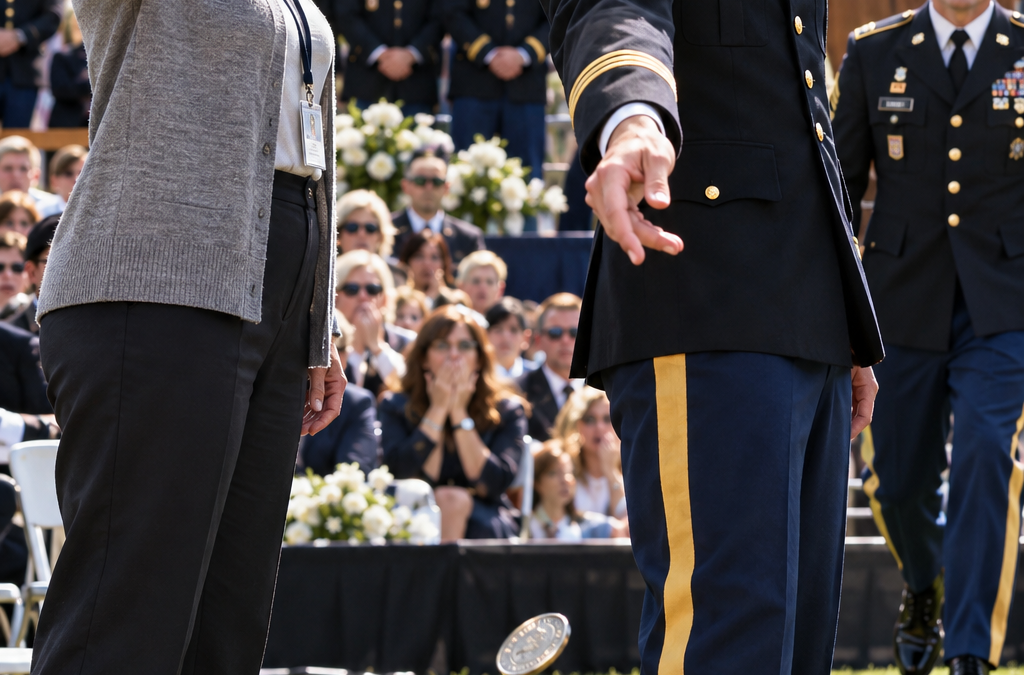
𝗣𝗔𝗥𝗧 𝟮
The salute he returned was hurried and sloppy, but it was a salute.
Only then did I lower mine.
I turned toward the chair where I had left my clipboard.
I had taken two steps when Daniel spoke quietly behind me.
“Drill Sergeant Ellison.”
My feet stopped.
Those words struck harder than the coin ever could have.
Not here, I thought.
Not in front of them.
Not after all these years.
“Not here, Daniel,” I said softly.
He came around so his body blocked most of the crowd’s view. His face was older, of course. Broader. Hardened by rank and years and wars I knew nothing about. But his eyes were the same gray-blue eyes that had once stared at me through rainwater and mud, full of fear he had been too ashamed to name.
He opened my right hand and placed Ethan’s silver dollar into my palm.
“I’ve been trying to find you since 2007,” he whispered. “You can carry this until I figure out how to say the rest.”
Then he collected my clipboard from his reserved chair and sat down.
The ceremony continued.
That should have been the end of it.
It was not.
By Monday morning, a forty-three-second cellphone video had circulated through cadet group chats and escaped onto social media. Whoever uploaded it had added a caption over a frozen frame of me saluting Ethan.
OFFICE LADY INTERRUPTS COMMISSIONING.
There were laughing emojis after it.
Colonel Warren showed it to me from behind her desk.
More than seventy thousand people had watched it.
“They think it’s funny,” she said.
“Some of it probably is.”
Her expression remained serious. “Ethan sent me an email Saturday night.”
That surprised me more than the video.
“He says you inserted yourself into his commissioning without authorization and created a situation where Command Sergeant Major Mercer publicly undermined him in front of his family and peers. He copied brigade leadership and university HR.”
I studied the paused image on her monitor. The silver dollar was barely visible in the grass.
“Is he asking for disciplinary action?” I asked.
“He says he wants the incident reviewed.”
I nodded.
Colonel Warren leaned back in her chair. “Mara, I watched the entire thing. I know why you stepped forward. Nobody wants a newly commissioned officer standing alone while two hundred people wait for a person who promised to salute him.”
“He was embarrassed,” I said.
“Yes.”
“So he found somebody safer to blame.”
Her mouth tightened slightly.
She knew I was right.
She asked whether I would consider writing Ethan a short note expressing regret that the situation had embarrassed him. She made it clear she was not asking me to admit wrongdoing. She was trying to keep a small conflict from becoming an administrative problem.
Twenty years earlier, another officer had asked me for something similar.
Not an apology, exactly.
Just cooperation.
Just enough softness to make an ugly problem easier to file away.
“I’ll write anything that is true,” I said.
Colonel Warren watched me carefully. “That is not quite the answer HR wants.”
“No, ma’am.”
When I left work that afternoon, Daniel was waiting beside my car.
He was in jeans and a dark fleece jacket, leaning against a pickup parked one space away. Without the uniform, something about him briefly became nineteen again.
“Drill Sergeant,” he said.
“I haven’t been that in twenty years.”
“You have to me.”
I unlocked my car but did not open the door.
He told me he had tried to find me through old unit contacts, veterans’ groups, letters sent to addresses that were already outdated, even retiree records. I had no social media, attended no reunions, and had declined a retirement ceremony in 2020.
“I thought you were dead for two years,” he said.
“I was working in Ohio.”
“That isn’t better.”
I almost smiled.
Then his face became serious. “Let me come into the ROTC building in uniform. I’ll tell them who you were.”
“No.”
“Mara—”
“No.”
His eyebrows rose slightly. He was no longer a private, and I was no longer his drill sergeant, but some old reflexes survive rank.
“I don’t want a senior enlisted leader ordering people to respect me,” I said. “That was never the point.”
“I wouldn’t order them.”
“You wouldn’t have to.”
He looked away.
That was when I understood that Daniel had become exactly the kind of senior NCO I used to hope some of my trainees would become: powerful enough to influence a room, disciplined enough to know that influence can be dangerous, and humble enough to stop when someone asked him to.
He nodded.
Before getting into his truck, he asked, “You still have the dollar?”
I touched my cardigan pocket.
“Yes.”
Two days later, Ethan entered my office to collect his final commissioning packet.
He avoided using my name.
I reviewed every page anyway: oath, orders, medical envelope, travel forms, reporting instructions. I had already noticed that his branch paperwork listed the wrong arrival date and had called to correct it.
“You report on June fifteenth,” I said. “The sixteenth on the original letter was an administrative error.”
He looked up. “You called them?”
“It’s my job.”
He stared down at the folder, then back at me.
“Thank you.”
He sounded confused by his own words.
After he left, I found an email from university HR waiting in my inbox.
A formal review had begun.
That evening, I stood inside my bedroom closet looking at an old cardboard box on the highest shelf.
It had followed me through four states.
I had not opened it since February 2006.
For the first time in twenty years, I pulled it down.
In January 2005, I was twenty-three years old and still believed being good at something could protect you from the politics surrounding it.
I had returned from Iraq as a combat engineer. I had made staff sergeant earlier than expected. I had completed Drill Sergeant School with the kind of fierce confidence young people possess before life teaches them how expensive principles can become.
When they placed the campaign hat on my head, I remember touching the brim and thinking I had finally reached the place where everything I had survived made sense.
I loved training soldiers.
Even now, that is difficult to admit.
Not because I am ashamed of the work.
Because loving it made losing it hurt more.
Our engineer company ran one-station unit training in Missouri. Trainees arrived frightened, clumsy, loud in the wrong ways, silent in the worse ways, and convinced the Army would either remake them or reject them. Fourteen weeks later, most marched across a parade field standing taller than when they had arrived.
I was never the drill sergeant who screamed constantly.
I could yell. Every drill sergeant can.
But I had learned overseas that people listen differently when danger is real. A calm voice, used correctly, can become heavier than shouting. It makes people lean toward you. It makes them realize they should understand the first time.
Daniel Mercer arrived that October.
He was nineteen, thin, awkward, and so nearsighted without his glasses that he once saluted a supply sergeant because he thought the stripes belonged to an officer. He struggled with everything physical. Push-ups. Running. Obstacles. Carrying equipment. Moving with confidence. The Army seemed designed specifically to expose every weakness he possessed.
But he kept trying.
That mattered to me.
During his third week, I found him sitting on his footlocker after lights-out holding one boot in both hands.
“Private Mercer,” I said, “explain why you are vertical.”
He jumped up so fast the boot hit the floor. “Drill Sergeant, I was going to ask to quit tomorrow.”
“Then tomorrow is going to be disappointing.”
He stared at me.
“I’m not a real soldier,” he said.
“Nobody is,” I told him. “Yet.”
I handed him the boot.
“Get in your rack.”
The senior drill sergeant in our company was Sergeant First Class Russell Kincaid.
He was thirty-six, decorated, respected, technically excellent, and very good at presenting himself to commanders as exactly what the Army wanted. His uniform was always perfect. His formations looked sharp. His trainees performed well on paper.
His problem was not incompetence.
His problem was belief.
Kincaid believed weakness was a contaminant. He thought if you found the trainee most likely to fail and pressured that person far beyond everyone else, the weakness would either disappear or take the soldier with it. He spoke about it almost medically, as though cruelty were a treatment.
Daniel became his project.
At first, it looked like normal extra attention. More push-ups. More corrections. More scrutiny.
Then extra exercises became extra runs.
Extra runs became late-night corrective sessions.
Other trainees began saying Daniel’s name in the careful way people mention someone marked for suffering.
One cold November night, I followed the sound behind the barracks.
Rain was falling hard enough to shine beneath the security light. Daniel was in the front-leaning-rest position in a puddle, arms trembling so violently I could see it from ten yards away. Kincaid stood over him holding Daniel’s canteen.
“You want water?” Kincaid asked. “Stop acting weak.”
Then he emptied the canteen onto the gravel.
Daniel collapsed.
I crossed the distance before I consciously decided to move.
I lifted him by the back of his blouse and got him onto his knees.
“Breathe,” I said.
Behind me, Kincaid said, “Drill Sergeant Ellison, you are interfering with corrective training.”
“This soldier is going to the aid station.”
“He is going back down.”
I stood.
Kincaid was taller than me, older than me, senior to me, and far better connected inside the battalion.
“I’m reporting this,” I said.
His expression barely changed.
“You’re going to wreck your career over a private who can’t do ten good push-ups?”
“Then apparently it was a short career.”
At the aid station, Daniel was treated for dehydration, cold exposure, and torn skin on both palms.
I wrote everything down.
Captain Rebecca Shaw, our company commander, opened an inquiry the following morning. She did what regulations required. An outside officer interviewed trainees. Statements were taken. Questions were asked.
Nobody supported my version.
I never blamed them.
They had been in the Army for five weeks. They had watched a senior drill sergeant decide what happened to soldiers who disappointed him. They knew fear before they knew policy.
Ten trainees said they had seen nothing unusual.
Daniel said he had fallen during authorized corrective training.
He would not look at me while he said it.
The allegation was declared unsubstantiated.
Kincaid received administrative counseling.
Nothing else happened.
Captain Shaw offered to move Daniel to another platoon.
“No, ma’am,” I said.
“Mara, Kincaid will still be around him.”
“So will I.”
For the remaining nine weeks, I made Daniel difficult to reach.
I ran beside him. I stood under obstacles he failed until he stopped failing them. I put water into his hands at every halt until he began joking about it.
“I’m hydrated, Drill Sergeant.”
“You’re hydrated when I say you’re hydrated.”
By week twelve, he passed his physical fitness test.
By graduation, he no longer looked like someone waiting for permission to quit.
He marched past the reviewing stand with 109 other new soldiers. For one second his eyes moved toward the rear bleachers where I stood.
Then he looked forward.
Three months later, our first sergeant entered the drill office and shut the door.
His name was Marcus Bell, and he was one of the fairest men I had ever served with.
“Battalion is removing you from the trail,” he said.
My stomach tightened.
“For what?”
“Loss of confidence.”
“Whose?”
He did not answer.
No formal reprimand existed.
No punishment appeared in my record.
They simply reassigned me to headquarters.
Then Bell held out his hand.
I stared at it before understanding.
Slowly, I removed my campaign hat.
He took it by the brim.
“For what it’s worth,” he said, “you were right.”
I spent the next fourteen years in personnel and human resources. I performed well. I made sergeant first class. I learned every regulation that governed records, promotions, pay, assignments, evaluations, medical packets, separations, and the quiet machinery that moves lives across desks.
Promotion boards passed me again and again without explanation.
I retired in 2020 with twenty years of service and refused a ceremony.
Marcus Bell mailed my campaign hat back when he retired.
I never opened the package.
Not until the week Ethan Caldwell dropped a silver dollar at my feet.
On Thursday night, I cut through yellowed packing tape and removed the hat.
Dust rose from the box in a thin gray breath.
Underneath the hat was my old drill sergeant badge.
Below that lay an envelope.
The handwriting belonged to First Sergeant Bell.
Inside was an index card and an old silver dollar.
The card contained four lines.
Mercer left this before he shipped out. Said he couldn’t face you after the investigation.
Then beneath that, another sentence:
There was something else in your battalion file. I kept a copy because someday you may want to know why they were so determined to move you.
I sat alone at my kitchen table, staring at that last line.
For twenty years, I had believed Russell Kincaid punished me because I reported him.
For the first time, I wondered whether Kincaid had been protecting something larger than himself.
The next morning, I took Bell’s index card to work but left it folded inside my purse.
I did not call anyone immediately. I had spent enough years in personnel to know the danger of building a whole story from one sentence. “Something else” could mean a memorandum, a complaint, a recommendation, or merely the memory of an old first sergeant who disliked how battalion handled my reassignment.
What mattered immediately was the present.
My HR review was still open.
Ethan’s complaint remained active.
And the cadets had begun looking at me differently.
Some avoided my desk.
Others became suddenly and excessively polite.
Master Sergeant Torres came into my office Thursday afternoon, closed the door halfway, and leaned against the filing cabinet.
“You were a drill sergeant,” he said.
It was not a question.
“For nine months.”
“That explains the flag folding.”
“It explains some things.”
“And Mercer?”
“One of my trainees.”
Torres rubbed a hand across his jaw. “That explains a lot more.”
I expected questions.
Instead he said, “You know what bothers me?”
“What?”
“I’ve worked beside you for a year. I noticed how you check formations through the window. I noticed you correct military correspondence before officers catch the mistakes. I once watched you clear ninety cadets out of this building during a fire alarm faster than most platoon sergeants could have done it.”
“I like organized exits.”
He ignored that.
“I noticed all of it, but I never asked what it meant.”
That hurt differently than Ethan’s insult.
Ethan had failed to see me because he was young, arrogant, and eager to protect his pride.
Torres had seen the clues and decided they were not important enough to investigate.
And I had done something similar to myself.
Friday morning, I asked Colonel Warren for ten minutes.
I placed one typed page on her desk.
It listed my service plainly: combat engineer, Iraq deployment, staff sergeant, drill sergeant, reassignment, human resources specialist, sergeant first class, retired.
No defense.
No accusation.
At the bottom, I requested permission to lead the final underclass leadership laboratory of the semester.
Topic: military customs, the first salute, and professional responsibility.
I also requested that Second Lieutenant Ethan Caldwell be invited.
Colonel Warren read the page twice.
“You were twenty-three?” she asked.
“Yes, ma’am.”
“As a drill sergeant?”
“Yes.”
“You have worked fifteen feet from my office for two years.”
“That is also true.”
“Why didn’t you tell anyone?”
I looked through the glass wall toward the front desk, where cadets crossed the hallway carrying backpacks and coffee cups.
“Because after a while,” I said, “not telling people became easier than discovering what they thought about it.”
Colonel Warren studied me.
Then she wrote across the bottom of my request.
0700 Friday. Bring the hat.
Daniel came because I asked.
That mattered.
He had offered to fix the problem for me with his rank, his connections, and his story. I had refused. Now I asked him to appear as a witness, not a rescuer.
Ethan came because Colonel Warren invited him.
That distinction mattered too.
At 6:15 Friday morning, Torres found me inside the cadre office wearing pressed dark slacks, a white blouse, and the campaign hat I had not worn for twenty years.
He stopped in the doorway.
Neither of us spoke.
Finally, he asked, “Want me to check it?”
The question nearly undid me.
Every drill sergeant knows the small ritual of another professional checking your uniform before formation. A collar adjusted. A badge aligned. A brim examined. Nothing sentimental. Everything sacred.
I nodded.
Torres straightened my collar by perhaps an eighth of an inch.
Then he stepped back.
“Squared away, Drill Sergeant.”
I looked at the coffee maker until I trusted my face again.
Ninety cadets stood inside the drill hall.
Daniel waited at the rear in uniform.
Ethan stood near the door.
Colonel Warren remained along the wall.
I walked to the front.
The room became silent.
“My name is Mara Ellison,” I said. “Most of you know me as the woman who fixes your contracts.”
Several cadets looked uncomfortable.
“For a short time, twenty years ago, I was also a drill sergeant.”
Nobody laughed.
I taught them the first-salute tradition.
I explained that the enlisted soldier salutes first because a newly commissioned officer is being extended respect before having enough experience to deserve much of it personally. The silver dollar is not payment in any ordinary sense. It is an acknowledgment of a debt: the debt every officer owes to the enlisted soldiers who will carry out orders, correct mistakes, preserve standards, and sometimes save that officer from himself.
Then I placed them at attention.
“Ninety-degree angle,” I said, correcting one cadet’s elbow. “Fingers together. Wrist straight.”
I made them salute.
And hold it.
Thirty seconds.
Forty.
Arms began trembling.
“This is uncomfortable,” I said, walking between the ranks. “Someone should have returned your salute by now.”
Nobody moved.
“You may feel foolish. People may be watching. Your arm may hurt.”
I stopped at the front.
“You hold it because the salute is not a measurement of the person standing across from you. It is a statement about the standard you chose for yourself.”
I released them.
Arms dropped together.
“A real soldier,” I said, “is not someone who looks impressive while everything is easy.”
I did not look toward Ethan.
Daniel spoke from the rear.
“Nineteen years ago, I was a private who could barely pass anything.”
Every cadet turned.
“I told my drill sergeant I wasn’t a real soldier. She told me, ‘Nobody is yet.’”
He paused.
“She kept me in the Army. More importantly, she stopped someone who had decided breaking trainees was the same thing as building soldiers.”
My throat tightened.
Daniel continued.
“She paid for doing that.”
Then Ethan stepped away from the wall.
He crossed the floor slowly. His face was red, but this time it was not the red of anger. It was the red of a young man walking toward the truth without a script.
He stopped in front of me at the proper distance.
“Drill Sergeant Ellison.”
His voice cracked.
He swallowed and began again.
“Drill Sergeant Ellison, I would like to request that you render my first salute again.”
“You already received your first salute, Lieutenant.”
“Yes, ma’am.”
His eyes did not leave mine.
“I would like to receive it correctly.”
I studied him.
“You owe me no performance.”
“I know.”
“You owe me no public humiliation in return for mine.”
“I know.”
“What do you owe?”
He swallowed.
“A returned salute.”
That was the first answer he had given me that sounded like an officer.
I raised my hand.
He returned the salute sharply.
We held it.
Then we lowered our hands together.
Ethan removed a silver dollar from his pocket.
“I’m sorry,” he said quietly.
“I know.”
He placed the coin in my palm.
“Go become worth it,” I told him.
The complaint was withdrawn that afternoon.
For a few hours, I thought perhaps the story had reached its natural ending.
Then First Sergeant Marcus Bell finally returned the message I had left on his voicemail.
“Mara,” he said after nineteen years, “before you start forgiving the Army for what happened to you, there’s something you need to see.”
Marcus Bell lived outside Louisville in a small brick house with an American flag hanging from the porch and tomatoes growing in buckets along the driveway.
I drove there the following Saturday.
He had aged more than I expected. In my memory, he was a huge first sergeant with shoulders that filled doorways. The man who opened the door was still tall, but thinner, silver-haired, wearing reading glasses on a cord around his neck.
He stared at me.
“Well,” he said. “You finally opened the box.”
“You knew it would take twenty years?”
“I hoped for five.”
He made coffee.
We sat at his dining table.
I placed the index card between us.
“What did you mean?”
Marcus sighed.
Then he left the room and returned carrying a file folder.
“I was not supposed to keep this.”
Inside was a photocopy of a memorandum dated twelve days before my removal from drill sergeant duty.
The subject line concerned command climate and training consistency.
My name appeared three times.
The battalion executive officer had written that my “continued challenges to established senior trainer authority” were creating friction within the company. It referenced the Kincaid inquiry, but also two earlier complaints I had never known existed.
One involved hydration procedures.
The other involved medical referrals.
I read both.
In each case, I had intervened when trainees showed symptoms serious enough that I believed training should stop.
In each case, Kincaid had objected.
The memo did not accuse me of misconduct.
That was what made it effective.
It described me as technically competent but insufficiently aligned with senior trainer methodology.
“What methodology?” I asked.
Marcus gave me a tired look.
“You know what methodology.”
The final paragraph recommended removing me from the trail before my presence created further external scrutiny.
External scrutiny.
Those words changed the temperature of the room.
“What scrutiny?”
Marcus folded his hands.
“Two months before the Mercer incident, another trainee from Kincaid’s previous cycle went to the inspector general after graduation.”
I stared at him.
“He alleged excessive corrective training, denied medical care, and retaliation.”
“Why didn’t I know?”
“The complaint was handled above company level. I only learned because the battalion commander called the first sergeants in.”
“And Kincaid?”
“Protected.”
“By whom?”
Marcus did not dramatize it.
“The battalion commander believed Kincaid produced excellent graduation numbers and strong test scores. Brigade was already asking questions after the IG complaint. Then you filed a report involving Kincaid and a dehydrated trainee.”
I looked again at the phrase external scrutiny.
“They moved me because another investigation would create a pattern.”
Marcus nodded once.
The satisfaction I expected never arrived.
For years, I had imagined that discovering the truth would produce anger clean enough to use. Instead, I felt tired.
“So Kincaid kept his hat,” I said.
“Yes.”
“And the battalion avoided another investigation.”
“For a while.”
I looked toward the window.
Children were riding bicycles on the sidewalk across the street.
“You told me I was right,” I said.
“You were.”
“You could have told me this too.”
Marcus lowered his eyes.
“Yes.”
The answer hurt more because he did not defend himself.
“I had eighteen years in,” he said. “Two kids. A mortgage. I kept the copy because I told myself I might need it someday. Then you were gone, Kincaid transferred, and the commander retired.”
“And you stayed.”
“Yes.”
We sat in silence.
Finally, he said, “I have been ashamed of that longer than you have been angry.”
“I wasn’t angry.”
“That was the problem, Mara.”
I looked at him.
“You disappeared so politely that everyone who failed you got to tell themselves you were fine.”
There it was.
Not the conspiracy I might have preferred.
Not one villain moving every piece on the board.
Something more ordinary.
Kincaid abused authority.
Leaders valued results enough to look away.
Marcus knew enough to suspect the truth and chose survival.
I accepted the reassignment without demanding written justification because I still believed professionalism meant enduring humiliation quietly.
Everyone made one decision.
Together, those decisions became twenty years of my life.
When I returned to Hawthorne State on Monday, Colonel Warren told me the university wanted to create a part-time instructor position for the fall.
“Military Science One,” she said. “Freshmen. Drill, customs, basic leadership.”
I looked at the contract.
The name line already read:
Mara J. Ellison, Sergeant First Class, United States Army, Retired.
“You would still have to help train your replacement in administration,” she added.
“Who is my replacement?”
“I was hoping you knew where to find one.”
I laughed.
It surprised both of us.
I signed.
That afternoon Daniel called.
His voice changed when I told him about Marcus’s file.
“I know who Kincaid is now,” he said.
“What does that mean?”
“He retired as a sergeant first class. Works at a private military academy in Tennessee.”
I waited.
“There’s an investigation.”
My hand tightened around the phone.
“What kind?”
“Hazing allegations.”
I closed my eyes.
“A former cadet came forward this spring. Then another. There are seven now.”
For several seconds, neither of us spoke.
“Does the investigator know my name?” I asked.
“Not yet.”
“Then I’m not chasing them.”
“Mara—”
“If they ask me, I will answer everything. But I am not spending another year building my life around Russell Kincaid.”
Daniel was silent.
Then he said, “Yes, Drill Sergeant.”
Two days later, an email arrived from an address I did not recognize.
The subject line was:
2005 ENGINEER TRAINING INQUIRY — REQUEST FOR INTERVIEW.
Kincaid’s past had finally caught up with him.
And this time, nobody needed me to save him from the consequences of his own choices.
I agreed to speak with the investigator.
Not because I wanted revenge.
Not because Daniel encouraged me.
Not because I believed my statement would magically correct everything the Army had failed to correct in 2005.
I agreed because seven former cadets had already spoken.
I knew what it cost to be the first person in a room to say something happened while everyone else studied the floor.
The investigator was a civilian attorney named Priya Deshmukh, working with the academy’s independent review board. We spoke by video call on a Tuesday evening.
She asked precise questions.
I gave precise answers.
I described the rain behind the barracks, Daniel’s condition, the empty canteen, Kincaid’s words, my report, the inquiry, the reassignment, and the memorandum Marcus had kept.
I did not call Kincaid evil.
I did not need to.
Facts are often more durable than adjectives.
Priya asked whether I believed my career had been retaliated against.
“I believe the battalion removed a person who made an inconvenient problem visible.”
“Is that yes?”
“It is the most accurate answer I have.”
She nodded.
At the end, she asked whether I would provide the memorandum.
“With Marcus Bell’s permission,” I said.
He gave it.
For the first time in nineteen years, something that had existed as a private wound became evidence.
Meanwhile, Ethan left for his basic officer course.
Before he departed, he came by the office.
There was no audience.
No uniform.
No silver dollar.
He stood at the counter holding his car keys.
“I wanted to tell you something before I go,” he said.
“All right.”
“My father laughed at the video.”
I said nothing.
“He told me I shouldn’t have apologized. Said officers can’t let enlisted people embarrass them.”
That explained more than Ethan probably understood.
“What did you tell him?”
“That Sergeant Major Mercer didn’t embarrass me.”
I waited.
“I embarrassed myself.”
The sentence came out slowly, as though he had carved it from something hard inside him.
He looked toward the hallway.
“My dad was an officer. National Guard. He always talked about respect like it was something rank made people give you.”
“Some people do.”
“I believed him.”
“You probably still believe parts of what he taught you.”
Ethan looked surprised.
“I’m not asking you to replace one simple story with another,” I said. “Your father can love you and still teach you something wrong.”
He nodded.
Before leaving, he placed an envelope on my desk.
Inside was the printed copy of his withdrawn complaint.
Across the bottom, he had written:
I want to remember what certainty looks like before experience earns it.
I kept that paper.
Not because I needed his apology.
Because it was evidence of someone learning before the lesson became permanent.
In June, I drove to Fort Harrison, where Daniel’s brigade headquarters overlooked a large parade field.
His office walls were covered with photographs, plaques, and unit memorabilia. Behind his desk stood a wooden coin rack holding perhaps two hundred challenge coins.
But the first object in the upper-left corner was not a coin.
It was a small brass drill sergeant insignia.
I walked closer.
“You’re kidding.”
Daniel smiled.
“You dropped it.”
“When?”
“The night behind the barracks.”
I touched the glass beneath it.
“I replaced that thing and never wondered what happened to the original.”
“I found it in the gravel the next morning.”
“You were supposed to be concentrating on surviving basic training.”
“I contain multitudes.”
I looked at him.
He had become funnier.
That pleased me more than it should have.
“I was going to return it,” he said. “Then they took you off the trail.”
His smile faded.
“I kept it in my wallet until my first deployment. Then every office I’ve had, every unit, every assignment, I put it up first.”
“Why?”
“Because before I knew what leadership looked like, I knew what rank looked like. Kincaid had rank.”
He pointed toward the brass disc.
“You had leadership.”
For years, I had resisted gratitude because I believed accepting it would turn the story into something sentimental.
One brave drill sergeant saves one struggling private.
Happy ending.
But I had not saved Daniel from everything.
I had not stopped Kincaid from harming other trainees.
I had not changed the battalion.
I had not even saved my own career.
“I failed a lot of people after you,” I said.
Daniel shook his head.
“That’s not how this works.”
“You don’t know that.”
“I know I spent twenty-one years watching good leaders convince themselves that if they couldn’t fix everything, then fixing one thing didn’t count.”
He stepped from behind the desk.
“You stopped something that night.”
He held out his hand.
“You kept me in.”
I looked at it.
Nineteen years earlier, he had been too ashamed to thank me.
For nineteen years, I had been too ashamed to let him.
I shook his hand.
His grip was strong.
That evening, I drove home with the windows down.
For the first time, I separated the cost other people had imposed on me from the cost I had continued imposing on myself.
Kincaid had helped take nine months of work I loved.
Battalion leadership had helped stall a career.
Those losses belonged to them.
But the retirement ceremony I refused belonged to me.
The letters I never answered belonged to me.
The years I made myself invisible belonged to me.
I had mistaken disappearing for dignity.
In August, on the morning of my first official leadership lab, I placed three silver dollars inside the band of my campaign hat.
One from Daniel at nineteen.
One from the grass.
One from Ethan’s second attempt.
Then I put the hat on.
Before leaving my house, I looked in the mirror.
For the first time in twenty years, I did not see something that had been taken away.
I saw something I had finally chosen to wear again.
Ninety-one freshmen stood on the drill hall floor at seven in the morning.
The extra one had enrolled two days earlier.
Most were eighteen. A few were nineteen or twenty. Some looked athletic and impatient to prove themselves. Others stood with the stiff uncertainty of young people who did not yet know whether ROTC would become the best decision of their lives or a mistake they would someday laugh about.
Near the back stood a thin young man wearing glasses.
His patrol cap sat crooked.
I noticed immediately.
I did not correct it.
There would be time.
Master Sergeant Torres stood along one wall drinking coffee.
Colonel Warren pretended to review something on her phone.
I walked to the front wearing my campaign hat.
Several cadets had seen the commissioning video.
More had seen the second video someone posted from the final spring leadership lab.
Nobody spoke.
“My name is Drill Sergeant Mara Ellison.”
The title felt strange in my mouth.
Not wrong.
Just newly returned.
“Some of you will also know me as the woman who can tell you why your scholarship payment disappeared.”
A few nervous laughs.
“That woman still exists. Be nice to her.”
More laughter.
Then we worked.
I taught attention, parade rest, facing movements, saluting, customs, and the small disciplined habits that look ridiculous until several people perform them together.
I did not tell them my life story.
That was another lesson I had learned.
Young soldiers do not need every scar their instructors possess. They need whatever knowledge helps them survive their own mistakes.
After the lab, the thin cadet lingered near the door.
He held his patrol cap between both hands.
“Something on your mind?” I asked.
“Yes, ma’am. Drill Sergeant.”
He swallowed.
“I don’t think I’m going to be very good at this.”
For half a second, I saw Daniel Mercer at nineteen.
Then I stopped myself.
This cadet was not Daniel.
His name tape read PARKER.
He deserved his own story.
“Nobody is, Cadet Parker.”
He looked confused.
“Yet.”
His shoulders relaxed slightly.
“Be here Monday at 0630,” I said. “Bring water.”
“Yes, ma’am.”
He put his cap back on.
Still crooked.
I let him leave.
Three weeks into the semester, Priya Deshmukh called again.
The academy investigation had expanded. Former soldiers from Kincaid’s Army years had responded after investigators contacted them.
Some remembered nothing.
Some remembered too much.
Two acknowledged witnessing the treatment of Daniel behind the barracks.
“Why didn’t they speak in 2005?” Priya asked me.
“Because they were nineteen.”
“One said he’s regretted it for years.”
“That sounds about right.”
The academy terminated Kincaid’s employment before the review concluded.
No dramatic arrest occurred.
No courtroom exposed him before cameras.
His life simply became narrower because people who once remained silent were no longer nineteen.
I expected to feel triumphant.
Instead, I felt something close to relief.
Consequences had finally reached him without requiring me to carry them there.
Marcus Bell came to Hawthorne State in October.
He sat in the back of my class.
I knew he was there, but I did not acknowledge him until afterward.
When the cadets left, he approached.
“I owe you an apology,” he said.
“You already gave me the file.”
“That is not an apology.”
“No.”
He looked older beneath the fluorescent lights.
“I knew enough to push harder,” he said. “I didn’t.”
I nodded.
“I know.”
“I was afraid for my retirement.”
“I know.”
“I told myself I had a family.”
“You did.”
None of those answers made him comfortable.
That was not my job.
“Do you forgive me?” he asked.
I considered lying.
Not because I hated him.
Because the word forgive had too often been used as a way to rush injured people toward making everyone else comfortable.
“I understand you,” I said. “That’s what I can give you.”
He nodded.
It was enough.
We shook hands.
Later that afternoon, Daniel called.
He had been selected for a senior position at the Drill Sergeant Academy.
“You going to tell them you survived me?” I asked.
“Repeatedly.”
“You should probably omit the part where you couldn’t do push-ups.”
“I have rewritten that section.”
“That sounds dishonest.”
“That sounds like professional development.”
I laughed.
Then he became quiet.
“You know,” he said, “I used to think finding you would fix something.”
“Did it?”
“No.”
I appreciated that answer.
“It changed something,” he continued. “Different thing.”
That was closer to the truth for both of us.
In November, a postcard arrived from Ethan.
He was training at Fort Sill.
On the front was a photograph of an artillery battery firing beneath an enormous Oklahoma sky.
His handwriting on the back remained terrible.
Watched a staff sergeant receive a first salute from a private he trained. I explained the dollar to my platoon beforehand. Nobody laughed. I held mine until it was returned.
Then, beneath that:
Still working on being worth it.
I placed the postcard in my desk drawer beside his withdrawn complaint.
The next morning, Cadet Parker failed his first fitness assessment.
He came to my office afterward, ashamed.
“Drill Sergeant, I’m sorry.”
“For what?”
“For wasting your time.”
I leaned back in my chair.
There are moments when you hear another person speaking and realize the voice coming from their mouth belongs partly to someone else.
A parent.
A coach.
A teacher.
A Russell Kincaid.
“Cadet,” I said, “failure is information. It is not identity.”
He stared at me.
“You know what information says?”
He shook his head.
“It says Monday, 0630. Bring water.”
He smiled.
“Yes, ma’am.”
After he left, I took Ethan’s first silver dollar from the band inside my hat.
For months, I had thought of it as the coin he threw away.
That morning, I realized it had become something else.
It marked the last day I allowed another person’s ignorance to decide how visible I was willing to become.
By the following spring, Hawthorne State’s ROTC building no longer felt like a place where I was hiding beside the Army.
It felt like somewhere I belonged.
I still handled paperwork two mornings a week because Colonel Warren never found anyone who could untangle scholarship contracts without swearing at the computer. The rest of my time belonged to instruction.
Cadet Parker eventually passed his fitness test.
Not brilliantly.
Not heroically.
He passed with three push-ups to spare and stood up looking as if he had personally defeated gravity.
I did not tell him about Daniel.
I did not need to.
“Better,” I said.
He grinned.
“Yes, Drill Sergeant.”
Ethan returned to campus the following May for the next commissioning ceremony.
He arrived in uniform nearly forty minutes early.
That alone told me the Army had begun educating him.
His posture had changed. So had his face. Nothing dramatic—just the small reduction in certainty that often appears when a young officer has finally become responsible for people whose problems cannot be solved by quoting regulation.
He found me near the folding chairs.
“Drill Sergeant.”
“Lieutenant.”
“I checked the reserved seating.”
“That is an oddly responsible hobby.”
“Sergeant Major Mercer’s chair has the right name card.”
“Remarkable.”
He smiled.
Then he became serious.
“My father is coming today.”
I waited.
“I told him what happened.”
“How did that go?”
“He said I let you humiliate me.”
I looked toward the stage.
“And?”
“I told him I humiliated myself.”
He exhaled.
“We’re not talking much.”
“That may change.”
“Maybe.”
He looked at me.
“I don’t think I need him to understand it anymore.”
That was adulthood arriving in one sentence.
Daniel reached the quad ten minutes later.
Early.
I made sure to point that out.
He blamed traffic patterns.
I rejected the excuse.
The three of us stood for a moment on the same grass where the coin had landed a year earlier.
No one reenacted anything.
No one needed to.
During the ceremony, fourteen new lieutenants received their first salutes.
Every chosen soldier arrived.
Every dollar passed hand to hand.
One new lieutenant selected Master Sergeant Torres.
Another chose her grandmother, a retired Army medic in her seventies who needed a cane to walk onto the lawn.
The young officer saluted her.
The grandmother returned it.
When the lieutenant handed over the silver dollar, the older woman kissed it before putting it in her purse.
I liked that.
Afterward, Colonel Warren gathered the cadre and families for photographs.
I tried stepping aside.
She caught my sleeve.
“Not anymore,” she said.
So I stayed.
Three months later, the independent report involving Kincaid was completed.
The academy found a sustained pattern of degrading treatment, unsafe corrective practices, and retaliation against cadets who sought medical attention or reported misconduct. The report also referenced evidence from his Army service indicating similar concerns had existed long before he joined the school.
His name appeared in the document.
Mine did not.
I was grateful.
Nothing in the report restored the promotion boards I had missed.
Nothing returned the years.
Nothing changed what frightened trainees had said in 2005 or what commanders had decided afterward.
Consequences are not time machines.
That was another thing I learned late.
Russell Kincaid lost his position.
The academy changed supervision requirements and created confidential reporting procedures.
Marcus Bell provided testimony.
Daniel provided testimony.
Two former trainees did too.
The young people being trained there afterward would never know our names.
That was fine.
Justice does not become less useful because nobody applauds when it happens.
That summer, Daniel invited me to the Drill Sergeant Academy for a professional development seminar.
He introduced me simply.
“Sergeant First Class Mara Ellison, retired.”
No story.
No legend.
No dramatic explanation.
I spoke for an hour about intervention, professional courage, and the difference between correcting weakness and humiliating a person for possessing it.
At the end, one staff sergeant raised his hand.
“How do you know when pushing somebody is too much?”
I thought about rain hitting gravel.
“You ask yourself whether the action is making the soldier more capable or merely making you feel more powerful.”
The room became quiet.
“If the honest answer is the second one,” I said, “stop.”
That was all.
When I returned home, I took my campaign hat from its box.
The box had changed too.
It no longer lived on the top shelf of my closet.
It sat openly on a shelf in my study beside photographs, retirement papers, Daniel’s old silver dollar, Ethan’s postcard, and the brass insignia Daniel eventually returned to me after insisting he had carried it long enough.
I kept the three silver dollars tucked inside the hatband.
The first came from a frightened nineteen-year-old who could not bring himself to thank me.
The second came from a twenty-two-year-old who looked at my clothes and decided he knew what kind of person stood inside them.
The third came from that same young man after he learned better.
I never considered them medals.
They were reminders.
People can be wrong about you.
Institutions can be wrong about you.
People you respect can remain silent because speaking is expensive.
And sometimes the most damaging thing that happens afterward is that you begin helping them by disappearing.
For twenty years, I told myself Russell Kincaid had taken my campaign hat.
That was true for one afternoon.
Afterward, I kept taking it from myself.
I refused ceremonies.
Ignored letters.
Avoided reunions.
Accepted jobs where I could remain useful without becoming visible.
I called it humility.
Some of it was fear.
Some of it was shame.
And some of it was the belief that dignity meant never needing anyone to know what had happened to me.
I know better now.
Dignity is not silence.
Forgiveness is not pretending consequences should disappear.
And moving forward does not require inviting everyone who hurt you to come along.
I never contacted Russell Kincaid.
I never sent him the academy report.
I never asked whether he regretted anything.
His regret, if he possessed it, belonged to him.
Marcus and I exchanged Christmas cards, but we were never close.
I understood his choices without pretending they had not affected me.
Ethan and I stayed in occasional contact.
Daniel became family in the peculiar Army sense of the word: not someone I needed every week, but someone I could call after six months and continue a conversation without explanation.
The following August, I stood again before a new group of freshmen.
Ninety-three this time.
One young woman in the front row looked terrified.
A tall boy near the back could not stop moving his feet.
Someone’s uniform shirt was already untucked.
Cadet Parker, now a sophomore, stood beside the formation as an assistant.
His patrol cap was straight.
I noticed that too.
I walked to the center of the floor.
My campaign hat sat level, two fingers above my eyebrows.
The three silver dollars rested unseen inside the band.
“Good morning,” I said.
Ninety-three faces turned toward me.
“My name is Drill Sergeant Mara Ellison. Some of you will eventually know me as the person who fixes your paperwork.”
A few cadets laughed.
“That is not what we are doing this morning.”
I let the silence settle.
“This morning, I am going to teach you how to hold a salute.”
Ninety-three young people came to attention.
The heels were uneven.
The timing was terrible.
It was beautiful.
When their right hands rose, I walked the ranks correcting wrists, elbows, fingers, and posture.
“Hold it,” I told them.
A few arms began shaking.
“Keep holding.”
This time, when I said the words, I was not speaking to the woman who had stood on a university lawn while a silver dollar disappeared into the grass.
I was speaking to everyone who might someday be measured by somebody too careless, too frightened, or too arrogant to understand them.
“Your arm may get tired,” I said. “The person across from you may fail to return what you give them. That does not change the standard you chose.”
I looked down the formation.
“Hold.”
They held.
And so did I.
The End.