FULL ENDING The Ridge They Said Would Break Me Became the Only Place Left to Survive
𝗙𝗨𝗟𝗟 𝗦𝗧𝗢𝗥𝗬
“Multiple machine gun positions!”
“Need suppression now!”
I pressed my headset tighter against one ear and began relaying what I could, but the chatter became a storm. Coordinates. Casualty calls. Ammunition checks. Requests for air support. Updates that became worse every minute.
Martinez’s voice cut through the static.
“Base, this is Viper Seven. We are surrounded and heavily outnumbered. Ammunition running critically low. Request immediate evacuation.”
A pause followed.
I remember that pause more clearly than I remember some of the gunfire.
It stretched long enough for hope to enter it.
Then the response came back.
“Viper Seven, negative on air support. Weather conditions prevent helicopter operations. You are on your own until dawn.”
Dawn was eight hours away.
Nobody said anything at first.
Then one of the communications Marines beside me whispered, “We won’t last forty-five minutes against this.”
He was not being dramatic.
He was doing math.
Twenty-four Americans against more than two hundred fighters who had the high ground, the numbers, the preparation, and the weather. Our teams below were skilled, disciplined, and brave, but bravery does not refill magazines. Skill does not erase geometry. Every defensive position they took was being compressed. Every attempt to shift was met by fire from another angle.
I looked at the map.
Then through my optics.
Then back at the map.
The eastern ridge rose in darkness beyond our position.
Impossible, they had called it.
Too steep.
Too exposed.
Too much.
I could hear my own heartbeat.
It was not heroic.
It was scared.
People often tell stories about decisions as if courage arrives clean and shining, as if the person making the choice already knows history will approve.
That is not how it felt.
It felt like terror.
If I stayed, I would be following orders.
Communications support.
Rear security.
Hold position.
Maintain contact.
Do the job I had been assigned.
And below me, twenty-four men might die while I listened.
If I left, I would be breaking position without authorization.
I could get lost on the climb.
I could fall.
I could expose myself.
I could reach the ridge and miss.
That last possibility sat heaviest in my chest.
What if I missed?
Not on a range.
Not in training.
Not under stars in a quiet practice field where nobody’s life depended on the shot.
What if I missed while men were screaming for help below me?
What if I fired and gave away my position?
What if enemy counter-snipers found me?
What if I climbed into the dark believing I could save them and only added one more dead body to the mountain?
The fear came in waves.
Then another voice rose beneath it.
My grandfather’s.
When everyone says it’s over, Nieta, that’s when your shot matters most.
I closed my eyes for one breath.
Then I opened them.
Everything inside me became very still.
I keyed the radio.
“Communications maintaining position.”
It was the first necessary lie I had ever told in combat.
Then I grabbed my Barrett, spare ammunition, rangefinder, and a compact field pack.
One of the Marines beside me turned.
“Rodriguez?”
“Keep the channel clear,” I said.
“What are you doing?”
“My job.”
I did not wait for permission.
If I had, I would have lost the courage to move.
The climb was worse than anyone in the briefing room had imagined.
The eastern ridge rose like a broken wall, all jagged rock, loose shale, ice-slick patches, and narrow cuts where the wind screamed hard enough to push breath back into my mouth. Every step required a decision. Every handhold shifted under weight. The rifle pulled at my shoulder, and the ammunition dragged against my hips like someone trying to pull me back down.
Within minutes, my gloves were torn.
Soon after that, my knees were bleeding under my uniform.
The cold bit through the fabric and into the cuts, but pain belonged in the background. I let it stay there.
Below me, the battle continued.
Bursts of automatic fire rolled through the valley.
Explosions lit the compound in brief orange flashes.
Radio traffic snapped in my ear.
“Alpha is almost black on ammunition!”
“Bravo needs movement now!”
“Can’t shift! We’re pinned!”
“RPG! RPG!”
Each burst meant they were still alive.
Each pause made me wonder who was not.
I climbed faster.
Not recklessly.
Fast enough to matter.
The mountain did not care that men below me were dying.
Stone never does.
It demanded the same price from me that it had always demanded from anyone crossing it.
Attention.
Respect.
Patience.
My grandfather had taught me that too.
Panic wastes strength.
Precision saves it.
So I moved the way he had taught me in Colorado. Low when the wind surged. Still when loose rock shifted. Weight distributed. Breath measured. Hands finding cracks before feet committed.
Halfway up, I slipped.
My left boot skidded across loose shale, and for one sickening second, the weight of the rifle pulled me backward. I caught a rock edge with my right hand. Pain tore through my fingers. My body swung hard against the slope.
For a moment, I hung there, breathing through clenched teeth.
Below, Martinez shouted over the radio.
“All units, prepare final defensive positions. We’re almost out of options.”
Almost.
The word hit harder than the rock.
I pulled myself up.
My palm left blood on the stone.
I kept climbing.
When I finally reached the ridge line, my lungs felt scraped raw from cold air. My arms trembled from exertion. Sweat had frozen beneath my collar. My face was numb.
I crawled between two granite boulders and settled into a prone position.
The rifle came forward.
The bipod locked against stone.
I brought the scope to my eye.
And the valley opened beneath me.
For the first time that night, I saw the whole board.
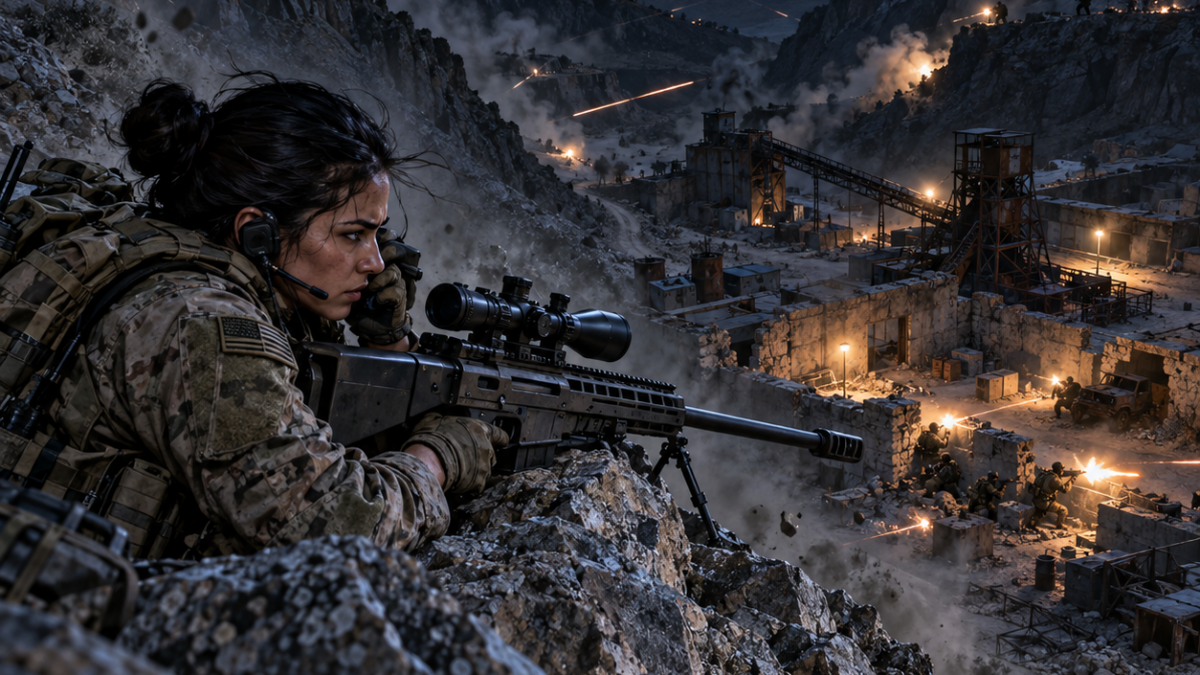
The compound below looked like a nightmare made of muzzle flashes.
Our teams were trapped among broken mining structures, using collapsed walls and rusted machinery for cover. Enemy fighters moved along elevated routes carved into the rock. Machine gun nests controlled the main exits. RPG teams shifted between protected pockets. A command group coordinated from a position partially concealed behind a dark outcrop.
From the ground, it must have looked like chaos.
From the ridge, it was a pattern.
Patterns could be broken.
I adjusted my scope.
The wind struck from my right, then curled off the rock face below. Distance was just over thirteen hundred meters to the far machine gun nest. Elevation shift severe. Temperature dropping. Air thin.
I could hear men shouting below.
I could hear my own breathing.
I could hear my grandfather.
Make it count.
I exhaled halfway.
Held.
The crosshairs settled.
My finger touched the trigger.
The first shot cracked through the mountain air.
For half a second, the world seemed to stop.
The heavy machine gun that had been chewing apart Alpha’s defensive line went silent.
Below, someone shouted, “Who the hell fired that?”
I did not answer.
I was already shifting.
Never fire twice from the same exact position when the enemy can triangulate sound.
I slid backward, moved three meters along the rock shelf, reset behind another boulder, and found the second target.
A fighter carrying an RPG was moving into position above Bravo.
He paused to kneel.
Too long.
Second shot.
He dropped out of view.
The RPG rolled loose across stone.
Now the valley reacted.
Enemy movement changed.
Confusion spread from the upper positions first. The men below them did not yet understand what was happening. They had believed they owned the high ground. They had planned the ambush carefully. They had surrounded a team on the valley floor and waited for ammunition and hope to run out.
They had not planned for a woman they had never considered worth listening to.
I keyed my radio.
“Guardian Overwatch to Viper Seven.”
Static.
Then Martinez.
“Say again?”
“Guardian Overwatch to Viper Seven. Move northeast toward the compound interior. I’ll provide cover.”
There was a silence.
Then Martinez’s voice came back, sharp with disbelief.
“Rodriguez?”
“Move northeast. Now.”
He did not argue.
That was the first time all night someone followed my call without making me defend it.
The SEALs began to shift.
The enemy tried to punish the movement.
I saw the muzzle flash before the rounds found them.
Third shot.
A rifleman fell from an elevated firing slit.
Fourth shot.
A second machine gun team broke apart before they could adjust.
Fifth.
A spotter with binoculars disappeared behind the rock he had been using.
I moved again.
The ridge was narrow, jagged, and treacherous, but it also offered concealment. Stone shelves. Shadowed cuts. Low boulders. Wind-carved pockets where a body could disappear between shots.
I had studied the terrain because nobody else wanted to.
Now that knowledge became the difference between being a target and being a ghost.
The radio filled with voices.
“Alpha moving!”
“Bravo shifting!”
“Where is that fire coming from?”
“Unknown overwatch has high-angle support!”
Martinez cut through them.
“Listen to Guardian! Move when she tells you!”
A strange feeling passed through me.
Not pride.
There was no space for pride.
Recognition, maybe.
Not from them.
From myself.
For eight months, I had trained in darkness while men called me a shadow.
Now shadow was exactly what survival required.
I worked systematically.
Not wildly.
Not emotionally.
Every shot had a purpose.
Machine gun teams first.
RPG crews second.
Spotters.
Radio operators.
Leaders.
Anyone directing the shape of the trap.
My job was not to shoot fast.
It was to make each round remove a piece of the enemy’s plan.
The sixth shot opened a gap near Alpha’s left flank.
The seventh stopped a fighter trying to close it.
The eighth took out a man signaling with a flashlight from a rock cut.
The ninth forced three enemy fighters to abandon a higher firing lane.
The valley began to loosen.
Not enough.
But enough for the trapped teams to breathe.
I could hear it in their voices.
Fear remained.
But now it had something beside it.
Possibility.
My cheek pressed against the rifle stock. The cold of it burned my skin. My shoulder absorbed recoil again and again until everything in my body became a rhythm.
Find.
Calculate.
Breathe.
Fire.
Move.
Reset.
Find again.
At one point, rounds struck the rocks twenty feet below my position.
Counter-fire.
They were looking for me.
I flattened against stone and waited.
A younger version of myself might have rushed.
Might have taken the next shot too soon to prove I was not afraid.
I was afraid.
Of course I was afraid.
Anyone who says they are not afraid when bullets are searching for them is either lying or not paying attention.
But fear can sharpen you if you stop trying to pretend it is not there.
I let it sharpen me.
Dust drifted across my scope.
The enemy counter-sniper shifted behind a black rock shelf.
I saw only a shoulder.
Then the edge of a rifle.
Then his head.
Tenth shot.
The searching fire stopped.
I moved again.
Minutes lost meaning.
Later, official reports would say the engagement shifted over forty-seven minutes.
To me, it became a series of breaths.
Inhale.
Let the body settle.
Exhale.
Make the world small.
There was no past in the scope.
No nickname.
No laughter in the briefing room.
No commanding officer telling me the rifle was too heavy.
No men asking whether I was trying to shoot satellites.
There was only what mattered.
A target.
A line.
A life depending on the space between them.
At shot fourteen, Martinez reported that Bravo had reached better cover.
At shot eighteen, Charlie broke away from the RPG lane.
At shot twenty-one, Alpha regained enough position to return coordinated fire.
The enemy began to understand that the battle they had designed was collapsing.
I could see it in their movement.
Confidence has a shape.
So does panic.
At first, they moved like men executing a plan.
Then they began moving like men trying to understand why the plan was failing.
By shot twenty-five, they were no longer pressing forward.
They were protecting themselves.
That change mattered.
An attacking force that starts defending has already lost part of its will.
Through the scope, I saw the command group shift behind the dark outcrop.
One man stood out.
Not because of rank insignia.
There was none visible.
But because everyone around him looked toward him before moving.
He carried a radio and used sharp hand signals. When he relocated, others adjusted. When he stopped, runners moved from him to the firing positions.
The spine.
Every coordinated attack has one.
Break the spine, and the limbs lose direction.
But he was distant.
Protected.
Partially concealed.
The wind between us had become ugly, curling unpredictably across the valley, striking the rock face below me, and rising in unstable columns.
I watched him through the scope.
My finger rested outside the trigger guard.
Not yet.
He moved behind cover.
I waited.
Below, Martinez shouted, “Guardian, we’ve got movement massing west!”
“I see it.”
But I stayed with the commander.
One shot left in the magazine.
I could reload, yes.
But the moment would not wait for my convenience.
The commander stepped out to signal.
Only two seconds.
Maybe less.
My grandfather’s voice came again, steady as the mountains of my childhood.
You don’t need many shots, Nieta.
The crosshairs drifted.
Wind pressed.
I adjusted.
He turned.
I exhaled.
The shot broke clean.
For a heartbeat, nothing happened.
Then the enemy commander dropped, his radio skittering across the rocks beside him.
The men around him froze.
The valley seemed to inhale.
Then their line collapsed.
Not all at once.
Not like a movie.
Real fear spreads unevenly.
One fighter ran first.
Two more followed.
A machine gun team abandoned its position.
Another group fired blindly toward the ridge, but without coordination, their shots struck empty stone.
The attack dissolved into scattered resistance, then retreat.
Martinez’s voice came through the radio, quiet with disbelief.
“They’re pulling back.”
I stayed behind the rifle.
“Confirm your teams.”
“Alpha?”
A voice answered.
“Still here.”
“Bravo?”
“Still here.”
“Charlie?”
“Two wounded, mobile.”
“Delta?”
“Low ammo, but alive.”
Alive.
I lowered my forehead briefly against the stock.
Just for one second.
Then I forced myself back into the scope.
Retreating enemies can still kill.
I continued overwatch until the valley fell almost completely silent.
Thirty-one shots.
Thirty-one decisions.
Not one of them belonged to the laughter in that briefing room.
When the helicopters finally came at dawn, the sky was pale and bruised above the mountains.
Weather had eased just enough for extraction, though the pilots had to fight every yard of air to get into the valley. Rotor wash kicked dust and snow into violent spirals. The wounded were loaded first. Then the remaining teams.
I stayed on the ridge until the last group moved.
My body had stiffened so badly that standing felt like learning to move again. My hands were cut and swollen. My knees throbbed. My shoulder felt beaten raw from recoil. My throat burned from cold air and dust.
I climbed down slower than I had climbed up.
There was no urgency left to carry me.
Only exhaustion.
When I reached the extraction point, several men turned toward me.
No one spoke.
Martinez stood near the helicopter, his helmet pushed back, face streaked with dirt and dried blood. For the first time since I had known him, he looked at me without already deciding what I was.
“Rodriguez,” he said.
I stopped in front of him.
“Staff Sergeant.”
His mouth opened.
Closed.
There are moments when language fails because the truth is larger than the words available.
I saw gratitude in his face.
And shame.
The shame mattered less to me than I expected.
Maybe because I was too tired.
Maybe because I had spent so long wanting to be seen that when it finally happened, it did not feel like victory.
It felt like arriving late to a place I should have been allowed to stand all along.
Martinez finally said, “You saved us.”
I adjusted the strap of my rifle.
“We had a ridge.”
He shook his head.
“No. You had the ridge. We laughed at it.”
I had no answer for that.
He looked down, then back at me.
“I should have listened.”
“Yes,” I said.
He flinched slightly.
Not because I was cruel.
Because I did not soften the truth.
Then I added, “Next time, listen before the mountain makes the decision for you.”
He nodded.
“Yes, Corporal.”
That was the first time he said my rank like it weighed something.
I climbed into the helicopter.
As it lifted away, I looked down at the valley.
The mining compound shrank beneath us.
The eastern ridge caught the first full light of morning.
From above, it looked almost peaceful.
That bothered me.
Places where people nearly die should look different afterward.
They rarely do.
Stone remains stone.
Wind keeps moving.
The mountain does not hold memorials.
People have to do that for one another.
By the time we reached Firebase Alpha, the story had outrun us.
It moved through military communication channels faster than any official report could control.
A single Marine sniper had climbed an impossible ridge.
A rear-support corporal had saved a SEAL team from annihilation.
Thirty-one shots.
Twenty-four lives.
No friendly casualties.
Men and women emerged from buildings as the helicopters touched down. Mechanics stopped working. Medics paused near the aid station doors. Officers stepped out from command structures. Nobody cheered at first.
They watched.
I stepped onto the landing zone with my rifle across my shoulder, uniform torn, gloves shredded, dried blood on my hands from the climb.
I wanted a shower.
I wanted sleep.
I wanted five minutes somewhere no one was looking at me.
Instead, the base stood in silence.
The same soldiers who had mocked my late-night range sessions were there.
Some of them could not meet my eyes.
Others stared as if they were seeing me for the first time.
Maybe they were.
Martinez approached with Colonel Harrison beside him.
Harrison was not a man known for dramatic gestures. He had a face carved by years of command and a voice that could make a room stand straighter without rising in volume.
He stopped in front of me.
For a moment, he said nothing.
Then Martinez spoke.
“Corporal Rodriguez.”
His voice was rough.
“What you did up there…”
He stopped again.
I waited.
He looked toward the mountains, then back at me.
“I’ve never seen anything like it. The positioning, the wind calls, the discipline under pressure. We owe you everything.”
I felt every eye on us.
Part of me wanted to disappear.
Another part remembered every night alone on the range.
Every laugh.
Every dismissal.
Every time I had swallowed my words because arguing would only make them say I was emotional.
Colonel Harrison raised his right hand.
A formal salute.
Sharp.
Crisp.
Deliberate.
The landing zone seemed to go even quieter.
For one second, I could not move.
Not because I didn’t know how to return a salute.
Because I understood what it meant.
He was not saluting a rumor.
He was not saluting a nickname.
He was recognizing the act.
The training.
The decision.
The woman they had put behind the team until the team needed the one thing she had spent years becoming.
I returned the salute with equal precision.
When our hands lowered, Harrison spoke loudly enough for the compound to hear.
“What you accomplished last night will be studied in Marine Special Operations training programs for years. Thirty-one confirmed enemy kills at ranges exceeding nine hundred meters, under mountain conditions, in an active engagement, with zero friendly casualties.”
He paused.
The words hung in the cold air.
“More importantly, this operation demonstrates that tactical innovation and personal initiative can overcome impossible odds when applied by someone with proper training, discipline, and absolute dedication.”
I stood straight.
My hands hurt.
My knees hurt.
My whole body wanted to fold.
But my voice came out steady.
“Just doing my duty, sir.”
Harrison almost smiled.
Almost.
“Corporal, your assigned duty was communications support and rear security.”
A few people shifted.
“What you did was redefine the tactical possibilities available to this operation.”
I looked past him toward the men who had survived the valley.
Some were bandaged.
Some could barely stand.
All were alive.
That mattered more than any sentence spoken about me.
Later, there would be reports.
Debriefings.
Questions.
Timelines.
Ballistic analysis.
Arguments over why my ridge recommendation had been dismissed.
Men who had laughed would become very careful about how they remembered themselves.
Some would apologize.
Some would avoid me.
A few would pretend they had believed in me all along.
That is how people protect themselves from shame.
I let them.
Mostly.
But that morning, on the landing zone, as the wind moved over the base and the mountains stood silent behind us, something simple and permanent changed.
No one called me Shadow Walker again.
Not to my face.
Not behind my back.
The name vanished as though it had never existed, erased not by anger, not by argument, but by thirty-one shots fired from a ridge they said would break me.
For a long time, I thought being recognized would feel like triumph.
It didn’t.
It felt quieter than that.
Heavier.
I thought of my grandfather then.
I imagined him standing beside me, his old hat pulled low, his hands tucked into his jacket pockets, his eyes narrowed against the mountain light.
He would not have bragged.
He would not have said he was proud in front of all those people.
That was not his way.
He would have waited until we were alone, handed me coffee in a dented metal cup, and said, “You counted right.”
That would have been enough.
Maybe that was why, when Harrison finished speaking and the silence broke into movement around us, I did not smile.
I simply adjusted the rifle strap on my shoulder and looked once more toward the distant ridge.
I had not climbed it to prove them wrong.
That would have been too small a reason to risk lives.
I climbed because the shot mattered.
Because twenty-four men needed a way out.
Because the mountain had given me an answer that the room had refused to hear.
Because sometimes the place everyone dismisses is the only place with a clear view.
And sometimes the person everyone overlooks has been preparing, silently, for the moment when being unseen becomes the mission itself.
That was the truth I carried away from Afghanistan.
Not that I was special.
Not that mockery could not hurt.
It had hurt.
Every laugh had landed somewhere.
Every dismissal had left a mark.
But pain is not proof that your enemies are right.
Sometimes pain is only the sound of your patience hardening.
For months, they thought I was walking in the shadows behind them.
In the end, the shadows gave me cover.
And from that cover, I brought them home.𝗧𝗛𝗘 𝗘𝗡𝗗
The Ridge They Said Would Break Me Became the Only Place Left to Survive
They called me Shadow Walker because they thought I belonged behind real soldiers, not beside them.
They laughed at the ridge I marked on the map and said the climb would kill me before the enemy ever had to try.
Forty-seven minutes later, with twenty-four American lives hanging below me in the dark, that same impossible ridge became the only reason anyone came home.
The first thing I remember from that night was the wind.
Not the gunfire, not the shouting over the radio, not even the sharp crack of rounds hitting stone close enough to spray my face with fragments of rock.
The wind came first.
It moved through the Afghan mountains like something alive, howling between granite walls and cutting through layers of fabric as if they were paper. It carried dust, cold, smoke, and the bitter metallic taste of fear. It bent sound in strange directions, made distance feel dishonest, and turned every rifle shot into a question.
Where did it come from?
How far?
Who was hit?
Who was still alive?
I sat in the rear communications position with my Barrett rifle across my knees and listened to men run out of options.
Twenty-four SEALs were trapped below us among the broken remains of an abandoned mining compound, pinned into a shrinking pocket by more than two hundred enemy fighters who had chosen their ground carefully. The valley floor was a kill box. The ridges belonged to the enemy. The exits had already been cut off.
Every map had become a lie.
Every route we had planned was now covered by fire.
Every minute that passed made the truth harder to deny.
We were not extracting.
We were not regrouping.
We were surviving by inches.
My name is Maya Rodriguez.
At the time, I was a Marine corporal assigned to communications and rear-area support, which was a polite way of saying I had been placed everywhere except the position I had trained for in secret.
I was twenty-eight years old, five foot four on a generous day, with black hair I kept twisted into a regulation bun and hands that had been cut open by more rocks, rifle bolts, and freezing metal than most people ever saw in a lifetime.
I did not look like what men expected when they heard the word sniper.
That had always been part of the problem.
Some people look at a rifle and see weight.
I look at a rifle and see math.
Wind.
Elevation.
Humidity.
Distance.
Heartbeat.
Breath.
Patience.
My grandfather taught me that long before the Marines ever put a weapon in my hands.
Back home in Colorado, he used to take me deep into the Rockies before sunrise, long before I understood how much those mountains were shaping me. He was a quiet man with silver hair, cracked hands, and a way of moving across stone that made him seem almost weightless. He had hunted those slopes for most of his life, not because he loved killing, but because he respected survival.
He taught me to listen before I looked.
To feel when the wind changed.
To understand that the mountain was never empty just because you could not see movement.
“Nieta,” he would say, keeping his voice low enough that even the trees seemed to lean in, “you don’t need many shots in life. But the ones you do take must count for everything.”
I carried those words with me into boot camp.
Into every range.
Into every room where men laughed because I took too long adjusting my scope.
Into every briefing where my suggestions were dismissed before they reached the end of the table.
When I enlisted, I had one clear dream.
I wanted to become a sniper.
Not because I wanted glory.
Not because I wanted a story people would repeat in bars or barracks.
I wanted the job because I understood it. I understood waiting. I understood distance. I understood how one quiet person in the right place at the right time could change everything without ever needing to be seen.
But the unit had different plans.
During my first week, a commanding officer watched me lift a rifle and smiled like I had tried to pick up a truck.
“That weapon is too heavy for you, Rodriguez.”
I held it steady.
He did not care.
“Maybe you should stick to communications and supply coordination.”
Men laughed.
Not all of them.
But enough.
That was how it began.
A joke here.
A comment there.
A nickname that sounded harmless until you understood the shape of it.
Shadow Walker.
At first, they said it like a tease.
Then like an assignment.
Then like a truth.
I was the one who followed.
The one who carried extra batteries, maintained contact, checked inventory, logged movements, adjusted antennas, and stood just outside the circle when the real conversations began.
If I spoke up during briefings, someone smirked.
If I corrected range data, someone asked whether I was trying to “shoot satellites.”
If I stayed late on the training ground, they called me obsessive.
If I outshot them, they called it luck.
Luck became the word men used when skill made them uncomfortable.
I learned not to answer.
Instead, I trained at night.
After the others went to sleep, after the laughter died behind thin walls and the base settled into darkness, I slipped away with my rifle and my notebook. I lay in freezing air until my fingers numbed, studying wind calls under conditions nobody had assigned me to master. I practiced breath control until I could slow myself under stress. I learned how far my body could crawl with weight on my back. I learned which muscles trembled first and how long I had before fatigue began to steal precision.
I did not train because I believed they would notice.
I trained because the bullet never cared who laughed at you.
The bullet cared about physics.
I trusted physics.
People were harder.
Staff Sergeant Martinez was one of the people who never quite saw me.
He was not cruel in the obvious way. He did not shout insults across the range or tell dirty jokes when I walked past. His dismissal was quieter and, in some ways, more difficult to challenge. He believed he was being practical.
To him, I was useful.
Reliable.
Disciplined.
Support.
But not the person you sent to decide a fight from a thousand meters away.
During mission planning for the Afghanistan operation, I pointed to the eastern ridge on the map.
The briefing room was hot, crowded, and thick with the smell of coffee, sweat, and dust. Red grease-pencil marks circled the mining structures below the valley walls. The main team routes were already drawn. Entry points. Extraction paths. Fall-back lines. Enemy movement estimates.
I had studied the terrain for hours.
The eastern ridge was steep and exposed, but it offered something no other location did.
Overwatch.
Actual overwatch.
From that height, a shooter could see into the blind spots behind the compound, the machine gun nests tucked into rock cuts, and the approach lanes that would be invisible to anyone trapped at ground level.
I raised my hand.
Martinez looked up.
“Yes, Rodriguez?”
I stood.
“We should consider placing overwatch here.”
I touched the map.
“The eastern ridge gives line of sight into the upper approaches and the compound’s rear angles. If we get boxed in below, this is the only position that sees the whole board.”
The room was silent for half a second.
Then someone laughed.
Not quietly.
A full, open laugh.
“That climb will finish you before the enemy even notices,” a voice called from the back.
Another Marine muttered, “Shadow Walker wants a mountain.”
A few more laughed.
I kept my finger on the ridge.
Martinez looked at the map, then at me.
“Rodriguez, rear support only.”
“Staff Sergeant, I understand the climb is difficult, but—”
“Rear support,” he repeated.
His tone closed the door.
The briefing moved on.
I sat down.
My face stayed still.
Inside, something small and cold settled into place.
I had learned long ago that anger was most useful after it stopped burning.
Burning anger made people reckless.
Cold anger could keep you alive.
The operation was supposed to be clean.
Move in.
Confirm the location of a high-value weapons facilitator.
Secure materials.
Extract before weather closed the flight window.
Twenty-five minutes on the ground.
That was the estimate.
The kind of estimate that looks reasonable on paper because paper does not bleed.
At first, everything moved according to plan.
The SEAL teams inserted under low light, split into four elements, and advanced toward the abandoned mining compound while our support cell maintained communications from a concealed rear position. The valley looked dead through my optics. Broken structures. Rusted metal. Collapsed walls. Wind dragging dust across stone.
Too quiet.
I remember thinking that.
Not peaceful.
Not empty.
Quiet.
There is a difference.
Then the mountains opened fire.
Machine guns from the north wall.
Rifle fire from the western slope.
RPG teams from two elevated positions we had not confirmed during planning.
Muzzle flashes appeared where there should have been only shadows.
The compound became a trap in seconds.
The radio exploded with overlapping voices.
“Alpha team pinned down!”
“Bravo taking fire from above!”
“Charlie has RPG movement, four o’clock high!”
“Multiple machine gun positions!”
“Need suppression now!”
I pressed my headset tighter against one ear and began relaying what I could, but the chatter became a storm. Coordinates. Casualty calls. Ammunition checks. Requests for air support. Updates that became worse every minute.
Martinez’s voice cut through the static.
“Base, this is Viper Seven. We are surrounded and heavily outnumbered. Ammunition running critically low. Request immediate evacuation.”
A pause followed.
I remember that pause more clearly than I remember some of the gunfire.
It stretched long enough for hope to enter it.
Then the response came back.
“Viper Seven, negative on air support. Weather conditions prevent helicopter operations. You are on your own until dawn.”
Dawn was eight hours away.
Nobody said anything at first.
Then one of the communications Marines beside me whispered, “We won’t last forty-five minutes against this.”
He was not being dramatic.
He was doing math.
Twenty-four Americans against more than two hundred fighters who had the high ground, the numbers, the preparation, and the weather. Our teams below were skilled, disciplined, and brave, but bravery does not refill magazines. Skill does not erase geometry. Every defensive position they took was being compressed. Every attempt to shift was met by fire from another angle.
I looked at the map.
Then through my optics.
Then back at the map.
The eastern ridge rose in darkness beyond our position.
Impossible, they had called it.
Too steep.
Too exposed.
Too much.
I could hear my own heartbeat.
It was not heroic.
It was scared.
People often tell stories about decisions as if courage arrives clean and shining, as if the person making the choice already knows history will approve.
That is not how it felt.
It felt like terror.
If I stayed, I would be following orders.
Communications support.
Rear security.
Hold position.
Maintain contact.
Do the job I had been assigned.
And below me, twenty-four men might die while I listened.
If I left, I would be breaking position without authorization.
I could get lost on the climb.
I could fall.
I could expose myself.
I could reach the ridge and miss.
That last possibility sat heaviest in my chest.
What if I missed?
Not on a range.
Not in training.
Not under stars in a quiet practice field where nobody’s life depended on the shot.
What if I missed while men were screaming for help below me?
What if I fired and gave away my position?
What if enemy counter-snipers found me?
What if I climbed into the dark believing I could save them and only added one more dead body to the mountain?
The fear came in waves.
Then another voice rose beneath it.
My grandfather’s.
When everyone says it’s over, Nieta, that’s when your shot matters most.
I closed my eyes for one breath.
Then I opened them.
Everything inside me became very still.
I keyed the radio.
“Communications maintaining position.”
It was the first necessary lie I had ever told in combat.
Then I grabbed my Barrett, spare ammunition, rangefinder, and a compact field pack.
One of the Marines beside me turned.
“Rodriguez?”
“Keep the channel clear,” I said.
“What are you doing?”
“My job.”
I did not wait for permission.
If I had, I would have lost the courage to move.
The climb was worse than anyone in the briefing room had imagined.
The eastern ridge rose like a broken wall, all jagged rock, loose shale, ice-slick patches, and narrow cuts where the wind screamed hard enough to push breath back into my mouth. Every step required a decision. Every handhold shifted under weight. The rifle pulled at my shoulder, and the ammunition dragged against my hips like someone trying to pull me back down.
Within minutes, my gloves were torn.
Soon after that, my knees were bleeding under my uniform.
The cold bit through the fabric and into the cuts, but pain belonged in the background. I let it stay there.
Below me, the battle continued.
Bursts of automatic fire rolled through the valley.
Explosions lit the compound in brief orange flashes.
Radio traffic snapped in my ear.
“Alpha is almost black on ammunition!”
“Bravo needs movement now!”
“Can’t shift! We’re pinned!”
“RPG! RPG!”
Each burst meant they were still alive.
Each pause made me wonder who was not.
I climbed faster.
Not recklessly.
Fast enough to matter.
The mountain did not care that men below me were dying.
Stone never does.
It demanded the same price from me that it had always demanded from anyone crossing it.
Attention.
Respect.
Patience.
My grandfather had taught me that too.
Panic wastes strength.
Precision saves it.
So I moved the way he had taught me in Colorado. Low when the wind surged. Still when loose rock shifted. Weight distributed. Breath measured. Hands finding cracks before feet committed.
Halfway up, I slipped.
My left boot skidded across loose shale, and for one sickening second, the weight of the rifle pulled me backward. I caught a rock edge with my right hand. Pain tore through my fingers. My body swung hard against the slope.
For a moment, I hung there, breathing through clenched teeth.
Below, Martinez shouted over the radio.
“All units, prepare final defensive positions. We’re almost out of options.”
Almost.
The word hit harder than the rock.
I pulled myself up.
My palm left blood on the stone.
I kept climbing.
When I finally reached the ridge line, my lungs felt scraped raw from cold air. My arms trembled from exertion. Sweat had frozen beneath my collar. My face was numb.
I crawled between two granite boulders and settled into a prone position.
The rifle came forward.
The bipod locked against stone.
I brought the scope to my eye.
And the valley opened beneath me.
For the first time that night, I saw the whole board.
The compound below looked like a nightmare made of muzzle flashes.
Our teams were trapped among broken mining structures, using collapsed walls and rusted machinery for cover. Enemy fighters moved along elevated routes carved into the rock. Machine gun nests controlled the main exits. RPG teams shifted between protected pockets. A command group coordinated from a position partially concealed behind a dark outcrop.
From the ground, it must have looked like chaos.
From the ridge, it was a pattern.
Patterns could be broken.
I adjusted my scope.
The wind struck from my right, then curled off the rock face below. Distance was just over thirteen hundred meters to the far machine gun nest. Elevation shift severe. Temperature dropping. Air thin.
I could hear men shouting below.
I could hear my own breathing.
I could hear my grandfather.
Make it count.
I exhaled halfway.
Held.
The crosshairs settled.
My finger touched the trigger.
The first shot cracked through the mountain air.
For half a second, the world seemed to stop.
The heavy machine gun that had been chewing apart Alpha’s defensive line went silent.
Below, someone shouted, “Who the hell fired that?”
I did not answer.
I was already shifting.
Never fire twice from the same exact position when the enemy can triangulate sound.
I slid backward, moved three meters along the rock shelf, reset behind another boulder, and found the second target.
A fighter carrying an RPG was moving into position above Bravo.
He paused to kneel.
Too long.
Second shot.
He dropped out of view.
The RPG rolled loose across stone.
Now the valley reacted.
Enemy movement changed.
Confusion spread from the upper positions first. The men below them did not yet understand what was happening. They had believed they owned the high ground. They had planned the ambush carefully. They had surrounded a team on the valley floor and waited for ammunition and hope to run out.
They had not planned for a woman they had never considered worth listening to.
I keyed my radio.
“Guardian Overwatch to Viper Seven.”
Static.
Then Martinez.
“Say again?”
“Guardian Overwatch to Viper Seven. Move northeast toward the compound interior. I’ll provide cover.”
There was a silence.
Then Martinez’s voice came back, sharp with disbelief.
“Rodriguez?”
“Move northeast. Now.”
He did not argue.
That was the first time all night someone followed my call without making me defend it.
The SEALs began to shift.
The enemy tried to punish the movement.
I saw the muzzle flash before the rounds found them.
Third shot.
A rifleman fell from an elevated firing slit.
Fourth shot.
A second machine gun team broke apart before they could adjust.
Fifth.
A spotter with binoculars disappeared behind the rock he had been using.
I moved again.
The ridge was narrow, jagged, and treacherous, but it also offered concealment. Stone shelves. Shadowed cuts. Low boulders. Wind-carved pockets where a body could disappear between shots.
I had studied the terrain because nobody else wanted to.
Now that knowledge became the difference between being a target and being a ghost.
The radio filled with voices.
“Alpha moving!”
“Bravo shifting!”
“Where is that fire coming from?”
“Unknown overwatch has high-angle support!”
Martinez cut through them.
“Listen to Guardian! Move when she tells you!”
A strange feeling passed through me.
Not pride.
There was no space for pride.
Recognition, maybe.
Not from them.
From myself.
For eight months, I had trained in darkness while men called me a shadow.
Now shadow was exactly what survival required.
I worked systematically.
Not wildly.
Not emotionally.
Every shot had a purpose.
Machine gun teams first.
RPG crews second.
Spotters.
Radio operators.
Leaders.
Anyone directing the shape of the trap.
My job was not to shoot fast.
It was to make each round remove a piece of the enemy’s plan.
The sixth shot opened a gap near Alpha’s left flank.
The seventh stopped a fighter trying to close it.
The eighth took out a man signaling with a flashlight from a rock cut.
The ninth forced three enemy fighters to abandon a higher firing lane.
The valley began to loosen.
Not enough.
But enough for the trapped teams to breathe.
I could hear it in their voices.
Fear remained.
But now it had something beside it.
Possibility.
My cheek pressed against the rifle stock. The cold of it burned my skin. My shoulder absorbed recoil again and again until everything in my body became a rhythm.
Find.
Calculate.
Breathe.
Fire.
Move.
Reset.
Find again.
At one point, rounds struck the rocks twenty feet below my position.
Counter-fire.
They were looking for me.
I flattened against stone and waited.
A younger version of myself might have rushed.
Might have taken the next shot too soon to prove I was not afraid.
I was afraid.
Of course I was afraid.
Anyone who says they are not afraid when bullets are searching for them is either lying or not paying attention.
But fear can sharpen you if you stop trying to pretend it is not there.
I let it sharpen me.
Dust drifted across my scope.
The enemy counter-sniper shifted behind a black rock shelf.
I saw only a shoulder.
Then the edge of a rifle.
Then his head.
Tenth shot.
The searching fire stopped.
I moved again.
Minutes lost meaning.
Later, official reports would say the engagement shifted over forty-seven minutes.
To me, it became a series of breaths.
Inhale.
Let the body settle.
Exhale.
Make the world small.
There was no past in the scope.
No nickname.
No laughter in the briefing room.
No commanding officer telling me the rifle was too heavy.
No men asking whether I was trying to shoot satellites.
There was only what mattered.
A target.
A line.
A life depending on the space between them.
At shot fourteen, Martinez reported that Bravo had reached better cover.
At shot eighteen, Charlie broke away from the RPG lane.
At shot twenty-one, Alpha regained enough position to return coordinated fire.
The enemy began to understand that the battle they had designed was collapsing.
I could see it in their movement.
Confidence has a shape.
So does panic.
At first, they moved like men executing a plan.
Then they began moving like men trying to understand why the plan was failing.
By shot twenty-five, they were no longer pressing forward.
They were protecting themselves.
That change mattered.
An attacking force that starts defending has already lost part of its will.
Through the scope, I saw the command group shift behind the dark outcrop.
One man stood out.
Not because of rank insignia.
There was none visible.
But because everyone around him looked toward him before moving.
He carried a radio and used sharp hand signals. When he relocated, others adjusted. When he stopped, runners moved from him to the firing positions.
The spine.
Every coordinated attack has one.
Break the spine, and the limbs lose direction.
But he was distant.
Protected.
Partially concealed.
The wind between us had become ugly, curling unpredictably across the valley, striking the rock face below me, and rising in unstable columns.
I watched him through the scope.
My finger rested outside the trigger guard.
Not yet.
He moved behind cover.
I waited.
Below, Martinez shouted, “Guardian, we’ve got movement massing west!”
“I see it.”
But I stayed with the commander.
One shot left in the magazine.
I could reload, yes.
But the moment would not wait for my convenience.
The commander stepped out to signal.
Only two seconds.
Maybe less.
My grandfather’s voice came again, steady as the mountains of my childhood.
You don’t need many shots, Nieta.
The crosshairs drifted.
Wind pressed.
I adjusted.
He turned.
I exhaled.
The shot broke clean.
For a heartbeat, nothing happened.
Then the enemy commander dropped, his radio skittering across the rocks beside him.
The men around him froze.
The valley seemed to inhale.
Then their line collapsed.
Not all at once.
Not like a movie.
Real fear spreads unevenly.
One fighter ran first.
Two more followed.
A machine gun team abandoned its position.
Another group fired blindly toward the ridge, but without coordination, their shots struck empty stone.
The attack dissolved into scattered resistance, then retreat.
Martinez’s voice came through the radio, quiet with disbelief.
“They’re pulling back.”
I stayed behind the rifle.
“Confirm your teams.”
“Alpha?”
A voice answered.
“Still here.”
“Bravo?”
“Still here.”
“Charlie?”
“Two wounded, mobile.”
“Delta?”
“Low ammo, but alive.”
Alive.
I lowered my forehead briefly against the stock.
Just for one second.
Then I forced myself back into the scope.
Retreating enemies can still kill.
I continued overwatch until the valley fell almost completely silent.
Thirty-one shots.
Thirty-one decisions.
Not one of them belonged to the laughter in that briefing room.
When the helicopters finally came at dawn, the sky was pale and bruised above the mountains.
Weather had eased just enough for extraction, though the pilots had to fight every yard of air to get into the valley. Rotor wash kicked dust and snow into violent spirals. The wounded were loaded first. Then the remaining teams.
I stayed on the ridge until the last group moved.
My body had stiffened so badly that standing felt like learning to move again. My hands were cut and swollen. My knees throbbed. My shoulder felt beaten raw from recoil. My throat burned from cold air and dust.
I climbed down slower than I had climbed up.
There was no urgency left to carry me.
Only exhaustion.
When I reached the extraction point, several men turned toward me.
No one spoke.
Martinez stood near the helicopter, his helmet pushed back, face streaked with dirt and dried blood. For the first time since I had known him, he looked at me without already deciding what I was.
“Rodriguez,” he said.
I stopped in front of him.
“Staff Sergeant.”
His mouth opened.
Closed.
There are moments when language fails because the truth is larger than the words available.
I saw gratitude in his face.
And shame.
The shame mattered less to me than I expected.
Maybe because I was too tired.
Maybe because I had spent so long wanting to be seen that when it finally happened, it did not feel like victory.
It felt like arriving late to a place I should have been allowed to stand all along.
Martinez finally said, “You saved us.”
I adjusted the strap of my rifle.
“We had a ridge.”
He shook his head.
“No. You had the ridge. We laughed at it.”
I had no answer for that.
He looked down, then back at me.
“I should have listened.”
“Yes,” I said.
He flinched slightly.
Not because I was cruel.
Because I did not soften the truth.
Then I added, “Next time, listen before the mountain makes the decision for you.”
He nodded.
“Yes, Corporal.”
That was the first time he said my rank like it weighed something.
I climbed into the helicopter.
As it lifted away, I looked down at the valley.
The mining compound shrank beneath us.
The eastern ridge caught the first full light of morning.
From above, it looked almost peaceful.
That bothered me.
Places where people nearly die should look different afterward.
They rarely do.
Stone remains stone.
Wind keeps moving.
The mountain does not hold memorials.
People have to do that for one another.
By the time we reached Firebase Alpha, the story had outrun us.
It moved through military communication channels faster than any official report could control.
A single Marine sniper had climbed an impossible ridge.
A rear-support corporal had saved a SEAL team from annihilation.
Thirty-one shots.
Twenty-four lives.
No friendly casualties.
Men and women emerged from buildings as the helicopters touched down. Mechanics stopped working. Medics paused near the aid station doors. Officers stepped out from command structures. Nobody cheered at first.
They watched.
I stepped onto the landing zone with my rifle across my shoulder, uniform torn, gloves shredded, dried blood on my hands from the climb.
I wanted a shower.
I wanted sleep.
I wanted five minutes somewhere no one was looking at me.
Instead, the base stood in silence.
The same soldiers who had mocked my late-night range sessions were there.
Some of them could not meet my eyes.
Others stared as if they were seeing me for the first time.
Maybe they were.
Martinez approached with Colonel Harrison beside him.
Harrison was not a man known for dramatic gestures. He had a face carved by years of command and a voice that could make a room stand straighter without rising in volume.
He stopped in front of me.
For a moment, he said nothing.
Then Martinez spoke.
“Corporal Rodriguez.”
His voice was rough.
“What you did up there…”
He stopped again.
I waited.
He looked toward the mountains, then back at me.
“I’ve never seen anything like it. The positioning, the wind calls, the discipline under pressure. We owe you everything.”
I felt every eye on us.
Part of me wanted to disappear.
Another part remembered every night alone on the range.
Every laugh.
Every dismissal.
Every time I had swallowed my words because arguing would only make them say I was emotional.
Colonel Harrison raised his right hand.
A formal salute.
Sharp.
Crisp.
Deliberate.
The landing zone seemed to go even quieter.
For one second, I could not move.
Not because I didn’t know how to return a salute.
Because I understood what it meant.
He was not saluting a rumor.
He was not saluting a nickname.
He was recognizing the act.
The training.
The decision.
The woman they had put behind the team until the team needed the one thing she had spent years becoming.
I returned the salute with equal precision.
When our hands lowered, Harrison spoke loudly enough for the compound to hear.
“What you accomplished last night will be studied in Marine Special Operations training programs for years. Thirty-one confirmed enemy kills at ranges exceeding nine hundred meters, under mountain conditions, in an active engagement, with zero friendly casualties.”
He paused.
The words hung in the cold air.
“More importantly, this operation demonstrates that tactical innovation and personal initiative can overcome impossible odds when applied by someone with proper training, discipline, and absolute dedication.”
I stood straight.
My hands hurt.
My knees hurt.
My whole body wanted to fold.
But my voice came out steady.
“Just doing my duty, sir.”
Harrison almost smiled.
Almost.
“Corporal, your assigned duty was communications support and rear security.”
A few people shifted.
“What you did was redefine the tactical possibilities available to this operation.”
I looked past him toward the men who had survived the valley.
Some were bandaged.
Some could barely stand.
All were alive.
That mattered more than any sentence spoken about me.
Later, there would be reports.
Debriefings.
Questions.
Timelines.
Ballistic analysis.
Arguments over why my ridge recommendation had been dismissed.
Men who had laughed would become very careful about how they remembered themselves.
Some would apologize.
Some would avoid me.
A few would pretend they had believed in me all along.
That is how people protect themselves from shame.
I let them.
Mostly.
But that morning, on the landing zone, as the wind moved over the base and the mountains stood silent behind us, something simple and permanent changed.
No one called me Shadow Walker again.
Not to my face.
Not behind my back.
The name vanished as though it had never existed, erased not by anger, not by argument, but by thirty-one shots fired from a ridge they said would break me.
For a long time, I thought being recognized would feel like triumph.
It didn’t.
It felt quieter than that.
Heavier.
I thought of my grandfather then.
I imagined him standing beside me, his old hat pulled low, his hands tucked into his jacket pockets, his eyes narrowed against the mountain light.
He would not have bragged.
He would not have said he was proud in front of all those people.
That was not his way.
He would have waited until we were alone, handed me coffee in a dented metal cup, and said, “You counted right.”
That would have been enough.
Maybe that was why, when Harrison finished speaking and the silence broke into movement around us, I did not smile.
I simply adjusted the rifle strap on my shoulder and looked once more toward the distant ridge.
I had not climbed it to prove them wrong.
That would have been too small a reason to risk lives.
I climbed because the shot mattered.
Because twenty-four men needed a way out.
Because the mountain had given me an answer that the room had refused to hear.
Because sometimes the place everyone dismisses is the only place with a clear view.
And sometimes the person everyone overlooks has been preparing, silently, for the moment when being unseen becomes the mission itself.
That was the truth I carried away from Afghanistan.
Not that I was special.
Not that mockery could not hurt.
It had hurt.
Every laugh had landed somewhere.
Every dismissal had left a mark.
But pain is not proof that your enemies are right.
Sometimes pain is only the sound of your patience hardening.
For months, they thought I was walking in the shadows behind them.
In the end, the shadows gave me cover.
And from that cover, I brought them home.