𝗙𝗨𝗟𝗟 𝗦𝗧𝗢𝗥𝗬 The Ramp Was Never Just Wood and Concrete
𝗙𝗨𝗟𝗟 𝗦𝗧𝗢𝗥𝗬
I thanked him because I knew he was trying to help. Then I went inside, put the groceries on the floor, locked myself in the bathroom, turned on the fan, and cried with my hand over my mouth so Lily would not hear me.
Anger is easy when it first arrives. It feels clean. Hot. Useful.
But underneath it was something heavier.
I had wanted this house to be safe.
I had wanted a front door that belonged to Lily as much as it belonged to me.
I had wanted a neighborhood where she could be a child, not a case file. Not an argument. Not a spectacle.
Instead, she had become a topic at a meeting she was not old enough to attend.
I gathered myself, washed my face, and opened every folder related to the ramp.
Permit.
Inspection.
Plans.
Contractor invoice.
City sign-off.
I made copies. I scanned everything. I labeled files. I built a digital folder so organized it would have made a lawyer weep.
Then I attended the next HOA meeting.
It was held in the clubhouse, a beige room with folding chairs, fluorescent lights, and a framed print of a sailboat on the wall, even though we were nowhere near water. Karen sat at a folding table in front like she was presiding over a trial. Beside her sat a woman who looked enough like her to explain the family resemblance before anyone introduced her as vice president. The treasurer was a muscular man in a tight polo who kept flexing his arms when he reached for his water bottle. The secretary barely looked up from his phone.
Karen smiled when she saw me.
Not a welcoming smile.
A prepared one.
“We have a homeowner here regarding ongoing violations,” she announced.
I stood.
“I’m here regarding an accessibility ramp approved by the city.”
Karen lifted a stack of papers.
“The board has reviewed the matter.”
“I’d like to provide copies of the permit packet, inspection approval, and applicable accessibility guidance.”
“You may submit those after the meeting.”
“I already submitted them by email.”
“We have many emails.”
“I’m sure you do.”
A few people shifted in their seats.
Karen’s eyes narrowed.
“The issue,” she said, “is not whether the city allowed construction. The issue is whether the structure complies with our private community standards.”
“The ramp allows my daughter to enter her home.”
“No one is denying your daughter access.”
I almost laughed.
“You’re telling me the ramp that gives her access violates the rules, and if I don’t remove it, you’ll fine me. That is denying access.”
“The ADA is federal,” Karen said, with the satisfied tone of someone who had memorized half a sentence from the internet. “We are a private covenant.”
“The ADA and fair housing protections still apply to reasonable accommodations,” I said.
She tapped her bylaws.
“Not to aesthetics.”
There are statements so absurd that your brain pauses before responding, as if it needs a moment to confirm you actually heard them.
“Aesthetics,” I repeated.
“Yes.”
“My daughter’s ability to enter her home is not a decoration.”
Karen’s smile disappeared.
The room went quiet, but not in support. More like people were afraid the conflict might splash on them. I saw neighbors glance down at their laps. One man pretended to read a flyer. The vice president whispered something to Karen. The treasurer crossed his arms.
I left that meeting shaking.
Not because I thought they were right.
Because I realized being right might not be enough to stop them.
The certified letter arrived ten days later.
It said the board had voted unanimously that our ramp violated aesthetic guidelines and must be removed within thirty days. If we failed to comply, the HOA would impose fines of five hundred dollars per day.
Five hundred dollars per day.
I read the letter twice, then looked up the board members.
President: Karen Caldwell.
Vice President: Karen’s sister.
Treasurer: Karen’s sister’s boyfriend.
Secretary: a man whose social media photos consisted almost entirely of gym mirrors.
That was their system of checks and balances.
I called a lawyer.
His name was Daniel Price, and his voice had the calm steadiness of someone who had seen enough nonsense to stop being surprised by it.
“They can’t do that,” he said after reviewing the documents.
My whole body sagged with relief.
Then he added, “But they may try anyway.”
Relief turned to dread.
“What does that mean?”
“It means the law is on your side. It does not mean they will behave rationally.”
“They’re threatening fines.”
“We can respond.”
“They’re questioning whether my daughter needs the ramp.”
“That is a serious problem for them.”
“They’re saying the board voted.”
“Then we ask for records.”
“And if they ignore it?”
“Then we make them wish they hadn’t.”
I wanted to believe a letter from an attorney would end it.
Daniel sent one. It was firm, precise, and beautifully boring. It cited the ramp permits, accessibility rights, reasonable accommodation, and warned the HOA not to interfere with our property or contact my daughter. It requested records of the alleged vote, meeting minutes, bylaws, and authority for enforcement.
Karen responded three days later.
Not to Daniel.
To me.
Her email said the association would not be intimidated by legal threats and expected immediate compliance.
At the bottom, she added, “Continued misuse of disability claims to avoid community standards will not be tolerated.”
I stared at that line until the words blurred.
Lily found me in the kitchen.
“Mom?”
I closed the laptop.
“Yeah?”
“Is she still being weird?”
I forced a smile.
“Extremely.”
“Can we move?”
The question came softly. Not dramatic. Not angry. Just tired.
That hurt worse than anything Karen had written.
I crouched beside Lily’s chair.
“No,” I said. “We just got here.”
“I know.”
“You deserve to live in your house.”
“I know.”
“And you deserve to use your front door.”
Her chin trembled, but she nodded.
I rested my hand over hers.
“I’m not letting her take that from you.”
At the time, I thought I meant the ramp.
I did not yet understand she was going to take it anyway.
The day they demolished it, we were at a neurology appointment.
It was one of those long appointments where everything runs behind, the waiting room television is too loud, and you leave with more questions than answers. Lily was exhausted by the time we got back in the car. She leaned her head against the window and asked if we could get fries on the way home.
I said yes because I was not a monster.
We pulled into our street with a bag of fries between us and the radio playing quietly.
Then Lily sat up.
“Mom,” she said.
I saw the yellow tape first.
It stretched across our driveway, bright and ugly, fluttering in the afternoon wind.
For one stupid second, my mind tried to make it anything else.
Utility work.
Tree trimming.
A mistake.
Then I saw the dirt.
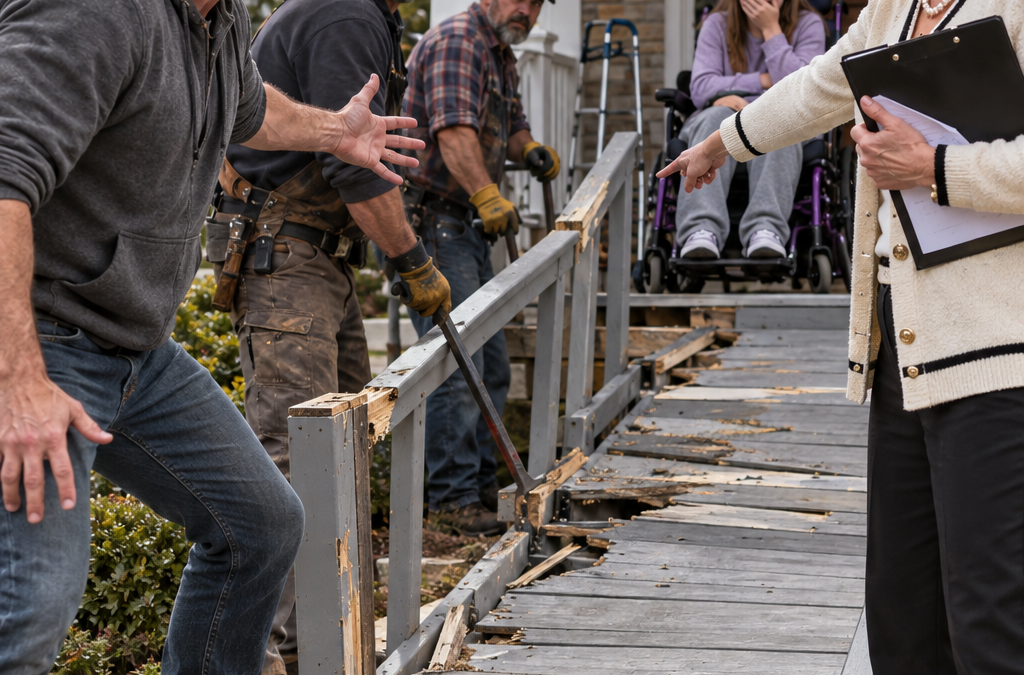
The front yard had been torn open. The smooth concrete pad was cracked and gouged. The landing was gone. The ramp was gone. One handrail lay twisted in the flower bed like something dead. There were deep machine tracks in the grass and chunks of concrete scattered near the walkway.
Our front door sat above the steps, unreachable.
Lily made a sound I had never heard from her before.
Not a sob.
Not a scream.
A small, breathless sound, like the air had been knocked out of her.
I parked crooked at the curb and got out slowly.
My legs felt unreal beneath me.
I walked to the edge of the yard, holding Lily’s backpack in one hand and the cold bag of fries in the other. I remember noticing the grease had soaked through the paper. That detail lodged in my brain for no reason. The uselessness of fries while my daughter’s independence lay in pieces.
Karen was on her porch.
Of course she was.
She held her dog’s leash in one hand and her phone in the other. She was recording us.
I crossed the yard toward her.
“What happened?” I asked.
My voice was quiet. Too quiet.
Karen lifted her chin.
“Enforcement of bylaws.”
I looked at the torn earth, then back at her.
“You destroyed my ramp.”
“The board ordered removal of a non-compliant structure.”
“You ordered a demolition crew onto my property?”
“The association has authority.”
“No,” I said. “It does not.”
She smiled then, small and smug.
“You were warned.”
Behind me, Lily began crying.
I turned and saw her sitting in the driveway, looking at the front door as if someone had moved it miles away. She was not wailing. She was not making a scene. Tears just ran silently down her face.
That was when something inside me went cold.
Karen wanted me to scream. She wanted a show. She had her phone ready because she wanted a video she could use to make me look unstable.
I gave her nothing.
“Who performed the demolition?” I asked.
“The association contracted it.”
“Name.”
“I don’t have to provide that to you.”
“Permit?”
“We do not need a city permit to remove non-compliant structures.”
A laugh escaped me before I could stop it.
It was not amused. It was disbelief with teeth.
Karen’s smile faltered.
“You think this is funny?”
“No,” I said. “I think you have no idea what you just did.”
Then I walked back to Lily.
I knelt beside her chair and touched her shoulder.
“I can’t get inside,” she whispered.
“I know.”
“My room is in there.”
“I know, baby.”
“My stuff is in there.”
“I know.”
Her hands curled around her wheels.
“She took my house.”
That was the sentence that did it.
Not “she took my ramp.”
My house.
Because Lily understood exactly what Karen had done. She had turned our home back into a place that needed someone else’s body to carry her into it.
I called the police. I called Daniel. I called the contractor who built the ramp.
The officer who arrived was polite and careful. He did not try to play mediator. He looked at the broken concrete, the tire tracks, the twisted rail, and then at Lily. He wrote everything down. Karen hovered on her porch, filming until the officer asked her whether she had anything useful to provide besides video.
She said, “This is an HOA matter.”
He said, “Ma’am, this is someone’s property.”
Her mouth shut.
The police report did not solve anything. I knew that. But it created a record, and from that moment forward, records became weapons.
We slept at a friend’s house that night.
Lily barely spoke. She sat on the guest bed in borrowed pajamas, staring at the wall while I tried to sound cheerful about ordering pizza. When the pizza came, she ate half a slice and said she was tired.
After she fell asleep, I sat on the floor beside the bed and cried silently into my sleeve.
The next day, our contractor loaned us a temporary ramp plank. It took two adults to help Lily into the house safely. She cried again, steady and quiet, while we maneuvered her up the front steps. Every inch felt humiliating. Every careful lift reminded her of what had been stolen.
That afternoon, I bought a cheap door camera and pointed it toward Karen’s porch.
Then I began.
There was the obvious legal route: ADA complaint, damages, replacement costs, attorney’s fees. Daniel handled that. But lawsuits move like glaciers, and I could not sit still while Karen strutted around as if she had won.
So I took a second route.
Paperwork.
If Karen wanted to rule by documents, I was going to bury her in them.
First, I formally requested every record connected to the ramp: the vote, the notices, the bylaws, board member terms, financial authority, enforcement procedures, and meeting minutes. According to their own governing documents, members had inspection rights. Karen stalled for a week, then sent PDFs that looked like they had been created in a panic at two in the morning.
The alleged unanimous vote had names but no signatures.
The minutes were vague.
The bylaws were strange.
Not old strange. New strange.
Formatting changed halfway through. Fonts shifted. Some sections sounded like they had been copied from generic templates, while others seemed written specifically to give the president sweeping power to approve fines, authorize enforcement, and declare emergency action.
Daniel noticed it too.
“These are messy,” he said.
“Messy illegal or messy annoying?”
“Potentially both.”
Second, I talked to neighbors.
Not dramatically. Not with accusations. I did not knock on doors yelling for justice. I took walks. I accepted conversations at mailboxes. I asked questions and listened more than I spoke.
People were tired.
That was the first thing I learned.
Karen had fined one woman for a garden gnome shaped like a frog. She had cited another family because their trash bins were visible for forty minutes after pickup. She had threatened liens over mailbox paint, chalk drawings, holiday lights, a basketball hoop, and one child’s lemonade stand. Dues had gone up twice since Karen became president, but the community pool pump was still broken, the park lights had been out for months, and a promised mulch project never happened.
“She says the money goes to improvements,” one neighbor told me.
“What improvements?”
He gave me a bitter smile.
“Exactly.”
Third, I pulled public records.
The ramp permit existed. Clean. Approved. Inspected.
The demolition permit for my address did not exist.
There was nothing.
No city approval. No removal permit. No inspection. No record that anyone had permission to tear up concrete at my home.
Then a friend told me to search the secretary of state’s website for the HOA’s registration.
I did.
At first, I thought I had entered the name wrong.
I tried different spellings.
Nothing active.
The last filing had been years earlier under a different president. The annual reports had stopped. The status was inactive.
I stared at the screen.
Then I laughed so hard I scared myself.
The association that had threatened me, fined me, voted against me, and destroyed my daughter’s ramp was legally dead.
A ghost with letterhead.
Karen had not taken control of a functioning HOA.
She had climbed into the costume of one.
Fourth, I followed the money.
I requested financial records: dues collected, expenses paid, vendor names, invoices, contracts. Karen resisted until Daniel sent a certified letter citing the inspection provision in their own bylaws. Then she sent an Excel spreadsheet so vague it looked less like accounting and more like a ransom note.
Landscaping consulting: round number.
Administrative support: round number.
Community outreach: round number.
Security planning: round number.
No receipts. No vendor details. No contracts attached.
One of the landscaping consulting payments matched the amount shown in a public post Karen had made about her kitchen refresh. She had posted a photo of a new backsplash with a caption full of emojis and congratulatory comments underneath.
I screenshotted it.
Maybe it proved nothing by itself.
But evidence rarely arrives as a lightning bolt. More often, it comes as crumbs. You collect enough, and eventually you have a trail.
The fifth crumb was stuck to my own broken handrail.
The demolition company had left a sticker on the twisted metal in the flower bed.
I called the number.
A man answered with the bored tone of someone expecting a routine question.
I gave him my address and asked whether his company had a permit for residential demolition work performed there.
The line went quiet.
“Who is this?” he asked.
“The homeowner.”
Another pause.
“We did a small concrete removal.”
“You demolished an accessibility ramp.”
“We were contracted by the HOA.”
“By whom?”
“I can’t discuss client details.”
“You entered my property and destroyed permitted accessibility construction without my consent. You may want to discuss something.”
He breathed into the phone.
“The president approved it.”
“Name.”
He hesitated.
Then he said Karen’s full name.
I wrote it down even though I already knew.
“Did she provide proof of authority?”
“She signed the contract as HOA president.”
“Did she provide a demolition permit?”
“We assumed the association had what they needed.”
There it was.
Assumed.
That word would become expensive.
He refused to email me the contract, claiming client privacy, but Daniel later subpoenaed it. For the moment, the admission was enough for my notes.
Meanwhile, Karen continued performing authority.
She sent a final notice saying fines were accruing. She warned that failure to pay could result in legal action. She suggested the HOA could place a lien on my house.
I placed the letter face down in the recycling bin and kept documenting.
Daniel sent preservation letters to Karen, the board, and the demolition company. He told them not to delete emails, texts, meeting notes, contracts, financial records, video footage, or communications regarding my property. He told them not to contact Lily. He told them to stop enforcement immediately.
The board got nervous.
I knew because they started copying too many people on email.
That was their mistake.
People say stupid things when they think an email chain is private. Karen wrote about “making an example” of homeowners who believed personal circumstances placed them above community rules. Her sister replied that “unsightly ramps” could set a precedent. The treasurer complained that if they allowed one exception, “everyone will want special treatment.”
Special treatment.
For a twelve-year-old child to enter her own home.
I printed that one twice.
We filed a complaint with the city for unpermitted demolition. An inspector came out, looked at the yard, and shook his head in a way that felt almost kind.
“They did this without a permit?” he asked.
“Yes.”
“To an accessibility ramp?”
“Yes.”
“With the occupant using a wheelchair?”
“Yes.”
He looked toward Karen’s house. She was on the porch again, filming.
The inspector took photos. He measured the damaged area. He wrote notes. Then he placed a stop-work order and told me to keep receipts for every expense connected to temporary access, repairs, housing disruption, and safety modifications.
“People think permits are suggestions,” he said.
“Apparently people also think children’s access is decorative.”
He looked at Lily, who sat quietly near the garage.
His expression changed.
“I’m sorry,” he said.
It was the simplest sentence anyone had given us since the ramp came down.
I almost cried again.
The board meeting where everything snapped happened two weeks later.
I almost did not go. Daniel advised caution. He told me not to argue, not to threaten, not to let Karen bait me into saying something she could twist.
“I can handle legal communications,” he said.
“I know.”
“Then why go?”
“Because she humiliated my daughter in front of this neighborhood. I want them to hear the truth in the same room where she lied.”
He paused.
“Then bring copies.”
I brought a folder so heavy it felt alive.
Karen opened the meeting with her usual performance. She stood at the front of the clubhouse under the fluorescent lights, shoulders squared, clipboard in hand. Her sister sat beside her. The treasurer looked less confident than usual. The secretary avoided my eyes.
“We are here,” Karen announced, “to address ongoing community concerns, including the importance of uniform standards and fair enforcement. Certain homeowners have suggested that personal circumstances exempt them from rules every other resident must follow.”
I looked around the room.
More people had come than usual.
Mr. Alvarez sat in the back. The lemon bar neighbor was there. So was the woman fined for the garden gnome. A father whose kids had been warned about chalk drawings stood near the wall with his arms crossed.
Karen lifted a paper.
“As you know, the board voted unanimously to enforce removal of an unapproved structure.”
I raised my hand.
She ignored it.
So I stood.
“I have copies of the city permit, inspection approval, and accessibility documentation,” I said. “I also have a copy of the police report, the city complaint for unpermitted demolition, and the attorney’s preservation letter.”
Karen’s face tightened.
“This is not the time for theatrics.”
“I agree.”
A few people murmured.
I walked to the front and placed packets on the table.
“I also checked the state registration for this association.”
The room changed.
It was subtle, but I felt it. Bodies leaning forward. Phones coming out. People who had been half-listening suddenly paying attention.
Karen’s smile returned too quickly.
“We are registered.”
“No,” I said. “You are inactive.”
“That is a formality.”
“Then you should have no trouble showing the current active registration.”
“It is in process.”
“That is not the same thing.”
The treasurer shifted in his seat.
I turned to the room.
“The last active filing I could find was years ago under a different president. Annual reports were not filed. The association appears to have lapsed before Karen ever claimed authority to enforce rules, collect dues, issue fines, or hire a demolition company.”
Someone in the back whispered, “Wait, what?”
Karen slapped her palm lightly on the table.
“This is misinformation.”
“Then produce the registration.”
Silence.
I picked up another paper.
“I also requested the minutes for the vote authorizing demolition of my daughter’s ramp. The document I received has names but no signatures. No proof of a properly noticed meeting. No valid authority attached. So I’m asking now, in front of everyone, who voted to send a crew onto my property?”
Karen’s sister cleared her throat.
“We can discuss procedural matters later.”
“No,” I said. “You discussed my daughter’s disability in this room. You discussed my property in this room. You voted, allegedly, in this room. So we can discuss procedure in this room.”
The treasurer took a sip of water. His hand shook.
Karen’s voice dropped.
“You are out of order.”
“I’m a homeowner whose permitted accessibility ramp was demolished without consent.”
“You were warned.”
“And you were unauthorized.”
A ripple moved through the room.
Karen pointed toward the door.
“This meeting will continue without disruption.”
“I’m not disrupting it,” I said. “I’m informing the members that Daniel Price, my attorney, is filing claims related to disability discrimination, property damage, unpermitted demolition, and unlawful enforcement. We are also filing complaints with the state and with the financial institution holding association funds, because I have concerns about dues collected by an inactive entity and expenses without documentation.”
The room erupted.
Not yelling at me.
At them.
“What does she mean inactive?”
“Where did our dues go?”
“You told me I had to pay a fine!”
“Can they even do that?”
“My husband wrote checks for two years!”
Karen tried to shout over them.
“Enough! This is defamation!”
Mr. Alvarez stood.
“Is it defamation if the state website says the same thing?”
That was when I knew she had lost the room.
Not legally. Not yet.
But emotionally.
The fear had cracked.
After the meeting, neighbors surrounded me in the parking lot. Not all of them. Some still avoided me because conflict makes people small. But enough came.
The garden gnome woman showed me violation letters. The chalk father forwarded emails. Mr. Alvarez told me he had saved screenshots from neighborhood posts Karen had deleted. Another man admitted Karen had threatened a lien over unpaid “administrative fees” that did not appear anywhere in the bylaws.
Then a quiet neighbor I barely knew came to my house two days later with an envelope.
His name was Paul, but in my head I still think of him as the backyard guy because he always seemed to appear from behind a fence.
He stood on my porch, looking nervous.
“She doesn’t know I have these,” he said.
Inside were printed emails from an old HOA account.
Before Karen moved in, there had been a legitimate board. The president at the time had moved away and asked for volunteers to replace her. Nobody stepped up. The bank renewal was missed. State filings lapsed. The association became inactive.
Then Karen arrived.
According to the emails, she had pushed to “revive” the neighborhood standards committee, but there was no proper election, no valid re-registration, no legitimate transfer of authority. She had printed new bylaws, appointed relatives and loyal acquaintances, collected dues, and started enforcing rules.
She had not revived the HOA.
She had invented a throne and sat down on it.
When I sent the documents to Daniel, he called me within twenty minutes.
For the first time since I hired him, he laughed.
Not loudly. Not joyfully. More like his professionalism had briefly lost its grip.
“Well,” he said, “that changes the shape of things.”
“Good shape or bad shape?”
“For her? Catastrophic.”
The bank froze the HOA account after receiving notice of the disputed authority and pending complaints.
I found out because Karen posted on the neighborhood group claiming “hostile members” had caused community funds to be illegally frozen and that services might be interrupted.
Someone commented, “What services?”
Someone else asked why the park lights had been broken for months.
A third person posted a photo of a canceled dues check next to Karen’s kitchen refresh post.
Karen deleted the thread.
Then she posted again saying defamation was a serious crime.
That one did not go better.
The city cited the HOA for unpermitted demolition. Karen appealed and lost. The citation named the responsible party as the association president who authorized the work.
The demolition company, once subpoenaed, produced the contract.
There it was in black and white.
Removal of unapproved ramp structure.
Signed by Karen Caldwell, HOA President.
Paid from the HOA account.
The canceled check’s memo line read: Ramp compliance.
Ramp compliance.
I stared at that phrase for a long time.
It sounded so clean. So official. So bloodless.
It did not show Lily sitting in the driveway crying because she could not get into her house. It did not show two adults lifting her up the steps while she stared at the place where her independence used to be. It did not show the nights she asked whether neighbors hated her. It did not show the way she stopped cheering during physical therapy for a while, as if joy itself had become evidence someone could use against her.
Legal documents flatten pain.
But they preserve facts.
And facts were enough.
The state sent formal notice that the association was operating without proper registration and had thirty days to comply or cease operations. Karen tried to file paperwork after the fact, but the complaints had already reached the right desks. The state asked for proof of board elections, valid minutes, financial records, and authority to act.
Karen had Word documents.
The state wanted records.
Karen had signatures missing from votes.
The state wanted procedure.
Karen had a clipboard and a bad attitude.
That was not enough.
At the same time, our disability-related complaint gained traction. Daniel updated the claims to include the new evidence: the inactive association, the improper authority, the targeted comments, the emails about “unsightly ramps,” the demolition contract, the city citation, and the financial irregularities.
Karen doubled down until the very end.
That was the most astonishing part.
Even with the state questioning her authority, the city citing the demolition, the bank freezing funds, neighbors turning over documents, and a lawyer sending letters that got sharper by the week, she still seemed to believe she could posture her way through it.
She sent one final email to a huge list of homeowners accusing me of trying to destroy the neighborhood because I refused to follow rules.
I replied to Daniel only.
He wrote back: “Do not respond. She is doing our work for us.”
He was right.
Every email became another exhibit.
Every insult became context.
Every attempt to shame us became proof.
The state eventually denied the attempt to re-register under Karen’s control because she could not establish proper authority, compliant records, or valid elections. The notice was not written dramatically. Government letters rarely are. But its meaning was clear.
The association, as Karen had been operating it, was done.
No fines.
No enforcement.
No dues collection.
No threats.
No clipboard kingdom.
The old land declaration still existed somewhere in the bones of the subdivision, but without a properly registered entity to administer it, the neighborhood would have had to start over the right way—with real elections, transparent finances, proper filings, and actual member consent.
Most people wanted no part of that.
They had seen enough.
The settlement came soon after.
I will not pretend it made everything disappear. Money does not erase the image of your child sitting outside her own home, locked out by cruelty dressed up as procedure. A rebuilt ramp does not undo the weeks she spent wondering whether her body made her unwelcome. An agreement signed in a conference room does not cleanse a neighborhood of every person who stayed silent when they should have spoken.
But it mattered.
The HOA, such as it was, agreed to pay damages and cover attorney’s fees. The demolition company contributed because they should have verified authority and permits before touching my property. Karen had to pay personally as well, because she acted outside legitimate authority.
The settlement covered a new ramp.
Not just a replacement.
A better one.
Smooth concrete. Stronger rails. A wider landing. An automatic front door opener. And, because Daniel pushed harder than I expected, a small exterior lift we had never been able to afford before.
The day the new work was finished, Lily refused help.
I stood at the bottom of the ramp with my heart in my throat, trying not to hover.
“Mom,” she said, looking over her shoulder.
“What?”
“You’re doing the face.”
“What face?”
“The ‘I am pretending not to panic’ face.”
“I have no idea what you mean.”
“You absolutely do.”
Marissa, standing beside me, grinned.
“Let her do it,” she said softly.
So I did.
Lily pushed forward. Her wheels moved over the smooth surface without the old clatter Karen had once called a nuisance. The new handrails gleamed in the late afternoon light. The front door waited at the top, fitted with a button Lily could reach.
Halfway up, she stopped.
For one terrible second, I thought something was wrong.
Then she turned toward Karen’s house.
The porch was empty.
Karen had put her house up for sale not long after the state decision. By the time the ramp was complete, she was gone. No farewell. No apology. No final speech about standards. Just a moving truck one morning and a bare patch on the porch where her chair used to be.
Lily looked at that empty porch, then back at me.
“She moved?”
“Yes.”
“For real?”
“For real.”
“Good.”
It was the hardest little word I had ever heard from her.
She turned forward again and continued up the ramp. At the landing, she pressed the door button. The door opened slowly, smoothly, like the house itself was finally learning manners.
Lily rolled through.
Then she stopped inside, spun her chair around, and looked back at me.
“I can get home by myself,” she said again.
The same words as before.
But this time, they carried everything we had survived.
I walked up the ramp after her, slower than I needed to, because I wanted to feel every inch of it beneath my feet. I touched the handrail. I looked at the clean concrete, the new landing, the door, the place where my daughter had reclaimed what someone tried to steal.
For months, I had been angry at the neighbors who stayed quiet.
Some eventually apologized. Some avoided us. Some acted as if the whole thing had been unfortunate weather that had passed through the subdivision rather than a choice people made and allowed. I learned something about silence during that time. Silence is not neutral when someone vulnerable is being targeted. Silence is a vote for whoever is doing the harm.
But I also learned something about records, persistence, and the strange power of refusing to be embarrassed by your own need.
Karen had counted on shame.
She thought she could make me ashamed of my daughter’s disability, ashamed of the ramp, ashamed of needing accommodation, ashamed of causing trouble, ashamed of being the parent who would not just accept the fine and go away.
She misunderstood me.
I had spent twelve years learning how to fight without permission.
I had fought insurance denials with one hand while packing school lunches with the other. I had fought appointment waitlists, inaccessible buildings, careless teachers, pitying strangers, broken elevators, and the quiet cruelty of people who thought accessibility was optional if it inconvenienced them.
Karen was not new.
She was just louder.
And she left a paper trail.
After the HOA collapsed, the neighborhood changed.
Not magically. Not into some perfect community where everyone suddenly understood disability rights and baked casseroles together. Real life is not that neat.
But the letters stopped.
The fines stopped.
People painted mailboxes without fear. Kids drew chalk animals on driveways. Trash cans occasionally sat out too long, and the world did not end. The pool still needed repairs, but now people discussed it like neighbors instead of subjects waiting for orders from a queen with a clipboard.
Mr. Alvarez fixed the park lights with two other homeowners after getting everyone’s permission and splitting the cost voluntarily. The garden gnome woman put her frog back outside, then added a second frog wearing sunglasses. The chalk father’s kids drew an enormous rainbow that stretched across half their driveway, and nobody called it graffiti.
As for Lily, she slowly became herself again.
That was the real ending I cared about.
Not Karen leaving.
Not the settlement.
Not the state letter.
Those things mattered, but they were adult victories. Paper victories. Necessary victories.
The real victory was the first time Lily yelled “woohoo” rolling down the new ramp.
She had not done that since before the demolition.
The sound flew down the driveway, bright and wild, and for one brief second I felt my whole body tense from old fear. I looked instinctively toward Karen’s porch, expecting the phone, the glare, the complaint.
There was nothing there.
Just an empty house with a sale sign gone from the lawn and sunlight hitting the windows.
Lily stopped at the bottom of the ramp, breathless and grinning.
“Was that too loud?” she asked.
I swallowed hard.
“No,” I said. “Do it again.”
So she did.
She rolled up, pressed the door button, came back out, and flew down the ramp with another joyful shout. Marissa cheered. I cheered. Mr. Alvarez, watering the same plant he had been watering for what felt like three years, lifted both hands in the air and shouted, “That’s right!”
Lily laughed so hard she had to brake.
And I stood there on the driveway, watching my daughter celebrate a ramp that should never have been controversial, and felt the weight of everything settle into something almost like peace.
I still keep the old twisted handrail.
Not in the yard. Not where Lily has to see it every day.
It sits in the garage, leaning against the wall behind the boxes of holiday decorations. Sometimes I think I should throw it away. Sometimes I think keeping it is strange. But every time I reach for it, I remember the day I found it bent in the flower bed like proof of how far cruelty will go when nobody stops it early.
So I keep it.
Not as a shrine to what Karen did.
As a reminder of what she failed to do.
She destroyed the first ramp, but she did not destroy my daughter’s right to come home. She humiliated us, but she did not make us disappear. She tried to turn neighbors against us, but she exposed herself instead. She believed authority was something she could print, sign, and wave in someone’s face.
She learned authority without truth is just paper.
And paper burns.
The new ramp is still there.
Lily uses it every day.
Sometimes she rolls down it quietly, earbuds in, already texting a friend before she reaches the driveway. Sometimes she takes it slowly, tired from therapy or school or just being a kid in a body that asks more of her than most people will ever understand. Sometimes she stops halfway and complains that I bought the wrong cereal. Sometimes she decorates the railings with holiday lights, and every year she chooses colors that are absolutely not earth tones.
Nobody sends letters.
Nobody measures.
Nobody films.
Nobody calls her independence a nuisance.
And every time I hear her wheels moving across that ramp, I think about how close I came to believing quiet was the same thing as safe.
It is not.
A quiet community can still hide cruelty. A friendly neighborhood can still follow a bully. A rule can still be wrong even if it is printed in clean font and mailed certified. And a ramp can be more than a ramp.
It can be a line in the concrete.
A declaration.
A promise.
A way of saying: this home belongs to my child, too.
Karen never understood that.
But Lily did.
And in the end, that was why we won.