𝗙𝗨𝗟𝗟 𝗦𝗧𝗢𝗥𝗬 The Racist Woman Tried to Run Me Out of the Village, Then Learned I Owned the House She Was Living In
part2
Karen lived in the hillside house.
It was one of my grandfather’s favorite properties, though I doubt she knew that. The house sat above the village on a narrow lane bordered by old stone walls and rosemary bushes that released scent when the sun hit them. From the front terrace, you could see red rooftops, the church tower, vineyards beyond the lower road, and the soft blue line of hills in the distance.
It was the kind of home people dreamed about.
Karen treated it like a throne.
The first things I heard about her came from neighbors, though no one volunteered too much at first. Small villages know how to talk, but they also know how to measure a newcomer. Eventually, after enough shared meals and long walks, people began mentioning her with that particular tone people use for someone exhausting.
“She keeps to herself,” Madame Laurent from the bakery said one morning.
Then, after a pause, she added, “Until she does not.”
That was accurate.
Karen did not attend gatherings. She did not wave from her terrace. She did not join market mornings unless she wanted to complain about prices. She harassed vendors for discounts, lectured buskers about noise, and once tried to stop a children’s music event in the square because “some people value peace.” According to my neighbor Luc, people had invited her to community dinners more than once.
“She comes only to ruin things,” he said. “So now we let her stay on her hill.”
At first, I treated it as local personality drama.
Every village has difficult people.
Then the old property management agency sent me the tenant reports.
Karen was behind on rent.
Not a little behind.
Several months.
She had been late before, often enough that the agency had a file of reminders, partial payments, excuses, and promises. Since I had taken over direct management to save costs and have more control, the problem now belonged to me. I was not desperate for the money in the way some landlords might have been. The portfolio was stable. Other tenants paid. I could afford patience.
But patience is not the same as ignoring the law.
French rental procedures required documentation. Proper notices. Correct steps. If the situation did not improve, I would eventually have to begin formal legal action through a bailiff. I did not want to. My hope, naïve as it now sounds, was that meeting me face to face might humanize the issue. Maybe Karen had a real problem. Maybe she was sick, overwhelmed, confused about agency transition, or dealing with something private.
I wanted to give her the chance to explain.
So I decided to introduce myself.
I even brought muffins.
That detail embarrasses me now.
There was a local bakery where, according to Madame Laurent, Karen sometimes bought lemon muffins. I thought showing up with something familiar might soften the conversation. Looking back, I see how badly I underestimated the kind of person I was walking toward.
It was a bright afternoon when I climbed the lane to her house. The village below looked peaceful enough to make the world seem kinder than it was. I carried the small bakery tray in both hands, rehearsing my introduction.
Hello, I’m Alfie. I recently took over management of the property. I wanted to introduce myself and discuss the account.
Professional.
Calm.
Respectful.
I knocked.
Nothing.
I knocked again.
After several minutes, a voice shouted from inside, “For God’s sake, give me a minute.”
I almost left.
Then the door flew open.
Karen stood there in a silk robe, hair pinned messily on top of her head, sunglasses perched on her nose even though she was indoors. She was a white woman in her late fifties, sharp-faced and thin-lipped, with the permanent expression of someone disappointed by everyone but herself.
“What?” she snapped.
I smiled because I still believed in manners.
“Good afternoon. I’m sorry to bother you. I wanted to introduce myself. I recently moved into the village. My name is Alfie, and I’m—”
She looked me up and down.
Then she laughed.
Not because anything was funny.
It was a fake laugh, loud and brittle, designed to put me beneath her before I could finish my sentence.
“You live here?”
“Yes,” I said carefully.
“No.” She shook her head, still laughing. “No, we don’t have your kind here.”
The words landed slowly.
Maybe because I did not expect them.
Maybe because the village had been so warm until then that my guard had lowered in a way I had not realized.
I am a person of color. I have dealt with racism before. In America, in airports, in offices, in restaurants, in polite rooms where no one used slurs but somehow still made sure you knew the hierarchy. But in this little French village, for a few months, I had felt something close to peace. People had welcomed me, corrected my French, fed me, teased me, asked questions, invited me in.
Karen ripped through that peace in one sentence.
“I’m sorry?” I said.
I tried again. “I think there may be a misunderstanding. I’m here because—”
She lifted a hand in front of my face.
Actually lifted it.
Like stopping a servant from speaking.
“I don’t know what story you’ve told people down there, but your kind does not last long in places like this.”
My fingers tightened around the bakery tray.
“The village knows I live here,” I said. “People have been very welcoming.”
“Then they’re being polite.” Her smile became thin and cruel. “They won’t say it to your face. I will. You should leave before the rest of them get tired of pretending.”
For a moment, I forgot why I had come.
The rent.
The property.
The notice.
All of it disappeared behind the old familiar heat rising in my chest.
“You don’t know me,” I said.
“I know enough.”
“No,” I replied. “You really don’t.”
She slammed the door.
I stood there on the terrace with the muffins in my hands, heart pounding, face hot.
Then the door opened again.
Karen reached out, snatched the muffins from the tray, and said, “I’ll take these.”
Then she shut the door a second time.
I walked back down the hill feeling ridiculous, furious, and strangely hollow.
I had not told her I was her landlord.
At first, that bothered me. I had failed at the one task I went there to do. But by the time I reached the lower square, I realized something important.
If I had opened with authority, she might have hidden herself.
Instead, she had shown me exactly who she was.
I told Luc and Madame Laurent what happened. Their reaction was not surprise. It was anger wrapped around weary recognition.
“She has always been like this,” Luc said.
“Not always so open,” Madame Laurent added. “But yes.”
They bought me coffee. Someone made a joke about Karen stealing racist muffins. I laughed because I needed to, and because people who care often do not know how else to patch a wound except with warmth and absurdity.
I tried to move on.
Karen did not.
A week later, I was sitting on a bench in the small park near the fountain, reading emails on my phone and drinking coffee from a paper cup, when her voice cut through the afternoon.
“You again.”
I looked up.
Karen stood on the path with a cloth shopping bag over one arm, sunglasses on, lips pinched.
“Good afternoon,” I said.
She looked at the bench as if I had contaminated it. “Move along.”
I stared at her. “Excuse me?”
“We don’t want homeless people sleeping in the park.”
“I’m not homeless.”
“Of course you aren’t.” Her tone dripped sarcasm. “You just sit around all day with nowhere to go.”
“I live down the road.”
She scoffed. “Liar.”
Then, as she passed, she kicked over my coffee.
Not accidentally.
Her shoe caught the cup cleanly, sending it across the gravel path, dark liquid spilling into dust.
“Oops,” she said.
I sat there frozen for half a second as she walked away.
The park was not crowded, but people saw. An old man near the fountain shook his head. A mother with a stroller looked horrified. No one seemed surprised.
That somehow made it worse.
At that point, Karen still had not paid a euro toward the overdue rent.
My sympathy, already badly wounded, began to die.
I emailed her through the rental management account, using the business alias the agency had used for years. My personal name and photo were not attached. The message was professional: outstanding rent balance, request for explanation, reminder of lease obligations, offer to discuss a payment plan if there were hardship circumstances.
Her reply came a few hours later.
It was carefully written.
She claimed her bank had been experiencing transfer delays. She insisted payments had been sent but not cleared. She said she was “offended by the implication of delinquency” and expected the matter to resolve once “clerical incompetence” stopped interfering.
I called the bank listed in the old payment records.
No such transfers existed.
She was lying.
Around the same time, a friend in the village told me Karen came from money. Not vague comfort. Real wealth. Her family owned several companies. She had investment income, expensive habits, and no known financial hardship. That made the unpaid rent less confusing and more insulting.
It was not inability.
It was entitlement.
Meanwhile, the harassment escalated.
Karen began coming into the village more often, and somehow she always found me. At the market, she muttered slurs under her breath while pretending to inspect tomatoes. Outside the post office, she told an elderly man I was “one of the outsiders ruining the village.” Near the bakery, she asked Madame Laurent why “people like him” were being served ahead of “locals,” even though I had been standing in line like everyone else.
Madame Laurent replied, “Because he arrived before you.”
I loved her for that.
One evening, I attended a small gathering at Luc’s house. Nothing formal, just wine, food, neighbors, music playing softly, people talking over one another in that warm, chaotic way I had come to love.
Karen arrived uninvited.
The entire room changed.
She stepped inside with a look of grim triumph, found me near the kitchen, and marched directly toward me.
“There you are,” she said loudly.
Luc moved forward. “Karen, this is private—”
She ignored him.
“You think you can hide behind these people?” she said, pointing at me.
I felt every face turn.
“I’m not hiding.”
“You are a parasite.” Her voice rose. “You come here with your fake politeness and your foreign manners and expect everyone to clap because you bought yourself a little place among civilized people.”
Someone gasped.
Luc said, “Enough.”
Karen kept going.
Slurs. Insults. Homeless. Criminal. Waste of space. Words she had probably used in private for years, now spilling out in a room full of witnesses because she was too angry to filter herself.
I did not answer.
Not because I was noble.
Because my hands were shaking, and I knew if I spoke, my voice would betray how much it hurt.
Finally, Luc’s sister grabbed Karen by the arm and dragged her toward the door.
“Get off me!” Karen shouted.
“You were not invited,” Luc said, and helped push her out.
The door shut behind her.
The room stayed silent.
Then Madame Laurent walked over, placed one hand on my arm, and said, “She does not speak for us.”
I nodded.
I wanted to believe her.
I mostly did.
But racism has a way of making one cruel voice echo louder than twenty kind ones.
The police calls began after that.
Karen called them at the market, claiming I was stealing.
At the park, claiming I was loitering suspiciously.
Near the church, claiming I was trespassing.
Once, I was walking home with groceries when two officers approached me and asked where I was going. Their tone was polite but official, and I knew before they said her name.
At first, they took the complaints seriously.
They had to.
A call is a call.
But after the third or fourth time, skepticism entered their eyes before they even reached me. They started recognizing the pattern. One officer, young and tired-looking, once apologized quietly after confirming I was simply sitting on a public bench.
“She calls often,” he said.
“I noticed.”
“You should document everything.”
“I have been.”
That was true.
By then, I had a folder.
Screenshots. Dates. Locations. Witness names. Rent records. Emails. Her false bank claims. Notes after every encounter. I had begun consulting with a local bailiff about proper eviction procedures for unpaid rent and lease violations. Because Karen was on a month-to-month arrangement rather than a long-term protected lease, the process could move somewhat faster, but France is not a place where a landlord simply changes locks and calls it done. There were rules. Notices. Documentation. Steps.
My neighbors urged me to act sooner.
I hesitated.
Not because Karen deserved patience.
Because confrontation drains me.
People who enjoy standing up to bullies make it sound clean. It is not. It is exhausting. It invades your sleep. It makes every walk through town feel like a possible scene. It turns your phone into a source of dread and your own restraint into something other people mistake for weakness.
But one afternoon in the park, Karen gave me the moment I needed.
I was sitting on the same bench where she had kicked my coffee weeks earlier. The day was clear. Children played near the fountain. An old man read a newspaper in the shade. I remember thinking, foolishly, that the afternoon felt peaceful.
Then I heard running footsteps.
Karen came first, breathless and flushed, pointing at me.
Behind her ran two police officers, confused and annoyed.
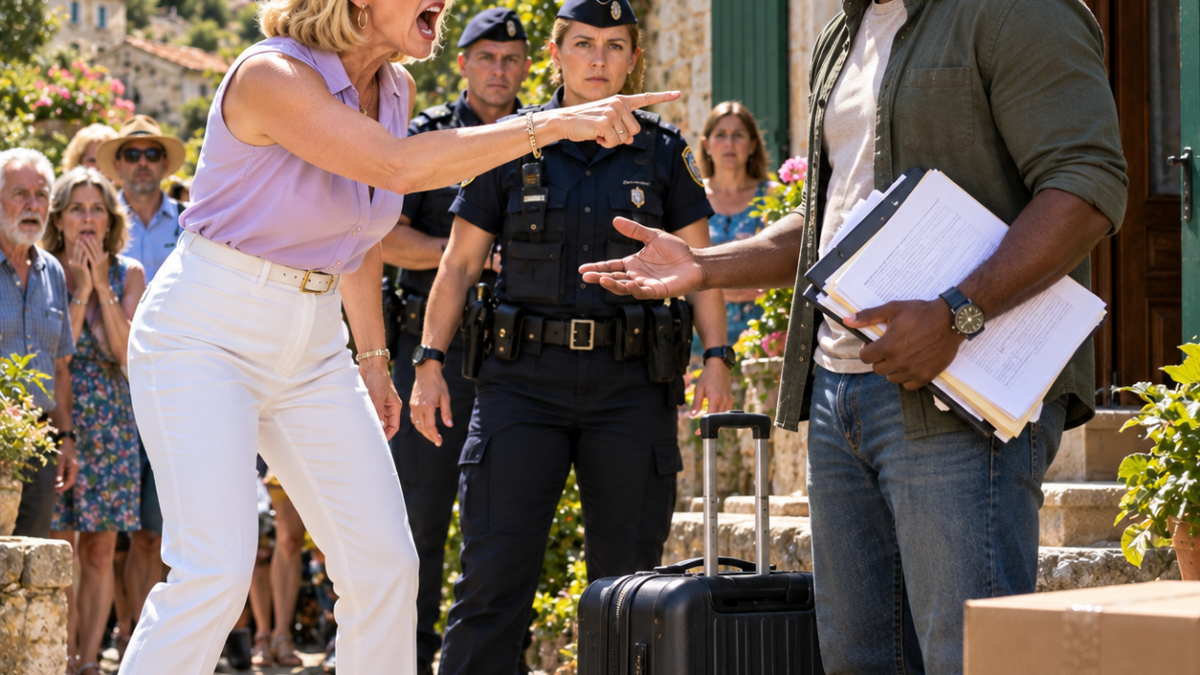
“There!” Karen shouted. “That’s him!”
One officer stopped, panting slightly. “Madame, where is the attack?”
Karen pointed harder. “He threatened me.”
I stood slowly.
“I have not spoken to her today.”
The officers looked at me and immediately sighed in that tired way I had come to recognize.
One said, “Madame, again?”
“She is making false reports,” I said.
Karen whipped toward me. “Liar!”
“No,” I said, and this time my voice did not shake. “I would like to make a formal statement.”
The officers straightened slightly.
I looked at Karen.
Then at them.
“This woman has been harassing me for weeks with racist insults, false accusations, and repeated police calls. I have documented incidents, witnesses, and dates. There is also an ongoing civil matter involving unpaid rent because I am her landlord.”
Karen froze.
For the first time since I had met her, she had nothing to say.
I turned back to her.
“I own the house you live in, Karen.”
The silence around us was extraordinary.
Even the children near the fountain seemed quieter.
Karen’s face changed slowly. First confusion. Then disbelief. Then something like fear. Then rage rushing in to cover it.
“No,” she said.
“Yes.”
“You’re lying.”
“I am not.”
“You cannot possibly—”
“I own that property,” I said. “And several others in this village. The agency handled communications before. I recently took over direct management. I came to your door weeks ago to introduce myself and discuss your overdue rent. You called me slurs before I could finish.”
Her mouth opened.
Closed.
Opened again.
Then she did the worst possible thing for herself.
She started screaming slurs in front of the police.
It was almost surreal. Like watching someone handed a shovel and deciding the hole was not deep enough. She called me a liar, a fraud, a thief, a foreign parasite. She told the officers I had tricked everyone. She said I could not own “French homes” because I was not “one of them.” Her voice rose until people across the park stopped pretending not to watch.
I looked at the officers.
“This,” I said quietly, “is the pattern.”
The older officer nodded once.
“Madame,” he said to Karen, “you need to calm down.”
She did not.
She stepped toward me, finger raised, still shouting.
The younger officer moved between us.
Karen shoved his arm.
Not hard enough to injure him.
More than enough to change the situation.
Within seconds, they detained her for disturbing the peace and public harassment. She screamed the entire time. People gathered. Phones appeared. The old man with the newspaper folded it very slowly, as if even he wanted a better view.
As they guided Karen toward the police car, I reached into my folder.
I had prepared the notice days earlier with the bailiff. Properly drafted. Properly served if handed to her in person with witnesses. It began the legal process tied to nonpayment and lease violations.
“Karen,” I said.
She twisted toward me, face red.
I held out the document.
“This is formal notice regarding your unpaid rent and violation of lease terms.”
For one second, she did not take it.
Then the officer said, “Take the paper, madame.”
She snatched it from my hand.
“And one more thing,” I said.
I do not know why I said it. Maybe because months of restraint had finally reached its limit. Maybe because she had spent so long trying to make me feel small that I needed, just once, to let the truth stand at full height.
“I own half the properties in this village.”
Her scream as they put her into the police car was not a word.
It was pure outrage.
The car door closed.
The sound felt final.
It was not, of course. Legal processes are rarely final in a single dramatic moment. But something shifted that day.
People had heard her.
Police had heard her.
The false reports, the harassment, the unpaid rent, the racist language—all of it finally collided in public where she could not edit it afterward.
Karen was detained for a short time over the disturbance and harassment. During that time, I filed a formal complaint about the racist abuse with the authorities, supported by my documentation and witness statements. I continued the eviction process properly through the bailiff. My lawyer reviewed everything. The unpaid rent alone gave us a strong civil case. The harassment, false police reports, and lease violations made it stronger.
When Karen was released, she came back to a village that no longer allowed her to pretend.
Neighbors did not greet her.
Vendors did not indulge her.
The police no longer treated her calls about me as isolated concerns.
The agency records showed months of nonpayment. Her email about imaginary bank issues looked exactly like what it was. The witnesses from Luc’s gathering gave statements. Madame Laurent wrote one too, in precise handwriting that looked gentle until you read the words.
Karen did not fight long.
I expected her to.
I expected threats. Lawyers. More lies. Some performance where she claimed victimhood and accused me of discrimination for enforcing rent. Instead, she packed.
Quickly.
A moving van came before sunrise on a cold morning, the kind where mist hangs low over the lane. I stood near the lower square with coffee in my hand, watching from a distance because I am human and not above wanting to see it. Karen’s hillside house looked pale in the early light. Movers carried boxes out while she directed them in a long coat and sunglasses, even though the sun had barely risen.
She saw me once.
Even from far away, I felt the hate in her stare.
I raised my coffee cup.
Not a toast.
Not quite a wave.
A goodbye with punctuation.
She looked away first.
She left the village that day and never returned.
Through the legal process and the bailiff, we recovered most of the unpaid rent. Her security deposit was not returned because of rent arrears and damage to the property. The remaining balance went through the proper channels. It was not as satisfying as a movie ending where a villain loses everything in one clean stroke, but real justice is usually paperwork stacked neatly until the lie has nowhere left to sit.
After she left, I inspected the hillside house.
That was harder than I expected.
Not because of the damage, though there was some. Scratched floors. Broken cabinet hinges. Stained walls. A cracked tile in the bathroom. Neglect in little corners where contempt had settled like dust.
It was hard because my grandfather had loved that house.
I remembered him describing the terrace, the view, the old stones. He had believed homes deserved people who understood they were borrowing history, not consuming it. Karen had lived there for years and never seemed to understand the gift of waking up above a village that had tolerated her far longer than she deserved.
I stood in the empty living room and opened the shutters.
Sunlight filled the space.
For the first time since I inherited the properties, I understood what my grandfather meant.
Land remembers who respected it.
So do houses.
So do villages.
The new family moved in two months later.
A young couple with a little girl and an elderly mother who loved gardening. They arrived with too many plants, too many books, and the kind of nervous excitement that makes a house feel alive before the furniture is even arranged. They knew who I was from the beginning. By then, there was no point hiding it. Everyone knew.
The little girl asked if the house came with ghosts.
“Only old plumbing,” I said.
Her grandmother laughed so hard she had to sit down.
They paid rent on time. They planted lavender near the terrace. They invited neighbors over for tea. Within weeks, the house on the hill no longer felt like Karen’s house. It felt like itself again.
As for me, life became peaceful in the way I had hoped for when I first moved.
Not perfect.
No place is perfect. Pipes burst. Tenants call at odd hours. Taxes remain taxes in every language. My French still fails me at the worst possible moments. The baker still corrects me with the intensity of a schoolmaster facing national decline.
But the village feels like home now.
I no longer hide that I own properties, but I do not lead with it either. People know me as Alfie first. The man who lives near the square. The American who tries. The landlord, yes, but also the neighbor who helps carry chairs, attends dinners, buys too many pastries, and remembers whose roof needs checking before winter.
I have changed how I manage things.
Not because Karen scared me.
Because she taught me that distance can protect peace, but it can also hide rot. The agency had kept me insulated, but it had also allowed a tenant like Karen to become a mystery instead of a known problem. Now I know my tenants. I do not interfere in their lives, but I make sure they know how to reach me, and I make sure I see enough to know when something is wrong.
Most people are decent.
That is the truth Karen never understood.
She thought cruelty made her powerful because people avoided her. But avoidance is not respect. It is exhaustion. The village did not admire her. It endured her until the day endurance became unnecessary.
Sometimes I still pass the bench where she kicked over my coffee.
I sit there often now, partly out of stubbornness. The fountain runs nearby. Children play. The old man still reads his newspaper. People nod when they pass. Sometimes Madame Laurent brings me a pastry she claims was “too ugly to sell,” even though it always tastes perfect.
One afternoon, Luc sat beside me and said, “You know, when you first came, some people wondered why you did not say you owned everything.”
“I don’t own everything.”
“Enough.”
“I wanted people to know me first.”
He nodded. “They do.”
That meant more than he knew.
For a long time, Karen’s words had left a bruise I did not want to admit existed.
Your kind does not last long here.
She said it like a curse.
But she was gone.
I remained.
Not because I owned houses. Not because I had legal papers. Not because the police finally heard her say what she had been saying when they were not around.
I remained because the village made room for me, and I chose to stand in that room instead of letting one hateful woman define it.
That is the part I think about most.
Racism wants you isolated.
It wants you wondering whether the cruel voice is the honest one and the kind voices are merely polite. It wants you shrinking yourself before anyone else has to do the work. Karen tried that. She tried to make me feel temporary in a place where I had every right to build a life.
But hatred is often loudest right before it loses an audience.
The day she learned I was her landlord, she did not suddenly become less racist. She became exposed. That was enough. Sometimes people imagine consequences require changing the heart of the person who harmed you. I have no interest in Karen’s heart. She can keep it, wherever she went. What mattered was stopping her from using that heart as a weapon in my village.
The hillside house glows in late afternoon now.
Lavender on the terrace. A child’s bicycle by the wall. Curtains open. Music sometimes drifting down the lane. When I walk past, the grandmother waves from the garden. The little girl once shouted, “Bonjour, Monsieur Alfie!” so proudly that her mother applauded her pronunciation.
I waved back.
A house remembers who respects it.
So does a village.
And maybe people do too.
Karen thought I was just some outsider she could insult until I disappeared.
She thought I was homeless, powerless, temporary, and alone.
She thought wrong.
I was her landlord.
I was the owner of the house on the hill.
I was the name behind the leases, the one who had been patient while she lied, documented while she harassed, and waited until the truth could stand in front of police, neighbors, and paperwork all at once.
But more than that, I was a person who belonged because belonging is not something a racist gets to grant or revoke.
The last time I saw Karen, she was leaving in a car packed with boxes, face tight with humiliation, the village she tried to police shrinking behind her.
The last thing she saw of me was not anger.
It was not fear.
It was me standing calmly in the square with coffee in my hand, watching her go from a place she had never truly respected.
My grandfather was right.
Land remembers.
And this village, finally, was done remembering Karen.
𝗧𝗛𝗘 𝗘𝗡𝗗
The Racist Woman Tried to Run Me Out of the Village, Then Learned I Owned the House She Was Living In
Karen thought I was a stranger she could shame out of town.
She had no idea the house on the hill, the rent she refused to pay, and half the village she looked down on all traced back to my name.
My grandfather used to say land remembers who respected it.
When I was younger, I thought that was one of those dramatic things old men say when they want to sound wiser than they are. He had a habit of speaking in little sentences that seemed designed to outlive him. Buy what people ignore. Fix what others abandon. Never raise your voice when paperwork can do the talking. Land remembers who respected it.
At the time, I did not understand.
To me, my grandfather was simply the man who somehow knew how to turn quiet opportunities into family security. He was not flashy. He did not wear expensive watches or talk about investments at dinner like he wanted applause. He drove an old car long after he could afford something newer, kept receipts in labeled envelopes, and remembered every person who ever tried to cheat him by full name, date, and amount.
Decades ago, long before anyone in my family imagined I would one day live there, he began buying properties in a small village in France.
The place was not fashionable then. It was rural, sleepy, a little overlooked, tucked into hills that tourists passed through only when they got lost or wanted a quiet lunch. Houses were cheap because young people were leaving, old families were thinning out, and nobody with big money seemed interested in a village with narrow lanes, stone walls, stubborn gardens, and more history than convenience.
My grandfather saw something there.
Maybe he saw beauty.
Maybe he saw numbers.
Knowing him, it was probably both.
Over several years, he bought what he could when owners wanted out. A cottage near the lower square. Two little row houses by the bakery. A stone house with blue shutters on the lane above the church. A hillside home overlooking the valley. A handful of apartments above old shops. Nothing enormous by itself, but together, over time, it amounted to nearly half the rental properties in the village.
He kept them maintained.
Not luxuriously, but properly. Roofs repaired. Plumbing updated. Windows replaced when needed. Tenants treated fairly as long as they treated the homes fairly in return. He believed property ownership came with obligations, not just rent checks. That was one of the few lessons from him my father never argued with.
When my grandfather died, my father inherited the portfolio.
By then, the village had changed.
Government improvement money had cleaned up the public square, restored the old fountain, repaired roads, encouraged small shops, and helped preserve the kind of quaint charm outsiders suddenly loved. What had once been overlooked became desirable. The village stayed small, but it became the kind of place people described with words like idyllic, hidden gem, and authentic. The kind of place that appeared in lifestyle magazines with photos of morning markets and old women carrying bread in woven baskets.
My father managed it for years through a local property agency.
Tenants called the agency. Repairs went through the agency. Rent went through the agency. Most people living in our properties had no idea who actually owned them. That was intentional. My father preferred distance. He liked retirement, disliked stress, and eventually decided that the properties had become too much for him.
So he passed them to me.
I was in America at the time, restless in a way I could not explain.
I had money, stability, and no real reason to complain. But my life felt borrowed. I worked, paid bills, saw friends, smiled at the right times, and went home feeling like I was waiting for something I had forgotten to schedule. When my father suggested I take over the French properties, I surprised both of us by saying yes.
Not from afar.
I wanted to move.
One tenant had just left a modest stone house near the center of the village. It had green shutters, a small garden, uneven floors, and a kitchen window facing a lane where neighbors greeted each other like time still moved slowly. I decided not to re-rent it.
I moved in myself.
I arrived from America with too many boxes, mediocre French, and a determination to live quietly.
For the first few months, I did not tell people I owned much of anything.
That was not shame. It was caution. I did not want to become “the landlord” before I became Alfie. I did not want people editing themselves around me, inviting me to dinner out of obligation, or resenting me before they knew whether I deserved it. I wanted to understand the village as a person, not as a file of leases.
Most people welcomed me.
The baker corrected my pronunciation with theatrical despair. The butcher called me “l’Américain” until he learned my name, and then continued calling me “l’Américain” because he liked it better. Neighbors invited me to small dinners, afternoon coffee, market gatherings, birthday lunches, and the kind of community events that seemed casual but somehow involved six courses and three generations.
I met almost all my tenants naturally.
Almost.
The one I did not meet was Karen.
part2
Karen lived in the hillside house.
It was one of my grandfather’s favorite properties, though I doubt she knew that. The house sat above the village on a narrow lane bordered by old stone walls and rosemary bushes that released scent when the sun hit them. From the front terrace, you could see red rooftops, the church tower, vineyards beyond the lower road, and the soft blue line of hills in the distance.
It was the kind of home people dreamed about.
Karen treated it like a throne.
The first things I heard about her came from neighbors, though no one volunteered too much at first. Small villages know how to talk, but they also know how to measure a newcomer. Eventually, after enough shared meals and long walks, people began mentioning her with that particular tone people use for someone exhausting.
“She keeps to herself,” Madame Laurent from the bakery said one morning.
Then, after a pause, she added, “Until she does not.”
That was accurate.
Karen did not attend gatherings. She did not wave from her terrace. She did not join market mornings unless she wanted to complain about prices. She harassed vendors for discounts, lectured buskers about noise, and once tried to stop a children’s music event in the square because “some people value peace.” According to my neighbor Luc, people had invited her to community dinners more than once.
“She comes only to ruin things,” he said. “So now we let her stay on her hill.”
At first, I treated it as local personality drama.
Every village has difficult people.
Then the old property management agency sent me the tenant reports.
Karen was behind on rent.
Not a little behind.
Several months.
She had been late before, often enough that the agency had a file of reminders, partial payments, excuses, and promises. Since I had taken over direct management to save costs and have more control, the problem now belonged to me. I was not desperate for the money in the way some landlords might have been. The portfolio was stable. Other tenants paid. I could afford patience.
But patience is not the same as ignoring the law.
French rental procedures required documentation. Proper notices. Correct steps. If the situation did not improve, I would eventually have to begin formal legal action through a bailiff. I did not want to. My hope, naïve as it now sounds, was that meeting me face to face might humanize the issue. Maybe Karen had a real problem. Maybe she was sick, overwhelmed, confused about agency transition, or dealing with something private.
I wanted to give her the chance to explain.
So I decided to introduce myself.
I even brought muffins.
That detail embarrasses me now.
There was a local bakery where, according to Madame Laurent, Karen sometimes bought lemon muffins. I thought showing up with something familiar might soften the conversation. Looking back, I see how badly I underestimated the kind of person I was walking toward.
It was a bright afternoon when I climbed the lane to her house. The village below looked peaceful enough to make the world seem kinder than it was. I carried the small bakery tray in both hands, rehearsing my introduction.
Hello, I’m Alfie. I recently took over management of the property. I wanted to introduce myself and discuss the account.
Professional.
Calm.
Respectful.
I knocked.
Nothing.
I knocked again.
After several minutes, a voice shouted from inside, “For God’s sake, give me a minute.”
I almost left.
Then the door flew open.
Karen stood there in a silk robe, hair pinned messily on top of her head, sunglasses perched on her nose even though she was indoors. She was a white woman in her late fifties, sharp-faced and thin-lipped, with the permanent expression of someone disappointed by everyone but herself.
“What?” she snapped.
I smiled because I still believed in manners.
“Good afternoon. I’m sorry to bother you. I wanted to introduce myself. I recently moved into the village. My name is Alfie, and I’m—”
She looked me up and down.
Then she laughed.
Not because anything was funny.
It was a fake laugh, loud and brittle, designed to put me beneath her before I could finish my sentence.
“You live here?”
“Yes,” I said carefully.
“No.” She shook her head, still laughing. “No, we don’t have your kind here.”
The words landed slowly.
Maybe because I did not expect them.
Maybe because the village had been so warm until then that my guard had lowered in a way I had not realized.
I am a person of color. I have dealt with racism before. In America, in airports, in offices, in restaurants, in polite rooms where no one used slurs but somehow still made sure you knew the hierarchy. But in this little French village, for a few months, I had felt something close to peace. People had welcomed me, corrected my French, fed me, teased me, asked questions, invited me in.
Karen ripped through that peace in one sentence.
“I’m sorry?” I said.
I tried again. “I think there may be a misunderstanding. I’m here because—”
She lifted a hand in front of my face.
Actually lifted it.
Like stopping a servant from speaking.
“I don’t know what story you’ve told people down there, but your kind does not last long in places like this.”
My fingers tightened around the bakery tray.
“The village knows I live here,” I said. “People have been very welcoming.”
“Then they’re being polite.” Her smile became thin and cruel. “They won’t say it to your face. I will. You should leave before the rest of them get tired of pretending.”
For a moment, I forgot why I had come.
The rent.
The property.
The notice.
All of it disappeared behind the old familiar heat rising in my chest.
“You don’t know me,” I said.
“I know enough.”
“No,” I replied. “You really don’t.”
She slammed the door.
I stood there on the terrace with the muffins in my hands, heart pounding, face hot.
Then the door opened again.
Karen reached out, snatched the muffins from the tray, and said, “I’ll take these.”
Then she shut the door a second time.
I walked back down the hill feeling ridiculous, furious, and strangely hollow.
I had not told her I was her landlord.
At first, that bothered me. I had failed at the one task I went there to do. But by the time I reached the lower square, I realized something important.
If I had opened with authority, she might have hidden herself.
Instead, she had shown me exactly who she was.
I told Luc and Madame Laurent what happened. Their reaction was not surprise. It was anger wrapped around weary recognition.
“She has always been like this,” Luc said.
“Not always so open,” Madame Laurent added. “But yes.”
They bought me coffee. Someone made a joke about Karen stealing racist muffins. I laughed because I needed to, and because people who care often do not know how else to patch a wound except with warmth and absurdity.
I tried to move on.
Karen did not.
A week later, I was sitting on a bench in the small park near the fountain, reading emails on my phone and drinking coffee from a paper cup, when her voice cut through the afternoon.
“You again.”
I looked up.
Karen stood on the path with a cloth shopping bag over one arm, sunglasses on, lips pinched.
“Good afternoon,” I said.
She looked at the bench as if I had contaminated it. “Move along.”
I stared at her. “Excuse me?”
“We don’t want homeless people sleeping in the park.”
“I’m not homeless.”
“Of course you aren’t.” Her tone dripped sarcasm. “You just sit around all day with nowhere to go.”
“I live down the road.”
She scoffed. “Liar.”
Then, as she passed, she kicked over my coffee.
Not accidentally.
Her shoe caught the cup cleanly, sending it across the gravel path, dark liquid spilling into dust.
“Oops,” she said.
I sat there frozen for half a second as she walked away.
The park was not crowded, but people saw. An old man near the fountain shook his head. A mother with a stroller looked horrified. No one seemed surprised.
That somehow made it worse.
At that point, Karen still had not paid a euro toward the overdue rent.
My sympathy, already badly wounded, began to die.
I emailed her through the rental management account, using the business alias the agency had used for years. My personal name and photo were not attached. The message was professional: outstanding rent balance, request for explanation, reminder of lease obligations, offer to discuss a payment plan if there were hardship circumstances.
Her reply came a few hours later.
It was carefully written.
She claimed her bank had been experiencing transfer delays. She insisted payments had been sent but not cleared. She said she was “offended by the implication of delinquency” and expected the matter to resolve once “clerical incompetence” stopped interfering.
I called the bank listed in the old payment records.
No such transfers existed.
She was lying.
Around the same time, a friend in the village told me Karen came from money. Not vague comfort. Real wealth. Her family owned several companies. She had investment income, expensive habits, and no known financial hardship. That made the unpaid rent less confusing and more insulting.
It was not inability.
It was entitlement.
Meanwhile, the harassment escalated.
Karen began coming into the village more often, and somehow she always found me. At the market, she muttered slurs under her breath while pretending to inspect tomatoes. Outside the post office, she told an elderly man I was “one of the outsiders ruining the village.” Near the bakery, she asked Madame Laurent why “people like him” were being served ahead of “locals,” even though I had been standing in line like everyone else.
Madame Laurent replied, “Because he arrived before you.”
I loved her for that.
One evening, I attended a small gathering at Luc’s house. Nothing formal, just wine, food, neighbors, music playing softly, people talking over one another in that warm, chaotic way I had come to love.
Karen arrived uninvited.
The entire room changed.
She stepped inside with a look of grim triumph, found me near the kitchen, and marched directly toward me.
“There you are,” she said loudly.
Luc moved forward. “Karen, this is private—”
She ignored him.
“You think you can hide behind these people?” she said, pointing at me.
I felt every face turn.
“I’m not hiding.”
“You are a parasite.” Her voice rose. “You come here with your fake politeness and your foreign manners and expect everyone to clap because you bought yourself a little place among civilized people.”
Someone gasped.
Luc said, “Enough.”
Karen kept going.
Slurs. Insults. Homeless. Criminal. Waste of space. Words she had probably used in private for years, now spilling out in a room full of witnesses because she was too angry to filter herself.
I did not answer.
Not because I was noble.
Because my hands were shaking, and I knew if I spoke, my voice would betray how much it hurt.
Finally, Luc’s sister grabbed Karen by the arm and dragged her toward the door.
“Get off me!” Karen shouted.
“You were not invited,” Luc said, and helped push her out.
The door shut behind her.
The room stayed silent.
Then Madame Laurent walked over, placed one hand on my arm, and said, “She does not speak for us.”
I nodded.
I wanted to believe her.
I mostly did.
But racism has a way of making one cruel voice echo louder than twenty kind ones.
The police calls began after that.
Karen called them at the market, claiming I was stealing.
At the park, claiming I was loitering suspiciously.
Near the church, claiming I was trespassing.
Once, I was walking home with groceries when two officers approached me and asked where I was going. Their tone was polite but official, and I knew before they said her name.
At first, they took the complaints seriously.
They had to.
A call is a call.
But after the third or fourth time, skepticism entered their eyes before they even reached me. They started recognizing the pattern. One officer, young and tired-looking, once apologized quietly after confirming I was simply sitting on a public bench.
“She calls often,” he said.
“I noticed.”
“You should document everything.”
“I have been.”
That was true.
By then, I had a folder.
Screenshots. Dates. Locations. Witness names. Rent records. Emails. Her false bank claims. Notes after every encounter. I had begun consulting with a local bailiff about proper eviction procedures for unpaid rent and lease violations. Because Karen was on a month-to-month arrangement rather than a long-term protected lease, the process could move somewhat faster, but France is not a place where a landlord simply changes locks and calls it done. There were rules. Notices. Documentation. Steps.
My neighbors urged me to act sooner.
I hesitated.
Not because Karen deserved patience.
Because confrontation drains me.
People who enjoy standing up to bullies make it sound clean. It is not. It is exhausting. It invades your sleep. It makes every walk through town feel like a possible scene. It turns your phone into a source of dread and your own restraint into something other people mistake for weakness.
But one afternoon in the park, Karen gave me the moment I needed.
I was sitting on the same bench where she had kicked my coffee weeks earlier. The day was clear. Children played near the fountain. An old man read a newspaper in the shade. I remember thinking, foolishly, that the afternoon felt peaceful.
Then I heard running footsteps.
Karen came first, breathless and flushed, pointing at me.
Behind her ran two police officers, confused and annoyed.
“There!” Karen shouted. “That’s him!”
One officer stopped, panting slightly. “Madame, where is the attack?”
Karen pointed harder. “He threatened me.”
I stood slowly.
“I have not spoken to her today.”
The officers looked at me and immediately sighed in that tired way I had come to recognize.
One said, “Madame, again?”
“She is making false reports,” I said.
Karen whipped toward me. “Liar!”
“No,” I said, and this time my voice did not shake. “I would like to make a formal statement.”
The officers straightened slightly.
I looked at Karen.
Then at them.
“This woman has been harassing me for weeks with racist insults, false accusations, and repeated police calls. I have documented incidents, witnesses, and dates. There is also an ongoing civil matter involving unpaid rent because I am her landlord.”
Karen froze.
For the first time since I had met her, she had nothing to say.
I turned back to her.
“I own the house you live in, Karen.”
The silence around us was extraordinary.
Even the children near the fountain seemed quieter.
Karen’s face changed slowly. First confusion. Then disbelief. Then something like fear. Then rage rushing in to cover it.
“No,” she said.
“Yes.”
“You’re lying.”
“I am not.”
“You cannot possibly—”
“I own that property,” I said. “And several others in this village. The agency handled communications before. I recently took over direct management. I came to your door weeks ago to introduce myself and discuss your overdue rent. You called me slurs before I could finish.”
Her mouth opened.
Closed.
Opened again.
Then she did the worst possible thing for herself.
She started screaming slurs in front of the police.
It was almost surreal. Like watching someone handed a shovel and deciding the hole was not deep enough. She called me a liar, a fraud, a thief, a foreign parasite. She told the officers I had tricked everyone. She said I could not own “French homes” because I was not “one of them.” Her voice rose until people across the park stopped pretending not to watch.
I looked at the officers.
“This,” I said quietly, “is the pattern.”
The older officer nodded once.
“Madame,” he said to Karen, “you need to calm down.”
She did not.
She stepped toward me, finger raised, still shouting.
The younger officer moved between us.
Karen shoved his arm.
Not hard enough to injure him.
More than enough to change the situation.
Within seconds, they detained her for disturbing the peace and public harassment. She screamed the entire time. People gathered. Phones appeared. The old man with the newspaper folded it very slowly, as if even he wanted a better view.
As they guided Karen toward the police car, I reached into my folder.
I had prepared the notice days earlier with the bailiff. Properly drafted. Properly served if handed to her in person with witnesses. It began the legal process tied to nonpayment and lease violations.
“Karen,” I said.
She twisted toward me, face red.
I held out the document.
“This is formal notice regarding your unpaid rent and violation of lease terms.”
For one second, she did not take it.
Then the officer said, “Take the paper, madame.”
She snatched it from my hand.
“And one more thing,” I said.
I do not know why I said it. Maybe because months of restraint had finally reached its limit. Maybe because she had spent so long trying to make me feel small that I needed, just once, to let the truth stand at full height.
“I own half the properties in this village.”
Her scream as they put her into the police car was not a word.
It was pure outrage.
The car door closed.
The sound felt final.
It was not, of course. Legal processes are rarely final in a single dramatic moment. But something shifted that day.
People had heard her.
Police had heard her.
The false reports, the harassment, the unpaid rent, the racist language—all of it finally collided in public where she could not edit it afterward.
Karen was detained for a short time over the disturbance and harassment. During that time, I filed a formal complaint about the racist abuse with the authorities, supported by my documentation and witness statements. I continued the eviction process properly through the bailiff. My lawyer reviewed everything. The unpaid rent alone gave us a strong civil case. The harassment, false police reports, and lease violations made it stronger.
When Karen was released, she came back to a village that no longer allowed her to pretend.
Neighbors did not greet her.
Vendors did not indulge her.
The police no longer treated her calls about me as isolated concerns.
The agency records showed months of nonpayment. Her email about imaginary bank issues looked exactly like what it was. The witnesses from Luc’s gathering gave statements. Madame Laurent wrote one too, in precise handwriting that looked gentle until you read the words.
Karen did not fight long.
I expected her to.
I expected threats. Lawyers. More lies. Some performance where she claimed victimhood and accused me of discrimination for enforcing rent. Instead, she packed.
Quickly.
A moving van came before sunrise on a cold morning, the kind where mist hangs low over the lane. I stood near the lower square with coffee in my hand, watching from a distance because I am human and not above wanting to see it. Karen’s hillside house looked pale in the early light. Movers carried boxes out while she directed them in a long coat and sunglasses, even though the sun had barely risen.
She saw me once.
Even from far away, I felt the hate in her stare.
I raised my coffee cup.
Not a toast.
Not quite a wave.
A goodbye with punctuation.
She looked away first.
She left the village that day and never returned.
Through the legal process and the bailiff, we recovered most of the unpaid rent. Her security deposit was not returned because of rent arrears and damage to the property. The remaining balance went through the proper channels. It was not as satisfying as a movie ending where a villain loses everything in one clean stroke, but real justice is usually paperwork stacked neatly until the lie has nowhere left to sit.
After she left, I inspected the hillside house.
That was harder than I expected.
Not because of the damage, though there was some. Scratched floors. Broken cabinet hinges. Stained walls. A cracked tile in the bathroom. Neglect in little corners where contempt had settled like dust.
It was hard because my grandfather had loved that house.
I remembered him describing the terrace, the view, the old stones. He had believed homes deserved people who understood they were borrowing history, not consuming it. Karen had lived there for years and never seemed to understand the gift of waking up above a village that had tolerated her far longer than she deserved.
I stood in the empty living room and opened the shutters.
Sunlight filled the space.
For the first time since I inherited the properties, I understood what my grandfather meant.
Land remembers who respected it.
So do houses.
So do villages.
The new family moved in two months later.
A young couple with a little girl and an elderly mother who loved gardening. They arrived with too many plants, too many books, and the kind of nervous excitement that makes a house feel alive before the furniture is even arranged. They knew who I was from the beginning. By then, there was no point hiding it. Everyone knew.
The little girl asked if the house came with ghosts.
“Only old plumbing,” I said.
Her grandmother laughed so hard she had to sit down.
They paid rent on time. They planted lavender near the terrace. They invited neighbors over for tea. Within weeks, the house on the hill no longer felt like Karen’s house. It felt like itself again.
As for me, life became peaceful in the way I had hoped for when I first moved.
Not perfect.
No place is perfect. Pipes burst. Tenants call at odd hours. Taxes remain taxes in every language. My French still fails me at the worst possible moments. The baker still corrects me with the intensity of a schoolmaster facing national decline.
But the village feels like home now.
I no longer hide that I own properties, but I do not lead with it either. People know me as Alfie first. The man who lives near the square. The American who tries. The landlord, yes, but also the neighbor who helps carry chairs, attends dinners, buys too many pastries, and remembers whose roof needs checking before winter.
I have changed how I manage things.
Not because Karen scared me.
Because she taught me that distance can protect peace, but it can also hide rot. The agency had kept me insulated, but it had also allowed a tenant like Karen to become a mystery instead of a known problem. Now I know my tenants. I do not interfere in their lives, but I make sure they know how to reach me, and I make sure I see enough to know when something is wrong.
Most people are decent.
That is the truth Karen never understood.
She thought cruelty made her powerful because people avoided her. But avoidance is not respect. It is exhaustion. The village did not admire her. It endured her until the day endurance became unnecessary.
Sometimes I still pass the bench where she kicked over my coffee.
I sit there often now, partly out of stubbornness. The fountain runs nearby. Children play. The old man still reads his newspaper. People nod when they pass. Sometimes Madame Laurent brings me a pastry she claims was “too ugly to sell,” even though it always tastes perfect.
One afternoon, Luc sat beside me and said, “You know, when you first came, some people wondered why you did not say you owned everything.”
“I don’t own everything.”
“Enough.”
“I wanted people to know me first.”
He nodded. “They do.”
That meant more than he knew.
For a long time, Karen’s words had left a bruise I did not want to admit existed.
Your kind does not last long here.
She said it like a curse.
But she was gone.
I remained.
Not because I owned houses. Not because I had legal papers. Not because the police finally heard her say what she had been saying when they were not around.
I remained because the village made room for me, and I chose to stand in that room instead of letting one hateful woman define it.
That is the part I think about most.
Racism wants you isolated.
It wants you wondering whether the cruel voice is the honest one and the kind voices are merely polite. It wants you shrinking yourself before anyone else has to do the work. Karen tried that. She tried to make me feel temporary in a place where I had every right to build a life.
But hatred is often loudest right before it loses an audience.
The day she learned I was her landlord, she did not suddenly become less racist. She became exposed. That was enough. Sometimes people imagine consequences require changing the heart of the person who harmed you. I have no interest in Karen’s heart. She can keep it, wherever she went. What mattered was stopping her from using that heart as a weapon in my village.
The hillside house glows in late afternoon now.
Lavender on the terrace. A child’s bicycle by the wall. Curtains open. Music sometimes drifting down the lane. When I walk past, the grandmother waves from the garden. The little girl once shouted, “Bonjour, Monsieur Alfie!” so proudly that her mother applauded her pronunciation.
I waved back.
A house remembers who respects it.
So does a village.
And maybe people do too.
Karen thought I was just some outsider she could insult until I disappeared.
She thought I was homeless, powerless, temporary, and alone.
She thought wrong.
I was her landlord.
I was the owner of the house on the hill.
I was the name behind the leases, the one who had been patient while she lied, documented while she harassed, and waited until the truth could stand in front of police, neighbors, and paperwork all at once.
But more than that, I was a person who belonged because belonging is not something a racist gets to grant or revoke.
The last time I saw Karen, she was leaving in a car packed with boxes, face tight with humiliation, the village she tried to police shrinking behind her.
The last thing she saw of me was not anger.
It was not fear.
It was me standing calmly in the square with coffee in my hand, watching her go from a place she had never truly respected.
My grandfather was right.
Land remembers.
And this village, finally, was done remembering Karen.