FULL ENDING The Quietest Woman on the Mat Was the One They Should Have Feared Most
𝗙𝗨𝗟𝗟 𝗦𝗧𝗢𝗥𝗬
The hallway outside the gym hummed with fluorescent light and recycled air. My boots struck the polished concrete in an even rhythm. Every step sent a small ache through my knee and jaw, but I did not slow down.
I passed medical without stopping.
Paperwork has its place. So do reports. So do official channels with clean boxes and signatures at the bottom. But paperwork does not fix culture by itself. Sometimes it only teaches cowards how to hide inside procedure.
The locker room was empty.
I stood in front of the mirror and looked at myself.
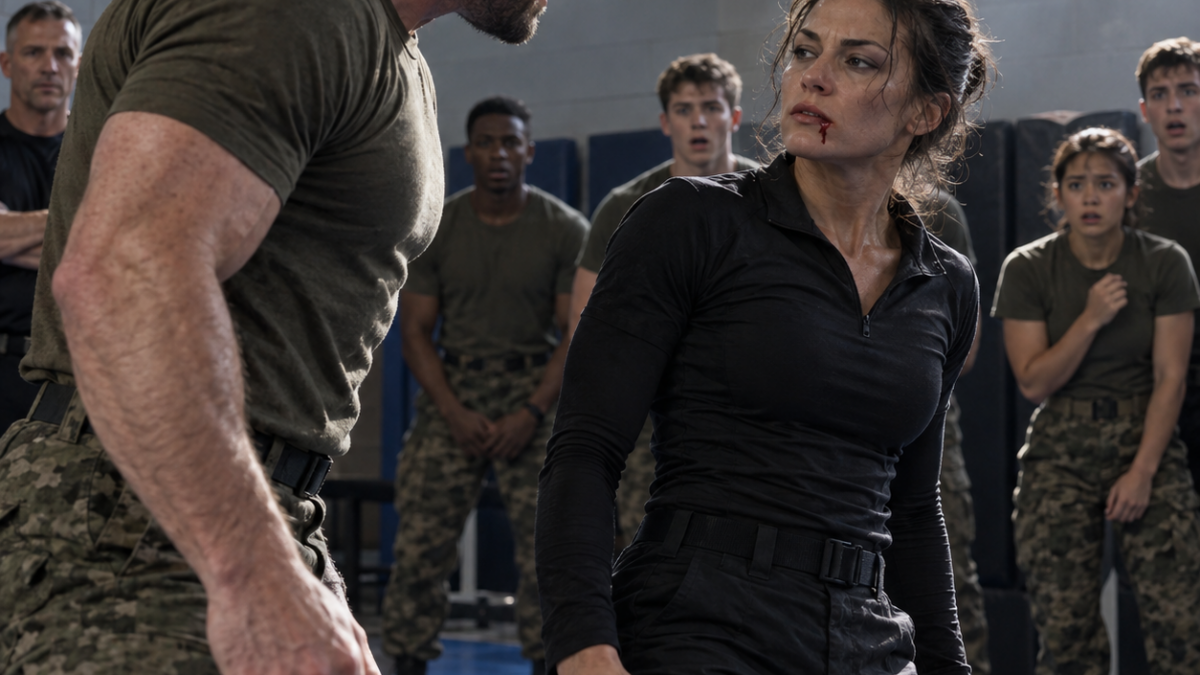
Bruise blooming beneath the left eye. Split lip. A faint line of blood at the corner of my mouth. Hair still tight. Uniform still pressed. Eyes steady.
That mattered most.
The faucet squealed when I turned it on. Cold water spilled over my hands. I rinsed the blood from my mouth and watched pale pink swirl down the drain.
For a moment, the mirror was not a mirror.
It was gray water.
White foam.
Coronado.
Cold surf hammering my chest so hard breathing became negotiation.
I was younger then. Angrier. More willing to mistake endurance for worth. Men twice my size had stumbled beside me in the water, some laughing, some cursing, some waiting for me to quit so the world would make sense again.
“You don’t belong here.”
I had heard that sentence in more forms than I could count.
Sometimes it came as a joke. Sometimes as concern. Sometimes as advice dressed in kindness. Sometimes as pure hatred. But it always meant the same thing.
We had a shape in mind for strength, and you are not it.
During selection, there had been an instructor with a prosthetic leg who rarely spoke. He moved like weathered steel, quiet and exact, the kind of man whose silence had more authority than most people’s shouting.
One night, half-buried in sand, shivering so hard my teeth hurt, I heard him stop beside me.
He did not tell me I was strong.
He did not tell me to prove them wrong.
He only said, “Never fight their noise. Outlast it.”
Then he moved on.
At the time, I thought endurance meant suffering longer than everyone else. Years later, I understood what he meant.
Noise wants you to answer in its language.
Discipline refuses.
I shut off the faucet and dried my hands.
My phone buzzed on the bench.
A text from my sister.
How’s the knee holding up?
I stared at it for a long moment.
My sister taught elementary school in Sacramento. She could quiet a room of seven-year-olds with a look. She could turn construction paper, glue, and patience into wonder. She believed in conferences, clear expectations, and restorative conversations. She had never had to decide whether reporting a man would expose a problem or bury it beneath politics.
Different worlds.
Different wars.
I typed back: Good. Getting stronger.
Then I set the phone down.
My locker door creaked open. Inside, beneath the folded spare shirt and emergency wrap, sat a black binder.
I pulled it out.
CQB evaluations.
Phase Four.
Tomorrow’s schedule.
Training slots. Pairings. Safety clearances. Instructor requirements.
My name was at the top.
I opened the binder and turned the pages slowly, the way some people might touch prayer beads.
Phase Four was not a punishment drill. It was not theatrical. It was not even new.
It was designed to do one thing: strip away ego.
Blindfolded contact reflex training. Controlled stimulus. Minimal force. No preemptive movement. No anticipation. No guessing. You responded only after confirmed contact, and you responded with enough control to neutralize without escalating.
It sounded simple to people who had never done it.
It was not simple.
Blindfolded, the body confesses. Men who look calm with their eyes open start swinging at ghosts. Men who preach control flinch too early. Men who confuse aggression with readiness expose themselves before anyone touches them.
I turned to Section Seven, Subsection C.
Instructor Evaluation Standards.
There it was, black ink on white paper.
All instructors assigned to contact training were required to demonstrate mastery before teaching recruits.
No exceptions.
The protocol had been in the pipeline for two years. Most instructors treated it like a formality. Some skipped it entirely. It was too exposing. Too clean. Too difficult to bluff.
I ran my finger down the page.
Blindfolded contact reflex.
Response timing.
Non-escalation under pressure.
Force discipline.
Every movement documented. Every response measured against baseline standards.
At the bottom of the page was Lieutenant Phelps’s signature.
Approved three months ago.
I closed the binder.
The bruise in the mirror had darkened.
My phone buzzed again.
This time it was Hayes, one of the younger instructors.
Dolan’s already spinning it. Says you couldn’t handle full contact.
I did not reply.
I set the phone down, leaned back against the locker, and breathed through the ache in my face.
Let him spin it.
The mat would answer tomorrow.
Revenge is emotion.
Emotion is noise.
But a lesson, delivered properly, keeps echoing long after the room goes quiet.
Lieutenant Phelps was in the observation room when I found him.
He stood over the desk, watching CCTV footage loop across four wall-mounted monitors. The gym from different angles. Recruits in a line. Dolan moving in. My hand raised slightly. The elbow.
Then the pause.
Then me walking away.
Phelps did not look up when I entered.
“Half the recruits are saying Dolan clocked you on purpose.”
“He did.”
Now he looked at me.
Phelps was late thirties, clean-cut, academy-polished, career arranged in smooth upward steps. He had the kind of face that looked good in command photos and tired in real rooms. There were officers who led from mud, heat, hunger, and consequence. Phelps led from paperwork. Not because he was stupid. He wasn’t. But he had mistaken proximity to hard people for hardness.
“You want me to write him up?” he asked.
“No.”
“Medical?”
“No.”
His eyes narrowed.
“Then why are you here?”
“I want full discretion over tomorrow’s CQB drills.”
He leaned back.
“The reaction control test.”
“Yes.”
“You want to start Phase Four now?”
“It’s already scheduled.”
“It’s scheduled for later in the week.”
“The binder gives me discretion based on readiness and staffing.”
Phelps sighed. The kind of sigh officers use when they want to sound burdened by someone else’s integrity.
“You know how this plays, Reeves. These guys roughhouse. Things get hot. You signed up for this world.”
“I signed up for training,” I said. “Not theater.”
He gave me a thin smile.
“You held your own.”
“I was not sparring. I was demonstrating control. He broke it.”
Phelps looked back at the monitors. The elbow landed again in silence.
“You want this escalated?”
“I said no.”
“Then what do you want?”
“I want the standard applied.”
He understood enough to be uncomfortable.
“Dolan and Markson?”
“All instructors assigned to contact training.”
“That includes you.”
“Yes.”
His gaze moved to the bruise on my face.
“You’re not planning to settle a score, are you?”
I looked him directly in the eye.
“I don’t settle anything. I teach.”
For a moment, neither of us spoke.
Phelps wanted an easier answer. He wanted anger, something he could file under personal conflict. Anger would have given him permission to dilute the issue, to advise cooler heads, to protect the machinery of the place from the inconvenience of truth.
But I was not angry.
I was clear.
That made him uneasy.
Finally he waved a hand toward the binder in my arms.
“Fine. They’re yours tomorrow. Keep it inside protocol.”
“It will be.”
“And don’t turn it into theater.”
I said nothing.
Because he was right about one thing.
It would not be theater.
The mats were spotless the next morning.
I made sure of it myself.
I arrived before anyone else, long before boots, voices, jokes, pride, and fatigue filled the gym. I turned on the lights one bank at a time. White institutional light washed over the blue mats, the equipment racks, the scuffed wall pads, the hanging bag in the corner.
An empty training room has a strange honesty to it.
No rank. No applause. No witnesses. Just space waiting to reveal what people bring into it.
I laid the binder on the bench.
Then I placed two black blindfolds at center mat.
At 0700 sharp, the recruits filed in.
They were quieter than usual.
That told me everything.
Private Chen stood near the second row, eyes moving from the blindfolds to my face and back again. She noticed the bruise. So did everyone else. Nobody mentioned it.
The instructors entered after them.
Dolan came in with his usual swagger, but it looked slightly repaired, like something cracked overnight and hastily glued back together. Markson trailed behind him, chewing gum, already wearing a smirk that did not reach his eyes.
“Morning, Commander,” Dolan called. “You here to demo again?”
I stood at the center of the mat with the clipboard in my hand.
“No demo. Today is Phase Four. Reaction control evaluation.”
Dolan looked at the blindfolds.
“The blindfold dance?”
“Blindfolded contact reflex. One-on-one. Minimal force. Zero escalation. Respond only to confirmed contact. No preemptive movement.”
Markson snorted.
“So don’t fight unless you’re touched.”
“Exactly,” I said. “Discipline isn’t about action. It’s about timing.”
I turned to the recruits.
“All of you will run through it later. We’re starting with instructors.”
The room went still.
Phelps was not there. I had checked the schedule. He had signed out for a morning briefing across base, which meant there would be no immediate interference, no convenient interruption, no soft place for Dolan’s pride to land.
Just the protocol.
Just the standard.
“Chief Dolan,” I said. “Petty Officer Markson. Mat.”
Markson’s gum stopped moving.
Dolan gave a short laugh.
“Us first?”
“You’re the standard,” I said.
That landed exactly where I meant it to.
The recruits watched them step forward.
Dolan removed his boots with the slow irritation of a man already imagining how to turn compliance into contempt. Markson followed. Each took a blindfold.
“Mask on,” I said. “Hands at your sides. Breathe normally. Do not move until contact is made. Respond with minimum necessary force. Reset on command.”
Dolan tied his blindfold too tightly, jaw flexing.
Markson tied his crooked.
I circled them once.
Blindfolds change a room. They make the watched become the exposed. Dolan had spent years performing toughness for men and women he thought needed his permission to respect themselves. Now he stood in front of them without eyes, without posture, without the ability to dominate the room by glaring at it.
“Ready,” I said.
Dolan’s shoulders lifted with his inhale.
Too much tension.
I approached from his left side and touched two fingers to his shoulder.
He moved instantly.
Too fast.
His hand snapped up to trap my wrist, his foot turning to pivot into a throw. It was instinctive, aggressive, and completely outside protocol.
I redirected his grip before it closed, stepped into his center line, cut his balance at the hip, and swept his base.
He went down flat.
Hard enough to drive the breath out of him.
Not hard enough to injure.
There is a difference. I knew it. So did he.
I turned without comment and approached Markson.
He stood ten feet away, blindfolded, breathing through his mouth.
I touched his elbow.
He flinched and swung wide.
Panic response.
I ducked beneath the arc, caught his wrist, rotated through the joint, and lowered him into a controlled pin. My knee settled beside his sternum, not on it. A warning, not weight.
He froze.
“Reset,” I said.
They got up slower.
The recruits said nothing.
That silence was not empty. It was learning.
Round two.
I touched Dolan’s wrist.
This time he tried to pull away before responding, as if distance might save him from his own impulse. Wrong move. Withdrawal without awareness is still reaction without control.
I followed the motion, redirected his momentum, and swept his legs again.
He hit the mat with a grunt.
Markson shifted where he stood, already sweating.
I tapped his shoulder blade.
He pivoted fast, overcommitting with his upper body. I stepped outside the line, caught his elbow, and used his own speed to fold him forward. He landed on his hands and knees, breath bursting out in a curse he swallowed too late.
“Reset.”
No one laughed.
That mattered too.
I was not humiliating them for entertainment. If the recruits laughed, the lesson would rot. It would become a show. A show has winners and losers. Training has standards and consequences.
Round three.
Dolan’s breathing had changed. He was trying to control it now, which meant he was finally aware of how much he had lost.
I touched his collarbone.
His hand came up to trap mine, aggressive again, almost the same motion he had used the day before when he twisted my wrist too far. The body repeats what the character permits.
I slipped the trap, stepped close, used my forearm to collapse his posture, and dropped him to the mat.
His shoulder struck first.
Clean.
Controlled.
Final.
Across the room, I heard a whisper.
“How is she doing this?”
Private Chen’s voice answered, just as soft.
“Training.”
I did not look at her, but something in my chest loosened.
Markson’s turn.
I touched his ribs.
He tried to stay still this time. Overcorrection. His entire upper body locked. Stillness is not control when it comes from fear. I felt the tension before he moved, tapped his knee, disrupted his base, and guided him down.
He landed on his side and slapped the mat.
“Reset.”
By then, Dolan’s face had gone red beneath the blindfold. Sweat ran down his temple. His chest rose and fell with anger he was trying to dress as effort.
Round four.
I touched his shoulder again.
He exploded.
No other word fit.
He came toward the contact with full aggression, trying to overwhelm what he could not see. His hand swept for my arm, shoulder driving forward, weight committed completely. A blind man trying to conquer darkness by charging into it.
I let him.
Then I stepped under his arm, came up behind him, and used his own momentum to send him sprawling forward.
He hit chest first.
The mat took him with a dull, heavy sound.
For one second, he lay still.
Then he pushed himself up, breathing hard.
I turned to Markson.
I touched his lower back.
He spun with an arm coming around in a defensive arc.
Pure panic.
I ducked, caught his wrist, rotated him into a standing joint lock, and held it only long enough for him to understand that he could have been broken if I had chosen breaking.
Then I released him.
“Reset.”
Round five was quiet.
No whispering.
No shifting.
No smirks.
Even Dolan had run out of performance.
I touched him at the forearm. He hesitated, then moved too late. Hesitation is not patience. Patience is readiness without premature action. I stepped in, redirected, and lowered him again.
He did not fall as hard this time because I did not need him to.
Markson went next.
Shoulder contact. Delayed reaction. Bad base. Controlled takedown.
When it was done, both men stood blindfolded in the middle of the mat, breathing like they had run a mile uphill.
I let the silence stretch.
Then I said, “Remove the blindfolds.”
They did.
Dolan blinked in the light. His eyes moved immediately to the recruits, searching for mockery. He found none. That may have been worse for him. Laughter would have given him an enemy. Silence gave him a mirror.
I faced the room.
“Discipline means reacting when needed. Not before. Not after. No ego. No guessing. No panic dressed up as aggression. Timing and control.”
No one moved.
I looked at Dolan, then Markson, then the recruits.
“You all saw what happened yesterday.”
The silence thickened.
Dolan’s jaw tightened.
“I didn’t raise my voice,” I said. “I didn’t retaliate. I waited.”
I looked down at the clipboard.
“And today, I responded.”
The gym doors banged open.
Lieutenant Phelps stormed in with his uniform half-wrinkled and a clipboard clenched like a weapon. His shoes struck the floor sharply, polished office leather against concrete. He looked from the recruits to Markson, then to Dolan, then to me.
“I was told this was a standard evaluation,” he said, “not whatever this is.”
I turned calmly.
“It is a standard reaction control drill. Blindfolded discipline assessment. Pre-cleared under your signature.”
His eyes flicked to the binder on the bench.
He walked over, flipped it open, scanned the page, and found exactly what I knew he would find.
Section Seven.
Subsection C.
Instructor evaluation requirements.
His signature.
Approved three months ago.
His jaw tightened.
“This is about yesterday.”
“This is about standards,” I said. “The same ones you signed off on.”
Phelps lowered his voice.
“You’re using protocol as a weapon.”
“I’m using protocol as intended.”
He glanced at Dolan. Dolan looked furious, embarrassed, and relieved that someone in authority had arrived to rescue him from consequence. Markson stood behind him, eyes lowered.
“You’ve made your point,” Phelps said. “They’re exhausted.”
“They’re instructors.”
“You embarrassed them in front of recruits.”
“Discipline isn’t about embarrassment. It’s about demonstration.”
“They’ve seen enough.”
“Have they?”
He stepped closer.
“You’re playing a dangerous game, Commander.”
I held his gaze.
“No. I’m teaching the one they forgot.”
The whole room waited.
There are moments when hierarchy tries to reassert itself by sound alone. Phelps had rank in that room, and he wanted the room to remember it. But authority is not volume either. Authority is alignment between responsibility and action. When that alignment is missing, rank becomes costume.
Phelps straightened his jacket.
“Fine,” he said. “You’ve run your drill. Dismiss them.”
I did not move.
His eyes narrowed.
“Commander.”
I stepped to the center of the mat and picked up the practice baton from the equipment rack. Foam core, reinforced handle, regulation issue.
Then I tossed it underhand to him.
He caught it by instinct.
“Blindfold me,” I said.
A flicker of confusion crossed his face.
“What?”
“Blindfold me.”
“I’m not participating in this charade.”
“You already are.”
I turned slightly.
“Carter.”
A young recruit near the wall stiffened. She was the one who had been watching most carefully all morning, late twenties, small frame, nervous hands, steady eyes.
“Yes, ma’am?”
“Tie it.”
For half a second, she looked at Phelps.
Then she stepped forward.
Her fingers were quick and careful as she tied the black cloth over my eyes. Darkness settled over me. Not empty darkness. Useful darkness. The kind that strips the room down to breath, friction, distance, intention.
My hands rested open at my sides.
The gym seemed to inhale.
“Lieutenant,” I said, “if you think this is about sending a message, then you’d better be sure I can’t deliver one blind.”
No one spoke.
Phelps shifted his weight.
Leather sole. Right foot. Slight hesitation.
The baton creaked faintly in his grip.
He did not want to strike me. Not truly. But he wanted to disprove me badly enough to act before wisdom caught him.
That is where most failures begin.
I heard the air change.
The baton came down fast.
I stepped in, not away.
People who have never trained properly move away from impact and give the strike room to grow. I entered the space before it matured. My left hand found his wrist. My right stripped the baton from his grip. I turned, dropped my center, and pressed the rubber edge lightly against his throat in one clean motion.
Phelps froze.
The room froze with him.
The blindfold still covered my eyes.
I leaned close enough that only he could hear me.
“Contact is a contract,” I said. “You hit me. You signed for what came next.”
Then I released him.
He stumbled back, breath caught somewhere between fear and humiliation.
A voice came from the rear door.
“Lieutenant.”
Phelps turned so fast I could feel the movement in the air.
I removed the blindfold.
The base commander stood inside the threshold, arms folded, eyes hard.
He had the kind of presence that did not need announcement. Some people enter a room and take oxygen. He entered and returned it to its proper weight.
“Sir,” Phelps muttered.
The commander did not look at him at first. His eyes were on me, then on the baton in my hand, then on Dolan and Markson.
“Continue,” he said. “I’ll be observing.”
Phelps’s face lost color.
I nodded.
“Yes, sir.”
Then I turned back to the recruits.
“Next pair.”
The drill continued.
Not with fear.
Not with spectacle.
With reverence.
Not for me. I did not want reverence. Reverence for the standard. For the idea that control mattered. That power without discipline was not strength but liability. That being loud did not make a person dangerous, and being calm did not make a person weak.
One by one, the recruits stepped onto the mat.
Some flinched too early. Some froze. Some overreacted. Some surprised themselves with how much they could sense when their eyes no longer gave them permission to lie.
Private Chen went midway through the line.
She tied the blindfold herself.
Her partner touched her forearm. Her shoulder twitched, but she did not move. He touched again, firmer. She pivoted late and lost the angle. He took her down, controlled.
She got up immediately.
“Again?” she asked.
This time I let the word sit between us before answering.
“Again.”
Her second attempt was better.
The third was clean.
When she redirected her partner and put him on the mat, there was a sound from the other recruits. Not applause. Not laughter. Something smaller. Recognition.
Chen stood breathing hard, blindfold still on, her face lifted as if listening to a world she had never trusted before.
I stepped near her.
“Good,” I said.
Her mouth tightened, fighting a smile.
That was the moment I knew the lesson had moved beyond Dolan.
That was the only reason it mattered.
The command briefing room was colder than the gym.
It always was.
There is a particular chill in rooms built for accountability. Oak table. Clean walls. Polished floor. No mats to absorb impact. No sweat. No honest breath. Just chairs, screens, and men deciding how much truth the institution could tolerate without embarrassing itself.
Inside sat Dolan, Markson, Phelps, the base commander, and me.
No one had said much since we entered.
On the screen at the front of the room, the gym footage played on silent loop.
Yesterday’s footage first.
Me stepping onto the mat.
Dolan lunging.
The first takedown.
The wrist twist.
The ankle sweep.
My mouth forming the word enough.
Then the elbow.
Even without sound, the impact looked loud.
The commander paused the frame.
There I was, caught mid-stagger, blood just beginning to track from my lip.
I did not look away.
Phelps leaned forward, palms flat on the table.
“Sir, if I may, yesterday’s incident has been misinterpreted. The contact occurred during a live sparring demonstration. No malicious intent. Commander Reeves may have misread the tempo.”
The commander stared at the frozen image.
“Misread the tempo,” he repeated.
Phelps swallowed.
“Yes, sir.”
The commander pressed play again, then switched to a different angle.
This one showed Dolan’s body more clearly.
The setup.
The shift.
The windup.
The follow-through.
The fact that I had disengaged before he struck.
The fact that my hand had already signaled stop.
The room watched in silence.
The commander paused it again.
“Chief Dolan,” he said quietly, “you have thirty seconds to explain that footage.”
Dolan finally looked up.
His face was tight.
“Sir, it was a sparring drill. Things happened fast. I misjudged the—”
“You misjudged nothing.”
The commander’s voice did not rise.
That made it worse.
Dolan’s mouth stayed open for half a second before shutting.
“You struck a senior officer in the face during a demonstration drill she had already called to a stop,” the commander said. “You did it in front of recruits. You made contact with a deliberate elbow strike that had no place in a controlled training environment.”
Dolan’s eyes dropped.
“Sir, with respect—”
“You will speak when I ask you a question.”
Dolan went still.
The commander turned to Phelps.
“And you.”
Phelps straightened.
“You signed off on Phase Four protocols three months ago. Instructor evaluation standards. Blindfolded reflex drills required before teaching recruits. When was the last time Chief Dolan or Petty Officer Markson completed that evaluation?”
Phelps hesitated.
“I would have to check the records.”
“I already did.”
The commander let the words settle.
“The answer is never.”
Markson looked like he wanted the floor to open beneath him.
The commander folded his hands on the table.
“So what I have is this. An instructor struck a senior SEAL combat leader in the face after she called a drill to stop. Another instructor stood by and treated it as entertainment. The overseeing officer failed to verify compliance with the standards he approved. Then, when Commander Reeves applied those standards the following morning, the same officer accused her of using protocol as a weapon.”
Phelps said nothing.
The commander looked at Markson.
Markson cleared his throat.
“Sir, I believe the intent was—”
“Stop.”
Markson stopped.
The commander looked back to the screen and changed the footage.
Now the morning drill played.
Dolan blindfolded. Contact. Premature reaction. Controlled takedown.
Markson swinging wild. Controlled pin.
Dolan exploding forward. Redirected. Dropped.
Phelps with the baton.
Me blindfolded.
Disarm.
Release.
The commander watched without expression.
Then he turned to me.
“Commander Reeves.”
“Yes, sir.”
“I reviewed the security footage. I spoke with recruits. I observed the continuation of the evaluation personally.”
I waited.
“What I saw was not revenge,” he said. “It was restraint. Professional, surgical restraint. The kind I expect from someone wearing the trident.”
Dolan’s jaw tightened.
The commander did not look at him.
“You maintained discipline in the face of disrespect. You defused an incident that could have fractured this unit’s credibility, and you did it without compromising your rank, your ethics, or the safety of the recruits.”
For the first time all day, something in me nearly moved.
Not my face.
Something deeper.
There are praises that inflate a person.
This one did not.
It simply found a place inside me that had gone unacknowledged for a long time and stood there quietly.
“Thank you, sir,” I said.
The commander stood.
“As of now, Chief Dolan and Petty Officer Markson are suspended from instructional duties pending formal review.”
Markson shut his eyes.
Dolan stared at the table.
“Lieutenant Phelps,” the commander continued, “we will revisit your oversight role next week.”
Phelps did not argue.
He knew better at last.
The commander moved toward the door, then paused with his hand near the handle.
“One more thing.”
Everyone looked up.
“Control under pressure is not just a leadership trait,” he said. “It is the mark of someone who knows exactly who they are and who they answer to.”
His eyes rested briefly on each of us.
Then he left.
The door closed behind him.
No one spoke.
Phelps gathered his papers with hands that tried to look calm. Markson remained seated. Dolan rose first, chair scraping against the floor. He did not look at me as he left.
I did not need him to.
An apology would have been smaller than the silence.
When the room emptied, I stayed seated for a moment.
The screen had gone dark, reflecting my face faintly back at me. The bruise beneath my eye looked worse under the overhead lights. My lip had split again sometime during the day. There was dried blood at the edge.
I touched it once.
Then I exhaled.
Slow.
Quiet.
Steady.
Not vindicated.
Seen.
Sometimes that is enough.
Word spread by evening, because military installations are not as large as people think. News travels through chow lines, equipment rooms, smoke pits, parking lots, barracks hallways, and the pauses between official conversations.
By the time the sun dropped low, the whole base seemed to know some version of what had happened.
In the mess hall, voices dipped when officers passed and rose again the moment they were gone. I heard pieces as I walked past the entrance.
“Five rounds blindfolded.”
“Dropped them every time.”
“Phelps tried to challenge her.”
“She disarmed him blind.”
“No, I heard she put the baton to his throat.”
“She didn’t even raise her voice.”
That last part followed me down the hallway.
She didn’t even raise her voice.
I almost smiled.
People are always most impressed by the thing that cost them the least to witness and someone else the most to maintain.
Hayes sat near the far side of the mess with three other instructors. He saw me through the doorway and lifted his coffee cup slightly. Not dramatic. Not a salute. Just acknowledgement.
I nodded once and kept walking.
I did not enter.
I was not interested in becoming a story while people were still deciding what the story meant.
Outside, the evening air was cooling. The base had begun its slow transition into night operations. Engines rumbled in the distance. A flag snapped lightly somewhere beyond the buildings. The sky had gone the color of worn steel at the horizon.
My phone buzzed.
My sister again.
You sure you’re okay? You sound weird even over text.
I leaned against the side of the building and stared at the message.
There are people who know you before the armor. They hear the smallest change. They can tell when “good” means “I’m bleeding but not dead” and when “fine” means “don’t ask unless you’re ready.”
I typed: Long day.
Then deleted it.
Typed: Got hit in training. Handled it.
Deleted that too.
Finally I wrote: I’m okay. I’ll call this weekend.
Her reply came almost immediately.
You always say that when you’re not okay.
I looked at the words until the screen dimmed.
Then I put the phone away.
There are truths you can tell your family, and truths that only make them helpless from a distance.
The gym was empty when I returned.
Late evening light spilled through the high windows in long golden bands. Dust floated in the air. The mats, scrubbed and silent, held the memory of every fall from the day.
I wrapped my hands.
The tape made a soft rasp as I pulled it across my knuckles. Around and between the fingers. Across the wrist. Tight enough to support, loose enough not to numb.
Then I stood before the heavy bag.
Breath in.
Strike.
Breath out.
Reset.
One-two.
Pause.
One-two-three.
The first few punches hurt my face more than my hands. The vibration traveled up through my shoulders and into the bruise beneath my eye. I welcomed it. Pain, when honest, can be grounding. It tells you what is damaged and what still works.
No anger moved through me.
That surprised some people. They always assumed calm was natural to me, as if I had been born without the same flames that lived in everyone else. But calm is not the absence of anger. Calm is anger trained to wait outside the door until called.
I had wanted to hit Dolan back.
Of course I had.
For one brief, human second after his elbow split my lip, something old and hot had risen in me. Not fear. Not shock. The ancient animal certainty that pain should be returned immediately, doubled if possible.
But I had seen Chen’s face.
I had seen twenty recruits watching.
And in that instant, the question was not what Dolan deserved.
The question was what they needed to learn.
If I had struck him back, they would have remembered a fight.
Because I waited, they remembered a standard.
I hit the bag again.
One-two.
One-two-three.
Footwork around the left knee. Adjust. Don’t favor it too much. Pain can create habits if you let it. So can pride.
The door creaked open behind me.
I lowered my gloves and turned.
Carter stood just inside the gym, the same recruit who had tied my blindfold that morning. She was smaller than most of the others, compact like Chen but with a different kind of tension in her shoulders. Nervous, but not fragile. There is a difference there too.
“Ma’am,” she said.
“You’re not interrupting.”
She stepped inside.
“I just wanted to say thank you.”
“For tying a blindfold?”
A faint smile touched her face, then vanished.
“For not flinching.”
I studied her.
She looked down at the mat, gathering courage like equipment.
“For not yelling,” she said. “For not making it about proving you were tougher than them. For showing us what it looks like when someone has the power to hurt back and chooses control instead.”
The words stayed in the air between us.
I set my gloves on the bench.
“Who told you control means not fighting?”
She looked up.
“No one.”
“Good. Because that would be wrong.”
Her brow furrowed.
I walked to the center of the mat. The same place Dolan had hit me. The same place I had stood blindfolded with Phelps holding a baton. The room felt different now. Not healed. Rooms do not heal in a day. But changed.
“Control doesn’t mean you don’t fight,” I said. “It means you know what the fight is.”
Carter listened.
“Yesterday, if I had hit him back, the fight would have become about my anger. Today, the fight was about the standard. That’s the one that mattered.”
She nodded slowly.
“So it’s not about letting people get away with it.”
“No.” I looked at the empty mat. “It’s about making sure they don’t get to choose the battlefield.”
Something in her face shifted.
Maybe she had needed those words before today. Most people who recognize a lesson quickly have been waiting for it longer than they admit.
“My father used to say,” I added, surprising myself, “that anyone can swing when they’re hurt. The hard part is deciding whether swinging serves the mission.”
Carter’s eyes moved to the bruise on my face.
“Did it feel like enough?” she asked.
Honest question.
Hard question.
I thought about Dolan leaving the briefing room without meeting my eyes. Markson staring at the floor. Phelps discovering that signatures have weight. Chen standing blindfolded and learning to trust technique over size.
“Yes,” I said. “Not because they were embarrassed. Because the recruits saw the difference.”
She breathed out.
“I hope I can do that someday.”
“You can.”
“You don’t know that.”
“No,” I said. “But you came back to ask. That’s where it starts.”
For the first time, she smiled fully.
She turned toward the door, then paused.
“See you on the mat tomorrow?”
“Early,” I said.
Her smile widened.
“Yes, ma’am.”
The door clicked shut behind her.
I stood alone again.
But the room did not feel empty now.
I returned to the heavy bag.
One-two.
One-two-three.
The rhythm settled into my bones.
In time, the bruise would fade. The swelling would go down. Dolan’s suspension would turn into whatever formal review decided. Markson would learn, or he would not. Phelps would become more careful with his signatures, if not wiser with his judgment.
The recruits would remember the morning differently over the years. Stories always change as they travel. Maybe they would make the takedowns cleaner than they were. Maybe they would turn the baton disarm into legend. Maybe one of them would tell it someday to someone smaller, doubted, cornered, or dismissed.
Maybe Chen would remember the first time technique worked against size.
Maybe Carter would remember that control was not surrender.
Maybe that would be enough.
I hit the bag again.
The sound echoed down the corridor, sharp and steady.
One.
Two.
Three.
Reset.
For most of my career, people had mistaken my quiet for permission.
Permission to doubt.
Permission to test.
Permission to push until something broke.
They never understood that silence is not emptiness. Sometimes silence is structure. Sometimes it is restraint. Sometimes it is a door locked from the inside.
Dolan had thought hitting me would expose weakness.
Instead, it exposed his.
Phelps had thought protocol could be waved around when convenient and ignored when uncomfortable.
Instead, it answered him in his own handwriting.
The recruits had thought strength was loud because loud men had spent years telling them so.
Now they knew better.
I stopped punching and rested my wrapped hands against the bag.
My breath came steady.
My face hurt.
My knee ached.
My body carried the day in small, honest ways.
But I was still standing.
And somewhere beyond the gym, in barracks rooms and mess hall corners, twenty recruits were carrying a different lesson than the one Dolan had tried to teach.
Not revenge.
Not fear.
Not humiliation.
Control.
That was the lesson.
Control when someone tries to pull you into their chaos.
Control when the room expects you to perform pain for them.
Control when power is watching, waiting to see whether you will make yourself easier to dismiss.
Control when every angry part of you wants the immediate satisfaction of impact.
Because strength is not the loudest voice in the room.
It is the one that remains steady when every other voice mistakes noise for command.
I unwrapped my hands slowly, folded the tape, and placed it on the bench.
Then I walked to the door and turned off the lights.
The gym disappeared behind me in sections, the mats fading from blue to gray to black.
In the darkness, I could still smell rubber, sweat, and old pride.
But beneath it, faint and new, there was something cleaner.
Respect.
Not demanded.
Not begged for.
Earned.
One disciplined response at a time.