𝙍𝙚𝙖𝙙𝙈𝙤𝙧𝙚👉 The Quiet Woman They Cornered in the Snow Was Never Alone
𝗣𝗔𝗥𝗧 𝟮
The lodge was larger than it looked from outside. A main hall connected to briefing rooms, sleeping quarters, equipment storage, a small mess area, and a rear corridor leading toward the generator shed and rescue gear bays.
As I moved, I counted doors, windows, blind corners, fire extinguishers, camera placement, floorboard noise, and the slight slope in the back stairwell where melted snow had warped the wood over time.
I also noticed what was missing.
The equipment cage was locked, but the spare key box showed fresh scratches.
The emergency radio cabinet had been opened recently.
The bulletin board listed me under Audit Observers, Week Two, with no further detail.
Good.
The fewer questions people asked, the more honest they became around me.
That night, I sat at the far end of the common room with my laptop open and no documents visible. People filtered through after dinner, loud from weather and fatigue. Boots thudded. Silverware clinked. Radios crackled from somewhere behind a closed office door.
Caleb, Jax, and Dorsy held court near the fireplace.
They told stories in the exaggerated rhythm of men trying to impress each other.
A training accident became a heroic near-death incident.
A routine search exercise became “basically a live mission.”
A disagreement with an instructor became “politics.”
They also watched me.
Not constantly.
Just enough.
Men like that do not enjoy being ignored by someone they tried to embarrass. Silence unsettles them because they cannot tell whether they failed to wound you or whether you are too weak to respond.
Either possibility irritates them.
At one point, Jax walked past my table and glanced at my laptop.
“Working hard over there?”
I closed one file.
“Yes.”
He smirked.
“On what, spreadsheets?”
“Among other things.”
Caleb approached with two cups of coffee, handing one to Jax without taking his eyes off me.
“You always this friendly?”
“When I’m working.”
Dorsy joined them, leaning both hands on the back of the chair across from me.
“That’s what worries us. You don’t really look like you belong in this kind of rotation.”
I lifted my eyes.
“Is that so?”
Caleb grinned.
“Don’t take it personal. This place gets rough. Cold weather work. Rescue drills. Rope systems. Situational stress.”
“Sounds useful.”
“Useful if you’re built for it.”
The room quieted slightly.
Not much.
Enough.
I could feel several people pretending not to listen.
I looked from Caleb to Jax to Dorsy.
“I’ll manage.”
Dorsy chuckled.
“That’s the spirit.”
They walked away believing they had won something.
They had not.
They had only confirmed my first impression.
The next morning began before sunrise.
Snowmobile engines growled outside while headlights cut through blue fog. The briefing room filled with trainees pulling on gloves, fastening harnesses, and stamping feeling back into their feet.
Maps covered three folding tables.
Climbing ropes lay coiled in neat stacks.
Carabiners clinked against metal rails.
The instructor in charge, Brewster, stood near the front with a beard that looked like it had lost several arguments and a thermos permanently attached to his hand.
He barked through the schedule.
“Cold rescue harness drills. Ice anchor formation. Rappel preparation. Partner descent and extraction. Watch your lines. Secure your own gear. Don’t waste daylight.”
I stood near the edge of the group, tightening my gloves.
My harness was already fastened.
Not flashy. Not overdone. Just correct.
Caleb noticed.
He nudged Jax.
“She even clipped in yet?”
Jax gave him a grin.
“Let’s find out.”
As the group moved toward the gear rack, Jax picked up a secondary harness from the pile and dropped it into mine.
The movement was small.
Casual.
Meant to look like nothing.
One buckle had been partially released and rethreaded incorrectly. To an inexperienced person, it would appear secure. Under pressure, it could slip.
The kind of prank that reveals exactly how little someone understands consequences.
I picked up the harness, looked at the buckle, and felt a coldness settle behind my ribs.
There are lines I can forgive when people are ignorant.
There are other lines that are not jokes.
I rethreaded the buckle in one smooth motion and tightened the strap.
Brewster glanced over.
“Something wrong, analyst?”
“Mispack,” I said.
He frowned.
“Try not to hold us up.”
Caleb laughed softly.
“She’s doing great.”
I looked at him.
Only for a second.
His smile flickered.
Then I turned back to the gear.
Outside, the wind pushed fine snow across the training field. Ropes were anchored to lodge pylons and simulated ridge hooks. Teams split into pairs.
When I stepped forward for pairing, Caleb looked away.
Jax stepped back.
Dorsy tightened his gloves as if deeply occupied.
“No offense,” Dorsy said loudly, “but we don’t really do the babysitting thing.”
A few trainees chuckled.
I said nothing.
An older medic standing nearby watched the exchange with tired eyes. His name tape read Harris. Mid-fifties. Weathered. Calm. He wore an old fleece under his parka, the kind of garment people keep long after regulations suggest replacing it.
He gave me a slight nod.
“You anchor,” he said. “I’ll drop.”
“Copy.”
We worked without conversation.
Harris descended cleanly, and I fed line with steady pressure, adjusting tension before he needed to ask. When it was my turn, he anchored competently and without fuss.
By the third rotation, he looked at me differently.
Not suspiciously.
Knowingly.
He did not ask where I had learned rope discipline like that.
I appreciated him for that.
Inside after drills, the jokes continued.
“Did you see her footing?”
“Walks like an admin officer.”
“I’ve seen better grip on a clipboard.”
“Bet she brought a keyboard in that tactical laptop case.”
I sat by the fireplace with an enamel mug warming my hands.
My face gave them nothing.
But I heard every voice.
Every laugh.
Every little social permission granted to cruelty.
That is what people misunderstand about bullying in professional spaces. It is rarely one person acting alone. It is a room deciding the target can absorb it.
A room deciding not to care.
I had been in rooms like that before.
Different uniforms. Different stakes. Same cowardice.
By the second evening, the storm had thickened. Snow pressed against the windows and gathered in the corners of the porch. The lodge grew quieter as people settled after dinner.
I waited until most of the common room had emptied before stepping outside.
The cold hit immediately, sharp enough to burn the inside of my nose.
I zipped my coat to my chin and walked past the generator housing toward the side clearing behind the equipment shed, where the signal was strongest.
My phone connected on the second try.
A voice answered.
“Status.”
“Three unauthorized personnel modifications in the shift roster,” I said. “No secondary clearance signatures. Multiple irregularities in the training logs. One equipment tamper observed this morning.”
“Engagement?”
“Not yet.”
“Threat level?”
“Unclear. Could be incompetence. Could be internal culture masking something else.”
“Are you compromised?”
“No.”
A pause.
“Do you need extraction?”
I looked toward the dark lodge windows glowing yellow through the snow.
“No. I’m observing.”
“Understood. Report again at 0900.”
I ended the call and slipped the phone into my coat pocket.
That was when I heard boots in the snow behind me.
Three sets.
Not approaching directly at first.
Spreading.
I stood still and let the sounds map themselves.
One behind me.
One left.
One ahead.
They thought they were being clever.
I turned toward the lodge and began walking.
Caleb emerged near the fire escape, shoulders loose beneath his jacket, breath fogging in the cold.
“Working late, new girl?”
Jax stepped from the left, his grin bright in the dark.
“Who were you calling? Your little audit friends?”
Dorsy moved in front of me, blocking the narrow path back.
“We’re not interested in being written up by some clipboard with glasses.”
I stopped three feet from him.
Snow tapped against my coat.
The generator hummed behind us.
“I’m not here for you,” I said. “I’m doing my job. Step aside.”
Caleb laughed softly behind me.
“You hear that? She’s doing her job.”
Jax came closer on my left.
“You know what we don’t like? People who show up for three days and start snooping.”
Dorsy leaned forward.
“Especially people who don’t know how things work up here.”
I looked at him.
“Then explain it.”
He smiled, thinking that meant he had control.
“You drop the report. You stop asking questions. You remember this is a training lodge, not some office where you can hide behind procedure.”
“I’m not hiding.”
Jax snorted.
“No. You’re standing out here alone.”
That was the second mistake.
The first was assuming silence was submission.
The second was assuming I had not chosen this clearing deliberately.
Open space.
Snow deep enough to soften impact.
No sharp rocks nearby.
Propane tanks behind Jax, but far enough not to be involved if he fell correctly.
Equipment shed to the right.
Generator noise masking conversation but not close enough to hide a scream from the lodge if one occurred.
I did not want a fight.
But if they insisted on creating one, I wanted to control where it happened.
Dorsy reached out and grabbed my sleeve.
Not hard.
Just enough to make a point.
I looked down at his hand.
Then I peeled his fingers off one by one and let them drop.
“You don’t want to do this,” I said.
His smile hardened.
“You threatening me?”
“No.”
I lifted my eyes to his.
“I’m warning you.”
Jax stepped closer behind my left shoulder.
“Cute.”
Caleb shifted behind me.
“You’ve got two choices. Drop the report, or we help you understand how things work.”
My breathing remained even.
I felt the cold against my face.
The pressure of snow beneath my boots.
The location of each man.
The distance to the lodge.
The weight of my coat.
The fact that Dorsy smelled like whiskey.
I said one word.
“Enough.”
Caleb moved first.
A shove to my shoulder.
Not a punch.
Not full force.
Just enough violence to humiliate if I let it.
I allowed the shove to move me half a step back into the snowbank. Powder broke around my legs.
Then I stopped.
I brushed snow from my sleeve with one clean motion.
Jax laughed.
“Maybe someone should teach her how to take a push.”
Dorsy joined in.
“I thought logistics girls understood balance.”
They came closer.
That is another thing weak men do in groups.
They mistake proximity for dominance.
Jax reached for my wrist.
His grip tightened hard enough to bruise.
He tugged upward, expecting resistance.
I gave him none.
Instead, I shifted my weight back a fraction, let his pull overcommit him, and watched his boot slide across a patch of packed ice beneath the powder.
He staggered.
I did not strike him.
“Careful,” I said. “This ground isn’t as steady as you think.”
He recovered with anger in his eyes.
They were no longer laughing quite as freely.
Caleb stepped in, jaw tight.
“Still got rules, new girl?”
Then he swung.
Not a closed fist.
A palm strike toward my shoulder, hard enough to hurt, controlled enough to let him call it a shove afterward.
It never landed.
My hand came up and caught his wrist midair.
Thumb over radius.
Elbow dropped.
Pressure applied precisely where pain becomes instruction.
Caleb froze.
For the first time, confusion crossed his face.
He tried to pull away.
Nothing moved.
He yanked harder.
Still nothing.
Jax stared.
“Let go of him.”
I kept my eyes on Caleb.
“You already made one mistake,” I said. “Don’t make the second.”
Then I released him.
He stumbled back two steps, clutching his wrist.
For a moment, the clearing was quiet except for wind and the generator.
I turned toward the lodge.
I meant to leave.
Truly.
I had no need to prove anything else.
But men like Caleb, Jax, and Dorsy do not always recognize mercy when it is offered quietly.
Dorsy grabbed me from behind.
His arm wrapped around my upper bicep, his body pushing forward into what he probably imagined was a takedown.
He never completed it.
I widened my stance half an inch.
Enough.
My spine aligned.
My center dropped.
His force met structure instead of softness.
He grunted in surprise.
Caleb, still holding his wrist, said, “She’s bluffing.”
That was when I understood they were past embarrassment and entering desperation.
Desperate men are clumsy.
Clumsy men injure people by accident.
I lowered my chin.
“You just picked a fight with the wrong girl.”
Dorsy swung first from the side, frustration wrapped in bad mechanics. His arm came over wide, his shoulder rising before his hand moved.
I stepped inside the arc.
My left palm redirected his shoulder.
My right arm swept low behind his knee.
One shift.
One twist.
He went sideways into the snow with a hard, breathless grunt.
No punch.
No flourish.
Just gravity correcting arrogance.
Jax charged next.
He had no plan beyond motion.
I pivoted toward him and let him step too far. His front foot planted heavy. I hooked the timing, swept his leg midstride, and let his own speed finish what pride had started.
He hit the ground flat on his back.
The impact echoed off the equipment shed like a dropped sandbag.
Caleb hesitated.
Only half a second.
Then he lunged in a wide bear-hug motion, arms open, trying to wrap me up and use size where skill had failed.
I let him close.
Then I slipped inside his reach, turned behind him, and redirected his forward drive into the snowbank.
His knees hit first.
His face followed.
Snow exploded around his shoulders.
I stepped away.
Not because I was afraid.
Because control means stopping when the threat stops.
The three of them groaned in the clearing.
Their bodies marked the snow in a rough triangle around me.
I stood at the center, breathing slowly.
I had not thrown a punch.
I had not raised my voice.
I had not lost discipline.
That mattered to me more than whether they would remember the pain.
Dorsy tried to sit up.
Jax rolled onto his hands and knees, coughing snow.
Caleb pushed himself up with disbelief all over his face.
“What the hell are you?” Jax rasped.
I didn’t answer.
I walked toward the lodge.
Behind me, one of them shifted, and another muttered something I could not make out.
No one followed.
By morning, snow had softened most of the tracks.
But not all of them.
At 0600, the maintenance worker assigned to the west lot made his usual round past the generator shed. I watched from a second-floor window as he stopped at the clearing.
He looked at the collapsed snowbank.
The wide semicircle of boot scuffs.
The three body impressions pressed into crusted powder.
Then he looked at the clean center where I had stood.
He said nothing.
Just returned to the lodge.
By breakfast, the story had already begun moving through the building.
Quietly at first.
Not the way jokes travel.
The way real things travel.
“You hear what happened out by the fuel shed?”
“No way she did that alone.”
“She never even threw a punch.”
“Moved like she knew what they were going to do before they did it.”
I sat at my corner table with the same enamel mug and a tray of food I had no appetite for.
The room had changed.
People still talked, but not as loudly.
Chairs scraped with more care.
No one passed behind me without giving space.
Caleb wore a scarf pulled high enough to hide part of his face.
Jax had a faint bruise near one eye.
Dorsy did not come to breakfast.
Harris sat down across from me without asking permission.
He placed his tray carefully on the table.
“Morning.”
“Morning.”
He stirred his coffee.
“Interesting weather last night.”
“Was it?”
“Left some unusual patterns in the snow.”
I took a sip from my mug.
“Storms do that.”
He looked at me for a long moment, then nodded once.
“Suppose they do.”
That was all he said.
I respected him more for it.
Midmorning, Brewster summoned me to the contractor office.
The room was cramped and overheated, with fogged windows and a folding desk covered in clipboards. Brewster sat behind it, thermos near his elbow. The federal liaison leaned against the door frame with his arms crossed.
Neither looked comfortable.
“We received a report,” Brewster said.
I waited.
“A minor incident. Some kind of scuffle out back.”
“Three trainees obstructed my exit path,” I said. “I cleared it.”
The liaison narrowed his eyes.
“That’s it?”
“Yes.”
Brewster tapped his pen against the clipboard.
“You didn’t think that warranted immediate escalation?”
“No injuries requiring medical documentation. No property damage. No continuing threat.”
“And the trainees?”
“Discouraged.”
The liaison shifted.
“Handled how?”
I looked at him.
“Efficiently.”
Brewster’s pen stopped moving.
For a few seconds, the office held only the hum of the building’s heating system.
Then the liaison asked, “Do you want to file a formal complaint?”
“No.”
“Why not?”
“Because I’m not here for revenge.”
Brewster leaned back.
“And what are you here for, Miss Ellison?”
I let the wrong title sit between us.
“Standards.”
Neither man replied immediately.
That was often the problem with standards.
Everyone claimed to value them until enforcing them became inconvenient.
“You can go,” Brewster said finally.
I left without another word.
Later, I learned the liaison tried to open my personnel background file after that meeting.
The system denied access twice.
When he pushed the request through another channel, it redirected to Naval Command.
Apparently, that was when the first real doubt entered the room.
Why would a civilian logistics analyst be protected behind Naval Command access?
The answer was simple.
Because I was not a civilian logistics analyst.
But I had not come to the lodge to announce that.
I had come to see what people did when they believed the person watching them did not matter.
The next day’s schedule proceeded as planned.
The snowfall slowed, leaving the world bright, cold, and brittle. The air stung on every inhale. The ridge above the lodge had been prepared for a simulated cold-weather rescue over an icy slope.
A dozen trainees gathered near the cordoned edge while instructors secured ropes to ice anchors buried deep in packed snow.
Brewster stood with his thermos, voice carrying through the wind.
“Standard procedure. Simulated fall. Partner descends. Secure recovery. Watch your balance. Use anchor belts. This isn’t a playground.”
Everyone nodded.
Not everyone listened.
I watched the first team complete the drill cleanly.
The second team performed well enough.
The third team included a younger trainee named Rodriguez. He was nervous before he even approached the anchor point. His breathing was too fast. His gloves fumbled twice with equipment he clearly understood in theory but had not internalized under stress.
He checked his anchor.
Then his boot caught a patch of hidden ice.
His weight shifted wrong.
The safety line snapped taut, but not before he dropped halfway off the ledge.
Snow poured down around him.
One glove tore loose.
His shoulder dipped below the ridge line.
For half a second, everyone froze.
That half second matters.
It is where accidents become tragedies.
Brewster shouted, “Hold your lines!”
Caleb flinched toward the edge, then stopped.
His wrist was still wrapped from the clearing.
Jax looked around, waiting for someone else to move.
Dorsy stood pale and rigid.
I was already crossing the snow.
No shout.
No hesitation.
Just movement.
I dropped to one knee at the anchor point and checked the line tension. Rodriguez was hanging at a bad angle, panic beginning to fight the equipment keeping him alive.
“Don’t move,” I called. “I’ve got you.”
His eyes found mine.
He stopped struggling.
That was the first victory.
Panic spreads through ropes, through hands, through entire teams.
Calm can do the same if delivered with enough certainty.
I clipped into the secondary harness ring, pulled slack, adjusted the carabiner, and drove the rope deeper into the ice clamp with controlled force. The anchor held.
I belly-crawled toward the edge, keeping my weight low and distributed.
Snow scraped against my coat.
The ridge dropped away beneath me.
Rodriguez was breathing hard, fingers clawing uselessly at the packed snow.
“Look at me,” I said.
He looked.
“You’re not falling.”
His mouth trembled.
“Okay.”
“Say it.”
“I’m not falling.”
“Good.”
I secured a double-wrapped loop around his chest harness and tightened it beneath his arms. Then I fed the tail back into the anchor ring and improvised a pulley assist using a side carabiner from my own belt.
It was not pretty.
It was not textbook for a classroom demonstration.
It was field expedient, fast, and strong enough.
Three tugs tightened the system.
“Now,” I told the instructors. “Pull on my count.”
Two instructors moved in.
“One. Two. Pull.”
The line came alive.
Rodriguez rose several inches.
He gasped.
“Again,” I said. “Pull.”
On the third coordinated effort, we brought him over the edge and onto solid ground.
He rolled onto his back, shaking, alive.
The entire recovery took less than a minute.
It felt longer because fear stretches time.
I unclipped, recoiled my portion of line, and stepped back.
No one spoke.
Then one of the medics whispered, “She just ran a Tier One pulley under live pressure.”
Brewster stared at me.
“Where did you learn to rig like that?”
I adjusted my gloves.
For a moment, I considered deflecting.
But Rodriguez was still trembling in the snow, and the room—or rather, the mountain—needed a new standard.
“United States Navy,” I said.
Three words.
No decoration.
No explanation.
Caleb looked down.
Jax swallowed.
Even Brewster did not move for a moment.
Then he cleared his throat.
“Reset the drill.”
I walked away from the ridge.
This time, every eye followed me.
The lodge did not become respectful all at once.
People are rarely that clean.
But it became aware.
Voices lowered when I entered rooms. Conversations shortened. The trainees who had been loudest around Caleb and Jax suddenly found reasons to discuss weather, equipment, or nothing at all.
Rodriguez found me that afternoon near the equipment lockers.
He approached slowly, one arm held against his chest where the harness had bruised him.
“Ma’am?”
I looked up from the rope log.
“How’s the shoulder?”
“Sore. Medic says I’m fine.”
“Good.”
He swallowed.
“I froze up there.”
“Yes.”
He looked embarrassed.
“I mean, I knew the procedure. We drilled it. I just—”
“Knowing something in calm conditions is not the same as knowing it under stress.”
He nodded.
“I thought I was ready.”
“You are more ready now than you were this morning.”
He seemed surprised by that.
“You don’t think I failed?”
“You slipped. Then you panicked. Then you listened. That last part saved time.”
His eyes shifted.
“Thank you.”
“You’re welcome.”
He started to leave, then stopped.
“Are you really Navy?”
“Yes.”
“Like rescue?”
I closed the logbook.
“Among other things.”
He understood that was all he was getting.
This time, he did not push.
At 1500 hours, I was called to the admin conference room.
Brewster waited inside with the federal liaison and the facility director, Wilson.
Wilson was a narrow man in his fifties with careful hair and the strained expression of someone realizing a problem had existed on his watch.
“Have a seat,” Brewster said.
I remained standing.
Wilson looked uncomfortable.
“Miss Ellison, we’ve reviewed the report from the other night.”
“I assumed you would.”
“We’ve also reviewed the rescue drill footage from this morning,” the liaison added. “Several personnel flagged your response as beyond the scope of logistics training.”
“Reasonable.”
Brewster leaned forward.
“What exactly is your operational background?”
I reached into my coat, withdrew a sealed folder, and placed it on the table.
The liaison opened it first.
His face changed as he read.
Then he passed the page to Wilson.
Brewster leaned over just far enough to see.
The room went very still.
Naval Special Warfare Command.
Lieutenant Commander Mara Ellison.
Active duty classified liaison.
Interagency rotational cover authorized.
Operational Safety Audit Protocol 147.
OCONUS clearance granted.
Wilson looked up slowly.
“You’re a SEAL.”
“Yes.”
Brewster stared as if trying to reconcile the woman in the brown coat with whatever image he carried of that word.
“You were embedded here under cover.”
“Correct.”
The liaison exhaled.
“And the audit?”
“Real.”
Wilson rubbed the bridge of his nose.
“Why didn’t you disclose after the altercation?”
“Because I did not need identity disclosure to restore control.”
Brewster frowned.
“Three trainees cornered you outside in the dark.”
“Yes.”
“And you chose not to escalate.”
“I chose not to turn their stupidity into the center of my mission.”
Wilson leaned back.
“That’s one way to put it.”
“They were given a chance to stop,” I said. “They did not take it. I ended the threat without injury requiring evacuation. That was sufficient for the moment.”
The liaison studied me.
“For the moment?”
I met his eyes.
“Your program has a culture problem. If those three felt comfortable tampering with gear, humiliating participants, and physically obstructing an assigned observer, they were either confident no one would stop them or confident someone would protect them afterward.”
No one spoke.
I continued.
“Both possibilities should concern you.”
Wilson’s face hardened, not at me, but at the truth of it.
“What do you recommend?”
“Immediate removal of Caleb, Jax, and Dorsy from active exercises. Freeze evaluations pending review. Audit all equipment access logs. Revalidate roster changes. Interview support staff without instructors present. And stop treating harassment as personality conflict.”
Brewster looked down.
That one had landed.
Wilson nodded slowly.
“Done.”
The liaison closed the folder.
“Will there be a formal Naval complaint?”
“That depends on what the review finds.”
Brewster looked at me.
“You could have turned this into something much bigger.”
“I still can.”
His mouth closed.
Then I added, “But I’m not here to punish embarrassment. I’m here to prevent failure.”
Wilson glanced at the folder again.
“And the three trainees?”
“Your call.”
“No,” he said. “Your recommendation.”
I thought of Dorsy’s hand on my sleeve.
Jax’s grip on my wrist.
Caleb’s shove.
The sabotaged buckle.
Rodriguez hanging from the ridge while all three hesitated.
“Remove them from the exercise,” I said. “Document everything. If they want a future in federal service, make them earn it after they learn the difference between strength and intimidation.”
Wilson nodded.
“They’ll be pulled by end of day.”
Brewster tapped his pen once.
“They’ll know why.”
“I think they already do.”
As I turned to leave, Brewster called after me.
“Lieutenant Commander.”
I stopped.
His voice was quieter now.
“For what it’s worth, I should have paid closer attention.”
I looked back.
“Yes.”
He accepted that.
No excuse.
No protest.
That was a start.
Word spread before dinner.
Not from me.
Secrets are heavy in places like that, and people drop pieces without meaning to.
By the time I entered the mess hall, everyone knew enough.
Not everything.
But enough.
Caleb, Jax, and Dorsy were gone from the main room. Their gear had been removed from the active trainee racks. No one mentioned them loudly.
That was how shame moved when it had no audience left to perform for.
Harris raised his mug slightly when I passed.
I gave him a nod.
Rodriguez stood when I approached the coffee station, then seemed unsure whether that was too formal.
I spared him by saying, “Sit down before you hurt that shoulder again.”
He smiled.
“Yes, ma’am.”
The lodge resumed its ordinary sounds around us.
Boots scraped wood.
Silverware clinked.
Someone laughed at something small and harmless near the far table.
Snow slid from the roof in soft thuds.
Life continued, but the shape of the room had changed.
People made space now.
Not out of fear.
At least, not only fear.
Recognition is different from fear.
Fear says, I know you can hurt me.
Recognition says, I understand I misjudged you.
I did not need applause.
I did not need apologies from people who had laughed when my coffee spilled.
But I noticed who met my eyes and who could not.
That evening, I walked alone to the overlook above the secondary trail.
The storm had passed.
Clouds broke apart over the ridge, and the last light of the day turned the snow blue and gold. Wind lifted powder in thin ribbons across the path.
The lodge glowed behind me, warm and yellow through frosted windows.
For the first time since arriving, I let my body feel tired.
My shoulder was scraped where Jax had grazed me during the takedown. My knees ached from the ridge rescue. My hands were stiff from cold rope and metal hardware.
None of it mattered.
I stood at the overlook and breathed.
People think discipline is hard because of what it demands in the moment.
They are wrong.
Discipline is hard because of what it asks you to carry afterward.
The insult you did not answer.
The rage you did not use.
The easy revenge you refused because it would have made the mission smaller than your pride.
I had learned that over years of training, deployment, loss, and command.
There is a kind of power in being able to break a thing.
There is a greater one in deciding not to.
Footsteps came up the trail behind me.
Not aggressive.
Not hesitant.
Just careful.
I did not turn.
“Ma’am?”
Rodriguez.
I recognized the voice.
“What is it?”
He came to stand a few feet behind me.
“I wanted to ask you something.”
“Ask.”
“If you didn’t want recognition, why step in at all?”
I turned then.
He looked genuinely confused, not disrespectful.
Young enough to still believe action and recognition naturally belonged together.
I thought about the coffee on the rug.
The sabotaged harness.
The three men in the snow.
Rodriguez hanging over the ridge.
The people who had watched and said nothing until the outcome taught them what they should have known sooner.
“Because sometimes,” I said, “the right thing isn’t loud.”
He absorbed that.
The wind moved between us.
Then he nodded.
Not like someone accepting an order.
Like someone understanding a lesson that would take years to fully unfold.
He saluted.
Crisp.
Clean.
Unforced.
I let the moment stand.
Then I gave him a small nod.
He dropped his hand and walked back toward the lodge without another word.
As I turned toward the slope, a patrol team passed in the distance. A few trainees from the equipment shack followed. One by one, without discussion, they shifted slightly as they passed me.
Not making a show of it.
Not bowing.
Not shrinking.
Just acknowledging.
I walked back toward the lodge.
My shadow stretched long over the snow, but it no longer felt alone.
Inside those walls, people would talk. Reports would be filed. Caleb, Jax, and Dorsy would face consequences they had earned long before they put their hands on me. Brewster would either learn or he would be replaced by someone who could. Wilson would have to explain how a program built to train control had allowed arrogance to masquerade as strength.
And I would finish my audit.
Quietly.
Thoroughly.
The same way I had arrived.
But something had changed.
Not in me.
I had known who I was when I stepped off that shuttle.
The change was in the room that finally caught up.
For three days, they had looked at me and seen an analyst, a civilian, a quiet woman in glasses who did not raise her voice.
They saw small hands and assumed weakness.
They saw silence and assumed fear.
They saw restraint and assumed permission.
That was their mistake.
I did not need them to know my title.
I did not need them to know what I had survived.
I did not need to prove that I belonged in violent places.
The truth had been there from the beginning.
In the way I watched exits.
In the way I checked gear.
In the way I did not waste movement.
In the way I gave three men every chance to walk away before making sure they could not hurt anyone else.
By morning, the lodge would return to drills.
Ropes would be checked twice.
Harnesses would be inspected by someone who understood that “mispack” could mean attempted injury.
Trainees would move with less swagger and more attention.
Maybe some would only behave because they were afraid of consequences.
That was fine.
Sometimes standards begin as fear before they mature into character.
As I reached the lodge steps, Harris opened the door from inside.
Warm air spilled out around him.
He looked at me, then past me at the darkening trail.
“Cold night.”
“Yes.”
“You coming in?”
I looked once more at the mountains.
Silent.
Severe.
Unimpressed by all human pride.
Then I stepped inside.
“Yes,” I said. “There is work to do.”
The door closed behind me, shutting out the wind.
No medals waited.
No speech.
No dramatic confession in front of the room.
Just a lodge full of people who now understood that the quietest person in the room might be the one holding the line for everyone else.
And that was enough.
𝗧𝗛𝗘 𝗘𝗡𝗗
The Quiet Woman They Cornered in the Snow Was Never Alone
They thought silence meant fear.
They thought a woman who refused to answer their insults had already accepted her place.
They never understood that I was counting exits, measuring weight shifts, and waiting for the moment discipline would matter more than anger.
By the time the shuttle van climbed the last mile toward the training lodge, the road had almost disappeared beneath the snow.
Colorado in winter has a way of making even strong people quiet. The mountains do not ask for attention. They simply rise around you, dark and immovable, while the wind combs through the pines and reminds you that everything warm, loud, and human is temporary.
The driver kept both hands tight on the wheel, leaning forward whenever the tires slipped against the packed ice. The road had been plowed earlier that morning, but the storm had started again before noon, laying a fresh white skin over every turn.
Behind me, two trainees complained about the cold.
One of them said the lodge looked like the kind of place where people went to disappear.
I looked out the window and thought, Not disappear.
Observe.
My name is Mara Ellison, though for that rotation I was not supposed to be anyone worth remembering.
My laminated badge said M. Ellison, Logistics Analyst, Rotation C-14.
That was deliberate.
No rank.
No unit patch.
No insignia.
No weapon visible.
No hint that beneath my long brown coat, simple boots, and black-framed glasses was a body trained by the United States Navy to endure cold, exhaustion, fear, violence, humiliation, and silence without wasting energy on any of them.
Most people look for strength in the wrong places.
They expect it to announce itself.
Broad shoulders. Loud voices. Tactical gear. A hard stare. The kind of swagger that fills a room before a person even speaks.
I had spent enough years around real operators to know better.
Real capability often looks boring from across a room.
It conserves itself.
It does not perform unless there is a reason.
And that week, I had every reason not to perform.
I had been sent to the high-altitude training lodge under joint command authorization to audit irregularities in the program. On paper, the lodge hosted a mixed-agency cold-weather rescue and tactical coordination rotation. Federal trainees, contractors, medical personnel, mountain rescue specialists, and security officers came through in cycles.
On paper, everything looked clean.
On paper, every roster change had been approved.
On paper, every safety drill had been logged properly.
But paper lies when frightened people sign it.
Three unauthorized personnel modifications had appeared in the shift roster during the previous month. Two training logs had been edited after submission. A clearance check attached to one contractor account had passed through a channel it should not have touched.
Individually, those things might have been explained.
Together, they smelled like someone testing boundaries.
My job was not to storm in with accusations.
My job was to watch.
If the problems were administrative, I would document them.
If they were operational, I would intervene.
If someone was using the lodge as cover for something more dangerous, I would find out before they realized anyone was looking.
That was why I stepped off the shuttle van looking harmless.
That was why I wore the coat.
That was why I carried one duffel and one laptop case.
And that was why I did not react when three men near the fireplace decided I was easy prey before they even knew my name.
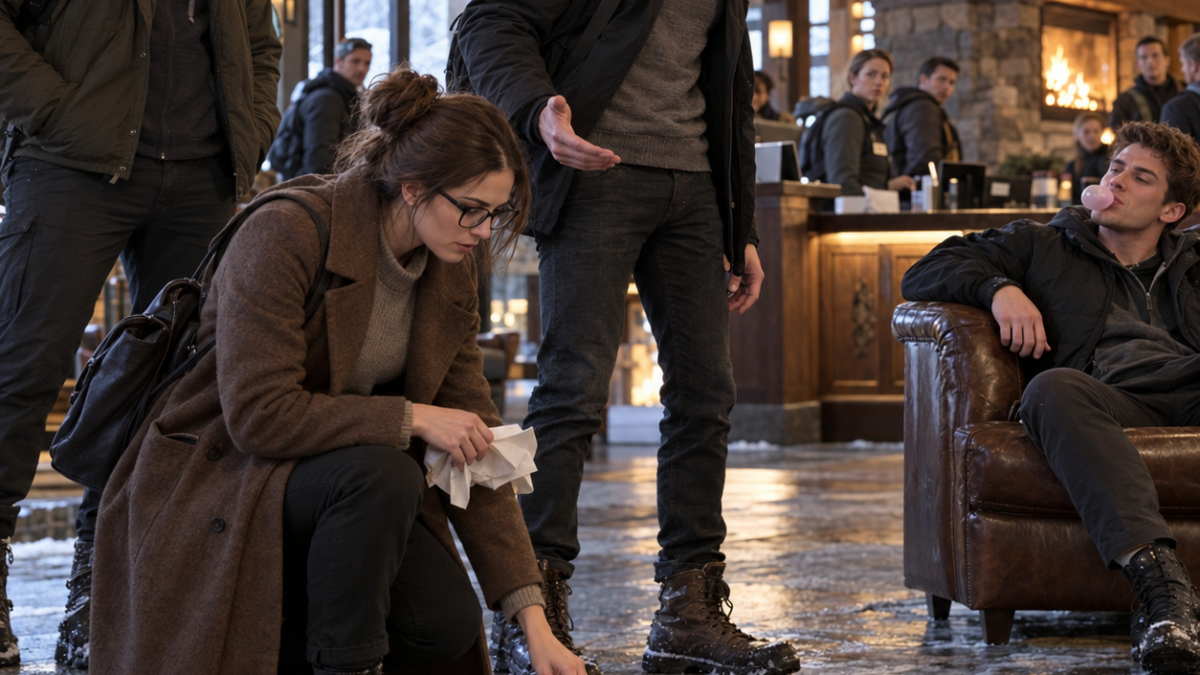
The welcome hall smelled of wet boots, burnt coffee, pine disinfectant, and old wood warmed by a stone fireplace. Snow melted from the edges of people’s jackets and collected in small dark patches across the entry rug.
A civilian administrator barely looked up when I handed over my credentials.
She scanned the badge, slid a room key across the counter, and pointed down the corridor.
“Second floor. End of the hall. Briefing at 0600.”
“Thank you,” I said.
My voice was quiet because there was no reason for it not to be.
That was when I heard the first laugh.
Three trainees lounged beside the fireplace as if the room had been built around them.
Caleb stood in the middle, broad and loose-limbed, with the kind of confidence that came from being praised too early in life. He had a red knit cap pushed back on his head and a grin that treated everything as an invitation.
Jax leaned against the mantle, taller, sharper, eyes always moving toward whoever seemed easiest to mock.
Dorsy sat on the arm of a leather chair, boots planted wide, chewing gum with his mouth half open.
Late twenties. Federal trainees. Physically capable. Emotionally undisciplined.
I knew the type.
They had enough training to mistake themselves for dangerous and not enough experience to understand what danger actually was.
As I passed them, Jax shifted his shoulder at exactly the right moment to bump my elbow.
The paper cup of coffee the admin had given me jerked in my hand.
Hot liquid spilled across the entry rug and splashed onto the toe of my boot.
Caleb laughed.
“Easy there, new girl.”
Dorsy looked me up and down.
“Not exactly combat footing. Might need to bubble-wrap the analyst.”
Jax spread his hands in fake apology.
“Careful. Logistics might file a report.”
Their laughter was loud, theatrical, designed less for me than for everyone watching.
A few people glanced over.
No one stepped in.
That told me more about the lodge than the insult did.
I looked down at the spilled coffee, then walked to the counter, took a handful of napkins, and cleaned the mess myself.
I could have said something.
I could have made a point.
But men like that thrive on reaction. They want anger because anger lets them pretend the problem began when someone answered them.
So I wiped the rug clean while they laughed.
When I stood, I did not look at them.
I had already memorized what mattered.
Caleb favored his right shoulder when he leaned. Old injury or poor mobility.
Jax kept most of his weight on his heels. Fast mouth, slower hips.
Dorsy carried tension high in his neck and shoulders, which meant if panic entered him, he would swing wide and telegraph everything.
None of them moved like men who had seen real violence.
That did not mean they could not hurt someone.
In some ways, it made them more dangerous.
A disciplined person knows where the line is.
An insecure one often finds it only after crossing.
I walked down the hall with my duffel over my shoulder while laughter followed me like smoke.
The lodge was larger than it looked from outside. A main hall connected to briefing rooms, sleeping quarters, equipment storage, a small mess area, and a rear corridor leading toward the generator shed and rescue gear bays.
As I moved, I counted doors, windows, blind corners, fire extinguishers, camera placement, floorboard noise, and the slight slope in the back stairwell where melted snow had warped the wood over time.
I also noticed what was missing.
The equipment cage was locked, but the spare key box showed fresh scratches.
The emergency radio cabinet had been opened recently.
The bulletin board listed me under Audit Observers, Week Two, with no further detail.
Good.
The fewer questions people asked, the more honest they became around me.
That night, I sat at the far end of the common room with my laptop open and no documents visible. People filtered through after dinner, loud from weather and fatigue. Boots thudded. Silverware clinked. Radios crackled from somewhere behind a closed office door.
Caleb, Jax, and Dorsy held court near the fireplace.
They told stories in the exaggerated rhythm of men trying to impress each other.
A training accident became a heroic near-death incident.
A routine search exercise became “basically a live mission.”
A disagreement with an instructor became “politics.”
They also watched me.
Not constantly.
Just enough.
Men like that do not enjoy being ignored by someone they tried to embarrass. Silence unsettles them because they cannot tell whether they failed to wound you or whether you are too weak to respond.
Either possibility irritates them.
At one point, Jax walked past my table and glanced at my laptop.
“Working hard over there?”
I closed one file.
“Yes.”
He smirked.
“On what, spreadsheets?”
“Among other things.”
Caleb approached with two cups of coffee, handing one to Jax without taking his eyes off me.
“You always this friendly?”
“When I’m working.”
Dorsy joined them, leaning both hands on the back of the chair across from me.
“That’s what worries us. You don’t really look like you belong in this kind of rotation.”
I lifted my eyes.
“Is that so?”
Caleb grinned.
“Don’t take it personal. This place gets rough. Cold weather work. Rescue drills. Rope systems. Situational stress.”
“Sounds useful.”
“Useful if you’re built for it.”
The room quieted slightly.
Not much.
Enough.
I could feel several people pretending not to listen.
I looked from Caleb to Jax to Dorsy.
“I’ll manage.”
Dorsy chuckled.
“That’s the spirit.”
They walked away believing they had won something.
They had not.
They had only confirmed my first impression.
The next morning began before sunrise.
Snowmobile engines growled outside while headlights cut through blue fog. The briefing room filled with trainees pulling on gloves, fastening harnesses, and stamping feeling back into their feet.
Maps covered three folding tables.
Climbing ropes lay coiled in neat stacks.
Carabiners clinked against metal rails.
The instructor in charge, Brewster, stood near the front with a beard that looked like it had lost several arguments and a thermos permanently attached to his hand.
He barked through the schedule.
“Cold rescue harness drills. Ice anchor formation. Rappel preparation. Partner descent and extraction. Watch your lines. Secure your own gear. Don’t waste daylight.”
I stood near the edge of the group, tightening my gloves.
My harness was already fastened.
Not flashy. Not overdone. Just correct.
Caleb noticed.
He nudged Jax.
“She even clipped in yet?”
Jax gave him a grin.
“Let’s find out.”
As the group moved toward the gear rack, Jax picked up a secondary harness from the pile and dropped it into mine.
The movement was small.
Casual.
Meant to look like nothing.
One buckle had been partially released and rethreaded incorrectly. To an inexperienced person, it would appear secure. Under pressure, it could slip.
The kind of prank that reveals exactly how little someone understands consequences.
I picked up the harness, looked at the buckle, and felt a coldness settle behind my ribs.
There are lines I can forgive when people are ignorant.
There are other lines that are not jokes.
I rethreaded the buckle in one smooth motion and tightened the strap.
Brewster glanced over.
“Something wrong, analyst?”
“Mispack,” I said.
He frowned.
“Try not to hold us up.”
Caleb laughed softly.
“She’s doing great.”
I looked at him.
Only for a second.
His smile flickered.
Then I turned back to the gear.
Outside, the wind pushed fine snow across the training field. Ropes were anchored to lodge pylons and simulated ridge hooks. Teams split into pairs.
When I stepped forward for pairing, Caleb looked away.
Jax stepped back.
Dorsy tightened his gloves as if deeply occupied.
“No offense,” Dorsy said loudly, “but we don’t really do the babysitting thing.”
A few trainees chuckled.
I said nothing.
An older medic standing nearby watched the exchange with tired eyes. His name tape read Harris. Mid-fifties. Weathered. Calm. He wore an old fleece under his parka, the kind of garment people keep long after regulations suggest replacing it.
He gave me a slight nod.
“You anchor,” he said. “I’ll drop.”
“Copy.”
We worked without conversation.
Harris descended cleanly, and I fed line with steady pressure, adjusting tension before he needed to ask. When it was my turn, he anchored competently and without fuss.
By the third rotation, he looked at me differently.
Not suspiciously.
Knowingly.
He did not ask where I had learned rope discipline like that.
I appreciated him for that.
Inside after drills, the jokes continued.
“Did you see her footing?”
“Walks like an admin officer.”
“I’ve seen better grip on a clipboard.”
“Bet she brought a keyboard in that tactical laptop case.”
I sat by the fireplace with an enamel mug warming my hands.
My face gave them nothing.
But I heard every voice.
Every laugh.
Every little social permission granted to cruelty.
That is what people misunderstand about bullying in professional spaces. It is rarely one person acting alone. It is a room deciding the target can absorb it.
A room deciding not to care.
I had been in rooms like that before.
Different uniforms. Different stakes. Same cowardice.
By the second evening, the storm had thickened. Snow pressed against the windows and gathered in the corners of the porch. The lodge grew quieter as people settled after dinner.
I waited until most of the common room had emptied before stepping outside.
The cold hit immediately, sharp enough to burn the inside of my nose.
I zipped my coat to my chin and walked past the generator housing toward the side clearing behind the equipment shed, where the signal was strongest.
My phone connected on the second try.
A voice answered.
“Status.”
“Three unauthorized personnel modifications in the shift roster,” I said. “No secondary clearance signatures. Multiple irregularities in the training logs. One equipment tamper observed this morning.”
“Engagement?”
“Not yet.”
“Threat level?”
“Unclear. Could be incompetence. Could be internal culture masking something else.”
“Are you compromised?”
“No.”
A pause.
“Do you need extraction?”
I looked toward the dark lodge windows glowing yellow through the snow.
“No. I’m observing.”
“Understood. Report again at 0900.”
I ended the call and slipped the phone into my coat pocket.
That was when I heard boots in the snow behind me.
Three sets.
Not approaching directly at first.
Spreading.
I stood still and let the sounds map themselves.
One behind me.
One left.
One ahead.
They thought they were being clever.
I turned toward the lodge and began walking.
Caleb emerged near the fire escape, shoulders loose beneath his jacket, breath fogging in the cold.
“Working late, new girl?”
Jax stepped from the left, his grin bright in the dark.
“Who were you calling? Your little audit friends?”
Dorsy moved in front of me, blocking the narrow path back.
“We’re not interested in being written up by some clipboard with glasses.”
I stopped three feet from him.
Snow tapped against my coat.
The generator hummed behind us.
“I’m not here for you,” I said. “I’m doing my job. Step aside.”
Caleb laughed softly behind me.
“You hear that? She’s doing her job.”
Jax came closer on my left.
“You know what we don’t like? People who show up for three days and start snooping.”
Dorsy leaned forward.
“Especially people who don’t know how things work up here.”
I looked at him.
“Then explain it.”
He smiled, thinking that meant he had control.
“You drop the report. You stop asking questions. You remember this is a training lodge, not some office where you can hide behind procedure.”
“I’m not hiding.”
Jax snorted.
“No. You’re standing out here alone.”
That was the second mistake.
The first was assuming silence was submission.
The second was assuming I had not chosen this clearing deliberately.
Open space.
Snow deep enough to soften impact.
No sharp rocks nearby.
Propane tanks behind Jax, but far enough not to be involved if he fell correctly.
Equipment shed to the right.
Generator noise masking conversation but not close enough to hide a scream from the lodge if one occurred.
I did not want a fight.
But if they insisted on creating one, I wanted to control where it happened.
Dorsy reached out and grabbed my sleeve.
Not hard.
Just enough to make a point.
I looked down at his hand.
Then I peeled his fingers off one by one and let them drop.
“You don’t want to do this,” I said.
His smile hardened.
“You threatening me?”
“No.”
I lifted my eyes to his.
“I’m warning you.”
Jax stepped closer behind my left shoulder.
“Cute.”
Caleb shifted behind me.
“You’ve got two choices. Drop the report, or we help you understand how things work.”
My breathing remained even.
I felt the cold against my face.
The pressure of snow beneath my boots.
The location of each man.
The distance to the lodge.
The weight of my coat.
The fact that Dorsy smelled like whiskey.
I said one word.
“Enough.”
Caleb moved first.
A shove to my shoulder.
Not a punch.
Not full force.
Just enough violence to humiliate if I let it.
I allowed the shove to move me half a step back into the snowbank. Powder broke around my legs.
Then I stopped.
I brushed snow from my sleeve with one clean motion.
Jax laughed.
“Maybe someone should teach her how to take a push.”
Dorsy joined in.
“I thought logistics girls understood balance.”
They came closer.
That is another thing weak men do in groups.
They mistake proximity for dominance.
Jax reached for my wrist.
His grip tightened hard enough to bruise.
He tugged upward, expecting resistance.
I gave him none.
Instead, I shifted my weight back a fraction, let his pull overcommit him, and watched his boot slide across a patch of packed ice beneath the powder.
He staggered.
I did not strike him.
“Careful,” I said. “This ground isn’t as steady as you think.”
He recovered with anger in his eyes.
They were no longer laughing quite as freely.
Caleb stepped in, jaw tight.
“Still got rules, new girl?”
Then he swung.
Not a closed fist.
A palm strike toward my shoulder, hard enough to hurt, controlled enough to let him call it a shove afterward.
It never landed.
My hand came up and caught his wrist midair.
Thumb over radius.
Elbow dropped.
Pressure applied precisely where pain becomes instruction.
Caleb froze.
For the first time, confusion crossed his face.
He tried to pull away.
Nothing moved.
He yanked harder.
Still nothing.
Jax stared.
“Let go of him.”
I kept my eyes on Caleb.
“You already made one mistake,” I said. “Don’t make the second.”
Then I released him.
He stumbled back two steps, clutching his wrist.
For a moment, the clearing was quiet except for wind and the generator.
I turned toward the lodge.
I meant to leave.
Truly.
I had no need to prove anything else.
But men like Caleb, Jax, and Dorsy do not always recognize mercy when it is offered quietly.
Dorsy grabbed me from behind.
His arm wrapped around my upper bicep, his body pushing forward into what he probably imagined was a takedown.
He never completed it.
I widened my stance half an inch.
Enough.
My spine aligned.
My center dropped.
His force met structure instead of softness.
He grunted in surprise.
Caleb, still holding his wrist, said, “She’s bluffing.”
That was when I understood they were past embarrassment and entering desperation.
Desperate men are clumsy.
Clumsy men injure people by accident.
I lowered my chin.
“You just picked a fight with the wrong girl.”
Dorsy swung first from the side, frustration wrapped in bad mechanics. His arm came over wide, his shoulder rising before his hand moved.
I stepped inside the arc.
My left palm redirected his shoulder.
My right arm swept low behind his knee.
One shift.
One twist.
He went sideways into the snow with a hard, breathless grunt.
No punch.
No flourish.
Just gravity correcting arrogance.
Jax charged next.
He had no plan beyond motion.
I pivoted toward him and let him step too far. His front foot planted heavy. I hooked the timing, swept his leg midstride, and let his own speed finish what pride had started.
He hit the ground flat on his back.
The impact echoed off the equipment shed like a dropped sandbag.
Caleb hesitated.
Only half a second.
Then he lunged in a wide bear-hug motion, arms open, trying to wrap me up and use size where skill had failed.
I let him close.
Then I slipped inside his reach, turned behind him, and redirected his forward drive into the snowbank.
His knees hit first.
His face followed.
Snow exploded around his shoulders.
I stepped away.
Not because I was afraid.
Because control means stopping when the threat stops.
The three of them groaned in the clearing.
Their bodies marked the snow in a rough triangle around me.
I stood at the center, breathing slowly.
I had not thrown a punch.
I had not raised my voice.
I had not lost discipline.
That mattered to me more than whether they would remember the pain.
Dorsy tried to sit up.
Jax rolled onto his hands and knees, coughing snow.
Caleb pushed himself up with disbelief all over his face.
“What the hell are you?” Jax rasped.
I didn’t answer.
I walked toward the lodge.
Behind me, one of them shifted, and another muttered something I could not make out.
No one followed.
By morning, snow had softened most of the tracks.
But not all of them.
At 0600, the maintenance worker assigned to the west lot made his usual round past the generator shed. I watched from a second-floor window as he stopped at the clearing.
He looked at the collapsed snowbank.
The wide semicircle of boot scuffs.
The three body impressions pressed into crusted powder.
Then he looked at the clean center where I had stood.
He said nothing.
Just returned to the lodge.
By breakfast, the story had already begun moving through the building.
Quietly at first.
Not the way jokes travel.
The way real things travel.
“You hear what happened out by the fuel shed?”
“No way she did that alone.”
“She never even threw a punch.”
“Moved like she knew what they were going to do before they did it.”
I sat at my corner table with the same enamel mug and a tray of food I had no appetite for.
The room had changed.
People still talked, but not as loudly.
Chairs scraped with more care.
No one passed behind me without giving space.
Caleb wore a scarf pulled high enough to hide part of his face.
Jax had a faint bruise near one eye.
Dorsy did not come to breakfast.
Harris sat down across from me without asking permission.
He placed his tray carefully on the table.
“Morning.”
“Morning.”
He stirred his coffee.
“Interesting weather last night.”
“Was it?”
“Left some unusual patterns in the snow.”
I took a sip from my mug.
“Storms do that.”
He looked at me for a long moment, then nodded once.
“Suppose they do.”
That was all he said.
I respected him more for it.
Midmorning, Brewster summoned me to the contractor office.
The room was cramped and overheated, with fogged windows and a folding desk covered in clipboards. Brewster sat behind it, thermos near his elbow. The federal liaison leaned against the door frame with his arms crossed.
Neither looked comfortable.
“We received a report,” Brewster said.
I waited.
“A minor incident. Some kind of scuffle out back.”
“Three trainees obstructed my exit path,” I said. “I cleared it.”
The liaison narrowed his eyes.
“That’s it?”
“Yes.”
Brewster tapped his pen against the clipboard.
“You didn’t think that warranted immediate escalation?”
“No injuries requiring medical documentation. No property damage. No continuing threat.”
“And the trainees?”
“Discouraged.”
The liaison shifted.
“Handled how?”
I looked at him.
“Efficiently.”
Brewster’s pen stopped moving.
For a few seconds, the office held only the hum of the building’s heating system.
Then the liaison asked, “Do you want to file a formal complaint?”
“No.”
“Why not?”
“Because I’m not here for revenge.”
Brewster leaned back.
“And what are you here for, Miss Ellison?”
I let the wrong title sit between us.
“Standards.”
Neither man replied immediately.
That was often the problem with standards.
Everyone claimed to value them until enforcing them became inconvenient.
“You can go,” Brewster said finally.
I left without another word.
Later, I learned the liaison tried to open my personnel background file after that meeting.
The system denied access twice.
When he pushed the request through another channel, it redirected to Naval Command.
Apparently, that was when the first real doubt entered the room.
Why would a civilian logistics analyst be protected behind Naval Command access?
The answer was simple.
Because I was not a civilian logistics analyst.
But I had not come to the lodge to announce that.
I had come to see what people did when they believed the person watching them did not matter.
The next day’s schedule proceeded as planned.
The snowfall slowed, leaving the world bright, cold, and brittle. The air stung on every inhale. The ridge above the lodge had been prepared for a simulated cold-weather rescue over an icy slope.
A dozen trainees gathered near the cordoned edge while instructors secured ropes to ice anchors buried deep in packed snow.
Brewster stood with his thermos, voice carrying through the wind.
“Standard procedure. Simulated fall. Partner descends. Secure recovery. Watch your balance. Use anchor belts. This isn’t a playground.”
Everyone nodded.
Not everyone listened.
I watched the first team complete the drill cleanly.
The second team performed well enough.
The third team included a younger trainee named Rodriguez. He was nervous before he even approached the anchor point. His breathing was too fast. His gloves fumbled twice with equipment he clearly understood in theory but had not internalized under stress.
He checked his anchor.
Then his boot caught a patch of hidden ice.
His weight shifted wrong.
The safety line snapped taut, but not before he dropped halfway off the ledge.
Snow poured down around him.
One glove tore loose.
His shoulder dipped below the ridge line.
For half a second, everyone froze.
That half second matters.
It is where accidents become tragedies.
Brewster shouted, “Hold your lines!”
Caleb flinched toward the edge, then stopped.
His wrist was still wrapped from the clearing.
Jax looked around, waiting for someone else to move.
Dorsy stood pale and rigid.
I was already crossing the snow.
No shout.
No hesitation.
Just movement.
I dropped to one knee at the anchor point and checked the line tension. Rodriguez was hanging at a bad angle, panic beginning to fight the equipment keeping him alive.
“Don’t move,” I called. “I’ve got you.”
His eyes found mine.
He stopped struggling.
That was the first victory.
Panic spreads through ropes, through hands, through entire teams.
Calm can do the same if delivered with enough certainty.
I clipped into the secondary harness ring, pulled slack, adjusted the carabiner, and drove the rope deeper into the ice clamp with controlled force. The anchor held.
I belly-crawled toward the edge, keeping my weight low and distributed.
Snow scraped against my coat.
The ridge dropped away beneath me.
Rodriguez was breathing hard, fingers clawing uselessly at the packed snow.
“Look at me,” I said.
He looked.
“You’re not falling.”
His mouth trembled.
“Okay.”
“Say it.”
“I’m not falling.”
“Good.”
I secured a double-wrapped loop around his chest harness and tightened it beneath his arms. Then I fed the tail back into the anchor ring and improvised a pulley assist using a side carabiner from my own belt.
It was not pretty.
It was not textbook for a classroom demonstration.
It was field expedient, fast, and strong enough.
Three tugs tightened the system.
“Now,” I told the instructors. “Pull on my count.”
Two instructors moved in.
“One. Two. Pull.”
The line came alive.
Rodriguez rose several inches.
He gasped.
“Again,” I said. “Pull.”
On the third coordinated effort, we brought him over the edge and onto solid ground.
He rolled onto his back, shaking, alive.
The entire recovery took less than a minute.
It felt longer because fear stretches time.
I unclipped, recoiled my portion of line, and stepped back.
No one spoke.
Then one of the medics whispered, “She just ran a Tier One pulley under live pressure.”
Brewster stared at me.
“Where did you learn to rig like that?”
I adjusted my gloves.
For a moment, I considered deflecting.
But Rodriguez was still trembling in the snow, and the room—or rather, the mountain—needed a new standard.
“United States Navy,” I said.
Three words.
No decoration.
No explanation.
Caleb looked down.
Jax swallowed.
Even Brewster did not move for a moment.
Then he cleared his throat.
“Reset the drill.”
I walked away from the ridge.
This time, every eye followed me.
The lodge did not become respectful all at once.
People are rarely that clean.
But it became aware.
Voices lowered when I entered rooms. Conversations shortened. The trainees who had been loudest around Caleb and Jax suddenly found reasons to discuss weather, equipment, or nothing at all.
Rodriguez found me that afternoon near the equipment lockers.
He approached slowly, one arm held against his chest where the harness had bruised him.
“Ma’am?”
I looked up from the rope log.
“How’s the shoulder?”
“Sore. Medic says I’m fine.”
“Good.”
He swallowed.
“I froze up there.”
“Yes.”
He looked embarrassed.
“I mean, I knew the procedure. We drilled it. I just—”
“Knowing something in calm conditions is not the same as knowing it under stress.”
He nodded.
“I thought I was ready.”
“You are more ready now than you were this morning.”
He seemed surprised by that.
“You don’t think I failed?”
“You slipped. Then you panicked. Then you listened. That last part saved time.”
His eyes shifted.
“Thank you.”
“You’re welcome.”
He started to leave, then stopped.
“Are you really Navy?”
“Yes.”
“Like rescue?”
I closed the logbook.
“Among other things.”
He understood that was all he was getting.
This time, he did not push.
At 1500 hours, I was called to the admin conference room.
Brewster waited inside with the federal liaison and the facility director, Wilson.
Wilson was a narrow man in his fifties with careful hair and the strained expression of someone realizing a problem had existed on his watch.
“Have a seat,” Brewster said.
I remained standing.
Wilson looked uncomfortable.
“Miss Ellison, we’ve reviewed the report from the other night.”
“I assumed you would.”
“We’ve also reviewed the rescue drill footage from this morning,” the liaison added. “Several personnel flagged your response as beyond the scope of logistics training.”
“Reasonable.”
Brewster leaned forward.
“What exactly is your operational background?”
I reached into my coat, withdrew a sealed folder, and placed it on the table.
The liaison opened it first.
His face changed as he read.
Then he passed the page to Wilson.
Brewster leaned over just far enough to see.
The room went very still.
Naval Special Warfare Command.
Lieutenant Commander Mara Ellison.
Active duty classified liaison.
Interagency rotational cover authorized.
Operational Safety Audit Protocol 147.
OCONUS clearance granted.
Wilson looked up slowly.
“You’re a SEAL.”
“Yes.”
Brewster stared as if trying to reconcile the woman in the brown coat with whatever image he carried of that word.
“You were embedded here under cover.”
“Correct.”
The liaison exhaled.
“And the audit?”
“Real.”
Wilson rubbed the bridge of his nose.
“Why didn’t you disclose after the altercation?”
“Because I did not need identity disclosure to restore control.”
Brewster frowned.
“Three trainees cornered you outside in the dark.”
“Yes.”
“And you chose not to escalate.”
“I chose not to turn their stupidity into the center of my mission.”
Wilson leaned back.
“That’s one way to put it.”
“They were given a chance to stop,” I said. “They did not take it. I ended the threat without injury requiring evacuation. That was sufficient for the moment.”
The liaison studied me.
“For the moment?”
I met his eyes.
“Your program has a culture problem. If those three felt comfortable tampering with gear, humiliating participants, and physically obstructing an assigned observer, they were either confident no one would stop them or confident someone would protect them afterward.”
No one spoke.
I continued.
“Both possibilities should concern you.”
Wilson’s face hardened, not at me, but at the truth of it.
“What do you recommend?”
“Immediate removal of Caleb, Jax, and Dorsy from active exercises. Freeze evaluations pending review. Audit all equipment access logs. Revalidate roster changes. Interview support staff without instructors present. And stop treating harassment as personality conflict.”
Brewster looked down.
That one had landed.
Wilson nodded slowly.
“Done.”
The liaison closed the folder.
“Will there be a formal Naval complaint?”
“That depends on what the review finds.”
Brewster looked at me.
“You could have turned this into something much bigger.”
“I still can.”
His mouth closed.
Then I added, “But I’m not here to punish embarrassment. I’m here to prevent failure.”
Wilson glanced at the folder again.
“And the three trainees?”
“Your call.”
“No,” he said. “Your recommendation.”
I thought of Dorsy’s hand on my sleeve.
Jax’s grip on my wrist.
Caleb’s shove.
The sabotaged buckle.
Rodriguez hanging from the ridge while all three hesitated.
“Remove them from the exercise,” I said. “Document everything. If they want a future in federal service, make them earn it after they learn the difference between strength and intimidation.”
Wilson nodded.
“They’ll be pulled by end of day.”
Brewster tapped his pen once.
“They’ll know why.”
“I think they already do.”
As I turned to leave, Brewster called after me.
“Lieutenant Commander.”
I stopped.
His voice was quieter now.
“For what it’s worth, I should have paid closer attention.”
I looked back.
“Yes.”
He accepted that.
No excuse.
No protest.
That was a start.
Word spread before dinner.
Not from me.
Secrets are heavy in places like that, and people drop pieces without meaning to.
By the time I entered the mess hall, everyone knew enough.
Not everything.
But enough.
Caleb, Jax, and Dorsy were gone from the main room. Their gear had been removed from the active trainee racks. No one mentioned them loudly.
That was how shame moved when it had no audience left to perform for.
Harris raised his mug slightly when I passed.
I gave him a nod.
Rodriguez stood when I approached the coffee station, then seemed unsure whether that was too formal.
I spared him by saying, “Sit down before you hurt that shoulder again.”
He smiled.
“Yes, ma’am.”
The lodge resumed its ordinary sounds around us.
Boots scraped wood.
Silverware clinked.
Someone laughed at something small and harmless near the far table.
Snow slid from the roof in soft thuds.
Life continued, but the shape of the room had changed.
People made space now.
Not out of fear.
At least, not only fear.
Recognition is different from fear.
Fear says, I know you can hurt me.
Recognition says, I understand I misjudged you.
I did not need applause.
I did not need apologies from people who had laughed when my coffee spilled.
But I noticed who met my eyes and who could not.
That evening, I walked alone to the overlook above the secondary trail.
The storm had passed.
Clouds broke apart over the ridge, and the last light of the day turned the snow blue and gold. Wind lifted powder in thin ribbons across the path.
The lodge glowed behind me, warm and yellow through frosted windows.
For the first time since arriving, I let my body feel tired.
My shoulder was scraped where Jax had grazed me during the takedown. My knees ached from the ridge rescue. My hands were stiff from cold rope and metal hardware.
None of it mattered.
I stood at the overlook and breathed.
People think discipline is hard because of what it demands in the moment.
They are wrong.
Discipline is hard because of what it asks you to carry afterward.
The insult you did not answer.
The rage you did not use.
The easy revenge you refused because it would have made the mission smaller than your pride.
I had learned that over years of training, deployment, loss, and command.
There is a kind of power in being able to break a thing.
There is a greater one in deciding not to.
Footsteps came up the trail behind me.
Not aggressive.
Not hesitant.
Just careful.
I did not turn.
“Ma’am?”
Rodriguez.
I recognized the voice.
“What is it?”
He came to stand a few feet behind me.
“I wanted to ask you something.”
“Ask.”
“If you didn’t want recognition, why step in at all?”
I turned then.
He looked genuinely confused, not disrespectful.
Young enough to still believe action and recognition naturally belonged together.
I thought about the coffee on the rug.
The sabotaged harness.
The three men in the snow.
Rodriguez hanging over the ridge.
The people who had watched and said nothing until the outcome taught them what they should have known sooner.
“Because sometimes,” I said, “the right thing isn’t loud.”
He absorbed that.
The wind moved between us.
Then he nodded.
Not like someone accepting an order.
Like someone understanding a lesson that would take years to fully unfold.
He saluted.
Crisp.
Clean.
Unforced.
I let the moment stand.
Then I gave him a small nod.
He dropped his hand and walked back toward the lodge without another word.
As I turned toward the slope, a patrol team passed in the distance. A few trainees from the equipment shack followed. One by one, without discussion, they shifted slightly as they passed me.
Not making a show of it.
Not bowing.
Not shrinking.
Just acknowledging.
I walked back toward the lodge.
My shadow stretched long over the snow, but it no longer felt alone.
Inside those walls, people would talk. Reports would be filed. Caleb, Jax, and Dorsy would face consequences they had earned long before they put their hands on me. Brewster would either learn or he would be replaced by someone who could. Wilson would have to explain how a program built to train control had allowed arrogance to masquerade as strength.
And I would finish my audit.
Quietly.
Thoroughly.
The same way I had arrived.
But something had changed.
Not in me.
I had known who I was when I stepped off that shuttle.
The change was in the room that finally caught up.
For three days, they had looked at me and seen an analyst, a civilian, a quiet woman in glasses who did not raise her voice.
They saw small hands and assumed weakness.
They saw silence and assumed fear.
They saw restraint and assumed permission.
That was their mistake.
I did not need them to know my title.
I did not need them to know what I had survived.
I did not need to prove that I belonged in violent places.
The truth had been there from the beginning.
In the way I watched exits.
In the way I checked gear.
In the way I did not waste movement.
In the way I gave three men every chance to walk away before making sure they could not hurt anyone else.
By morning, the lodge would return to drills.
Ropes would be checked twice.
Harnesses would be inspected by someone who understood that “mispack” could mean attempted injury.
Trainees would move with less swagger and more attention.
Maybe some would only behave because they were afraid of consequences.
That was fine.
Sometimes standards begin as fear before they mature into character.
As I reached the lodge steps, Harris opened the door from inside.
Warm air spilled out around him.
He looked at me, then past me at the darkening trail.
“Cold night.”
“Yes.”
“You coming in?”
I looked once more at the mountains.
Silent.
Severe.
Unimpressed by all human pride.
Then I stepped inside.
“Yes,” I said. “There is work to do.”
The door closed behind me, shutting out the wind.
No medals waited.
No speech.
No dramatic confession in front of the room.
Just a lodge full of people who now understood that the quietest person in the room might be the one holding the line for everyone else.
And that was enough.