𝗙𝗨𝗟𝗟 𝗦𝗧𝗢𝗥𝗬 The Quiet Nurse in the Back Seat Knew How to Save Men Everyone Else Had Already Misjudged
𝗙𝗨𝗟𝗟 𝗦𝗧𝗢𝗥𝗬
I climbed out of the car and ran.
The man from the sedan followed close behind me.
A paramedic shouted, “Collapsed during selection run. Barely responsive. Core temp one-oh-six.”
One hundred and six.
The number went through me like a blade.
The young man on the stretcher was maybe twenty-four. Lean, muscular, built by training and discipline. His lips moved around words that made no sense.
“What’s his name?” I asked.
“Diesel,” one of the instructors said, breathless beside the stretcher. “Candidate Diesel.”
I put my hand on Diesel’s shoulder.
His skin burned through my palm.
Heat stroke is not heat exhaustion.
People confuse them because both happen under the sun, but heat stroke is the body crossing a line it cannot come back from without help. When the core temperature rises past 104 degrees, the brain begins to fail. Speech slurs. Judgment disappears. The heart races. Skin can be hot and flushed. Some people collapse. Some seize. Organs begin suffering before families even understand this is more than someone “getting overheated.”
At 106, minutes matter.
Not after paperwork.
Not after a scan.
Not after a doctor finishes proving a point.
Now.
Dr. Thorne strode into the trauma bay looking annoyed.
Not alarmed.
Annoyed.
“Drug screen,” he said before he reached the stretcher. “Head CT. Full labs. Slow saline drip.”
I looked at him.
“Doctor, his core temp is one-oh-six.”
“These candidates take supplements like candy,” Thorne said. “Likely stimulant overdose.”
“He needs immediate cooling.”
“He will be cooled when I say so. Step back, nurse.”
My hand stayed on Diesel’s shoulder.
“Doctor, with respect, the scan can wait. His brain cannot.”
The room changed.
Nurses looked at one another.
One of the medical students froze with a pen in her hand.
Nobody had ever heard me finish a sentence to Thorne.
He turned slowly.
His smile returned.
The one he used when he was about to make someone small.
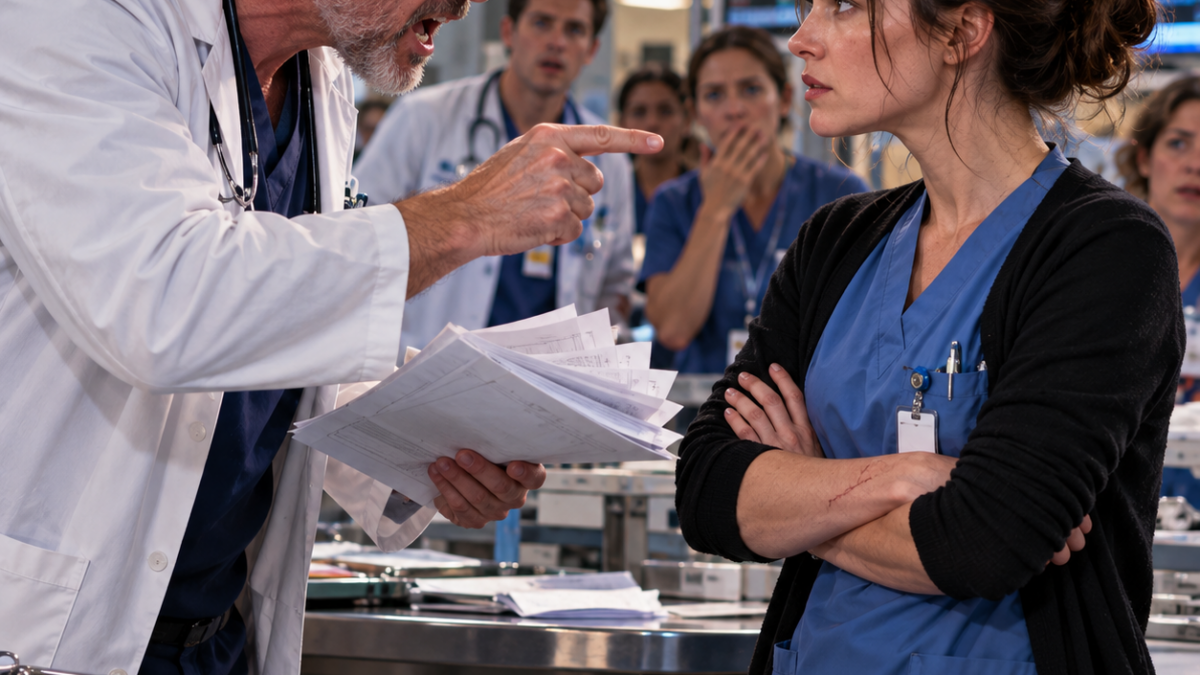
“I do not take medical advice from someone who cannot deliver a lab result,” he said. “Security, remove her from my trauma bay.”
Two guards stepped forward.
Then Diesel seized.
His body went rigid. His back arched off the stretcher. The monitor screamed.
Something inside me went quiet.
Not calm.
Beyond calm.
The trembling in my hands stopped as if someone had cut a wire.
My shoulders came back. My chin lifted. I looked at Diesel, then at the room, and I became the voice I had spent six years trying not to use.
“Turn him on his side,” I said.
The words were low, flat, and loud enough to carry.
The nearest guard stopped.
“Protect his head. You—trauma tarp from supply. You—every bag of ice on this floor. You—cafeteria, freezer, anything cold. Cut off his clothes now.”
Nobody moved for a fraction of a second.
Then everyone moved at once.
Techs ran.
A nurse grabbed shears.
Someone shouted for ice.
Thorne’s face flushed red.
“I gave you an order, Nurse Dunore.”
“And I am giving this patient a chance,” I said without looking at him. “Write me up afterward. Right now, we cool him.”
The man from the sedan stepped between the guards and the stretcher.
He did not raise his voice.
He did not need to.
“Gentlemen,” he said, “I would let her work.”
Thorne snapped, “And who exactly are you?”
“Master Chief Graves. Naval Special Warfare.”
The instructors in tan uniforms near the bay straightened at the title.
Graves continued, eyes fixed on Thorne.
“And those are my men on those stretchers.”
“I am the attending physician,” Thorne said.
“Then you’ll have a good view.”
We rolled Diesel onto the tarp and lifted the edges to form a basin. Ice crashed into it. Cold water followed. I packed ice towels at his neck, under his arms, and at his groin where large blood vessels run close to the surface and cooling can move fast.
“Fan,” I said.
A tech brought one from the nurse’s station and aimed it across the wet sheets.
The monitor screamed.
Diesel shook.
Then slowly, the seizure eased.
“Temperature,” I called.
“One-oh-five point two.”
“Keep cooling.”
Cold water splashed over my scrubs. Ice burned my hands. I did not care.
“Rachel,” Colleen Pratt said behind me, her voice thin with panic, “are you sure—”
“Temperature.”
“One-oh-four point six.”
“Keep going.”
The room seemed to hold its breath.
At 103, Diesel’s breathing deepened.
At 102.2, his eyelids fluttered.
I eased back.
“Stop active immersion. Maintain cooling. We don’t overshoot.”
Diesel blinked, confused.
“Where am I?”
I leaned over him.
“You’re at the hospital, sailor,” I said. “You’re going to live. Stay with me.”
He stared at me without understanding.
That was all right.
Alive was enough.
Thorne stood stiffly, searching for a way to reclaim the room.
“Fine,” he said at last. “Now get him to the scanner.”
“Yes, doctor,” I said. “Now that he is safe to move.”
Before anyone could breathe, the bay doors opened again.
Seven more stretchers rolled in.
The department tipped toward chaos.
Colleen Pratt grabbed the edge of the desk.
“We don’t have enough beds.”
“Then we use the floor.”
“We don’t have enough cooling equipment.”
“Then we make it.”
I turned to the room.
“Anyone who cannot say their own name goes to the cooling line first. Anyone alert gets wet sheets, shade, and fans. Recheck mental status every ten minutes. If they become confused, they move up.”
The instructors watched me.
Big men.
Hard men.
Frightened men.
Graves turned toward them.
“This nurse gives the orders tonight. You carry them out.”
“Yes, Master Chief,” they answered.
They moved like a single body.
Within minutes, eight young men lay on tarps and wet sheets. Ice packed their necks and armpits. Fans hummed. Nurses called temperatures. Techs cut away overheated clothing. Paramedics brought more supplies from rigs.
I moved from patient to patient.
Diesel.
Carter.
Mills.
Ochoa.
Bennett.
Lee.
Hawkins.
Young.
Names mattered.
Names kept them human.
By the time the eighth candidate could tell me where he was, the ER had gone quiet in the way a battlefield goes quiet after the shooting stops.
The instructors stood along the wall with their heads bowed.
Graves watched me from near the nurses’ station.
I wiped sweat from my forehead with my sleeve.
My watchband slipped.
Beneath it, on the inside of my left wrist, a small tattoo showed.
A faded compass rose.
Graves saw it.
His face changed.
He reached into his pocket and pulled out a small brass compass, scratched and dented, its surface worn smooth by years of handling.
“Ghost,” he said quietly.
I went still.
“I don’t know what you mean.”
“Six years ago,” he said. “A mountain. Six wounded men. A medic who wouldn’t leave us.”
My throat closed.
He held up the compass.
“You pressed this into my hand and told me to follow it home.”
The room blurred for half a second.
Snow.
Blood.
Dark.
A man’s hand closing around brass.
My voice telling him he would not die because I was too tired to carry another ghost.
“Please,” I whispered. “Not here.”
He lowered the compass.
But the past had already entered the room.
Dr. Thorne waited until the patients were stable.
He waited until the danger had passed.
Then he straightened his white coat and turned to Colleen Pratt.
“Write this down,” he said. “Unauthorized orders. Insubordination in front of staff. Interference with the attending physician during a critical case.”
The room held its breath.
“I want her badge.”
Colleen looked from him to me.
For one moment, I thought she might refuse.
Then she lowered her eyes.
“Rachel,” she said softly, “you’re suspended pending review. Please hand over your badge.”
I looked at the badge clipped to my scrubs.
Rachel Dunore, RN.
The name I had chosen.
The life I had tried to build.
I unclipped it and placed it in her palm.
My hands did not shake this time.
Graves stepped forward.
“You cannot be serious.”
Thorne turned on him.
“Master Chief, this is my department. You may thank her for her enthusiasm and leave.”
The lights flickered.
Every monitor stayed on, but the overhead hum dipped.
Then the air conditioning died.
At first, the silence was small.
Then it became enormous.
In Phoenix, in August, after a mass heat casualty incident, the loss of cooling in an emergency department is not an inconvenience.
It is a second disaster.
A facilities technician burst through the doors soaked in sweat.
“Main chiller plant failed,” he said. “The East Tower is losing cooling. Backup crew is forty minutes out.”
Forty minutes.
The thermostat read 81.
Then 83.
The room was packed with patients, staff, instructors, family members, and eight recovering candidates whose cooling sheets would become useless the moment the surrounding air grew too warm.
Down the hall, elderly patients from the citywide heat advisory filled overflow chairs. A mother held a feverish toddler near triage. Someone shouted from the waiting room.
Colleen looked at Thorne.
“Doctor?”
Thorne looked at the technician.
Then at the packed room.
Then at his clipboard.
“Pratt, handle it.”
Her face went blank.
“I—I don’t know who to call. Facilities isn’t answering.”
The thermostat clicked to 85.
Every eye shifted toward me.
The woman without a badge.
For a moment, I wanted to sit down.
I wanted to let someone else carry it.
I had done my part. I had saved the candidates. I had been humiliated, suspended, exposed, and dragged halfway back to a mountain I had sworn never to revisit.
But heat does not care about what you have already survived.
Neither does duty.
I stepped forward.
“Dr. Thorne,” I said, “you may suspend me later. Right now, your department has about twenty minutes before the sickest patients begin to fail. Do you want help or not?”
His jaw worked.
No words came.
Colleen whispered, “Please.”
I turned to the room.
“Listen carefully. I have walked every corridor of this building at three in the morning for eight months, and I know where everything is.”
Graves’s eyes sharpened.
“The cafeteria has two walk-in freezers. Oncology has ice machines on every floor. The loading dock faces north and falls into shade after six. ICU has independent emergency cooling.”
I pointed to the instructors.
“Master Chief, I need your people.”
“You have them.”
“Group one moves ventilated and critical patients to ICU slowly, nurse at every bed. Group two forms an ice chain from cafeteria freezers to this room. Every bag, every tray, every cold pack. Group three opens the loading dock, gathers every fan in the building, and moves stable walking patients into shade. Group four hoses down tarps in the ambulance bay and sets up a cooling station for incoming heat cases.”
The instructors waited.
I lifted my voice.
“Anyone dizzy, confused, slurring, collapsing, or unable to answer basic questions comes straight to cooling. Anyone alert can drink slowly. Nobody gives fluids to a confused or unconscious patient. Move.”
They moved.
Not chaotically.
Not frantically.
With purpose.
The ER transformed around me.
Nurses who had been frozen moments before found tasks and completed them. Techs dragged fans from offices. Security opened service corridors. Instructors passed ice hand to hand from the cafeteria freezers like a human conveyor belt.
I knelt beside an old man whose lips had gone gray and lifted his legs.
“Name?” I asked.
“Arthur,” he whispered.
“Arthur, stay with me.”
I wrapped his neck in cold cloth and called for a blood pressure.
A mother clutched her feverish toddler near triage, crying so hard she could barely speak.
I took the child gently.
“How long has he been hot?”
“Hours. The apartment AC died.”
The toddler was flushed and limp, wrapped in too many layers.
“We’re going to cool him down.”
I stripped off the extra clothing and sponged cool water over his neck, underarms, and chest. When he began crying loudly, the mother looked terrified.
I smiled at her.
“That’s good. Crying is good. He’s fighting.”
The waiting room was beginning to surge.
People pressed toward the doors, frightened and overheated.
A security guard looked ready to panic.
I walked into the noise and raised one hand.
“Everyone, breathe.”
My voice cut through the shouting.
“We have a plan. If you feel dizzy, confused, weak, or like you might pass out, step to the left. Everyone else, sit in the shade and drink slowly if you are alert. Do not crowd the doors. Help is here.”
They obeyed.
People usually do when panic finally meets certainty.
Three more ambulances arrived from a care home whose air conditioning had failed.
This time, the ambulance bay was ready.
Wet tarps.
Ice stacked.
Fans roaring.
Instructors waiting.
I met the first stretcher before it stopped moving.
“Cool first,” I said. “Move second. Get them on the tarps.”
For thirty-five minutes, the building burned, and the people inside it refused to burn with it.
At one point, Colleen found me at the ice line. Sweat streaked her face. Her eyes were wide.
“Who are you?” she asked quietly.
I took two bags of ice from an instructor and passed them to a tech.
“A nurse who is very tired.”
Graves walked past carrying ice over both shoulders.
“That,” he said, “is only half true.”
At last, a deep mechanical rumble moved through the walls.
Cool air whispered from the vents.
The thermostat stopped climbing.
Then it fell.
The entire emergency department seemed to exhale.
Nobody had died.
Not one.
I sat down on an overturned supply crate with ice water dripping from my sleeves. My hands started trembling again.
Only from exhaustion this time.
The doors opened one last time.
Dr. Victoria Lang, the hospital’s chief medical officer, entered with a Navy captain in dress whites. The captain’s face was stern until she saw the row of living candidates. Then something in her softened.
She scanned the room.
Her eyes found me.
She walked across the wet floor, stopped three feet away, and came to attention.
“Lieutenant Rachel Dunore,” she said. “Navy Nurse Corps. Call sign Ghost.”
A ripple moved through the room.
My chest tightened.
“I was told you left the service,” the captain continued. “I was not told you were hiding in a hospital.”
Every head turned toward me.
Graves, still holding ice, straightened and saluted.
His hand held steady for five full seconds.
Dr. Lang looked between us.
“Captain,” she said, “what is this?”
The captain did not take her eyes off me.
“Six years ago, a special warfare team was ambushed on a mountain in a storm. Six operators wounded. Evacuation impossible. Nearest help eleven hours away. One Navy nurse stayed with them in the dark with frozen hands, kept every man breathing, and walked them down when morning came.”
Graves’s voice was rough.
“I was one of those six.”
He lifted the brass compass.
“She told us to follow this home.”
The room blurred again, but I held myself still.
Dr. Thorne found his voice.
“Nobody told me any of this.”
The captain turned toward him.
“Nobody needed to. You never asked her a single question. You only gave her orders.”
Dr. Lang’s expression changed.
It became quiet and cold.
“Dr. Thorne, I heard what happened. A patient with a core temperature of one hundred and six, and you ordered a scan before cooling. A nurse saved him, then saved this department during a chiller failure, and you suspended her for it.”
Thorne opened his mouth.
Dr. Lang continued.
“Turn in your badge. You are removed from your role as chief of this department pending full review.”
For the first time since I had known him, Julian Thorne had no audience willing to help him.
He placed his badge on a supply cart and walked out.
Nobody called after him.
Colleen stepped forward shaking.
She held out my badge.
“I was wrong,” she said. “I was so wrong. I am sorry.”
I took it.
For a moment, I looked at my name.
Rachel Dunore, RN.
Then I clipped it back onto my scrubs.
“Thank you for saying so.”
The captain stepped closer.
“Lieutenant, the Navy would welcome you back. We have missions that need a medic like you.”
I looked toward the candidates.
Diesel was sitting up now, pale but alive, listening with wide eyes.
Beyond him, nurses leaned against counters, exhausted and stunned. The mother held her toddler, who was now awake and crying with real strength. Arthur, the old man, slept with a cold cloth across his chest.
I thought of the mountain.
Snow.
Blood.
Graves barely conscious beneath my hands.
The compass pressed into his palm.
I had carried that life for a long time.
Maybe I would always carry it.
But carrying a thing is not the same as going back to live inside it.
“No, Captain,” I said softly. “I’m not going back to the mountain.”
The captain nodded once, as if she understood.
I stood.
My legs ached. My scrubs were soaked. My hair had fallen completely loose from its knot.
But for the first time in eight months, I looked directly at every person in the room.
“I won’t hide anymore either.”
No one spoke.
“Heat kills quietly,” I said. “It kills the elderly. It kills children. It kills young strong people who think strength protects them. It does not. Confusion, slurred speech, collapse, hot skin, seizures—those are warnings you do not debate.”
I looked at the nurses.
“At one hundred and six degrees, you cool first. Transport second. Scan later. Argue later. Save the brain now.”
Dr. Lang nodded slowly.
“If this hospital will let me,” I said, “I want to train every nurse, doctor, tech, paramedic unit, and training group in this city to recognize heat stroke and act in the first five minutes.”
Dr. Lang smiled for the first time that night.
“You’ll have the whole building, Lieutenant.”
I shook my head.
“Just Rachel.”
Later, near dawn, I stood in the parking lot where the air had finally cooled.
The sky over Phoenix was turning pale.
Graves stood beside me without speaking for a while.
Then he opened his hand.
The brass compass rested on his palm.
“I carried this for six years,” he said. “Waiting to give it back.”
I looked at it.
The metal was scratched, worn, and familiar.
I remembered pressing it into his hand.
Remembered telling him to follow it home because I needed him to believe there was a home to follow.
I closed his fingers around it.
“Keep it.”
His eyes searched mine.
“Rachel—”
“Give it to the next person who needs a way home.”
He swallowed.
“All those years, I thought a ghost saved us.”
I looked through the hospital windows.
The eight candidates were awake now, trading weak jokes, color returning to their faces. The staff moved differently around my station. Not afraid. Not worshipful. Aware.
“I was only a nurse,” I said.
Graves looked at me for a long time.
“No,” he said. “You were the whole mountain.”
The words should have hurt.
Instead, they settled somewhere deep and tired inside me.
I had spent six years believing survival meant disappearing.
But maybe survival could become something else.
A hand on a burning shoulder.
A command in a room full of panic.
A lesson taught before the next body failed.
A compass passed forward.
I walked back toward the emergency department as the sun rose over the desert.
For the first time in years, I did not lower my eyes when people looked at me.
I did not need a rank on my collar.
I did not need a battlefield.
I did not need anyone to know the whole story.
I was Rachel Dunore.
A nurse.
A ghost.
A woman who had learned on a mountain that the difference between death and survival was sometimes one voice refusing to go quiet.
And when the next emergency came, I would be ready.
Not because I was unbroken.
Because I knew exactly what broken things could still do.
𝗧𝗛𝗘 𝗘𝗡𝗗
The Quiet Nurse in the Back Seat Knew How to Save Men Everyone Else Had Already Misjudged
I was so tired that night I climbed into a stranger’s car and fell asleep before I realized it was not my ride.
By the time I woke up, ambulances were screaming into the bay with young men burning alive from the inside.
The doctor who had just humiliated me ordered everyone to stand down, and that was the moment the person I had buried six years earlier came back.
Dr. Julian Thorne never lowered his voice when he wanted to hurt someone.
That was one of the first things I learned about him after I started working nights at Sonoran Ridge Regional Medical Center.
Some doctors lost their temper because they were exhausted. Some snapped because the emergency department broke people down hour by hour until compassion came out rough around the edges. But Thorne was different. He did not shout because stress got the better of him.
He shouted because he liked an audience.
At nine o’clock that night, after I had been on my feet for thirty-one hours, he held a lab printout in front of the entire shift-change huddle and pointed it at me like evidence in a trial.
“Thirty-one hours on the clock,” he said, “and you still cannot deliver a simple result on time.”
The emergency department went still.
Nurses, techs, residents, and two nervous medical students stood in a loose half circle near the charge desk. Everyone heard him. Everyone was meant to.
I stood at the edge of the group in blue scrubs that hung too loose on my frame. My hair had come free from the knot at the back of my head. My shoes were damp from spilled saline, sweat, and whatever else collected on hospital floors after midnight. The clipboard in my hand trembled.
I hated that.
Not because I was afraid of Dr. Thorne.
Because my hands had once held pressure over a man’s open chest in freezing darkness without shaking once.
The lab delay had not been my fault. The system had crashed at three in the morning, and I had carried samples to the basement myself while Thorne slept in the on-call room. I could have said that.
I did not.
Speaking meant looking up.
Looking up meant being seen.
And I had spent six years trying to become the kind of woman people looked through.
“Dead weight does not get a second chance in my department,” Thorne said.
Someone behind me gave a small laugh.
Someone else looked away.
Nobody spoke.
Colleen Pratt, the nurse manager, folded her arms across her chest.
“This is your third warning this month, Rachel,” she said. “Do not make me have a different conversation with you.”
I swallowed.
“Yes, Dr. Thorne,” I whispered. “I’m sorry.”
He smiled as if my apology belonged to him.
The huddle broke apart.
People moved quickly, grateful for tasks that let them pretend they had not watched a grown woman be stripped down in front of them.
I remained still for half a second longer.
Then I turned and walked to the locker room.
Eight months earlier, I had come to Sonoran Ridge asking for night shifts and no attention. That was all. I did not want special treatment. I did not want questions about my service record. I did not want anyone noticing the thin scar above my left eyebrow, the worn watchband that never left my wrist, or the way I counted exits every time I entered a room.
I wanted to be Rachel Dunore, RN.
Quiet.
Reliable.
Invisible.
Quiet people are easy to underestimate.
They are also easy to step on.
At 9:15 p.m., I clocked out.
The Arizona night hit me like an oven door opening.
Even after sunset, the parking lot still held the day’s heat. Asphalt shimmered under the lights. My legs felt like wet cement. Every sound arrived slightly delayed: a distant siren, a cart rattling near the ambulance bay, someone laughing near the visitor entrance.
I opened my phone and saw that my ride was supposed to be a black sedan.
A black sedan idled near the pickup lane with its hazard lights blinking.
I did not check the license plate.
I did not check the driver.
That was how tired I was.
I pulled open the back door, slid onto cool leather, and murmured, “Maple and Fourth, please.”
Before the man behind the wheel could answer, my head tipped against the window.
I was gone.
Sleep did not feel like sleep.
It felt like falling through thin ice.
One second, I was in Phoenix heat.
The next, I was back on a mountain six years earlier, snow cutting sideways through the dark, my gloves stiff with frozen blood, six men breathing because I would not let them stop.
“Ghost is here, brother,” I whispered in the dream. “Breathe with me one more minute. Stay with me.”
My own voice dragged me toward waking.
When I opened my eyes, I was not in my ride-share.
I was in the back of a stranger’s car.
My right hand flew to my waist where a sidearm had once lived.
Nothing there.
My eyes swept the cabin before my mind supplied words.
Driver.
Male.
Middle-aged.
Broad shoulders.
Hands visible.
Hospital ahead.
No immediate threat.
The motion lasted half a second.
Then embarrassment flooded in behind adrenaline.
“Oh no,” I said, sitting up too fast. “I’m so sorry. I thought you were my ride. I’m so sorry.”
The man behind the wheel turned slightly.
He had a weathered face, close-cropped hair, and the kind of stillness I recognized before I recognized anything else.
He was not civilian.
“No harm done,” he said.
His voice was calm, but he was studying me too carefully.
“You’ve been working a long time.”
“Thirty-one hours,” I said before I could stop myself.
He looked at me in the mirror.
His eyes dropped briefly to the scar above my eyebrow, then to the pale line on my forearm where my sleeve had ridden up.
Something changed in his face.
I saw recognition trying to become certainty.
“What’s your name?” he asked.
“Rachel Dunore.”
His brow tightened.
He did not know the name.
But I had the awful feeling he knew something else.
Before he could speak again, his phone buzzed against the dashboard. He read the message, and the calm in his face hardened into command.
Then sirens tore through the parking lot.
One ambulance swung into the bay.
Then another.
Then a third.
Their doors burst open almost at once, and the night filled with paramedics shouting over engines.
The first stretcher rolled under the lights carrying a young man whose skin was a terrifying red. His head moved weakly from side to side. His eyes did not focus. Even from ten feet away, I could feel the heat coming off him.
Exhaustion vanished.
My body moved before I decided to move.
I climbed out of the car and ran.
The man from the sedan followed close behind me.
A paramedic shouted, “Collapsed during selection run. Barely responsive. Core temp one-oh-six.”
One hundred and six.
The number went through me like a blade.
The young man on the stretcher was maybe twenty-four. Lean, muscular, built by training and discipline. His lips moved around words that made no sense.
“What’s his name?” I asked.
“Diesel,” one of the instructors said, breathless beside the stretcher. “Candidate Diesel.”
I put my hand on Diesel’s shoulder.
His skin burned through my palm.
Heat stroke is not heat exhaustion.
People confuse them because both happen under the sun, but heat stroke is the body crossing a line it cannot come back from without help. When the core temperature rises past 104 degrees, the brain begins to fail. Speech slurs. Judgment disappears. The heart races. Skin can be hot and flushed. Some people collapse. Some seize. Organs begin suffering before families even understand this is more than someone “getting overheated.”
At 106, minutes matter.
Not after paperwork.
Not after a scan.
Not after a doctor finishes proving a point.
Now.
Dr. Thorne strode into the trauma bay looking annoyed.
Not alarmed.
Annoyed.
“Drug screen,” he said before he reached the stretcher. “Head CT. Full labs. Slow saline drip.”
I looked at him.
“Doctor, his core temp is one-oh-six.”
“These candidates take supplements like candy,” Thorne said. “Likely stimulant overdose.”
“He needs immediate cooling.”
“He will be cooled when I say so. Step back, nurse.”
My hand stayed on Diesel’s shoulder.
“Doctor, with respect, the scan can wait. His brain cannot.”
The room changed.
Nurses looked at one another.
One of the medical students froze with a pen in her hand.
Nobody had ever heard me finish a sentence to Thorne.
He turned slowly.
His smile returned.
The one he used when he was about to make someone small.
“I do not take medical advice from someone who cannot deliver a lab result,” he said. “Security, remove her from my trauma bay.”
Two guards stepped forward.
Then Diesel seized.
His body went rigid. His back arched off the stretcher. The monitor screamed.
Something inside me went quiet.
Not calm.
Beyond calm.
The trembling in my hands stopped as if someone had cut a wire.
My shoulders came back. My chin lifted. I looked at Diesel, then at the room, and I became the voice I had spent six years trying not to use.
“Turn him on his side,” I said.
The words were low, flat, and loud enough to carry.
The nearest guard stopped.
“Protect his head. You—trauma tarp from supply. You—every bag of ice on this floor. You—cafeteria, freezer, anything cold. Cut off his clothes now.”
Nobody moved for a fraction of a second.
Then everyone moved at once.
Techs ran.
A nurse grabbed shears.
Someone shouted for ice.
Thorne’s face flushed red.
“I gave you an order, Nurse Dunore.”
“And I am giving this patient a chance,” I said without looking at him. “Write me up afterward. Right now, we cool him.”
The man from the sedan stepped between the guards and the stretcher.
He did not raise his voice.
He did not need to.
“Gentlemen,” he said, “I would let her work.”
Thorne snapped, “And who exactly are you?”
“Master Chief Graves. Naval Special Warfare.”
The instructors in tan uniforms near the bay straightened at the title.
Graves continued, eyes fixed on Thorne.
“And those are my men on those stretchers.”
“I am the attending physician,” Thorne said.
“Then you’ll have a good view.”
We rolled Diesel onto the tarp and lifted the edges to form a basin. Ice crashed into it. Cold water followed. I packed ice towels at his neck, under his arms, and at his groin where large blood vessels run close to the surface and cooling can move fast.
“Fan,” I said.
A tech brought one from the nurse’s station and aimed it across the wet sheets.
The monitor screamed.
Diesel shook.
Then slowly, the seizure eased.
“Temperature,” I called.
“One-oh-five point two.”
“Keep cooling.”
Cold water splashed over my scrubs. Ice burned my hands. I did not care.
“Rachel,” Colleen Pratt said behind me, her voice thin with panic, “are you sure—”
“Temperature.”
“One-oh-four point six.”
“Keep going.”
The room seemed to hold its breath.
At 103, Diesel’s breathing deepened.
At 102.2, his eyelids fluttered.
I eased back.
“Stop active immersion. Maintain cooling. We don’t overshoot.”
Diesel blinked, confused.
“Where am I?”
I leaned over him.
“You’re at the hospital, sailor,” I said. “You’re going to live. Stay with me.”
He stared at me without understanding.
That was all right.
Alive was enough.
Thorne stood stiffly, searching for a way to reclaim the room.
“Fine,” he said at last. “Now get him to the scanner.”
“Yes, doctor,” I said. “Now that he is safe to move.”
Before anyone could breathe, the bay doors opened again.
Seven more stretchers rolled in.
The department tipped toward chaos.
Colleen Pratt grabbed the edge of the desk.
“We don’t have enough beds.”
“Then we use the floor.”
“We don’t have enough cooling equipment.”
“Then we make it.”
I turned to the room.
“Anyone who cannot say their own name goes to the cooling line first. Anyone alert gets wet sheets, shade, and fans. Recheck mental status every ten minutes. If they become confused, they move up.”
The instructors watched me.
Big men.
Hard men.
Frightened men.
Graves turned toward them.
“This nurse gives the orders tonight. You carry them out.”
“Yes, Master Chief,” they answered.
They moved like a single body.
Within minutes, eight young men lay on tarps and wet sheets. Ice packed their necks and armpits. Fans hummed. Nurses called temperatures. Techs cut away overheated clothing. Paramedics brought more supplies from rigs.
I moved from patient to patient.
Diesel.
Carter.
Mills.
Ochoa.
Bennett.
Lee.
Hawkins.
Young.
Names mattered.
Names kept them human.
By the time the eighth candidate could tell me where he was, the ER had gone quiet in the way a battlefield goes quiet after the shooting stops.
The instructors stood along the wall with their heads bowed.
Graves watched me from near the nurses’ station.
I wiped sweat from my forehead with my sleeve.
My watchband slipped.
Beneath it, on the inside of my left wrist, a small tattoo showed.
A faded compass rose.
Graves saw it.
His face changed.
He reached into his pocket and pulled out a small brass compass, scratched and dented, its surface worn smooth by years of handling.
“Ghost,” he said quietly.
I went still.
“I don’t know what you mean.”
“Six years ago,” he said. “A mountain. Six wounded men. A medic who wouldn’t leave us.”
My throat closed.
He held up the compass.
“You pressed this into my hand and told me to follow it home.”
The room blurred for half a second.
Snow.
Blood.
Dark.
A man’s hand closing around brass.
My voice telling him he would not die because I was too tired to carry another ghost.
“Please,” I whispered. “Not here.”
He lowered the compass.
But the past had already entered the room.
Dr. Thorne waited until the patients were stable.
He waited until the danger had passed.
Then he straightened his white coat and turned to Colleen Pratt.
“Write this down,” he said. “Unauthorized orders. Insubordination in front of staff. Interference with the attending physician during a critical case.”
The room held its breath.
“I want her badge.”
Colleen looked from him to me.
For one moment, I thought she might refuse.
Then she lowered her eyes.
“Rachel,” she said softly, “you’re suspended pending review. Please hand over your badge.”
I looked at the badge clipped to my scrubs.
Rachel Dunore, RN.
The name I had chosen.
The life I had tried to build.
I unclipped it and placed it in her palm.
My hands did not shake this time.
Graves stepped forward.
“You cannot be serious.”
Thorne turned on him.
“Master Chief, this is my department. You may thank her for her enthusiasm and leave.”
The lights flickered.
Every monitor stayed on, but the overhead hum dipped.
Then the air conditioning died.
At first, the silence was small.
Then it became enormous.
In Phoenix, in August, after a mass heat casualty incident, the loss of cooling in an emergency department is not an inconvenience.
It is a second disaster.
A facilities technician burst through the doors soaked in sweat.
“Main chiller plant failed,” he said. “The East Tower is losing cooling. Backup crew is forty minutes out.”
Forty minutes.
The thermostat read 81.
Then 83.
The room was packed with patients, staff, instructors, family members, and eight recovering candidates whose cooling sheets would become useless the moment the surrounding air grew too warm.
Down the hall, elderly patients from the citywide heat advisory filled overflow chairs. A mother held a feverish toddler near triage. Someone shouted from the waiting room.
Colleen looked at Thorne.
“Doctor?”
Thorne looked at the technician.
Then at the packed room.
Then at his clipboard.
“Pratt, handle it.”
Her face went blank.
“I—I don’t know who to call. Facilities isn’t answering.”
The thermostat clicked to 85.
Every eye shifted toward me.
The woman without a badge.
For a moment, I wanted to sit down.
I wanted to let someone else carry it.
I had done my part. I had saved the candidates. I had been humiliated, suspended, exposed, and dragged halfway back to a mountain I had sworn never to revisit.
But heat does not care about what you have already survived.
Neither does duty.
I stepped forward.
“Dr. Thorne,” I said, “you may suspend me later. Right now, your department has about twenty minutes before the sickest patients begin to fail. Do you want help or not?”
His jaw worked.
No words came.
Colleen whispered, “Please.”
I turned to the room.
“Listen carefully. I have walked every corridor of this building at three in the morning for eight months, and I know where everything is.”
Graves’s eyes sharpened.
“The cafeteria has two walk-in freezers. Oncology has ice machines on every floor. The loading dock faces north and falls into shade after six. ICU has independent emergency cooling.”
I pointed to the instructors.
“Master Chief, I need your people.”
“You have them.”
“Group one moves ventilated and critical patients to ICU slowly, nurse at every bed. Group two forms an ice chain from cafeteria freezers to this room. Every bag, every tray, every cold pack. Group three opens the loading dock, gathers every fan in the building, and moves stable walking patients into shade. Group four hoses down tarps in the ambulance bay and sets up a cooling station for incoming heat cases.”
The instructors waited.
I lifted my voice.
“Anyone dizzy, confused, slurring, collapsing, or unable to answer basic questions comes straight to cooling. Anyone alert can drink slowly. Nobody gives fluids to a confused or unconscious patient. Move.”
They moved.
Not chaotically.
Not frantically.
With purpose.
The ER transformed around me.
Nurses who had been frozen moments before found tasks and completed them. Techs dragged fans from offices. Security opened service corridors. Instructors passed ice hand to hand from the cafeteria freezers like a human conveyor belt.
I knelt beside an old man whose lips had gone gray and lifted his legs.
“Name?” I asked.
“Arthur,” he whispered.
“Arthur, stay with me.”
I wrapped his neck in cold cloth and called for a blood pressure.
A mother clutched her feverish toddler near triage, crying so hard she could barely speak.
I took the child gently.
“How long has he been hot?”
“Hours. The apartment AC died.”
The toddler was flushed and limp, wrapped in too many layers.
“We’re going to cool him down.”
I stripped off the extra clothing and sponged cool water over his neck, underarms, and chest. When he began crying loudly, the mother looked terrified.
I smiled at her.
“That’s good. Crying is good. He’s fighting.”
The waiting room was beginning to surge.
People pressed toward the doors, frightened and overheated.
A security guard looked ready to panic.
I walked into the noise and raised one hand.
“Everyone, breathe.”
My voice cut through the shouting.
“We have a plan. If you feel dizzy, confused, weak, or like you might pass out, step to the left. Everyone else, sit in the shade and drink slowly if you are alert. Do not crowd the doors. Help is here.”
They obeyed.
People usually do when panic finally meets certainty.
Three more ambulances arrived from a care home whose air conditioning had failed.
This time, the ambulance bay was ready.
Wet tarps.
Ice stacked.
Fans roaring.
Instructors waiting.
I met the first stretcher before it stopped moving.
“Cool first,” I said. “Move second. Get them on the tarps.”
For thirty-five minutes, the building burned, and the people inside it refused to burn with it.
At one point, Colleen found me at the ice line. Sweat streaked her face. Her eyes were wide.
“Who are you?” she asked quietly.
I took two bags of ice from an instructor and passed them to a tech.
“A nurse who is very tired.”
Graves walked past carrying ice over both shoulders.
“That,” he said, “is only half true.”
At last, a deep mechanical rumble moved through the walls.
Cool air whispered from the vents.
The thermostat stopped climbing.
Then it fell.
The entire emergency department seemed to exhale.
Nobody had died.
Not one.
I sat down on an overturned supply crate with ice water dripping from my sleeves. My hands started trembling again.
Only from exhaustion this time.
The doors opened one last time.
Dr. Victoria Lang, the hospital’s chief medical officer, entered with a Navy captain in dress whites. The captain’s face was stern until she saw the row of living candidates. Then something in her softened.
She scanned the room.
Her eyes found me.
She walked across the wet floor, stopped three feet away, and came to attention.
“Lieutenant Rachel Dunore,” she said. “Navy Nurse Corps. Call sign Ghost.”
A ripple moved through the room.
My chest tightened.
“I was told you left the service,” the captain continued. “I was not told you were hiding in a hospital.”
Every head turned toward me.
Graves, still holding ice, straightened and saluted.
His hand held steady for five full seconds.
Dr. Lang looked between us.
“Captain,” she said, “what is this?”
The captain did not take her eyes off me.
“Six years ago, a special warfare team was ambushed on a mountain in a storm. Six operators wounded. Evacuation impossible. Nearest help eleven hours away. One Navy nurse stayed with them in the dark with frozen hands, kept every man breathing, and walked them down when morning came.”
Graves’s voice was rough.
“I was one of those six.”
He lifted the brass compass.
“She told us to follow this home.”
The room blurred again, but I held myself still.
Dr. Thorne found his voice.
“Nobody told me any of this.”
The captain turned toward him.
“Nobody needed to. You never asked her a single question. You only gave her orders.”
Dr. Lang’s expression changed.
It became quiet and cold.
“Dr. Thorne, I heard what happened. A patient with a core temperature of one hundred and six, and you ordered a scan before cooling. A nurse saved him, then saved this department during a chiller failure, and you suspended her for it.”
Thorne opened his mouth.
Dr. Lang continued.
“Turn in your badge. You are removed from your role as chief of this department pending full review.”
For the first time since I had known him, Julian Thorne had no audience willing to help him.
He placed his badge on a supply cart and walked out.
Nobody called after him.
Colleen stepped forward shaking.
She held out my badge.
“I was wrong,” she said. “I was so wrong. I am sorry.”
I took it.
For a moment, I looked at my name.
Rachel Dunore, RN.
Then I clipped it back onto my scrubs.
“Thank you for saying so.”
The captain stepped closer.
“Lieutenant, the Navy would welcome you back. We have missions that need a medic like you.”
I looked toward the candidates.
Diesel was sitting up now, pale but alive, listening with wide eyes.
Beyond him, nurses leaned against counters, exhausted and stunned. The mother held her toddler, who was now awake and crying with real strength. Arthur, the old man, slept with a cold cloth across his chest.
I thought of the mountain.
Snow.
Blood.
Graves barely conscious beneath my hands.
The compass pressed into his palm.
I had carried that life for a long time.
Maybe I would always carry it.
But carrying a thing is not the same as going back to live inside it.
“No, Captain,” I said softly. “I’m not going back to the mountain.”
The captain nodded once, as if she understood.
I stood.
My legs ached. My scrubs were soaked. My hair had fallen completely loose from its knot.
But for the first time in eight months, I looked directly at every person in the room.
“I won’t hide anymore either.”
No one spoke.
“Heat kills quietly,” I said. “It kills the elderly. It kills children. It kills young strong people who think strength protects them. It does not. Confusion, slurred speech, collapse, hot skin, seizures—those are warnings you do not debate.”
I looked at the nurses.
“At one hundred and six degrees, you cool first. Transport second. Scan later. Argue later. Save the brain now.”
Dr. Lang nodded slowly.
“If this hospital will let me,” I said, “I want to train every nurse, doctor, tech, paramedic unit, and training group in this city to recognize heat stroke and act in the first five minutes.”
Dr. Lang smiled for the first time that night.
“You’ll have the whole building, Lieutenant.”
I shook my head.
“Just Rachel.”
Later, near dawn, I stood in the parking lot where the air had finally cooled.
The sky over Phoenix was turning pale.
Graves stood beside me without speaking for a while.
Then he opened his hand.
The brass compass rested on his palm.
“I carried this for six years,” he said. “Waiting to give it back.”
I looked at it.
The metal was scratched, worn, and familiar.
I remembered pressing it into his hand.
Remembered telling him to follow it home because I needed him to believe there was a home to follow.
I closed his fingers around it.
“Keep it.”
His eyes searched mine.
“Rachel—”
“Give it to the next person who needs a way home.”
He swallowed.
“All those years, I thought a ghost saved us.”
I looked through the hospital windows.
The eight candidates were awake now, trading weak jokes, color returning to their faces. The staff moved differently around my station. Not afraid. Not worshipful. Aware.
“I was only a nurse,” I said.
Graves looked at me for a long time.
“No,” he said. “You were the whole mountain.”
The words should have hurt.
Instead, they settled somewhere deep and tired inside me.
I had spent six years believing survival meant disappearing.
But maybe survival could become something else.
A hand on a burning shoulder.
A command in a room full of panic.
A lesson taught before the next body failed.
A compass passed forward.
I walked back toward the emergency department as the sun rose over the desert.
For the first time in years, I did not lower my eyes when people looked at me.
I did not need a rank on my collar.
I did not need a battlefield.
I did not need anyone to know the whole story.
I was Rachel Dunore.
A nurse.
A ghost.
A woman who had learned on a mountain that the difference between death and survival was sometimes one voice refusing to go quiet.
And when the next emergency came, I would be ready.
Not because I was unbroken.
Because I knew exactly what broken things could still do.