FULL ENDING The Nurse They Mocked Had One Name the Navy Never Forgot
𝗙𝗨𝗟𝗟 𝗦𝗧𝗢𝗥𝗬
“My uncle Ray says my lungs are being grumpy.” She leaned closer, lowering her voice. “My daddy is coming later. He is very important, but he says I am more important.”
I smiled despite myself.
“Sounds like your daddy is smart.”
“He is,” Hazel said. “But he worries too much.”
Behind her, Uncle Ray had opened the SUV’s rear hatch and was reaching for a bag.
Ten steps away.
Only ten.
Most people think disaster announces itself with time.
It doesn’t.
It arrives inside ordinary seconds, while someone is reaching for a bag, while a child is smiling, while a nurse is holding a paper crane and feeling, for the first time all day, like the world might not be entirely cruel.
A horn blasted from the hill road above the hospital.
Long.
Desperate.
My head snapped toward it.
A white delivery truck came racing down the slope.
Too fast.
Far too fast.
Its brake lights were dark. The front wheels shook violently as the driver fought the steering wheel with both hands. The truck jumped the curb, bounced hard, and swung toward the circular drive.
Straight toward Hazel.
The world narrowed.
There was no time for fear.
No time for thought.
Only the old calm, dropping over me like a hand between my shoulder blades.
Move.
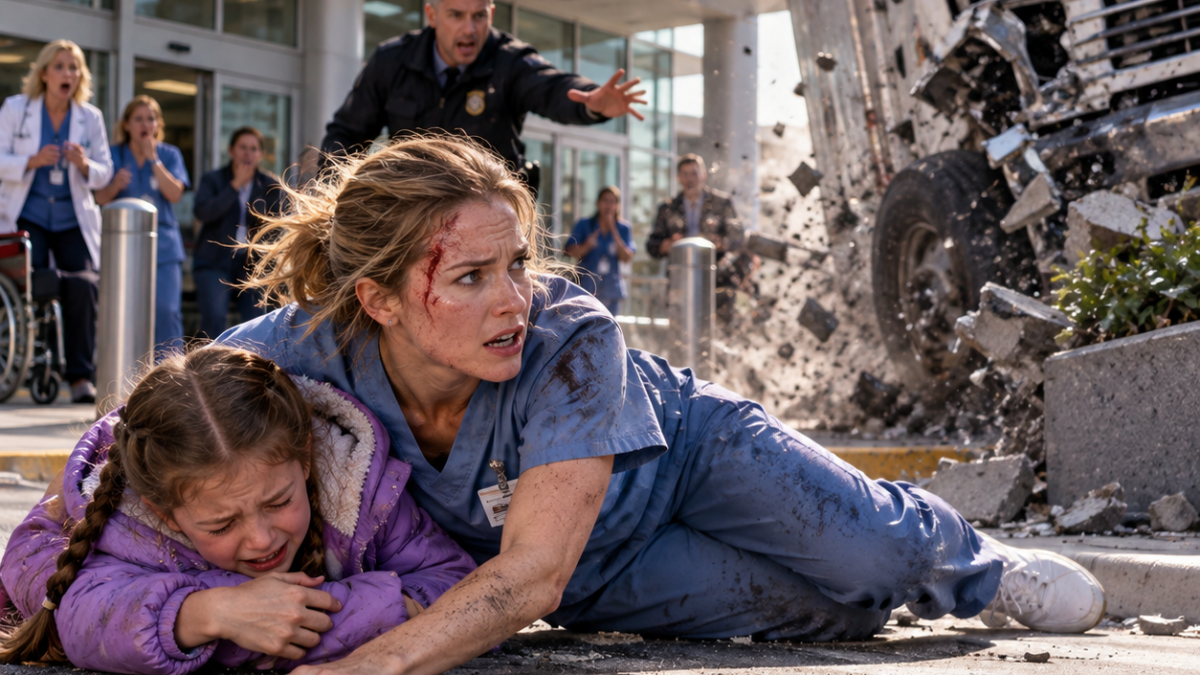
I grabbed Hazel by the back of her purple coat and threw her toward the grass with everything I had.
Then I turned my back to the truck.
The side mirror hit my left shoulder like a bat swung by a giant.
Pain detonated white across my body.
For half a second, I saw sky. Gray clouds. A flash of hospital windows. The paper crane tumbling from my hand.
Then pavement.
I hit hard, rolled, and somehow pushed onto my knees.
Behind me, the truck slammed into a concrete planter with a scream of metal and stone. Steam hissed. Something cracked. Something began to drip.
My left arm hung wrong.
The shoulder had gone loose and terrible, disconnected from the shape of me. Pain flooded down my side so violently that black spots opened at the edges of my vision.
I clamped my right hand over the joint and swallowed the sound trying to come out of me.
Shouting exploded around the entrance.
Someone screamed for security.
Someone yelled, “Call 911!”
Someone else shouted, “The driver!”
But through the ringing in my ears, I heard the only sound that mattered.
A child coughing.
Hard.
Wet.
Then not wet.
Tight.
I turned my head.
Hazel was on the grass on her hands and knees, trying to pull air into a body that had begun to betray her.
Dr. Draper reached the entrance first.
Of course he did.
He looked at the truck, then the crowd, then the little girl. Last, he looked at me kneeling on the pavement with my hand clamped over my ruined shoulder.
His face twisted.
Not with concern.
With annoyance.
“What did you do?” he snapped. “Get up, Landry. You’re making a scene and blocking my entrance.”
Something inside me went very still.
Not calm.
Still.
There is a difference.
I lifted my head.
For six months, my voice around him had been quiet, careful, almost apologetic. This voice was not.
“You looked down at me for six months, Dr. Draper,” I said. “Not once did you look at what I was doing.”
He blinked.
Before he could answer, Hazel made a sound that cut through everyone.
A ragged saw of breath.
She tried to speak.
Only one word came.
“Can’t…”
Her fingers dug into the grass.
“…breathe.”
Draper turned sharply.
“She’s panicking from the shock,” he said quickly. “Get her on a gurney. Lay her flat and put oxygen on her face. Move.”
Two nurses rushed out with a gurney.
My stomach dropped.
“No.”
Draper’s head snapped toward me.
“I beg your pardon?”
“Do not lay her down.”
The nurses hesitated.
I tried to stand and nearly collapsed. Pain tore through my shoulder so violently that nausea rose in my throat. I stayed on my knees and dragged myself toward Hazel with my right hand.
“She needs to sit upright,” I said. “Forward. Lying flat will make it worse.”
Draper’s eyes hardened.
“I will not be corrected by a nurse who can’t file a lab order.”
He waved the gurney forward.
That sentence decided something.
Not in me.
In the air.
Some cruelties are small enough to survive embarrassment. Others reveal themselves at exactly the wrong time, and once seen, they cannot crawl back into shadow.
I reached Hazel before the gurney did.
With one working arm, I pulled her gently but firmly into a seated position, leaning forward, small hands braced against her knees. Her face was slick with tears. Her lips were losing color. The skin between her ribs pulled inward with each desperate breath.
I placed myself in front of her.
“Look at me, Hazel.”
Her terrified eyes found mine.
“We’re going to breathe together. I’m right here.”
Her small fingers grabbed my sleeve.
Every nerve in my shoulder screamed.
I ignored it.
“Good girl,” I said. “Stay upright. Lean forward. Don’t fight for a big breath. Small and slow. Follow me.”
Boots pounded across pavement.
Uncle Ray dropped beside us, his broad face gray with fear.
“Hazel. Baby, look at me.”
“Her inhaler,” I said without looking away from Hazel. “Blue pouch. Side pocket of her bag. Spacer too. Now.”
He hesitated for half a second.
Not because he doubted me.
Because my tone did not match the woman kneeling broken on the grass. It was not a request. It was command. The kind of voice people obey before their pride has time to object.
He tore open the bag and shoved the blue pouch into my hand.
Draper stepped closer.
“Senior Chief, step away from the nurse. She has a head injury and is not qualified to make medical decisions about this child.”
Uncle Ray did not look at him.
“She’s the only person out here who knows what she’s doing.”
The words moved through the crowd.
I did not have time to feel them.
My left arm was useless. I wedged the spacer against my knee and worked one-handed, shaking the inhaler hard, fitting it into place, checking Hazel’s posture.
“Hold the back of her head,” I told Uncle Ray. “Keep her chin forward. Don’t force it up. Just steady.”
He obeyed instantly.
His large hand cupped her head like glass.
“Hazel,” I said, “when I count, breathe in slow. Like you’re smelling a warm cookie.”
Her eyes, huge and wet, stayed on mine.
“One… two… three… four.”
She inhaled.
Thin.
Shaking.
Enough.
“Hold it. One… two… three. Good. Now out like you’re blowing on hot soup.”
She exhaled.
The first puff went in.
I watched her ribs.
Not the crowd. Not Draper. Not the truck. Not the pain turning my vision gray at the corners.
Ribs.
Lips.
Shoulders.
Eyes.
Breath tells the truth faster than machines when you learn to listen.
I counted the seconds.
A full minute.
People always want to rush when someone can’t breathe. Panic makes time feel immoral. But medicine does not care how badly you want a shortcut. The body has rules.
“Pediatric team to the entrance,” I said. “Nebulizer kit. Now.”
Draper stepped toward me.
“You do not give orders in my department.”
I kept my eyes on Hazel.
“Then don’t hold up the girl while you argue.”
Silence struck harder than shouting would have.
Behind Draper, Monica Straud finally lifted the radio from her belt.
“Pediatric team to front entrance,” she said, voice tight. “Bring nebulizer kit. Possible severe asthma exacerbation.”
I gave Hazel the second puff.
Again, slow.
Again, count.
Again, hold.
Again, breathe out.
Her chest eased by a fraction.
Then another.
The ragged saw softened back into a whistle. The whistle thinned into a hiss. A faint line of color returned to her lips.
“Better,” she whispered.
The word almost broke me.
I smiled, though sweat had gathered at my hairline and my shoulder felt like it was being torn open from the inside.
“You’re doing so well, sweetheart.”
For one second, the wind changed.
Not here.
Not bay wind.
Dust.
Burned metal.
Hot sand.
Radio static.
My own younger voice in my ear, steadier than the hand holding the receiver.
Keep breathing. Stay with me. I’m not going anywhere.
Then it passed.
I was back on cold grass outside Narragansett Point Naval Hospital, one arm hanging useless, a paper crane lying crushed near the curb, a little girl breathing because my hands still remembered who they were.
Uncle Ray was staring at those hands.
His voice lowered.
“Those are not ordinary nurse’s hands.”
I said nothing.
“Those hands have worked under fire.”
My right hand tightened around the spacer.
I tried to tuck my injured arm into the front of my scrub top to hold it still. The motion tugged my sleeve back.
On the inside of my left wrist, daylight caught a tattoo the size of a coin.
A phoenix rising from a ring of flame.
Uncle Ray saw it.
Every muscle in his face went still.
I knew the moment recognition tried to surface.
No.
Not now.
Draper snorted.
“Lucky guess and a lucky inhaler. Don’t let it go to your head, Landry.”
Nobody answered him.
Hazel’s small hand found my fingers.
“Are you hurt, Miss Brooke?” she whispered.
“A little.”
Her eyes filled again.
“Your arm looks funny.”
“Your lungs matter more right now. Keep breathing with me.”
She nodded.
That was when I smelled it.
Sharp.
Sweet.
Wrong.
Diesel.
My head turned toward the truck.
A dark pool spread from beneath the wrecked vehicle, creeping across the pavement in a slow, widening sheet. The driver, an older man, slumped against the wheel, groaning faintly. The cab door hung open. Inside the dashboard, frayed wires spat tiny blue sparks.
Forty feet away, an ambulance idled in the bay.
Its exhaust pipe shimmered with heat.
The fuel was moving toward it.
Behind the glass doors sat the waiting room, the oxygen lines, the patients, the staff, the old veteran in his wheelchair, everyone still watching the drama they thought had already reached its worst point.
It had not.
“Dr. Draper,” I said. “That fuel is going to reach the ambulance.”
“It’s a spill. Fire department is on the way.”
“They won’t arrive in time.”
“Stand down, nurse.”
I looked at the fuel.
At the sparks.
At the glass.
At Hazel.
Then I stood.
Pain roared through me so violently my knees almost folded. My vision swam, gray at the edges. I bit the inside of my cheek until I tasted blood.
But I stood.
The old voice came back fully now.
Not as memory.
As command.
I looked at Uncle Ray.
“Anvil, this is Phoenix.”
The world stopped.
His eyes locked on mine.
The name struck him like a hand to the chest.
I had not said it aloud in eleven years.
“Pull everyone back sixty feet,” I ordered. “Kill that ambulance engine. Get the driver out with his neck held still. One of you grab the extinguisher from the wall inside the doors. Move.”
Uncle Ray whispered one word.
“Phoenix.”
Then training swallowed shock.
“Aye, Phoenix.”
He moved.
Two younger men had stepped out of a second vehicle near the curb. They responded instantly, as if the name had reached them before explanation could. One sprinted to the ambulance and shut down the engine. The other tore the extinguisher from the wall inside the entrance and ran toward the truck.
I turned to the hospital staff frozen by the doors.
“Clear the waiting room glass. Move patients to the east corridor away from windows. Wheelchairs first if they’re closest, walking patients behind them, stretchers last with staff on both sides. Count heads at the East Chapel. I want numbers.”
They stared.
I pointed.
“You. You. You. Move.”
The first nurse ran.
Then another.
Then the whole entrance seemed to wake.
Monica Straud’s mouth opened, closed, and then she shouted with more authority than I had ever heard from her.
“Clear the windows! East corridor now! Move, move, move!”
Patients rose. Chairs scraped. Security officers began directing the flow. The old veteran in the wheelchair looked back at me once as someone turned him away from the glass.
He knew.
Maybe not the story.
But he knew command when he heard it.
At the truck, Anvil and his men worked with brutal precision. One held the driver’s head and neck in alignment. Another cut the seat belt. Together, they slid the groaning man onto a board and pulled him clear.
A flame flickered beneath the hood.
For one heartbeat, the whole circle drive held its breath.
Anvil hit it with the extinguisher.
White chemical cloud swallowed orange.
The first fire engine came wailing around the corner seconds later.
Only seconds.
Sometimes that is the difference between a close call and a memorial plaque.
The pediatric team lifted Hazel onto a stretcher, keeping her upright the entire time. The nebulizer mask came over her face. She clutched the bent paper crane in one hand.
The truck driver, strapped to the board now, opened his eyes.
His voice cracked.
“Little girl… is she…”
“She’s breathing,” a medic told him.
The old man began to cry.
“My brakes failed,” he whispered. “I tried… I tried…”
I closed my eyes for half a second.
There were too many kinds of guilt in the world, and not all of them belonged to the guilty.
When I opened my eyes, Dr. Draper was standing in front of me.
His face was pale with fury.
Not fear.
Fury.
Because he had lost control of the scene.
Because people had obeyed me.
Because everyone had seen what happened when they did.
“Do you have any idea what you just did?” he demanded.
I could barely stay upright.
“Yes.”
“You disobeyed an attending physician. You gave medical orders outside your role. You caused panic in front of patients.”
“There was fuel.”
“You are suspended effective immediately.”
The circle drive went quiet again.
“Hand me your badge.”
Monica froze near the entrance.
Security Officer Kent Osgood approached slowly, distress written across his face.
“Ma’am,” he said softly, “I’m sorry. I have to follow the order.”
“It’s all right, Officer.”
I unclipped my badge with my right hand.
Brooke Landry, RN.
A name I had chosen because it was simple and quiet.
I placed it in Draper’s open palm.
He closed his fingers around it as if reclaiming a kingdom.
I looked at him once.
Not angrily.
Anger would have been too small.
I looked at him the way I had once looked at a dying man in a medical tent when I needed him to understand that truth had arrived and comfort could not change it.
Then I turned toward the doors.
I made it three steps.
My knees gave out.
The pavement rose hard and fast. I sank down, one hand pressed uselessly against my shoulder, blonde hair falling across my face. The pain had become enormous, filling every space thought normally used.
No one moved to help.
Not because they did not want to.
Because Draper still stood there with my badge in his hand.
That was the kind of department he had built.
Anvil stepped away and pulled out his phone.
His voice was rough when he spoke.
“Admiral, it’s Delgado. Hazel is safe. She’s breathing.”
A pause.
“No, sir. You need to get here fast.”
Another pause.
“Because you need to see who is kneeling on the pavement.”
My stomach dropped.
“Anvil,” I whispered.
He looked at me, and for the first time his eyes were not those of a senior chief following orders. They were the eyes of a man who had been looking for a ghost.
“I’m sorry, ma’am,” he said quietly. “But he deserves to know.”
I stared at the wet pavement.
Eleven years.
Eleven years of small hospitals and quiet shifts. Eleven years of taking jobs in towns where nobody knew call signs. Eleven years of keeping my sleeves low over the phoenix tattoo. Eleven years of convincing myself the radio voice had died somewhere overseas and Brooke Landry was all that remained.
But the voice had come back.
In front of patients.
In front of nurses.
In front of cameras.
In front of the one man who could call the past by name.
I was not afraid of being exposed.
I was afraid of what being known would open.
Two black cars turned into the circular drive.
The first door opened before the vehicle fully stopped.
A tall man in dress blues stepped out, gold stripes shining at his sleeves, white cap pulled low. He moved like a man fighting the urge to run because rank had trained his body to contain panic.
Rear Admiral Thomas Wittmann.
Former SEAL.
Father.
I had never met his daughter before that morning.
But I knew him.
Not his face at first. The years had put more lines around his eyes and silver at his temples. But memory recognized posture, the set of the shoulders, the controlled violence of a man who had once survived because strangers refused to let him die.
He came toward Hazel first.
She was visible through the glass now, upright in the pediatric bay, nebulizer mask hanging near her chin, color returning to her cheeks.
“Daddy!” she called weakly through the door.
He stopped just long enough to press his hand against the glass.
Then Anvil said something low.
The admiral turned.
His eyes found me kneeling on the pavement.
He stopped completely.
The color drained from his face.
For a long moment, he looked like a man seeing a voice step out of fog and become flesh.
“It can’t be,” he said.
I lifted my eyes.
For the first time in years, I let someone see my whole face.
“Hello, sir.”
His mouth parted.
“Phoenix?”
My throat tightened.
“It’s Brooke now.”
He removed his cap.
The waiting room had gathered behind the glass again. Nurses, patients, security, firefighters, corpsmen, doctors, strangers with phones raised and mouths open.
In front of all of them, Rear Admiral Thomas Wittmann lowered himself onto one knee on the wet pavement.
Dress blues and all.
“No,” I whispered.
But he was already there.
“Eleven years ago,” he said, and his voice broke on the first word, “my team was pinned down in Helmand Province. We were bleeding out and no helicopter could land. A voice came over the radio.”
The circle drive went silent.
“That voice kept us alive for three hours. Talked us through tourniquets. Chest seals. Needle decompression. Triage. Kept men conscious who wanted to close their eyes. Kept me from losing my brother in the dirt.”
His eyes shone.
“We never knew her name. She only said, ‘Call me Phoenix.’ I spent eleven years trying to find that voice.”
My breath caught.
The old radio room came back.
Not the whole thing. Just pieces. Headset pressed too hard against my ear. Static. Coordinates. Men shouting over one another. Blood loss reports. Wind. Enemy fire. My own hands shaking beneath the table where nobody could see while my voice stayed calm because their lives needed it.
The admiral looked toward the pediatric bay, where Hazel watched us with wide eyes.
“Today you took a truck for my daughter,” he said. “Twice now, you have given my family everything.”
He stood.
Straightened.
Raised his hand.
And saluted.
Anvil saluted next.
Then the two younger men.
Then Security Officer Osgood, tears running down his face.
Behind the glass, the old Navy veteran rose from his wheelchair with help from a nurse and placed his hand over his heart.
I wanted to disappear.
I wanted to say they were wrong.
I wanted to hand the moment to someone stronger.
But there are times when refusing honor becomes another form of pride. Sometimes people need to give thanks as much as you need to avoid receiving it.
So I sat on the pavement, arm broken, face wet, and let them see me.
Anvil turned toward the crowd.
“Those were not the hands of a nurse who carries trays,” he said.
His voice was steady, but I heard the emotion beneath it.
“That is Lieutenant Commander Brooke Landry, Navy Nurse Corps, attached to special warfare medical teams. The woman responsible for more of our lives than any of us can count.”
A sound moved through the staff behind the glass.
Shock.
Shame.
Recognition arriving too late but arriving all the same.
Dr. Draper stood very still, my badge still in his palm.
He looked like a man who had stepped backward off a roof and had not yet hit the ground.
The admiral turned to him.
The quiet in his voice was more frightening than shouting.
“Dr. Draper.”
Draper swallowed.
“Sir.”
“You took the badge from the woman who just saved my daughter’s life.”
“Sir, I didn’t know—”
“You ordered my daughter laid flat while she could not breathe.”
Draper’s face went gray.
“I thought she was panicking.”
“You thought,” the admiral said, “because you did not look.”
Draper flinched.
“You looked down at her for six months,” the admiral continued. “That is not her failure. It is yours.”
The hospital commander arrived then, a gray-haired captain with a face like carved stone. He had heard enough. Everyone had.
He walked to Draper and held out his hand.
“My badge,” I said quietly.
Draper stared at me.
Then at the commander.
Then he placed the badge in the captain’s hand.
The captain stepped toward me, knelt with care, and clipped the badge back onto my scrubs himself.
“Lieutenant Commander Landry,” he said, “we will get you treated now.”
“It’s just Brooke here.”
His expression shifted, almost gently.
“Not today.”
Then he stood and turned to Draper.
“Dr. Anthony Draper, you are relieved of emergency department leadership effective immediately, pending full inquiry. Hand your keys to Nurse Straud.”
Monica’s face changed when she heard her name. Fear first. Then something like responsibility.
Draper’s mouth opened.
No words came.
At last, stiffly, he turned toward me.
“I’m sorry, Commander Landry.”
I studied him.
An apology from a man cornered by consequence is not the same as repentance. Maybe someday he would understand the difference. Maybe not.
“I don’t need an apology, Doctor,” I said.
His eyes flickered.
“What do you need?”
“A seat in the front row.”
He stared.
“You’ll understand soon.”
The paramedics eased me onto a stretcher. I nearly blacked out when they immobilized my shoulder. The world blurred, then sharpened again around the edges.
The admiral walked beside the stretcher with one hand resting lightly on the rail.
At the pediatric bay window, Hazel pressed her small face to the glass.
Her color was better now. The nebulizer mask hung near her chin. The paper crane was still in her hand, bent but intact.
“Daddy,” she called weakly. “The nurse sat me up. She counted with me.”
The admiral pressed his palm to the glass.
“I know, sweetheart,” he said, voice thick. “I know.”
Hazel looked past him at me.
“Miss Brooke?”
I turned my head.
She lifted the paper crane.
“You dropped it.”
A laugh broke out of me.
It hurt terribly.
But it was real.
Two weeks later, I walked back through the glass doors of Narragansett Point Naval Hospital with my arm in a sling and my chin lifted.
The automatic doors opened with the same soft rush as always.
But the room beyond them had changed.
Or maybe I had.
The waiting room was full. Patients looked up. Nurses paused. Security Officer Osgood straightened near the entrance. Monica Straud stood behind the nurses’ station, hair pulled back, eyes tired in a way that suggested the last two weeks had asked a great deal of her.
Nobody stared at my hands.
They looked me in the eye.
The hospital commander offered me a new position that morning.
Chief of Nursing Education.
An office. A staff. A salary that would have made the quiet version of me laugh into her coffee. Authority. Protection. A title large enough that people would have to think before dismissing me.
I thanked him.
Then I said no.
His eyebrows rose.
“No?”
“I want to stay near the bedside,” I said. “That’s where the real work happens.”
“You earned more than bedside shifts.”
“I know.”
He waited.
“What do you want, Brooke?”
“A classroom.”
That Saturday, more than a hundred chairs filled the hospital auditorium.
The class title was written on the whiteboard in blue marker:
SIT UP, SLOW DOWN.
A paper crane was taped beside it, slightly bent on one wing.
Hazel’s gift.
Nurses came. Corpsmen came. Parents from the base came. Security officers, medics, administrators, two firefighters, and several people I recognized from the waiting room. Senior Chief Ray Delgado stood at the back wall with his arms folded, flanked by the two younger men from that morning. He nodded at every instruction like a man hearing an old prayer spoken in a new language.
Hazel sat in the second row beside her father, swinging her feet.
The admiral wore a plain jacket.
No stripes. No medals. Just a father with a notebook open on his knee.
In the front row sat Dr. Anthony Draper.
Plain gray sweater. No white coat. No chart in his hand. No audience to command.
Only a notebook.
He looked up when I entered.
For the first time since I had met him, he did not look through me, over me, or down at me.
He looked at me.
I walked to the front of the room.
My left arm was still in a sling, but my right hand was steady. I rolled up my sleeve enough for the small phoenix tattoo to show.
I no longer hid it.
The room quieted.
I looked at their faces.
People who had laughed. People who had frozen. People who had helped. People who had failed. People who had come back anyway.
That mattered.
Coming back to learn is not the same as never being wrong. Sometimes it is more important.
“Good morning,” I said.
My voice was warm.
Not soft.
Warm.
“Today we’re going to learn how to help someone breathe.”
A few pens moved across paper.
“When a child can’t breathe, panic will tell you to do everything fast. Your job is to become the calmest person in the room. Calm does not mean slow in the wrong places. It means clear. It means useful.”
Hazel watched me solemnly.
I smiled at her.
“First, sit them upright. Forward slightly. Let the lungs work with gravity, not against it.”
Draper wrote that down.
“Second, speak slowly. Fear tightens the body. Your voice matters more than you think.”
Anvil’s face shifted at the back of the room.
He knew.
He had heard my voice through static and war and eleven years of searching.
“Third, use the rescue medication as prescribed. If there is a spacer, use it. One step at a time. Watch the child, not your fear.”
The class listened.
Really listened.
No one checked a phone. No one laughed. No one whispered.
I taught them the signs of danger. The shoulders rising. The ribs pulling inward. The lips losing color. The inability to finish a sentence. I taught them when to call emergency services and why waiting to see if it passed could cost a life. I taught them how to count with a child, how to make breath feel less lonely.
But I taught them something else too.
Something no manual had ever said clearly enough.
“The smallest person in the emergency may be the one seeing it best,” I said. “Do not dismiss a voice because it is quiet. Do not confuse hierarchy with wisdom. And never let pride stand between a patient and air.”
My eyes moved briefly to Draper.
He did not look away.
Good.
Not because I wanted him humiliated.
Because I wanted him changed.
After the class, people lined up with questions. Parents asked about inhalers. Nurses asked about emergency positioning. A young corpsman admitted he froze when Hazel started coughing because he was waiting for a doctor to tell him what to do.
“What should I have done?” he asked.
“Started with what you knew,” I said. “Then called for help. Freezing usually comes from believing you must know everything before you do anything.”
He nodded like that answer had found a place in him.
Hazel waited until the room thinned.
Then she approached with her father behind her.
Her braids were still crooked. Her cheeks were pink again. She held a new paper crane, this one blue.
“For your classroom,” she said.
I took it carefully.
“This is the second most beautiful crane I’ve ever seen.”
She grinned.
“What’s the first?”
“The one that survived the truck.”
She giggled, then grew serious.
“Daddy says you were a hero before you were a nurse.”
I glanced at the admiral.
He had the good sense to look mildly guilty.
“I was always a nurse,” I told her. “Just in different places.”
“Were you scared?”
The room seemed to soften around that question.
Children ask the thing adults decorate.
“Yes,” I said. “Very.”
Her brow wrinkled.
“But you did it anyway.”
“That’s usually what courage is.”
She considered that.
Then she leaned in and hugged me carefully around the waist, avoiding the sling with the concentration of someone handling glass.
“Thank you for helping my lungs,” she whispered.
My throat tightened.
“You did the hardest part,” I said. “You kept breathing.”
After she left, Draper remained in the front row.
The notebook was still open on his knee.
I began erasing the whiteboard.
“Commander Landry.”
I paused.
“Brooke is fine.”
He stood.
For once, he looked uncertain without looking angry about it.
“I was wrong,” he said.
“Yes.”
The directness startled him, but he accepted it.
“I don’t mean only outside. I mean before. The charts. The way I spoke to you. The assumptions.”
I set the eraser down.
“You built a department where people were afraid to move until you approved their breathing.”
His face tightened.
Not defensively.
Painfully.
“I know.”
“Do you?”
“I’m starting to.”
I studied him.
Starting was not enough, but it was not nothing.
He looked toward the taped paper crane.
“I’ll be in the front row next week too,” he said.
“Bring questions.”
He nodded.
Then he left.
Monica approached after him.
For a moment, she only stood there, coffee cup in hand, no smile to hide behind.
“I should have spoken up,” she said.
“Yes.”
Her eyes filled.
“I’m sorry.”
I thought about all the times apology comes late because courage arrives after consequence. I thought about the department, about the nurses who had run when someone finally told them they could, about the way silence grows when everyone waits for someone else to risk being first.
“You can speak up next time,” I said.
She nodded quickly.
“I will.”
“Good.”
When the auditorium emptied, I stayed behind.
The blue crane sat beside the purple one on the whiteboard tray. Two small birds made of fragile paper, both slightly uneven, both still standing.
Anvil came forward last.
He stopped beside me, hands clasped behind his back.
“Admiral wants to invite you to dinner,” he said.
“I know.”
“You going?”
“Not yet.”
He nodded.
“He’ll understand.”
“I know that too.”
For a while, neither of us spoke.
Then he said quietly, “The night you disappeared, every man in the unit asked where Phoenix went.”
I looked at the cranes.
“I didn’t disappear. I survived.”
His face softened.
“Yes, ma’am.”
“I couldn’t keep being a voice in people’s worst moments.”
“You kept a lot of us alive.”
“And I heard all of it afterward.”
He understood.
The silence between us held gunfire, static, screams, coordinates, names. It held men we saved and men we didn’t. It held eleven years of sleep I had chased and rarely caught.
“I only wanted quiet,” I said.
“Did you find it?”
I looked around the empty classroom.
At the chairs. The whiteboard. The cranes. The doorway where Hazel had waved. The front row where Draper had taken notes like a first-year student.
“No,” I said. “I found something better.”
“What’s that?”
“A reason to use the voice again.”
Anvil looked at me for a long moment.
Then he saluted.
Not the public salute from the pavement.
A smaller one.
Private.
I returned it as well as I could with one arm.
That evening, after the hospital settled into its usual rhythm, I walked outside to the concrete pillar where Hazel had first found me.
The bay wind was cold again.
The flag snapped overhead.
The circular drive had been repaired. The broken planter replaced. The pavement washed clean. There was no diesel smell, no glass, no steam, no blood. Nothing to prove what had happened except the memory held by everyone who had been there.
For years, I thought healing meant becoming someone untouched by the past.
I know better now.
Healing is not erasure.
It is when the past stops dragging you backward and starts placing tools in your hands.
I was not the same woman who had stood there humiliated while Draper waved a chart above his head. I was not only Phoenix either, the radio voice men had turned into legend because they never had to see the hands shaking after the transmission ended.
I was both.
Brooke Landry.
Nurse.
Lieutenant Commander.
Survivor.
Teacher.
A woman who had hidden command because command had once cost her everything.
Inside the hospital, someone called for a nurse.
Not urgently.
Just normally.
A patient needed help sitting up. Someone needed medication. Someone needed discharge instructions repeated more slowly. Someone needed a blanket warmed, a pulse checked, a fear noticed before it became a crisis.
The real work.
I took one more breath of cold bay air.
Then I went back through the glass doors.
This time, no one laughed.
No one looked down.
And when I passed the front desk, Monica lifted her head.
“Brooke,” she said, “Room Three is having trouble breathing.”
I was already moving.
“Sit them upright,” I said.
And behind me, without hesitation, the whole department moved with me.
𝗧𝗛𝗘 𝗘𝗡𝗗
The Nurse They Mocked Had One Name the Navy Never Forgot
For six months, they thought my silence meant I had nothing worth hearing.
Then a child stopped breathing in front of the hospital doors.
And the voice I had buried for eleven years came back like it had never left.
Dr. Anthony Draper raised my chart over his head as if he were holding evidence at a trial.
The emergency waiting room went quiet in pieces. First the nurses at the station stopped typing. Then the patients stopped pretending not to listen. Then the security guards near the glass doors turned their heads, already uncomfortable but unwilling to move. Forty people watched me become the lesson he wanted to teach.
“This,” Dr. Draper announced, loud enough for the farthest row of chairs, “is what happens when a nurse believes she is smarter than a physician.”
My hands were still on the medication cart.
They trembled before I could stop them.
I hated that most of all.
Not his voice. Not the humiliation. Not even the way Monica Straud, the charge nurse, hid a smile behind her coffee cup. I hated that my body still betrayed me when eyes gathered too quickly. I could stand in blood, smoke, gunfire, and screaming without losing the shape of my breath, but one arrogant man in a clean white coat could make my fingers shake by turning a waiting room into a courtroom.
Draper snapped the chart open with a theatrical flick.
“Delayed lab order. Mishandled paperwork. A patient waiting unnecessarily because Nurse Landry cannot manage a simple stack of forms.”
The truth sat behind my teeth.
He had signed the order late.
I had warned him twice.
I had placed it in front of him, pointed to the time stamp, and said, “Doctor, this needs your signature before the lab can process it.”
He had waved me off without looking up.
Twice.
But truth does not always win because it is available. Sometimes truth needs a room willing to receive it, and this room belonged to him.
So I lowered my eyes.
“Yes, Doctor.”
A woman in the waiting room shifted in her chair. A little boy stopped swinging his feet. One of the security guards looked down at the floor. Nobody said anything.
Nobody ever did.
I had worked at Narragansett Point Naval Hospital for six months. Six months of quiet shifts, double shifts, graveyard shifts, filling gaps, taking blame, moving through crowded rooms as if I were made of shadow. I knew which patients needed extra blankets without asking. I knew which corpsman was afraid of pediatric trauma. I knew which veteran came in every Thursday more for loneliness than blood pressure checks. I knew where every emergency cart stuck, which cabinet door jammed, and which doctor wrote orders in a rush and blamed nurses when the ink dried crooked.
No one knew much about me.
That was by design.
To them, I was Brooke Landry.
Five-four. Dirty blonde hair twisted into a loose knot. Scrubs always a little too big across the shoulders. Soft voice. Thin scar above my left eyebrow that nobody asked about. A nurse who carried trays, charts, blankets, and blame with the same quiet expression.
I had made myself forgettable because being remembered had once cost too much.
Dr. Draper lowered the chart and stared at me like he expected me to shrink.
“Landry, you carry trays. You carry charts. You carry my patience, and it is almost gone.”
A few people laughed.
Small laughter.
Cowardly laughter.
The kind people use when they want power to know they are on its side.
“Go outside,” he said. “Breathe. Come back when you remember where you belong.”
My chest tightened, but I nodded once.
“Yes, Doctor.”
I turned toward the glass doors.
Every step felt measured. Too slow, and they would think I was defiant. Too fast, and they would think I was broken. I had spent years learning how to move through rooms full of danger. This was only another room. A cleaner one. A crueler one in smaller ways.
As I passed the nurses’ station, Monica looked into her coffee like she had not enjoyed what happened.
She had.
Near the front row, an old man in a wheelchair caught my eye.
Mr. Keene. Retired Navy. Came in twice a month for wound checks he pretended were more urgent than they were. His hands were spotted with age, but his back remained straight in the chair.
He gave me a small nod.
Not pity.
Recognition.
The kind of nod that said, I know what it looks like when someone chooses silence instead of surrender.
It was the only kindness I had felt all week.
Outside, the October wind coming off Narragansett Bay cut through my scrubs. Cold air struck my face, and I welcomed it. A gray warship sat far out near the pier. The flag above the main entrance snapped hard against the sky.
I stepped beside a concrete pillar and pressed my back to it.
Inhale.
Hold.
Exhale.
Again.
The breathing trick was old. Older than this hospital. Older than the name badge clipped to my scrub top. I had learned it in places where the air smelled of hot dust and copper, where panic killed almost as often as bullets, where my voice over a radio had been the only thread between dying men and the possibility of morning.
Inhale.
Hold.
Exhale.
My hands steadied.
I looked down at them.
Small hands. Pale scars across the knuckles. A faint tremor fading from the fingertips. Hands people saw and assumed were made for paperwork, not pressure. For holding clipboards, not arteries. For carrying trays, not command.
I tucked them under my arms.
A black SUV rolled into the circular drive and stopped near the entrance. The vehicle was clean, dark, official without markings. A broad man in a plain jacket stepped out first.
He scanned the parking lot.
Not casually.
His eyes moved over exits, vehicles, corners, windows, rooflines, sightlines. It was fast, disciplined, and familiar enough that my body reacted before my mind did.
I knew that kind of scan.
Security. Combat. Protective detail.
I looked away quickly.
The rear door opened.
A little girl climbed down holding a folded paper crane.
She was about eight years old, maybe nine, in a purple coat with two crooked braids and a pale, serious face. She held the paper crane like it was something precious enough to require both hands.
The broad man moved to the back of the SUV for a bag.
The child turned toward me.
I heard her before she reached me.
Not her footsteps.
Her breathing.
Thin.
Whistling.
Wrong.
Her small shoulders lifted too high with every breath. Her mouth was slightly open. She was working harder than she should have been, but children often learn to smile through distress because adults look less frightened when children are brave.
“Hi,” she said. “I’m Hazel.”
I pushed away from the pillar.
“Hi, Hazel.”
“You look sad.”
I blinked.
She held out the paper crane.
“This is for you.”
For one strange second, I did not know what to do with kindness that direct.
I took it carefully.
The paper was purple, creased unevenly by small fingers. One wing was folded lower than the other.
“Thank you,” I said. “It’s beautiful.”
She looked pleased, then coughed once. A tight little cough that did not clear anything.
“Are you here to see a doctor?” I asked.
“My uncle Ray says my lungs are being grumpy.” She leaned closer, lowering her voice. “My daddy is coming later. He is very important, but he says I am more important.”
I smiled despite myself.
“Sounds like your daddy is smart.”
“He is,” Hazel said. “But he worries too much.”
Behind her, Uncle Ray had opened the SUV’s rear hatch and was reaching for a bag.
Ten steps away.
Only ten.
Most people think disaster announces itself with time.
It doesn’t.
It arrives inside ordinary seconds, while someone is reaching for a bag, while a child is smiling, while a nurse is holding a paper crane and feeling, for the first time all day, like the world might not be entirely cruel.
A horn blasted from the hill road above the hospital.
Long.
Desperate.
My head snapped toward it.
A white delivery truck came racing down the slope.
Too fast.
Far too fast.
Its brake lights were dark. The front wheels shook violently as the driver fought the steering wheel with both hands. The truck jumped the curb, bounced hard, and swung toward the circular drive.
Straight toward Hazel.
The world narrowed.
There was no time for fear.
No time for thought.
Only the old calm, dropping over me like a hand between my shoulder blades.
Move.
I grabbed Hazel by the back of her purple coat and threw her toward the grass with everything I had.
Then I turned my back to the truck.
The side mirror hit my left shoulder like a bat swung by a giant.
Pain detonated white across my body.
For half a second, I saw sky. Gray clouds. A flash of hospital windows. The paper crane tumbling from my hand.
Then pavement.
I hit hard, rolled, and somehow pushed onto my knees.
Behind me, the truck slammed into a concrete planter with a scream of metal and stone. Steam hissed. Something cracked. Something began to drip.
My left arm hung wrong.
The shoulder had gone loose and terrible, disconnected from the shape of me. Pain flooded down my side so violently that black spots opened at the edges of my vision.
I clamped my right hand over the joint and swallowed the sound trying to come out of me.
Shouting exploded around the entrance.
Someone screamed for security.
Someone yelled, “Call 911!”
Someone else shouted, “The driver!”
But through the ringing in my ears, I heard the only sound that mattered.
A child coughing.
Hard.
Wet.
Then not wet.
Tight.
I turned my head.
Hazel was on the grass on her hands and knees, trying to pull air into a body that had begun to betray her.
Dr. Draper reached the entrance first.
Of course he did.
He looked at the truck, then the crowd, then the little girl. Last, he looked at me kneeling on the pavement with my hand clamped over my ruined shoulder.
His face twisted.
Not with concern.
With annoyance.
“What did you do?” he snapped. “Get up, Landry. You’re making a scene and blocking my entrance.”
Something inside me went very still.
Not calm.
Still.
There is a difference.
I lifted my head.
For six months, my voice around him had been quiet, careful, almost apologetic. This voice was not.
“You looked down at me for six months, Dr. Draper,” I said. “Not once did you look at what I was doing.”
He blinked.
Before he could answer, Hazel made a sound that cut through everyone.
A ragged saw of breath.
She tried to speak.
Only one word came.
“Can’t…”
Her fingers dug into the grass.
“…breathe.”
Draper turned sharply.
“She’s panicking from the shock,” he said quickly. “Get her on a gurney. Lay her flat and put oxygen on her face. Move.”
Two nurses rushed out with a gurney.
My stomach dropped.
“No.”
Draper’s head snapped toward me.
“I beg your pardon?”
“Do not lay her down.”
The nurses hesitated.
I tried to stand and nearly collapsed. Pain tore through my shoulder so violently that nausea rose in my throat. I stayed on my knees and dragged myself toward Hazel with my right hand.
“She needs to sit upright,” I said. “Forward. Lying flat will make it worse.”
Draper’s eyes hardened.
“I will not be corrected by a nurse who can’t file a lab order.”
He waved the gurney forward.
That sentence decided something.
Not in me.
In the air.
Some cruelties are small enough to survive embarrassment. Others reveal themselves at exactly the wrong time, and once seen, they cannot crawl back into shadow.
I reached Hazel before the gurney did.
With one working arm, I pulled her gently but firmly into a seated position, leaning forward, small hands braced against her knees. Her face was slick with tears. Her lips were losing color. The skin between her ribs pulled inward with each desperate breath.
I placed myself in front of her.
“Look at me, Hazel.”
Her terrified eyes found mine.
“We’re going to breathe together. I’m right here.”
Her small fingers grabbed my sleeve.
Every nerve in my shoulder screamed.
I ignored it.
“Good girl,” I said. “Stay upright. Lean forward. Don’t fight for a big breath. Small and slow. Follow me.”
Boots pounded across pavement.
Uncle Ray dropped beside us, his broad face gray with fear.
“Hazel. Baby, look at me.”
“Her inhaler,” I said without looking away from Hazel. “Blue pouch. Side pocket of her bag. Spacer too. Now.”
He hesitated for half a second.
Not because he doubted me.
Because my tone did not match the woman kneeling broken on the grass. It was not a request. It was command. The kind of voice people obey before their pride has time to object.
He tore open the bag and shoved the blue pouch into my hand.
Draper stepped closer.
“Senior Chief, step away from the nurse. She has a head injury and is not qualified to make medical decisions about this child.”
Uncle Ray did not look at him.
“She’s the only person out here who knows what she’s doing.”
The words moved through the crowd.
I did not have time to feel them.
My left arm was useless. I wedged the spacer against my knee and worked one-handed, shaking the inhaler hard, fitting it into place, checking Hazel’s posture.
“Hold the back of her head,” I told Uncle Ray. “Keep her chin forward. Don’t force it up. Just steady.”
He obeyed instantly.
His large hand cupped her head like glass.
“Hazel,” I said, “when I count, breathe in slow. Like you’re smelling a warm cookie.”
Her eyes, huge and wet, stayed on mine.
“One… two… three… four.”
She inhaled.
Thin.
Shaking.
Enough.
“Hold it. One… two… three. Good. Now out like you’re blowing on hot soup.”
She exhaled.
The first puff went in.
I watched her ribs.
Not the crowd. Not Draper. Not the truck. Not the pain turning my vision gray at the corners.
Ribs.
Lips.
Shoulders.
Eyes.
Breath tells the truth faster than machines when you learn to listen.
I counted the seconds.
A full minute.
People always want to rush when someone can’t breathe. Panic makes time feel immoral. But medicine does not care how badly you want a shortcut. The body has rules.
“Pediatric team to the entrance,” I said. “Nebulizer kit. Now.”
Draper stepped toward me.
“You do not give orders in my department.”
I kept my eyes on Hazel.
“Then don’t hold up the girl while you argue.”
Silence struck harder than shouting would have.
Behind Draper, Monica Straud finally lifted the radio from her belt.
“Pediatric team to front entrance,” she said, voice tight. “Bring nebulizer kit. Possible severe asthma exacerbation.”
I gave Hazel the second puff.
Again, slow.
Again, count.
Again, hold.
Again, breathe out.
Her chest eased by a fraction.
Then another.
The ragged saw softened back into a whistle. The whistle thinned into a hiss. A faint line of color returned to her lips.
“Better,” she whispered.
The word almost broke me.
I smiled, though sweat had gathered at my hairline and my shoulder felt like it was being torn open from the inside.
“You’re doing so well, sweetheart.”
For one second, the wind changed.
Not here.
Not bay wind.
Dust.
Burned metal.
Hot sand.
Radio static.
My own younger voice in my ear, steadier than the hand holding the receiver.
Keep breathing. Stay with me. I’m not going anywhere.
Then it passed.
I was back on cold grass outside Narragansett Point Naval Hospital, one arm hanging useless, a paper crane lying crushed near the curb, a little girl breathing because my hands still remembered who they were.
Uncle Ray was staring at those hands.
His voice lowered.
“Those are not ordinary nurse’s hands.”
I said nothing.
“Those hands have worked under fire.”
My right hand tightened around the spacer.
I tried to tuck my injured arm into the front of my scrub top to hold it still. The motion tugged my sleeve back.
On the inside of my left wrist, daylight caught a tattoo the size of a coin.
A phoenix rising from a ring of flame.
Uncle Ray saw it.
Every muscle in his face went still.
I knew the moment recognition tried to surface.
No.
Not now.
Draper snorted.
“Lucky guess and a lucky inhaler. Don’t let it go to your head, Landry.”
Nobody answered him.
Hazel’s small hand found my fingers.
“Are you hurt, Miss Brooke?” she whispered.
“A little.”
Her eyes filled again.
“Your arm looks funny.”
“Your lungs matter more right now. Keep breathing with me.”
She nodded.
That was when I smelled it.
Sharp.
Sweet.
Wrong.
Diesel.
My head turned toward the truck.
A dark pool spread from beneath the wrecked vehicle, creeping across the pavement in a slow, widening sheet. The driver, an older man, slumped against the wheel, groaning faintly. The cab door hung open. Inside the dashboard, frayed wires spat tiny blue sparks.
Forty feet away, an ambulance idled in the bay.
Its exhaust pipe shimmered with heat.
The fuel was moving toward it.
Behind the glass doors sat the waiting room, the oxygen lines, the patients, the staff, the old veteran in his wheelchair, everyone still watching the drama they thought had already reached its worst point.
It had not.
“Dr. Draper,” I said. “That fuel is going to reach the ambulance.”
“It’s a spill. Fire department is on the way.”
“They won’t arrive in time.”
“Stand down, nurse.”
I looked at the fuel.
At the sparks.
At the glass.
At Hazel.
Then I stood.
Pain roared through me so violently my knees almost folded. My vision swam, gray at the edges. I bit the inside of my cheek until I tasted blood.
But I stood.
The old voice came back fully now.
Not as memory.
As command.
I looked at Uncle Ray.
“Anvil, this is Phoenix.”
The world stopped.
His eyes locked on mine.
The name struck him like a hand to the chest.
I had not said it aloud in eleven years.
“Pull everyone back sixty feet,” I ordered. “Kill that ambulance engine. Get the driver out with his neck held still. One of you grab the extinguisher from the wall inside the doors. Move.”
Uncle Ray whispered one word.
“Phoenix.”
Then training swallowed shock.
“Aye, Phoenix.”
He moved.
Two younger men had stepped out of a second vehicle near the curb. They responded instantly, as if the name had reached them before explanation could. One sprinted to the ambulance and shut down the engine. The other tore the extinguisher from the wall inside the entrance and ran toward the truck.
I turned to the hospital staff frozen by the doors.
“Clear the waiting room glass. Move patients to the east corridor away from windows. Wheelchairs first if they’re closest, walking patients behind them, stretchers last with staff on both sides. Count heads at the East Chapel. I want numbers.”
They stared.
I pointed.
“You. You. You. Move.”
The first nurse ran.
Then another.
Then the whole entrance seemed to wake.
Monica Straud’s mouth opened, closed, and then she shouted with more authority than I had ever heard from her.
“Clear the windows! East corridor now! Move, move, move!”
Patients rose. Chairs scraped. Security officers began directing the flow. The old veteran in the wheelchair looked back at me once as someone turned him away from the glass.
He knew.
Maybe not the story.
But he knew command when he heard it.
At the truck, Anvil and his men worked with brutal precision. One held the driver’s head and neck in alignment. Another cut the seat belt. Together, they slid the groaning man onto a board and pulled him clear.
A flame flickered beneath the hood.
For one heartbeat, the whole circle drive held its breath.
Anvil hit it with the extinguisher.
White chemical cloud swallowed orange.
The first fire engine came wailing around the corner seconds later.
Only seconds.
Sometimes that is the difference between a close call and a memorial plaque.
The pediatric team lifted Hazel onto a stretcher, keeping her upright the entire time. The nebulizer mask came over her face. She clutched the bent paper crane in one hand.
The truck driver, strapped to the board now, opened his eyes.
His voice cracked.
“Little girl… is she…”
“She’s breathing,” a medic told him.
The old man began to cry.
“My brakes failed,” he whispered. “I tried… I tried…”
I closed my eyes for half a second.
There were too many kinds of guilt in the world, and not all of them belonged to the guilty.
When I opened my eyes, Dr. Draper was standing in front of me.
His face was pale with fury.
Not fear.
Fury.
Because he had lost control of the scene.
Because people had obeyed me.
Because everyone had seen what happened when they did.
“Do you have any idea what you just did?” he demanded.
I could barely stay upright.
“Yes.”
“You disobeyed an attending physician. You gave medical orders outside your role. You caused panic in front of patients.”
“There was fuel.”
“You are suspended effective immediately.”
The circle drive went quiet again.
“Hand me your badge.”
Monica froze near the entrance.
Security Officer Kent Osgood approached slowly, distress written across his face.
“Ma’am,” he said softly, “I’m sorry. I have to follow the order.”
“It’s all right, Officer.”
I unclipped my badge with my right hand.
Brooke Landry, RN.
A name I had chosen because it was simple and quiet.
I placed it in Draper’s open palm.
He closed his fingers around it as if reclaiming a kingdom.
I looked at him once.
Not angrily.
Anger would have been too small.
I looked at him the way I had once looked at a dying man in a medical tent when I needed him to understand that truth had arrived and comfort could not change it.
Then I turned toward the doors.
I made it three steps.
My knees gave out.
The pavement rose hard and fast. I sank down, one hand pressed uselessly against my shoulder, blonde hair falling across my face. The pain had become enormous, filling every space thought normally used.
No one moved to help.
Not because they did not want to.
Because Draper still stood there with my badge in his hand.
That was the kind of department he had built.
Anvil stepped away and pulled out his phone.
His voice was rough when he spoke.
“Admiral, it’s Delgado. Hazel is safe. She’s breathing.”
A pause.
“No, sir. You need to get here fast.”
Another pause.
“Because you need to see who is kneeling on the pavement.”
My stomach dropped.
“Anvil,” I whispered.
He looked at me, and for the first time his eyes were not those of a senior chief following orders. They were the eyes of a man who had been looking for a ghost.
“I’m sorry, ma’am,” he said quietly. “But he deserves to know.”
I stared at the wet pavement.
Eleven years.
Eleven years of small hospitals and quiet shifts. Eleven years of taking jobs in towns where nobody knew call signs. Eleven years of keeping my sleeves low over the phoenix tattoo. Eleven years of convincing myself the radio voice had died somewhere overseas and Brooke Landry was all that remained.
But the voice had come back.
In front of patients.
In front of nurses.
In front of cameras.
In front of the one man who could call the past by name.
I was not afraid of being exposed.
I was afraid of what being known would open.
Two black cars turned into the circular drive.
The first door opened before the vehicle fully stopped.
A tall man in dress blues stepped out, gold stripes shining at his sleeves, white cap pulled low. He moved like a man fighting the urge to run because rank had trained his body to contain panic.
Rear Admiral Thomas Wittmann.
Former SEAL.
Father.
I had never met his daughter before that morning.
But I knew him.
Not his face at first. The years had put more lines around his eyes and silver at his temples. But memory recognized posture, the set of the shoulders, the controlled violence of a man who had once survived because strangers refused to let him die.
He came toward Hazel first.
She was visible through the glass now, upright in the pediatric bay, nebulizer mask hanging near her chin, color returning to her cheeks.
“Daddy!” she called weakly through the door.
He stopped just long enough to press his hand against the glass.
Then Anvil said something low.
The admiral turned.
His eyes found me kneeling on the pavement.
He stopped completely.
The color drained from his face.
For a long moment, he looked like a man seeing a voice step out of fog and become flesh.
“It can’t be,” he said.
I lifted my eyes.
For the first time in years, I let someone see my whole face.
“Hello, sir.”
His mouth parted.
“Phoenix?”
My throat tightened.
“It’s Brooke now.”
He removed his cap.
The waiting room had gathered behind the glass again. Nurses, patients, security, firefighters, corpsmen, doctors, strangers with phones raised and mouths open.
In front of all of them, Rear Admiral Thomas Wittmann lowered himself onto one knee on the wet pavement.
Dress blues and all.
“No,” I whispered.
But he was already there.
“Eleven years ago,” he said, and his voice broke on the first word, “my team was pinned down in Helmand Province. We were bleeding out and no helicopter could land. A voice came over the radio.”
The circle drive went silent.
“That voice kept us alive for three hours. Talked us through tourniquets. Chest seals. Needle decompression. Triage. Kept men conscious who wanted to close their eyes. Kept me from losing my brother in the dirt.”
His eyes shone.
“We never knew her name. She only said, ‘Call me Phoenix.’ I spent eleven years trying to find that voice.”
My breath caught.
The old radio room came back.
Not the whole thing. Just pieces. Headset pressed too hard against my ear. Static. Coordinates. Men shouting over one another. Blood loss reports. Wind. Enemy fire. My own hands shaking beneath the table where nobody could see while my voice stayed calm because their lives needed it.
The admiral looked toward the pediatric bay, where Hazel watched us with wide eyes.
“Today you took a truck for my daughter,” he said. “Twice now, you have given my family everything.”
He stood.
Straightened.
Raised his hand.
And saluted.
Anvil saluted next.
Then the two younger men.
Then Security Officer Osgood, tears running down his face.
Behind the glass, the old Navy veteran rose from his wheelchair with help from a nurse and placed his hand over his heart.
I wanted to disappear.
I wanted to say they were wrong.
I wanted to hand the moment to someone stronger.
But there are times when refusing honor becomes another form of pride. Sometimes people need to give thanks as much as you need to avoid receiving it.
So I sat on the pavement, arm broken, face wet, and let them see me.
Anvil turned toward the crowd.
“Those were not the hands of a nurse who carries trays,” he said.
His voice was steady, but I heard the emotion beneath it.
“That is Lieutenant Commander Brooke Landry, Navy Nurse Corps, attached to special warfare medical teams. The woman responsible for more of our lives than any of us can count.”
A sound moved through the staff behind the glass.
Shock.
Shame.
Recognition arriving too late but arriving all the same.
Dr. Draper stood very still, my badge still in his palm.
He looked like a man who had stepped backward off a roof and had not yet hit the ground.
The admiral turned to him.
The quiet in his voice was more frightening than shouting.
“Dr. Draper.”
Draper swallowed.
“Sir.”
“You took the badge from the woman who just saved my daughter’s life.”
“Sir, I didn’t know—”
“You ordered my daughter laid flat while she could not breathe.”
Draper’s face went gray.
“I thought she was panicking.”
“You thought,” the admiral said, “because you did not look.”
Draper flinched.
“You looked down at her for six months,” the admiral continued. “That is not her failure. It is yours.”
The hospital commander arrived then, a gray-haired captain with a face like carved stone. He had heard enough. Everyone had.
He walked to Draper and held out his hand.
“My badge,” I said quietly.
Draper stared at me.
Then at the commander.
Then he placed the badge in the captain’s hand.
The captain stepped toward me, knelt with care, and clipped the badge back onto my scrubs himself.
“Lieutenant Commander Landry,” he said, “we will get you treated now.”
“It’s just Brooke here.”
His expression shifted, almost gently.
“Not today.”
Then he stood and turned to Draper.
“Dr. Anthony Draper, you are relieved of emergency department leadership effective immediately, pending full inquiry. Hand your keys to Nurse Straud.”
Monica’s face changed when she heard her name. Fear first. Then something like responsibility.
Draper’s mouth opened.
No words came.
At last, stiffly, he turned toward me.
“I’m sorry, Commander Landry.”
I studied him.
An apology from a man cornered by consequence is not the same as repentance. Maybe someday he would understand the difference. Maybe not.
“I don’t need an apology, Doctor,” I said.
His eyes flickered.
“What do you need?”
“A seat in the front row.”
He stared.
“You’ll understand soon.”
The paramedics eased me onto a stretcher. I nearly blacked out when they immobilized my shoulder. The world blurred, then sharpened again around the edges.
The admiral walked beside the stretcher with one hand resting lightly on the rail.
At the pediatric bay window, Hazel pressed her small face to the glass.
Her color was better now. The nebulizer mask hung near her chin. The paper crane was still in her hand, bent but intact.
“Daddy,” she called weakly. “The nurse sat me up. She counted with me.”
The admiral pressed his palm to the glass.
“I know, sweetheart,” he said, voice thick. “I know.”
Hazel looked past him at me.
“Miss Brooke?”
I turned my head.
She lifted the paper crane.
“You dropped it.”
A laugh broke out of me.
It hurt terribly.
But it was real.
Two weeks later, I walked back through the glass doors of Narragansett Point Naval Hospital with my arm in a sling and my chin lifted.
The automatic doors opened with the same soft rush as always.
But the room beyond them had changed.
Or maybe I had.
The waiting room was full. Patients looked up. Nurses paused. Security Officer Osgood straightened near the entrance. Monica Straud stood behind the nurses’ station, hair pulled back, eyes tired in a way that suggested the last two weeks had asked a great deal of her.
Nobody stared at my hands.
They looked me in the eye.
The hospital commander offered me a new position that morning.
Chief of Nursing Education.
An office. A staff. A salary that would have made the quiet version of me laugh into her coffee. Authority. Protection. A title large enough that people would have to think before dismissing me.
I thanked him.
Then I said no.
His eyebrows rose.
“No?”
“I want to stay near the bedside,” I said. “That’s where the real work happens.”
“You earned more than bedside shifts.”
“I know.”
He waited.
“What do you want, Brooke?”
“A classroom.”
That Saturday, more than a hundred chairs filled the hospital auditorium.
The class title was written on the whiteboard in blue marker:
SIT UP, SLOW DOWN.
A paper crane was taped beside it, slightly bent on one wing.
Hazel’s gift.
Nurses came. Corpsmen came. Parents from the base came. Security officers, medics, administrators, two firefighters, and several people I recognized from the waiting room. Senior Chief Ray Delgado stood at the back wall with his arms folded, flanked by the two younger men from that morning. He nodded at every instruction like a man hearing an old prayer spoken in a new language.
Hazel sat in the second row beside her father, swinging her feet.
The admiral wore a plain jacket.
No stripes. No medals. Just a father with a notebook open on his knee.
In the front row sat Dr. Anthony Draper.
Plain gray sweater. No white coat. No chart in his hand. No audience to command.
Only a notebook.
He looked up when I entered.
For the first time since I had met him, he did not look through me, over me, or down at me.
He looked at me.
I walked to the front of the room.
My left arm was still in a sling, but my right hand was steady. I rolled up my sleeve enough for the small phoenix tattoo to show.
I no longer hid it.
The room quieted.
I looked at their faces.
People who had laughed. People who had frozen. People who had helped. People who had failed. People who had come back anyway.
That mattered.
Coming back to learn is not the same as never being wrong. Sometimes it is more important.
“Good morning,” I said.
My voice was warm.
Not soft.
Warm.
“Today we’re going to learn how to help someone breathe.”
A few pens moved across paper.
“When a child can’t breathe, panic will tell you to do everything fast. Your job is to become the calmest person in the room. Calm does not mean slow in the wrong places. It means clear. It means useful.”
Hazel watched me solemnly.
I smiled at her.
“First, sit them upright. Forward slightly. Let the lungs work with gravity, not against it.”
Draper wrote that down.
“Second, speak slowly. Fear tightens the body. Your voice matters more than you think.”
Anvil’s face shifted at the back of the room.
He knew.
He had heard my voice through static and war and eleven years of searching.
“Third, use the rescue medication as prescribed. If there is a spacer, use it. One step at a time. Watch the child, not your fear.”
The class listened.
Really listened.
No one checked a phone. No one laughed. No one whispered.
I taught them the signs of danger. The shoulders rising. The ribs pulling inward. The lips losing color. The inability to finish a sentence. I taught them when to call emergency services and why waiting to see if it passed could cost a life. I taught them how to count with a child, how to make breath feel less lonely.
But I taught them something else too.
Something no manual had ever said clearly enough.
“The smallest person in the emergency may be the one seeing it best,” I said. “Do not dismiss a voice because it is quiet. Do not confuse hierarchy with wisdom. And never let pride stand between a patient and air.”
My eyes moved briefly to Draper.
He did not look away.
Good.
Not because I wanted him humiliated.
Because I wanted him changed.
After the class, people lined up with questions. Parents asked about inhalers. Nurses asked about emergency positioning. A young corpsman admitted he froze when Hazel started coughing because he was waiting for a doctor to tell him what to do.
“What should I have done?” he asked.
“Started with what you knew,” I said. “Then called for help. Freezing usually comes from believing you must know everything before you do anything.”
He nodded like that answer had found a place in him.
Hazel waited until the room thinned.
Then she approached with her father behind her.
Her braids were still crooked. Her cheeks were pink again. She held a new paper crane, this one blue.
“For your classroom,” she said.
I took it carefully.
“This is the second most beautiful crane I’ve ever seen.”
She grinned.
“What’s the first?”
“The one that survived the truck.”
She giggled, then grew serious.
“Daddy says you were a hero before you were a nurse.”
I glanced at the admiral.
He had the good sense to look mildly guilty.
“I was always a nurse,” I told her. “Just in different places.”
“Were you scared?”
The room seemed to soften around that question.
Children ask the thing adults decorate.
“Yes,” I said. “Very.”
Her brow wrinkled.
“But you did it anyway.”
“That’s usually what courage is.”
She considered that.
Then she leaned in and hugged me carefully around the waist, avoiding the sling with the concentration of someone handling glass.
“Thank you for helping my lungs,” she whispered.
My throat tightened.
“You did the hardest part,” I said. “You kept breathing.”
After she left, Draper remained in the front row.
The notebook was still open on his knee.
I began erasing the whiteboard.
“Commander Landry.”
I paused.
“Brooke is fine.”
He stood.
For once, he looked uncertain without looking angry about it.
“I was wrong,” he said.
“Yes.”
The directness startled him, but he accepted it.
“I don’t mean only outside. I mean before. The charts. The way I spoke to you. The assumptions.”
I set the eraser down.
“You built a department where people were afraid to move until you approved their breathing.”
His face tightened.
Not defensively.
Painfully.
“I know.”
“Do you?”
“I’m starting to.”
I studied him.
Starting was not enough, but it was not nothing.
He looked toward the taped paper crane.
“I’ll be in the front row next week too,” he said.
“Bring questions.”
He nodded.
Then he left.
Monica approached after him.
For a moment, she only stood there, coffee cup in hand, no smile to hide behind.
“I should have spoken up,” she said.
“Yes.”
Her eyes filled.
“I’m sorry.”
I thought about all the times apology comes late because courage arrives after consequence. I thought about the department, about the nurses who had run when someone finally told them they could, about the way silence grows when everyone waits for someone else to risk being first.
“You can speak up next time,” I said.
She nodded quickly.
“I will.”
“Good.”
When the auditorium emptied, I stayed behind.
The blue crane sat beside the purple one on the whiteboard tray. Two small birds made of fragile paper, both slightly uneven, both still standing.
Anvil came forward last.
He stopped beside me, hands clasped behind his back.
“Admiral wants to invite you to dinner,” he said.
“I know.”
“You going?”
“Not yet.”
He nodded.
“He’ll understand.”
“I know that too.”
For a while, neither of us spoke.
Then he said quietly, “The night you disappeared, every man in the unit asked where Phoenix went.”
I looked at the cranes.
“I didn’t disappear. I survived.”
His face softened.
“Yes, ma’am.”
“I couldn’t keep being a voice in people’s worst moments.”
“You kept a lot of us alive.”
“And I heard all of it afterward.”
He understood.
The silence between us held gunfire, static, screams, coordinates, names. It held men we saved and men we didn’t. It held eleven years of sleep I had chased and rarely caught.
“I only wanted quiet,” I said.
“Did you find it?”
I looked around the empty classroom.
At the chairs. The whiteboard. The cranes. The doorway where Hazel had waved. The front row where Draper had taken notes like a first-year student.
“No,” I said. “I found something better.”
“What’s that?”
“A reason to use the voice again.”
Anvil looked at me for a long moment.
Then he saluted.
Not the public salute from the pavement.
A smaller one.
Private.
I returned it as well as I could with one arm.
That evening, after the hospital settled into its usual rhythm, I walked outside to the concrete pillar where Hazel had first found me.
The bay wind was cold again.
The flag snapped overhead.
The circular drive had been repaired. The broken planter replaced. The pavement washed clean. There was no diesel smell, no glass, no steam, no blood. Nothing to prove what had happened except the memory held by everyone who had been there.
For years, I thought healing meant becoming someone untouched by the past.
I know better now.
Healing is not erasure.
It is when the past stops dragging you backward and starts placing tools in your hands.
I was not the same woman who had stood there humiliated while Draper waved a chart above his head. I was not only Phoenix either, the radio voice men had turned into legend because they never had to see the hands shaking after the transmission ended.
I was both.
Brooke Landry.
Nurse.
Lieutenant Commander.
Survivor.
Teacher.
A woman who had hidden command because command had once cost her everything.
Inside the hospital, someone called for a nurse.
Not urgently.
Just normally.
A patient needed help sitting up. Someone needed medication. Someone needed discharge instructions repeated more slowly. Someone needed a blanket warmed, a pulse checked, a fear noticed before it became a crisis.
The real work.
I took one more breath of cold bay air.
Then I went back through the glass doors.
This time, no one laughed.
No one looked down.
And when I passed the front desk, Monica lifted her head.
“Brooke,” she said, “Room Three is having trouble breathing.”
I was already moving.
“Sit them upright,” I said.
And behind me, without hesitation, the whole department moved with me.