𝗙𝗨𝗟𝗟 𝗦𝗧𝗢𝗥𝗬 The Night the Storm Walked Into My Emergency Room
𝗙𝗨𝗟𝗟 𝗦𝗧𝗢𝗥𝗬
I cleaned the floor.
I heard Dr. Ashford continue rounds as if humiliating me had been a useful teaching exercise. His voice moved from bed to bed, smooth and certain. People followed him. People always follow certainty, even when certainty is only arrogance with better posture.
I kept working.
Then I heard something beneath the thunder.
Claws.
Wet claws on tile.
At first, I thought memory had reached for me again.
There were sounds from my old life that sometimes broke through without permission. Rotor wash. Distant gunfire. A dog whining after being injured. Boots running over gravel.
But this was real.
The hospital’s glass doors slid open.
A security guard shouted.
And a German Shepherd walked in from the storm.
The whole emergency department seemed to inhale at once.
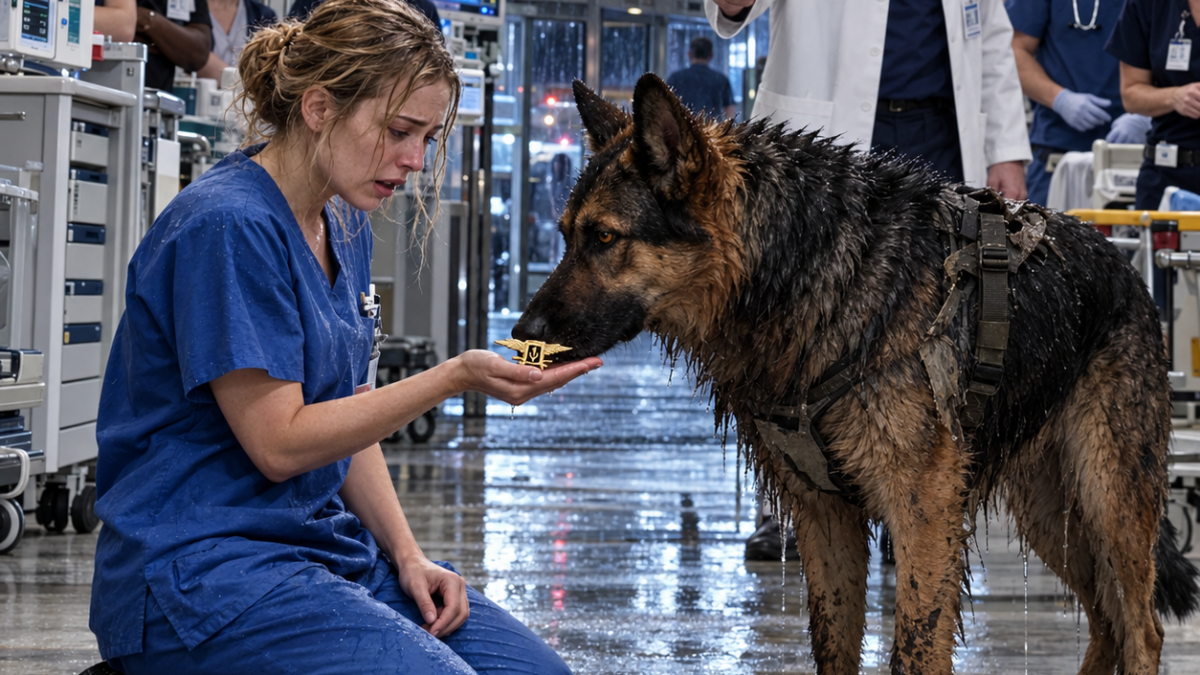
He was soaked to the bone, black-and-tan coat plastered flat against his body, water pouring from him in sheets. A torn tactical harness hung loose across his chest. Mud streaked his legs. His ears were alert, but his body carried exhaustion.
He was alone.
In his mouth, held with impossible care, was a small gold object.
My hand tightened around the mop.
No.
The dog stepped past the security guard.
“Get that animal out of here,” Dr. Ashford snapped.
Two guards moved toward him.
The Shepherd did not even look at them.
He came down the center of the emergency department with rainwater marking every step, amber eyes fixed on me.
Not the doctors.
Not the residents.
Not the nurses.
Me.
My heartbeat changed.
The mop handle slipped slightly in my grip.
The dog stopped in front of me.
For a moment, all I could hear was the rain.
Then he lowered his head and placed the gold object into my open hand.
The mop hit the floor.
I knew what it was before I looked.
An eagle.
An anchor.
A trident.
A flintlock pistol.
The Special Warfare insignia.
The golden trident.
Every Navy SEAL on earth would know that shape by touch in the dark.
My fingers closed around it, and six years vanished.
My knees nearly failed.
“Koda,” I whispered.
The dog made a sound so soft nobody else heard it.
But I did.
I had heard that sound once before from him on a hillside where smoke hung low and the night would not end.
Someone laughed nervously.
Dr. Ashford’s voice cut through the room.
“It appears the janitor has a friend. Remove them both.”
Lorraine stepped forward as if to take me by the arm.
Koda moved first.
He caught my sleeve gently between his teeth and pulled hard toward the ambulance bay.
Then he released me, looked back, and whined.
Not a pet seeking comfort.
Not a lost dog asking for help.
A working dog reporting.
My blood went cold.
“What is it?” I whispered.
Koda tugged again.
In that instant, I understood.
Someone was dying.
I ran.
The mop stayed on the floor.
Behind me, Dr. Ashford shouted my name. Lorraine called for security. Someone yelled that the dog needed to be restrained.
I heard none of it in a way that mattered.
My body remembered speed.
Doors banged open ahead of me. Cold rain slapped my face as I burst into the ambulance bay behind Koda.
Red emergency lights flashed against the concrete. Water ran in sheets down the ramp. A lone paramedic was shouting for help while trying to guide a stretcher up from the storm.
On it lay a man in a torn wetsuit top, his skin gray beneath the bay lights, lips the color of slate. Sand clung to his beard. His chest barely moved.
His name tape read Hayes.
Beside the stretcher stood a massive bearded man in a soaked tactical jacket, water streaming from his sleeves. His hands shook, not from fear but from cold and controlled fury.
The paramedic gasped, “Boat flipped at the old pier. He was under for minutes. My partner went down on the ramp. I’m alone. Heart’s still going, but he’s not breathing right.”
Dr. Ashford had followed us outside under an umbrella.
Now that an audience had returned, so had his command voice.
“Trauma Bay One. Airway tray. Full team. Move.”
Those were reasonable orders.
Too slow.
The team would need several minutes to mobilize through the storm, power fluctuations, crowded halls, and confusion.
Hayes did not have several minutes.
I could see the failing pulse in his neck.
Weak.
Sluggish.
Sliding away.
I dropped to my knees beside the stretcher.
My hands stopped shaking.
They always did when the work began.
“Hayes,” I said, leaning close. “Stay with me.”
The bearded man stared at me.
The paramedic looked relieved and confused at the same time.
Dr. Ashford barked, “Nurse Sutton, step away from that patient.”
I tilted Hayes’s head back and lifted his chin to open the airway.
His mouth was cold beneath my fingers.
Rain hammered the awning overhead.
His chest did not rise.
“Paige!” Ashford snapped.
I bent down and gave the first rescue breath.
One second.
Watch the chest.
It rose.
Good.
I gave another.
Then I checked his pulse again.
Still there.
Weak.
Drowning is cruel because the heart can keep trying after breathing has already failed. The body struggles for oxygen, the pulse slows, and every second spent performing authority instead of giving air becomes theft.
I gave two more breaths.
The paramedic whispered, “Come on, man.”
Hayes did not cough.
His pulse fluttered beneath my fingers like a moth trapped in a fist.
“Nurse Sutton,” Dr. Ashford said, his voice deadly now, “you are not cleared for airway management. You are a probationary nurse. You are about to lose your license.”
I gave another breath.
The big bearded man stepped closer.
“Doctor,” he said, low and dangerous, “she is helping him.”
“She is acting outside her scope in my emergency department.”
Hayes’s pulse stumbled.
Then vanished.
Everything inside me narrowed.
No thunder.
No rain.
No Ashford.
No audience.
Only the man on the stretcher and the empty space where his pulse had been.
I locked my elbows, placed the heel of one hand in the center of his chest, laced my other hand over it, and drove down.
Hard.
Fast.
Steady.
Compression after compression.
“Someone get the AED,” I ordered. “Now. Clear the path.”
My voice carried across the bay.
It did not sound like the woman who had taken the mop.
It sounded like a voice built in war.
A young resident broke from the crowd and ran.
“You’ll break his ribs,” Ashford hissed.
“Then I’ll fix his ribs after he’s alive.”
The words came out flat.
I did not look at him.
Compressions.
Breaths.
Compressions.
Breaths.
The AED arrived.
I placed the pads quickly.
The machine analyzed.
No shock advised.
That meant no easy reset.
No dramatic jolt.
Only work.
I went back to compressions.
My shoulders aligned over my hands. My body moved in rhythm, using weight instead of panic. I counted under my breath because counting is how you keep fear out of your fingers.
The bearded man stood completely still now.
Watching my hands.
Watching the breaths.
Watching something he recognized but could not yet name.
Koda paced beside the stretcher, whining low.
“Stay,” I told him.
He obeyed.
Another cycle.
Another breath.
Hayes’s skin remained gray.
The paramedic was crying openly now, one hand pressed over his mouth.
I did not tell him to stop.
Some people cry and still function.
That is not weakness.
Weakness is refusing to move because your pride has no instructions.
“Come on, Hayes,” I whispered. “Do not do this.”
Another compression.
Another.
Then his body convulsed.
Water rushed from his mouth.
I rolled him onto his side in one smooth movement, clearing his airway with my fingers while the paramedic held the stretcher steady.
Hayes coughed once.
A horrible, wet sound.
Then again.
Then he dragged in a breath so ragged and beautiful that every person in that bay seemed to feel it inside their own chest.
“Easy,” I said, supporting him. “You’re at Cedar Harbor. You’re safe.”
He coughed again, shuddering.
His pulse returned under my fingers.
Faint.
But there.
I closed my eyes for half a second.
Only after the work ended did the shaking come back.
A fine, terrible tremor began in my hands and moved up my arms.
It always came after.
Never during.
The bay had gone silent.
Then the bearded man crouched beside me.
He was huge, broad through the shoulders, beard dark with rain, eyes sharp enough to cut through every lie in the room.
“Senior Chief Bear Lindren,” he said. “Naval Special Warfare.”
My throat closed around the name.
Bear.
I had heard of him.
I had never served directly under him, but the teams were a small world when blood was involved. Names traveled. Reputations traveled. Loss traveled fastest of all.
He looked at Hayes, then back at me.
“A nurse follows protocol,” he said quietly. “What I just watched was someone who has done this while people were shooting at her.”
I held his gaze.
For the first time since I had walked into Cedar Harbor, I did not look down.
“He needs monitoring,” I said. “Drowning injuries can turn on you later. Watch his lungs. Watch oxygen saturation. Keep him warm.”
Bear’s eyes narrowed slightly.
Not suspicion.
Recognition beginning to wake.
Dr. Ashford found his voice.
“Senior Chief, this woman has no authority here. She practiced outside her scope in front of forty witnesses, and I will be filing a report.”
Bear rose slowly.
He stood a full head taller than Dr. Ashford.
“Doctor,” he said, “forty witnesses just watched a man come back from the dead. File whatever you like.”
Lightning struck so close the world turned white.
For one blinding instant, the ambulance bay flashed as bright as noon.
Then every light in Cedar Harbor went out.
The monitors inside died.
Alarms wailed, then fell silent.
Someone screamed in the hallway.
A second later, the backup generator coughed.
Sputtered.
Failed.
Darkness swallowed the emergency department.
For a moment, nobody moved.
That is what darkness does to untested people.
It asks a question.
Who is in charge now?
A second ambulance came screaming up the flooded street and stopped at the bottom of the ramp. Water had risen knee-deep across the approach, swirling with leaves, trash, and broken branches.
A medic leaned from the driver’s side window.
“We have another man from the boat! Young sailor, hypothermic, barely awake. We can’t get the stretcher up the ramp. Water’s rising.”
Panic spread faster than the floodwater.
Staff shouted over one another.
Patients inside the hall cried out as monitors went dark.
A nurse called for flashlights.
Someone knocked over a metal tray.
Dr. Ashford stood frozen under his tilted umbrella, rainwater spilling from its edge onto his polished shoes.
He looked almost offended that the world had stopped obeying him.
I stood.
“Listen to me.”
My voice was not loud.
It did not need to be.
The bay turned.
Even in the dark, I could feel every face.
“Phones out. Lights on. Point them down, not in each other’s eyes.”
Small lights appeared one by one.
“Senior Chief, I need four of your men on that stretcher. The rest form a chain on the ramp, hand to hand, so nobody slips.”
Bear did not hesitate.
“You heard her. Move.”
“Do not use the front entrance,” I continued. “Water is too deep there. We use the linen corridor on the east side. It runs under the main hall. No stairs. Dry floor if the drains are still holding.”
Lorraine’s voice shook somewhere behind me.
“How do you know that?”
“Because I looked.”
Nobody argued.
Four operators splashed into the flooded ramp and lifted the stretcher carrying the young sailor. He was shivering under foil blankets, lips pale, eyes half open.
I walked backward ahead of them with my phone light aimed low.
“Left foot down. Slow. Go wide near the drain. The slope changes there.”
Water surged around their boots.
Koda stayed beside me, ears forward, body tense.
Behind us, Bear organized the chain without needing another word.
Staff followed.
Then patients.
Then residents.
Wheelchairs.
Gurneys.
A nurse carrying an infant wrapped in blankets.
Every person placed a hand on the shoulder ahead of them, just as I instructed.
Nobody asked why the nurse with the mop knew the hospital’s forgotten corridors better than people who had worked there for years.
The linen corridor was black as a cave and smelled of detergent, old concrete, and damp cloth. The air was colder there. Emergency signs glowed faintly, their battery lights weak but alive.
“Step up in three,” I called. “Low pipe on the left. Keep the stretcher level.”
The SEALs moved like one body.
Even soaked and freezing, they followed commands cleanly.
That is what good teams do.
They recognize function faster than rank.
Behind them, Dr. Ashford’s voice echoed from the ambulance bay.
“Nurse Sutton! I am the chief of this department, and I order you to stop.”
No one stopped.
Bear turned his head.
“Sir, with respect, step aside. She’s running this.”
The corridor continued under the main hall. I remembered the route from my first day, when another nurse had told me to fetch linens and I had taken the long way back on purpose.
I always map places.
I cannot help it.
In Trauma Bay Two, we set the young sailor near the warmest interior wall. I found the emergency lantern in the supply closet before anyone asked where it was. Then I started sorting the room.
Critical near the light.
Stable against the wall.
Hypothermia blankets from the lower cabinet.
Manual blood pressure cuffs because monitors were unreliable.
One resident assigned to oxygen checks.
One to warming measures.
One to document by hand.
Lorraine stood at the edge of the room, pale and silent.
“Lorraine,” I said.
She flinched.
“Medication access. Controlled substances locked. Check what can be done manually and assign one nurse to log everything on paper.”
She stared at me for half a second.
Then nodded.
“Yes.”
Hayes arrived last, with Koda trotting beside his bed and refusing to be separated from him. The dog placed himself between Hayes and the door, then looked at me as if asking whether he had done enough.
I crouched and touched his wet fur.
“You did good, buddy.”
His body leaned into my hand.
The generator finally roared to life twenty-three minutes later.
Lights flickered overhead.
First dim.
Then bright.
When power returned, everyone saw what had happened to the room.
The small nurse in oversized scrubs, soaked to the knees, stood in the middle of Trauma Bay Two giving orders to doctors, residents, medics, nurses, and SEALs.
And every one of them obeyed.
No one laughed.
Koda lay down beside Hayes’s bed and put his chin across my boot.
I sank to the floor beside him because my legs had begun to tremble.
The golden trident was still clutched in my hand.
I had forgotten I was holding it.
“You brought it back,” I whispered. “After all this time.”
Bear heard me.
His eyes dropped to the insignia.
Something changed in his face.
“Ma’am,” he said slowly, “where did you get that?”
I looked down at the gold.
The edges were worn. Scratched. Familiar.
“From a hillside in the dark,” I said. “A long time ago.”
Bear stepped closer.
I could feel him trying to place me.
I could feel the past rising like floodwater.
“I clipped it onto a dog’s harness,” I said softly. “I told him to take it home.”
Bear stopped breathing for a moment.
I did not say more.
I could not.
By dawn, the storm had blown itself over the lake, leaving the hospital washed in pale gray light. The parking lot was littered with branches. The ambulance ramp smelled like rain, mud, and diesel. Inside, Cedar Harbor looked like a place that had survived something it did not yet understand.
Captain Neil Ferrante, commanding officer of the medical center, called the key staff into the main conference room.
I stood near the door in damp scrubs, my hair still partly wet, my eyes on the carpet.
Dr. Ashford was seated at the table with a thick folder in front of him.
Lorraine sat beside him, gripping a coffee cup with both hands.
Captain Ferrante looked exhausted. Gray hair, lined face, uniform jacket buttoned despite the long night. He had the bearing of a man who did not enjoy politics but understood them well enough to hate them accurately.
Dr. Ashford began before anyone asked him to.
“Captain, her personnel file is a joke. Six years of nothing. A reference letter nobody signed in any traceable capacity. Certifications routed through restricted channels. She ignored my direct orders, practiced outside her authority, and took command of my emergency department during a power failure.”
He opened the folder.
“I want her suspended. I want her escorted out. And I want to know who hired her.”
Captain Ferrante looked at me.
“Nurse Sutton, do you have anything to say?”
For a long moment, I said nothing.
There are moments when truth stands at the back of your throat and asks whether you are ready to pay for it.
I lifted my head slowly.
“Everything in my file is true, Captain. There’s just a part of it I’m not allowed to read to you.”
Ashford scoffed.
“Convenient.”
The door opened.
Bear Lindren stepped in with Koda at his heel.
He wore dry clothes now. Four SEALs entered behind him. They did not come in loudly. They came in the way men enter a memorial chapel: quiet, controlled, carrying more than their own weight.
Bear looked at Captain Ferrante.
“Permission to speak.”
“Granted, Senior Chief.”
Bear turned toward me.
His eyes were wet.
Then, in front of everyone, that enormous man came to attention and saluted me.
“Chief Sutton,” he said, voice rough. “It has been six years.”
The room went silent.
I closed my eyes.
No.
Not here.
Not like this.
But Bear continued.
“I didn’t know you at first. You cut your hair. You looked at the floor. You made yourself small.” His voice caught. “But I know that command voice. And I know those hands.”
He turned to the room.
“This is Chief Hospital Corpsman Paige Sutton. Call sign Sparrow. She served eleven years with Naval Special Warfare. Her records are sealed because of where she worked and who she worked beside.”
Dr. Ashford stared at him.
Lorraine’s coffee cup trembled.
Bear’s voice deepened.
“She is the reason twenty-three of my brothers came home.”
The room blurred.
I was no longer in the conference room.
I was on a cold hillside six years earlier, kneeling over Senior Chief Eli Marsh with blood on my hands.
Eli had been larger than life in the way certain men become when everyone around them trusts them completely. He was not the loudest SEAL I had ever known. Not the most reckless. Not the kind who needed to remind anyone he was dangerous.
He was steadiness.
He was the hand on a younger operator’s shoulder before a mission.
He was the voice that said slow down when panic rushed the room.
He was also Koda’s handler.
Koda had been younger then, all focus and muscle, with amber eyes that searched Eli’s face before every command.
That night, everything had gone wrong.
The ridge was colder than expected. Communications were fractured. Extraction was delayed. We were carrying wounded through darkness broken by muzzle flashes and burning vehicles below.
Eli was hit bringing another man out.
By the time I reached him, his blood was already soaking into the dirt beneath him.
I worked until my hands cramped.
Pressure.
Airway.
Packing.
Tourniquet.
Breath.
Again.
Again.
Again.
Koda lay beside us with a wound through his shoulder, shaking but refusing to leave Eli’s side.
Eli knew before I did.
That is one mercy dying sometimes gives the brave.
He caught my wrist.
“Paige.”
“Don’t talk.”
“Listen.”
“No.”
His grip tightened with the last strength he had.
“Hold the line.”
Those were his last clear words.
After he was gone, I took the gold trident from his chest. My hands were red to the wrists. Koda whimpered as I clipped it to his torn harness.
“Take him home,” I whispered to the dog. “Take him home for me.”
The medevac crew lifted Koda out with the wounded.
I never saw him again.
Until the storm walked through Cedar Harbor’s doors.
In the conference room, Bear was still speaking.
“Eli Marsh was my best friend,” he said. “Koda carried his trident for six years. Last night, that dog tore it from his harness and ran a mile through a lightning storm. He passed three other buildings to reach this one.”
Koda stood beside him, eyes fixed on me.
“I don’t know how he knew she was here,” Bear said. “But he did not choose the loudest room. He chose the quiet one.”
Nobody moved.
Captain Ferrante stood.
He buttoned his jacket slowly.
“Dr. Ashford.”
Ashford’s face had gone pale.
“Captain—”
“You humiliated a member of this staff in public. You dismissed a valid patient safety concern because it came from someone you had already decided not to respect. You tried to remove the woman who saved a SEAL’s life. And during a hospital emergency, you ordered her to stop while a hypothermic sailor was trapped on our ramp.”
Ashford opened his mouth.
Ferrante cut him off.
“I am relieving you as chief of emergency medicine pending full review. Effective immediately.”
Lorraine’s coffee cup slipped from her hand and shattered against the floor.
The sound made everyone flinch.
Ashford looked smaller than I had ever seen him.
“I didn’t know who she was,” he said.
Captain Ferrante’s expression hardened.
“That is exactly the problem. You never looked.”
The silence afterward was not empty.
It was full of everything the room had refused to see.
Later that morning, in the same emergency department where he had handed me the mop, Dr. Ashford stood in front of the staff.
The same residents.
The same nurses.
The same security guards.
The same forty people, or close enough.
His hands were at his sides. His white coat looked less like armor now.
He faced me.
“Nurse Sutton,” he said.
His voice did not carry the old polish.
It was rough around the edges.
“I was wrong. I was cruel. You identified a safety concern, and I turned it into humiliation. You saved lives last night while I stood in the way. I am sorry.”
Nobody laughed.
I looked at him for a long moment.
Part of me wanted anger.
Part of me wanted to throw the mop back into his hands.
Part of me wanted to explain exactly how many men I had watched die because someone in authority confused ego with command.
But revenge is not healing.
And humiliation does not become justice just because the target changes.
So I gave him one small nod.
That was all.
He did not deserve more.
I did not need less.
The young resident who had run for the AED found me later by the supply closet. His hands were still shaking.
“I froze,” he said.
I turned.
“I froze until you spoke.”
“You moved when it mattered.”
“After you told me to.”
“That still counts.”
His eyes were wet.
“Will you teach me how to do that?”
“Run for AEDs?”
“Stay calm.”
I looked at him for a long moment.
Then I said, “Everyone starts afraid. The trick is to move anyway.”
He nodded as if I had given him something heavier than advice.
Maybe I had.
Hayes woke at noon.
The first thing he saw was Koda sitting beside the bed with his head resting on the mattress, refusing to move.
The second thing he saw was me checking his monitor.
His eyes focused slowly.
“Sparrow,” he rasped.
My hand stilled.
He tried to smile.
“Senior Chief told us stories. Thought you were a legend.”
I adjusted his blanket.
“Legends don’t wear oversized scrubs.”
He laughed, then coughed hard enough to regret it.
“Easy,” I said.
He reached weakly toward Koda. The dog lifted his head and pressed his nose under Hayes’s hand.
“Good boy,” Hayes whispered.
Koda sighed like something inside him had finally set down a heavy load.
That afternoon, when I walked into the hall, the staff of Cedar Harbor stood along both walls.
No one clapped.
I would have hated that.
They simply stepped back.
One by one.
Creating a path.
Not because they were afraid of me.
Because they saw me now.
Lorraine was last.
Her eyes were wet.
“I should have said something,” she whispered.
“Yes,” I said.
She nodded, accepting the wound.
“I will next time.”
I looked at her.
“Make sure there is a next time.”
Two days later, at dawn, Lake Michigan was calm enough to look innocent.
The old pier stretched into pale gold light. Storm debris still clung to the rocks, but the water itself was smooth, almost glassy.
At the end of the pier stood a small gray stone for Senior Chief Eli Marsh.
I came with Bear, Hayes in a wheelchair, and Koda walking between us.
No ceremony.
No speeches.
Just wind, water, and the dog who had carried memory longer than any of us had asked him to.
I knelt at the stone and took the trident from my pocket.
For six years, I had wondered whether I had failed Eli by surviving.
That is a terrible thing survivors do.
We turn breath into guilt.
We treat our own heartbeat as evidence that some bargain went wrong.
Koda placed one paw on my hand.
I looked at him through tears.
“I kept my promise, Eli,” I whispered. “I got him home.”
Then I fastened the trident back onto Koda’s new harness, over his heart, where it had belonged all along.
“He earned it,” I said.
Bear turned away toward the water, but not before I saw his face break.
For a while, none of us spoke.
The lake moved softly below the pier.
Hayes sat wrapped in a blanket, alive.
Koda leaned against my knee.
Bear finally said, “There’s a place for you on my team.”
I looked at him.
“There always was,” he added.
The offer touched something old inside me.
A door I thought had closed forever.
But when I imagined walking through it, I did not feel called back to war.
I felt called back to the emergency department.
To frightened patients.
To young residents who froze and wanted to learn.
To nurses who needed to remember that looking at the floor was not the same as failing to see.
I shook my head.
“I’m done with war, Bear.”
He nodded slowly.
“But if anyone comes through the doors of Cedar Harbor drowning or bleeding or afraid,” I said, “I’ll be there. That’s the only mission I need.”
The next morning, I returned to work.
Same blue scrubs.
Still too big.
Same quiet walk.
But I did not look at the floor anymore.
When a frightened patient reached for my hand, I looked straight into her eyes.
When a resident hesitated, I guided him instead of shaming him.
When a chart did not match a patient, no one laughed.
They checked.
Dr. Ashford was gone from the department pending review. Lorraine became quieter, but better. The young resident practiced emergency drills after every shift. Captain Ferrante ordered an audit of every sealed credentialing file, not to expose people, but to stop treating gaps as jokes or weaknesses.
As for Koda, he began appearing outside the sliding doors on clear afternoons, golden trident gleaming on his chest, certain I would eventually come out to see him.
He was usually right.
People still called me Nurse Sutton.
Some called me Chief when they thought I would not hear.
Bear called me Sparrow once in a while, usually when he wanted to remind me that the past had not vanished simply because I had chosen a gentler mission.
But I did not need to be anyone’s legend.
I never had.
I had spent years thinking I survived by disappearing.
I was wrong.
I survived because I kept looking, kept listening, kept moving when fear tried to freeze me in place.
The quiet ones are not always weak.
Sometimes they are carrying names, promises, scars, and skills no one bothered to ask about.
Sometimes they are waiting for the right moment to speak.
And sometimes, when the storm is loud enough and someone is dying, they finally lift their eyes from the floor and remember exactly who they are.
𝗧𝗛𝗘 𝗘𝗡𝗗
The Night the Storm Walked Into My Emergency Room
I had spent years learning how to disappear, but I never imagined a dog would be the one to find me.
Everyone at Cedar Harbor thought I was the kind of woman who lowered her head because she was weak.
Then Koda came through the hospital doors carrying a golden trident in his mouth, and the life I had buried beneath silence began breathing again.
On my fifth day at Cedar Harbor Naval Medical Center, Dr. Trevor Ashford handed me a mop in front of nearly forty people and told me to enjoy the lesson.
The storm outside had been building all morning, rolling in from Lake Michigan like a wall of gray iron. Rain hammered the windows hard enough to blur the ambulance bay lights, and thunder moved over Milwaukee in long, low growls that seemed to shake the hospital from its foundation.
Inside the emergency department, everything smelled like disinfectant, wet coats, old coffee, and fear.
People think hospitals are orderly places because everyone wears badges and moves with purpose. They do not see the little cruelties that happen in corners. They do not hear the jokes made behind curtains, the exhausted sighs, the way powerful people can turn one human being into an example because they know an audience is watching.
That morning, the example was me.
My name tag read Paige Sutton.
Bright blue scrubs hung loose on my frame, two sizes too big because I had accepted whatever the supply office gave me without complaint. My dirty-blonde hair was tied back, but strands kept falling loose around my face. My hands shook whenever too many eyes turned toward me.
People noticed that first.
The shaking.
They noticed the way I looked at the floor.
They noticed how softly I spoke.
And then they decided they knew me.
That was fine.
I had survived worse than being underestimated.
But survival and peace are not the same thing.
Dr. Trevor Ashford, chief of emergency medicine, stood at the center of the department as if the entire hospital had been built around his voice. He was silver at the temples, handsome in the expensive, polished way of men who have learned that admiration protects them from accountability. His white coat was always clean. His shoes always shined. His smile always appeared just before he cut someone down.
That morning, I had asked him one question.
A patient chart did not match the person assigned to the bed.
The chart listed a medication allergy the patient denied having. It also listed a surgical history that belonged to someone at least twenty years older. I saw the mismatch while checking vitals and stepped quietly toward Dr. Ashford before anyone administered medication.
“Doctor,” I said, keeping my voice low, “may I ask about the chart in Bay Six? There may be an identification issue.”
He stopped speaking to a resident and turned slowly.
The resident smiled before anything happened.
Some people can sense blood before it is drawn.
“What did you say, Nurse Sutton?”
“The chart may not match the patient. I just wanted to confirm before—”
He clapped once.
The sharp sound cut through the hall.
“Everyone gather around.”
My stomach tightened.
A few nurses looked over. Two residents turned from the trauma board. Lorraine Keating, the charge nurse, lifted her coffee cup and watched from beside the medication station.
“Our newest nurse,” Dr. Ashford announced, “has a question about a chart.”
Heat rose in my face.
“I only wanted to make sure the patient was safe.”
“A real nurse reads the chart,” he said. “A tourist questions it.”
A few people laughed.
Not everyone.
But enough.
That is always how it begins. Enough laughter to tell the cruelty it has permission.
Dr. Ashford stepped closer until I could smell the mint on his breath.
“You tremble when anyone looks at you. You hide behind your hair. You whisper like you’re afraid the room might answer back. In my emergency room, that is a liability.”
I stared at his shoes.
They were perfectly polished.
He lowered his voice, but not enough to spare me.
“Housekeeping has a mop. Go learn where you belong.”
Someone behind him snorted.
Lorraine hid her smile behind her coffee.
Then Dr. Ashford said the sentence everyone would remember later, though not for the reason he intended.
“I do not need a nurse who looks at the floor. I need one who looks at the patient. Since you love the floor so much, you can have it.”
The laughter came louder that time.
I took the mop.
For one second, my fingers closed around the wooden handle, and the shaking stopped.
No one noticed.
That was the mistake people kept making with me.
They thought my lowered head meant I saw less.
In truth, the floor told me things.
A loose cable near the supply cart. A trail of water from the ambulance entrance. The slight hitch in the elevator doors when they tried to close. The scuffed path nurses used when moving from trauma bays to medication storage. The crack in the north window where wind pressed rain through the frame.
My eyes were down.
They were not blind.
I had spent years learning to gather information without appearing to gather anything at all. Seven exits. Two blocked corridors. One oxygen cylinder unsecured near Bay Three. Three residents who froze when Ashford raised his voice. One patient in Bay Six still at risk of receiving care from the wrong chart.
I lowered my head and began to mop.
The wooden handle was rough beneath my palm.
A long time ago, my hands had done very different work.
They had packed wounds with gauze while dirt kicked up around us. They had held pressure on arteries under red light. They had dragged men larger than me across ground that shook with impacts. They had performed rescue breathing in places where nobody used words like “protocol” because staying alive was the only protocol left.
Chief Hospital Corpsman Paige Sutton.
Call sign Sparrow.
Eleven years with Naval Special Warfare.
That life was supposed to be over.
I had buried it under a civilian nursing license, a sealed record, a quiet apartment, and scrubs that did not fit.
I wanted small days.
Normal days.
Days where nobody screamed for a medic over a radio.
Days where rain was only weather and not cover for movement.
Days where a man could stop breathing and it would not be because he was bleeding out beside a wall in the dark.
Cedar Harbor had been my attempt at ordinary.
Five days in, ordinary had handed me a mop.
I cleaned the floor.
I heard Dr. Ashford continue rounds as if humiliating me had been a useful teaching exercise. His voice moved from bed to bed, smooth and certain. People followed him. People always follow certainty, even when certainty is only arrogance with better posture.
I kept working.
Then I heard something beneath the thunder.
Claws.
Wet claws on tile.
At first, I thought memory had reached for me again.
There were sounds from my old life that sometimes broke through without permission. Rotor wash. Distant gunfire. A dog whining after being injured. Boots running over gravel.
But this was real.
The hospital’s glass doors slid open.
A security guard shouted.
And a German Shepherd walked in from the storm.
The whole emergency department seemed to inhale at once.
He was soaked to the bone, black-and-tan coat plastered flat against his body, water pouring from him in sheets. A torn tactical harness hung loose across his chest. Mud streaked his legs. His ears were alert, but his body carried exhaustion.
He was alone.
In his mouth, held with impossible care, was a small gold object.
My hand tightened around the mop.
No.
The dog stepped past the security guard.
“Get that animal out of here,” Dr. Ashford snapped.
Two guards moved toward him.
The Shepherd did not even look at them.
He came down the center of the emergency department with rainwater marking every step, amber eyes fixed on me.
Not the doctors.
Not the residents.
Not the nurses.
Me.
My heartbeat changed.
The mop handle slipped slightly in my grip.
The dog stopped in front of me.
For a moment, all I could hear was the rain.
Then he lowered his head and placed the gold object into my open hand.
The mop hit the floor.
I knew what it was before I looked.
An eagle.
An anchor.
A trident.
A flintlock pistol.
The Special Warfare insignia.
The golden trident.
Every Navy SEAL on earth would know that shape by touch in the dark.
My fingers closed around it, and six years vanished.
My knees nearly failed.
“Koda,” I whispered.
The dog made a sound so soft nobody else heard it.
But I did.
I had heard that sound once before from him on a hillside where smoke hung low and the night would not end.
Someone laughed nervously.
Dr. Ashford’s voice cut through the room.
“It appears the janitor has a friend. Remove them both.”
Lorraine stepped forward as if to take me by the arm.
Koda moved first.
He caught my sleeve gently between his teeth and pulled hard toward the ambulance bay.
Then he released me, looked back, and whined.
Not a pet seeking comfort.
Not a lost dog asking for help.
A working dog reporting.
My blood went cold.
“What is it?” I whispered.
Koda tugged again.
In that instant, I understood.
Someone was dying.
I ran.
The mop stayed on the floor.
Behind me, Dr. Ashford shouted my name. Lorraine called for security. Someone yelled that the dog needed to be restrained.
I heard none of it in a way that mattered.
My body remembered speed.
Doors banged open ahead of me. Cold rain slapped my face as I burst into the ambulance bay behind Koda.
Red emergency lights flashed against the concrete. Water ran in sheets down the ramp. A lone paramedic was shouting for help while trying to guide a stretcher up from the storm.
On it lay a man in a torn wetsuit top, his skin gray beneath the bay lights, lips the color of slate. Sand clung to his beard. His chest barely moved.
His name tape read Hayes.
Beside the stretcher stood a massive bearded man in a soaked tactical jacket, water streaming from his sleeves. His hands shook, not from fear but from cold and controlled fury.
The paramedic gasped, “Boat flipped at the old pier. He was under for minutes. My partner went down on the ramp. I’m alone. Heart’s still going, but he’s not breathing right.”
Dr. Ashford had followed us outside under an umbrella.
Now that an audience had returned, so had his command voice.
“Trauma Bay One. Airway tray. Full team. Move.”
Those were reasonable orders.
Too slow.
The team would need several minutes to mobilize through the storm, power fluctuations, crowded halls, and confusion.
Hayes did not have several minutes.
I could see the failing pulse in his neck.
Weak.
Sluggish.
Sliding away.
I dropped to my knees beside the stretcher.
My hands stopped shaking.
They always did when the work began.
“Hayes,” I said, leaning close. “Stay with me.”
The bearded man stared at me.
The paramedic looked relieved and confused at the same time.
Dr. Ashford barked, “Nurse Sutton, step away from that patient.”
I tilted Hayes’s head back and lifted his chin to open the airway.
His mouth was cold beneath my fingers.
Rain hammered the awning overhead.
His chest did not rise.
“Paige!” Ashford snapped.
I bent down and gave the first rescue breath.
One second.
Watch the chest.
It rose.
Good.
I gave another.
Then I checked his pulse again.
Still there.
Weak.
Drowning is cruel because the heart can keep trying after breathing has already failed. The body struggles for oxygen, the pulse slows, and every second spent performing authority instead of giving air becomes theft.
I gave two more breaths.
The paramedic whispered, “Come on, man.”
Hayes did not cough.
His pulse fluttered beneath my fingers like a moth trapped in a fist.
“Nurse Sutton,” Dr. Ashford said, his voice deadly now, “you are not cleared for airway management. You are a probationary nurse. You are about to lose your license.”
I gave another breath.
The big bearded man stepped closer.
“Doctor,” he said, low and dangerous, “she is helping him.”
“She is acting outside her scope in my emergency department.”
Hayes’s pulse stumbled.
Then vanished.
Everything inside me narrowed.
No thunder.
No rain.
No Ashford.
No audience.
Only the man on the stretcher and the empty space where his pulse had been.
I locked my elbows, placed the heel of one hand in the center of his chest, laced my other hand over it, and drove down.
Hard.
Fast.
Steady.
Compression after compression.
“Someone get the AED,” I ordered. “Now. Clear the path.”
My voice carried across the bay.
It did not sound like the woman who had taken the mop.
It sounded like a voice built in war.
A young resident broke from the crowd and ran.
“You’ll break his ribs,” Ashford hissed.
“Then I’ll fix his ribs after he’s alive.”
The words came out flat.
I did not look at him.
Compressions.
Breaths.
Compressions.
Breaths.
The AED arrived.
I placed the pads quickly.
The machine analyzed.
No shock advised.
That meant no easy reset.
No dramatic jolt.
Only work.
I went back to compressions.
My shoulders aligned over my hands. My body moved in rhythm, using weight instead of panic. I counted under my breath because counting is how you keep fear out of your fingers.
The bearded man stood completely still now.
Watching my hands.
Watching the breaths.
Watching something he recognized but could not yet name.
Koda paced beside the stretcher, whining low.
“Stay,” I told him.
He obeyed.
Another cycle.
Another breath.
Hayes’s skin remained gray.
The paramedic was crying openly now, one hand pressed over his mouth.
I did not tell him to stop.
Some people cry and still function.
That is not weakness.
Weakness is refusing to move because your pride has no instructions.
“Come on, Hayes,” I whispered. “Do not do this.”
Another compression.
Another.
Then his body convulsed.
Water rushed from his mouth.
I rolled him onto his side in one smooth movement, clearing his airway with my fingers while the paramedic held the stretcher steady.
Hayes coughed once.
A horrible, wet sound.
Then again.
Then he dragged in a breath so ragged and beautiful that every person in that bay seemed to feel it inside their own chest.
“Easy,” I said, supporting him. “You’re at Cedar Harbor. You’re safe.”
He coughed again, shuddering.
His pulse returned under my fingers.
Faint.
But there.
I closed my eyes for half a second.
Only after the work ended did the shaking come back.
A fine, terrible tremor began in my hands and moved up my arms.
It always came after.
Never during.
The bay had gone silent.
Then the bearded man crouched beside me.
He was huge, broad through the shoulders, beard dark with rain, eyes sharp enough to cut through every lie in the room.
“Senior Chief Bear Lindren,” he said. “Naval Special Warfare.”
My throat closed around the name.
Bear.
I had heard of him.
I had never served directly under him, but the teams were a small world when blood was involved. Names traveled. Reputations traveled. Loss traveled fastest of all.
He looked at Hayes, then back at me.
“A nurse follows protocol,” he said quietly. “What I just watched was someone who has done this while people were shooting at her.”
I held his gaze.
For the first time since I had walked into Cedar Harbor, I did not look down.
“He needs monitoring,” I said. “Drowning injuries can turn on you later. Watch his lungs. Watch oxygen saturation. Keep him warm.”
Bear’s eyes narrowed slightly.
Not suspicion.
Recognition beginning to wake.
Dr. Ashford found his voice.
“Senior Chief, this woman has no authority here. She practiced outside her scope in front of forty witnesses, and I will be filing a report.”
Bear rose slowly.
He stood a full head taller than Dr. Ashford.
“Doctor,” he said, “forty witnesses just watched a man come back from the dead. File whatever you like.”
Lightning struck so close the world turned white.
For one blinding instant, the ambulance bay flashed as bright as noon.
Then every light in Cedar Harbor went out.
The monitors inside died.
Alarms wailed, then fell silent.
Someone screamed in the hallway.
A second later, the backup generator coughed.
Sputtered.
Failed.
Darkness swallowed the emergency department.
For a moment, nobody moved.
That is what darkness does to untested people.
It asks a question.
Who is in charge now?
A second ambulance came screaming up the flooded street and stopped at the bottom of the ramp. Water had risen knee-deep across the approach, swirling with leaves, trash, and broken branches.
A medic leaned from the driver’s side window.
“We have another man from the boat! Young sailor, hypothermic, barely awake. We can’t get the stretcher up the ramp. Water’s rising.”
Panic spread faster than the floodwater.
Staff shouted over one another.
Patients inside the hall cried out as monitors went dark.
A nurse called for flashlights.
Someone knocked over a metal tray.
Dr. Ashford stood frozen under his tilted umbrella, rainwater spilling from its edge onto his polished shoes.
He looked almost offended that the world had stopped obeying him.
I stood.
“Listen to me.”
My voice was not loud.
It did not need to be.
The bay turned.
Even in the dark, I could feel every face.
“Phones out. Lights on. Point them down, not in each other’s eyes.”
Small lights appeared one by one.
“Senior Chief, I need four of your men on that stretcher. The rest form a chain on the ramp, hand to hand, so nobody slips.”
Bear did not hesitate.
“You heard her. Move.”
“Do not use the front entrance,” I continued. “Water is too deep there. We use the linen corridor on the east side. It runs under the main hall. No stairs. Dry floor if the drains are still holding.”
Lorraine’s voice shook somewhere behind me.
“How do you know that?”
“Because I looked.”
Nobody argued.
Four operators splashed into the flooded ramp and lifted the stretcher carrying the young sailor. He was shivering under foil blankets, lips pale, eyes half open.
I walked backward ahead of them with my phone light aimed low.
“Left foot down. Slow. Go wide near the drain. The slope changes there.”
Water surged around their boots.
Koda stayed beside me, ears forward, body tense.
Behind us, Bear organized the chain without needing another word.
Staff followed.
Then patients.
Then residents.
Wheelchairs.
Gurneys.
A nurse carrying an infant wrapped in blankets.
Every person placed a hand on the shoulder ahead of them, just as I instructed.
Nobody asked why the nurse with the mop knew the hospital’s forgotten corridors better than people who had worked there for years.
The linen corridor was black as a cave and smelled of detergent, old concrete, and damp cloth. The air was colder there. Emergency signs glowed faintly, their battery lights weak but alive.
“Step up in three,” I called. “Low pipe on the left. Keep the stretcher level.”
The SEALs moved like one body.
Even soaked and freezing, they followed commands cleanly.
That is what good teams do.
They recognize function faster than rank.
Behind them, Dr. Ashford’s voice echoed from the ambulance bay.
“Nurse Sutton! I am the chief of this department, and I order you to stop.”
No one stopped.
Bear turned his head.
“Sir, with respect, step aside. She’s running this.”
The corridor continued under the main hall. I remembered the route from my first day, when another nurse had told me to fetch linens and I had taken the long way back on purpose.
I always map places.
I cannot help it.
In Trauma Bay Two, we set the young sailor near the warmest interior wall. I found the emergency lantern in the supply closet before anyone asked where it was. Then I started sorting the room.
Critical near the light.
Stable against the wall.
Hypothermia blankets from the lower cabinet.
Manual blood pressure cuffs because monitors were unreliable.
One resident assigned to oxygen checks.
One to warming measures.
One to document by hand.
Lorraine stood at the edge of the room, pale and silent.
“Lorraine,” I said.
She flinched.
“Medication access. Controlled substances locked. Check what can be done manually and assign one nurse to log everything on paper.”
She stared at me for half a second.
Then nodded.
“Yes.”
Hayes arrived last, with Koda trotting beside his bed and refusing to be separated from him. The dog placed himself between Hayes and the door, then looked at me as if asking whether he had done enough.
I crouched and touched his wet fur.
“You did good, buddy.”
His body leaned into my hand.
The generator finally roared to life twenty-three minutes later.
Lights flickered overhead.
First dim.
Then bright.
When power returned, everyone saw what had happened to the room.
The small nurse in oversized scrubs, soaked to the knees, stood in the middle of Trauma Bay Two giving orders to doctors, residents, medics, nurses, and SEALs.
And every one of them obeyed.
No one laughed.
Koda lay down beside Hayes’s bed and put his chin across my boot.
I sank to the floor beside him because my legs had begun to tremble.
The golden trident was still clutched in my hand.
I had forgotten I was holding it.
“You brought it back,” I whispered. “After all this time.”
Bear heard me.
His eyes dropped to the insignia.
Something changed in his face.
“Ma’am,” he said slowly, “where did you get that?”
I looked down at the gold.
The edges were worn. Scratched. Familiar.
“From a hillside in the dark,” I said. “A long time ago.”
Bear stepped closer.
I could feel him trying to place me.
I could feel the past rising like floodwater.
“I clipped it onto a dog’s harness,” I said softly. “I told him to take it home.”
Bear stopped breathing for a moment.
I did not say more.
I could not.
By dawn, the storm had blown itself over the lake, leaving the hospital washed in pale gray light. The parking lot was littered with branches. The ambulance ramp smelled like rain, mud, and diesel. Inside, Cedar Harbor looked like a place that had survived something it did not yet understand.
Captain Neil Ferrante, commanding officer of the medical center, called the key staff into the main conference room.
I stood near the door in damp scrubs, my hair still partly wet, my eyes on the carpet.
Dr. Ashford was seated at the table with a thick folder in front of him.
Lorraine sat beside him, gripping a coffee cup with both hands.
Captain Ferrante looked exhausted. Gray hair, lined face, uniform jacket buttoned despite the long night. He had the bearing of a man who did not enjoy politics but understood them well enough to hate them accurately.
Dr. Ashford began before anyone asked him to.
“Captain, her personnel file is a joke. Six years of nothing. A reference letter nobody signed in any traceable capacity. Certifications routed through restricted channels. She ignored my direct orders, practiced outside her authority, and took command of my emergency department during a power failure.”
He opened the folder.
“I want her suspended. I want her escorted out. And I want to know who hired her.”
Captain Ferrante looked at me.
“Nurse Sutton, do you have anything to say?”
For a long moment, I said nothing.
There are moments when truth stands at the back of your throat and asks whether you are ready to pay for it.
I lifted my head slowly.
“Everything in my file is true, Captain. There’s just a part of it I’m not allowed to read to you.”
Ashford scoffed.
“Convenient.”
The door opened.
Bear Lindren stepped in with Koda at his heel.
He wore dry clothes now. Four SEALs entered behind him. They did not come in loudly. They came in the way men enter a memorial chapel: quiet, controlled, carrying more than their own weight.
Bear looked at Captain Ferrante.
“Permission to speak.”
“Granted, Senior Chief.”
Bear turned toward me.
His eyes were wet.
Then, in front of everyone, that enormous man came to attention and saluted me.
“Chief Sutton,” he said, voice rough. “It has been six years.”
The room went silent.
I closed my eyes.
No.
Not here.
Not like this.
But Bear continued.
“I didn’t know you at first. You cut your hair. You looked at the floor. You made yourself small.” His voice caught. “But I know that command voice. And I know those hands.”
He turned to the room.
“This is Chief Hospital Corpsman Paige Sutton. Call sign Sparrow. She served eleven years with Naval Special Warfare. Her records are sealed because of where she worked and who she worked beside.”
Dr. Ashford stared at him.
Lorraine’s coffee cup trembled.
Bear’s voice deepened.
“She is the reason twenty-three of my brothers came home.”
The room blurred.
I was no longer in the conference room.
I was on a cold hillside six years earlier, kneeling over Senior Chief Eli Marsh with blood on my hands.
Eli had been larger than life in the way certain men become when everyone around them trusts them completely. He was not the loudest SEAL I had ever known. Not the most reckless. Not the kind who needed to remind anyone he was dangerous.
He was steadiness.
He was the hand on a younger operator’s shoulder before a mission.
He was the voice that said slow down when panic rushed the room.
He was also Koda’s handler.
Koda had been younger then, all focus and muscle, with amber eyes that searched Eli’s face before every command.
That night, everything had gone wrong.
The ridge was colder than expected. Communications were fractured. Extraction was delayed. We were carrying wounded through darkness broken by muzzle flashes and burning vehicles below.
Eli was hit bringing another man out.
By the time I reached him, his blood was already soaking into the dirt beneath him.
I worked until my hands cramped.
Pressure.
Airway.
Packing.
Tourniquet.
Breath.
Again.
Again.
Again.
Koda lay beside us with a wound through his shoulder, shaking but refusing to leave Eli’s side.
Eli knew before I did.
That is one mercy dying sometimes gives the brave.
He caught my wrist.
“Paige.”
“Don’t talk.”
“Listen.”
“No.”
His grip tightened with the last strength he had.
“Hold the line.”
Those were his last clear words.
After he was gone, I took the gold trident from his chest. My hands were red to the wrists. Koda whimpered as I clipped it to his torn harness.
“Take him home,” I whispered to the dog. “Take him home for me.”
The medevac crew lifted Koda out with the wounded.
I never saw him again.
Until the storm walked through Cedar Harbor’s doors.
In the conference room, Bear was still speaking.
“Eli Marsh was my best friend,” he said. “Koda carried his trident for six years. Last night, that dog tore it from his harness and ran a mile through a lightning storm. He passed three other buildings to reach this one.”
Koda stood beside him, eyes fixed on me.
“I don’t know how he knew she was here,” Bear said. “But he did not choose the loudest room. He chose the quiet one.”
Nobody moved.
Captain Ferrante stood.
He buttoned his jacket slowly.
“Dr. Ashford.”
Ashford’s face had gone pale.
“Captain—”
“You humiliated a member of this staff in public. You dismissed a valid patient safety concern because it came from someone you had already decided not to respect. You tried to remove the woman who saved a SEAL’s life. And during a hospital emergency, you ordered her to stop while a hypothermic sailor was trapped on our ramp.”
Ashford opened his mouth.
Ferrante cut him off.
“I am relieving you as chief of emergency medicine pending full review. Effective immediately.”
Lorraine’s coffee cup slipped from her hand and shattered against the floor.
The sound made everyone flinch.
Ashford looked smaller than I had ever seen him.
“I didn’t know who she was,” he said.
Captain Ferrante’s expression hardened.
“That is exactly the problem. You never looked.”
The silence afterward was not empty.
It was full of everything the room had refused to see.
Later that morning, in the same emergency department where he had handed me the mop, Dr. Ashford stood in front of the staff.
The same residents.
The same nurses.
The same security guards.
The same forty people, or close enough.
His hands were at his sides. His white coat looked less like armor now.
He faced me.
“Nurse Sutton,” he said.
His voice did not carry the old polish.
It was rough around the edges.
“I was wrong. I was cruel. You identified a safety concern, and I turned it into humiliation. You saved lives last night while I stood in the way. I am sorry.”
Nobody laughed.
I looked at him for a long moment.
Part of me wanted anger.
Part of me wanted to throw the mop back into his hands.
Part of me wanted to explain exactly how many men I had watched die because someone in authority confused ego with command.
But revenge is not healing.
And humiliation does not become justice just because the target changes.
So I gave him one small nod.
That was all.
He did not deserve more.
I did not need less.
The young resident who had run for the AED found me later by the supply closet. His hands were still shaking.
“I froze,” he said.
I turned.
“I froze until you spoke.”
“You moved when it mattered.”
“After you told me to.”
“That still counts.”
His eyes were wet.
“Will you teach me how to do that?”
“Run for AEDs?”
“Stay calm.”
I looked at him for a long moment.
Then I said, “Everyone starts afraid. The trick is to move anyway.”
He nodded as if I had given him something heavier than advice.
Maybe I had.
Hayes woke at noon.
The first thing he saw was Koda sitting beside the bed with his head resting on the mattress, refusing to move.
The second thing he saw was me checking his monitor.
His eyes focused slowly.
“Sparrow,” he rasped.
My hand stilled.
He tried to smile.
“Senior Chief told us stories. Thought you were a legend.”
I adjusted his blanket.
“Legends don’t wear oversized scrubs.”
He laughed, then coughed hard enough to regret it.
“Easy,” I said.
He reached weakly toward Koda. The dog lifted his head and pressed his nose under Hayes’s hand.
“Good boy,” Hayes whispered.
Koda sighed like something inside him had finally set down a heavy load.
That afternoon, when I walked into the hall, the staff of Cedar Harbor stood along both walls.
No one clapped.
I would have hated that.
They simply stepped back.
One by one.
Creating a path.
Not because they were afraid of me.
Because they saw me now.
Lorraine was last.
Her eyes were wet.
“I should have said something,” she whispered.
“Yes,” I said.
She nodded, accepting the wound.
“I will next time.”
I looked at her.
“Make sure there is a next time.”
Two days later, at dawn, Lake Michigan was calm enough to look innocent.
The old pier stretched into pale gold light. Storm debris still clung to the rocks, but the water itself was smooth, almost glassy.
At the end of the pier stood a small gray stone for Senior Chief Eli Marsh.
I came with Bear, Hayes in a wheelchair, and Koda walking between us.
No ceremony.
No speeches.
Just wind, water, and the dog who had carried memory longer than any of us had asked him to.
I knelt at the stone and took the trident from my pocket.
For six years, I had wondered whether I had failed Eli by surviving.
That is a terrible thing survivors do.
We turn breath into guilt.
We treat our own heartbeat as evidence that some bargain went wrong.
Koda placed one paw on my hand.
I looked at him through tears.
“I kept my promise, Eli,” I whispered. “I got him home.”
Then I fastened the trident back onto Koda’s new harness, over his heart, where it had belonged all along.
“He earned it,” I said.
Bear turned away toward the water, but not before I saw his face break.
For a while, none of us spoke.
The lake moved softly below the pier.
Hayes sat wrapped in a blanket, alive.
Koda leaned against my knee.
Bear finally said, “There’s a place for you on my team.”
I looked at him.
“There always was,” he added.
The offer touched something old inside me.
A door I thought had closed forever.
But when I imagined walking through it, I did not feel called back to war.
I felt called back to the emergency department.
To frightened patients.
To young residents who froze and wanted to learn.
To nurses who needed to remember that looking at the floor was not the same as failing to see.
I shook my head.
“I’m done with war, Bear.”
He nodded slowly.
“But if anyone comes through the doors of Cedar Harbor drowning or bleeding or afraid,” I said, “I’ll be there. That’s the only mission I need.”
The next morning, I returned to work.
Same blue scrubs.
Still too big.
Same quiet walk.
But I did not look at the floor anymore.
When a frightened patient reached for my hand, I looked straight into her eyes.
When a resident hesitated, I guided him instead of shaming him.
When a chart did not match a patient, no one laughed.
They checked.
Dr. Ashford was gone from the department pending review. Lorraine became quieter, but better. The young resident practiced emergency drills after every shift. Captain Ferrante ordered an audit of every sealed credentialing file, not to expose people, but to stop treating gaps as jokes or weaknesses.
As for Koda, he began appearing outside the sliding doors on clear afternoons, golden trident gleaming on his chest, certain I would eventually come out to see him.
He was usually right.
People still called me Nurse Sutton.
Some called me Chief when they thought I would not hear.
Bear called me Sparrow once in a while, usually when he wanted to remind me that the past had not vanished simply because I had chosen a gentler mission.
But I did not need to be anyone’s legend.
I never had.
I had spent years thinking I survived by disappearing.
I was wrong.
I survived because I kept looking, kept listening, kept moving when fear tried to freeze me in place.
The quiet ones are not always weak.
Sometimes they are carrying names, promises, scars, and skills no one bothered to ask about.
Sometimes they are waiting for the right moment to speak.
And sometimes, when the storm is loud enough and someone is dying, they finally lift their eyes from the floor and remember exactly who they are.