𝗣𝗔𝗥𝗧 𝟮 The Night My Silent K9 Stood Between My Wife and the Dark Stairwell
𝗣𝗔𝗥𝗧 𝟮
He didn’t look at me.
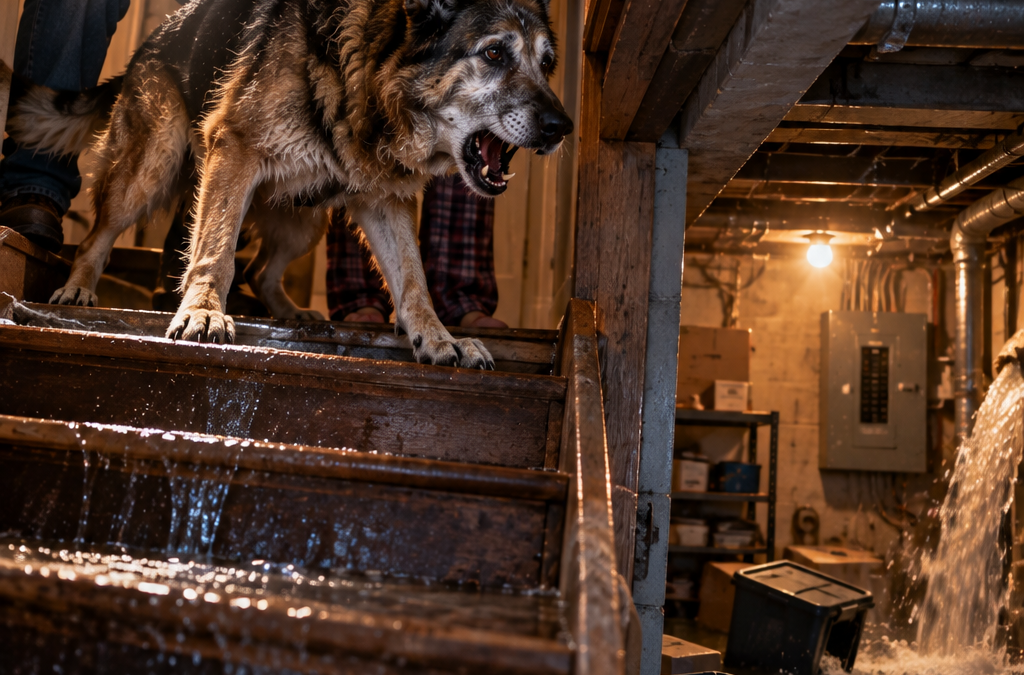
His entire focus remained fixed on the basement stairwell.
Rainwater tapped somewhere below us.
That was when I noticed the smell.
Damp concrete.
Something metallic.
And beneath it, faint but unmistakable, the sharp bite of burning insulation.
My stomach tightened.
“Mary, back up.”
She turned toward me.
“What?”
“Back up. Now.”
She must have heard something in my voice because she stepped away from the stairwell immediately.
Shadow kept himself between her and the door.
I moved closer and put my hand on his side.
His ribs were rising and falling too quickly.
“Good boy,” I whispered. “I’ve got it.”
He still didn’t move.
I reached past him and switched on the basement light.
Nothing happened.
The bulb at the bottom of the stairs did not come on.
But in the dark below, I saw something move.
A reflection.
Water.
It covered the bottom step.
Then I heard it clearly.
A steady rush.
Not a drip.
Not a small leak.
Water was pouring into our basement.
I grabbed the flashlight from the hall drawer and shone it down the stairs.
The beam hit brown water swirling across the concrete floor. Storage boxes floated near the far wall. A plastic bin bumped against the old workbench. Near the breaker panel, water splashed against an outlet mounted too low on the wall.
Then the lights flickered above us.
Once.
Twice.
From somewhere below came a faint snapping sound.
Mary gasped.
“Oh my God.”
“Get your coat,” I said. “Now.”
“What about—”
“Mary, move.”
Shadow barked again, then coughed so hard his front legs nearly folded.
I caught his harness before he fell.
“Easy. Easy, buddy.”
The air smelled stronger now.
Hot plastic.
Wet wiring.
Something no homeowner ever wants to smell near standing water.
I grabbed my phone and dialed 911.
“This is retired Trooper Thomas Callahan,” I told the dispatcher. “We have active water intrusion in the basement, possible electrical hazard, lights flickering, burning smell. Two adults in the house, one elderly K9. We are evacuating.”
The dispatcher told us to leave immediately and not touch the breaker panel.
I didn’t need to be told twice.
I’d worked enough storm calls to know how fast a flooded basement could turn deadly when electricity was involved.
What I didn’t know then was that the danger had started before Mary opened that basement door.
What I didn’t know was that Shadow had known first.
And what I couldn’t understand, as I lifted my dying dog into the back seat of our truck twenty minutes later, was that saving Mary would cost him the last strength he had.
My name is Thomas Callahan.
Most people call me Tom.
I spent thirty years in law enforcement in Pennsylvania, first as a patrol officer, then as a state trooper, and finally as a K9 handler.
Shadow was my last partner.
He came to me when I was forty-eight and already old enough to know that young men in uniform confuse confidence with wisdom.
He was seventeen months old, black and tan, with a dark face and eyes that seemed older than the rest of him.
The trainer at the K9 facility warned me before she brought him out.
“He’s serious.”
I laughed.
“I’ve worked with plenty of serious dogs.”
“No,” she said. “You haven’t worked with this one.”
Then Shadow appeared.
He didn’t bounce.
He didn’t pull wildly.
He didn’t look around like the world was full of distractions.
He stepped into the training yard beside the handler, sat perfectly straight, and looked directly at me.
Not at the toy in my hand.
Not at the other dogs barking in their kennels.
At me.
I remember thinking that he wasn’t asking whether I wanted him.
He was deciding whether I was worth following.
The trainer handed me his leash.
“Good luck.”
I looked down at him.
“Shadow, heel.”
He did not move.
The trainer pressed her lips together.
I crouched.
“All right. So that’s how we’re starting.”
Shadow’s ears shifted.
I held out my hand.
He sniffed it once.
Then turned his head toward the far side of the field, where a traffic cone had fallen in the grass.
“Fine,” I said. “Ignore me. That’s healthy for a long-term partnership.”
The trainer laughed.
“He needs trust before compliance.”
That sentence irritated me at first.
I was a trooper. I gave commands. People followed them. Dogs were supposed to do the same.
Shadow taught me otherwise.
For the first two weeks, he worked only when he understood the purpose of the exercise. If I rushed him, he slowed down. If I corrected him unfairly, he shut me out. If I gave him a clear task and respected his intelligence, he gave me everything.
He was not difficult.
He was honest.
That distinction took me longer to learn than I like admitting.
Our first major call together came during a February snowstorm near the Allegheny foothills.
An elderly man with dementia had wandered away from his son’s farmhouse before dusk. By the time our unit arrived, snow was falling sideways and the temperature had dropped below freezing.
The family was frantic.
The man’s daughter-in-law handed me one of his flannel shirts.
“His name is Walter,” she said. “He doesn’t always answer when he’s confused.”
I let Shadow scent the shirt.
He lowered his nose, inhaled, then turned toward a narrow line of trees bordering the property.
“Find him,” I said.
Shadow moved.
No hesitation.
No wasted motion.
We tracked through frozen pasture, across a shallow creek, and into a patch of dense woods. Snow collected on Shadow’s back. Ice formed along my mustache. My hands went numb inside my gloves.
After nearly an hour, Shadow stopped beside a fallen oak.
He lifted his head, then barked once.
I pushed through the brush.
Walter was lying in a hollow beneath the roots, half-covered with snow, alive but dangerously cold.
His eyes opened when I knelt beside him.
“Am I in trouble?” he whispered.
I smiled.
“No, sir. You’re going home.”
Shadow stepped closer and lowered his head.
Walter reached out with a shaking hand.
“Good dog.”
Shadow stood completely still.
That was the night I began to understand him.
Shadow did not work for praise.
He did not work for applause.
He worked because someone was missing, frightened, cornered, or in danger.
And once he understood that, he would spend himself completely.
That trait made him a great K9.
Years later, it nearly killed him.
Mary used to say Shadow had two faces.
“The officer face,” she called one.
That was the one he wore in harness, focused and intense, all discipline and purpose.
The other was what she called “the kitchen face.”
That was the soft-eyed thief who stood beside the counter pretending not to notice roast chicken, followed her into the garden, and slept with his head on her slippers whenever I worked late.
Mary loved him from the first week.
She told everyone she hadn’t married a man and adopted a dog. She had married a man and acquired a second, much hairier husband who listened better.
She was right about the listening.
Shadow watched Mary differently than he watched anyone else.
When she moved around the house, he tracked her quietly. If she sneezed, he lifted his head. If she stood on a chair to reach something from a cabinet, he stood beside the chair until she climbed down.
He had protected me in alleys, empty warehouses, fields, and traffic stops.
But at home, he appointed himself Mary’s guardian.
I teased her about it.
“You realize my dog likes you better.”
She’d look down at Shadow, who would be sitting perfectly beside her.
“That’s because I feed him things you pretend not to see.”
“I see everything.”
“No, trooper. You notice evidence. I create reasonable doubt.”
Shadow would thump his tail like he understood.
For eleven years, that dog filled our house with movement.
His nails clicked on the floor before dawn.
His water bowl clanged against the tile.
His tags jingled when he shook rain from his coat.
His bark rattled windows when someone pulled into the driveway.
Then, slowly, everything became quieter.
Retirement came first.
He was eleven when the department veterinarian found worsening arthritis in his hips and lower spine. He’d already begun hesitating before jumping into the patrol vehicle. After a difficult training session where he slipped on wet grass and struggled to stand, I knew.
I had seen handlers keep dogs working too long.
Not because they were cruel.
Because they loved them and could not imagine the job without them.
I refused to do that to Shadow.
His retirement ceremony was small.
A few troopers.
Some photographs.
A plaque.
A bag of treats that he cared about more than all official recognition combined.
When it was over, I removed his working collar and held his gray-flecked face between my hands.
“You did enough,” I told him.
He looked at me as if I had said something foolish.
Mary cried during the drive home.
I didn’t.
Not then.
I waited until that night, after she went to bed and Shadow lay beside my chair with his head on my boot.
Then I cried quietly into his fur.
He didn’t move.
He just stayed.
Two years later, I retired too.
For a while, life was gentle.
Mornings on the porch.
Coffee with Mary.
Slow walks to the mailbox with Shadow sniffing every fence post like it contained classified information.
Afternoons in the garden while he slept in the shade.
But age kept moving.
Shadow’s arthritis worsened.
His breathing changed.
At first, it sounded like snoring.
Then like effort.
He coughed after walking too far. He struggled to regulate his breathing when excited. His bark grew hoarse, then weak, then disappeared almost entirely.
Dr. Elaine Mercer, our veterinarian, diagnosed multiple age-related problems: laryngeal paralysis, advanced arthritis, and early heart strain. None of it was surprising for a large working dog his age.
That didn’t make it easier.
We adjusted his medication.
Changed his food.
Added rugs through the house so he wouldn’t slip.
Installed a ramp off the back porch.
Bought an orthopedic bed large enough for a small pony.
Mary joked that Shadow had better medical equipment than either of us.
But she was the one who warmed his meals when he wouldn’t eat.
She was the one who sat on the floor with him during bad breathing episodes.
She was the one who whispered, “You’re safe, sweetheart,” when storms unsettled him.
The disease that worried me most was the one Dr. Mercer didn’t name as a single thing.
It was simply decline.
A series of small losses.
He stopped following us upstairs.
Then stopped getting onto the couch.
Then stopped meeting us at the door.
His world became smaller: kitchen, living room, porch, sunny spot near the back window.
But his eyes still followed Mary.
Always.
If she walked toward the basement door, he lifted his head.
That detail matters now.
At the time, I barely noticed.
Our basement was old, unfinished, and temperamental. The house had been built in the 1950s, long before anyone thought about drainage the way they should have.
We had a sump pump. We had upgraded part of the electrical system. We had the foundation checked twice.
Still, during heavy storms, water sometimes seeped along the far wall.
Nothing dramatic.
Enough to annoy me.
Enough to make Mary roll towels under the door and tell me for the hundredth time that we should hire another contractor.
I always planned to.
Then the rain stopped.
Then something else needed attention.
Then I forgot.
That October had been wet even by Pennsylvania standards.
The ground was saturated. Creeks ran high. Every ditch along our road seemed full.
The week before Shadow’s final warning, a storm knocked a branch against the side of the house. I checked the roof, cleared the gutter, and thought that was the end of it.
It wasn’t.
Water had started finding its way toward the foundation near the rear wall.
Downstairs, behind boxes of Christmas decorations and old police files, the seepage had grown worse.
I didn’t know that.
Shadow may have.
Not in the human way.
He didn’t understand breaker panels or electrical current or flooded outlets.
But he understood smells.
Wet insulation.
Mold.
Burning plastic.
Fear in Mary’s body.
Changes in air.
Changes in sound.
He’d spent his life noticing what I missed.
That last week, he became restless.
At night, he lifted his head and stared toward the hallway.
Twice, he struggled to stand when Mary opened the basement door.
I told myself he wanted to follow her.
“He thinks you’re hiding snacks down there,” I said.
Mary smiled.
“He knows me too well.”
But Shadow didn’t wag.
He didn’t soften.
He watched the door with an intensity I should have recognized.
The night everything happened, the storm arrived just after dinner.
Rain came down hard, loud against the roof and windows. Wind pushed through the trees behind the house. The power flickered once around nine, then steadied.
Mary wanted to bring up a plastic bin of old blankets from the basement in case the power went out later.
“We have blankets upstairs,” I said.
“Not the heavy ones.”
“Mary, we are not camping in the living room.”
She looked at me over her glasses.
“You complain now, but you’ll be the first one asking where the wool blanket is.”
She was right.
I stayed in the living room while she carried the empty laundry basket toward the hall.
Shadow was asleep beside the kitchen doorway.
Or I thought he was.
The basement door opened.
Then came that first bark.
Deep.
Broken.
Furious.
I will hear that sound for the rest of my life.
By the time I reached the hallway, Shadow had placed himself across the stairwell.
Mary tried to soothe him.
“Shadow, honey, it’s just me.”
He barked again.
His body trembled with effort.
The bark turned into a cough, but he held his position.
When Mary shifted left, he blocked left.
When she tried to step around him, he pushed into her knees.
He was old.
He was sick.
He had not barked in months.
But he was not letting her go down those stairs.
When I smelled the electrical burn and saw water moving at the bottom, the old part of my brain came back online.
The trooper.
The K9 handler.
The man trained to read danger before it finished becoming danger.
“Out,” I said.
Mary looked at the basement.
Then at Shadow.
“Tom, the boxes—”
“Forget the boxes.”
The lights flickered again.
This time, the hallway bulb buzzed before it steadied.
I grabbed Shadow’s harness from the hook and fitted it around his chest. He coughed hard, legs shaking.
“Easy, buddy.”
Mary had already pulled on her coat. I made her take her phone, purse, and medication from the kitchen counter. I grabbed my wallet, keys, and Shadow’s emergency medicine kit.
Outside, rain slapped cold against my face.
I helped Mary into the truck first. Then I turned back for Shadow.
He was standing near the hall entrance, still watching the basement door.
“Come on, partner.”
He tried to move, but his rear legs buckled.
I caught him.
For a moment, I felt the full weight of what age had done to him.
This was the dog who had once cleared fences, crossed ravines, and pulled me toward missing people through waist-deep snow.
Now I had to lift him inch by inch into my arms.
He coughed against my shoulder.
“I’ve got you,” I whispered.
I carried him through the rain and placed him in the back seat.
He sank onto his blanket, breathing hard.
But his eyes remained fixed on the house.
The fire department arrived within minutes, along with a utility crew and township emergency services. A firefighter I vaguely recognized from my old patrol days approached my truck.
“Trooper Callahan?”
“Retired,” I said automatically.
He nodded toward the house.
“Everybody out?”
“Just us and the dog.”
“You smell smoke?”
“Electrical. Basement’s flooding. Panel’s down there.”
His expression changed.
“We’ll handle it.”
They moved quickly.
No drama.
No wasted motion.
The utility crew cut power from outside.
Firefighters checked for active fire and evaluated the basement conditions once it was safe enough.
Mary sat in the truck beside me, both hands wrapped around a travel mug she hadn’t drunk from.
Shadow lay across the back seat.
His breathing was rough.
Every few minutes, I reached back to touch him.
“Still here, buddy?”
His tail moved faintly.
Mary’s hand covered her mouth.
“He knew.”
I looked toward the house.
Water had begun flowing out near the basement window well.
“Maybe.”
She shook her head.
“No. He knew something was wrong.”
I didn’t argue.
Because deep down, I knew it too.
Later, the fire chief told us what they found.
Heavy water intrusion along the rear foundation wall.
A failed sump pump circuit.
Standing water rising near the electrical panel and several lower outlets.
Evidence of arcing near a junction point.
Not a full structure fire yet.
Not electrocution because Mary hadn’t gone down.
Not tragedy.
Not that night.
But close enough that the chief looked at me and said, “Your dog did you a favor.”
I turned toward the truck.
Shadow’s eyes were half closed.
“He’s done that before.”
The chief nodded.
“Looks like he did it again.”
We couldn’t stay in the house that night.
The power was off, the basement needed professional cleanup, and the electrical system had to be inspected before we could return.
Mary’s sister lived thirty minutes away, but the roads were bad, and Shadow was deteriorating fast.
His breathing had become labored.
His gums looked pale.
He couldn’t settle.
I called Dr. Mercer from the truck.
She listened to his symptoms and said, “Bring him in now.”
Her clinic was closed, but she met us at the emergency entrance.
By then, the storm had softened to a cold drizzle.
I carried Shadow inside wrapped in his blanket.
He felt lighter than he should have.
Dr. Mercer didn’t waste time.
She placed him on oxygen, listened to his chest, checked his heart, and examined him for signs of physical injury from the exertion.
Mary stood beside me, shaking.
“Is he going to be okay?” she asked.
Dr. Mercer didn’t answer immediately.
That silence frightened me more than anything.
She adjusted the oxygen line and looked at both of us.
“His heart and airway are under severe strain. The episode tonight took a lot out of him.”
I swallowed.
“He barked. Hard. Several times.”
“With his condition, that level of agitation and effort could be very taxing.”
Mary began to cry.
“He was trying to stop me.”
Dr. Mercer touched her arm.
“I believe he was responding to something he perceived as dangerous.”
I looked at Shadow.
His eyes were open, but tired.
He was watching Mary.
Even lying on an exam table, breathing through oxygen, he was watching my wife.
“What can you do?” I asked.
“We can stabilize him tonight. Oxygen, medication, monitoring. But Tom—”
I hated the way she said my name.
“Don’t.”
She continued gently.
“We need to talk about where Shadow is in the overall course of his illness.”
I stared at the floor.
Not because I didn’t understand.
Because I did.
We had been avoiding this conversation for months by calling every decline a bad day.
A breathing episode.
A flare-up.
A medication adjustment.
Anything except what it was.
The end coming closer.
Dr. Mercer pulled up a chair.
“His arthritis is advanced. His airway disease has progressed. His heart is showing strain. His appetite has been poor, his mobility is limited, and now even a short period of intense activity has left him severely exhausted.”
Mary wiped her face.
“But he saved us.”
“He did something extraordinary,” Dr. Mercer said. “But extraordinary effort doesn’t mean his body has recovered from the disease.”
I looked at Shadow.
He shifted slightly when he heard Mary’s crying, or maybe smelled it, or felt the tension in the room.
His front paw moved toward her.
Mary took it and sobbed.
I felt something break open inside my chest.
For years, I had trusted Shadow to tell me where danger was.
That night, he had.
But now the danger was different.
It wasn’t water in a basement or damaged wiring.
It was my own refusal to see that asking him to keep fighting might no longer be love.
Dr. Mercer explained our options.
They could continue aggressive stabilization and monitoring. There were medications that might reduce the acute distress. He might rally for a short time.
But the underlying problems remained.
His airway would not become young again.
His joints would not stop failing.
His heart would not regain what time had taken.
We could also choose comfort care, including a peaceful euthanasia if his distress could not be managed or if we believed further treatment would only extend suffering.
I had heard those words before from other handlers.
I had attended memorials for retired K9s.
I had stood beside grown men as they cried into the fur of their partners.
I knew the shape of this moment.
Knowing did not make it easier.
“He still looks at us,” I said.
Dr. Mercer nodded.
“He knows you’re here.”
“He still wags his tail.”
“Yes.”
“Then how do I decide?”
She folded her hands.
“By looking at the whole dog. Not just the moments when he responds to love.”
That sentence landed hard.
The whole dog.
The dog who could no longer walk without help.
The dog who struggled to breathe.
The dog whose bark had disappeared because using it hurt.
The dog who had spent the last strength in his body to keep Mary from walking into danger.
The dog who was now lying on an emergency table because his loyalty had pushed him beyond what his body could safely endure.
Mary looked at me.
“Tom.”
I couldn’t meet her eyes.
“I need a minute.”
Dr. Mercer nodded and stepped out.
Mary stayed with Shadow.
I walked into the small hallway outside the exam room.
The clinic smelled like antiseptic, wet dog, and old fear.
I leaned against the wall and closed my eyes.
I thought about Shadow as a young dog, ignoring me in the training yard.
Shadow finding Walter in the snow.
Shadow asleep beneath Mary’s chair.
Shadow on the porch, watching rain move over the fields.
Shadow standing in our hallway, old and shaking, using a voice he no longer had because danger stood below my wife in the dark.
I wanted to demand more time.
I wanted one more morning at home.
One more slow walk to the porch.
One more chance to tell him he had done enough while he was still lying in his own bed.
But I had told him that before.
At retirement.
After bad medical appointments.
During long nights when he couldn’t breathe well.
And still, when Mary moved toward danger, he had gotten up.
Because Shadow did not understand retirement the way humans do.
He did not know that his badge was gone.
He did not know that his body was failing.
He only knew that someone he loved was about to step into the dark.
So he stood.
The question wasn’t whether Shadow would keep trying.
Of course he would.
The question was whether I would keep allowing him to suffer because I was too afraid to let him rest.
When I returned to the exam room, Mary was sitting beside him with her forehead against his.
“He’s tired,” she whispered.
I nodded.
“I know.”
“I don’t want him to hurt anymore.”
I placed my hand on Shadow’s shoulder.
His eyes moved toward me.
Still there.
Still trusting.
“Neither do I.”
Dr. Mercer came back in.
I asked the question that felt like lifting a stone with my bare hands.
“If we continue treatment tonight, what are we giving him?”
She answered carefully.
“Possibly hours or days. Maybe a brief improvement. But it would require continued oxygen, injections, monitoring, and likely more episodes of distress when he attempts to move or becomes anxious.”
“And if we don’t?”
“We can make sure he’s comfortable. You can be with him. He doesn’t have to struggle.”
Mary took my hand.
I looked at Shadow.
My partner.
My wife’s protector.
The stubborn, serious dog who had never given his trust cheaply but had given it completely once earned.
I bent close.
“Hey, buddy.”
His ear shifted.
“You did good.”
My voice broke.
“You saved her.”
Mary sobbed beside me.
“You saved us.”
Shadow’s tail moved once beneath the blanket.
A small movement.
Almost nothing.
Enough to destroy me.
I looked at Dr. Mercer.
“Can we take him home?”
She hesitated.
“Given his condition, transporting him again could cause distress. I can make this room quiet. You can stay as long as you need. But I worry the trip would be hard on him.”
I looked at Mary.
She nodded through tears.
“He doesn’t need the house,” she whispered. “He needs us.”
She was right.
Shadow had spent his life making strange places safe for others.
A snowy field.
A dark building.
A wet hallway outside a basement.
Now we would make this room safe for him.
Dr. Mercer brought in a larger blanket and dimmed the lights.
Mary and I sat on the floor because that was where Shadow could rest partly against us. The oxygen helped enough that his breathing eased a little, but his eyes remained heavy.
I removed his old leather collar from my coat pocket.
The working collar had been retired years earlier, but I still carried his soft one when we traveled. I laid it beside his paw.
Mary stroked his face.
“Remember when you stole the pot roast?”
I let out a broken laugh.
“He did not steal it. He conducted an unauthorized evidence seizure.”
Mary cried and laughed at the same time.
“You defended him then too.”
“He had a strong case.”
Shadow’s eyes moved faintly between us.
For the next half hour, we told him stories.
The funny ones.
The brave ones.
The ordinary ones.
Mary reminded him about sleeping in the garden while she planted tomatoes.
I reminded him about ignoring me the first day we met.
We talked about the snow search, his retirement party, the first time he realized Mary kept chicken in the refrigerator drawer.
We did not talk about the basement at first.
Then I knew I had to.
I placed my hand against his chest.
“You knew something was wrong tonight.”
He breathed slowly.
“You knew before I did.”
I swallowed.
“That was always your gift, wasn’t it?”
Mary leaned into my shoulder.
“You saw what I missed.”
I brushed the white fur along his muzzle.
“But you don’t have to watch the stairs anymore.”
His eyes were half closed.
“You don’t have to guard the door.”
My voice failed, then returned.
“You don’t have to protect us from every dark place.”
I kissed his forehead.
“You brought us out.”
Dr. Mercer entered quietly and explained the process.
First, a sedative to let him relax fully.
Then, when he was sleeping, the final medication.
She asked if we were ready.
No.
I would never be ready.
But Shadow was tired.
And love, real love, could not demand that he keep proving himself.
I nodded.
Mary bent over him.
“Thank you,” she whispered. “Thank you for stopping me.”
Shadow’s nose moved faintly against her wrist.
Dr. Mercer gave the sedative.
His breathing slowly became calmer.
The tension left his shoulders.
His head grew heavier against my leg.
I kept one hand over his heart.
Mary held his paw.
“That’s it,” I whispered. “Rest, buddy.”
His eyes softened.
For the first time in months, he looked free of effort.
Not young.
Not restored.
But peaceful.
I cried then.
Quietly at first, then harder.
“You were the best partner I ever had.”
Mary kissed his paw.
“And the best friend.”
When Dr. Mercer confirmed he was deeply asleep, she looked at us.
I nodded again.
She administered the final medication.
Shadow’s chest rose once.
Fell.
Rose again, barely.
Then stilled beneath my hand.
Dr. Mercer listened to his heart.
After a long moment, she whispered, “He’s gone.”
Mary collapsed against me.
I bent over Shadow and pressed my face into his neck.
He smelled faintly of rain, antiseptic, and the familiar warmth of home.
“End of watch,” I whispered.
My voice broke.
“Good boy.”
We stayed with him until the rain stopped.
When we finally left the clinic, dawn had begun turning the clouds gray.
Our house would need repairs.
The basement would need cleanup.
Electricians, insurance adjusters, contractors—there would be phone calls, estimates, inconvenience, and frustration.
All of that could be handled.
Mary was alive.
I was alive.
Because an old dog with failing lungs and shaking legs had found one final bark when it mattered.
The house felt wrong without him.
The first night back, after the power had been restored and the basement declared safe, Mary stood at the top of the stairs for a long time.
I came up behind her.
“You okay?”
She shook her head.
“I keep seeing him there.”
I looked at the hallway.
So did I.
Not sick.
Not weak.
Standing.
Blocking the door.
Doing what he had done his whole life.
Mary took my hand.
“He didn’t let me go down there.”
“No,” I said. “He didn’t.”
She leaned against me.
“And we let him go.”
I closed my eyes.
“Yes.”
It hurt to say.
But it was true.
And because it was true, I needed to understand it properly.
We had not abandoned him.
We had not repaid his loyalty with death.
We had done the only thing left that could protect him.
We stopped asking his failing body to carry our fear.
A month later, the department held a small memorial for Shadow.
I didn’t ask for one, but word spread.
Handlers came.
Retired troopers came.
The fire chief came.
Dr. Mercer came too, standing quietly near the back.
Mary stood beside me, holding Shadow’s collar.
When it was my turn to speak, I looked at the younger K9 handlers in the crowd.
Their dogs sat beside them, alert and restless.
So much life.
So much strength.
I thought of Shadow at that age.
Serious eyes.
Stubborn head.
A heart too loyal for its own safety.
I cleared my throat.
“Shadow saved people during his career,” I said. “Missing people. Frightened people. People trapped in places they couldn’t get out of alone.”
My voice shook.
“He saved my wife after he retired. After age had taken his strength, after illness had taken his voice, after everyone would have understood if he had simply stayed in his bed.”
Mary began crying beside me.
I continued.
“But I need to say something especially to the handlers here.”
The younger troopers watched me.
“These dogs will give you everything. They’ll give it on duty. They’ll give it at home. They’ll give it when they’re young and strong, and if you let them, they’ll try to give it when they have almost nothing left.”
I touched Shadow’s collar.
“Our job is not only to trust their courage. It’s to protect them from spending themselves past the point of mercy.”
No one spoke.
I looked toward the memorial photograph.
Shadow stood in uniform beside my patrol vehicle, ears high, eyes fixed slightly upward toward me.
“He watched over us until his final night,” I said. “Then it was our turn to watch over him.”
After the ceremony, the fire chief approached Mary.
“I’ve thought about that night a lot,” he said. “Your dog probably saved you from walking into a very bad situation.”
Mary held the collar against her chest.
“He always watched the stairs.”
The chief nodded.
“Smart dog.”
I looked at Shadow’s photograph.
“Smart enough to know when I wasn’t.”
He smiled sadly.
“That’s what good partners do.”
That evening, Mary and I returned home and sat in the living room.
The basement door had been repaired. A new drainage system had been installed. The electrical panel had been upgraded and relocated higher, exactly where it should have been years earlier.
The hallway was safe now.
But every time I passed it, I remembered the warning.
Shadow’s bark.
Mary’s startled face.
The smell of burning insulation.
The old dog standing where danger began.
Mary placed his collar on the bookshelf beside his framed photograph.
For a long time, neither of us spoke.
Then she said, “I miss hearing him breathe.”
I nodded.
“I miss tripping over him.”
“You complained about that every day.”
“I was wrong.”
She laughed softly through tears.
We sat together in the quiet house.
Outside, rain began tapping gently against the windows.
Not a storm.
Just rain.
Mary slipped her hand into mine.
I held it tightly.
For years, Shadow had stood between us and danger.
On his last night, he did it one final time.
But the truth I carry now is larger than that single act.
Shadow did not save our family only by blocking a stairwell.
He saved us in all the ordinary years before it.
In the mornings he made me laugh after hard shifts.
In the way he loved Mary with a devotion so complete it seemed almost sacred.
In the discipline he taught me.
In the humility of learning that trust must be earned, not commanded.
And finally, in the painful lesson that love sometimes means letting a loyal heart rest before it breaks itself trying to protect you.
I still wake sometimes expecting to hear his nails in the hallway.
Mary still says goodnight to his photograph.
And whenever rain hits the windows, I find myself glancing toward the basement door.
The hallway is empty now.
But I don’t feel unprotected.
Not exactly.
Because Shadow is still there in the habits he left behind.
Check the door.
Notice the smell of rain.
Listen when something feels wrong.
Hold the people you love a little closer.
And when the time comes, be brave enough to give mercy to the ones who have given you everything.
That night, Mary had wanted only to fetch a blanket from the basement.
Shadow gave her a warning.
Then he gave us the last of his strength.
We gave him the only gift we had left.
Peace.
And if I could stand in that hallway one more time with my hand buried in his thick old fur, I would tell him what I hope he already knew.
He did not fail because he could not keep living.
He succeeded because he kept loving until the very end.