𝗙𝗨𝗟𝗟 𝗦𝗧𝗢𝗥𝗬 The Night Karen Called the Police on My Wheelchair, I Finally Stopped Being Polite
𝗙𝗨𝗟𝗟 𝗦𝗧𝗢𝗥𝗬
The next day, the official violation notice arrived.
Unauthorized exterior structure. Remove within thirty days. Failure to comply will result in daily fines of $200.
The letter was signed by Karen Whitmore, HOA President.
I sat at my desk reading it while my laptop hummed in front of me. A client message blinked unanswered in the corner of the screen. Outside, a lawn crew trimmed hedges with mechanical precision.
I should have been angry. I was, somewhere underneath. But the first thing I felt was exhaustion. Deep, familiar exhaustion. The kind that settles into your bones when you realize the fight you thought you had avoided had only been waiting for you in a nicer outfit.
Still, I started polite.
I wrote an email to the property management company with the violation notice attached. I included my original application, the approval letter, and a brief explanation. I kept the tone professional. I assumed there had been a communication error. I even gave Karen the benefit of the doubt, which now seems almost funny.
A week later, the response came.
Not from the management company.
From Karen.
Mr. Mason,
Your alleged approval letter was issued in error. The architectural review committee did not review or approve the ramp currently installed at your property. As such, the ramp remains unauthorized and must be removed within the previously stated deadline. HOA rules apply equally to all residents.
Regards,
Karen Whitmore
HOA President
Alleged approval letter.
I read that phrase at least five times.
Then I rolled back from my desk, locked my wheels, and pressed my palms against my face.
I had dealt with bureaucracy before. I knew how people used passive language as a weapon. “Alleged.” “Issued in error.” “Unauthorized.” Words chosen to make reality negotiable. Words designed to turn my documented approval into something shady, flimsy, and inconvenient.
I wrote back the same day.
This time, I cited the Fair Housing Act.
I explained that the ramp was a reasonable modification necessary for equal use and enjoyment of my dwelling. I explained that I had paid for it myself. I explained that it met every aesthetic guideline. I explained that refusing it because the board president personally disliked it would constitute disability discrimination. I attached the approval letter again.
I was firm.
I was respectful.
I gave them every chance to step back.
Karen responded with a hearing notice.
I was ordered to appear before the HOA board to appeal my violation.
Fine.
If she wanted paperwork, I would bring paperwork.
The hearing was held in the community center on a Thursday evening. I remember that because getting into the building was my first warning that Karen’s definition of “community standards” did not include people like me.
The entrance had three concrete steps and no ramp.
I sat at the bottom of those steps in my wheelchair while one of the board members, a nervous man named Elliot, looked down at me from the doorway with a face full of panic.
“I’m so sorry,” he said. “We usually meet inside.”
“I noticed.”
“We can, uh, we can help you up.”
“No,” I said.
He blinked. “No?”
“No one is carrying me into an HOA hearing about my wheelchair ramp.”
He went red.
Eventually, they moved the meeting to a side room accessible through a service entrance near the maintenance area. That meant I had to roll past trash bins and a broken hose reel to attend a formal board hearing about the supposed ugliness of my ramp.
Karen was already seated when I came in.
She looked immaculate. Navy dress. Pearl earrings. Red lipstick. Her hair arranged in waves that seemed too disciplined to be natural. She smiled at Elliot, then at the other board member, a woman named Marcy, then finally at me.
“Mr. Mason,” she said, sweet as poisoned tea. “Thank you for joining us.”
“I had to come through the maintenance entrance.”
Her smile tightened. “This meeting is about your violation, not the community center.”
“It might become about both.”
Elliot stared at the table. Marcy shuffled papers.
Karen opened the hearing with a dramatic sigh, as if my ramp had personally betrayed the neighborhood.
“We are here regarding an unauthorized exterior structure installed at 214 Hawthorne Lane. Mr. Mason has been notified and has refused to remove the structure.”
“I haven’t refused to do anything unlawful,” I said. “I submitted an application. It was approved in writing.”
I placed my folder on the table. It was thick enough to make a sound when it landed.
Karen glanced at it but did not touch it.
“I have the full application, approval letter, photos, contractor plans, paint samples, medical documentation, and Fair Housing Act guidance,” I said. “I’d like these entered into the record.”
Karen leaned back. “That won’t be necessary.”
“It is necessary.”
Her eyes narrowed.
There it was. The first crack in the polished surface.
“Mr. Mason,” she said, “we are sympathetic to your situation.”
“No, you’re not.”
The room went still.
I had promised myself I would stay calm, but there are words people use when they want credit for compassion they have not shown. “Sympathetic” was one of them.
Karen’s cheeks flushed under her makeup.
“As I was saying,” she continued, “the board must balance individual preferences with community standards.”
“My spinal cord injury is not an individual preference.”
Elliot shifted again. Marcy looked like she wanted to disappear into her cardigan.
Karen’s smile returned, sharper now. “We are not here to debate medical issues. We are here to determine whether the structure complies with our governing documents.”
“It does. And even if it didn’t, federal law requires reasonable modifications for disabled residents.”
She waved one manicured hand. “Federal laws are complicated.”
“They are, yes. That’s why I brought the relevant sections.”
“I’m sure you have done some internet research,” she said. “But our legal interpretation is that the CC&Rs take precedence in private community matters.”
For a second, I thought I had misheard her.
“You believe HOA rules override federal disability law?”
“I said,” she replied, slowly, as if speaking to a stubborn child, “that community rules exist for a reason.”
Elliot cleared his throat but did not speak. Marcy stared at the papers in front of her.
I looked at each of them, giving someone, anyone, an opportunity to be brave.
No one took it.
The hearing lasted fifteen minutes. Karen barely glanced at my documents. She allowed me to speak, but only in the way a judge might allow a condemned man to make a final statement after the verdict had already been typed.
They voted three to zero to uphold the violation.
I requested a written record of the decision.
Karen’s expression hardened. “You’ll receive the official notice.”
“I also want it noted that I am formally requesting a reasonable accommodation under the Fair Housing Act and that I expect a written response within the legally required time frame.”
She clicked her pen.
“Noted,” she said.
It was not noted.
Two weeks later, I received a new violation notice.
This one was not about the ramp.
It was about my wheelchair.
I remember opening the envelope at the kitchen counter and reading the first line twice because my brain refused to accept it.
Violation of Section 4.7.3: storage of personal equipment, recreational items, or unsightly objects on front porches, patios, or areas visible from the street or common areas.
The notice claimed that my wheelchair, when visible on my patio, constituted an unsightly object.
My wheelchair.
The one I used every day to move through the world. The one that took me from my bed to the bathroom, from the kitchen to my office, from inside my house to that small patch of evening air where I still felt human.
Karen wanted it hidden.
Not because it blocked traffic. Not because it created a hazard. Not because it violated any rational safety rule.
Because she did not want to look at it.
For a while, I just sat there holding the paper.
There are insults that hit loud and insults that hit deep. This one was quiet, and that made it worse. It did not call me broken. It did not call me ugly. It simply treated the evidence of my survival as clutter.
Unsightly object.
I had seen friends come home without limbs. I had watched men twice as tough as me sob during rehab because they could not button their own shirts. I had learned how much dignity a person can lose in public without making a sound.
But that letter made something cold settle inside me.
I wrote back again.
My wheelchair is a medically necessary mobility device, not recreational equipment, personal storage, or an unsightly object. Requiring me to hide it from view constitutes discriminatory treatment based on disability. I again request reasonable accommodation under the Fair Housing Act.
Karen’s answer came in the form of a $200 fine.
Then she called the police.
It was a Saturday afternoon. I was in my office, troubleshooting a server issue for a client, when the doorbell rang.
I checked the camera feed and saw two uniformed officers standing on my ramp.
For half a second, Iraq flashed behind my eyes. Not because the officers were threatening, but because uniforms at the door rarely bring good news.
I rolled to the entry, opened it, and both men looked immediately uncomfortable.
The older officer, gray at the temples, removed his sunglasses.
“Mr. Mason?”
“Yes.”
“I’m Officer Reynolds. This is Officer Patel. We received a complaint from your homeowners association.”
“About what?”
Reynolds glanced at my wheelchair. Then at the ramp beneath his boots. Then back at me.
“About an unauthorized structure and prohibited outdoor equipment.”
“Outdoor equipment.”
His jaw tightened. “She specifically mentioned a wheelchair visible on the patio.”
Officer Patel, younger, maybe late twenties, looked like he wanted to apologize before anyone said another word.
I laughed once.
It did not sound like humor.
“She called the police on my wheelchair?”
Reynolds sighed. “Sir, we’re not here to force you to remove anything. This appears to be a civil matter. And frankly, we don’t have authority to make you remove an accessibility ramp or your mobility device.”
“Did she think you did?”
Patel looked toward the street where Karen stood on the sidewalk in sunglasses, arms crossed, pretending not to watch.
“I can’t speak to what she thought,” Reynolds said carefully.
I could.
Karen thought the sight of police at my door would scare me into obedience. She thought uniforms would do what her letters had not. She thought being disabled meant I was isolated, weak, easy to pressure.
The officers were professional. Embarrassed, but professional. Reynolds gave me a case number for documentation. Patel shook my hand before leaving.
“I’m sorry you’re dealing with this, sir,” he said. “And thank you for your service.”
I nodded because I did not trust my voice.
That evening, Karen came back.
Of course she did.
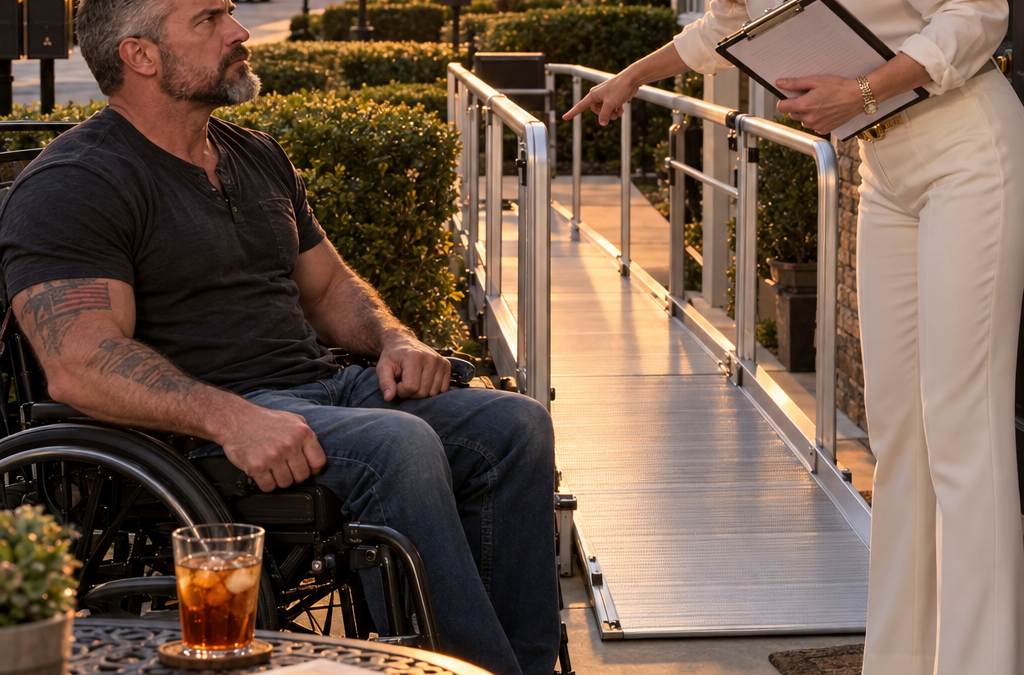
The sun was low. I was on the patio again, not because I felt peaceful, but because I refused to hide inside my own home. My wheelchair was visible. My ramp was visible. My anger was sitting beside me like a third person.
Karen approached with the same clipboard, the same heels, the same perfume drifting ahead of her like a warning.
She looked pleased with herself.
“I assume the officers explained that you remain in violation,” she said.
“They explained you wasted their time.”
Her eyes flashed. “I contacted law enforcement because you have refused to comply with legal HOA directives.”
“Legal?”
“Yes,” she snapped. Then she caught herself, smoothing her face back into that beauty-pageant smile. “I understand this is emotional for you.”
“Careful.”
She ignored the warning. “But rules cannot bend every time someone has a personal hardship.”
I gripped my wheels until my fingers ached.
“A personal hardship,” I repeated.
Karen stepped closer, lowering her voice. “You may have convinced the management company to rubber-stamp your little project, but I run this board. I have protected the appearance and value of this community for six years, and I will not let one resident turn his front entrance into a medical display.”
There it was.
Not about process. Not about safety. Not about the governing documents.
A medical display.
I looked at her expensive shoes planted on the edge of my patio. The light caught her hair, making it shine like copper. She was beautiful in the most useless way—polished, decorated, empty of mercy.
“You think my existence lowers property values?” I asked.
She smiled again. “I think every resident has a responsibility to maintain standards.”
“Say it plainly, Karen.”
Her nostrils flared.
Instead, she lifted her clipboard. “Your refusal to comply is being documented. The HOA will pursue all available legal remedies. Fines will continue. Further violations will be added as necessary.”
“Anything else?”
“Yes.” She jabbed her pen toward me. “I demand that you comply with all HOA regulations. Every single one. I expect the same from every property and every facility in this community. Rules are rules, and they apply to everyone equally.”
The words landed between us.
For the first time since meeting her, I smiled.
Not because I was amused.
Because she had just made a mistake.
“You want every rule enforced equally?” I asked.
“Exactly.”
“Every regulation. Every property. Every facility.”
“That is literally what I just said.”
“And if something in this community violates the law?”
Karen tilted her head. “Then it should be corrected.”
I nodded slowly.
“Okay.”
She blinked. “Okay?”
“Okay, Karen. I’ll comply with your demand.”
Her expression relaxed, triumph spreading over her face.
“And I’ll make sure everyone else does, too.”
She huffed, satisfied enough not to hear the difference.
“Good,” she said. “I’m glad you’re finally being reasonable.”
Then she turned and clicked away down the sidewalk.
I watched her go, feeling something inside me shift.
For months, I had tried to resolve the issue like a reasonable neighbor. I had sent documents. I had cited law. I had stayed polite while she insulted my body, my home, and my right to exist visibly in the community I paid to live in.
But Karen did not want reasonable.
She wanted submission.
Fine.
I had spent a good portion of my adult life learning that terrain matters. If you cannot win on the ground your opponent chooses, you change the battlefield.
Karen had chosen compliance.
So compliance was exactly what she was going to get.
I spent the next several weeks working with the focus I used to reserve for mission planning.
During the day, I handled client projects, answered emails, and kept paying bills while fines stacked up like little threats in my mailbox. At night, I read.
I read the HOA governing documents again. Then again. I read the architectural guidelines. I read local building codes. I read state accessibility requirements. I read Fair Housing Act guidance until the words blurred. I read ADA Title III material and case summaries and enforcement actions. I took notes. I built spreadsheets. I made folders for photographs, correspondence, dates, witnesses, and legal references.
Then I started inspecting the community.
Karen had accused me of violating regulations while living in a neighborhood full of common areas that seemed designed under the assumption that disabled people either did not exist or should stay home.
The community center was the first and most obvious problem. It had three concrete steps at the front entrance and no accessible ramp. The service entrance technically had a flatter approach, but it ran past trash bins, maintenance equipment, and a cracked strip of pavement barely wide enough for my chair. It was not marked as an accessible entrance because it was not one. It was an afterthought.
I measured everything.
Rise. Run. Door width. Threshold height. Path slope. Turning radius.
The pool was worse. The gate was too narrow for my chair. I could not get through it without scraping both sides, and even then I needed someone to hold it open because the latch was positioned high and awkward. Inside the pool house, the bathroom had no accessible stall. No grab bars. Not enough clearance. The sink pipes were exposed at knee height. The mirror was mounted for standing adults only, as if the possibility of a seated person had never occurred to anyone.
The walking paths had cracks wide enough to trap a caster wheel. Several sections had lifted where tree roots pushed through the concrete, creating lips that could stop my chair abruptly if I hit them wrong. Curbs around the park had no curb cuts. The picnic tables were fixed bench style, bolted in place, impossible for me to use without sitting at the very end like an unwanted guest.
The playground was accessible only by stairs and mulch. No ramp. No transfer platform. No inclusive equipment.
Everywhere I looked, the community Karen claimed to protect had barriers built into it.
I took photographs. I documented measurements. I made videos showing where my wheelchair could not pass. Sometimes neighbors saw me and asked what I was doing.
“Community compliance review,” I said.
That phrase traveled fast.
Mrs. Alvarez brought me coffee one morning while I was photographing the curb by the park.
“I heard Karen is still bothering you,” she said.
“That’s one way to put it.”
She watched me measure the height of the curb.
“My sister uses a walker,” she said quietly. “She stopped visiting the clubhouse because she was afraid of those front steps.”
I wrote that down with her permission.
A week later, Paul stopped beside me with his golden retriever.
“My wife used that pool before she died,” he said. “Cancer weakened her legs near the end. I had to half-carry her through that gate once. She was mortified.”
He looked away, jaw tight.
I wrote that down, too.
The more I looked, the more I realized Karen had not just targeted me. She had been the loudest expression of a bigger rot. The HOA had ignored accessibility for years because the people affected were too tired, too polite, too isolated, or too afraid of retaliation to push back.
Karen had mistaken silence for agreement.
I compiled everything into a formal complaint.
It was not emotional. That mattered. Emotion had its place, and mine was real, but paperwork wins by being cold. I included photos, measurements, dates, citations, and explanations. I sent copies to the HOA board, the property management company, and the state fair housing office.
Then I called an attorney.
Her name was Allison Grant, and she specialized in disability rights and housing discrimination. Her office was downtown in an old brick building with a ramp that looked newer than the rest of the structure. That detail made me trust her before we even met.
She was in her fifties, sharp-eyed, silver-haired, and direct in a way that felt refreshing after months of Karen’s sugared hostility. She listened without interrupting while I told the story. Then she read the violation notices, the fine letters, the hearing record, and the emails I had sent.
When she reached the notice calling my wheelchair an unsightly object, she froze.
“May I keep a copy of this?” she asked.
“I brought you three.”
Her mouth twitched.
Then she read the police report.
That was when she leaned back in her chair, removed her glasses, and looked at me with an expression I can only describe as professional hunger.
“Mr. Mason,” she said, “I need you to understand something. This is not a small case.”
“I figured it wasn’t great.”
“No,” she said. “It is spectacularly bad. For them.”
She explained what I already understood in pieces but had not yet seen as a full picture. The ramp was a reasonable modification. The HOA could impose reasonable aesthetic standards, and I had met them. They could require documentation, and I had provided it. They could not deny or rescind approval simply because Karen disliked the appearance of disability. They absolutely could not fine me for my wheelchair. Calling the police strengthened the harassment claim. Retaliatory fines after I requested accommodation strengthened it further.
Then there were the common areas.
Because the development contained multifamily housing built after the Fair Housing Act accessibility requirements took effect, certain design and construction rules applied. The community center, pool, pathways, and other shared facilities created serious exposure. Some public use of the community center could potentially implicate ADA concerns as well.
Allison tapped the stack of papers.
“You gave them chances to fix this.”
“I did.”
“And they escalated.”
“Repeatedly.”
“Good,” she said.
I raised an eyebrow.
“Good for the case,” she clarified. “Terrible for your life.”
That was the first time in months someone in a position of authority acknowledged both realities at once.
We filed complaints with HUD and the state fair housing office. Then Allison filed suit against the HOA, alleging discrimination under the Fair Housing Act, failure to grant reasonable accommodation and modification, harassment, retaliation, and accessibility violations in common areas. We sought compensatory damages, punitive damages where applicable, attorney’s fees, and injunctive relief requiring the HOA to bring the community into compliance.
Karen responded by fining me for trash cans.
They were visible on pickup day.
Pickup day.
The next week, she fined me for an “excessive number of vehicles” because my friend Marcus parked in front of my house for two hours while helping me install shelves in my garage.
Allison added both incidents to the retaliation record.
When Karen realized I had hired an attorney, she changed tactics in public and got nastier in private.
In public, she played victim.
At the mailbox cluster, I overheard her telling Marcy that the HOA had always supported residents “within reason” and that some people were “weaponizing disability language” to avoid rules. At the pool, which I still could not access, she told another neighbor that lawsuits like mine would raise everyone’s dues. At a board meeting, she dabbed at her eyes with a tissue and said she had received “hostile communications,” though all of mine had been more professional than she deserved.
In private, she kept sending letters.
Formal. Cold. Aggressive.
The fines continued until Allison sent a cease-and-desist letter so sharp I could practically hear it cutting through Karen’s perfume cloud.
Then discovery began.
If the lawsuit was the storm, discovery was the moment thunder started cracking directly overhead.
We subpoenaed HOA records, board communications, management company emails, architectural review files, maintenance records, meeting minutes, and correspondence related to me, my ramp, my wheelchair, and accessibility complaints.
The first batch was messy. Incomplete. Conveniently vague. Allison sent another letter. The second batch was better.
That was where Karen began to destroy herself.
The emails were worse than I expected.
In one, she referred to my ramp as “that eyesore at 214.”
In another, she wrote to the property manager, “If we let him keep that ramp, next thing you know everyone will claim they need special treatment.”
I sat in Allison’s office reading those words while traffic moved outside the window.
Special treatment.
A ramp to enter my own home.
In another email, Karen complained about “that thing he leaves on his patio,” meaning my wheelchair, and asked whether there was “any language in the CC&Rs requiring mobility equipment to be stored indoors where other residents do not have to look at it.”
Other residents.
Not me.
Never me.
The community existed for people who could climb steps, open heavy gates, sit at fixed benches, and move through narrow doors without thinking. People like me were visual disruptions.
Allison watched my face as I read.
“You don’t have to keep going right now,” she said.
“No,” I said. “I want to see it.”
There was another email that made even Allison go quiet.
Karen had written to Elliot and Marcy after the hearing.
“He is trying to intimidate us with federal law language. We need to stand firm or we’ll lose control of architectural standards. I want him made an example of before others get ideas.”
Made an example of.
I thought about the years after Iraq, the rehab, the pain, the loneliness, the small victories nobody sees. I thought about the first time I transferred into a shower chair without help and cried afterward because independence can feel like grief before it feels like freedom. I thought about how proud I had been when the ramp was installed, how Miguel said it looked like it belonged there.
Karen had seen all of that and decided I needed to be punished for existing too visibly.
For a few minutes, the office blurred.
Allison waited.
When I finally looked up, she said, “A jury is going to hate this.”
“I’m not doing this for a jury.”
“I know.”
“I’m doing this because she thought I was alone.”
Allison nodded. “Then let’s make sure she understands you’re not.”
The HOA’s insurance company got involved shortly after the emails surfaced.
That changed everything.
Until then, Karen had behaved like the lawsuit was a personal disagreement she could control with enough confidence and social pressure. But insurance companies do not care about Karen’s pride. They care about exposure, liability, documentation, and how angry twelve ordinary people might become when shown an email calling a wheelchair “that thing.”
The insurer assigned defense counsel. The tone from the HOA shifted overnight.
Suddenly, letters became courteous. Suddenly, the management company wanted to “open a productive dialogue.” Suddenly, Elliot was very sorry for “any misunderstanding.” Suddenly, Marcy claimed she had relied on Karen’s interpretation of the documents and had not understood the legal implications.
Karen, however, did not surrender gracefully.
At the next open HOA meeting, she arrived dressed like she was going to a charity gala. White blazer, fitted dress, high heels, gold necklace, hair shining under fluorescent lights. She sat at the front table with her hands folded and her chin lifted while homeowners packed the room.
By then, people knew enough to be angry and not enough to be bored. That is a dangerous combination for anyone trying to hide misconduct behind procedure.
I attended with Allison.
Karen’s eyes found me immediately.
For a second, her face changed. Just a flicker. Hatred, maybe. Fear, maybe. It was gone too quickly to name.
The meeting began with routine business. Landscaping contract. Pool hours. Budget review. Karen tried to move briskly, but Mrs. Alvarez raised her hand.
“I want to ask about the lawsuit.”
Karen’s smile went stiff. “Due to pending legal matters, the board cannot discuss—”
“My sister cannot enter the community center,” Mrs. Alvarez said. “She uses a walker. I have asked about the steps before. You ignored me.”
Murmurs moved through the room.
Karen’s voice sharpened. “This is not the appropriate forum.”
Paul stood next.
“My wife couldn’t get through the pool gate safely when she was sick. I’d like to know why we’re paying dues for facilities not everyone can use.”
More murmurs.
A man in the back said, “Is it true you fined him for his wheelchair?”
Karen’s face turned pink. “That is a gross oversimplification.”
Allison leaned toward me and whispered, “Don’t say anything unless I tell you.”
I had no intention of helping Karen by losing my temper.
Another neighbor spoke. Then another. The room shifted from curiosity to accusation. People who had been afraid to complain individually found courage in hearing each other.
Karen tried every tool she had.
She smiled. She scolded. She flirted with the older men in the front row, laughing softly and touching her necklace when one of them asked a procedural question. She invoked property values. She blamed legal complexity. She said the board had always acted in good faith.
Then a woman I barely knew stood up with a printed copy of one of Karen’s emails.
“My daughter has cerebral palsy,” she said. “She visits twice a year. Did you mean children like her when you wrote about people getting ideas?”
The room went silent.
Karen’s eyes darted to the paper.
Defense counsel, seated stiffly near the wall, looked like a man watching a train approach a stalled car.
“I will not respond to documents taken out of context,” Karen said.
“What context makes that better?” the woman asked.
Karen’s mouth opened.
Nothing came out.
That was the first time I saw her truly lose control of a room.
The settlement discussions accelerated after that.
Allison prepared me for the possibility that we might still go to trial. Part of me wanted that. Part of me wanted Karen under oath, wanted every email read aloud, wanted strangers to see her polished mask fall apart.
But litigation is not a movie. Trials are expensive, stressful, unpredictable, and slow. My health mattered. My peace mattered. The accessibility fixes mattered more than watching Karen sweat in a courtroom.
The offer came eight months after we filed.
One hundred fifty thousand dollars to me for compensatory damages, emotional distress, and statutory claims. The HOA would pay my attorney’s fees separately, approximately forty-five thousand dollars. All fines and violation notices against me would be rescinded. My ramp would remain. The HOA would be prohibited from taking enforcement action against reasonable accessibility features or mobility devices.
And the big one: injunctive relief.
The HOA had eighteen months to bring the common areas into compliance.
Ramp at the community center. Accessible entrance signage. Widened pool gate. Accessible bathroom stall with proper clearances and grab bars. Repaired pathways. Curb cuts. Accessible picnic tables. Playground modifications, including transfer-accessible features. Review of policies and enforcement practices. Training for board members and management staff on fair housing obligations.
Estimated cost: more than three hundred thousand dollars.
When Allison read the final terms aloud, I felt something complicated rising in my chest.
Victory is not always joy.
Sometimes victory feels like finally being allowed to put down a weight you should never have had to carry.
“Do you want to accept?” Allison asked.
I thought about Karen on my patio, pen pointed at me, demanding every rule apply equally to everyone.
I thought about Officer Patel apologizing at my door.
I thought about the word unsightly.
“Yes,” I said. “But I want the accessibility deadlines specific.”
“They are.”
“And enforcement if they miss them.”
“Included.”
“And Karen doesn’t get to pretend this was voluntary.”
Allison smiled slightly. “The agreement speaks for itself.”
Maybe it did.
The settlement was finalized on a rainy Tuesday.
The next morning, a crew arrived to inspect the community center entrance.
By the end of the week, every homeowner had received a carefully worded notice explaining that the HOA had resolved pending legal claims and would be undertaking “community accessibility improvements.”
Karen resigned from the board two weeks later.
Her resignation letter was a masterpiece of wounded vanity. She said she had served the community faithfully for six years, that recent events had created an atmosphere of hostility, and that she could no longer volunteer her time in a climate where leadership decisions were “mischaracterized by those with personal agendas.”
She did not apologize.
Not to me. Not to the neighbors who had been unable to use facilities they paid for. Not to the people she had silenced, ignored, or humiliated.
But resignation was not enough for the neighborhood.
A group of homeowners started a petition for a recall election to formally remove her from any remaining board authority and prevent her from being appointed back into a committee position. At first, I stayed out of it. I had done what I set out to do. I did not need to lead a mob.
But people came to me anyway.
Mrs. Alvarez knocked one afternoon with a clipboard in her hand and a determined look on her face.
“I know you may not want to be involved,” she said.
“You’re right.”
“I understand.” She hesitated. “But would you sign?”
I looked at the petition.
Then at the ramp behind me.
Then at the sidewalk where Karen had once stood, demanding I remove the thing that let me leave my house.
I signed.
The special meeting took months to schedule because Karen fought it at every step. She challenged signatures. She accused organizers of harassment. She threatened defamation suits. She claimed misinformation had poisoned the community. She cornered neighbors at the mailbox and told them dues would skyrocket because of “certain people.” She still could not say my name without making it sound like a stain.
But something had changed.
People were no longer afraid of her.
That may have been the most satisfying part. Not the money. Not the settlement. Not even the construction crews cutting into concrete. It was watching Karen discover that power built on intimidation collapses the moment people stop flinching.
The recall meeting was held in the same community center where my HOA hearing had begun months earlier.
This time, a temporary ramp had already been installed.
I rolled through the front entrance.
Not the service entrance.
Not past trash bins.
The front.
It is difficult to explain what that meant without sounding dramatic, but I felt it in my throat. The simple dignity of entering through the same door as everyone else should not feel revolutionary. But that night, it did.
Karen stood near the front of the room, surrounded by a shrinking cluster of supporters. She looked stunning, of course. She always did. Black dress, red heels, diamond studs, hair swept back from her face. Her beauty had become almost theatrical to me by then, a costume for authority. She was still charming people when she could, touching arms, laughing softly, lowering her voice in that intimate way that made every conversation feel like a private alliance.
But the room had learned to see past the performance.
When the meeting was called to order, Karen requested time to speak.
No one objected.
She walked to the front with her shoulders back.
“For six years,” she began, “I have given my time, energy, and heart to this community.”
A few people shifted in their chairs.
“I have enforced standards that protect every homeowner’s investment. I have made difficult decisions. I have been unfairly vilified for trying to keep this neighborhood beautiful, safe, and consistent.”
I watched her carefully.
She did not look at me.
“Recently, certain residents have chosen conflict over cooperation. They have taken internal matters outside the community, resulting in unnecessary expense and division. I regret that the board’s efforts to maintain order have been twisted into something ugly.”
Mrs. Alvarez muttered, “You did that yourself.”
Karen heard. Her jaw tightened.
“I ask you to consider whether removing experienced leadership serves this community, or whether it rewards hostility, entitlement, and legal bullying.”
That word hit the room wrong.
Legal bullying.
Paul stood before anyone could stop him.
“My wife cried because she couldn’t get into the pool safely,” he said. “Was that leadership?”
Karen’s eyes flashed. “I’m sorry for your loss, Paul, but—”
“No,” he said. “Don’t use my wife’s death to soften your answer.”
The room went dead quiet.
Karen looked trapped.
Then the woman with the daughter who had cerebral palsy stood.
“You called accessibility special treatment.”
Karen lifted her chin. “My words were taken out of context.”
“Then give us the context.”
Silence.
Someone else asked about the wheelchair fine.
Someone asked about the police call.
Someone asked why the ramp approval had been challenged after the management company approved it.
That question finally revealed the absurd heart of the whole thing.
After the settlement, I learned what had happened with my original application. The property management company handled routine architectural approvals. Accessibility modifications that met standard criteria did not require full board review unless there was something unusual. My ramp had been approved normally. Properly. Exactly as the documents allowed.
Karen had simply believed nothing should be approved without her personal blessing.
She saw my ramp appear before she had granted permission, and she took it as disrespect.
Not a legal issue.
Not a design issue.
A personal affront.
All of this—the fines, the hearing, the police, the lawsuit, the settlement, the three hundred thousand dollars in required modifications—began because Karen Whitmore could not tolerate a decision being made without her control.
At the recall meeting, when that came out, even some of her former supporters looked disgusted.
The vote was not close.
About seventy percent supported removal.
When the result was announced, Karen stood perfectly still. For one second, the mask disappeared completely. Her face twisted with shock and fury so raw that it almost felt private to witness. Then she gathered herself, lifted her purse from the chair beside her, and walked out without looking at anyone.
Her heels clicked across the new temporary ramp.
I will admit something that does not make me look noble.
I enjoyed that sound.
After Karen was removed, the neighborhood changed slowly, then all at once.
The construction was inconvenient. There were torn-up sidewalks, temporary fencing, dust, noise, budget meetings, special assessments, angry emails from people who had not paid attention until the bill came due. Not everyone thanked me. A few residents avoided eye contact. Someone left an anonymous note in my mailbox calling me selfish for costing the community money.
I kept it.
Documentation, old habits.
But more people understood.
Mrs. Alvarez’s sister came to visit after the permanent community center ramp was finished. I watched from across the street as she walked up it with her walker, slowly but steadily, while Mrs. Alvarez hovered beside her pretending not to cry.
Paul stood at the widened pool gate the day it reopened, one hand resting on the latch. He did not go in. He just stood there for a while, looking at it.
A family moved in the next year with a daughter named Lily who used a bright purple wheelchair and had opinions about everything. She was eight, fearless, and immediately unimpressed by me.
“That ramp is yours?” she asked the first time she saw me outside.
“Mine and the house’s.”
“It’s okay,” she said critically. “Purple would be better.”
“I’ll take that under advisement.”
She rolled away without laughing.
That summer, I saw her at the pool, moving through the widened gate like she had every right to be there.
Because she did.
Her father caught me watching and gave me a nod. Not dramatic. Not sentimental. Just one man acknowledging another across a distance.
That nod was worth more than Karen’s apology would have been.
My ramp stayed exactly where it was.
The fines were refunded. The violation notices were rescinded. The HOA adopted a written reasonable accommodation policy drafted by someone who, unlike Karen, understood that federal law was not a decorative suggestion. Board members had to attend training. The management company suddenly became very responsive to accessibility requests.
As for Karen, she sold her townhouse the following spring.
Not immediately. People like Karen rarely leave before making sure everyone knows they could have stayed. For months, she remained in the neighborhood like a storm cloud refusing to move. She drove too fast past my house. She ignored me at the mailbox. Once, I saw her at the grocery store, and she turned her cart around so quickly she nearly hit a display of canned tomatoes.
The “For Sale” sign appeared in April.
I was on my patio when the movers came. Karen stood in her driveway wearing sunglasses too large for her face, directing two men as they loaded furniture into a truck. Even moving out, she managed to look like she was supervising a photo shoot.
At one point, she looked toward my house.
I was sitting in my wheelchair at the top of my ramp.
Visible from the street.
Unsightly as ever.
For a moment, I thought she might come over. Part of me wanted her to. Part of me wanted one final confrontation, one final sharp exchange where she said something awful and I said something satisfying.
But she only stared.
Then she got into her car and left.
No apology. No final insult. No dramatic speech.
Just departure.
I expected to feel triumph.
Instead, I felt quiet.
The kind of quiet that comes after a long alarm finally shuts off.
That evening, I sat outside until the sky darkened. The ramp beneath me was solid. The patio smelled faintly of rain and basil from the planter Mrs. Alvarez had given me. Somewhere down the street, Lily was laughing. A dog barked. A garage door opened. Normal sounds. Ordinary sounds.
For a long time after my injury, I thought independence meant not needing anyone. I thought if I could transfer alone, work alone, cook alone, drive alone, and fight alone, then I had won something back from the war.
Karen taught me I was wrong.
Independence is not isolation. It is not proving you can absorb every blow without help. Sometimes independence means knowing the law. Sometimes it means keeping records. Sometimes it means hiring the right attorney. Sometimes it means letting neighbors stand up beside you after they realize your fight was never only yours.
Karen wanted my ramp gone because she thought it made the neighborhood look weak.
She never understood that the ramp was not weakness.
It was access.
It was dignity.
It was proof that the world could be changed, board by board, bolt by bolt, line by line, if someone stubborn enough refused to disappear.
She demanded every rule be enforced equally.
So I enforced them.
Every property.
Every facility.
Every regulation.
Equal enforcement for everyone.
Karen just never imagined the rules would apply to her, too.